





















How to Select Diamond Grinding Wheels for Different Materials: Grit, Bond, and Concentration

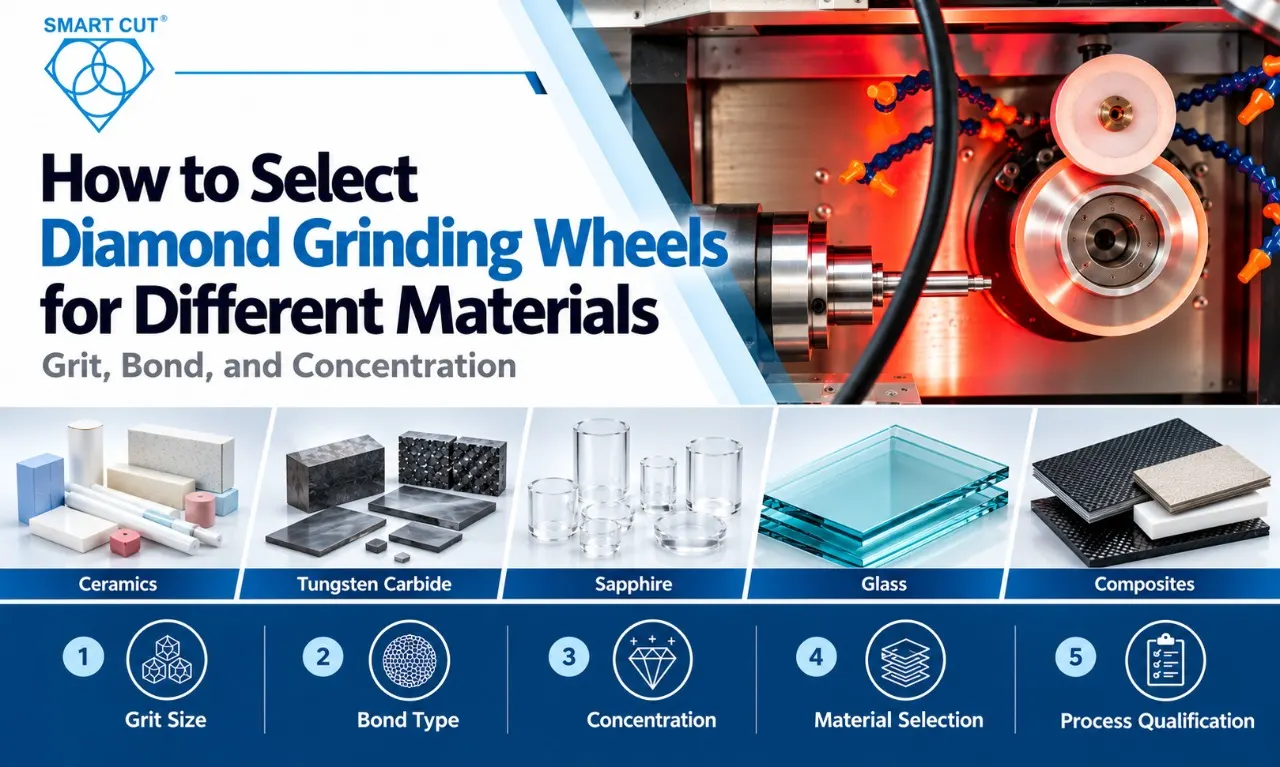
Table of Contents
Toggle
American Based Manufacturer

Established in 1990


Custom manufacturing


Quick answer: match the abrasive to the material (diamond for hard non-ferrous materials, CBN first for hardened steel), choose grit for the finish and removal target, choose the bond for the process and machine, treat concentration as a convention-dependent specification rather than a life rating, then qualify the wheel on cost per acceptable part.
Selecting a diamond grinding wheel requires more than matching the abrasive to the workpiece material. Grit size, bond system, diamond concentration, wheel geometry, machine capability, and grinding conditions all influence material removal, surface finish, subsurface damage, wheel wear, and cost per acceptable part.
A wheel that performs well on tungsten carbide may not be the best choice for silicon nitride, sapphire, fused silica, or a composite material. Even when two applications use the same abrasive type, differences in wheel specification and operating conditions can produce substantially different results.
This guide explains how engineers can evaluate diamond grinding wheels by material, select an appropriate starting grit and bond, understand concentration ratings, and qualify a wheel under actual production conditions.
The objective is not to identify one universally best wheel. It is to establish a technically defensible starting specification and a repeatable process for selecting the right wheel for the application.
Start With the Workpiece Material and Grinding Operation
Before specifying a wheel, document the workpiece material, grinding operation, required finish, dimensional tolerances, and production target. Material name alone is not enough to determine the correct specification.
For example, surface grinding a ceramic component and grinding a precision profile into the same ceramic may require different wheel geometries, abrasive sizes, bond characteristics, and dressing strategies.
Initial wheel-selection guide by material
|
Workpiece material |
Abrasive to evaluate |
Main selection considerations |
Bond direction to trial (illustrative) |
|---|---|---|---|
|
Diamond |
Carbide grade, cobalt content, grinding allowance, edge integrity, finish and wheel wear |
Resin for finishing; metal or hybrid for heavier stock removal |
|
|
Diamond |
High hardness, brittleness, material grade, chipping, thermal conditions and required finish |
Metal or hybrid for stock removal; resin for finishing |
|
|
Diamond |
Grain structure, porosity, surface integrity, removal rate and dimensional accuracy |
Metal or hybrid for stock removal; resin for finishing |
|
|
Silicon nitride |
Diamond |
Fracture resistance, grinding forces, thermal management and subsurface damage |
Metal or hybrid for stock removal; resin for finishing |
|
Sapphire |
Diamond |
Crystal orientation where relevant, surface damage, finish and geometry |
Resin or hybrid for finishing; metal for stock removal |
|
Fused silica and quartz |
Diamond |
Brittle fracture, edge chipping, surface quality and thermal control |
Resin or hybrid for finishing |
|
Diamond |
Edge quality, fracture control, contact geometry and coolant delivery |
Metal for edge and profile work; resin for finishing |
|
|
Evaluate diamond and other suitable abrasives against the matrix and reinforcement |
Reinforcement type, matrix properties, fiber damage, pull-out, loading and tool wear |
Electroplated or brazed constructions are commonly evaluated for abrasive composites |
|
|
Evaluate CBN first |
Ferrous-material chemistry, temperature, steel grade and grinding conditions |
CBN in resin, vitrified or electroplated form |
Important: Diamond is widely used for grinding hard, non-ferrous materials, including carbide, ceramics, glass, sapphire, and quartz. For hardened ferrous materials, cubic boron nitride (CBN) is often the more appropriate starting point because diamond can undergo unfavorable chemical interactions with iron-based materials under grinding conditions.
This table is an initial screening guide, not a guaranteed wheel specification. The final combination must be validated for the actual workpiece and machine.
Ferrous and nickel-base materials UKAM lists for CBN wheels
UKAM’s wheel guidance lists the following groups as typical CBN applications. For background on the abrasive itself, see UKAM’s CBN grinding wheel guide.
|
Material group |
Materials listed |
|---|---|
|
Alloy and tool steels (listed at 45–68 HRC) |
Alloy steels, carbon tool steels, die steel, high speed steel |
|
Cast irons |
Chilled cast iron, Ni-Hard, Meehanite iron |
|
Forged steel and rolls |
Forged steel, moly chrome steel rolls |
|
Nickel and cobalt alloys, hardfacing |
Inconel 600, Rene, Incoloy, Monel, Waspoloy, Stellite, Colmonoy |
Select the Diamond Grit Size
Grit size influences the balance between material removal, surface finish, edge quality, grinding forces, and sensitivity to subsurface damage. See also how grit size influences cutting speed, finish and tool life.
A coarse abrasive can support higher material removal in suitable conditions, but it may leave a rougher surface or increase chipping on brittle materials. A finer abrasive can improve finish, but it may reduce removal rate and become more sensitive to loading or glazing if the bond and operating conditions are unsuitable.
Neither coarse nor fine grit is universally better. The correct choice depends on the stock allowance, required finish, material behavior, and the intended grinding stage.
Mesh size versus micron size
Diamond abrasives are specified using different grading systems, including mesh-based designations and micron ranges.
- Mesh designation: In a conventional sieve-based system, a higher mesh number generally corresponds to smaller abrasive particles.
- Micron designation: A larger particle-size value in microns indicates a coarser abrasive.
- Graded ranges: A designation such as 60/80 represents a grading range, not a single exact particle diameter.
- Conversion: Mesh and micron values should not be treated as exact one-to-one equivalents without identifying the applicable grading standard.
Always confirm the supplier’s grading system and the specified particle-size distribution before comparing wheel specifications.
For a more detailed explanation, see UKAM’s Diamond Mesh Size Guide.
How diamond grit is graded and reported
In the American (ANSI) system, mesh size is the number of sieve openings per linear inch, so a higher number means finer particles. The European (FEPA) system instead reports the average particle diameter in microns, so a larger number means coarser particles. Because the two scales run in opposite directions, always confirm which standard a specification uses.
Particles larger than about 40 microns are sized by shaking them through stacked sieves, so each grit becomes a band between two sieve apertures. Below about 40 microns, sieving becomes ineffective and methods such as laser diffraction and scanning electron microscopy (SEM) are used. UKAM also notes that mesh sizing is not perfectly precise, because wire thickness in the screen slightly changes the opening size.
UKAM’s guide describes two broad industrial bands: “saw grits”, which are larger and used for rapid removal, and “wheel grits”, which are finer and used for precision grinding and polishing.
|
Notation |
Meaning (per UKAM) |
Example |
|---|---|---|
|
60/80 |
Most particles fall between the 60 and 80 mesh sieves; the mean is near the midpoint |
Mean close to 70 mesh |
|
+70 mesh |
Particles are retained on the 70 mesh sieve, so they are larger than its openings |
Coarser fraction |
|
−70 mesh |
Particles pass through the 70 mesh sieve, so they are smaller than its openings |
Finer fraction |
|
−10 / +30 |
More than 90% pass 10 mesh (under about 2.0 mm) and are retained on 30 mesh (over about 0.595 mm) |
Typical “over 90% in range” convention |
|
−30 (single value) |
90% or more pass a 30 mesh sieve (under about 0.595 mm) |
Upper size limit only |
Mesh and micron reference
The table below reproduces the approximate mesh, micron and application relationships shown in UKAM’s Diamond Mesh Size Guide. Rows marked “µm grade” are micron-graded products, so no mesh value is given.
|
Description |
Mesh / grade |
Approx. micron size |
Typical use |
|---|---|---|---|
|
Super coarse |
60/80 |
213 |
Roughing (heavy stock removal) |
|
Large coarse |
80/100 |
163 |
Medium roughing (general drilling) |
|
Coarse |
100/120 |
137 |
Semi-roughing |
|
Medium |
140/170 |
97 |
Rough finishing |
|
Fine |
200/230 |
68 |
Finishing |
|
Extra fine |
270/325 |
49 |
Fine finishing |
|
µm grade |
45 µm |
45 |
Super finishing |
|
µm grade |
30 µm |
30 |
Polishing |
|
µm grade |
15 µm |
15 |
Polishing |
|
µm grade |
9 µm |
9 |
Polishing |
|
µm grade |
6 µm |
6 |
Fine polishing |
|
µm grade |
3 µm |
3 |
Extra polishing |
What “coarse”, “medium” and “fine” mean depends on the bond
The same mesh number behaves differently in different bonds. UKAM notes that a 120 mesh resin bond tool will usually give a smoother finish than a 120 mesh metal bond tool, because the softer resin cushions the diamond, and that even a finer grit in a metal bond may not match it. UKAM’s classification of grit bands by bond type is shown below.
|
Bond type |
Coarse (mesh) |
Medium (mesh) |
Fine (mesh) |
|---|---|---|---|
|
30–60 |
70–120 |
140–200 |
|
|
100–180 |
200–300 |
320–600 |
|
|
80–120 |
150–220 |
230–270 |
|
|
40–100 |
120–180 |
200–300 |
|
|
Vitrified bond |
80–150 |
180–320 |
400–1200 |
|
CVD diamond |
150–250 |
260–350 |
400–500 |
|
PCD (polycrystalline diamond) |
150–300 |
350–500 |
600–800 |
How grit size changes grinding behavior
|
Variable |
Coarser grit (lower mesh number) |
Finer grit (higher mesh number) |
|---|---|---|
|
Removal rate and cutting speed |
Higher |
Lower |
|
Surface finish |
Rougher |
Smoother |
|
Edge chipping on brittle materials |
More likely, because each particle applies more force per pass |
Less likely |
|
Loading with material residue |
Less prone, with better clearance for swarf |
More prone, especially on sticky or soft materials |
|
Heat |
Better chip evacuation helps limit heat |
More friction and slower removal can raise heat |
UKAM’s guide also recommends a short written trial plan: assess the material, define the finish and speed targets, consult the supplier’s specifications, then test several grit sizes under realistic conditions and record the grit, material, speed, finish and wear rate of each.
Match grit to the production requirement
|
Requirement |
Grit-selection approach |
What to evaluate |
|---|---|---|
|
High stock removal |
Evaluate a coarser grit |
Removal rate, grinding forces, edge damage and wheel wear |
|
Intermediate grinding |
Evaluate a medium grit |
Balance between removal, finish and process stability |
|
Fine finishing |
Evaluate a finer grit |
Surface roughness, dimensional control, loading and cycle time |
|
Precision finishing of brittle materials |
Test a suitable fine-grit specification |
Chipping, subsurface damage, edge integrity and inspection results |
|
Multiple grinding stages |
Consider separate roughing and finishing wheels |
Whether a two-stage process improves total cycle time and cost per acceptable part |
These are selection principles, not fixed grit assignments. Use the table above as a trial starting point.
Illustrative trial starting points by grinding stage
|
Stage |
Grit direction |
Bond direction |
Concentration to trial |
|---|---|---|---|
|
Roughing / high stock removal |
Coarse band for the chosen bond |
Metal or hybrid |
Trial a lower and a higher value within the supplier's range |
|
Intermediate grinding |
Medium band for the chosen bond |
Hybrid, metal or resin |
Trial a lower and a higher value |
|
Fine finishing |
Fine band for the chosen bond |
Resin or hybrid |
Compare at least two values |
Should one wheel perform roughing and finishing?
A single wheel may be adequate when the stock allowance, tolerance, and finish requirements are compatible. Separate roughing and finishing wheels may be more effective when high removal rates and stringent surface-quality requirements conflict.
Compare the complete process rather than judging the wheel by finish or removal rate alone. Include wheel changes, dressing, inspection, rework, and scrap when assessing total production cost.
Select the Bond System
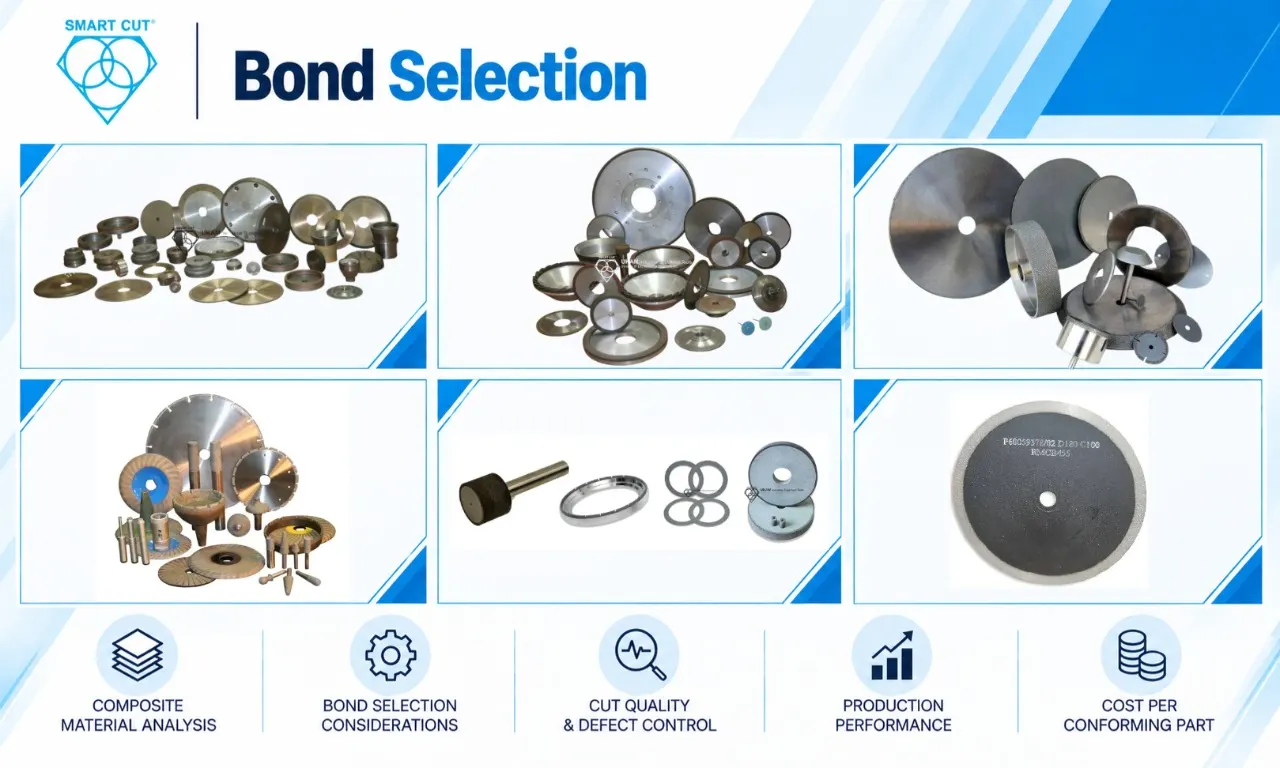
The bond holds the diamond abrasive in the working layer. Its properties influence grain retention, abrasive exposure, wear behavior, wheel profile retention, and how the wheel responds to the workpiece.
The correct bond depends on the interaction between the abrasive, workpiece, contact conditions, machine stiffness, coolant delivery, and grinding parameters.
Common diamond grinding wheel bond systems
|
Bond type |
General characteristics |
Selection considerations |
|---|---|---|
|
Often used where fine finishing and a controlled surface are important |
Finish requirement, heat generation, wear rate and profile retention |
|
|
Often selected for wear resistance and demanding applications |
Bond wear, abrasive exposure, dressing requirements and material compatibility |
|
|
Can provide a porous structure and controlled abrasive exposure in suitable designs |
Wheel structure, coolant access, dressing, rigidity and operating conditions |
|
|
Retains abrasive in a plated nickel layer, with single- or multi-layer constructions, and is often used for formed profiles or specialized tools |
Number of diamond layers, profile requirements, exposure and available wear allowance |
|
|
Combines features of different bond technologies, depending on its formulation |
Specific formulation, intended application and validated performance |
|
|
Uses a brazed interface to retain abrasive particles in the tool structure |
Tool design, abrasive retention, geometry, temperature and application suitability |
These descriptions are general. Bond formulations differ among manufacturers, and bond names alone do not establish equivalent performance. For a direct comparison of two common options, see resin bond vs. metal bond diamond wheels.
How bond selection affects grinding
When evaluating a bond, engineers should ask:
- Does the bond retain the diamond adequately under the intended load?
- Is enough abrasive exposed to maintain effective cutting?
- Does the bond wear at a suitable rate to expose fresh abrasive?
- Can the wheel maintain the required profile and dimensions?
- Can the wheel be dressed or conditioned as required?
- Does the bond structure support adequate coolant access and chip clearance?
- Is the bond compatible with the required surface finish and production rate?
A bond that retains abrasive too strongly for a particular process may contribute to glazing. A bond that wears too quickly may increase wheel consumption or reduce profile stability. However, these outcomes depend on the complete wheel and process—not bond type in isolation.
Consider wheel design, not just the bond name
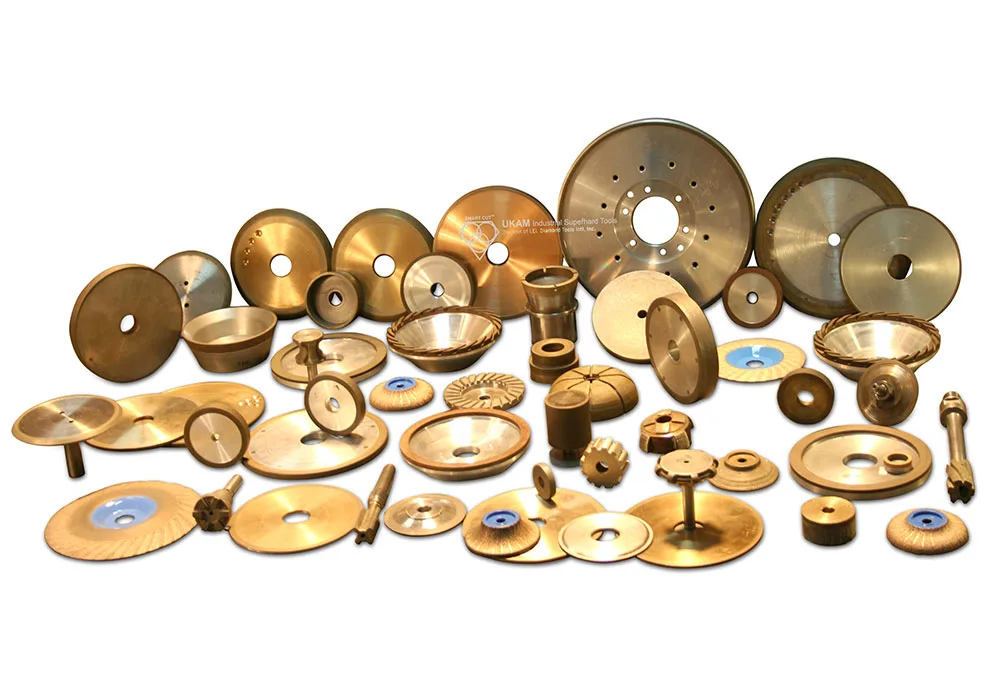
UKAM’s SMART CUT diamond and CBN wheel technology describes wheel designs intended to manage abrasive exposure and bond behavior. Such design features should be evaluated against the actual workpiece, operation, and production requirements rather than treated as a universal performance guarantee.
UKAM describes SMART CUT as an open bond design in which diamond or CBN crystals are activated at the exposed layer and, as that layer wears, crystals in the next bond layer are exposed in turn. UKAM states that this open structure is intended to limit chipping and keep cutting speed consistent. Treat these as the manufacturer’s design intent and confirm them in your own trial. UKAM also offers bond hardness grades from super soft to hard on these wheels, which is a further variable to specify.
Understand Diamond Concentration Correctly
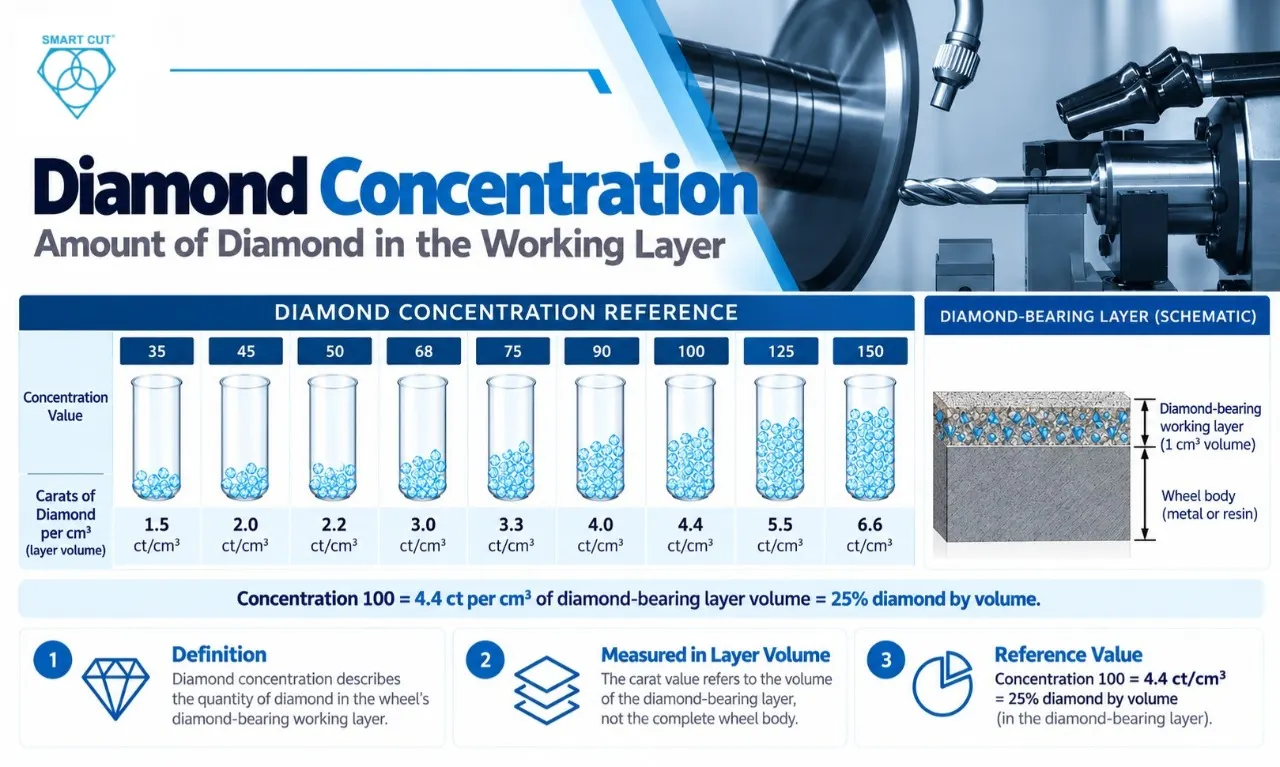
Diamond concentration describes the quantity of diamond in the wheel’s diamond-bearing working layer according to a specified concentration convention. It is not simply the percentage of the entire wheel made of diamond.
The convention shown in UKAM’s concentration reference images uses the relationship:
Concentration 100 = 4.4 carats of diamond per cm³ of diamond-bearing layer volume = 25% diamond by volume.
Under this convention, concentration values scale proportionally. The carat value refers to the volume of the diamond-bearing layer, not the complete wheel body.
Concentration reference values
|
Concentration (CON)
|
Diamond content (ct/cm³) |
Diamond by volume |
|---|---|---|
|
25 |
1.1 |
6.25% |
|
35 |
Approximately 1.5 |
8.75% |
|
45 |
Approximately 2.0 |
11.25% |
|
50 |
2.2 |
12.5% |
|
68 |
Approximately 3.0 |
17% |
|
75 |
3.3 |
18.75% |
|
90 |
Approximately 4.0 |
22.5% |
|
100 |
4.4 |
25% |
|
125 |
5.5 |
31.25% |
|
150 |
6.6 |
37.5% |
The calculations follow these relationships:
- Diamond content in ct/cm³ = concentration × 0.044
- Diamond volume percentage = concentration × 0.25%
For example, concentration 75 corresponds to approximately 3.3 ct/cm³ and 18.75% diamond by volume under this convention.
See UKAM’s Diamond Concentration Guide for additional background.
Does higher concentration always improve wheel life?
No. A higher concentration means more diamond is present in a given volume of the working layer under the stated convention. It does not, by itself, guarantee longer wheel life, a better finish, or higher productivity. For more on balancing cutting speed, tool life and cost, see UKAM’s technical article.
Performance also depends on:
- Diamond grit size and particle-size distribution
- Diamond quality and particle characteristics
- Bond type, hardness, and wear behavior
- Abrasive exposure and chip clearance
- Workpiece material and grinding contact
- Machine rigidity, speed, feed, and coolant conditions
- Dressing, conditioning, and the required dimensional accuracy
A higher concentration may be appropriate for some applications, but the best choice should be established through supplier guidance and controlled process trials.
Nominal concentration range and how CON 100 is derived
UKAM’s concentration guide gives the nominal range for precision diamond and CBN tools as about 0.5 to 6 ct/cm³, which corresponds to roughly CON 8 to 135. UKAM’s wheel page lists concentrations from about 10 to 150 CON.
The 25% figure follows from two constants: 1 carat equals 0.2 g, and diamond density is 3.52 g/cm³. At CON 100, 4.4 ct/cm³ × 0.2 g/ct = 0.88 g of diamond per cm³, and 0.88 ÷ 3.52 = 0.25 cm³ of diamond per cm³ of layer, which is 25% by volume.
Trade-offs between higher and lower concentration
|
Aspect |
Higher concentration (general trend) |
Lower concentration (general trend) |
|---|---|---|
|
Tool life |
Longer, because load is shared across more cutting points; UKAM's chart shows life peaking and then declining at very high values |
Shorter, with faster wear and more frequent diamond exposure |
|
Cutting speed |
Slower, because of greater resistance |
Faster, because of less resistance |
|
Heat |
Spreads heat over more cutting edges |
Needs efficient cooling to avoid overheating |
|
Cost |
Higher, because more diamond is used |
Lower |
|
Typical fit (per UKAM) |
Softer and more abrasive materials, and long-life applications |
Ultra-hard and brittle materials where speed and precision matter |
UKAM’s guide states that the concentration is usually set by the slowest cutting speed that is acceptable for the application, then balanced against life and cost. These are trends, and UKAM’s guide also shows that the best value depends on grit, bond and cooling.
How bond hardness and cooling shift the choice
|
Condition |
Concentration tendency (per UKAM) |
Reasoning |
|---|---|---|
|
Softer bond |
Higher |
The bond releases diamonds faster, so more crystals are needed to keep a supply of sharp edges |
|
Harder bond |
Lower |
The bond retains diamonds longer, so fewer are needed |
|
Flood cooling |
Higher can be used |
Continuous cooling controls heat |
|
Mist cooling |
Moderate |
Cooling is less intense but adds some lubrication |
|
Dry or air cooling |
Lower |
LowerLimited heat removal calls for a conservative value |
|
Oil-based or synthetic lubricant |
Higher can be used |
Lower friction reduces heat and wear |
|
Water-based coolant |
Balanced |
Strong cooling with moderate lubrication |
See UKAM’s guide to diamond tool coolants for how to choose and apply coolant.
How to evaluate concentration in practice
Compare concentration options while holding other variables as constant as possible. Record material removal, wheel wear, surface quality, dimensional stability, dressing frequency, and cost per acceptable part.
If grit, bond, concentration, and operating parameters all change simultaneously, it becomes difficult to identify which variable caused the result.
Material-Specific Wheel Selection
The following guidance narrows the selection process for common industrial materials. It should be used to define trial candidates, not to replace a supplier’s application review.
Tungsten carbide
Tungsten carbide grades differ in carbide grain size, binder content, hardness, and toughness. These differences can change grinding behavior significantly.
Evaluate:
- Carbide grade and binder content
- Required stock removal and final tolerance
- Grit size appropriate to roughing or finishing
- Bond wear and diamond retention
- Edge chipping and surface integrity
- Coolant delivery and heat generation
- Wheel wear and dressing requirements
A wheel that performs well on one carbide grade may not produce the same result on another. Validate the wheel on the actual grade and geometry.
Silicon carbide and alumina ceramics
Both materials are hard ceramics, but their microstructure and fracture behavior differ. Their grinding response depends on material grade, porosity, grain structure, and process conditions.
Evaluate:
- Required surface finish and dimensional accuracy
- Edge chipping and visible fracture
- Grit size and bond suitability
- Grinding forces and thermal effects
- Wheel loading and abrasive exposure
- Subsurface damage where component reliability requires it
Do not assume that one grit or bond specification is optimal for both silicon carbide and alumina.
Silicon nitride
Silicon nitride can exhibit different grinding behavior from other ceramics because of its microstructure and mechanical properties.
Wheel selection should consider the component’s functional requirements, material grade, removal allowance, and sensitivity to surface or subsurface damage.
In addition to cycle time and finish, monitor grinding forces, edge integrity, dimensional variation, and inspection results. Where the component is safety-critical or fatigue-sensitive, surface appearance alone may not be sufficient to establish acceptability.
Sapphire and other optical materials
For sapphire and optical materials, the required finish and allowable damage may be more important than maximizing removal rate.
Consider:
- Required roughness and surface quality
- Edge integrity and dimensional tolerances
- Crystal orientation where relevant
- Grit size and finishing sequence
- Bond behavior and abrasive exposure
- Thermal management and coolant delivery
- Inspection methods appropriate to the component
A finer grit may help achieve a finer finish, but it does not automatically eliminate subsurface damage. Validate the complete process against the component’s acceptance criteria.
Glass, fused silica, and quartz
Brittle materials require particular attention to fracture, edge chipping, and local grinding conditions.
Evaluate contact geometry, grit size, bond characteristics, coolant delivery, feed conditions, and the required edge or surface quality. For components with tight optical or dimensional requirements, define the inspection method before beginning the trial.
Avoid selecting a wheel solely from a material name. Glass composition, fused silica, and different quartz materials can respond differently under the same nominal process.
Composite materials
Composite grinding behavior depends on the matrix, reinforcement, fiber orientation, and the interaction between the abrasive and the constituent materials.
For fiber-reinforced or ceramic-matrix composites, investigate:
- Reinforcement type and orientation
- Matrix hardness and toughness
- Fiber pull-out, breakage, and delamination
- Surface integrity and dimensional accuracy
- Wheel loading and wear
- Coolant compatibility and process constraints
Diamond may be a suitable candidate for many abrasive or hard composite systems, but selection must account for the specific composite architecture and acceptance criteria.
Confirm Wheel Geometry and Machine Compatibility
A suitable abrasive specification can still fail if the wheel does not match the machine, mounting system, or grinding geometry.
Before ordering, confirm the following details.
|
Specification |
What to define |
Why it matters |
|---|---|---|
|
Outside diameter |
Required wheel diameter and permitted variation |
Machine clearance, peripheral speed and contact geometry |
|
Thickness or width |
Working-layer and overall dimensions, as applicable |
Profile access, stiffness and grinding contact |
|
Profile |
Flat, formed, recessed, or application-specific geometry |
Feature access and dimensional accuracy |
|
Arbor or mounting interface |
Bore, shank, flange, or other mounting details (see diamond tool accessories |
Secure fit, runout and alignment |
|
Core material |
Suitable core and construction |
Rigidity, weight, mounting and operating requirements |
|
Bond and concentration |
Supplier-defined specification |
Abrasive retention, exposure and wear behavior |
|
Maximum operating speed |
Supplier-rated limit for the exact wheel |
Safe machine operation |
|
Tolerances |
Dimensional, profile, and runout requirements |
Repeatability and component quality |
|
Dressing or conditioning |
Required method and compatibility (see diamond dressers |
Maintaining the intended cutting behavior |
Reference: UKAM SMART CUT wheel capabilities
UKAM’s wheel page lists the following capabilities. Use them to check whether a specification is within the manufacturer’s range, and confirm tolerances and exact availability with UKAM before ordering.
|
Attribute |
Capability stated by UKAM |
|---|---|
|
Wheel diameter |
0.5 in (12.7 mm) to 20 in (500 mm) for the wheel range; the SMART CUT capability list extends from 0.3 mm to 1,219 mm across tool types |
|
Bond types |
Sintered (metal), resin, hybrid, electroplated (nickel), vitrified and brazed |
|
Bond hardness grades |
Super soft, soft, medium, hard |
|
Abrasive |
Synthetic diamond, coated diamond and CBN |
|
Concentration |
About 10 to 150 CON |
|
Core materials |
Steel, stainless steel, bronze, high-carbon steel, tungsten carbide, or fully impregnated with diamond |
|
Thickness |
From 0.004 in (100 microns) |
|
Edge types |
Continuous rim, slotted, segmented, serrated |
|
Arbor |
Any size can be produced; standard sizes are listed on the product page |
|
Shapes |
ISO shapes including 1A1, 1A1R, 1V1, 4A2, 6A2, 11V9, 12A2, 14A1 and 15V9 |
UKAM notes that the wheel shape determines how the wheel contacts the workpiece and what operation it performs; common families are straight, cup, dish and tool-grinding wheels. Related accessories include coolants, wheel adapters and hubs, dressing sticks, and the dressers noted above.
Two wheels with the same diameter and grit are not necessarily interchangeable: construction, bond, mounting, speed rating, and tolerances can differ.
Confirm the maximum permitted operating speed for the exact wheel and never exceed the manufacturer’s rating. Coolant requirements, guarding, mounting, and machine operating procedures must also be followed. UKAM’s guide on how to properly use diamond tools covers safety and tool life in more detail.
For a more comprehensive specification checklist, refer to UKAM’s Diamond Grinding Wheel Specification Guide.
Qualify the Wheel Under Production Conditions
A wheel specification should be qualified using measurable acceptance criteria rather than subjective judgments such as “cuts well” or “lasts longer.”
Begin with a documented baseline and change one primary variable at a time wherever practical. If several variables must change together, document the reason and treat the trial as a combined specification test.
Parameters to record before a trial
|
Parameter |
Record |
|---|---|
|
Workpiece |
Material, grade, hardness or relevant material condition |
|
Initial geometry |
Dimensions, stock allowance and existing surface condition |
|
Wheel |
Diameter, width, profile, grit, bond, concentration and supplier specification |
|
Machine |
Machine type, spindle condition, mounting and relevant rigidity constraints |
|
Operating conditions |
Wheel speed, feed, depth of cut, traverse and coolant conditions |
|
Quality requirements |
Dimensional tolerance, surface finish and defect acceptance criteria |
|
Production target |
Required cycle time, batch size and output |
|
Baseline results |
Existing removal rate, wheel wear, dressing frequency, quality and scrap |
Measure the outcomes that affect production
|
Performance measure |
What it helps establish |
|---|---|
|
Material removal rate |
Whether the wheel meets the required removal targe |
|
Cycle time |
Total processing time per component |
|
Surface finish |
Whether the specified finish is achieved consistently |
|
Dimensional accuracy |
Whether the process maintains the required geometry |
|
Edge chipping and defects |
Whether the component meets quality requirements |
|
Wheel wear |
How quickly the wheel loses useful abrasive or profile |
|
Dressing frequency |
Additional maintenance and machine downtime |
|
Cost per acceptable part |
Overall economic performance, including quality losses |
The cost per acceptable part should include relevant wheel consumption, machine time, labor, dressing, inspection, rework, and scrap. The exact calculation should reflect the factory’s costing method.
A wheel with a lower purchase price is not necessarily the lower-cost option if it requires more frequent dressing, produces more rejected parts, or increases cycle time.
For more detail on measurement and production economics, see UKAM’s Diamond Grinding Wheel Performance Guide.
Common Selection Mistakes
Avoid these frequent errors when specifying a diamond grinding wheel.
Choosing grit by finish alone. A finer abrasive may improve finish but could increase cycle time or introduce loading. Evaluate the complete process. If loading or poor cutting appears, UKAM’s Diamond Grinding Wheel Loading and Glazing Guide explains how to diagnose it.
Assuming all bonds behave alike. Bond formulations and structures differ. Confirm the actual wheel design and intended application.
Treating concentration as a guaranteed life rating. Concentration describes abrasive quantity under a defined convention, not guaranteed tool life or performance.
Comparing supplier concentrations without checking the convention. Confirm the units, reference basis, and definition used by each supplier.
Ignoring machine and mounting limitations. Runout, rigidity, mounting, speed limits, and coolant access can undermine an otherwise suitable wheel specification. See grinding wheel and machine troubleshooting.
Changing several variables at once without a test plan. Uncontrolled changes make results difficult to interpret and repeat.
Using surface appearance as the only acceptance criterion. Some precision or high-reliability components require additional inspection for dimensional errors, edge defects, or subsurface damage. For a broader fault reference, consult UKAM’s Diamond/CBN Wheel Troubleshooting Guide.
Questions to Ask Your Diamond Grinding Wheel Supplier
Before requesting a quotation or ordering a custom wheel, provide the supplier with enough engineering information to assess the application.
- Which abrasive type is appropriate for the exact workpiece material and grade?
- What grit range would you recommend for roughing, intermediate grinding, or finishing?
- Which bond systems are suitable for the operation, and why?
- What concentration convention do you use, and how is the value defined?
- What wheel geometry, core, mounting interface, and dimensional tolerances are required?
- What maximum operating speed and coolant conditions apply to the proposed wheel?
- What dressing or conditioning method is required?
- Which process variables should remain fixed during qualification?
- What measurements should be used to compare wheel performance?
- Can the proposed specification be validated against the required surface quality, dimensional accuracy, and production target?
Supplying drawings, material details, machine information, current process parameters, and acceptance criteria helps the manufacturer evaluate the application more accurately.
UKAM Industrial Superhard Tools provides diamond and CBN tooling for industrial applications. For a wheel-selection review, provide the workpiece material and grade, grinding operation, wheel dimensions, machine details, required finish, tolerances, and production objectives.
Frequently Asked Questions
Start with the exact material and grade, the grinding operation, required surface finish, dimensional tolerances, and stock allowance. Then evaluate suitable grit sizes, bond systems, concentration, and wheel geometry. Confirm the final specification through controlled testing.
Not generally for conventional mesh-based grading. A higher mesh number usually indicates finer particles. Micron designations work differently: a larger micron value represents a coarser particle size. Always confirm the grading standard.
Under the concentration convention shown in UKAM’s reference graphics, concentration 100 corresponds to approximately 4.4 carats of diamond per cm³ of diamond-bearing layer volume and 25% diamond by volume. Other suppliers may use different conventions, so verify the definition before comparing specifications.
Not necessarily. Higher concentration means more diamond within a given volume under the specified convention, but wheel life also depends on grit, bond behavior, abrasive exposure, material, operating conditions, dressing, and quality requirements.
There is no universally best bond for all ceramics. Resin, metal, vitrified, and other bond systems have different characteristics. Selection depends on the ceramic grade, grinding operation, surface requirements, machine conditions, and desired wheel-wear behavior.
Sometimes, but not always. A single wheel may be appropriate when removal and finish requirements are compatible. Separate roughing and finishing wheels may be preferable when the process requires both high removal and a very fine finish. Compare total cycle time, wheel consumption, and cost per acceptable part.
ANSI mesh counts sieve openings per inch, so a higher number is finer. FEPA-style micron designations give the average particle diameter, so a higher number is coarser. Always confirm which system a specification uses.
With 1 carat equal to 0.2 g and diamond density of 3.52 g/cm³, 4.4 ct/cm³ equals 0.88 g/cm³, which is 25% of the layer volume (0.88 ÷ 3.52). Other suppliers may use a different convention.
Conclusion
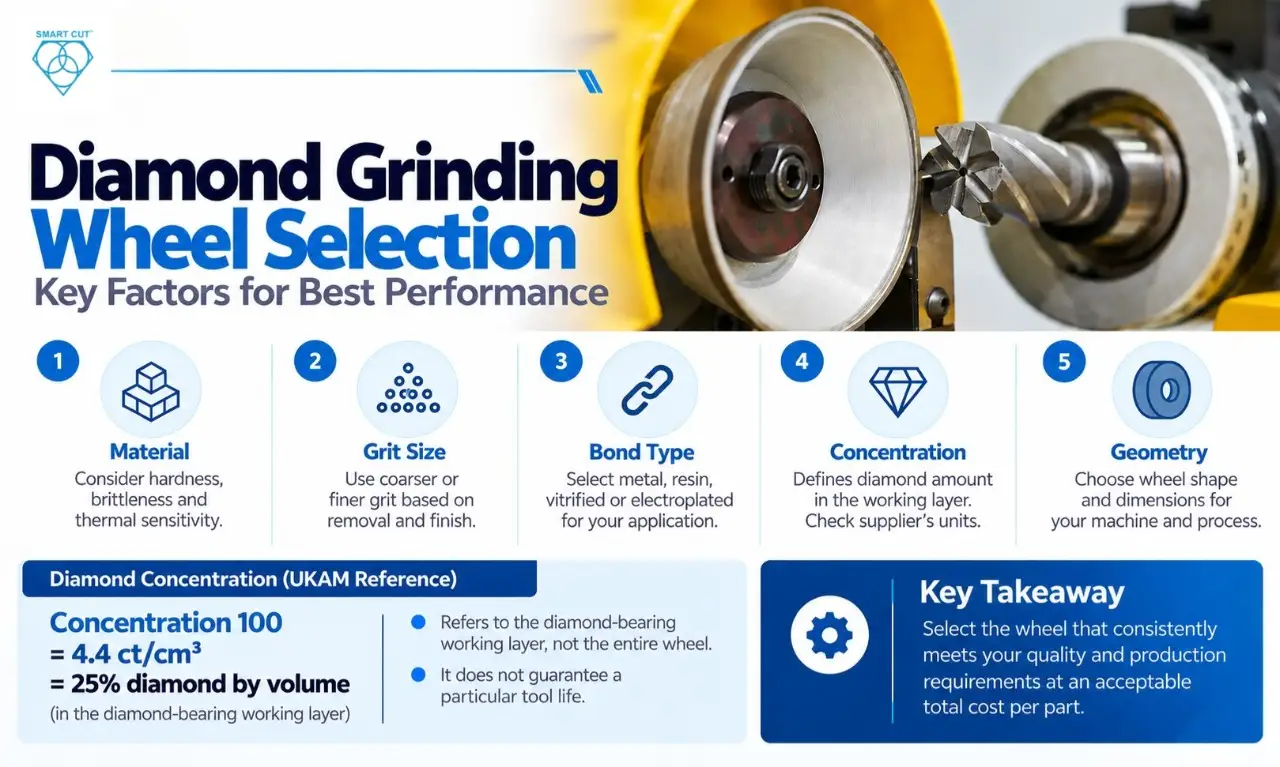
Selecting a diamond grinding wheel is an engineering decision that balances material behavior, grit size, bond characteristics, concentration, geometry, machine compatibility, and production requirements.
Use the material as the starting point, not the only selection criterion. Define the quality and productivity targets, compare suitable wheel specifications, and qualify the chosen wheel using repeatable measurements.
When concentration values are compared, verify the supplier’s convention and keep the units clear: under UKAM’s reference convention, concentration 100 means approximately 4.4 ct/cm³ of diamond-bearing layer volume and 25% diamond by volume. It does not mean 4.4 carats in the entire wheel or guarantee a particular tool life.
The most effective wheel is the one that consistently meets the application’s quality and production requirements at an acceptable total cost per part.
Trusted by Tens of Thousands of Manufacturers, Laboratories,
Research Institutions Worldwide Since 1990
American Based Manufacturer
Established in 1990
