




















How to Choose the Right Diamond Dresser for Your Grinding Wheel

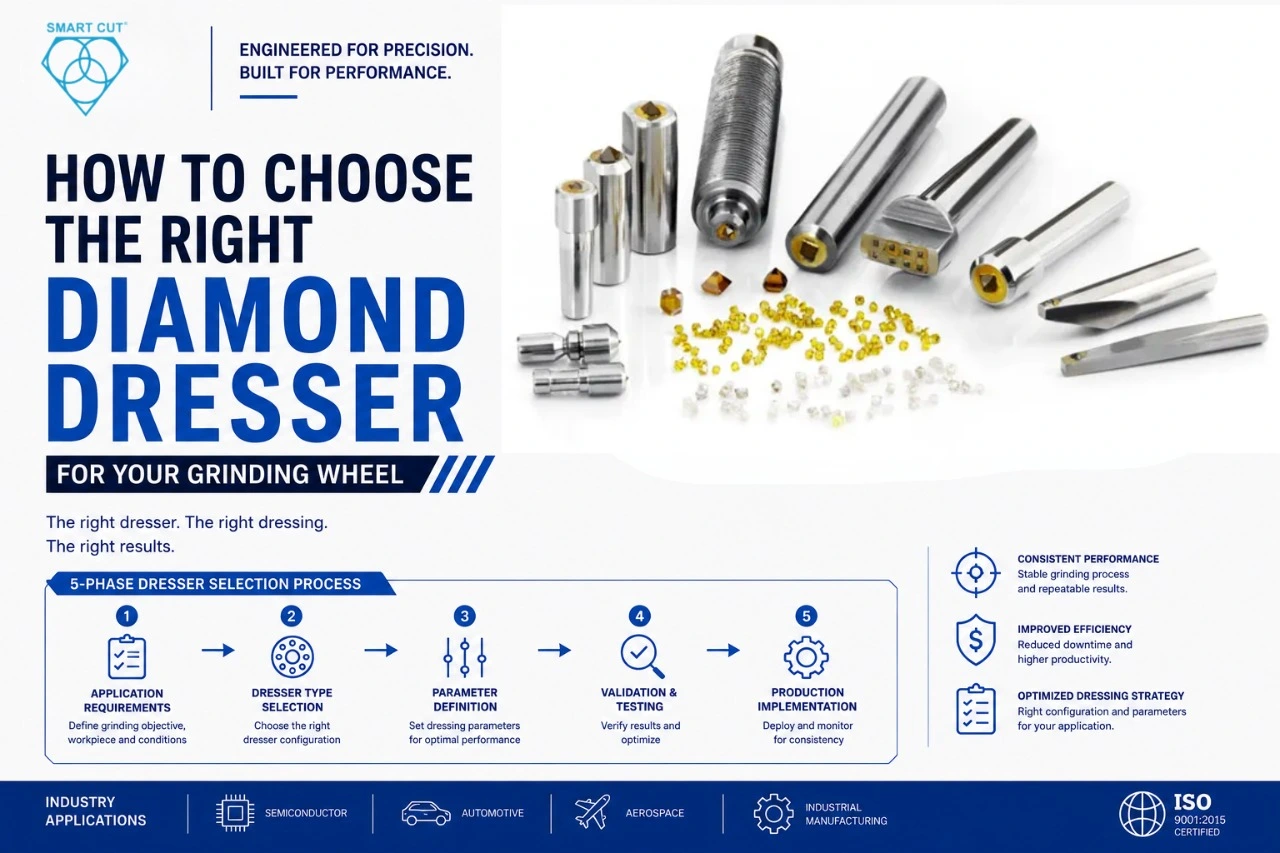
Table of Contents
Toggle
American Based Manufacturer

Established in 1990


Custom manufacturing


Selecting the wrong diamond dresser can shorten grinding wheel life, increase dressing frequency, change wheel geometry, increase grinding forces, and create inconsistent surface finish. The problem often looks like a grinding wheel problem, but the dresser, the dressing method, the machine condition, and the dressing parameters can all be equally responsible.
A grinding wheel changes during production. Abrasive grains become dull, the wheel face can load with workpiece material, and the wheel profile can drift out of tolerance. Dressing restores the working surface by removing unwanted material and exposing fresh, usable abrasive. Truing restores wheel geometry and profile. The dresser therefore becomes part of the grinding process itself, not simply a maintenance accessory.
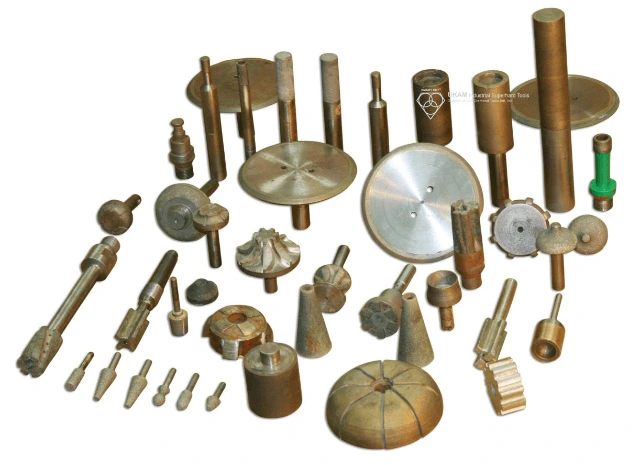
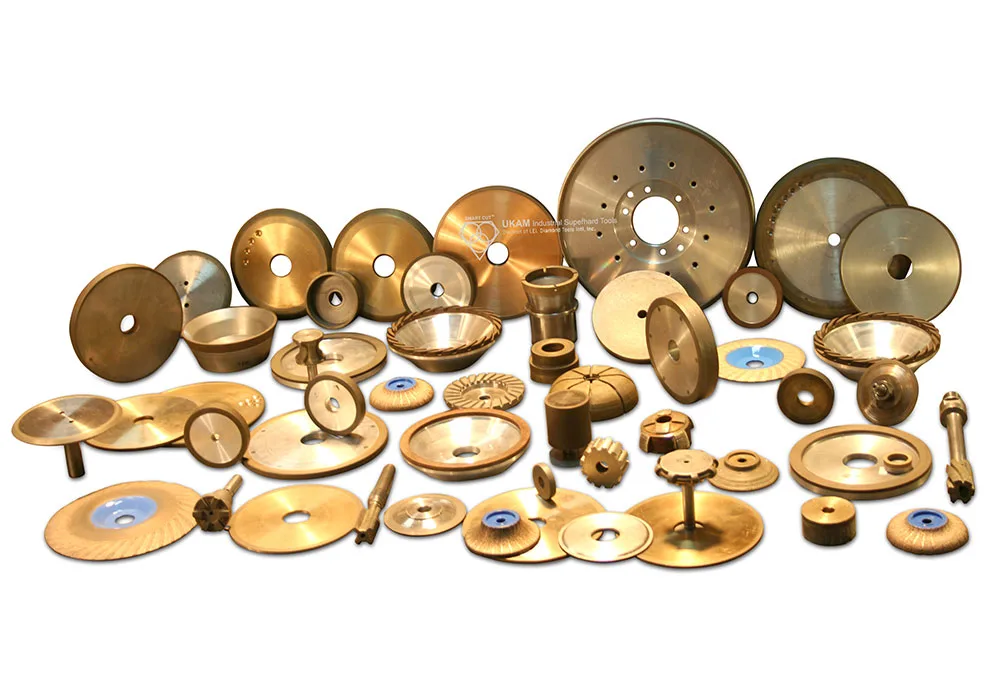
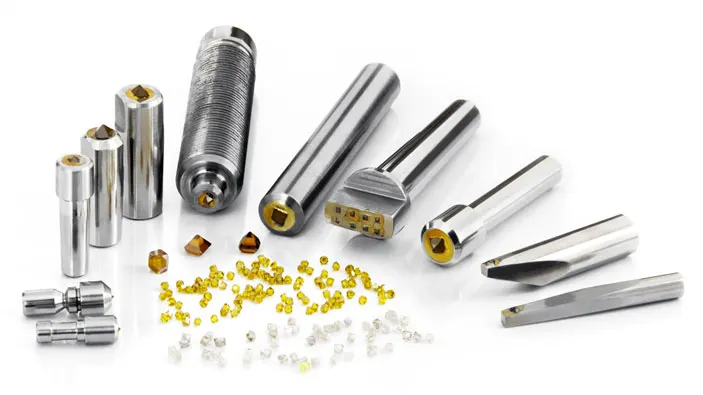
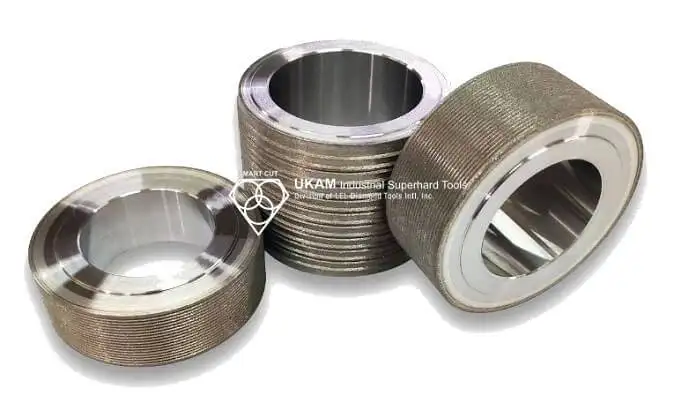
UKAM manufactures diamond dressing tools in configurations including single point, multipoint, chisel, straight, angle, radius, clustered, and layered designs, alongside diamond rotary dressers for high-volume forming. UKAM also offers custom-configured diamond and CBN tools for application-specific requirements that fall outside standard catalog geometry.
The Engineering Question
Not: “Which diamond dresser should I buy?”
But: “Which dresser configuration will maintain the required wheel geometry and abrasive condition under my actual grinding conditions?”
Why Diamond Dresser Selection Affects Grinding Performance
A grinding wheel can have the correct abrasive and bond specification and still perform poorly if the dressing process is incorrect. Dressing controls how the wheel face is renewed. It influences abrasive exposure, wheel profile, dressing time, wheel consumption, and process repeatability.
|
Production Symptom |
Possible Dresser or Dressing Cause |
First Investigation |
|---|---|---|
|
Wheel becomes dull quickly |
Inadequate dressing |
Dressing depth and feed |
|
Wheel loads frequently |
Poor abrasive exposure |
Dresser type and wheel condition |
|
Surface finish changes |
Inconsistent wheel condition |
Dressing consistency |
|
Profile changes |
Dresser geometry or wear |
Dresser condition and setup |
|
Grinding forces increase |
Dull or loaded wheel |
Dressing interval |
|
Excessive wheel consumption |
Excessive dressing depth |
Material removed per dressing |
|
Dimensional drift |
Profile not being restored |
Truing and dressing method |
|
Dresser wears rapidly |
Incorrect configuration or conditions |
Diamond size, exposure, pressure |
|
Production becomes inconsistent |
Variable dressing procedure |
Standardize the process |
A dresser should therefore be evaluated based on the production problem it is expected to solve, not purchased as a generic commodity from a shop listing.
Engineering Insight
In production grinding, the worn wheel often gets blamed before the process is investigated. A team may switch to a more expensive wheel because the existing one loads, only to discover that coolant delivery, dressing depth, material condition, wheel specification, or machine alignment was the actual problem. The same principle applies to the dresser: a new dresser should not be selected until the failure mechanism has been identified.
For background on how wheel specification interacts with dressing, see UKAM’s guide on how to select the right diamond tools for your application and choosing the correct diamond bond type.
Dressing and Truing Are Different Operations
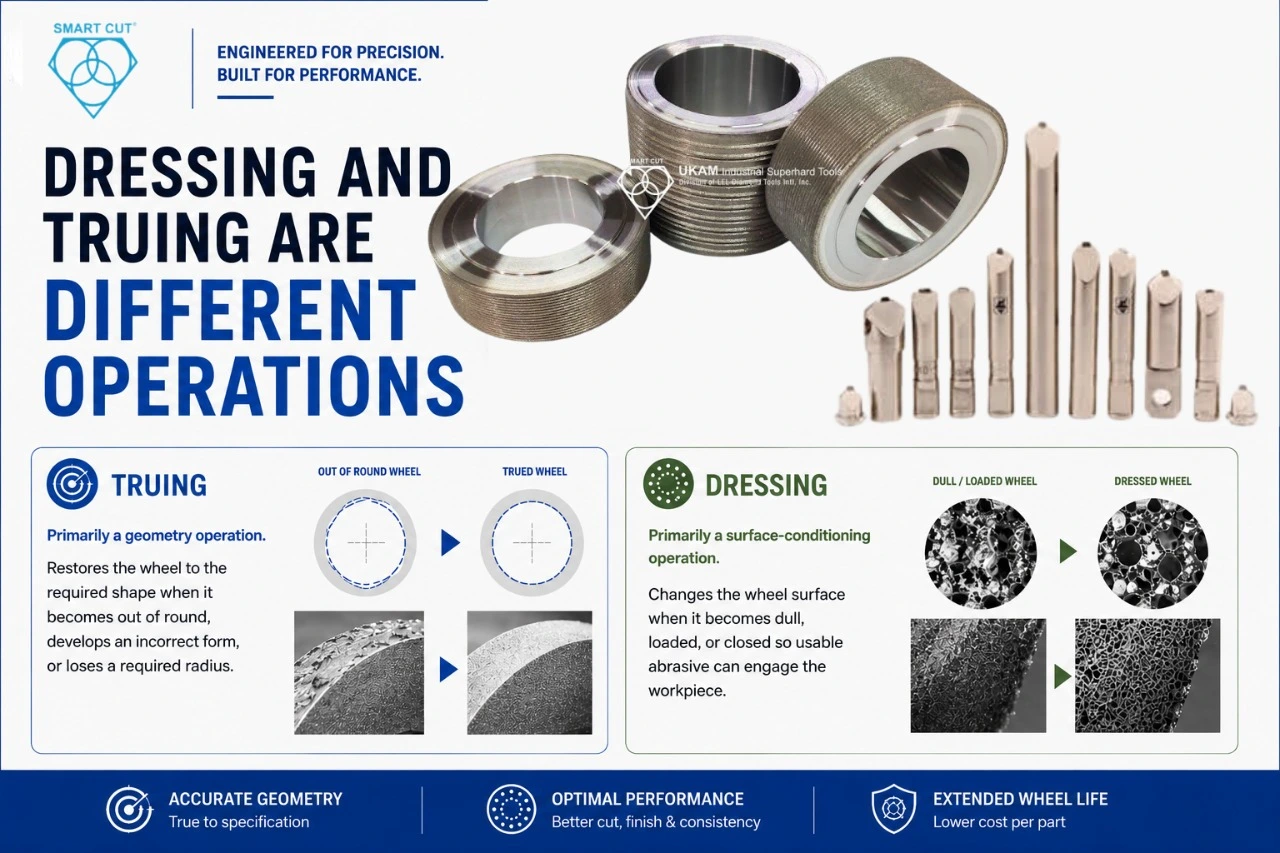
Before selecting a dresser, determine what the wheel actually needs.
UKAM describes diamond dressers as tools used for both truing and dressing conventional abrasive grinding wheels, as well as for dressing conventional and superabrasive wheels used across the diamond and CBN wheel line.
Truing
Primarily a geometry operation. If a wheel becomes out of round, develops an incorrect form, or loses a required radius, the wheel must be restored to the required shape.
Dressing
Primarily a surface-conditioning operation. If the wheel becomes dull, loaded, or closed, dressing changes the active surface so usable abrasive can engage the workpiece.
Engineering Insight
A common mistake is to treat every dressing operation as if it has the same objective. If the wheel is geometrically correct but cutting poorly, more aggressive truing may only waste wheel material. If the wheel has lost its profile, simply opening the abrasive surface may not restore dimensional accuracy.
Define the problem first:
- Is the wheel out of round?
- Has the wheel lost its profile?
- Is the abrasive surface loaded?
- Has the wheel become dull?
- Is grinding force increasing?
- Has surface finish deteriorated?
- Is the wheel consuming too quickly?
The answer determines the dressing strategy — and, downstream, whether you need a standard catalog dresser or a custom-manufactured tool built to your exact wheel profile.
Document the Grinding Application Before Selecting a Dresser
A dresser should not be selected from wheel diameter alone. Before requesting a quotation or changing the dresser, document the complete dressing application.
|
Parameter |
What to Record |
Why It Matters |
|---|---|---|
|
Grinding wheel |
Exact specification |
Establishes baseline |
|
Abrasive |
Aluminum oxide, silicon carbide, or other |
Determines dressing interaction |
|
Bond |
Vitrified, resin, metal, or other |
Influences wheel response |
|
Wheel diameter |
Actual diameter |
Determines geometry |
|
Wheel width |
Actual width |
Determines contact |
|
Wheel profile |
Straight, radius, form, etc. |
Determines dresser configuration |
|
Machine |
Grinding machine model |
Determines setup |
|
Dressing method |
Traverse, plunge, rotary, form |
Determines dresser selection |
|
Dressing feed |
Actual setting |
Controls contact |
|
Dressing depth |
Actual settingContent |
Controls wheel consumption |
|
Dressing frequency |
Parts or cycles |
Determines production requirement |
|
Coolant |
Type and delivery |
Controls heat and debris |
|
Workpiece |
Material and hardness |
Determines grinding load |
|
Finish |
Required result |
Defines acceptance |
|
Tolerance |
Required result |
Defines profile accuracy |
|
Production volume |
Parts per shift or period |
Determines dresser durability |
|
Current dresser |
Type and condition |
Establishes baseline |
|
Dresser life |
Parts or dressing cycles |
Required for cost analysis |
A wheel drawing or profile drawing is particularly useful for form grinding. Photographs of the current dresser, worn diamond, wheel face, and finished workpiece can also provide useful information during application review — the same information UKAM’s engineers request through the request a consultation process.
Quick Diamond Dresser Selection Guide
The fastest way to narrow the selection is to match the dresser configuration to the actual wheel requirement.
|
Your Requirement |
Starting Point |
|---|---|
|
Precision straight wheel dressing |
Single point |
|
Multiple diamond contact points |
Multipoint |
|
Higher dressing demand |
Clustered or layered |
|
Radius profile |
Radius dresser |
|
Angled wheel profile |
Angle dresser |
|
Specialized edge geometry |
Chisel dresser |
|
Repeated production profile |
Rotary dresser |
|
Complex wheel form |
Profile or form roller |
|
Nonstandard geometry |
Custom dresser |
This is a starting point, not a final specification. UKAM’s current diamond dresser range includes single point, multipoint, chisel, straight, angle, radius, clustered, and layered configurations, with custom configurations available on request.
Selecting the Diamond Configuration
The dresser holder is only part of the tool. The diamond itself also affects performance. When comparing dressers, consider:
- Diamond size
- Diamond quality
- Diamond shape
- Diamond orientation
- Diamond exposure
- Diamond setting
- Working point geometry
- Shank configuration
- Required dressing force
- Expected dresser life
Diamond Size
Influences the working contact between the dresser and grinding wheel. A larger working diamond can be appropriate for demanding dressing conditions, while a smaller controlled contact can be useful where precision and profile control are the primary objectives.
Diamond Quality
A production dresser should provide consistent working characteristics. Variability in the working diamond can affect contact geometry and dresser life, particularly where a consistent wheel profile is required across many dressing cycles.
Diamond Orientation
The working orientation of the diamond affects how it contacts the grinding wheel. Incorrect orientation can increase localized wear and make dressing behavior less predictable.
Diamond Exposure
The usable diamond surface must remain available to perform the dressing operation. Exposure that is too limited can restrict dressing action; excessive exposure can create an unstable or overly aggressive contact condition.
Diamond Setting
The diamond must remain stable under dressing loads — particularly important when the dresser is used repeatedly in production.
Engineering Insight
A common purchasing mistake is specifying a dresser by holder dimensions alone. Two dressers can have similar external dimensions and produce different results because their diamond size, quality, orientation, exposure, and setting differ. For production applications, the dresser should be specified as a complete working system, not simply a steel holder containing a diamond — the same philosophy UKAM applies to its SMART CUT® bond technology, where diamond orientation within the matrix is engineered rather than random.
Single Point Diamond Dressers
A single point diamond dresser uses one primary diamond contact point. This configuration provides controlled contact and can be suitable for precision dressing applications. UKAM lists single point diamond dressers as one of its standard configurations.
A single point dresser should be evaluated according to:
- Wheel diameter
- Wheel width
- Wheel profile
- Dressing direction
- Dressing feed
- Dressing depth
- Machine setup
- Diamond orientation
- Production volume
The dresser position should be repeatable. Small changes in position or orientation can change contact conditions and affect wheel profile.
Engineering Insight
A single point dresser does not automatically produce a precision wheel. Precision comes from the complete system: the diamond must be correctly positioned, the machine must be stable, the wheel must be properly mounted, dressing parameters must be controlled, and coolant must reach the working zone where required.
Multipoint and Cluster Diamond Dressers
Multipoint and cluster dressers use multiple diamonds to distribute dressing contact. UKAM lists multipoint, clustered, and layered configurations among its diamond dresser options.
These configurations can be useful when the dressing operation requires broader diamond contact or greater dressing capacity. The selection should be based on the wheel and production requirements rather than assuming that more diamonds automatically produce better performance.
- High production process — the distribution of dressing contact can affect dresser wear and wheel conditioning.
- Precision operation — controlled contact may matter more than maximum dressing coverage.
Radius, Angle, Chisel, and Form Dressers
A straight grinding wheel face is relatively simple to dress. A wheel used for form grinding — the kind of work UKAM supports through its diamond routers, points, profile and milling tools, and often paired with diamond tool accessories such as dressing sticks and flanges — can be much more demanding.
The wheel may require:
- A specific radius
- An angled shoulder
- A groove
- A step
- A defined contour
- A combination of geometric features
|
Wheel Requirement |
Dresser Consideration |
|---|---|
|
Straight face |
Straight dresser |
|
Radius |
Radius dresser |
|
Angled surface |
Angle dresser |
|
Specialized edge |
Chisel configuration |
|
Complex contour |
Profile or form dresser |
|
Repeated production profile |
Rotary form dresser |
Engineering Insight
A profile problem should not be corrected by simply increasing dressing pressure. If the dresser geometry is wrong, more aggressive dressing can remove more wheel material without restoring the required profile. When the requirement doesn’t match anything in the standard catalog, a custom diamond and CBN tool becomes the practical answer.
Rotary Diamond Dressers for Production Grinding
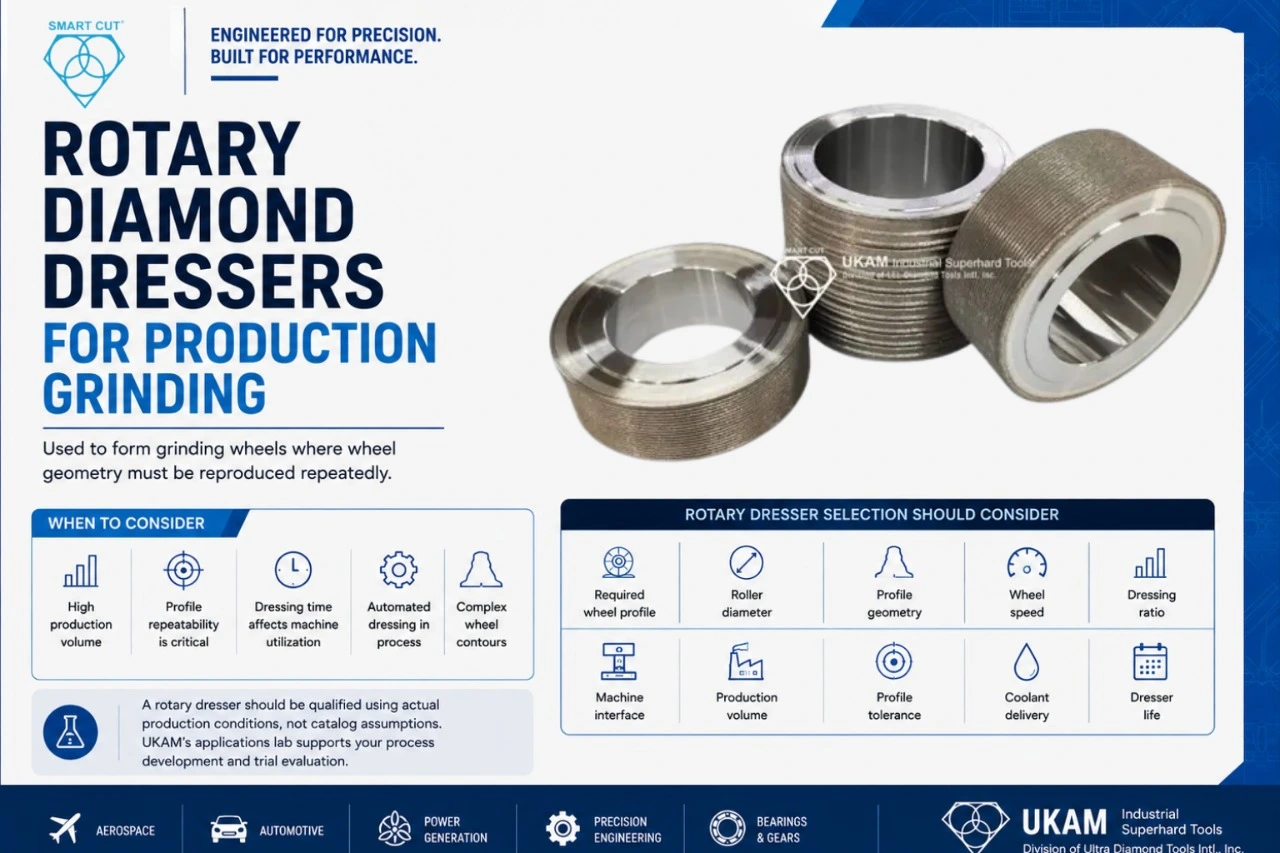
Rotary diamond dressers are used to form grinding wheels, particularly where wheel geometry must be reproduced repeatedly. UKAM describes diamond rollers as tools used to form grinding wheels for mass production, with applications spanning aerospace, automotive, power generation, machine tools, precision engineering, bearings, gears, engine components, transmission components, and turbine blades.
A rotary dresser becomes more relevant when:
- Production volume is high
- The same wheel profile must be reproduced repeatedly
- Dressing time affects machine utilization
- A complex wheel contour is required
- Profile repeatability is critical
- Automated dressing is part of the process
Rotary Dresser Selection Should Consider:
- Required wheel profile
- Roller diameter
- Profile geometry
- Wheel speed
- Dressing ratio
- Machine interface
- Production volume
- Required profile tolerance
- Coolant delivery
- Expected dresser life
A rotary dresser should be qualified using actual production conditions, not catalog assumptions — see the process development and consulting page for how UKAM’s applications lab supports this kind of trial.
How Dressing Changes Grinding Wheel Performance
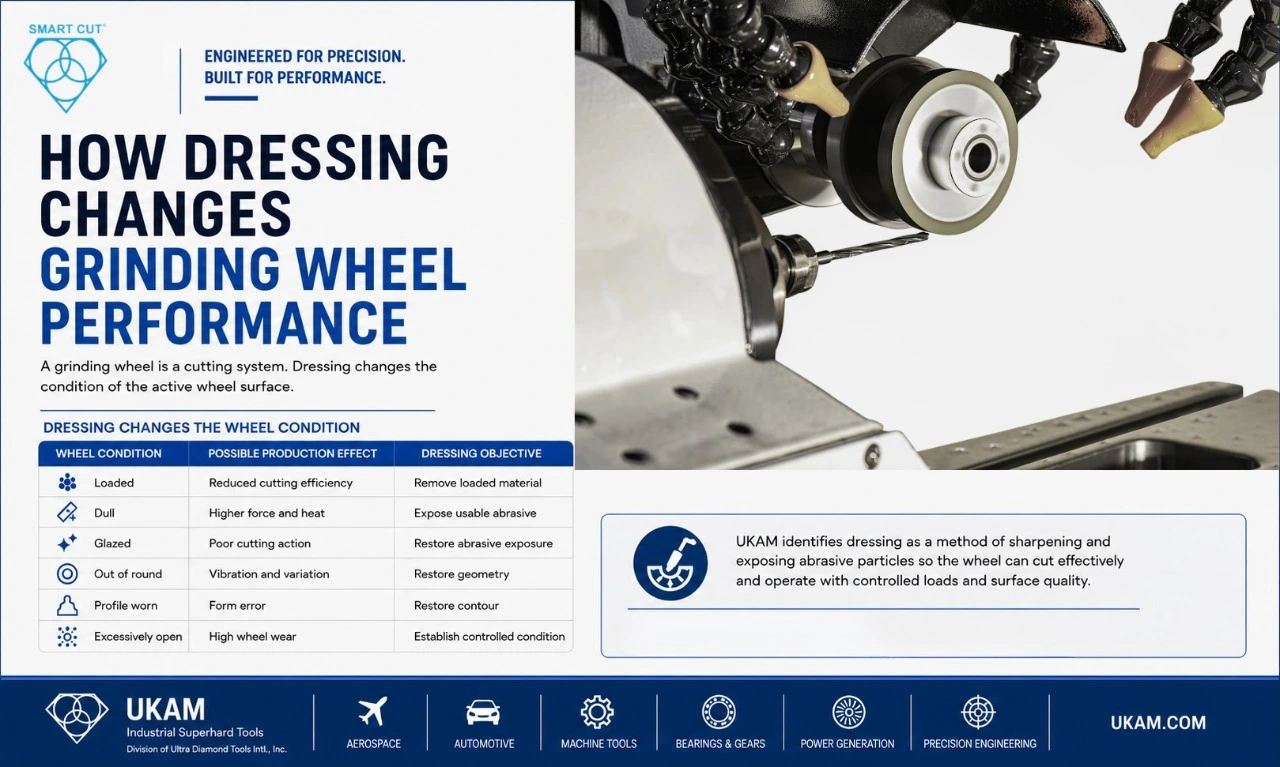
A grinding wheel is a cutting system. The abrasive grains perform the cutting, the bond holds the abrasive, and the wheel structure provides space for chips and coolant. Dressing changes the condition of the active wheel surface.
|
Wheel Condition |
Possible Production Effect |
Dressing Objective |
|---|---|---|
|
Loaded |
Reduced cutting efficiency |
Remove loaded material |
|
Dull |
Higher force and heat |
Expose usable abrasive |
|
Glazed |
Poor cutting action |
Restore abrasive exposure |
|
Out of round |
Vibration and variation |
Restore geometry |
|
Profile worn |
Form error |
Restore contour |
|
Excessively open |
High wheel wear |
Establish controlled condition |
UKAM identifies dressing as a method of sharpening and exposing abrasive particles so the wheel can cut effectively and operate with controlled loads and surface quality. For more, see why use diamond and diamond vs. CBN (cubic boron nitride) tools.
Dressing Frequency Is a Production Variable
Dressing frequency should be treated as a production parameter, not a habit.
- Dressing too frequently removes usable wheel material and consumes machine time.
- Dressing too late can allow grinding forces, temperature, loading, surface deterioration, or dimensional variation to increase.
The correct interval is application specific.
Engineering Insight: Tool Life Is Not Process Life
A grinding wheel can remain physically usable while the process has already failed. If dimensional drift begins before the wheel reaches its physical wear limit, the effective process life is shorter than the physical wheel life. The best dressing interval is not necessarily the longest one — it is the interval that maintains acceptable part quality, wheel condition, dimensional stability, surface finish, grinding forces, production rate, and wheel consumption.
Common Diamond Dresser Selection Mistakes
Mistake 1 — Choosing a dresser by wheel diameter alone
Wheel diameter does not define the complete dressing requirement — wheel profile, abrasive, bond, dressing method, machine, and production volume must also be considered.
Mistake 2 — Selecting the cheapest dresser
A lower purchase price can become a higher operating cost if dresser life is shorter or dressing time is longer. Compare cost per dressing cycle, not sticker price.
Mistake 3 — Dressing too deeply
Excessive dressing depth can remove usable wheel material unnecessarily, shortening wheel life without a corresponding improvement in performance.
Mistake 4 — Dressing too lightly
Insufficient dressing may leave dull or loaded abrasive at the wheel surface, so grinding forces stay high even though dressing is being performed.
Mistake 5 — Ignoring diamond orientation
Incorrect orientation can increase uneven diamond wear and change dressing behavior.
Mistake 6 — Ignoring machine condition
Spindle runout, fixture movement, slide condition, vibration, and dresser mounting can all affect the result.
Mistake 7 — Using one dresser specification for every wheel
Different wheels and profiles can require different dresser configurations.
Mistake 8 — Changing the dresser without recording the baseline
Without baseline data, it becomes difficult to determine whether the new dresser actually improved the process.
Mistake 9 — Ignoring coolant
Coolant delivery can influence wheel condition, dressing behavior, and thermal conditions.
Mistake 10 — Measuring only dresser life
A dresser that lasts longer is not automatically better — the qualification should also measure wheel life, dressing time, surface finish, dimensional stability, scrap, and cost.
Engineering Insight: Separate Dresser Performance From Setup Performance
If a dresser performs well on one machine and poorly on another, do not immediately conclude that the dresser specification is wrong. Compare machine alignment, spindle runout, dresser mounting, dresser orientation, wheel mounting, coolant delivery, dressing feed, dressing depth, dressing direction, wheel specification, and workpiece condition. A dressing tool is only as stable as the system holding it. If the machine setup changes between trials, the result cannot be attributed confidently to the dresser.
For general best practice, see how to properly use diamond tools and the complete guide to performance, safety, and tool life.
Cost Per Dressing Cycle
Dresser economics should be evaluated using operating cost rather than purchase price alone. The following figures are illustrative examples only and do not represent UKAM production data or guaranteed dresser performance.
|
Metric |
Dresser A |
Dresser B |
|---|---|---|
|
Purchase price |
$350 |
$550 |
|
Dressing cycles |
600 |
1,200 |
|
Dressing time per cycle |
2.5 min |
1.8 min |
|
Wheel consumption |
Higher |
Lower |
|
Dresser cost per cycle |
$0.58 |
$0.46 |
|
Dressing time for 100 cycles |
250 min |
180 min |
|
Dressing time difference |
Baseline |
70 min less |
Illustrative calculation: dresser purchase price divided by useful dressing cycles gives a basic dresser cost per cycle. Actual production economics should also include machine time, wheel consumption, labor, coolant, setup, scrap, and downtime.
Engineering Insight
The correct procurement question is not “How much does the dresser cost?” It is “How much does it cost to maintain the grinding process with this dresser?” A higher-priced dresser can have a lower cost per dressing cycle if its service life and production efficiency justify the initial cost.
Supplier Evaluation
A technically capable supplier should be able to discuss the complete dressing application rather than simply provide a catalog number.
|
What to Ask |
What the Answer Reveals |
|---|---|
|
What dresser type do you recommend? |
Whether the application was evaluated |
|
What wheel is being dressed? |
Whether wheel compatibility was considered |
|
What is the wheel profile? |
Whether geometry was considered |
|
What is the dressing method? |
Whether machine operation was considered |
|
What is the production volume? |
Whether dresser life was considered |
|
What diamond configuration is recommended? |
Whether contact requirements were evaluated |
|
What dressing parameters should be used? |
Whether process support is available |
|
How should the dresser be oriented? |
Whether setup requirements are understood |
|
What dresser life should be measured? |
Whether performance has a measurable target |
|
Can the dresser be customized? |
Whether unusual geometry can be supported |
|
What information is required? |
Whether the supplier follows an engineering process |
UKAM states that custom diamond dresser configurations are available for specific requirements. A supplier should also be willing to discuss the application — through channels like customer support or a request for consultation — rather than making a recommendation from wheel diameter alone.
UKAM Diamond Dresser Technology Comparison
UKAM currently lists several diamond dresser configurations. The comparison below focuses on application characteristics rather than ranking one configuration above another.
|
UKAM Dresser Configuration |
Primary Selection Consideration |
|---|---|
|
Single point |
Controlled point contact |
|
Multipoint |
Multiple diamond contact points |
|
Clustered |
Distributed diamond contact |
|
Layered |
Broader dressing configuration |
|
Straight |
Straight wheel faces |
|
Angle |
Angled wheel profiles |
|
Radius |
Radius and form requirements |
|
Chisel edge |
Specialized profile geometry |
|
Rotary dresser |
Production wheel forming |
|
Profile roller |
Repeated wheel geometry |
|
Form roller |
Complex wheel contours |
|
Custom dresser |
Nonstandard application requirements |
Engineering Insight
The right dresser is not necessarily the one with the largest diamond, the most diamond points, or the highest purchase price. The correct choice is the configuration that maintains the wheel condition required by the process — the same principle that guides UKAM’s bond-technology lineup, from sintered metal bond and resin bond to HYBRID Bond™, electroplated nickel bond, brazed bond, vitrified bond, polycrystalline (PCD/PCBN), and CVD tools.
Related technology pages:
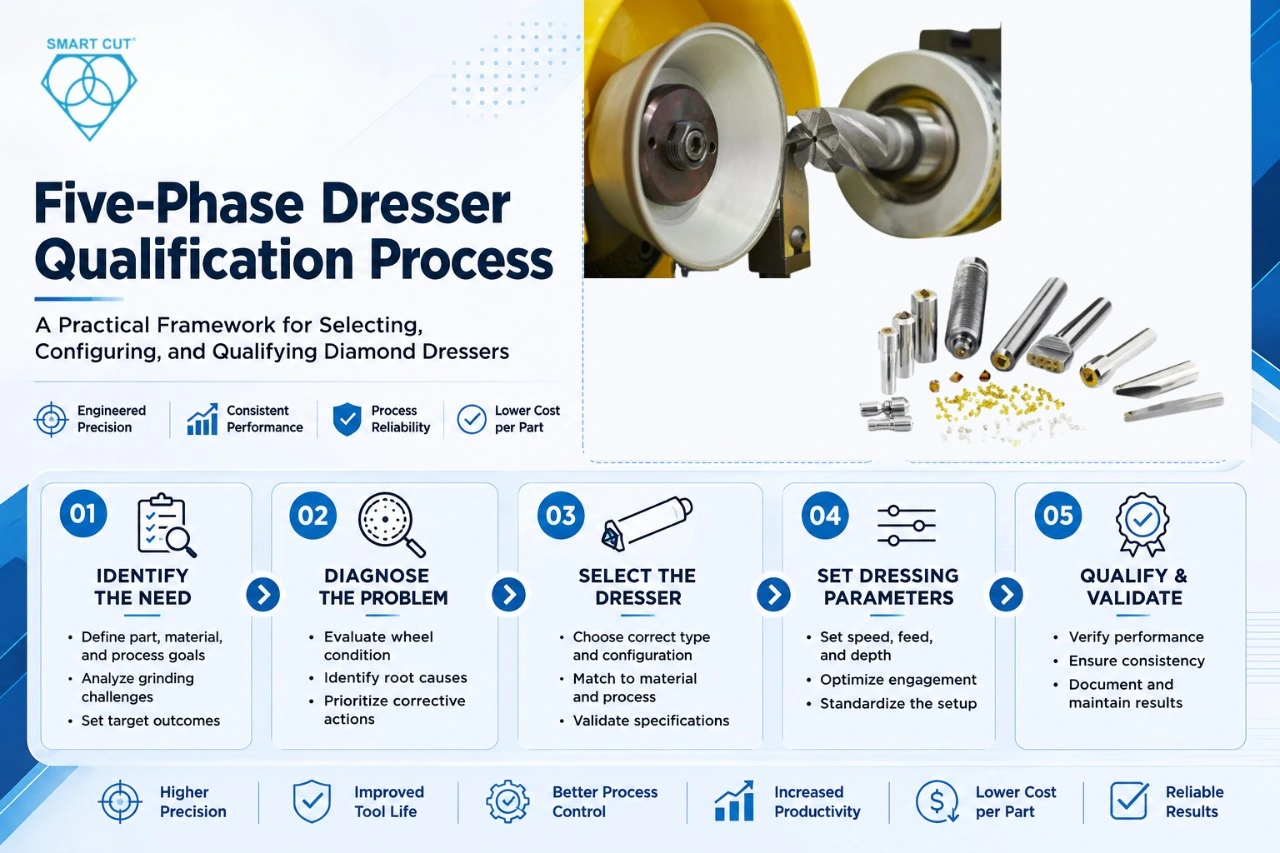
A Five-Phase Dresser Qualification Process
Phase One: Identify the Grinding Wheel
Record wheel manufacturer, abrasive type, bond, grade, structure, diameter, width, profile, machine, current dresser, current dressing method, and dressing interval. If the wheel is a form wheel, provide a profile drawing or dimensional specification.
Phase Two: Identify the Actual Dressing Problem
Classify the problem before changing the dresser:
- Wheel loading — investigate abrasive exposure, wheel specification, dressing depth, coolant, and workpiece interaction.
- Wheel glazing — investigate dressing frequency, dressing depth, wheel condition, and abrasive exposure.
- Profile loss — investigate dresser geometry, machine alignment, wheel mounting, and dresser wear.
- Excessive wheel consumption — investigate dressing depth and dressing frequency.
- Rapid dresser wear — investigate diamond configuration, orientation, contact pressure, machine vibration, and dressing conditions.
- Poor surface finish — investigate wheel condition, dressing consistency, grinding parameters, and machine stability.
- Dimensional variation — investigate wheel profile, wheel runout, dressing consistency, machine condition, and workholding.
The new dresser should address a defined failure mechanism, not a hunch.
Phase Three: Select the Dresser Configuration
Once the failure mechanism is understood, select the starting dresser configuration:
- Simple straight wheel dressing → single point or straight configuration
- Broader contact requirements → multipoint or clustered configuration
- Radius or angled profiles → matching geometry
- Repeated complex production profiles → rotary or form dressing
- Unusual wheel geometry → custom tooling
Phase Four: Establish Dressing Parameters
A dresser cannot be evaluated without defined operating conditions. Record dressing feed, dressing depth, traverse direction, contact location, coolant, wheel speed, dresser orientation, dressing interval, number of dressing passes, and wheel material removed per dressing.
Avoid copying dressing parameters from another wheel without qualification — two wheels with different abrasive, bond, hardness, or structure can respond very differently to the same dresser and dressing depth. The goal is a controlled process window, not a single unexplained setting.
Phase Five: Qualify the Dresser
Measure wheel profile before and after dressing, wheel diameter change, dresser wear, dressing time, grinding force, surface finish, dimensional accuracy, wheel life, dressing frequency, scrap, and cost per dressing cycle.
The dresser is qualified when it maintains the required wheel and part condition at an acceptable operating cost.
Engineering Insight
The strongest dresser trial is not the one that produces the lowest dressing cost during the first few cycles — it is the one that demonstrates stable wheel condition throughout the production period. A useful qualification should answer: how consistently does the dresser maintain the wheel?
Application Considerations by Industry
Hardened Steel Grinding
Failure mode to watch: Grinding burn and dimensional drift
Hardened steel grinding can generate substantial grinding forces and thermal loads. Dressing should maintain a cutting wheel condition without consuming excessive wheel material. Monitor grinding forces, surface condition, temperature indicators where available, dimensional stability, and dressing interval. See related: tools for the metal industry.
Tool and Die Grinding
Failure mode to watch: Profile error
Tool steels and die steels often require controlled form retention. The dresser must maintain the wheel geometry required to produce the finished component — a small profile change in the wheel can become a dimensional error in the finished tool.
Bearing Grinding
Failure mode to watch: Dimensional variation and surface deterioration
Bearing components require controlled geometry and surface condition. Dressing consistency matters especially in repeated production, relevant to automotive and aerospace component manufacturers alike.
Tungsten Carbide Grinding
Failure mode to watch: Grinding burn and microcracking
Tungsten carbide is commonly processed using diamond abrasive wheels. The dressing process must maintain abrasive exposure without excessive wheel consumption. The wheel, dresser, coolant, and grinding parameters should be evaluated together. See related: ultra thin, high precision & micro carbide tools.
Precision Profile Grinding
Failure mode to watch: Form deviation
Complex profiles require controlled wheel geometry. A rotary profile or form dresser may be appropriate when the same complex profile must be reproduced repeatedly, applicable in semiconductor, dental, and metallography sample preparation contexts. See related: consumables for metallography.
Other adjacent industries with similar dressing and wheel-condition requirements include semiconductor, glass & quartz, lapidary, stone, and advanced ceramics processing. Browse the full application & industry guide to find the closest match to your process.
Qualification Checklist
Grinding Wheel
- Exact wheel specification documented
- Abrasive type documented
- Bond documented
- Grade documented
- Structure documented
- Diameter documented
- Width documented
- Profile documented
Dresser
- Dresser configuration selected
- Diamond configuration documented
- Dresser dimensions documented
- Mounting configuration verified
- Diamond orientation established
- Dresser life measurement defined
- Custom geometry reviewed where required
Machine
- Machine identified
- Spindle condition checked
- Dresser mounting checked
- Alignment checked
- Coolant delivery checked
- Machine vibration evaluated
Dressing Process
- Dressing method documented
- Dressing feed documented
- Dressing depth documented
- Dressing direction documented
- Dressing frequency documented
- Coolant condition documented
- Number of passes documented
Quality
- Wheel profile measured
- Wheel runout checked
- Surface finish measured
- Dimensional accuracy measured
- Grinding forces evaluated
- Thermal damage evaluated
- Scrap recorded
Economics
- Dresser price recorded
- Dresser life recorded
- Dressing time recorded
- Wheel consumption recorded
- Machine time calculated
- Operator time calculated
- Scrap cost calculated
- Cost per dressing cycle calculated
Frequently Asked Questions
A diamond dresser conditions and restores grinding wheel surfaces. Dressing removes unwanted material and exposes usable abrasive; truing restores wheel geometry and profile. Diamond provides the hardness required to dress conventional abrasive wheels.
Start with the exact wheel specification. Record abrasive, bond, diameter, width, profile, and hardness. Determine whether the requirement is dressing, truing, or profile generation. Consider the machine, dressing method, production volume, and required dresser life, then select the dresser configuration according to the wheel geometry and process.
A single point dresser uses one primary diamond contact point; a multipoint dresser uses multiple diamond contact points distributed across several diamonds. The correct choice depends on wheel geometry, dressing method, production requirements, and machine setup.
Rotary dressers are useful for repeated wheel-forming operations, particularly in production grinding. Profile rollers can generate defined wheel geometries; form rollers can produce simple or complex contours.
There is no universal dressing interval. Frequency depends on wheel condition, workpiece material, grinding parameters, and quality requirements. The correct interval should be established through measured production results.
Incorrect diamond orientation, excessive dressing depth, excessive contact pressure, poor coolant delivery, machine vibration, or a mismatched dresser configuration can all accelerate wear.
Yes. UKAM states that custom dresser configurations are available to address specific wheel profiles, machine requirements, mounting arrangements, and application conditions.
Compare purchase price, measure dresser life, record dressing cycles, measure dressing time, record wheel consumption, measure surface finish and dimensional stability, calculate total cost per dressing cycle, and evaluate technical support and customization capability.
Request a Diamond Dresser Recommendation
The correct diamond dresser depends on the grinding wheel, machine, profile, dressing method, production volume, and required process result.
Before requesting a recommendation, gather:
- Grinding wheel specification
- Abrasive type
- Bond type
- Wheel diameter and width
- Wheel profile or drawing
- Grinding machine model
- Current dresser type
- Current dressing method
- Dressing feed and depth
- Dressing frequency
- Workpiece material and hardness
- Required surface finish
- Dimensional tolerance
- Production volume
- Current dressing problem
Request a Diamond Dresser Recommendation
Send your grinding wheel specification and application requirements to UKAM for an application-specific dresser recommendation through Request a Consultation, Request a Quote, or Contact Us directly.
Summary of Engineering Principles
- Select the diamond dresser from the grinding wheel and dressing requirement, not wheel diameter alone.
- Determine whether the process requires dressing, truing, profile restoration, or multiple functions.
- Match dresser geometry to wheel geometry.
- Consider diamond size, quality, orientation, exposure, and setting as part of the dresser specification.
- Use single point, multipoint, cluster, radius, angle, and rotary configurations according to the application.
- Use rotary dressers when repeated wheel forming and production consistency justify the configuration.
- Establish dressing feed, depth, orientation, coolant, and frequency through controlled process trials.
- Do not assume that a more expensive dresser automatically produces a lower production cost.
- Calculate dresser cost per dressing cycle and include machine time and wheel consumption.
- Monitor wheel profile, grinding force, surface finish, dimensional accuracy, and dresser wear.
- Investigate machine alignment, runout, coolant, and mounting before blaming the dresser for inconsistent results.
- Consider custom dressing tools when standard configurations cannot reproduce the required wheel geometry.
- Treat the dresser as part of the grinding process rather than as a replaceable maintenance accessory.
The correct dresser is the one that maintains the required wheel condition, profile, part quality, and production economics under the actual application.
Note on illustrative data: all numerical cost examples in this article are illustrative methodology examples only. Actual dresser life, dressing time, wheel consumption, and production economics must be established through application-specific trials, such as those available through UKAM’s guaranteed trial order program.
Trusted by Tens of Thousands of Manufacturers, Laboratories,
Research Institutions Worldwide Since 1990
American Based Manufacturer
Established in 1990
