







blog, Cutting

How Diamond Grit Size Influences Cutting Speed, Surface Finish, and Tool Life
Trusted by Tens of Thousands of Manufacturers, Laboratories Research Institutions Worldwide Since 1990

American Based Manufacturer

Established in 1990

Custom manufacturing

Diamond grit size is one of the most significant factors influencing the performance of diamond debt cutting, grinding, and polishing tools. While operators in many applications may focus on machine settings, feed rates, or coolant conditions, they often ignore the fact that, like any material, diamond abrasive particle size is a fundamental requirement that dictates tool/material interaction.

Diamond abrasives have relevance to a range of domains, including semiconductor, optical, ceramics processing, and precision machining. This means the grit size within the precious tool bond influences how coarse or fine the cut the diamond makes and how long the tool will hold up before degrading in service.

Knowing the diamond grit size that produces the result allows engineers and operators to choose and configure an optimal abrasive for their application.

Understanding Diamond Grit Size

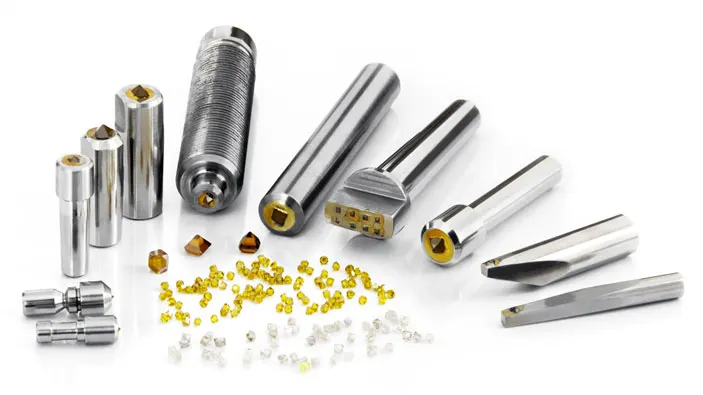
Diamond grit size is the measurement of individual diamond abrasive particles used for cutting, grinding, and polishing tools. So, we refer to these particles as microscopic cutting edges that remove material from the workpiece.

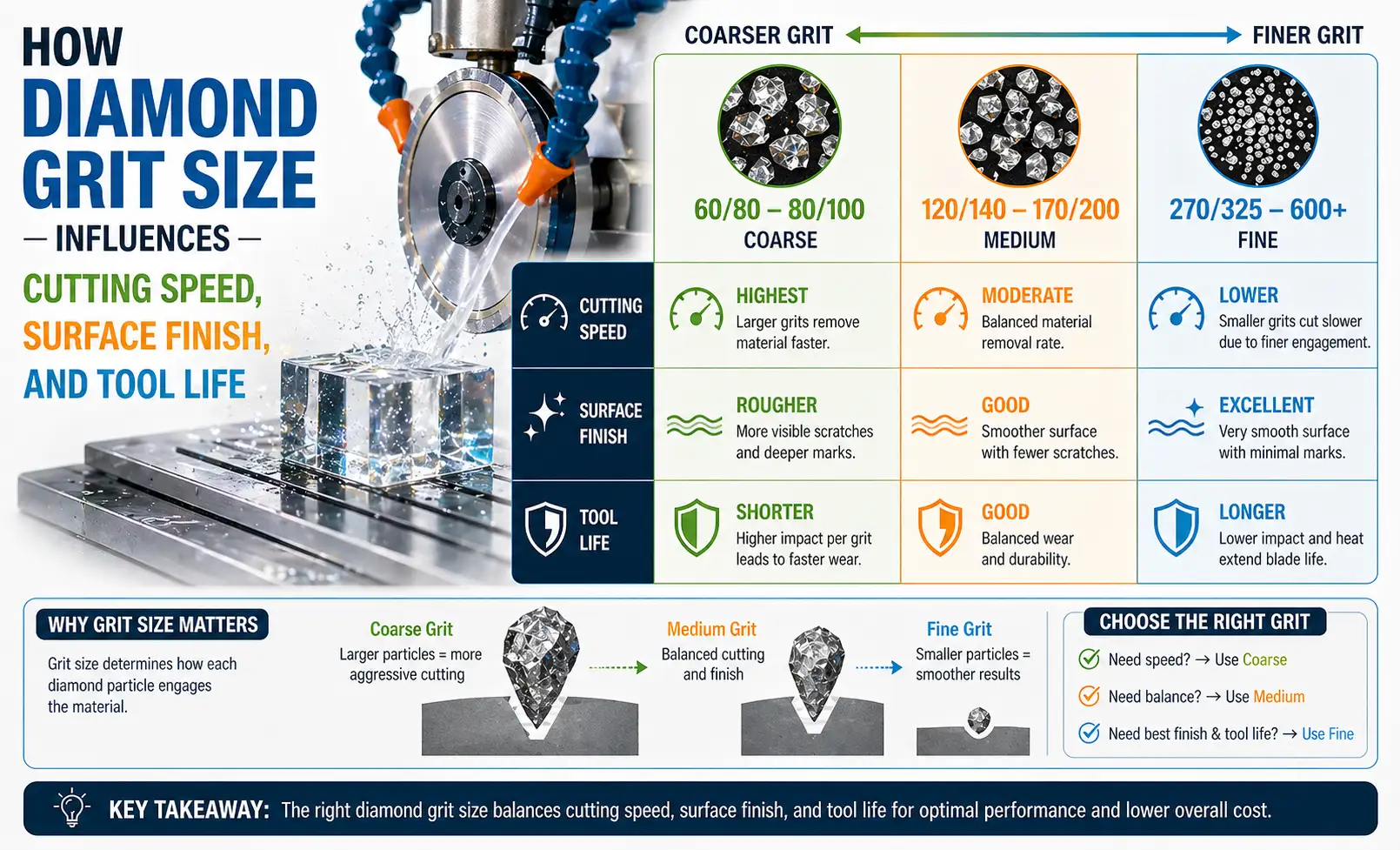
Coarser particles at higher grit sizes penetrate deeper into the material and remove more quickly. Larger grit sizes contain coarser particles, which cut more deeply and result in rougher surface finishes.

Particle size is typically expressed in terms of mesh measurements for abrasive technology. A detailed explanation of this system can be found in our guide on diamond mesh size and how to select the best one for your application, which explains how mesh classification determines the actual size distribution of diamond particles used in abrasive tools.

While mesh size defines the particle classification, the effective grit size determines the cutting behavior of the tool during operation.

How Diamond Grit Size Affects Cutting Speed

One of the most noticeable effects of diamond grit size is its influence on cutting speed and material removal rate.

Coarse Grit Sizes

Coarse diamond grits contain larger particles that penetrate deeper into the material being processed. Because each particle removes more material with each pass, tools using coarse grits typically achieve higher material removal rates.

These grits are commonly used in applications such as:

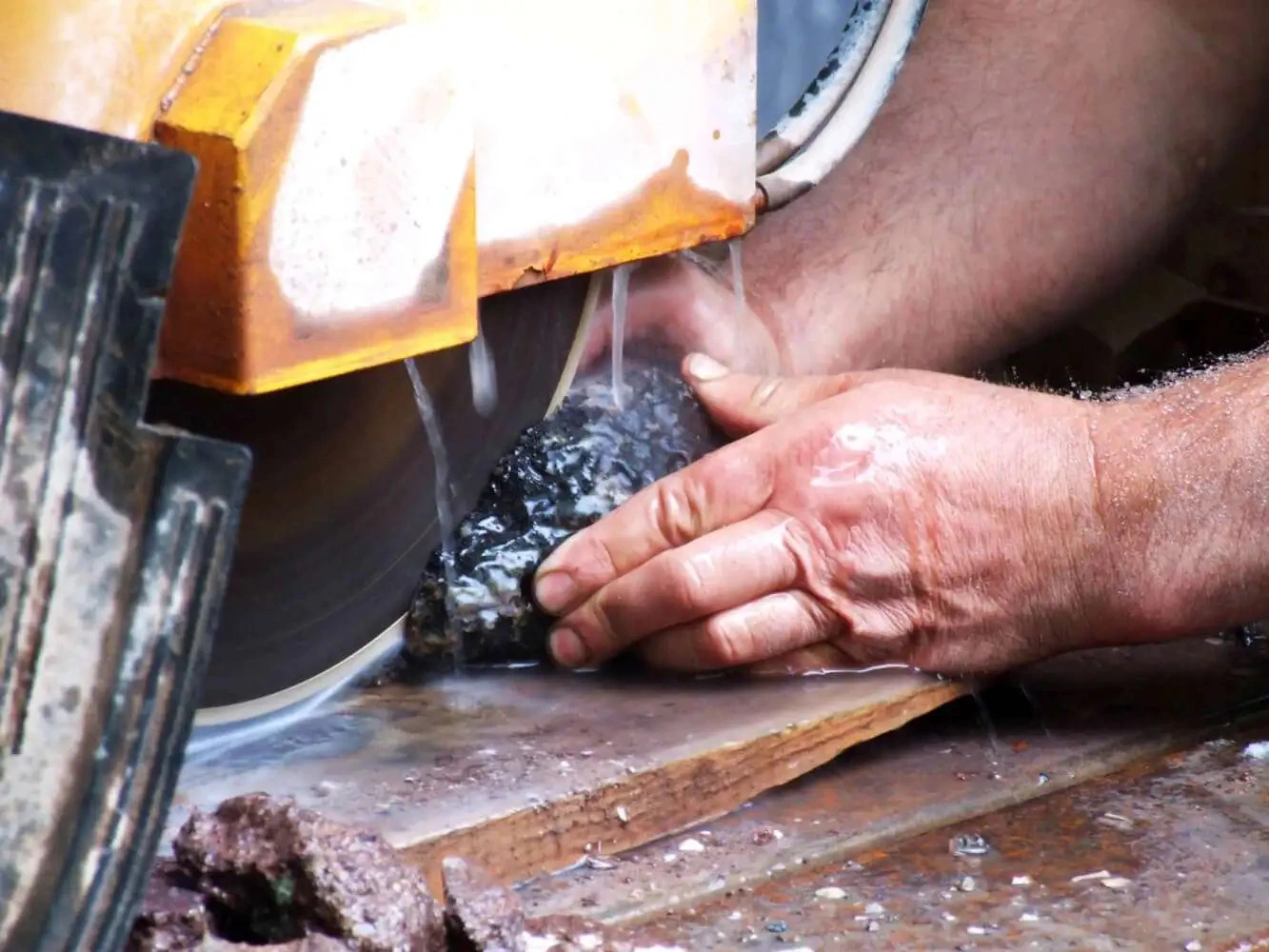
● stone cutting

● rough grinding

● ceramic machining

● hard material sectioning

The aggressive cutting action of coarse grits makes them ideal for rapid stock removal, although they tend to leave a rougher surface finish.

Fine Grit Sizes

Fine diamond grits contain much smaller particles. Instead of removing large amounts of material quickly, they produce many small cutting interactions across the surface.

This results in:

● slower cutting speeds

● improved surface quality

● more controlled finishing operations

Fine grits are typically used in precision finishing and polishing applications where surface quality is more important than removal rate.

Effect of Diamond Grit Size on Surface Finish

Surface finish is another critical factor influenced by diamond abrasive size.

Coarse Abrasives and Surface Roughness

When larger particles interact with the workpiece surface, they create deeper scratches and grooves. This results in a rougher surface texture, which may require additional finishing steps to achieve the desired smoothness.

However, coarse abrasives are extremely useful in the initial stages of machining, where the primary goal is to remove material quickly.

Fine Abrasives and Surface Smoothness

Fine diamond particles produce shallower cutting marks, resulting in a significantly smoother surface. Because the scratches are smaller and more uniform, the final surface finish becomes more refined.

This makes fine grits essential for applications such as:

● semiconductor wafer finishing

● optical component polishing

● precision ceramic finishing

● metallographic sample preparation

In these industries, surface quality and dimensional accuracy are critical requirements.

Diamond Grit Size and Tool Life

The size of the abrasive particles also influences tool wear and lifespan.

Coarse Grit Tools

The reason is that coarse grits undergo higher mechanical stress because one particle has to take more of the cutting load. They are very efficient for fast material removal, but they wear out sooner based on the hardness of the material being machined.

However, in many heavy-duty applications, coarse grits are still the most efficient choice since their higher cutting efficiency makes up for a higher wear rate.

Fine Grit Tools

Fine grits spread out the cutting load over a greater – and smaller – number of particles, which can lower the stress on individual abrasives. This does not always make tools, but can sometimes lead to greater cutting performance that remains consistently over time.

AdvertisementFine grits are often ideal for precision applications, achieving a balance between tool life and surface quality.

How to Choose the Right Diamond Grit Size

Selecting the appropriate diamond grit size depends on several factors, including the material being processed and the desired surface finish.

General guidelines include:

● Coarse grits (20–60 mesh) – best for rapid material removal and rough cutting operations

● Medium grits (80–140 mesh) – suitable for general grinding and shaping processes

● Fine grits (200 mesh and above) – used for precision finishing and polishing

For most manufacturing workflows, the operator starts with a coarser abrasive for removing stock and then makes their way to finer grits to complete finishing operations.

Understanding the relationship between grit size, mesh classification, and particle distribution is essential when optimizing abrasive tool performance. For a deeper explanation of particle classification systems, refer to our detailed guide on diamond mesh size selection and classification, which explains how mesh measurements determine diamond particle ranges.

Diamond Grit Size and Typical Applications

Grit Size

Cutting Behavior

Typical Applications

Coarse (20–60)

Fast material removal

Stone cutting, heavy grinding

Medium (80–140)

Balanced cutting and finish

General grinding and shaping

Fine (200+)

Smooth surface finish

Polishing semiconductor wafers

This progression from coarse to fine abrasives allows manufacturers to optimize both efficiency and surface quality throughout the machining process.

The Importance of Diamond Abrasive Size In Precision Manufacturing

More recently, precision machining and advanced materials are used by many modern manufacturing industries; the hardness or brittleness of these new materials is the critical problem in their engineering practice. These hard materials include silicon, sapphire, ceramics, and advanced composites, would need cutting tools that can provide extremely high efficiency with outstanding surface quality.

By carefully selecting the correct diamond grit size, manufacturers can:

● improve cutting efficiency

● control surface finish quality

● extend tool performance

● reduce machining time

Consequently, selecting the right diamond abrasive size becomes instrumental in maximizing productivity in a range of industries, including electronics, aerospace, medical device manufacturing, and semiconductor processing.

Conclusion

This is a discussion about diamond grit size, which particle size of diamond that has been an important parameter affecting cutting speed, surface finish, and tool life. The coarse grits aid rapid material removal, while the finer grits provide excellent surface quality and finishing.

Choosing the right abrasive size is a trade-off between requirements on material removal rate, surface quality, and tool durability. Having information on the behaviour of diamond particles on the workpiece, engineers can develop more efficient abrasive tools.

For a comprehensive overview of the methods used to classify and measure diamond particles, visit our guide on diamond mesh size and how to choose the ideal one for your application, which details how mesh classification correlates with abrasive particle dimensions.

Trusted by Tens of Thousands of Manufacturers, Laboratories,
Research Institutions Worldwide Since 1990

American Based Manufacturer

Established in 1990

Custom manufacturing

Brian is an experienced professional in the field of precision cutting tools, with over 27 years of experience in technical support. Over the years, he has helped engineers, manufacturers, researchers, and contractors find the right solutions for working with advanced and hard-to-cut materials. He’s passionate about bridging technical knowledge with real-world applications to improve efficiency and accuracy.

As an author, Brian Farberov writes extensively on diamond tool design, application engineering, return on investment strategies, and process optimization, combining technical depth with a strong understanding of customer needs and market dynamics.

author-avatar

About Brian Farberov

Brian is an experienced professional in the field of precision cutting tools, with over 27 years of experience in technical support. Over the years, he has helped engineers, manufacturers, researchers, and contractors find the right solutions for working with advanced and hard-to-cut materials. He’s passionate about bridging technical knowledge with real-world applications to improve efficiency and accuracy. As an author, Brian Farberov writes extensively on diamond tool design, application engineering, return on investment strategies, and process optimization, combining technical depth with a strong understanding of customer needs and market dynamics.