





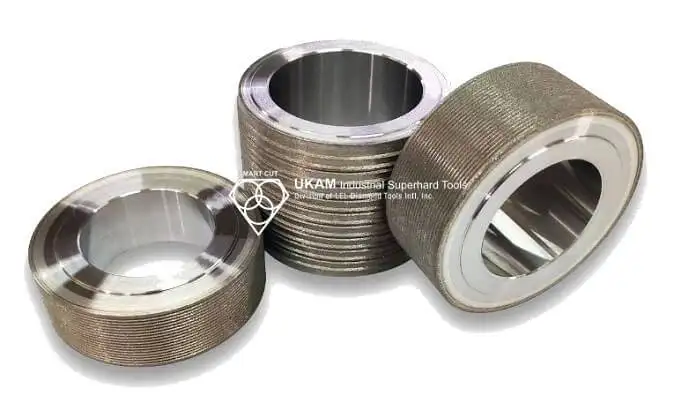













How to Select the Best Diamond Grinding Wheel for Tungsten Carbide

Table of Contents
Toggle
American Based Manufacturer

Established in 1990


Custom manufacturing


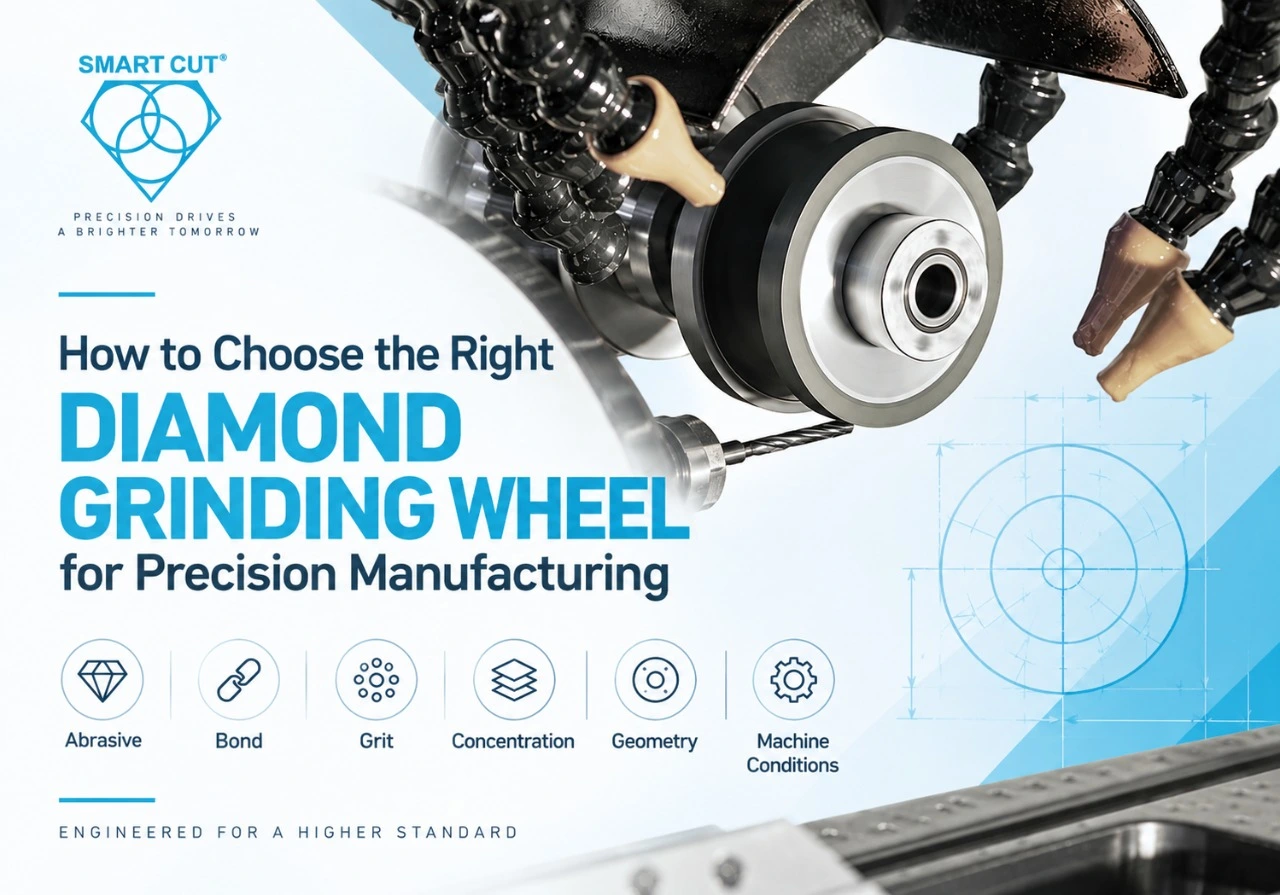
Engineering Selection Guide for Maximizing Grinding Performance, Wheel Life & Process Stability
Tungsten carbide is one of the most widely used engineering materials for cutting tools, wear components, punches, dies, mining equipment, precision tooling, and high-performance industrial parts because it combines exceptional hardness with outstanding wear resistance. These same properties, however, also make it one of the most demanding materials to grind efficiently.
Unlike conventional steels, tungsten carbide does not respond well to trial-and-error grinding practices. Selecting an unsuitable diamond grinding wheel can quickly lead to problems such as:
- Rapid wheel wear
- Wheel glazing
- Poor surface finish
- Edge chipping
- Thermal damage
- Excessive dressing
- Reduced dimensional accuracy
- Increased grinding costs
- Lower machine productivity
Many manufacturers initially adjust spindle speed, feed rate, or coolant flow when grinding performance declines. While these variables influence results, they often address the symptoms rather than the underlying cause. In many cases, the grinding wheel specification itself is the primary factor affecting productivity, surface quality, wheel life, and process stability.
Successful carbide grinding requires viewing the wheel as part of an integrated engineering system rather than as a standalone consumable. Bond type, diamond grit size, abrasive concentration, wheel geometry, coolant strategy, dressing practices, machine rigidity, and carbide grade all interact to determine grinding performance.
Engineering Insight
Experienced manufacturing engineers rarely ask, “Which diamond grinding wheel is the best?”
Instead, they ask:
“Which wheel specification is best suited for this carbide grade, machine, production objective, and grinding operation?”
That shift in perspective is the foundation of consistent, repeatable grinding performance.
Why Engineers Reevaluate Their Grinding Wheel Selection
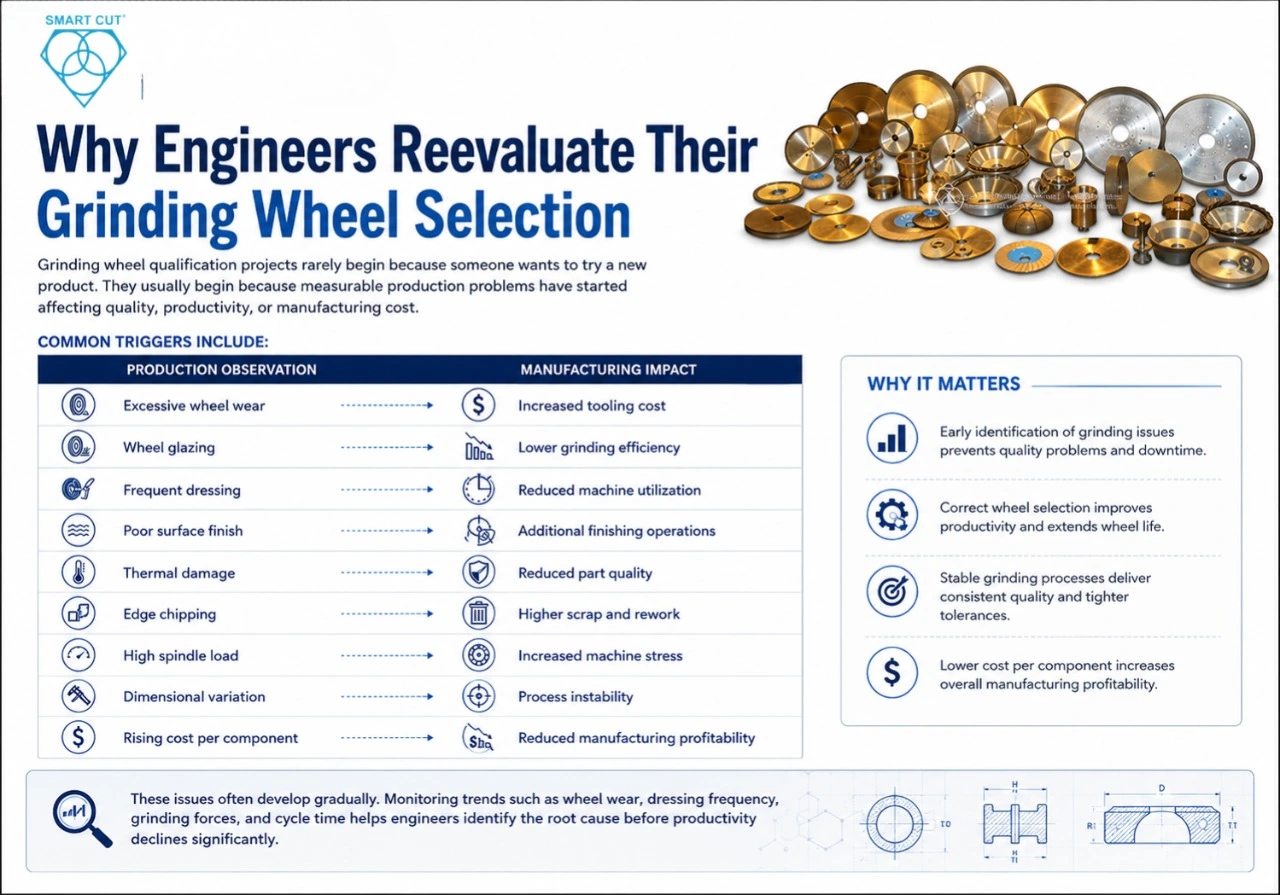
Grinding wheel qualification projects rarely begin because someone wants to try a new product. They usually begin because measurable production problems have started affecting quality, productivity, or manufacturing cost.
Common triggers include:
|
Production Observation |
Manufacturing Impact |
|---|---|
|
Excessive wheel wear |
Increased tooling cost |
|
Wheel glazing |
Lower grinding efficiency |
|
Frequent dressing |
Reduced machine utilization |
|
Poor surface finish |
Additional finishing operations |
|
Thermal damage |
Reduced part quality |
|
Edge chipping |
Higher scrap and rework |
|
High spindle load |
Increased machine stress |
|
Dimensional variation |
Process instability |
|
Rising cost per component |
Reduced manufacturing profitability |
These issues often develop gradually. Monitoring trends such as wheel wear, dressing frequency, grinding forces, and cycle time helps engineers identify the root cause before productivity declines significantly.
Why Tungsten Carbide Requires Diamond Grinding Wheels
Selecting a grinding wheel begins with understanding the material itself.
Tungsten carbide is significantly harder than hardened tool steels and cannot be ground efficiently using conventional aluminum oxide or silicon carbide wheels in most precision applications. Because diamond is substantially harder than tungsten carbide, it maintains cutting efficiency while enabling controlled material removal, improved dimensional accuracy, and superior surface quality.
However, diamond alone does not guarantee good grinding performance.
Grinding results depend on the interaction of multiple engineering variables:
- Diamond grit size
- Bond system
- Diamond concentration
- Wheel geometry
- Grinding parameters
- Coolant delivery
- Dressing strategy
- Carbide grain size
- Cobalt binder content
- Machine rigidity
Even components manufactured from the same carbide family may require different wheel specifications if their grain size, cobalt content, geometry, or production objective differs.
Engineering Note
A diamond grinding wheel should never be selected based on grit size or bond type alone. Optimal performance results from selecting an entire wheel specification that matches the workpiece material, grinding operation, machine capability, and production objectives.
Establish a Baseline Before Changing Wheel Specifications
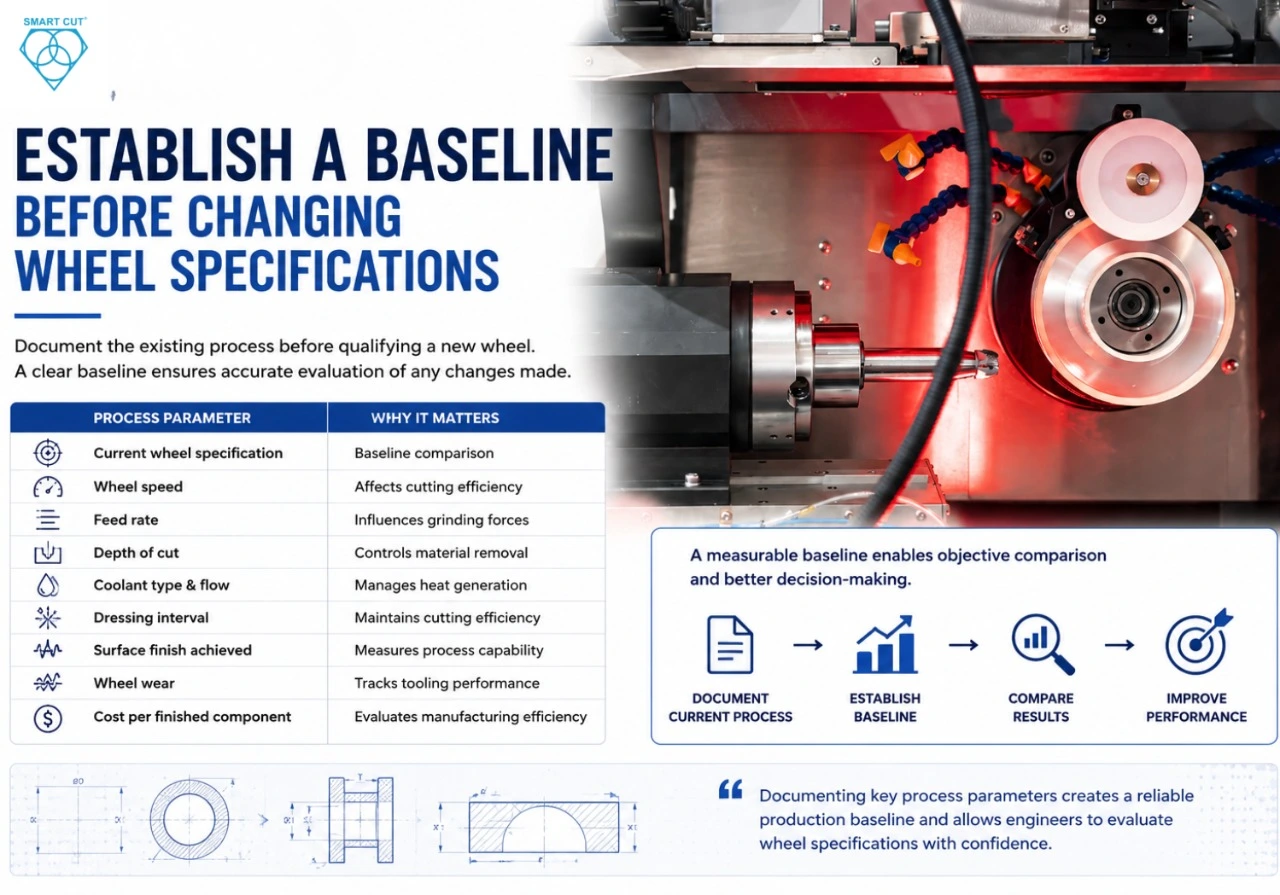
One of the most common mistakes in production environments is changing several process variables simultaneously. Replacing the grinding wheel while also modifying feed rate, spindle speed, coolant flow, or dressing intervals makes it difficult to determine which change actually influenced performance.
Before qualifying a new wheel, document the existing process.
|
Process Parameter |
Why It Matters |
|---|---|
|
Tungsten carbide grade |
Determines wheel compatibility |
|
Grain size |
Influences grit selection |
|
Cobalt binder content |
Affects wheel loading and grinding forces |
|
Current wheel specification |
Baseline comparison |
|
Bond type |
Controls wheel wear behavior |
|
Diamond grit size |
Influences stock removal and finish |
|
Diamond concentration |
Balances productivity and wheel life |
|
Wheel dimensions |
Ensures machine compatibility |
|
Wheel speed |
Affects cutting efficiency |
|
Feed rate |
Influences grinding forces |
|
Depth of cut |
Controls material removal |
|
Coolant type and flow |
Manages heat generation |
|
Dressing interval |
Maintains cutting efficiency |
|
Surface finish achieved |
Measures process capability |
|
Wheel wear |
Tracks tooling performance |
|
Cost per finished component |
Evaluates overall manufacturing efficiency |
Documenting these parameters creates a measurable production baseline, allowing engineers to compare wheel specifications objectively rather than relying on assumptions or operator perception.
Engineering Tip
If you change more than one variable at a time, you lose the ability to identify the true cause of process improvement—or process failure. Always qualify grinding wheel changes using controlled, documented production trials.
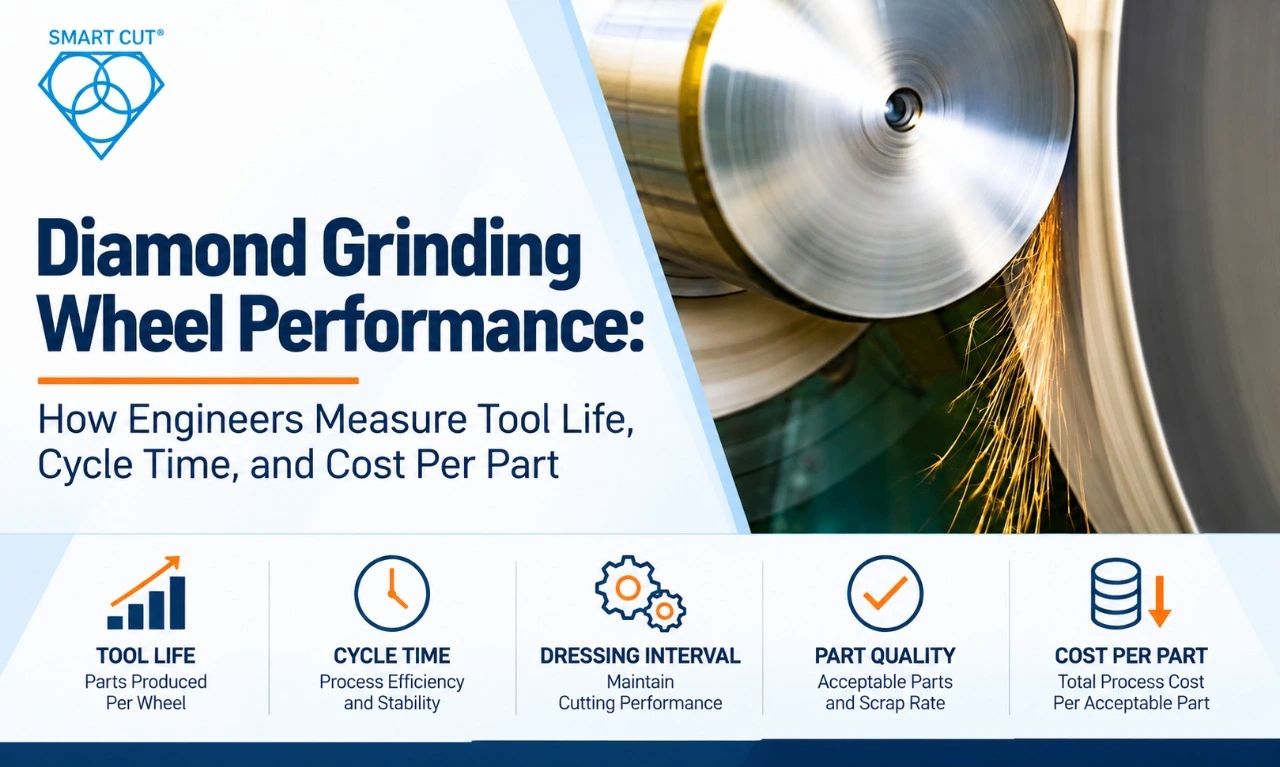
Cost Per Component vs. Wheel Price
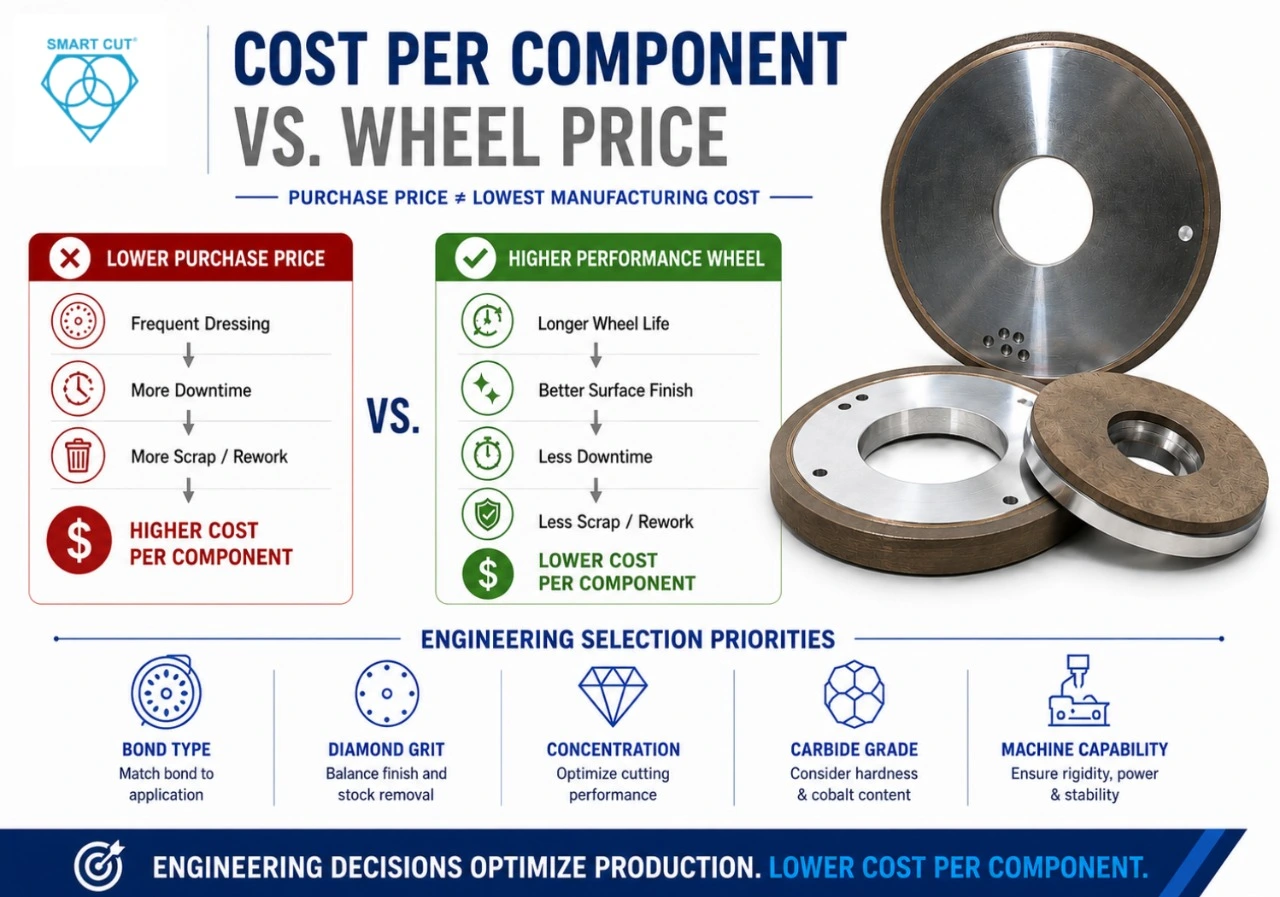
One of the biggest misconceptions in grinding operations is assuming that the lowest-cost wheel delivers the lowest manufacturing cost.
Experienced engineers evaluate wheel performance using cost per finished component, not purchase price alone.
A wheel with a higher initial cost may reduce overall manufacturing expense by:
- Lasting longer between replacements
- Requiring fewer dressing cycles
- Producing more consistent surface finishes
- Reducing scrap and rework
- Minimizing machine downtime
- Improving overall process stability
For this reason, grinding wheel selection should be based on total manufacturing performance rather than catalog price alone.
What You'll Learn in This Guide
By the end of this engineering guide, you’ll understand how to:
- Select the appropriate bond type for your application
- Choose the correct diamond grit size
- Determine the right diamond concentration
- Match wheel specifications to carbide grade
- Reduce glazing, wheel loading, and thermal damage
- Qualify new wheel specifications systematically
- Troubleshoot common grinding problems
- Improve wheel life while lowering cost per component
Selecting a diamond grinding wheel is not about choosing a single product from a catalog—it is an engineering decision that directly influences grinding efficiency, wheel life, dimensional accuracy, surface integrity, and manufacturing cost.
Experienced engineers evaluate the entire wheel specification because every parameter affects how the wheel interacts with the workpiece during grinding. A change in bond type, grit size, or concentration may improve one aspect of performance while negatively affecting another.
For this reason, grinding wheel selection should always begin with understanding the complete specification rather than focusing on a single characteristic such as grit size or wheel price.
How to Read a Diamond Grinding Wheel Specification
Every diamond grinding wheel contains dimensional and performance information that defines where and how it should be used.
A typical specification includes:
|
Specification |
Engineering Purpose |
|---|---|
|
Outside Diameter (D) |
Determines wheel speed and machine compatibility |
|
Wheel Thickness (TE) |
Influences rigidity, cutting stability, and kerf width |
|
Arbor Hole (H) |
Matches the machine spindle |
|
Manufacturing Tolerance |
Maintains dimensional accuracy |
|
Bond Type |
Controls wheel wear and cutting behavior |
|
Diamond Grit Size |
Determines stock removal and surface finish |
|
Diamond Concentration |
Balances wheel life and cutting efficiency |
|
Wheel Profile |
Matches the grinding operation |
None of these specifications should be evaluated independently. Together they determine whether the wheel will perform efficiently under actual production conditions.
Engineering Tip
Always verify wheel dimensions before evaluating abrasive specifications. Even an ideal bond and grit combination cannot compensate for an incorrectly sized wheel.
Step 1 – Selecting the Right Bond Type
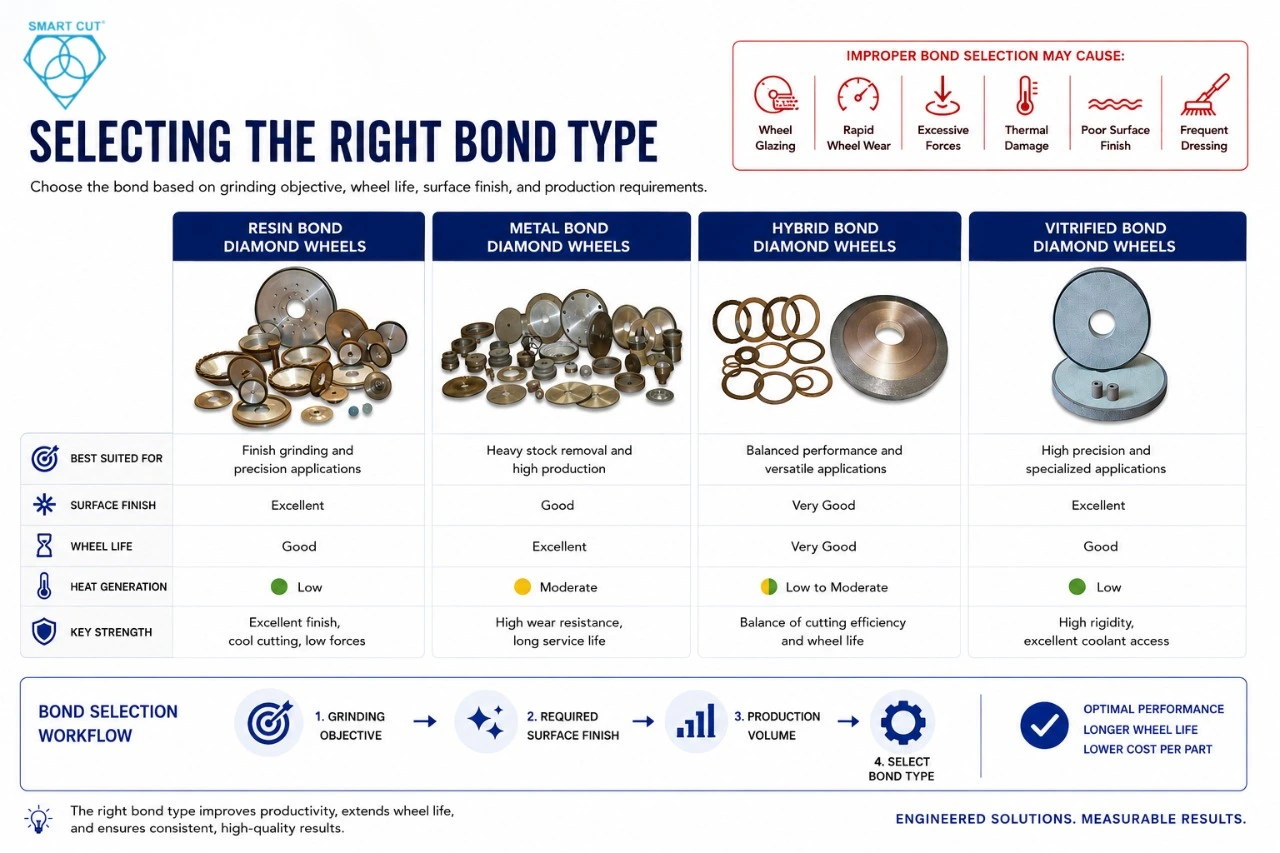
The bond system is the engineered matrix that holds diamond particles within the grinding wheel.
Its primary function is not simply to retain abrasive particles but to control how the wheel wears, how fresh diamonds are exposed, and how efficiently heat is managed throughout the grinding process.
An improperly selected bond may result in:
- Wheel glazing
- Rapid wheel wear
- Thermal damage
- Poor surface finish
- Frequent dressing
Selecting the correct bond is therefore one of the most important engineering decisions in the entire grinding process.
Resin Bond Diamond Wheels
Resin bond wheels are widely used for precision grinding because they produce lower grinding forces while generating excellent surface finishes.
Typical Applications
- Tool & cutter grinding
- Carbide inserts
- End millsEnd millsEnd mills
- Reamers
- Precision punches
- Finish grinding
Advantages
- Excellent surface finish
- Cooler cutting action
- Lower grinding forces
- Reduced thermal damage
- Self-sharpening characteristics
Engineering Consideration
Because resin bonds wear more quickly than metal bonds during aggressive stock removal, they are generally preferred for finishing rather than heavy production grinding.
Metal Bond Diamond Wheels
Metal bond wheels provide significantly greater wear resistance and maintain wheel geometry over extended production runs.
These wheels are frequently selected when wheel life and profile retention are higher priorities than achieving the finest possible surface finish.
Typical Applications
- Heavy stock removal
- Production grinding
- Profile grinding
- Form grinding
- Automated manufacturing
Advantages
- Excellent wear resistance
- Long service life
- High profile stability
- Consistent dimensional accuracy
Engineering Consideration
Metal bond wheels generally require well-controlled dressing practices to maintain cutting efficiency throughout their service life.
Hybrid Bond Wheels
Hybrid bond systems combine characteristics of resin and metal bonds to achieve a balance between cutting efficiency and wheel durability.
They are commonly used where manufacturers require:
- Higher productivity
- Stable grinding forces
- Improved wheel life
- Consistent surface quality
Hybrid wheels often perform well in CNC production environments where repeatability is critical.
Vitrified Bond Wheels
Vitrified bond wheels provide excellent rigidity and coolant penetration, making them suitable for specialized precision grinding applications.
Typical advantages include:
- Stable wheel geometry
- Good coolant access
- High dimensional consistency
- Excellent profile retention
Because machine capability plays an important role in vitrified wheel performance, compatibility should always be verified before qualification.
Bond Selection Matrix
|
Production Objective |
Recommended Bond |
|---|---|
|
Precision finish grinding |
Resin Bond |
|
Heavy stock removal |
Metal Bond |
|
Long unattended production |
Metal Bond |
|
Mixed production |
Hybrid Bond |
|
Automated CNC grinding |
Vitrified Bond |
|
Tool & cutter grinding |
Resin Bond |
No bond system is universally superior.
The correct choice depends on:
- Grinding objective
- Machine capability
- Production volume
- Surface finish requirement
- Wheel life expectations
Engineering Insight
A wheel that appears “dull” is not always worn out. In many cases, the bond is simply too hard for the application, preventing worn diamond particles from breaking away and exposing fresh cutting edges.
Step 2 – Selecting Diamond Grit Size
Diamond grit size determines how aggressively the wheel removes material and the quality of the finished surface.
In general:
- Larger diamond particles remove material more quickly.
- Smaller particles produce smoother surfaces and tighter dimensional control.
The optimum grit size depends on:
- Stock removal requirement
- Surface finish specification
- Edge quality
- Dimensional tolerance
- Production rate
Selecting grit size should always be balanced against bond type because both variables influence grinding forces and wheel wear.
General Engineering Guide
|
Diamond Grit |
Typical Application |
Expected Surface Finish |
|---|---|---|
|
80–120 |
Heavy stock removal |
Rough |
|
120–170 |
General production grinding |
Medium |
|
170–230 |
Semi-finishing |
Fine |
|
230–325 |
Precision finishing |
Very Fine |
|
325+ |
Optical & ultra-precision grinding |
Ultra Fine |
Common Mistake
Selecting the finest available grit does not automatically improve grinding performance. Fine grits produce superior finishes but often reduce stock removal rates and may increase cycle time when used for rough grinding.
Step 3 – Selecting Diamond Concentration
Diamond concentration refers to the amount of diamond abrasive contained within the bond matrix.
It influences:
- Wheel life
- Cutting efficiency
- Grinding forces
- Profile retention
- Manufacturing cost
Higher concentrations distribute grinding forces across more abrasive particles, while lower concentrations expose fewer cutting points that may cut more freely under certain conditions.
The appropriate concentration depends on:
- Carbide grade
- Production volume
- Material removal rate
- Wheel life objectives
- Grinding operation
Increasing concentration does not automatically improve grinding performance. In some applications, excessively high concentrations can increase grinding forces and require changes to operating parameters.
Engineering Tip
Select diamond concentration according to the application’s productivity goals—not simply for maximum abrasive content. The best-performing wheel is the one that delivers the lowest cost per finished component, not necessarily the highest concentration.
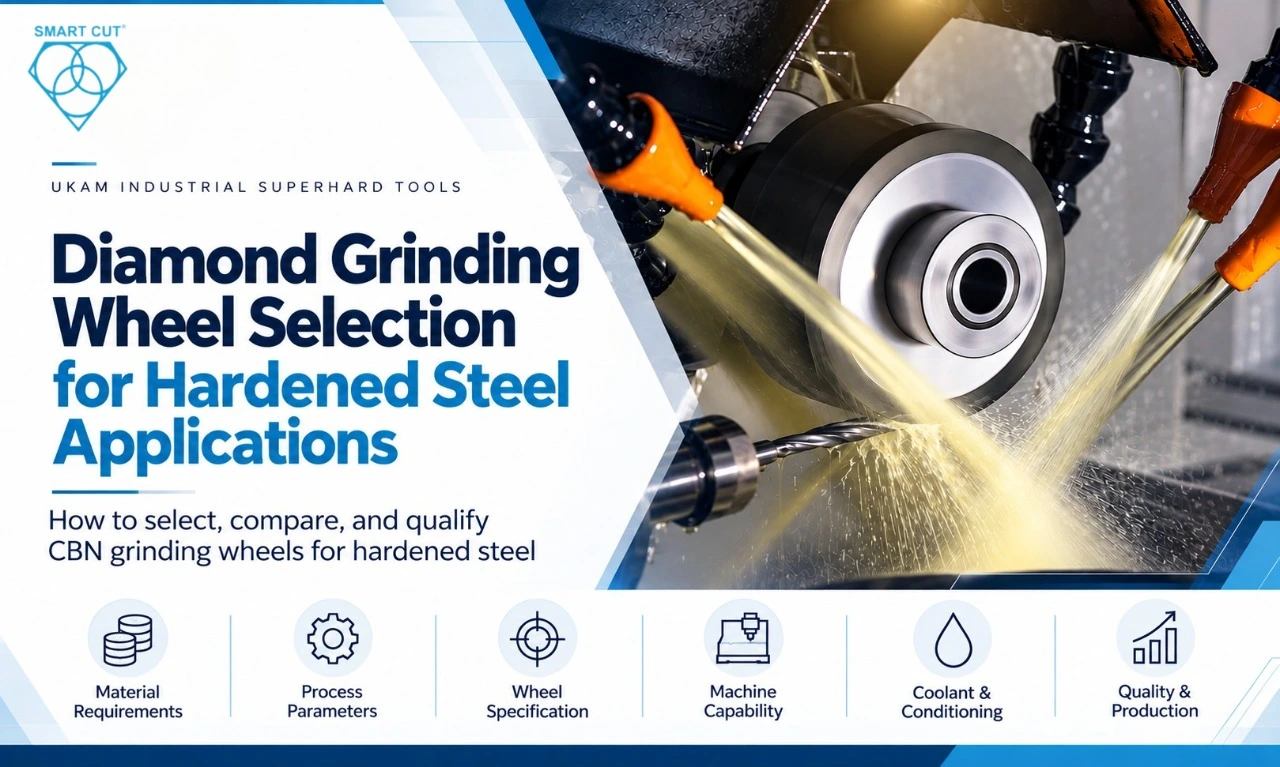
Matching the Diamond Grinding Wheel to Your Tungsten Carbide Application
Selecting the correct bond type, diamond grit size, and concentration establishes the foundation for successful grinding. However, achieving consistent production results requires matching those specifications to the actual carbide grade, machine capability, grinding operation, and production objective.
Two grinding wheels with identical specifications can perform very differently depending on the workpiece material, machine rigidity, coolant application, and process parameters. Successful grinding therefore depends on evaluating the entire grinding system, not just the wheel itself.
Step 4 – Understanding Tungsten Carbide Grades
Tungsten carbide is not a single material. It is a family of cemented carbide grades developed for different industrial applications.
Manufacturers adjust properties such as:
- Grain size
- Cobalt binder content
- Hardness
- Toughness
- Wear resistance
to achieve specific performance characteristics.
Because these properties vary significantly, grinding behavior also changes from one carbide grade to another.
For example:
- A fine-grain carbide used for precision cutting tools requires a different grinding strategy than
- A coarse-grain carbide used for mining tools or wear-resistant components.
Selecting one grinding wheel specification for every carbide application often produces inconsistent grinding performance and unnecessary qualification trials.
How Carbide Characteristics Affect Wheel Selection
|
Carbide Characteristic |
Grinding Consideration |
|---|---|
|
Fine grain carbide |
Finer diamond grit for improved surface finish |
|
Medium grain carbide |
Balanced grit for productivity and finish |
|
Coarse grain carbide |
Coarser grit for higher stock removal |
|
High hardness |
Longer grinding cycles may be required |
|
Tight dimensional tolerances |
Stable wheel specification becomes more important |
|
High production volume |
Wheel life and process stability become critical |
Rather than selecting a wheel based solely on hardness, engineers should consider how all material characteristics influence grinding behavior.
Engineering Tip
Material hardness alone should never determine wheel selection. Grain size, cobalt content, production volume, and dimensional requirements are equally important engineering considerations.
Step 5 – Evaluating Cobalt Binder Content
Cobalt functions as the metallic binder that holds tungsten carbide particles together.
Although it improves toughness and impact resistance, it also changes how the material behaves during grinding.
Understanding cobalt content helps engineers anticipate wheel loading, grinding forces, dressing frequency, and process stability.
Lower Cobalt Grades
Lower cobalt content generally produces:
- Higher hardness
- Greater wear resistance
- Lower wheel loading tendency
- Increased brittleness
- Greater sensitivity to grinding forces
These grades often benefit from:
- Finer diamond grits
- Controlled feed rates
- Stable grinding conditions
Higher Cobalt Grades
Higher cobalt content typically provides:
- Greater toughness
- Better impact resistance
- Higher tendency for wheel loading
- More frequent dressing requirements
- Increased importance of coolant delivery
Monitoring wheel condition becomes increasingly important when grinding carbide grades with higher cobalt percentages.
Engineering Note
Wheel loading is commonly associated with carbide grades containing higher cobalt content. Maintaining proper dressing intervals and selecting an appropriate bond system helps preserve cutting efficiency throughout production.
Step 6 – Match the Wheel to the Grinding Objective
Not every grinding operation has the same production priorities.
Some manufacturers focus on rapid stock removal, while others require exceptional dimensional accuracy or superior surface finish.
The wheel specification should always support the primary manufacturing objective rather than attempting to maximize every performance characteristic simultaneously.
|
Grinding Objective |
Grinding Objective |
|---|---|
|
Heavy stock removal |
Higher productivity |
|
General production |
Balanced performance |
|
Finish grinding |
Surface finish quality |
|
Precision tooling |
Edge integrity |
|
Profile grinding |
Dimensional stability |
|
High-volume manufacturing |
Wheel life and consistency |
No wheel specification performs optimally in every situation. The best choice is the one that aligns with the production requirements.
Machine Capability Matters
Grinding wheel performance depends not only on the wheel but also on the machine on which it operates.
A wheel that performs exceptionally well on a rigid CNC grinding center may produce inconsistent results on a manual machine with lower rigidity.
Machine capability influences:
- Wheel stability
- Grinding forces
- Surface finish
- Vibration
- Wheel wear
- Process repeatability
Engineers should evaluate machine capability before qualifying any new wheel specification.
Machine Qualification Checklist
Before installing a new wheel, verify:
- Spindle condition
- Wheel balance
- Machine rigidity
- Wheel flanges
- Coolant delivery
- Workholding stability
These inspections help eliminate machine-related variables during qualification.
Engineering Insight
Many grinding problems are initially blamed on the wheel specification when the underlying cause is spindle vibration, poor workholding, or inadequate machine rigidity.
Selecting the Right Wheel for Different Grinding Operations
The contact conditions between the wheel and the workpiece vary depending on the grinding process.
Understanding these differences helps engineers choose a specification that delivers predictable performance.
Surface Grinding
Typical priorities include:
- Flatness
- Surface finish
- Dimensional accuracy
- Controlled heat generation
Common applications:
- Wear plates
- Carbide inserts
- Precision fixtures
- Flat tooling components
Cylindrical Grinding
Engineers should consider:
Stable wheel geometry becomes increasingly important during long production runs.
- Continuous contact length
- Roundness
- Heat accumulation
- Surface integrity
- Dimensional consistency
Tool & Cutter Grinding
Grinding carbide cutting tools requires balancing:
- Stock removal
- Edge sharpness
- Surface finish
- Dimensional accuracy
Typical applications include:
- End mills
- Reamers
- Drills
- Router tools
- Burrs
- Form tools
Because cutting-edge quality directly influences tool performance, wheel specification becomes especially critical in these applications.
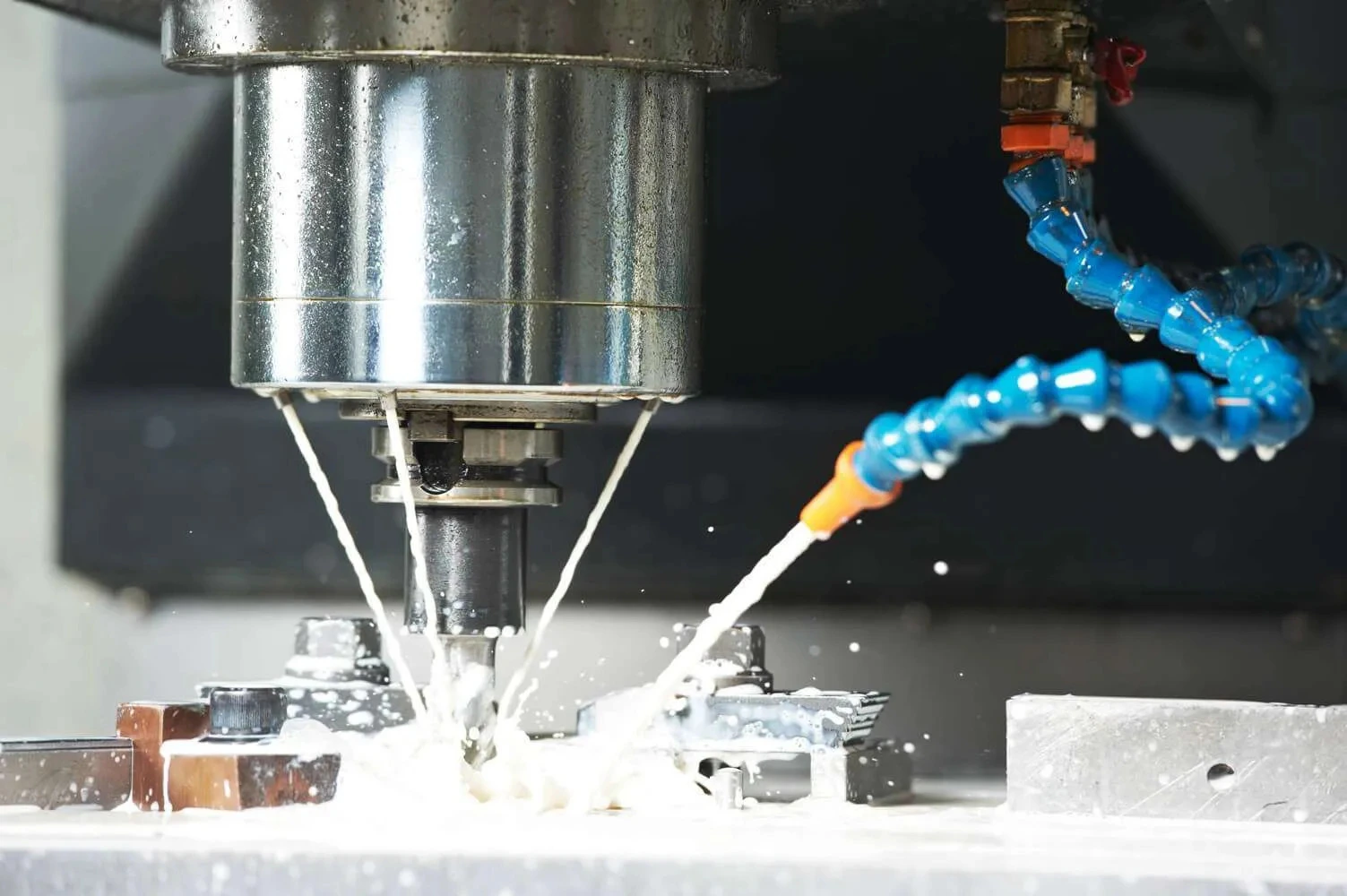
Coolant: One of the Most Overlooked Process Variables
Grinding tungsten carbide generates localized heat at the wheel-workpiece interface.
Even when using an appropriate diamond wheel specification, inadequate coolant application can contribute to:
- Thermal damage
- Wheel loading
- Accelerated wheel wear
- Reduced surface quality
- Inconsistent dimensional accuracy
An effective coolant system helps:
- Remove grinding heat
- Flush grinding swarf
- Reduce wheel loading
- Improve surface finish
- Extend wheel life
- Stabilize the grinding process
Coolant should be directed into the grinding zone—not simply sprayed onto the rotating wheel.
Engineering Tip
Increasing coolant volume is not always the solution. Proper nozzle placement and directing coolant into the wheel-workpiece interface often provide greater improvements than simply increasing flow rate.
Dressing and Wheel Conditioning
Diamond grinding wheels require periodic conditioning to maintain cutting efficiency and dimensional accuracy.
Wheel conditioning helps to:
- Restore wheel geometry
- Remove loaded material
- Expose fresh diamond particles
- Reduce grinding forces
- Improve surface finish
Rather than dressing on a fixed schedule, engineers should monitor wheel performance and dress when process indicators suggest reduced cutting efficiency.
Common signs include:
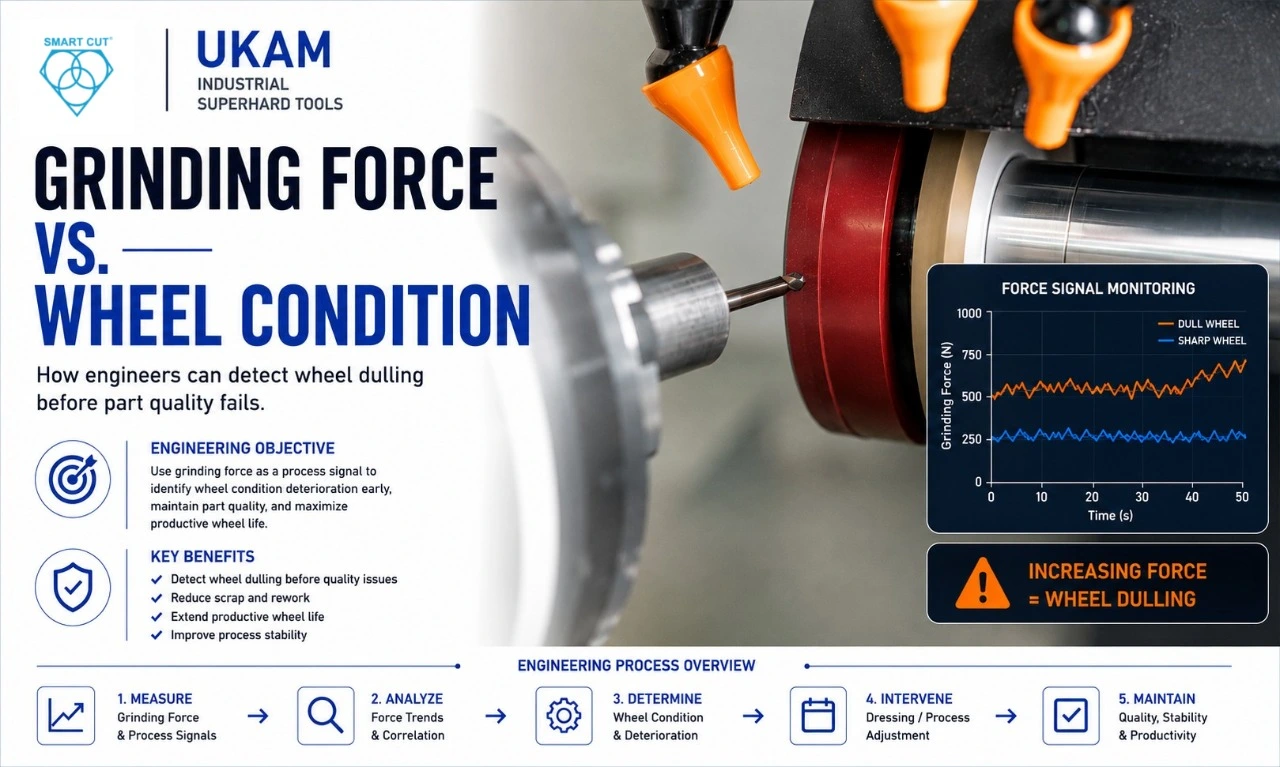
- Increased spindle load
- Poor surface finish
- Higher grinding temperatures
- Wheel glazing
- Increased grinding forces
Common Mistake
Increasing feed rate to compensate for a glazed wheel often increases grinding temperatures and accelerates wheel wear. In many cases, the correct solution is wheel conditioning or specification review—not more aggressive machining parameters.
Preparing for Production Qualification
Before approving a grinding wheel specification for full production, manufacturers should verify that the wheel consistently meets process requirements under actual operating conditions.
Successful qualification should confirm:
- Stable surface finish
- Predictable wheel wear
- Consistent dimensional accuracy
- Repeatable grinding performance
- Acceptable dressing intervals
- Improved cost per finished component
Documenting these results creates a repeatable process that can be applied across future production runs and simplifies future wheel qualification projects.
Engineering Qualification: Validating Wheel Performance Before Production
Selecting the correct diamond grinding wheel is only the first step. Before a wheel specification is approved for production, it should be validated under actual operating conditions to ensure it consistently meets process requirements.
Production qualification helps manufacturers:
- Reduce process variation
- Improve repeatability
- Minimize scrap
- Optimize wheel life
- Reduce unplanned downtime
- Establish documented machining parameters
Rather than relying on operator experience or isolated production trials, successful qualification follows a structured engineering process based on measurable performance data.
Diamond Grinding Wheel Qualification Checklist
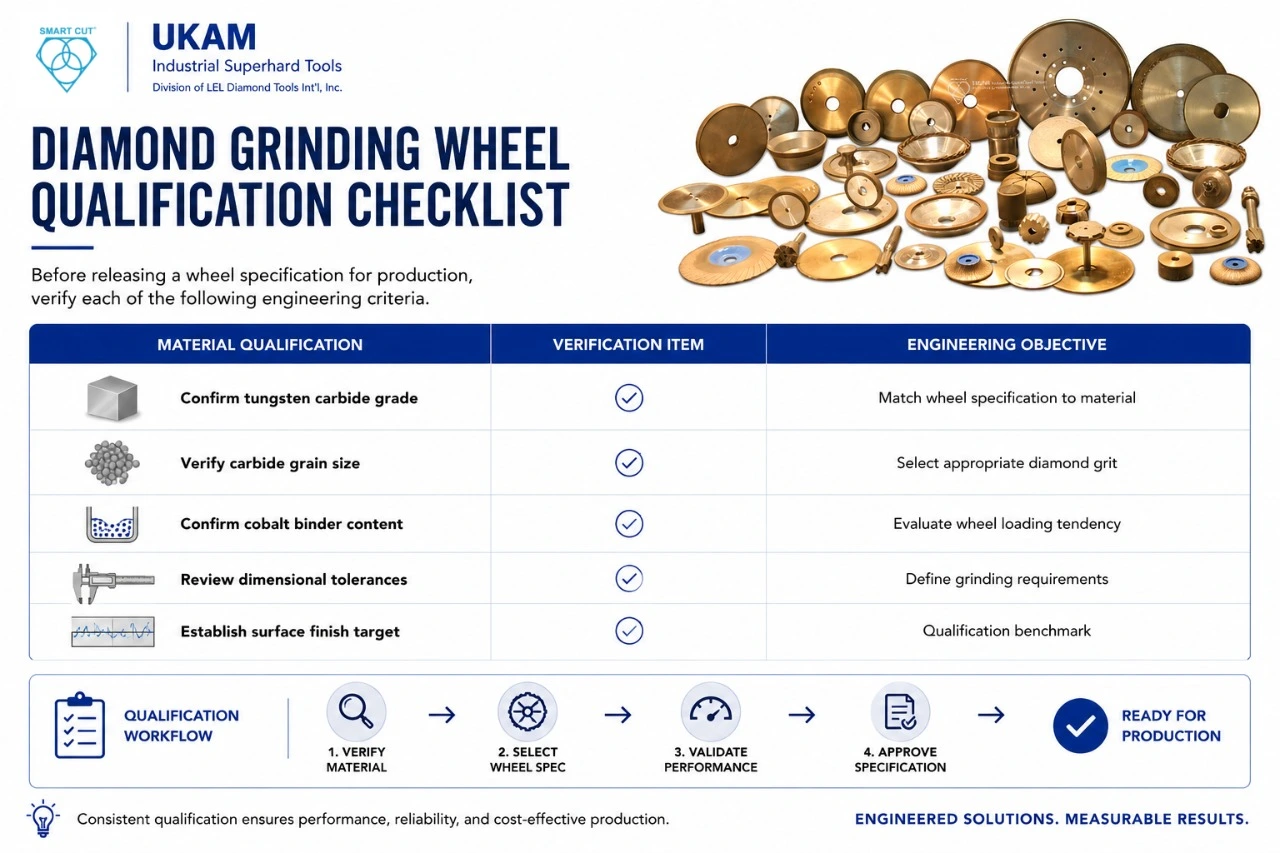
Before releasing a wheel specification for production, verify each of the following engineering criteria.
Material Qualification
|
Verification Item |
Engineering Objective |
|---|---|
|
Confirm tungsten carbide grade |
Match wheel specification to material |
|
Verify carbide grain size |
Select appropriate diamond grit |
|
Confirm cobalt binder content |
Evaluate wheel loading tendency |
|
Review dimensional tolerances |
Define grinding requirements |
|
Establish surface finish target |
Qualification benchmark |
Machine Qualification
|
Verification Item |
Engineering Objective |
|---|---|
|
Inspect spindle runout |
Minimize vibration |
|
Verify wheel balance |
Improve grinding stability |
|
Confirm machine rigidity |
Maintain dimensional accuracy |
|
Inspect wheel flanges |
Prevent wheel misalignment |
|
Verify coolant delivery |
Control grinding temperature |
|
Confirm workholding |
Reduce vibration and deflection |
Grinding Wheel Qualification
|
Verification Item |
Engineering Objective |
|---|---|
|
Verify bond type |
Match grinding objective |
|
Confirm diamond grit |
Achieve required finish |
|
Verify concentration |
Balance wheel life and productivity |
|
Confirm wheel dimensions |
Ensure machine compatibility |
|
Inspect wheel condition |
Detect handling damage |
|
Verify wheel balance |
Improve process consistency |
Process Qualification
|
Verification Item |
Engineering Objective |
|---|---|
|
Record wheel wear |
Compare wheel performance |
|
Measure grinding forces |
Evaluate cutting efficiency |
|
Record dressing interval |
Monitor wheel condition |
|
Measure surface finish |
Verify quality |
|
Measure dimensional accuracy |
Confirm process capability |
|
Calculate cost per finished component |
Compare manufacturing efficiency |
Engineering Tip
Qualification should be completed using normal production conditions—not laboratory conditions. The objective is to verify stable, repeatable performance during actual manufacturing operations.
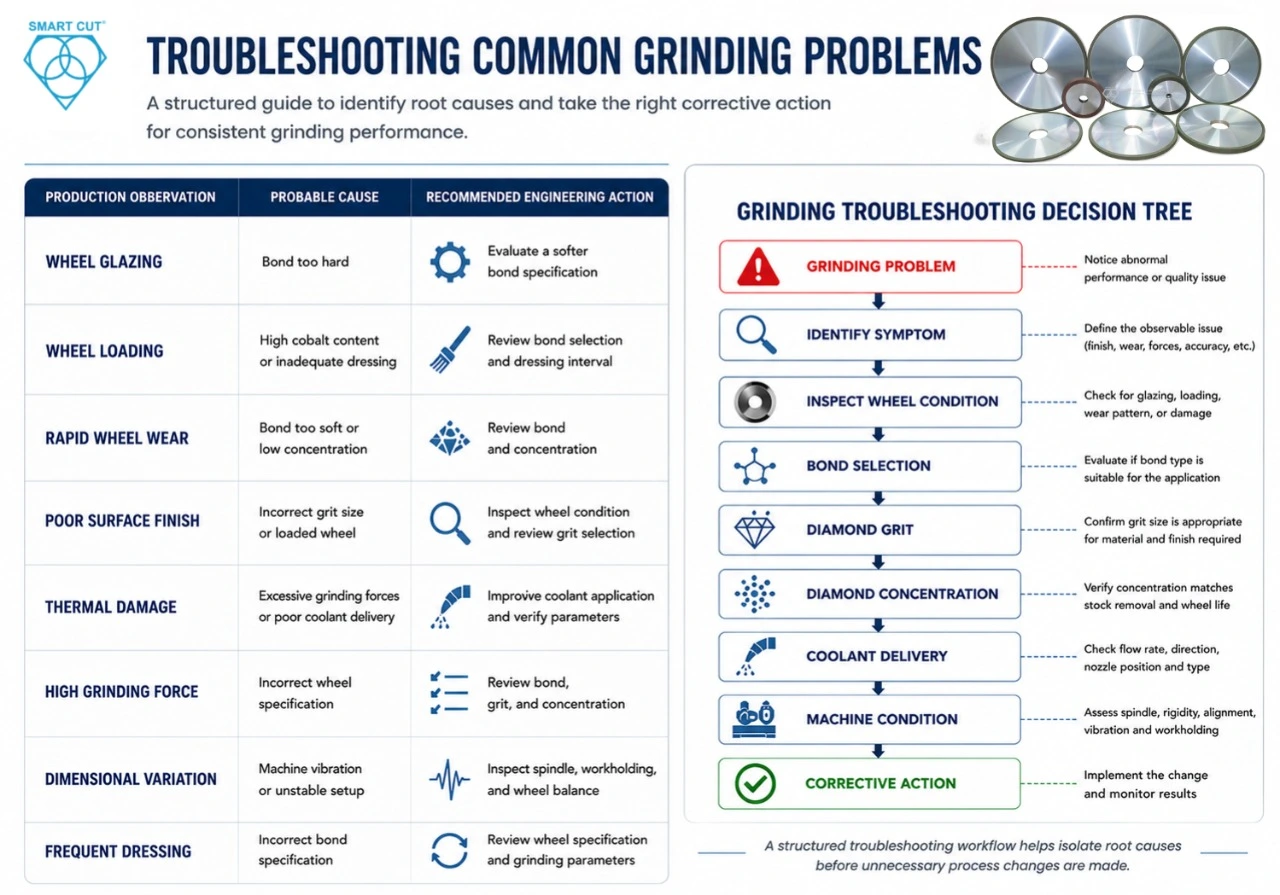
Troubleshooting Common Grinding Problems
Grinding performance is influenced by numerous interacting variables. When problems occur, the root cause often involves the entire grinding system rather than a single component.
The following troubleshooting guide provides a structured starting point for identifying and correcting common production issues.
|
Production Observation |
Probable Cause |
Recommended Engineering Action |
|---|---|---|
|
Wheel glazing |
Bond too hard |
Evaluate a softer bond specification |
|
Wheel loading |
High cobalt content or inadequate dressing |
Review bond selection and dressing interval |
|
Rapid wheel wear |
Bond too soft or low concentration |
Review bond and concentration |
|
Poor surface finish |
Incorrect grit size or loaded wheel |
Inspect wheel condition and review grit selection |
|
Thermal damage |
Excessive grinding forces or poor coolant delivery |
Improve coolant application and verify parameters |
|
High grinding force |
Incorrect wheel specification |
Review bond, grit, and concentration |
|
Dimensional variation |
Machine vibration or unstable setup |
Inspect spindle, workholding, and wheel balance |
|
Frequent dressing |
Incorrect bond specification |
Review wheel specification and grinding parameters |
Evaluating Grinding Wheels Beyond Purchase Price
The lowest-cost grinding wheel is not always the most economical choice.
Experienced manufacturing engineers evaluate the total cost of the grinding process, considering factors that influence long-term productivity and manufacturing efficiency.
Important performance metrics include:
- Wheel life
- Dressing frequency
- Grinding cycle time
- Surface finish consistency
- Dimensional repeatability
- Machine downtime
- Scrap rate
- Cost per finished component
A wheel with a higher purchase price may reduce total manufacturing cost by improving process stability, reducing downtime, and extending service life. Comparing wheels based on cost per finished component provides a more meaningful measure of economic performance than purchase price alone.
Engineering Insight
Purchasing departments often compare wheel prices. Manufacturing engineers compare cost per finished component because it reflects the true economic impact of the grinding process.
Choosing the Right Grinding Wheel Supplier
Selecting a grinding wheel supplier involves more than comparing product catalogs. Engineering support, customization capabilities, and application knowledge often determine the success of a qualification project.
When evaluating a supplier, consider asking:
|
Evaluation Question |
Why It Matters |
|---|---|
|
Do you manufacture your own grinding wheels? |
Indicates manufacturing control and consistency |
|
Can wheel specifications be customized? |
Supports application-specific optimization |
|
Which bond systems are available? |
Determines application flexibility |
|
Can you recommend grinding parameters? |
Demonstrates practical engineering experience |
|
Can custom wheel profiles be produced? |
Supports specialized applications |
|
Is technical documentation available? |
Assists process validation and traceability |
Manufacturers that provide engineering consultation in addition to standard products can often help reduce qualification time and improve long-term process consistency.
Engineering Best Practices
Consistent grinding performance depends on controlling the complete process—not optimizing a single variable.
The following practices help improve repeatability across a wide range of tungsten carbide applications:
- Document baseline grinding parameters before changing wheel specifications.
- Select the wheel according to carbide grade and production objectives.
- Match bond type to the grinding application.
- Choose diamond grit based on the required surface finish and stock removal rate.
- Verify machine condition and wheel balance before production.
- Deliver coolant directly into the grinding zone.
- Monitor wheel wear and dressing intervals regularly.
- Record qualification data to support future process optimization.
- Compare wheel performance using cost per finished component rather than purchase price.
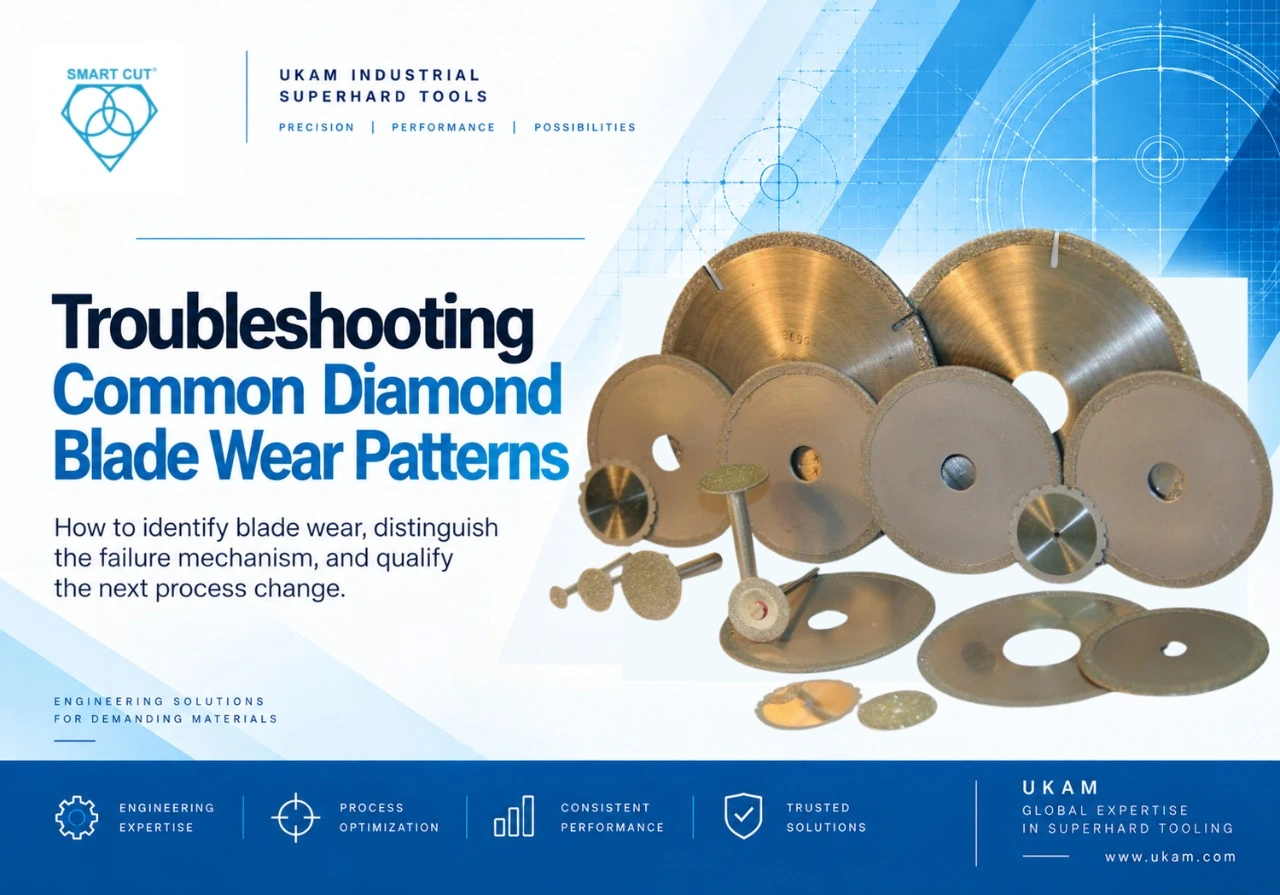
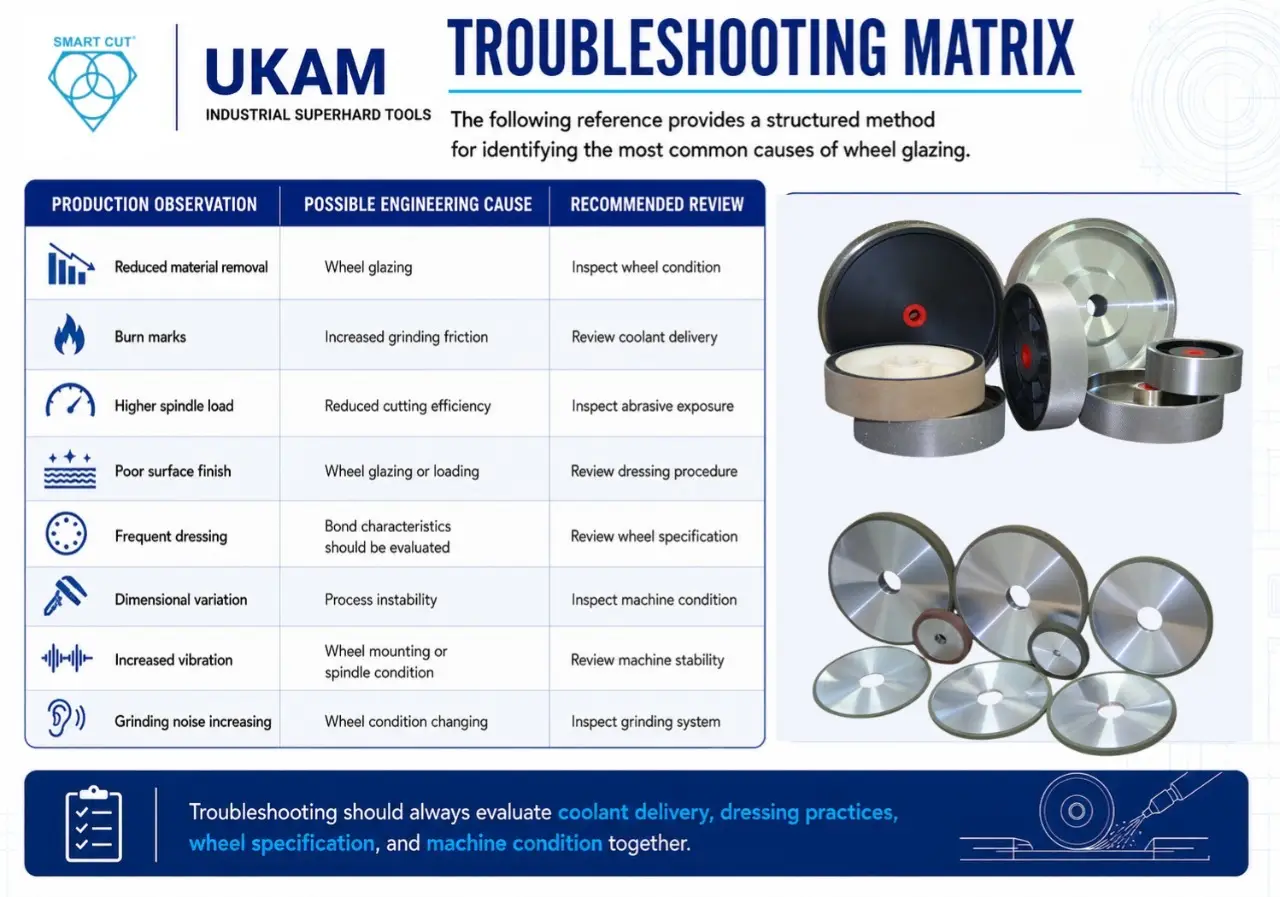
Troubleshooting Matrix
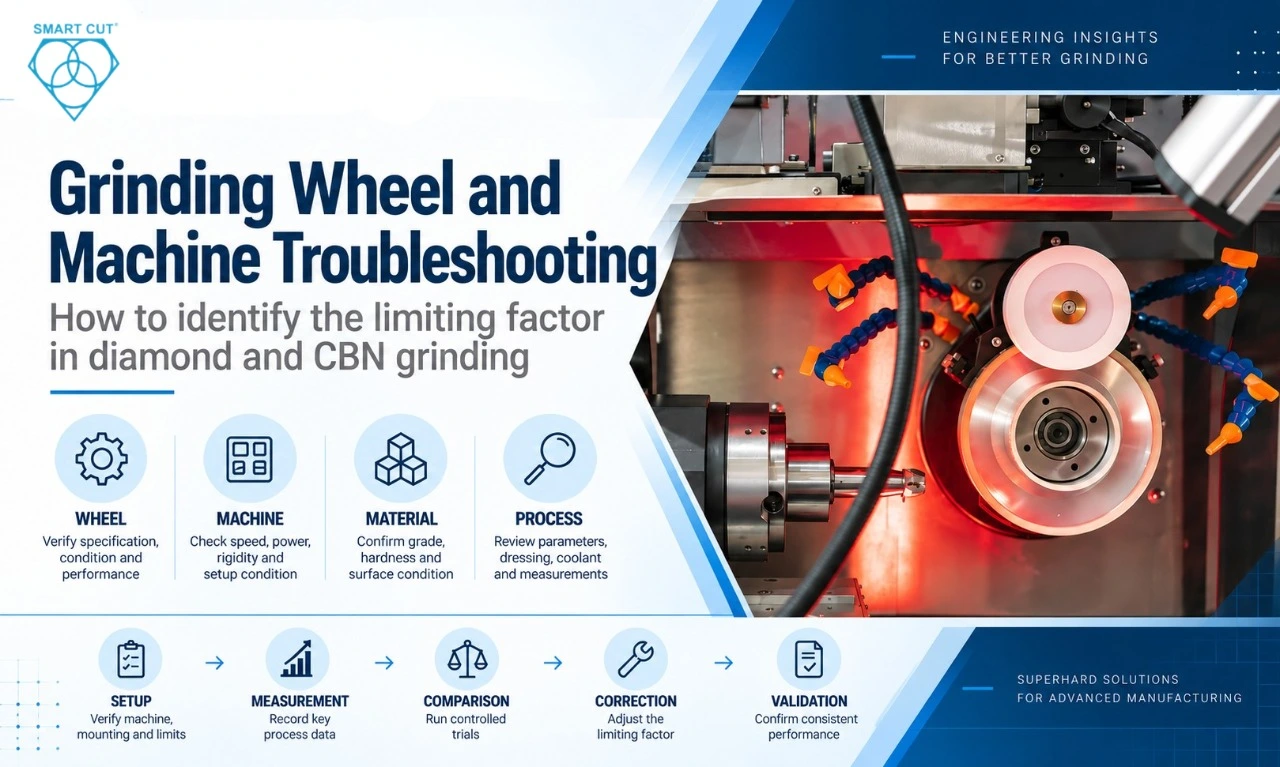
The following reference provides a structured method for identifying the most common causes of wheel glazing. For a step-by-step diagnostic walkthrough, see UKAM’s Diamond & CBN Wheel Troubleshooting Guide.
Frequently Asked Questions
No. Tungsten carbide typically requires diamond abrasives because conventional abrasives wear rapidly and cannot maintain efficient cutting performance in precision grinding applications.
There is no universal answer. Resin bond wheels are commonly selected for finish grinding and excellent surface quality, while metal bond wheels are often preferred for heavy stock removal and long production runs. Hybrid and vitrified bonds may also be appropriate depending on the application.
Coarser grits generally increase material removal rates, while finer grits improve surface finish and edge quality. The appropriate grit depends on the grinding objective and production requirements.
Wheel glazing develops when worn diamond particles remain embedded in the bond rather than exposing fresh cutting edges. Bond selection, dressing practices, and grinding parameters should all be evaluated when glazing occurs.
Wheel loading is often associated with carbide grades containing higher cobalt binder content. Appropriate bond selection, regular dressing, and effective coolant delivery help maintain cutting efficiency.
Purchase price alone does not reflect manufacturing efficiency. Evaluating tooling cost together with wheel life, productivity, downtime, scrap rate, and process stability provides a more complete picture of total grinding cost.
Requalification should be considered whenever there are changes to carbide grade, production volume, machine configuration, dimensional tolerances, or when grinding performance begins to decline.
Key Engineering Takeaways
Successful tungsten carbide grinding depends on selecting and qualifying the complete grinding system—not just the wheel.
Remember these principles:
- Select wheels according to carbide grade and production objectives.
- Match bond type to the grinding application.
- Choose grit size based on stock removal and finish requirements.
- Balance diamond concentration with productivity and wheel life.
- Verify machine capability before changing wheel specifications.
- Optimize coolant delivery and dressing practices.
- Validate wheel performance through documented qualification trials.
- Measure success using cost per finished component, not purchase price.
Conclusion
Selecting the best diamond grinding wheel for tungsten carbide requires more than choosing the hardest abrasive or the most popular bond type. Successful grinding depends on understanding how carbide grade, cobalt binder content, bond system, diamond grit size, concentration, machine capability, coolant delivery, and production objectives interact as a complete engineering system.
By following a structured qualification process, documenting baseline process conditions, and evaluating performance using measurable production data, manufacturers can improve process stability, reduce wheel consumption, maintain consistent dimensional accuracy, and optimize overall manufacturing efficiency.
Ultimately, the most effective grinding wheel is not the one with the lowest purchase price—it is the one that consistently delivers the best balance of productivity, quality, wheel life, and cost per finished component for the specific application.
Need Assistance Selecting the Right Diamond Grinding Wheel?
Every grinding application is unique. Factors such as carbide grade, machine configuration, production volume, required tolerances, and surface finish all influence the ideal wheel specification.
If you’re evaluating a new grinding process or optimizing an existing one, UKAM Industrial Superhard Tools offers standard and custom diamond grinding wheel solutions along with application engineering support to help match the appropriate wheel specification to your manufacturing requirements.
Trusted by Tens of Thousands of Manufacturers, Laboratories,
Research Institutions Worldwide Since 1990
American Based Manufacturer
Established in 1990
Custom manufacturing
RELATED ARTICLES