




















Understanding Diamond Crystal Concentration: Balancing Cutting Speed, Tool Life & Cost
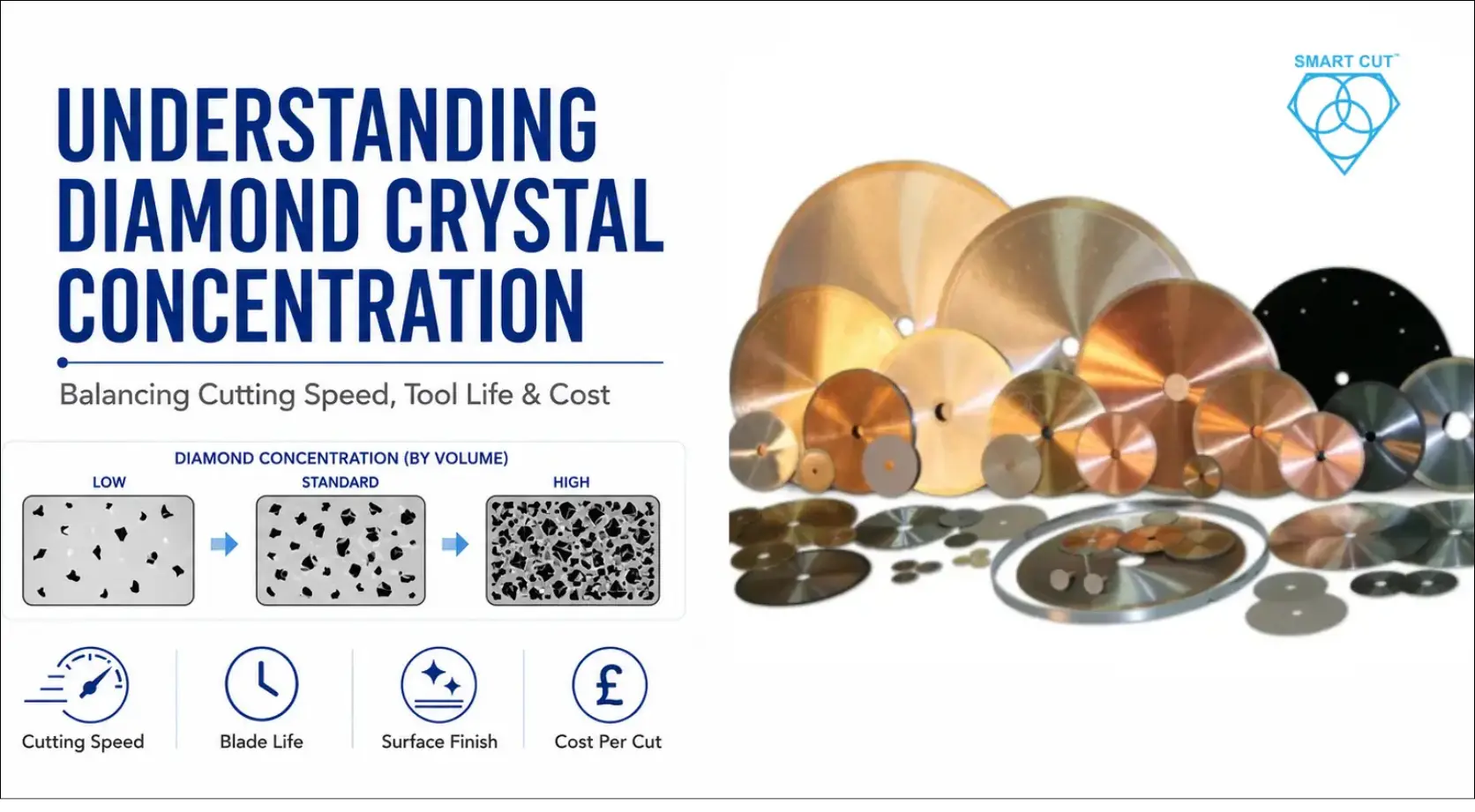
Table of Contents
ToggleDiamond crystal concentration is one of the most important and one of the most misunderstood specifications in diamond blade selection.
Many users assume that a blade with a higher diamond concentration will always cut faster, last longer, and produce superior results. In reality, concentration is only one component of an engineered cutting system, and increasing it without considering bond hardness, grit size, material properties, spindle speed, feed rate, coolant performance, and machine rigidity can reduce cutting efficiency rather than improve it.
A blade with an excessively high concentration may generate greater friction, retain more heat, require more dressing, and even cut more slowly than a blade with a lower concentration that is properly matched to the application. Likewise, a blade with too few diamonds may cut aggressively at first but wear prematurely because individual diamond particles carry excessive cutting loads.
Selecting the correct concentration is therefore an engineering optimization exercise rather than a simple decision to maximize the amount of diamond in the blade.
This becomes particularly important when precision cutting expensive or difficult-to-machine materials such as:
- Silicon wafers
- Sapphire
- Quartz
- Technical ceramics
- Tungsten carbide
- Silicon carbide
- Glass
- Composite materials
- Semiconductor packages
- Metallographic specimens
- Advanced aerospace materials
In these applications, concentration directly influences:
- Cutting speed
- Blade life
- Surface finish
- Edge quality
- Cutting forces
- Heat generation
- Blade stiffness
- Dressing frequency
- Overall cost per cut
Understanding how concentration affects these variables allows engineers to select tooling that maximizes productivity while maintaining dimensional accuracy and minimizing consumable costs.
This guide explains the engineering principles behind diamond crystal concentration, dispels common misconceptions, and provides practical guidance for selecting the appropriate concentration for different cutting applications.
Trusted by Tens of Thousands of Manufacturers, Laboratories Research Institutions Worldwide Since 1990

American Based Manufacturer

Established in 1990


Custom manufacturing


Understanding Diamond Crystal Concentration
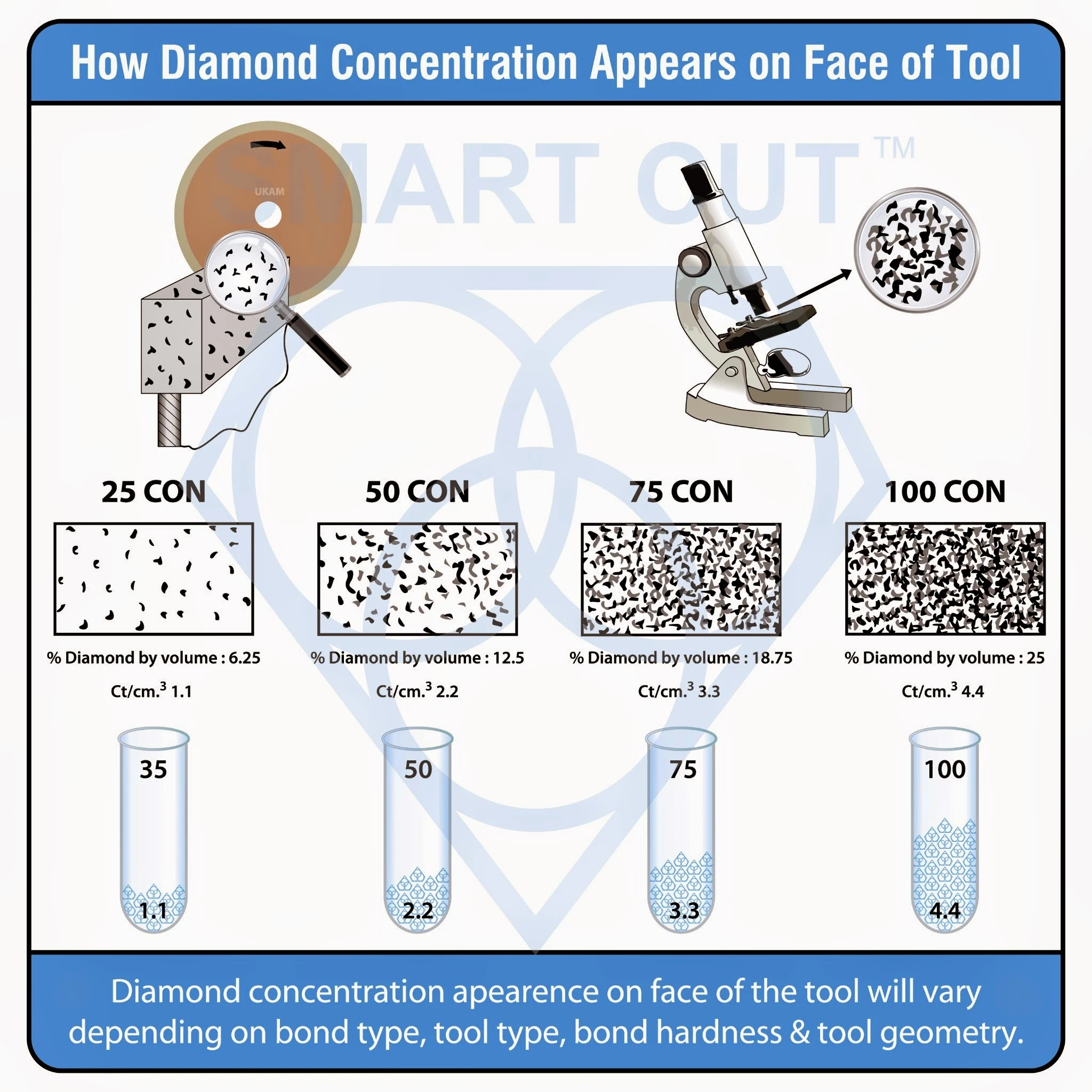
Before discussing how concentration influences cutting performance, it is important to understand what the specification actually represents.
Diamond concentration does not describe the quality of the diamonds, their size, or their cutting ability.
Instead, it defines the quantity of diamond abrasive contained within a given volume of bond material.
Every precision diamond blade consists of three primary components:
- Diamond abrasive crystals
- Bond matrix
- Steel core
The diamonds perform the cutting.
The bond supports and retains the diamonds.
The steel core provides structural rigidity and dimensional stability.
Diamond concentration determines how many abrasive particles are distributed throughout the bond matrix.
Changing this distribution alters how cutting forces are shared between individual diamonds and significantly influences blade behavior throughout its service life.
For this reason, concentration should always be evaluated together with:
- Bond hardness
- Diamond grit size
- Material properties
- Feed rate
- Spindle speed
- Coolant delivery
- Machine rigidity
Treating concentration as an isolated specification often results in incorrect blade selection.
How Is Diamond Concentration Measured?
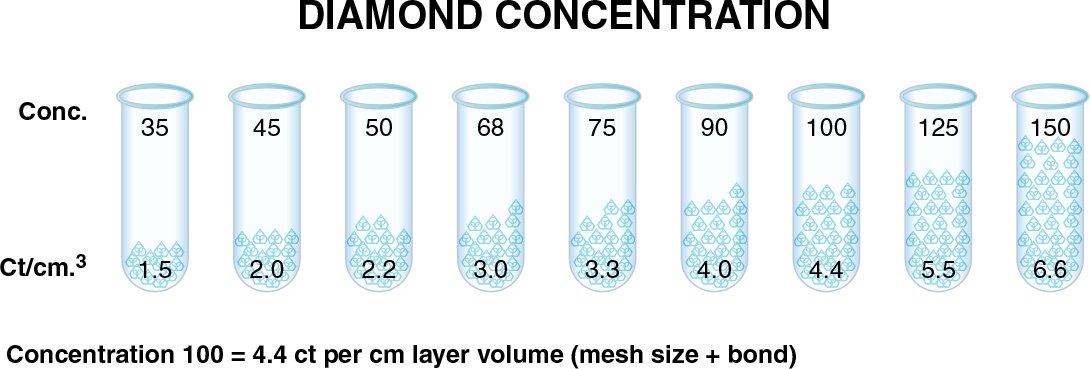
The diamond tooling industry typically expresses concentration using standardized concentration values rather than percentages.
This terminology often confuses.
Many users incorrectly assume that a blade labeled 100 concentration contains 100% diamond.
This is not the case.
Industry concentration values are reference standards used to describe the relative quantity of diamond within the bond matrix.
Higher concentration numbers simply indicate that more diamond crystals occupy a given volume of bond material than lower concentration numbers.
The concentration value itself does not indicate:
- Diamond quality
- Diamond size
- Diamond hardness
- Cutting speed
- Blade life
Those characteristics depend on the complete blade design rather than concentration alone.
Standard Diamond Concentration Levels
Diamond tools are commonly manufactured using standardized concentration values that represent the relative volume of diamond abrasive within the bond matrix. While exact formulations vary between manufacturers and applications, these concentration grades provide engineers with a useful reference when selecting tooling for different cutting objectives.
| Concentration | Relative Diamond Content | Relative Diamond Content |
|---|---|---|
| 25 | Very Low | Specialty applications requiring aggressive cutting or low diamond density |
| 50 | Low | Softer materials, rapid stock removal, economical production |
| 75 | Medium-Low | General-purpose cutting where balanced performance is desired |
| 100 | Standard | The most widely used concentration for precision cutting across a broad range of materials |
| 125 | High | Abrasive materials requiring extended blade life and improved wear resistance |
| 150 | Very High | Specialized production applications where maximum diamond distribution is beneficial |
No single concentration is universally superior. The optimum selection depends on the material being cut, bond formulation, grit size, cutting parameters, and the required balance between cutting speed, blade life, and surface quality.
Why More Diamonds Are Not Always Better
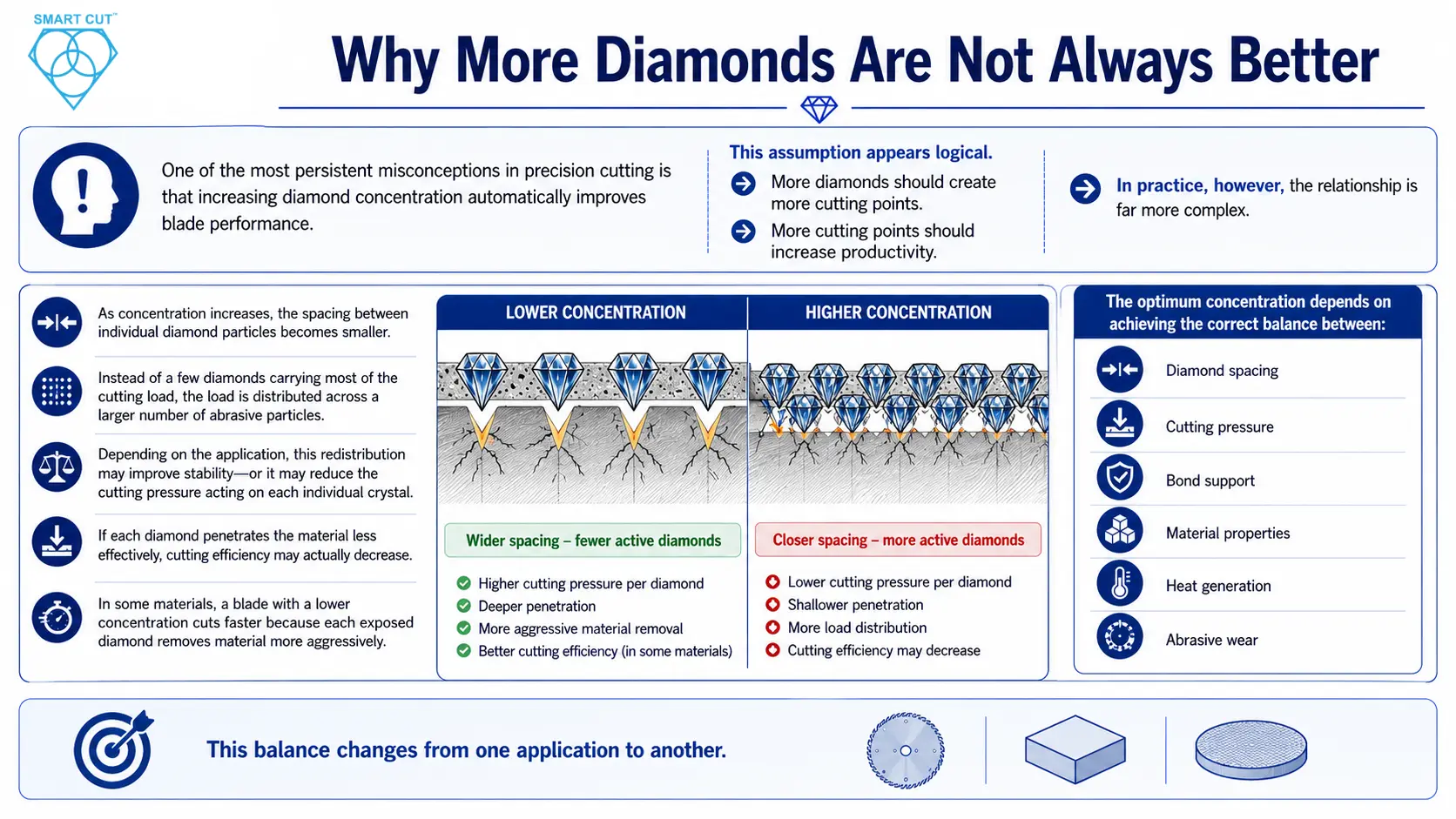
One of the most persistent misconceptions in precision cutting is that increasing diamond concentration automatically improves blade performance.
This assumption appears logical.
More diamonds should create more cutting points.
More cutting points should increase productivity.
In practice, however, the relationship is far more complex.
As concentration increases, the spacing between individual diamond particles becomes smaller.
Instead of a few diamonds carrying most of the cutting load, the load is distributed across a larger number of abrasive particles.
Depending on the application, this redistribution may improve stability—or it may reduce the cutting pressure acting on each individual crystal.
If each diamond penetrates the material less effectively, cutting efficiency may actually decrease.
In some materials, a blade with a lower concentration cuts faster because each exposed diamond removes material more aggressively.
The optimum concentration, therefore, depends on achieving the correct balance between:
- Diamond spacing
- Cutting pressure
- Bond support
- Material properties
- Heat generation
- Abrasive wear
This balance changes from one application to another.
How Diamond Concentration Influences the Cutting Process
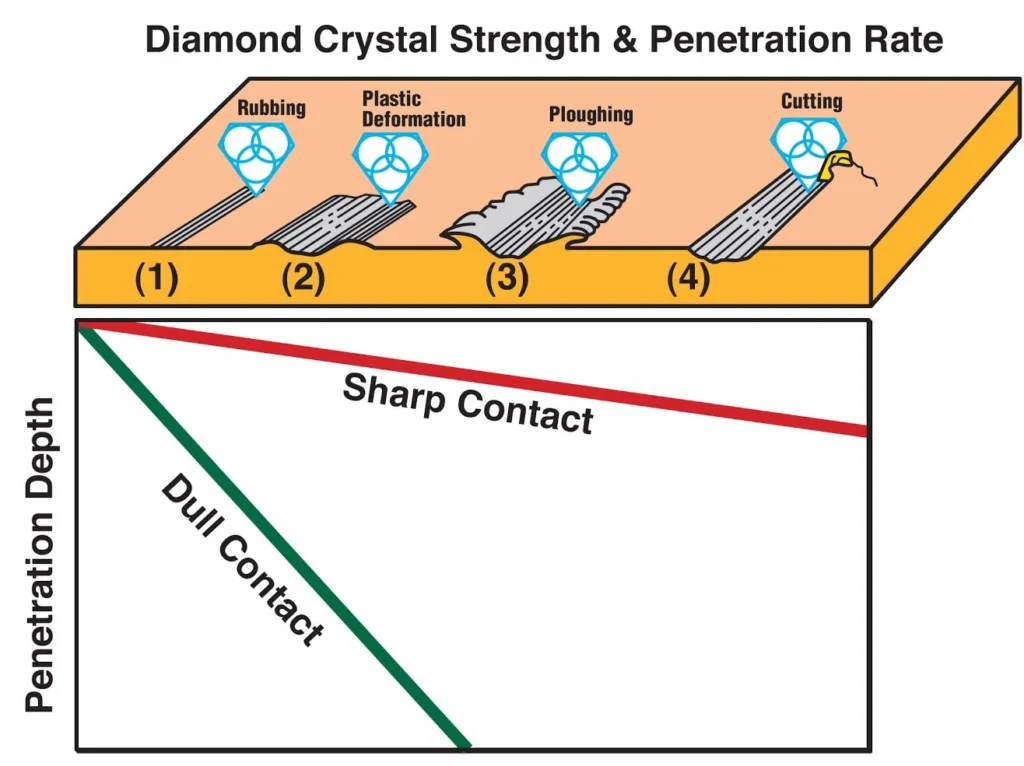
Every exposed diamond crystal functions as an individual cutting tool.
During rotation, each crystal enters the workpiece, removes material, and exits the cutting zone.
The cutting force acting on each diamond depends largely on how many neighboring diamonds share the load.
With relatively low concentrations:
- Fewer diamonds engage the material simultaneously.
- Each diamond experiences higher mechanical loading.
- Material penetration tends to be deeper.
- Material removal can become more aggressive.
With higher concentrations:
- More diamonds engage simultaneously.
- Cutting forces are distributed across additional particles.
- Individual penetration depth decreases.
- Cutting action often becomes smoother and more controlled.
Neither condition is universally better.
The optimum concentration depends on the objectives of the cutting operation.
Applications prioritizing maximum productivity may require a different concentration than applications emphasizing:
- Low subsurface damage
- Superior surface finish
- Minimal edge chipping
- Dimensional precision
- Long blade life
Successful blade design, therefore, balances concentration with every other component of the cutting system.
The Microscopic Mechanics of Diamond Concentration
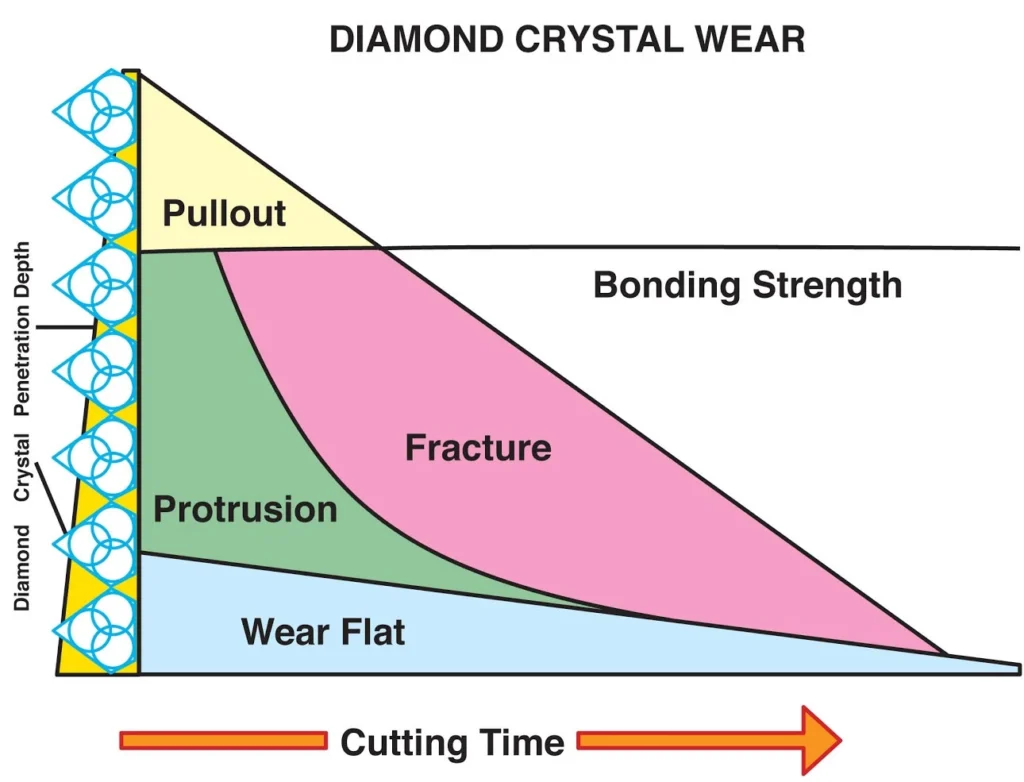
At the microscopic level, the cutting process is governed by the interaction between thousands of individual diamond crystals and the workpiece.
Each crystal experiences repeated cycles of:
- Compression
- Shearing
- Friction
- Thermal loading
- Impact
As these forces accumulate, diamonds gradually develop microscopic wear flats before eventually fracturing or becoming dull.
The bond surrounding each crystal then wears away under controlled conditions, exposing fresh abrasive particles.
Diamond concentration influences how this entire self-renewing process occurs.
With low concentrations, larger spacing between diamonds means each particle removes a greater volume of material.
While this often increases cutting aggressiveness, it also subjects each crystal to higher stresses, which may accelerate wear or increase the likelihood of premature pull-out if the bond does not provide sufficient support.
Higher concentrations distribute the cutting load more evenly across the blade.
Individual diamonds experience lower forces, reducing localized stress and often improving dimensional stability.
However, if concentration becomes excessively high for the application, the reduced penetration of each abrasive particle may increase rubbing instead of cutting.
This can lead to:
- Higher friction
- Increased heat generation
- Greater glazing tendency
- Reduced cutting efficiency
The goal is therefore not to maximize concentration, but to achieve the correct balance between diamond exposure, cutting pressure, and controlled bond wear.
Why Concentration Is Only One Part of Blade Engineering
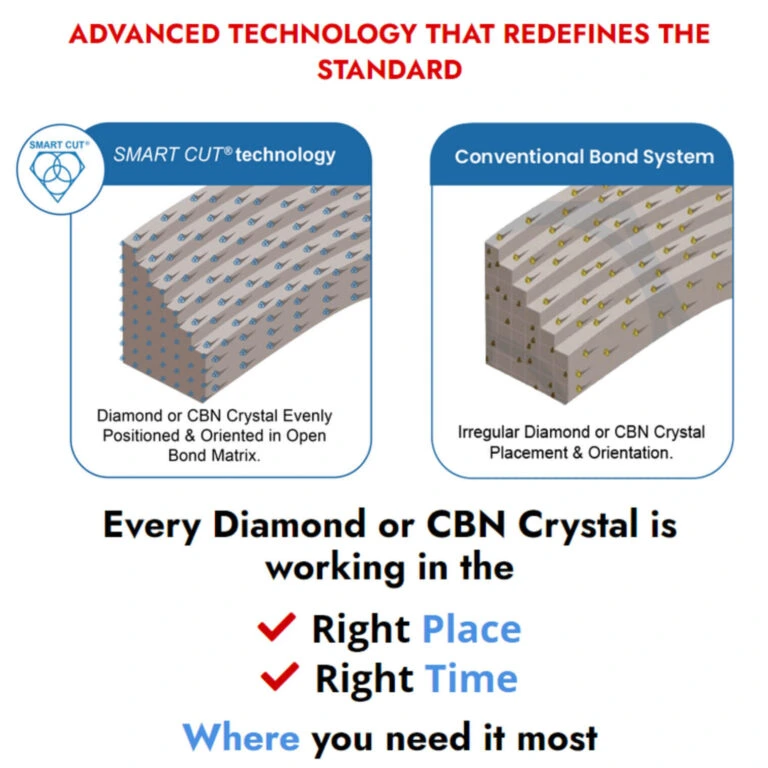
Diamond concentration should never be selected independently.
A concentration that performs exceptionally well in one application may perform poorly in another because its interaction with the rest of the blade changes.
Successful blade design depends on balancing concentration with:
- Bond hardness
- Diamond grit size
- Blade thickness
- Material abrasiveness
- Material toughness
- Feed rate
- Spindle speed
- Coolant effectiveness
For example, increasing concentration while leaving every other parameter unchanged may require an entirely different bond formulation to maintain efficient diamond exposure.
Likewise, changing grit size without adjusting concentration can significantly alter cutting forces and blade wear characteristics.
Experienced applications engineers therefore evaluate concentration as part of an integrated cutting system rather than as a standalone specification.
Understanding these interactions is essential for selecting a blade that delivers the desired balance between cutting speed, blade life, surface integrity, and operating cost.
Diamond Concentration vs. Cutting Speed
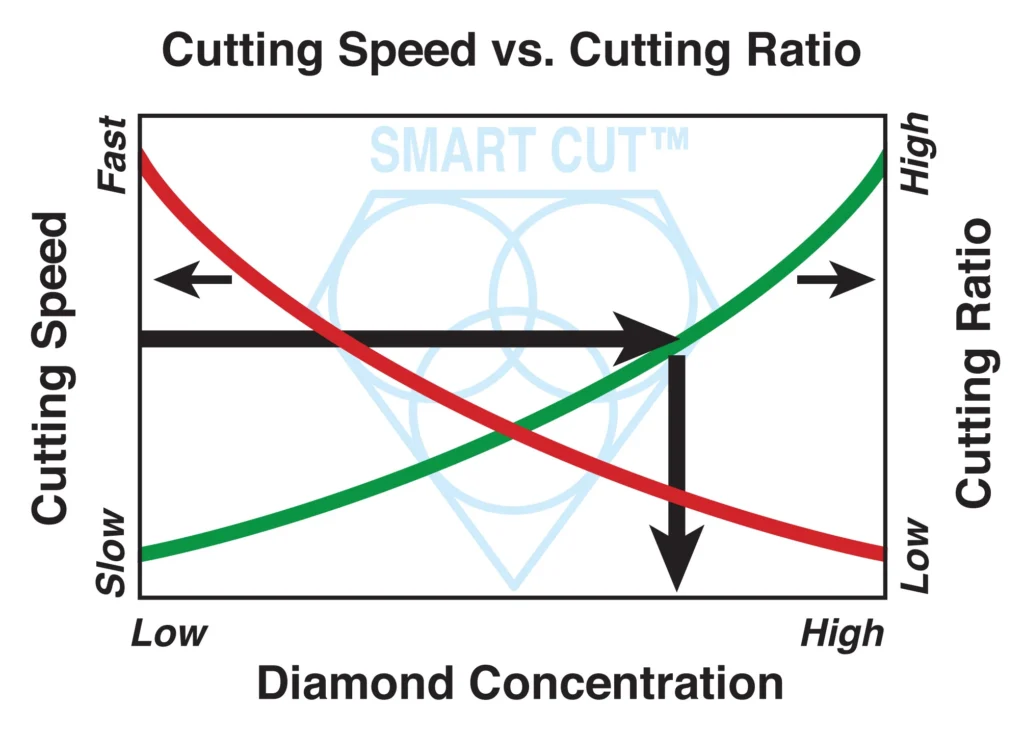
One of the most common assumptions in precision cutting is that increasing diamond concentration automatically increases cutting speed. While this may appear logical, the relationship between concentration and cutting efficiency is considerably more complex.
Cutting speed depends on how effectively each exposed diamond particle penetrates the workpiece and removes material. Increasing the number of diamond crystals does not necessarily increase penetration. In some applications, adding more diamonds actually reduces the cutting load carried by each crystal.
When individual diamonds carry less load, they may penetrate the material less aggressively. Instead of efficiently fracturing or shearing the workpiece, they begin sliding across the surface. This increases rubbing rather than cutting.
As a result, extremely high concentrations may produce:
- Lower instantaneous material removal rates
- Increased friction
- Higher cutting temperatures
- Greater tendency for blade glazing
- Reduced cutting efficiency
Conversely, concentrations that are too low place excessive loads on individual diamonds. Although initial cutting may appear aggressive, rapid abrasive wear can shorten blade life and reduce process stability.
The optimum concentration is therefore the one that allows each diamond particle to operate within its most efficient cutting range rather than simply maximizing the number of diamonds inside the blade.
Why Higher Diamond Concentration Sometimes Cuts Slower
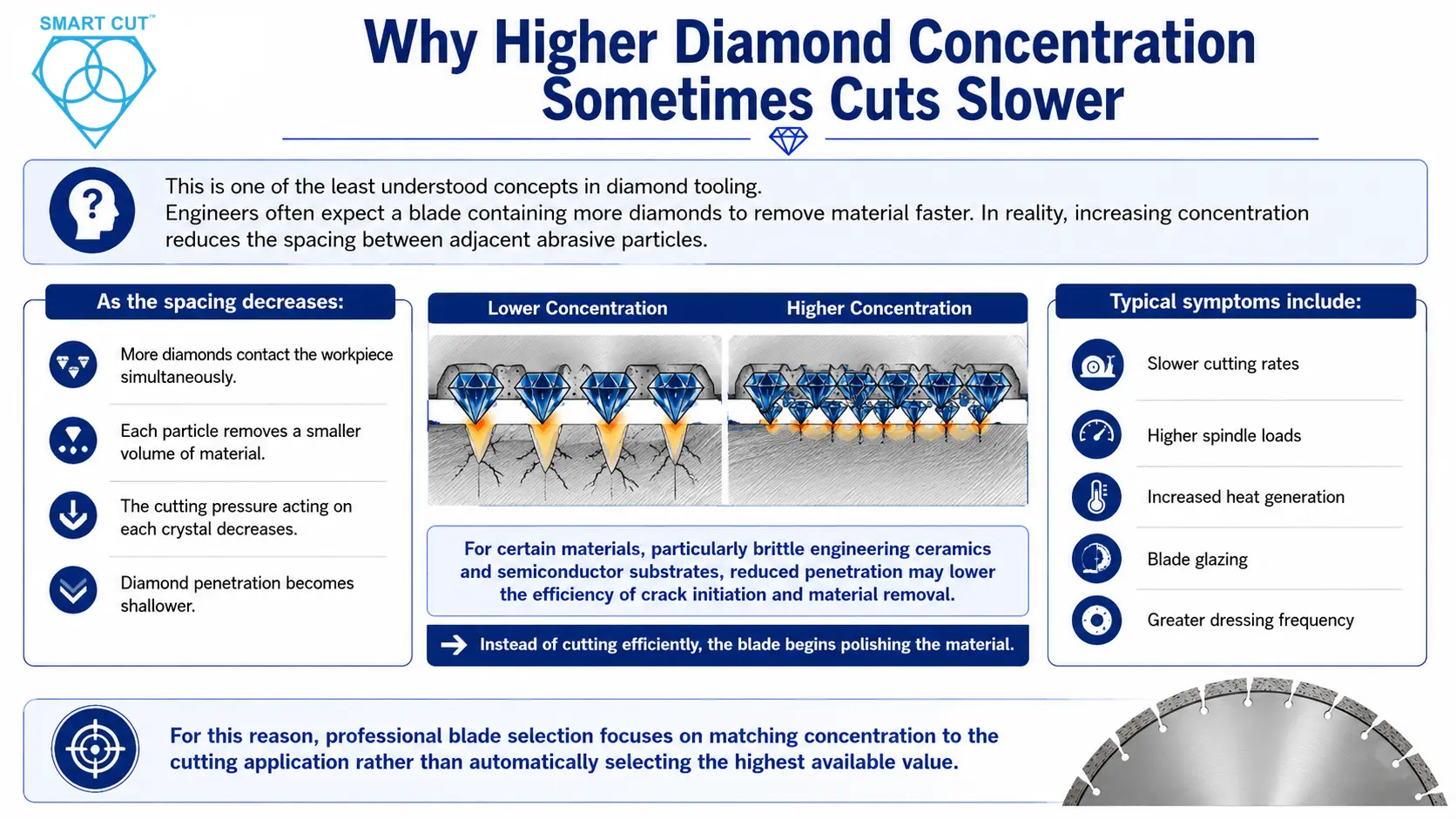
This is one of the least understood concepts in diamond tooling.
Engineers often expect a blade containing more diamonds to remove material faster. In reality, increasing concentration reduces the spacing between adjacent abrasive particles.
As the spacing decreases:
- More diamonds contact the workpiece simultaneously.
- Each particle removes a smaller volume of material.
- The cutting pressure acting on each crystal decreases.
- Diamond penetration becomes shallower.
For certain materials, particularly brittle engineering ceramics and semiconductor substrates, reduced penetration may lower the efficiency of crack initiation and material removal.
Instead of cutting efficiently, the blade begins polishing the material.
Typical symptoms include:
- Slower cutting rates
- Higher spindle loads
- Increased heat generation
- Blade glazing
- Greater dressing frequency
For this reason, professional blade selection focuses on matching concentration to the cutting application rather than automatically selecting the highest available value.
Diamond Concentration vs. Tool Life
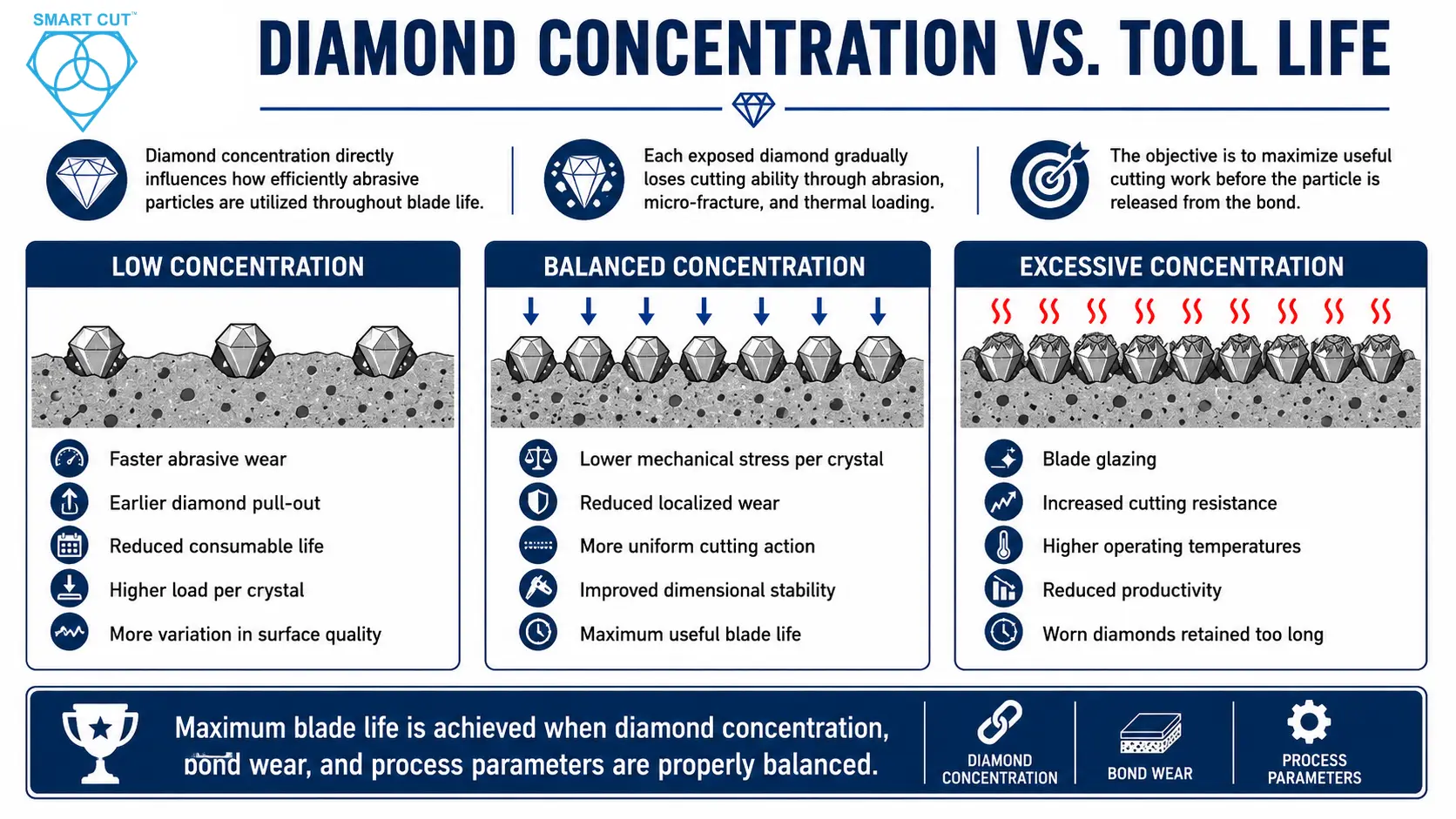
Diamond concentration has a direct influence on how efficiently abrasive particles are utilized throughout the life of the blade.
Each exposed diamond gradually loses its cutting ability through abrasion, micro-fracture, and thermal loading.
The objective is to maximize useful cutting work before the particle is released from the bond.
Higher concentrations distribute cutting forces across more abrasive particles.
This generally results in:
- Lower mechanical stress per crystal
- Reduced localized wear
- More uniform cutting action
- Improved dimensional stability
However, if concentration becomes excessive, worn diamonds may remain active longer than they should, particularly when combined with hard bond systems.
This often causes:
- Blade glazing
- Increased cutting resistance
- Higher operating temperatures
- Reduced productivity
Lower concentrations expose fewer cutting points.
Each diamond performs more work but also experiences significantly greater loading.
Potential consequences include:
- Faster abrasive wear
- Earlier diamond pull-out
- Reduced consumable life
- Increased variation in surface quality
Maximum blade life is achieved when diamond concentration, bond wear, and process parameters are balanced so that each crystal reaches the end of its useful cutting life before being replaced by a fresh cutting edge.
Diamond Concentration vs. Surface Finish
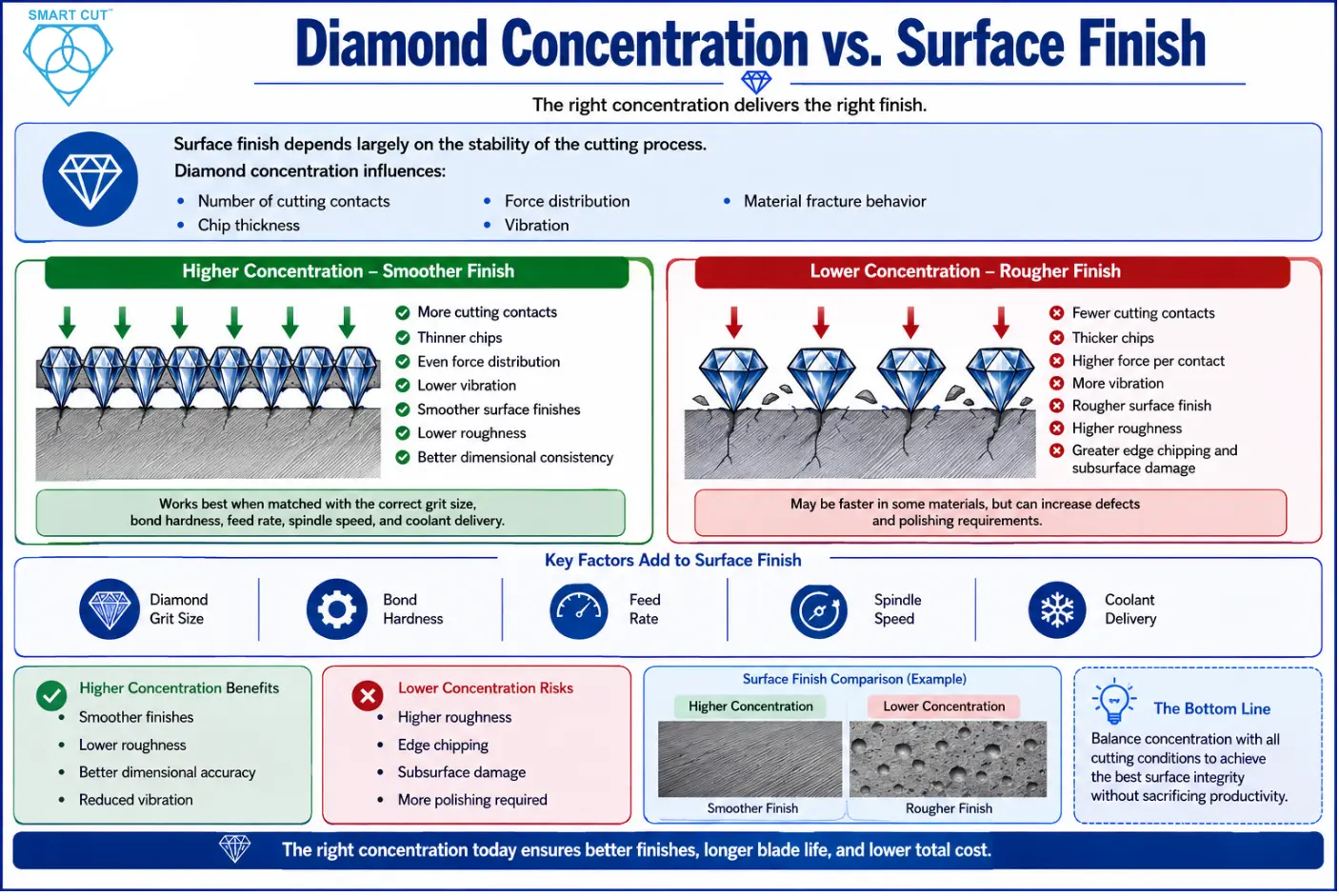
Surface finish depends largely on the stability of the cutting process.
Diamond concentration influences:
- Number of cutting contacts
- Chip thickness
- Force distribution
- Vibration
- Material fracture behavior
Higher concentrations generally create more cutting contacts across the workpiece surface.
This often produces:
- Smoother surface finishes
- Lower roughness
- Better dimensional consistency
- Reduced vibration
However, this benefit exists only when concentration is correctly matched to:
- Diamond grit size
- Bond hardness
- Feed rate
- Spindle speed
- Coolant delivery
Excessively high concentrations may increase rubbing rather than efficient material removal, resulting in thermal damage instead of improved finishes.
Lower concentrations frequently generate larger chip thicknesses.
While this may improve cutting speed, it can also increase:
- Edge chipping
- Surface roughness
- Subsurface damage
- Polishing requirements
Engineers should therefore balance concentration according to the required surface integrity rather than production speed alone.
Diamond Concentration vs. Bond Hardness
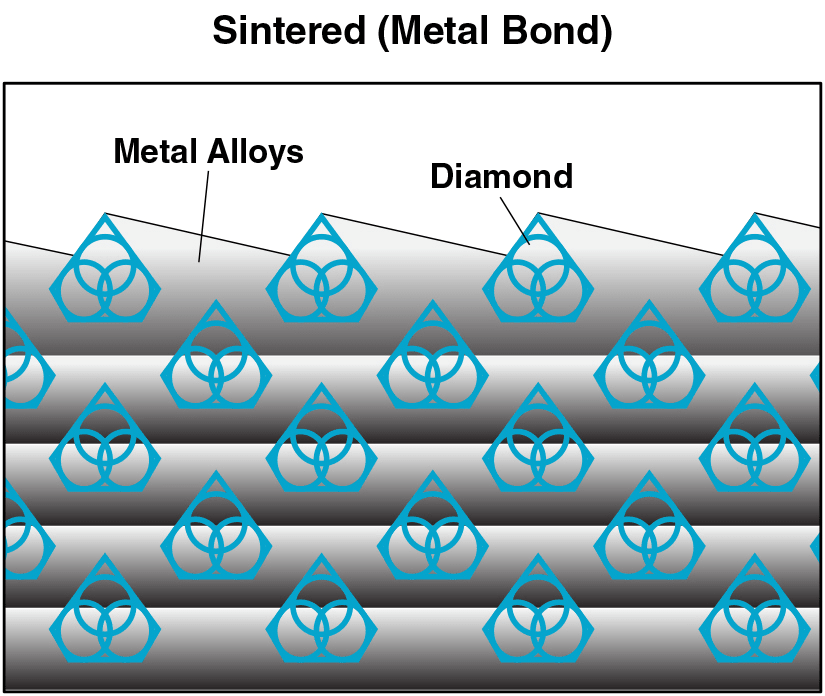
Diamond concentration and bond hardness are among the most closely related variables in blade design.
Changing one almost always affects the behavior of the other.
Higher concentrations generally require carefully engineered bond support to ensure worn diamonds are released at the appropriate time.
If a high concentration is combined with an excessively hard bond:
- Diamond exposure becomes limited.
- Worn crystals remain trapped.
- Blade glazing becomes more likely.
- Cutting forces increase.
Conversely, combining high concentration with an excessively soft bond may release useful diamonds before they have completed their cutting life.
Similarly, low concentrations often require bonds capable of adequately supporting individual diamonds because each crystal carries significantly greater cutting loads.
Successful blade design therefore optimizes concentration and bond hardness together rather than treating them as independent specifications.
Diamond Concentration vs. Heat Generation
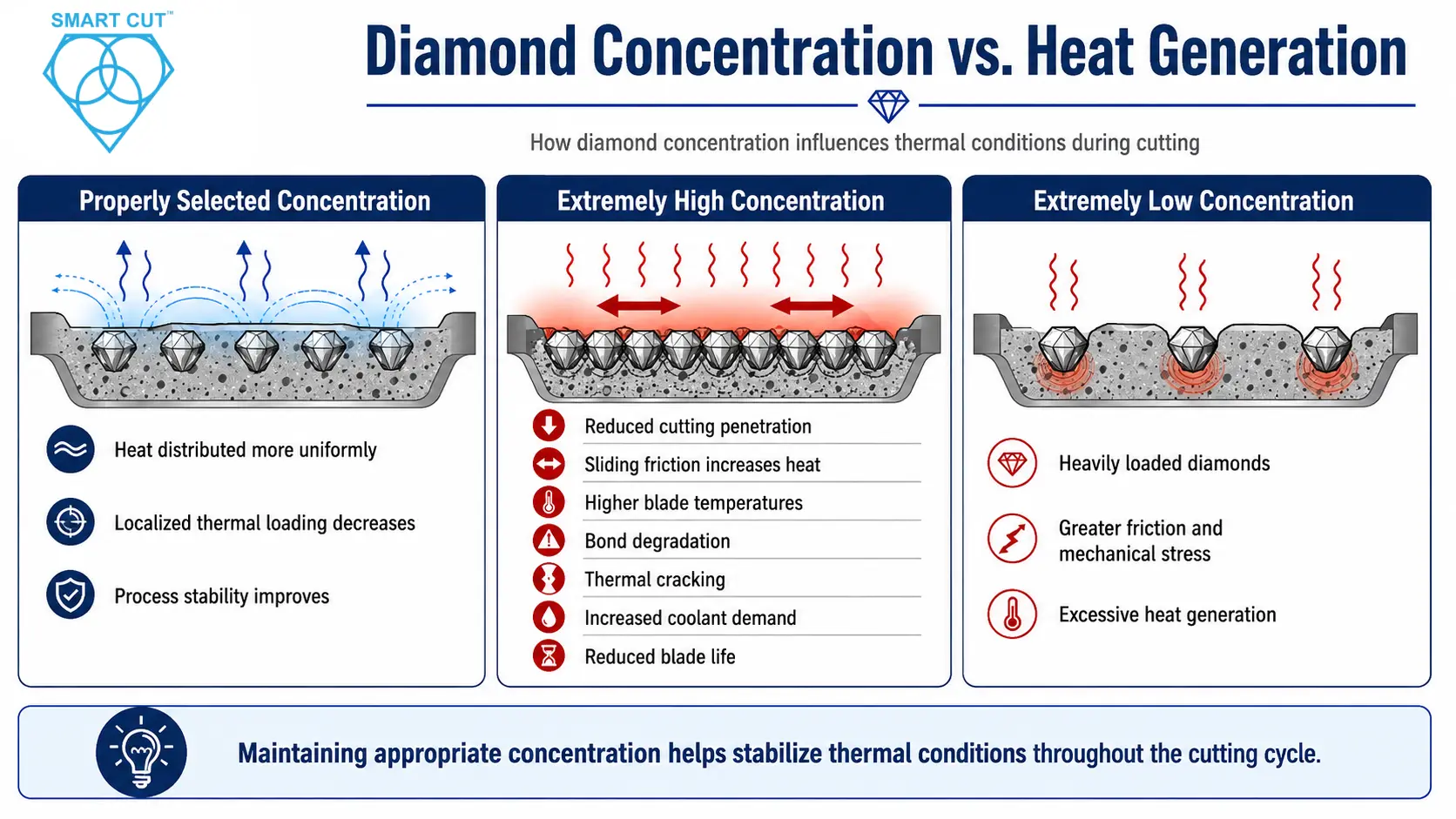
Heat generation is one of the primary factors affecting both blade performance and workpiece quality.
Diamond concentration influences heat production by changing how cutting forces are distributed across the cutting edge.
With properly selected concentrations:
- Heat is distributed more uniformly.
- Localized thermal loading decreases.
- Process stability improves.
However, extremely high concentrations may reduce cutting penetration.
Instead of removing material efficiently, diamonds begin sliding against the workpiece.
Sliding friction produces considerably more heat than efficient cutting.
The result may include:
- Higher blade temperatures
- Bond degradation
- Thermal cracking
- Increased coolant demand
- Reduced blade life
Likewise, extremely low concentrations may also generate excessive heat because heavily loaded diamonds experience greater friction and mechanical stress.
Maintaining appropriate concentration, therefore, helps stabilize thermal conditions throughout the cutting cycle.
Diamond Concentration vs. Cutting Force
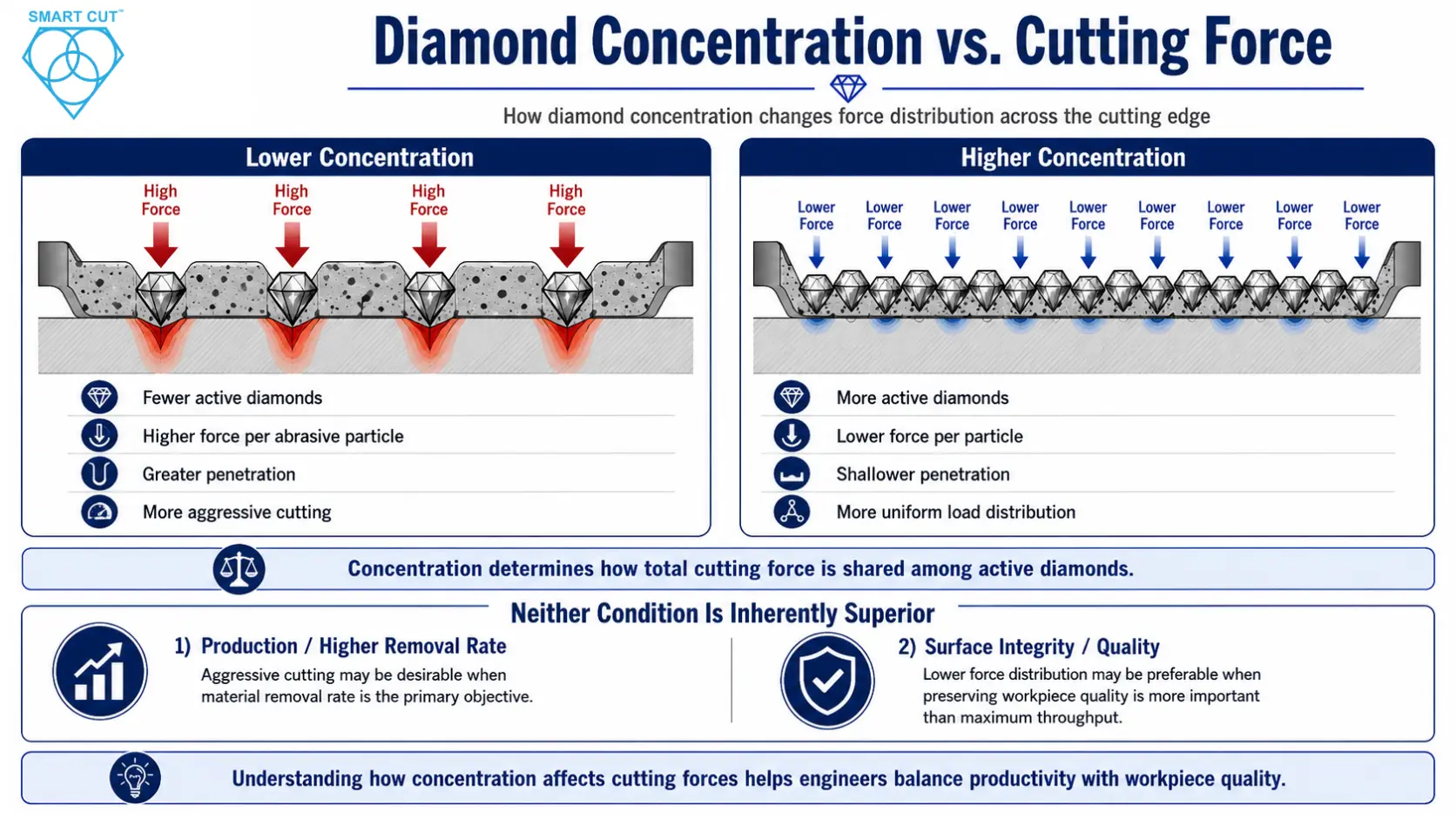
Every exposed diamond carries a portion of the total cutting force.
Concentration determines how this force is shared.
Lower concentrations mean:
- Fewer active diamonds
- Higher force per abrasive particle
- Greater penetration
- More aggressive cutting
Higher concentrations mean:
- More active diamonds
- Lower force per particle
- Shallower penetration
- More uniform load distribution
Neither condition is inherently superior.
Aggressive cutting may be desirable during production applications where the material removal rate is the primary objective.
Lower force distribution may be preferable when preserving surface integrity is more important than maximum throughput.
Understanding how concentration affects cutting forces helps engineers balance productivity with workpiece quality.
Diamond Concentration vs. Blade Stiffness
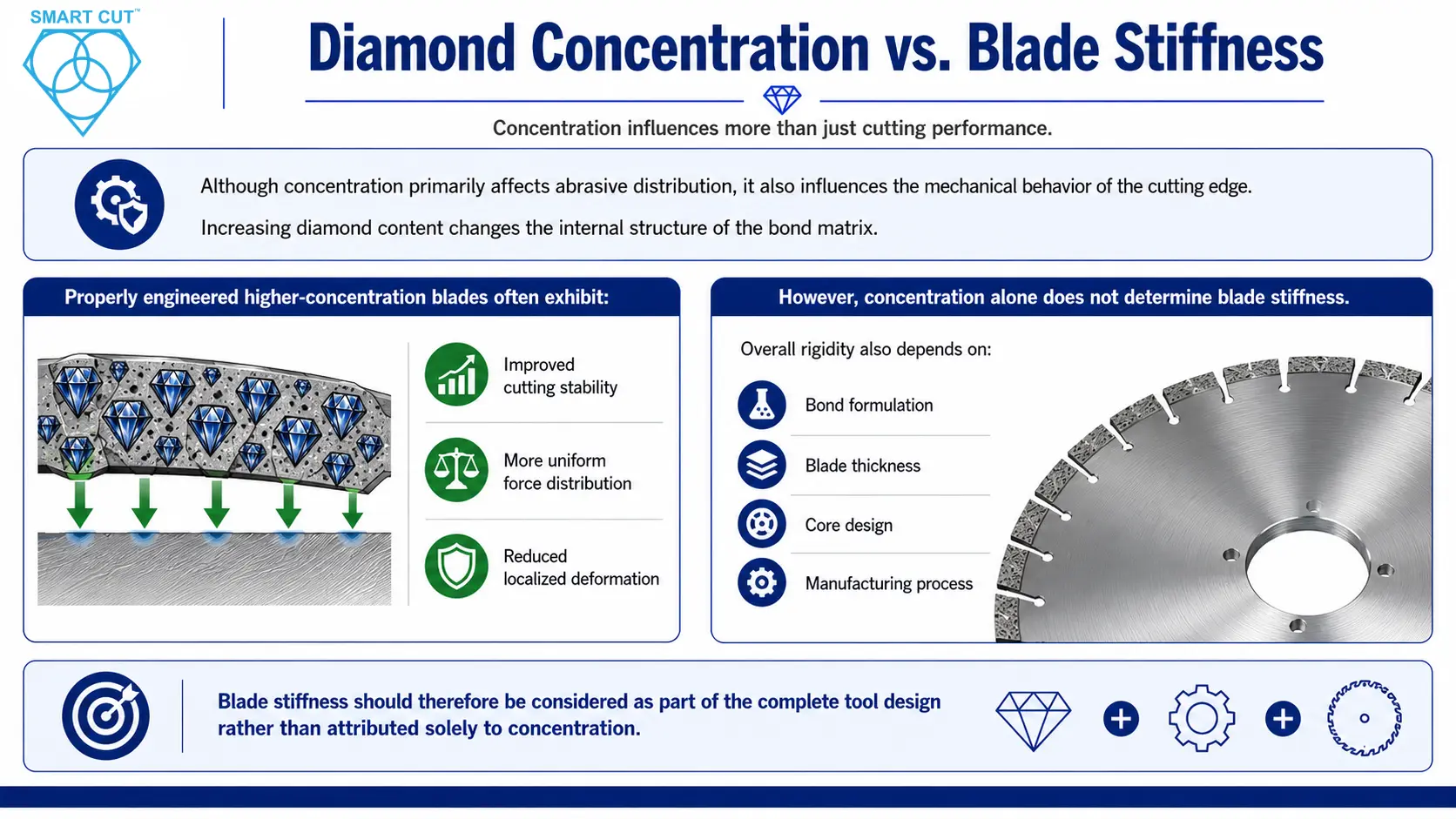
Although concentration primarily affects abrasive distribution, it also influences the mechanical behavior of the cutting edge.
Increasing diamond content changes the internal structure of the bond matrix.
Properly engineered higher-concentration blades often exhibit:
- Improved cutting stability
- More uniform force distribution
- Reduced localized deformation
However, concentration alone does not determine blade stiffness.
Overall rigidity also depends on:
- Bond formulation
- Blade thickness
- Core design
- Manufacturing process
Blade stiffness should therefore be considered as part of the complete tool design rather than attributed solely to concentration.
Diamond Concentration vs. Dressing Frequency
Dressing restores cutting efficiency by exposing fresh diamond particles after glazing or bond loading has occurred.
Diamond concentration directly affects how frequently dressing becomes necessary.
Higher concentrations may require more frequent dressing if:
- Bond wear is insufficient.
- Worn diamonds remain exposed.
- Cutting pressure becomes too low.
- Glazing develops.
Lower concentrations often self-sharpen more readily because heavily loaded diamonds fracture or detach sooner.
However, excessively low concentrations may reduce blade life before dressing becomes necessary.
The optimum concentration minimizes dressing frequency while maintaining stable cutting performance over the longest practical operating period.
Engineering Reference Guide: General Concentration Selection by Material
| Material | General Concentration Range | Primary Objective |
|---|---|---|
| Silicon Wafers | Medium–High | Minimize edge chipping and subsurface damage |
| Sapphire | Medium | Stable cutting and reduced thermal damage |
| Quartz | Medium | Improved edge integrity and dimensional control |
| Optical Glass | Medium | Reduced breakout and smoother surface finish |
| Alumina | Medium | Balance blade life with cutting efficiency |
| Zirconia | Medium–High | Improved wear resistance |
| Silicon Carbide | High | Maximize blade life in abrasive materials |
| Tungsten Carbide | High | Extended production cutting |
| Composite Materials | Low–Medium | Reduce delamination |
| Electronic Packages | Medium | Preserve delicate internal structures |
| Metallographic Samples | Medium | Low-damage precision sectioning |
These recommendations represent general engineering guidance. Final blade selection should consider bond type, grit size, feed rate, spindle speed, coolant delivery, and machine rigidity.
Cost Per Cut: Why Blade Price Does Not Tell the Whole Story
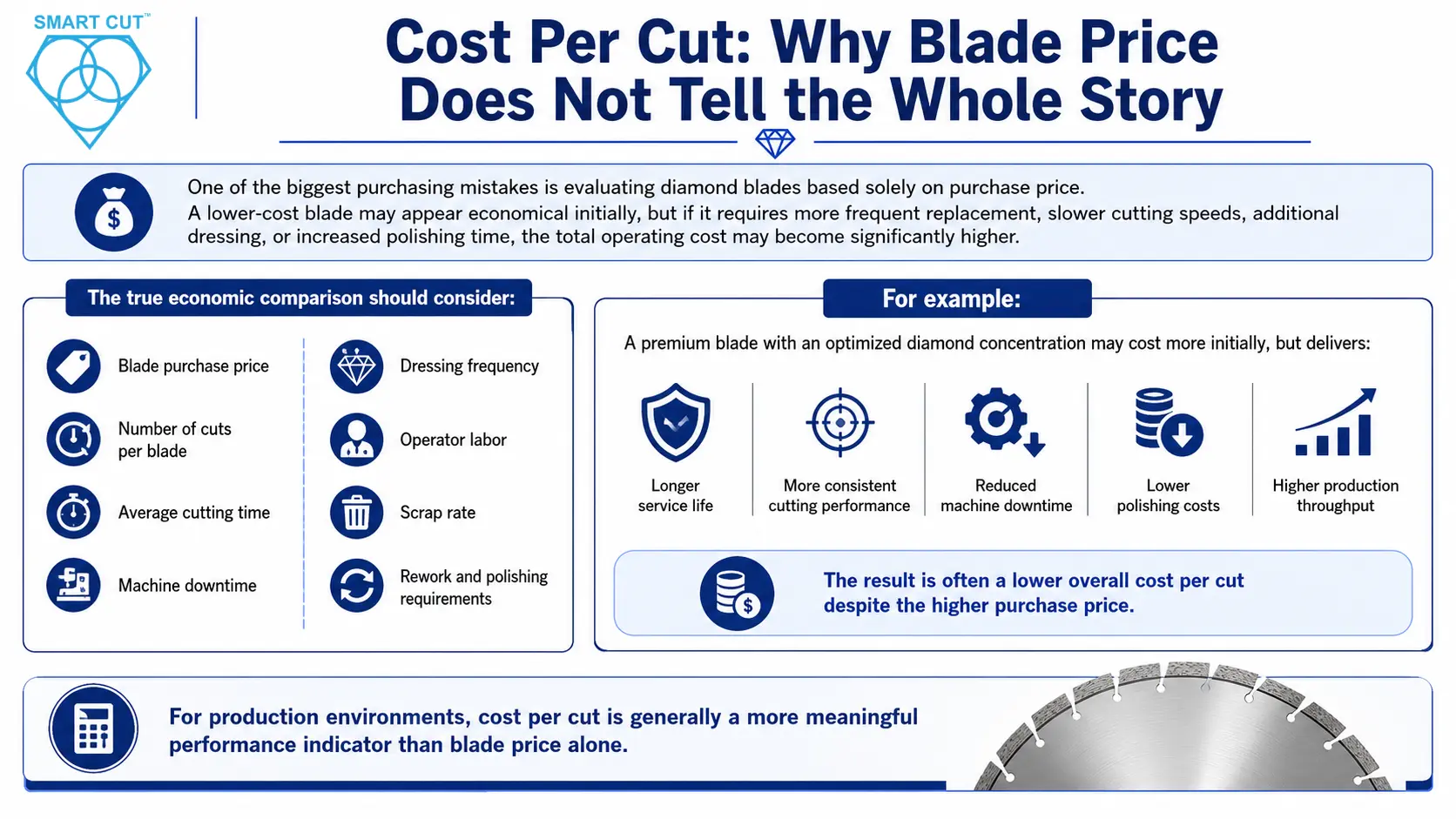
One of the biggest purchasing mistakes is evaluating diamond blades based solely on purchase price.
A lower-cost blade may appear economical initially, but if it requires more frequent replacement, slower cutting speeds, additional dressing, or increased polishing time, the total operating cost may become significantly higher.
The true economic comparison should consider:
- Blade purchase price
- Number of cuts per blade
- Average cutting time
- Machine downtime
- Dressing frequency
- Operator labor
- Scrap rate
- Rework and polishing requirements
For example:
A premium blade with an optimized diamond concentration may cost more initially, but delivers:
- Longer service life
- More consistent cutting performance
- Reduced machine downtime
- Lower polishing costs
- Higher production throughput
The result is often a lower overall cost per cut despite the higher purchase price.
For production environments, cost per cut is generally a more meaningful performance indicator than blade price alone.
Common Mistakes When Selecting Diamond Concentration
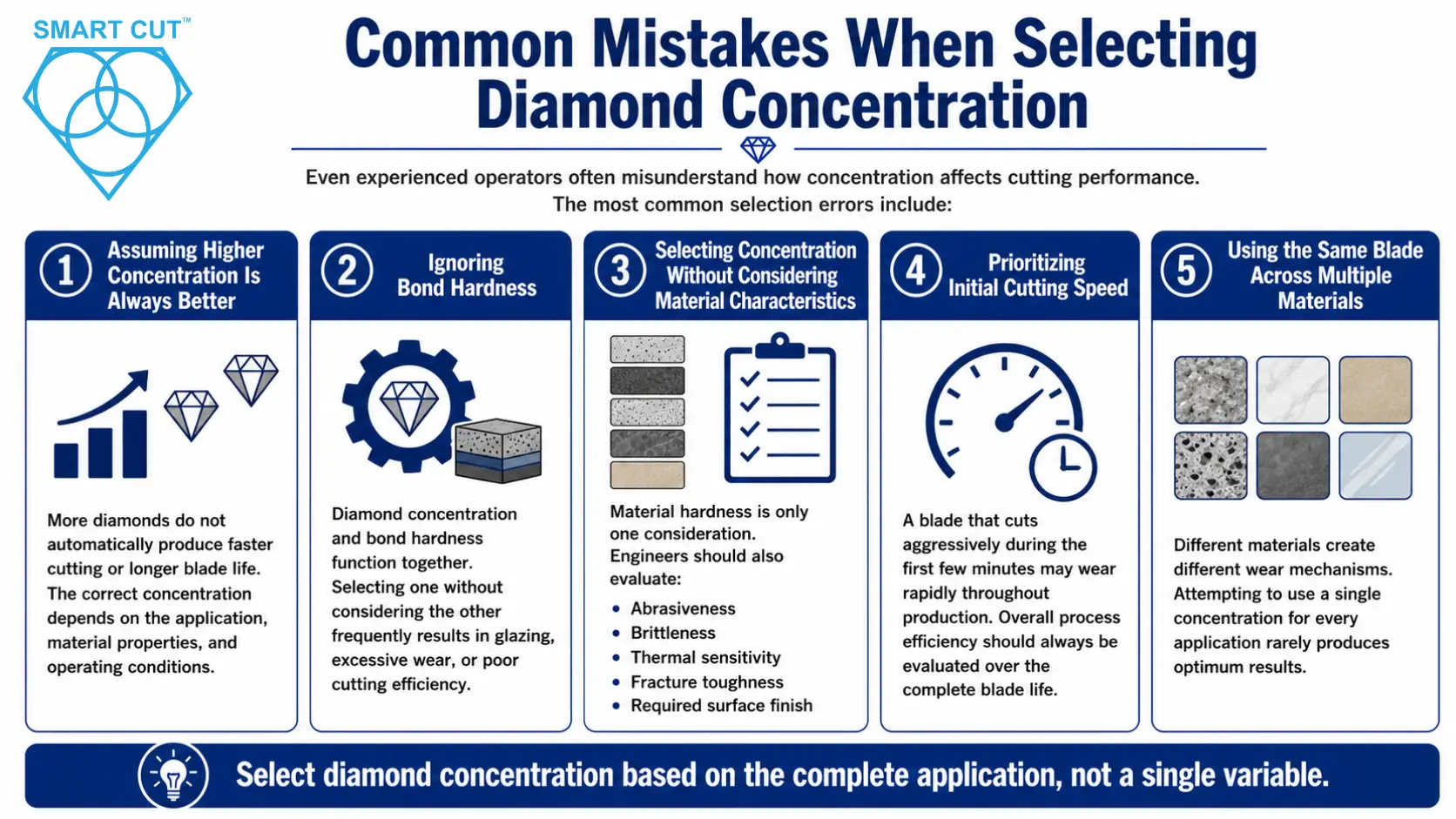
Even experienced operators often misunderstand how concentration affects cutting performance.
The most common selection errors include:
Assuming Higher Concentration Is Always Better
More diamonds do not automatically produce faster cutting or longer blade life.
The correct concentration depends on the application, material properties, and operating conditions.
Ignoring Bond Hardness
Diamond concentration and bond hardness function together.
Selecting one without considering the other frequently results in glazing, excessive wear, or poor cutting efficiency.
Selecting Concentration Without Considering Material Characteristics
Material hardness is only one consideration.
Engineers should also evaluate:
- Abrasiveness
- Brittleness
- Thermal sensitivity
- Fracture toughness
- Required surface finish
Prioritizing Initial Cutting Speed
A blade that cuts aggressively during the first few minutes may wear rapidly throughout production.
Overall process efficiency should always be evaluated over the complete blade life.
Using the Same Blade Across Multiple Materials
Different materials create different wear mechanisms.
Attempting to use a single concentration for every application rarely produces optimum results.
Engineering Case Study 1: Semiconductor Wafer Sectioning
A laboratory performing failure analysis on silicon wafers observed increasing polishing times despite maintaining consistent machine parameters.
Engineering evaluation revealed that the selected blade concentration produced excessive rubbing rather than efficient cutting.
Although blade wear remained low, localized heat generation increased subsurface damage.
After selecting a concentration better suited to precision wafering, the laboratory achieved:
- Improved cutting stability
- Reduced polishing requirements
- More consistent edge quality
- Better sample repeatability
The investigation demonstrated that a higher concentration was not necessarily the optimum solution for this application.
Engineering Case Study 2: Cutting Technical Ceramics
A manufacturer processing alumina ceramics experienced rapid diamond wear using a relatively low-concentration blade.
The abrasive material placed excessive loads on individual diamond particles, shortening blade life.
By selecting a higher concentration combined with an appropriate bond system, cutting loads were distributed more evenly across the blade.
This resulted in:
- Improved consumable utilization
- More stable cutting performance
- Better dimensional consistency
- Reduced blade replacement frequency
Engineering Case Study 3: High-Volume Carbide Production
A production facility cutting tungsten carbide prioritized maximum blade life and consistent throughput.
After evaluating several blade configurations, engineers selected a higher concentration specifically designed for abrasive materials.
The optimized blade maintained stable cutting performance throughout extended production cycles while reducing consumable costs and machine downtime.
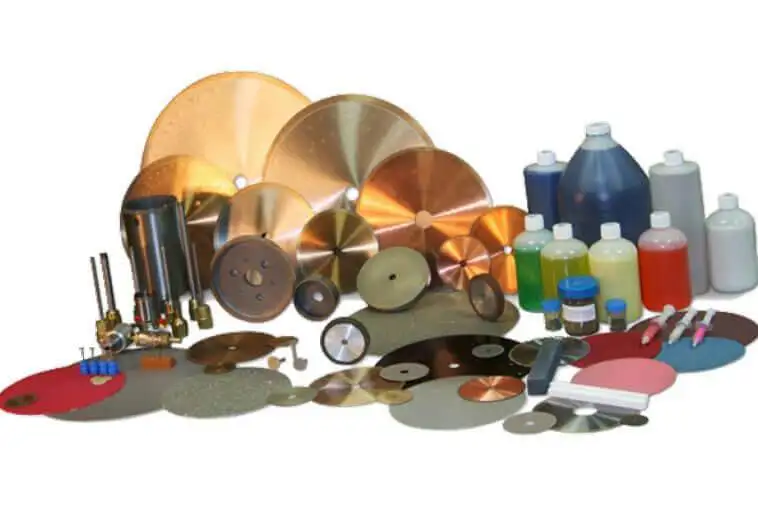
Recommended UKAM Solutions
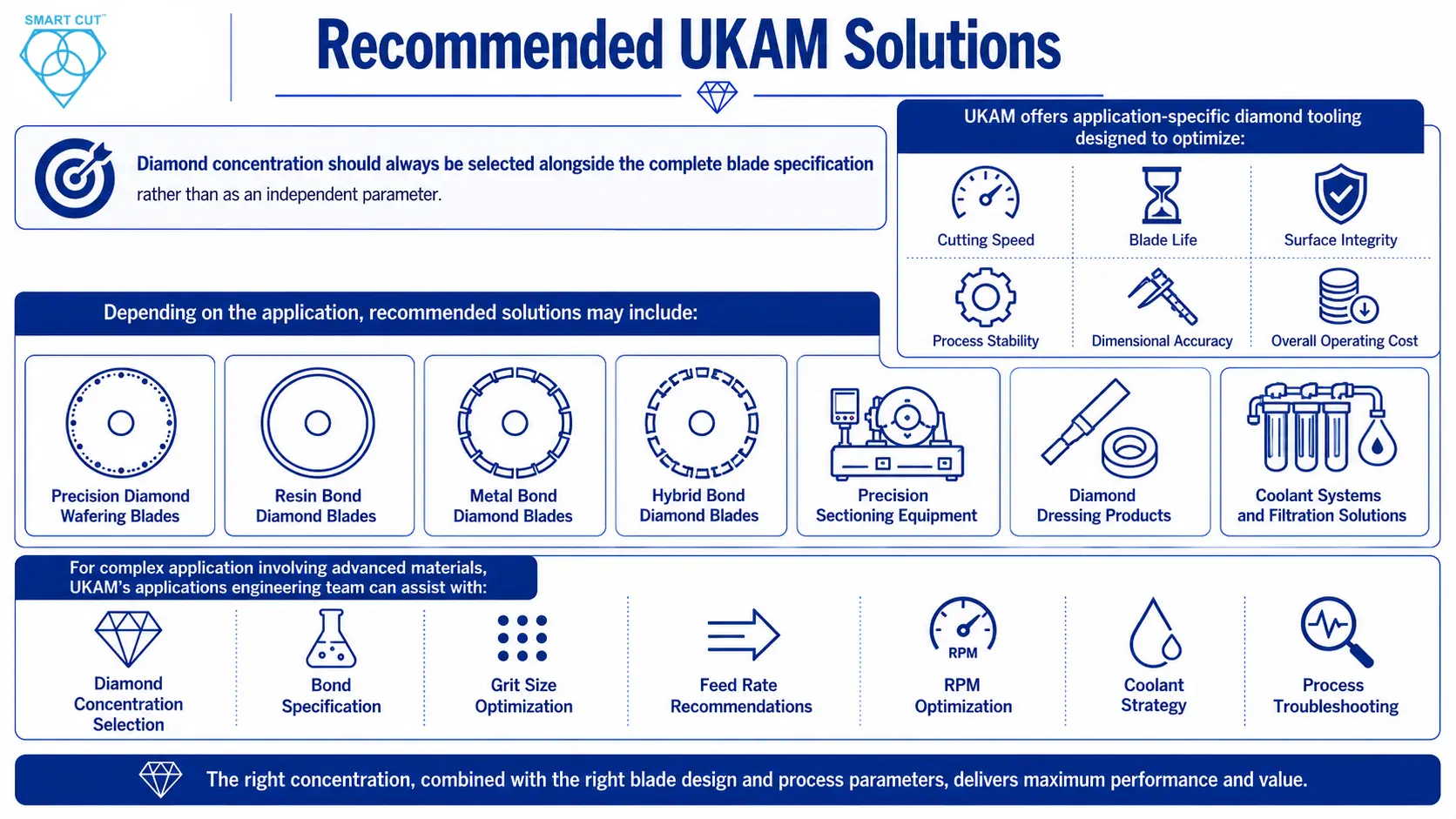
Diamond concentration should always be selected alongside the complete blade specification rather than as an independent parameter.
UKAM offers application-specific diamond tooling designed to optimize:
- Cutting speed
- Blade life
- Surface integrity
- Process stability
- Dimensional accuracy
- Overall operating cost
Depending on the application, recommended solutions may include:
- Precision Diamond Wafering Blades
- Resin Bond Diamond Blades
- Metal Bond Diamond Blades
- Hybrid Bond Diamond Blades
- Precision Sectioning Equipment
- Diamond Dressing Products
- Coolant Systems and Filtration Solutions
For complex applications involving advanced materials, UKAM’s applications engineering team can assist with:
- Diamond concentration selection
- Bond specification
- Grit size optimization
- Feed rate recommendations
- RPM optimization
- Coolant strategy
- Process troubleshooting
Frequently Asked Questions
Diamond concentration refers to the quantity of diamond abrasive contained within a given volume of bond material. It influences cutting performance, blade life, heat generation, and overall process stability.
No. Higher concentration distributes cutting forces across more diamonds, which may reduce the penetration depth of each crystal. In some applications, this can actually reduce cutting efficiency.
Blade life depends on the interaction between concentration, bond hardness, material properties, and operating conditions. An excessively high concentration may increase glazing or friction if not properly matched to the application.
Properly selected concentrations help distribute cutting forces more evenly, improving dimensional consistency and reducing surface damage. Incorrect concentration may increase roughness or edge chipping.
Yes. Diamond distribution affects friction and cutting efficiency. Improper concentration may increase rubbing rather than cutting, resulting in higher operating temperatures.
Both parameters work together. Concentration determines how many diamonds are present, while bond hardness determines how effectively those diamonds are supported and renewed during cutting.
Higher concentrations distribute forces across more abrasive particles, reducing the load carried by each diamond. However, the overall process must remain balanced to maintain efficient cutting.
Yes. Certain concentration and bond combinations may increase glazing, requiring more frequent dressing to restore cutting efficiency.
Selection should consider:
● Material properties
● Required surface finish
● Production volume
● Bond specification
● Diamond grit size
● Feed rate
● Spindle speed
● Coolant performance
No. Different materials require different concentrations and bond combinations to achieve optimum cutting performance and blade life.
100 concentration is commonly used as a reference point because it provides a balanced combination of cutting efficiency, blade life, and manufacturing practicality for many precision cutting applications.
In some applications, yes. Higher concentrations distribute cutting forces across more diamond particles, potentially reducing wear on individual crystals. However, the overall result also depends on bond hardness and cutting parameters.
Not necessarily. Surface finish depends on multiple variables, including grit size, bond type, spindle speed, feed rate, and machine stability.
Improper concentration can increase rubbing instead of efficient cutting, resulting in higher friction and elevated cutting temperatures.
Yes. Bond formulation, diamond quality, grit size, blade geometry, and manufacturing quality all influence performance.
Whenever material properties change significantly, engineers should review the entire blade specification—including concentration—to maintain optimum cutting performance.
Yes. Some concentration and bond combinations require more frequent dressing to expose fresh diamond particles and maintain cutting efficiency.
Individual diamonds carry higher cutting loads, which may increase wear, reduce blade life, and affect dimensional consistency.
Excessively high concentrations may reduce penetration depth, increase friction, encourage glazing, and lower cutting efficiency.
No. Concentration and bond hardness should always be evaluated together since they work as an integrated cutting system.
Conclusion
Diamond crystal concentration is one of the most influential design parameters in a precision diamond blade, yet it remains one of the most misunderstood.
Rather than indicating overall blade quality, concentration determines how cutting forces are distributed, how efficiently diamond particles are utilized, and how the blade interacts with the workpiece throughout its service life.
Selecting the correct concentration requires balancing numerous engineering variables, including bond hardness, grit size, material characteristics, cutting speed, feed rate, spindle speed, coolant delivery, and production objectives.
Contrary to common belief, higher concentration is not automatically better. In many applications, excessive concentration may increase friction, heat generation, glazing, and dressing frequency while reducing cutting efficiency. Likewise, concentrations that are too low may accelerate abrasive wear and shorten blade life.
Understanding these relationships allows engineers to optimize blade performance based on the complete cutting system rather than relying on a single specification.
For precision cutting of semiconductors, ceramics, carbides, composites, optical materials, and other advanced engineering materials, selecting the appropriate diamond concentration can significantly improve productivity, reduce operating costs, extend blade life, and preserve workpiece integrity.
If you need assistance selecting the appropriate diamond concentration, bond specification, grit size, or cutting parameters for your application, UKAM’s applications engineering team can provide recommendations tailored to your material, equipment, and production requirements.
Trusted by Tens of Thousands of Manufacturers, Laboratories,
Research Institutions Worldwide Since 1990
American Based Manufacturer
Established in 1990
Custom manufacturing
RELATED ARTICLES

Brian is an experienced professional in the field of precision cutting tools, with over 27 years of experience in technical support. Over the years, he has helped engineers, manufacturers, researchers, and contractors find the right solutions for working with advanced and hard-to-cut materials. He’s passionate about bridging technical knowledge with real-world applications to improve efficiency and accuracy.
As an author, Brian Farberov writes extensively on diamond tool design, application engineering, return on investment strategies, and process optimization, combining technical depth with a strong understanding of customer needs and market dynamics.