

















Cutting Dental Ceramics and Medical Device Materials with Diamond Blades
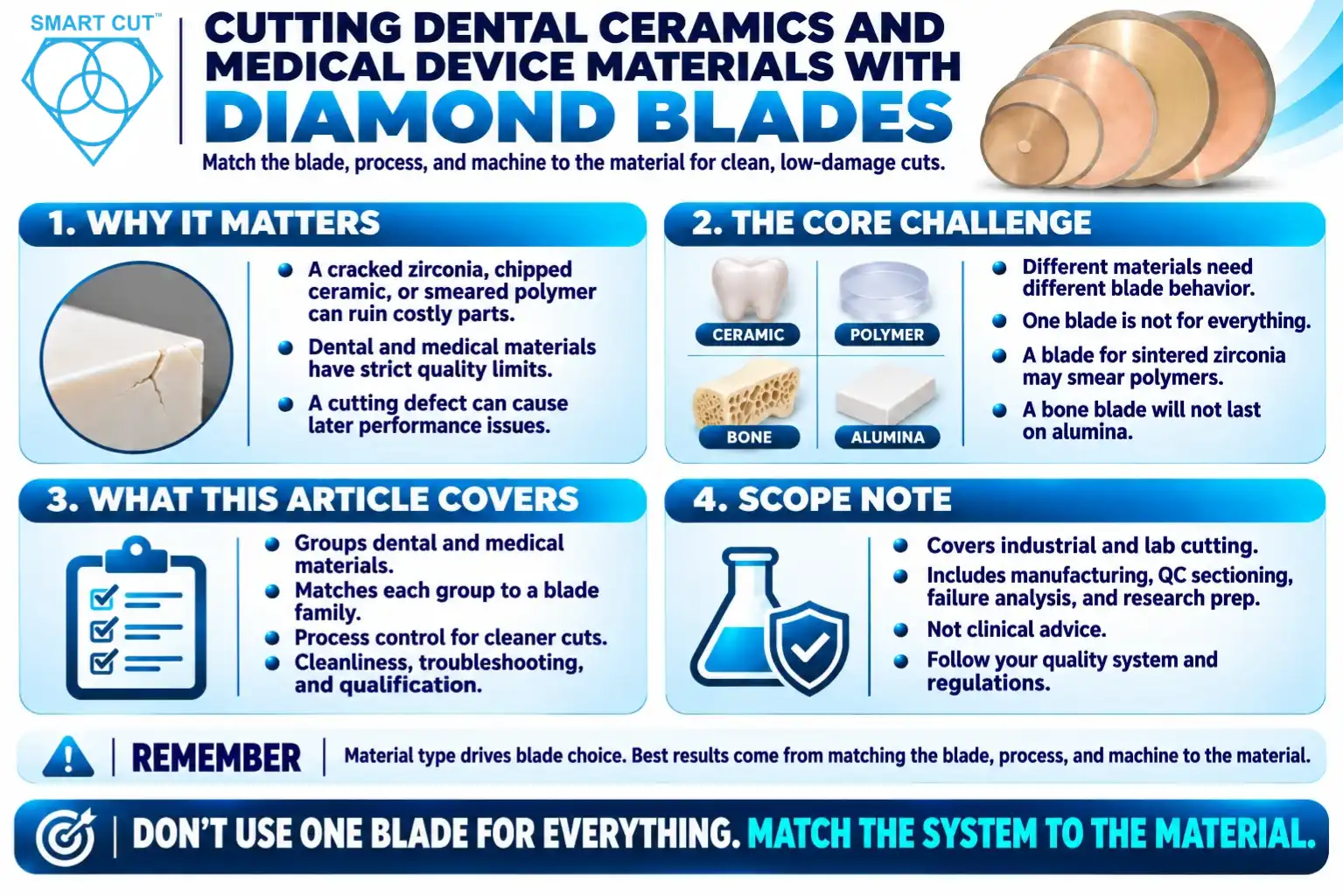
Table of Contents
ToggleA cracked zirconia blank, a chipped ceramic edge, or a smeared polymer section can cost more than the blade, the saw, and the day’s work. Dental and medical device materials are expensive; they are held to strict quality limits, and a cutting defect can become a failure later.
Cutting dental ceramics with diamond blades works well when the blade, the process, and the machine match the material. It goes wrong when one blade is used for everything. A blade that suits fully sintered zirconia will smear a polymer. A blade that suits bone will not last on alumina.
This article explains how to approach cutting dental ceramics and medical device materials with diamond blades. It groups the materials, matches each group to a blade family using UKAM’s published guidance, and covers process control, cleanliness, troubleshooting, and qualification.
A scope note: this article covers industrial and laboratory cutting, such as manufacturing blanks, quality control sectioning, failure analysis, and research sample preparation. It is not clinical advice, and it does not address regulatory requirements for any specific device. Follow your own quality system and applicable regulations. UKAM also offers dental and laboratory diamond tools, including burs, discs, and foil for shaping dental restorative materials, which are separate from the sectioning blades discussed here.
Trusted by Tens of Thousands of Manufacturers, Laboratories Research Institutions Worldwide Since 1990

American Based Manufacturer

Established in 1990


Custom manufacturing


Why Cutting Dental Ceramics with Diamond Blades Is Demanding
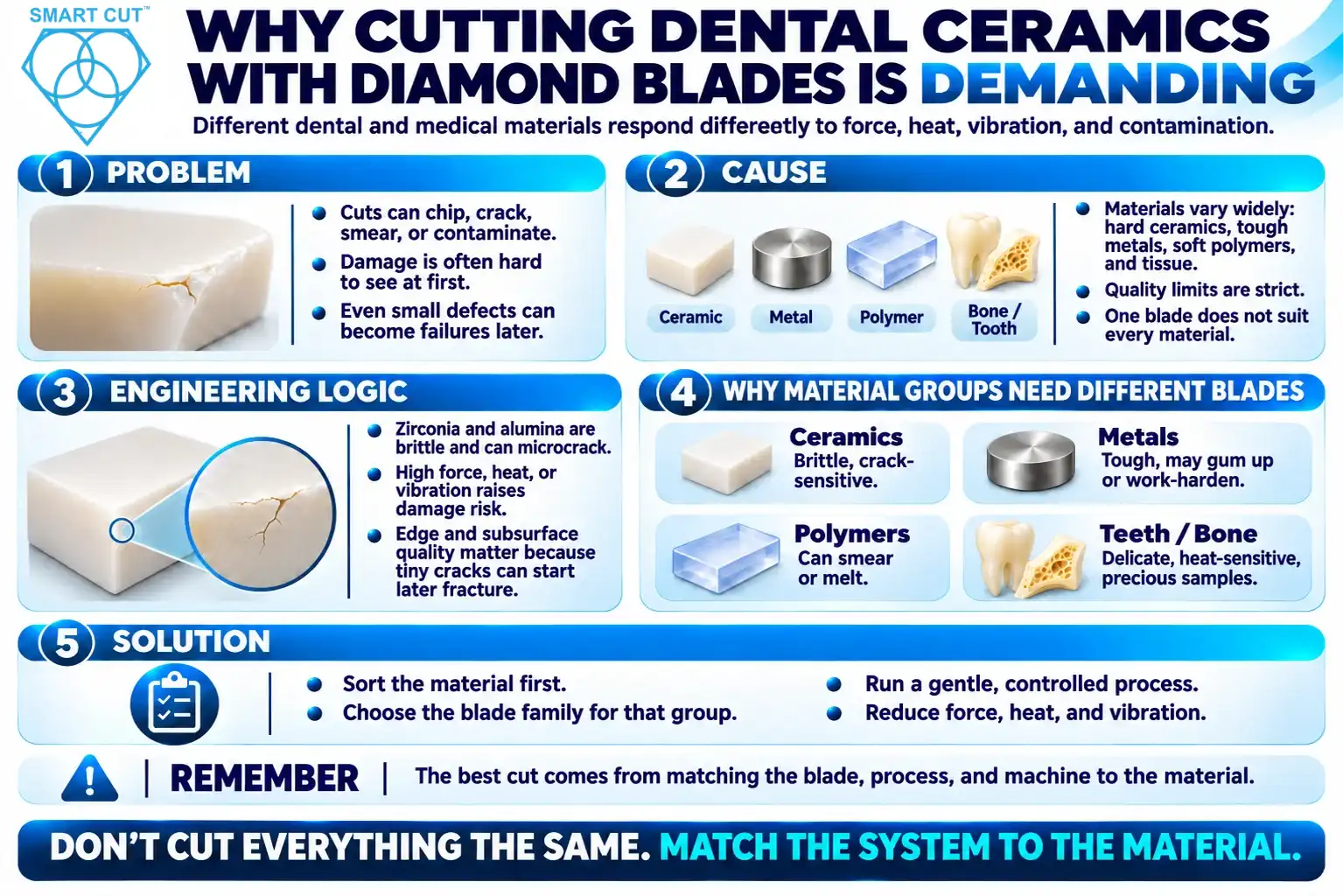
Problem: Cuts in dental and medical materials chip, crack, smear, or contaminate, and the damage is hard to see.
Cause: The materials vary widely, from very hard ceramics to soft polymers and biological tissue, and the quality limits are strict.
Engineering logic: Hard ceramics such as zirconia and alumina are brittle. They crack when cutting force, heat, or vibration is too high. UKAM’s guidance on cutting force describes the damage unstable force can cause: microcracks, residual stresses, plastic deformation, grain pull-out, delamination, and heat-affected regions. In a ceramic part, even a tiny crack at the edge can act as a starting point for a later fracture, which is why edge and subsurface quality matter.
Metals such as titanium alloys and cobalt alloys are tough and tend to gum up or work-harden. Polymers smear and melt. Teeth and bone are delicate, heat-sensitive, and often precious samples in research.
Each group needs a different blade. UKAM’s own selection guide makes the point: cutting a dense, brittle material such as zirconia or sapphire needs a very different approach than cutting a ductile, low-density material.
Solution: Sort the material first, choose the blade family for that group, and run a gentle, controlled process.
Step 1: Sort the Materials into Groups
The table below groups common dental and medical device materials and shows a starting blade family from UKAM’s published guidance. Treat it as a starting point and confirm with a trial.
| Material group | Examples | Starting blade family (UKAM guidance) |
|---|---|---|
| Hard, brittle ceramics | Fully sintered zirconia, alumina, yttria-stabilized zirconia | Sintered (metal bond) diamond blades; the low-concentration “L” series such as 15LCU for hard, brittle materials |
| Glass-ceramics | Glass-ceramic restorative blocks, Macor-type materials | Sintered (metal bond); finer diamond for delicate edges |
| Pre-sintered or “green” ceramics | Pre-sintered zirconia blanks, pre-fired ceramic materials | Nickel bond (electroplated) blades |
| Titanium and cobalt alloys | Implant alloys, dental frameworks | CBN wafering blades for cobalt alloys and tough, gummy titanium; Series 20HCU or 15HCU for titanium |
| Polymers and elastomers | Implant polymers, silicone, rubber components | Series 30HCU; nickel bond blades for soft, gummy materials |
| Teeth, enamel, dentin, and bone | Research and archaeology samples | Electroplated (nickel bond), cut wet |
A note on the letters: UKAM’s bond codes use M for metal bond and E for electroplated. UKAM’s selection guide lists zirconia, alumina, yttria-stabilized zirconia, and glass-ceramics under M. It lists teeth, enamel, and dentin (dental research and archaeology) under E.
Step 2: Define the Purpose of the Cut
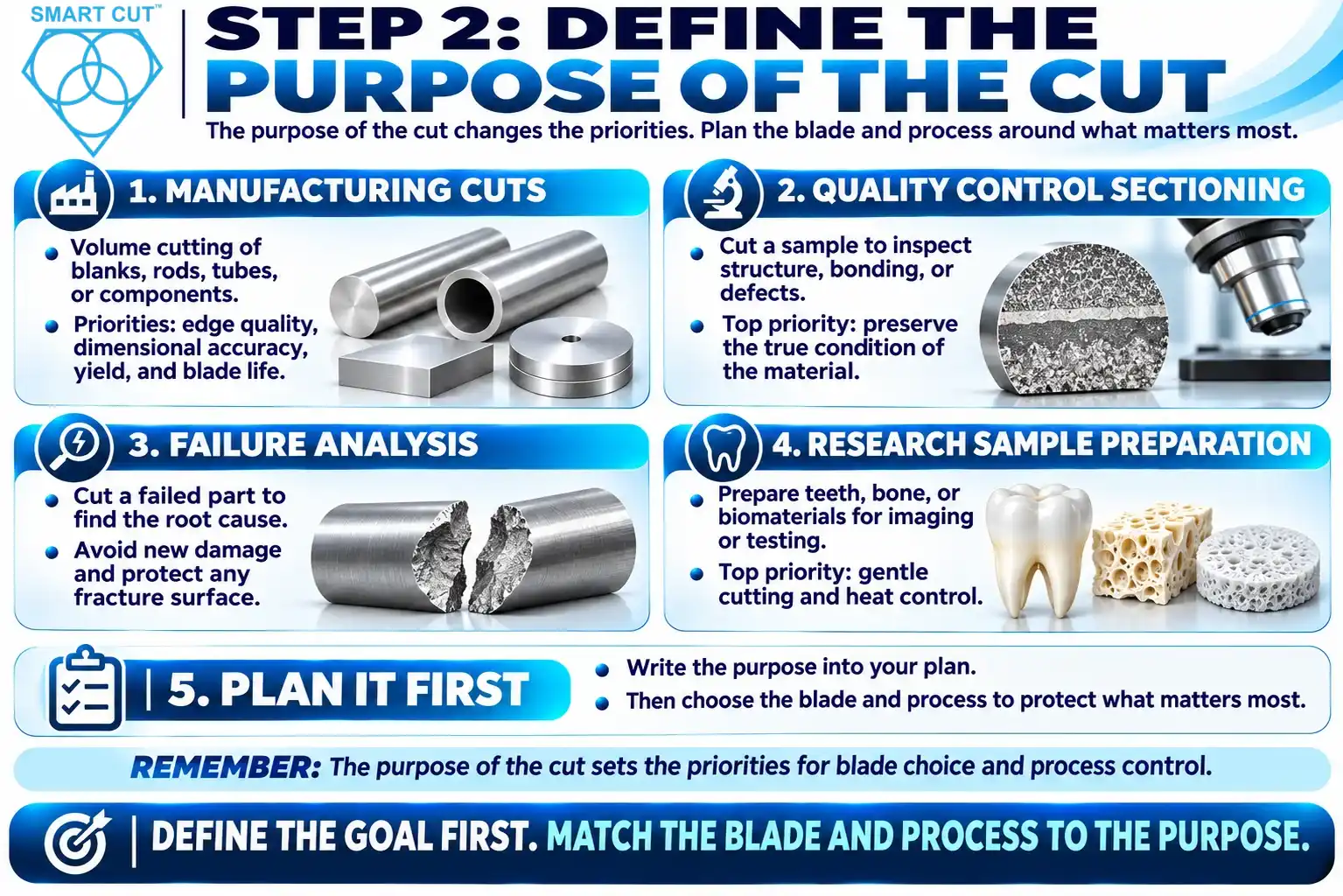
The purpose changes the priorities.
Manufacturing cuts. You cut blanks, rods, tubes, or components in volume. Edge quality, dimensional accuracy, yield, and blade life matter most.
Quality control sectioning. You cut a sample to inspect structure, bonding, or defects. Preserving the true condition of the material matters most.
Failure analysis. You cut a failed part to find the root cause. Avoiding new damage and protecting any fracture surface matters most. Our article on sectioning damage in metallography explains how cutting artifacts can mislead an analysis.
Research sample preparation. You prepare teeth, bone, or biomaterials for imaging or testing. Gentle cutting and heat control matter most.
Write the purpose into your plan. Then choose the blade and process to protect what matters most for that purpose.
Step 3: Choose the Blade
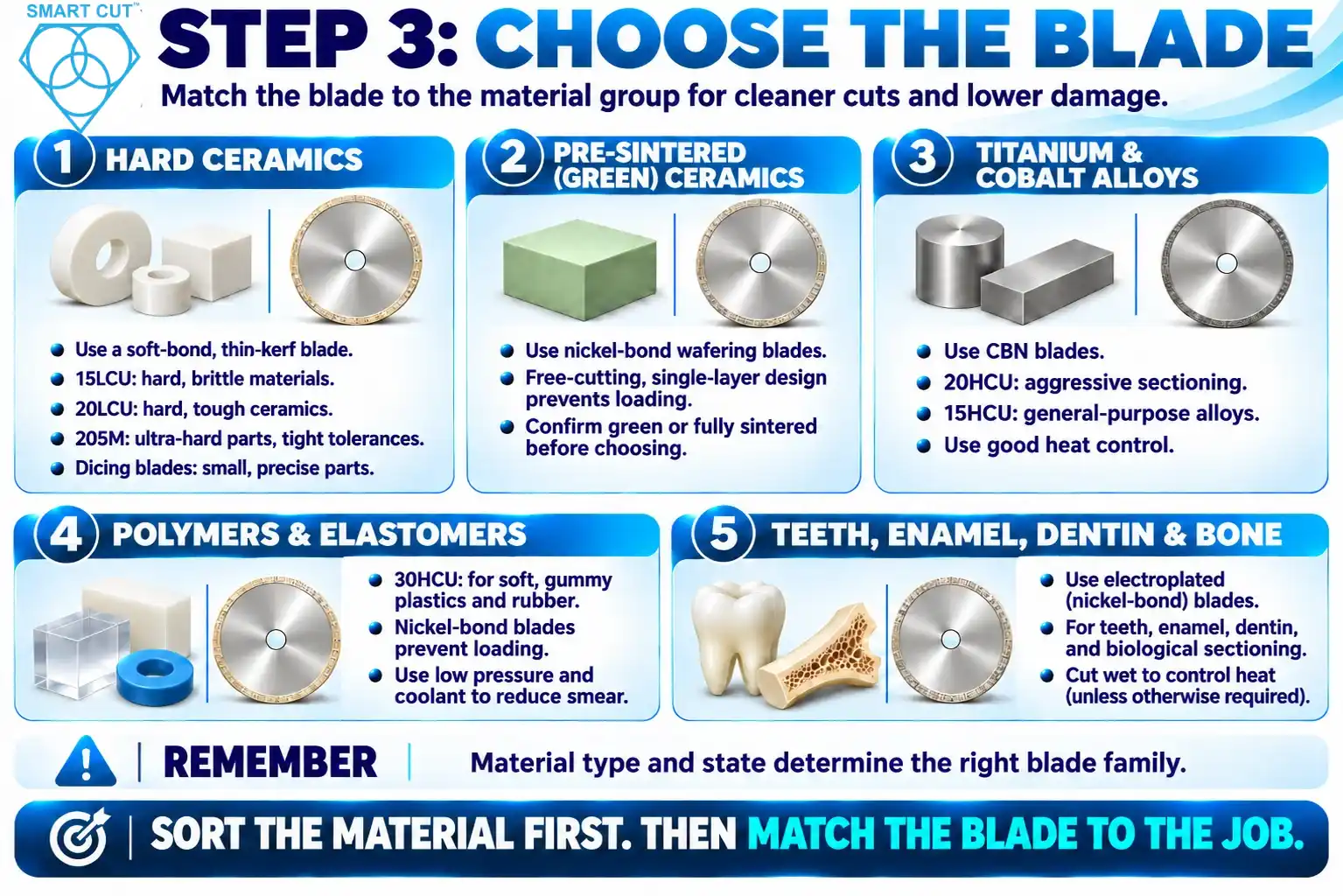
Hard Ceramics: Zirconia, Alumina, and Similar Materials
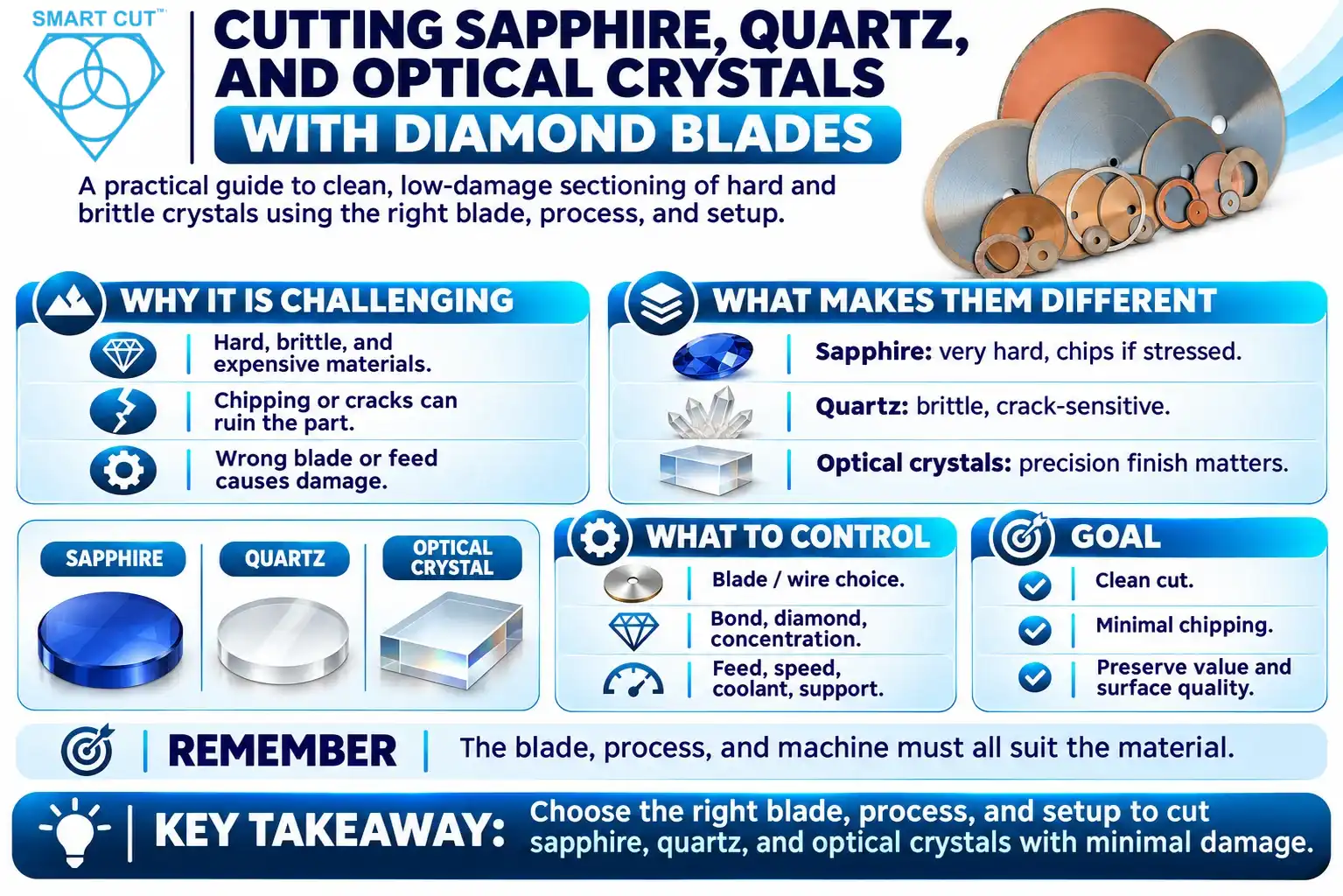
UKAM’s blade selection guide gives a clear rule for the hardest ceramics: the harder the material, the softer the bond. Its guidance for hard alumina and sapphire is a soft bond, thin kerf diamond blade. A softer bond wears away faster, constantly exposing fresh diamond, which keeps the blade cutting freely instead of glazing.
UKAM’s sintered wafering series also helps here. Its product page lists the low-concentration 15LCU series for hard and brittle materials such as glass, alumina, and zirconia, and the 20LCU series for hard and tough materials and structural ceramics. UKAM’s guidance describes low-concentration blades as cutting by a fracture process, where each diamond carries higher pressure and chips off small flakes, which suits brittle materials. For the series table, see the SMART CUT® wafering blades, and for how to read the fields, see our guide on how to read a diamond blade specification sheet.
UKAM’s SMART CUT® 205M cut-off blades are sintered metal bond blades for ultra-hard and brittle materials, with high diamond concentration and a 10 mm diamond depth. UKAM states they can be used for materials with stringent dimensional tolerances, such as medical devices. See the SMART CUT® 205M blades.
For small, precise parts and substrates, UKAM also makes dicing blades for advanced ceramics, hubbed and hubless, starting from 0.1 mm thick. See the advanced ceramics page.
For related alumina guidance, see How to Select a Diamond Blade for 99.5% Alumina Ceramic Without Edge Chipping.
Pre-Sintered (“Green”) Ceramics
Pre-sintered materials are softer and chalkier than the final ceramic. UKAM states that nickel bond diamond wafering blades are particularly well suited to pre-sintered and pre-fired (green) materials. A free-cutting, single-layer blade keeps the cut clean and does not load up. Always confirm the state of your material: a pre-sintered blank and a fully sintered one need different blades. Keep dust and slurry control in mind, and use a method that suits your process.
Titanium and Cobalt Alloys
Diamond reacts with iron at high temperatures, and UKAM recommends CBN for ferrous and high-metallic materials. UKAM states that CBN blades give significantly reduced cutting times on cobalt alloys and nickel superalloys, and on tough, gummy materials such as titanium. Its Series 20HCU is for aggressive sectioning of metals, including titanium alloys, and 15HCU is for general use on ferrous and non-ferrous alloys, copper, aluminum, and titanium alloys. Choose by your alloy and your quality limit, and test.
Metals need heat control. Heat can discolor the surface and change the structure beneath it. Our article on sectioning damage in metallography explains burn, deformation, and heat tinting in detail.
Polymers and Elastomers
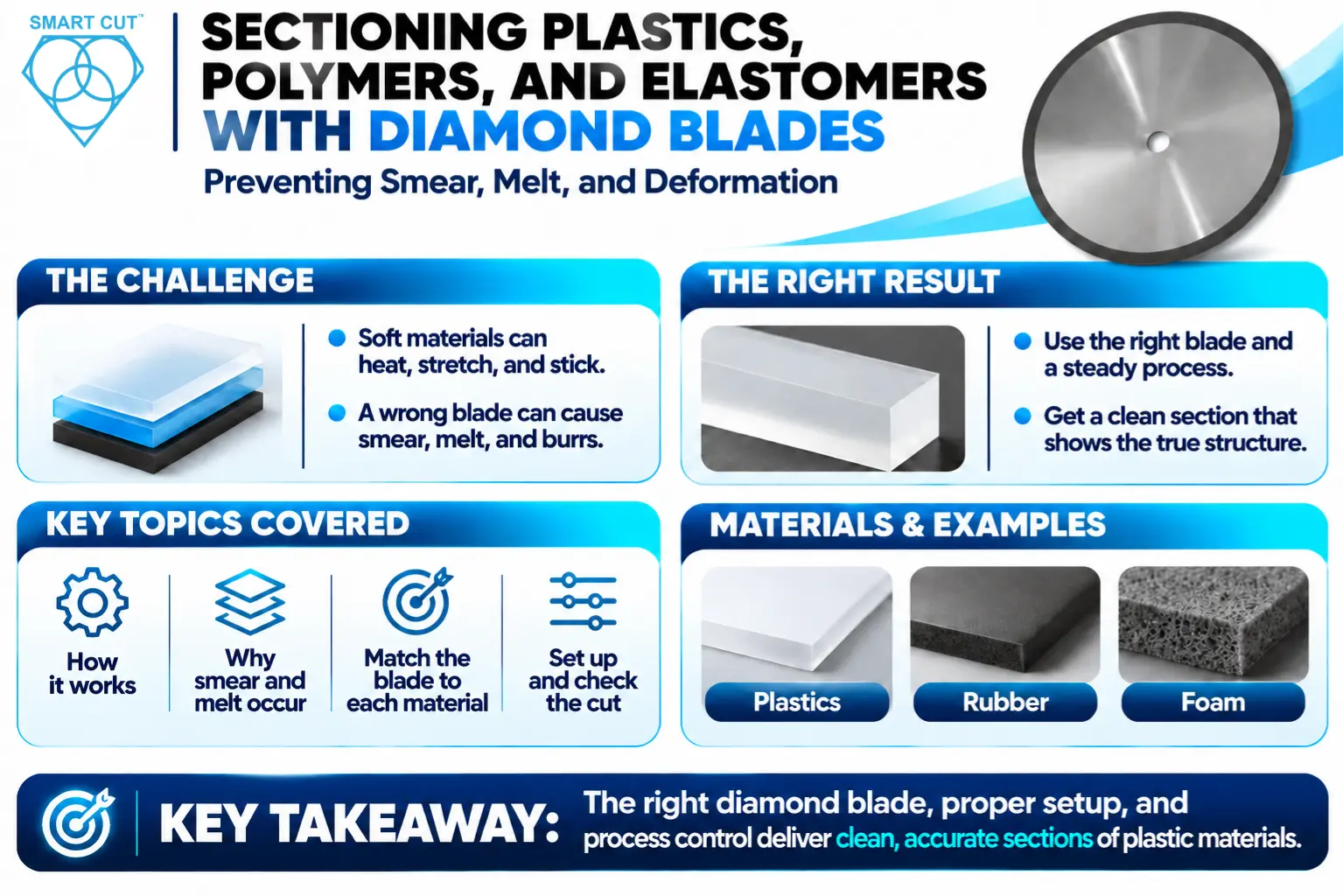
UKAM’s Series 30HCU is tailored for soft and gummy materials, including plastics, polymers, rubber, and similar substances, and UKAM’s guide notes that soft or low-melting plastics are good candidates for it. Nickel bond blades suit soft, gummy materials where sintered blades load up. Soft materials smear and melt, so keep the feed steady, the pressure low, and the coolant on the cut.
Teeth, Enamel, Dentin, and Bone
For research and archaeological samples, UKAM’s guide lists electroplated (nickel bond) blades for teeth, enamel, and dentin. UKAM also notes that electroplated blades are used for biological sectioning, including bones, and that its nickel-bond continuous-rim blades suit soft, fragile crystals and fiberglass. Electroplated blades can run dry in some applications, but for biological samples where heat and structure matter, cut wet unless your method calls for otherwise.
Step 4: Control the Process
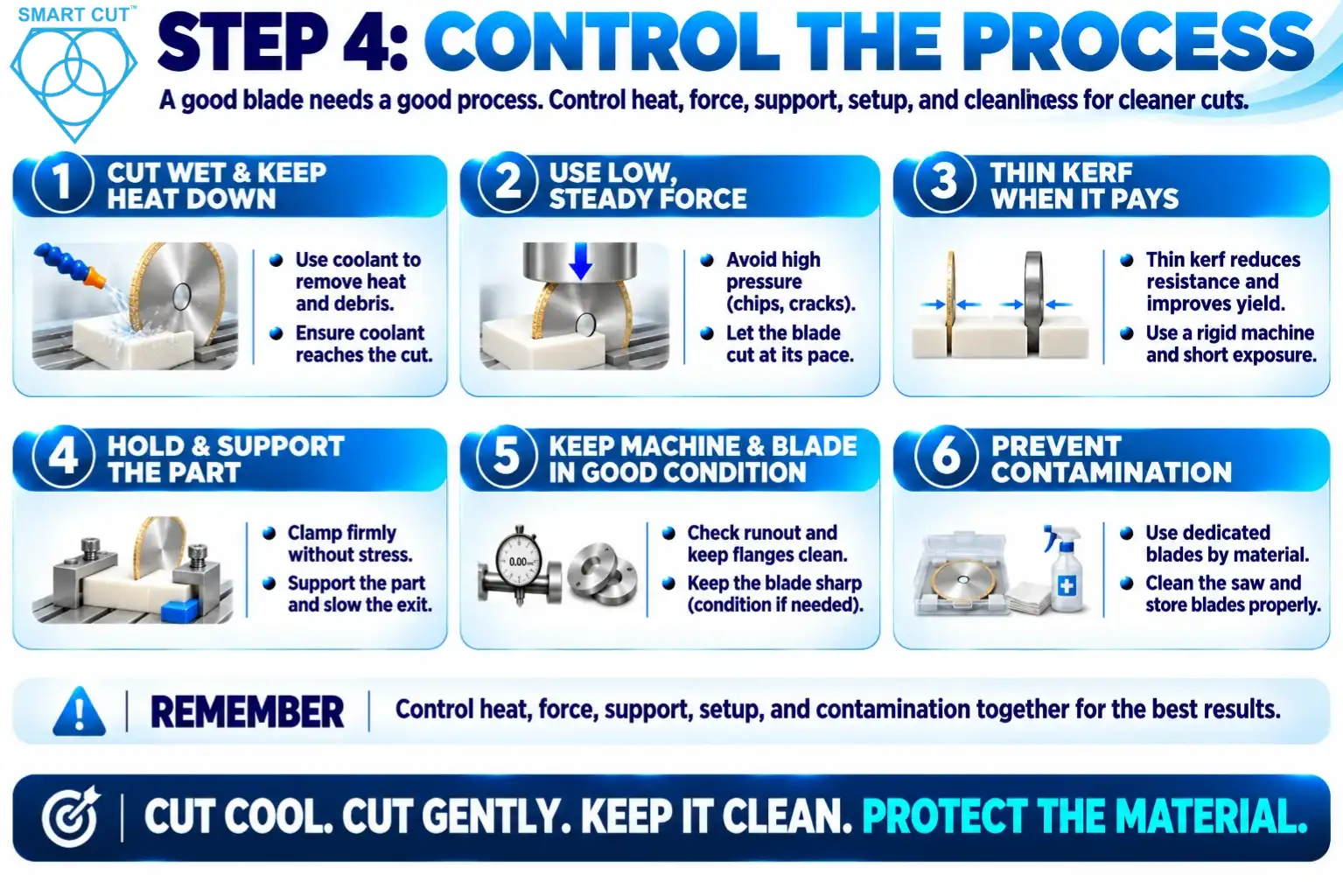
A good blade needs a good process.
Cut Wet and Keep Heat Down
Coolant carries heat away, flushes debris, and reduces friction. UKAM’s guidance states that for hard, brittle, and heat-sensitive materials, coolant is essential, and that without it thermal cracking, microfractures, and chipping will occur. Make sure coolant reaches the cut. See how coolant flow affects blade life and cut quality, and read our article on coolant condition management. For materials that will be cleaned, tested, or used in a regulated process, ask your supplier about coolant composition and safety data before you choose one.
Use Low, Steady Force
Force causes chipping, cracks, and smearing. UKAM warns that excessive pressure can cause burning, smearing, cracks, and deformation. Let the blade cut at its own pace, and do not push. Start the cut with a light load.
Choose a Thin Kerf Where Material Value Justifies It
UKAM states that thin-kerf blades generally reduce cutting resistance and improve yield because less material is removed. For costly blanks, that matters. A thin blade needs a rigid machine and short exposure. See our article on diamond blade diameter and thickness trade-offs.
Hold and Support the Part
If the part moves or vibrates, the blade chips it. Clamp firmly but without stress, support the part near the cut and at the exit, and slow the feed as the blade exits. Over-clamping can crack brittle ceramics before the cut starts. See workholding for precision diamond sectioning and dicing.
Keep the Machine and Blade in Good Condition
Check runout after every mount, keep flanges clean, and keep the blade cutting freely. See our articles on diamond blade runout, setup mistakes, and diamond and CBN blade dressing. A new blade may need conditioning first, as explained in do new diamond blades need conditioning before use. Use a rigid precision cutting saw.
Prevent Contamination
Dental and medical samples are sensitive to contamination. Dedicate blades to a material family where cross-contamination would matter, clean flanges and the saw between materials, and store blades protected. UKAM lists a non-magnetic alloy core and low contamination among the advantages of its wafering blades. See diamond blade storage, handling, and transport.
Step 5: Clean, Inspect, and Document
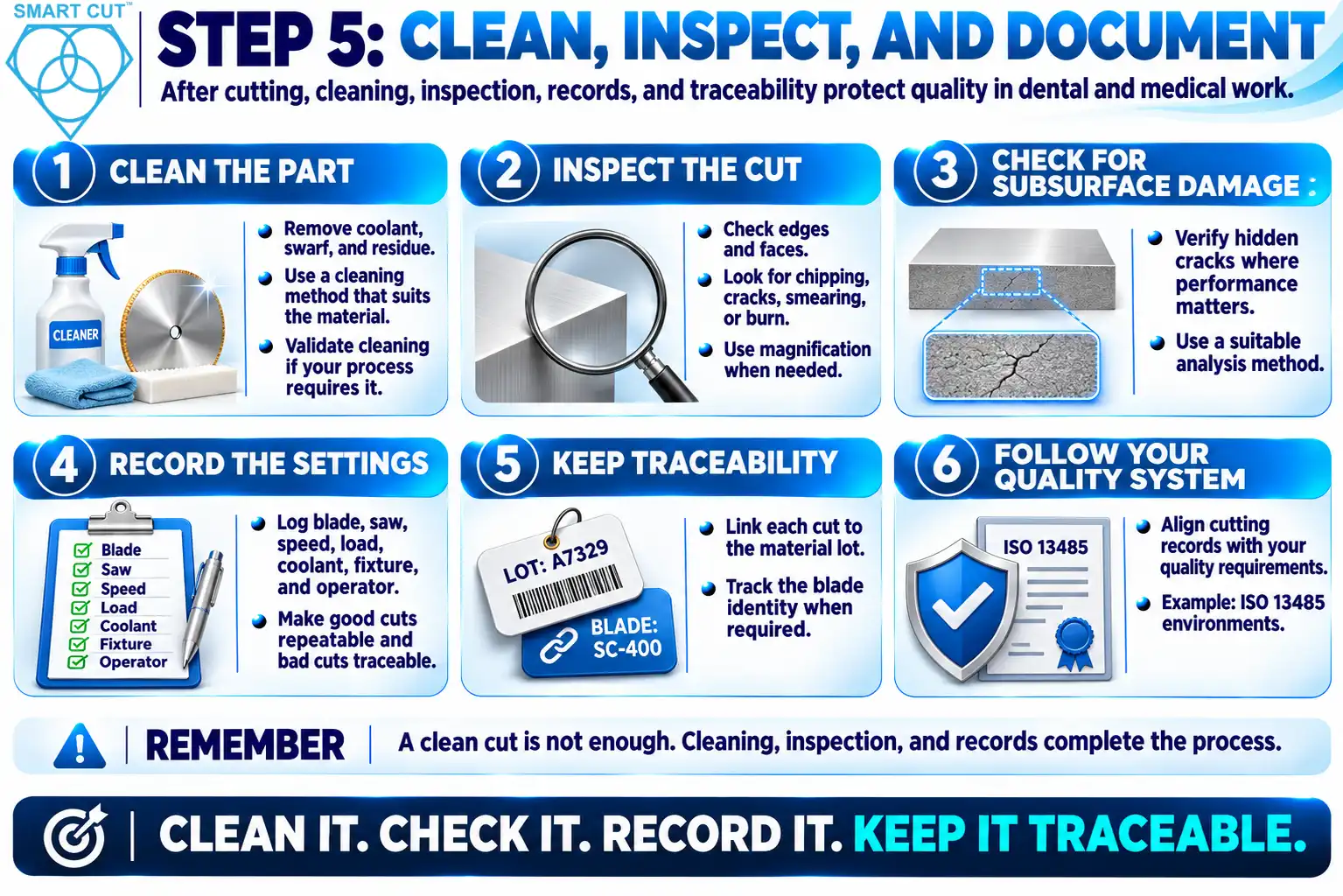
In a medical device or dental setting, the cut is only part of the job. What happens afterward matters too.
- Clean the part. Remove coolant, swarf, and residue by a method that suits your process and does not damage the material. Validate your cleaning if your quality system requires it.
- Inspect the cut. Check edges and faces for chipping, cracks, smearing, and burn. Use magnification as needed.
- Check for subsurface damage where it matters. If a hidden crack could affect performance, verify it with a suitable method for your analysis.
- Record the settings. Log the blade, saw, speed, load, coolant, fixture, and operator with the result, so you can repeat a good cut and trace a bad one.
- Keep traceability. Link each cut to the material lot and blade identity if your quality system requires it.
- Follow your quality system. If you work under a medical device quality system such as ISO 13485, align your cutting procedure and records with its requirements.
Troubleshooting Table
The table below combines UKAM guidance with general practice. Treat it as a guide, and confirm each cause.
| Problem | Likely causes | First actions |
|---|---|---|
| Edge chipping in ceramics | Feed too high, wrong blade, vibration, blade worn or glazed | Lower feed, review blade (soft bond, finer diamond), check runout and fixturing, dress or replace the blade |
| Microcracks or subsurface damage | Excess cutting force, coarse diamond | Lower force, use finer diamond and a thinner free-cutting blade |
| Corner breakout at the exit | Weak support, feed too high near the end | Support the exit, slow down at the end of the cut |
| Burn or discoloration on metal | Heat, weak coolant, dull blade, wrong blade | Improve coolant, lower force, dress or replace the blade, review CBN or bond choice |
| Smeared or melted polymer | Heat, high pressure, dull blade | Lower pressure, improve coolant, use a soft-material blade |
| Blade loads or glazes | Bond too hard for the material, weak coolant | Dress the blade, improve coolant, consider a softer bond |
| Cut wanders or tapers | Blade too thin for the load, runout, poor fixturing | Check runout and workholding, lower feed, review thickness |
| Contamination on the sample | Shared blades, dirty flanges, poor cleaning | Dedicate blades, clean flanges and saw, improve cleaning |
See diamond blade cut wander and kerf drift for wandering cuts and troubleshooting common diamond blade wear patterns for blade condition.
Step 6: Qualify the Process Before Production
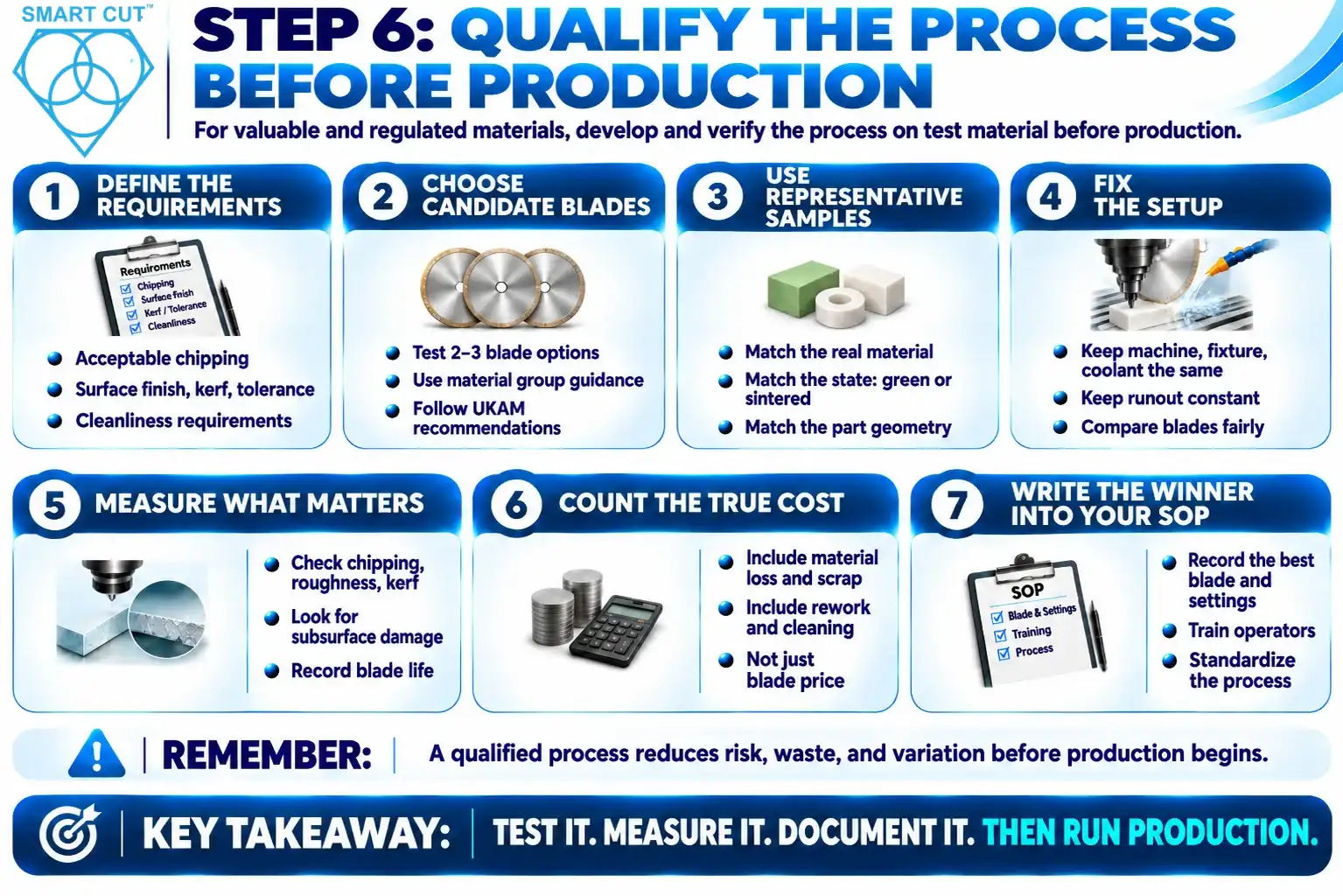
For valuable and regulated materials, develop the process on test material first.
- Define the requirements. State the acceptable chipping, surface finish, kerf, dimensional tolerance, and cleanliness.
- Choose two or three candidate blades. Use the groups above and UKAM’s recommendations for your material.
- Use representative samples. Match the material, state (pre-sintered or fully sintered), and geometry.
- Fix the setup. Keep the machine, fixture, coolant, and runout the same for every blade.
- Measure what matters. Inspect chipping, roughness, kerf, and subsurface damage, and record blade life.
- Count the true cost. Include material loss, scrap, rework, and cleaning, not only blade price. See diamond blade cost per cut.
- Write the winner into your SOP and train operators. See our diamond blade cutting SOP guide.
For the testing methods, see the diamond blade testing series and how to compare two diamond blades fairly. UKAM’s process development team and its precision machining services, which handle metals, polymers, ceramics, composites, and biological samples, can help.
Common Mistakes
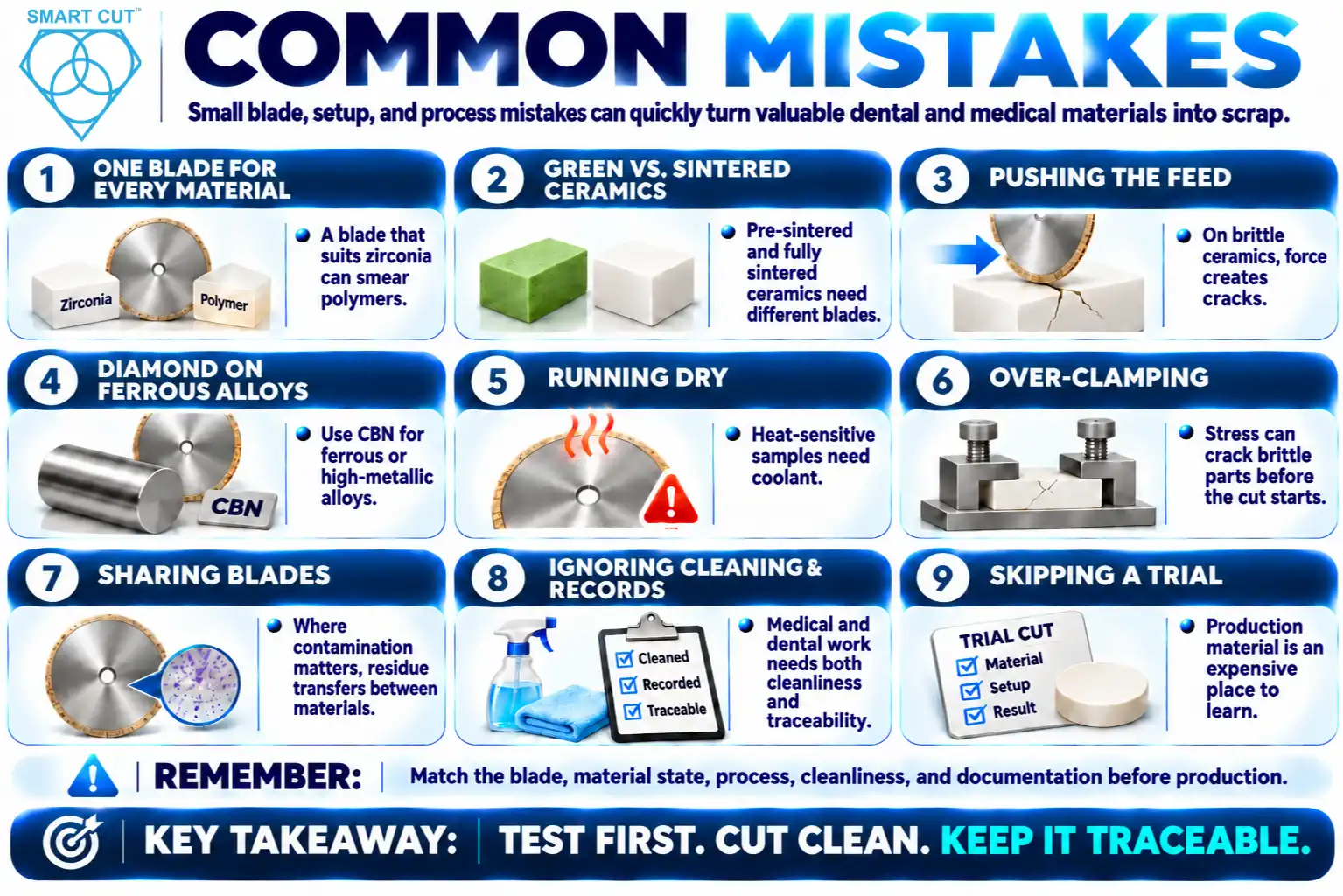
Using one blade for every material. A blade that suits zirconia smears polymers.
Confusing pre-sintered and fully sintered ceramics. They need different blades.
Pushing the feed on brittle ceramics. Force makes cracks.
Using diamond on ferrous alloys. CBN suits those alloys.
Running dry on heat-sensitive samples. Heat damages the material and the structure.
Over-clamping brittle parts. Stress cracks them before the cut starts.
Sharing blades between materials where contamination matters. Residue transfers.
Ignoring cleaning and records. Medical and dental work needs both.
Skipping a trial. Production material is an expensive place to learn.
Applying This in Your Lab or Shop
Start by sorting your materials into groups and writing down the purpose of each cut. Pick a starting blade for each group from the table, set a low steady load with coolant on the cut, and support the part at the exit. Run a controlled trial on test material, inspect the edges, and record the settings. Then clean the parts, document the result, and put the winning settings into your procedure.
If you cut many different materials, keep a short table of approved blades and settings for each, and review it when a material, blade, or machine changes.
Related UKAM Products and Resources
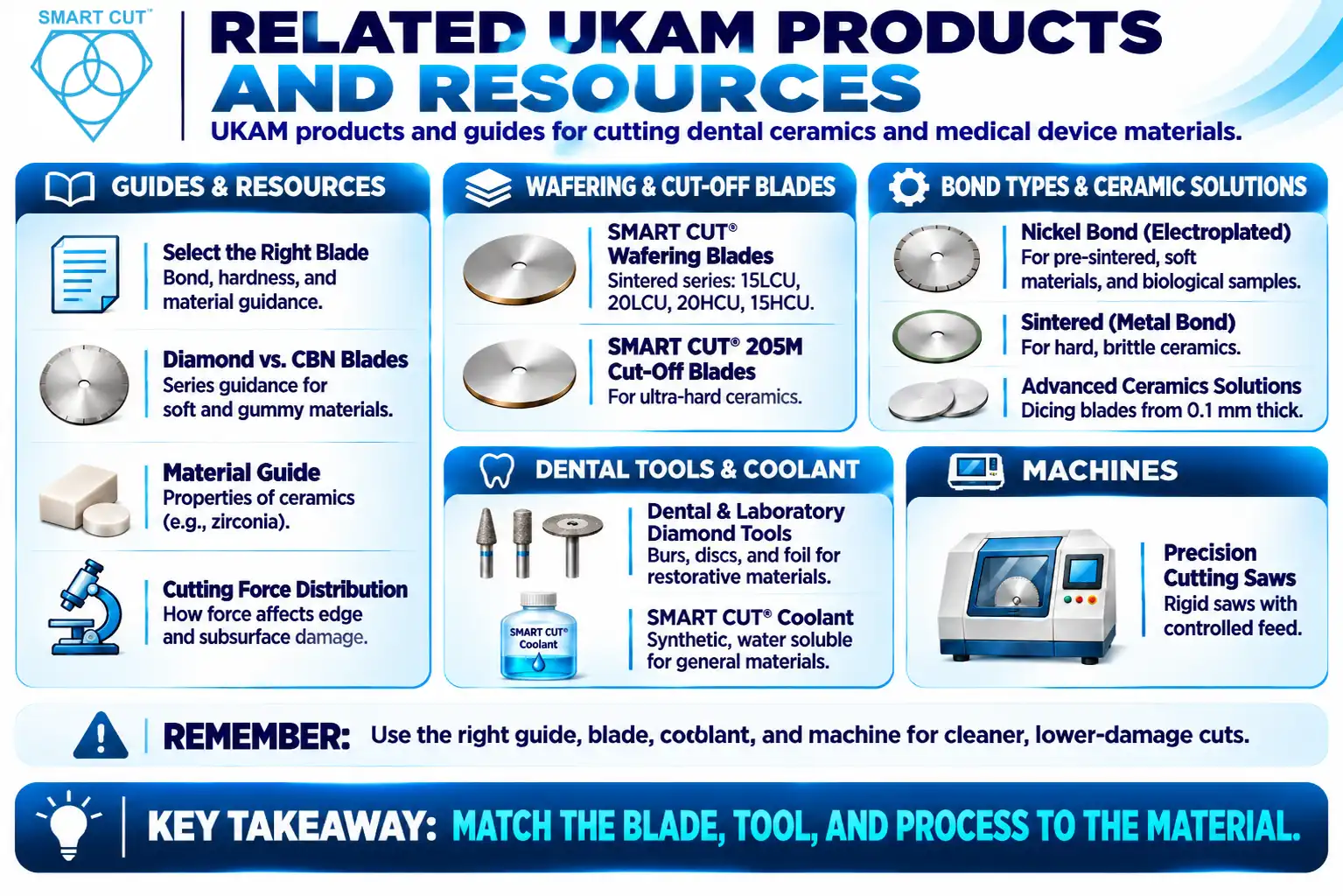
These UKAM products and guides support cutting dental ceramics and medical device materials.
- Select the right diamond blade for your application: bond, hardness, and material guidance, including zirconia and dental samples.
- SMART CUT® diamond wafering blades: sintered series including 15LCU, 20LCU, 20HCU, and 15HCU.
- SMART CUT® 205M cut-off blades: sintered blades for ultra-hard ceramics.
- Nickel bond (electroplated) blades: for pre-sintered ceramics, soft materials, and biological samples.
- Sintered (metal bond) blades: for hard, brittle ceramics.
- Advanced ceramics solutions: dicing blades from 0.1 mm thick.
- Dental and laboratory diamond tools: burs, discs, and foil for restorative materials.
- Understanding and comparing diamond and CBN wafering blades: series guidance, including soft and gummy materials.
- Material guide: hardness and properties of advanced ceramics, including zirconia.
- Cutting force distribution in metallographic sectioning: how force causes edge and subsurface damage.
- SMART CUT® synthetic water soluble coolant: general materials coolant.
- Precision cutting saws: rigid saws with controlled feed.
Key Takeaways
- Dental and medical device materials span hard ceramics, tough alloys, soft polymers, and delicate tissue, so one blade cannot suit all of them.
- For hard ceramics, UKAM’s guidance is a soft bond, thin kerf blade, and its low-concentration series suit hard, brittle materials such as zirconia and alumina.
- Pre-sintered ceramics suit nickel bond blades, so know the state of your material.
- CBN suits cobalt alloys and tough, gummy titanium. Diamond reacts with iron at high temperatures.
- Soft and gummy polymers suit Series 30HCU and nickel bond blades.
- Teeth, enamel, dentin, and bone suit electroplated blades; cut wet.
- Cut wet, use low steady force, support the exit, and keep runout low.
- Clean, inspect, document, and keep traceability, and follow your own quality system.
- Qualify the process on representative test material before production.
Frequently Asked Questions
Yes, UKAM lists zirconia among the hard ceramics its sintered metal bond blades cut.
UKAM’s guidance points to a soft-bond, thin-kerf sintered metal bond blade.
UKAM’s low-concentration 15LCU series is listed for hard and brittle materials such as alumina and zirconia.
UKAM states nickel bond blades suit pre-sintered and pre-fired (green) materials.
UKAM recommends CBN for cobalt alloys and tough, gummy titanium.
Use a soft-material blade such as Series 30HCU, keep pressure low, and keep coolant on the cut.
UKAM lists electroplated (nickel bond) blades for teeth, enamel, dentin, and bone.
Avoid it for brittle, heat-sensitive materials, because thermal cracking and chipping follow.
It reduces cutting resistance and material loss, but it needs a rigid machine.
Dedicate blades where it matters, and clean flanges and the saw between materials.
Use a suitable inspection method for your analysis, and cut a gentler reference if you are unsure.
Yes, because records let you repeat a good cut and trace a bad one.
No, it covers laboratory and industrial cutting, not clinical or regulatory requirements.
Test candidate blades on representative samples under matched conditions and measure chipping, finish, kerf, and subsurface damage.
Conclusion
Cutting dental ceramics with diamond blades, and medical device materials more broadly, is a matter of fit. The material group determines the blade: soft-bond, thin-kerf sintered blades for hard ceramics; nickel bond for pre-sintered and soft materials; CBN for cobalt alloys and tough titanium; and electroplated blades for teeth and bone. The process then decides whether the blade delivers wet cutting, low steady force, firm support, and a machine that runs true.
Because these materials are valuable and the quality limits are strict, qualify the process on test material, clean and inspect the result, and keep records. Do that, and you protect both the part and the analysis that depends on it.
If you want help choosing a blade or process for your dental or medical materials, request a consultation with the UKAM team, or browse our diamond wafering blades, dicing blades, and ultra thin precision diamond blades.
Trusted by Tens of Thousands of Manufacturers, Laboratories,
Research Institutions Worldwide Since 1990
American Based Manufacturer
Established in 1990
Custom manufacturing
RELATED ARTICLES


Brian is an experienced professional in the field of precision cutting tools, with over 27 years of experience in technical support. Over the years, he has helped engineers, manufacturers, researchers, and contractors find the right solutions for working with advanced and hard-to-cut materials. He’s passionate about bridging technical knowledge with real-world applications to improve efficiency and accuracy.
As an author, Brian Farberov writes extensively on diamond tool design, application engineering, return on investment strategies, and process optimization, combining technical depth with a strong understanding of customer needs and market dynamics.