









Skip to navigation Skip to main content
Home > Blog > Do New Diamond Blades Need Conditioning Before Use? Dressing a New Diamond Blade Explained
Diamond Blade Articles, blog

Do New Diamond Blades Need Conditioning Before Use? Dressing a New Diamond Blade Explained

Do New Diamond Blades Need Conditioning Before Use? Dressing a New Diamond Blade Explained

You unpack a new diamond blade and mount it. Should you start cutting right away, or prepare it first? Operators ask this all the time, and they hear different answers from different people.

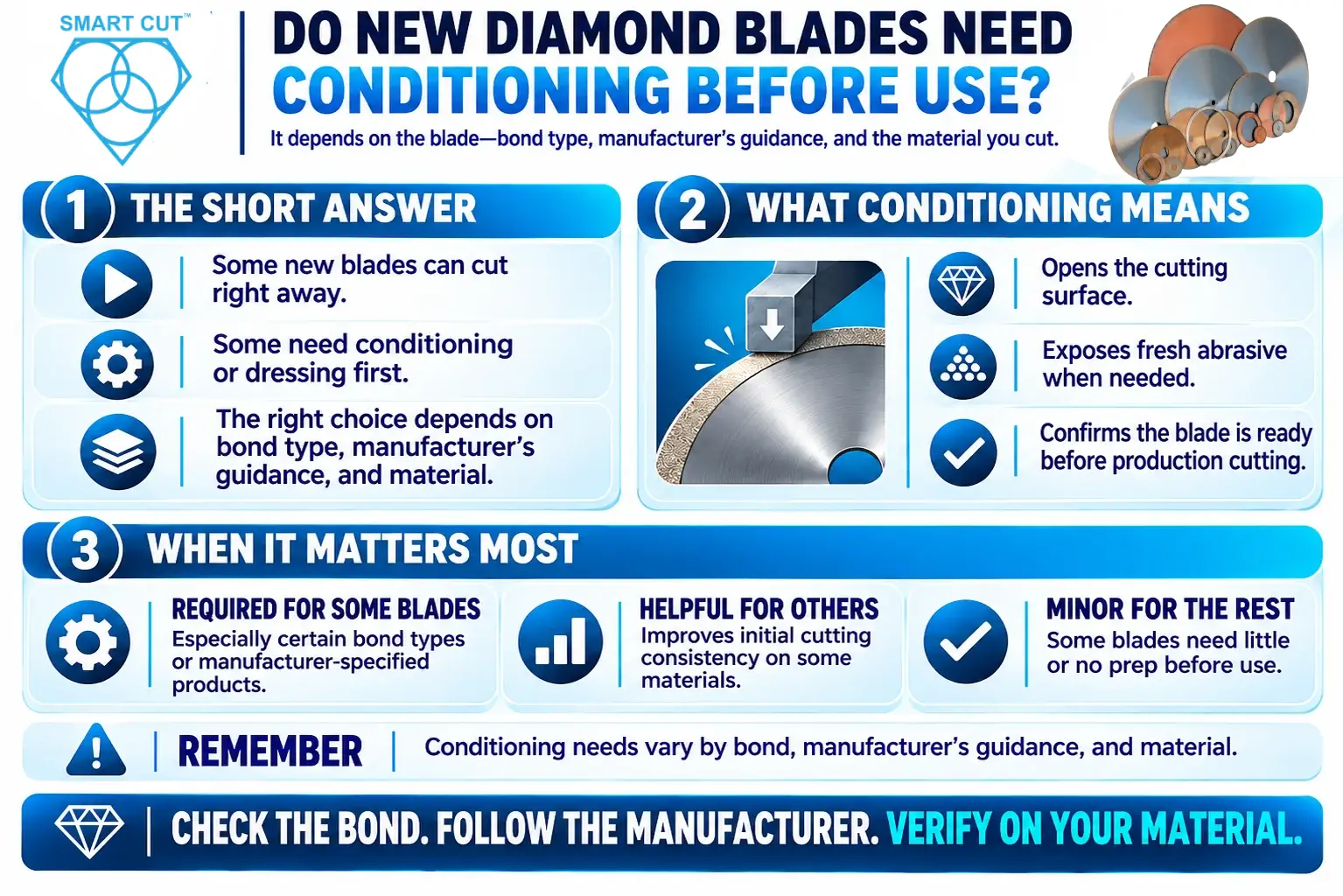
The honest answer is: it depends on the blade. Dressing a new diamond blade before the first cut helps some blades, is required for others, and matters very little for the rest. The right choice depends on the bond type, the manufacturer’s instructions, and the material you cut.

This article explains what conditioning a new diamond blade means, which blades need it, how UKAM’s own guidance treats it, and how to confirm that a blade is ready. It focuses on the start of a blade’s life. For restoring a blade that has already been cutting, see our guide on diamond and CBN blade dressing.

Trusted by Tens of Thousands of Manufacturers, Laboratories Research Institutions Worldwide Since 1990

American Based Manufacturer

Established in 1990

Custom manufacturing

The Short Answer

The Short Answer

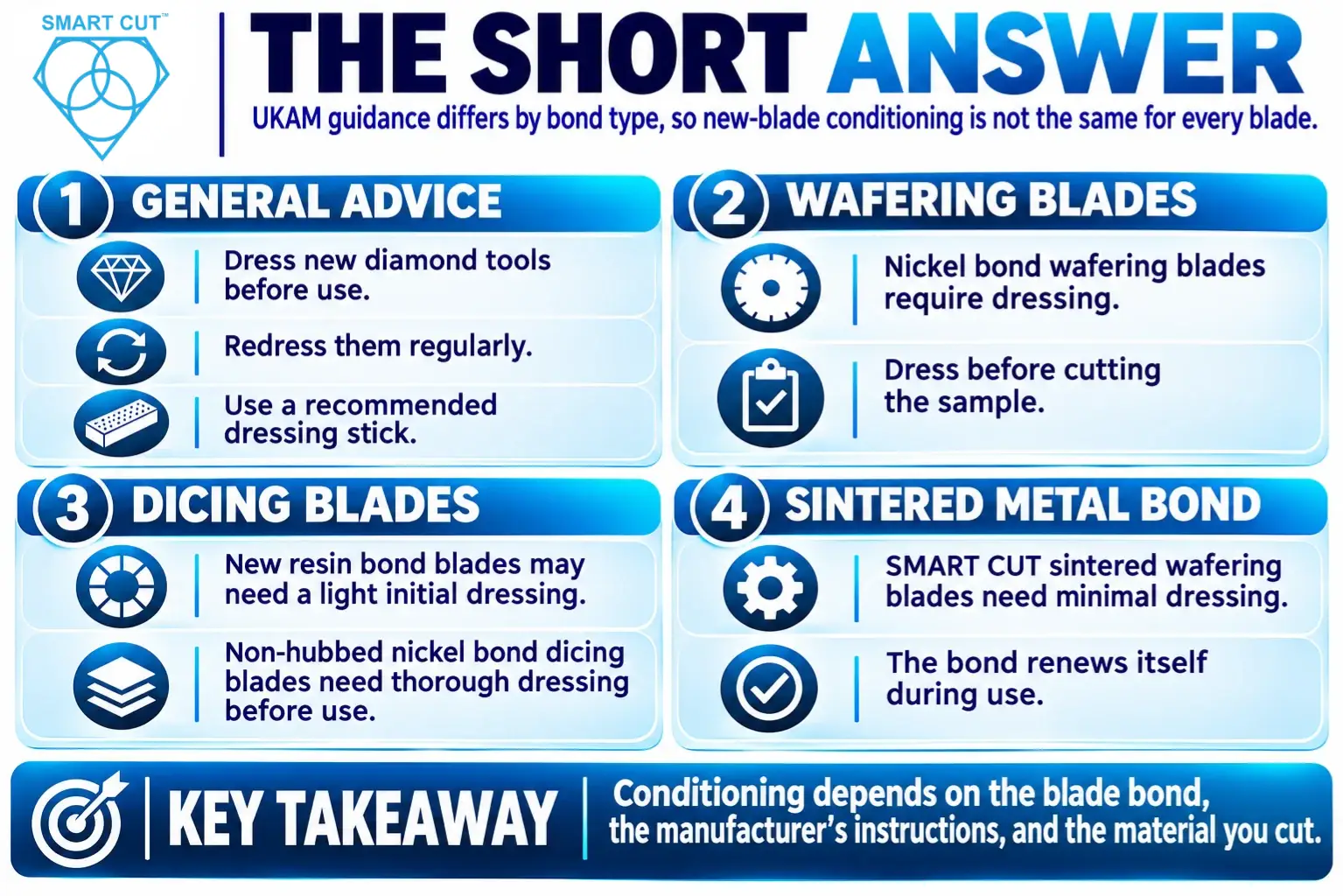
UKAM’s published guidance gives a few clear points.

  • UKAM’s general advice is to dress new diamond tools before use and to redress them frequently, using a recommended dressing stick. See how to properly use diamond tools.
  • UKAM’s wafering blade guidance states that nickel bond wafering blades require dressing, and it recommends dressing before you start cutting a sample. See the wafering blade usage recommendations.
  • UKAM’s dicing blade guidance says a new resin bond blade may need an initial light dressing, and that non-hubbed nickel bond dicing blades need thorough dressing before use.
  • UKAM states that its SMART CUT® sintered (metal bond) wafering blades need minimal dressing because the bond renews itself.

So the answer is not the same for every blade. The rest of this article explains why, and how to decide for the blade in your hand.

What "Conditioning" a New Blade Means

what conditioning a new blade means

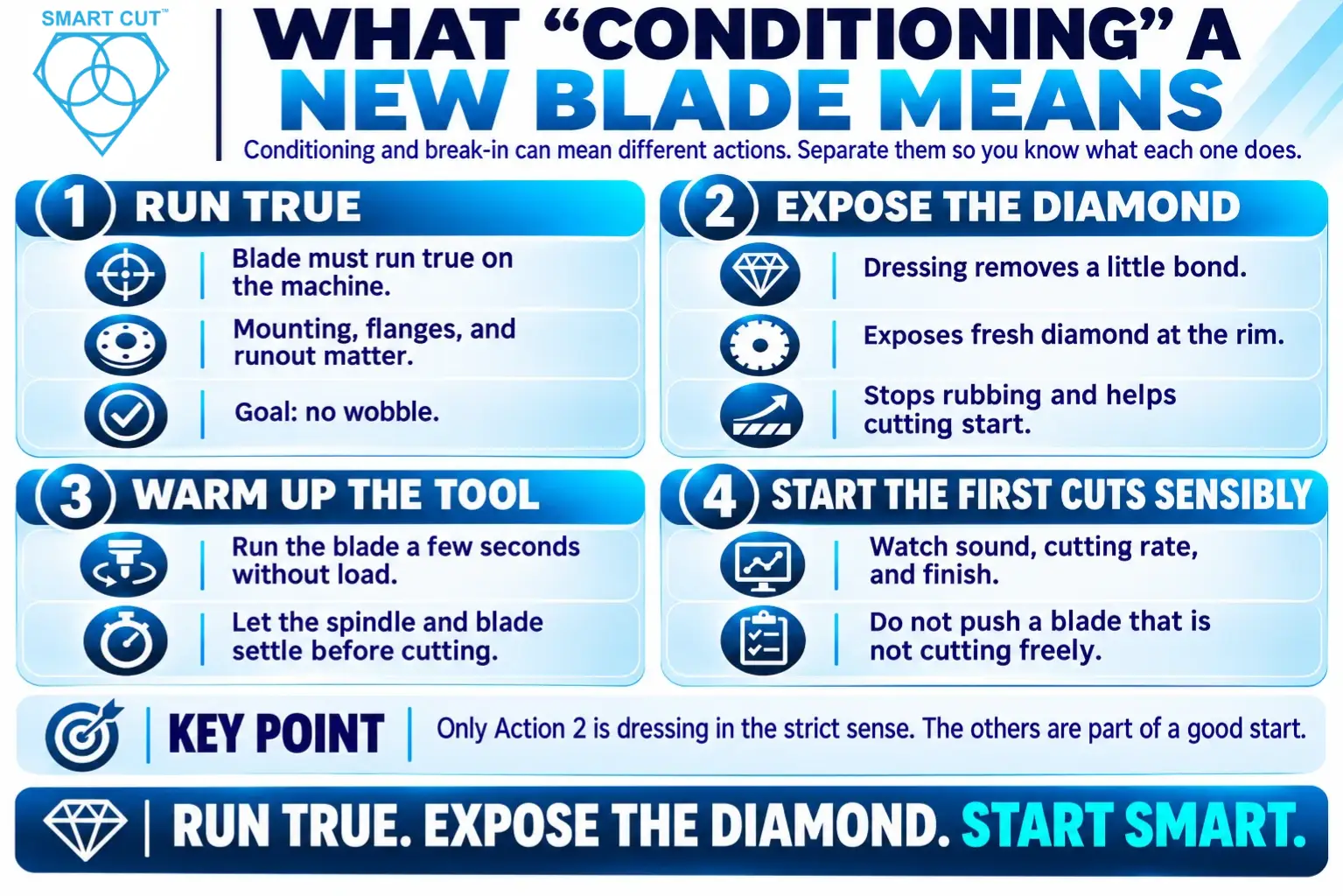
People use “conditioning” or “break-in” for several different actions. Separate them, because each one has a different purpose.

  1. Making the blade run true. The blade must run without wobble on your machine. UKAM describes the goal of dressing as keeping the diamond tool “true in running” on your machine. Mounting quality, flange condition, and runout all matter here. See our runout article for the full method.
  2. Exposing the diamond. The diamond does the cutting. If the bond covers the diamond at the rim surface, the blade rubs instead of cutting. Dressing removes a little bond and exposes the diamond so it can engage the material. UKAM says dressing keeps diamonds thoroughly exposed.
  3. Warming up the spindle and blade. UKAM recommends letting the tool run for a few seconds without load before you start any cutting operation.
  4. Starting the first cuts sensibly. The first cuts tell you whether the blade is ready. Watch the sound, the cutting rate, and the finish, and avoid pushing a blade that is not yet cutting freely.

Only the second action is dressing in the strict sense. The others are part of a good start.

Why Dressing a New Diamond Blade Can Help

Why Dressing a New Diamond Blade Can Help

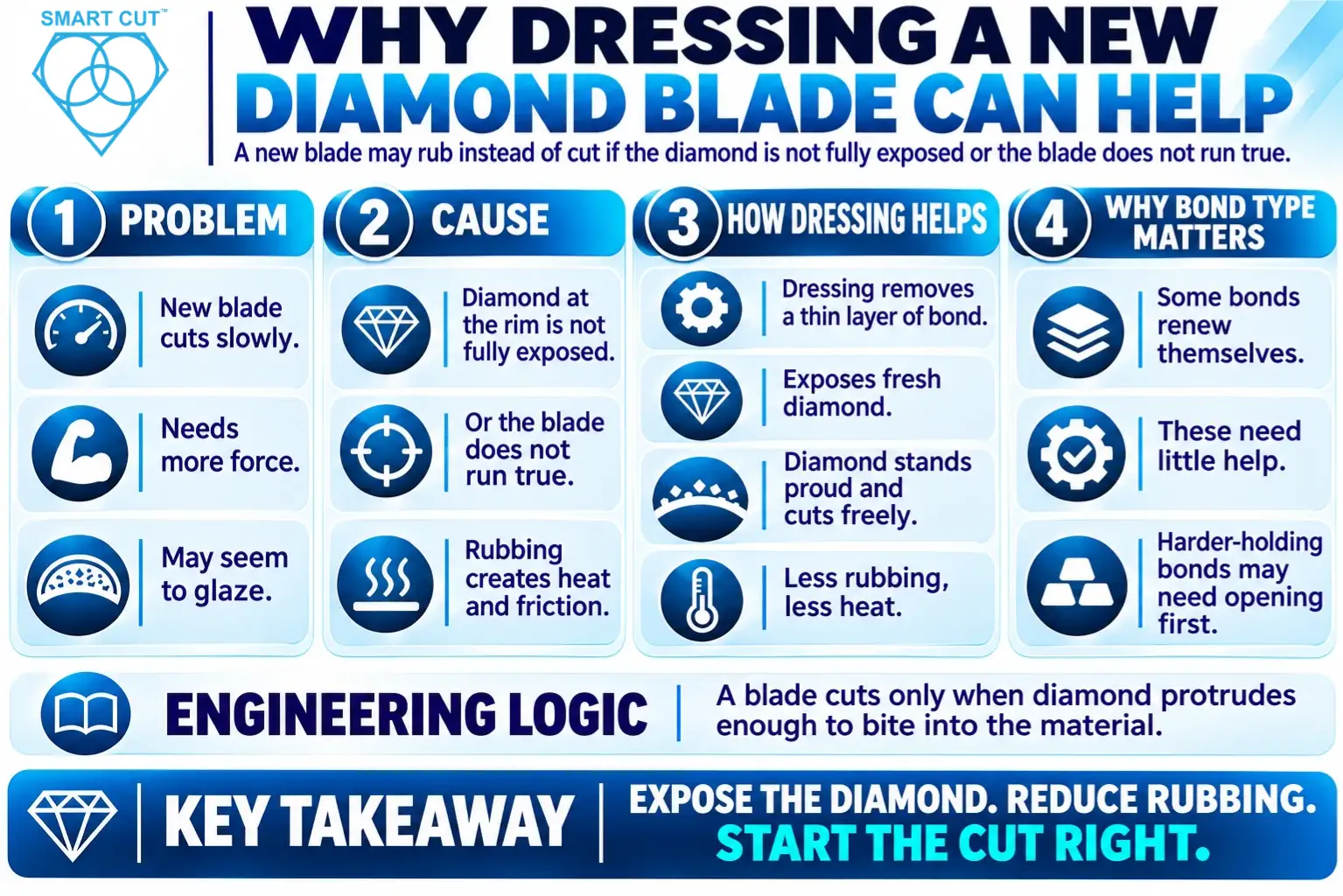
Problem: A brand-new blade cuts slowly, needs more force, or seems to glaze, even though nothing is wrong with it.

Cause: The diamond at the rim surface is not fully exposed, or the blade does not run true.

Engineering logic: A diamond blade cuts only when diamonds protrude from the bond far enough to bite into the material. During use, the bond erodes and exposes fresh diamond. Some bond types do this readily, and others need help. A blade whose diamonds sit below the bond surface will rub the material. Rubbing makes heat and friction, and it can glaze the surface. The operator then pushes harder, which makes the problem worse.

Dressing speeds up the process. A dressing stick removes a thin layer of bond and exposes the diamond. After a proper dressing, the diamond stands proud and the blade cuts freely.

Bond type matters because different bonds wear in different ways. A bond that renews itself needs little help. A bond that holds firmly may need to be opened up first.

What Each Bond Type Needs

What Each Bond Type Needs

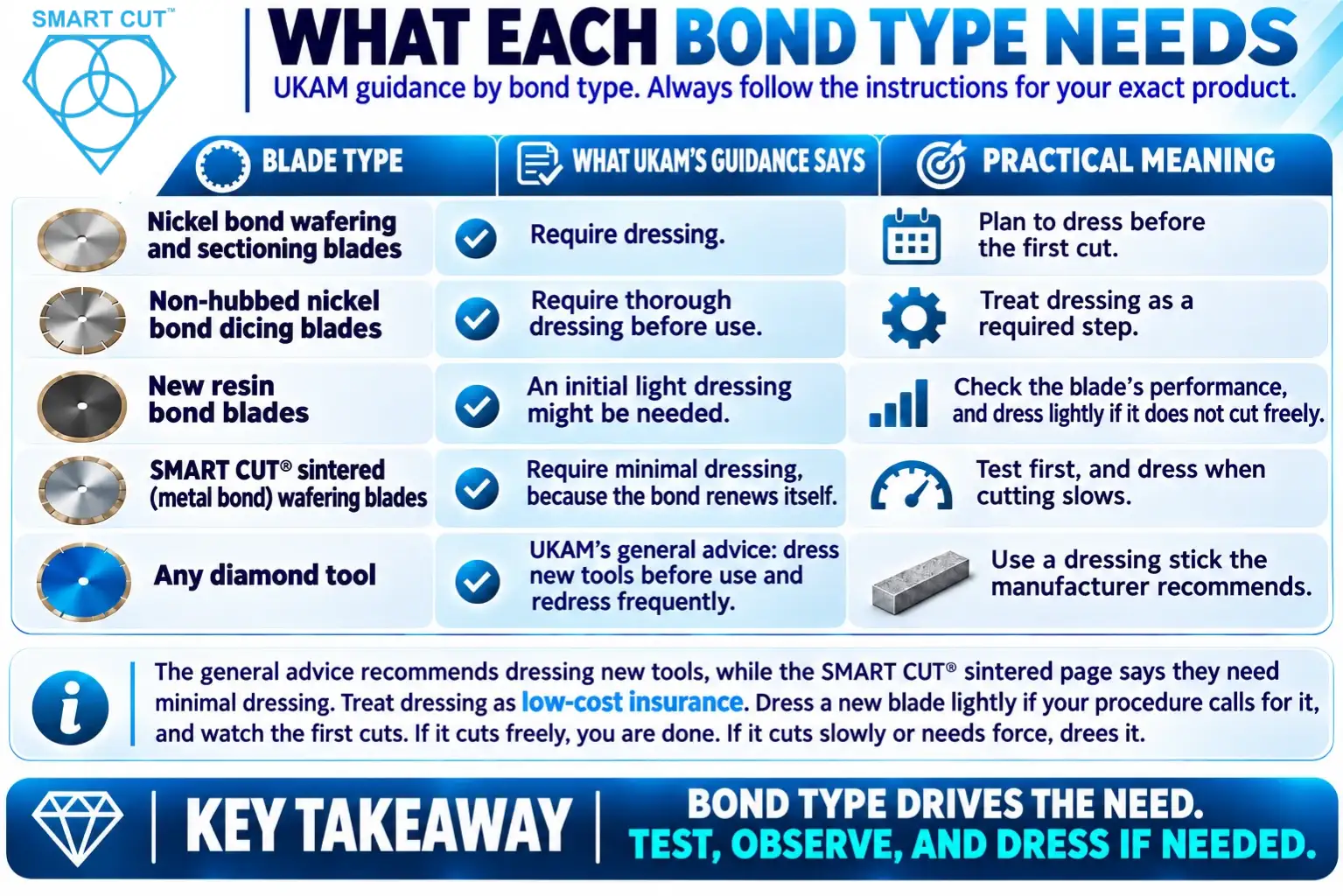
The table below summarizes UKAM’s published guidance by bond type. Always follow the instructions for your exact product.

Blade type What UKAM’s guidance says Practical meaning
Nickel bond wafering and sectioning blades Require dressing Plan to dress before the first cut
Non-hubbed nickel bond dicing blades Require thorough dressing before use Treat dressing as a required step
New resin bond blades An initial light dressing might be needed Check the blade’s performance, and dress lightly if it does not cut freely
SMART CUT® sintered (metal bond) wafering blades Require minimal dressing, because the bond renews itself Test first, and dress when cutting slows
Any diamond tool UKAM’s general advice: dress new tools before use and redress frequently Use a dressing stick the manufacturer recommends

These statements can look inconsistent at first. The general advice recommends dressing new tools, while the SMART CUT® sintered page says they need minimal dressing. The way to reconcile them is practical. Treat dressing as low-cost insurance. Dress a new blade lightly if your procedure calls for it, and watch the first cuts. If the blade cuts freely, you are done. If it cuts slowly or needs force, dress it. For any blade type not listed above, ask the manufacturer.

How to Dress a New Blade

How to Dress a New Blade

Dressing is simple, but details matter. The steps below follow UKAM’s guidance. Always follow the machine manufacturer’s safety instructions, and keep hands clear of the blade.

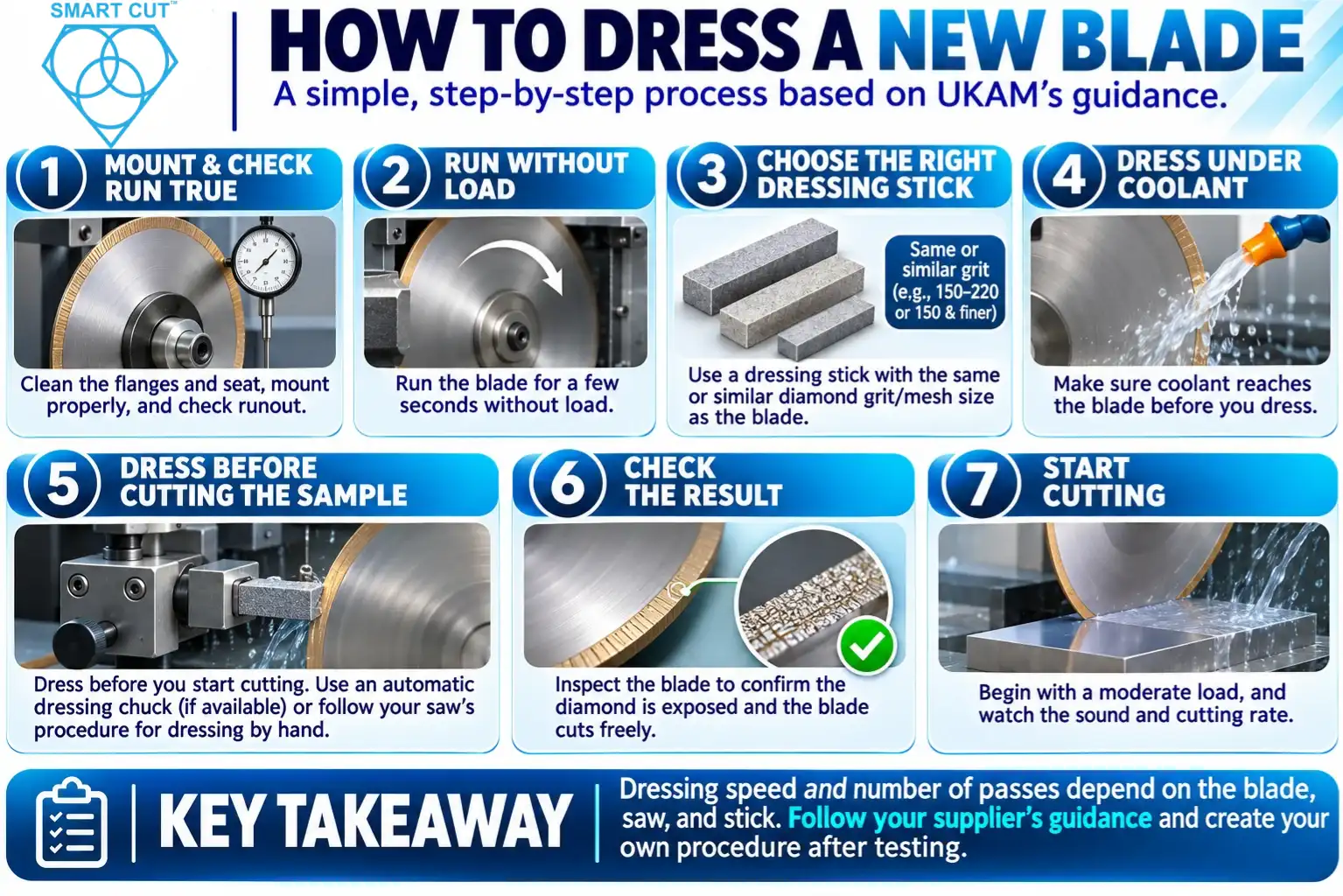
  1. Mount the blade and check it runs true. Clean the flanges and seat, mount following your standard procedure, and check runout.
  2. Run the blade for a few seconds without load. UKAM recommends this before any cutting operation.
  3. Choose the right dressing stick. UKAM states that the dressing stick should have the same or a similar diamond grit or mesh size as the blade. Dressing sticks come in different grades, so ask your supplier if you are unsure. UKAM lists several, including sticks for grit sizes of 150 to 220 and for 150 and finer.
  4. Dress under coolant. Make sure coolant reaches the blade before you dress, as you would for any cut.
  5. Dress before you start cutting the sample. Many sectioning saws have an automatic dressing chuck that feeds the dressing stock slowly into the rotating blade. If yours does not, follow your saw’s procedure for dressing by hand.
  6. Check the result. See the next section.
  7. Start cutting. Begin with a moderate load, and watch the sound and cutting rate.

The dressing speed and the number of passes depend on the blade, the saw, and the stick. UKAM does not give a fixed count for wafering blades and tells operators to use their best judgment. Follow your supplier’s guidance for your product, and write your own procedure after you test it.

How to Tell That a Blade Is Ready

You do not have to guess. Use these checks.

The thumbnail test. UKAM recommends this simple check. After thorough dressing, you should be able to snag your thumbnail on the diamonds. Do it with the machine stopped and secured, and take care with the edge. If the rim feels smooth and glassy, dress further.

Free cutting. A conditioned blade cuts at a steady rate with a steady sound. It does not need extra force.

A first test cut. Cut a sample of your usual material and compare the rate and finish with what you expect. Record it as the blade’s baseline.

No heat marks. Burn marks at the start of a blade’s life suggest that the diamond is not exposed or that coolant is not reaching the cut.

If the blade cuts well, stop dressing. Over-dressing wastes diamond. UKAM’s dicing blade guidance warns about this, and recommends light, occasional dressing to maintain cutting efficiency.

How Often to Redress After the First Time

Conditioning does not end at the first cut. UKAM’s guidance is practical.

  • There are no fixed rules on when or how often to dress a wafering blade. The operator should use judgment.
  • A good rule of thumb is that the blade needs dressing when the cutting rate is clearly slower than when the blade was new.
  • For deep cuts, UKAM gives an example: cutting 1 inch of material with a 5-inch wafering blade, the blade should be dressed continuously during operation.
  • UKAM states that continuously dressing sintered and resin bond wafering blades does not reduce blade life.

UKAM’s blade dressing guide adds a useful idea: dress before problems occur. Many labs and production shops dress only after cutting problems appear, but preventive dressing keeps performance more predictable. Dressing frequency still depends on the blade specification, the cutting parameters, coolant, and machine condition, so treat the guidance as a starting point and refine it from your own results.

When Dressing Will Not Help

when dressing will not help

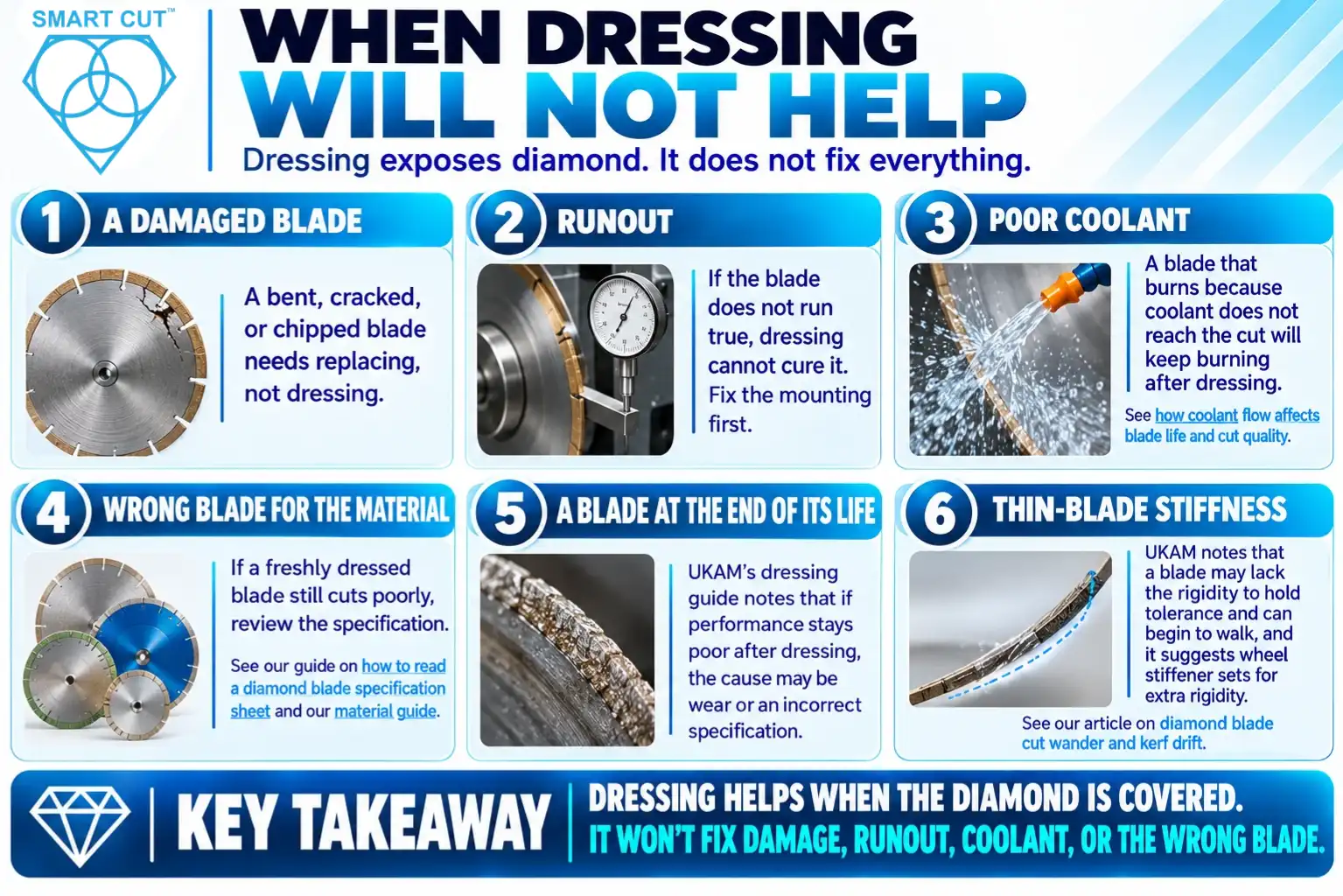
Dressing exposes diamond. It does not fix everything.

  • A damaged blade. A bent, cracked, or chipped blade needs replacing, not dressing.
  • If the blade does not run true, dressing cannot cure it. Fix the mounting first.
  • Poor coolant. A blade that burns because coolant does not reach the cut will keep burning after dressing. See how coolant flow affects blade life and cut quality.
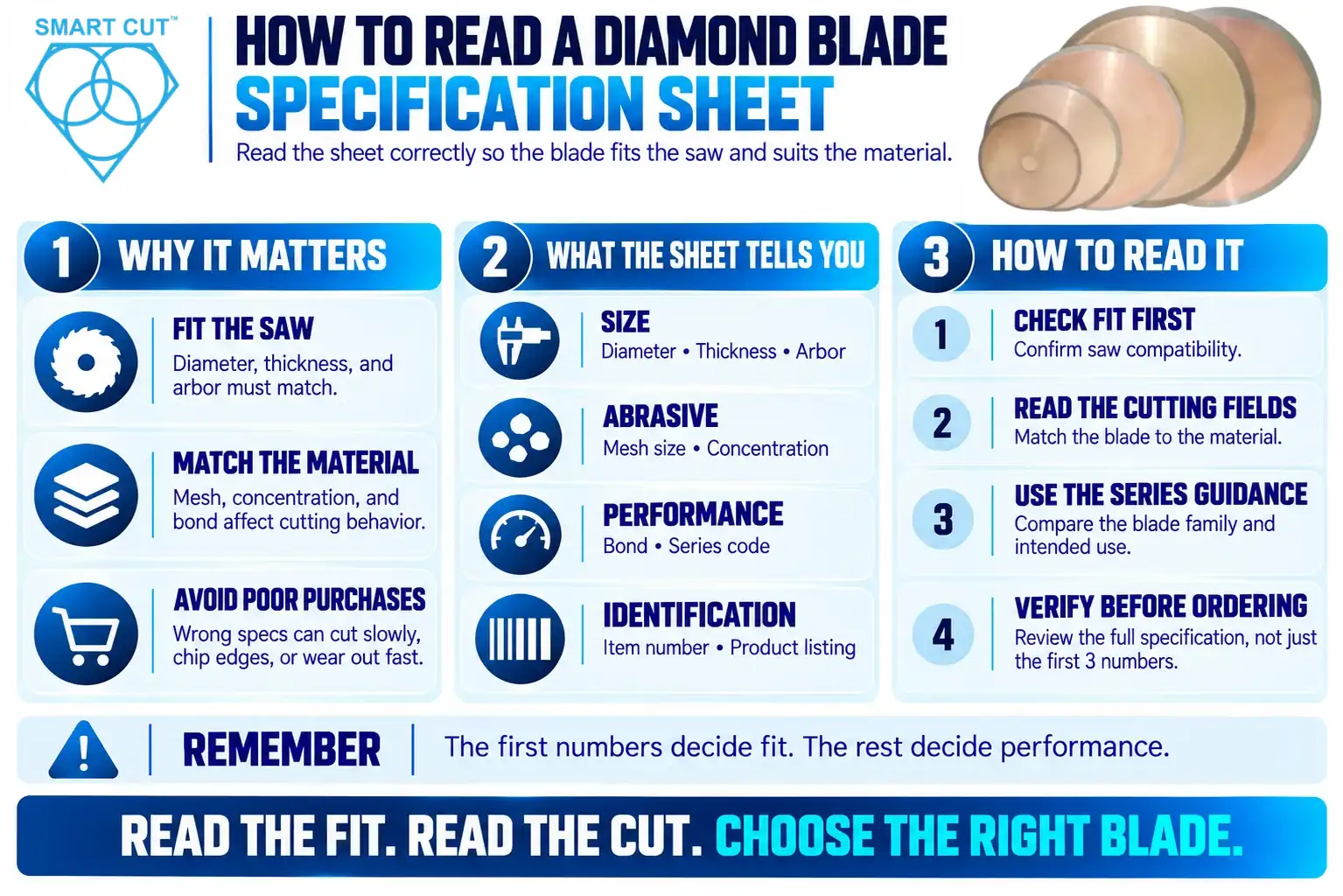
  • Wrong blade for the material. If a freshly dressed blade still cuts poorly, review the specification. See our guide on how to read a diamond blade specification sheet and our material guide.
  • A blade at the end of its life. UKAM’s dressing guide notes that if performance stays poor after dressing, the cause may be wear or an incorrect specification.
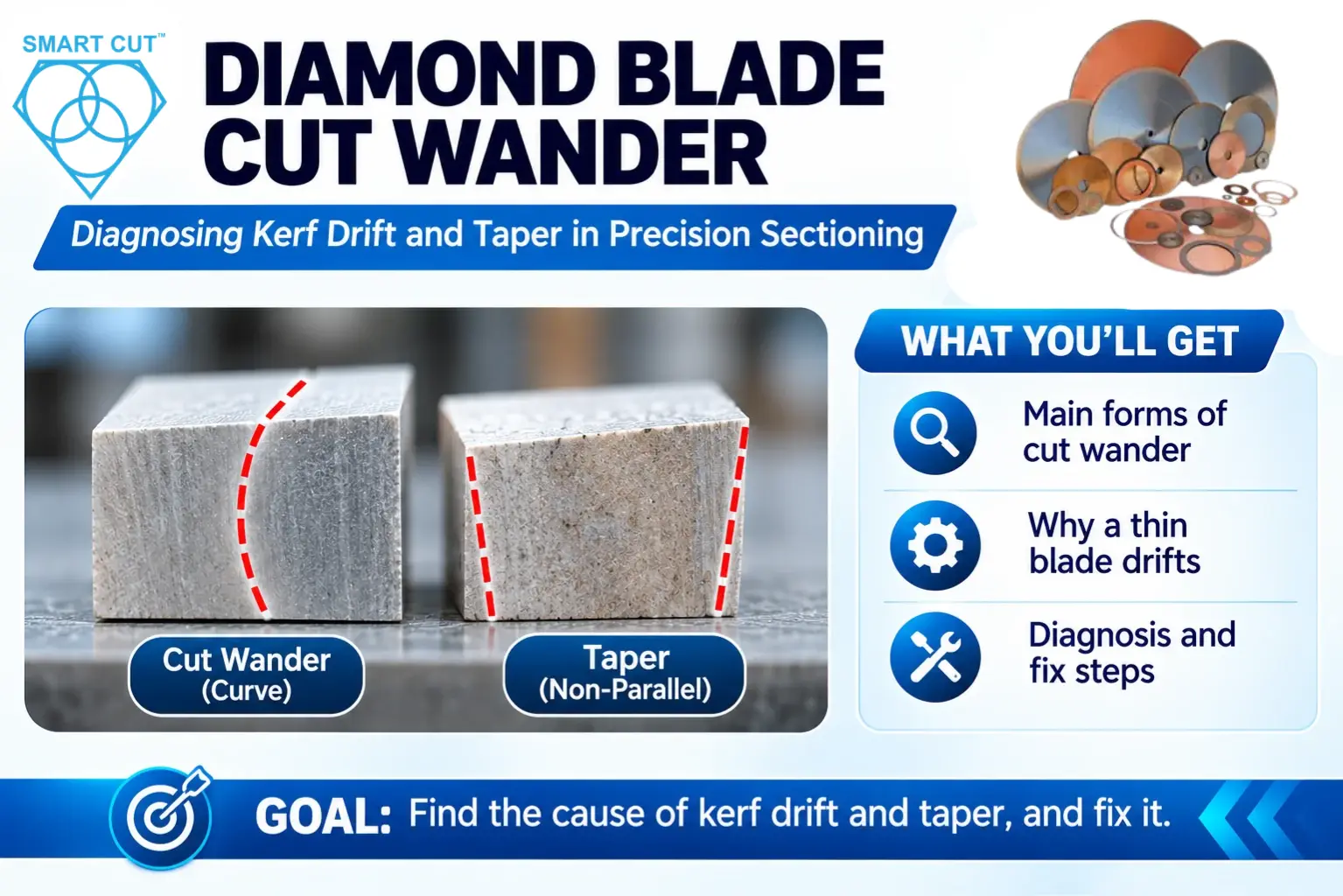
  • Thin-blade stiffness. UKAM notes that a blade may lack the rigidity to hold tolerance and can begin to walk, and it suggests wheel stiffener sets for extra rigidity. See our article on diamond blade cut wander and kerf drift.

Conditioning and Blade Testing

Conditioning and Blade Testing

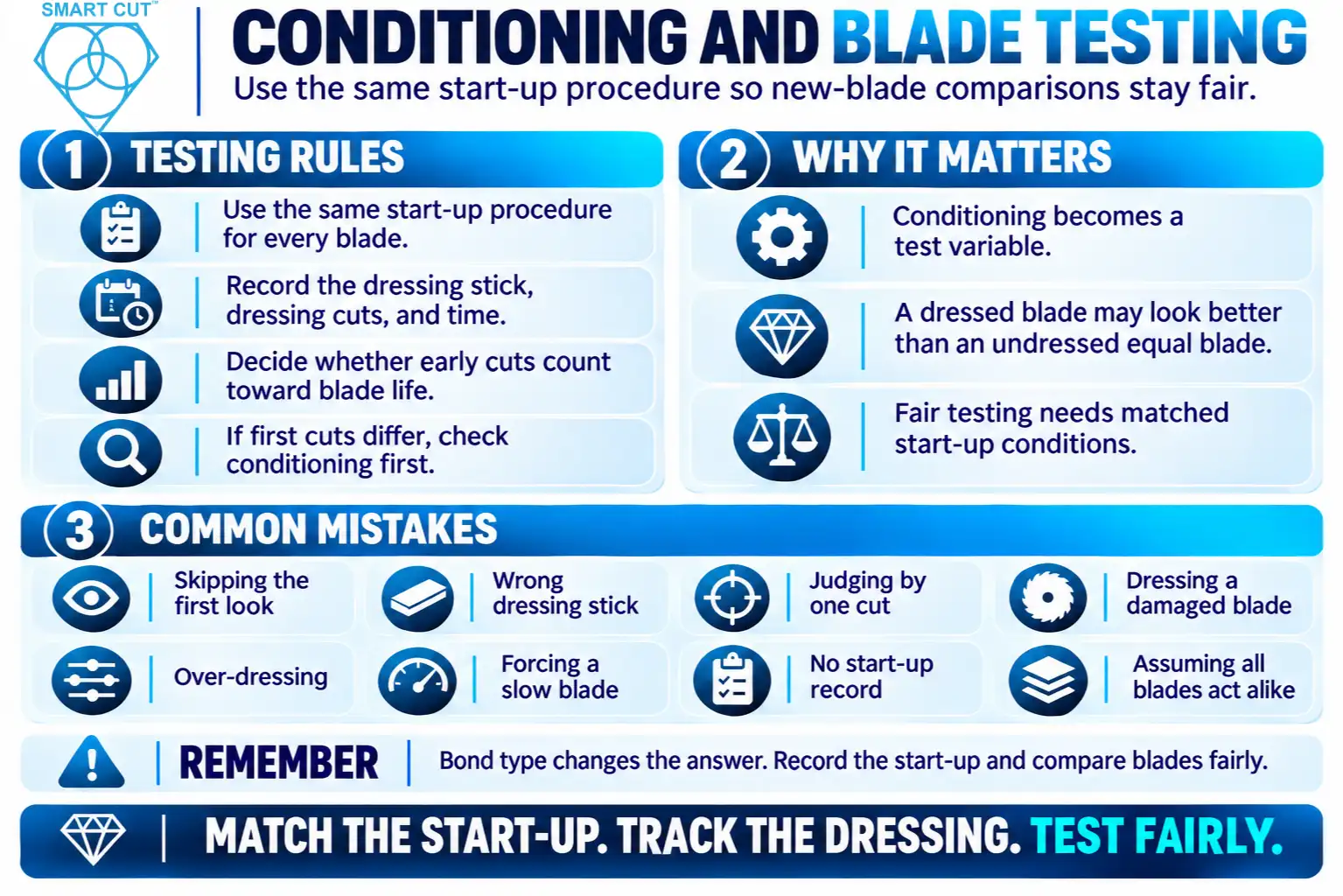
If you test blades, conditioning becomes a test variable. A blade dressed carefully before the test may look better than one that was not, even if the blades are equal.

  • Use the same start-up procedure for every blade in a comparison.
  • Record the dressing stick, the number of dressing cuts, and the time.
  • Decide whether early cuts count toward blade life, and say so in the report.
  • Treat unexplained differences in the first cuts as a reason to check conditioning.

See how to compare two diamond blades fairly and how to design a repeatable diamond blade test for the full approach.

Common Mistakes with New Blades

Skipping the first look. Starting a cut without checking that the blade runs true.

Using the wrong dressing stick. The stick should match the blade’s grit or mesh, as UKAM advises.

Judging a new blade by one cut. Conditioning takes a few cuts to show its effect.

Dressing a damaged blade. Remove it instead.

Over-dressing. It wastes diamond without improving the cut.

Forcing a slow blade. Push-through makes heat. Dress, then retest.

Not recording the start-up. Without records, you cannot repeat a good start.

Assuming all blades behave alike. Bond type changes the answer.

Applying This in Your Shop

Write a start-up procedure for new blades. Include the mounting and runout check, the no-load run, the dressing stick, and the first test cut. Train operators on it, and add it to your cutting SOP. Then keep a log: record how each new blade behaves in its first cuts, so you learn which of your blades need dressing and which do not.

If you are unsure about a blade, ask the supplier. UKAM’s team can advise on the best start-up for your blade and material. Browse the SMART CUT® sintered wafering blades or the wider diamond wafering blades category, and use a precision cutting saw that holds a blade true.

Related UKAM Products and Resources

These UKAM products and guides support a good blade start-up.

Key Takeaways

  • Whether a new blade needs conditioning depends on the bond type and the manufacturer’s instructions.
  • UKAM’s general advice is to dress new diamond tools before use, with a recommended dressing stick.
  • Nickel bond blades require dressing. New resin bond blades may need an initial light dressing. SMART CUT® sintered blades need minimal dressing.
  • Conditioning includes true running, exposing the diamond, a no-load run, and sensible first cuts.
  • Match the dressing stick to the blade’s grit or mesh size.
  • Check readiness with the thumbnail test, free cutting, and a baseline test cut.
  • Stop dressing once the blade cuts freely, because over-dressing wastes diamond.
  • Dressing cannot fix runout, damage, poor coolant, or a wrong specification.
  • Use one start-up procedure for every blade in a test, and record it.

Frequently Asked Questions

It depends on the bond type, so follow the instructions for your specific blade.

UKAM advises dressing new diamond tools before use and redressing them frequently.

Yes, UKAM states that nickel bond wafering blades require dressing.

UKAM says they need minimal dressing because the bond renews itself.

UKAM’s guidance says an initial light dressing might be needed.

Use one with the same or a similar grit or mesh size as the blade.

After thorough dressing, you should be able to snag a thumbnail on the exposed diamonds.

UKAM recommends a few seconds of no-load running before any cutting operation.

It cuts freely at a steady rate and sound, with no heat marks.

Yes, because over-dressing wastes diamond without improving the cut.

UKAM states that continuous dressing of sintered and resin bond wafering blades does not reduce life.

No, fix the mounting and runout first.

Dress when the cutting rate drops clearly below the blade’s early rate, and sooner for deep cuts.

Yes, so use the same start-up procedure for every blade and record it.

Conclusion

So, is dressing a new diamond blade always necessary? No. Often a little, sometimes a lot, and occasionally not at all. The answer depends on the bond. Nickel bond blades require dressing. New resin bond blades may need a light dressing. UKAM’s SMART CUT® sintered blades need minimal dressing because the bond renews itself. UKAM’s general advice is to dress new tools before use and keep redressing them.

The practical approach is simple. Make sure the blade runs true, run it a few seconds without load, dress it with a stick that matches its grit if your product calls for it, and check the result with a thumbnail test and a baseline cut. Then record what you did. A consistent start-up gives you blades that cut freely from the first sample, and test results you can trust.

If you want help choosing a blade or a start-up routine for your material and process, request a consultation with the UKAM team, or browse our diamond wafering blades and ultra thin precision diamond blades.

Trusted by Tens of Thousands of Manufacturers, Laboratories,
Research Institutions Worldwide Since 1990

American Based Manufacturer

Established in 1990

Custom manufacturing

RELATED ARTICLES

Brian is an experienced professional in the field of precision cutting tools, with over 27 years of experience in technical support. Over the years, he has helped engineers, manufacturers, researchers, and contractors find the right solutions for working with advanced and hard-to-cut materials. He’s passionate about bridging technical knowledge with real-world applications to improve efficiency and accuracy.

As an author, Brian Farberov writes extensively on diamond tool design, application engineering, return on investment strategies, and process optimization, combining technical depth with a strong understanding of customer needs and market dynamics.

author-avatar

About Brian Farberov

Brian is an experienced professional in the field of precision cutting tools, with over 27 years of experience in technical support. Over the years, he has helped engineers, manufacturers, researchers, and contractors find the right solutions for working with advanced and hard-to-cut materials. He’s passionate about bridging technical knowledge with real-world applications to improve efficiency and accuracy. As an author, Brian Farberov writes extensively on diamond tool design, application engineering, return on investment strategies, and process optimization, combining technical depth with a strong understanding of customer needs and market dynamics.

Download Checklist

Please fill in your details to download the Precision Diamond Saw Pre-Operation Checklist.