


















How to Read a Diamond Blade Specification Sheet
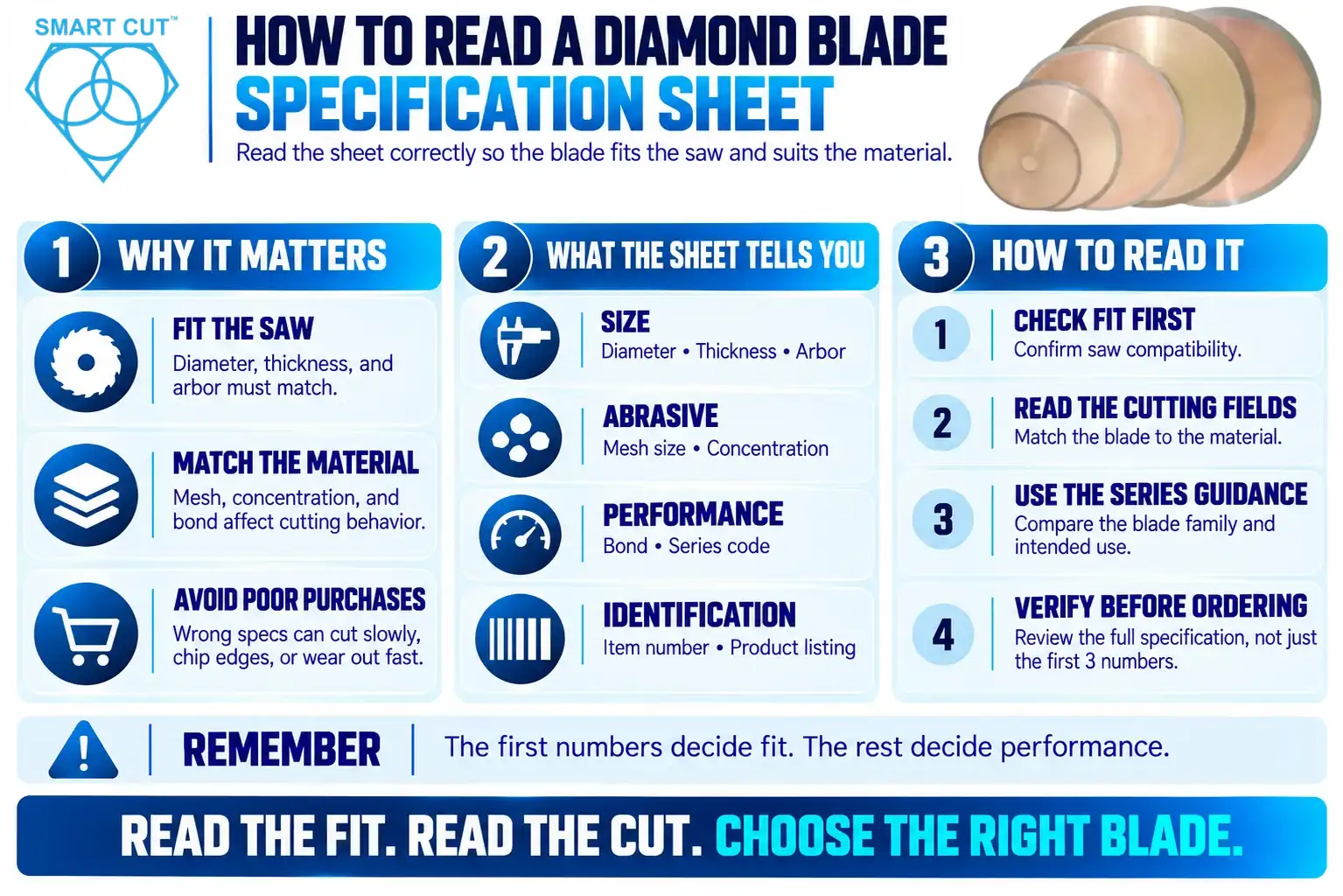
Table of Contents
ToggleA diamond blade specification sheet packs a lot into a few lines. Diameter, thickness, arbor, mesh, concentration, bond, series code, item number. Each one tells you something about how the blade will cut. Read them wrong, and you order a blade that cuts slowly, chips the edge, or wears out in a week.
Most buyers read the first three numbers (diameter, thickness, arbor) because those decide whether the blade fits the saw. The rest decide whether the blade suits the material. That second half gets skipped, and it causes most poor purchases.
This article walks through a diamond blade specification sheet one field at a time. For each field, it explains what the number means, how it changes the cut, and what to watch for. It uses UKAM’s SMART CUT® wafering blade series as a worked example, because their specification listings and product guidance are public. For the wider set of variables, see our Diamond & CBN Wafering Blade Guide.
Trusted by Tens of Thousands of Manufacturers, Laboratories Research Institutions Worldwide Since 1990

American Based Manufacturer

Established in 1990


Custom manufacturing


Why the Specification Sheet Matters
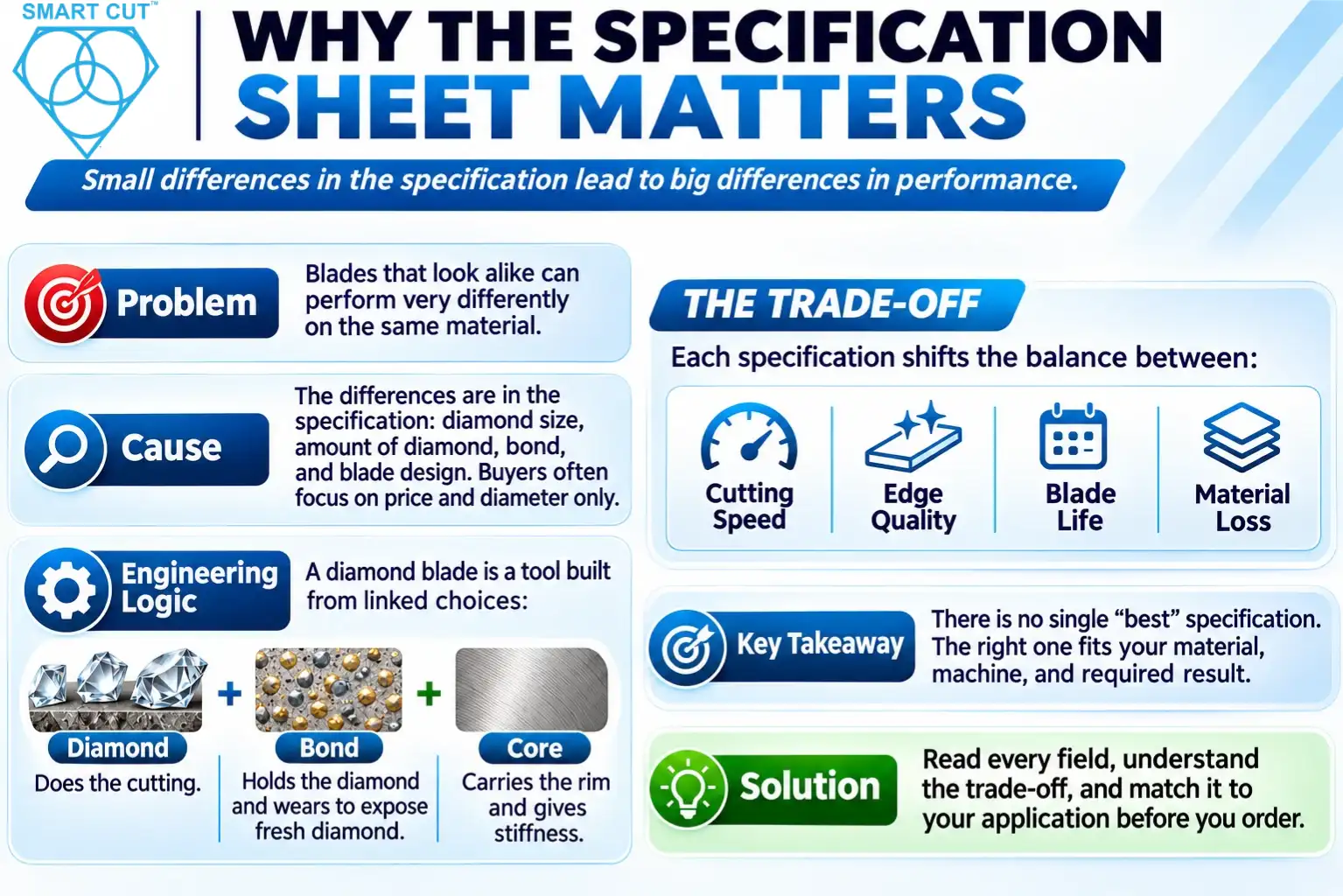
Problem: Blades that look alike on a shelf perform very differently on the same material.
Cause: The differences sit in the specification: the diamond size, the amount of diamond, the bond that holds it, and the shape of the blade. Buyers often compare price and diameter and ignore the rest.
Engineering logic: A diamond blade is a tool built from several linked choices. The diamond does the cutting. The bond holds the diamond and wears away to expose fresh diamond. The core carries the rim and gives the blade its stiffness. Each choice pushes the blade toward a different balance of cutting speed, edge quality, blade life, and material loss. No single specification is “best.” A good specification fits the material, the machine, and the result you need.
Solution: Read every field, understand the trade-off behind it, and match it to your application before you order.
The Fields on a Diamond Blade Specification Sheet
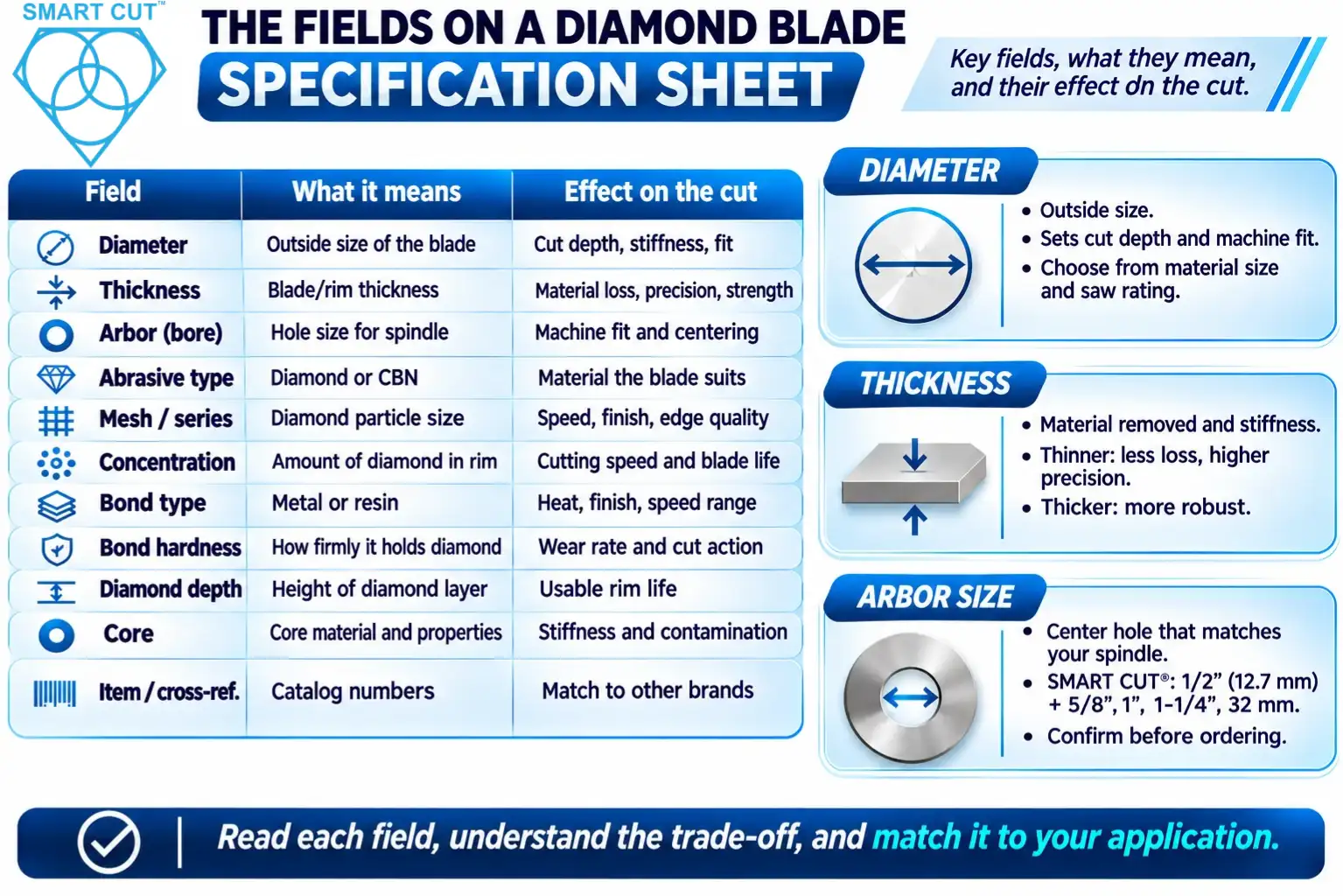
A typical listing includes the fields below. Some sheets use different names or add more. The sections that follow explain each one.
| Field | What it describes | Main effect on the cut |
|---|---|---|
| Diameter | Outside diameter of the blade | Cut depth, stiffness, machine fit |
| Thickness | Blade or rim thickness | Material loss, precision, robustness |
| Arbor (bore) | Hole size for the spindle | Machine fit and centering |
| Abrasive type | Diamond or CBN | Which materials the blade suits |
| Mesh or series | Diamond particle size | Speed, finish, and edge damage |
| Concentration | Amount of diamond in the rim | Cutting speed and blade life |
| Bond type | Metal or resin | Heat, finish, and speed range |
| Bond hardness | How firmly the bond holds diamond | Wear rate and cutting action |
| Diamond depth | Height of the diamond layer | Usable life of the rim |
| Core | Material and properties of the core | Stiffness and contamination |
| Item and cross-reference numbers | Catalog numbers | Matching to other brands |
Diameter
Diameter is the outside size of the blade. It decides how deep a cut the blade can make and which machines it fits.
UKAM’s product guidance explains the trade-off. Smaller blades suit smaller specimens and precision work, but they are more prone to bending. Larger blades handle larger and heavier samples at higher loads and speeds. Choose the diameter from the size of your material, then confirm that your saw supports it.
What to check: Does the diameter match your saw’s rating, and does it give enough depth of cut for your sample? Remember that surface speed depends on diameter, so a change in diameter changes the cutting conditions at the same RPM. Our RPM and feed rate guide explains how.
Thickness
Thickness sets how much material the blade removes and how stiff it is.
Thinner blades remove less material and suit precision cutting, especially when you must hold a cutting plane. Thicker blades are sturdier and more forgiving for less experienced operators. A thin blade also flexes more under load, so it needs good setup and a moderate feed. See our article on how thin kerf diamond blades improve material yield for the yield side of the trade-off.
What to check: Does the thickness suit the precision you need, the value of the material you cut, and the skill of the operators? Note that the real cut can be wider than the blade if runout or deflection is present.
Arbor Size
The arbor, or bore, is the center hole. It must match the spindle of your saw so the blade sits centered and runs true.
On the SMART CUT® sintered wafering blades, the listed arbor is 1/2 inch (12.7 mm), and UKAM states it can modify the arbor to other sizes, usually the same day. The product page also lists 1/2 inch, 5/8 inch, 1 inch, 1-1/4 inch, and 32 mm as available sizes.
What to check: Confirm the arbor against your spindle before you order. A poor fit lets the blade sit off-center and adds runout. For more on why, see the arbor sizes listed on the SMART CUT® wafering blade page, and ask about custom manufacturing if you need a non-standard size.
Abrasive Type: Diamond or CBN
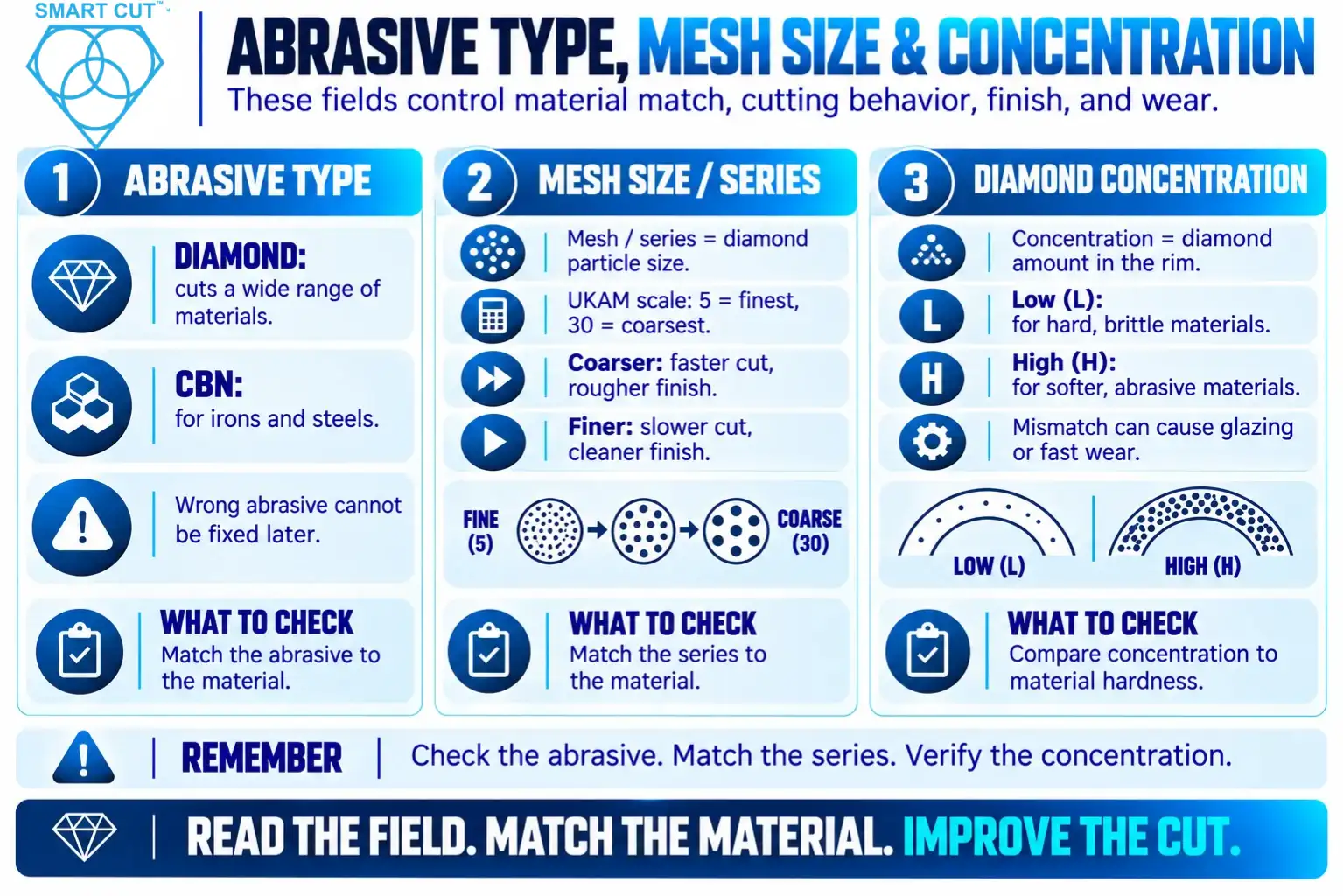
Diamond cuts a very wide range of materials. CBN (cubic boron nitride) suits ferrous materials such as irons and steels, where diamond can react with the work material.
UKAM’s guidance recommends its CBN METACUT series for cutting iron, carbon steels, high alloy steels, cobalt alloys, nickel superalloys, and lead alloys. Check the abrasive type first, because the wrong abrasive cannot be fixed by any other field.
What to check: Does the abrasive match your material family? When in doubt, ask. Our material guide is a good starting point.
Mesh Size and Series Designation
Mesh describes the size of the diamond particles. Many wafering blade listings use a series number instead.
UKAM uses a scale from 5 (finest) to 30 (coarsest). A series 10 blade has larger diamond particles than a series 5, though not twice as large. The product guidance notes a general rule: smaller particles tend to cause less deformation, but this depends on the material. Some materials need larger particles to cut effectively and economically, and fine diamond on those materials would be slow and uneconomical.
In practice, the effect looks like this.
- Coarser diamond: cuts faster, but can cause more edge damage and a rougher finish.
- Finer diamond: cuts more slowly, but is gentler on delicate or brittle materials.
What to check: Match the series to the material and to how much damage you can accept. For detail on the scale, read Understanding & Comparing Diamond & CBN Wafering Blades.
Diamond Concentration
Concentration is the amount of diamond in the rim. Many series codes show it with a letter: in UKAM’s listings, a blade labeled with “L” in the code, such as 15LCU, is low concentration, and one labeled “H,” such as 15HCU, is high concentration.
UKAM’s guidance states that higher concentration suits softer and more abrasive materials, and lower concentration suits ultra-hard and brittle materials. The choice balances cutting speed against blade life.
What to check: Find the concentration on the sheet and compare it with the material hardness and abrasiveness. A mismatch shows up as glazing or fast wear.
Bond Type: Metal or Resin
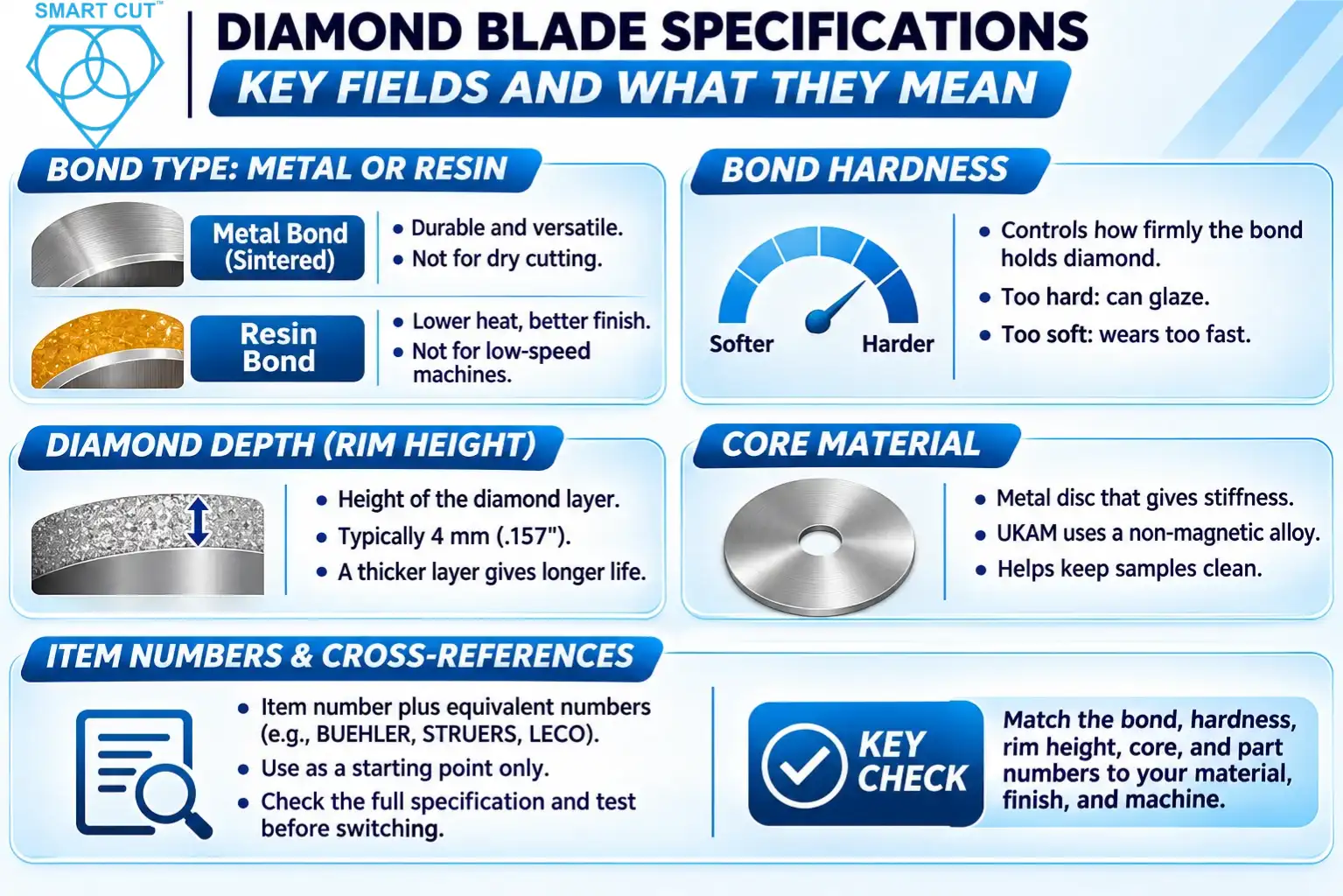
The bond holds the diamond in the rim. The two main types behave differently.
- Metal bond (sintered): durable, suits a wide range of materials, and holds up well. UKAM notes that its sintered metal bond wafering blades are not designed for dry cutting.
- Resin bond: creates less heat and gives a better surface finish, so it suits hard, delicate, or brittle materials. UKAM notes that resin bond blades cannot be used on low speed cutting machines.
What to check: Does the bond type suit your material, your finish requirement, and your saw’s speed range? Learn more on our sintered metal bond and resin bond pages.
Bond Hardness
Bond hardness describes how firmly the bond holds the diamond.
According to UKAM’s guidance, softer bonds release diamond particles faster, so they wear faster, while harder bonds hold diamond longer and give slower cutting. The right choice depends on the material. A bond that is too hard for the material glazes, because the diamond dulls and does not release. A bond that is too soft wears away before the diamond does its work.
What to check: Look for a bond hardness rating, and compare it with the hardness of your material. If you see glazing, the bond may be too hard. If you see fast wear, it may be too soft. For restoring a glazed blade, see diamond and CBN blade dressing.
Diamond Depth (Rim Height)
Diamond depth is the height of the diamond layer on the rim. UKAM lists 4 mm (.157 inch) for its wafering blades and notes that a thicker diamond layer generally allows longer life.
What to check: Compare the rim height when you compare blades, because two blades with the same diameter can have very different usable life.
Core Material
The core is the metal disc that carries the rim. It gives the blade its stiffness. UKAM lists a non-magnetic alloy core for its wafering blades, which helps prevent magnetic materials from sticking to the blade and reduces contamination.
What to check: If you cut magnetic materials or need a clean sample, confirm that the core is non-magnetic. If you cut with a thin blade, ask about core stiffness and flatness.
Item Numbers and Cross-References
Many sheets list an item number and cross-reference numbers for other brands. UKAM’s listings include columns for BUEHLER, STRUERS, and LECO numbers, so you can find the equivalent SMART CUT® blade.
Treat a cross-reference as a starting point. Two blades with matching dimensions can still differ in bond, concentration, and diamond. Check the full specification, and test the replacement in your own process before you switch.
Reading the Series Descriptions: A Worked Example
UKAM groups its sintered wafering blades into series with stated uses. Reading these descriptions together shows how the fields work as a system. The descriptions below come from UKAM’s product page.
| Series | Stated use |
|---|---|
| 30HCU | Soft and gummy materials, such as plastics, polymers, and rubber |
| 20HCU | Aggressive general sectioning of metals, including titanium alloys |
| 15HCU | General use with ferrous and non-ferrous alloys, copper, aluminum, metal matrix, composites, PC boards, thermal spray coatings, and titanium alloys |
| 20LCU | Hard and tough materials, structural ceramics, boron carbide, boron nitride, and silicon carbide |
| 15LCU | Hard and brittle materials such as glass, alumina, zirconia, and concrete |
| 10LCU | Medium to soft ceramics, electronic packages, GaAs, AlN, and glass fiber reinforced composites |
Notice the pattern. The “H” series, with high concentration, serve metals and softer or more abrasive materials. The “L” series, with low concentration, serve hard and brittle materials. The number moves from coarser to finer diamond. The letters and numbers do real work. Once you can read them, you can narrow a long catalog to a few candidates quickly.
A Step-by-Step Way to Read Any Specification Sheet
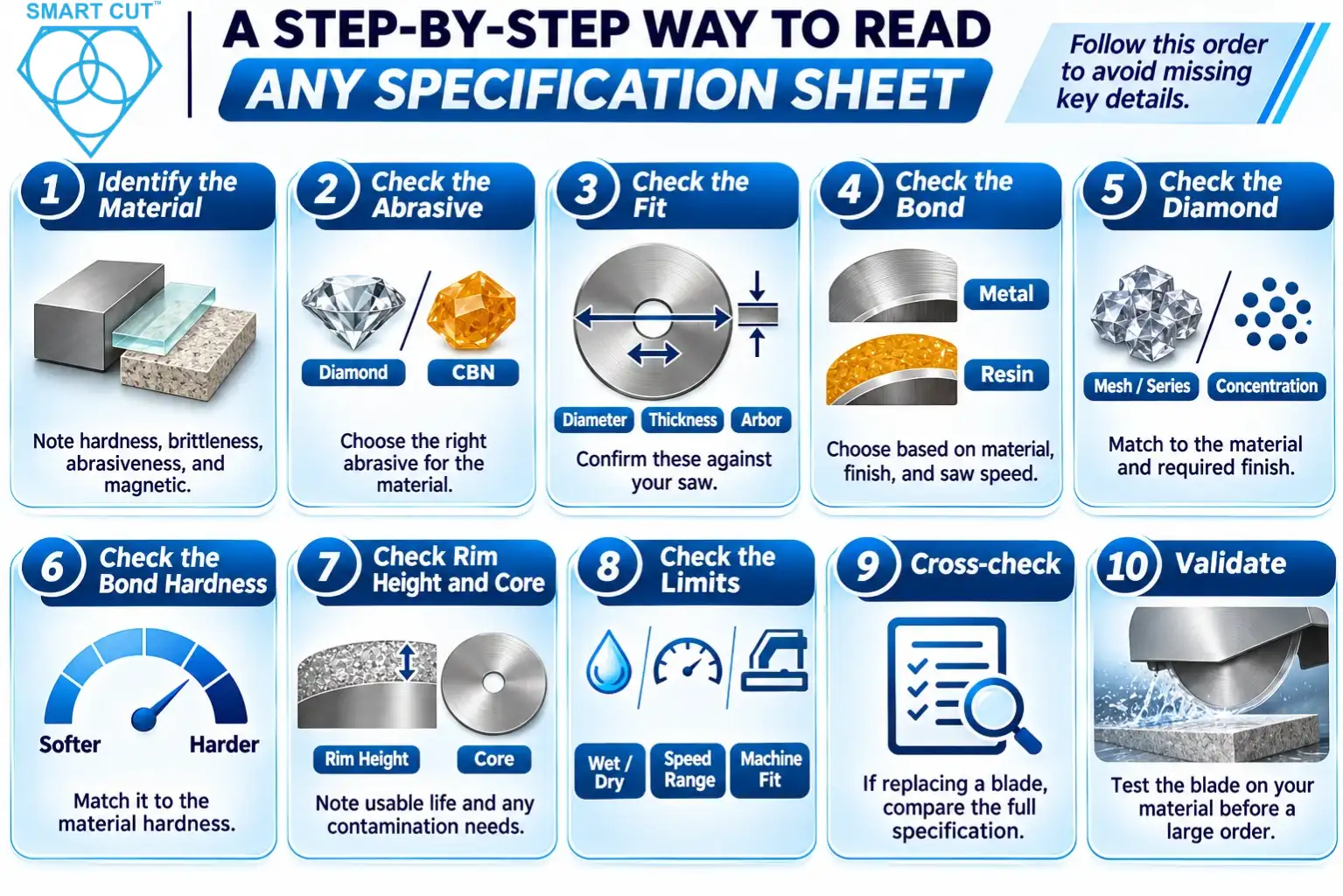
Use this order to avoid missing something.
- Identify the material. Note its hardness, brittleness, abrasiveness, and whether it is magnetic.
- Check the abrasive. Choose diamond or CBN for that material family.
- Check the fit. Confirm diameter, thickness, and arbor against your saw.
- Check the bond. Decide between metal and resin, based on the material, finish, and saw speed.
- Check the diamond. Compare mesh or series and concentration with the material.
- Check the bond hardness. Match it to the material hardness.
- Check rim height and core. Note the usable life and any contamination needs.
- Check the limits. Look for notes on wet or dry use, speed range, and machine compatibility.
- Cross-check. If you are replacing another blade, compare the full specification, not just the dimensions.
- Validate. Test the blade on your material before you commit to a large order.
What a Specification Sheet Does Not Tell You
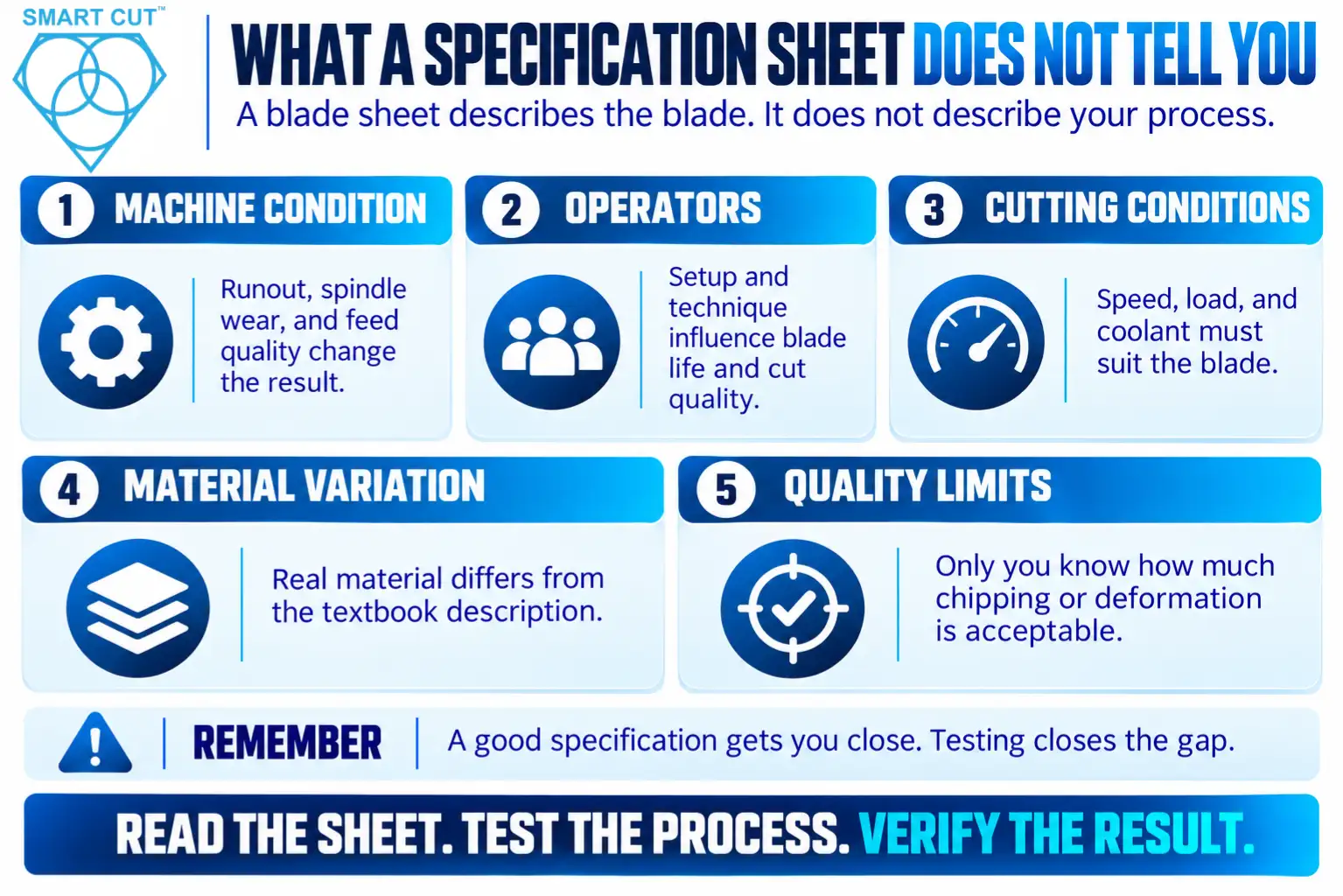
A sheet describes the blade. It does not describe your process. Several things sit outside it.
- Your machine condition. Runout, spindle wear, and feed quality change the result.
- Your operators. Setup and technique influence blade life and cut quality.
- Your cutting conditions. Speed, load, and coolant must suit the blade.
- Your material variation. Real material differs from the textbook description.
- Your quality limits. Only you know how much chipping or deformation you can accept.
That is why a good specification gets you close, and testing closes the gap. For the testing method, see how to verify diamond blade performance and how to compare two diamond blades fairly.
Questions to Ask the Supplier
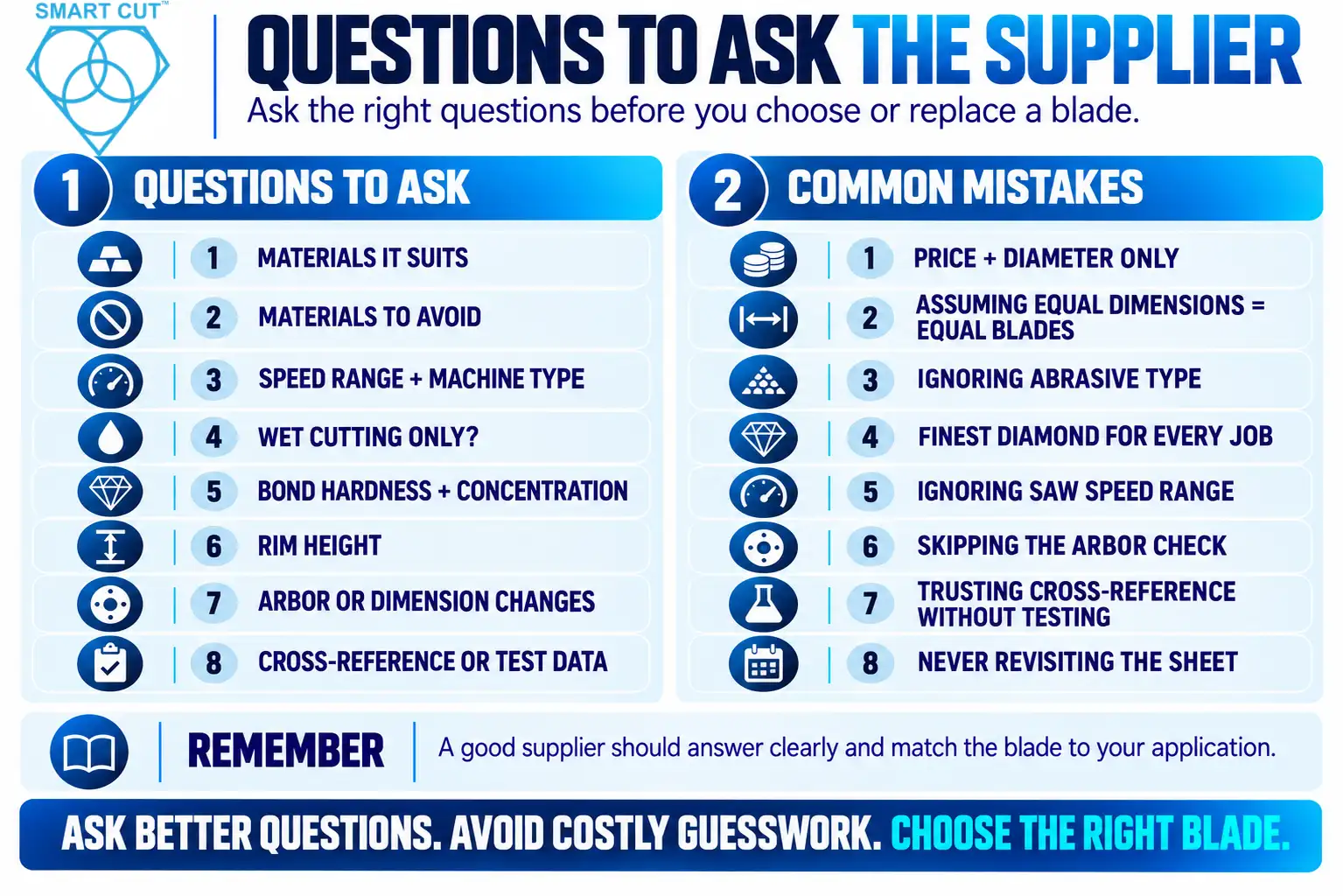
If the sheet leaves gaps, ask. Useful questions include the following.
- What materials is this series designed for, and what materials should I avoid?
- What speed range and machine type does the blade suit?
- Is the blade for wet cutting only?
- What is the bond hardness and the diamond concentration?
- What is the rim height?
- Can you modify the arbor or other dimensions?
- Can you provide a cross-reference to the blade I use now?
- Do you have test data or a case study for a material like mine?
A good supplier answers clearly. UKAM publishes wafering blade case studies and offers technical support to help match a blade to an application.
Common Mistakes When Reading Specifications
Comparing price and diameter only. The other fields decide performance.
Assuming equal dimensions mean equal blades. Bond, concentration, and diamond can differ.
Ignoring the abrasive type. Diamond is not right for every material.
Choosing the finest diamond for every job. Fine diamond cuts slowly on materials that need coarser grit.
Ignoring the saw’s speed range. Some blades suit only certain speeds.
Skipping the arbor check. A poor fit adds runout.
Trusting a cross-reference without testing. Always verify in your process.
Reading the sheet once and never again. Revisit it when results change.
Applying This in Your Shop
Start by writing down your three or four most common materials. For each one, pick a candidate series from the worked example above, then read its full specification against the steps in this article. Order a small quantity, test it, and record the result. Over time, you build a short list of approved blades for each material.
Equipment also matters. A well-set-up precision cutting saw lets a good specification perform as intended. If you need help narrowing the choice, ask the UKAM team. You can browse the full range of diamond wafering blades or the SMART CUT® sintered wafering blades to see the specification listings described above.
Related UKAM Products and Resources
These UKAM products and guides support reading and applying a specification sheet.
- SMART CUT® diamond wafering blades: sintered metal bond blades with series, diameter, thickness, arbor, and BUEHLER, STRUERS, and LECO cross-references listed.
- Sintered (metal bond) diamond wafering blades: the sintered subcategory.
- Diamond and CBN wafering and cut-off blades: for material families that need a different abrasive or bond.
- Selecting the right wafering blade for your application: a selection walk-through by material.
- Diamond and CBN wafering blade performance metrics: what to measure after you choose.
- Ultra thin precision diamond blades: the precision blade range.
- Diamond dicing blades: for dicing applications.
- Metallography consumables: sectioning and sample preparation supplies.
Key Takeaways
- A diamond blade specification sheet describes several linked choices, and each changes the cut.
- Diameter, thickness, and arbor decide fit. Abrasive, mesh, concentration, bond, and bond hardness decide material suitability.
- Coarser diamond cuts faster and damages more. Finer diamond cuts more slowly and damages less.
- Higher concentration generally suits softer or more abrasive materials. Lower concentration suits hard, brittle materials.
- Metal bond is durable. Resin bond runs cooler and gives a better finish, and suits hard, delicate materials.
- Softer bonds release diamond sooner and wear faster. Harder bonds hold diamond longer and cut slower.
- Treat cross-references as a starting point, and test before you switch.
- A sheet describes the blade, not your process, so validate on your own material.
Frequently Asked Questions
It lists diameter, thickness, arbor, abrasive, mesh or series, concentration, bond, and related data.
In UKAM’s scale, it indicates diamond particle size from 5 (finest) to 30 (coarsest).
In UKAM’s listings, H marks high diamond concentration and L marks low concentration.
UKAM’s guidance recommends lower concentration for ultra-hard and brittle materials.
No, because some materials need coarser diamond to cut effectively and economically.
Metal bond is durable and versatile, while resin bond runs cooler and gives a better finish.
It affects how quickly the diamond releases, which drives wear rate and cutting speed.
It sets material loss, precision, and how robust the blade is.
Compare the listed arbor with your spindle, and ask the supplier about modification if needed.
No, because ferrous materials often call for CBN instead.
Use it as a starting point and test the blade in your own process.
No, because machine condition, operators, and cutting conditions also shape results.
Ask about suitable materials, speed range, wet or dry use, bond hardness, and test data.
Test it on your material under controlled conditions and compare the results.
Conclusion
A diamond blade specification sheet is a compact description of a tool built from linked choices. Diameter, thickness, and arbor decide whether the blade fits your saw. Abrasive, mesh, concentration, bond, and bond hardness decide whether it suits your material.
Read every field, understand the trade-off behind it, and match it to your application. Then treat the sheet as the start of the decision, not the end. Test the blade on your own material, and record the result. That habit turns a catalog full of similar-looking blades into a short list you trust.
If you want help reading a specification or matching a blade to your material and process, request a consultation with the UKAM team, or browse our diamond wafering blades and ultra thin precision diamond blades.
Trusted by Tens of Thousands of Manufacturers, Laboratories,
Research Institutions Worldwide Since 1990
American Based Manufacturer
Established in 1990
Custom manufacturing
RELATED ARTICLES

Brian is an experienced professional in the field of precision cutting tools, with over 27 years of experience in technical support. Over the years, he has helped engineers, manufacturers, researchers, and contractors find the right solutions for working with advanced and hard-to-cut materials. He’s passionate about bridging technical knowledge with real-world applications to improve efficiency and accuracy.
As an author, Brian Farberov writes extensively on diamond tool design, application engineering, return on investment strategies, and process optimization, combining technical depth with a strong understanding of customer needs and market dynamics.