





















Diamond Blade Diameter and Thickness: Selection Trade-offs for Your Material, Saw, and Precision
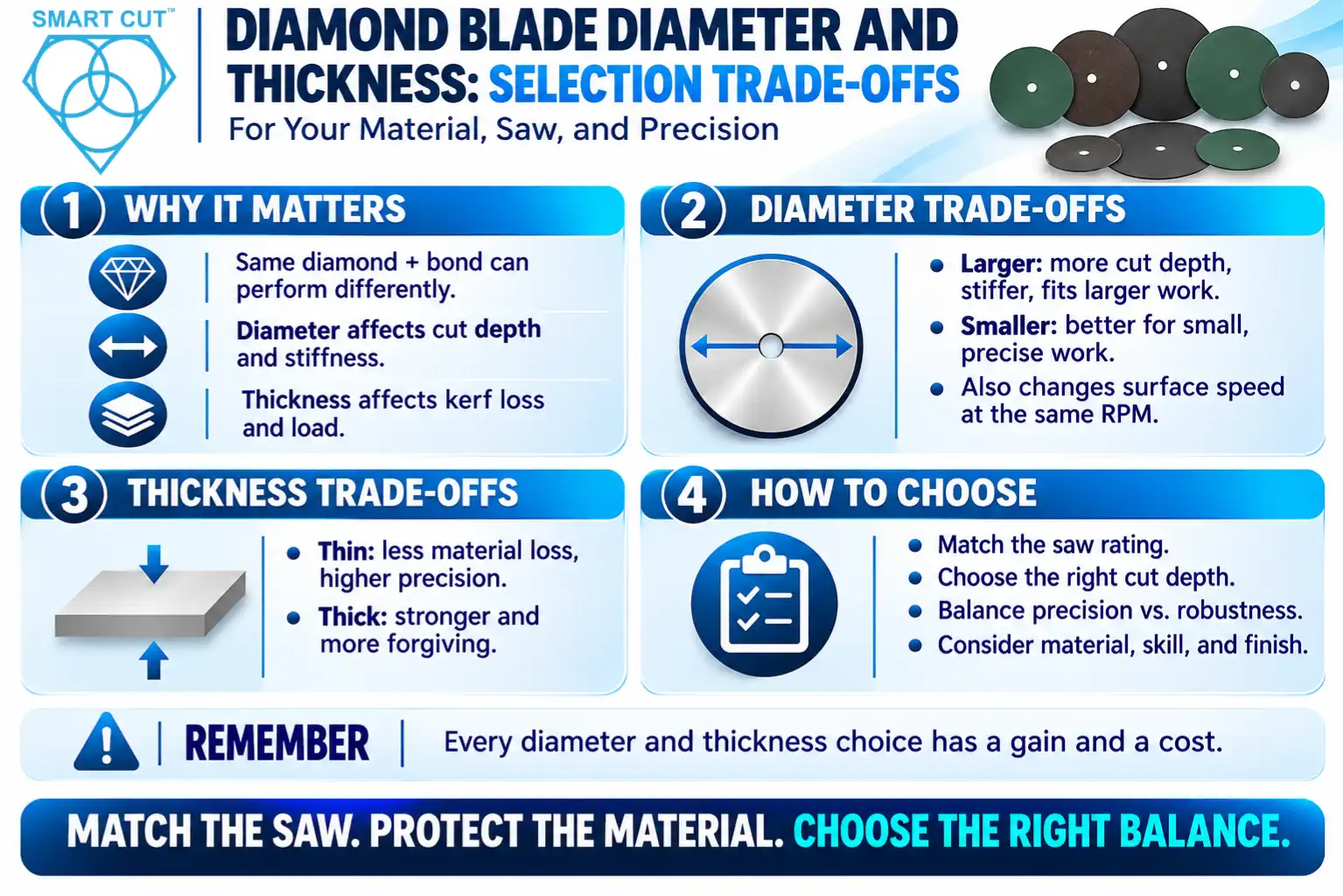
Table of Contents
ToggleTwo blades can have the same diamond, the same bond, and the same concentration, and still perform very differently. The difference often sits in two plain numbers: diamond blade diameter and thickness.
These two numbers look simple. They are not. Diameter sets how deep you can cut and how stiff the blade is. Thickness sets how much material you lose and how much load the blade can carry. Every choice gains something and costs something. A thin blade saves material but flexes. A thick blade is sturdy but removes more.
This article explains the trade-offs behind diamond blade diameter and thickness, how they interact, and how to choose for your material, saw, and precision requirement. It draws on UKAM’s published guidance for wafering and dicing blades. For the other fields on a blade listing, see our guide on how to read a diamond blade specification sheet.
Trusted by Tens of Thousands of Manufacturers, Laboratories Research Institutions Worldwide Since 1990

American Based Manufacturer

Established in 1990


Custom manufacturing


Why Diamond Blade Diameter and Thickness Matter
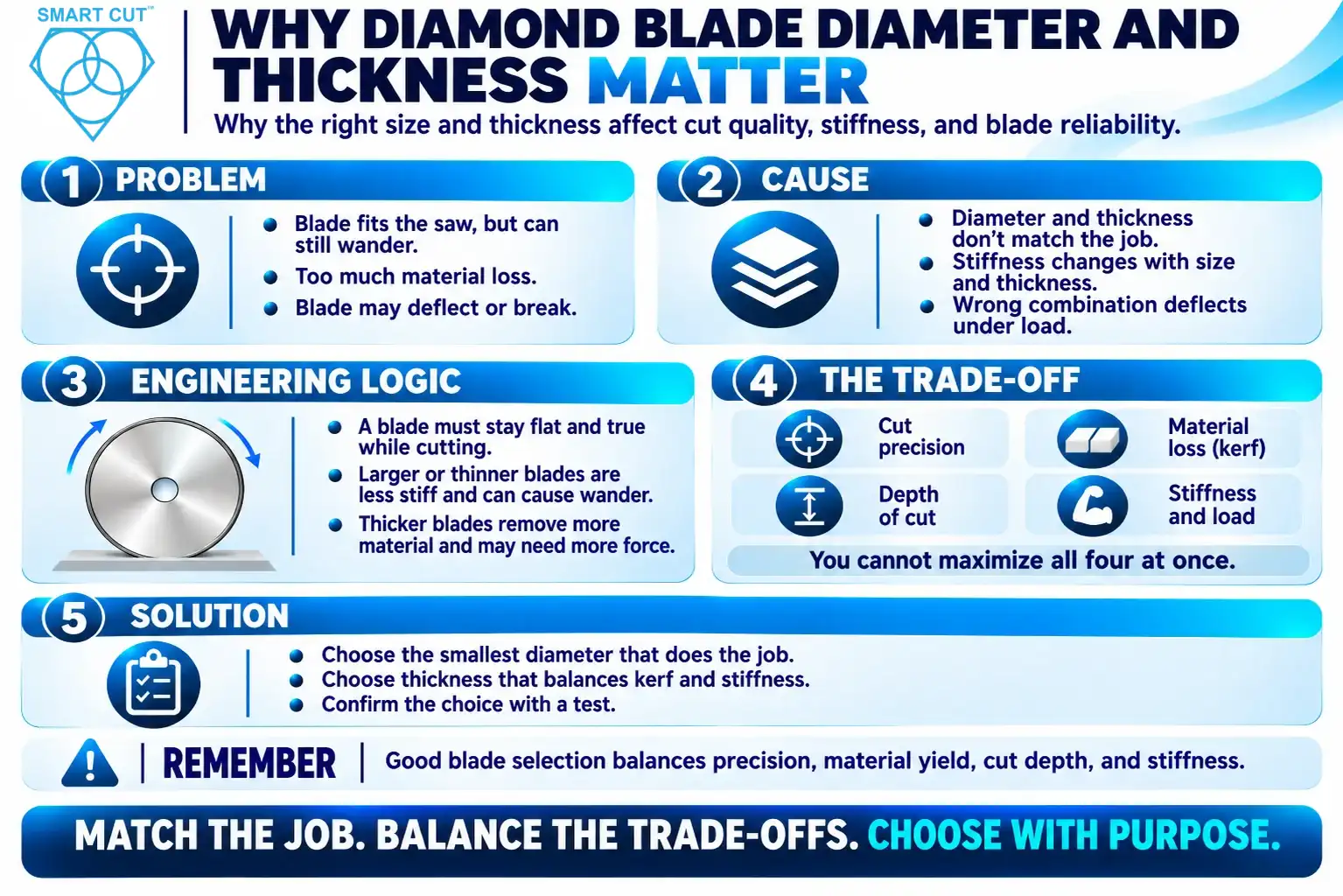
Problem: A blade fits the saw and suits the material, yet the cut wanders, the sample loses too much material, or the blade breaks.
Cause: The diameter and thickness do not match the job.
Engineering logic: A diamond blade works like a thin disk that must stay flat and true while it cuts. Its stiffness depends on its thickness, its diameter, and how much of it sticks out beyond the flanges. A larger or thinner blade is less stiff. When stiffness falls, the blade deflects under load, and the cut wanders or the blade fails. At the same time, a thicker blade removes more material and may need more force to advance.
So the choice is a balance among four things:
- Precision of the cut position.
- Material loss (kerf).
- Depth of cut.
- Stiffness and tolerance for load and operator error.
You cannot maximize all four. Good selection means knowing which one matters most for your application.
Solution: Choose the smallest diameter that does the job, choose the thickness that balances kerf and stiffness for your precision and your operators, and confirm the choice with a test.
Diameter: What It Controls
Depth of Cut and Sample Size
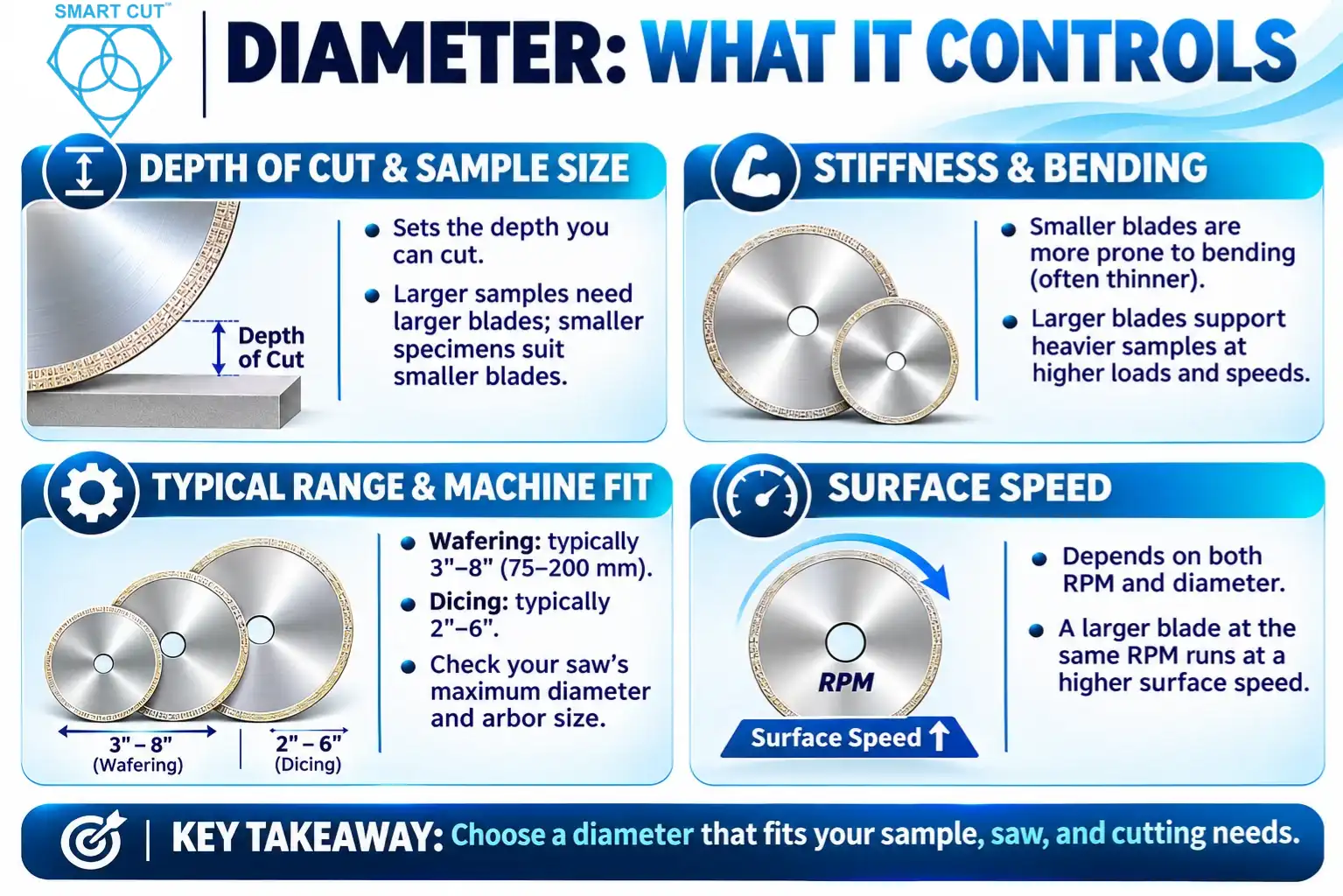
Blade diameter sets the depth you can cut. UKAM’s guidance says to choose the blade diameter based on the diameter and thickness of the material you cut. Larger samples need larger blades. Smaller specimens suit smaller blades.
A simple geometric limit helps. The flanges cover the center of the blade, so the exposed rim is roughly half the difference between the blade diameter and the flange diameter. That exposed height is the theoretical maximum depth of cut. In practice, leave some margin for clearance and for the best support. A blade with too little exposure cannot cut through your sample, and a blade with too much exposure loses support.
Stiffness and Bending
UKAM notes that smaller blades are more prone to bending, which may seem backwards at first. Smaller blades are often thinner, and a thin core flexes easily. Larger blades support heavier samples at higher loads and speeds. UKAM’s dicing guidance adds that stability falls as blade diameter increases, so flange support becomes more important. Read both statements together: bigger blades carry bigger samples, but they need more support, and thin large blades need the most.
Typical Range and Machine Fit
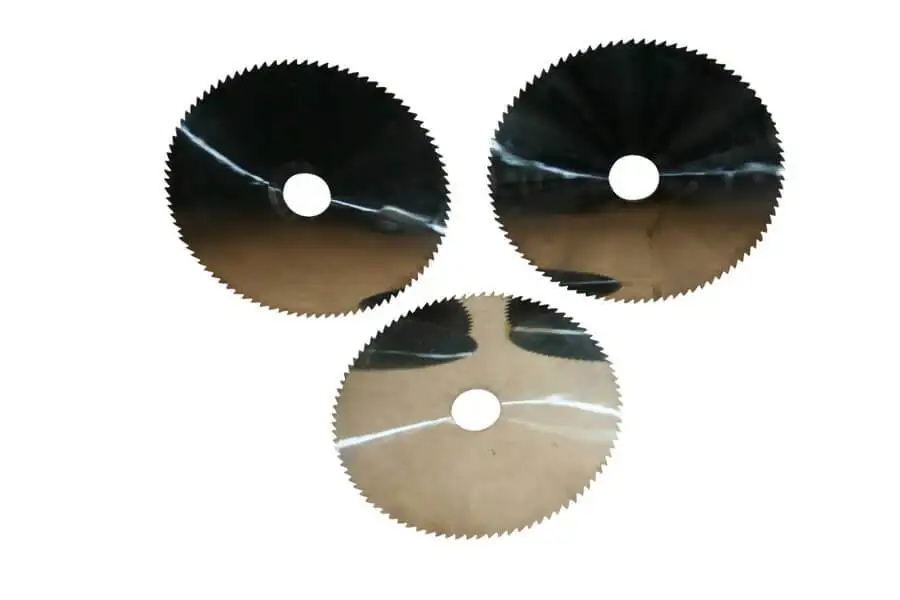
UKAM states that wafering blade diameters typically range from 3 inches (75 mm) to 8 inches (about 200 mm). Its SMART CUT® sintered wafering blade listings run from 3 inches to 8 inches. Dicing blades commonly run from about 2 to 6 inches in UKAM’s saw selection guidance.
Your saw sets the limit. Check the maximum diameter that the spindle, guards, and flanges accept. The arbor must also match. The SMART CUT® wafering blade page lists standard arbor sizes, and you can ask about custom sizes if needed.
Surface Speed
Surface speed depends on both RPM and diameter. A larger blade at the same RPM runs at a higher surface speed. When you change blade diameter, you change the cutting conditions even if the RPM setting does not move. Our RPM and feed rate guide explains how.
Small vs Large Diameter
| Smaller diameter | Larger diameter | |
|---|---|---|
| Best for | Small specimens, precision positioning | Larger or thicker samples, deeper cuts |
| Stiffness | Can be stiff if thick, but thin small blades bend | Needs more flange support, and thin large blades flex |
| Kerf | Typically thinner | Typically thicker, since kerf rises with diameter |
| Material loss | Lower | Higher |
| Machine need | Fits smaller saws | Needs a saw built for the size |
| Risk | Insufficient depth of cut | Wander and deflection if too thin or poorly supported |
UKAM’s dicing guidance sets the same pattern. Smaller blades of 2 or 3 inches suit ultra-thin wafers and delicate substrates. They allow higher spindle speeds, finer kerfs, and less material loss. Larger blades of 4 or 5 inches suit thicker wafers, ceramics, glass, and optical materials where deeper sectioning is needed.
Thickness: What It Controls
Kerf and Material Loss
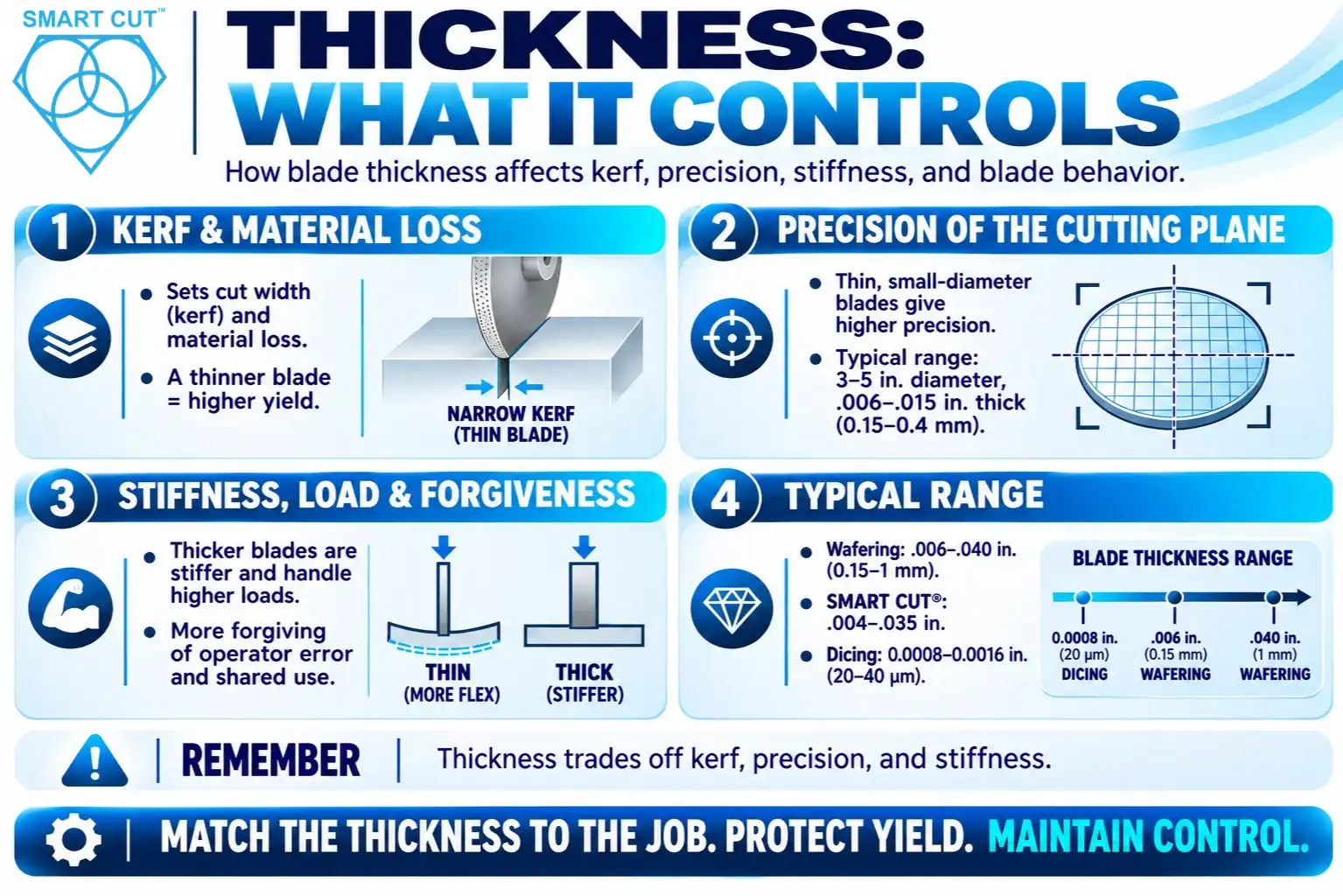
Thickness sets the width of the cut, and so the material you lose. A thinner blade removes less. That matters when the sample is valuable, when you need maximum yield, or when you must keep the cut close to a feature.
UKAM’s guide on how thin kerf diamond blades improve material yield explains the yield side in detail. UKAM also notes that its fully sintered blades can reach the thinnest possible kerf, which is not possible with a steel core.
Remember that the real kerf can be wider than the blade. Runout and deflection widen the cut, so a thin blade that wobbles loses its advantage.
Precision of the Cutting Plane
UKAM’s guidance says that applications needing high-precision positioning of the cutting plane, such as integrated circuits and other microscale devices, suit a thinner, smaller-diameter blade. It names blades of 3 to 5 inches (75 to 125 mm) in diameter and thicknesses of .006 to .015 inch (about 0.15 to 0.4 mm) as typically suited to this purpose.
Stiffness, Load, and Forgiveness
UKAM states that thicker wafering blades are stiffer and can withstand higher loads and feed rates. It also says thicker blades are more forgiving of operator error and abuse. For that reason, UKAM recommends thicker kerf blades in environments where many people share the same equipment.
This point matters for training and shared labs. A thin blade rewards good technique and punishes poor technique. If your operators vary in experience, a thicker blade may give you steadier results and fewer broken blades, even though it removes more material.
Typical Range
UKAM gives a typical wafering blade thickness range of .006 to .040 inch (about 0.15 to 1 mm). It also says thinner and thicker blades are available, often from stock on request, and that kerf thickness typically increases with blade diameter in proportion. Its SMART CUT® sintered wafering listings run from about .004 to .035 inch. Dicing blades for wafers run much thinner. UKAM’s semiconductor dicing guide lists thicknesses of 0.0008 to 0.0016 inch (20 to 40 microns), and notes that thickness sets kerf width, material loss, and die density.
Thin vs Thick Thickness
| Thinner blade | Thicker blade | |
|---|---|---|
| Kerf and material loss | Lower | Higher |
| Positioning precision | Better | Lower |
| Stiffness | Lower, so it flexes more | Higher |
| Load and feed capacity | Lower | Higher |
| Tolerance for operator error | Low | Higher |
| Risk | Wander, bending, breakage | More material loss, more force to advance |
| Best for | Valuable samples, tight positioning, skilled operators | General use, shared equipment, heavier loads |
How Diameter, Thickness, and Exposure Work Together
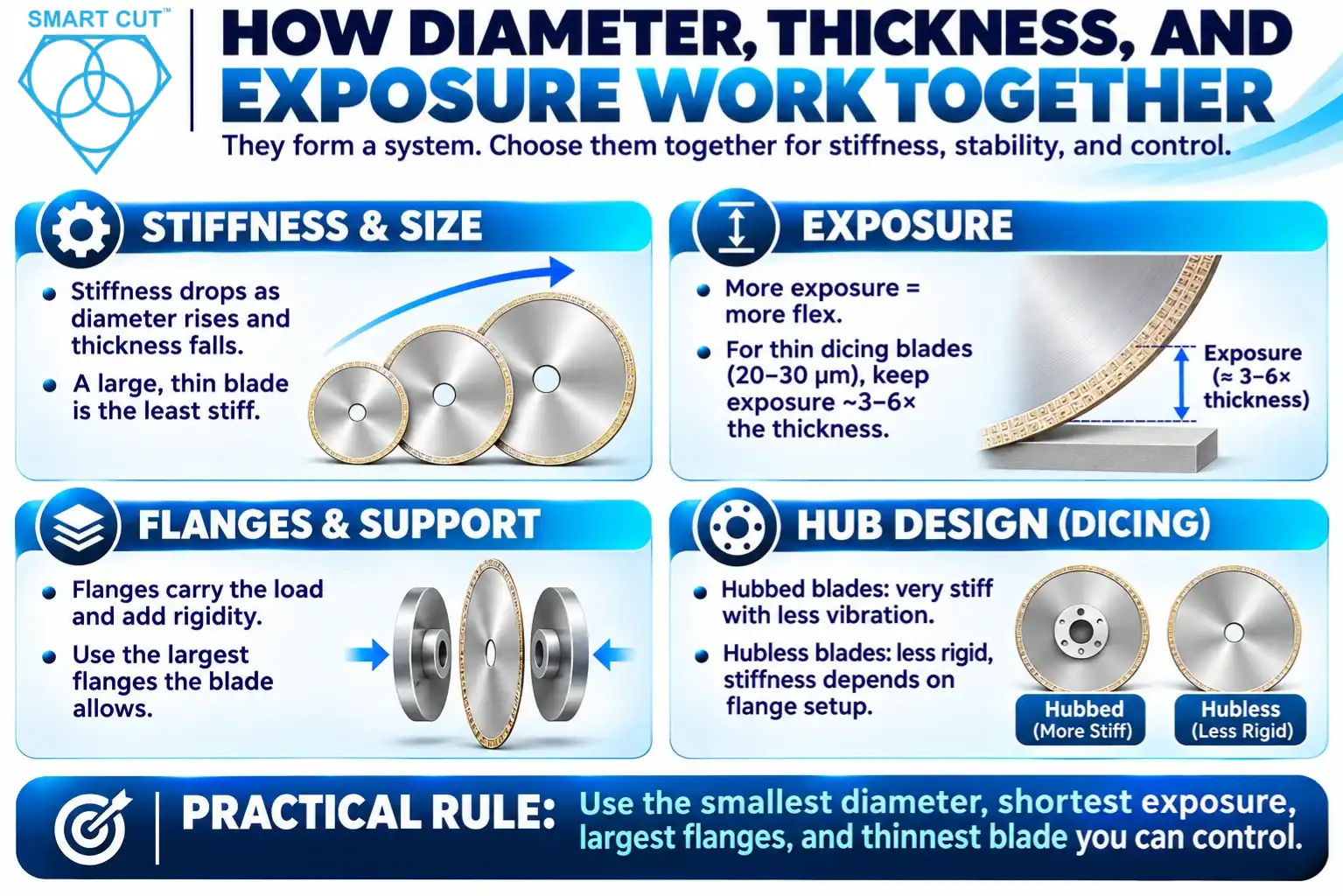
You cannot pick one alone. They form a system.
Stiffness falls as diameter rises and as thickness falls. A large, thin blade is the least stiff combination. If you need depth of cut, the diameter has to rise, and stiffness then depends on thickness and flange support.
Exposure decides how much of that stiffness you use. More exposure means more unsupported blade, so more flex. UKAM’s semiconductor dicing guidance gives a concrete rule for very thin dicing blades of about 20 to 30 microns: keep exposure to roughly 3 to 6 times the blade thickness, to maintain stiffness. That rule applies to thin dicing blades, and your own application may differ, but the principle holds for every blade: less exposure gives more stiffness.
Flanges carry the load. Larger flanges support more of the blade. Our setup-mistakes article explains why wrong flanges damage blades, and UKAM notes that wheel stiffener sets can add rigidity to a blade that begins to walk. Stiffeners appear in UKAM’s diamond consumables.
Hub design changes the picture for dicing. UKAM’s dicing guidance describes hubbed blades as very stiff, because the hub reduces vibration, and hubless blades as less rigid, with stiffness depending on the flange assembly.
A practical rule follows: use the smallest diameter that cuts your sample, the shortest exposure that does the job, the largest flanges the blade allows, and the thinnest blade that you can control.
Choosing for Your Application
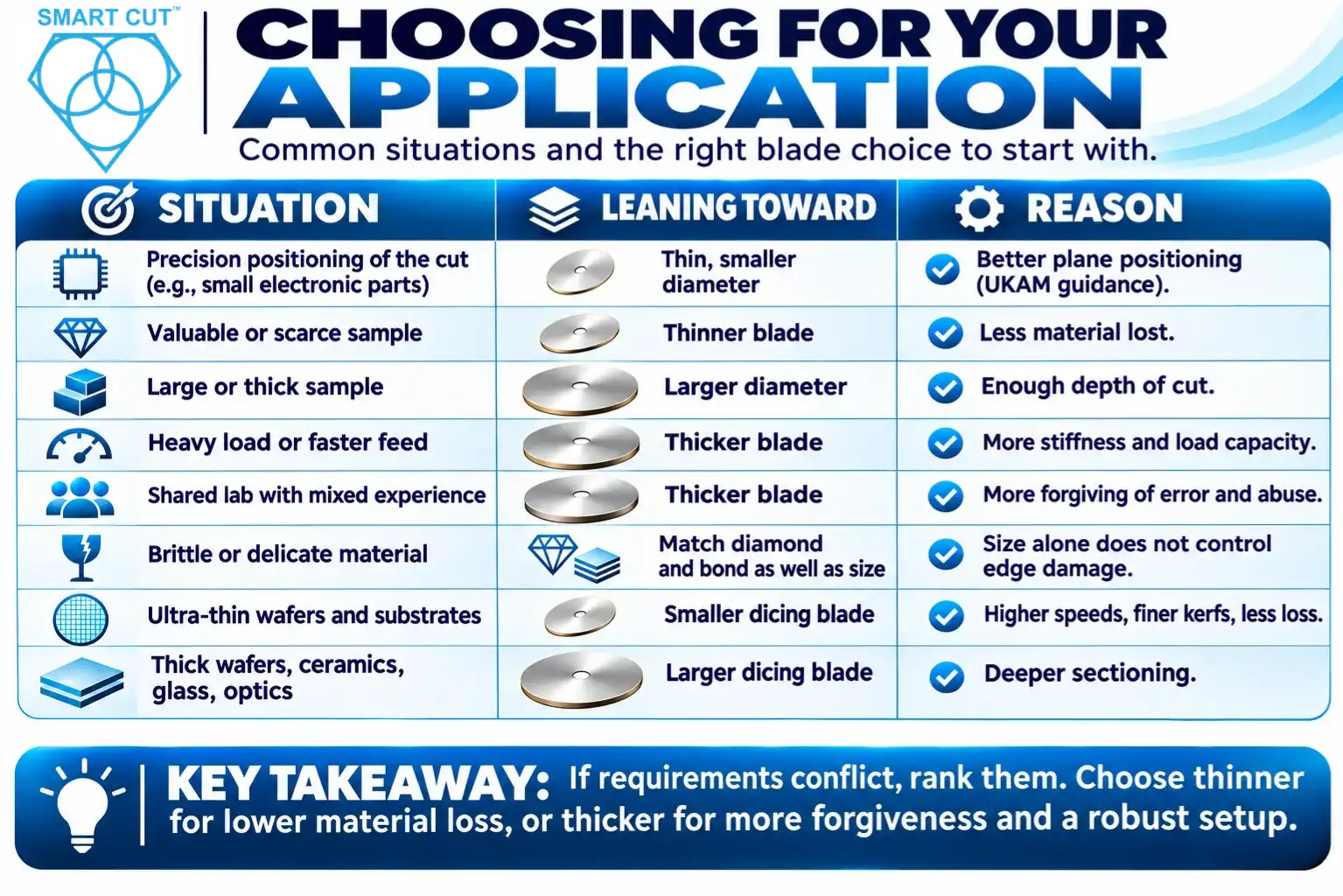
The table below summarizes common situations. Use it as a starting point, and confirm with a test.
| Situation | Leaning toward | Reason |
|---|---|---|
| Precision positioning of the cut, such as small electronic parts | Thin, smaller diameter | UKAM guidance: better plane positioning |
| Valuable or scarce sample | Thinner blade | Less material lost |
| Large or thick sample | Larger diameter | Enough depth of cut |
| Heavy load or faster feed | Thicker blade | More stiffness and load capacity |
| Shared lab with mixed experience | Thicker blade | More forgiving of error and abuse |
| Brittle or delicate material | Match the diamond and bond as well as size | Size alone does not control edge damage |
| Ultra-thin wafers and substrates | Smaller dicing blade | Higher speeds, finer kerfs, less loss |
| Thick wafers, ceramics, glass, optics | Larger dicing blade | Deeper sectioning |
When two requirements conflict, rank them. If material loss matters more than operator forgiveness, go thinner and train the operators. If you cannot control the operator or the setup, go thicker and accept the loss.
What Diameter and Thickness Do Not Decide
Size is only part of blade selection. Diamond size, concentration, bond type, and bond hardness often matter more for edge quality and blade life. A thin blade with the wrong bond will still glaze. A large blade with poor flange support will still wander. Choose the size to fit the geometry and the stiffness you need, and choose the diamond and bond to fit the material. Our guides on selecting the right wafering blade and the diamond and CBN wafering blade guide cover the full set of variables.
How to Test Your Choice
Confirm the choice with a controlled comparison.
- Change one thing. Compare two thicknesses or two diameters with everything else fixed: same bond, same diamond, same machine, same conditions.
- Match the conditions. Surface speed changes with diameter, so adjust the RPM to keep it equal. Keep exposure, flanges, and runout the same.
- Measure what matters. Record the actual kerf, cut position, wander, edge quality, and blade life. Do not rely on the nominal thickness.
- Count the real cost. Include material loss, cut quality, scrap, and blade life, not just blade price. See diamond blade cost per cut.
- Include the operator. If different people run the blade, test with them.
See how to compare two diamond blades fairly, how to design a repeatable diamond blade test, and how to measure diamond blade cut quality for the methods.
When the Standard Size Does Not Fit
You do not have to settle for a stock size. UKAM states that it keeps popular sizes in stock and can manufacture almost any blade specification, diameter, inside diameter, kerf thickness, grit size, or abrasive type. If your sample, saw, or precision requirement does not match a stock blade, ask about a custom specification through custom manufacturing.
Common Mistakes in Choosing Diameter and Thickness
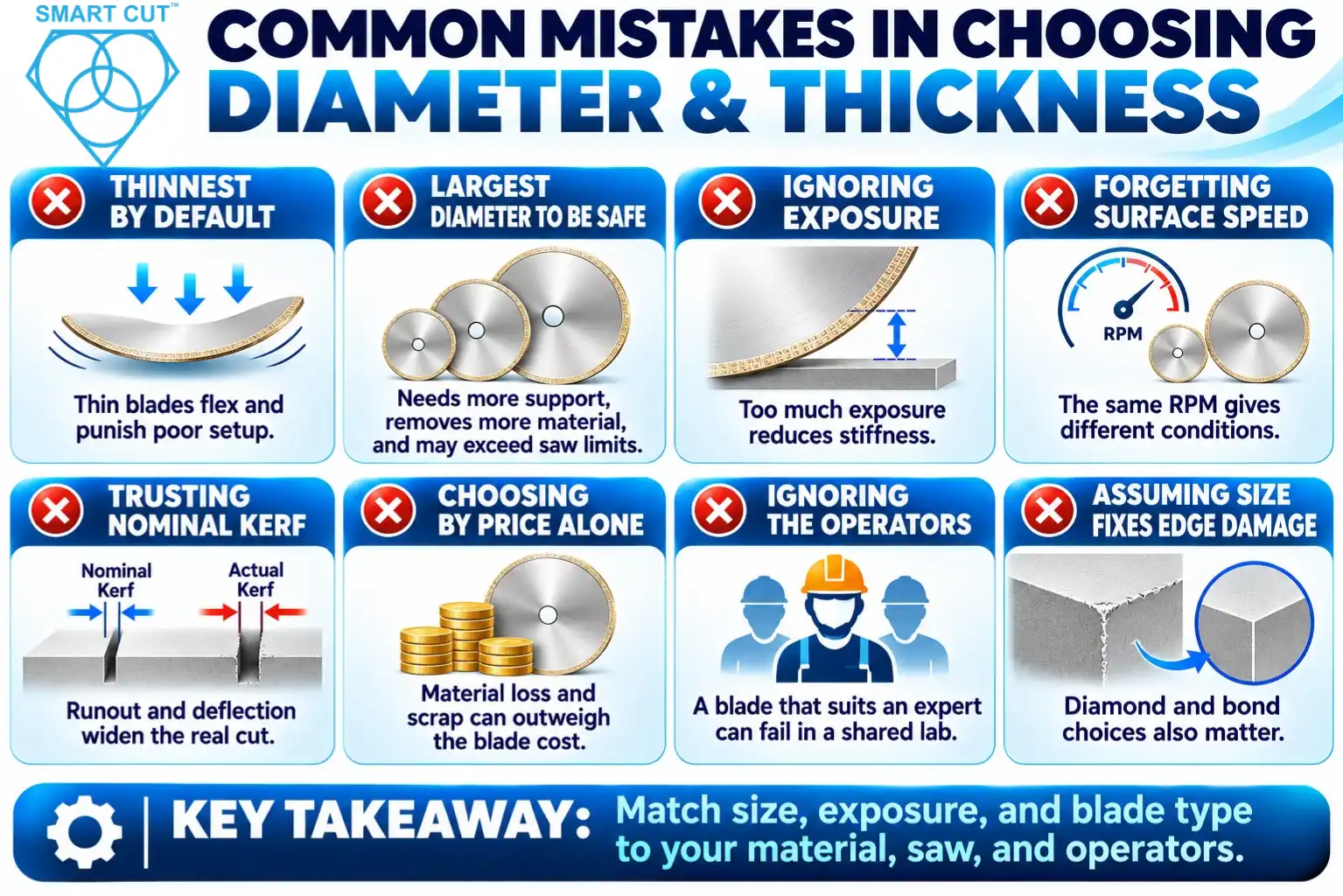
Choosing the thinnest blade by default. Thin blades flex, and they punish poor setup and technique.
Choosing the largest diameter “to be safe”. Larger blades need more support, remove more material, and may exceed the saw’s rating.
Ignoring exposure. A blade with too much exposure flexes, whatever its thickness.
Forgetting that surface speed changes with diameter. The same RPM gives different conditions.
Trusting the nominal kerf. Runout and deflection widen the real cut.
Choosing by price alone. Material loss and scrap can outweigh blade cost.
Ignoring the operators. A blade that suits an expert can fail in a shared lab.
Assuming size fixes edge damage. Diamond and bond choices matter as well.
Applying This in Your Shop
Start with your most valuable or most demanding cut. Write down the sample size, the precision you need, the saw’s limits, and who runs the blade. Use the tables in this article to pick two candidate sizes. Test them under matched conditions, and record the kerf, the position, and the blade life. Then document the winner as your standard for that application.
Equipment matters too. A rigid precision cutting saw and good flange support let you use thinner blades with confidence. Browse the SMART CUT® sintered wafering blades to see sizes from 3 to 8 inches, the diamond wafering blades category, and the ultra thin precision diamond blades.
Related UKAM Products and Resources
These UKAM products and guides support blade size selection.
- Diamond and CBN wafering blade guide: kerf thickness, diameter, and inside diameter guidance.
- Selecting the right wafering blade for your application: the selection variables together.
- Select the right diamond dicing blade: diameter, hubbed versus hubless, and kerf.
- Semiconductor wafer dicing guide: thickness, exposure, and kerf control for dicing.
- SMART CUT® diamond wafering blades: sintered blades from 3 to 8 inches.
- SMART CUT® Series 400 resin bond blades: resin bond blades from 4 to 8 inches.
- Fully sintered metal bond wafering blades: the thinnest possible kerf, with near-custom sizes.
- Diamond dicing blades: hubbed and hubless dicing blades.
- Diamond consumables: wheel stiffeners and accessories.
Key Takeaways
- Diameter and thickness decide depth of cut, kerf, stiffness, and tolerance for load and error.
- Choose diameter from the size of the material you cut, and check the saw’s limits and arbor.
- Smaller blades suit small specimens and fine work, and they are prone to bending when thin. Larger blades handle bigger samples but need more flange support.
- Thinner blades lose less material and position the cut more precisely, but they flex and need skill.
- Thicker blades are stiffer, carry more load, and forgive operator error, so UKAM recommends them for shared equipment.
- Stiffness depends on diameter, thickness, and exposure together. Keep exposure short and flanges large.
- Surface speed rises with diameter, and the real kerf can exceed the nominal thickness.
- Size is only part of selection. Diamond, bond, and concentration matter too.
- Test your choice under matched conditions, and count material loss in the cost.
Frequently Asked Questions
Choose it from the diameter and thickness of the material you cut, then check your saw’s limits.
UKAM states that wafering blades typically run from 3 to 8 inches.
UKAM gives .006 to .040 inch, about 0.15 to 1 mm.
UKAM’s guidance points to thinner, smaller-diameter blades for high-precision positioning.
Thicker blades are stiffer, carry higher loads and feeds, and forgive operator error.
It removes less material and positions the cut more precisely.
A thin core has less stiffness, so uneven force deflects it.
Yes, because stability falls as diameter rises, so flange support matters more.
More exposure means more unsupported blade, which flexes more, so keep it as short as the cut allows.
UKAM states that kerf thickness typically increases with blade diameter.
No, runout and deflection can make the real cut wider.
UKAM says it can manufacture almost any diameter, inside diameter, and kerf thickness.
UKAM recommends thicker kerf blades where many people share equipment.
Compare candidate sizes under matched conditions and measure kerf, position, and blade life.
Conclusion
Diamond blade diameter and thickness are simple numbers with real consequences. Diameter decides how deep you can cut and how much support the blade needs. Thickness decides how much material you lose and how much load the blade can carry. Exposure and flange support decide how much of the blade’s stiffness you actually get.
Choose the smallest diameter that does the job, and the thickness that balances kerf against stiffness for your precision and your operators. Then test the choice under matched conditions, and count material loss as part of the cost. A well-chosen size lets the diamond and bond do their work instead of fighting a blade that flexes or a cut that wastes your sample.
If you want help choosing a blade size or a custom specification for your material and saw, request a consultation with the UKAM team, or browse our diamond wafering blades and ultra thin precision diamond blades.
Trusted by Tens of Thousands of Manufacturers, Laboratories,
Research Institutions Worldwide Since 1990
American Based Manufacturer
Established in 1990
Custom manufacturing
RELATED ARTICLES

Brian is an experienced professional in the field of precision cutting tools, with over 27 years of experience in technical support. Over the years, he has helped engineers, manufacturers, researchers, and contractors find the right solutions for working with advanced and hard-to-cut materials. He’s passionate about bridging technical knowledge with real-world applications to improve efficiency and accuracy.
As an author, Brian Farberov writes extensively on diamond tool design, application engineering, return on investment strategies, and process optimization, combining technical depth with a strong understanding of customer needs and market dynamics.