












Skip to navigation Skip to main content
Home > Blog > Sectioning Plastics, Polymers, and Elastomers with Diamond Blades: Preventing Smear, Melt, and Deformation
blog, Materials

Sectioning Plastics, Polymers, and Elastomers with Diamond Blades: Preventing Smear, Melt, and Deformation


Sectioning Plastics, Polymers, and Elastomers with Diamond Blades

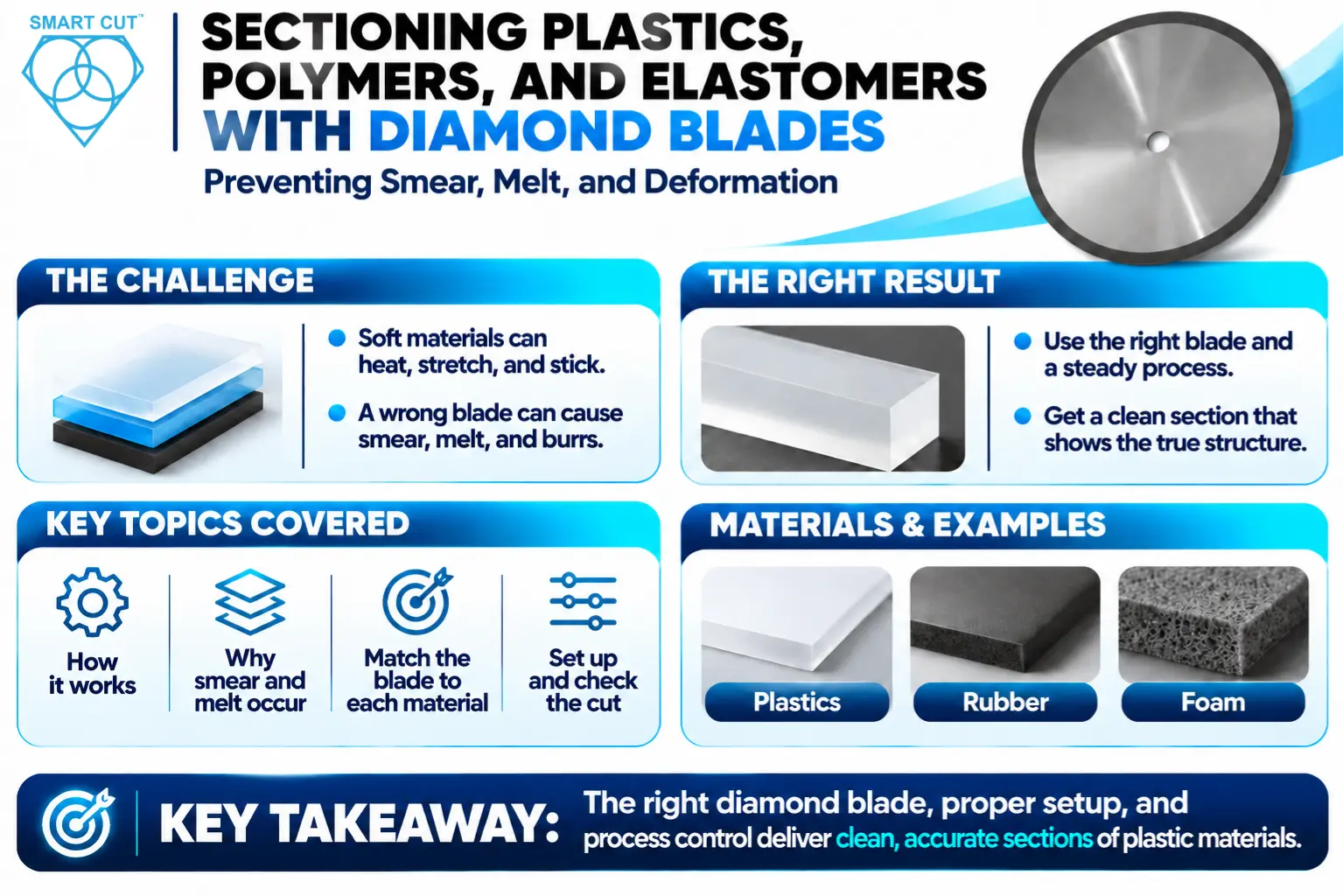
Diamond blades have a reputation for cutting the hardest materials on earth. Cutting plastics with diamond blades seems like an easy job by comparison. They are not. A hard ceramic fights the blade with hardness. A soft polymer fights it with heat, stretch, and stickiness.

Cut a plastic with the wrong blade, and you get a smeared face, melted edges, burrs, and a blade coated in polymer. Cut it with the right blade and a steady process, and you get a clean section that shows the true structure.

This article explains how cutting plastics with diamond blades works, why soft materials smear and melt, how to match a blade to each material family, and how to set up and check the cut. It uses UKAM’s published guidance for wafering blades, including its reference settings for plastics, rubber, and foam. For a real example, UKAM also published customer case studies on sectioning polyethylene, which we summarize in a separate case study post.

Trusted by Tens of Thousands of Manufacturers, Laboratories Research Institutions Worldwide Since 1990

American Based Manufacturer

Established in 1990

Custom manufacturing

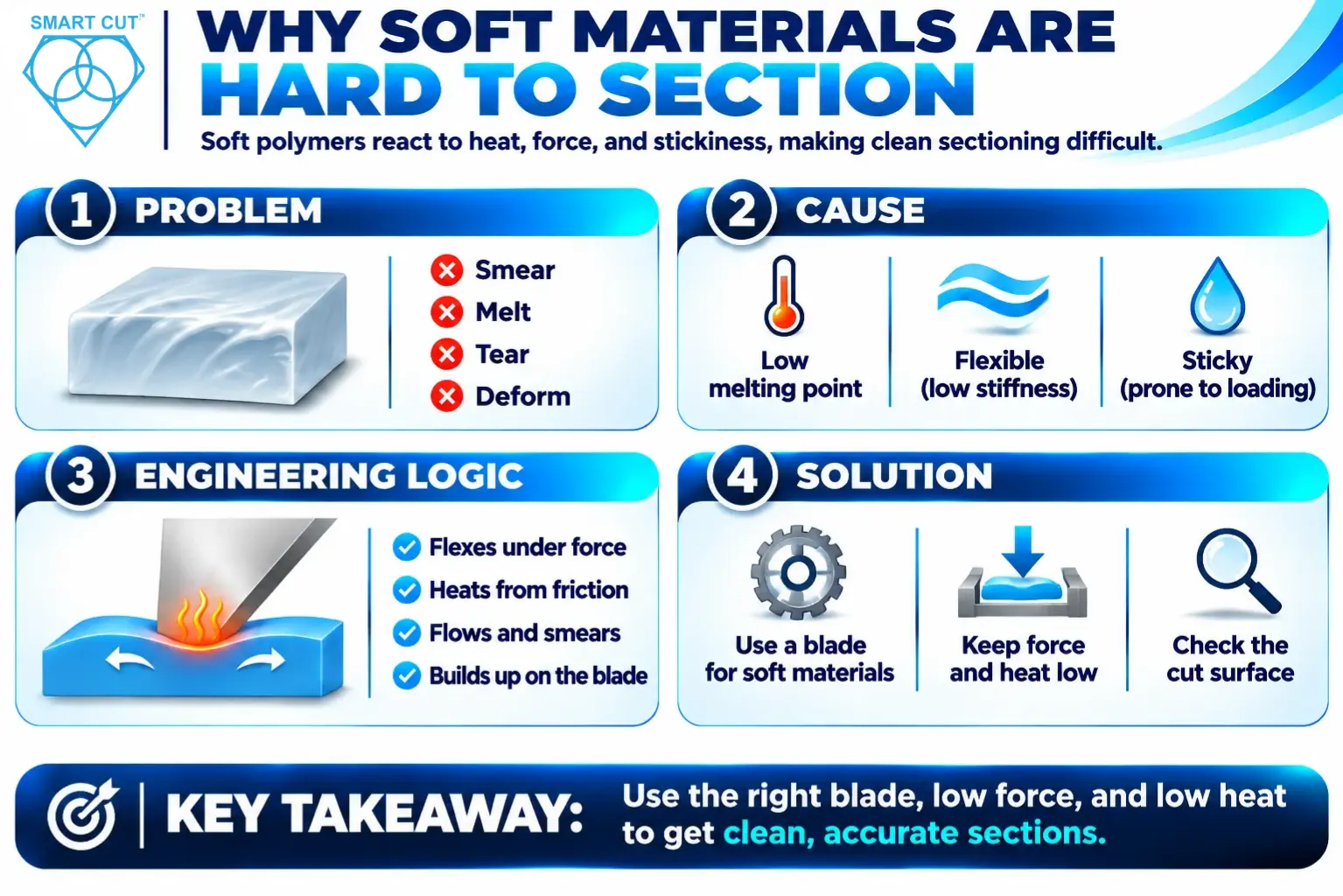
Why Soft Materials Are Hard to Section

Why Soft Materials Are Hard to Section

Problem: Plastic sections come out smeared, melted, torn, or deformed, and the blade clogs.

Cause: Soft polymers have low melting points, low stiffness, and a tendency to stick. They respond to a blade differently from brittle materials.

Engineering logic: Hard, brittle materials crack when force is too high. Soft polymers do something else. They flex under the blade, they heat from friction, and they flow. A blade that rubs instead of cutting generates heat. The polymer softens and smears across the cut face. Smeared polymer coats the blade, which raises friction and heat further. The cycle repeats until the cut fails.

Elastomers add another problem. They spring back. A blade can push the material aside, so the cut face is compressed or torn, and the section no longer shows the original structure.

UKAM’s guidance describes the right approach: a blade that removes material with sharp, widely spaced cutting points, sheds chips freely, and does not load. A high concentration of larger diamond particles gives wide chip space and reduces loading.

Solution: Choose a blade made for soft and gummy materials, keep force and heat low, support the sample without squeezing it, and check the cut surface.

Know Your Material Family Before Cutting Plastics with Diamond Blades

Plastics and similar materials behave differently. Sort your sample first.

Family Examples Main cutting problem
Thermoplastics Polyethylene, polypropylene, PVC, PTFE Melting and smearing
Thermosets Phenolic resins, epoxies Cracking and heat that can alter cure
Elastomers and rubber Natural rubber, silicone, neoprene, nitrile Tearing, compression, and spring-back
Foam Open-cell and closed-cell foams Crushing and deformation
Brittle polymers Polycarbonate, acrylic (Plexiglas) Cracking
Reinforced plastics Fiberglass and fiber-reinforced plastics Fraying and delamination
Resins, adhesives, gels Uncured or partly cured resins, hydrogels Sticking and compression

Each family points to a different blade. The sections below explain how.

Choose the Blade

Choose the Blade

Soft and Gummy Materials: Series 30HCU

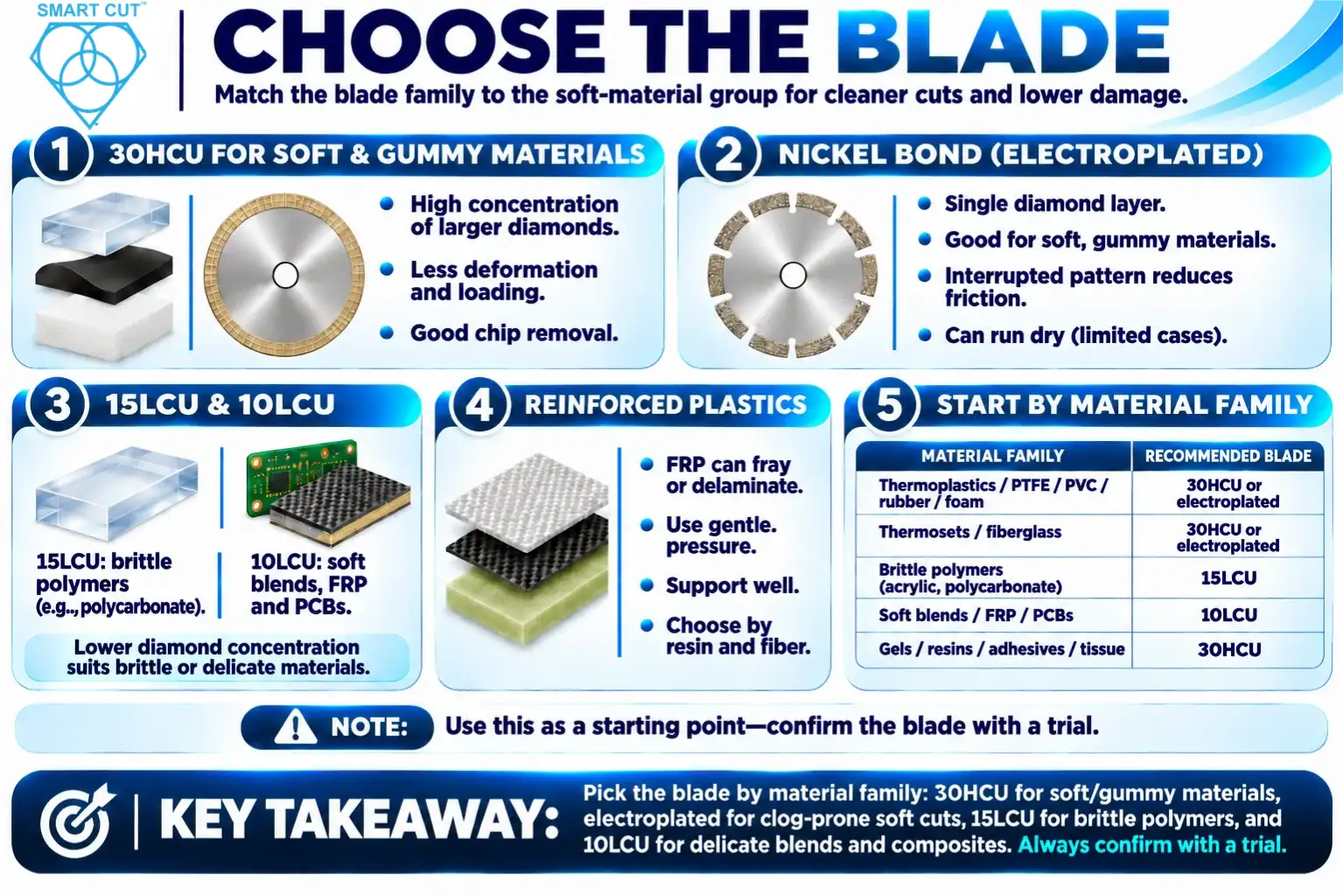
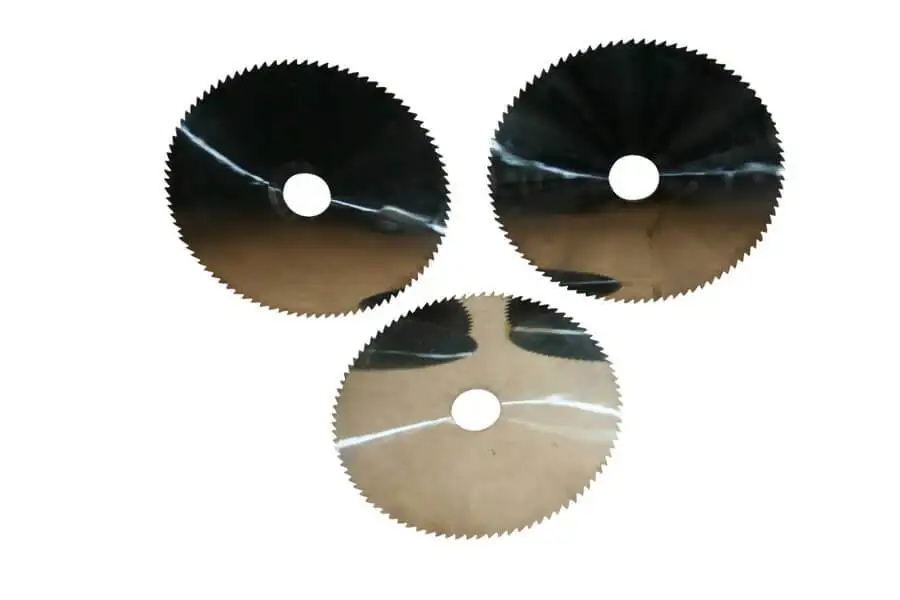
UKAM’s Series 30HCU wafering blade is tailored for soft and gummy materials, including plastics, polymers, rubber, and similar substances. Its high concentration of larger diamond particles is the key. UKAM explains that the large particles act as robust cutting points that slice through soft material without the excessive force that causes deformation, and that they reduce blade loading and improve swarf removal. UKAM lists the series for thermoplastics such as polyethylene and polypropylene, thermosets such as phenolic resins and epoxies, PTFE, PVC, rubber, elastomers, foams, soft-matrix composites, fiberglass in soft resin, uncured resins and adhesives, synthetic gels, and soft tissue samples.

See the Understanding and Comparing guide for the full series description.

Nickel Bond (Electroplated) Blades

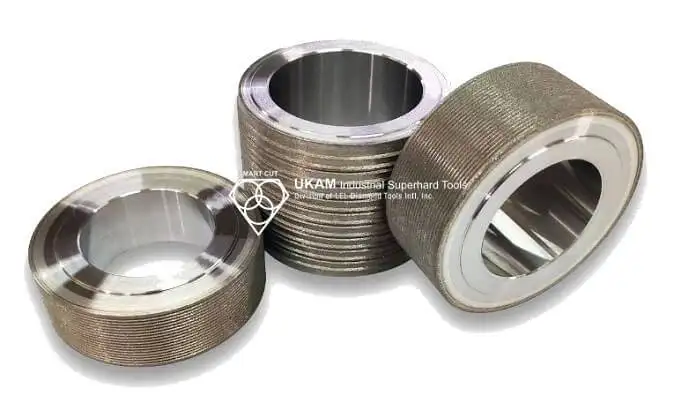
Electroplated blades expose a single layer of diamond. UKAM notes they suit soft, ductile, and gummy materials that would clog other bonds, including thermosetting plastics, glass fiber reinforced plastics, pre-sintered “green” ceramics, electro carbons, graphite, and soft ferrites. In UKAM’s polyethylene customer cases, an electroplated blade with an interrupted coating and a memory steel core cut clean sections in about 20 seconds for small samples. The interrupted pattern reduces friction and helps clear chips.

Electroplated blades can run dry in some applications, but UKAM advises limiting dry cutting to softer, less abrasive materials. See the nickel bond (electroplated) blades and the electroplating technology page.

Brittle Polymers and Delicate Soft Materials: Series 15LCU and 10LCU

Not all plastics are gummy. UKAM lists the low-concentration Series 15LCU for brittle polymers such as polycarbonate and Plexiglas, where cracking is the risk, and Series 10LCU for soft polymers and polymer blends, fiber-reinforced plastics, and printed circuit boards, where excessive force causes damage. These series use less diamond, so each particle carries more pressure, which suits brittle or delicate materials.

Reinforced Plastics

Fiberglass and fiber-reinforced plastics fray and delaminate. UKAM’s guidance recommends steady, gentle pressure and good support, and it lists these materials under several series depending on the resin and the fiber. Our article on precision sectioning of coated, composite, and multilayer materials covers layered samples in more detail.

Choosing by Family

Family Starting blade (UKAM guidance)
Thermoplastics, PTFE, PVC, rubber, elastomers, foam Series 30HCU, or an electroplated blade
Thermosets, fiberglass in soft resin Series 30HCU or electroplated; steady, light pressure
Brittle polymers (polycarbonate, acrylic) Series 15LCU
Soft polymer blends, fiber-reinforced plastics, PCBs Series 10LCU
Gels, resins, adhesives, tissue samples Series 30HCU

Treat the table as a starting point and confirm with a trial. For help reading the fields on a blade listing, see our guide on how to read a diamond blade specification sheet.

Set the Process

Speed and Feed

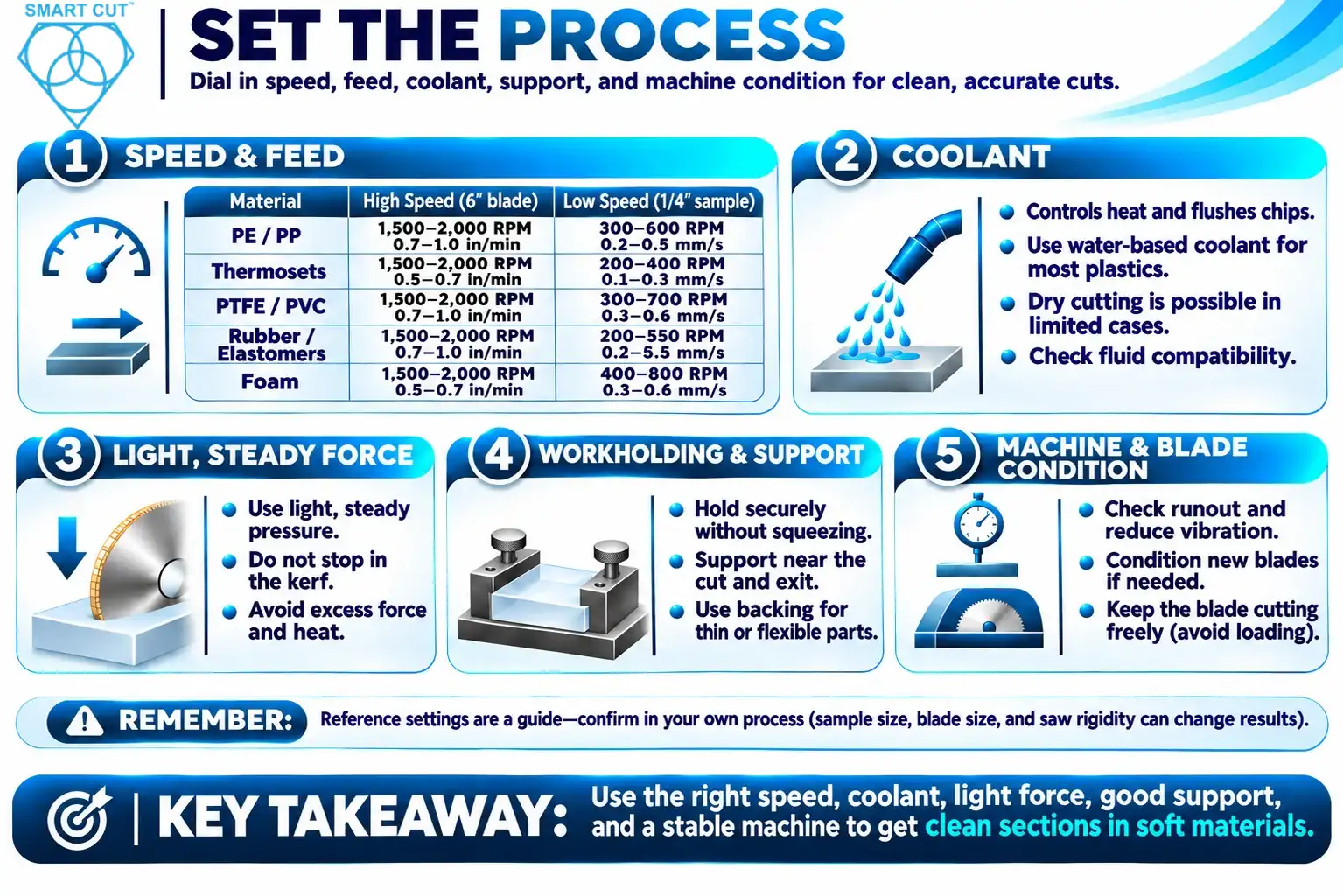
UKAM publishes reference settings for plastics. They are for orientation only. UKAM states that the low-speed data were taken on a 1/4 inch (6.4 mm) sample, and the medium-to-high speed data on a laboratory saw with a 6 inch blade.

Material Medium-to-high speed saw, 6-inch blade Low-speed saw, 1/4 inch sample
Polyethylene, polypropylene 1,500 to 2,000 RPM, 0.7 to 1 in/min 300 to 600 RPM, 0.2 to 0.5 mm/s
Thermosets (phenolics, epoxies) 1,500 to 2,000 RPM, 0.5 to 0.7 in/min 200 to 400 RPM, 0.1 to 0.3 mm/s
PTFE, PVC 1,500 to 2,000 RPM, 0.7 to 1 in/min 300 to 700 RPM, 0.3 to 0.6 mm/s
Rubber 1,500 to 2,000 RPM, 0.7 to 1 in/min 200 to 500 RPM, 0.2 to 0.4 mm/s
Elastomers 1,500 to 2,000 RPM, 0.7 to 1 in/min 250 to 550 RPM, 0.2 to 0.5 mm/s
Foam 1,500 to 2,000 RPM, 0.5 to 0.7 in/min 400 to 800 RPM, 0.3 to 0.6 mm/s

UKAM’s notes alongside these values are practical: avoid overheating, use gentle and consistent pressure, and keep a steady feed rate. For thick rubber on a low-speed saw, UKAM suggests a slower speed to avoid tearing, and for softer plastics it suggests higher RPM within the range and care not to melt the material.

Surface speed also depends on blade diameter, so adjust when you change blade size. See our RPM and feed rate guide. Confirm any setting in your own process, because sample size, blade diameter, and saw rigidity change the result.

Coolant

Heat is the main enemy. UKAM’s reference tables list water-based coolant for most plastics and rubbers, with “none” as an option for some plastics, polymers, elastomers, and foams on a low-speed saw. UKAM’s selection guidance adds that softer, ductile, or fibrous materials such as plastics can sometimes be cut dry, but the operator must accept faster blade wear and less consistent results.

For heat-sensitive polymers, cut wet. Coolant lubricates the cut, holds the polymer below its softening temperature, and flushes soft chips from the kerf. See how coolant flow affects blade life and cut quality in our article on coolant condition management. Some polymers react to certain fluids, so check compatibility with your material and supplier.

Light, Steady Force

Force deforms soft materials and heats the cut. Use light, steady pressure and do not stop in the kerf. A blade that stops and restarts can melt a line into the polymer.

Workholding and Support

Soft samples compress and spring back. Clamp firmly enough to prevent movement, but do not squeeze the sample, because compression distorts the section. Support the sample close to the cut and at the exit so the material does not flex or tear. For thin or flexible samples, consider a backing or a fixture that matches the sample shape. See workholding for precision diamond sectioning and dicing.

Machine and Blade Condition

Check runout after every mount, because vibration tears soft materials. See our articles on diamond blade runout and diamond blade setup mistakes. A new blade may need conditioning before use, as explained in do new diamond blades need conditioning before use. Keep the blade cutting freely, because a loaded blade smears. Use a rigid precision cutting saw.

Troubleshooting Table

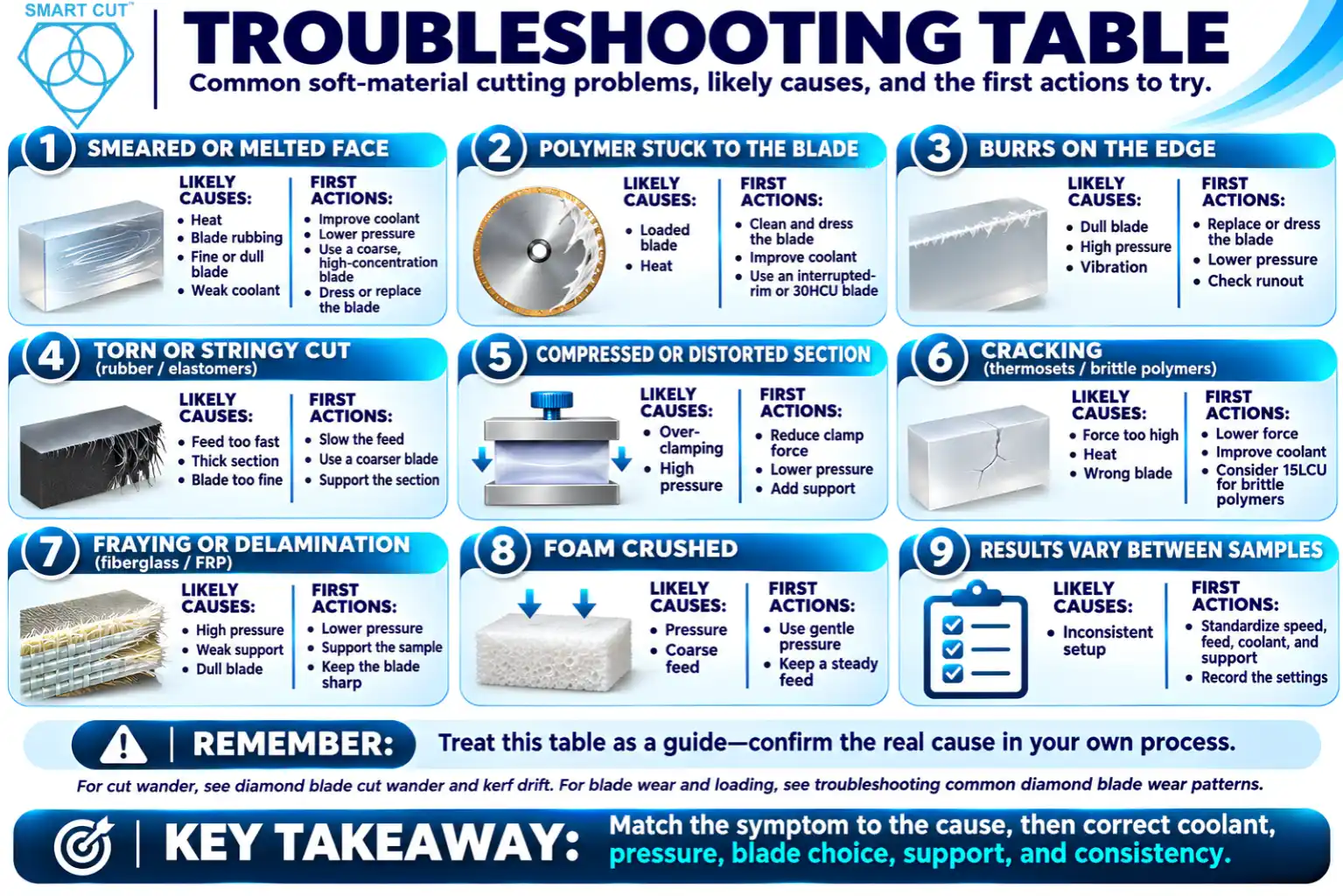
The table below combines UKAM guidance with general practice. Treat it as a guide, and confirm each cause.

Problem Likely causes First actions
Smeared or melted face Heat, blade rubbing, fine or dull blade, weak coolant Improve coolant, lower pressure, use a coarse, high-concentration blade, dress or replace the blade
Polymer stuck to the blade Loaded blade, heat Clean and dress the blade, improve coolant, use an interrupted-rim or Series 30HCU blade
Burrs on the edge Dull blade, high pressure, vibration Replace or dress the blade, lower pressure, check runout
Torn or stringy cut (rubber, elastomers) Feed too fast, thick section, blade too fine Slow the feed, use a coarser blade, support the section
Compressed or distorted section Over-clamping, high pressure Reduce clamp force, lower pressure, add support
Cracking (thermosets, brittle polymers) Force too high, heat, wrong blade Lower force, improve coolant, consider Series 15LCU for brittle polymers
Fraying or delamination (fiberglass, FRP) High pressure, weak support, dull blade Lower pressure, support the sample, keep the blade sharp
Foam crushed Pressure, coarse feed Use gentle pressure and a steady feed
Results vary between samples Inconsistent setup Standardize speed, feed, coolant, and support, and record them

For wandering cuts, see our article on diamond blade cut wander and kerf drift. For wear and loading on the blade, see troubleshooting common diamond blade wear patterns.

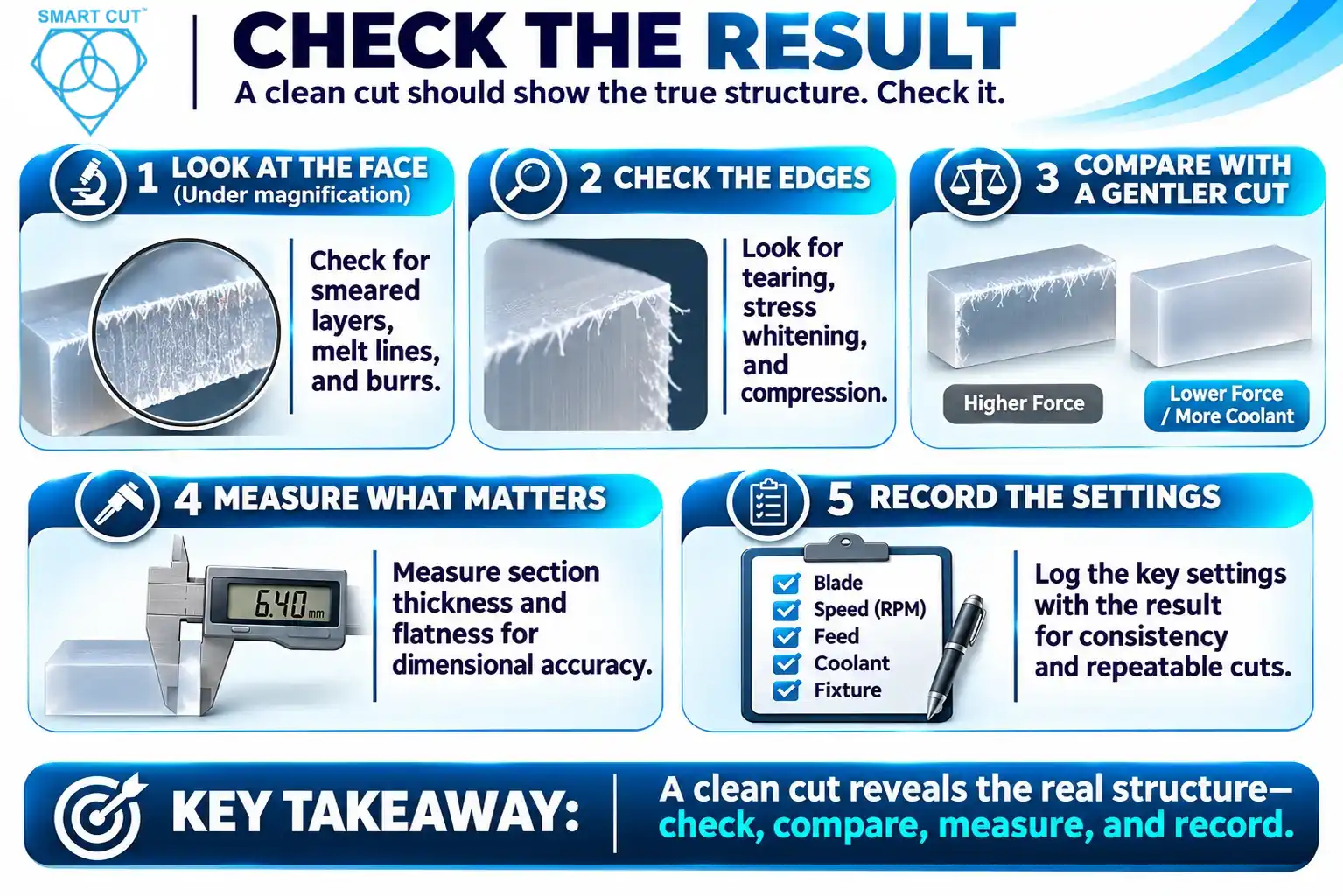
Check the Result

A clean cut should show the true structure. Check it.

  • Look at the face under magnification. Smeared layers, melt lines, and burrs show up as a flowed or glazed surface.
  • Check the edges. Look for tearing, stress whitening, and compression.
  • Compare with a gentler cut. If a feature disappears at lower force or with more coolant, it was cutting damage.
  • Measure what matters. If you need dimensional accuracy, measure the section thickness and flatness. See how to measure diamond blade cut quality.
  • Record the settings. Log the blade, speed, feed, coolant, and fixture with the result.

Our article on sectioning damage in metallography explains how heat and deformation alter a sample, and the same logic applies to polymers.

Qualify the Process on Test Samples

If your lab cuts plastics regularly, set a standard.

  1. Define the requirement. State what finish, edge quality, and dimensional accuracy you need.
  2. Pick two or three candidate blades. Use the table above and UKAM’s series guidance.
  3. Use representative samples. Match the material, thickness, and shape.
  4. Fix the setup. Keep the saw, support, and coolant the same.
  5. Compare the results. Inspect smear, burrs, and edge quality, and record cutting time.
  6. Write the winner into your procedure. See our diamond blade cutting SOP guide.

See how to compare two diamond blades fairly for the method. UKAM’s process development team can help.

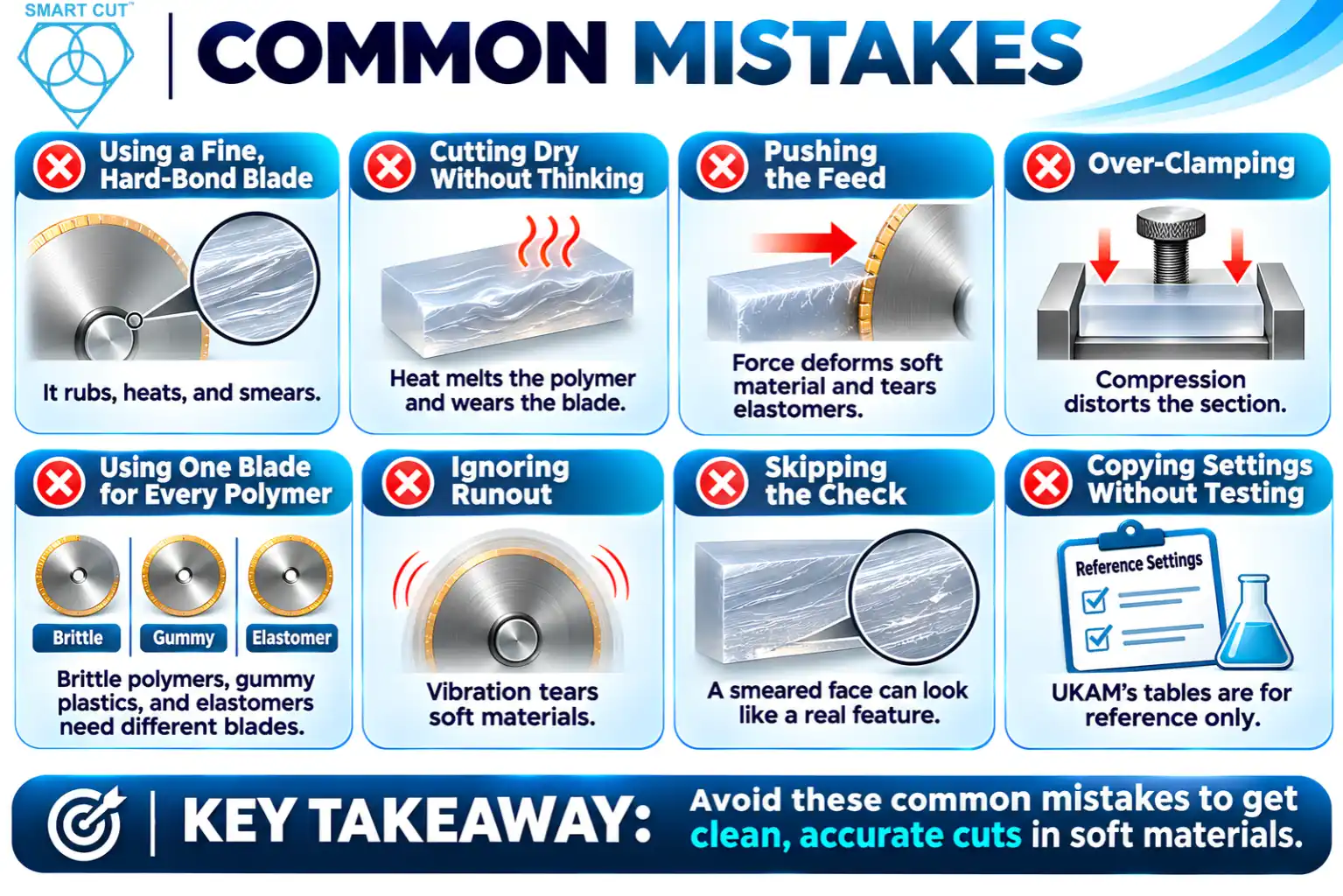
Common Mistakes

Common Mistakes

Using a fine, hard-bond blade on soft plastic. It rubs, heats, and smears.

Cutting dry without thinking. Heat melts the polymer and wears the blade.

Pushing the feed. Force deforms soft material and tears elastomers.

Over-clamping. Compression distorts the section.

Using one blade for every polymer. Brittle polymers, gummy plastics, and elastomers need different blades.

Ignoring runout. Vibration tears soft materials.

Skipping the check. A smeared face can look like a real feature.

Copying settings without testing. UKAM’s tables are for reference only.

Applying This in Your Lab

Start by sorting your samples into the families above. Choose a starting blade for each, set a light, steady feed with coolant on the cut, and support the sample without squeezing it. Cut a test piece, inspect the face under magnification, and compare it with a gentler cut. Then record the settings and write them into your procedure.

If you cut many different polymers, keep a short table of approved blades and settings for each, and review it when materials or blades change.

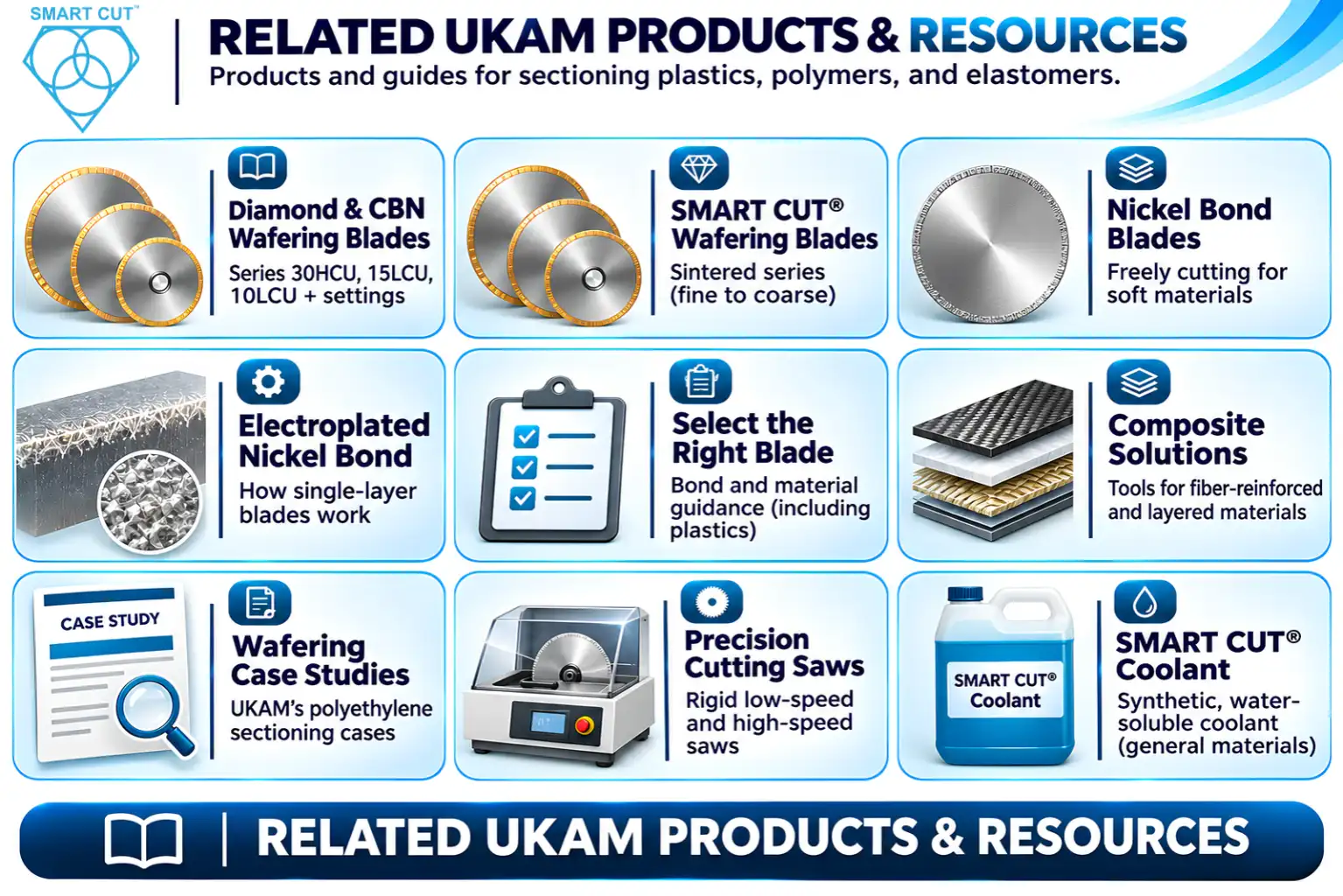
Related UKAM Products and Resources

Related UKAM Products and Resources

These UKAM products and guides support sectioning plastics, polymers, and elastomers.

Key Takeaways

  • Soft plastics fail by heat, stretch, and stickiness, not by hardness, so they need a different blade from hard ceramics.
  • Sort your material: thermoplastic, thermoset, elastomer, foam, brittle polymer, or reinforced plastic.
  • UKAM’s Series 30HCU, with high concentration and larger diamond, is built for soft and gummy materials. Electroplated blades suit gummy plastics, and Series 15LCU and 10LCU suit brittle or delicate polymers.
  • Keep force light and steady, and cut wet to keep heat down.
  • Support the sample without squeezing it, and keep runout low.
  • UKAM’s reference settings are for orientation only, so confirm them in your own process.
  • Inspect the cut face under magnification, and compare against a gentler cut.
  • Record the settings so a good cut can be repeated.

Frequently Asked Questions

Yes, if the blade is built for soft, gummy materials and the process keeps heat low.

Series 30HCU, a high-concentration, larger-diamond blade for soft and gummy materials.

Friction heats the polymer, which softens and flows across the cut face.

UKAM lists the low-concentration Series 15LCU for brittle polymers.

Cut wet for heat-sensitive polymers, since dry cutting raises heat and blade wear.

Use a light, steady feed, and start from UKAM’s reference settings, then test.

It reduces friction and heat and helps clear chips, which suits soft plastics.

Slow the feed, use a coarser blade, and support the section.

Over-clamping or high pressure squeezes soft samples, so reduce both.

Yes, thermosets crack more easily and need careful heat and pressure control.

Examine the cut face under magnification and compare it with a gentler cut.

No, they are for orientation only and depend on sample size, blade, and saw.

Yes, with gentle pressure and a steady feed, and UKAM lists it for Series 30HCU.

UKAM’s wafering blade case studies include polyethylene sectioning examples.

Conclusion

Cutting plastics with diamond blades is about managing heat, force, and stickiness. Soft polymers do not break the way ceramics do. They melt, stretch, tear, and smear, and a normal blade makes all of it worse.

The fix is a matched setup. Choose a blade made for soft and gummy materials, such as UKAM’s Series 30HCU or an interrupted-rim electroplated blade, and use a low-concentration blade for brittle polymers. Keep force light and steady, cut wet, support the sample without squeezing it, and keep the machine true. Then check the face under magnification and record what worked.

If you want help matching a blade and process to your plastic, rubber, or composite samples, request a consultation with the UKAM team, or browse our diamond wafering blades, nickel bond blades, and precision cutting saws.

Trusted by Tens of Thousands of Manufacturers, Laboratories,
Research Institutions Worldwide Since 1990

American Based Manufacturer

Established in 1990

Custom manufacturing

RELATED ARTICLES

Brian is an experienced professional in the field of precision cutting tools, with over 27 years of experience in technical support. Over the years, he has helped engineers, manufacturers, researchers, and contractors find the right solutions for working with advanced and hard-to-cut materials. He’s passionate about bridging technical knowledge with real-world applications to improve efficiency and accuracy.

As an author, Brian Farberov writes extensively on diamond tool design, application engineering, return on investment strategies, and process optimization, combining technical depth with a strong understanding of customer needs and market dynamics.

author-avatar

About Brian Farberov

Brian is an experienced professional in the field of precision cutting tools, with over 27 years of experience in technical support. Over the years, he has helped engineers, manufacturers, researchers, and contractors find the right solutions for working with advanced and hard-to-cut materials. He’s passionate about bridging technical knowledge with real-world applications to improve efficiency and accuracy. As an author, Brian Farberov writes extensively on diamond tool design, application engineering, return on investment strategies, and process optimization, combining technical depth with a strong understanding of customer needs and market dynamics.

Download Checklist

Please fill in your details to download the Precision Diamond Saw Pre-Operation Checklist.