


















How to Select a Diamond Blade for 99.5% Alumina Ceramic Without Edge Chipping

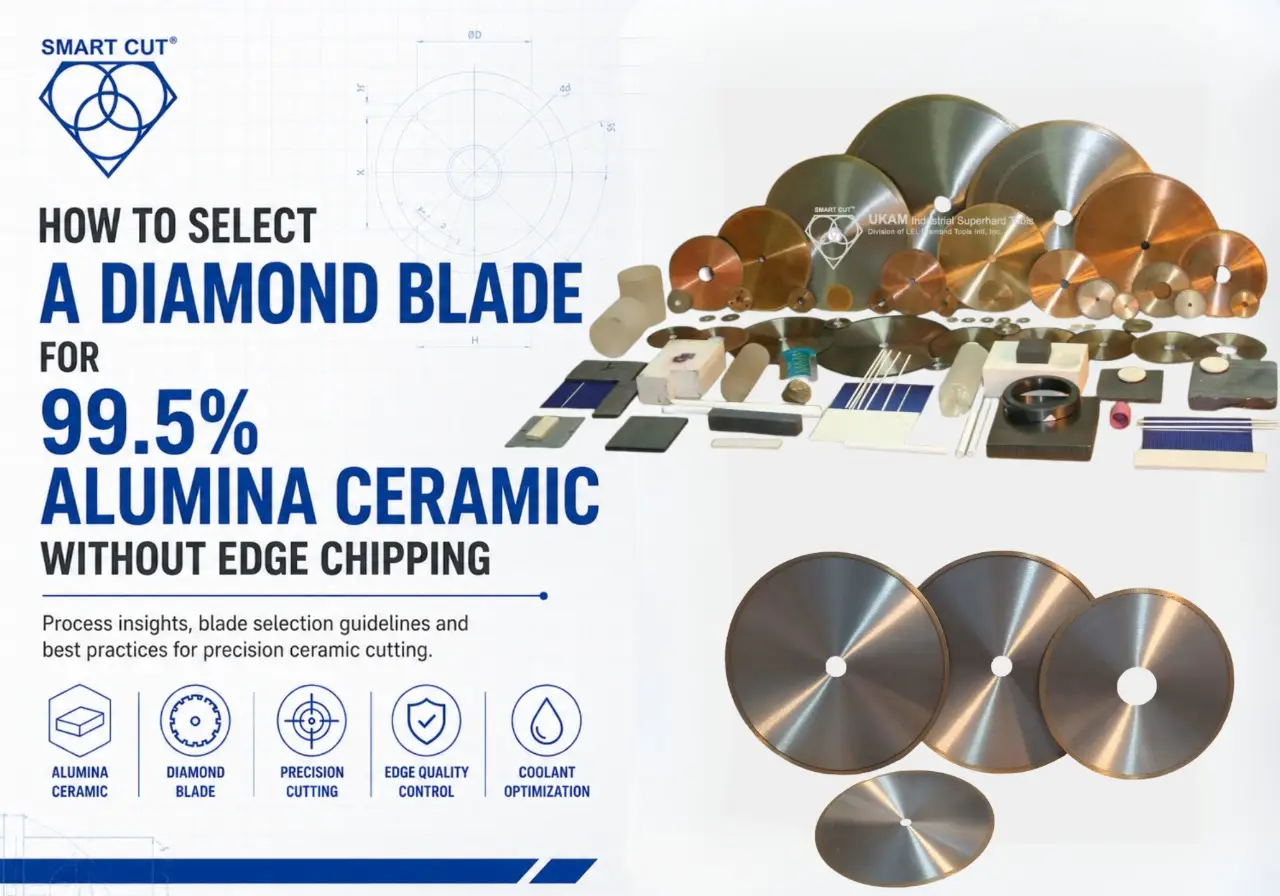
Table of Contents
Toggle
American Based Manufacturer

Established in 1990


Custom manufacturing


Technical Guide for Precision Cutting, Sectioning & Production Applications
Published by UKAM Industrial Superhard Tools — American manufacturer of precision diamond & CBN tools since 1990.
99.5% alumina ceramic is one of the most widely used advanced ceramics in semiconductor, aerospace, electronics, medical, optics, and industrial manufacturing applications. It offers excellent hardness, dielectric properties, wear resistance, and thermal stability — but it is also highly brittle and sensitive to edge chipping during cutting.
Edge chipping in alumina is rarely caused by a single factor alone. In most production and laboratory environments, it results from a combination of:
- Incorrect diamond blade specification
- Excessive blade runout or vibration
- Improper bond selection
- Inadequate flange support
- Incorrect feed rates or surface speed
- Poor coolant delivery
- Machine rigidity limitations
- Material thickness and geometry considerations
One of the biggest misconceptions in ceramic cutting is the idea that there is one “best” diamond blade specification for all 99.5% alumina applications. In reality, the correct blade depends heavily on:
- Material thickness
- Shape and dimensions
- Machine type and spindle rigidity
- Cut depth
- Surface finish requirements
- Allowable edge chipping tolerance
- Production rate
- Wet vs dry cutting capability
- Current blade specification and operating parameters
This guide explains the engineering principles behind cutting 99.5% alumina ceramic while minimizing edge chipping and subsurface damage.
Why 99.5% Alumina Ceramic Is Difficult to Cut
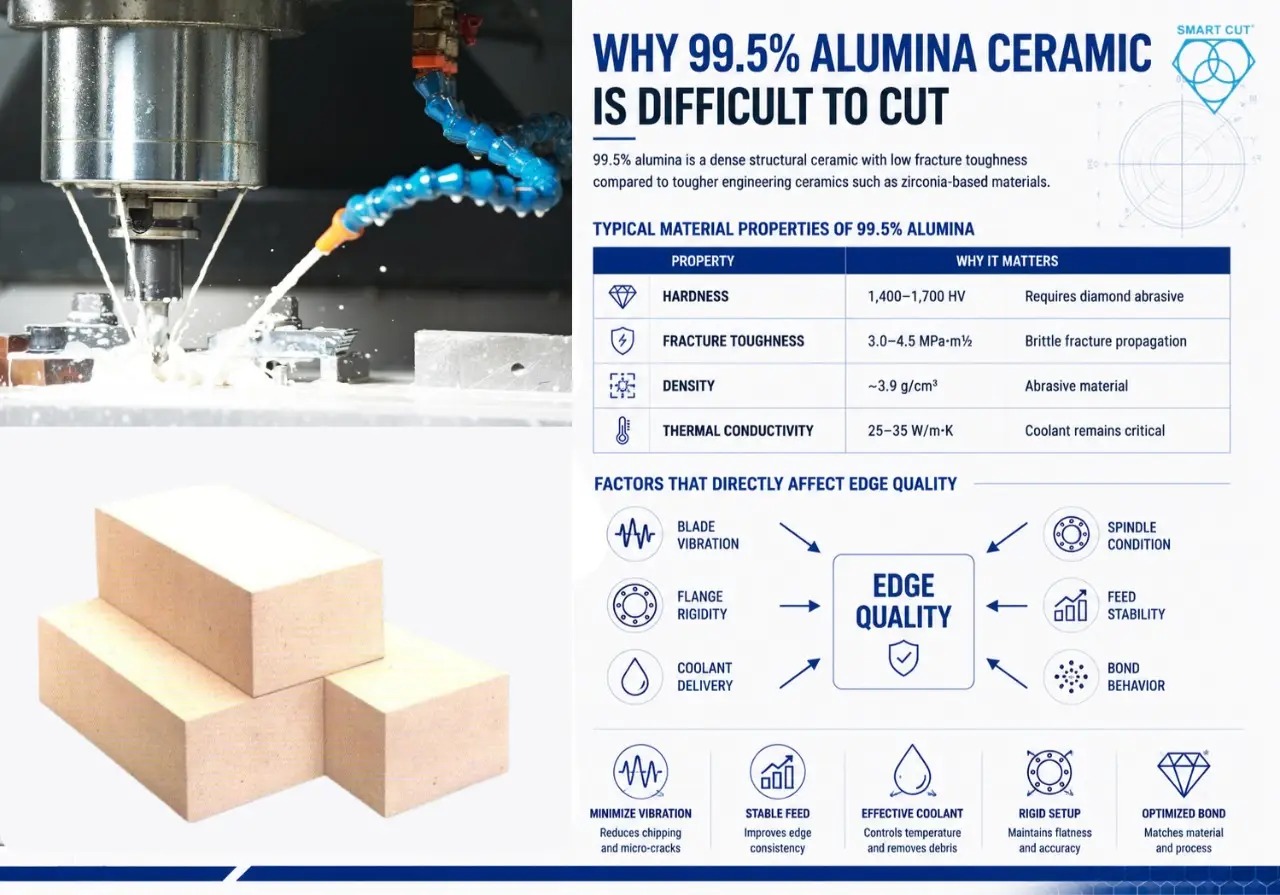
99.5% alumina is a dense structural ceramic with low fracture toughness compared to tougher engineering ceramics such as zirconia-based materials.
Typical Material Properties of 99.5% Alumina
|
Property |
Typical Value |
Cutting Implication |
|---|---|---|
|
Hardness |
1,400–1,700 HV |
Requires diamond abrasive |
|
Fracture Toughness |
3.0–4.5 MPa·m½ |
Brittle fracture propagates easily |
|
Density |
~3.9 g/cm³ |
Highly abrasive material |
|
Flexural Strength |
300–400 MPa |
Sensitive to subsurface damage |
|
Thermal Conductivity |
25–35 W/m·K |
Coolant remains important |
Unlike metals, alumina does not plastically deform during cutting. Material removal primarily occurs through brittle fracture mechanisms.
This means that:
- blade vibration
- spindle condition
- flange rigidity
- feed stability
- coolant delivery
- bond behavior
all directly affect edge quality.
⚠️ Important Engineering Principle:
In brittle ceramics like 99.5% alumina, edge chipping is often driven more by localized stress concentration and vibration than by cutting force alone.
The First Step: Define the Application Properly
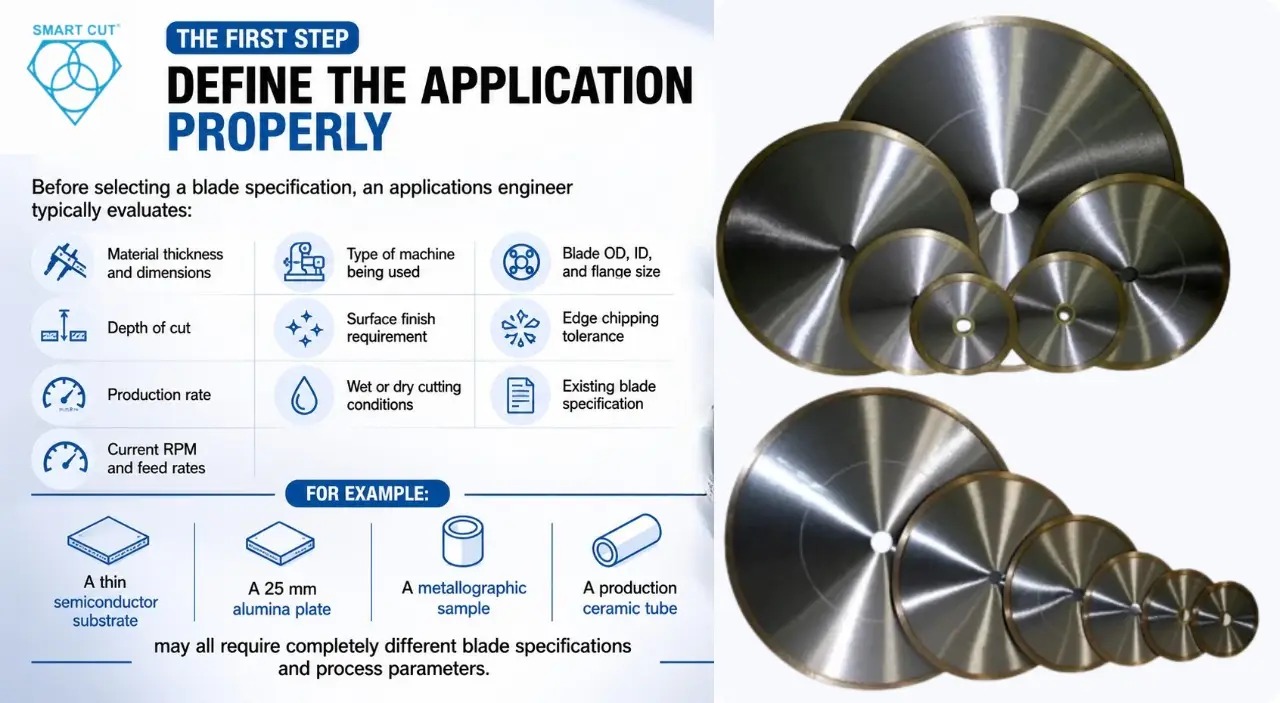
Before selecting a blade specification, an applications engineer typically evaluates:
- Material thickness and dimensions
- Type of machine being used
- Blade OD, ID, and flange size
- Depth of cut
- Surface finish requirement
- Edge chipping tolerance
- Production rate
- Wet or dry cutting conditions
- Existing blade specification
- Current RPM and feed rates
For example:
- A thin semiconductor substrate
- A 25 mm alumina plate
- A metallographic sample
- A production ceramic tube
may all require completely different blade specifications and process parameters.
Bond Type Selection for 99.5% Alumina
Bond selection is one of the most important process variables in ceramic cutting.
There is no universally correct bond type for all alumina applications.
The correct choice depends on:
- machine rigidity
- cut depth
- production requirements
- edge quality requirements
- blade life priorities
- coolant conditions
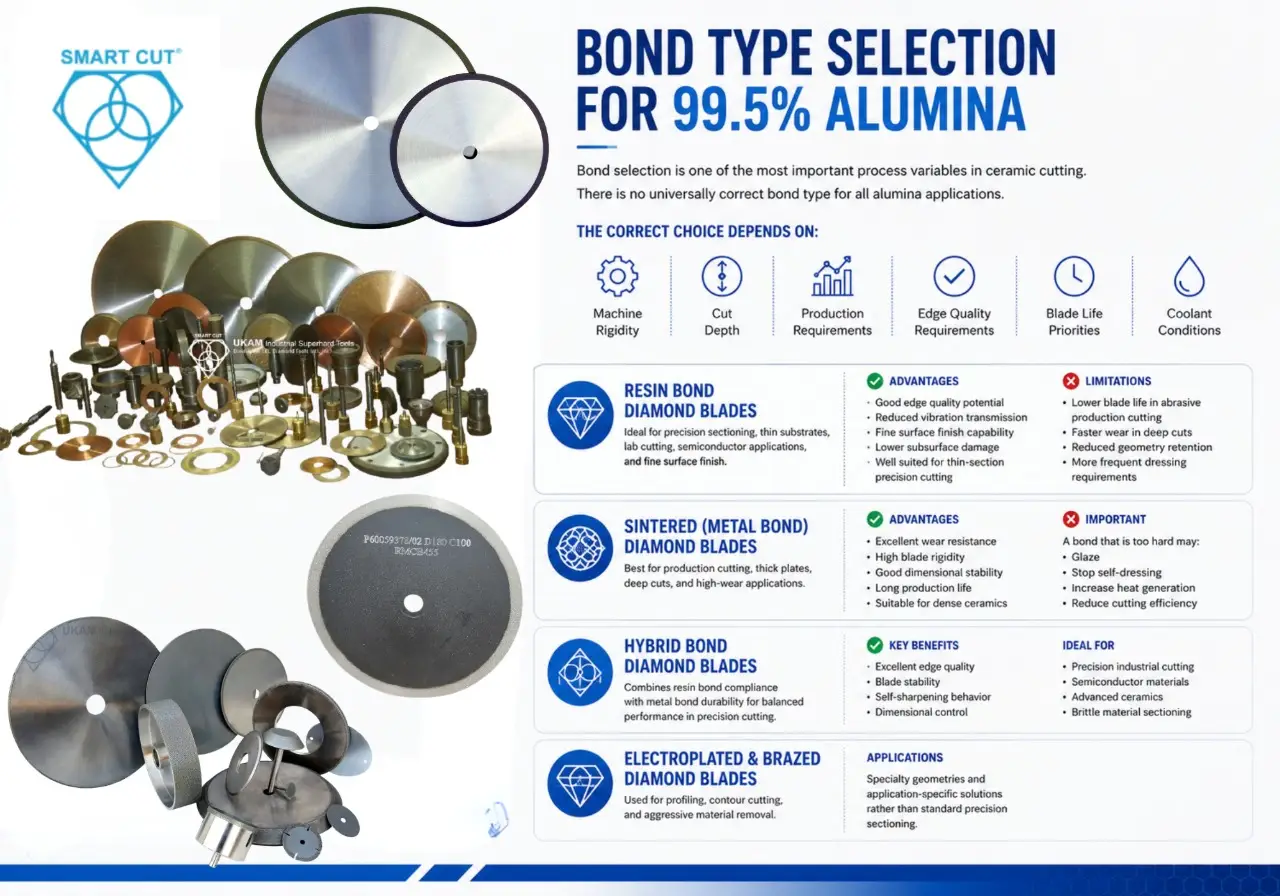
Resin Bond Diamond Blades
Resin bond diamond blades are commonly used for:
- Precision sectioning
- Thin substrates
- Laboratory cutting
- Semiconductor applications
- Fine surface finish requirements
Resin bond systems provide some mechanical compliance, which can help reduce vibration transfer into brittle materials.
Advantages of Resin Bond Blades
- Good edge quality potential
- Reduced vibration transmission
- Fine surface finish capability
- Lower subsurface damage in some applications
- Well suited for thin-section precision cutting
Limitations of Resin Bond Blades
- Lower blade life in abrasive production cutting
- Faster wear in deep cuts
- Reduced geometry retention under heavy load
- More frequent dressing requirements
For high-volume production cutting of thick alumina sections, resin bond is not always the preferred solution.
Sintered (Metal Bond) Diamond Blades
Sintered metal bond blades are widely used in:
- Production cutting
- Thick alumina plates
- Deep cuts
- High-wear applications
- Precision industrial cutting
A properly engineered metal bond blade can often provide:
- superior geometry retention
- longer life
- better stability under load
- improved production consistency
compared to softer bond systems.
Advantages of Metal Bond Blades
- Excellent wear resistance
- High blade rigidity
- Good dimensional stability
- Long production life
- Suitable for dense abrasive ceramics
Important Considerations
A bond that is too hard for the application may:
- glaze
- stop self-dressing
- increase heat generation
- reduce cutting efficiency
Metal bond blades should always be matched carefully to:
- material hardness
- machine capability
- coolant delivery
- feed rate
- required finish quality
Hybrid Bond Diamond Blades
|
Concentration |
Cutting Points per cm² |
Grinding Force per Grit |
Recommended Application |
|---|---|---|---|
|
75% |
Lower |
Higher per grit, faster self-sharpening |
Soft bond grades, finish passes, thermal-sensitive materials |
|
100% |
Moderate |
Balanced |
General PDC grinding, most production environments |
|
125% |
Higher |
Lower per grit, longer life before dressing |
High-volume roughing, abrasive materials, long runs |
|
150 to 200% |
Very high |
Very low per grit |
Aggressive stock removal, rough grinding only |
Hybrid bond systems combine characteristics of:
- resin bond compliance
- metal bond durability
These systems are increasingly used in:
- precision industrial cutting
- semiconductor materials
- advanced ceramics
- brittle material sectioning
where balancing:
- edge quality
- blade stability
- self-sharpening behavior
- dimensional control
is critical.
Electroplated & Brazed Diamond Blades
Electroplated (nickel bond) and brazed diamond blades are generally used for:
- profiling
- contour cutting
- specialty geometries
- aggressive material removal
These are typically application-specific solutions rather than standard precision sectioning choices.
Bond Type Comparison Table
|
Bond Type |
Edge Quality Potential |
Blade Life |
Typical Applications |
|---|---|---|---|
|
Resin Bond |
Excellent |
Moderate |
Precision sectioning |
|
Sintered Metal Bond |
Good–Excellent |
High |
Production cutting |
|
Hybrid Bond |
Excellent |
Moderate–High |
Precision industrial cutting |
|
Electroplated |
Moderate |
Low–Moderate |
Profiling & contour work |
|
Brazed Bond |
Moderate |
High |
Aggressive specialty cutting |
Diamond Grit Size Selection
Diamond grit size affects:
- edge quality
- surface finish
- cutting speed
- subsurface damage
- blade wear behavior
Finer grit generally reduces edge chipping and subsurface damage — but may also reduce cutting speed and increase heat if feed rates are too aggressive.
Typical Grit Ranges by Application
|
Grit Range |
Typical Use |
|---|---|
|
80–120 mesh |
Thick plates, rough cutting |
|
120–220 mesh |
General production cutting |
|
220–325 mesh |
Controlled edge quality applications |
|
325–500 mesh |
Precision sectioning |
|
500–600 mesh |
Thin wafers and fine edge requirements |
|
600+ mesh |
Optical/metallographic applications |
⚠️ Grit selection should always be matched to:
- material thickness
- machine rigidity
- feed rate
- desired surface finish
- acceptable edge chipping tolerance
Many successful production alumina applications use coarser grit than laboratory sectioning operations.
Continuous Rim vs Segmented Blades
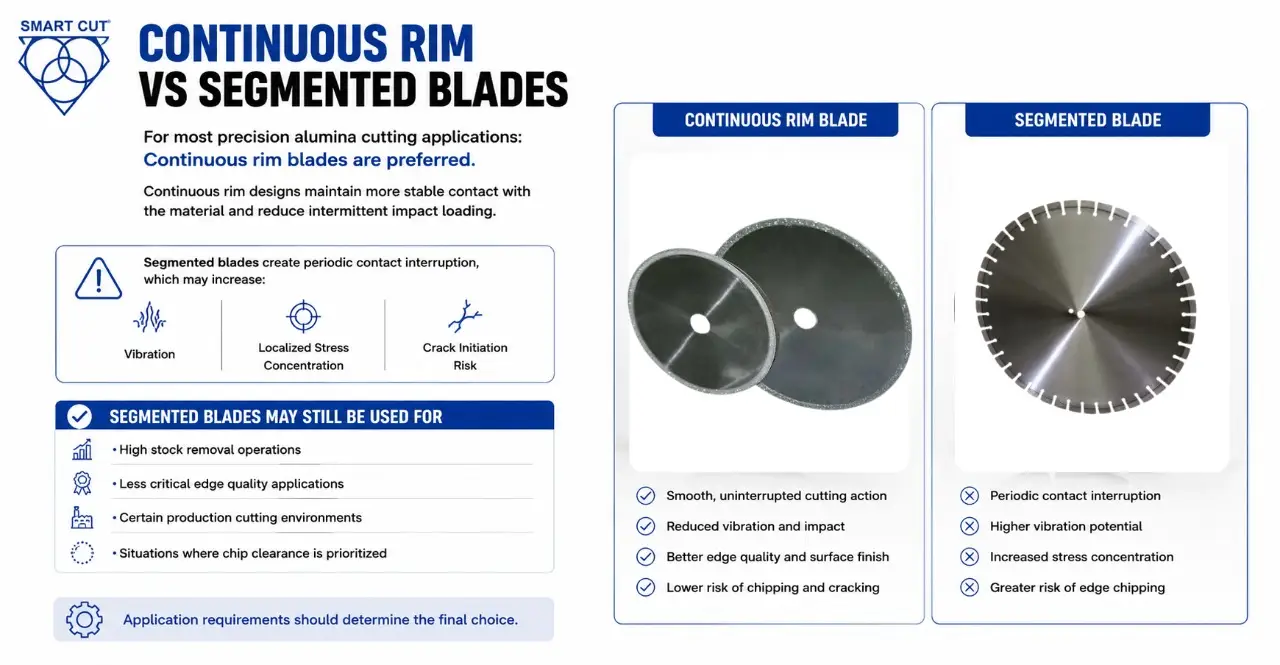
For most precision alumina cutting applications:
Continuous rim blades are preferred.
For most precision alumina cutting applications:
- vibration
- localized stress concentration
- crack initiation risk
Segmented Blades May Still Be Used For
- High stock removal operations
- Less critical edge quality applications
- Certain production cutting environments
- Situations where chip clearance is prioritized
Application requirements should determine the final choice.
Blade Runout & Machine Rigidity
Even a properly specified blade can produce edge chipping if:
- spindle bearings are worn
- flanges are undersized
- arbor alignment is poor
- machine rigidity is insufficient
Runout creates repeated impact loading at the cutting interface.
Recommended Runout Targets
|
Application Type |
Recommended Runout |
|---|---|
|
Standard precision cutting |
≤0.002" |
|
Thin wafers / ultra-precision |
Tighter if possible |
Dynamic runout during operation is often more important than static runout measured at rest.
Blade Thickness & Flange Support
Thin blades reduce kerf loss —
but also increase susceptibility to deflection.
Blade deflection contributes directly to:
- edge chipping
- wandering cuts
- vibration instability
Recommended Flange Practices
- Use flanges on both sides of blade
- Larger flange diameter improves stability
- Verify arbor seating regularly
- Match blade stiffness to cut depth
For deep production cuts, thicker and stiffer blades may outperform ultra-thin blades even if kerf loss increases.
RPM & Feed Rate Considerations
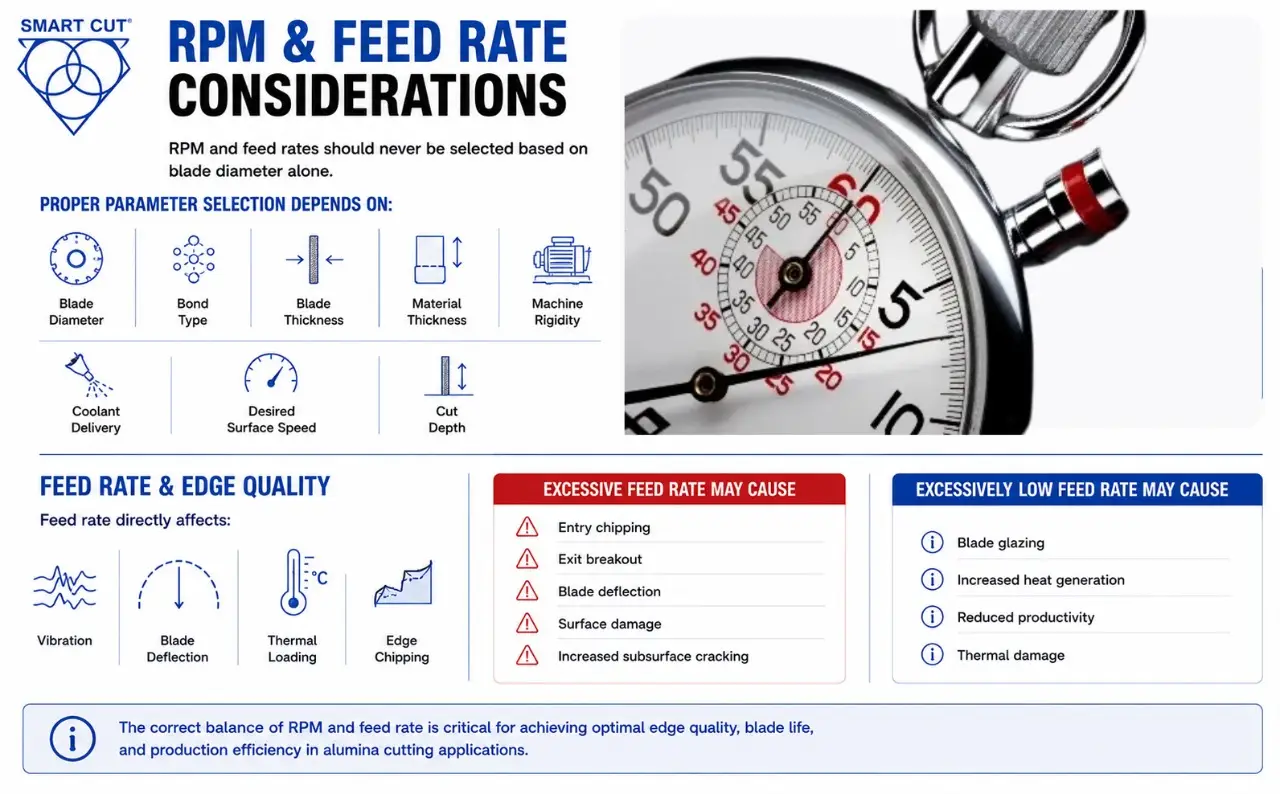
RPM and feed rates should never be selected based on blade diameter alone.
Proper parameter selection depends on:
- blade diameter
- bond type
- blade thickness
- material thickness
- machine rigidity
- coolant delivery
- desired surface speed
- cut depth
⚠️ Any published RPM/feed table should be treated as a starting point only — not a universal specification.
Feed Rate & Edge Quality
Feed rate directly affects:
- vibration
- blade deflection
- thermal loading
- edge chipping
Excessive Feed Rate May Cause
- Entry chipping
- Exit breakout
- Blade deflection
- Surface damage
- Increased subsurface cracking
Excessively Low Feed Rate May Cause
- Blade glazing
- Increased heat generation
- Reduced productivity
- Thermal damage
Engineering Best Practice
A common process optimization method is:
- Start conservatively
- Inspect edge quality under magnification
- Increase feed gradually
- Reduce feed near cut entry and exit
Wet cutting with proper coolant delivery is strongly recommended for most precision and production alumina cutting applications.
Coolant helps:
Coolant Recommendations
Wet cutting with proper coolant delivery is strongly recommended for most precision and production alumina cutting applications.
Coolant helps:
- reduce heat
- evacuate swarf
- reduce friction
- stabilize blade performance
- minimize thermal damage
However, specialized operations may sometimes use:
- air mist
- near-dry cutting
- controlled dry cutting
depending on:
- machine design
- contamination concerns
- application requirements
Coolant Delivery Best Practices
- Aim coolant directly into cutting interface
- Maintain sufficient flow and pressure
- Monitor coolant concentration regularly
- Maintain filtration system
- Avoid interrupted coolant flow during cutting
Sacrificial Backing Materials
Backing materials may help reduce exit edge chipping in many applications by supporting the material during breakthrough.
Common backing materials include:
- graphite
- phenolic
- glass
- ceramic
- wax mounting systems
- application-specific supports
The effectiveness of backing material depends on:
- workpiece geometry
- mounting quality
- feed rate
- blade exposure
- vibration levels
- material thickness
Backing material alone will not solve chipping caused by:
- excessive runout
- poor spindle condition
- incorrect bond selection
- unstable fixturing
96% vs 99.5% Alumina: Can the Same Blade Be Used?
In many cases, yes.
A properly designed blade for dense alumina can often cut both:
- 96% alumina
- 99.5% alumina
successfully.
However:
- higher purity alumina is generally harder and more abrasive
- blade wear behavior may differ
- optimal bond and grit may vary depending on production requirements
For high-volume or tight-tolerance applications, process optimization for each material grade is recommended.
|
Problem |
Likely Cause |
Corrective Action |
|---|---|---|
|
Entry edge chipping |
Feed too aggressive |
Reduce entry feed |
|
Exit breakout |
Unsupported exit edge |
Add backing support |
|
Blade glazing |
Bond too hard |
Dress blade |
|
Excessive vibration |
Runout or spindle issues |
Verify machine condition |
|
Blade wandering |
Blade too thin |
Increase stiffness |
|
Burning/discoloration |
Poor coolant delivery |
Improve coolant flow |
|
Rapid blade wear |
Bond too soft |
Review blade specification |
UKAM Diamond Blades for Advanced Ceramics
UKAM Industrial Superhard Tools manufactures precision diamond blades and superabrasive tooling for:
- advanced ceramics
- semiconductor materials
- sapphire
- quartz
- technical glass
- composites
- brittle engineering materials
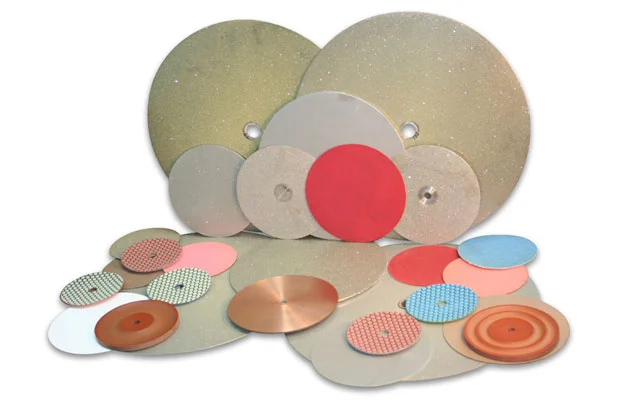
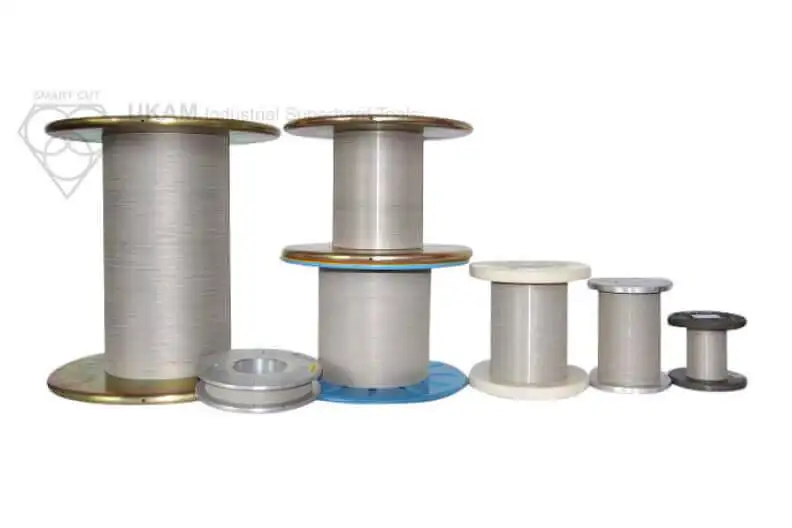
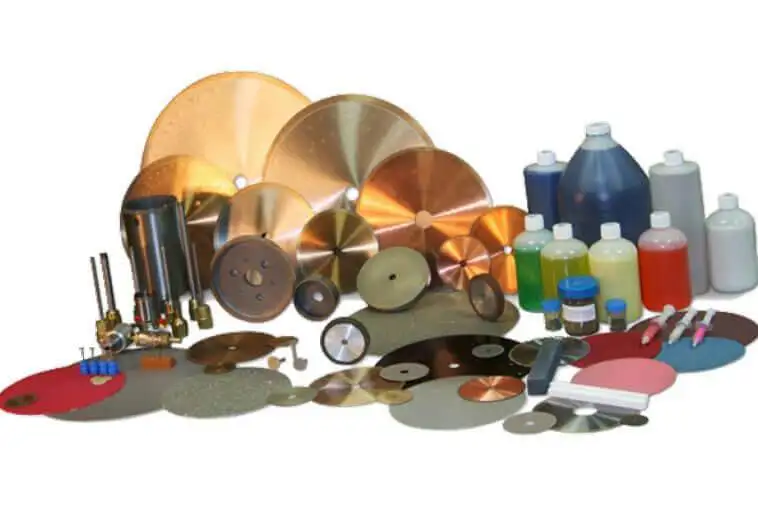
Our product range includes:
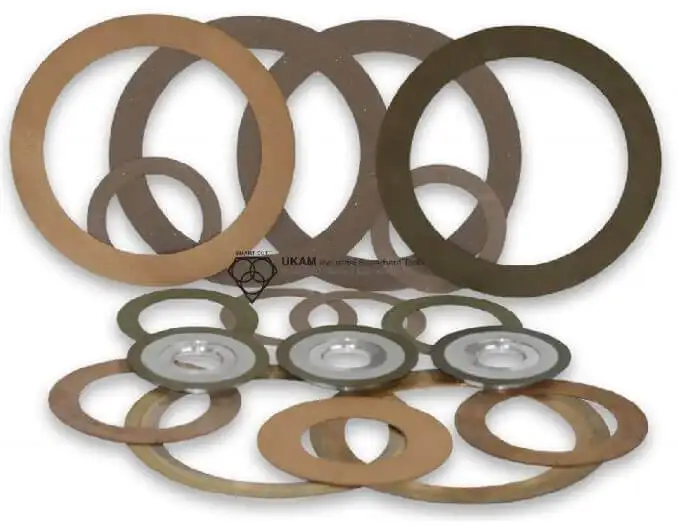
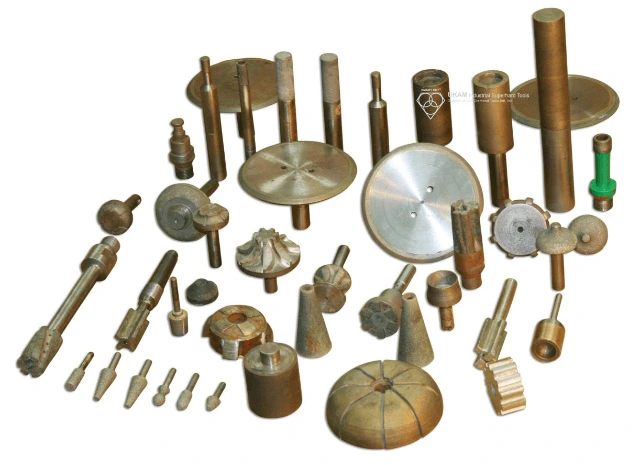
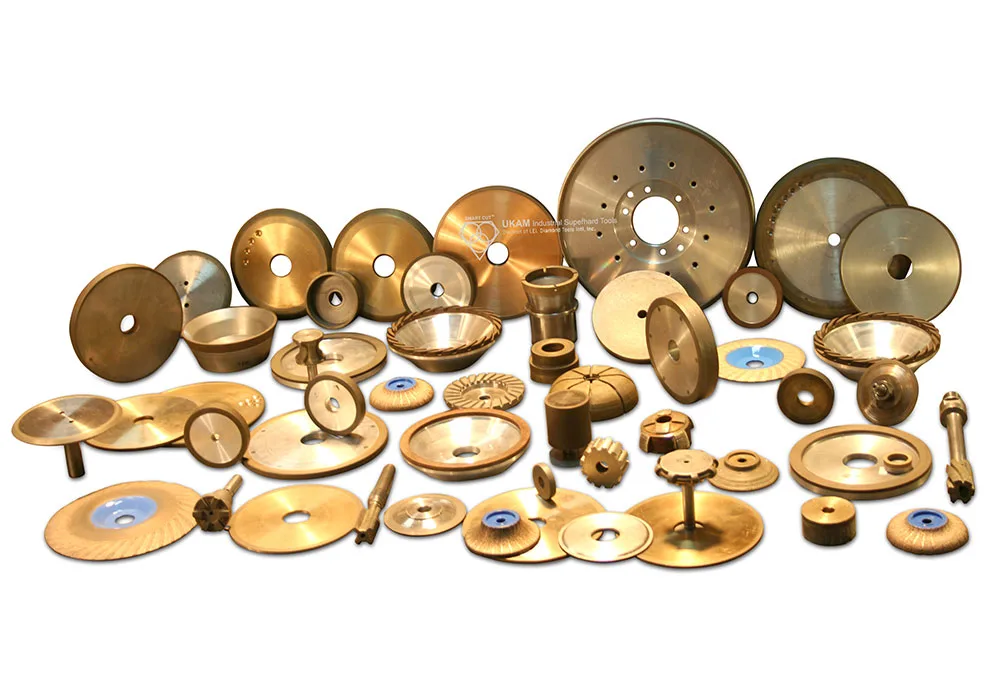
for laboratories, OEMs, universities, aerospace suppliers, semiconductor manufacturers, and industrial production facilities worldwide.
Related UKAM Resources
- Diamond Blades Overview
- Advanced Ceramics Applications
- Dicing Blades
- Knowledge Center
- Semiconductor Industry Applications
Frequently Asked Questions
- The correct bond depends on the application.
- Resin bond is commonly used for precision sectioning and thin substrates.
- Sintered metal bond is often preferred for production cutting and deeper cuts.
- Hybrid bond systems may provide advantages in specialized precision applications.
- 80–220 mesh is commonly used for stock removal and thicker sections.
- 220–325 mesh is common for controlled edge quality applications.
- 325–600 mesh is often used for precision sectioning and thin substrates.
- Final selection depends on finish requirements, machine rigidity, and acceptable chipping tolerance.
- Wet cutting with proper coolant delivery is strongly recommended for most precision alumina applications.
- Some specialized operations may use controlled dry or near-dry cutting depending on machine design and process requirements.
- Common causes include excessive blade runout, unstable fixturing, aggressive feed rates, insufficient coolant delivery, incorrect bond selection, or machine vibration.
- In many cases, yes.
- A properly designed blade for dense alumina can often cut both successfully.
- However, performance optimization may vary depending on purity level, thickness, and production requirements.
Trusted by Tens of Thousands of Manufacturers, Laboratories,
Research Institutions Worldwide Since 1990
American Based Manufacturer
Established in 1990
Custom manufacturing
RELATED ARTICLES
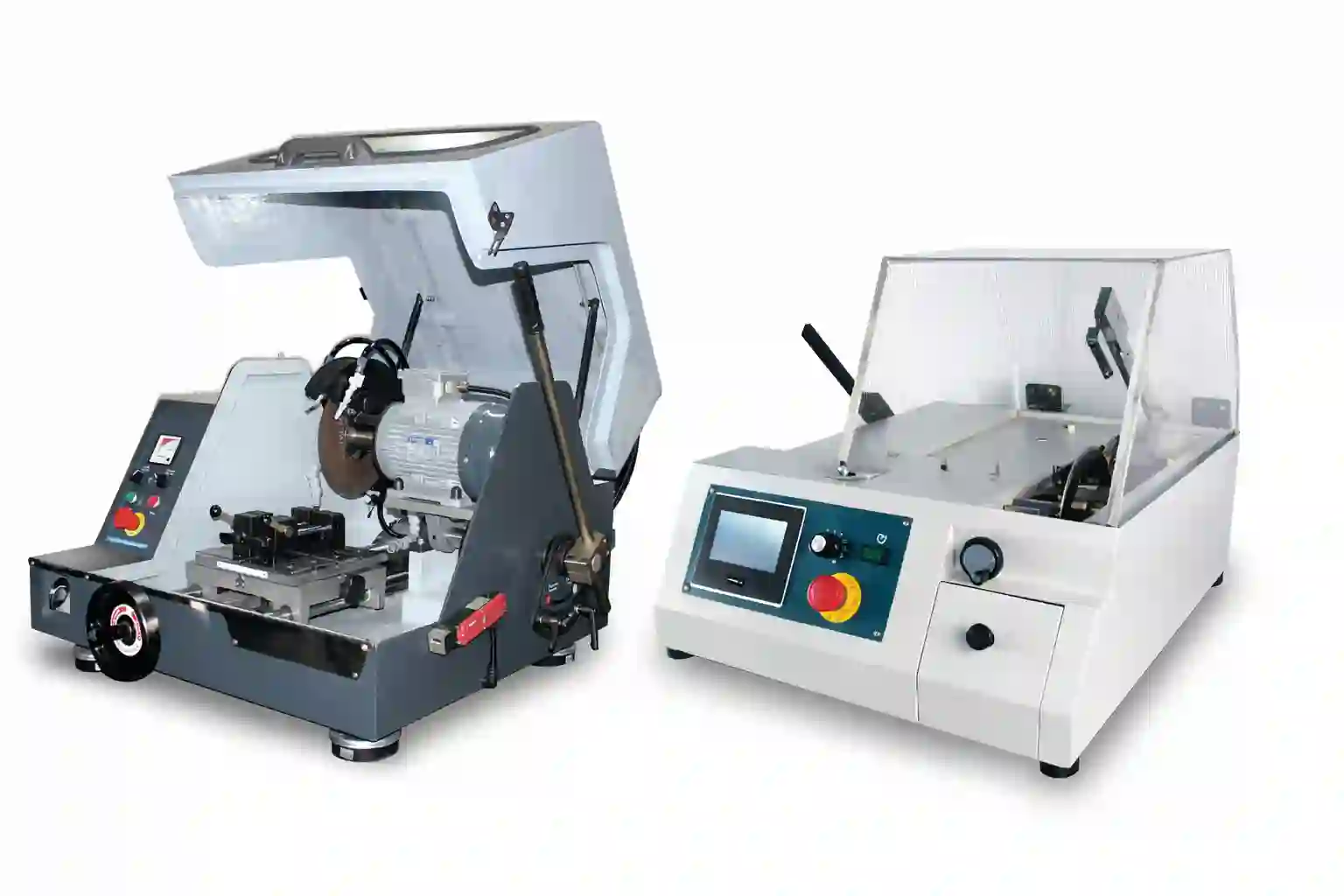
Whether in a factory for industrial production or in the research lab, testing lab, and inspection area of a university
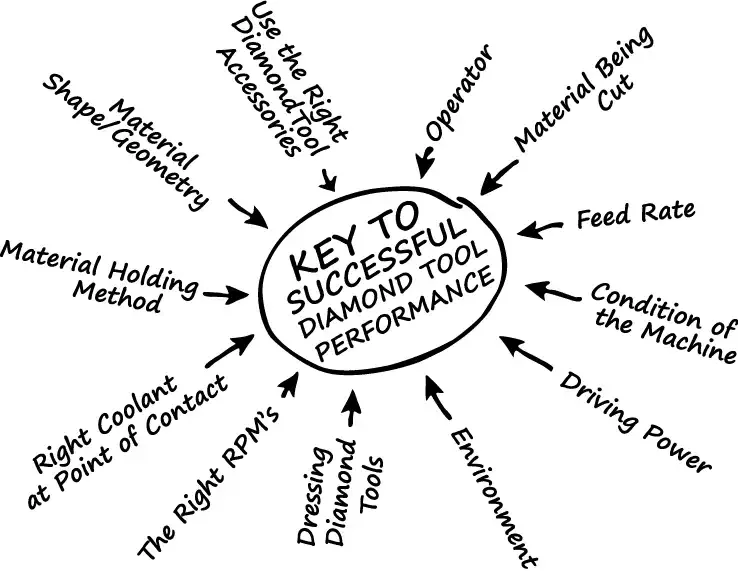
The use of diamond tools in the manufacturing and precision machining industries, as well as in construction, research, etc., is essential.
