










Diamond Blade Storage, Handling, and Transport: Prevent Damage Before the First Cut
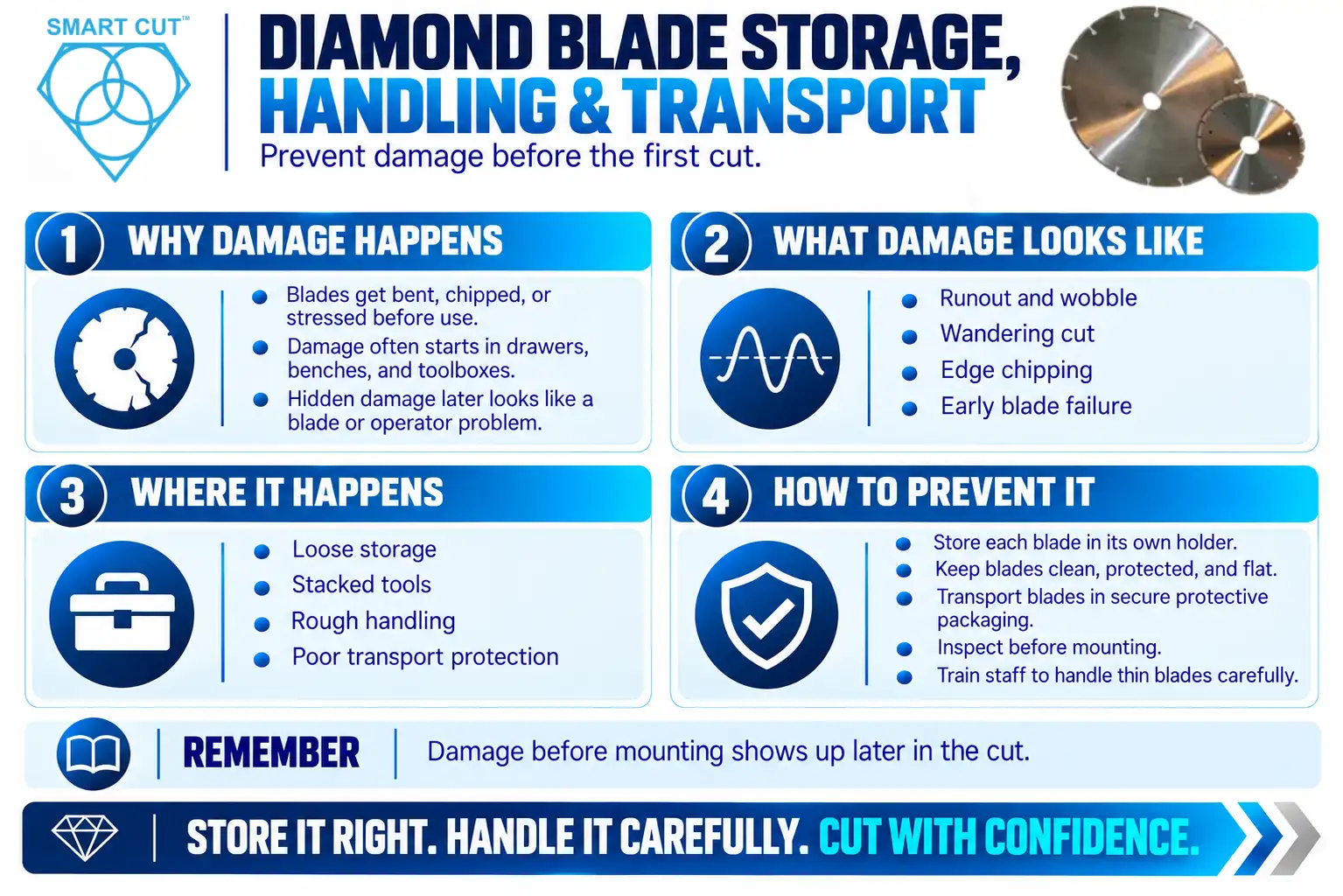
Table of Contents
ToggleMany diamond blades are damaged before they ever touch a workpiece. A blade slides off a bench, rests under another tool in a drawer, or rides loose in a toolbox. A thin core bends. A rim chips. The blade looks fine, so it goes onto the saw.
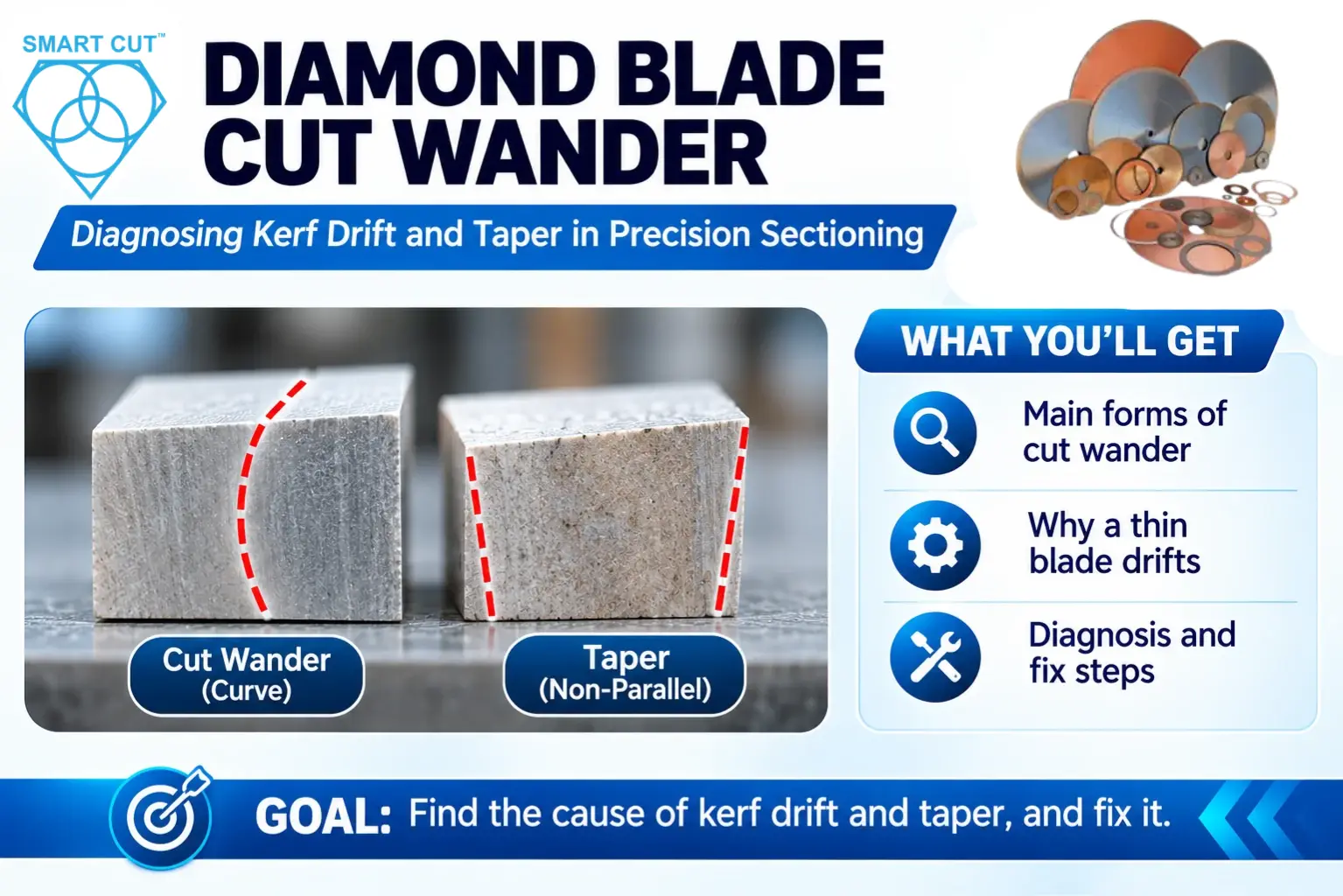
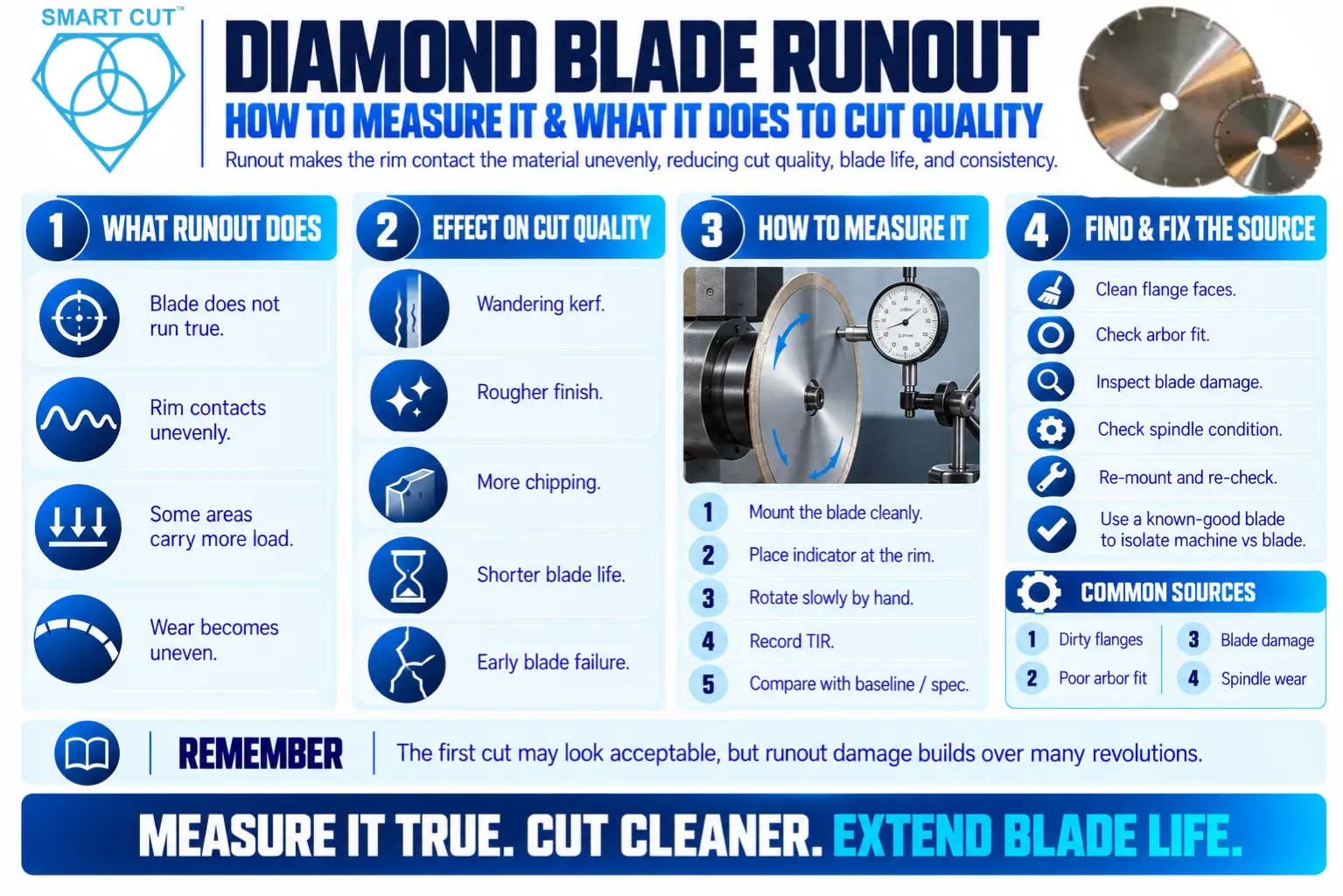
The damage then shows up later as runout, a wandering cut, edge chipping, or a blade that fails early. By that point, nobody connects the problem to the drawer. The shop blames the blade or the operator.
This article covers diamond blade storage, handling, and transport. It explains how blades get damaged between delivery and mounting, and it gives practical rules to prevent that. The rules suit labs and production shops alike.
This article focuses on care before and after the cut. For mounting, see our setup-mistakes article. For checking blades when they arrive, see our incoming diamond blade inspection and trial-cut checklist.
Trusted by Tens of Thousands of Manufacturers, Laboratories Research Institutions Worldwide Since 1990
Established in 1990
Why Diamond Blade Storage and Handling Matter
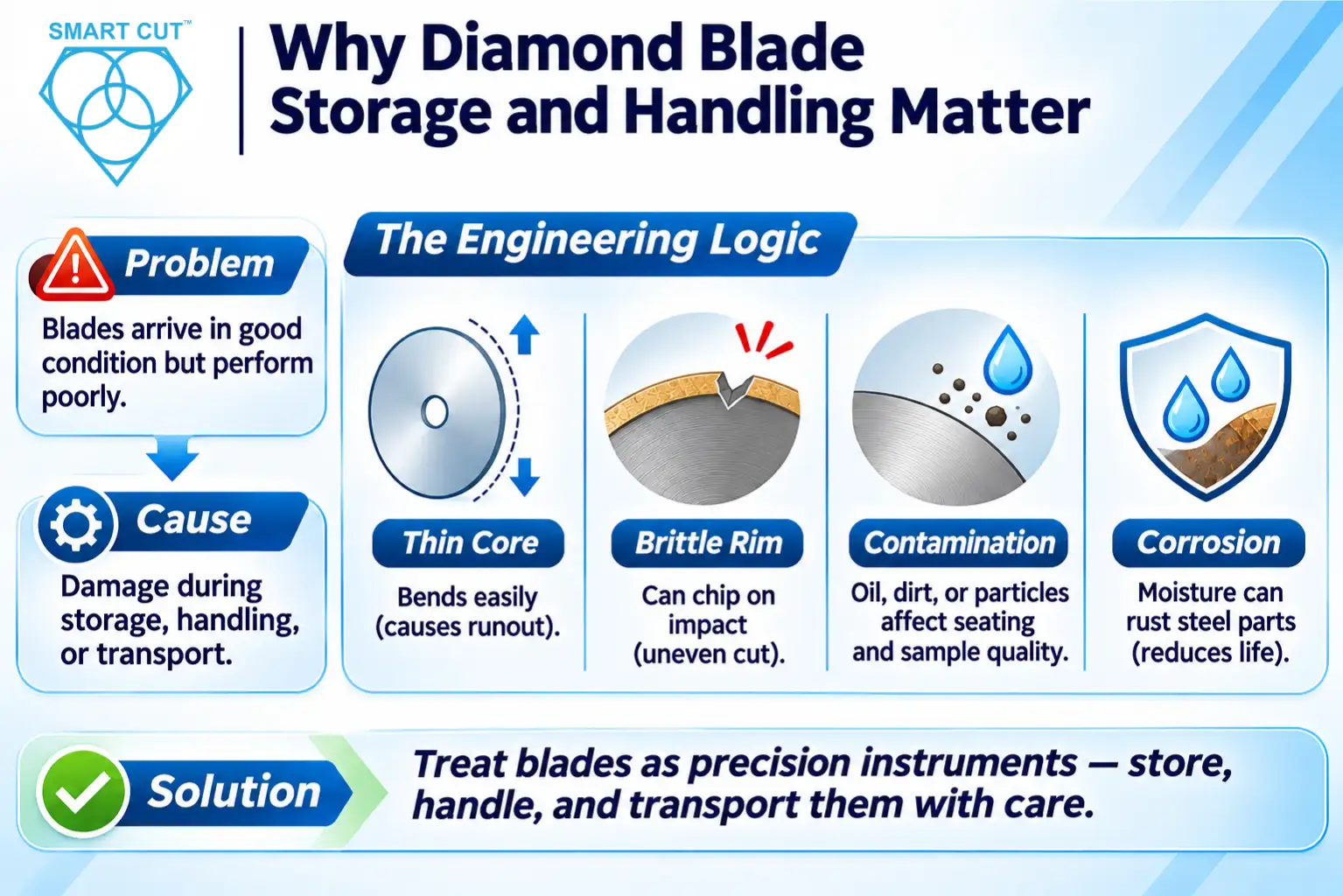
Problem: Blades arrive in good condition but perform poorly, and nobody can say why.
Cause: Damage happened during storage, handling, or transport, and nobody saw it.
Engineering logic: A precision blade has a thin core and an abrasive rim. Both are vulnerable in different ways.
- The core is thin and flexible. A thin core bends easily if it is stacked under weight, dropped, or leaned against a hard edge. Even a small bend becomes runout once the blade turns. UKAM’s product guidance notes that smaller and thinner blades are more prone to bending.
- The rim is hard but brittle at its edge. Diamond abrasive is very hard, but an impact on the rim can chip it or damage the bond. A chipped rim cuts unevenly.
- The surfaces can be contaminated. Oil, dirt, coolant residue, and metal particles can transfer to the blade or the flanges. Contamination interferes with seating and can contaminate your samples.
- Steel parts can corrode. A wet or humid environment can attack unprotected metal.
Each of these effects is small and silent. Together, they explain a share of “mystery” blade problems. A blade that arrives true and gets mounted bent will wobble no matter how well you set up the saw.
Solution: Treat blades as precision instruments. Give each blade a protected place, handle it with care, and move it in a way that protects the rim and the core.
Step 1: Receive and Inspect
Good practice starts at the dock.
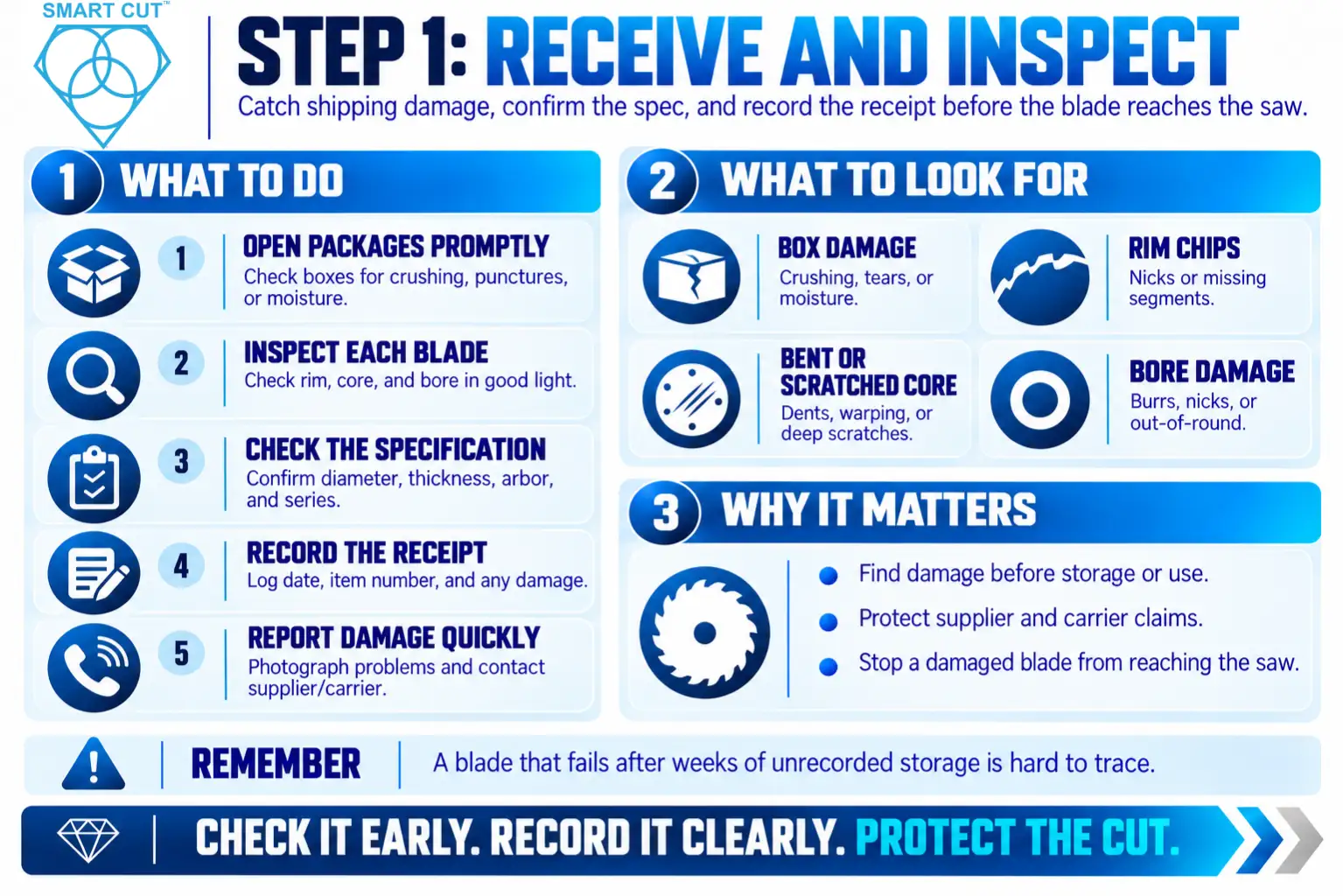
- Open packages promptly. Check each box for crushing, punctures, or moisture before you accept it.
- Inspect each blade on receipt. Look at the rim for chips, at the core for bends or scratches, and at the bore for damage. Do this in good light.
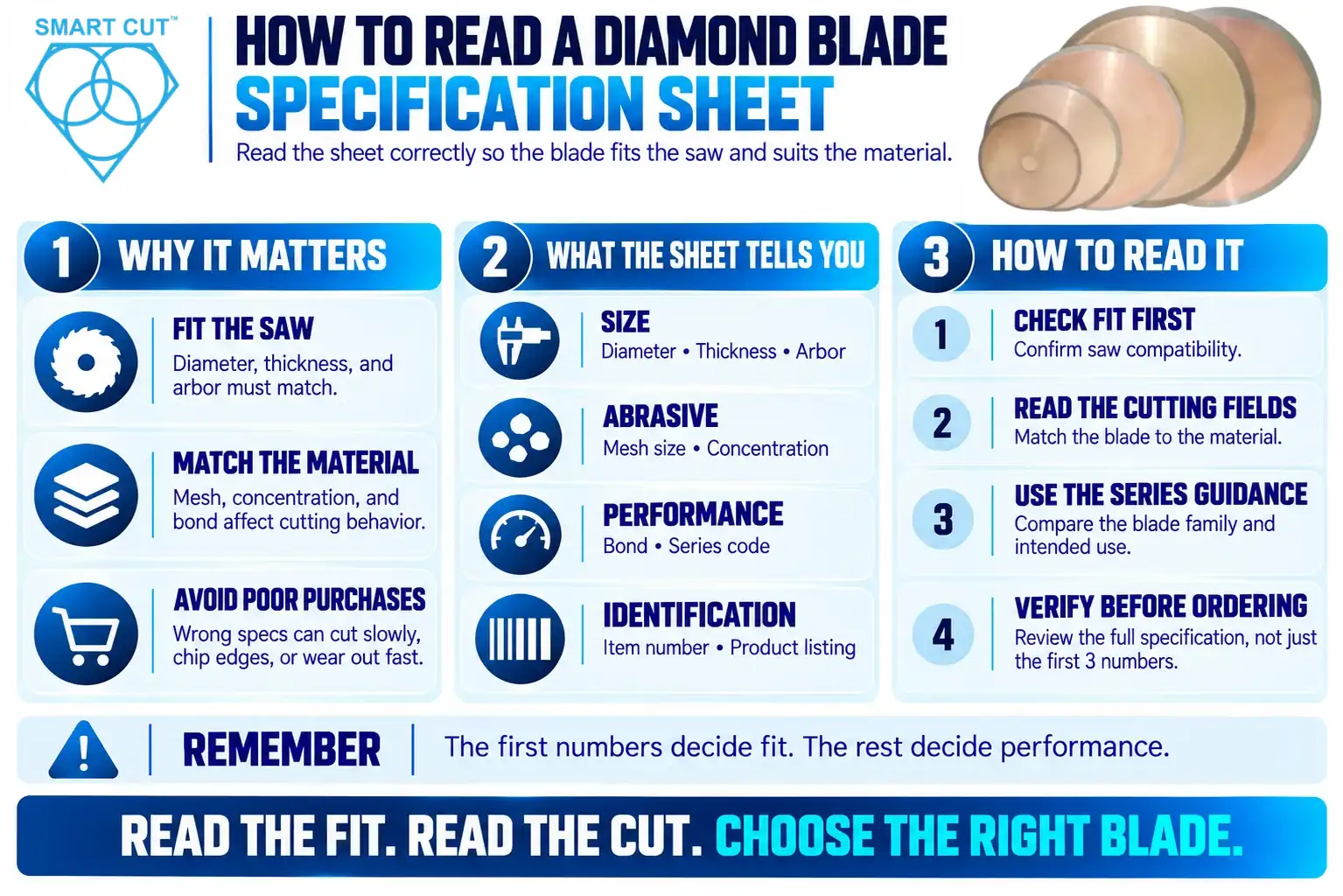
- Check the specification. Confirm that diameter, thickness, arbor, and series match your order. Our guide on how to read a diamond blade specification sheet shows what to compare, and the SMART CUT® product page lists these fields for each series.
- Record the receipt. Note the date, the item number, and any damage.
- Report damage quickly. Photograph any problem and tell your supplier and carrier at once.
Catching damage at receipt matters because it protects your claim. A blade that fails after weeks of unrecorded storage is hard to trace.
Step 2: Store Blades Properly
Storage is where most avoidable damage occurs. Use these rules as a base, and follow your supplier’s guidance for each product.
Choose the Right Environment
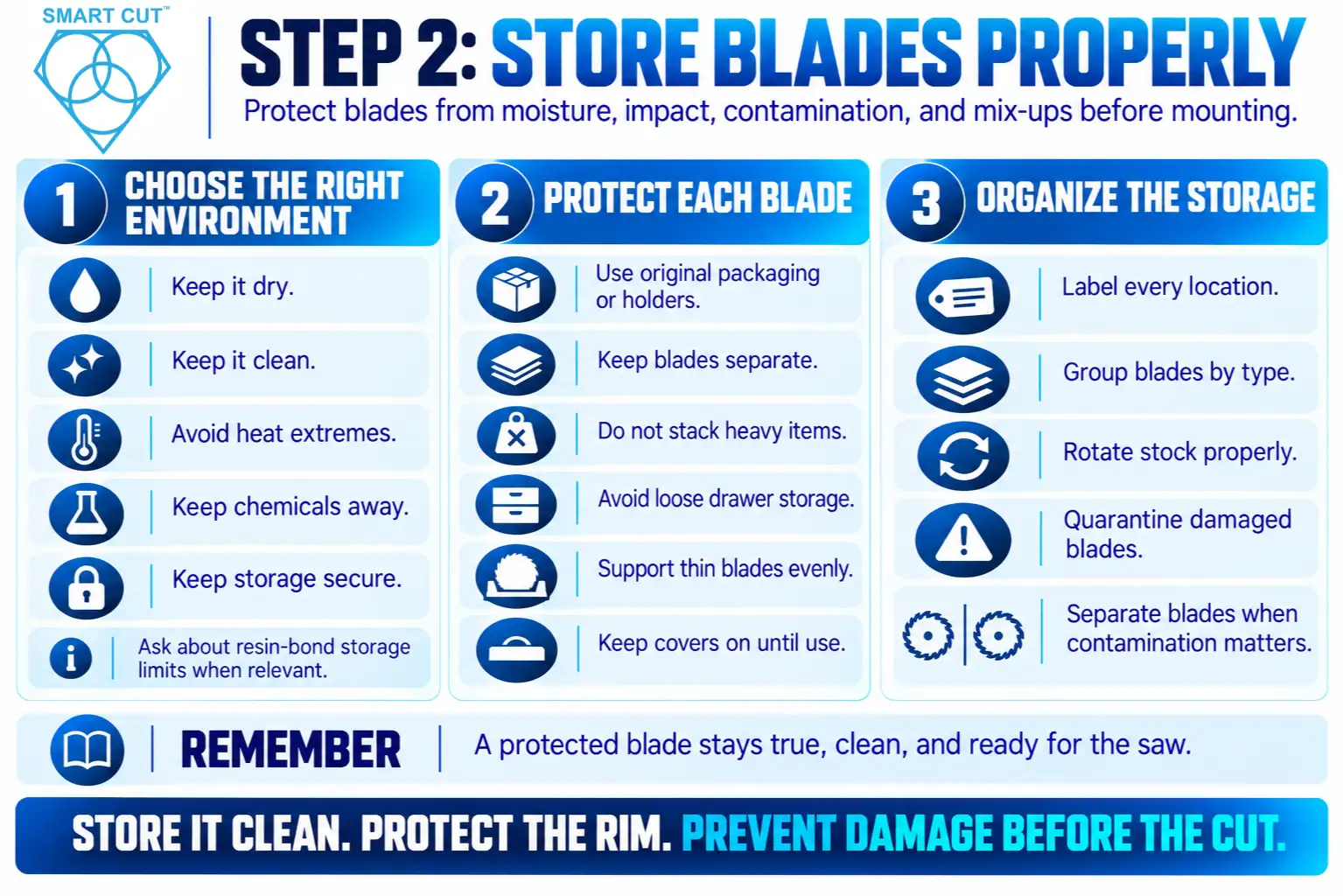
UKAM’s product guidance advises storing wafering blades in a clean, dry, and secure environment, which prevents damage and contamination. Build on that.
- Keep it dry. Moisture can corrode steel cores and flanges.
- Keep it clean. Dust, oil, and swarf cause contamination and poor seating.
- Avoid extremes. Large temperature swings and direct heat sources are poor places for blades.
- Keep chemicals away. Solvents, acids, and other chemicals do not belong near blades.
- Keep it secure. Limit access to people who know how to handle blades.
For resin bond blades in particular, ask your supplier about storage conditions and shelf life, since resin can react to heat, humidity, and solvents. Our page on resin bond tools describes the bond type.
Protect Each Blade Individually
- Use the original packaging or a dedicated holder. A sleeve, case, or slot that protects the rim and the faces is best.
- Never let blades touch each other. Rim-to-rim or face-to-rim contact causes chips and scratches.
- Never stack heavy items on blades. Weight bends thin cores.
- Avoid loose storage. Drawers, toolboxes, and open shelves invite impact and abrasion.
- Support the blade evenly. Store thin blades flat on a smooth, flat surface or on a proper peg or spindle that supports the bore, so the weight does not distort the core. Do not lean blades on an edge.
- Keep protective covers on until you mount the blade.
Organize the Storage
- Label every position. Show the item number, series, diameter, and thickness. Mix-ups cause the wrong blade to reach the saw.
- Group by type. Keep new blades separate from used ones, and keep different series apart.
- Rotate stock. Use older stock first, within your supplier’s guidance.
- Segregate damaged blades. Put suspect blades in a labeled quarantine place, so nobody mounts them by accident.
- Dedicate blades where contamination matters. If cross-contamination between materials would affect your results, keep separate blades for separate material families. UKAM lists a non-magnetic core and low contamination among the advantages of its wafering blades, and your storage should protect that.
Step 3: Handle Blades Carefully
Most damage happens in the hand. Build a few simple habits.
Do:
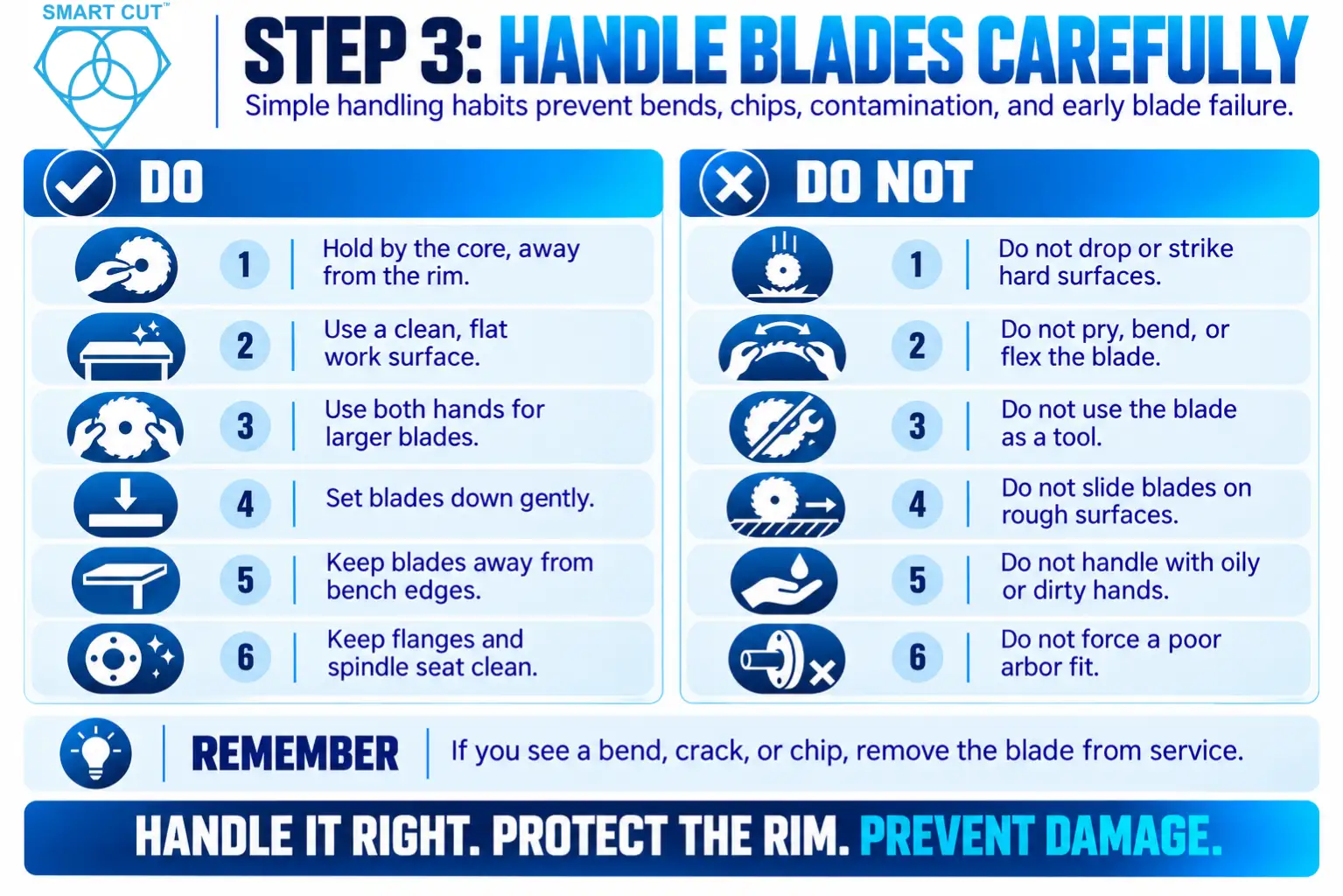
- Hold the blade by its flat core faces near the bore or by the edges of the core, away from the rim, and keep fingers off the abrasive edge.
- Keep your work surface clean, flat, and clear before you lift a blade.
- Use both hands for larger blades.
- Place the blade down gently on a clean, soft, flat surface.
- Keep blades away from the edges of benches.
- Keep flanges and the spindle seat clean when you mount, so you do not transfer dirt to the blade.
Do not:
- Drop blades or let them strike hard surfaces.
- Pry, bend, or flex the blade to “fix” it.
- Use a blade as a shim, a scraper, or a tool for anything other than cutting.
- Slide blades across rough surfaces.
- Handle blades with oily or dirty hands or gloves.
- Do not force a blade onto an arbor that does not fit.
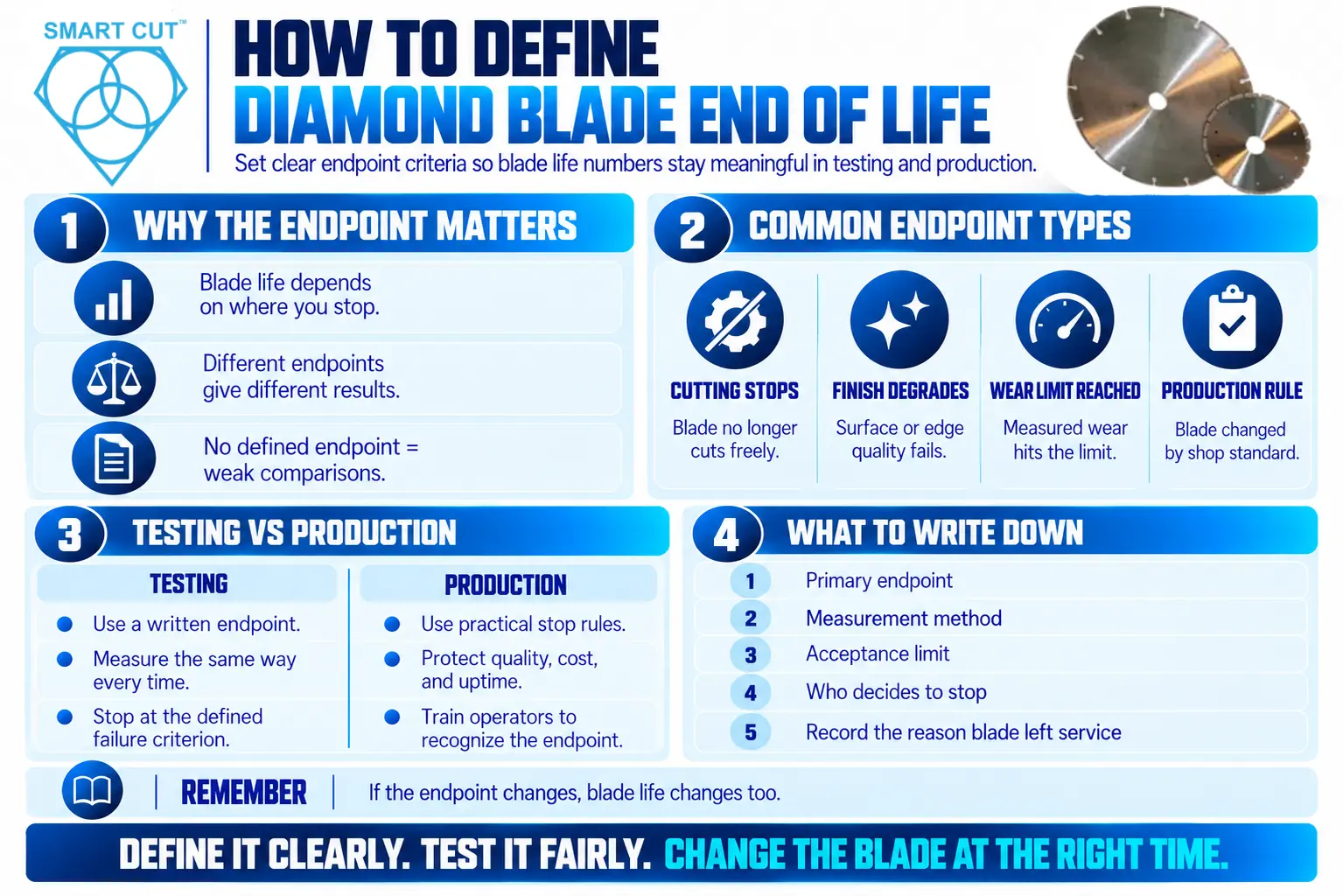
A damaged core or rim does not repair itself. If you see a bend, a crack, or a chip, take the blade out of service. See our article on defining diamond blade end of life for the criteria that decide when to retire a blade.
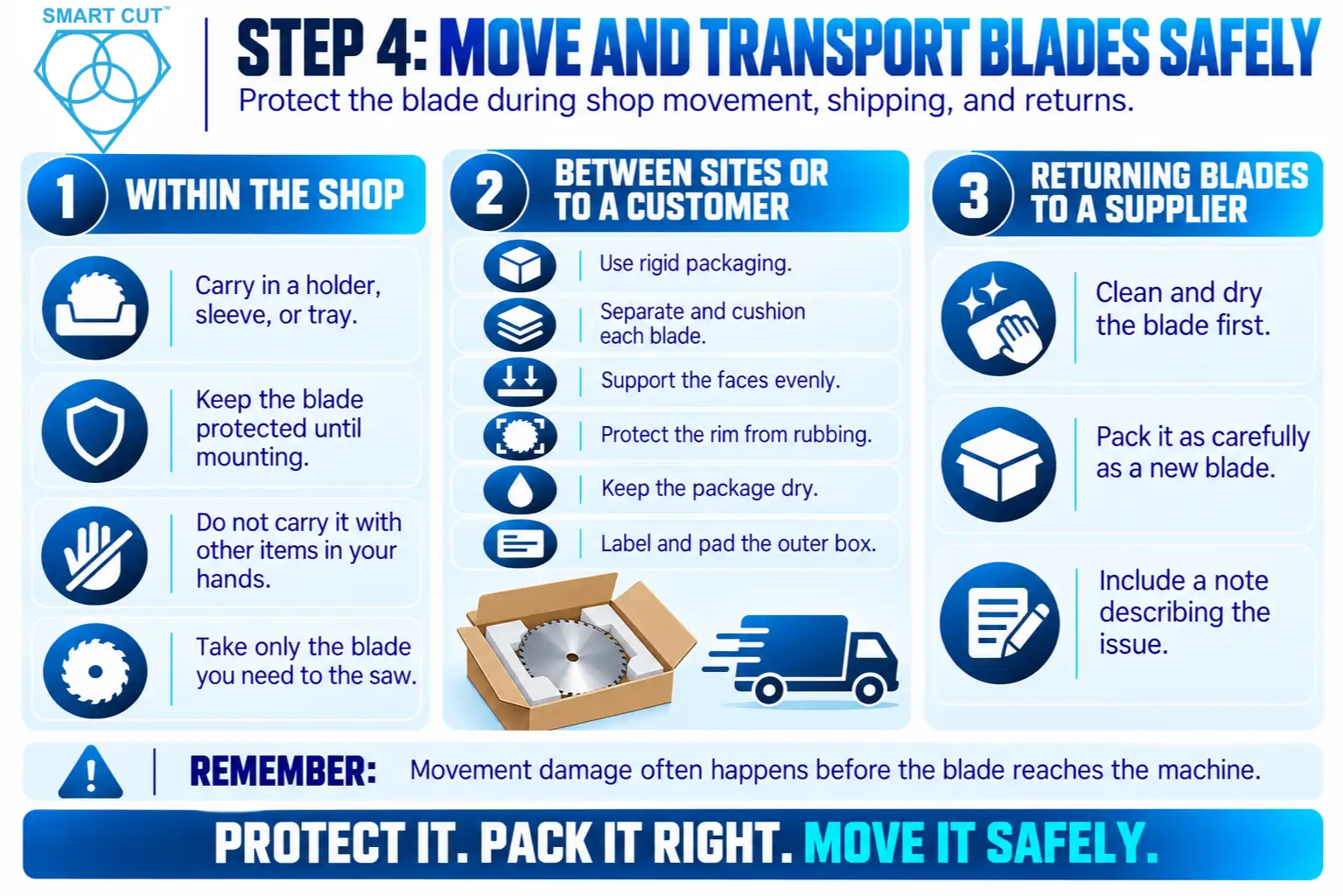
Step 4: Move and Transport Blades Safely
Blades travel in three ways: across the shop, between sites, and back to a supplier.
Within the Shop
- Carry blades in a holder, sleeve, or tray, not loose in a pocket or a bin.
- Keep the blade protected until it reaches the machine.
- Do not carry blades while your hands are full of other items.
- Take only the blade you need to the saw.
Between Sites or to a Customer
- Use rigid packaging. A crushable box does not protect a thin blade.
- Separate and cushion. Put protective separators between blades, and cushion them so they cannot shift.
- Support the faces. Pack so that no weight bears on the core.
- Protect the rim. Make sure the rim cannot rub against the packaging or another blade.
- Keep it dry. Seal packaging against moisture.
- Label clearly. Show the contents, the fragile nature, and the orientation if it matters.
- Pad the outer box so it survives rough handling.
Returning Blades to a Supplier
Package a returned blade as carefully as a new one. Clean and dry it first, and include a note describing the issue. That helps the supplier understand any problem. If you want to discuss blade performance, contact UKAM’s technical support through the request a consultation page.
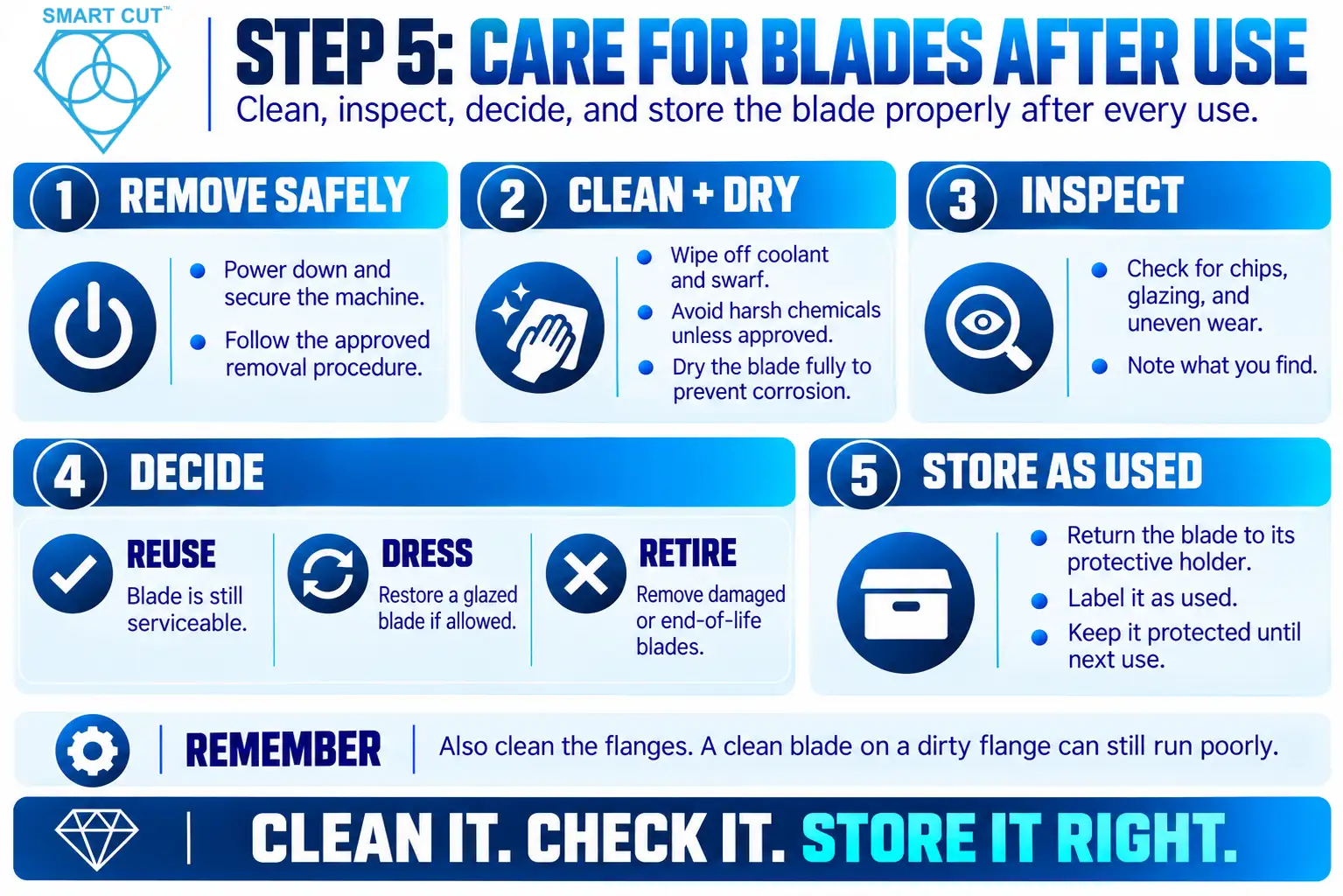
Step 5: Care for Blades After Use
Storage rules also apply to blades that you remove from the saw. Used blades carry coolant, swarf, and sample residue.
- Remove the blade following your machine’s safe procedure. Power down and secure the machine first.
- Clean off residue. Wipe away swarf and coolant, and avoid harsh chemicals unless your supplier approves them.
- Dry the blade. Moisture left on the core and flanges can cause corrosion.
- Inspect it. Check the rim for chips, glazing, and uneven wear, and note the findings. Our article on troubleshooting common diamond blade wear patterns helps you read what you see.
- Decide: reuse, dress, or retire. If the blade is glazed, dressing may restore it. See diamond and CBN blade dressing. If it is damaged or at its endpoint, retire it.
- Store it properly. Return it to its protective holder, and label it as used.
Also clean the flanges. Dirty flange faces cause runout, so a clean blade on a dirty flange still runs poorly.
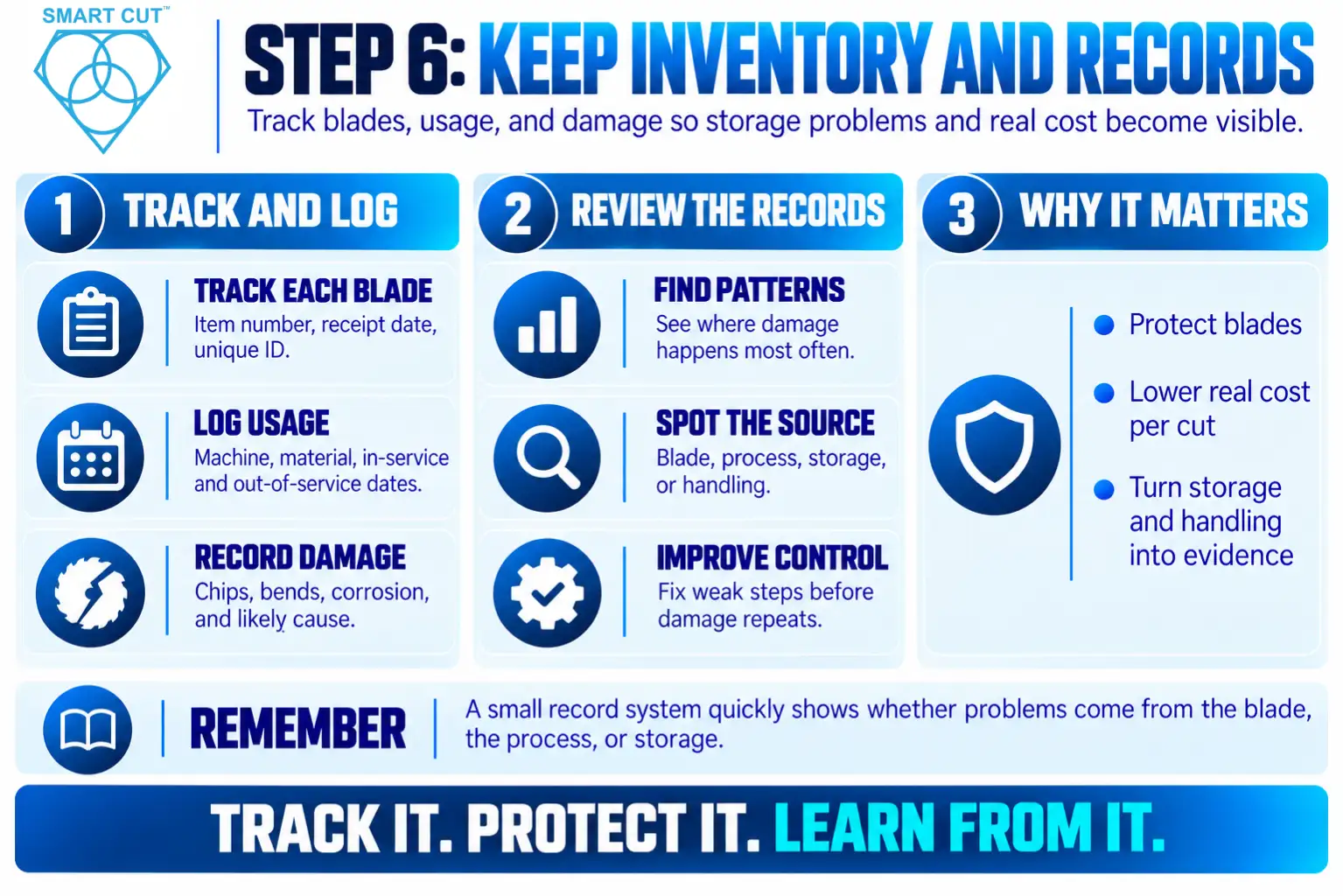
Step 6: Keep Inventory and Records
A simple inventory system helps you protect blades and track their cost.
- Track each blade. Record the item number, receipt date, and a unique identifier if you run many blades.
- Log usage. Note the machine, material, and when the blade went into service and out of it.
- Record damage. Note chips, bends, and corrosion, and what caused them if you know.
- Review the records. Patterns show where damage happens: a certain bench, a certain operator, a certain step.
- Link to cost. Damaged blades raise your real cost per cut. See diamond blade cost per cut for how to calculate it.
A small amount of tracking pays back quickly, because it shows whether blade problems come from the blade, the process, or the way blades were stored.
Step 7: Dispose of Blades Responsibly
Retired blades still need care. UKAM’s guidance says to dispose of used wafering blades according to local regulations and guidelines. Check your local rules before you throw blades away, and consider whether the blade carries any hazardous residue from the material it cut. Store retired blades in a marked place until disposal, so nobody remounts them.
Quick Reference: Damage, Likely Cause, and Prevention
| Damage you see | Likely storage or handling cause | Prevention |
|---|---|---|
| Bent or warped core | Weight on the blade, leaning on an edge, a drop | Store flat or supported at the bore; never stack items on blades |
| Chipped rim | Impact, rim-to-rim contact, rough carrying | Individual holders; gentle handling; protective covers |
| Scratched faces | Sliding across surfaces, contact with other blades | Separators; clean, smooth surfaces |
| Rust or corrosion | Moisture, wet storage | Dry before storing; keep the environment dry |
| Contamination on the blade | Dirty hands, oily surfaces, shared storage | Clean handling; dedicated storage where needed |
| Wrong blade mounted | Poor labeling, mixed storage | Labeled positions; grouped storage |
| Damage found only after mounting | Unrecorded damage during transit | Inspect on receipt and before mounting |
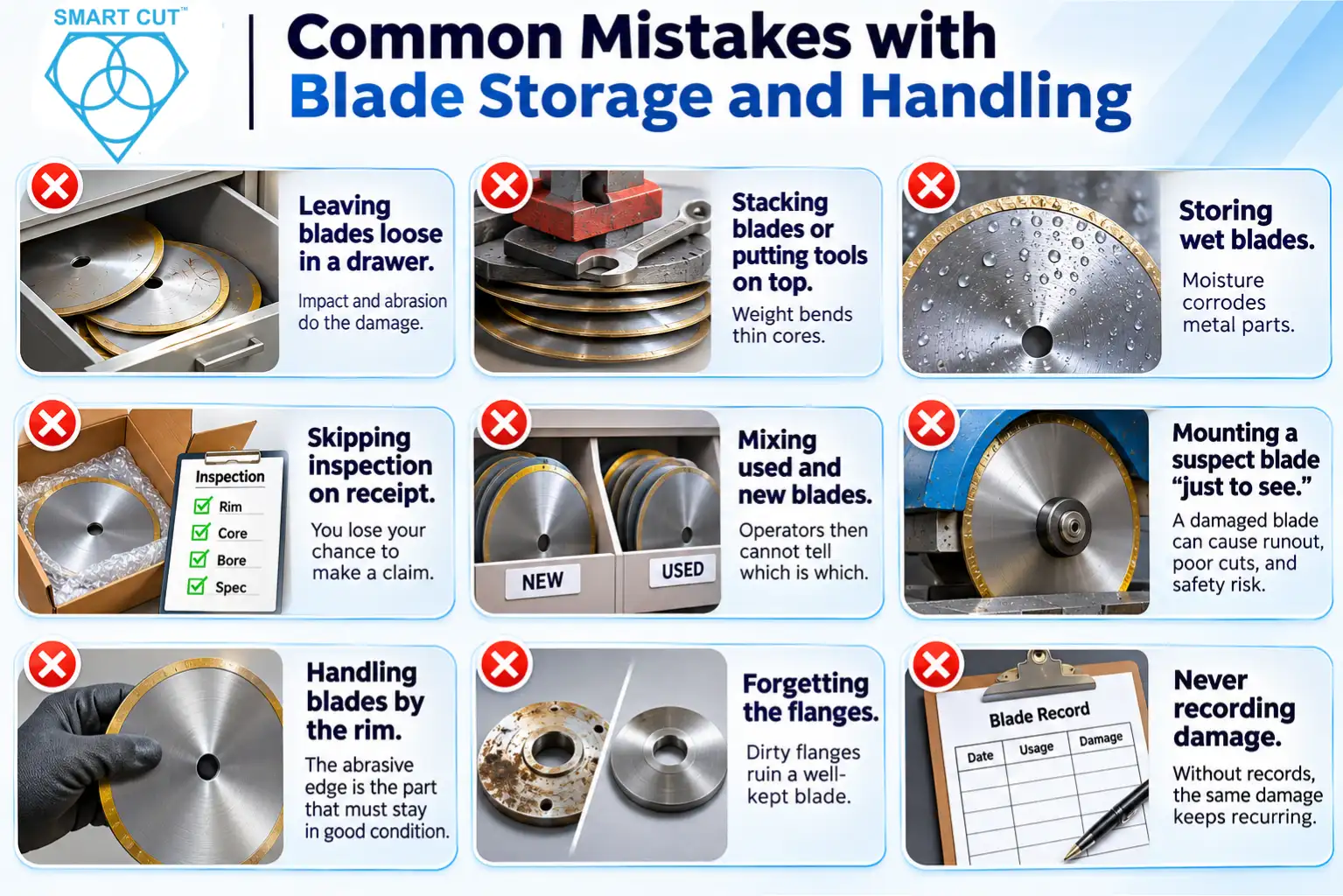
Common Mistakes with Blade Storage and Handling
Leaving blades loose in a drawer. Impact and abrasion do the damage.
Stacking blades or putting tools on top. Weight bends thin cores.
Storing wet blades. Moisture corrodes metal parts.
Skipping inspection on receipt. You lose your chance to make a claim.
Mixing used and new blades. Operators then cannot tell which is which.
Mounting a suspect blade “just to see.” A damaged blade can cause runout, poor cuts, and safety risk.
Handling blades by the rim. The abrasive edge is the part that must stay in good condition.
Forgetting the flanges. Dirty flanges ruin a well-kept blade.
Never recording damage. Without records, the same damage keeps recurring.
Applying This in Your Shop
Start with a walk-through of your storage areas. Look for loose blades, stacked tools, damp spots, and unlabeled positions. Fix the worst problems first. Then add a simple protective holder for each blade, a labeled place for each type, and a quarantine area for suspect blades.
Next, write the key rules into your procedures and train operators on them. Our precision diamond saw SOP template and the precision diamond saw pre-operation checklist show one way to build these habits into daily practice.
A blade that stays in good condition performs as designed. Start with the right blade, too. Explore our diamond wafering blades, and read the wafering blade usage recommendations for guidance on using them.
Related UKAM Products and Resources
These UKAM products and guides support good blade care.
- Wafering blade usage recommendations: recommended practice for using blades.
- Diamond lapidary blade guide: handling and use guidance for lapidary blades.
- SMART CUT® diamond wafering blades: sintered blades with a non-magnetic alloy core.
- Sintered (metal bond) diamond wafering blades: the sintered subcategory.
- Ultra thin precision diamond blades: thin blades that need the most careful handling.
- Diamond dicing blades: for dicing applications.
- Precision cutting saws: equipment that gets the best from a well-kept blade.
- Metallography consumables: sectioning and preparation supplies.
Key Takeaways
- Many blades are damaged between delivery and mounting, and the damage shows up later as runout, wander, chipping, or short life.
- Inspect every blade on receipt, and record any damage.
- Store blades clean and dry, individually protected, and supported flat or at the bore.
- Never stack items on blades, never let blades touch, and never store them loose.
- Handle blades by the core, away from the rim, and never drop or flex them.
- Pack blades in rigid, separated, cushioned packaging for transport.
- Clean and dry blades after use, inspect them, and store them in a labeled place.
- Keep records, quarantine suspect blades, and dispose of retired blades following local regulations.
Frequently Asked Questions
Store them clean, dry, and individually protected, supported flat or at the bore.
No, because contact and weight can chip the rim and bend thin cores.
Keep them in a clean, dry, secure place, as UKAM’s guidance recommends.
Their thin cores bend easily, and even a small bend becomes runout.
No, clean and dry them first to protect the metal parts from corrosion.
Hold it by the core faces or the core edges, away from the abrasive rim.
Check the rim, core, bore, and specification, and record any damage.
Use rigid packaging with separators and cushioning, protect the rim, and keep it dry.
No, remove a bent, cracked, or chipped blade from service.
Ask your supplier about storage conditions and shelf life, since resin can react to heat and humidity.
Labels prevent the wrong blade from reaching the saw.
Yes, because damaged blades raise your real cost per cut.
Follow local regulations and guidelines for handling and disposal.
Yes, because they cause runout when you mount the blade.
Conclusion
Diamond blade storage and handling look like housekeeping, but they protect the performance you paid for. A thin core bends under weight. A rim chips on a bench edge. A wet blade corrodes. Each problem is small, and each one shows up later as runout, wander, chipping, or short blade life.
The fix is simple and cheap. Inspect blades on receipt, store them clean, dry, and individually protected, handle them by the core, and pack them well for transport. Clean and dry them after use, keep records, and retire damaged blades. Do this consistently, and your blades reach the saw in the condition the supplier intended.
If you want help choosing a blade or setting up a care routine for your materials and process, request a consultation with the UKAM team, or browse our diamond wafering blades and ultra thin precision diamond blades.
Trusted by Tens of Thousands of Manufacturers, Laboratories,
Research Institutions Worldwide Since 1990
Established in 1990
RELATED ARTICLES

Brian is an experienced professional in the field of precision cutting tools, with over 27 years of experience in technical support. Over the years, he has helped engineers, manufacturers, researchers, and contractors find the right solutions for working with advanced and hard-to-cut materials. He’s passionate about bridging technical knowledge with real-world applications to improve efficiency and accuracy.
As an author, Brian Farberov writes extensively on diamond tool design, application engineering, return on investment strategies, and process optimization, combining technical depth with a strong understanding of customer needs and market dynamics.
About Brian Farberov
Brian is an experienced professional in the field of precision cutting tools, with over 27 years of experience in technical support. Over the years, he has helped engineers, manufacturers, researchers, and contractors find the right solutions for working with advanced and hard-to-cut materials. He’s passionate about bridging technical knowledge with real-world applications to improve efficiency and accuracy. As an author, Brian Farberov writes extensively on diamond tool design, application engineering, return on investment strategies, and process optimization, combining technical depth with a strong understanding of customer needs and market dynamics.
View all posts by Brian Farberov