Cutting Sapphire, Quartz, and Optical Crystals with Diamond Blades
Table of Contents
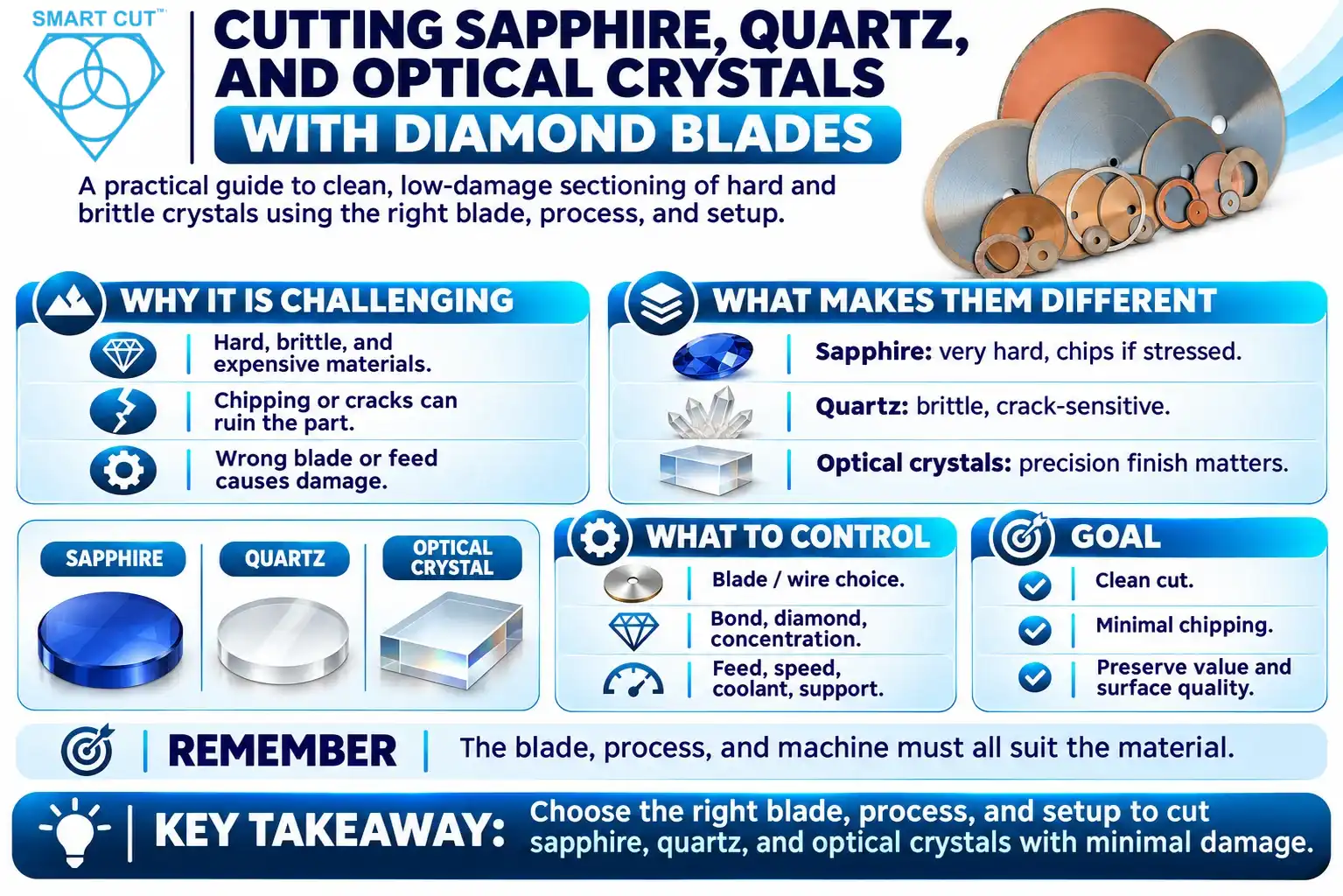
ToggleSapphire, quartz, and optical crystals are valuable, hard, and unforgiving. A chipped edge on a sapphire window or a cracked quartz plate can turn a high-value part into scrap. The material is often expensive, and so is the polishing needed to repair a damaged edge.
Cutting sapphire with diamond blades works well when the blade, the process, and the machine all suit the material. It fails when one of them does not. A blade that cuts soft glass cleanly can chip sapphire. A feed that works on a thick block can break a thin wafer.
This article explains how to approach cutting sapphire, quartz, and optical crystals with diamond blades. It covers what makes these materials hard to cut, how to choose between blades and wire, how bond, diamond, and concentration choices affect the result, and how to control the process. It uses UKAM’s published guidance and product information throughout.
UKAM already publishes a detailed guide on cutting glass with diamond saw blades, and a guide on diamond wire cutting for silicon, sapphire, and ceramics. This article focuses on crystals and the choice among those technologies. For general glass chipping, start with the glass guide.
Trusted by Tens of Thousands of Manufacturers, Laboratories Research Institutions Worldwide Since 1990
Established in 1990
Crystals, Glasses, and Why the Difference Matters
The names in this topic hide an important distinction.
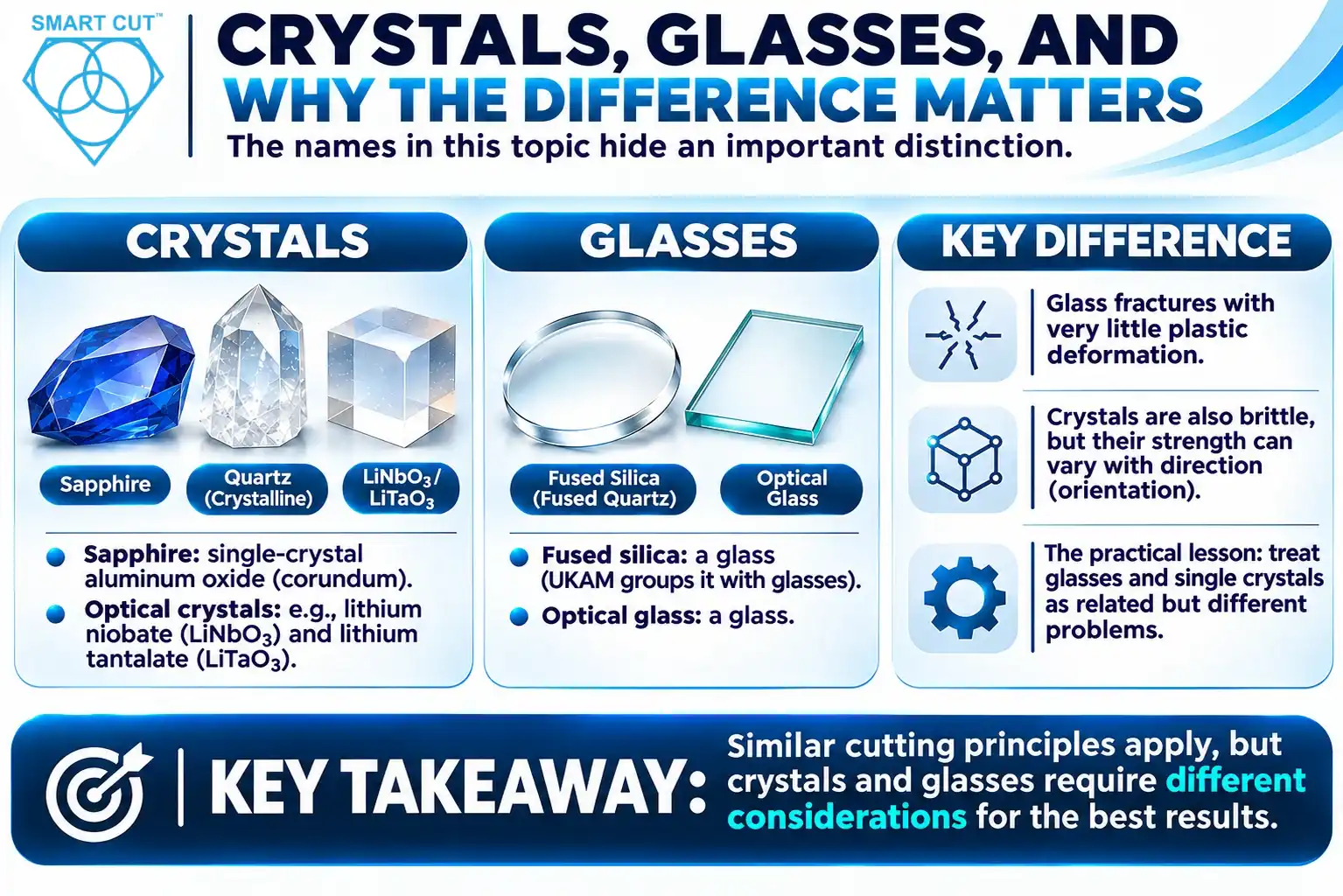
- Sapphire is single-crystal aluminum oxide, also called corundum. It is a crystal.
- Quartz can mean crystalline quartz, a crystal, or fused quartz, which is a glass.
- Fused silica is a glass, not a crystal. UKAM’s materials guidance groups fused silica and fused quartz with the glasses.
- Optical glass is a glass.
- Optical crystals, such as lithium niobate (LiNbO₃) and lithium tantalate (LiTaO₃), are crystals. UKAM lists them among the optical and photonic materials its dicing blades cut.
Glass fractures without much warning, and stresses concentrate at tiny flaws. UKAM’s glass guidance describes this behavior: glass shows very little plastic deformation before it fractures. Crystals share the brittleness, but they add one more factor. Single crystals have an internal structure, and their strength can vary with direction. As general materials science, a crystal can break more easily along certain planes. Whether that matters for your part depends on the crystal, the orientation, and the quality requirement. If your part has a specified orientation, tell your supplier and plan the cut with it in mind.
The practical lesson: treat amorphous glasses and single crystals as related but different problems. The blade principles overlap, and the details differ.
Why Cutting Sapphire with Diamond Blades Is Hard
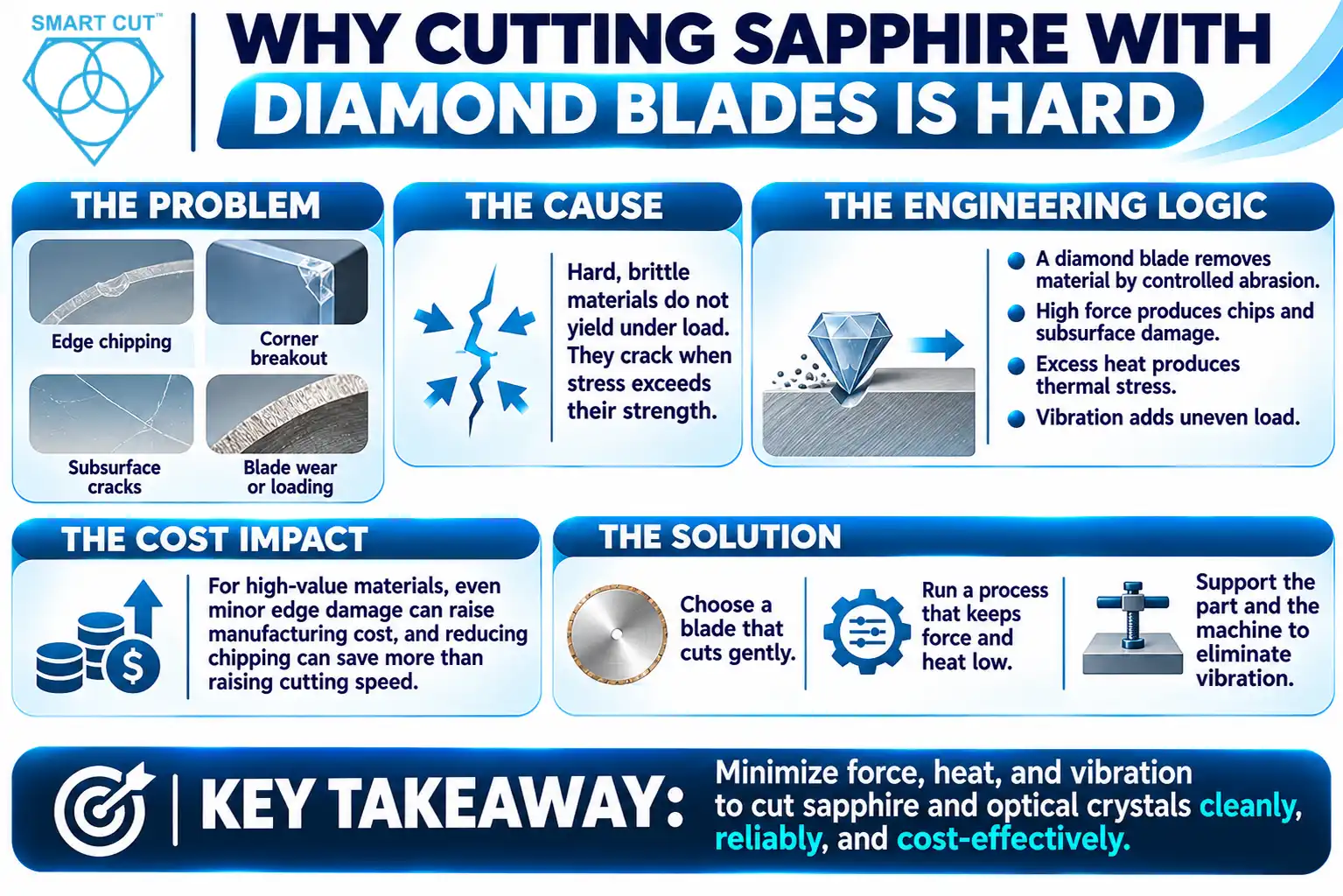
Problem: Edges chip, corners break out, subsurface cracks hide below the cut, and blades wear fast or load up.
Cause: Hard, brittle materials do not yield under load. They crack when stress exceeds their strength.
Engineering logic: A diamond blade removes material by controlled abrasion. Each diamond particle scratches a small groove. Cutting forces and heat are the enemy. High force produces chips and subsurface damage. Excess heat produces thermal stress. Vibration adds uneven load. Because these materials are expensive, every defect costs more than the same defect in a cheaper material.
UKAM’s glass guidance makes the cost point directly: for high-value materials, even minor edge damage can raise manufacturing cost, and reducing chipping can save more than raising cutting speed. The same reasoning applies even more strongly to sapphire and optical crystals.
Solution: Choose a blade that cuts gently, run a process that keeps force and heat low, and support the part and the machine so that nothing vibrates.
Step 1: Choose the Cutting Technology
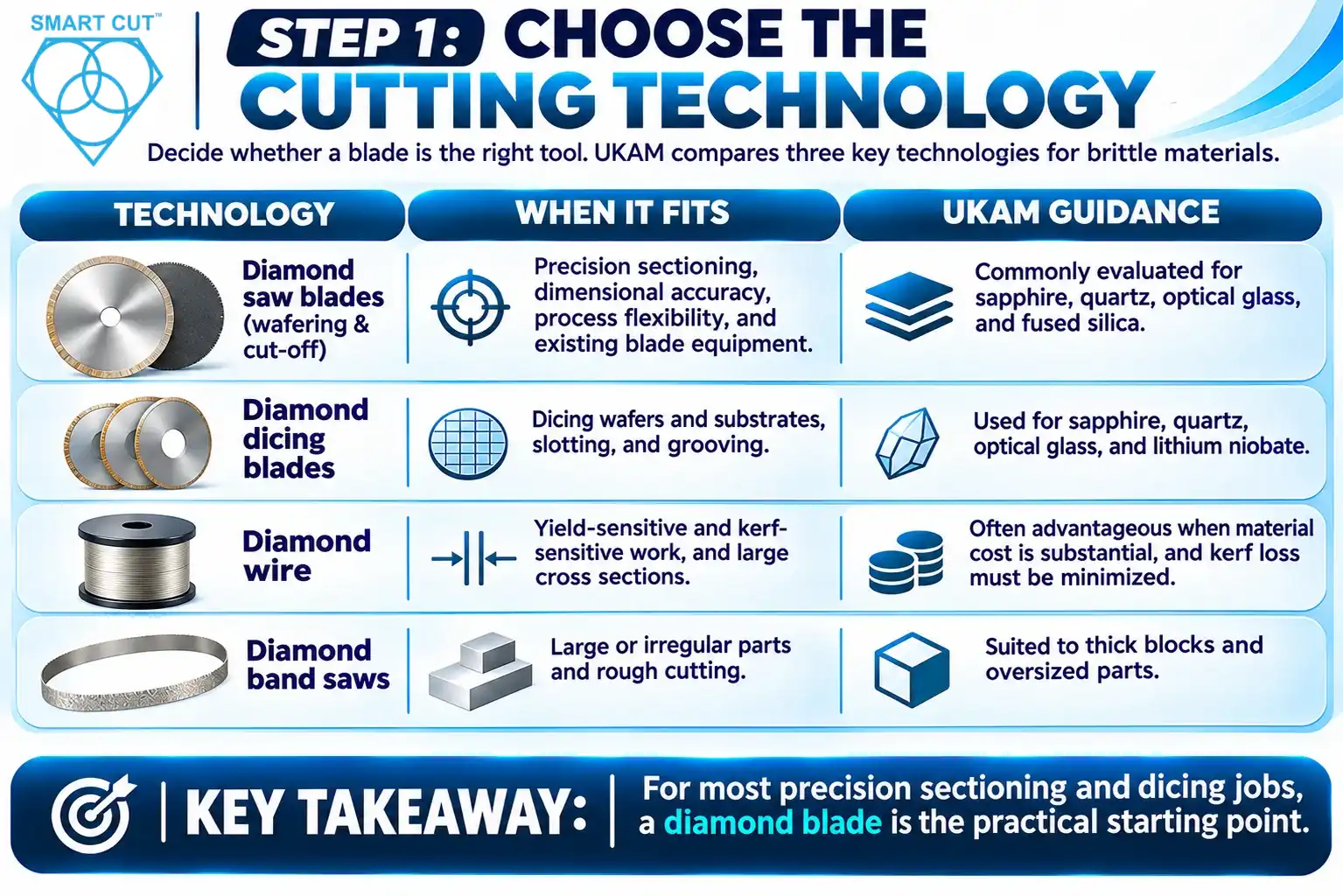
Before you pick a blade, decide whether a blade is the right tool. UKAM’s guidance compares three technologies for brittle materials.
| Technology | When it fits | UKAM guidance |
|---|---|---|
| Diamond saw blades (wafering and cut-off) | Precision sectioning, dimensional accuracy, process flexibility, and existing blade equipment | Commonly evaluated for sapphire, quartz, optical glass, and fused silica |
| Diamond dicing blades | Dicing wafers and substrates, slotting, and grooving | Used for sapphire, quartz, optical glass, and lithium niobate |
| Diamond wire | Yield-sensitive and kerf-sensitive work, and large cross sections | Often advantageous when material cost is substantial, and kerf loss must be minimized |
| Diamond band saws | Large or irregular parts and rough cutting | Suited to thick blocks and oversized parts |
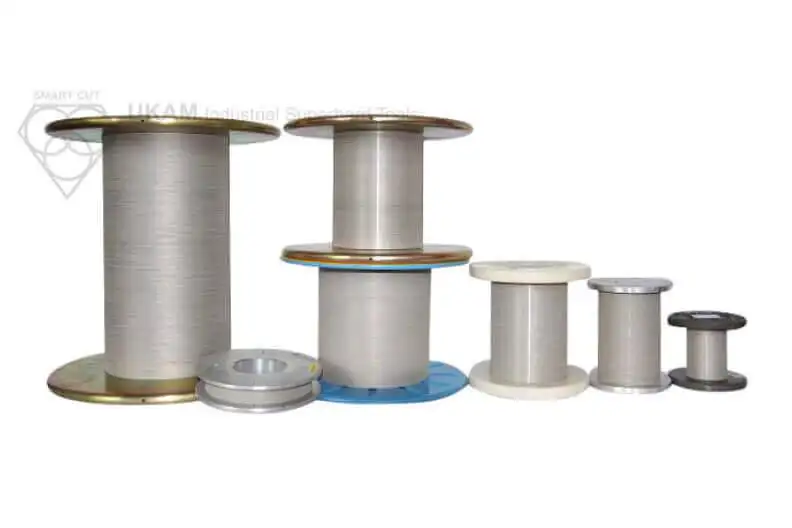
UKAM’s materials table lists diamond saw blades and diamond wire as the technologies commonly evaluated for sapphire. A blade suits sectioning and dimensional work. Wire suits cases where kerf loss and material utilization dominate, such as slicing high-value material. Read UKAM’s diamond wire cutting guide if kerf loss is your top priority, and use the diamond wire product page for specifications.
For most precision sectioning and dicing jobs, a diamond blade remains the practical starting point.
Step 2: Choose the Blade
Bond Type and Hardness
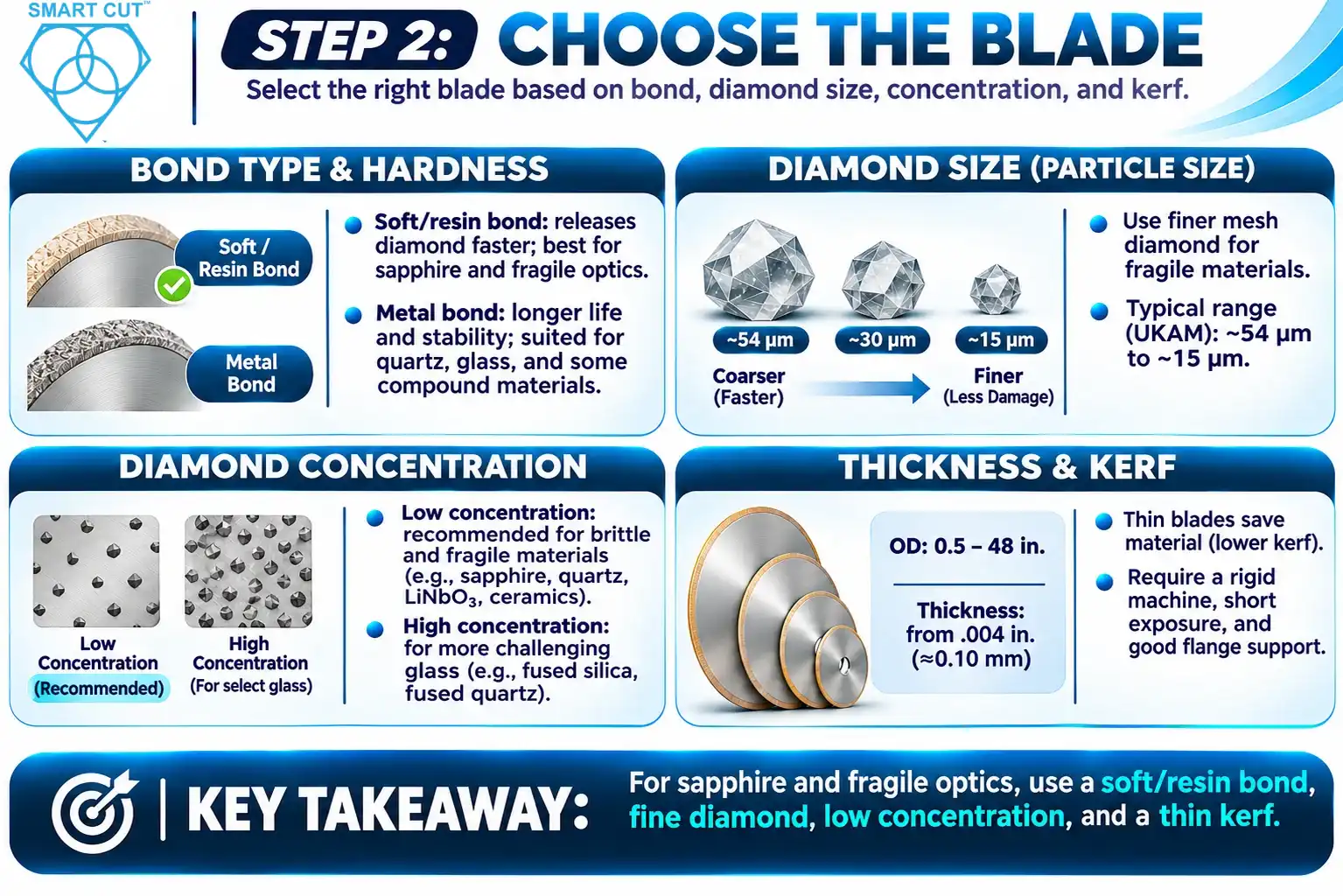
UKAM’s blade selection guidance gives a clear starting point for the hardest crystals: if you cut hard alumina or sapphire, it generally recommends a soft-bond, thin-kerf diamond blade.
A soft bond releases diamond faster. Hard materials dull diamond quickly, so a bond that wears away keeps fresh diamond exposed. A hard bond would hold dull diamond too long, and the blade would glaze. Our guide on how to read a diamond blade specification sheet explains bond hardness in more detail.
For dicing, UKAM’s buyer’s guide describes resin bond dicing blades as self-dressing and free-cutting, with excellent surface finish and low chipping rates. It lists them as the preferred choice for hard and brittle materials such as silicon, sapphire, and ceramics, and best for silicon wafers, sapphire, hard ceramics, and optical substrates. It lists metal bond dicing blades as best for compound semiconductors, quartz, glass, magnetic materials, and PCB substrates.
Read together, the rule of thumb is to lean toward soft or resin bonds for sapphire and fragile optical substrates, and toward metal bonds where blade life and stability matter more, as with some quartz and glass work. Always confirm for your own material.
Diamond Size
UKAM advises that fragile, delicate materials call for finer mesh diamond. Finer diamond cuts more gently and leaves less damage, at the cost of speed. For its photonics glass dicing blades, UKAM’s table lists diamond particle sizes ranging from about 54 microns down to 15 microns, with soft to medium-hard bonds. Start fine for demanding edges, and move coarser only if the edge quality allows.
Diamond Concentration
UKAM’s guidance for crystals leans toward low concentration. Its sintered dicing blade page recommends low concentration for brittle and fragile materials such as optical glass, ceramics, lithium niobate, sapphire, quartz, and silicon carbide. Its wafering blade page lists a low-concentration series (15LCU) as an example for sapphire (Al₂O₃), and its series table assigns the low-concentration “L” series to hard and brittle materials.
A caution: UKAM’s glass cut-off blade page recommends high concentration for some more challenging glass materials, such as fused silica, fused quartz, optical glass, and glass tubing. These are different product families, one for cut-off blades and one for wafering and dicing blades, so the guidance differs. Use each series’ own recommendation, and ask UKAM’s technical team when your material or tool falls between them.
Thickness and Kerf
Thin blades save valuable material. UKAM’s photonics page lists precision blades from 0.5 to 48 inches in outside diameter, starting at .004 inch thick. UKAM’s glass cut-off blade lists a standard thickness of .060 inch (1.52 mm) for precision cuts with minimal material loss on flat glass.
Thin blades flex more, so they need a rigid machine, short exposure, and good flange support. Our article on diamond blade diameter and thickness trade-offs explains the balance, and UKAM’s diamond and CBN wafering blade guide lists typical ranges, and the guide on how thin kerf blades improve material yield covers the yield side.

Blade Families to Consider
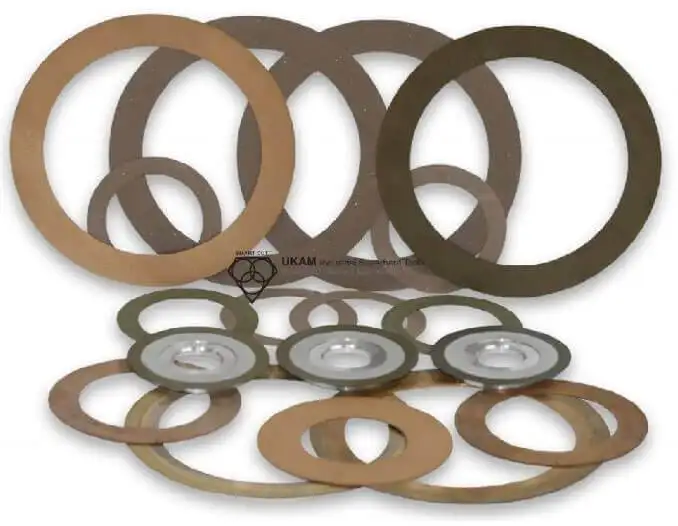
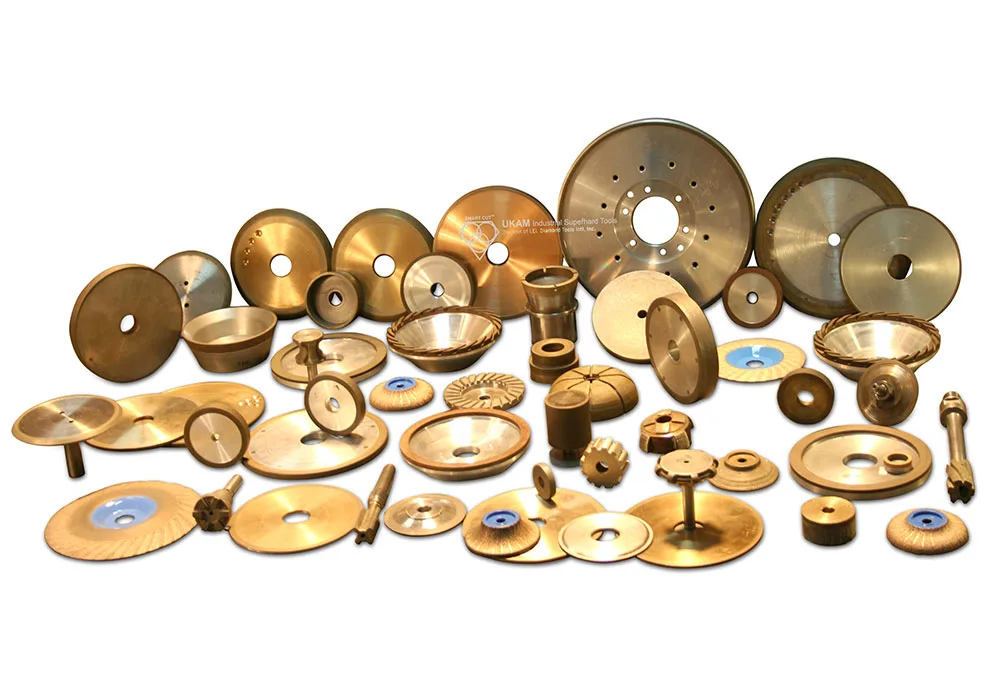
- SMART CUT® wafering blades (sintered, metal bond): UKAM states these are suitable for extremely hard materials like sapphire and ceramics. See the SMART CUT® wafering blades.
- SMART CUT® glass cut-off blades: the 455M is a medium-bond blade made for glass cutting where minimizing chipping and giving an excellent surface finish matter, including optical glass, quartz glass, and fused silica. See the SMART CUT® glass blade.
- Resin bond cut-off blades: available from 4 to 14 inches for glass and quartz tubing and delicate parts, with fine diamond versions for quartz and Pyrex. UKAM notes some may run dry on certain applications but does not recommend it. See the diamond blades for glass and quartz.
- Sintered dicing blades: for sapphire, quartz, optical glass, and lithium niobate. See the sintered (metal bond) dicing blades.
- Resin bond and hybrid bond blades: for precision and productivity on advanced ceramics, glass, sapphire, quartz, and optical components. See the resin bond and hybrid bond
Step 3: Control the Process
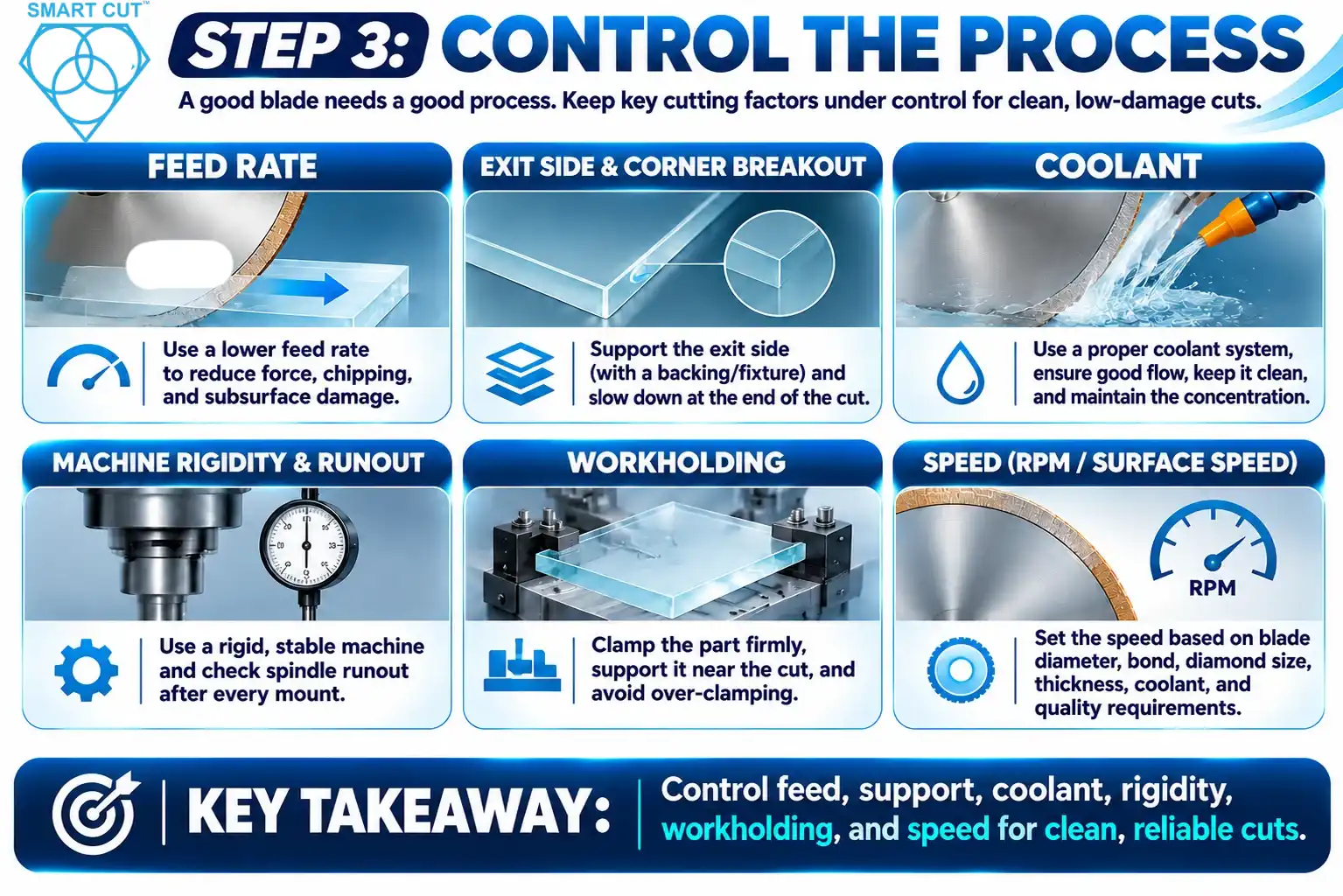
A good blade needs a good process. UKAM’s glass guidance identifies the same process factors for every brittle material.
Feed Rate
Excess feed raises cutting force, and force produces chipping and subsurface damage. UKAM describes excessive feed as one of the most common causes of edge chipping, corner breakout, and poor surface quality. Reduce feed and let the blade cut. If you must push, the blade, coolant, or machine needs attention instead.
Exit Side and Corner Breakout
Breakout happens where the blade leaves the material. UKAM’s troubleshooting guidance recommends better support near the cut exit and a lower feed rate as the blade exits. Support the exit side with a sacrificial backing or fixture, and slow down at the end of the cut.
Coolant
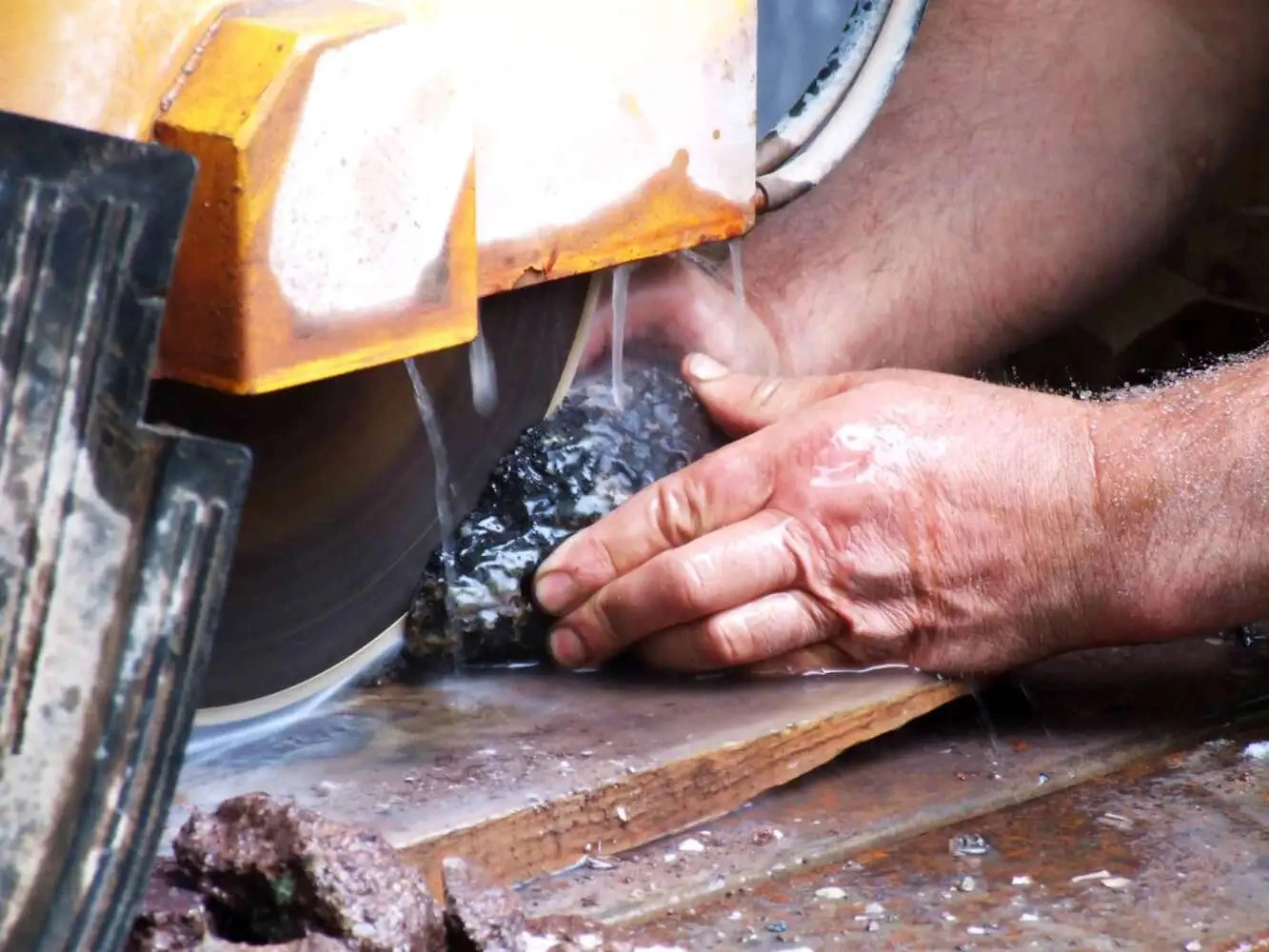
Heat causes thermal stress and loading. UKAM recommends a coolant system for most precision glass cutting, and the same logic applies to crystals. Make sure coolant reaches the cut, keep it clean, and check the concentration. See our guides on coolant flow and on coolant condition management. Avoid dry cutting on these materials unless the blade manufacturer says otherwise.
Machine Rigidity and Runout
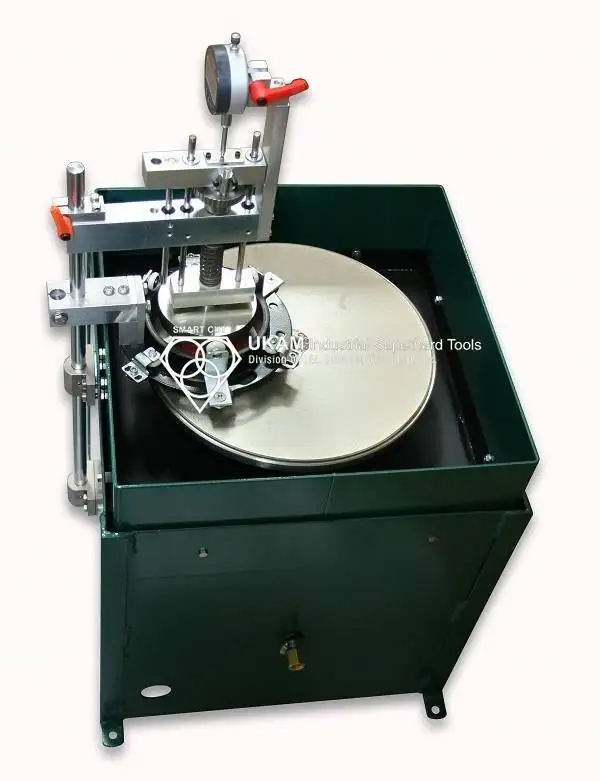
UKAM notes that even a premium blade cannot cut cleanly on an unstable machine. Spindle runout, worn bearings, loose mounting, and poor fixturing all cause chipping. Check runout after every mount. See our runout article, and use a rigid precision cutting saw.
Workholding
If the part shifts or vibrates, the blade chips it. Clamp the part firmly but without stress, support it near the cut, and avoid over-clamping, which can distort or crack brittle parts. See workholding for precision diamond sectioning and dicing.
Speed
Surface speed depends on diameter as well as RPM. There is no single speed for all materials. UKAM’s guidance says to set it based on blade diameter, bond, diamond size, thickness, coolant, and quality requirements. See the RPM and feed rate guide.
Troubleshooting Cuts in Sapphire, Quartz, and Optical Crystals
The table below adapts UKAM’s glass troubleshooting guidance. Treat it as a starting point, and confirm each cause.
| Problem | Most likely causes | First actions |
|---|---|---|
| Edge chipping | Feed too high, wrong blade, vibration, worn blade, weak coolant | Lower feed, check blade specification, check runout and fixturing, improve coolant |
| Corner breakout | Weak support at the exit, feed too high near the end | Support the exit side, slow down at the end of the cut |
| Subsurface damage | Diamond too coarse, force too high | Try finer diamond, lower feed |
| Poor surface finish | Coarse diamond, vibration, blade wear | Finer diamond, check machine, check blade condition |
| Thermal cracking | Heat, poor coolant coverage | Improve coolant delivery and nozzle aim |
| Rapid blade wear | Feed too high, wrong RPM, poor coolant, wrong specification | Optimize feed and speed, improve coolant, review the blade |
| Blade loading or glazing | Weak coolant, bond too hard, poor debris removal | Improve coolant, dress the blade, consider a softer bond |
| Wandering or deflection | Blade too thin, feed too high, vibration, poor fixturing | Check workholding and rigidity, lower feed, review thickness |
| Dimensional error | Runout, vibration, deflection | Check spindle, mounting, and fixturing |
For wandering cuts, see our article on diamond blade cut wander. For glazing, see diamond and CBN blade dressing.
How to Qualify the Process
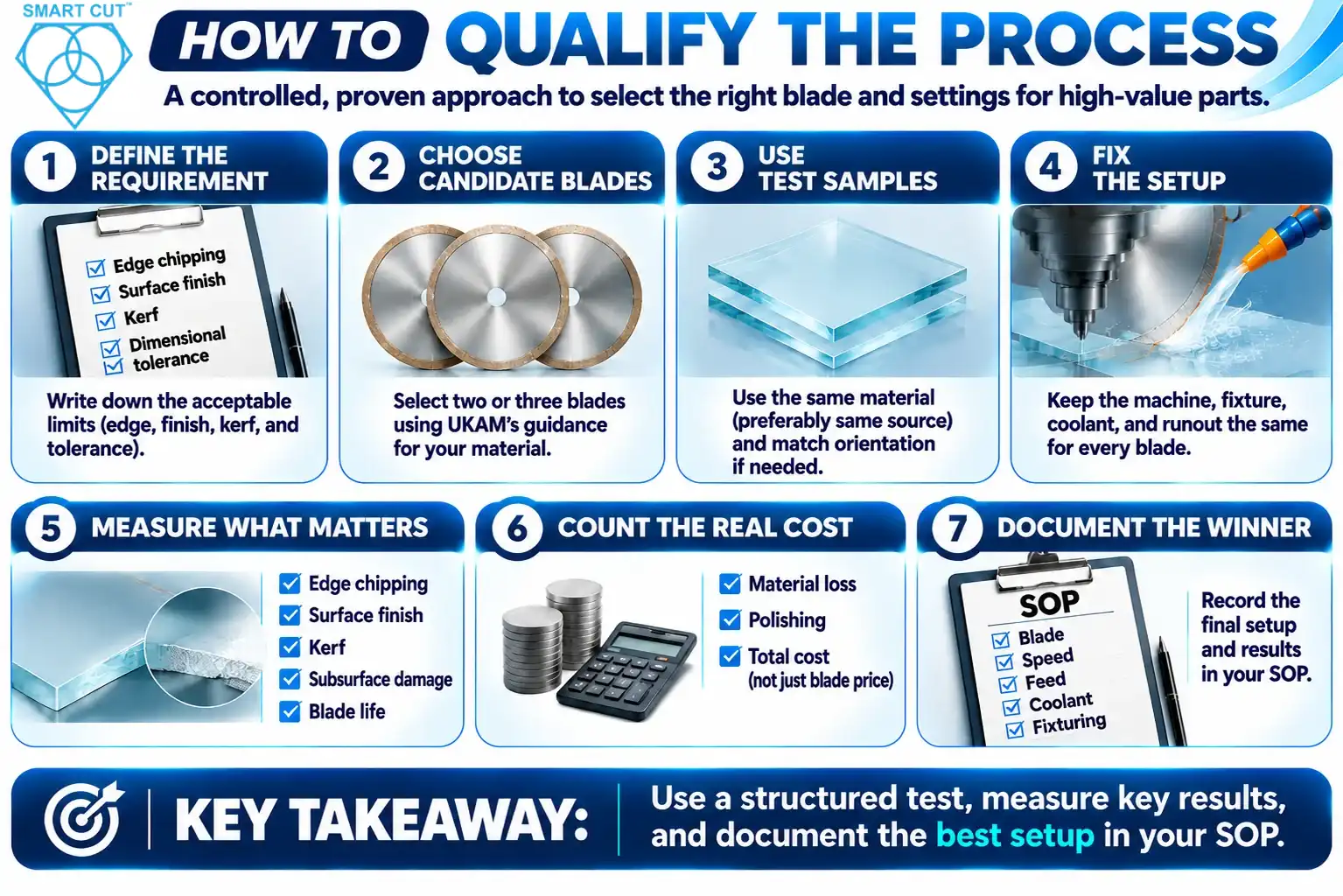
High-value parts deserve a controlled start. Do not run production parts to find the right settings.
- Define the requirement. Write down the acceptable edge chipping, surface finish, kerf, and dimensional tolerance.
- Choose two or three candidate blades. Use the guidance above and UKAM’s recommendations for your material.
- Use test samples. Use the same material, preferably from the same source, and match the orientation if it matters.
- Fix the setup. Keep the machine, fixture, coolant, and runout the same for every blade.
- Measure what matters. Inspect edge chipping, surface finish, kerf, and subsurface damage, and record the blade life and the polishing you must remove afterward.
- Count the real cost. Include material loss and polishing, not just blade price. See diamond blade cost per cut.
- Document the winner. Record the blade, speed, feed, coolant, and fixturing in your SOP.
See how to compare two diamond blades fairly and how to design a repeatable diamond blade test for the methods. UKAM also offers process development support and a guaranteed trial order for customers who want to evaluate a blade on their own material.
Common Mistakes with Sapphire, Quartz, and Optical Crystals
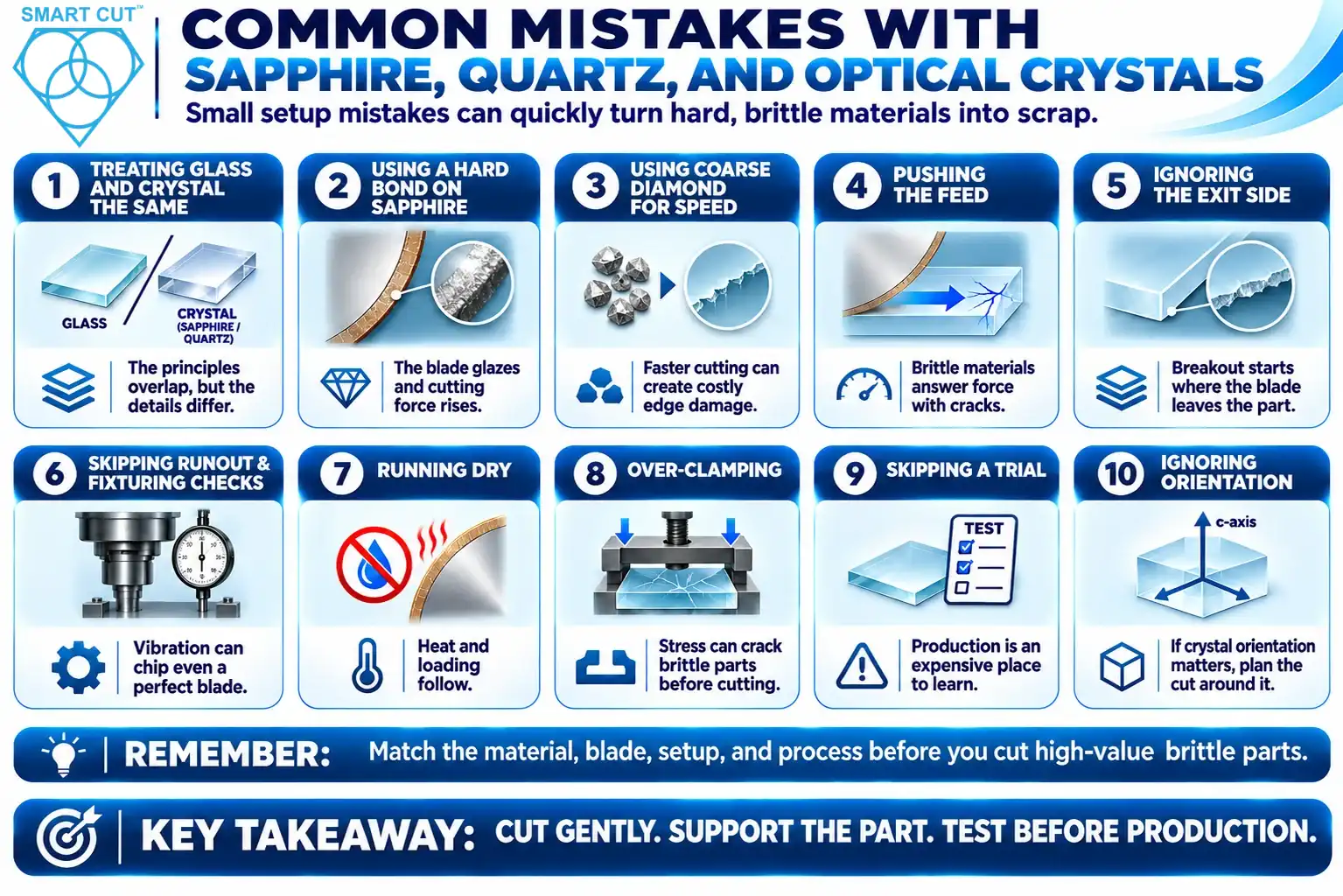
Treating glass and crystal as the same material. The principles overlap, but the details do not.
Using a hard bond on sapphire. The blade glazes, and the cutting force rises.
Using coarse diamond for speed. The edge damage costs more downstream.
Pushing the feed. Brittle materials answer force with cracks.
Ignoring the exit side. Breakout starts where the blade leaves the part.
Skipping runout and fixturing checks. Vibration chips even a perfect blade.
Running dry. Heat and loading follow.
Over-clamping. Stress cracks brittle parts before the cut starts.
Skipping a trial. Production is an expensive place to learn.
Ignoring orientation. If the crystal orientation matters, plan the cut around it.
Applying This in Your Shop
Start with the material and the quality requirement. Pick the technology: blade, dicing blade, or wire. Choose a soft-bond or resin-bond, thin-kerf blade with fine diamond as a starting point for sapphire, and follow the series guidance for quartz and optical materials. Set up a rigid machine, check runout, support the exit, and bring coolant to the cut. Then run a controlled trial, record the results, and write the winning settings into your procedure.
If you cut these materials regularly, build a small library of approved blades by material and thickness. Store and handle the blades with care, because a chipped blade chips crystals.
Related UKAM Products and Resources
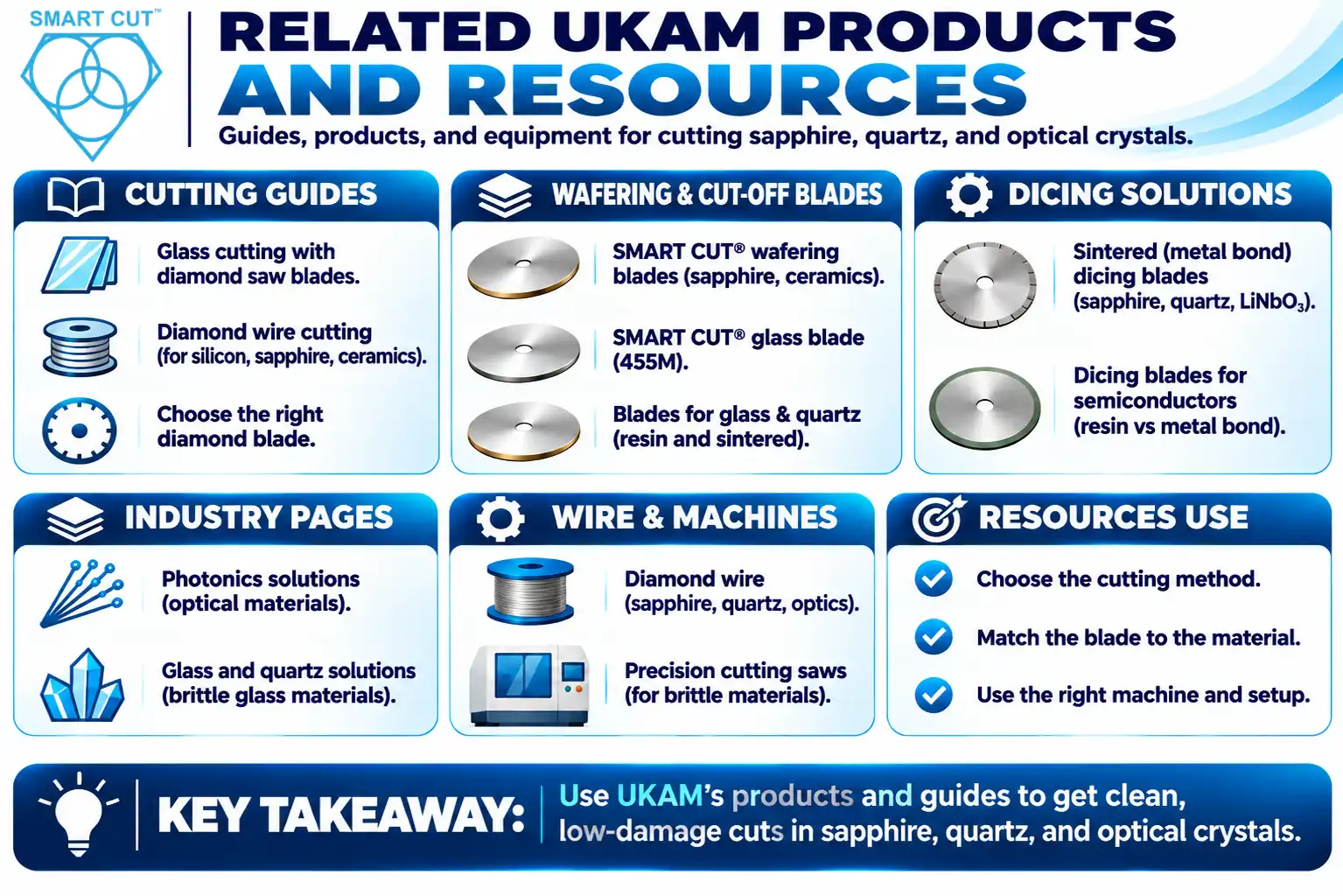
These UKAM products and guides support cutting sapphire, quartz, and optical crystals.
- Cutting glass with diamond saw blades: chipping, cracking, and material loss in glass.
- Diamond wire cutting for silicon, sapphire, and ceramics: when wire is the better technology.
- Select the right diamond blade for your application: bond and application guidance, including sapphire and quartz.
- SMART CUT® diamond wafering blades: sintered blades suitable for sapphire and ceramics.
- SMART CUT® glass blade: the 455M glass cut-off blade.
- Diamond blades for glass and quartz: resin and sintered cut-off blades.
- Sintered (metal bond) dicing blades: dicing blades for sapphire, quartz, and lithium niobate.
- Diamond dicing blades for the semiconductor industry: resin versus metal bond dicing.
- Photonics solutions and glass and quartz solutions: industry pages for optical materials.
- Diamond wire: wire for sapphire, quartz, and optical crystals.
- Precision cutting saws: rigid machines for brittle materials.
Key Takeaways
- Sapphire and optical crystals such as lithium niobate are single crystals. Fused silica and optical glass are glasses. The blade principles overlap, but the problems differ.
- Brittle materials crack when force, heat, or vibration is too high, so the process must keep all three low.
- UKAM generally recommends a soft bond, thin kerf diamond blade for sapphire and hard alumina.
- Resin bond dicing blades suit sapphire and optical substrates. Metal bond dicing blades suit quartz, glass, and compound semiconductors.
- Fragile materials call for finer diamond, and UKAM’s crystal guidance leans toward low concentration. Follow each series’ own recommendation.
- Diamond wire suits yield-sensitive and kerf-sensitive work, and blades suit precision sectioning.
- Reduce feed near the exit, support the exit side, bring coolant to the cut, and keep runout low.
- Qualify the process on test samples, and include polishing and material loss in the cost.
Frequently Asked Questions
Yes, UKAM states that its SMART CUT® wafering blades suit extremely hard materials like sapphire.
UKAM generally recommends a soft bond, thin kerf diamond blade for sapphire and hard alumina.
UKAM’s wafering and dicing guidance leans toward low concentration for sapphire and other brittle materials.
Yes, UKAM says diamond blades are widely used for quartz glass and fused quartz.
No, fused silica is a glass, while sapphire and lithium niobate are crystals.
UKAM lists lithium niobate among the materials its dicing blades cut, with a low concentration for fragile materials.
Both work, and wire is often chosen when kerf loss and yield are the priority.
Lower the feed, use finer diamond, check runout and fixturing, and bring coolant to the cut.
Weak support at the exit and a feed that is too high near the end of the cut.
Avoid it, because heat causes loading and thermal damage, and follow the blade manufacturer’s advice.
Yes, they save material, but they need a rigid machine and good flange support.
It can, so tell your supplier if your part has a specified orientation.
Test candidate blades on samples under matched conditions and measure chipping, finish, kerf, and subsurface damage.
Yes, UKAM offers technical support, process development, and a guaranteed trial order.
Conclusion
Cutting sapphire with diamond blades is a matter of fit. The blade must suit the material, the process must keep force and heat low, and the machine must hold the blade steady. Sapphire, quartz, and optical crystals reward that care with clean edges, and they punish shortcuts with chips, cracks, and costly rework.
Start with the technology: blade, dicing blade, or wire. Choose a soft or resin bond, a fine diamond, and a low concentration as a starting point for sapphire and fragile optical materials, and follow UKAM’s series guidance for quartz and glass. Control feed, support the exit, deliver coolant, and keep runout low. Then qualify the process on test samples before you cut production parts.
If you want help choosing a blade or process for your sapphire, quartz, or optical crystal material, request a consultation with the UKAM team, or browse our diamond wafering blades, diamond dicing blades, and ultra thin precision diamond blades.
Trusted by Tens of Thousands of Manufacturers, Laboratories,
Research Institutions Worldwide Since 1990
Established in 1990
RELATED ARTICLES
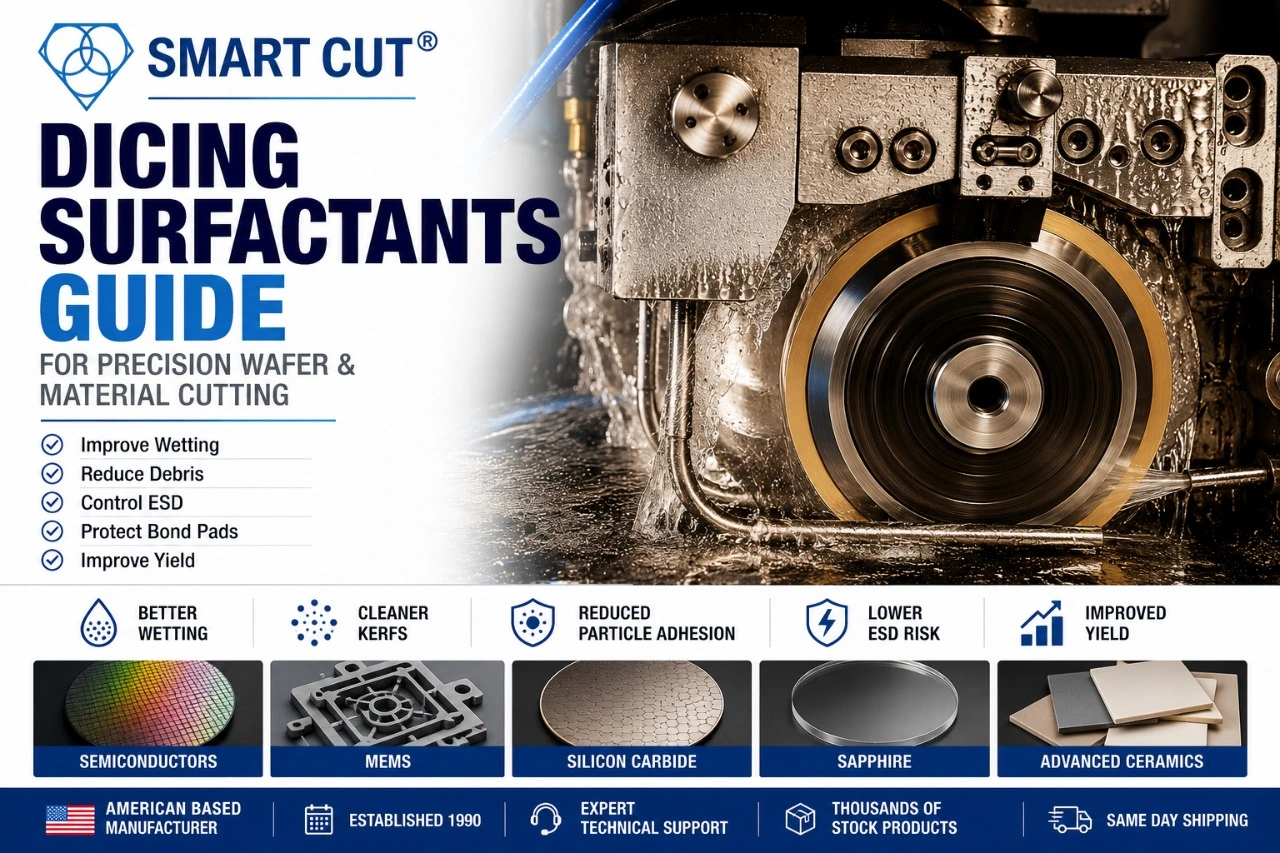
Dicing surfactants support stable and consistent wafer dicing. You use them as part of a complete dicing fluid designed to
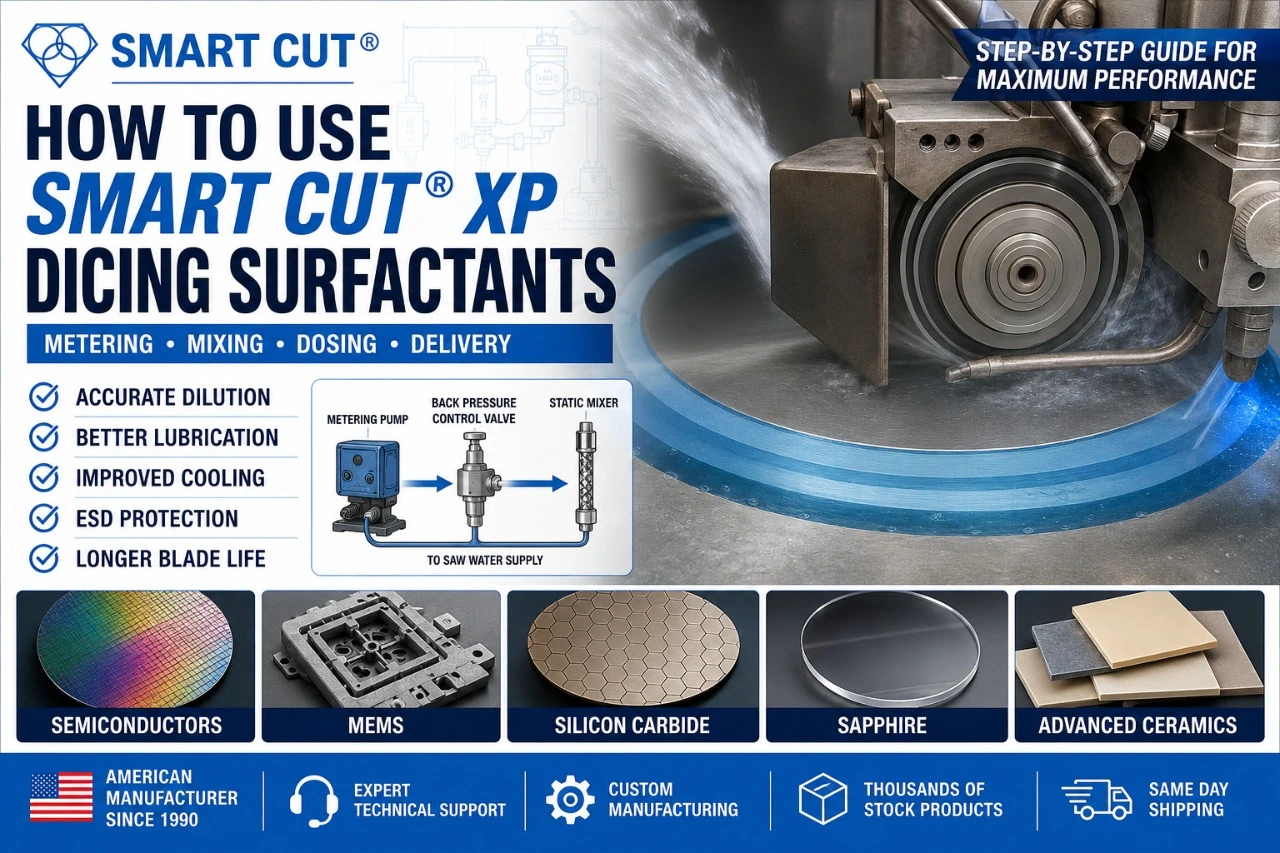
SMART CUT® XP dicing surfactants should be introduced into the saw water supply in a controlled and consistent manner to ensure proper dilution, stable chemical
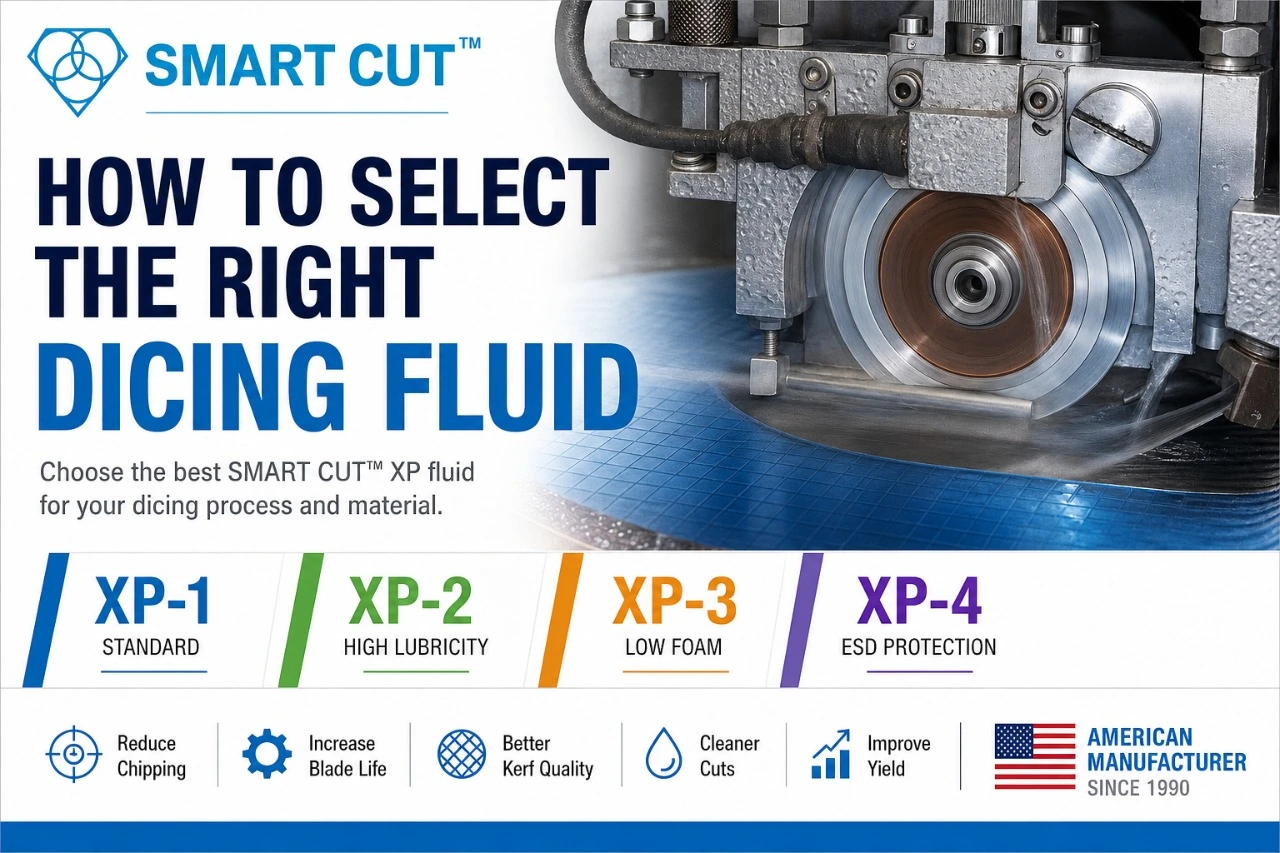
Selecting the correct dicing surfactant / fluid is essential for stable cutting, consistent kerf quality, and long blade life. Each

Brian is an experienced professional in the field of precision cutting tools, with over 27 years of experience in technical support. Over the years, he has helped engineers, manufacturers, researchers, and contractors find the right solutions for working with advanced and hard-to-cut materials. He’s passionate about bridging technical knowledge with real-world applications to improve efficiency and accuracy.
As an author, Brian Farberov writes extensively on diamond tool design, application engineering, return on investment strategies, and process optimization, combining technical depth with a strong understanding of customer needs and market dynamics.
About Brian Farberov
Brian is an experienced professional in the field of precision cutting tools, with over 27 years of experience in technical support. Over the years, he has helped engineers, manufacturers, researchers, and contractors find the right solutions for working with advanced and hard-to-cut materials. He’s passionate about bridging technical knowledge with real-world applications to improve efficiency and accuracy. As an author, Brian Farberov writes extensively on diamond tool design, application engineering, return on investment strategies, and process optimization, combining technical depth with a strong understanding of customer needs and market dynamics.
View all posts by Brian Farberov