










Coolant Condition Management for Diamond Blades: Contamination, Concentration, Filtration
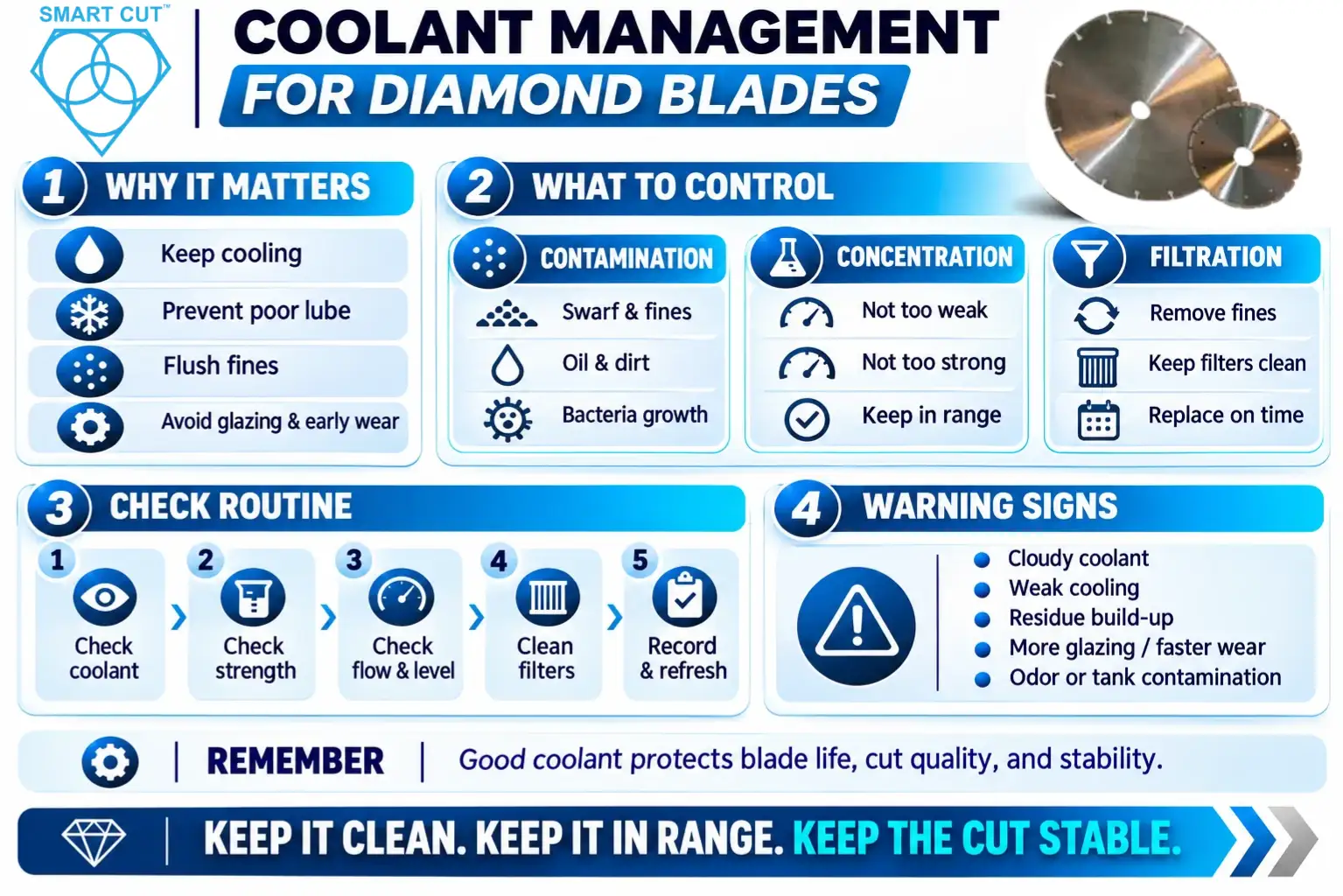
Table of Contents
ToggleMost shops check whether coolant is flowing. Far fewer check what is flowing. The nozzle is aimed, the pump runs, and the cut looks wet. Yet the coolant itself may be diluted, dirty, or starting to break down.
Coolant that has drifted out of condition cools and lubricates poorly. It carries abrasive fines back to the cut. It can stain samples, leave residue on blades, or grow bacteria in the tank. The blade then glazes, wears early, or cuts badly, and the shop blames the blade.
This article covers coolant condition management: how to control contamination, concentration, and filtration, what to measure, and how to build a simple routine. It focuses on the condition of the coolant over time. For flow, nozzle position, and delivery, see our guide on how coolant flow affects diamond blade life, cut quality, and process stability. For why coolant matters in the first place, see diamond tool coolants: why, how, when, and where to use.
Trusted by Tens of Thousands of Manufacturers, Laboratories Research Institutions Worldwide Since 1990
Established in 1990
Why Coolant Condition Management Matters
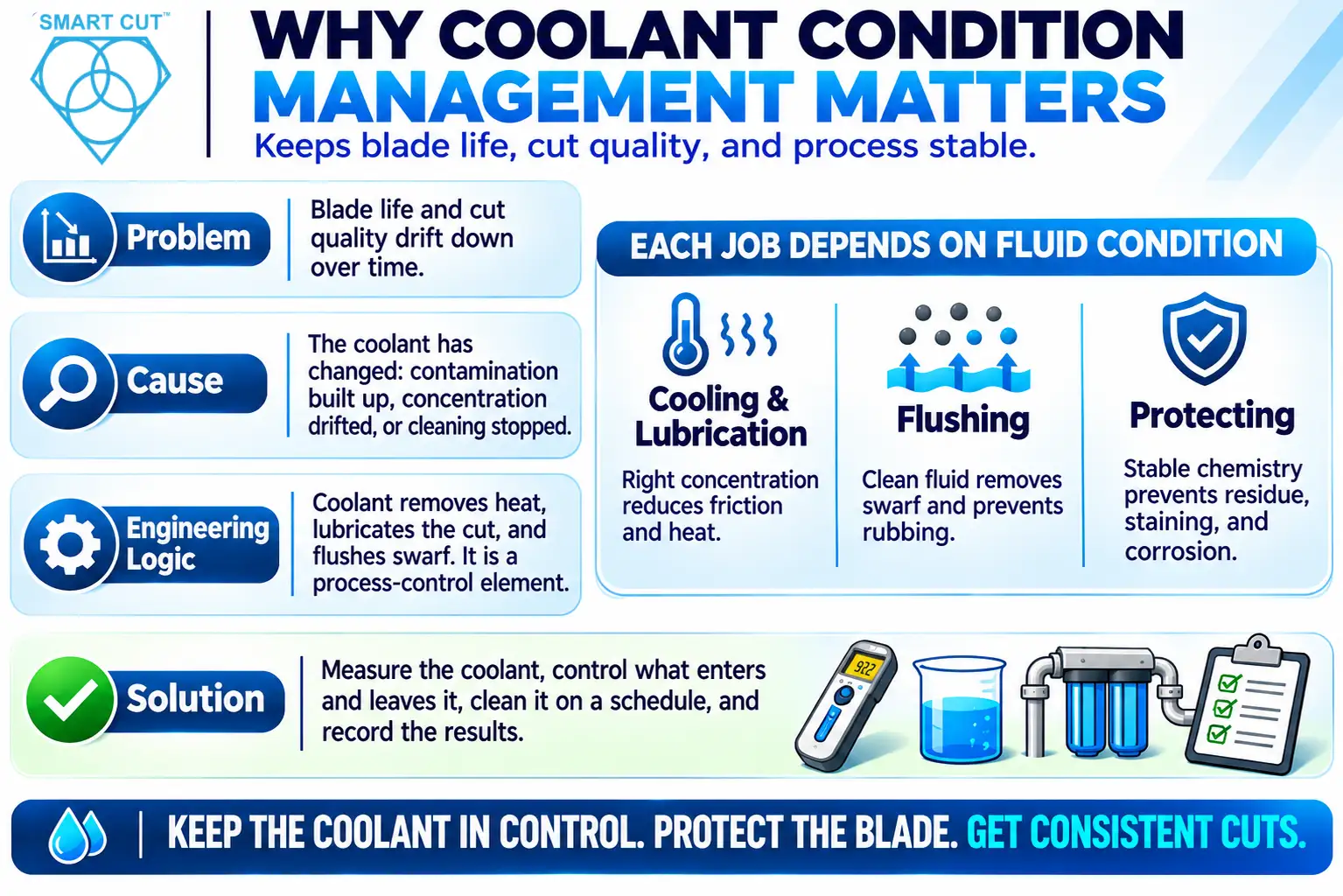
Problem: Blade life and cut quality drift down over days or weeks, and nothing obvious has changed.
Cause: The coolant has changed. Contamination built up, the concentration drifted, or the system stopped cleaning the fluid.
Engineering logic: Coolant does several jobs at the cut. It removes heat, lubricates the contact between the blade and the material, and flushes swarf out of the kerf. UKAM’s own guidance describes coolant as a process-control element, not just a way to cool, and notes that many blade failures that look like tooling problems are really thermal management problems. Read the details in our coolant flow guide.
Each job depends on the condition of the fluid.
- Cooling and lubrication depend on the right concentration. Too little coolant concentrate gives less lubrication, so friction and heat rise. Too much can cause foaming, residue, or sticky film.
- Flushing depends on clean fluid. Fluid loaded with fines carries abrasive particles back to the rim, so the blade rubs against its own waste.
- Protecting the blade and sample depends on stable chemistry. Contaminated or degraded fluid can leave residue or cause staining and corrosion.
A fresh batch of coolant does all of this well. Over time, the fluid gets dirtier and its concentration moves. Condition management is the routine that keeps it close to the fresh state.
Solution: Measure the coolant, control what enters and leaves it, clean it on a schedule, and record the results.
What Changes in a Coolant Over Time
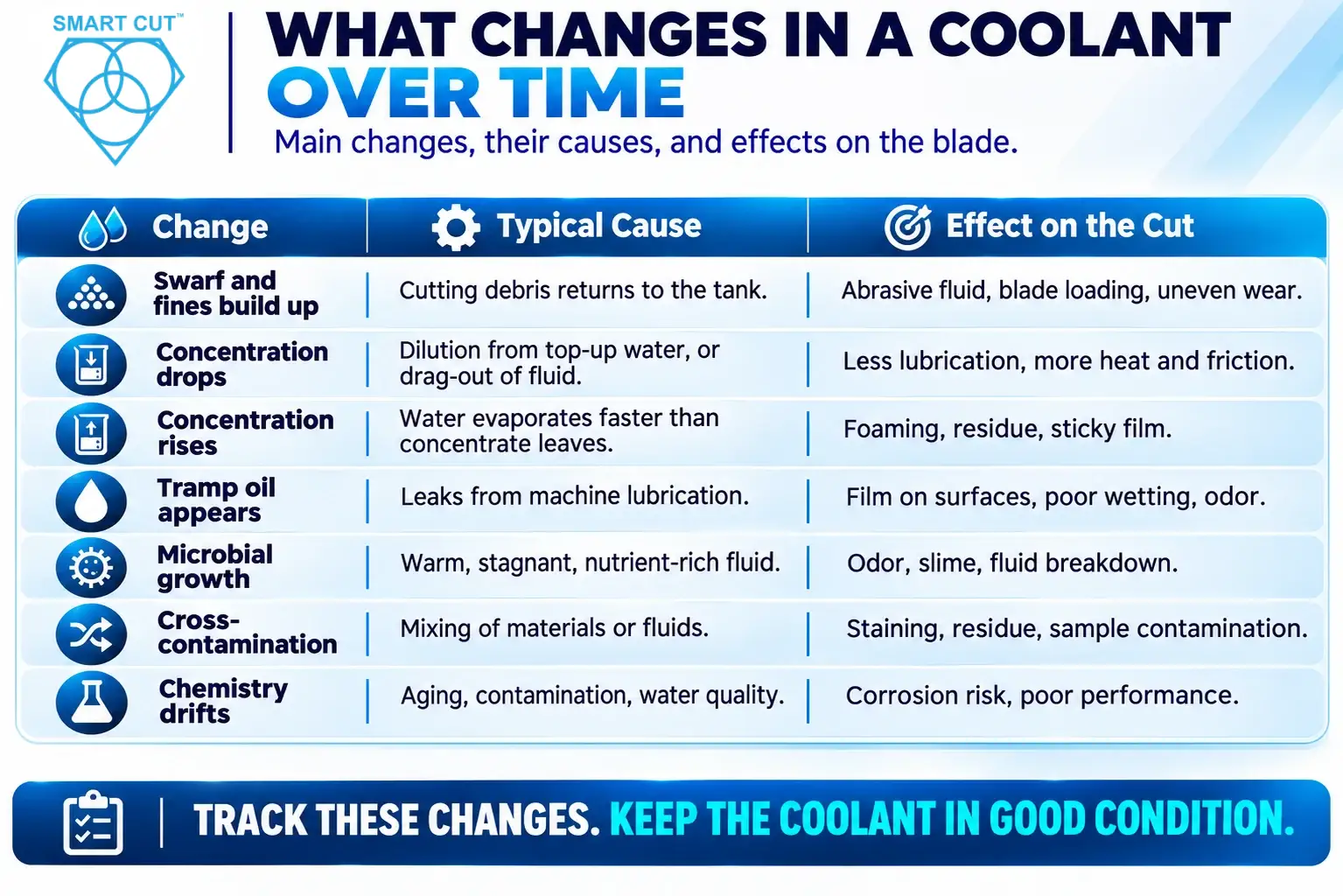
The table below summarizes the main changes, their causes, and their effects on the blade.
| Change | Typical cause | Effect on the cut |
|---|---|---|
| Swarf and fines build up | Cutting debris returns to the tank | Abrasive fluid, blade loading, uneven wear |
| Concentration drops | Dilution from top-up water, or drag-out of fluid | Less lubrication, more heat and friction |
| Concentration rises | Water evaporates faster than concentrate leaves | Foaming, residue, sticky film |
| Tramp oil appears | Leaks from machine lubrication | Film on surfaces, poor wetting, odor |
| Microbial growth | Warm, stagnant, nutrient-rich fluid | Odor, slime, fluid breakdown |
| Cross-contamination | Mixing of materials or fluids | Staining, residue, sample contamination |
| Chemistry drifts | Aging, contamination, water quality | Corrosion risk, poor performance |
Contamination: What Gets In and What It Does
Swarf and Fines
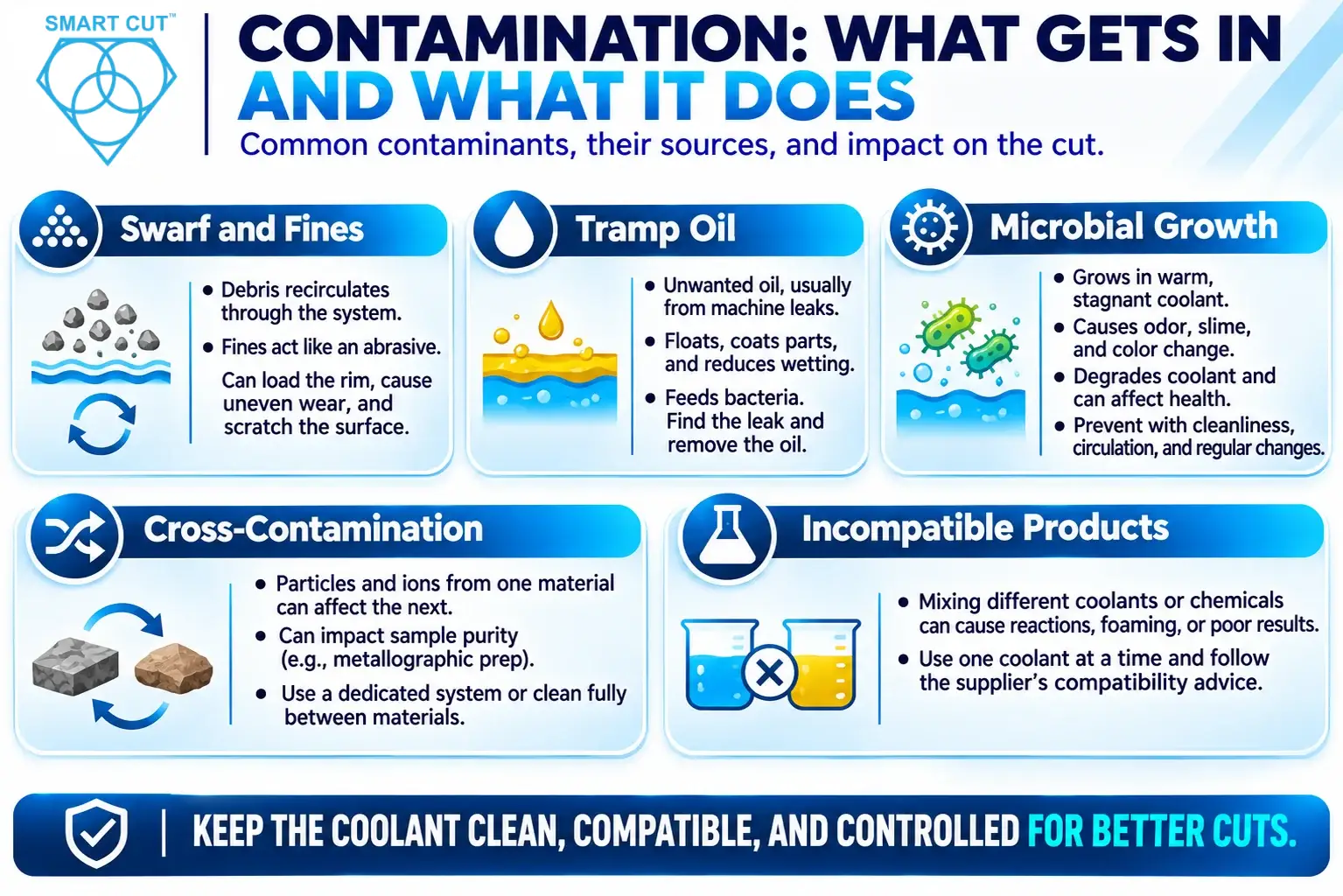
Every cut generates debris. Recirculating systems carry that debris back through the pump and the nozzle. Fine particles do the most harm because they stay suspended and return to the cut. They act like loose abrasive between the blade and the kerf walls. That can load the rim, wear it unevenly, or scratch the surface.
If you see loading, glazing, or one-sided wear, check the coolant before you blame the blade. Our article on troubleshooting common diamond blade wear patterns helps you read the marks.
Tramp Oil
Tramp oil is oil that does not belong in the coolant. It usually comes from machine lubrication that leaks into the tank. It floats on the surface, coats parts, and reduces how well the coolant wets the cut. It also feeds bacteria. Find the source of the leak and fix it, then remove the oil.
Microbial Growth
Warm, stagnant, water-based coolant can grow bacteria and fungi. The signs include a bad smell, slime in the tank, and fluid that changes color. Microbial growth degrades the coolant and can affect operator comfort and health. Prevention comes from cleanliness, good circulation, correct concentration, and regular changes. Follow your coolant supplier’s guidance and safety data on microbial control.
Cross-Contamination
If you cut different materials with the same coolant, particles and dissolved ions from one material can affect the next. That matters in applications where sample purity counts, such as metallographic preparation. Where it matters, dedicate a coolant system or clean it fully between materials.
Incompatible Products
Mixing different coolants, or adding other chemicals, can cause reactions, foaming, or poor performance. Use one coolant at a time, and follow the supplier’s compatibility advice.
Concentration: Getting the Mix Right
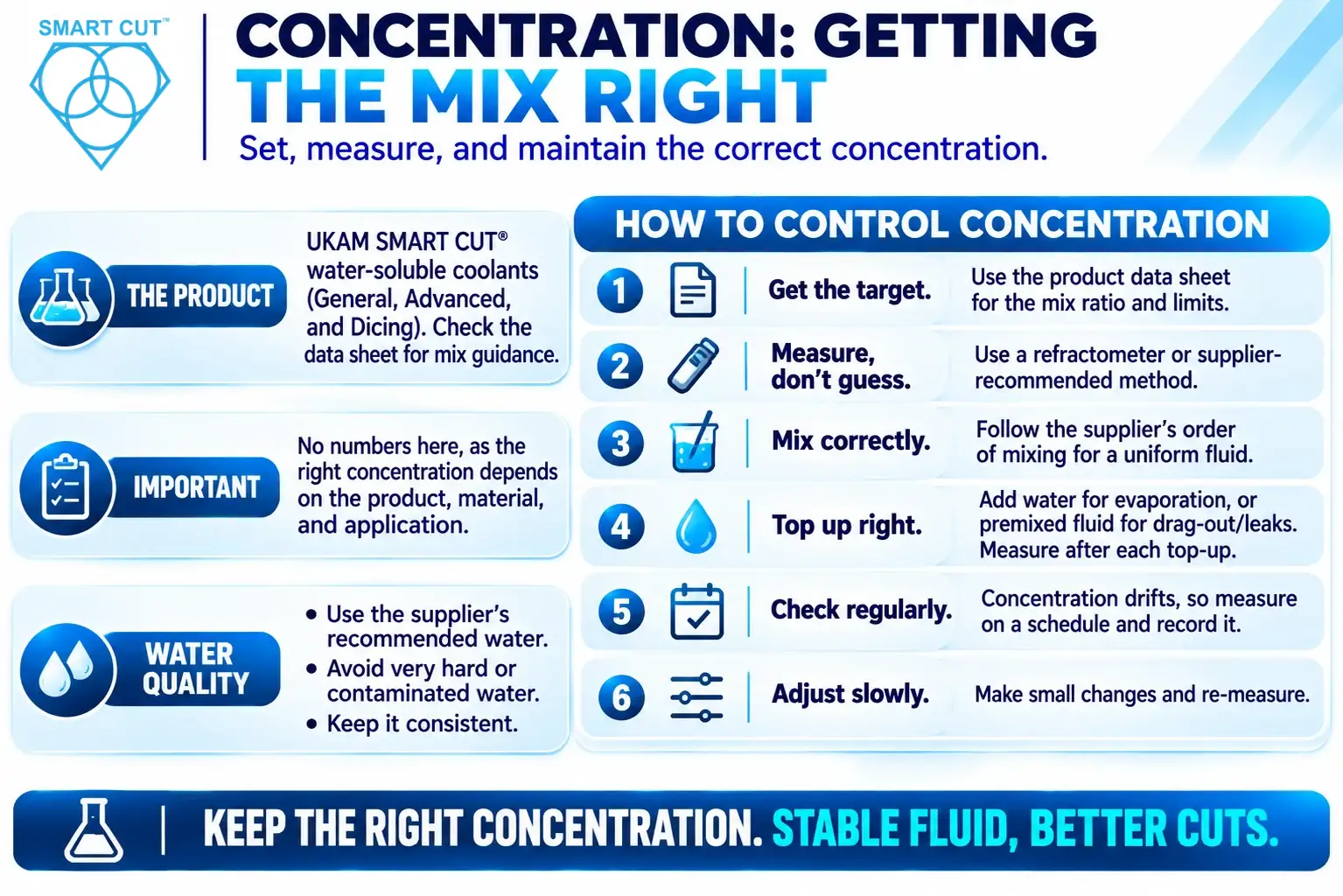
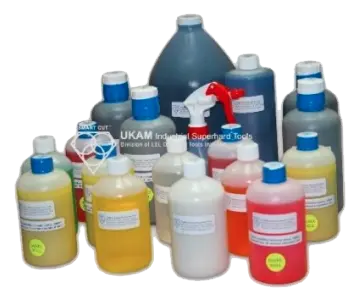
Water-soluble coolants work at a specified concentration. UKAM offers SMART CUT® water-soluble synthetic coolants in several formulas, including General Materials, Advanced Materials, and Dicing coolant, so check the data sheet for the formula you use and follow its mix guidance. This article gives no numbers on purpose, because the right value depends on the product, the material, and the application.
How to Control Concentration
- Get the target from the supplier. Use the product data sheet for the mix ratio and any limits.
- Measure, do not guess. A handheld refractometer is a common tool for checking concentration, and your supplier can advise on the right method and conversion for the product. Test strips or other methods may suit some systems.
- Mix correctly. Follow the supplier’s order of mixing, and use a consistent method. Poor mixing creates uneven fluid.
- Top up with the right fluid. When the tank level falls, decide whether you lost water or lost coolant. Evaporation removes mostly water, so concentration climbs, and you should add water. Drag-out and leaks remove coolant and water together, so you may need premixed fluid. Measure after each top-up.
- Check regularly. Concentration drifts, so measure on a schedule and record it.
- Adjust slowly. Make small changes and re-measure.
Water Quality
The water you mix with matters. Very hard water can leave scale or residue, and contaminated water brings in minerals or microbes. Ask your coolant supplier what water quality they recommend for the product, and use it consistently.
Filtration and Cleaning
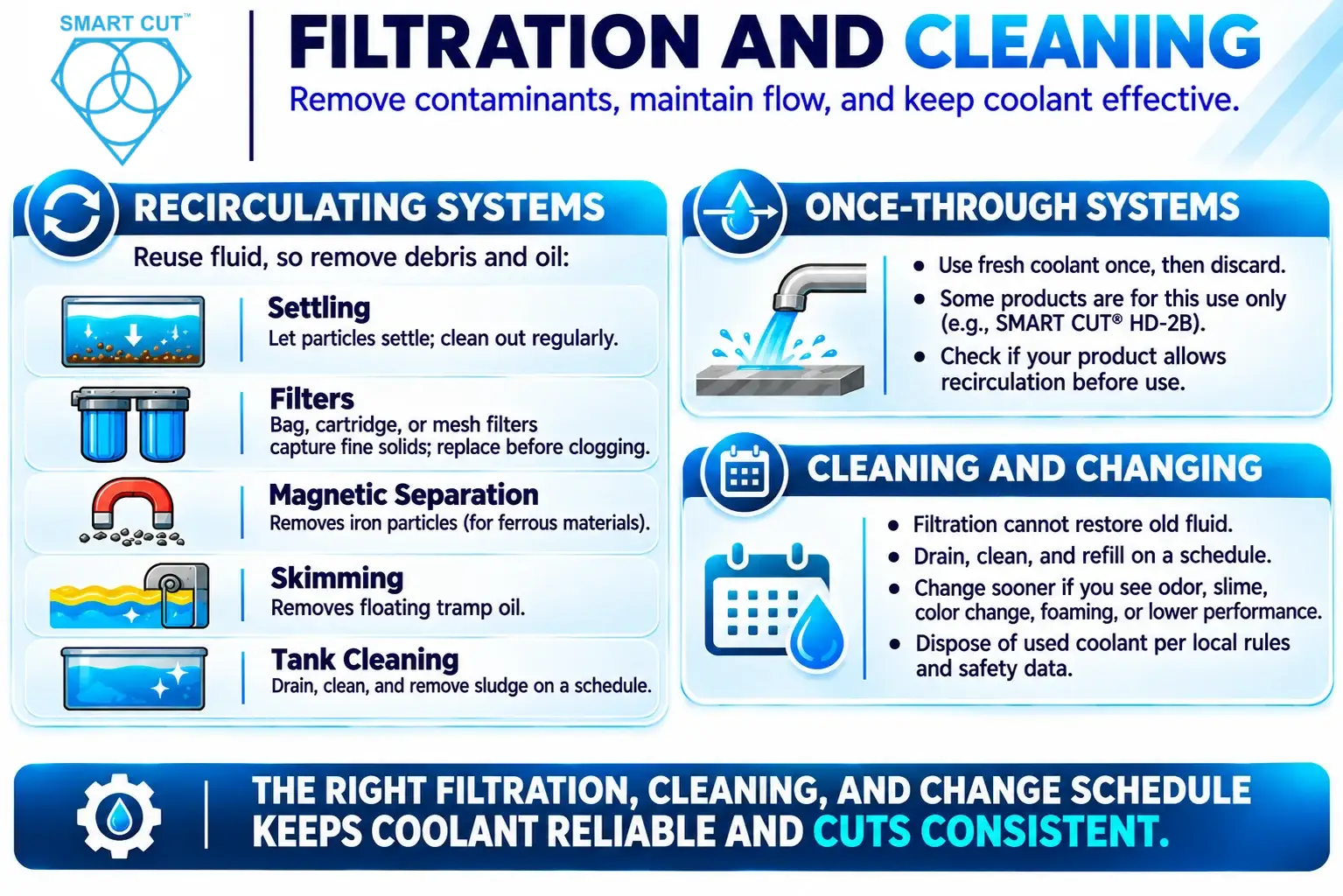
Filtration removes solids before they return to the cut. The right approach depends on how your system works.
Recirculating Systems
Recirculating systems reuse the fluid, so they need ways to remove debris and oil.
- A tank with a quiet zone lets heavier particles settle. Clean out the sediment before it builds up and gets pulled back into the pump.
- Bag, cartridge, or mesh filters capture finer solids. Choose a filter that suits the particle size you need to remove, and replace it before it clogs. A clogged filter can starve the pump and cut the flow.
- Magnetic separation. If you cut ferrous material, a magnetic separator can remove iron particles. Check that it suits your application.
- An oil skimmer removes floating tramp oil.
- Tank cleaning. Drain and clean the tank on a schedule, and remove sludge from corners and return paths.
Filtration quality also matters in other precision processes. UKAM’s coolant delivery optimization for diamond core drilling in advanced ceramics lists filtration quality among the factors that influence tool wear consistency.
Once-Through Systems
Some systems send fresh coolant through the cut once and then discard it. Some coolant products are designed only for this use. For example, UKAM’s SMART CUT® HD-2B is specified for once-through systems and is not intended for recirculation. Always check whether your product allows recirculation before you put it in a tank. Using a once-through coolant in a recirculating system can lead to poor results.
Cleaning and Changing
Even good filtration cannot restore old, degraded fluid. Plan to drain, clean, and refill the system on a schedule. Change it sooner if you see signs such as odor, slime, color change, foaming, or loss of cutting performance. Dispose of used coolant following local regulations and the supplier’s safety data.
What to Monitor and How Often
A short routine catches most problems. The table below shows what to check, how, and when. It gives no fixed time values, because the right frequency depends on your usage and your supplier’s guidance.
| What to check | How | When |
|---|---|---|
| Flow and nozzle aim | Visual check at the cut | Start of each shift and each new setup |
| Fluid level | Visual check | Start of each shift |
| Appearance and odor | Look and smell | Start of each shift |
| Foam | Visual check | Start of each shift, and whenever it appears |
| Tramp oil | Visual check of the surface | Regularly |
| Concentration | Refractometer or method the supplier recommends | Regularly, and after every top-up |
| pH or other chemistry | Strips or a meter, if the supplier advises | Periodically |
| Filter condition | Visual check or pressure reading | Regularly |
| Sediment in the tank | Visual check | Periodically |
| Full drain and clean | Maintenance task | On a schedule, or as the fluid condition dictates |
Adjust the frequency from your own records. If a check keeps finding problems, do it more often.
Recognizing Coolant Problems in the Cut
When results change, coolant condition may be the cause. The table below links common symptoms to likely coolant issues. Treat it as a guide, not a verdict.
| Symptom | Likely coolant issue |
|---|---|
| Burn marks or heat damage | Low concentration, weak flow, or contaminated fluid |
| Blade loading or glazing | Fines in the fluid, or too little coolant at the cut |
| Uneven or one-sided wear | Abrasive fines recirculating |
| Rough finish with scratches | Particles in the fluid |
| Foam at the nozzle or tank | Concentration too high, air entrainment, or contamination |
| Residue or film on blades and samples | High concentration, tramp oil, or poor water quality |
| Bad smell or slime | Microbial growth |
| Staining or corrosion on samples | Degraded fluid, wrong chemistry, or cross-contamination |
| Results drift slowly over weeks | Gradual change in concentration or cleanliness |
If a known-good blade also performs badly, check the coolant and the machine before you reject the blade. Our upcoming precision saw maintenance article covers the hardware side, including nozzles, pumps, and filters.
Coolant Condition and Blade Testing
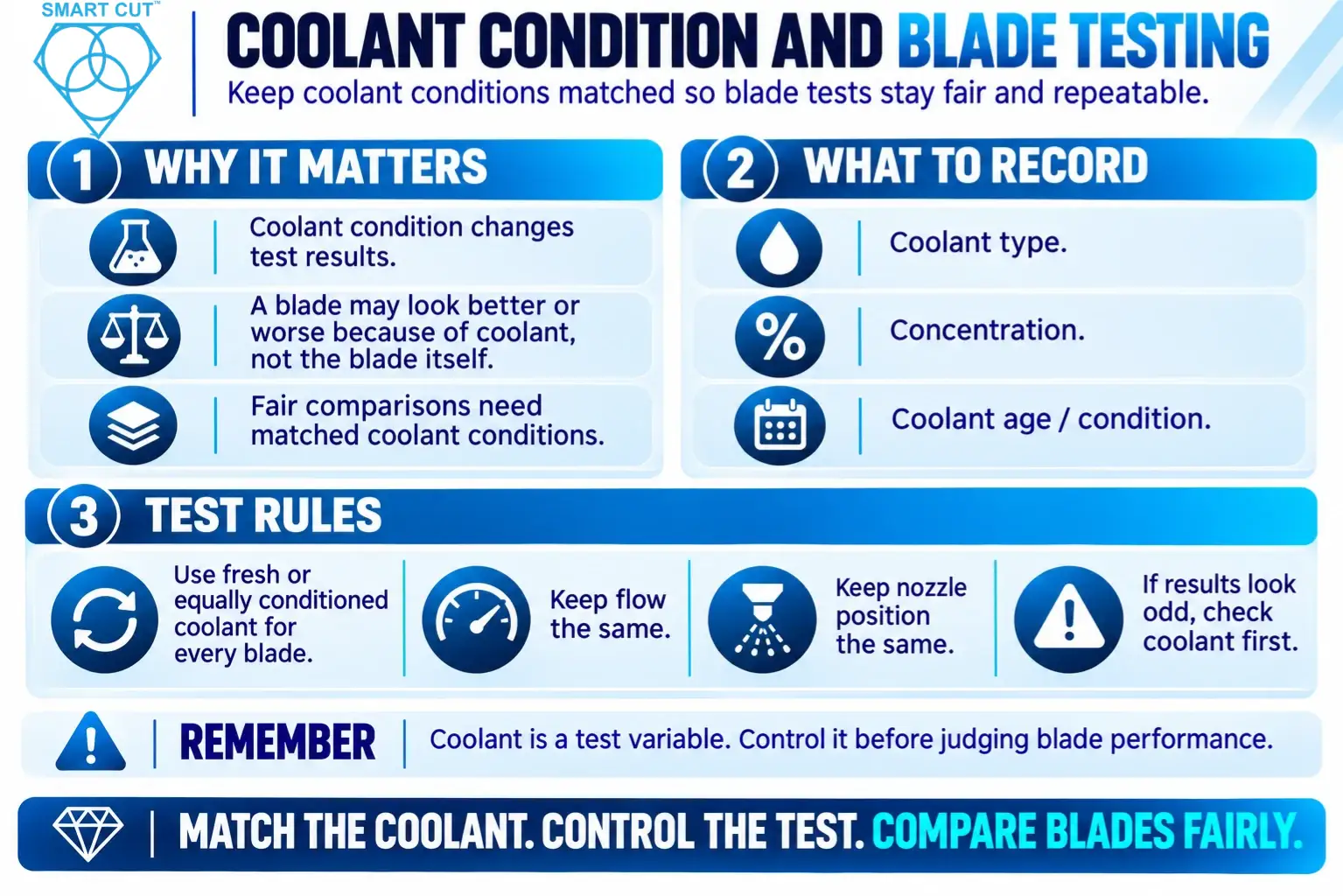
Coolant is a test variable. If the condition changes between tests, the results change with it, and a blade can look better or worse than it is.
- Record the coolant type, concentration, and age for every test.
- Use fresh or equally conditioned coolant for every blade in a comparison.
- Keep flow and nozzle position the same.
- Treat unexplained differences as a reason to check the coolant first.
See how to compare two diamond blades fairly and how to design a repeatable diamond blade test for the full approach. For the broader effects of speed, feed, and coolant together, read how feed rate, RPM, and coolant affect diamond blade performance.
Common Coolant Management Mistakes
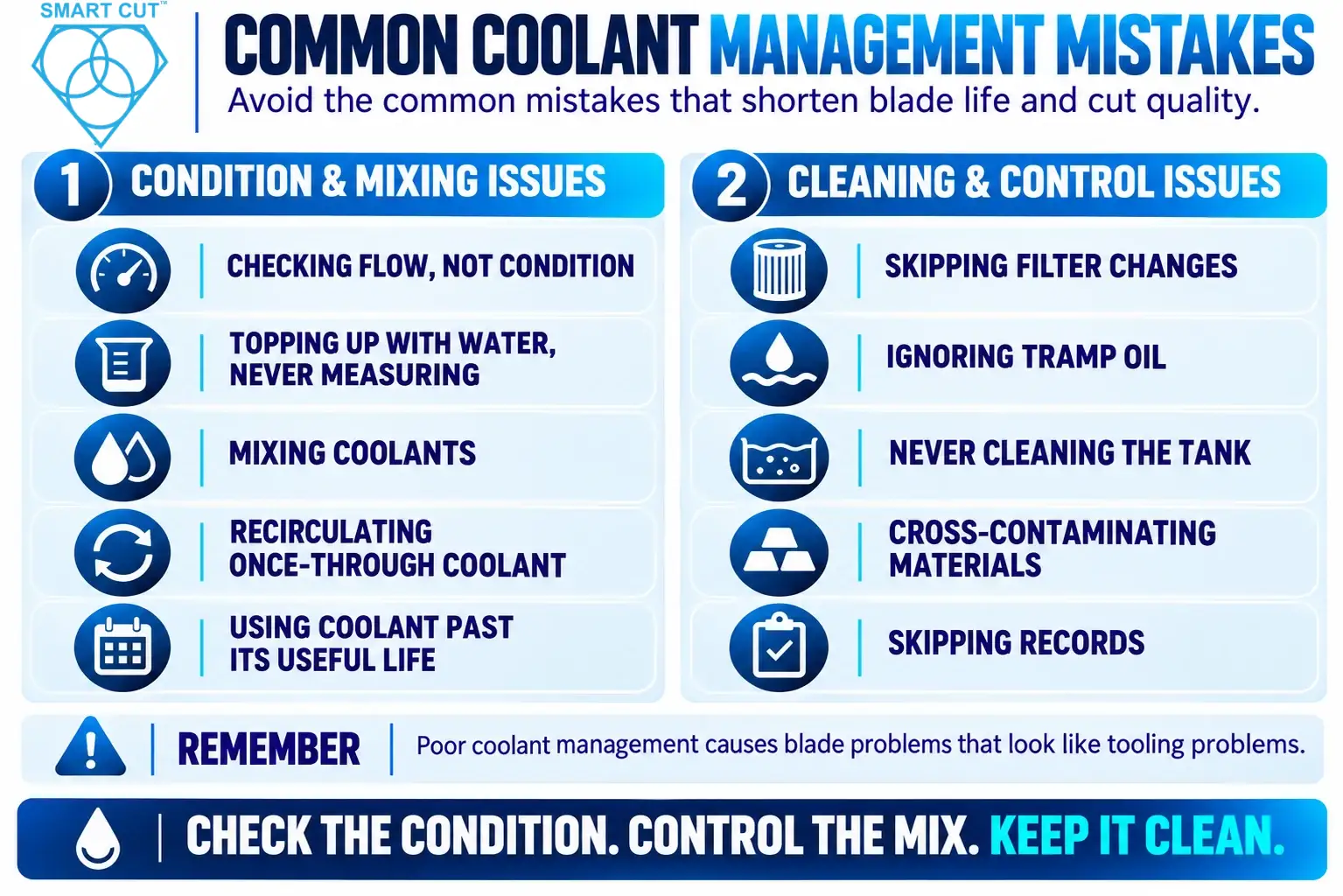
Checking flow but never checking condition. A strong stream of poor fluid still harms the blade.
Topping up with water and never measuring. Concentration slides without anyone noticing.
Skipping filter changes. A clogged filter cuts flow and lets bypass debris through.
Ignoring tramp oil. It coats the cut zone and feeds bacteria.
Mixing coolants. Incompatible products can foam or fail.
Recirculating a once-through coolant. Check the product’s intended use first.
Never cleaning the tank. Sludge and microbes build up in the corners.
Using coolant past its useful life. Odor, slime, and poor performance are signs to change it.
Cross-contaminating materials. It can ruin sensitive samples.
Skipping records. Without records, you cannot link a blade problem to a coolant change.
Applying This in Your Shop
Start with one saw. Find the coolant data sheet, and write down the target concentration and any limits. Add a quick check at the start of each shift for level, appearance, odor, and foam. Add a regular concentration measurement and a log. Then set a schedule for filter changes and tank cleaning, and adjust it from what you find.
Choose a coolant that suits your application. UKAM’s SMART CUT® water-soluble coolants come in general materials, advanced materials, and dicing formulas, and the SMART CUT® synthetic water soluble coolant is a general materials option. Equipment matters too. A well-maintained precision cutting saw with a clean, working coolant system gives blades the best working conditions. For more on setup and the cutting procedure, see our setup-mistakes article and our cutting SOP article.
Related UKAM Products and Resources
These UKAM products and guides support good coolant management.
- SMART CUT® synthetic water soluble coolant: general materials formula for sectioning and cutting.
- SMART CUT® HD-2B coolant: a once-through coolant for diamond wire, band, and ID sawing of silicon.
- Diamond tool coolants: why, how, when, and where to use: the case for using coolant.
- How coolant flow affects blade life and cut quality: delivery and flow.
- Wafering blade usage recommendations: coolant guidance alongside speed and load.
- Diamond wafering blades: blades to pair with a well-managed coolant system.
- Diamond dicing blades: dicing applications and dicing coolant.
- Precision cutting saws: machines with recirculating coolant systems.
- Metallography consumables: sectioning and preparation supplies.
Key Takeaways
- Coolant condition changes over time through contamination, concentration drift, and breakdown, and those changes affect blade life and cut quality.
- Swarf, tramp oil, microbes, cross-contamination, and incompatible products are the main contaminants.
- Measure concentration with a suitable method, and follow the supplier’s mix guidance. Do not guess.
- Evaporation raises concentration and drag-out lowers it, so top up with the right fluid and re-measure.
- Filter, settle, skim, and clean recirculating systems on a schedule.
- Check whether your coolant is once-through only before you recirculate it.
- Change coolant when odor, slime, color change, foam, or poor performance appear.
- Record coolant condition with every test and every job, and dispose of used coolant following local regulations.
Frequently Asked Questions
It is the routine of measuring and controlling the contamination, concentration, and cleanliness of cutting coolant.
Dirty or diluted coolant cools and lubricates poorly and can return abrasive fines to the cut.
Use a method your supplier recommends, such as a refractometer, and follow the product data sheet.
Lubrication drops, so friction and heat rise at the cut.
It can cause foaming, residue, or a sticky film.
Evaporation raises it, while drag-out and dilution from top-ups lower it.
It is oil that leaks from machine lubrication into the coolant and floats on the surface.
Look for a bad smell, slime, and fluid that changes color.
Yes, because fines that return to the cut wear the blade and mark the surface.
No, because some products are designed for once-through use only.
Follow your supplier’s guidance and change sooner if you see odor, slime, foam, or poor performance.
Yes, because poor water can leave residue or scale, so ask your supplier what to use.
Yes, because contamination or degraded fluid can leave residue or cause staining.
Follow local regulations and the supplier’s safety data.
Conclusion
A good coolant system does more than spray fluid on the cut. It delivers fluid that is clean, correctly mixed, and stable. When the condition slips, the effects look like blade problems: loading, glazing, burn marks, rough finish, and short life.
Coolant condition management prevents that. Know your target concentration, measure it, control what contaminates the fluid, filter and clean the system, and change the coolant before it breaks down. Record what you find. Over time, those records show how coolant condition connects to blade performance, and they let you fix problems before they reach the blade.
If you want help choosing a coolant or building a routine for your materials and process, request a consultation with the UKAM team, or browse our diamond wafering blades and ultra thin precision diamond blades.
Trusted by Tens of Thousands of Manufacturers, Laboratories,
Research Institutions Worldwide Since 1990
Established in 1990
RELATED ARTICLES

Brian is an experienced professional in the field of precision cutting tools, with over 27 years of experience in technical support. Over the years, he has helped engineers, manufacturers, researchers, and contractors find the right solutions for working with advanced and hard-to-cut materials. He’s passionate about bridging technical knowledge with real-world applications to improve efficiency and accuracy.
As an author, Brian Farberov writes extensively on diamond tool design, application engineering, return on investment strategies, and process optimization, combining technical depth with a strong understanding of customer needs and market dynamics.
About Brian Farberov
Brian is an experienced professional in the field of precision cutting tools, with over 27 years of experience in technical support. Over the years, he has helped engineers, manufacturers, researchers, and contractors find the right solutions for working with advanced and hard-to-cut materials. He’s passionate about bridging technical knowledge with real-world applications to improve efficiency and accuracy. As an author, Brian Farberov writes extensively on diamond tool design, application engineering, return on investment strategies, and process optimization, combining technical depth with a strong understanding of customer needs and market dynamics.
View all posts by Brian Farberov