



















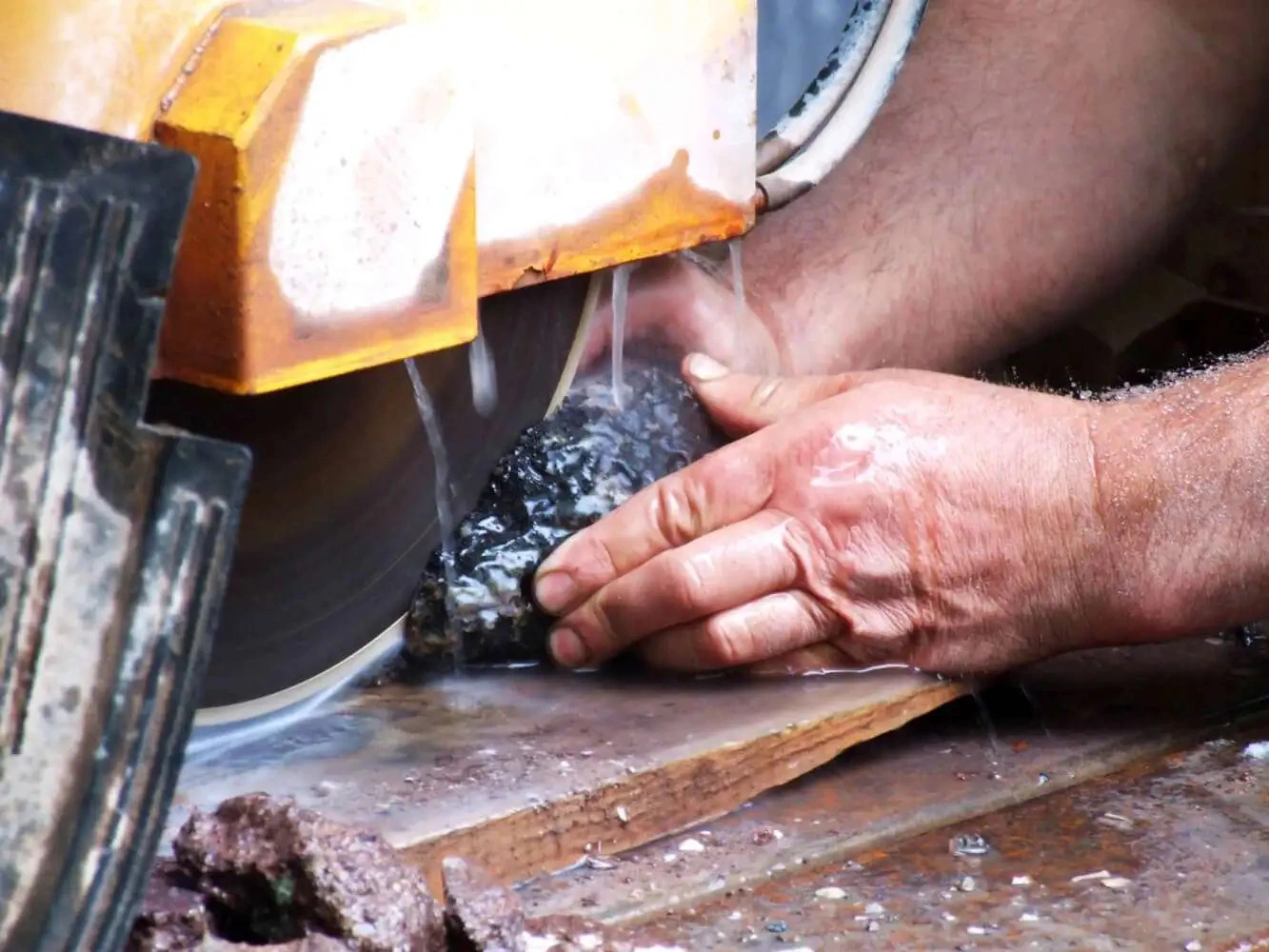


Diamond / CBN Blade Dressing: When, Why & How to Restore Maximum Cutting Efficiency
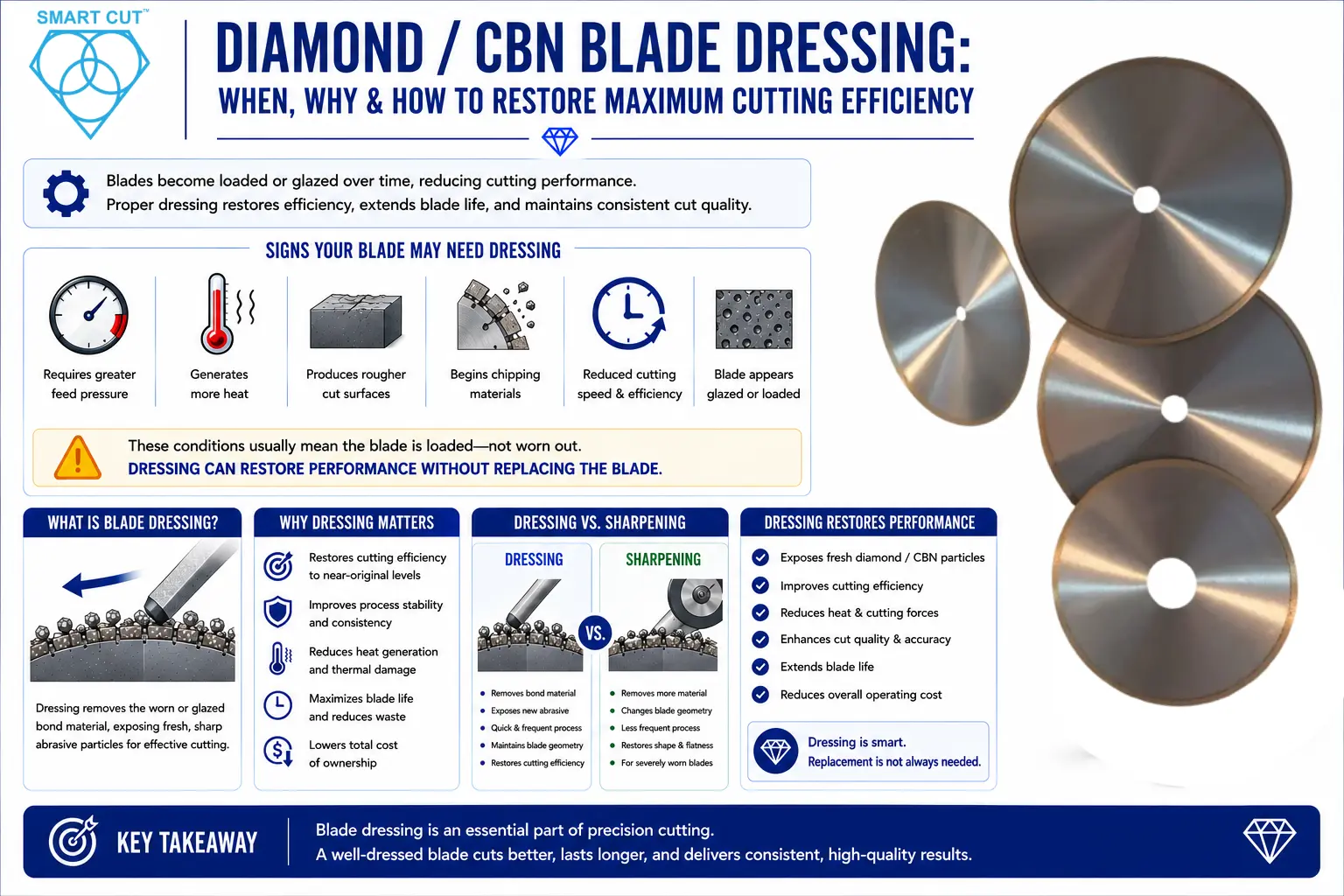
Table of Contents
TogglePrecision diamond and CBN blades are engineered to deliver exceptional cutting accuracy, minimal material damage, and long service life across a wide range of advanced materials. Whether sectioning silicon wafers, sapphire, technical ceramics, carbides, composites, hardened steels, or metallographic specimens, these tools rely on a carefully engineered balance between diamond or CBN abrasive particles and the bond material that supports them.
Over time, however, even a properly selected blade can begin to lose cutting efficiency.
Operators often notice that a blade requires greater feed pressure, generates more heat, produces rougher cut surfaces, or begins chipping materials that were previously cut cleanly. In many cases, the immediate assumption is that the blade has reached the end of its useful life and must be replaced.
In many cases, reduced cutting performance does not indicate that the blade has reached the end of its service life.
A significant number of blades that appear worn have simply become loaded or glazed, preventing fresh abrasive particles from participating effectively in the cutting process. Instead of replacing the blade, restoring the cutting surface through proper dressing may return the blade to near-original performance while significantly extending its usable life.
Understanding when, why, and how to dress a diamond or CBN blade is therefore an essential part of precision cutting. Proper dressing not only restores cutting efficiency but also improves process stability, reduces unnecessary blade consumption, minimizes thermal damage, and helps maintain consistent surface quality.
For manufacturers, laboratories, and research facilities where cutting accuracy directly affects downstream inspection, polishing, and analysis, dressing should be considered an integral part of process optimization rather than a corrective action performed only after cutting problems develop.
This guide explains the engineering principles behind blade dressing, how dressing restores cutting performance, the differences between dressing and sharpening, and the best practices for maintaining maximum cutting efficiency throughout the life of a precision diamond or CBN blade.
Trusted by Tens of Thousands of Manufacturers, Laboratories Research Institutions Worldwide Since 1990

American Based Manufacturer

Established in 1990


Custom manufacturing


Why Blade Dressing Is Critical to Precision Cutting
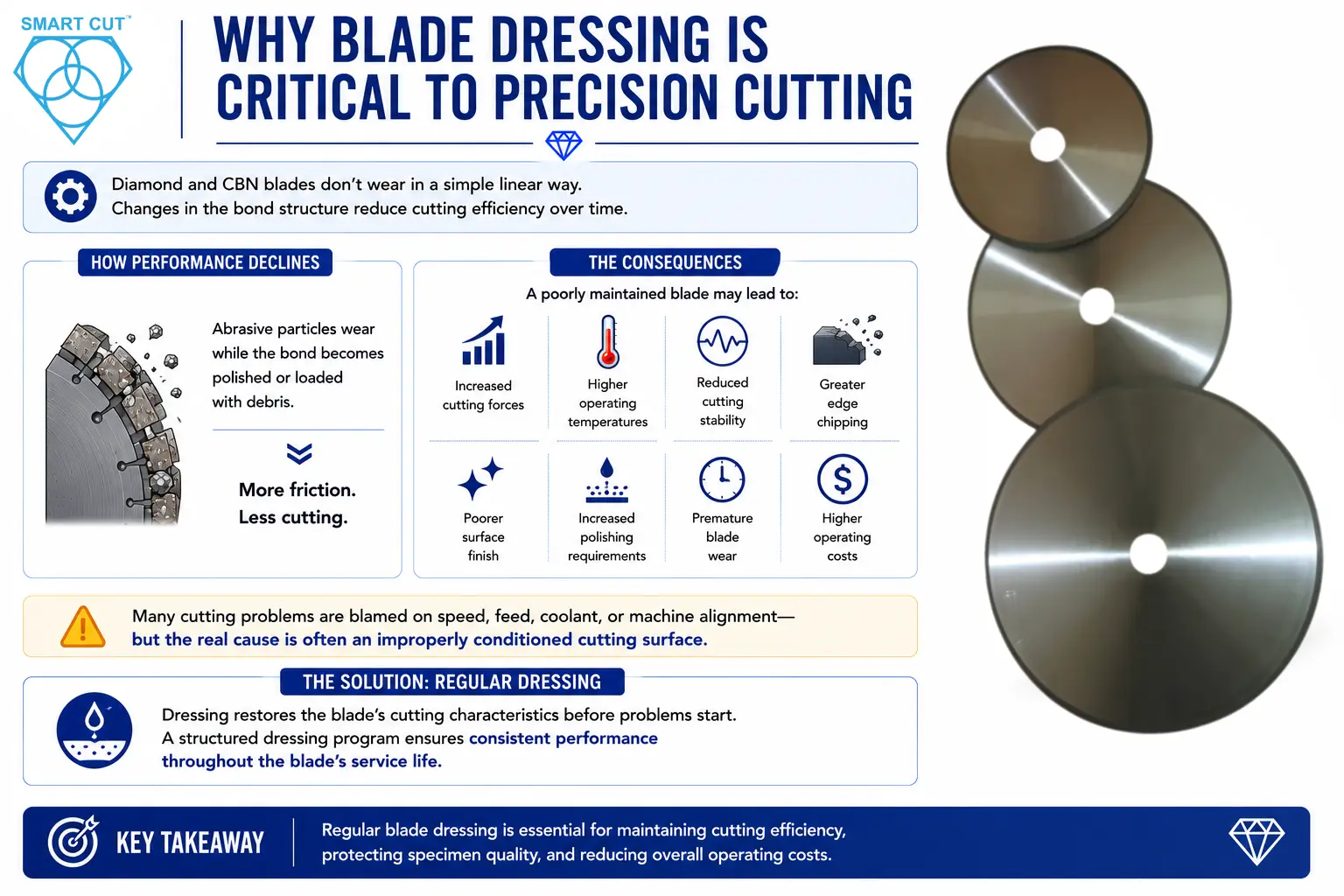
Diamond and CBN blades are consumable tools, but their performance does not decline in a simple linear manner.
Unlike conventional cutting tools that gradually become dull, superabrasive blades typically experience changes within the bond structure that alter how efficiently abrasive particles interact with the workpiece.
As cutting continues, the exposed abrasive particles gradually wear while the surrounding bond material may become polished or loaded with debris. This reduces the blade’s ability to efficiently remove material, increasing friction rather than cutting action.
The consequences extend far beyond slower cutting speeds.
A poorly maintained blade may contribute to:
- Increased cutting forces
- Higher operating temperatures
- Reduced cutting stability
- Greater edge chipping
- Poorer surface finish
- Increased polishing requirements
- Premature blade wear
- Higher operating costs
Many of these issues are incorrectly attributed to spindle speed, feed rate, coolant flow, or machine alignment when the underlying cause is simply an improperly conditioned cutting surface.
Regular dressing helps restore the blade’s cutting characteristics before these problems become severe.
Rather than waiting until cutting quality deteriorates significantly, implementing a structured dressing program helps maintain consistent performance throughout the blade’s service life.
What Is Diamond and CBN Blade Dressing?
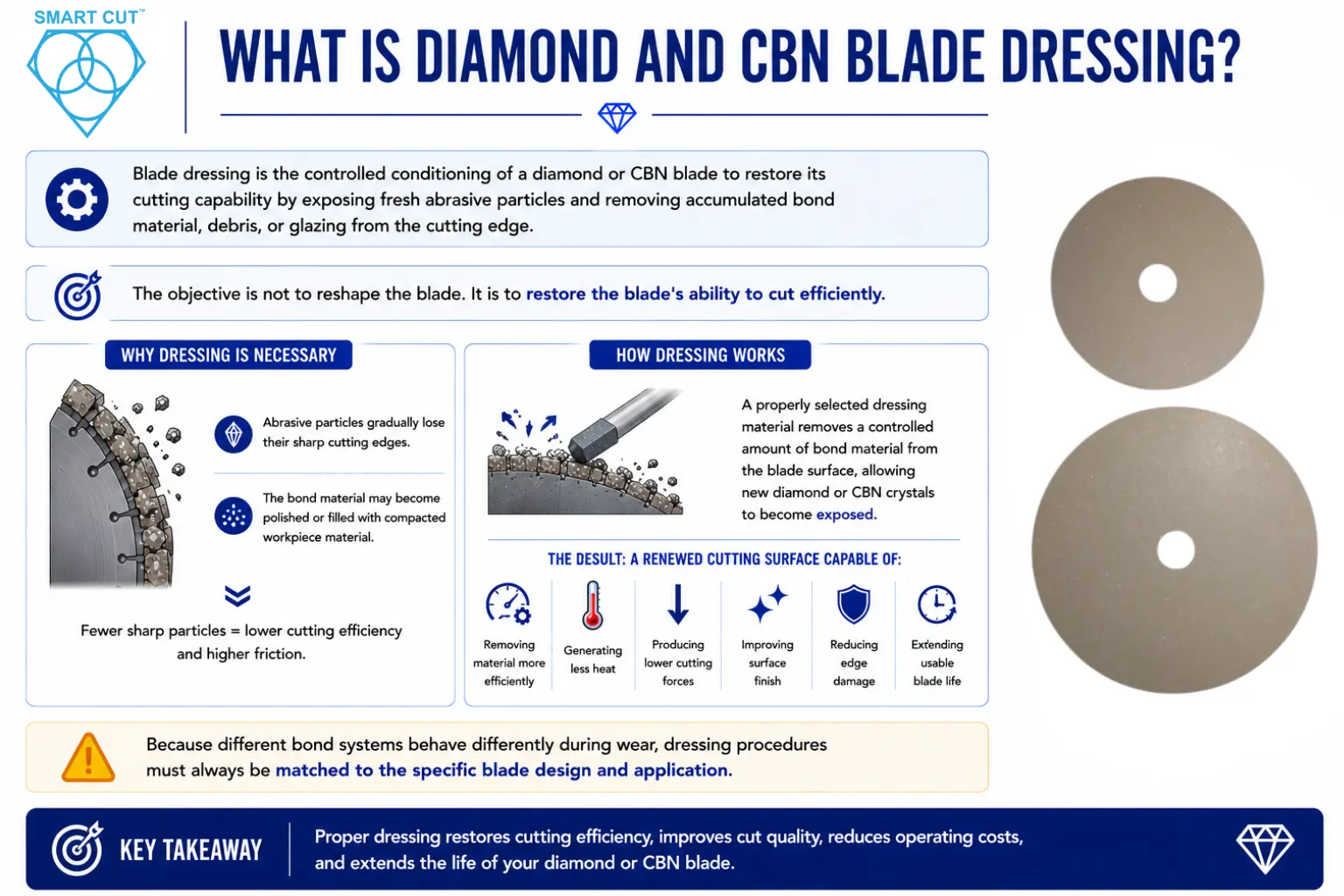
Blade dressing is the controlled conditioning of a diamond or CBN blade to restore its cutting capability by exposing fresh abrasive particles and removing accumulated bond material, debris, or glazing from the cutting edge.
The objective is not to reshape the blade.
It is to restore the blade’s ability to cut efficiently.
During normal operation, abrasive particles gradually lose their sharp cutting edges. At the same time, the bond material surrounding those particles may become polished or filled with compacted workpiece material. As fewer sharp abrasive particles remain exposed, cutting efficiency declines while friction increases.
A properly selected dressing material removes a controlled amount of bond material from the blade surface, allowing new diamond or CBN crystals to become exposed.
The result is a renewed cutting surface capable of:
- Removing material more efficiently
- Generating less heat
- Producing lower cutting forces
- Improving surface finish
- Reducing edge damage
- Extending usable blade life
Because different bond systems behave differently during wear, dressing procedures must always be matched to the specific blade design and application.
Dressing vs. Sharpening: Understanding the Difference
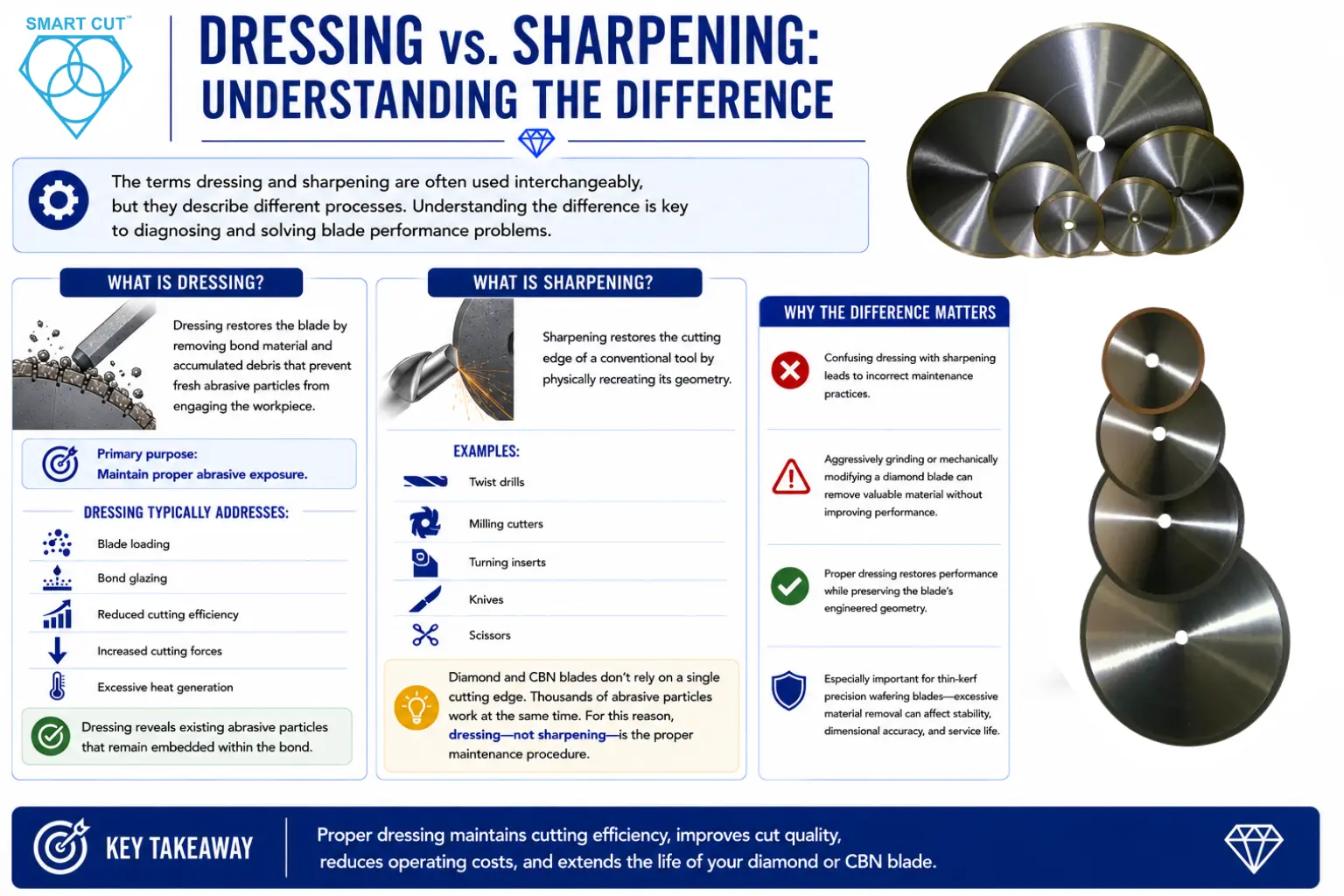
The terms dressing and sharpening are frequently used interchangeably, even within manufacturing environments.
Although they are closely related, they describe different processes.
Understanding this distinction is important when diagnosing blade performance problems.
What Is Dressing?
Dressing restores the blade by removing bond material and accumulated debris that prevent fresh abrasive particles from engaging the workpiece.
Its primary purpose is to maintain proper abrasive exposure.
Dressing typically addresses problems such as:
- Blade loading
- Bond glazing
- Reduced cutting efficiency
- Increased cutting forces
- Excessive heat generation
Rather than creating new cutting edges, dressing reveals existing abrasive particles that remain embedded within the bond.
What Is Sharpening?
Sharpening generally refers to restoring the cutting edge of a conventional tool by physically recreating its geometry.
Examples include:
- Twist drills
- Milling cutters
- Turning inserts
- Knives
- Scissors
These tools depend on a defined cutting edge that gradually wears during use.
Diamond and CBN blades operate differently.
They do not rely on a single cutting edge.
Instead, thousands of individual abrasive particles participate simultaneously in the cutting process.
For this reason, dressing, not sharpening, is the proper maintenance procedure for superabrasive blades.
Why the Difference Matters
Confusing dressing with sharpening often leads to incorrect maintenance practices.
Some operators assume a diamond blade should be aggressively ground or mechanically modified once cutting performance declines.
In reality, unnecessary material removal may shorten blade life without improving cutting efficiency.
Proper dressing restores performance while preserving the blade’s engineered geometry.
This distinction becomes especially important for thin-kerf precision wafering blades, where excessive material removal may affect blade stability, dimensional accuracy, and overall service life.
How Diamond and CBN Blades Actually Remove Material
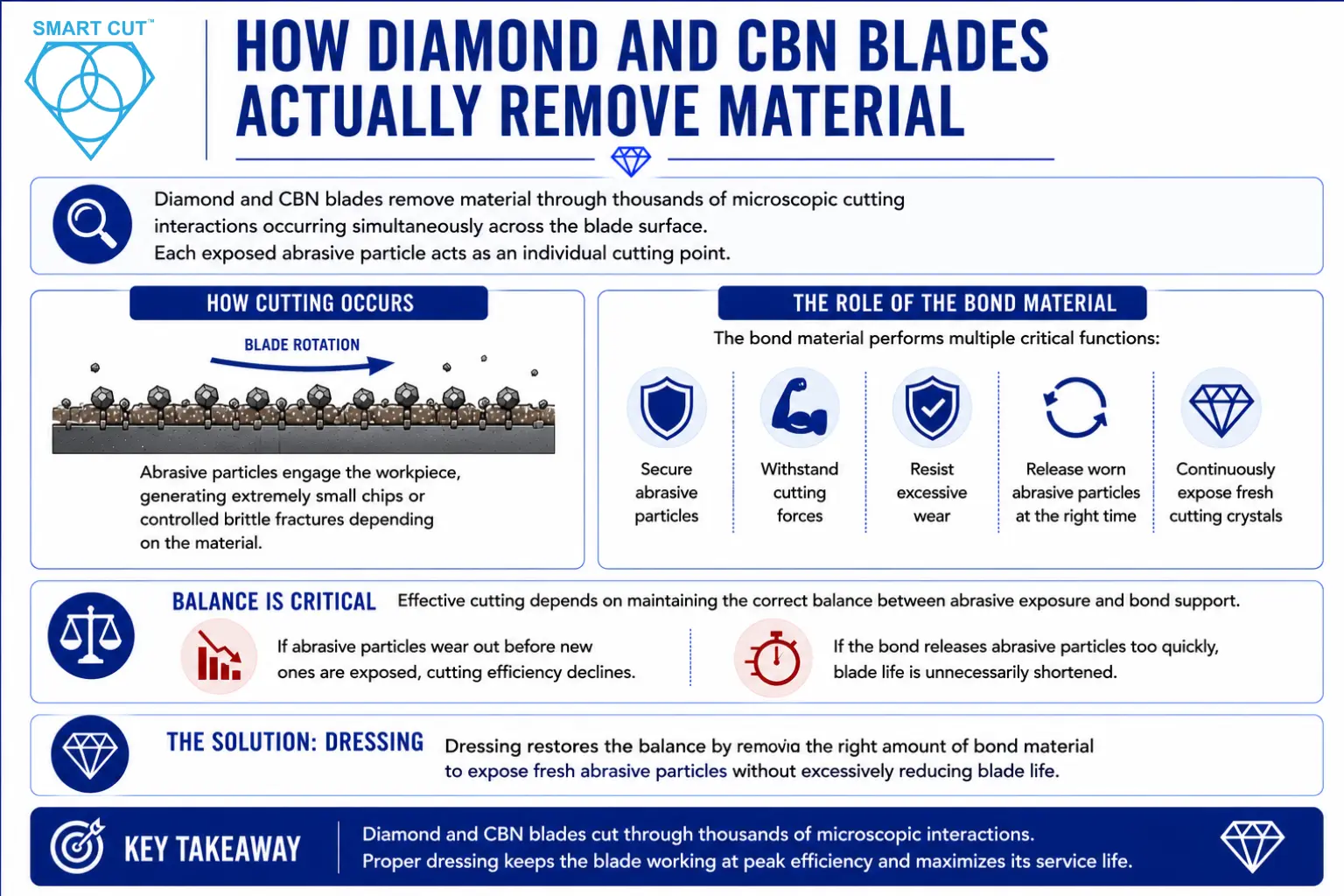
To understand why dressing is necessary, it is first important to understand how diamond and CBN blades cut.
Unlike conventional cutting tools that shear material using a continuous cutting edge, superabrasive blades remove material through thousands of microscopic cutting interactions occurring simultaneously across the blade surface.
Each exposed abrasive particle functions as an individual cutting point.
As the blade rotates, these particles engage the workpiece, generating extremely small chips or initiating controlled brittle fractures depending on the material being processed.
The bond material serves several equally important functions.
It must:
- Secure abrasive particles
- Withstand cutting forces
- Resist excessive wear
- Release worn abrasive particles at the appropriate time
- Continuously expose fresh cutting crystals
Effective cutting, therefore, depends upon maintaining the correct balance between abrasive exposure and bond support.
If abrasive particles become excessively worn before new particles are exposed, cutting efficiency declines.
Conversely, if the bond releases abrasive particles too quickly, blade life is unnecessarily shortened.
Dressing helps restore this balance by removing enough bond material to expose fresh abrasive particles without excessively reducing blade life.
Why Diamond and CBN Blades Lose Cutting Efficiency
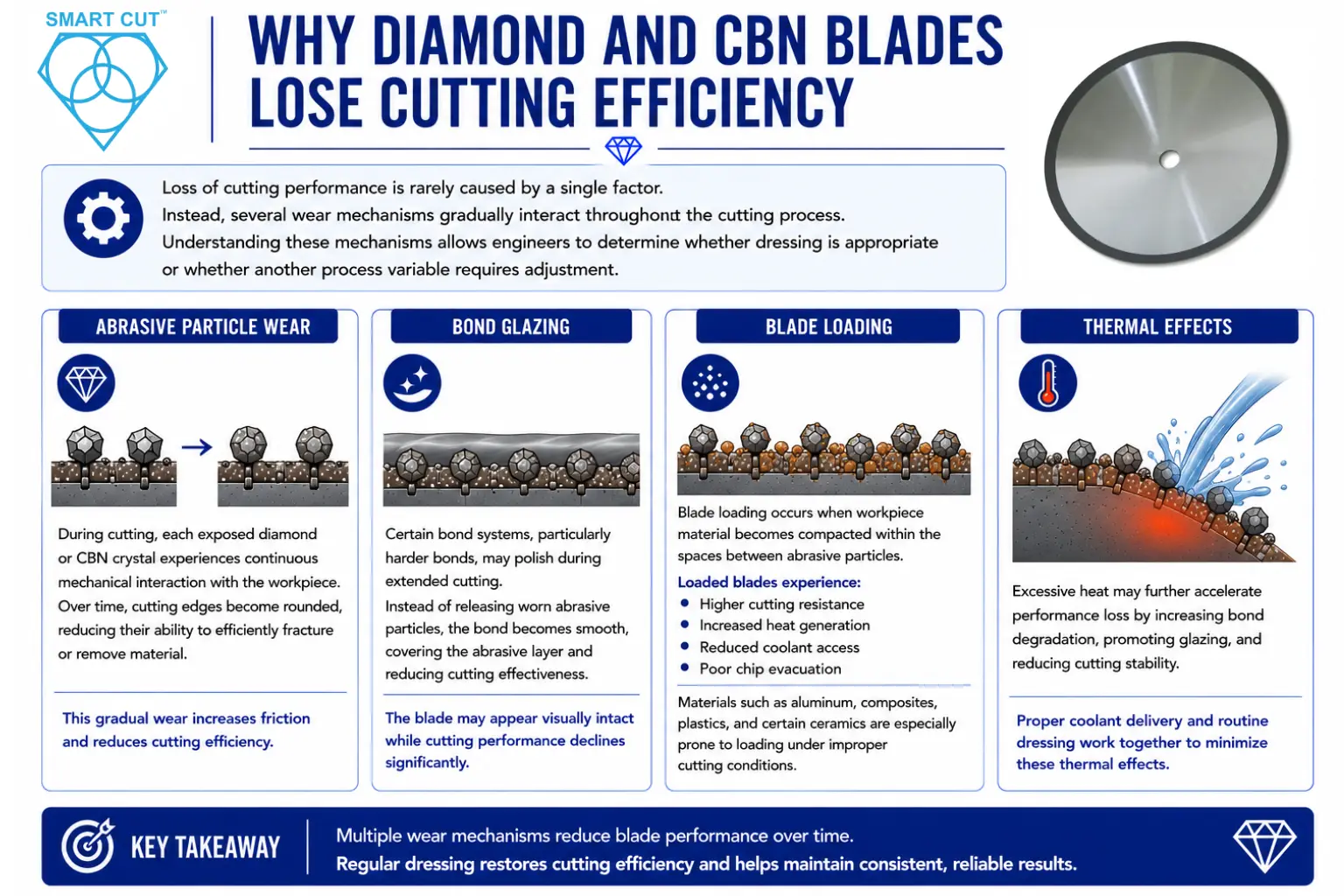
Loss of cutting performance is rarely caused by a single factor.
Instead, several wear mechanisms gradually interact throughout the cutting process.
Understanding these mechanisms allows engineers to determine whether dressing is appropriate or whether another process variable requires adjustment.
Abrasive Particle Wear
During cutting, each exposed diamond or CBN crystal experiences continuous mechanical interaction with the workpiece.
Although these abrasives are among the hardest materials available, they are not immune to wear.
Over time, cutting edges become rounded, reducing their ability to efficiently fracture or remove material.
This gradual wear increases friction and reduces cutting efficiency.
Bond Glazing
Certain bond systems, particularly harder bonds, may polish during extended cutting.
Instead of releasing worn abrasive particles, the bond becomes smooth, covering the abrasive layer and reducing cutting effectiveness.
The blade may appear visually intact while cutting performance declines significantly.
Blade Loading
Blade loading occurs when workpiece material becomes compacted within the spaces between abrasive particles.
Loaded blades experience:
- Higher cutting resistance
- Increased heat generation
- Reduced coolant access
- Poor chip evacuation
Materials such as aluminum, composites, plastics, and certain ceramics are especially prone to loading under improper cutting conditions.
Thermal Effects
Excessive heat may further accelerate performance loss by increasing bond degradation, promoting glazing, and reducing cutting stability.
Proper coolant delivery and routine dressing work together to minimize these thermal effects.
When Should a Diamond or CBN Blade Be Dressed?
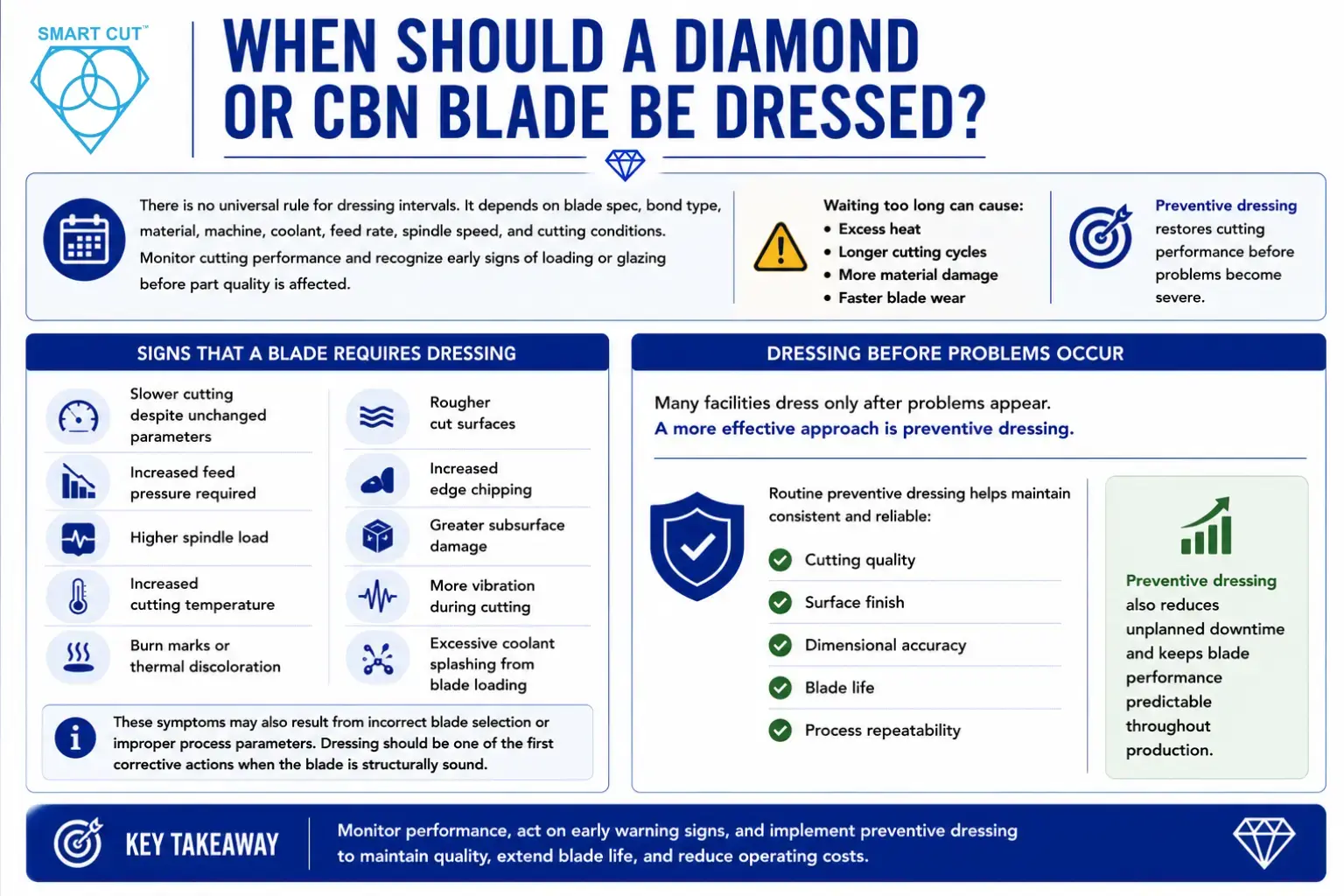
There is no universal rule that determines exactly when a diamond or CBN blade should be dressed.
The correct interval depends on numerous factors, including the blade specification, bond type, material being cut, machine rigidity, coolant delivery, feed rate, spindle speed, and overall cutting conditions.
Rather than following a fixed schedule, engineers should monitor changes in cutting performance and recognize the early indicators of blade loading or glazing before these conditions begin affecting part quality.
Waiting until a blade is no longer cutting efficiently often results in unnecessary heat generation, longer cutting cycles, increased material damage, and accelerated blade wear.
An effective preventive dressing program restores cutting performance before these problems become severe.
Signs That a Blade Requires Dressing
Most blades provide clear indications that cutting efficiency is beginning to decline.
Common symptoms include:
- Slower cutting despite unchanged process parameters
- Increased feed pressure is required to maintain cutting speed
- Higher spindle load
- Increased cutting temperature
- Burn marks or thermal discoloration
- Rougher cut surfaces
- Increased edge chipping
- Greater subsurface damage
- More vibration during cutting
- Excessive coolant splashing caused by blade loading
Although these symptoms may also result from incorrect blade selection or improper process parameters, dressing should be considered one of the first corrective actions when the blade remains structurally sound.
Dressing Before Problems Occur
Many laboratories and production facilities perform blade dressing only after significant cutting problems appear.
A more effective approach is preventive dressing.
By incorporating dressing into routine maintenance schedules, engineers can maintain more consistent:
- Cutting quality
- Surface finish
- Dimensional accuracy
- Blade life
- Process repeatability
Preventive dressing also reduces unplanned downtime because blade performance remains more predictable throughout production.
Factors That Affect Dressing Frequency
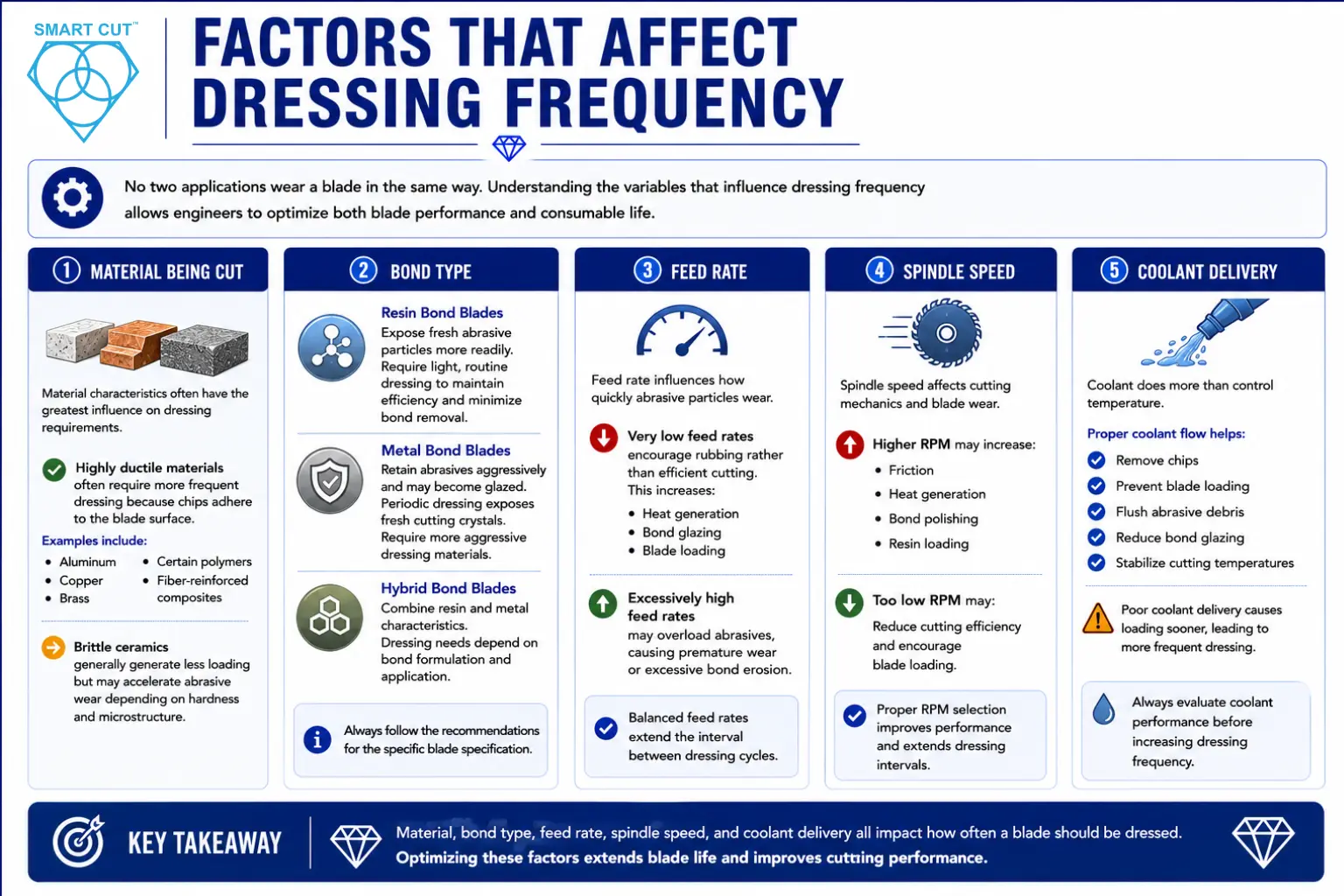
No two applications wear a blade in the same way.
Understanding the variables that influence dressing frequency allows engineers to optimize both blade performance and consumable life.
Material Being Cut
Material characteristics often have the greatest influence on dressing requirements.
Hard, brittle materials such as silicon carbide or alumina typically wear abrasive particles differently from ductile materials such as aluminum or copper alloys.
Some materials are primarily worn by the abrasive.
Others rapidly load the bond.
Highly ductile materials often require more frequent dressing because chips tend to adhere to the blade surface rather than fracture cleanly away.
Examples include:
- Aluminum
- Copper
- Brass
- Certain polymers
- Fiber-reinforced composites
Conversely, brittle ceramics generally generate less loading but may accelerate abrasive wear depending on their hardness and microstructure.
Bond Type
Bond characteristics strongly influence how frequently a blade should be dressed.
Resin Bond Blades
Resin bonds generally expose fresh abrasive particles more readily than harder bond systems.
Although they often require less aggressive dressing, loading may still occur when cutting softer or gummy materials.
Routine light dressing helps maintain cutting efficiency while minimizing unnecessary bond removal.
Metal Bond Blades
Metal bond blades retain abrasive particles much more aggressively.
As a result, they may become glazed if worn diamonds remain embedded within the bond.
Periodic dressing is therefore often necessary to expose fresh cutting crystals.
Metal bond systems typically require more aggressive dressing materials than resin bonds.
Hybrid Bond Blades
Hybrid bonds combine characteristics of both resin and metal systems.
Their dressing requirements depend upon the specific bond formulation and cutting application.
Engineers should always follow the recommendations provided for the particular blade specification.
Feed Rate
Feed rate influences how quickly abrasive particles wear.
Very low feed rates may encourage rubbing rather than efficient cutting.
This increases:
- Heat generation
- Bond glazing
- Blade loading
Excessively high feed rates may overload abrasive particles, causing premature wear or excessive bond erosion.
Maintaining balanced feed rates helps extend the interval between dressing cycles.
Spindle Speed
Spindle speed affects both cutting mechanics and blade wear.
Higher rotational speeds may increase:
- Friction
- Heat generation
- Bond polishing
- Resin loading
Conversely, spindle speeds that are too low may reduce cutting efficiency and encourage blade loading.
Proper RPM selection, therefore, contributes to longer dressing intervals while improving overall cutting performance.
Coolant Delivery
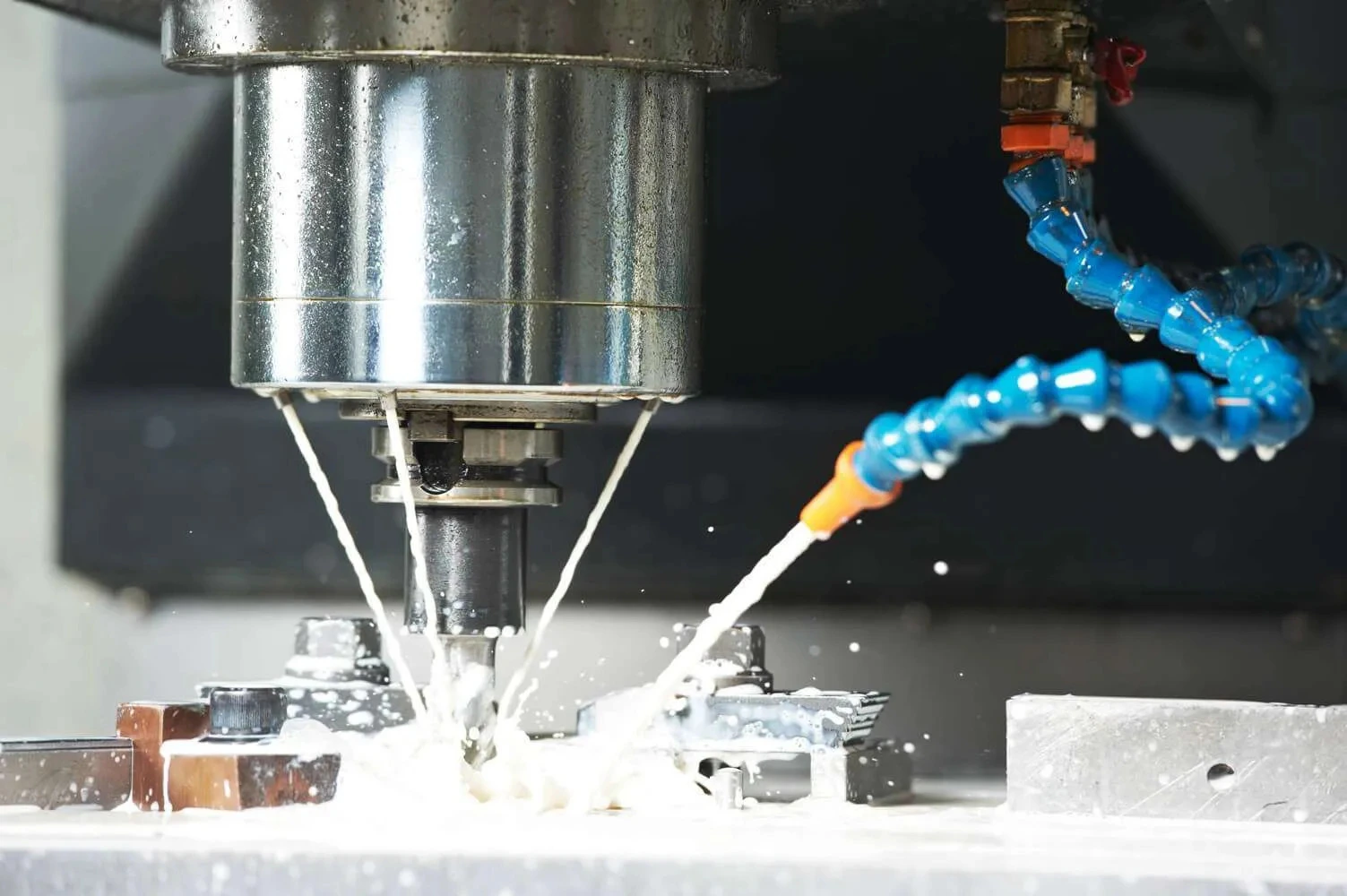
Coolant performs several important functions beyond temperature control.
Proper coolant flow helps:
- Remove chips
- Prevent blade loading
- Flush abrasive debris
- Reduce bond glazing
- Stabilize cutting temperatures
Poor coolant delivery often causes operators to dress blades more frequently than necessary because loading occurs much sooner.
Before increasing dressing frequency, coolant performance should always be evaluated.
Dressing Methods for Different Bond Types
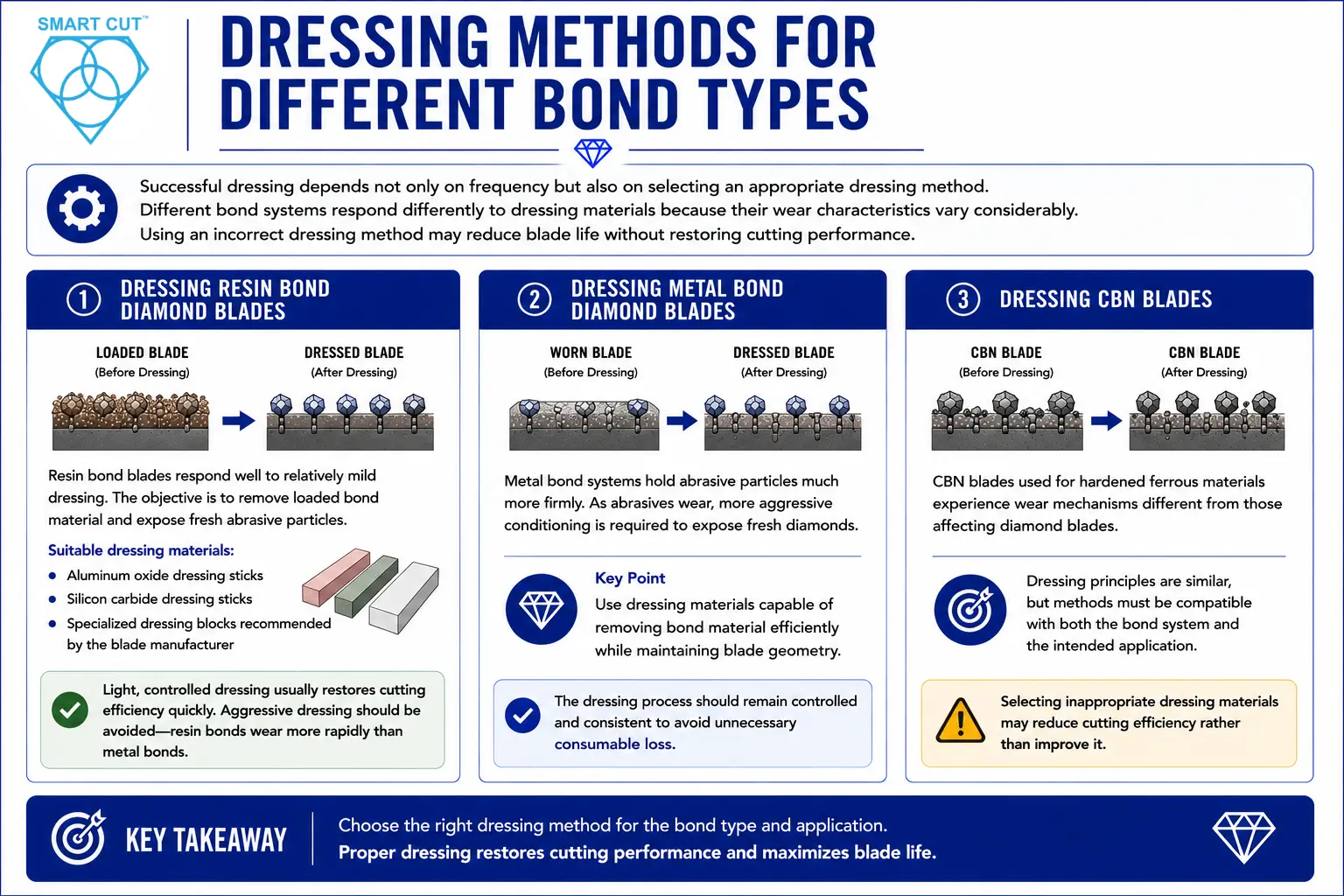
Successful dressing depends not only on frequency but also on selecting an appropriate dressing method.
Different bond systems respond differently to dressing materials because their wear characteristics vary considerably.
Using an incorrect dressing method may reduce blade life without restoring cutting performance.
Dressing Resin Bond Diamond Blades
Resin bond blades generally respond well to relatively mild dressing procedures.
The objective is to remove loaded bond material while exposing fresh abrasive particles without unnecessarily removing bond volume.
Suitable dressing materials commonly include:
- Aluminum oxide dressing sticks
- Silicon carbide dressing sticks
- Specialized dressing blocks recommended by the blade manufacturer
Light, controlled dressing usually restores cutting efficiency quickly.
Aggressive dressing should generally be avoided because resin bonds wear more rapidly than metal bonds.
Dressing Metal Bond Diamond Blades
Metal bond systems hold abrasive particles much more firmly.
As abrasive particles become worn, the surrounding bond may require more aggressive conditioning before fresh diamonds become exposed.
Metal bond blades therefore often require dressing materials capable of removing bond material efficiently while maintaining blade geometry.
The dressing process should remain controlled and consistent to avoid unnecessary consumable loss.
Dressing CBN Blades
CBN blades used for hardened ferrous materials experience wear mechanisms different from those affecting diamond blades.
Although the dressing principles remain similar, dressing methods should always be compatible with both the bond system and the intended application.
Selecting inappropriate dressing materials may reduce cutting efficiency rather than improve it.
Selecting the Right Dressing Material
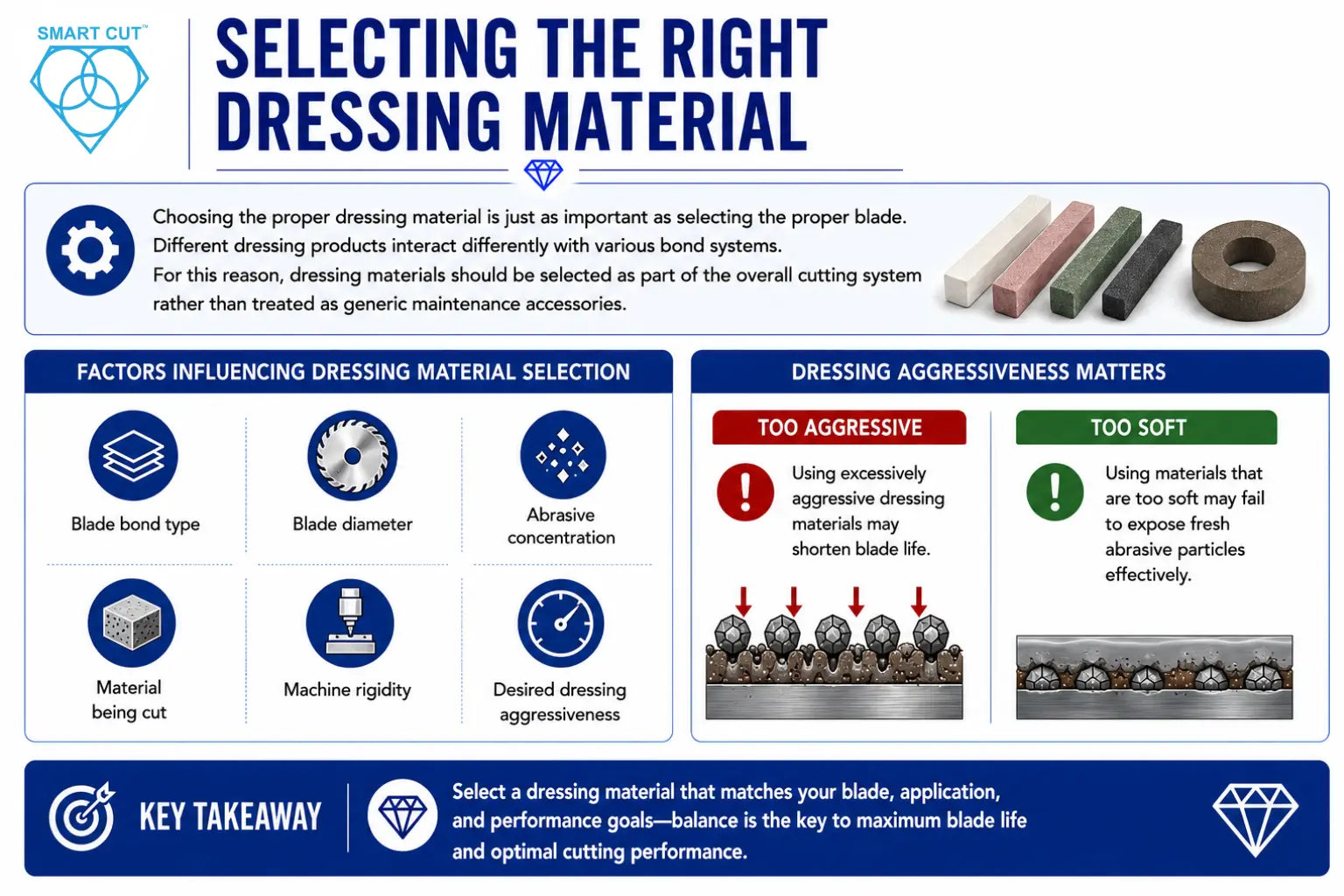
Choosing the proper dressing material is just as important as selecting the proper blade.
Different dressing products interact differently with various bond systems.
Factors influencing dressing material selection include:
- Blade bond type
- Blade diameter
- Abrasive concentration
- Material being cut
- Machine rigidity
- Desired dressing aggressiveness
Using excessively aggressive dressing materials may shorten blade life.
Using materials that are too soft may fail to expose fresh abrasive particles effectively.
For this reason, dressing materials should be selected as part of the overall cutting system rather than treated as generic maintenance accessories.
Material-Specific Dressing Recommendations
Different workpiece materials create different wear mechanisms.
Consequently, dressing intervals should often be adjusted according to the application.
| Material | Typical Dressing Requirement |
|---|---|
| Silicon | Moderate |
| Sapphire | Moderate |
| Alumina | Moderate to Frequent |
| Zirconia | Moderate |
| Silicon Carbide | Frequent |
| Tungsten Carbide | Moderate |
| Glass | Light to Moderate |
| Aluminum | Frequent |
| Copper | Frequent |
| Fiber-Reinforced Composites | Moderate to Frequent |
Actual dressing frequency depends upon blade specification, cutting parameters, coolant performance, and machine condition.
These recommendations should therefore be viewed as general engineering guidelines rather than fixed maintenance intervals.
Common Dressing Mistakes and Their Consequences
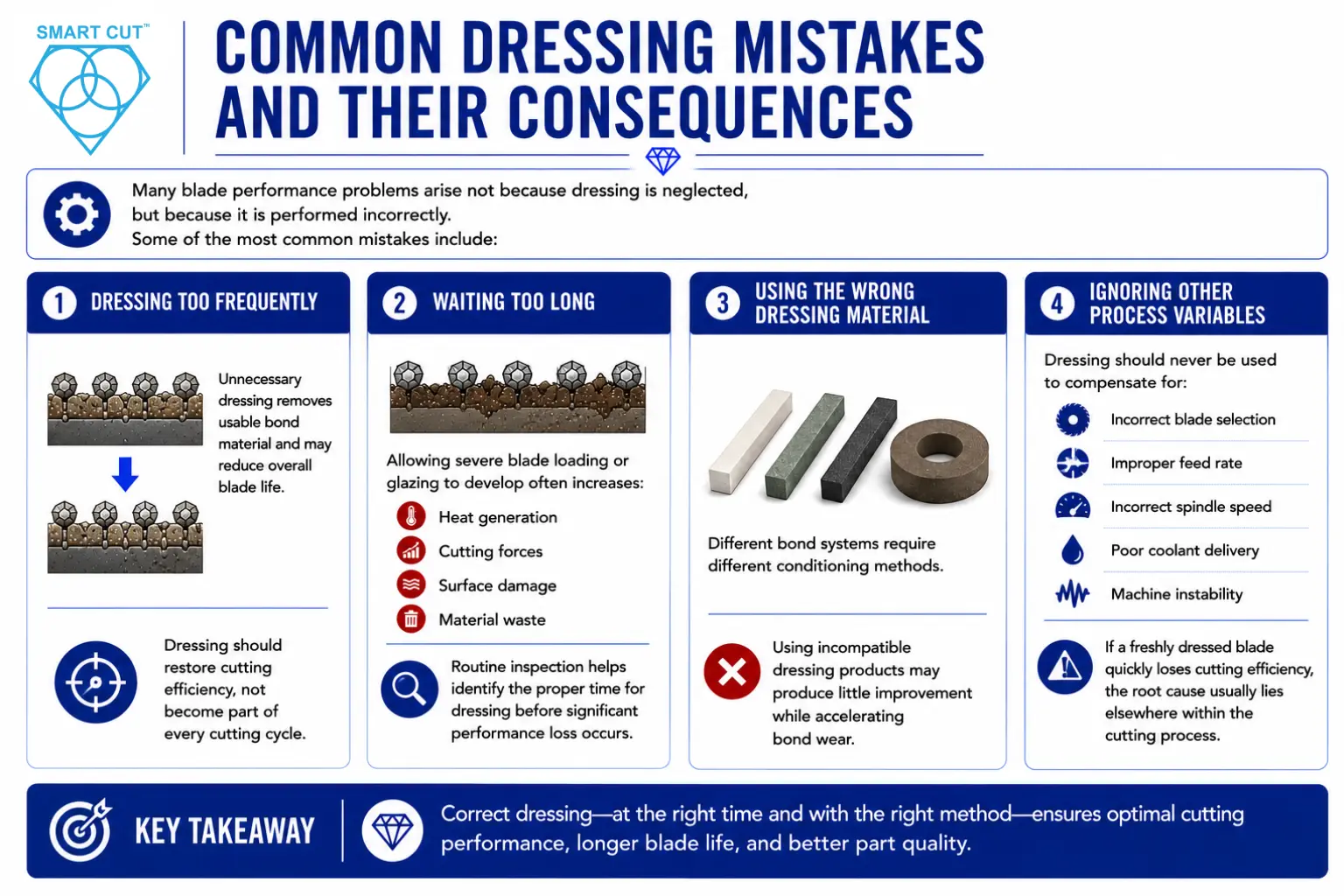
Many blade performance problems arise not because dressing is neglected, but because it is performed incorrectly.
Some of the most common mistakes include:
Dressing Too Frequently
Unnecessary dressing removes usable bond material and may reduce overall blade life.
Dressing should restore cutting efficiency, not become part of every cutting cycle.
Waiting Too Long
Allowing severe blade loading or glazing to develop often increases:
- Heat generation
- Cutting forces
- Surface damage
- Material waste
Routine inspection helps identify the proper time for dressing before significant performance loss occurs.
Using the Wrong Dressing Material
Different bond systems require different conditioning methods.
Using incompatible dressing products may produce little improvement while accelerating bond wear.
Ignoring Other Process Variables
Dressing should never be used to compensate for:
- Incorrect blade selection
- Improper feed rate
- Incorrect spindle speed
- Poor coolant delivery
- Machine instability
If a freshly dressed blade quickly loses cutting efficiency, the root cause usually lies elsewhere within the cutting process.
Troubleshooting Poor Cutting Performance
Before replacing a blade, engineers should systematically evaluate the complete cutting system.
Symptoms such as slower cutting, higher temperatures, or increased edge chipping may originate from several different sources.
A structured troubleshooting approach should include inspection of:
- Blade condition
- Dressing history
- Bond loading
- Coolant delivery
- Feed rate
- RPM
- Machine rigidity
- Workholding stability
- Blade mounting
Only after these factors have been evaluated should blade replacement be considered.
In many cases, proper dressing combined with minor process adjustments restores cutting performance without requiring a new blade.
Engineering Case Study: Restoring Cutting Performance Through Proper Blade Dressing
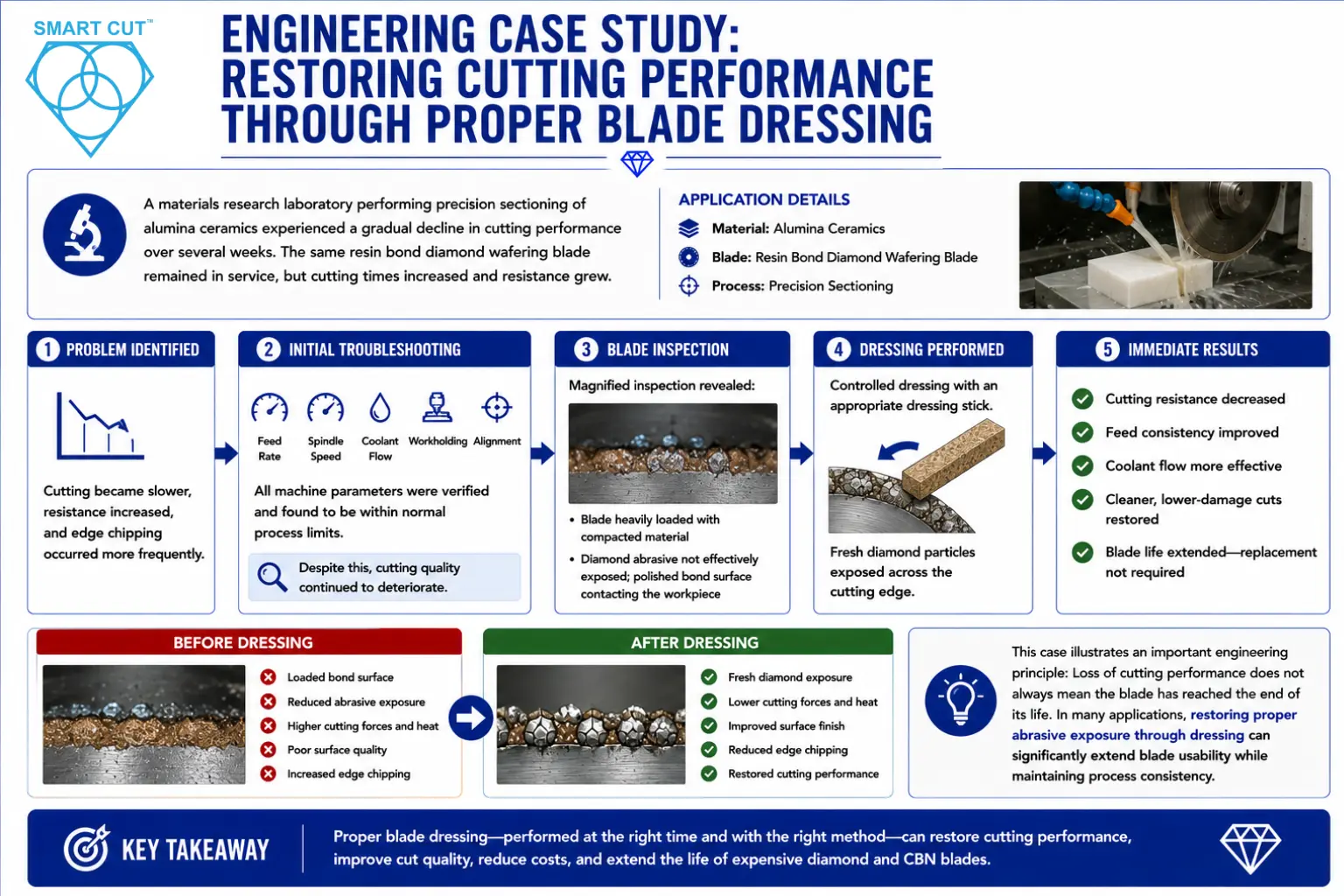
A materials research laboratory performing precision sectioning of alumina ceramics began experiencing a gradual decline in cutting performance over several weeks. Although the same resin bond diamond wafering blade remained in service, operators reported noticeably longer cutting times and increasing resistance during sectioning.
Initial troubleshooting focused on machine parameters.
Feed rate, spindle speed, coolant flow, workholding, and machine alignment were all verified and found to be operating within normal process limits. Despite these checks, cutting quality continued to deteriorate, and edge chipping became increasingly common.
Rather than replacing the blade immediately, the engineering team inspected the cutting edge under magnification.
The inspection revealed that the blade had become heavily loaded with compacted material and that much of the diamond abrasive was no longer effectively exposed. Instead of sharp cutting crystals engaging the workpiece, a polished bond surface was contacting the material.
After performing a controlled dressing procedure using an appropriate dressing stick, fresh diamond particles were exposed across the cutting edge.
The results were immediately noticeable.
Cutting resistance decreased, feed consistency improved, coolant flow became more effective at the cutting interface, and the blade resumed producing cleaner, lower-damage cuts without requiring replacement.
This example illustrates an important engineering principle.
Loss of cutting performance does not always indicate that a blade has reached the end of its service life. In many applications, restoring proper abrasive exposure through dressing can significantly extend blade usability while maintaining process consistency.
Developing a Preventive Dressing Program
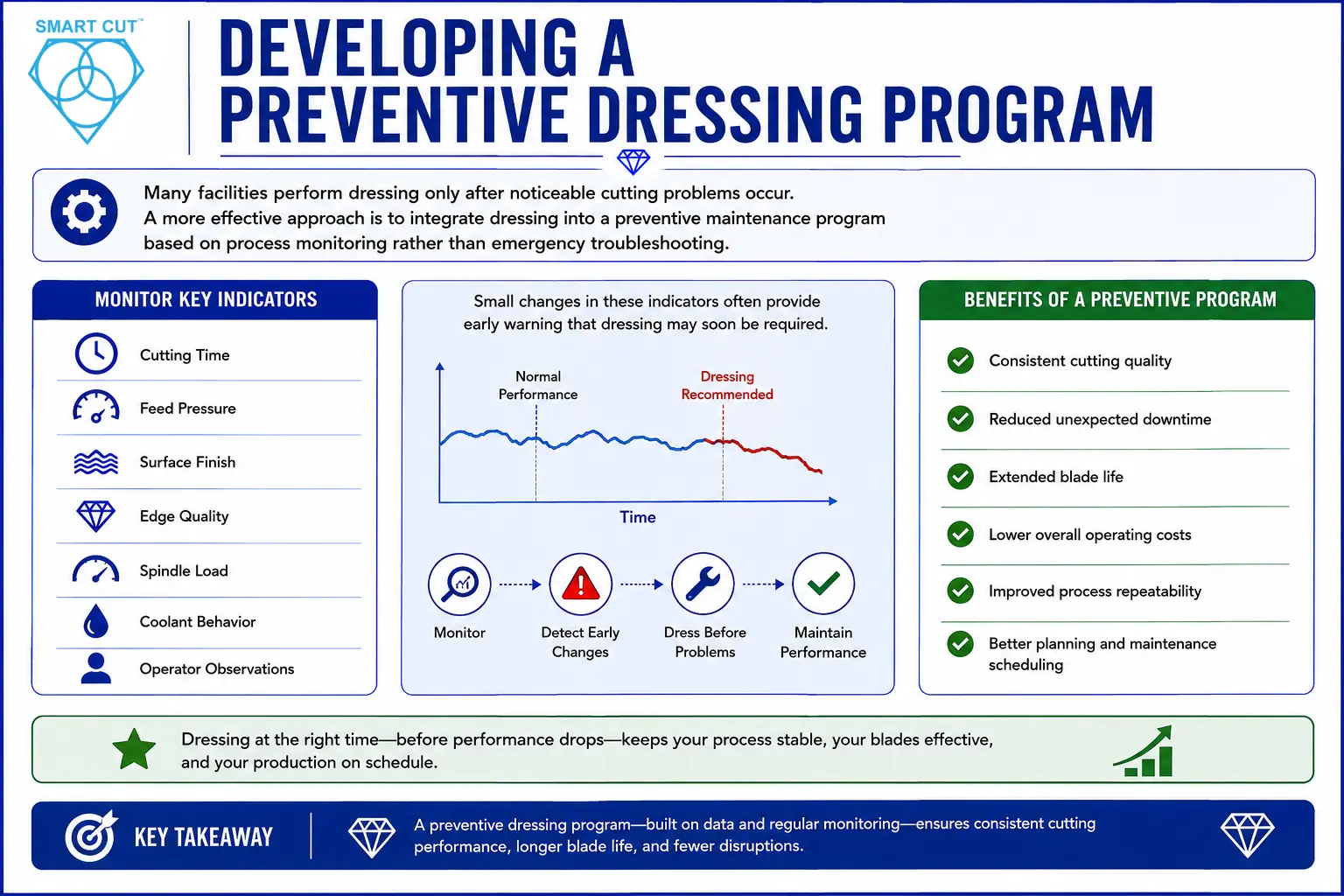
Many facilities perform dressing only after noticeable cutting problems occur.
A more effective approach is to integrate dressing into a preventive maintenance program based on process monitoring rather than emergency troubleshooting.
Instead of reacting to declining blade performance, engineers should routinely monitor indicators such as:
- Cutting time
- Feed pressure
- Surface finish
- Edge quality
- Spindle load
- Coolant behavior
- Operator observations
Small changes in these indicators often provide early warning that dressing may soon be required.
Recording dressing intervals also helps establish predictable maintenance schedules for different materials and blade specifications.
Over time, this creates a more repeatable cutting process while reducing unexpected downtime and unnecessary blade replacement.
Blade Dressing Decision Guide
The following decision process can help determine the appropriate corrective action when blade performance begins to decline.
| Observation | Likely Cause | Recommended Action |
|---|---|---|
| Cutting becomes slower | Blade loading or glazing | Inspect the blade and perform dressing if appropriate |
| Higher cutting temperatures | Reduced abrasive exposure | Verify coolant and dress blade |
| Increased edge chipping | Higher cutting forces | Inspect blade, optimize cutting parameters, and dress if required |
| Rough surface finish | Worn or loaded cutting surface | Dress the blade and verify process settings |
| Blade still performs poorly after dressing | Blade wear or incorrect specification | Evaluate blade selection and consider replacement |
A structured approach prevents unnecessary blade replacement while ensuring that underlying process problems are not overlooked.
Recommended UKAM Products
Proper blade maintenance requires selecting both the correct cutting tool and the appropriate conditioning products.
Depending on the application, UKAM offers solutions including:
- Diamond Dressing Sticks
- Precision Diamond Wafering Blades
- Precision Diamond Cut-Off Wheels
- CBN Cut-Off Wheels
- Resin Bond Diamond Blades
- Metal Bond Diamond Blades
- Hybrid Bond Diamond Blades
- Precision Sectioning Saws
- Precision Cutting Machines
- Water-Soluble Cutting Coolants
Selecting the correct combination of blade specification, bond type, dressing material, coolant, and cutting parameters helps maximize blade performance while improving overall process efficiency.
Frequently Asked Questions
Dressing restores cutting efficiency by exposing fresh diamond particles and removing loaded or glazed bond material from the cutting surface.
No. Sharpening recreates a cutting edge on conventional tools, while dressing restores abrasive exposure on diamond or CBN blades.
There is no universal interval. Dressing frequency depends on the blade specification, bond type, workpiece material, cutting parameters, coolant performance, and production requirements.
Yes. Proper dressing restores cutting efficiency and often delays blade replacement by maintaining effective abrasive exposure.
Not necessarily. Some applications require frequent dressing, while others experience minimal blade loading and may require dressing only occasionally.
Glazing occurs when the bond surface becomes polished and worn abrasive particles are no longer released efficiently, preventing fresh cutting crystals from engaging the workpiece.
Blade loading occurs when workpiece material becomes embedded between abrasive particles, reducing cutting efficiency and increasing friction.
Yes. Excessive or inappropriate dressing may remove unnecessary bond material and shorten blade life.
Yes. Their wear characteristics differ significantly, and dressing procedures should be matched to the bond system being used.
Yes. Insufficient coolant promotes blade loading, glazing, and heat generation, often requiring more frequent dressing.
No. A decline in cutting performance may simply indicate that the blade requires dressing rather than replacement.
In many applications, restoring proper abrasive exposure helps reduce cutting forces and improve surface quality.
When blade loading or glazing is the root cause of increased cutting forces, proper dressing can help reduce edge chipping and improve cut consistency.
Materials prone to loading, such as aluminum, copper, certain composites, and some polymers, often require more frequent dressing than brittle materials.
Routine inspection of cutting performance, blade condition, spindle load, cutting temperature, and surface quality provides reliable indicators that dressing may be beneficial.
Conclusion
Diamond and CBN blade dressing is one of the simplest yet most effective maintenance practices for preserving cutting performance throughout the life of a precision blade.
Rather than viewing dressing as a corrective action performed only after cutting quality declines, manufacturers and laboratories should incorporate it into a preventive process control strategy. Restoring abrasive exposure at the appropriate time helps maintain lower cutting forces, stable temperatures, consistent surface quality, and predictable process repeatability.
At the same time, dressing should never be considered a substitute for proper blade selection or optimized cutting parameters. Feed rate, spindle speed, coolant delivery, machine rigidity, and bond selection all influence blade performance and determine how frequently dressing is required.
When these variables are managed together, engineers can significantly improve blade utilization while reducing downtime, consumable costs, and unnecessary blade replacement.
If you’re experiencing reduced cutting efficiency, blade loading, excessive heat generation, or inconsistent cut quality, UKAM’s applications engineering team can help evaluate your process and recommend the appropriate blade specification, dressing material, cutting parameters, and maintenance strategy for your specific application.
Trusted by Tens of Thousands of Manufacturers, Laboratories,
Research Institutions Worldwide Since 1990
American Based Manufacturer
Established in 1990
Custom manufacturing
RELATED ARTICLES

Brian is an experienced professional in the field of precision cutting tools, with over 27 years of experience in technical support. Over the years, he has helped engineers, manufacturers, researchers, and contractors find the right solutions for working with advanced and hard-to-cut materials. He’s passionate about bridging technical knowledge with real-world applications to improve efficiency and accuracy.
As an author, Brian Farberov writes extensively on diamond tool design, application engineering, return on investment strategies, and process optimization, combining technical depth with a strong understanding of customer needs and market dynamics.