








Home > Blog > Diamond Milling Tools for Precision Machining of Advanced Materials
Diamond Tooling Articles, blog, Materials

Diamond Milling Tools for Precision Machining of Advanced Materials

Table of Contents

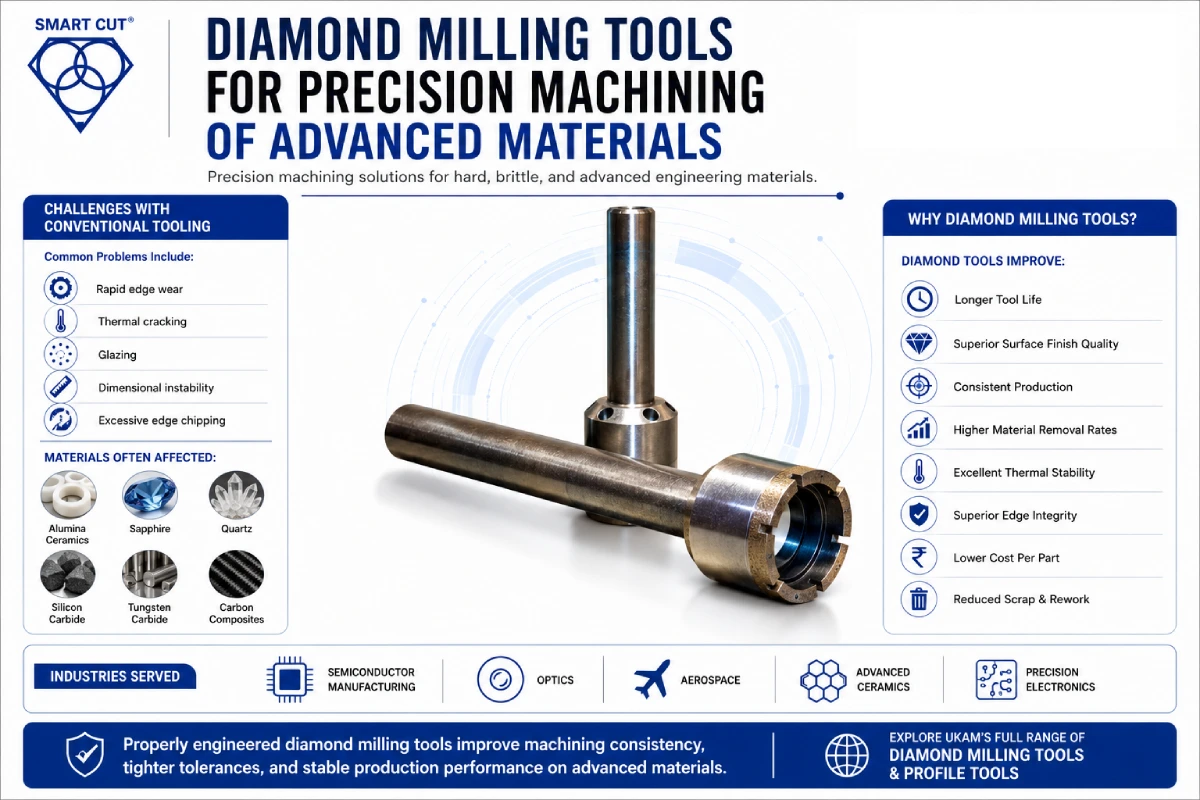
Conventional carbide end mills and abrasive tooling often struggle when machining advanced engineering materials such as alumina ceramics, sapphire, quartz, silicon carbide, ferrites, tungsten carbide, and carbon composites. In production environments, problems such as rapid edge wear, thermal cracking, glazing, dimensional instability, and excessive edge chipping become increasingly common as material hardness and brittleness increase.

For many manufacturers, the issue is not simply removing material — it is maintaining dimensional accuracy, surface integrity, repeatability, and stable production performance while minimizing scrap and tool replacement costs.

This is where diamond milling tools become critical.

Unlike conventional carbide tooling that relies primarily on shearing action, diamond milling tools machine hard and brittle materials through controlled abrasive interaction. Properly engineered diamond tools reduce cutting forces, improve edge quality, maintain tighter tolerances, and significantly improve machining consistency on materials that conventional tools cannot process efficiently.

In industries such as semiconductor manufacturing, optics, aerospace, advanced ceramics, and precision electronics, selecting the correct diamond milling tool directly affects:

  • Tool life
  • Surface finish quality
  • Production consistency
  • Material removal rates
  • Thermal stability
  • Edge integrity
  • Cost per part
  • Scrap reduction

Explore UKAM’s full range of Diamond Milling Tools & Profile Tools

Trusted by Tens of Thousands of Manufacturers, Laboratories Research Institutions Worldwide Since 1990

American Based Manufacturer

Established in 1990

Custom manufacturing

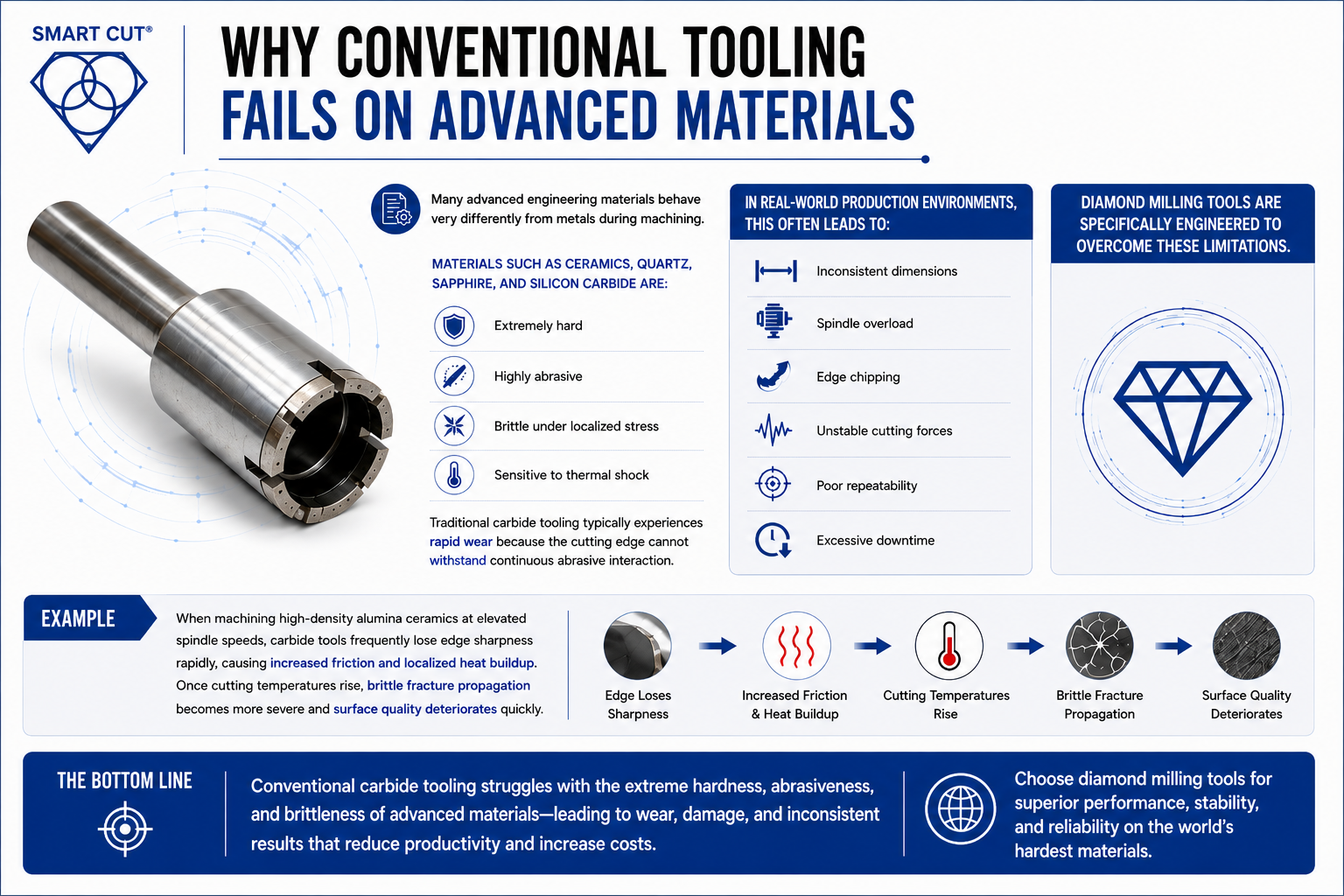
Why Conventional Tooling Fails on Advanced Materials
Many advanced engineering materials behave very differently from metals during machining.

Materials such as ceramics, quartz, sapphire, and silicon carbide are:

  • extremely hard
  • highly abrasive
  • brittle under localized stress
  • sensitive to thermal shock

Traditional carbide tooling typically experiences rapid wear because the cutting edge cannot withstand continuous abrasive interaction.

In real-world production environments, this often leads to:

  • inconsistent dimensions
  • spindle overload
  • edge chipping
  • unstable cutting forces
  • poor repeatability
  • excessive downtime

For example, when machining high-density alumina ceramics at elevated spindle speeds, carbide tools frequently lose edge sharpness rapidly, causing increased friction and localized heat buildup. Once cutting temperatures rise, brittle fracture propagation becomes more severe and surface quality deteriorates quickly.

Diamond milling tools are specifically engineered to overcome these limitations.

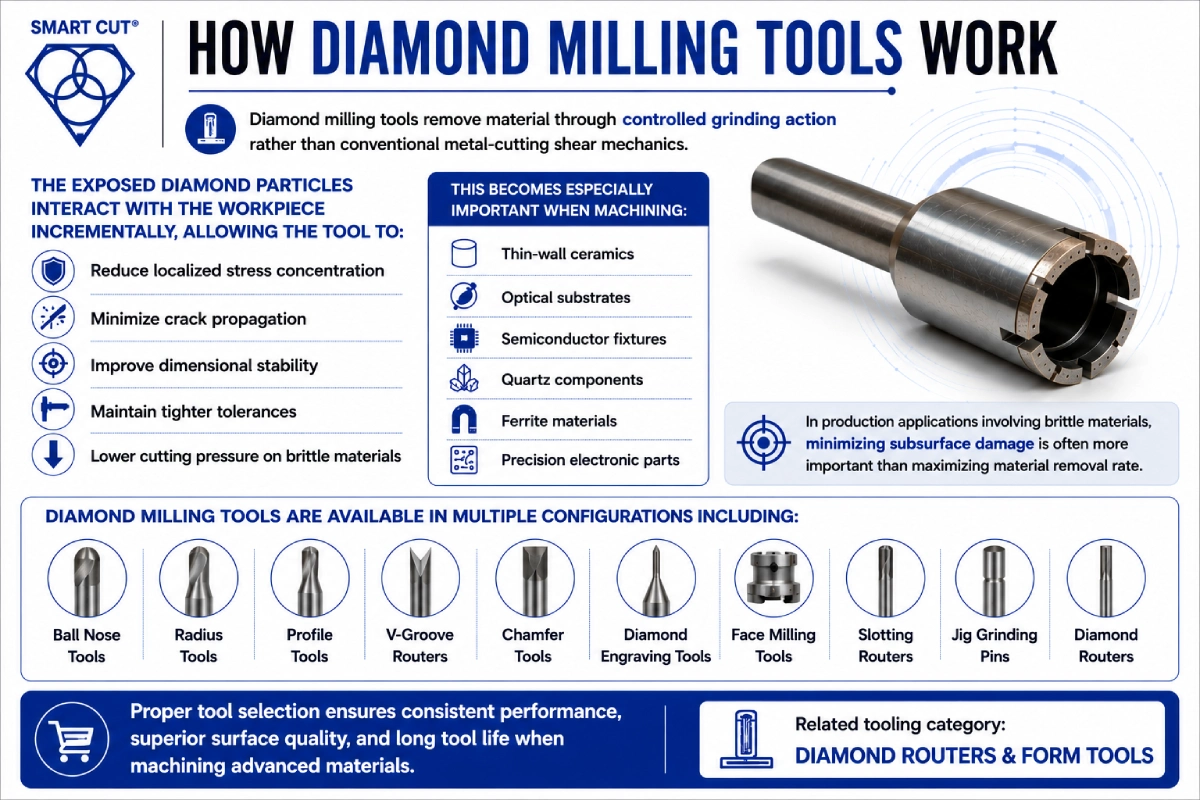
How Diamond Milling Tools Work

Diamond milling tools remove material through controlled grinding action rather than conventional metal-cutting shear mechanics.

The exposed diamond particles interact with the workpiece incrementally, allowing the tool to:

  • reduce localized stress concentration
  • minimize crack propagation
  • improve dimensional stability
  • maintain tighter tolerances
  • lower cutting pressure on brittle materials

This becomes especially important when machining:

  • thin-wall ceramics
  • optical substrates
  • semiconductor fixtures
  • quartz components
  • ferrite materials
  • precision electronic parts

In production applications involving brittle materials, minimizing subsurface damage is often more important than maximizing material removal rate.

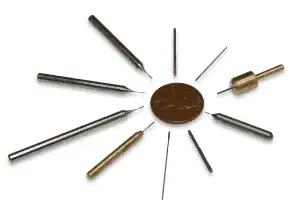
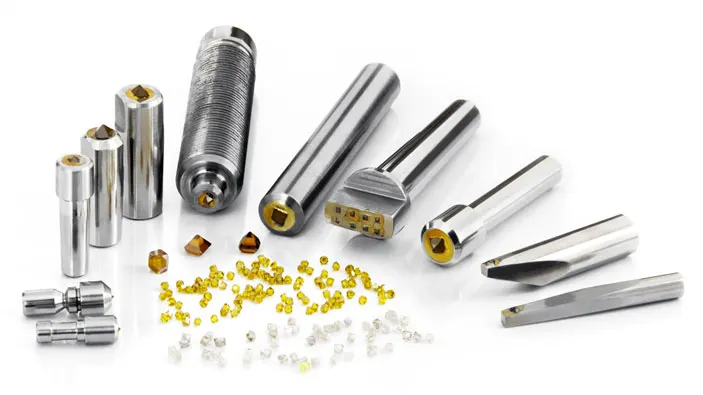
Diamond milling tools are available in multiple configurations including:

  • Ball nose tools
  • Radius tools
  • Profile tools
  • V-groove routers
  • Chamfer tools
  • Diamond engraving tools
  • Face milling tools
  • Slotting routers
  • Jig grinding pins
  • Diamond routers

Related tooling category: Diamond Routers & Form Tools

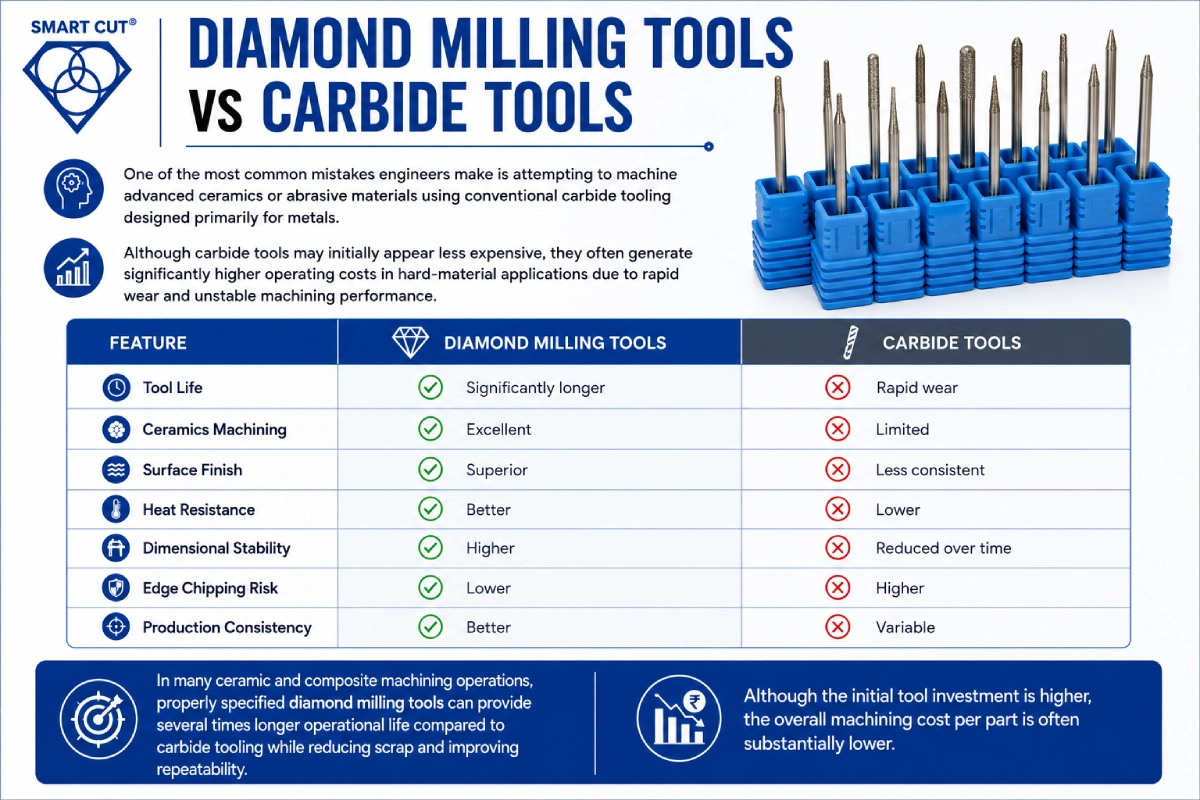
Diamond Milling Tools vs Carbide Tools

One of the most common mistakes engineers make is attempting to machine advanced ceramics or abrasive materials using conventional carbide tooling designed primarily for metals.

Although carbide tools may initially appear less expensive, they often generate significantly higher operating costs in hard-material applications due to rapid wear and unstable machining performance.

FeatureDiamond Milling ToolsCarbide Tools
Tool LifeSignificantly LongerRapid Wear
Ceramics MachiningExcellentLimited
Surface FinishSuperiorLess Consistent
Heat ResistanceBetterLower
Dimensional StabilityHigherReduced Over Time
Edge Chipping RiskLowerHigher
Production ConsistencyBetterVariable

In many ceramic and composite machining operations, properly specified diamond milling tools can provide several times longer operational life compared to carbide tooling while reducing scrap and improving repeatability.

Although the initial tool investment is higher, the overall machining cost per part is often substantially lower.

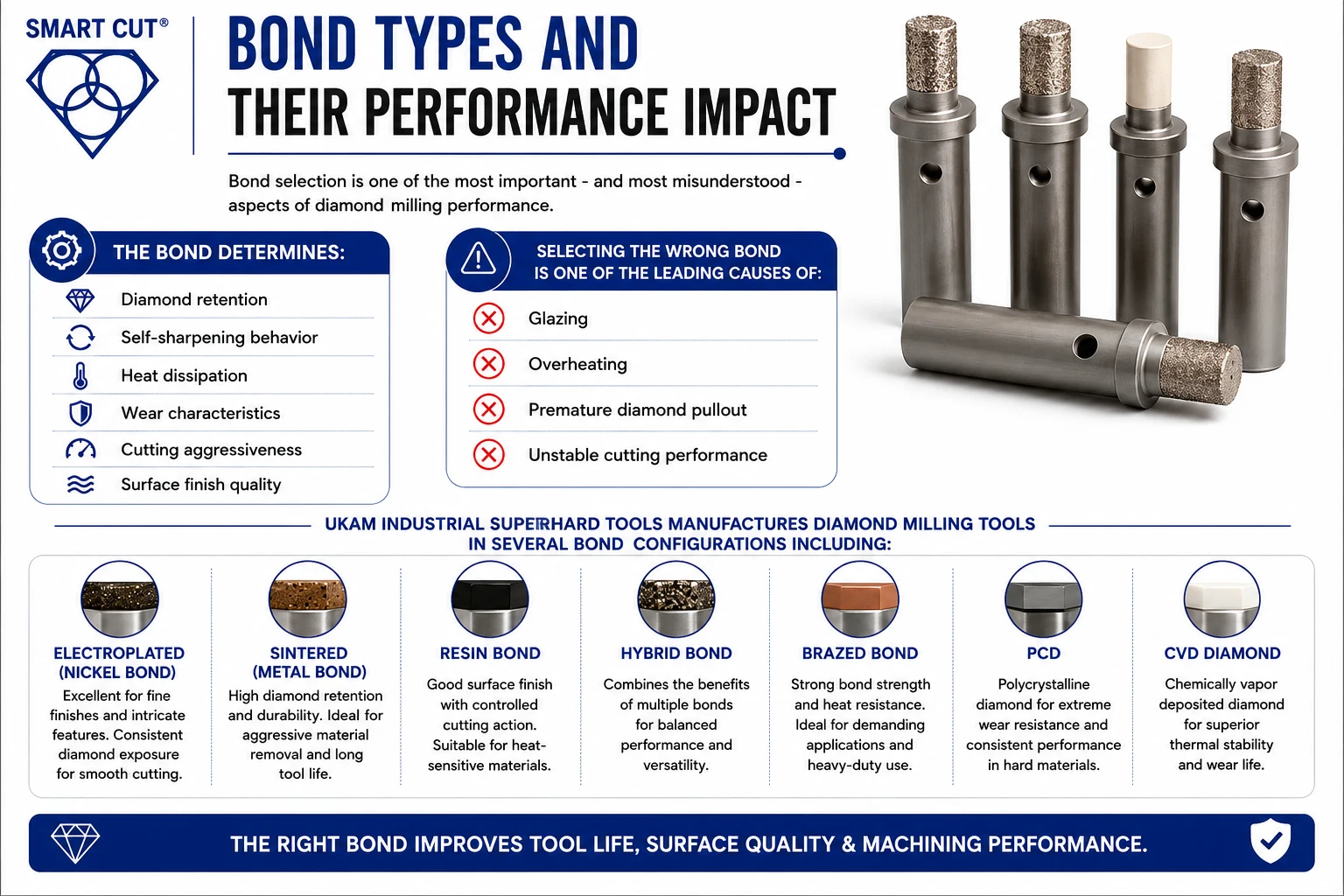
Bond Types and Their Performance Impact

Bond selection is one of the most important – and most misunderstood – aspects of diamond milling performance.

The bond determines:

  • diamond retention
  • self-sharpening behavior
  • heat dissipation
  • wear characteristics
  • cutting aggressiveness
  • surface finish quality

Selecting the wrong bond is one of the leading causes of:

  • glazing
  • overheating
  • premature diamond pullout
  • unstable cutting performance

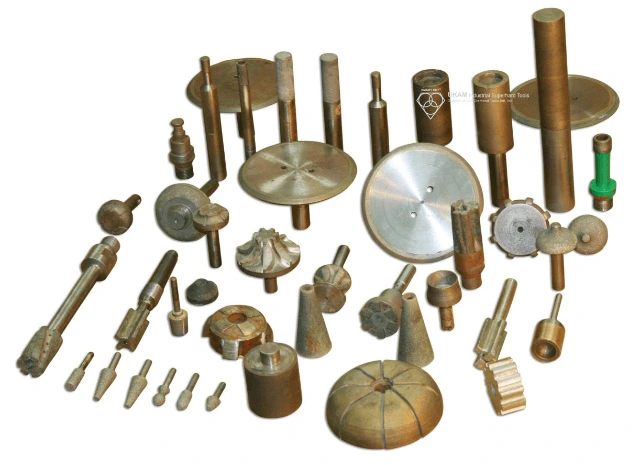
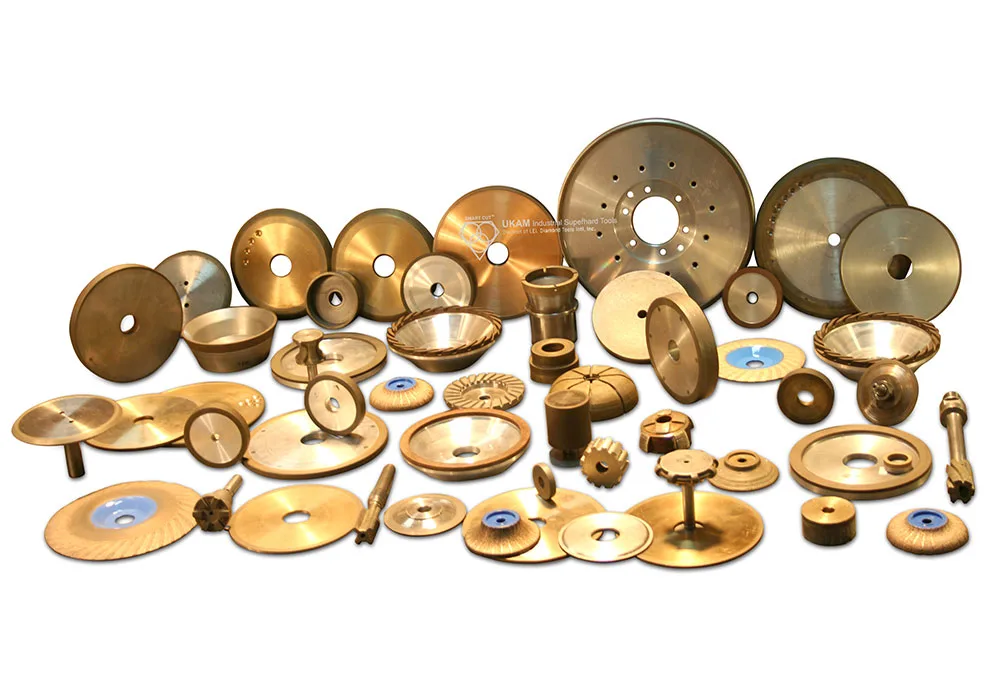
UKAM Industrial Superhard Tools manufactures diamond milling tools in several bond configurations including:

  • Electroplated (Nickel Bond)
  • Sintered (Metal Bond)
  • Resin Bond
  • Hybrid Bond
  • Brazed Bond
  • PCD
  • CVD Diamond

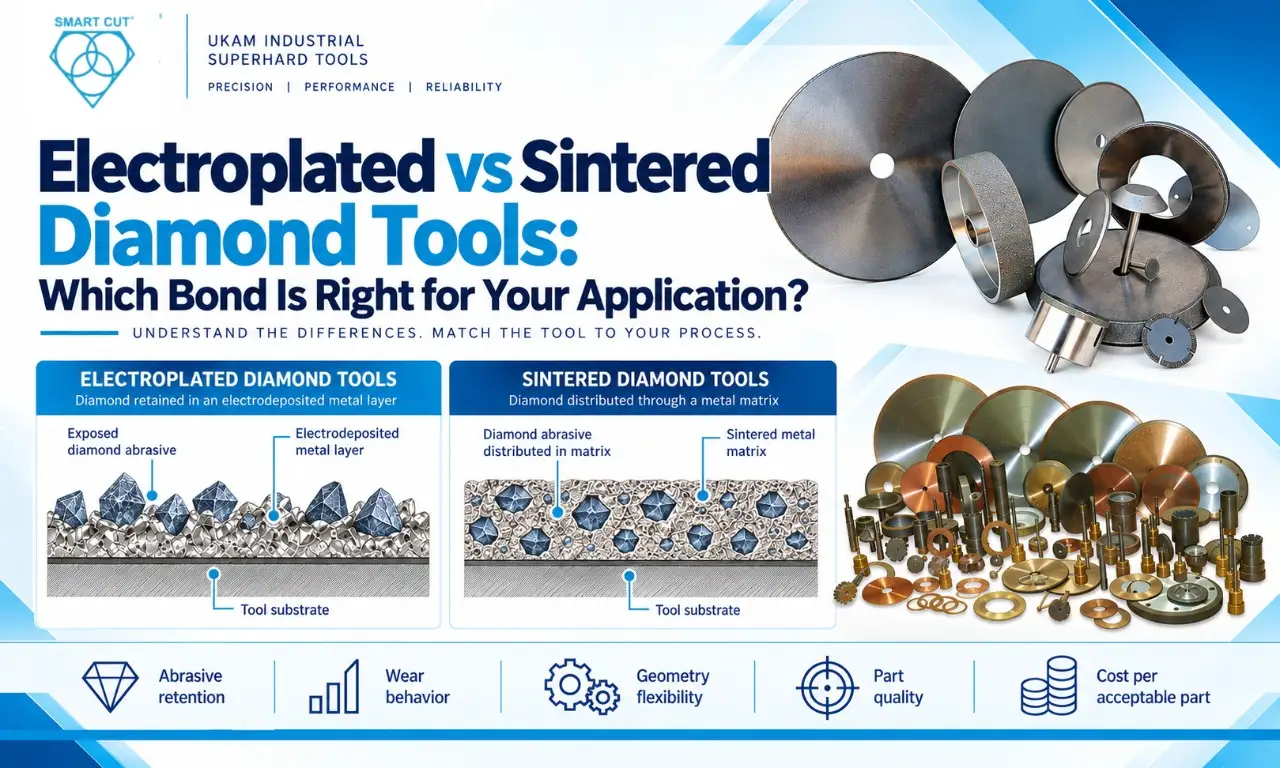
Electroplated Diamond Milling Tools

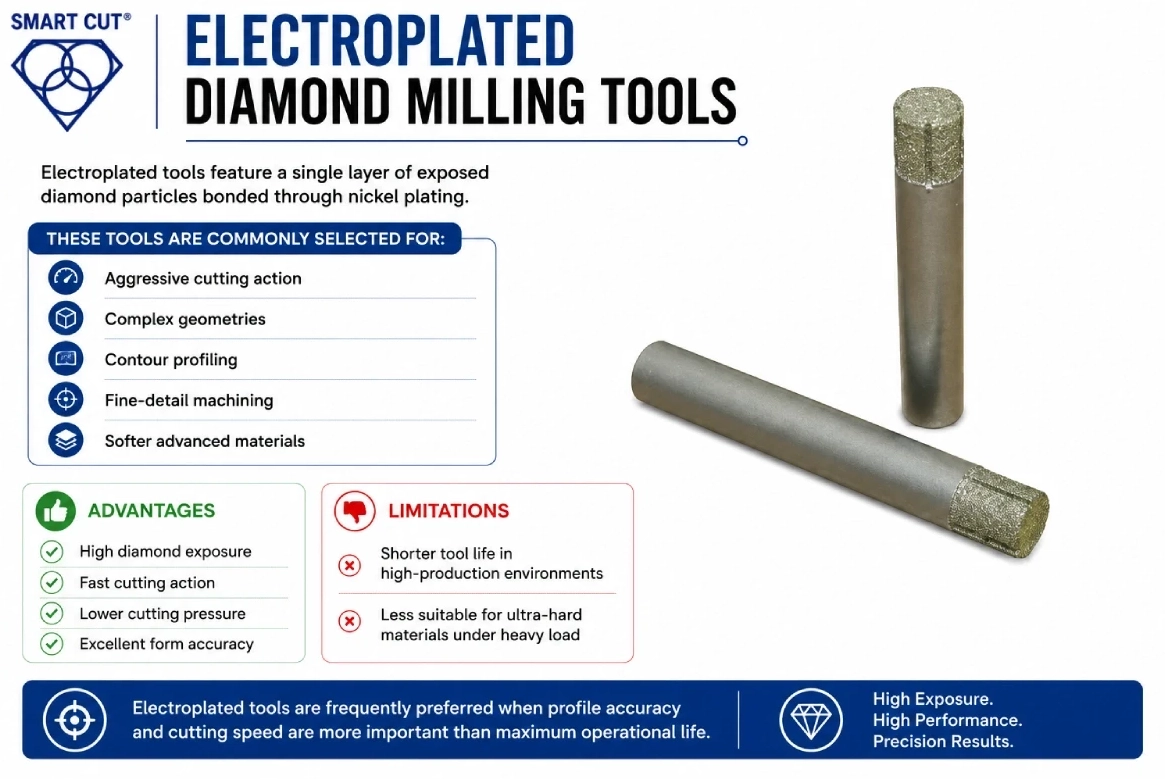
Electroplated tools feature a single layer of exposed diamond particles bonded through nickel plating.

These tools are commonly selected for:

  • aggressive cutting action
  • complex geometries
  • contour profiling
  • fine-detail machining
  • softer advanced materials

Advantages

  • High diamond exposure
  • Fast cutting action
  • Lower cutting pressure
  • Excellent form accuracy

Limitations

  • Shorter tool life in high-production environments
  • Less suitable for ultra-hard materials under heavy load

Electroplated tools are frequently preferred when profile accuracy and cutting speed are more important than maximum operational life.

Sintered (Metal Bond) Diamond Milling Tools

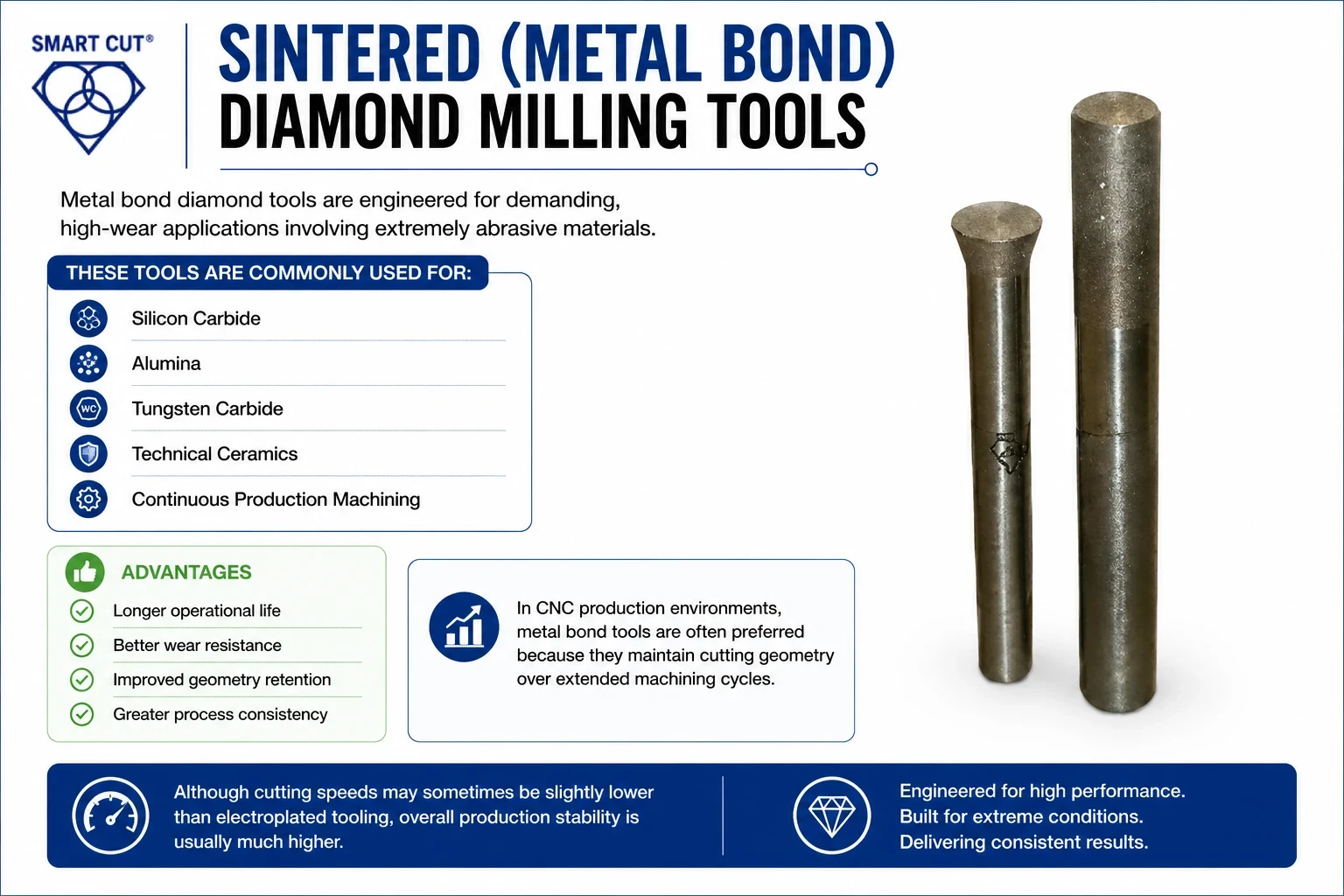
Metal bond diamond tools are engineered for demanding, high-wear applications involving extremely abrasive materials.

These tools are commonly used for:

  • silicon carbide
  • alumina
  • tungsten carbide
  • technical ceramics
  • continuous production machining

Advantages

  • Longer operational life
  • Better wear resistance
  • Improved geometry retention
  • Greater process consistency

In CNC production environments, metal bond tools are often preferred because they maintain cutting geometry over extended machining cycles.

Although cutting speeds may sometimes be slightly lower than electroplated tooling, overall production stability is usually much higher.

Resin Bond Diamond Milling Tools

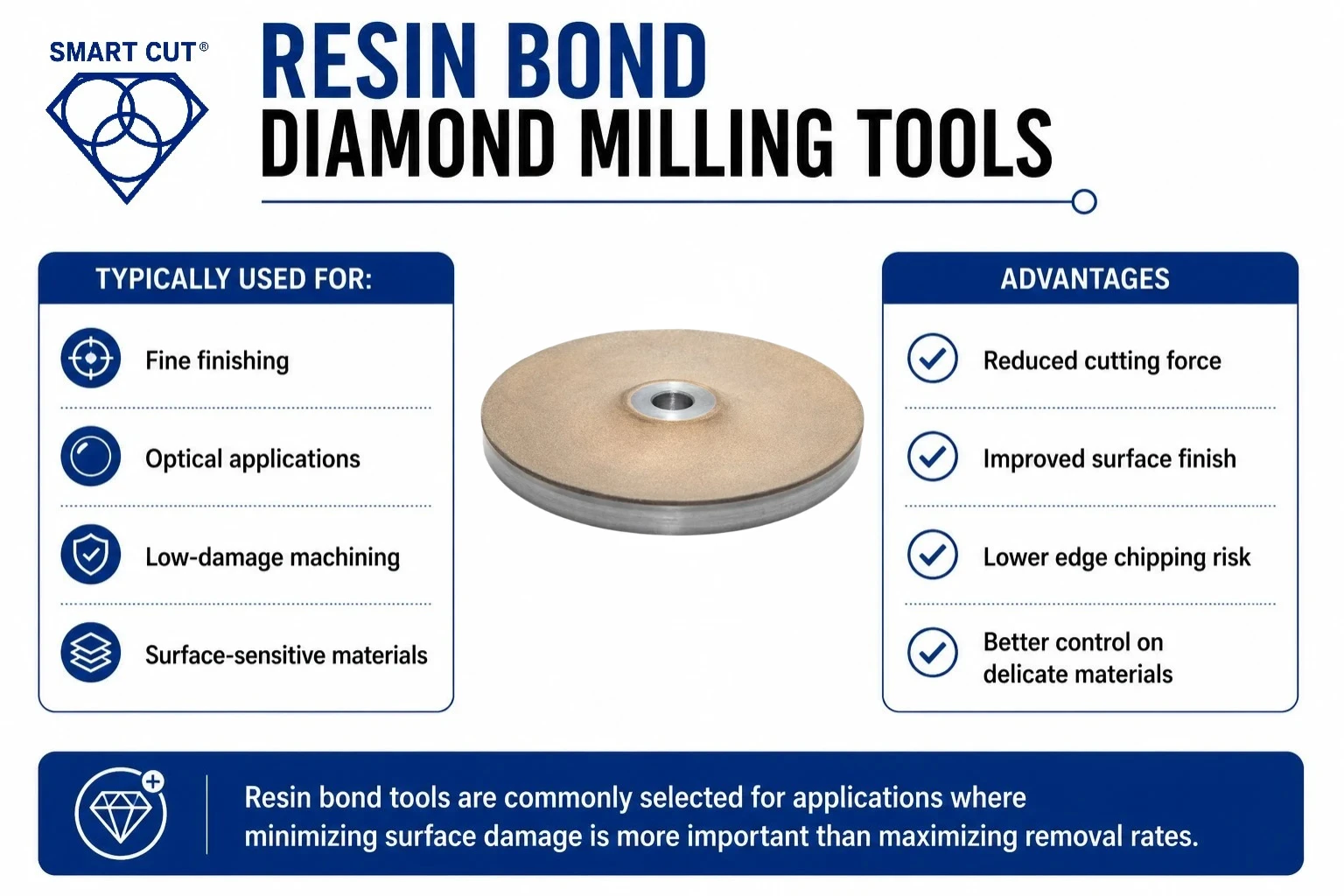
Resin bond tools are typically used for:

  • fine finishing
  • optical applications
  • low-damage machining
  • surface-sensitive materials

Advantages

  • Reduced cutting force
  • Improved surface finish
  • Lower edge chipping risk
  • Better control on delicate materials

Resin bond tools are commonly selected for applications where minimizing surface damage is more important than maximizing removal rates.

RPM and Feed Rate Recommendations

Incorrect spindle speed is one of the most common causes of diamond tool failure.

In production machining environments, excessive RPM frequently causes:

  • bond overheating
  • glazing
  • diamond dulling
  • thermal cracking
  • excessive spindle load

Typical operating ranges for diamond milling tools are:

  • 15,000–35,000 RPM depending on material, bond type, and tool diameter

General Starting Parameters

MaterialRPM RangeFeed Rate
Alumina18,000–28,000 RPM10–40 mm/min
Sapphire15,000–25,000 RPM5–20 mm/min
Quartz20,000–35,000 RPM15–50 mm/min
Silicon Carbide12,000–20,000 RPM5–15 mm/min
Glass18,000–30,000 RPM20–60 mm/min
Composites15,000–25,000 RPM30–100 mm/min

Actual operating parameters depend on:

  • spindle rigidity
  • coolant delivery
  • diamond grit size
  • bond specification
  • workpiece thickness
  • machine stability

In practice, very brittle materials often require lower feed pressure and more stable coolant delivery to minimize crack propagation near the cutting zone.

Coolant Requirements for Diamond Milling

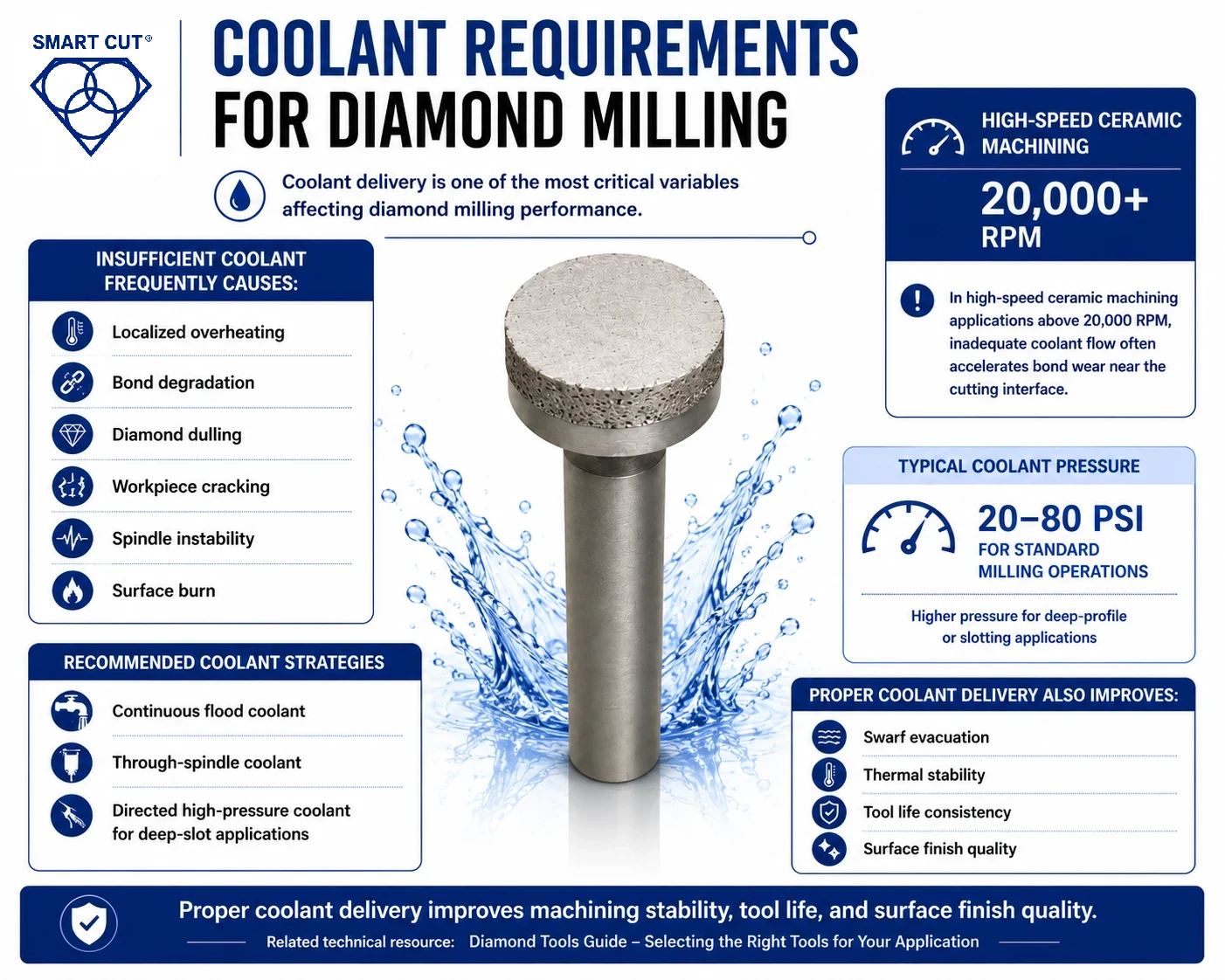
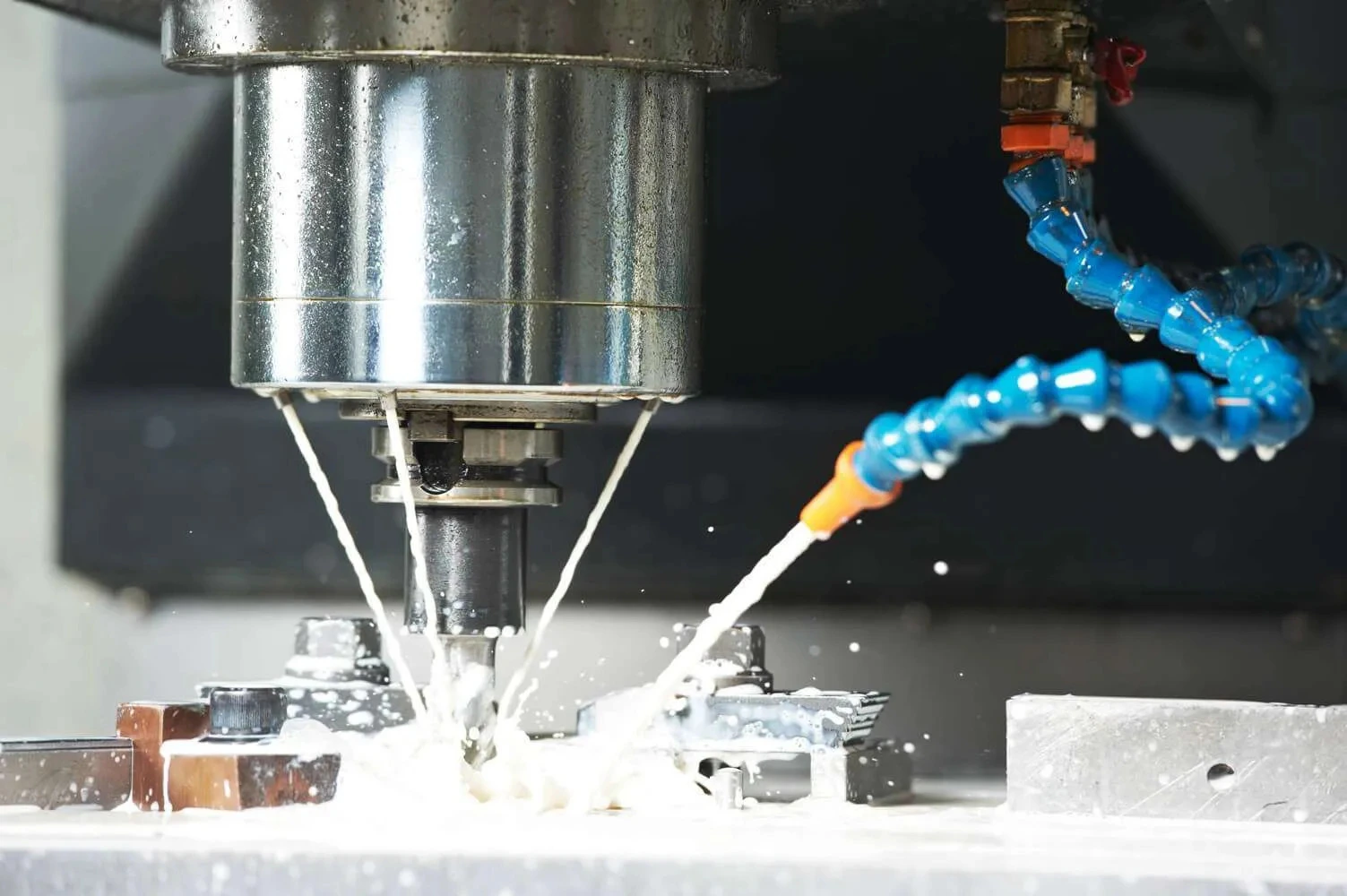
Coolant delivery is one of the most critical variables affecting diamond milling performance.

Insufficient coolant frequently causes:

  • localized overheating
  • bond degradation
  • diamond dulling
  • workpiece cracking
  • spindle instability
  • surface burn

In high-speed ceramic machining applications above 20,000 RPM, inadequate coolant flow often accelerates bond wear near the cutting interface.

Recommended coolant strategies include:

  • Continuous flood coolant
  • Through-spindle coolant
  • Directed high-pressure coolant for deep-slot applications

Typical Coolant Pressure

  • 20–80 PSI for standard milling operations
  • Higher pressure for deep-profile or slotting applications

Proper coolant delivery also improves:

  • swarf evacuation
  • thermal stability
  • tool life consistency
  • surface finish quality

Related technical resource:Diamond Tools Guide – Selecting the Right Tools for Your Application

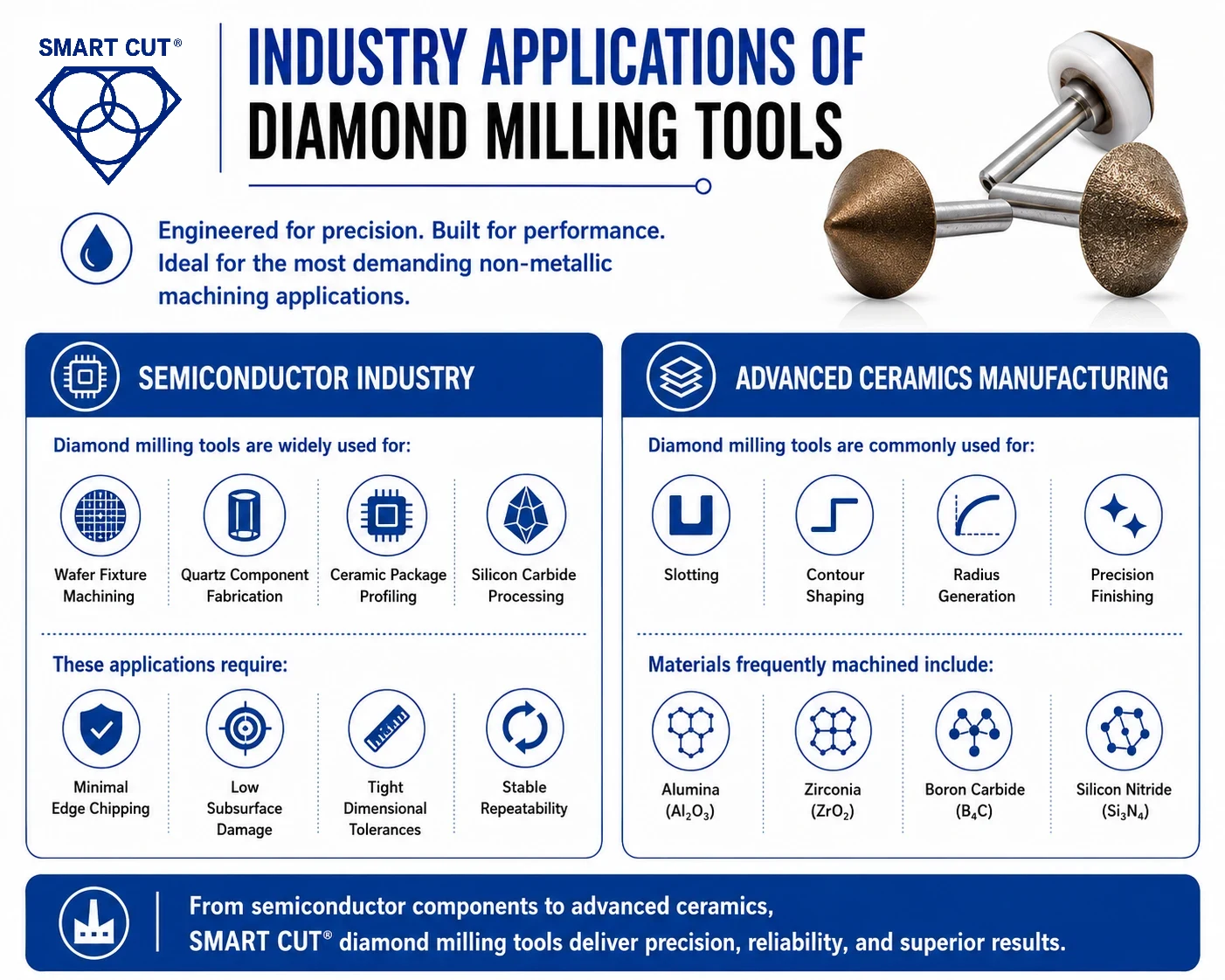
Industry Applications of Diamond Milling Tools

Semiconductor Industry

Diamond milling tools are widely used for:

  • wafer fixture machining
  • quartz component fabrication
  • ceramic package profiling
  • silicon carbide processing

These applications require:

  • minimal edge chipping
  • low subsurface damage
  • tight dimensional tolerances
  • stable repeatability

Advanced Ceramics Manufacturing

Diamond milling tools are commonly used for:

  • slotting
  • contour shaping
  • radius generation
  • precision finishing

Materials frequently machined include:

  • alumina
  • zirconia
  • boron carbide
  • silicon nitride

Optical & Photonics Industry

In optical applications, surface quality is often more critical than removal speed.

Diamond tools are widely used for:

  • optical glass shaping
  • quartz profiling
  • sapphire machining
  • precision groove generation

Fine-grit diamond tooling is often selected to minimize subsurface damage and improve optical finish quality.

Aerospace & Defense

Applications include:

  • composite trimming
  • ceramic component machining
  • carbide finishing
  • thermal barrier coating processing

Aerospace manufacturers often prioritize machining consistency and dimensional repeatability over maximum removal rates.

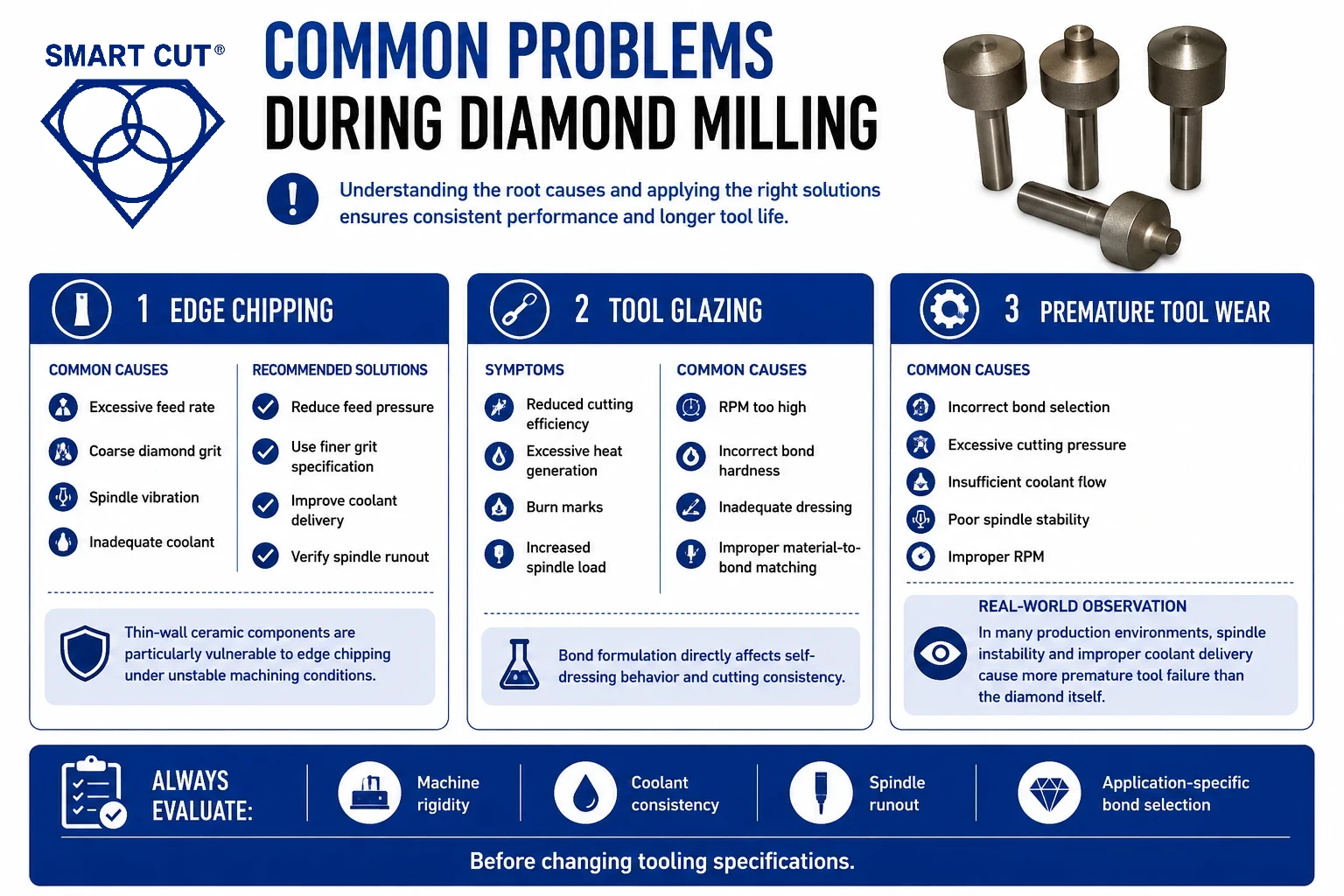
Common Problems During Diamond Milling

Edge Chipping

Common Causes

  • Excessive feed rate
  • Coarse diamond grit
  • Spindle vibration
  • Inadequate coolant

Recommended Solutions

  • Reduce feed pressure
  • Use finer grit specification
  • Improve coolant delivery
  • Verify spindle runout

Thin-wall ceramic components are particularly vulnerable to edge chipping under unstable machining conditions.

Tool Glazing

Symptoms

  • Reduced cutting efficiency
  • Excessive heat generation
  • Burn marks
  • Increased spindle load

Common Causes

  • RPM too high
  • Incorrect bond hardness
  • Inadequate dressing
  • Improper material-to-bond matching

Bond formulation directly affects self-dressing behavior and cutting consistency.

Premature Tool Wear

Common Causes

  • Incorrect bond selection
  • Excessive cutting pressure
  • Insufficient coolant flow
  • Poor spindle stability
  • Improper RPM

Real-World Observation

In many production environments, spindle instability and improper coolant delivery cause more premature tool failure than the diamond itself.

Always evaluate:

  • machine rigidity
  • coolant consistency
  • spindle runout
  • application-specific bond selection

before changing tooling specifications.

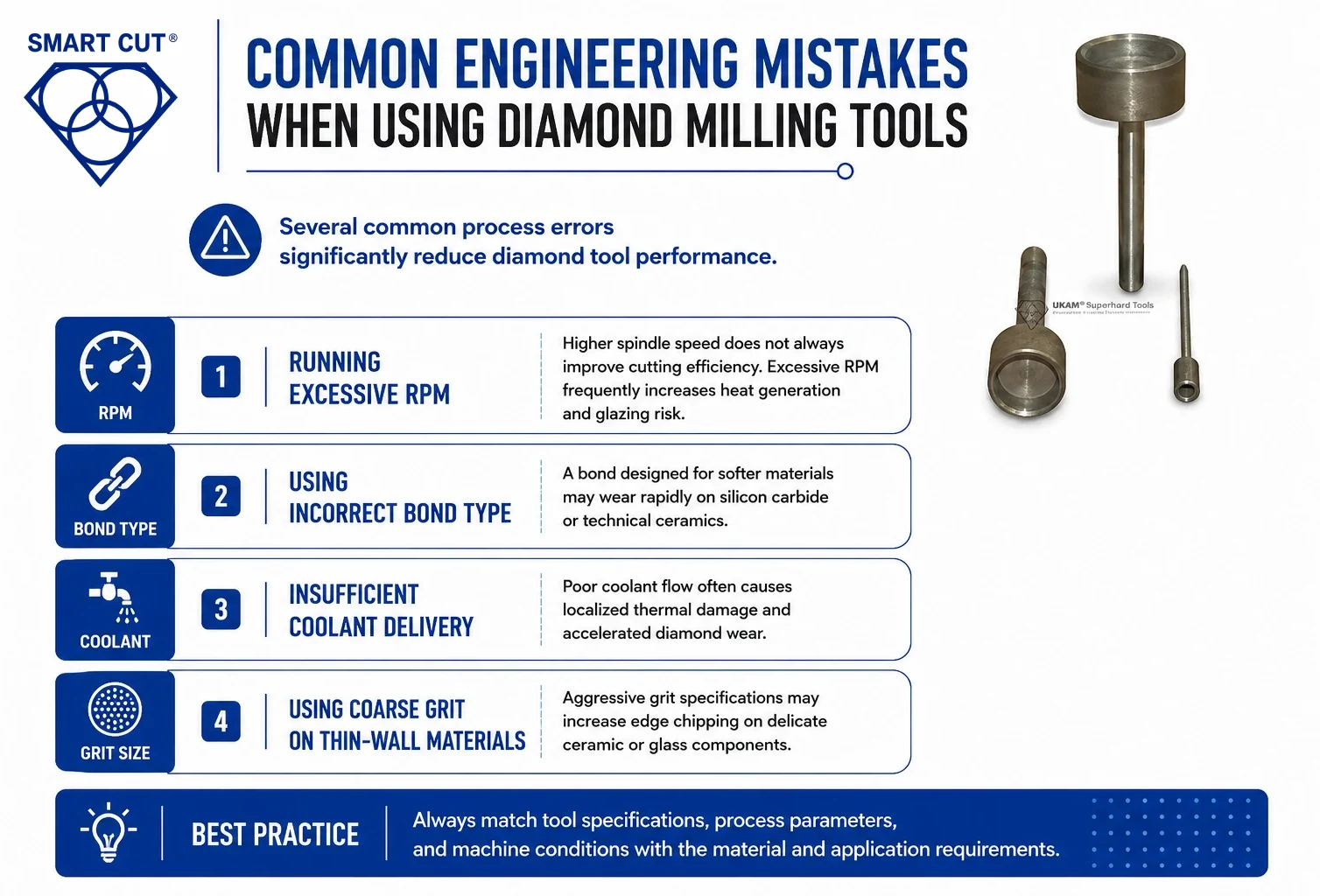
Common Engineering Mistakes When Using Diamond Milling Tools

Several common process errors significantly reduce diamond tool performance.

Running Excessive RPM

Higher spindle speed does not always improve cutting efficiency. Excessive RPM frequently increases heat generation and glazing risk.

Using Incorrect Bond Type

A bond designed for softer materials may wear rapidly on silicon carbide or technical ceramics.

Insufficient Coolant Delivery

Poor coolant flow often causes localized thermal damage and accelerated diamond wear.

Using Coarse Grit on Thin-Wall Materials

Aggressive grit specifications may increase edge chipping on delicate ceramic or glass components.

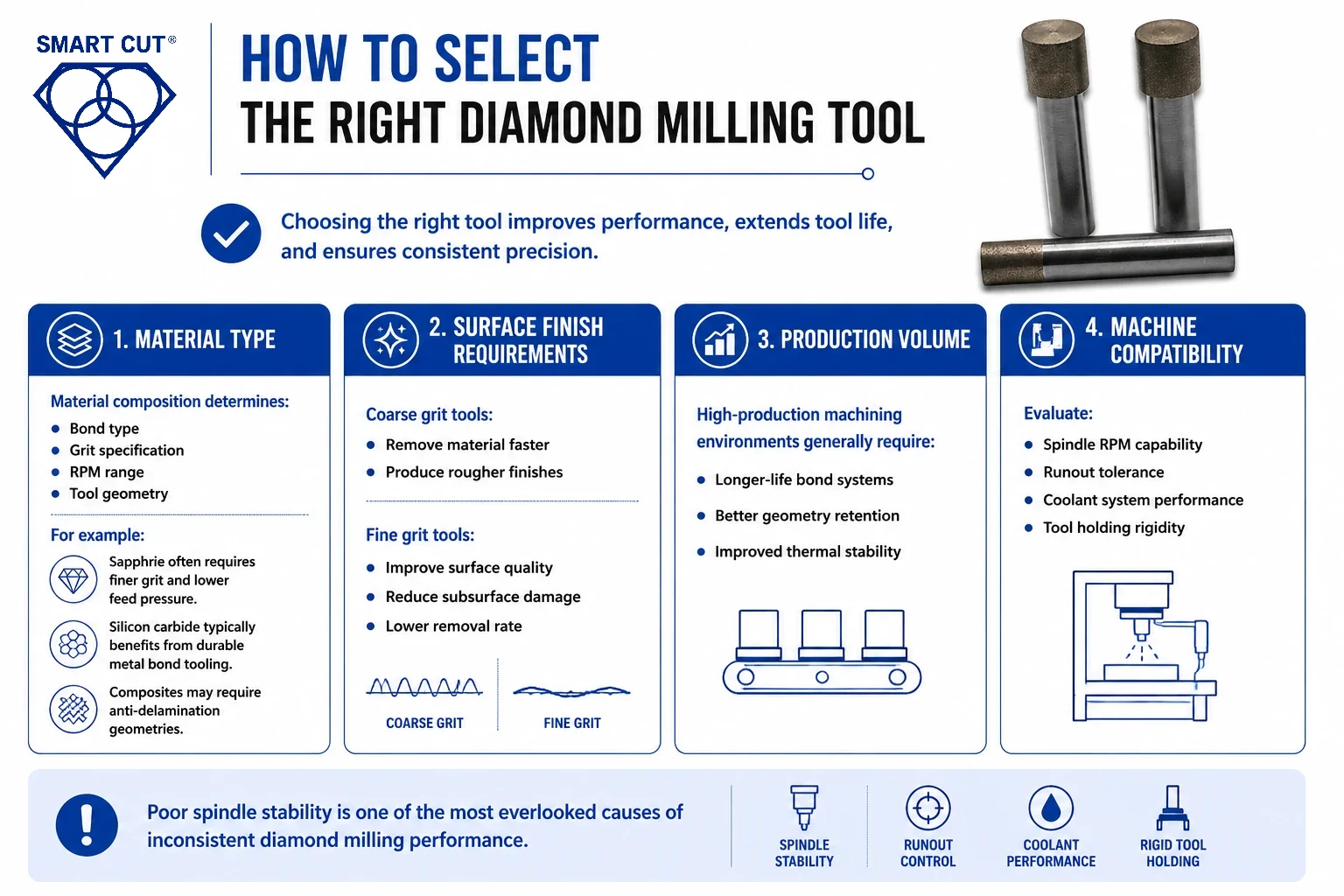
How to Select the Right Diamond Milling Tool

Material Type

Material composition determines:

  • bond type
  • grit specification
  • RPM range
  • tool geometry

For example:

  • sapphire often requires finer grit and lower feed pressure
  • silicon carbide typically benefits from durable metal bond tooling
  • composites may require anti-delamination geometries

Surface Finish Requirements

Coarse grit tools:

  • remove material faster
  • produce rougher finishes

Fine grit tools:

  • improve surface quality
  • reduce subsurface damage
  • lower removal rate

Production Volume

High-production machining environments generally require:

  • longer-life bond systems
  • better geometry retention
  • improved thermal stability

Machine Compatibility

Evaluate:

  • spindle RPM capability
  • runout tolerance
  • coolant system performance
  • tool holding rigidity

Poor spindle stability is one of the most overlooked causes of inconsistent diamond milling performance.

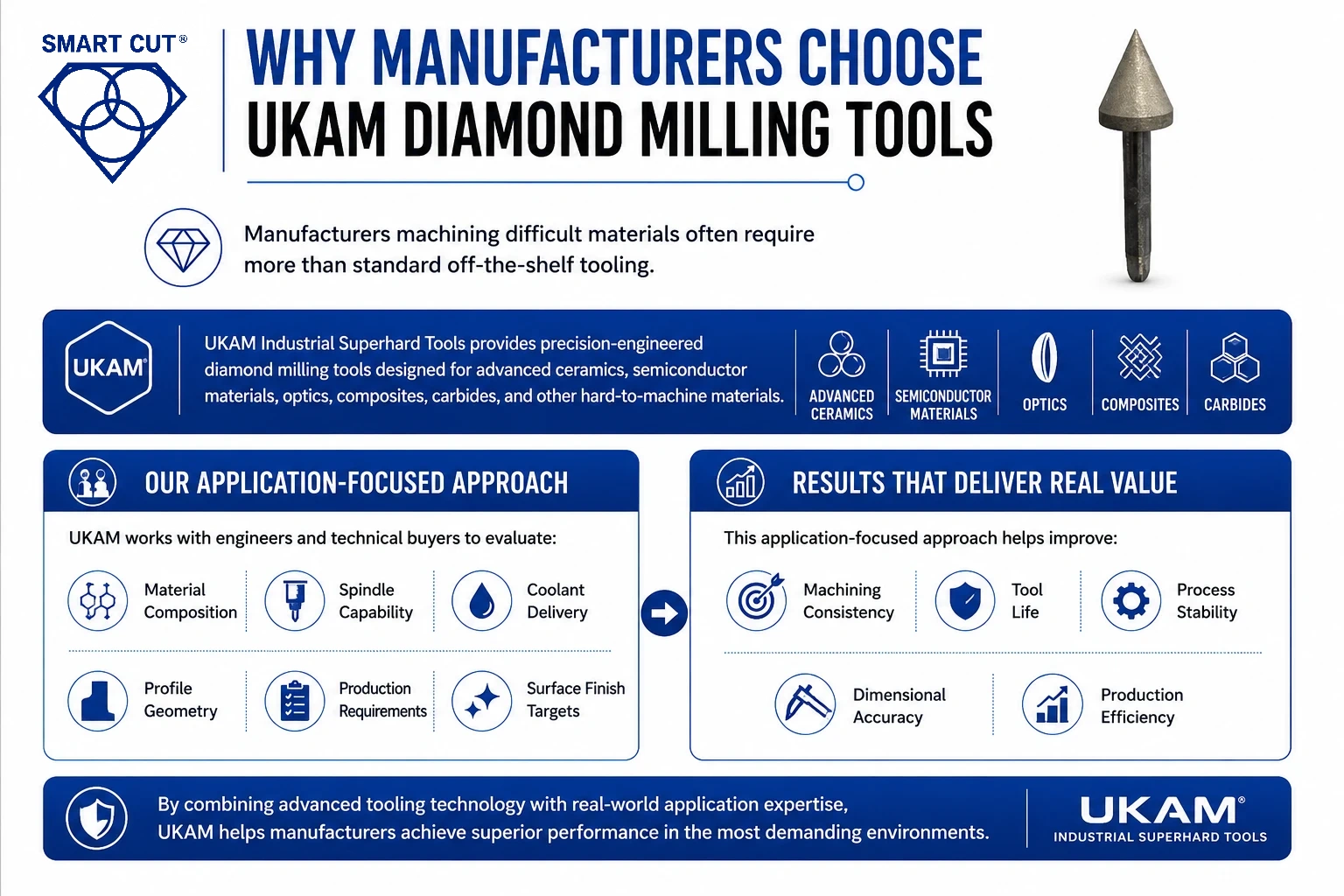
Why Manufacturers Choose UKAM Diamond Milling Tools

Manufacturers machining difficult materials often require more than standard off-the-shelf tooling.

UKAM Industrial Superhard Tools provides precision-engineered diamond milling tools designed for advanced ceramics, semiconductor materials, optics, composites, carbides, and other hard-to-machine materials.

UKAM works with engineers and technical buyers to evaluate:

  • material composition
  • spindle capability
  • coolant delivery
  • profile geometry
  • production requirements
  • surface finish targets

This application-focused approach helps improve:

  • machining consistency
  • tool life
  • process stability
  • dimensional accuracy
  • production efficiency

Frequently Asked Questions

Diamond milling tools are commonly used for ceramics, quartz, sapphire, composites, ferrites, glass, carbides, and semiconductor materials.

Most applications operate between 15,000 and 35,000 RPM depending on bond type, material, and tool diameter.
Glazing is typically caused by excessive RPM, incorrect bond hardness, inadequate dressing, or poor coolant delivery.
Metal bond diamond tools are generally preferred for ultra-hard materials due to superior wear resistance and longer operational life.
Coolant reduces heat buildup, improves swarf evacuation, minimizes cracking risk, and extends tool life.
Yes. Diamond tooling generally provides better wear resistance, improved surface finish, and greater machining consistency on hard ceramics.

Conclusion

Diamond milling tools play a critical role in the precision machining of advanced engineering materials where conventional carbide tooling cannot maintain acceptable performance, dimensional stability, or operational consistency. Proper selection of bond type, grit specification, RPM range, coolant strategy, and tool geometry directly affects tool life, surface quality, machining efficiency, and production repeatability. In industries such as semiconductor manufacturing, optics, aerospace, advanced ceramics, and precision engineering, optimized diamond milling processes help reduce scrap, improve machining stability, and lower overall production cost per part. Manufacturers using properly engineered diamond milling tools are often able to achieve significantly higher process reliability and longer operational performance in demanding machining applications.

Trusted by Tens of Thousands of Manufacturers, Laboratories,
Research Institutions Worldwide Since 1990

American Based Manufacturer

Established in 1990

Custom manufacturing

RELATED ARTICLES

Brian is an experienced professional in the field of precision cutting tools, with over 27 years of experience in technical support. Over the years, he has helped engineers, manufacturers, researchers, and contractors find the right solutions for working with advanced and hard-to-cut materials. He’s passionate about bridging technical knowledge with real-world applications to improve efficiency and accuracy.

As an author, Brian Farberov writes extensively on diamond tool design, application engineering, return on investment strategies, and process optimization, combining technical depth with a strong understanding of customer needs and market dynamics.

author-avatar

About Brian Farberov

Brian is an experienced professional in the field of precision cutting tools, with over 27 years of experience in technical support. Over the years, he has helped engineers, manufacturers, researchers, and contractors find the right solutions for working with advanced and hard-to-cut materials. He’s passionate about bridging technical knowledge with real-world applications to improve efficiency and accuracy. As an author, Brian Farberov writes extensively on diamond tool design, application engineering, return on investment strategies, and process optimization, combining technical depth with a strong understanding of customer needs and market dynamics.