
















Skip to navigation Skip to main content
Home > Blog > Diamond Blade Runout: How to Measure It and What It Does to Cut Quality

Diamond Blade Articles, blog

Diamond Blade Runout: How to Measure It and What It Does to Cut Quality

Diamond Blade Runout: How to Measure It and What It Does to Cut Quality

A diamond blade that doesn’t run true cuts poorly, wears unevenly, and often fails early. Yet runout is easy to miss. The blade looks fine. The spindle spins smoothly. The first cut may even look acceptable.

Meanwhile, the rim contacts the material unevenly on every revolution. Some sections carry more load than others. Over many cuts, that imbalance shows up as chipping, a wandering kerf, a rough finish, and a blade that dies before it should.

This article explains what runout is, how it damages cut quality, how to measure it, and how to find and fix the source. It focuses on measurement and diagnosis. For the full setup sequence, see our setup-mistakes article. For a quick pre-run list, see our precision diamond saw pre-operation checklist.

Trusted by Tens of Thousands of Manufacturers, Laboratories Research Institutions Worldwide Since 1990

American Based Manufacturer

Established in 1990

Custom manufacturing

What Runout Means

What-Runout-Means

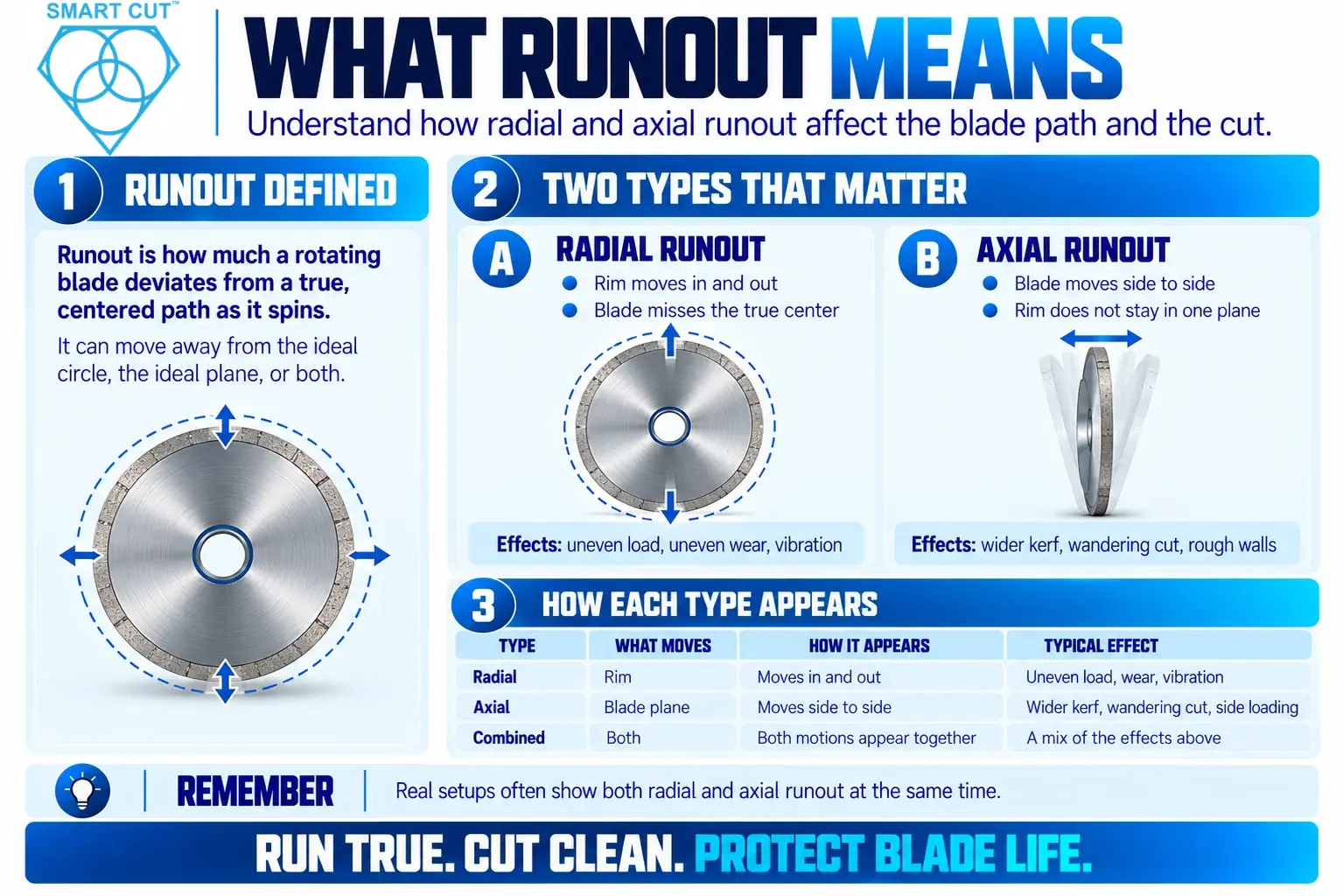
Runout is how much a rotating part deviates from a true, centered path. In blade terms, it describes how far the blade or its rim moves away from the ideal circle or plane as it spins.

Two types matter most.

Radial runout. The rim moves in and out as the blade rotates, so the blade does not turn around its true center. Some sections of the rim stand slightly proud, and others sit slightly low.

Axial runout (also called lateral runout or wobble). The blade moves from side to side as it turns, so it does not stay in one plane. The rim sweeps a path wider than its own thickness.

Real setups often show both at once. The table below summarizes how each appears and what it tends to do.

Type What moves Typical effect on the cut
Radial The rim moves in and out Uneven load on the rim sections, uneven wear, vibration
Axial The blade moves side to side Wider effective kerf, wandering cut, side loading, rough walls
Combined Both A mix of the effects above

Why Runout Matters

Why Runout Matters

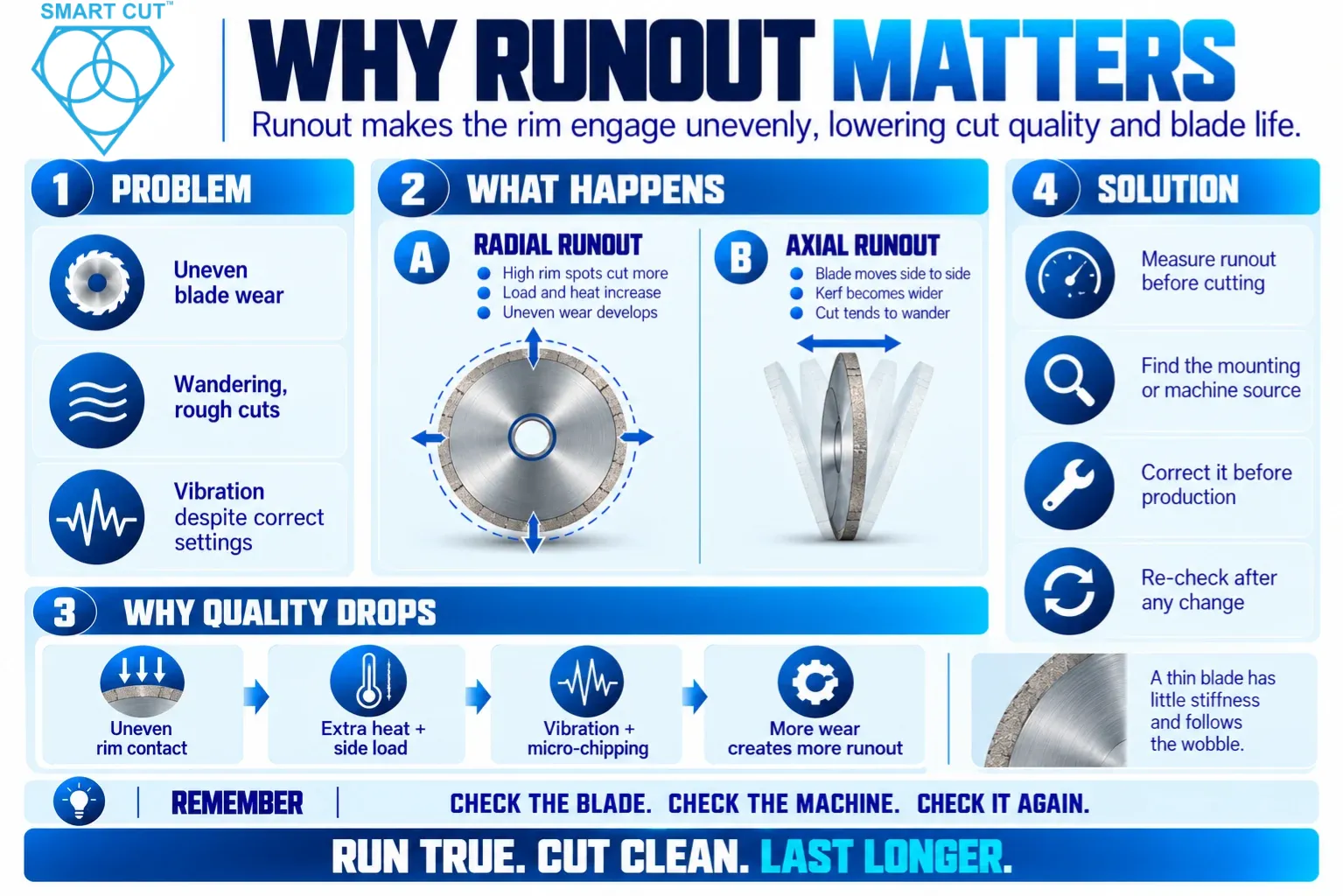
Problem: Blades wear unevenly, and cuts lose quality, even when speed, feed, and coolant look correct.

Cause: The blade does not run true, so the rim does not engage the material evenly.

Engineering logic: A blade engages the material through its rim. In a true-running blade, every part of the rim takes a similar share of the load. With radial runout, the high sections cut more than the low ones. They carry extra load, heat up more, and wear faster. As they wear, the imbalance may grow or shift, and the blade may develop uneven rim height.

With axial runout, the blade pushes sideways against the kerf walls. It rubs, it side-loads, and it tends to wander. A thin blade has little stiffness of its own, so it follows the wobble. The cut can then come out wider than the blade thickness, with rougher walls and a less accurate position.

Both types also add vibration. Vibration disturbs the contact between the rim and the material, which can cause micro-chipping at the cut edge. These effects feed each other. Uneven wear increases runout, and more runout increases uneven wear.

UKAM’s usage guidance treats the machine and mounting as part of the cutting system, not as background details. For the broader context, see our article on how to properly use precision diamond and CBN blades.

Solution: Measure runout, find the source, and correct it before you cut. Then check it again whenever something changes.

What Runout Does to Cut Quality

The following effects commonly trace back to runout. Each one has other possible causes, so treat the list as a set of clues.

Uneven blade wear. The rim wears in patches instead of evenly. You may see flat spots, bands, or one-sided wear.

Edge chipping. Vibration and uneven engagement damage the edge of brittle materials. For how chipping is measured, see our guide on how to measure diamond blade cut quality.

Wandering or tapered cuts. The blade drifts, and the cut leaves the intended line or loses parallelism.

Wider kerf than expected. Wobble sweeps a wider path. That costs material, which matters when kerf loss counts. Our article on how thin kerf blades improve material yield explains why kerf matters so much.

Rough finish and heat marks. Unstable contact raises friction and heat at the rim.

Short blade life. All of the above add up to earlier retirement.

Inconsistent results. A blade with runout may give different results from one mounting to the next, because the runout changes each time you mount it.

To read the wear signs on the blade itself, see troubleshooting common diamond blade wear patterns.

Where Runout Comes From

Where Runout Comes From

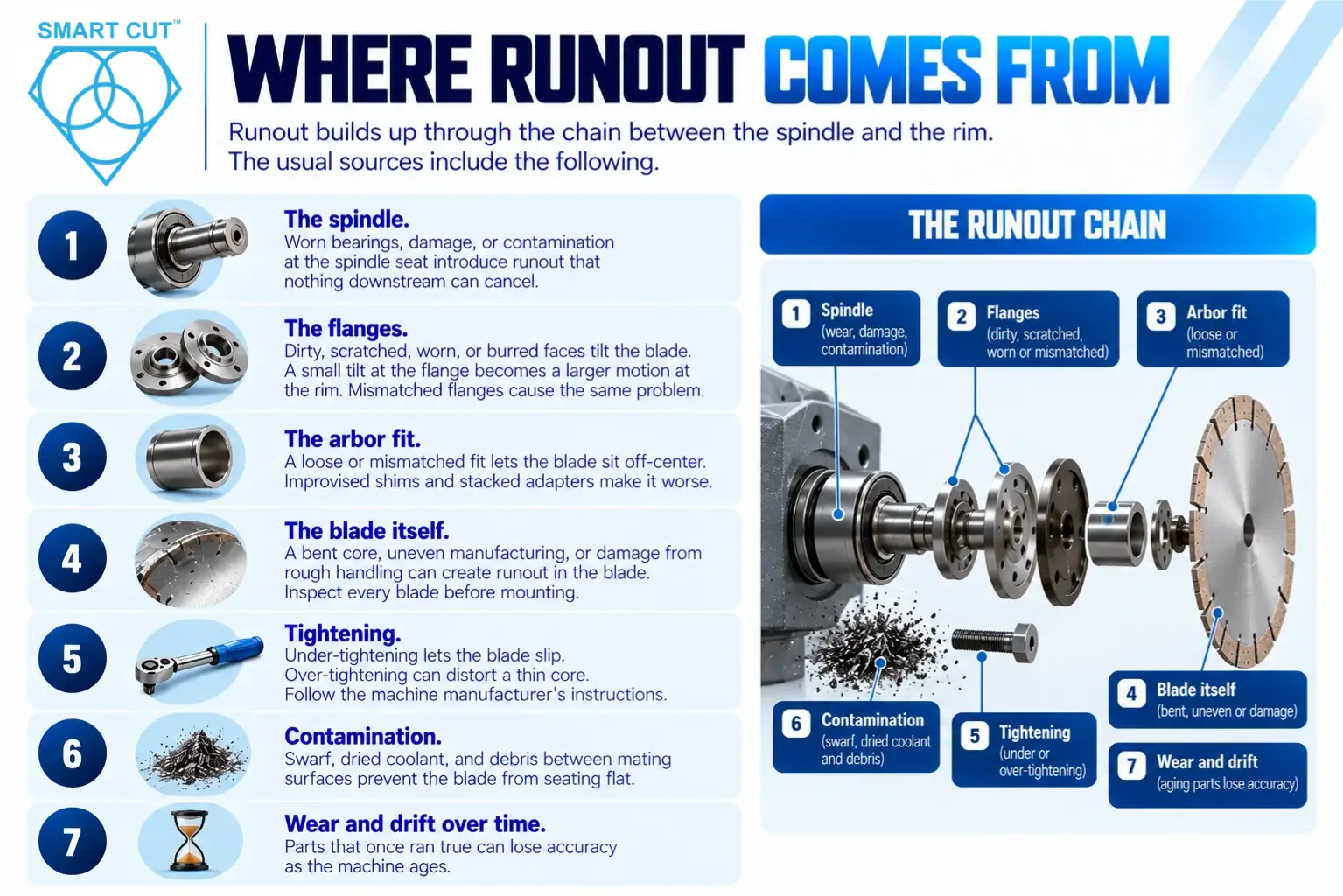
Runout rarely has a single cause. It builds up through the chain between the spindle and the rim. The usual sources include the following.

The spindle. Worn bearings, damage, or contamination at the spindle seat introduce runout that nothing downstream can cancel.

The flanges. Dirty, scratched, worn, or burred faces tilt the blade. A small tilt at the flange becomes a larger motion at the rim. Mismatched flanges cause the same problem.

The arbor fit. A loose or mismatched fit lets the blade sit off-center. Improvised shims and stacked adapters make it worse.

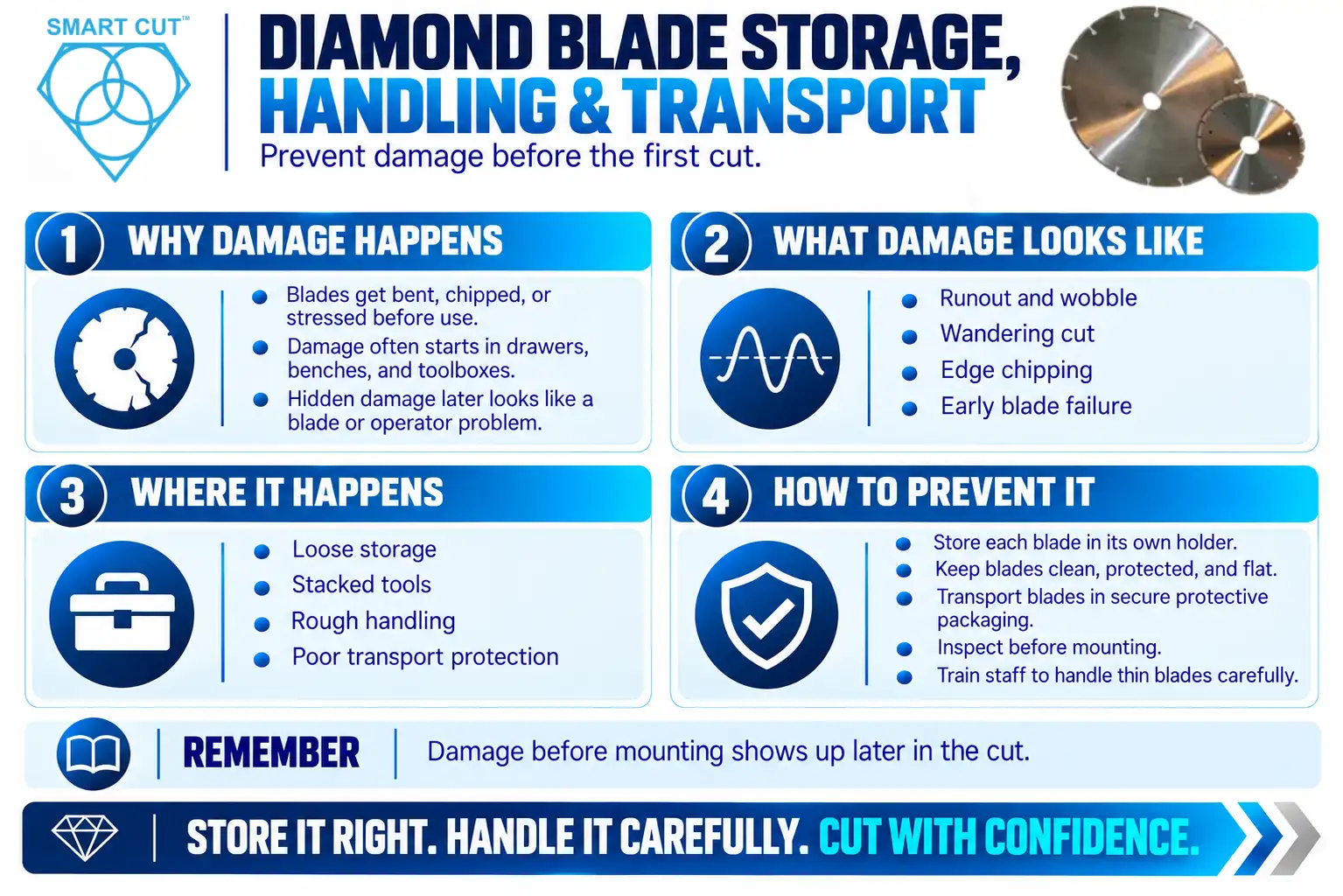
The blade itself. A bent core, uneven manufacturing, or damage from rough handling can create runout in the blade. Inspect every blade before mounting. For more on incoming checks, see our incoming diamond blade inspection and trial-cut checklist.

Tightening. Under-tightening lets the blade slip. Over-tightening can distort a thin core. Follow the machine manufacturer’s instructions.

Contamination. Swarf, dried coolant, and debris between mating surfaces prevent the blade from seating flat.

Wear and drift over time. Parts that once ran true can lose accuracy as the machine ages.

How to Measure Runout

How to Measure Runout

Measurement turns a suspicion into data. The method should be simple, repeatable, and safe.

What You Need

  • A dial indicator or a similar measuring device with suitable resolution for your blade size, mounted on a stable base.
  • A clean, stable reference point on the machine.
  • A record sheet or log.

Use the equipment and method that your machine manufacturer and your shop’s procedure allow. Always follow the manufacturer’s safety instructions. Power down and secure the machine before you set up the indicator, and keep hands clear of the blade.

Measuring Radial Runout

  1. Mount the blade following your standard procedure.
  2. Position the indicator so that its tip touches the rim edge, or another surface your procedure defines for radial measurement.
  3. Rotate the spindle slowly and by the means your machine allows.
  4. Watch the indicator through at least one full revolution.
  5. Note the total variation between the highest and lowest readings.
  6. Record the value and the measuring position.

Measuring Axial Runout

  1. Position the indicator so that its tip touches the blade face, near the rim.
  2. Rotate the spindle slowly through at least one full revolution.
  3. Record the total variation in the side-to-side reading.
  4. Repeat at a second radial position if your procedure calls for it, since the effect grows toward the rim.

Make the Measurement Repeatable

  • Use the same positions every time. Different points give different numbers.
  • Use the same method and the same instrument. Mixing methods makes comparison impossible.
  • Measure more than once. Repeat the reading to confirm it. A single reading can mislead.
  • Measure after mounting and after any change. Check again after a blade swap, a flange change, or a repair.
  • Record the result. A log lets you spot trends and compare machines.

If you cannot measure runout directly on your machine, ask the machine manufacturer for the approved method, or request help from the UKAM team.

How to Interpret the Reading

How to Interpret the Reading

A reading means little without a reference. Interpret it in three ways.

Against the manufacturer’s specification. Machine and blade manufacturers may state acceptable runout. Use those values when they exist. Do not borrow limits from a different machine or application.

Against your own baseline. Measure a known-good setup on your machine and record the result. Compare later readings with that baseline. A rise over time points to wear or damage.

Against the application. Precision cutting of delicate or brittle materials needs tighter control than rough cutting. The required level depends on the part requirement and the cut quality you must achieve.

This article does not give a universal tolerance. The right limit depends on the machine, the blade, and the application, so define it through your own qualification and testing. For a method, see diamond blade cutting process qualification.

How to Find the Source of Runout

When the reading is too high, isolate the cause step by step. Change one thing at a time and re-measure after each change.

  1. Remount the blade. Clean the blade, flanges, and spindle seat, then mount again. If the reading drops, contamination or poor seating was the cause.
  2. Rotate the blade relative to the flanges. Index it to a new position and re-measure. If the high spot follows the blade, the blade may be the source. If it stays at the same position on the machine, the machine or flanges are more likely.
  3. Swap the blade. Mount a known-good blade. If the problem stays, look at the flanges, arbor, or spindle. If the problem goes away, the first blade may be at fault.
  4. Check the flanges. Inspect the faces for dirt, scratches, burrs, and wear. Replace damaged ones, and always use a matched pair.
  5. Check the arbor fit. Confirm that the blade bore matches the arbor with no improvised shims.
  6. Check the tightening. Retighten following the manufacturer’s method.
  7. Check the spindle. Measure the spindle itself, using the method your manufacturer recommends. If the spindle runs out, it needs service. No downstream fix can compensate.

Work through the steps in order. The early ones cost almost nothing, and they solve most problems

How to Reduce Runout

Once you know the source, take the matching action.

  • Clean thoroughly. Clean the blade, flange faces, and spindle seat at every blade change.
  • Replace worn or damaged flanges. Use a matched pair that fits your machine and blade.
  • Use the correct arbor and flange sizes. If your blade needs a different arbor, UKAM can help with arbor modifications through its custom manufacturing
  • Mount the same way every time. A fixed method gives repeatable results.
  • Handle blades with care. Store each blade in a protective holder, and inspect it before mounting.
  • Service the machine. Schedule spindle checks and repairs. A rigid, well-maintained precision saw removes a major source of runout.
  • Remove damaged blades. A bent or cracked blade does not get corrected. It gets retired.

Also, support the blade properly with good workholding and a sensible blade exposure. Our article on workholding for precision diamond sectioning and dicing shows how fixturing affects the cut.

Runout and Blade Testing

Runout and Blade Testing

Runout adds hidden variation to tests. If one blade in a comparison runs with more runout than the other, the result reflects the setup, not the blade. A blade can look worse simply because it was mounted worse.

Therefore, treat runout as a controlled variable.

  • Measure and record runout for every blade in the test.
  • Keep it within the same range for all blades, or at least document the difference.
  • Remount and re-measure if a result looks unusual.

For the full approach, see how to compare two diamond blades fairly and how to design a repeatable diamond blade test.

Common Mistakes When Dealing with Runout

Common Mistakes When Dealing with Runout

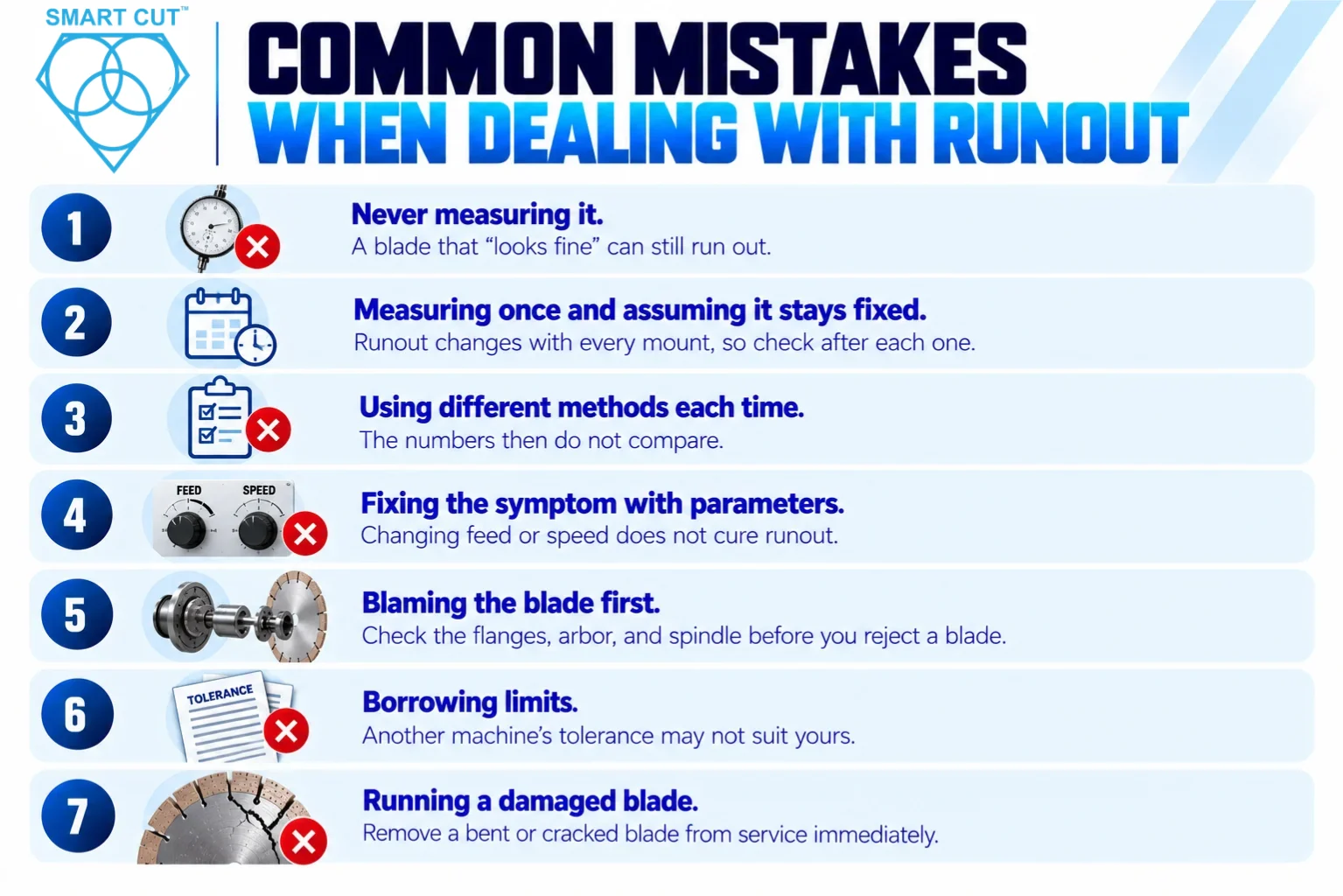
Never measuring it. A blade that “looks fine” can still run out.

Measuring once and assuming it stays fixed. Runout changes with every mount, so check after each one.

Using different methods each time. The numbers then do not compare.

Fixing the symptom with parameters. Changing feed or speed does not cure runout.

Blaming the blade first. Check the flanges, arbor, and spindle before you reject a blade.

Borrowing limits. Another machine’s tolerance may not suit yours.

Running a damaged blade. Remove a bent or cracked blade from service immediately.

Applying This in Your Shop

Start with one machine. Measure runout with a known-good blade and record the baseline. Add a runout check to the setup procedure, and log the value with each job. Then watch the trend.

When results change, check runout early. It is quick, and it rules out a common cause before you spend time on speed, feed, or blade selection. If you need help matching a blade and arbor to your machine, the UKAM team can help. Explore the diamond blade range, including the diamond and CBN wafering and cut-off blades, and our material guide.

Key Takeaways

  • Runout is the deviation of a rotating blade from a true path. Radial and axial runout both damage cuts.
  • Runout loads the rim unevenly, which causes uneven wear, chipping, wandering cuts, and short blade life.
  • Sources include the spindle, flanges, arbor fit, blade, tightening, and contamination.
  • Measure with a repeatable method, at the same positions, after every mount.
  • Judge readings against the manufacturer’s specification, your own baseline, and the application.
  • Isolate the source step by step, changing one thing at a time.
  • Control and record runout during blade tests.
  • Do not borrow tolerances from another machine.

Frequently Asked Questions

It is the deviation of a spinning blade from a true, centered, flat path.

Radial runout moves the rim in and out, while axial runout moves the blade side to side.

It loads the rim unevenly, so some sections wear and heat up faster than others.

Yes, because vibration and uneven engagement can damage brittle edges.

Yes, because a wobbling blade sweeps a wider path than its own thickness.

Use a dial indicator or similar device at fixed positions while rotating the spindle slowly.

Measure after every blade mount and after any change to flanges, arbor, or spindle.

It depends on the machine, blade, and application, so use the manufacturer’s specification and your own baseline.

Yes, because debris or burrs tilt the blade and magnify the error at the rim.

Index the blade and swap it with a known-good one, and see whether the problem follows the blade.

No, because runout comes from the mounting and machine, not from the cutting parameters.

Yes, because it adds hidden variation that can make one blade look better or worse.

No, correct the source first, and retire the blade if it is bent or damaged.

Yes, you can ask the team about arbor modifications through custom manufacturing.

Conclusion

Runout is a quiet problem with loud effects. A blade that does not run true loads its rim unevenly, wanders in the cut, chips edges, and wears out early. Because the blade can look perfectly fine, many shops never find the cause.

You can find it with a simple, repeatable measurement. Measure after every mount, compare against the manufacturer’s specification and your own baseline, and isolate the source one step at a time. Then fix the source instead of tuning the parameters. Record the values, and you will spot drift long before it damages parts.

If you want help matching a blade, arbor, and setup to your machine and material, request a consultation with the UKAM team, or browse the diamond blade range.

Trusted by Tens of Thousands of Manufacturers, Laboratories,
Research Institutions Worldwide Since 1990

American Based Manufacturer

Established in 1990

Custom manufacturing

RELATED ARTICLES

Brian is an experienced professional in the field of precision cutting tools, with over 27 years of experience in technical support. Over the years, he has helped engineers, manufacturers, researchers, and contractors find the right solutions for working with advanced and hard-to-cut materials. He’s passionate about bridging technical knowledge with real-world applications to improve efficiency and accuracy.

As an author, Brian Farberov writes extensively on diamond tool design, application engineering, return on investment strategies, and process optimization, combining technical depth with a strong understanding of customer needs and market dynamics.

author-avatar

About Brian Farberov

Brian is an experienced professional in the field of precision cutting tools, with over 27 years of experience in technical support. Over the years, he has helped engineers, manufacturers, researchers, and contractors find the right solutions for working with advanced and hard-to-cut materials. He’s passionate about bridging technical knowledge with real-world applications to improve efficiency and accuracy. As an author, Brian Farberov writes extensively on diamond tool design, application engineering, return on investment strategies, and process optimization, combining technical depth with a strong understanding of customer needs and market dynamics.

Download Checklist

Please fill in your details to download the Precision Diamond Saw Pre-Operation Checklist.