



















How to Specify Custom Diamond Tools for High Precision Manufacturing Applications

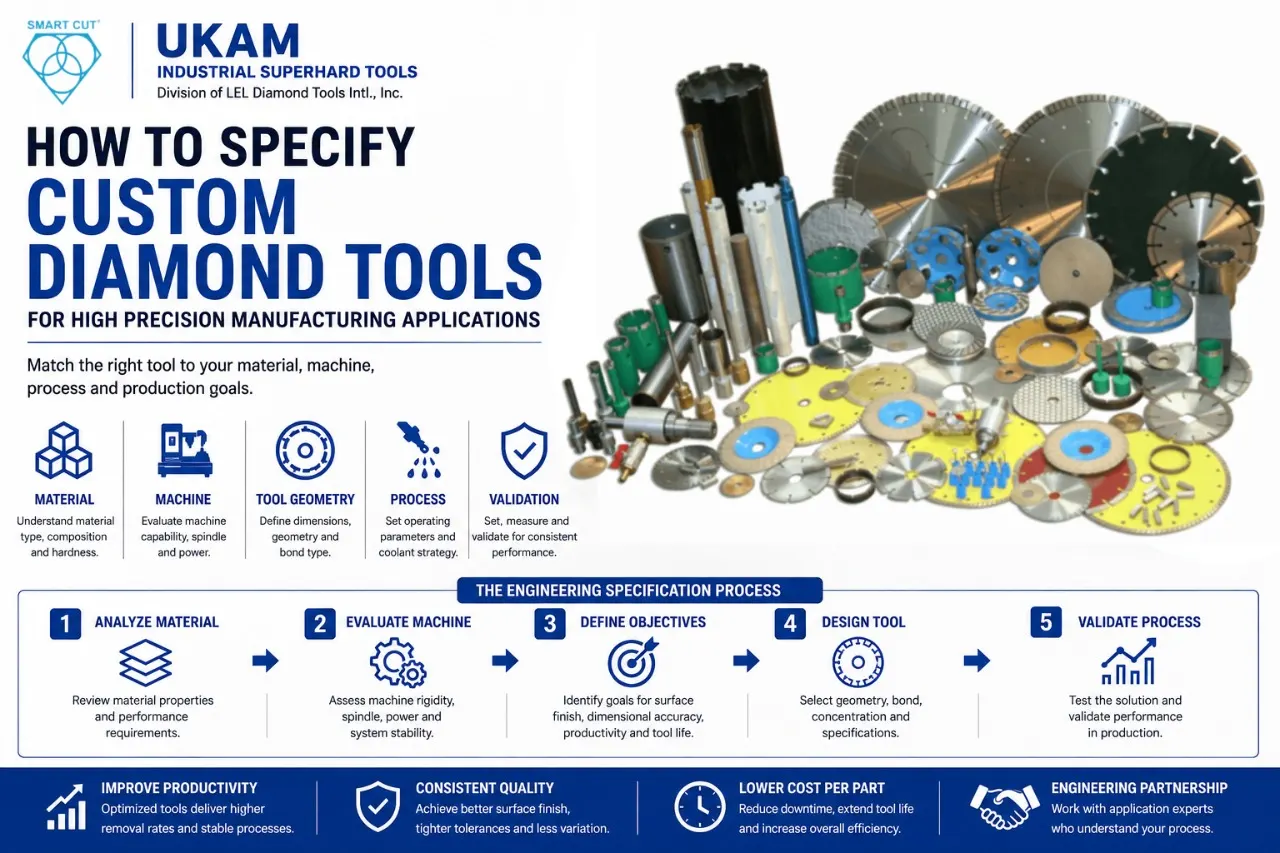
Table of Contents
Toggle
American Based Manufacturer

Established in 1990


Custom manufacturing


Engineering Problem
Standard diamond tools are designed to serve a broad range of applications. Manufacturing environments rarely operate under standard conditions. Material composition, machine rigidity, spindle characteristics, coolant delivery, production volume, dimensional tolerances, and surface finish requirements vary from one operation to another. A tool that performs well in one process may produce inconsistent results in another, even when machining the same material.
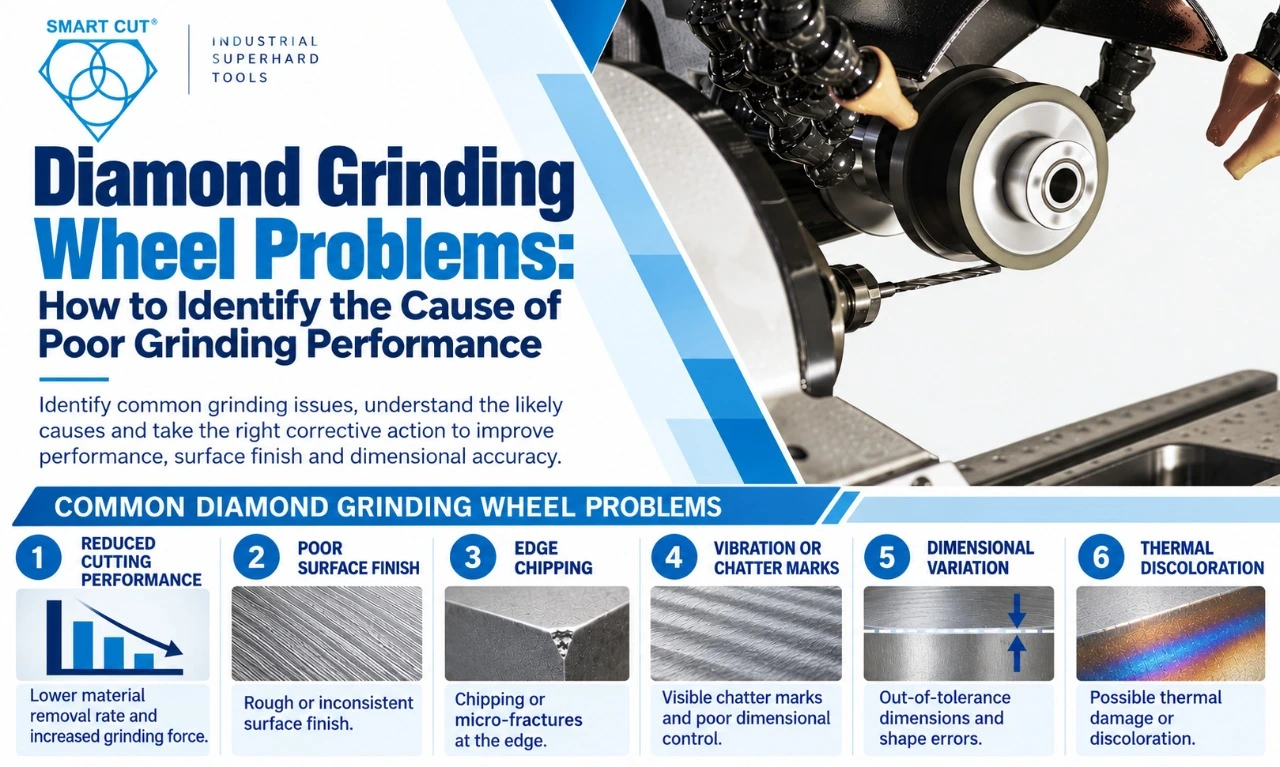
Production teams often begin investigating a custom diamond tool after experiencing recurring process issues rather than isolated failures. Common indicators include premature tool wear, excessive edge chipping, inconsistent surface finish, dimensional variation, thermal damage, unstable cycle times, or rising production costs. Replacing the existing tool with another standard specification may provide temporary improvement, but the underlying process limitations frequently remain unresolved.
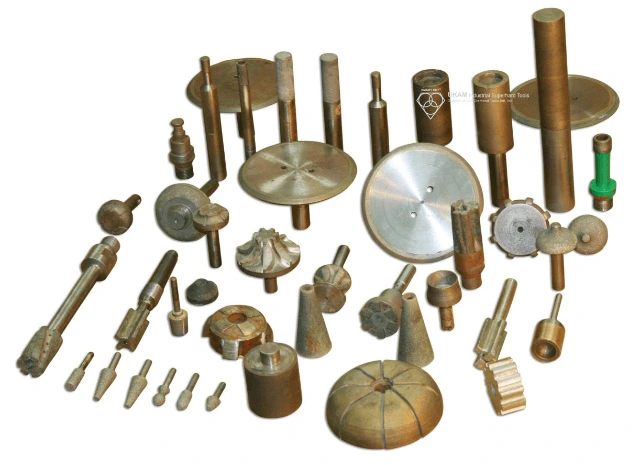
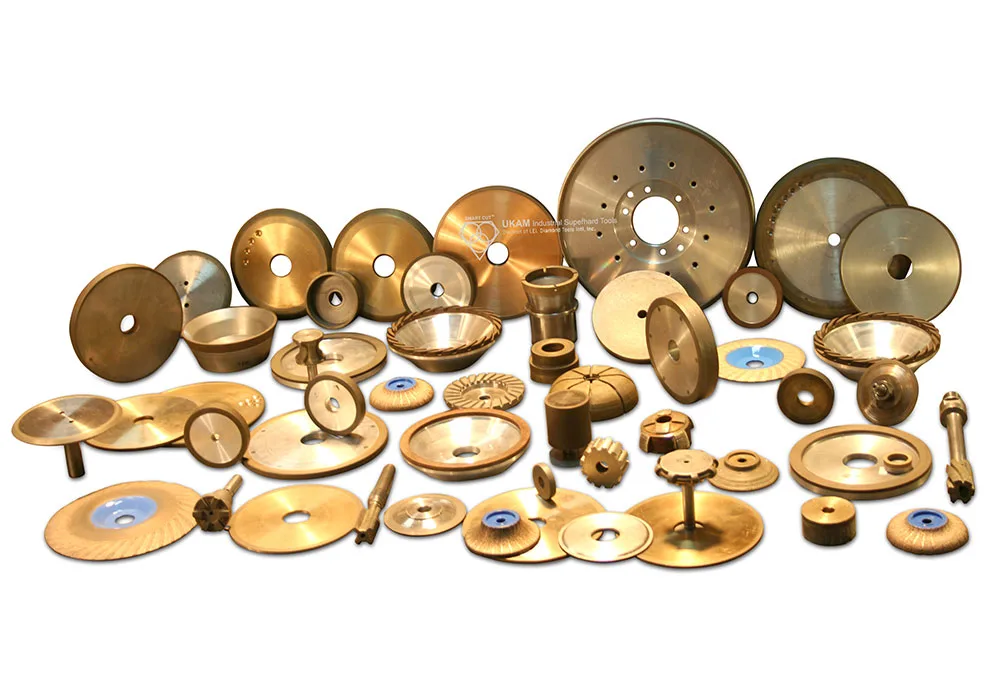
A custom diamond tool is specified to match the complete manufacturing process instead of adapting the process to fit an available catalog product. The specification considers the interaction between the workpiece material, machine capabilities, operating parameters, coolant strategy, production objectives, and quality requirements. This engineering approach improves process consistency and provides a specification that is optimized for the intended application rather than a general purpose solution.
For manufacturers producing advanced ceramics, semiconductor wafers, optical materials, carbide components, composite materials, or precision mechanical parts, even small specification changes can influence tool life, material removal characteristics, surface integrity, and production stability. Selecting a custom tool therefore becomes an engineering decision rather than a purchasing decision.
Why Engineers Specify Custom Diamond Tools
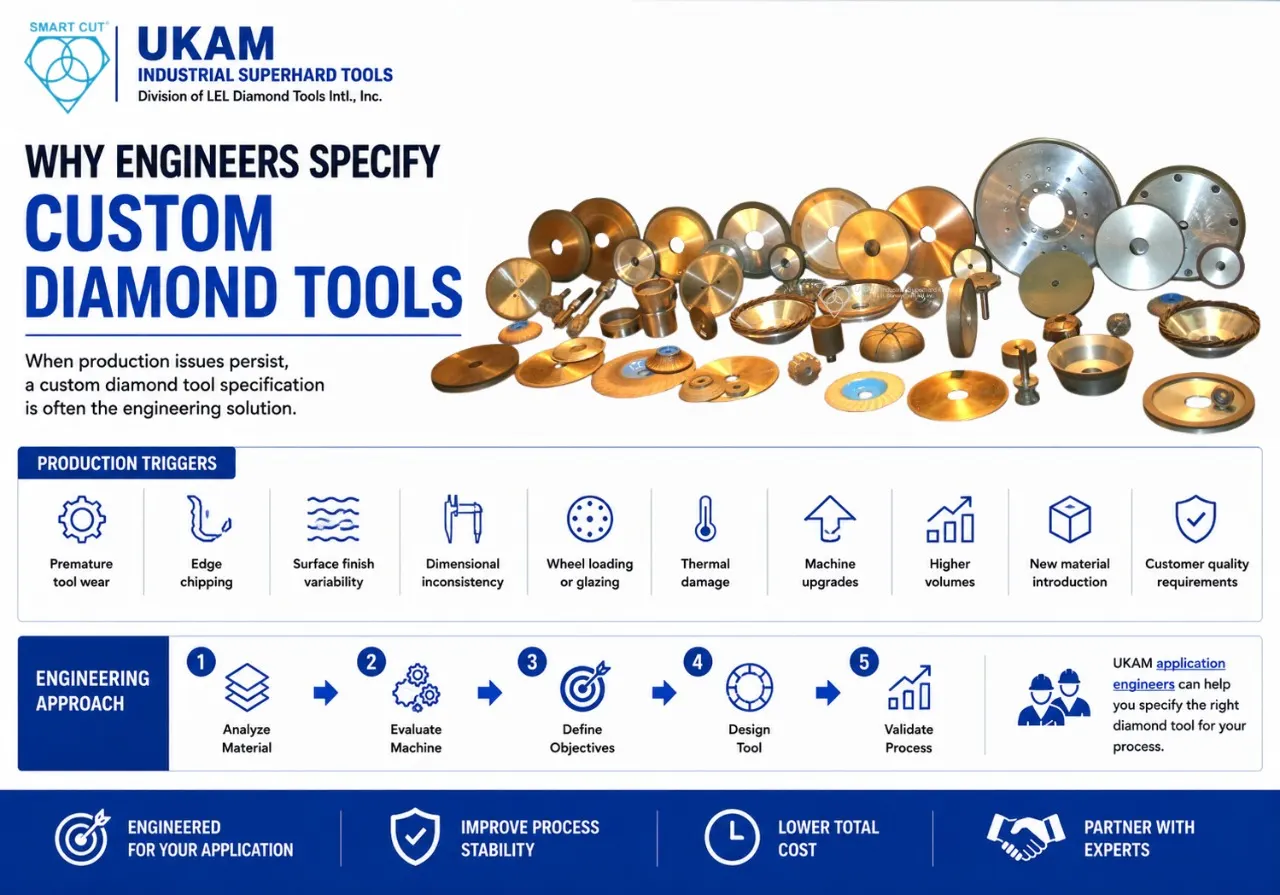
Engineering teams typically evaluate a custom specification after observing repeatable production trends that cannot be corrected through routine process adjustments. These situations often indicate that the current tool specification is no longer aligned with the manufacturing process.
|
Production Trigger |
Engineering Impact |
|---|---|
|
Premature tool wear |
Increased tooling costs and frequent production interruptions |
|
Edge chipping |
Reduced yield and additional inspection requirements |
|
Surface finish variability |
Additional polishing or secondary finishing operations |
|
Dimensional inconsistency |
Difficulty maintaining process capability and tolerance requirements |
|
Reduced cutting efficiency and unstable grinding forces |
|
|
Thermal damage |
Material degradation and lower component quality |
|
Machine upgrades |
Existing tooling may no longer match spindle performance or operating conditions |
|
Higher production volumes |
Standard tools may not provide the consistency required for continuous production |
|
New material introduction |
Existing specifications may not be compatible with different material properties |
|
Customer quality requirements |
Tighter tolerances often require application specific tool geometry and bond selection |
These production indicators should be evaluated collectively rather than individually. A process experiencing both increasing scrap rates and declining tool life may require a different engineering solution than a process where only surface finish has changed. Recording production trends over time provides valuable information before modifying the tooling specification.
Engineering Consultation Available
If your manufacturing process shows one or more of these production indicators, UKAM application engineers can review your material, machine configuration, and production objectives to recommend an application specific diamond tool specification.
Request Engineering Assistance
Before Requesting a Custom Diamond Tool
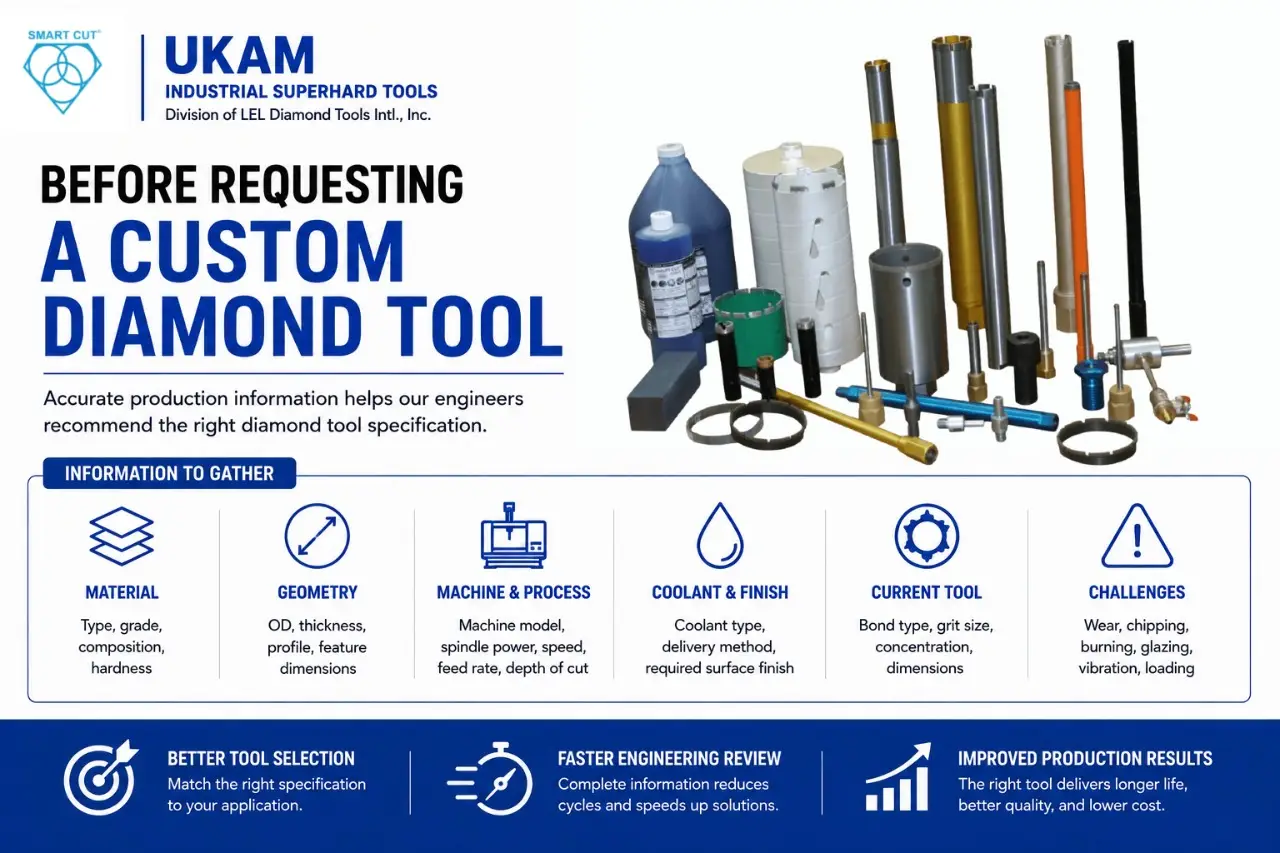
Collecting accurate production information before requesting a quotation allows application engineers to evaluate the complete manufacturing process. Incomplete information often results in additional engineering questions and longer specification cycles.
The following baseline information should be documented before changing any tooling specification.
|
Category |
Information to Record |
Engineering Purpose |
|---|---|---|
|
Workpiece Material |
Material type, grade, composition, hardness |
Determines abrasive characteristics and bond requirements |
|
Component Geometry |
Outside diameter, thickness, profile, feature dimensions |
Defines tool dimensions and geometry |
|
Machine Information |
Machine model, spindle type, spindle power |
Evaluates machine capability |
|
Operating Parameters |
Spindle speed, feed rate, depth of cut |
Identifies process limitations |
|
Coolant System |
Coolant type, concentration, delivery method |
|
|
Current Tool Specification |
Bond type, grit size, concentration, dimensions |
Establishes the existing production baseline |
|
Production Volume |
Prototype, batch production, continuous production |
Influences tool life objectives and specification priorities |
|
Surface Finish Requirement |
Required Ra or customer specification |
Guides abrasive selection |
|
Dimensional Tolerance |
Critical dimensional requirements |
Determines process stability requirements |
|
Existing Process Challenges |
Wear, chipping, burning, glazing, vibration, loading |
Helps identify root causes before changing specifications |
Recording this information creates a technical baseline that supports meaningful engineering discussions. Changing the tool specification without documenting the current process often makes it difficult to determine whether performance improvements result from the new tool or from changes elsewhere in the manufacturing process.
This baseline also simplifies future process optimization. As production requirements evolve, engineers can compare new trial results against documented process conditions instead of relying on historical observations or operator experience.
Cost Per Part Analysis and Engineering Decision Framework
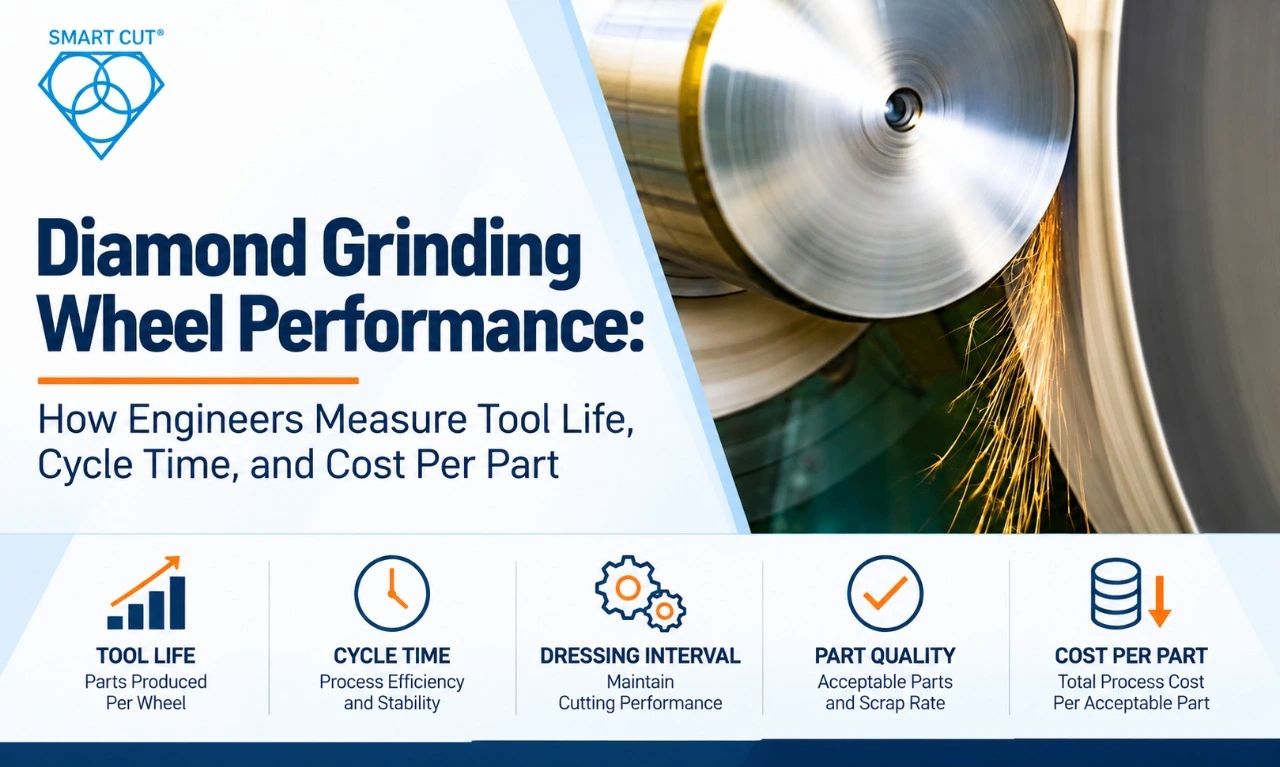
Selecting a custom diamond tool should never be based solely on the purchase price of the tool. Manufacturing engineers evaluate tooling based on its contribution to the total production process. Tool life, process stability, dressing requirements, cycle time, part quality, machine utilization, and operator intervention all contribute to the actual manufacturing cost of each component.
A lower priced standard tool may appear economical during procurement. Production data often tells a different story after the tool enters manufacturing. Frequent tool changes, inconsistent part quality, additional inspection, and unplanned downtime can increase overall production costs even when the initial purchase price is lower.
A custom engineered tool is specified to support the manufacturing process rather than simply replace an existing tool. The objective is to improve process consistency while reducing the operational factors that contribute to higher production costs.
Looking Beyond Tool Purchase Price
Procurement teams often compare tooling based on purchase price because it is easy to measure. Production engineers evaluate a much broader set of performance indicators.
|
Purchasing Perspective |
Engineering Perspective |
|---|---|
|
Initial tool price |
Total manufacturing cost |
|
Supplier availability |
Process capability |
|
Lead time |
Production stability |
|
Standard catalog specification |
Application specific specification |
|
Replacement frequency |
Tool life throughout production |
|
Unit cost |
Cost per acceptable component |
|
Product catalog |
Engineering support and application expertise |
A tooling decision that reduces process interruptions, improves part consistency, and minimizes scrap often provides greater long term value than selecting the lowest priced standard product.
What Contributes to Cost Per Part?
Every production environment has different manufacturing priorities. Some operations focus on maximizing throughput. Others prioritize surface finish, dimensional accuracy, or minimizing material damage. Regardless of the application, the following factors directly influence the overall cost of producing each component.
|
Manufacturing Variable |
Influence on Production Cost |
|---|---|
|
Tool life |
Determines replacement frequency and production interruptions |
|
Influences machine availability and labor requirements |
|
|
Cycle time |
Affects hourly production capacity |
|
Scrap and rework |
Increases material consumption and inspection costs |
|
Surface finish consistency |
Reduces secondary finishing operations |
|
Dimensional repeatability |
Improves process capability and customer acceptance |
|
Machine downtime |
Reduces productive manufacturing hours |
|
Operator intervention |
Increases labor requirements and process variability |
|
Coolant performance |
Influences heat control and tool wear |
|
Production stability |
Supports consistent manufacturing output |
These variables should be evaluated together rather than independently. Improving one production metric while negatively affecting another may not reduce the overall manufacturing cost.
Illustrative Cost Per Part Comparison
The following example demonstrates how engineers evaluate tooling performance during supplier selection. The values shown are illustrative only and are intended to demonstrate the evaluation process rather than represent actual production data.
|
Evaluation Criteria |
Supplier A. Standard Tool |
Supplier B. Custom Engineered Tool |
|---|---|---|
|
Initial Purchase Price |
Lower |
Higher |
|
Tool Life |
Moderate |
Extended |
|
Dressing Frequency |
Frequent |
Reduced |
|
Cycle Time Stability |
Moderate |
Consistent |
|
Surface finish consistency |
Variable |
Stable |
|
Scrap Rate |
Higher |
Lower |
|
Operator Adjustments |
Frequent |
Minimal |
|
Production Downtime |
More Frequent |
Less Frequent |
|
Overall Cost Per Acceptable Component |
Higher |
Lower over production life |
Illustrative comparison only. Actual results depend on material properties, machine capability, operating parameters, coolant strategy, and application specific conditions.
The objective of this comparison is not to suggest that every custom tool outperforms every standard tool. The objective is to demonstrate that engineers evaluate tooling as part of the entire manufacturing process instead of comparing purchase prices alone.
Want to Evaluate Your Current Manufacturing Cost?
UKAM application engineers can review your existing tool specification, production objectives, and manufacturing process to identify opportunities for improving process stability and reducing overall production costs.
Request a Cost Per Part Evaluation
Engineering Decision Framework
Selecting a custom diamond tool requires balancing several process requirements simultaneously. Optimizing one characteristic often influences another. For example, increasing material removal capability may affect surface finish requirements. Improving surface quality may require adjustments to production rate or bond characteristics.
The specification process begins by identifying the primary manufacturing objective before selecting tool characteristics.
Engineering Decision Reference Table
|
Manufacturing Objective |
Primary Engineering Consideration |
Specification Focus |
|---|---|---|
|
Longer tool life |
Wear resistance |
Bond characteristics, diamond concentration |
|
Better surface finish |
Reduced abrasive damage |
|
|
Higher production output |
Material removal efficiency |
Abrasive exposure and bond retention |
|
Reduced edge chipping |
Controlled cutting action |
Diamond size, concentration, and bond compatibility |
|
Tight dimensional tolerance |
Process consistency |
Tool geometry and manufacturing accuracy |
|
Improved thermal control |
Heat management |
Bond selection, coolant compatibility, operating parameters |
|
Automated production |
Repeatability |
Dimensional consistency and predictable wear characteristics |
|
Difficult to machine materials |
Material specific optimization |
Customized specification based on material behavior |
Each manufacturing objective should be prioritized before finalizing the specification. Attempting to maximize every performance characteristic simultaneously rarely produces the most efficient production process.
Engineering Questions Before Specifying a Custom Tool
Application engineers typically begin every specification review by answering a series of technical questions. These questions establish the engineering requirements before recommending abrasive characteristics or tool geometry.
Material Evaluation
- What material is being processed?
- Is the material homogeneous or composite?
- Does material hardness vary between production batches?
- Is edge quality a critical requirement?
Machine Evaluation
- What machine platform will be used?
- What spindle characteristics influence the process?
- Is the machine sufficiently rigid for the application?
- How is coolant delivered to the cutting or grinding zone?
Production Evaluation
- Is the application prototype production or continuous manufacturing?
- What production constraints currently limit productivity?
- Which quality characteristics are most critical?
- What process improvements are expected from the custom specification?
Documenting these engineering requirements before designing a custom diamond tool reduces specification revisions and provides a stronger technical foundation for qualification trials.
Engineering Process for Specifying a Custom Diamond Tool
Selecting a custom diamond tool follows a structured engineering process rather than trial and error. Every decision influences tool performance, production stability, component quality, and long term manufacturing cost. Engineers who follow a documented qualification process typically identify the correct specification faster than those who modify one parameter without evaluating the complete manufacturing system.
The specification process begins with the workpiece material and concludes only after production validation confirms that the tool consistently meets quality and productivity objectives.
Phase 1. Analyze the Workpiece Material
Material characteristics establish the foundation for every custom tool specification. Materials with similar hardness can behave very differently during cutting, grinding, drilling, or slicing because fracture toughness, thermal conductivity, grain structure, and abrasive wear resistance vary significantly.
Engineers should evaluate the complete material specification before selecting abrasive characteristics or bond type.
Material Evaluation Checklist
|
Engineering Parameter |
Why It Matters |
|---|---|
|
Material type |
Determines abrasive compatibility |
|
Material grade |
Different grades often require different specifications |
|
Hardness |
Influences cutting action and tool wear |
|
Fracture toughness |
Affects edge chipping and crack propagation |
|
Grain structure |
Influences surface finish and material removal behavior |
|
Thermal sensitivity |
Determines heat management requirements |
|
Component geometry |
Influences tool design and contact area |
|
Tolerance requirements |
Determines dimensional stability requirements |
|
Surface finish specification |
Guides grit selection |
Changing tool specifications without confirming the material characteristics often produces inconsistent qualification results. Even different grades of tungsten carbide or alumina may require different abrasive specifications despite appearing similar.
Engineering Tip
Material qualification should include the actual production material whenever possible. Development samples and production material may behave differently because of manufacturing variations, density, binder composition, or heat treatment.
Phase 2. Evaluate Machine Capability
A custom diamond tool performs only as well as the machine supporting it. Machine limitations often explain poor tool performance more accurately than the tool specification itself.
Machine rigidity, spindle condition, coolant delivery, and workholding influence vibration, cutting stability, dimensional accuracy, and surface finish.
Machine Assessment Checklist
|
Machine Characteristic |
Engineering Evaluation |
|---|---|
|
Machine type |
Surface grinder, CNC grinder, dicing saw, cutoff saw, machining center |
|
Spindle condition |
Runout, bearing condition, vibration |
|
Machine rigidity |
Structural stability during machining |
|
Coolant delivery |
Flow consistency and nozzle positioning |
|
Workholding |
Stability during machining |
|
Feed system |
Accuracy and repeatability |
|
Maintenance condition |
Overall machine performance |
Machines with excessive vibration or spindle runout often produce symptoms that resemble tool failure. Replacing the tool without correcting machine related issues rarely improves long term production performance.
Common Machine Related Problems
- Surface waviness
- Inconsistent dimensional accuracy
- Uneven wheel wear
- Excessive vibration
- Premature diamond loss
- Poor surface finish
Phase 3. Define Manufacturing Objectives
Every custom tool should be designed around clearly defined production goals. Without measurable objectives, engineers cannot determine whether a new specification represents an improvement over the existing process.
Many manufacturing operations attempt to improve several performance characteristics simultaneously. Prioritizing the primary objective simplifies the engineering process and provides a clear benchmark during qualification.
Production Objectives Reference
|
Manufacturing Goal |
Engineering Priority |
|---|---|
|
Increase tool life |
Wear resistance |
|
Improve surface finish |
Controlled abrasive action |
|
Reduce edge chipping |
Stable cutting performance |
|
Improve dimensional accuracy |
Consistent tool geometry |
|
Increase production throughput |
Higher process efficiency |
|
Reduce scrap |
Stable production quality |
|
Minimize operator intervention |
Predictable tool behavior |
|
Improve automation |
Repeatable manufacturing performance |
The selected objective influences every subsequent specification decision, including bond selection, diamond concentration, grit size, and tool geometry.
Ready to Define the Right Tool Specification?
If your production goals include reducing scrap, improving surface finish, increasing throughput, or extending tool life, UKAM engineers can review your application and recommend an application specific diamond tool design.
Speak with an Application Engineer
Phase 4. Develop the Tool Specification
The engineering specification combines material characteristics with manufacturing objectives to create a tool optimized for the application.
Several specification variables interact with one another. Adjusting one characteristic frequently requires changes elsewhere to maintain balanced performance.
Tool Specification Matrix
|
Specification Area |
Engineering Consideration |
|---|---|
|
Diamond grit size |
Surface finish and material removal characteristics |
|
Diamond concentration |
Abrasive density and wear behavior |
|
Diamond retention and cutting action |
|
|
Tool geometry |
Contact area and dimensional requirements |
|
Diamond quality |
Wear resistance and cutting efficiency |
|
Tool dimensions |
Machine compatibility and application requirements |
|
Coolant compatibility |
Heat management during machining |
The final specification represents a balance between production efficiency, quality requirements, and manufacturing stability.
Phase 5. Prototype Manufacturing and Engineering Trials
The first custom tool should always undergo controlled production trials before full scale implementation.
Qualification trials should compare the new specification against the current production baseline established during the initial engineering review.
Trial Evaluation Checklist
- Surface finish
- Edge quality
- Tool wear pattern
- Process stability
- Operator observations
- Machine behavior
- Coolant performance
- Part consistency
- Dimensional repeatability
- Production efficiency
Every trial should document observations using identical inspection methods to maintain consistent comparison throughout the qualification process.
Phase 6. Production Validation
Successful prototype trials demonstrate technical feasibility. Production validation confirms that the specification performs consistently during routine manufacturing.
Validation should include multiple production cycles rather than a single successful trial.
Production Validation Table
|
Validation Item |
Objective |
|---|---|
|
Process repeatability |
Confirm consistent production performance |
|
Tool wear consistency |
Verify predictable wear characteristics |
|
Dimensional capability |
Maintain required tolerances |
|
Surface finish stability |
Confirm quality throughout production |
|
Operator consistency |
Evaluate repeatability across shifts |
|
Machine compatibility |
Confirm long term production suitability |
|
Quality inspection results |
Verify customer requirements |
Production validation provides confidence before approving a specification for continuous manufacturing.
Phase 7. Continuous Process Optimization
Custom tooling should be reviewed periodically as production requirements evolve. Material suppliers, machine upgrades, production volumes, and customer specifications change over time.
Regular engineering reviews identify opportunities to improve manufacturing performance without disrupting production.
Continuous Improvement Checklist
|
Review Area |
Evaluation Frequency |
|---|---|
|
Tool wear trends |
Regular production review |
|
Surface finish consistency |
Ongoing quality monitoring |
|
Production yield |
Routine process evaluation |
|
Scrap causes |
Continuous root cause analysis |
|
Machine condition |
Evaluate repeatability across shifts |
|
Machine compatibility |
Preventive maintenance schedule |
|
Coolant performance |
Routine inspection |
|
Process capability |
Periodic validation |
Continuous optimization transforms a custom diamond tool from a one time purchase into an evolving manufacturing solution that adapts to changing production requirements.
Engineering Process Summary
A successful custom diamond tool specification follows a logical engineering workflow.
- Analyze the workpiece material.
- Evaluate machine capability.
- Define manufacturing objectives.
- Develop the engineering specification.
- Conduct controlled production trials.
- Validate production performance.
- Continuously optimize the manufacturing process.
This structured approach reduces unnecessary specification changes, shortens qualification time, and improves confidence before implementing a new tool in production.
Need Help Developing a Custom Diamond Tool Specification?
Every manufacturing process presents unique challenges. Material properties, machine capability, production goals, and quality requirements all influence the final tool design.
UKAM application engineers work with manufacturers to review application details, evaluate process requirements, and recommend custom diamond tool specifications tailored to specific production objectives.
Request a Custom Tool Recommendation
Material Specific Considerations for Custom Diamond Tool Specification
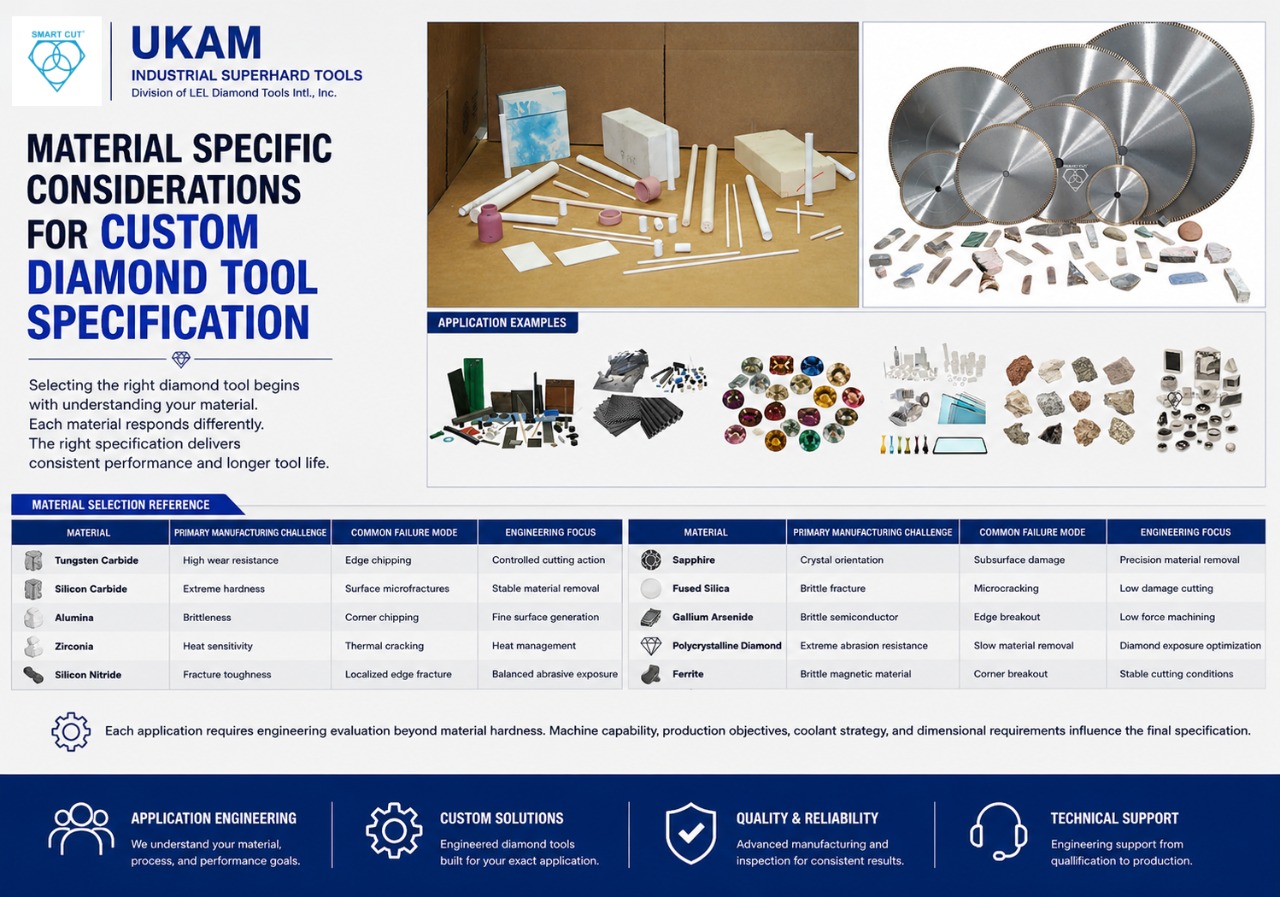
Selecting a custom diamond tool begins with the workpiece material. Each engineering material responds differently during cutting, grinding, drilling, slicing, and dicing. Hardness alone does not determine the correct specification. Fracture toughness, thermal conductivity, microstructure, binder composition, porosity, grain size, and component geometry all influence tool performance.
A specification that performs successfully on one material may produce unacceptable results on another. Reviewing the material’s manufacturing characteristics before developing the tool specification reduces qualification time and improves process stability.
Material Selection Reference
|
Material |
Primary Manufacturing Challenge |
Common Failure Mode |
Engineering Focus |
|---|---|---|---|
|
Tungsten Carbide |
High wear resistance |
Edge chipping |
Controlled cutting action |
|
Silicon Carbide |
Extreme hardness |
Surface microfractures |
Stable material removal |
|
Alumina |
Brittleness |
Corner chipping |
Fine surface generation |
|
Zirconia |
Heat sensitivity |
Thermal cracking |
Heat management |
|
Silicon Nitride |
Fracture toughness |
Localized edge fracture |
Balanced abrasive exposure |
|
Sapphire |
Crystal orientation |
Subsurface damage |
Precision material removal |
|
Fused Silica |
Brittle fracture |
Microcracking |
Low damage cutting |
|
Gallium Arsenide |
Brittle semiconductor |
Edge breakout |
Low force machining |
|
Polycrystalline Diamond |
Extreme abrasion resistance |
Slow material removal |
Diamond exposure optimization |
|
Ferrite |
Brittle magnetic material |
Corner breakout |
Stable cutting conditions |
Each application requires engineering evaluation beyond material hardness. Machine capability, production objectives, coolant strategy, and dimensional requirements influence the final specification.
Tungsten Carbide
Tungsten carbide remains one of the most common materials processed with diamond tooling because of its exceptional wear resistance and widespread use in cutting tools, dies, punches, wear components, and precision mechanical parts.
The material contains carbide particles bonded with a metallic binder. Variations in carbide grain size and binder content influence grinding behavior.
Primary Failure Mode
Edge chipping during grinding or cutting.
Edge chipping often develops when the abrasive action becomes too aggressive or when machine vibration introduces unstable cutting forces.
Engineering Considerations
|
Evaluation Area |
Engineering Consideration |
|---|---|
|
Material grade |
Fine grain and coarse grain grades behave differently |
|
Binder content |
Influences wear characteristics |
|
Required finish |
Determines abrasive selection |
|
Tool geometry |
Influences contact pressure |
|
Machine rigidity |
Supports dimensional stability |
Silicon Carbide
Silicon carbide combines high hardness with excellent wear resistance. The material is widely used in semiconductor processing, advanced ceramics, seals, bearings, and high temperature components.
Its brittle behavior requires careful control of cutting forces.
Primary Failure Mode
Surface microfractures.
Microfractures frequently develop before becoming visible during inspection and may reduce component reliability.
Engineering Considerations
|
Evaluation Area |
Engineering Consideration |
|---|---|
|
Surface integrity |
Minimize subsurface damage |
|
Feed consistency |
Maintain stable material removal |
|
Coolant delivery |
Improve thermal stability |
|
Tool specification |
Balance cutting efficiency with surface quality |
Alumina
Alumina ceramics are widely used in electrical insulation, medical components, wear parts, semiconductor equipment, and industrial ceramics.
Although alumina exhibits excellent hardness, its brittle structure requires controlled machining conditions.
Primary Failure Mode
Corner chipping.
Localized corner damage frequently appears during component entry or exit when cutting forces become unstable.
Engineering Considerations
|
Evaluation Area |
Engineering Consideration |
|---|---|
|
Component geometry |
Thin sections require additional support |
|
Edge quality |
Minimize localized stress |
|
Surface finish |
Select specification appropriate for finishing requirements |
|
Machine vibration |
Reduce instability throughout machining |
Zirconia
Zirconia provides excellent fracture toughness compared with many engineering ceramics. It is commonly used in medical devices, structural ceramics, wear components, and precision mechanical applications.
Primary Failure Mode
Thermal cracking.
Localized heat generation may initiate cracking during extended machining operations.
Engineering Considerations
|
Evaluation Area |
Engineering Consideration |
|---|---|
|
Coolant performance |
Maintain effective heat removal |
|
Material removal strategy |
Prevent localized overheating |
|
Production consistency |
Monitor thermal stability throughout machining |
Silicon Nitride
Silicon nitride offers excellent thermal stability and fracture resistance while maintaining high hardness.
The material is frequently used in bearings, aerospace components, automotive systems, and advanced engineering applications.
Primary Failure Mode
Localized edge fracture.
Edge fractures frequently occur near unsupported features during aggressive machining conditions.
Engineering Considerations
|
Evaluation Area |
Engineering Consideration |
|---|---|
|
Component support |
Reduce localized stress |
|
Tool geometry |
Maintain stable cutting action |
|
Surface integrity |
Preserve finished component quality |
Sapphire
Sapphire is widely used in semiconductor manufacturing, optical components, LEDs, laser systems, and precision instrumentation.
Crystal orientation significantly influences machining behavior.
Primary Failure Mode
Subsurface damage.
Subsurface damage may remain undetected until later manufacturing stages, reducing optical performance or structural integrity.
Engineering Considerations
|
Evaluation Area |
Engineering Consideration |
|---|---|
|
Crystal orientation |
Evaluate machining direction |
|
Surface integrity |
Minimize internal damage |
|
Dimensional accuracy |
Maintain optical quality |
Fused Silica
Fused silica is commonly processed for optics, semiconductor equipment, laboratory components, and photonics applications.
The material requires controlled machining to preserve optical quality.
Primary Failure Mode
Microcracking.
Small cracks may propagate during later polishing or assembly operations.
Engineering Considerations
|
Evaluation Area |
Engineering Consideration |
|---|---|
|
Heat generation |
Maintain stable cutting temperatures |
|
Surface finish |
Minimize polishing requirements |
|
Process stability |
Reduce crack initiation |
Gallium Arsenide (GaAs)
Gallium arsenide is widely used in semiconductor devices, radio frequency electronics, photonics, and aerospace systems.
Its brittle nature requires low force machining techniques.
Primary Failure Mode
Edge breakout.
Breakout commonly develops during component entry and exit.
Engineering Considerations
|
Evaluation Area |
Engineering Consideration |
|---|---|
|
Feed control |
Maintain stable cutting conditions |
|
Component support |
Reduce vibration |
|
Tool condition |
Monitor wear throughout production |
Polycrystalline Diamond (PCD)
PCD components require diamond tooling during manufacturing because conventional abrasives cannot effectively machine the material.
Primary Failure Mode
Low material removal efficiency.
An unsuitable specification may increase production time without improving component quality.
Engineering Considerations
|
Evaluation Area |
Engineering Consideration |
|---|---|
|
Abrasive exposure |
Balance cutting action and wear |
|
Tool geometry |
Maintain process stability |
|
Production objectives |
Optimize throughput and finish |
Ferrite
Ferrite materials are widely used in magnetic components, transformers, sensors, and electronic assemblies.
Their brittle structure requires stable machining conditions.
Primary Failure Mode
Corner breakout.
Localized damage often occurs around holes, slots, or thin wall features.
Engineering Considerations
|
Evaluation Area |
Engineering Consideration |
|---|---|
|
Workholding |
Maintain component stability |
|
Edge quality |
Reduce localized fracture |
|
Inspection |
Monitor component integrity throughout production |
Engineering Comparison Across Materials
|
Material |
Surface Finish Priority |
Dimensional Accuracy |
Heat Control |
Edge Protection |
|---|---|---|---|---|
|
Tungsten Carbide |
High |
High |
Medium |
High |
|
Silicon Carbide |
High |
High |
High |
High |
|
Alumina |
High |
High |
Medium |
Very High |
|
Zirconia |
Medium |
High |
Very High |
High |
|
Silicon Nitride |
High |
High |
High |
Very High |
|
Sapphire |
Extremely High |
Extremely High |
High |
Very High |
|
Fused Silica |
Extremely High |
High |
High |
Extremely High |
|
Gallium Arsenide |
High |
High |
Medium |
Extremely High |
|
PCD |
Medium |
High |
Medium |
Medium |
|
Ferrite |
High |
Medium |
Medium |
Very High |
Working with Difficult to Machine Materials?
Material behavior is one of the most significant factors influencing custom diamond tool performance. Providing material specifications, engineering drawings, and production objectives allows UKAM application engineers to recommend a specification aligned with your manufacturing process.
Discuss Your Application with an Engineer
Evaluating a Custom Diamond Tool Supplier
Selecting the right supplier is as important as selecting the right tool specification. A well designed diamond tool can still fail to meet production objectives if the supplier lacks application engineering expertise, manufacturing capability, or process knowledge.
Many suppliers offer standard catalog products with limited customization. High precision manufacturing applications often require engineering collaboration to optimize tool geometry, diamond characteristics, bond formulation, and operating recommendations for a specific process.
Engineers should evaluate a supplier based on technical capability, manufacturing experience, and long term support rather than product availability alone.
What Should Engineers Look for in a Custom Diamond Tool Supplier?
A supplier should demonstrate the ability to understand the manufacturing process before recommending a specification. Technical discussions should focus on the application, material behavior, machine capability, and production objectives rather than simply matching a catalog part number.
The following evaluation criteria help engineering teams compare suppliers using measurable technical capabilities.
|
Evaluation Area |
Engineering Consideration |
Why It Matters |
|---|---|---|
|
Application Engineering |
Reviews material, machine, and process requirements |
Reduces specification errors |
|
Manufacturing Capability |
Produces custom dimensions and geometries |
Supports application specific solutions |
|
Diamond Technology |
Offers multiple diamond grades, concentrations, and grit sizes |
Allows process optimization |
|
Bond Development |
Provides multiple bond formulations for different applications |
Improves compatibility with production objectives |
|
Technical Documentation |
Supplies engineering recommendations and operating guidance |
Supports qualification and production |
|
Quality Control |
Maintains manufacturing consistency |
Improves repeatability between production batches |
|
Engineering Support |
Assists during qualification and troubleshooting |
Reduces production delays |
|
Industry Experience |
Experience with similar materials and applications |
Shortens development time |
A supplier that asks detailed technical questions before recommending a specification is generally better positioned to support complex manufacturing applications than one that recommends a product based solely on material type.
Supplier Evaluation Questions
Engineering teams should prepare a structured list of technical questions before requesting a quotation. The quality of the supplier’s response often provides valuable insight into their engineering capabilities.
Supplier Evaluation Framework
|
Ask the Supplier |
What the Answer Reveals |
|---|---|
|
Can you review our engineering drawings before recommending a specification? |
Level of application engineering support |
|
Can the tool geometry be customized for our process? |
Manufacturing flexibility |
|
Engineering knowledge and manufacturing capability |
|
|
Can diamond concentration be customized? |
Ability to optimize tool performance |
|
Can you recommend operating parameters? |
Practical manufacturing experience |
|
Do you support qualification trials? |
Long term engineering partnership |
|
Can the specification be modified after production feedback? |
Engineering flexibility |
|
What quality controls are used during manufacturing? |
Manufacturing consistency |
|
Can you support low volume prototypes before production release? |
Product development capability |
|
Have you worked with this material previously? |
Industry specific experience |
These questions encourage technical discussions instead of price based comparisons. Suppliers that provide detailed engineering responses typically contribute more effectively during qualification and process optimization.
Engineering Documentation to Share with Your Supplier
The quality of the engineering recommendation depends on the information provided during the quotation process. Sharing complete production details reduces unnecessary revisions and allows the supplier to recommend a specification based on actual operating conditions.
Engineering Information Checklist
|
Category |
Information to Provide |
|---|---|
|
Material |
Material type, grade, hardness, composition |
|
Component |
Drawing, dimensions, tolerance requirement |
|
Machine |
Machine model, spindle information, operating capability |
|
Process |
|
|
Current Tool |
Existing specification and performance observations |
|
Surface Finish |
Required finish or customer specification |
|
Production Volume |
Prototype, batch production, or continuous manufacturing |
|
Coolant |
Type, concentration, and delivery method |
|
Quality Concerns |
Chipping, cracking, glazing, vibration, tool wear, thermal damage |
|
Production Objectives |
Longer tool life, improved finish, higher productivity, lower scrap |
Providing this information during the initial engineering discussion allows the supplier to evaluate the complete manufacturing process rather than recommending a generic catalog specification.
Need Engineering Support with Your Tool Specification?
Sharing engineering drawings, material information, and production objectives early in the specification process helps identify the most appropriate custom diamond tool for your application.
Upload Your Drawings for Engineering Review
SMART CUT Technology Comparison
Selecting a custom diamond tool often involves comparing standard catalog products with application specific solutions. The following table highlights common engineering considerations when evaluating tooling options.
|
Engineering Feature |
Standard Catalog Diamond Tool |
SMART CUT Custom Diamond Tool |
|---|---|---|
|
Tool Dimensions |
Standard catalog sizes |
Manufactured to application requirements |
|
Tool Geometry |
Fixed configurations |
Customized for component geometry |
|
Diamond Grit Options |
Standard selections |
Application specific grit selection |
|
Diamond Concentration |
Standard configurations |
Customized concentration options |
|
Bond Formulations |
Limited standard choices |
Multiple bond formulations based on application |
|
Material Compatibility |
General purpose applications |
Specified for individual material characteristics |
|
Engineering Review |
Product recommendation |
Application review based on manufacturing process |
|
Prototype Development |
Limited |
Available for qualification projects |
|
Specification Refinement |
Catalog based |
Updated based on production feedback |
|
Manufacturing Support |
Product supply |
Engineering collaboration during qualification |
This comparison illustrates the difference between selecting a standard product and developing a specification around a manufacturing process. The appropriate approach depends on application complexity, production requirements, and engineering objectives.
Signs That a Custom Diamond Tool May Be Required
Manufacturing processes evolve over time. Changes in production volume, quality requirements, or component design may indicate that the existing tooling strategy should be reviewed.
Engineering Assessment Checklist
- Surface finish no longer meets customer requirements.
- Tool wear has become inconsistent.
- Scrap rates have increased.
- Production capacity has expanded.
- New materials have been introduced.
- Machine capability has changed.
- Dimensional tolerances have become tighter.
- Secondary finishing operations continue to increase.
- Operators make frequent process adjustments.
- Existing catalog tools no longer meet production objectives.
A positive response to several of these indicators suggests that a technical review may identify opportunities to improve production performance through a custom tool specification.
Engineering Insight
The most successful custom tooling projects begin with collaboration rather than product selection. Engineers who document process requirements, production objectives, and quality expectations before requesting a quotation typically complete qualification more efficiently and achieve more consistent manufacturing results.
Ready to Start Your Custom Tool Specification?
Whether your objective is improving surface finish, extending tool life, reducing scrap, or increasing production consistency, a structured engineering review is the first step toward selecting the appropriate custom diamond tool.
Frequently Asked Questions
A custom diamond tool becomes a practical choice when standard tooling cannot consistently meet production requirements. Common reasons include recurring edge chipping, inconsistent surface finish, short tool life, tight dimensional tolerances, or processing unique materials that require an application specific specification.
The most useful information includes the workpiece material, engineering drawing, machine type, production process, dimensional tolerances, surface finish requirements, current tooling specification, coolant information, and production objectives. Complete application data helps engineers recommend a more suitable specification.
In some applications, a single specification may perform well across similar materials. Materials with significantly different hardness, fracture behavior, or thermal characteristics often require different specifications to maintain consistent performance.
No. Diamond concentration should match the application requirements. Higher concentration is not automatically better. The appropriate concentration depends on the material, bond type, operating conditions, and production objectives.
Qualification time varies with the application. Most manufacturers begin with controlled production trials before moving to full scale production. The process should verify surface finish, dimensional accuracy, tool wear, and overall production consistency.
Many tooling decisions focus only on purchase price. Engineers achieve better long term results by evaluating the complete manufacturing process, including tool life, process stability, surface quality, scrap reduction, and production efficiency.
Yes. A properly specified tool can improve process stability, reduce operator adjustments, minimize scrap, and extend tool life. These improvements often contribute more to manufacturing efficiency than the initial purchase price of the tool.
Engineering drawings provide critical information about component geometry, tolerances, material removal areas, and production requirements. This information allows application engineers to recommend a specification that matches the manufacturing process rather than selecting a generic catalog product.
Key Engineering Principles
Selecting a custom diamond tool is an engineering process that considers the interaction between the material, machine, tooling, and production objectives. A structured specification process reduces qualification time and improves manufacturing consistency.
Key Takeaways
- Evaluate the complete manufacturing process before changing tool specifications.
- Document baseline production conditions before beginning qualification.
- Match the tool specification to the workpiece material and production objectives.
- Compare suppliers based on engineering capability, not only product availability.
- Review total manufacturing cost instead of focusing only on tool purchase price.
- Conduct controlled production trials before full scale implementation.
- Use production feedback to refine future tooling specifications.
Ready to Specify a Custom Diamond Tool?
Every manufacturing application has unique requirements. Material characteristics, machine capability, component geometry, production volume, and quality expectations all influence the final tool specification.
Working with application engineers early in the process can reduce development time and improve production performance.
Need Assistance with Your Application?
Whether you are developing a new manufacturing process or improving an existing one, UKAM’s engineering team can review your application and recommend a custom diamond tool specification based on your production requirements.
Conclusion
Custom diamond tools are developed to solve specific manufacturing challenges that standard catalog products may not address effectively. A successful specification considers material properties, machine capability, production objectives, and quality requirements as a complete engineering system.
By following a structured evaluation process and collaborating with an experienced engineering team, manufacturers can improve process stability, support consistent product quality, and develop tooling solutions that align with long term production goals.
Trusted by Tens of Thousands of Manufacturers, Laboratories,
Research Institutions Worldwide Since 1990
American Based Manufacturer
Established in 1990
Custom manufacturing
RELATED ARTICLES