








Buehler Grinding Consumables Cross Reference
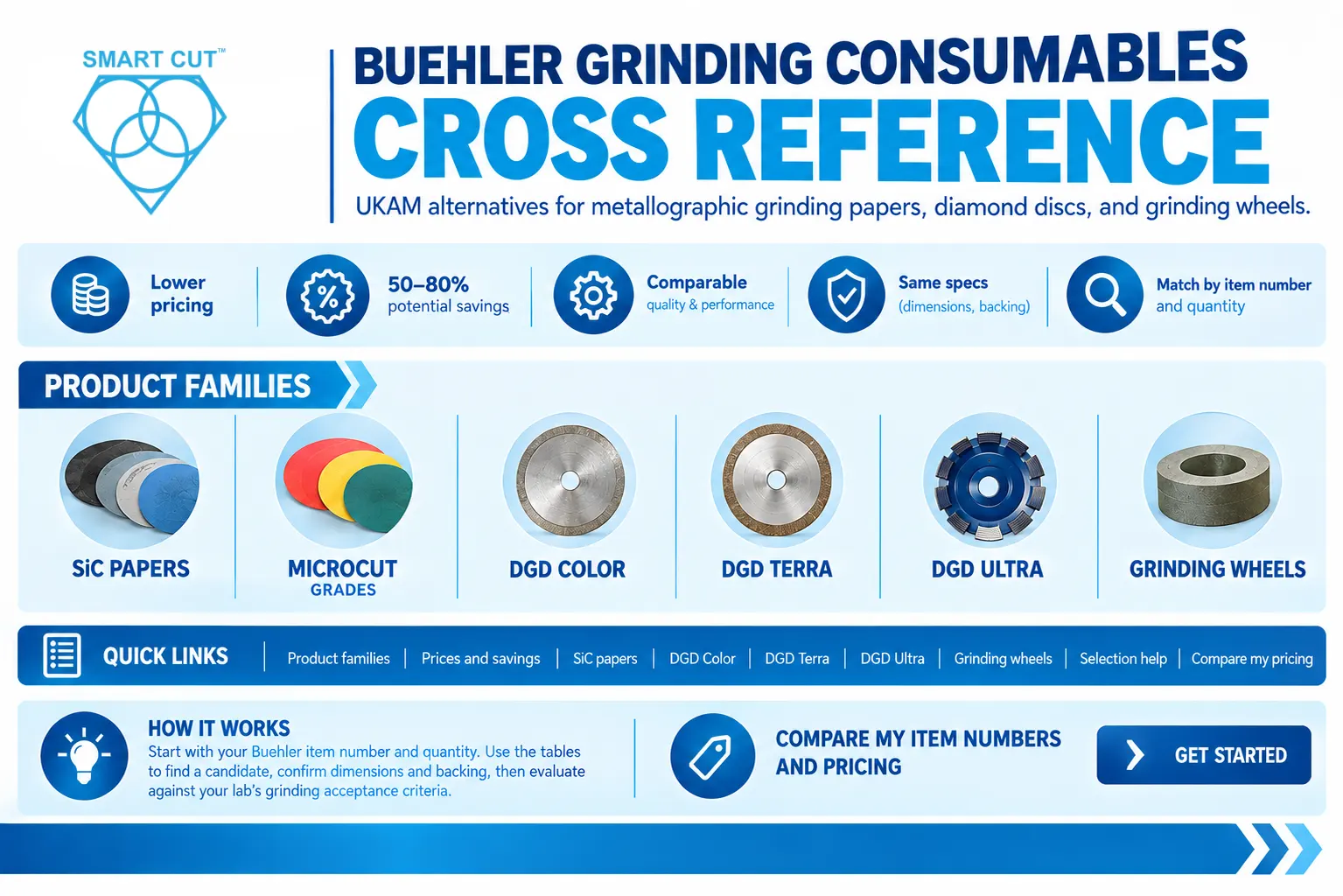
Table of Contents
ToggleUKAM alternatives for metallographic grinding papers, diamond discs, and grinding wheels
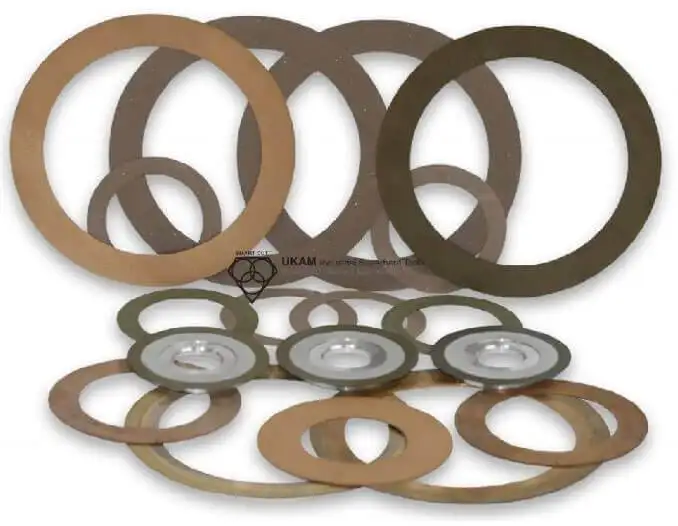
Use this Buehler grinding consumables cross reference to find UKAM alternatives by item number. Compare CarbiMet silicon carbide papers, MicroCut grades, DGD Color, DGD Terra, DGD Ultra, and grinding wheels for metallographic specimen preparation.
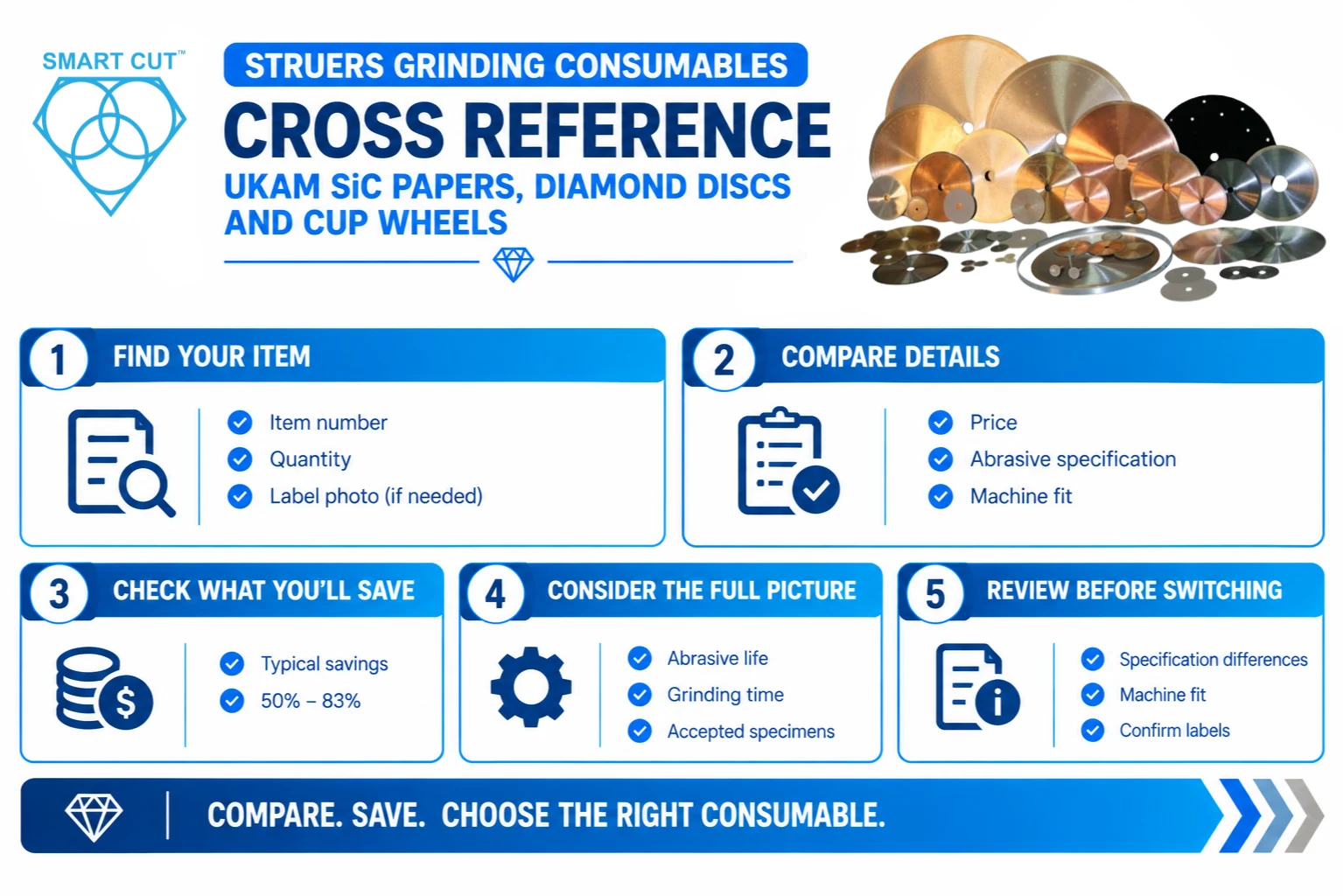
UKAM pricing can be 50% to 80% lower than Buehler pricing on selected comparable grinding consumables. That means paying one-half to one-fifth of the comparison price. Your savings depend on the item, specification, quantity, and current quotation. The range is UKAM’s reported pricing position and is not a verified discount for every row below.
Start with your Buehler item number and the quantity you buy. Use the tables to identify a candidate, confirm its dimensions and backing, then evaluate it against your laboratory’s grinding acceptance criteria.
Find a grinding item number or product family
Enter a Buehler or UKAM item number, CarbiMet, DGD Color, DGD Terra, or DGD Ultra. Spaces and hyphens are optional. Read the reference status with each result.
Trusted by Tens of Thousands of Manufacturers, Laboratories Research Institutions Worldwide Since 1990
Established in 1990
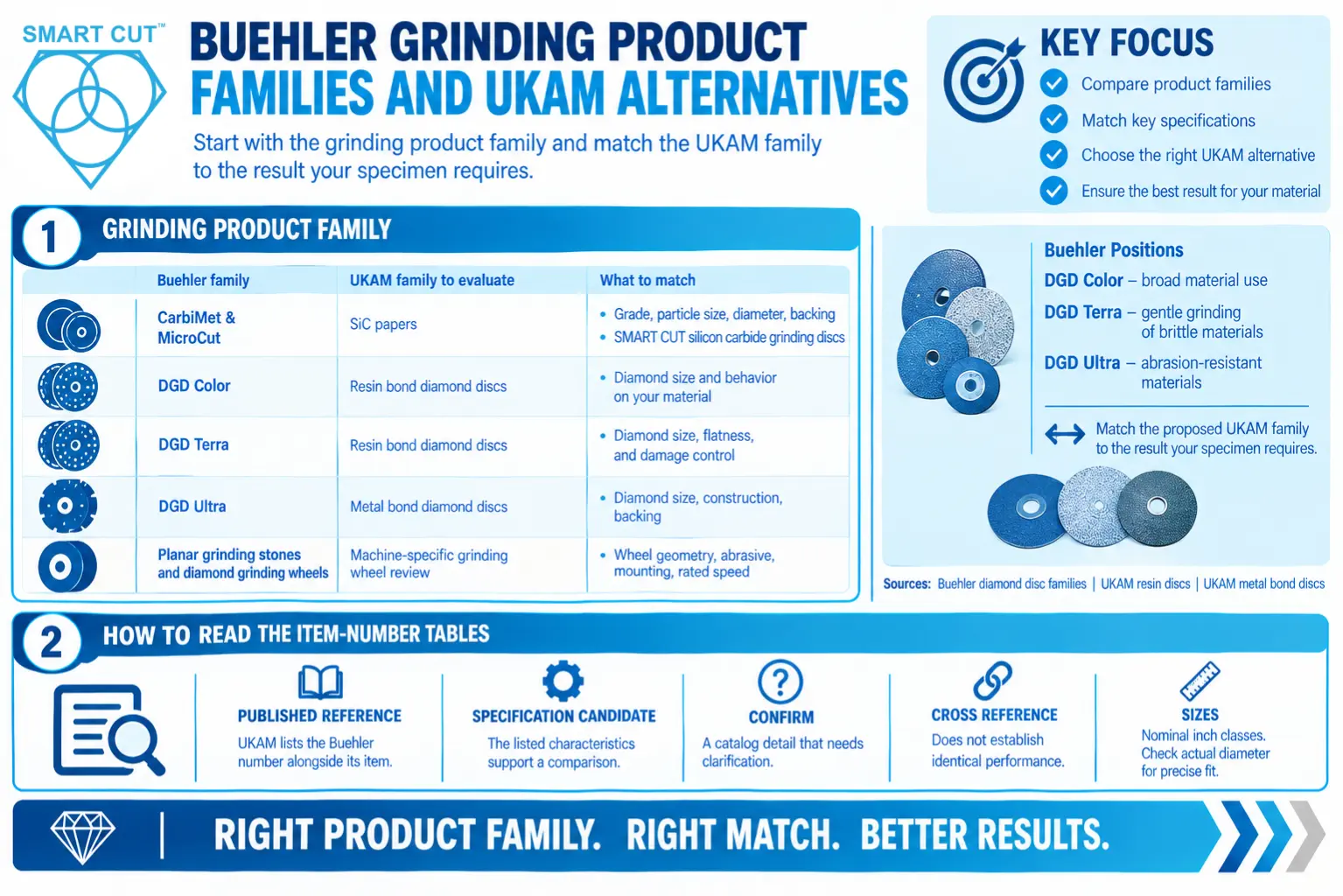
Buehler grinding product families and UKAM alternatives
| Buehler family | UKAM family to evaluate | What to match |
|---|---|---|
| CarbiMet and MicroCut SiC papers | SMART CUT silicon carbide grinding discs | Grade, particle size, diameter, backing |
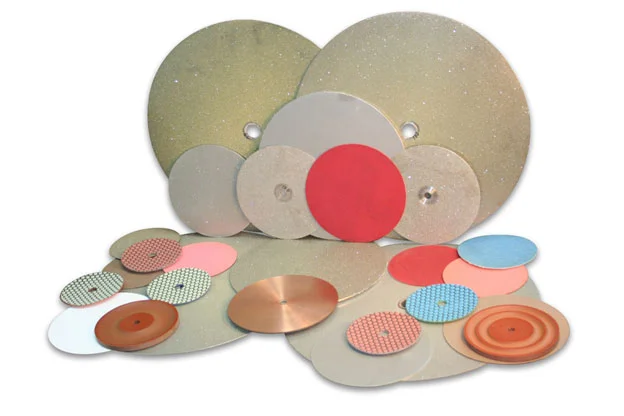
| DGD Color | Resin bond diamond discs | Diamond size and behavior on your material |
| DGD Terra | Resin bond diamond discs | Diamond size, flatness, and damage control |
| DGD Ultra | Metal bond diamond discs | Diamond size, construction, backing |
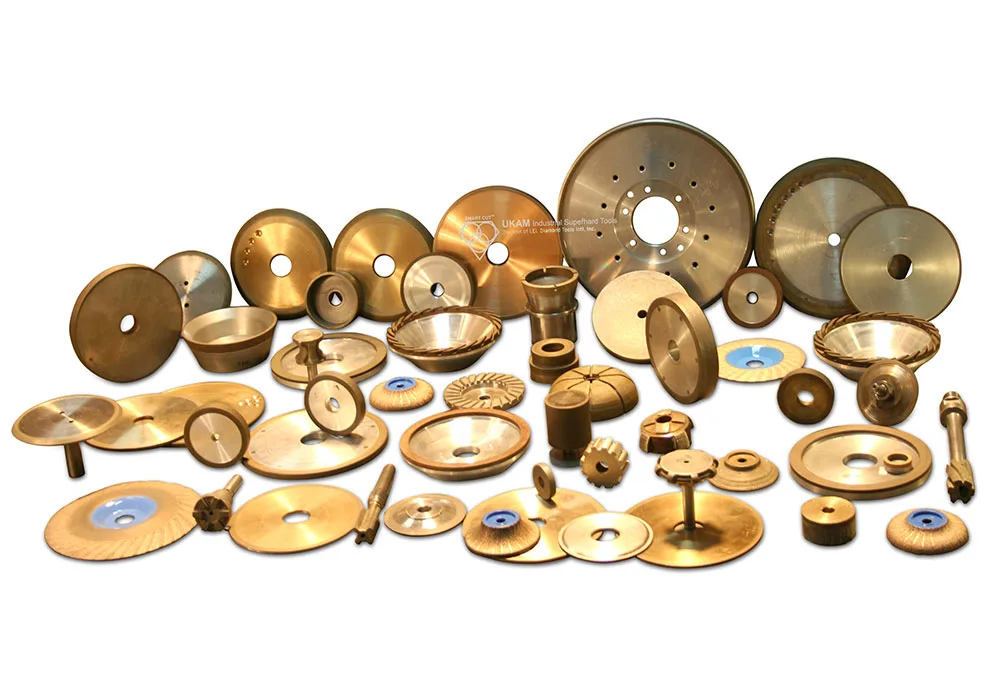
| Planar grinding stones and diamond grinding wheels | Machine-specific grinding wheel review | Wheel geometry, abrasive, mounting, rated speed |
Buehler positions DGD Color for broad material use, DGD Terra for gentle grinding of brittle materials, and DGD Ultra for abrasion-resistant materials. Match the proposed UKAM family to the result your specimen requires.
Sources: Buehler diamond disc families | UKAM resin discs | UKAM metal bond discs
How to read the item-number tables
Published reference means UKAM lists the Buehler number alongside its item. Specification candidate means the listed characteristics support a comparison. Confirm identifies a catalog detail that needs clarification. A cross reference does not establish identical performance. Sizes are nominal inch classes. Check actual diameter where precise fit matters.
Compare grinding consumable prices and potential savings
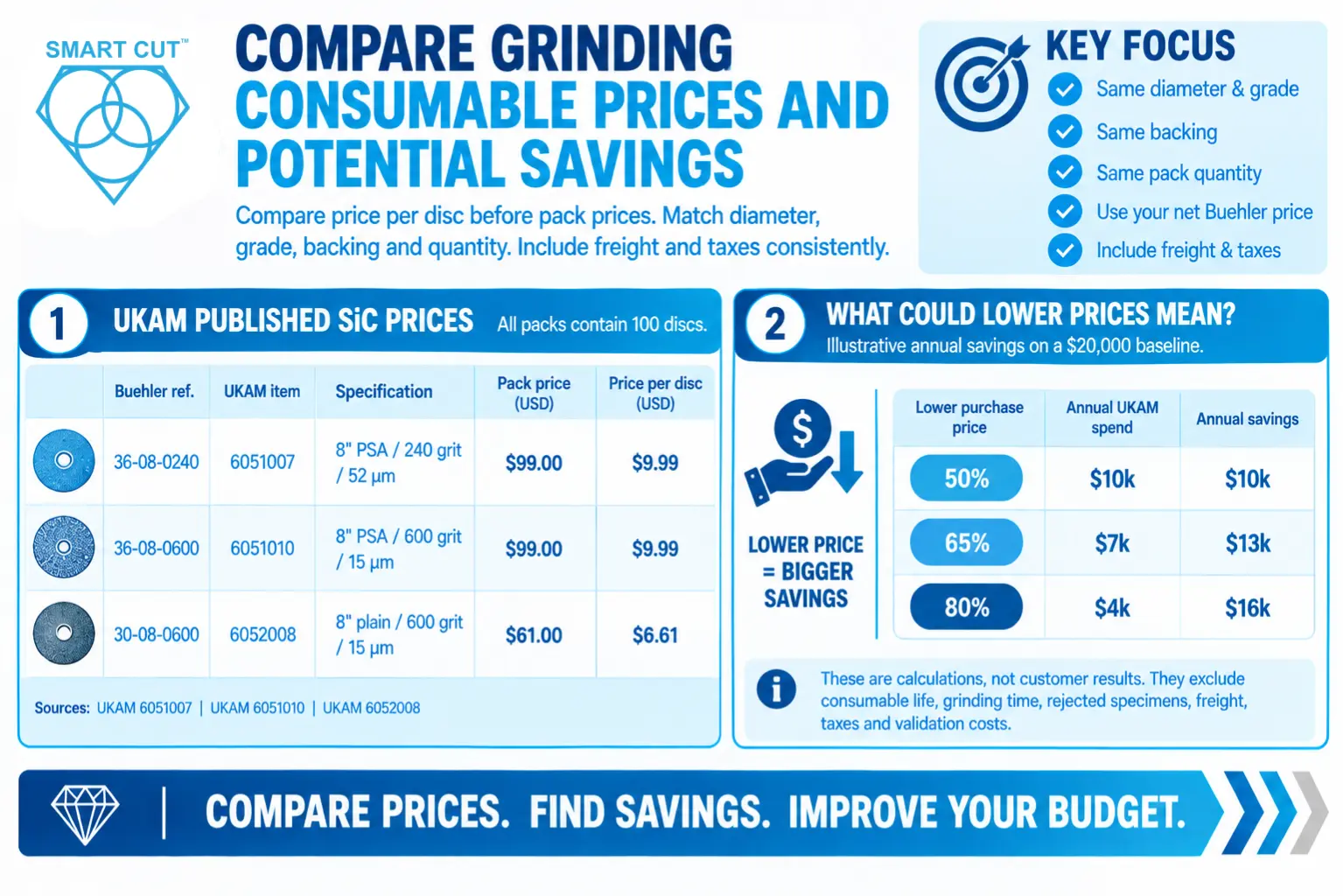
Compare price per disc before comparing pack prices. Match diameter, abrasive grade, backing, and pack quantity. Use your current net Buehler price after discounts and the UKAM price for the same purchase quantity. Account for freight and taxes consistently.
Published UKAM prices for three SiC paper candidates
The following UKAM product pages listed packs of 100 discs at these US dollar prices on September 19, 2026. These are UKAM price benchmarks, not verified Buehler-to-UKAM savings comparisons. Obtain a current quotation before purchasing.
| Buehler reference | UKAM item | Grinding paper specification | Pack price | Price per disc |
|---|---|---|---|---|
| 36-08-0240 | 6051007 | 8 in PSA / 240 grit / 52 µm | $99.00 | $0.99 |
| 36-08-0600 | 6051010 | 8 in PSA / 600 grit / 15 µm | $99.00 | $0.99 |
| 30-08-0600 | 6052008 | 8 in plain / 600 grit / 15 µm | $61.00 | $0.61 |
Sources: UKAM 6051007 pack price | UKAM 6051010 pack price | UKAM 6052008 pack price
Unit price = pack price divided by the number of discs. Purchase savings percentage = (Buehler unit price minus UKAM unit price) divided by Buehler unit price, multiplied by 100. Enter your actual invoice or quotation price to complete the comparison.
What could lower purchase prices mean for your annual budget
If your laboratory currently spends $20,000 per year on the comparable grinding items being reviewed, the following scenarios show the purchase savings at unchanged quantities and product mix. They are calculations, not customer results or quotations.
| Lower purchase price | Illustrative annual UKAM spend | Annual purchase savings |
|---|---|---|
| 50% | $10,000 | $10,000 |
| 65% | $7,000 | $13,000 |
| 80% | $4,000 | $16,000 |
These scenarios exclude differences in consumable life, grinding time, rejected specimens, freight, taxes, and validation costs. Measure those factors during the trial before treating purchase savings as total process savings.
Buehler CarbiMet silicon carbide paper cross reference
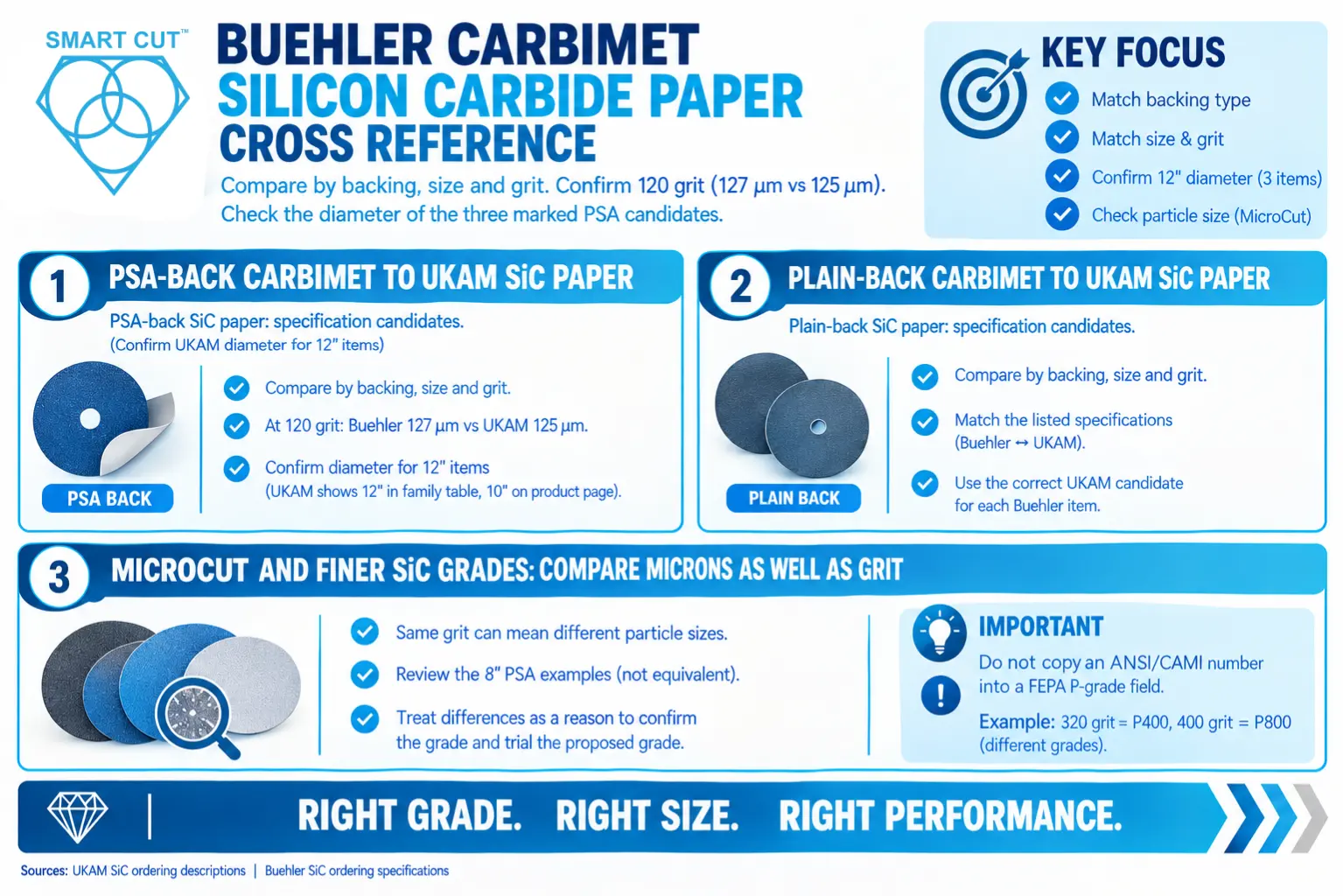
Compare these CarbiMet candidates by backing, nominal size, and grit. At 120 grit, Buehler lists 127 µm and UKAM lists 125 µm. Confirm the diameter of the three marked PSA candidates.
PSA-back CarbiMet to UKAM SiC paper
| Buehler item | Buehler size | Listed grit | UKAM candidate |
|---|---|---|---|
| 36-08-0060 | 8 in | 60 | 6051001 |
| 36-08-0120 | 8 in | 120 | 6051005 |
| 36-08-0240 | 8 in | 240 | 6051007 |
| 36-08-0600 | 8 in | 600 | 6051010 |
| 36-10-0060 | 10 in | 60 | 6053001 |
| 36-10-0120 | 10 in | 120 | 6053003 |
| 36-10-0240 | 10 in | 240 | 6053005 |
| 36-10-0600 | 10 in | 600 | 6053008 |
| 36-12-0060 | 12 in | 60 | 6055001 * Check OD |
| 36-12-0120 | 12 in | 120 | 6055003 * Check OD |
| 36-12-0240 | 12 in | 240 | 6055005 * Check OD |
| 36-12-0600 | 12 in | 600 | 6055008 |
* OD means outside diameter. For 6055001, 6055003, and 6055005, UKAM lists 12 inches in its family table and 10 inches in product page titles. Confirm diameter in writing.
Plain-back CarbiMet to UKAM SiC paper
| Buehler item | Buehler size | Listed grit | UKAM candidate |
|---|---|---|---|
| 30-08-0060 | 8 in | 60 | 6052001 |
| 30-08-0120 | 8 in | 120 | 6052003 |
| 30-08-0240 | 8 in | 240 | 6052005 |
| 30-08-0600 | 8 in | 600 | 6052008 |
| 30-10-0060 | 10 in | 60 | 6054001 |
| 30-10-0120 | 10 in | 120 | 6054003 |
| 30-10-0240 | 10 in | 240 | 6054005 |
| 30-10-0600 | 10 in | 600 | 6054008 |
| 30-12-0060 | 12 in | 60 | 6056001 |
| 30-12-0120 | 12 in | 120 | 6056003 |
| 30-12-0240 | 12 in | 240 | 6056005 |
| 30-12-0600 | 12 in | 600 | 6056008 |
MicroCut and finer SiC grades: compare microns as well as grit
The same printed grit number can conceal a meaningful difference in the listed particle size. The following 8-inch PSA examples need a grade review. They are not presented as equivalent replacements.
| Buehler item and grade | Buehler µm | UKAM item and grade | UKAM µm |
|---|---|---|---|
| 36-08-0400 | 400 grit | 22 | 6051009 | 400 grit | 30 |
| 36-08-0800 | MicroCut 800 | 13 | 6051011 | 800 grit | 10 |
| 36-08-1200 | MicroCut 1200 | 8 | 6051012 | 1200 grit | 5 |
Treat these differences as a reason to confirm the abrasive grading specification and trial the proposed grade. Do not copy an ANSI/CAMI number into a FEPA P-grade field. For example, Buehler lists 320 grit as P400 and 400 grit as P800. Those are different abrasive grades.
Sources: Buehler grit and micron listings | UKAM individual ordering descriptions
Buehler DGD Color to UKAM resin bond diamond discs
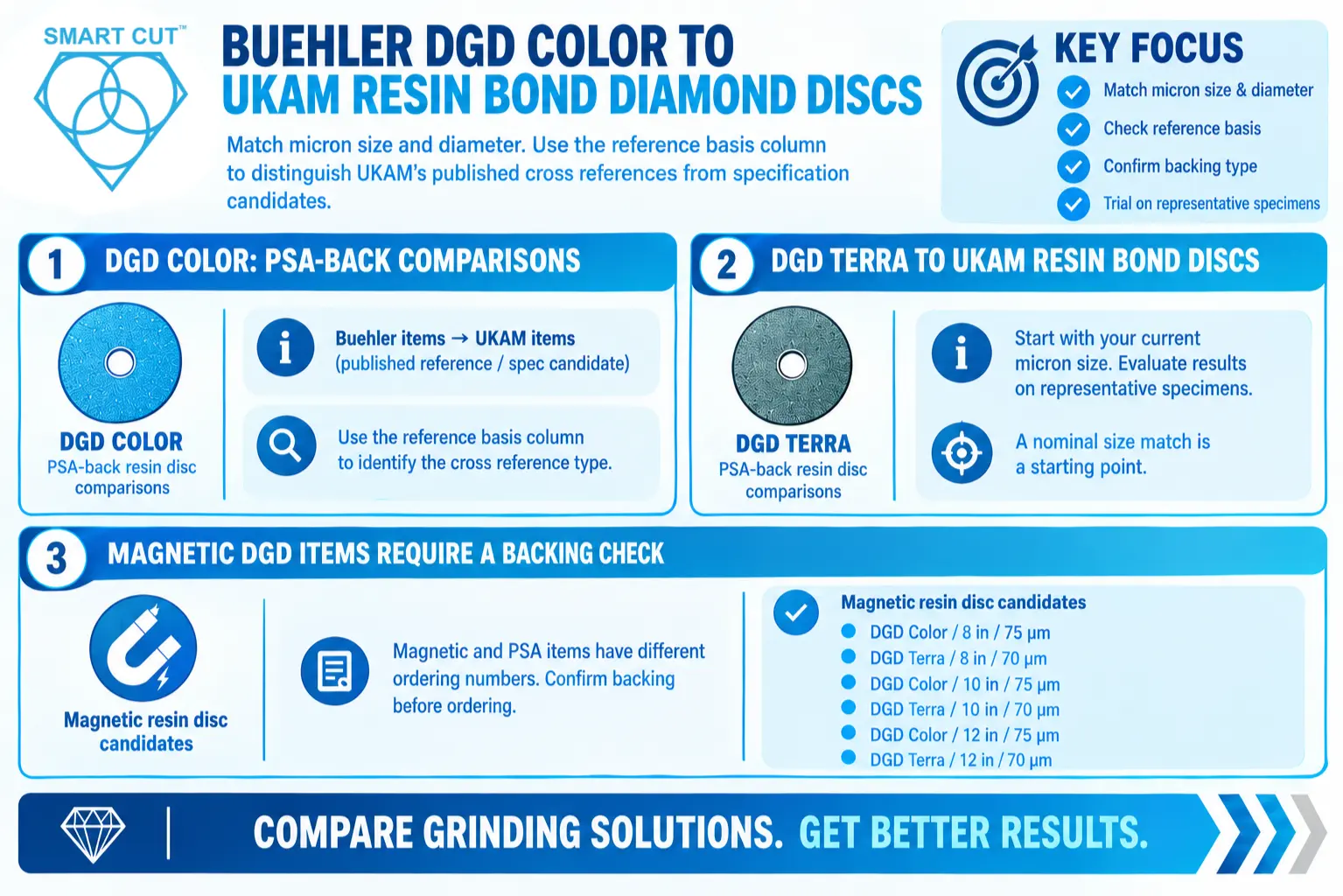
These PSA-back DGD Color comparisons use matching listed micron sizes and nominal diameters. Use the reference basis column to distinguish UKAM’s published cross references from specification candidates.
| Buehler item | Size in | Size µm | UKAM item | Reference basis |
|---|---|---|---|---|
| 41-3508 | 8 | 75 | 6140481 | Published reference |
| 41-3608 | 8 | 55 | 6140483 | Published reference |
| 41-3708 | 8 | 35 | 6140485 | Published reference |
| 41-3310 | 10 | 240 | 6140508 | Published reference |
| 41-3510 | 10 | 75 | 6140511 | Specification candidate |
| 41-3710 | 10 | 35 | 6140515 | Published reference |
| 41-3512 | 12 | 75 | 6140541 | Specification candidate |
| 41-3612 | 12 | 55 | 6140543 | Specification candidate |
| 41-3812 | 12 | 15 | 6140547 | Specification candidate |
Sources: Buehler DGD Color ordering | UKAM resin disc ordering and cross references
A useful trial asks whether the proposed disc removes the required material while retaining the specimen features you need to examine. Inspect the ground face and the time required to reach it. Do not select a disc by its color code alone.
Buehler DGD Terra to UKAM resin bond diamond discs
The following PSA-back entries compare selected DGD Terra grinding grades with UKAM resin discs. Begin with your existing micron size and evaluate the result on representative specimens. A nominal size match is a starting point for a controlled trial.
| Buehler item | Size in | Size µm | UKAM item | Reference basis |
|---|---|---|---|---|
| 41-5108 | 8 | 125 | 6140480 | Published reference |
| 41-5208 | 8 | 70 | 6140482 | Published reference |
| 41-5308 | 8 | 45 | 6140484 | Published reference |
| 41-5408 | 8 | 30 | 6140486 | Published reference |
| 41-5010 | 10 | 165 | 6140509 | Published reference |
| 41-5210 | 10 | 70 | 6140512 | Published reference |
| 41-5310 | 10 | 45 | 6140514 | Published reference |
| 41-5410 | 10 | 30 | 6140516 | Published reference |
| 41-5012 | 12 | 165 | 6140539 | Specification candidate |
| 41-5112 | 12 | 125 | 6140540 | Specification candidate |
| 41-5212 | 12 | 70 | 6140542 | Specification candidate |
| 41-5312 | 12 | 45 | 6140544 | Specification candidate |
| 41-5412 | 12 | 30 | 6140546 | Specification candidate |
Sources: Buehler DGD Terra ordering | UKAM resin disc ordering and cross references
Magnetic DGD items require a backing check
Magnetic and PSA items have different ordering numbers. UKAM publishes magnetic resin-disc sections, but their column labels identify PSA backing. The selected candidates below follow the section headings and require written confirmation of the supplied backing. Keep that condition with the item number when requesting a quotation.
| Buehler magnetic item | Family / size / µm | UKAM candidate |
|---|---|---|
| 41-4508D | DGD Color / 8 in / 75 µm | 6140496 |
| 41-6208D | DGD Terra / 8 in / 70 µm | 6140497 |
| 41-4510D | DGD Color / 10 in / 75 µm | 6140526 |
| 41-6210D | DGD Terra / 10 in / 70 µm | 6140527 |
| 41-4512D | DGD Color / 12 in / 75 µm | 6140556 |
| 41-6212D | DGD Terra / 12 in / 70 µm | 6140557 |
Buehler DGD Ultra to UKAM metal bond diamond discs
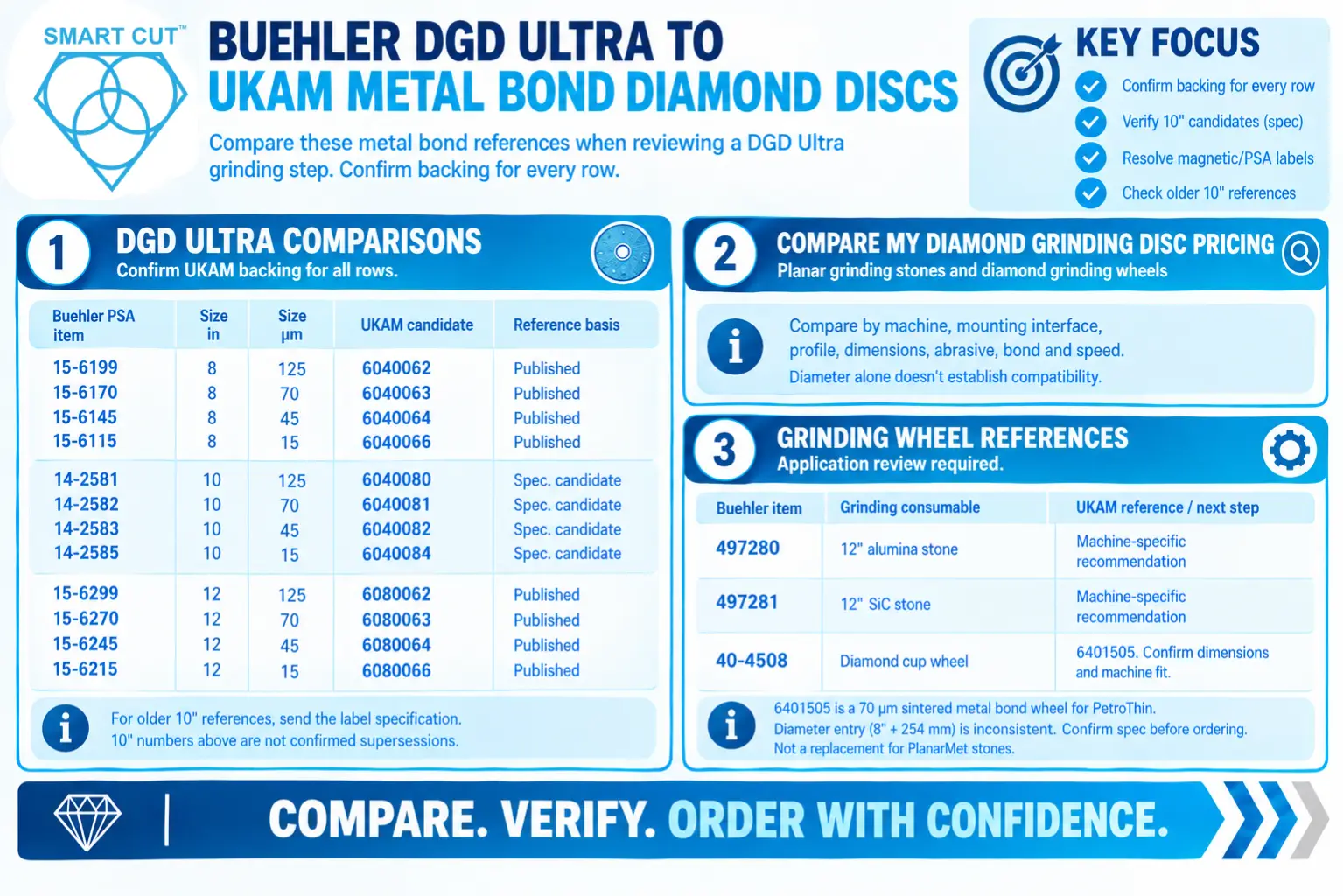
Compare these metal bond references when reviewing a DGD Ultra grinding step. UKAM lists the 8-inch and 12-inch Buehler numbers directly. The 10-inch rows below are specification candidates using the Buehler numbers in its current ordering table.
Confirm backing for every row. UKAM lists these items under PSA headings but labels the columns magnetic. Resolve the supplied backing before ordering any candidate below.
| Buehler PSA item | Size in | Size µm | UKAM candidate | Reference basis |
|---|---|---|---|---|
| 15-6199 | 8 | 125 | 6040062 | Published reference |
| 15-6170 | 8 | 70 | 6040063 | Published reference |
| 15-6145 | 8 | 45 | 6040064 | Published reference |
| 15-6115 | 8 | 15 | 6040066 | Published reference |
| 14-2581 | 10 | 125 | 6040080 | Specification candidate |
| 14-2582 | 10 | 70 | 6040081 | Specification candidate |
| 14-2583 | 10 | 45 | 6040082 | Specification candidate |
| 14-2585 | 10 | 15 | 6040084 | Specification candidate |
| 15-6299 | 12 | 125 | 6080062 | Published reference |
| 15-6270 | 12 | 70 | 6080063 | Published reference |
| 15-6245 | 12 | 45 | 6080064 | Published reference |
| 15-6215 | 12 | 15 | 6080066 | Published reference |
Sources: Buehler DGD Ultra ordering | UKAM metal bond disc listings
For older 10-inch references such as 15-8199, 15-8170, or 15-8115, send the label specification. The current numbers above are not presented as officially confirmed supersessions.
Planar grinding stones and diamond grinding wheels
Compare grinding wheels by machine, mounting interface, profile, overall dimensions, abrasive, bond, and permitted speed. Outside diameter alone does not establish compatibility.
| Buehler item | Grinding consumable | UKAM reference / next step |
|---|---|---|
| 497280 | 12-inch alumina stone for PlanarMet 300 | Request a machine-specific recommendation |
| 497281 | 12-inch SiC stone for PlanarMet 300 | Request a machine-specific recommendation |
| 40-4508 | Diamond grinding cup wheel reference | 6401505. Confirm dimensions and machine fit |
UKAM lists 6401505 against Buehler 40-4508 as a 70 µm sintered metal bond grinding cup wheel for PetroThin. Its diameter entry combines 8 inches with 254 mm, which are inconsistent. Confirm a dimensioned specification before ordering. This cup-wheel listing does not establish a replacement for either PlanarMet stone above.
Sources: Buehler planar grinding stone references | UKAM diamond grinding cup wheel reference
How to choose a metallographic grinding replacement
1. Start with the problem the grinding step must solve
Record whether the step establishes a plane, removes a known amount of material, or reduces the previous scratch pattern. Include the specimen material, approximate hardness, mount diameter, and important features such as a coating, interface, or brittle constituent. These details make a recommendation more useful than an item number alone.
2. Confirm diameter and attachment
Plain-back, PSA-back, magnetic, and friction-backed products use different attachment arrangements. Specify the actual platen or carrier system, including any retaining ring. A PSA disc mounted on a removable steel carrier is still a PSA consumable. It is not the same ordering choice as a magnetic-backed disc.
Buehler CarbiMet S and MicroCut S use the Apex S system. For example, 16-08-0600 is an Apex S-backed item. Do not replace it with a plain or PSA item on the assumption that every 8-inch paper uses the same interface. Request a compatible arrangement for the complete system.
Sources: Buehler paper backing and Apex S specifications | UKAM SiC selection guidance
3. Use a suitable grinding sequence
Use the least aggressive starting grade that removes the required material in an acceptable time. Move to the next grade when the whole target face is uniformly ground and the preceding scratch pattern has been removed. A finer abrasive cannot be expected to remove deep residual damage efficiently simply because it has run for a preset time.
Clean the specimen and contacting equipment between grades. Use a coolant or lubricant compatible with the material and consumable. Water-sensitive specimens need an appropriate alternative. Follow the specific machine and consumable instructions for speed, force, coolant, and any dressing procedure.
Sources: Metallographic grinding process guidance
4. Validate the change on representative specimens
Use your current consumable as the baseline. Record its actual settings and results, then evaluate the proposed UKAM item within its recommended operating conditions. Keep the specimen material, exposed area, and acceptance criteria consistent. If settings change, record them so you can repeat the result.
- Surface acceptance: define flatness, scratch pattern, edge condition, and unacceptable defects before the trial.
- Throughput: record grinding time, changeover time, cleaning time, and any repeated grinding.
- Consumable life: count acceptable specimens and record why each disc or paper was replaced.
- Repeatability: compare several representative batches rather than deciding from one favorable specimen.
Approve the replacement when it meets the laboratory’s acceptance criteria consistently. Keep the confirmed UKAM item, backing, grade, machine setup, and trial record together in the purchasing specification.
Compare cost per acceptable ground specimen
Lower purchase prices can reduce grinding costs even when cycle time stays the same. Verify that result using measured consumable life and acceptable specimen output. Include grinding labor, changeovers, and regrinding. Allocate reusable disc costs across their measured useful life.
Cost per acceptable ground specimen = total allocated grinding cost divided by the number of specimens that meet the grinding acceptance criteria.
Illustrative batch calculation. Equal consumable life and labor are assumed.
| Cost or output | Current process | UKAM scenario |
|---|---|---|
| Allocated consumables | $100 | $40 |
| Grinding and handling labor | $120 | $120 |
| Total grinding cost | $220 | $160 |
| Acceptable specimens | 100 | 100 |
| Cost per acceptable specimen | $2.20 | $1.60 |
Here, a 60% reduction in consumable cost lowers total grinding cost by about 27%, from $2.20 to $1.60 per acceptable specimen. No faster grinding or longer disc life is assumed. These figures are hypothetical, not product prices or measured performance results.
Include the cost of qualifying a replacement
Payback time in months = one-time qualification cost divided by measured monthly savings. For example, $600 spent validating a replacement is recovered in two months if it saves $300 per month. At that sustained rate, first-year net savings are $3,000 after qualification. This is an illustrative calculation. Use your own trial costs and results.
Troubleshooting after a grinding consumable change
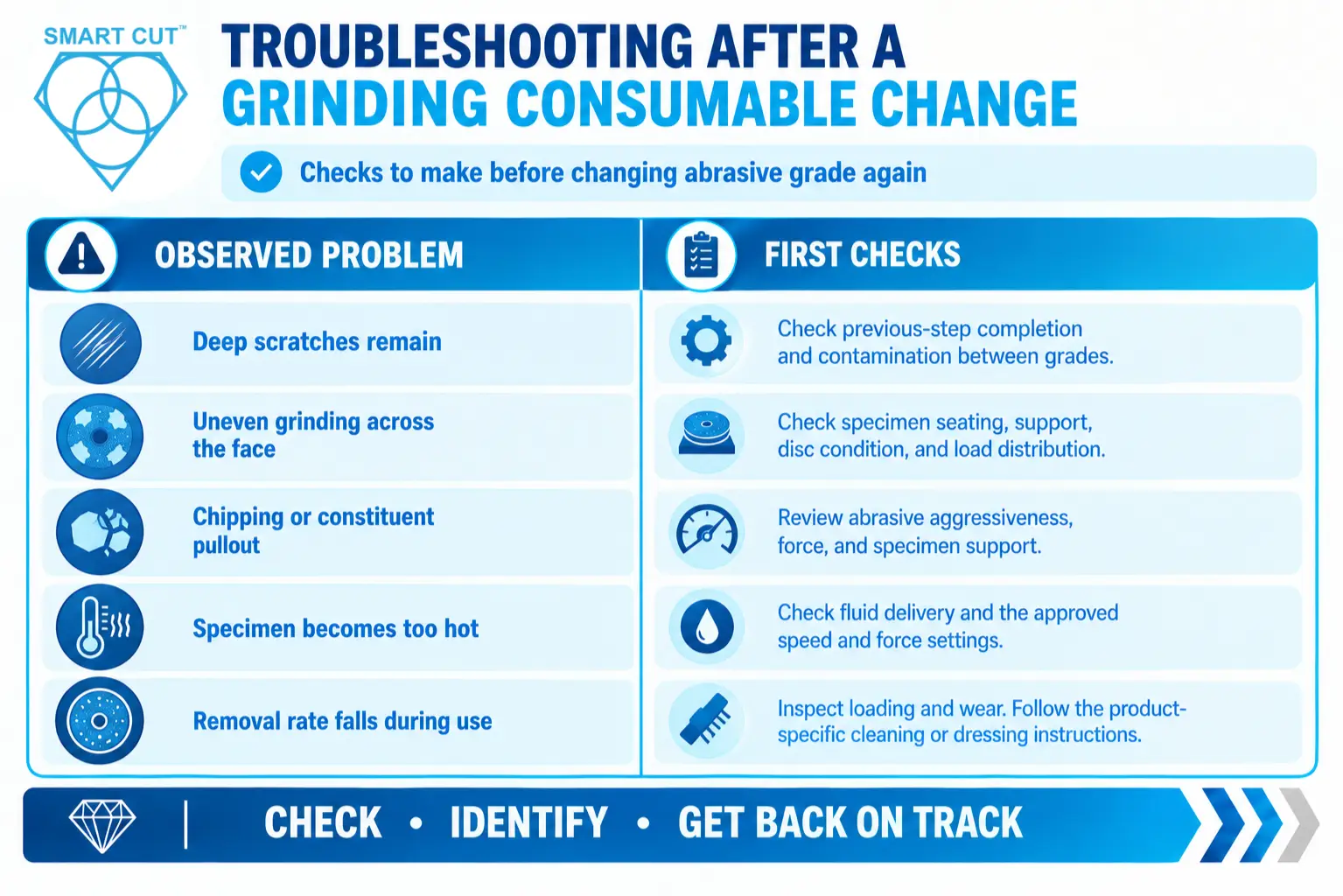
Checks to make before changing abrasive grade again
| Observed problem | First checks |
|---|---|
| Deep scratches remain | Check previous-step completion and contamination between grades. |
| Uneven grinding across the face | Check specimen seating, support, disc condition, and load distribution. |
| Chipping or constituent pullout | Review abrasive aggressiveness, force, and specimen support. |
| Specimen becomes too hot | Check fluid delivery and the approved speed and force settings. |
| Removal rate falls during use | Inspect loading and wear. Follow the product-specific cleaning or dressing instructions. |
Sources: UKAM grinding troubleshooting guide
Frequently asked questions
UKAM reports that selected comparable grinding consumables can cost 50% to 80% less. Your actual savings require a current item-by-item comparison using matched specifications, purchase quantities, and net unit prices. Total grinding savings also depend on consumable life, labor, and acceptable specimen output.
Evaluate the specific combination of machine, platen or carrier, consumable dimensions, and attachment. Machine brand alone does not establish compatibility. Provide those details with the Buehler item number so the proposed UKAM specification can be checked.
A published reference establishes a catalog relationship. A specification candidate identifies a plausible alternative. Neither establishes identical bond formulation, abrasive distribution, removal rate, surface damage, or useful life. A representative grinding trial establishes whether the proposed product meets your method.
Treat that change as a process review. Matching nominal particle size does not make the abrasive, bond, or contact surface identical. Compare the ground surface and operating conditions before approving the change.
Send the full item number, a label photograph or catalog description, and the required specification. Include older prefixes and suffixes exactly as shown. A missing entry means the guide does not list that reference. It does not establish that UKAM has no suitable option.
Request your Buehler-to-UKAM grinding cross reference
Start by sending your Buehler item number and the quantity you normally order. Add your current pack price and pack quantity if you want a direct purchase-price comparison. A current price is optional when requesting a UKAM quotation.
Include any available technical details below. UKAM can review missing specifications with you.
- Disc or wheel dimensions, abrasive grade or micron size, and backing.
- Machine model and platen, carrier, or wheel mounting arrangement.
- Specimen material, approximate hardness, specimen size, and batch quantity.
- Current grinding result, the improvement needed, and monthly consumption.
For several grinding grades, send the complete list to compare items, quantities, and prices together. Confirm the supplied specifications, then validate the candidates on representative specimens.
Sources: Shop UKAM SiC papers | View resin bond grinding discs | View metal bond grinding discs | View diamond grinding cup wheels
Catalog references reviewed September 19, 2026. Buehler product names identify comparison products and do not imply endorsement. Confirm current specifications, quantities, and availability before ordering.
Trusted by Tens of Thousands of Manufacturers, Laboratories,
Research Institutions Worldwide Since 1990
Established in 1990
RELATED ARTICLES

Brian is an experienced professional in the field of precision cutting tools, with over 27 years of experience in technical support. Over the years, he has helped engineers, manufacturers, researchers, and contractors find the right solutions for working with advanced and hard-to-cut materials. He’s passionate about bridging technical knowledge with real-world applications to improve efficiency and accuracy.
As an author, Brian Farberov writes extensively on diamond tool design, application engineering, return on investment strategies, and process optimization, combining technical depth with a strong understanding of customer needs and market dynamics.
About Brian Farberov
Brian is an experienced professional in the field of precision cutting tools, with over 27 years of experience in technical support. Over the years, he has helped engineers, manufacturers, researchers, and contractors find the right solutions for working with advanced and hard-to-cut materials. He’s passionate about bridging technical knowledge with real-world applications to improve efficiency and accuracy. As an author, Brian Farberov writes extensively on diamond tool design, application engineering, return on investment strategies, and process optimization, combining technical depth with a strong understanding of customer needs and market dynamics.
View all posts by Brian Farberov