


















Struers Grinding Consumables Cross-Reference: UKAM SiC Papers, Diamond Discs and Cup Wheels
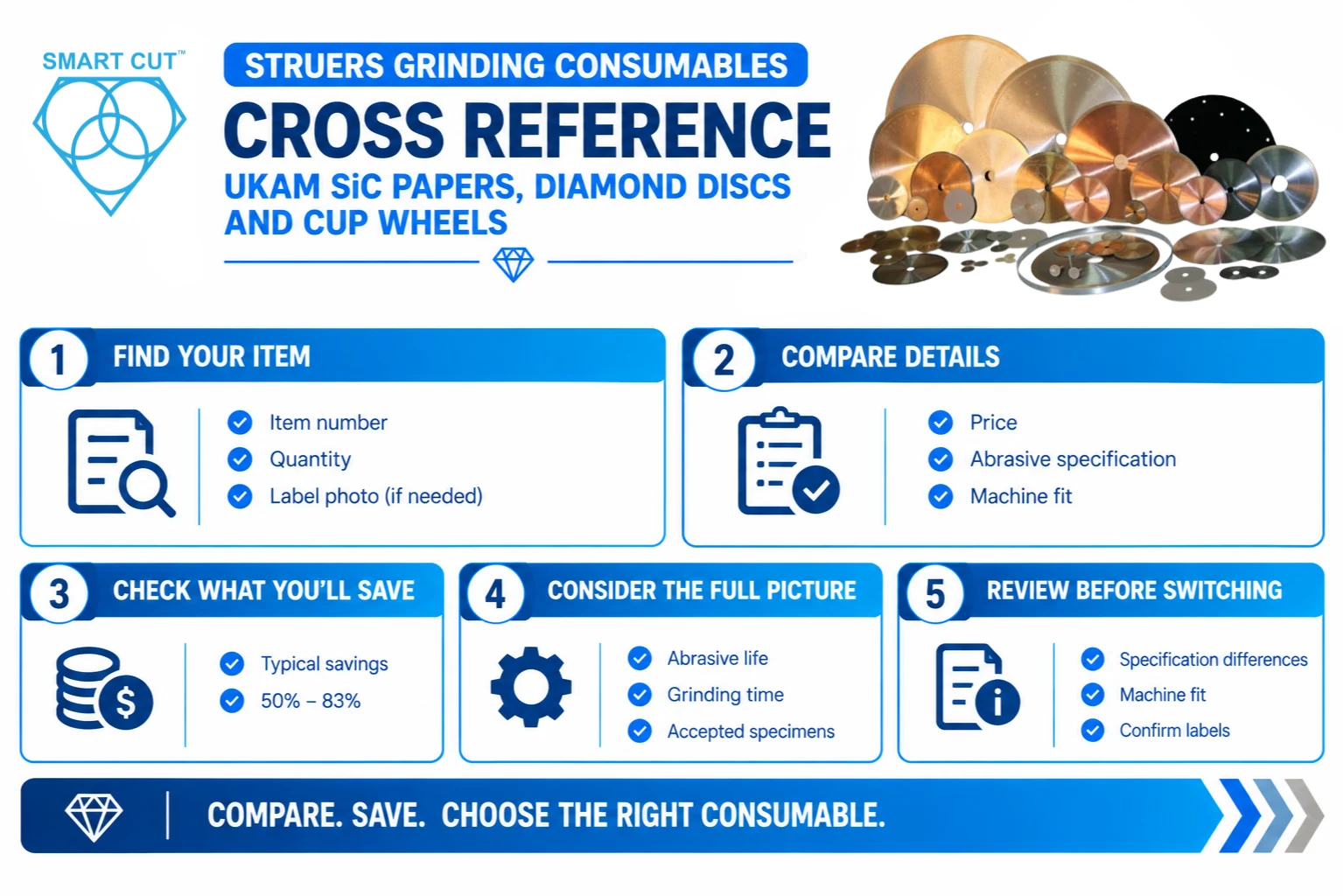
Table of Contents
ToggleFind a UKAM alternative to your Struers grinding consumable and compare the purchase price, abrasive specification and machine fit. Use the item-number tables below to investigate silicon carbide grinding papers, metal-bond and resin-bond diamond discs, and diamond grinding cup wheels.
Typical purchase-price savings: approximately 50% to 83%
For grinding consumables with a suitable UKAM alternative, our typical purchase prices are approximately one-half to one-sixth of corresponding Struers prices. Savings vary by item, specification, quantity and purchase terms. Your quotation confirms the proposed product and the actual price comparison.
A lower consumable price can reduce your laboratory’s recurring grinding expense. The complete decision also depends on abrasive life, grinding time and the number of specimens that meet your requirements. This guide helps you compare those factors before changing your purchasing specification.
Start with your item number and quantity. Add a label photograph to your inquiry if the original specification is unclear.
The lookup covers the tables below. If your item is missing, send its label or specification for review.
The tables distinguish specification-based candidates, checked specification pairs and catalog associations that need original-label confirmation. Review the stated differences before substitution. Matching selected specifications does not establish identical performance or complete machine fit.
Trusted by Tens of Thousands of Manufacturers, Laboratories Research Institutions Worldwide Since 1990

American Based Manufacturer

Established in 1990


Custom manufacturing


Struers SiC grinding paper cross-reference
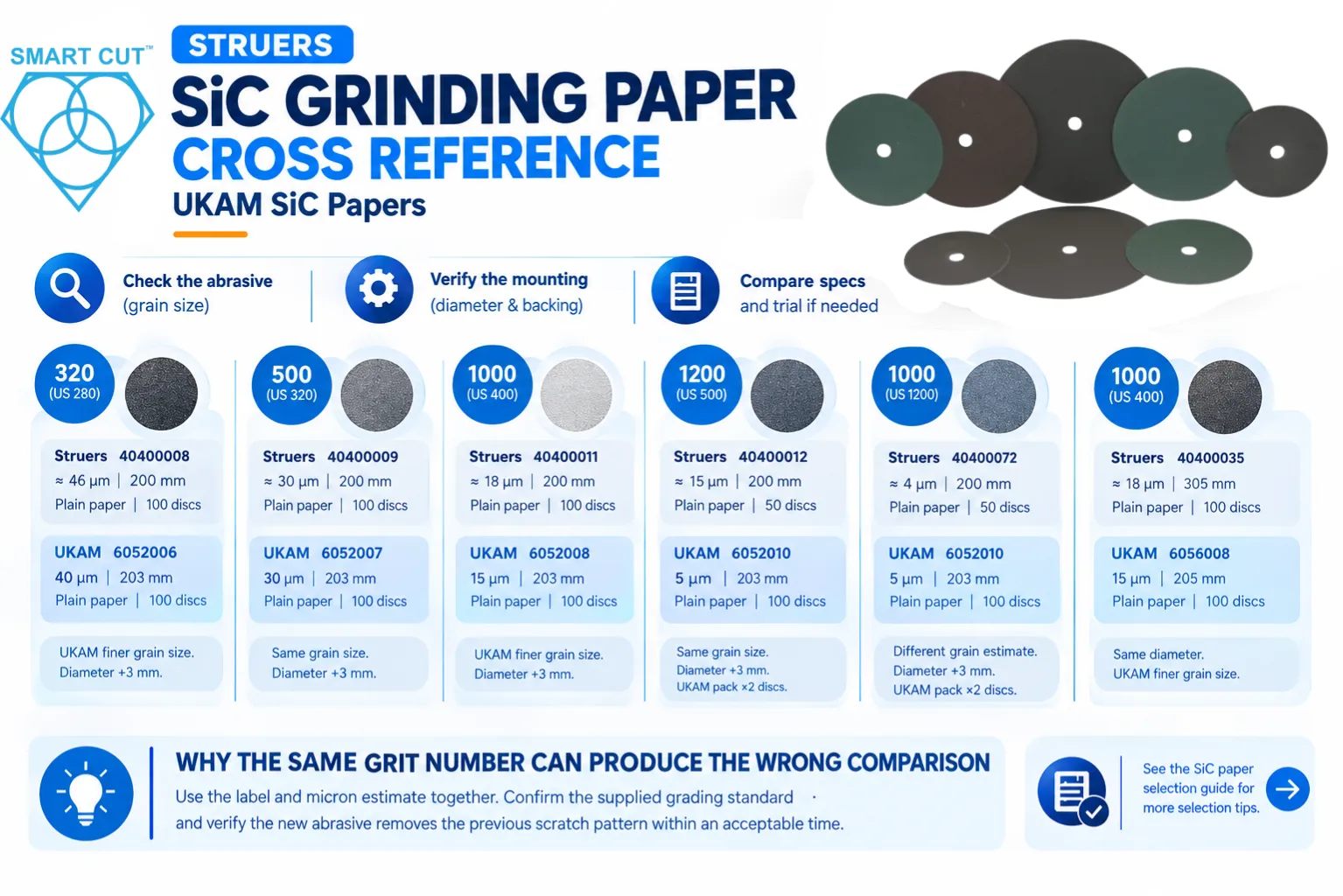
Silicon carbide paper gives laboratories a straightforward way to change grinding grades and replace a worn abrasive surface. When comparing UKAM silicon carbide grinding papers with Struers paper, verify both the abrasive and the mounting arrangement.
The following candidates use plain paper backing. The Struers micron values are approximate values from its SiC technical data sheet. UKAM micron values are its published product descriptions. Matching these values is a starting point for a trial, not proof that grain distributions or grinding results are identical.
SiC grinding paper: specification-based comparisons
| Struers item and specification | UKAM comparison candidate | Difference to review | Next step |
|---|---|---|---|
| 40400008 Grit 320 (US 280) · approximately 46 µm 200 mm · plain paper · 100 discs | 6052006 Listed US grit 320 · 40 µm 203 mm · plain paper · 100 discs | UKAM lists a finer indicative grain size. Diameter is 3 mm larger. | Request Price and Fit Confirmation |
| 40400009 Grit 500 (US 320) · approximately 30 µm 200 mm · plain paper · 100 discs | 6052007 Listed US grit 400 · 30 µm 203 mm · plain paper · 100 discs | Same listed indicative grain size. Diameter is 3 mm larger. | Request Price and Fit Confirmation |
| 40400011 Grit 1000 (US 400) · approximately 18 µm 200 mm · plain paper · 100 discs | 6052008 Listed US grit 600 · 15 µm 203 mm · plain paper · 100 discs | UKAM lists a finer indicative grain size. Diameter is 3 mm larger. | Request Price and Fit Confirmation |
| 40400012 Grit 1200 (US 500) · approximately 15 µm 200 mm · plain paper · 100 discs | 6052008 Listed US grit 600 · 15 µm 203 mm · plain paper · 100 discs | Same listed indicative grain size. Diameter is 3 mm larger. | Request Price and Fit Confirmation |
| 40400014 Grit 4000 (US 1200) · approximately 4 µm 200 mm · plain paper · 50 discs | 6052010 Listed US grit 1200 · 5 µm 203 mm · plain paper · 100 discs | Grain estimates differ. Diameter is 3 mm larger. UKAM pack contains twice as many discs. | Request Price and Fit Confirmation |
| 40400072 Grit 1000 (US 400) · approximately 18 µm 250 mm · plain paper · 100 discs | 6054008 Listed US grit 600 · 15 µm 254 mm · plain paper · 100 discs | UKAM lists a finer indicative grain size. Diameter is 4 mm larger. | Request Price and Fit Confirmation |
| 40400035 Grit 1000 (US 400) · approximately 18 µm 305 mm · plain paper · 100 discs | 6056008 Listed US grit 600 · 15 µm 305 mm · plain paper · 100 discs | Same published diameter. UKAM lists a finer indicative grain size. | Request Price and Fit Confirmation |
Why the same grit number can produce the wrong comparison
Struers 40400009 is labeled grit 500, with US 320 shown in parentheses. Its indicative particle size is about 30 µm. UKAM 6052007 is labeled US grit 400 and 30 µm. Those products therefore have comparable published micron estimates even though their grit labels differ.
Conversely, Struers 40400011 is labeled grit 1000, US 400, and corresponds to about 18 µm in the Struers guide. Choosing UKAM grit 400 simply because the US number matches would select a product listed at 30 µm. The 15 µm UKAM candidate in the table is closer in indicative size, but it still changes the abrasive specification.
Use the label and micron estimate together. For a controlled grinding method, ask for the supplied grading standard and confirm that the replacement removes the preceding scratch pattern within an acceptable time. Our SiC paper selection guide explains additional selection considerations.
Struers diamond grinding cup wheel cross-reference
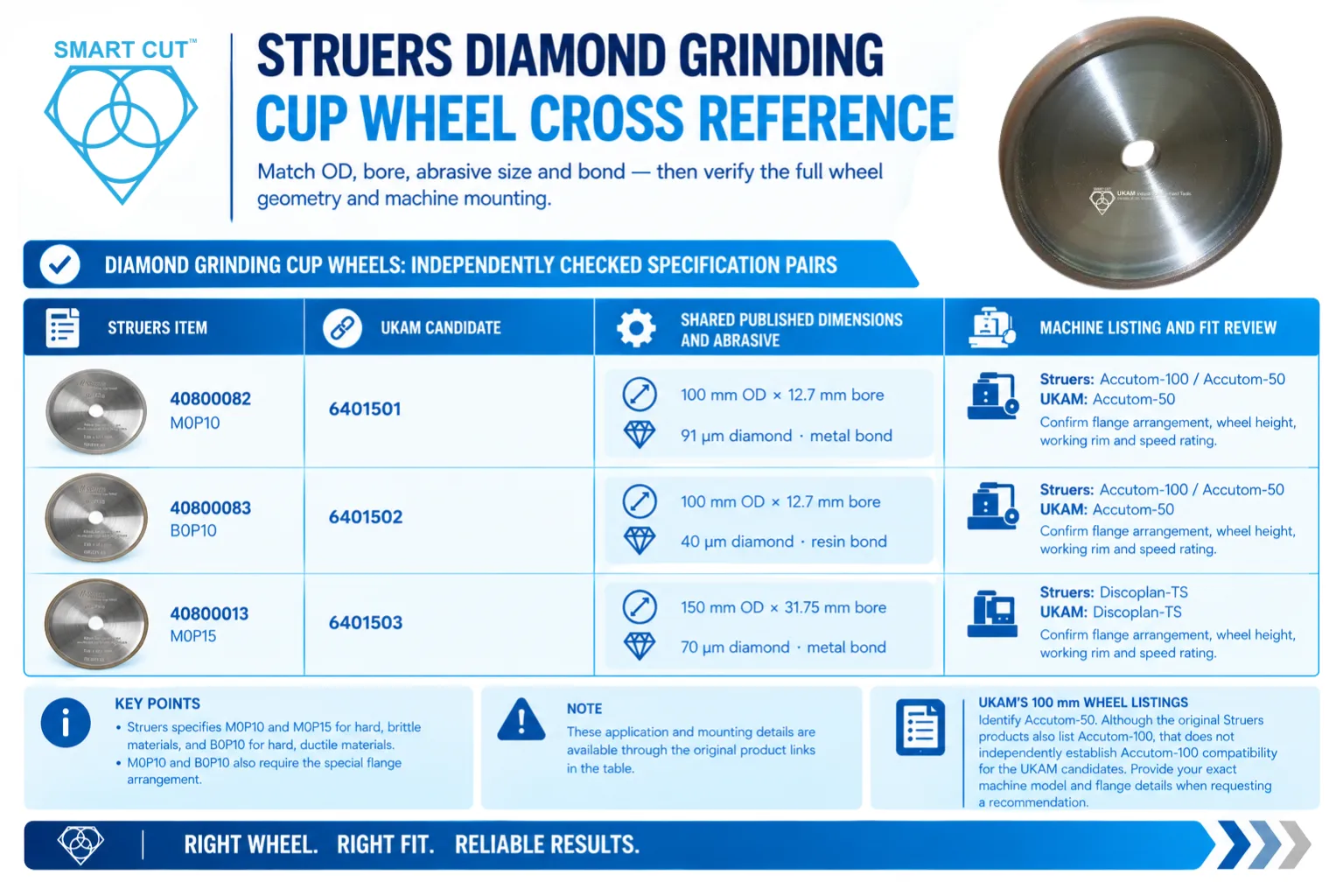
For precision grinding with a cup wheel, compare the outside diameter, bore, abrasive size and bond first. Then verify the complete wheel geometry and machine mounting. The following pairs have matching published values for the dimensions and abrasive specifications shown.
Diamond grinding cup wheels: independently checked specification pairs
| Struers item | UKAM candidate | Shared published dimensions and abrasive | Machine listing and fit review | Next step |
|---|---|---|---|---|
| 40800082 M0P10 | 6401501 | 100 mm OD × 12.7 mm bore 91 µm diamond · metal bond | Struers: Accutom-100 / Accutom-50. UKAM: Accutom-50. Confirm flange arrangement, wheel height, working rim and speed rating. | Request Price and Fit Confirmation |
| 40800083 B0P10 | 6401502 | 100 mm OD × 12.7 mm bore 40 µm diamond · resin bond | Struers: Accutom-100 / Accutom-50. UKAM: Accutom-50. Confirm flange arrangement, wheel height, working rim and speed rating. | Request Price and Fit Confirmation |
| 40800013 M0P15 | 6401503 | 150 mm OD × 31.75 mm bore 70 µm diamond · metal bond | Struers: Discoplan-TS. UKAM: Discoplan-TS. Confirm flange arrangement, wheel height, working rim and speed rating. | Request Price and Fit Confirmation |
Struers specifies M0P10 and M0P15 for hard, brittle materials, and B0P10 for hard, ductile materials. The M0P10 and B0P10 listings also require the specified special flange arrangement. These application and mounting details are available through the original product links in the table.
UKAM’s 100 mm wheel listings identify Accutom-50. Although the original Struers products also list Accutom-100, that does not independently establish Accutom-100 compatibility for the UKAM candidates. Provide your exact machine model and flange details when requesting a recommendation.
Struers metal-bond diamond grinding disc cross-reference
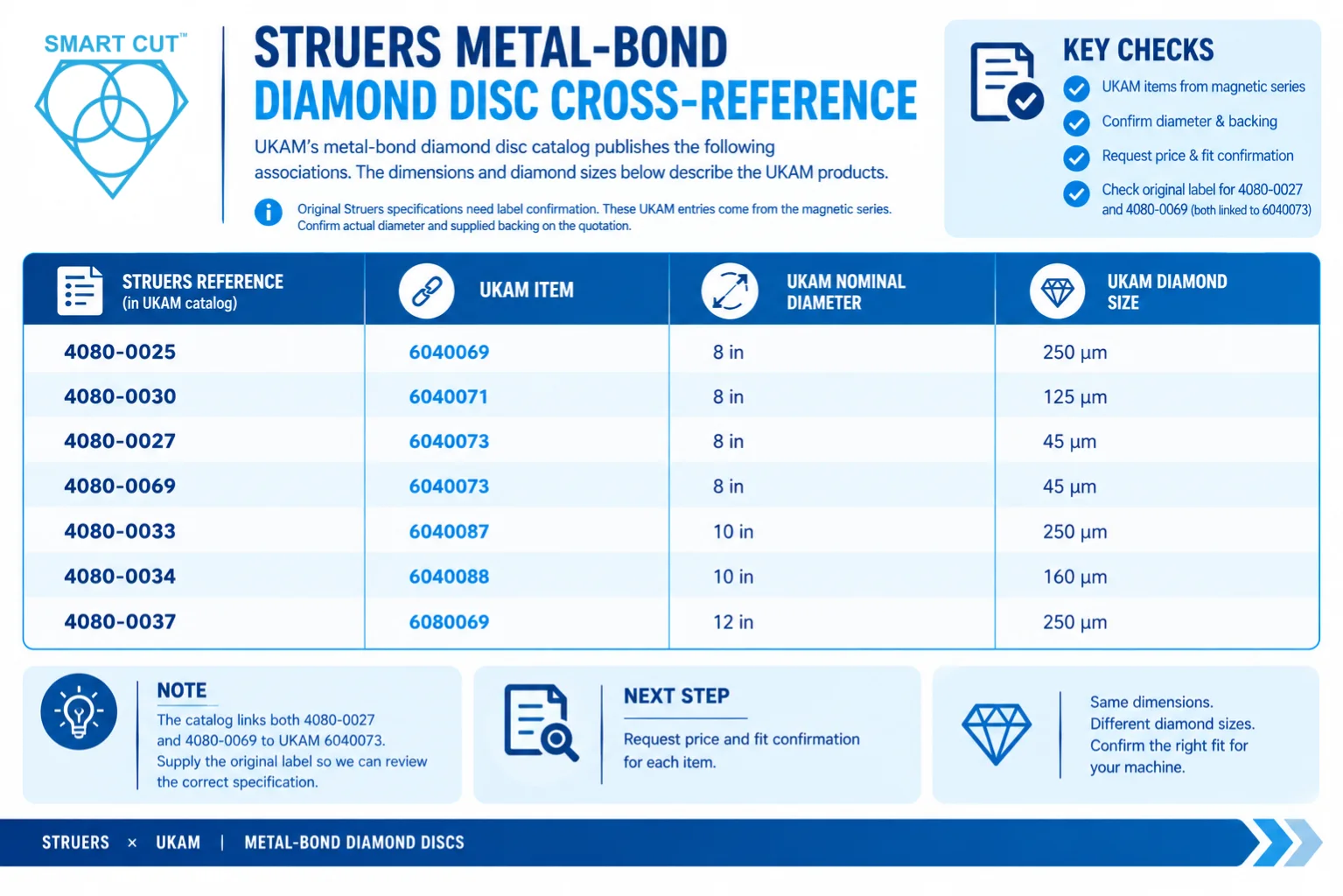
UKAM’s metal-bond diamond disc catalog publishes the following associations. The dimensions and diamond sizes below describe the UKAM products. The hyphenated Struers references are retained as printed in that catalog.
Catalog associations: original Struers specifications need label confirmation. These UKAM entries come from the magnetic series. Confirm actual diameter and supplied backing on the quotation.
Metal-bond diamond discs: published catalog associations, magnetic series
| Struers reference in UKAM catalog | UKAM item | UKAM nominal diameter | UKAM diamond size | Next step |
|---|---|---|---|---|
| 4080-0025 | 6040069 | 8 in | 250 µm | Request Price and Fit Confirmation |
| 4080-0030 | 6040071 | 8 in | 125 µm | Request Price and Fit Confirmation |
| 4080-0027 | 6040073 | 8 in | 45 µm | Request Price and Fit Confirmation |
| 4080-0069 | 6040073 | 8 in | 45 µm | Request Price and Fit Confirmation |
| 4080-0033 | 6040087 | 10 in | 250 µm | Request Price and Fit Confirmation |
| 4080-0034 | 6040088 | 10 in | 160 µm | Request Price and Fit Confirmation |
| 4080-0037 | 6080069 | 12 in | 250 µm | Request Price and Fit Confirmation |
The catalog links both 4080-0027 and 4080-0069 to UKAM 6040073. Supply the original label so we can review the correct specification. This shared association does not establish that the two original products are identical.
Struers resin-bond diamond grinding disc cross-reference
The following associations appear in the 8-inch PSA section of the UKAM resin-bond diamond disc catalog. PSA means pressure-sensitive adhesive. The original Struers backing and product specification still need confirmation.
Resin-bond diamond discs: published catalog associations, PSA series
| Struers reference in UKAM catalog | UKAM item | UKAM backing and diameter | UKAM diamond size | Next step |
|---|---|---|---|---|
| 4080-0098 | 6140479 | PSA · nominal 8 in | 165 µm | Request Price and Fit Confirmation |
| 4080-0091 | 6140480 | PSA · nominal 8 in | 125 µm | Request Price and Fit Confirmation |
| 4080-0094 | 6140482 | PSA · nominal 8 in | 70 µm | Request Price and Fit Confirmation |
| 4080-0109 | 6140486 | PSA · nominal 8 in | 30 µm | Request Price and Fit Confirmation |
For these UKAM discs, evaluate the intended scratch refinement and grinding load. UKAM describes this resin-bond disc family as unsuitable for heavy bulk stock removal. A candidate that refines a ground surface effectively may therefore be inappropriate for an aggressive initial grinding step.
PSA discs require a suitable adhesive-mounting carrier. Confirm that interface when comparing with a magnetic-backed surface.
How to choose a compatible metallographic grinding consumable
Compare the actual diameter and mounting interface
Nominal inch sizes can hide meaningful differences. The SiC table includes Struers paper listed at 200 mm and UKAM paper listed at 203 mm. It also includes 250 mm versus 254 mm products. For larger formats, check whether the listing specifies 300 mm or 305 mm. Use the actual product diameter and the machine’s approved mounting arrangement.
A disc must seat flat and remain securely supported. Confirm clearance to the retaining ring, splash guard and specimen holder. For cup wheels, add bore tolerance, flange contact, overall height, rim dimensions and the permitted operating speed to the comparison.
Backing types and the question to ask before ordering
| Backing or interface | What to confirm |
|---|---|
| Plain SiC paper | Which retention system or adhesive carrier holds the paper on your platen? |
| PSA grinding disc | Is the carrier suitable for adhesive mounting, and is the assembled thickness acceptable? |
| Magnetic grinding disc | Does the supplied disc interface match the machine’s magnetic preparation disc? |
| Struers SiC Foil | Is the system using MD-Gekko or another specified foil adaptor? Confirm the complete interface before changing consumable type. |
| Diamond cup wheel | Do the bore, flange arrangement, wheel geometry and speed rating match the machine requirements? |
Struers distinguishes PET-backed SiC foil from plain SiC paper and specifies different adaptors for them. See the Struers SiC paper and foil information. A similar abrasive grade does not remove this mounting difference.
What about MD-Piano, MD-Primo and other Struers MD grinding surfaces?
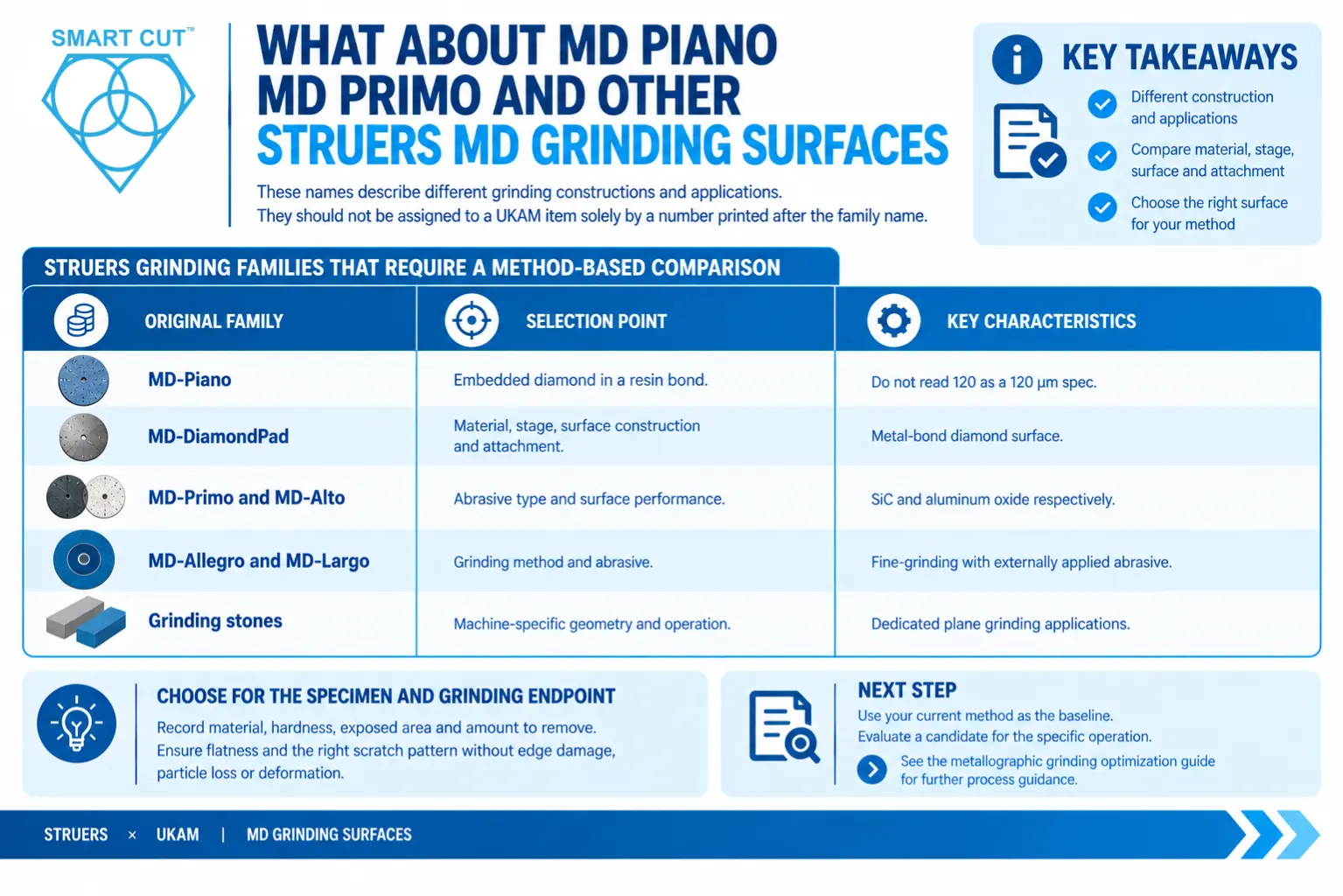
These names describe different grinding constructions and applications. They should not be assigned to a UKAM item solely by a number printed after the family name.
Struers grinding families that require a method-based comparison
| Original family | Selection point |
|---|---|
| MD-Piano | Embedded diamond in a resin bond. Do not read a finish designation such as 120 as a 120 µm diamond specification. |
| MD-DiamondPad | Metal-bond diamond grinding surface. Compare material, grinding stage, surface construction and attachment. |
| MD-Primo and MD-Alto | Different embedded abrasives, SiC and aluminum oxide respectively. A fixed-diamond disc changes the abrasive system. |
| MD-Allegro and MD-Largo | Fine-grinding surfaces used with externally applied abrasive. Compare the whole grinding method before selecting a fixed-abrasive disc. |
| Grinding stones for dedicated plane grinding | Machine-specific geometry and operating requirements need a separate specification review. |
Family construction information comes from the Struers MD grinding technical sheet. Dedicated stone applications are described in the Struers grinding stone guide. No UKAM item number is assigned here where a defensible match has not been established.
Choose for the specimen and grinding endpoint
Record the material, approximate hardness, exposed area and amount to remove. For a mounted specimen containing multiple materials, include the softer matrix and harder phases. The grinding surface must produce the required flatness and scratch pattern without unacceptable edge damage, particle loss or deformation.
Use your current method as the baseline. Decide whether the priority is initial flattening, controlled stock removal or scratch refinement. Then evaluate a candidate against that specific operation. Our metallographic grinding optimization guide provides further process guidance.
UKAM versus Struers grinding consumables: prices, total cost and ROI
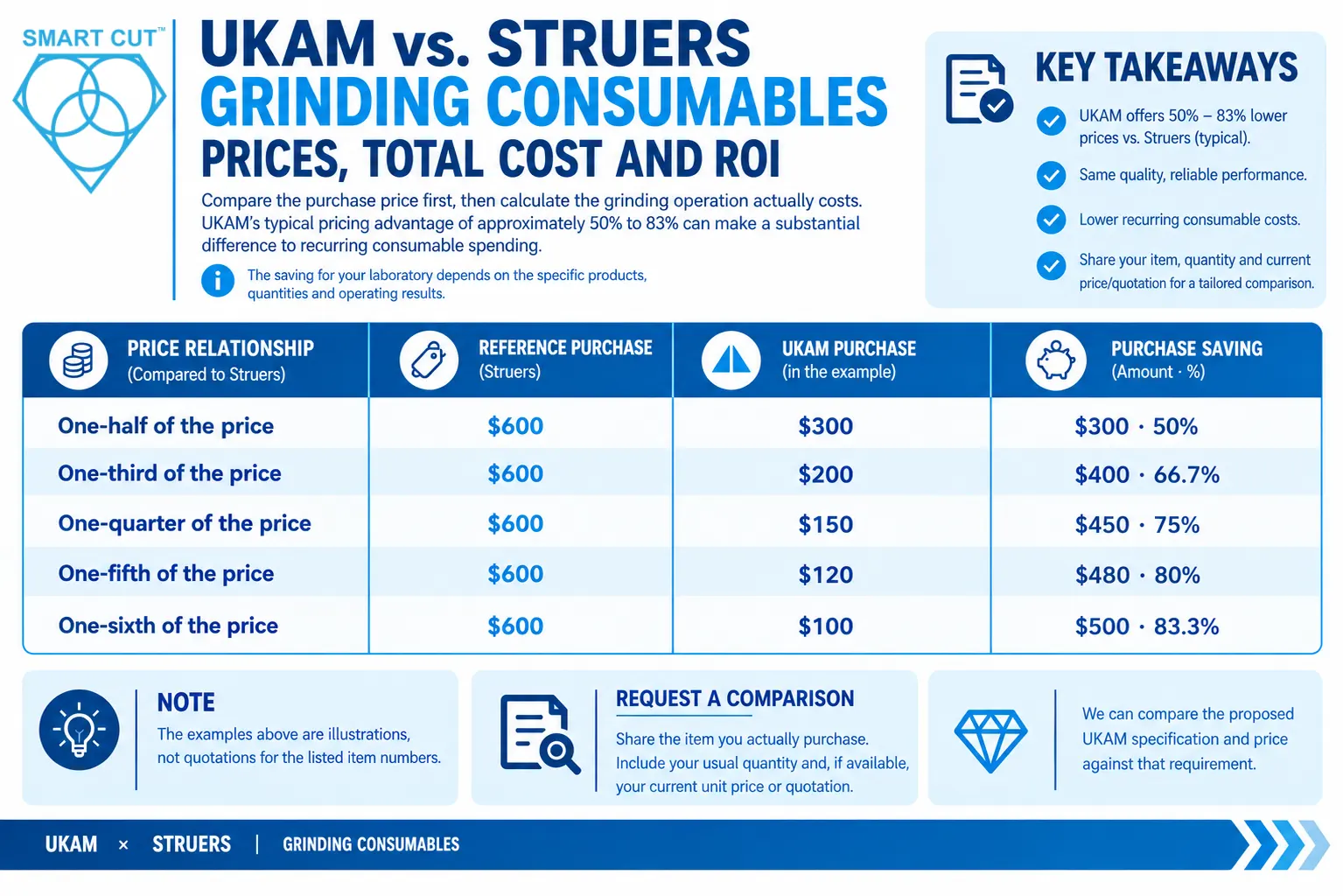
Compare the purchase price first, then calculate what the grinding operation actually costs. UKAM’s typical pricing advantage of approximately 50% to 83% can make a substantial difference to recurring consumable spending. The saving for your laboratory depends on the specific products, quantities and operating results.
What does one-half to one-sixth of the price mean?
If the corresponding purchase costs $600, a price of $300 is 50% lower. A price of $100 is approximately 83.3% lower. The examples below show the arithmetic across that range. They are illustrations, not quotations for the listed item numbers.
Illustrative purchase-price comparison for the same quantity
| Price relationship | Reference purchase | UKAM purchase in the example | Purchase saving |
|---|---|---|---|
| One-half of the price | $600 | $300 | $300 · 50% |
| One-third of the price | $600 | $200 | $400 · 66.7% |
| One-quarter of the price | $600 | $150 | $450 · 75% |
| One-fifth of the price | $600 | $120 | $480 · 80% |
| One-sixth of the price | $600 | $100 | $500 · 83.3% |
Request a comparison for the item you actually purchase. Include your usual quantity and, if available, your current unit price or quotation. We can compare the proposed UKAM specification and price against that requirement.
Normalize pack quantities and specifications
Divide the delivered pack price by the number of discs. Compare the same currency, quantity basis and treatment of shipping and taxes. Then review abrasive grade, diameter and backing.
For example, Struers 40400014 is listed as 50 discs, while UKAM 6052010 is listed as 100. The pack prices alone do not show the unit-price difference. Their published abrasive estimates and diameters also differ, as shown in the SiC table.
A useful written comparison identifies both item numbers, the relevant specifications, pack quantities, price per disc or wheel, comparison date and any difference that affects the application. This makes the purchasing decision easier to review and repeat.
Calculate grinding cost per accepted specimen
Grinding cost per accepted specimen = total grinding-related cost ÷ specimens accepted after grinding
Include abrasive consumption, operator time, machine occupancy, changeovers, applicable conditioning, grinding fluid and losses attributable to grinding. Count each expense once.
For paper, record how many discs you use to complete the grinding sequence for an accepted batch. For a reusable diamond surface, allocate its cost over the accepted specimens produced before replacement. Track any conditioning and changeover time.
The lowest purchase price is valuable when the proposed consumable also meets your grinding requirements. Define those requirements before the trial so both methods are compared at the same endpoint.
Illustrative total-cost comparison for 100 accepted ground specimens
This example uses the pricing ratios described above. It assumes equal abrasive consumption to produce 100 accepted specimens and identical labor, machine and other grinding costs. These figures are hypothetical. They are not product quotations or measured comparative results.
Example: lower abrasive prices with all other grinding costs held constant
| Cost component | Reference method | UKAM at half the abrasive price | UKAM at one-sixth the abrasive price |
|---|---|---|---|
| Abrasive cost for the run | $600 | $300 | $100 |
| Operator time: 4 hours at $40 | $160 | $160 | $160 |
| Machine occupancy: 3 hours at $20 | $60 | $60 | $60 |
| Grinding fluid and conditioning consumables | $20 | $20 | $20 |
| Total grinding cost | $840 | $540 | $340 |
| Cost per accepted specimen | $8.40 | $5.40 | $3.40 |
| Total grinding cost reduction | Baseline | 35.7% | 59.5% |
The example produces meaningful savings without assuming faster grinding or longer abrasive life. It also shows why purchase-price savings and total operating savings are different percentages.
The machine rate excludes operator labor and separately listed consumables. Include regrinding time in the appropriate time rows. If grinding causes specimen loss, include that attributable cost and keep the denominator as accepted specimens.
How much abrasive life is needed to reach break-even?
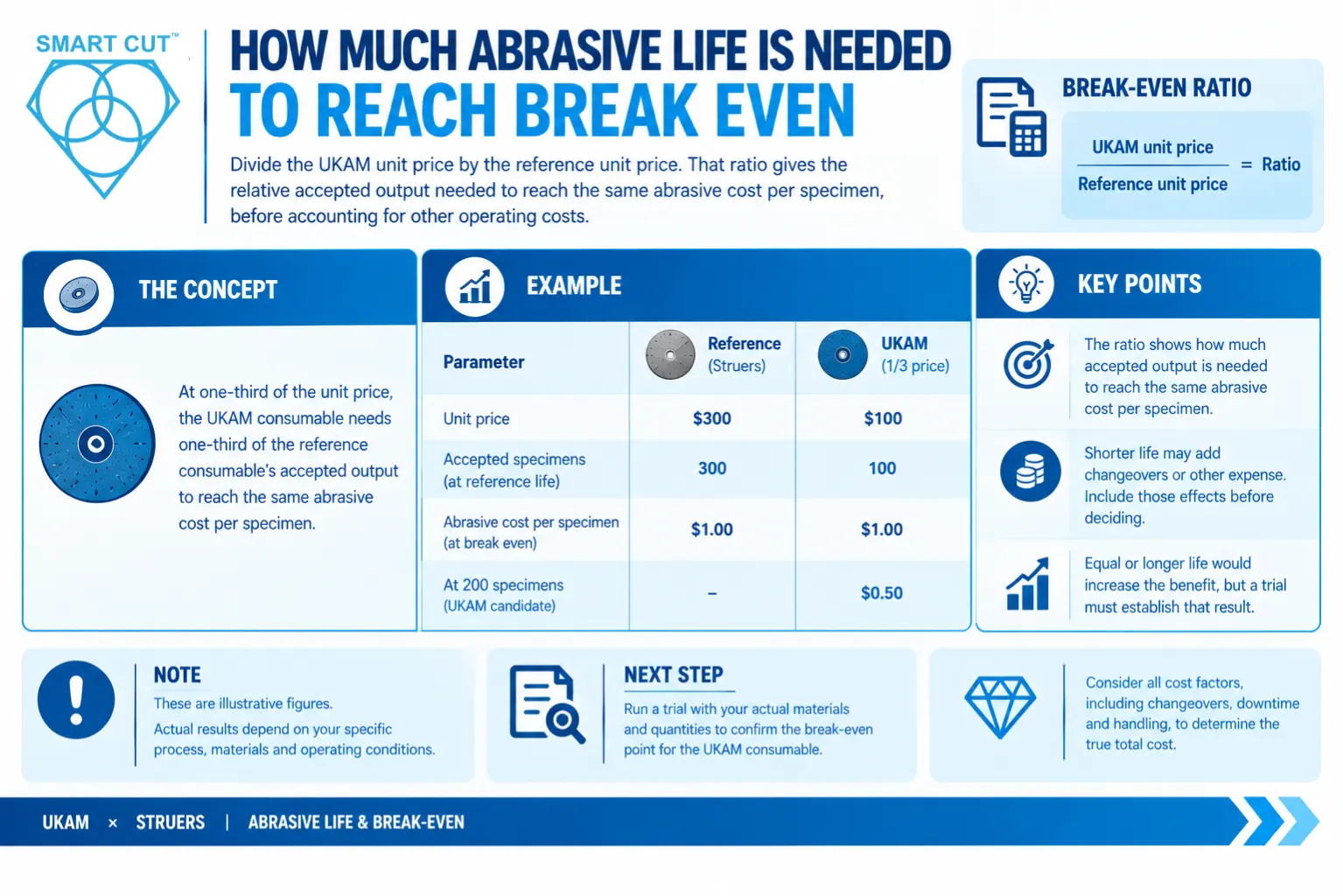
Divide the UKAM unit price by the reference unit price. That ratio gives the relative accepted output needed to reach the same abrasive cost per specimen, before accounting for other operating costs.
Abrasive-cost break-even output ratio = UKAM unit price ÷ reference unit price
At one-third of the unit price, the UKAM consumable needs one-third of the reference consumable’s accepted output to reach the same abrasive cost per specimen.
For example, suppose a reference disc costs $300 and produces 300 accepted specimens. Its abrasive cost is $1 per specimen. A $100 candidate reaches that same abrasive cost after 100 accepted specimens. At 200 accepted specimens, its abrasive cost falls to $0.50 per specimen.
These are illustrative figures. Shorter life may add changeovers or other expense. Include those effects before deciding which consumable has the lower total cost. Equal or longer life would increase the benefit, but a trial must establish that result.
Estimate annual savings, payback and return on investment
Begin with the portion of your grinding spend that has a technically suitable alternative. If annual spending on that portion is $12,000, a 50% purchase-price reduction would lower it to $6,000. An 83.3% reduction would lower it to approximately $2,000. The corresponding annual purchase savings would be $6,000 to approximately $10,000, assuming unchanged quantities and consumption.
For total-cost payback, include any one-time expense for evaluation, a required carrier or method qualification. Divide that expense by the measured saving per accepted specimen.
Using the half-price total-cost example above, the saving is $3 per accepted specimen. An illustrative $600 qualification expense would be recovered after 200 accepted specimens. At 1,000 accepted specimens, operating savings would total $3,000. Subtracting the $600 qualification expense leaves a $2,400 net benefit, or a 400% return on that one-time expense.
This is a calculation example, not a promised return. Use your actual prices, accepted output, operating costs and evaluation expense. Keep reduced cash expenditure separate from released staff or machine capacity.
Run a practical comparison before changing your standard item
- Choose the grinding step with a measurable cost, wear or quality problem.
- Define the required flatness, scratch condition and acceptable edge condition.
- Use comparable specimens and record the machine, holder, load, speed and fluid.
- Measure the time and consumables needed to reach the same grinding endpoint.
- Compare accepted output, regrinding, changes and total cost across repeated batches.
Troubleshooting metallographic grinding consumables
A change in performance may come from the abrasive, the mounting or the operating method. Check the symptom before replacing a grade or increasing the grinding load.
Grinding symptoms and useful first checks
| Symptom | Possible causes | First checks |
|---|---|---|
| Removal rate falls | Worn paper, loaded surface or unsuitable abrasive specification | Inspect the abrasive. Replace spent paper. Check fluid delivery and the permitted conditioning procedure for a reusable surface. |
| Deep scratches remain | Coarse contamination or incomplete removal of the previous scratch pattern | Clean the specimen and holder between grades. Confirm the current step removes the preceding scratches. |
| Uneven grinding or loss of flatness | Poor seating, debris under the disc, uneven loading or surface wear | Inspect carrier cleanliness, disc seating, specimen support and wear distribution. |
| Chipping or particle pullout | Excessive local load, unsuitable grade or inadequate specimen support | Review support and contact conditions. Adjust within the approved method and check the resulting surface. |
| Heating or discoloration | Inadequate cooling, excessive load or an ineffective grinding surface | Check fluid delivery, contact conditions and abrasive condition before continuing. |
For SiC paper, read our guide to improving metallographic grinding with SiC paper. For diamond grinding wheel problems, use our Diamond & CBN Wheel Troubleshooting Guide. Wheel dressing advice applies only where appropriate to the particular wheel construction and machine instructions.
Manufacturer support and custom diamond grinding consumables
UKAM Industrial Superhard Tools manufactures standard and custom diamond tools and supplies grinding consumables for metallographic preparation. When you request an alternative, our role includes reviewing the proposed abrasive specification, mounting arrangement and grinding requirement.
For a straightforward reorder, start with the existing item number and quantity. If the issue is loading, wear, poor flatness or inconsistent scratches, include the material, machine and current grinding method. That information helps us evaluate whether you need a different specification or a change in operating conditions.
Use our diamond grinding wheel troubleshooting guide for wheel problems and our metallographic grinding guide for broader process questions.
When a standard grinding disc or cup wheel does not fit
Our custom diamond tool manufacturing service can review dimensions, mounting, abrasive size, bond and working-layer geometry. Supply a drawing or dimensioned sketch for an unusual cup-wheel bore, flange interface or overall profile.
Custom tools are usually available without a minimum order quantity, with exceptions based on the specification. Fast lead times and expedited options depend on the tool and production schedule. Your written quotation confirms feasibility, quantity and delivery timing. Standard SiC paper packs retain their listed package quantities.
Evaluate customization against a specific objective, such as correcting fit, reducing premature wear or improving grinding consistency. Include development and qualification expense in your cost comparison. An appropriate initial quantity lets you evaluate the result before committing to recurring orders.
Frequently asked questions about Struers grinding consumable alternatives
Our typical purchase prices for suitable grinding consumable alternatives are approximately 50% to 83% lower than corresponding Struers prices. The actual saving depends on the product, specification, quantity and purchase terms. Request a current comparison for your item and normalize the pack quantities.
No. Total grinding cost also includes consumption, labor, machine time and other operating expenses. The example in this guide shows how a 50% abrasive-price reduction can produce a smaller percentage reduction in total cost when the other expenses remain unchanged.
UKAM 6052007 is a specification-based candidate. Both products have published indicative particle sizes of about 30 µm, although their grit labels differ. UKAM lists 203 mm diameter versus Struers 200 mm. Confirm mounting clearance and evaluate the grinding result.
No. Check the grading standard and particle-size information. For Struers 40400011, the Struers guide indicates about 18 µm. The table presents UKAM 6052008 at 15 µm as a candidate with a finer published estimate and a different listed diameter.
Review the exact machine, platen or carrier, actual diameter, backing and operating requirements. Cup wheels also require a check of the bore, flange arrangement and complete geometry. Send those details when requesting fit confirmation.
No. It identifies a candidate for review. The diamond-disc tables label associations whose original Struers specifications need confirmation. The checked cup-wheel pairs establish agreement only for the published dimensions and abrasive specifications shown.
Start by evaluating the specific step or consumable you want to replace. A change in abrasive type or grade may require a method adjustment. Confirm that the proposed step removes the preceding scratches and reaches your required endpoint.
Yes. Send the original item number or specification, machine information and quantity. Add a label photograph or drawing if needed. We can review a standard item or a custom option and confirm the proposed specification, pricing and lead time.
Request price and fit confirmation for your Struers grinding consumable
Trusted by Tens of Thousands of Manufacturers, Laboratories,
Research Institutions Worldwide Since 1990
American Based Manufacturer
Established in 1990
Custom manufacturing
RELATED ARTICLES

Brian is an experienced professional in the field of precision cutting tools, with over 27 years of experience in technical support. Over the years, he has helped engineers, manufacturers, researchers, and contractors find the right solutions for working with advanced and hard-to-cut materials. He’s passionate about bridging technical knowledge with real-world applications to improve efficiency and accuracy.
As an author, Brian Farberov writes extensively on diamond tool design, application engineering, return on investment strategies, and process optimization, combining technical depth with a strong understanding of customer needs and market dynamics.