

















When Should You Choose a Resin, Metal, or Hybrid Bond Diamond Wheel?

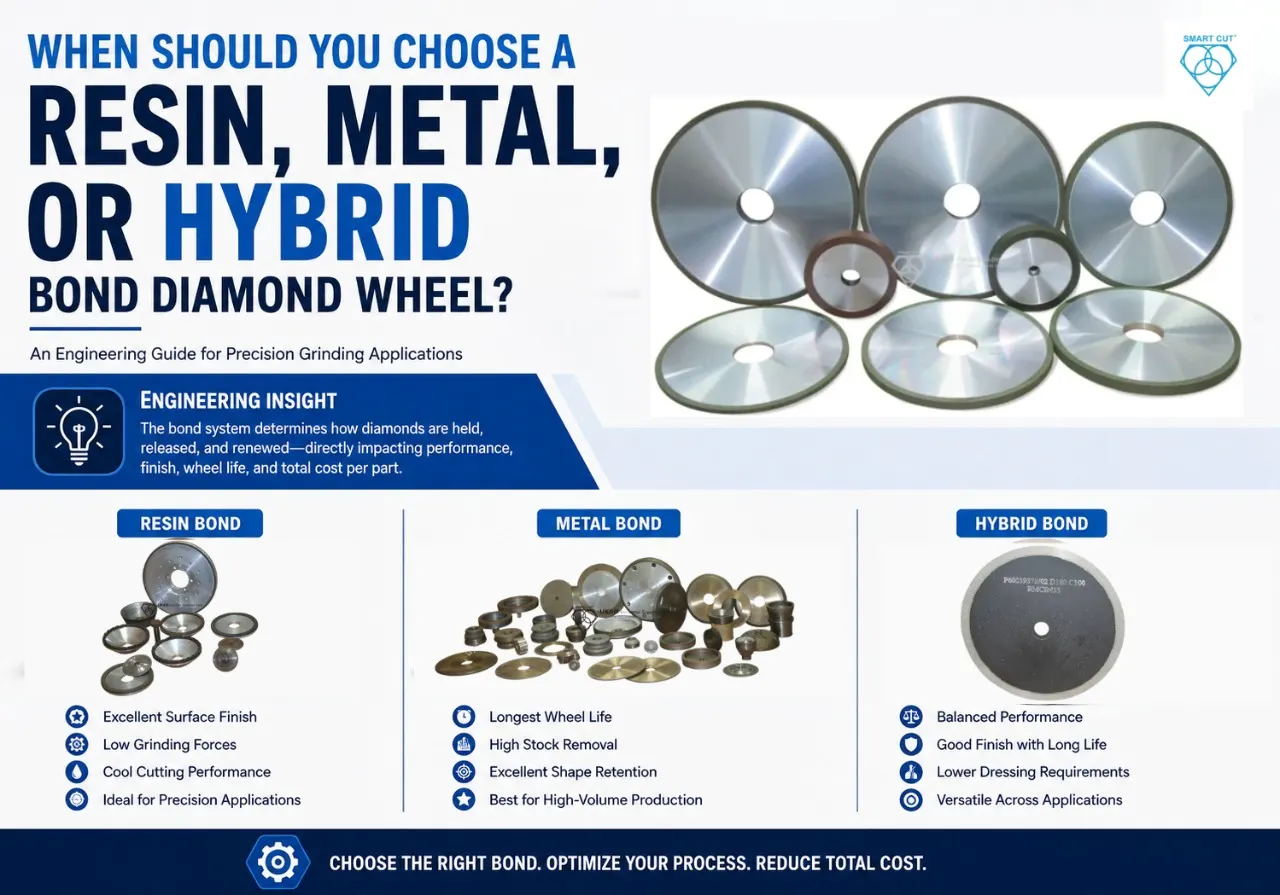
Table of Contents
Toggle
American Based Manufacturer

Established in 1990


Custom manufacturing


An Engineering Guide for Precision Grinding Applications
Selecting the right diamond grinding wheel involves far more than choosing the correct grit size or diamond concentration. While these characteristics influence grinding performance, the bond system ultimately determines how effectively the wheel performs throughout its service life. It controls how diamond particles are retained, when fresh cutting edges are exposed, how heat is generated, and how consistently the wheel maintains dimensional accuracy.
Despite its importance, bond selection is frequently overlooked during wheel specification. Many manufacturers continue to select grinding wheels based primarily on previous experience, purchase price, or supplier recommendations without fully evaluating how the bond interacts with the material, machine, and grinding process. This approach often leads to problems that are mistakenly attributed to machine setup or wheel quality.
Common production issues such as rapid wheel wear, glazing, excessive dressing, poor surface finish, thermal damage, inconsistent dimensional accuracy, and reduced productivity frequently result from selecting a bond system that is not optimized for the application. Even the highest-quality synthetic diamond abrasive cannot achieve its full performance potential when paired with an unsuitable bond.
For example, a Resin Bond wheel may produce an exceptional surface finish when grinding tungsten carbide cutting tools but wear too quickly in a high-volume production environment. Conversely, a Metal Bond wheel may deliver outstanding wheel life during ceramic grinding yet generate excessive grinding forces if process parameters are not properly optimized. Hybrid Bond technology was developed to bridge these performance gaps by combining the strengths of both bond systems for demanding precision applications.
Successful grinding therefore requires viewing the wheel as a complete engineered system rather than simply a cutting tool. Every application presents a unique combination of material properties, machine capability, production objectives, and quality requirements. The bond must be selected to support these variables while maintaining stable grinding performance over the required production cycle.
Instead of asking:
“Which bond lasts the longest?”
or
“Which bond produces the best finish?”
manufacturing engineers should ask a more practical question:
Which bond delivers the lowest total manufacturing cost while consistently meeting quality and productivity requirements?
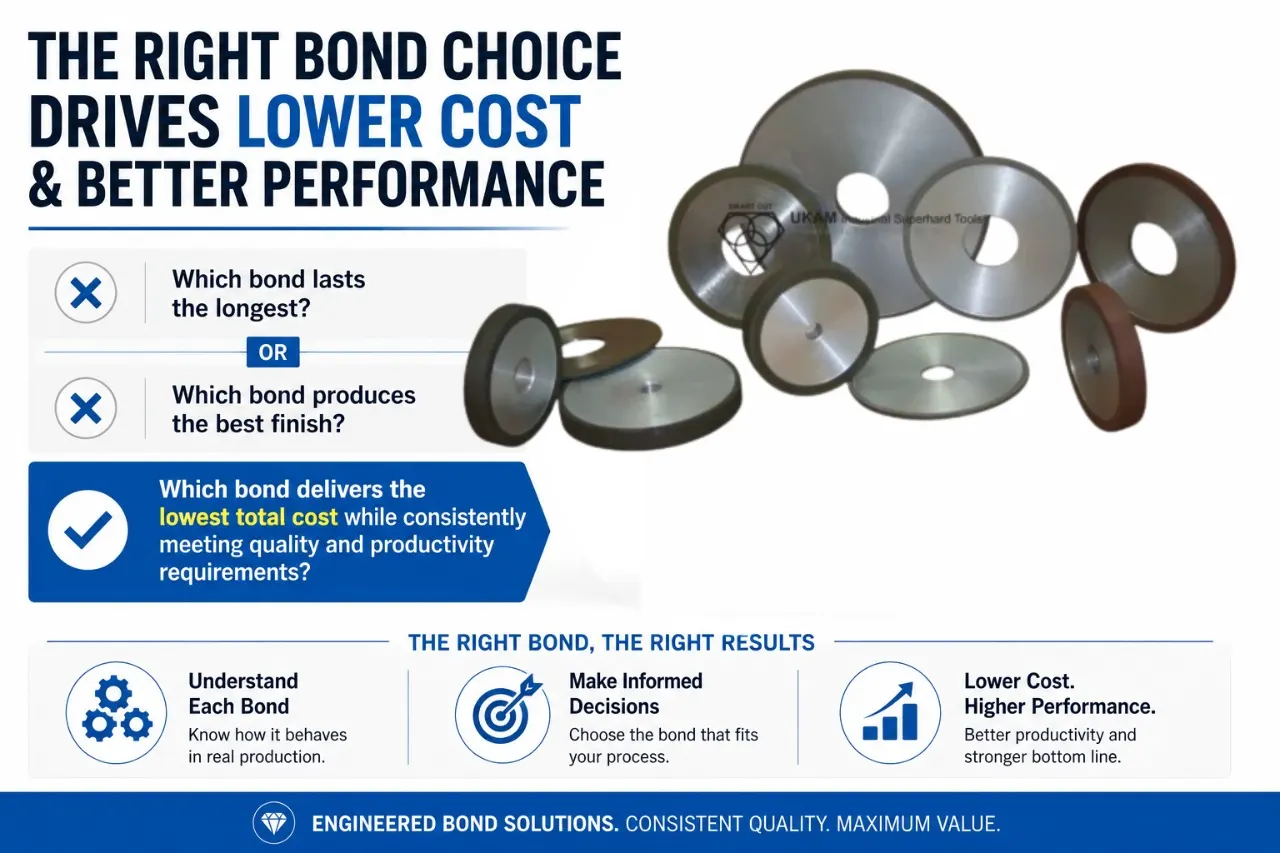
That answer depends on understanding how each bond behaves under real production conditions.
Throughout this guide, we’ll compare Resin Bond, Metal Bond, and Hybrid Bond diamond wheels from an engineering perspective—examining their construction, grinding characteristics, advantages, limitations, and ideal applications. Rather than promoting one bond over another, the goal is to help engineers make informed decisions based on process requirements, production objectives, and long-term manufacturing efficiency.
Understanding Diamond Wheel Bonds
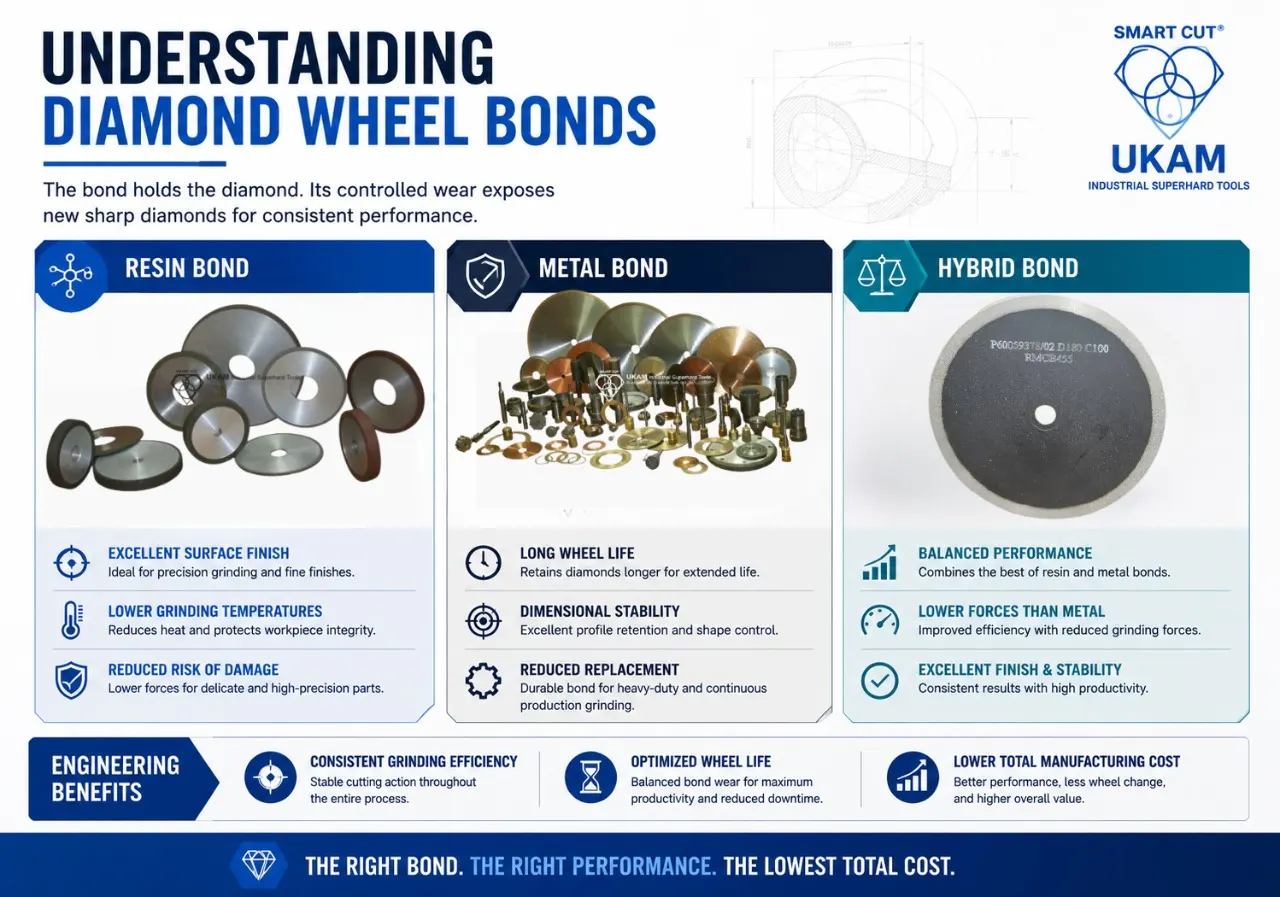
The diamond abrasive performs the cutting action, but the bond determines how effectively those diamonds can do their job.
A bond is the engineered material that holds individual diamond particles within the grinding wheel. As grinding progresses and abrasive particles become dull, the bond gradually wears away, exposing new sharp diamonds that continue the cutting process. This controlled cycle of abrasive retention and renewal is what enables diamond wheels to maintain consistent grinding performance.
The way a bond releases worn diamonds is one of the most important differences between wheel types.
If the bond releases diamonds too quickly, the wheel cuts aggressively but wears faster, increasing tooling costs and reducing production efficiency.
If the bond retains worn diamonds for too long, cutting efficiency decreases, grinding forces increase, and excess heat may damage both the wheel and the workpiece.
The ideal bond achieves a balance between abrasive retention and abrasive renewal, providing sufficient wheel life while maintaining efficient cutting throughout the grinding cycle.
Because different manufacturing operations have different priorities, no single bond performs best in every application.
Some operations require:
- Maximum surface finish
- Low grinding forces
- Minimal thermal damage
Others prioritize:
- Long wheel life
- High stock removal
- Continuous production
- Profile retention
This is why modern precision grinding primarily relies on three bond systems.
Resin Bond
Resin Bond wheels use an engineered polymer matrix that gradually releases worn diamond particles while continuously exposing new cutting edges.
Because fresh abrasives are constantly available, these wheels maintain a free-cutting action with relatively low grinding forces.
Resin Bond wheels are widely used for:
- Precision carbide tool grinding
- Optical components
- Advanced ceramics
- Medical components
- Semiconductor finishing
- Tool sharpening
Their primary advantages include excellent surface finish, lower grinding temperatures, and reduced risk of workpiece damage.
However, because the bond wears more quickly, Resin Bond wheels generally require more frequent dressing and have shorter service life during aggressive production grinding.
Metal Bond
Metal Bond wheels use metallic alloys that firmly anchor diamond particles within the wheel.
Instead of releasing abrasives rapidly, these wheels retain diamonds for much longer, providing exceptional wear resistance and outstanding profile retention.
Metal Bond wheels are commonly selected for:
- Glass grinding
- Quartz machining
- Advanced ceramics
- Ferrites
- Sapphire
- Semiconductor materials
- Profile grinding
- Continuous production
Their primary advantages include long wheel life, dimensional stability, and reduced wheel replacement.
Because worn diamonds remain embedded longer, Metal Bond wheels generally require more careful process control to prevent glazing and excessive grinding forces.
Hybrid Bond
Hybrid Bond technology combines carefully engineered characteristics of Resin Bond and Metal Bond systems.
Rather than simply blending two materials, Hybrid Bonds are designed to balance wheel life, cutting efficiency, profile retention, and surface quality within a single bond structure.
Hybrid Bond wheels are increasingly used for:
- High-performance carbide tool production
- Aerospace components
- Precision mold manufacturing
- Advanced ceramics
- Medical devices
- High-precision automated grinding
These wheels typically offer:
- Better wheel life than Resin Bond
- Lower grinding forces than Metal Bond
- Excellent surface finish
- Stable production performance
- Reduced dressing frequency
Hybrid technology is particularly valuable when manufacturers need both productivity and precision without sacrificing either objective.
Engineering Perspective
No bond system is universally superior.
A Resin Bond wheel that performs exceptionally well during finish grinding may be unsuitable for high-volume production. Likewise, a Metal Bond wheel that delivers excellent durability may not achieve the required surface finish for precision tooling.
The most effective bond is always the one that best matches the material, grinding operation, machine capability, production volume, and quality requirements.
How Bond Type Influences Grinding Performance
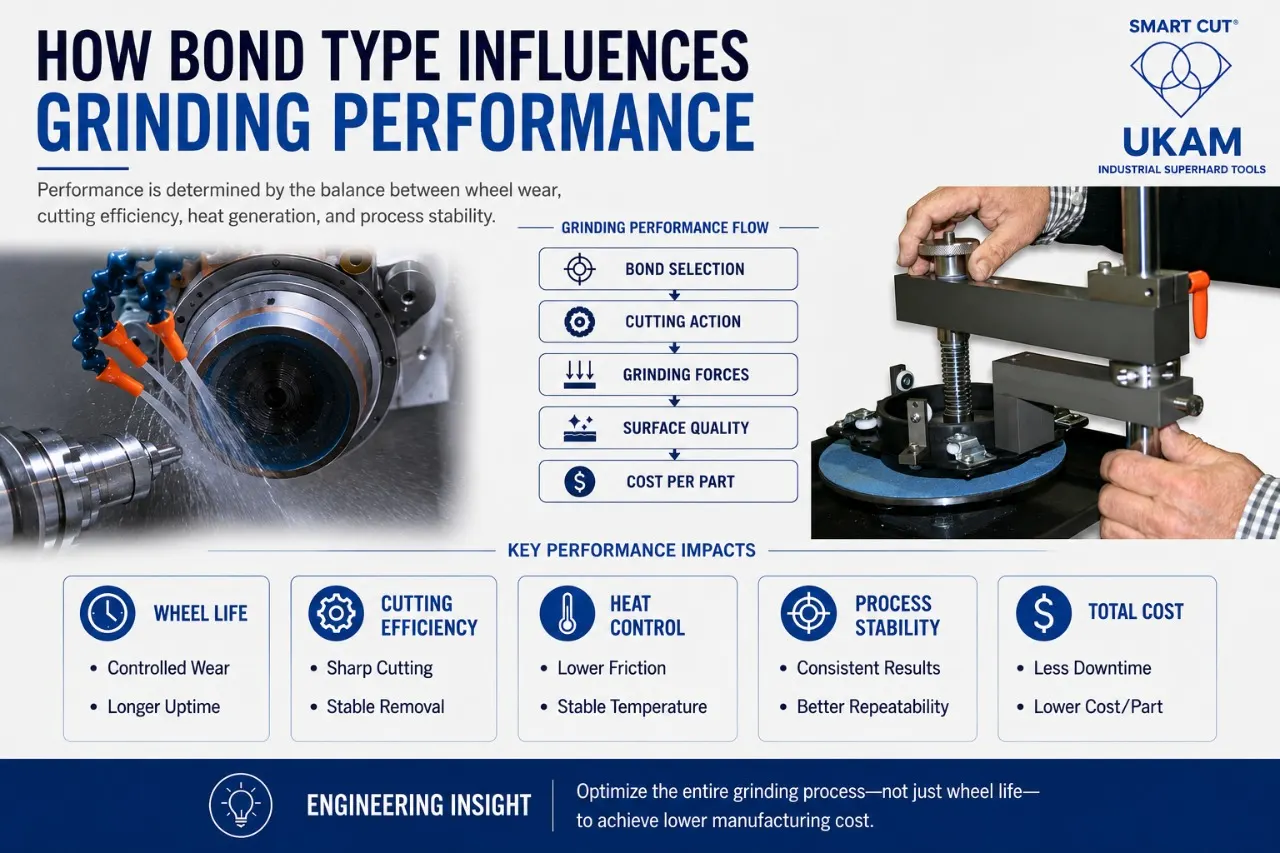
Selecting the appropriate bond system is ultimately about controlling grinding performance. While Resin Bond, Metal Bond, and Hybrid Bond wheels all use diamond abrasives, the way each bond supports and releases those abrasives has a direct impact on wheel life, cutting efficiency, surface quality, heat generation, and process stability.
Understanding these performance characteristics allows engineers to move beyond trial-and-error wheel selection and choose a specification that supports their production objectives.
Wheel Life and Wear Resistance
Wheel life is often the first performance metric considered during wheel selection. However, the wheel that lasts the longest is not always the most economical.
A grinding wheel must wear in a controlled manner. As diamond particles become dull, they must eventually be replaced by fresh cutting edges. If this renewal process occurs too slowly, grinding forces increase. If it occurs too quickly, wheel consumption becomes excessive.
Resin Bond wheels intentionally wear faster, continuously exposing fresh diamond particles. Learn more about extending this balance in How to Extend the Life and Performance of Your Diamond Grinding Wheels. Metal Bond wheels retain abrasive particles much longer, reducing wheel changes in automated production environments.
Metal Bond wheels retain abrasive particles much longer, making them highly resistant to wear. This extended service life reduces wheel changes and is particularly valuable in automated production environments where machine uptime is critical.
Hybrid Bond wheels occupy the middle ground. They are engineered to extend wheel life beyond conventional Resin Bond wheels while maintaining more aggressive cutting action than many Metal Bond designs.
Rather than evaluating wheel life alone, engineers should consider how wheel wear affects productivity, dressing intervals, and overall manufacturing cost.
Surface Finish and Dimensional Accuracy
Many precision grinding operations prioritize surface integrity over material removal rate. Cutting tools, semiconductor components, optical materials, and medical devices often require extremely fine finishes with minimal subsurface damage.
Because Resin Bond wheels maintain a continuously renewed cutting surface, they generally produce the finest finishes while reducing grinding pressure on the workpiece. Lower cutting forces also improve dimensional control and reduce the risk of edge chipping.
Metal Bond wheels provide excellent dimensional stability because they maintain wheel geometry throughout extended grinding cycles. While they may not always achieve the same surface finish as Resin Bond wheels, they excel in applications where profile accuracy is the primary requirement.
Hybrid Bond wheels combine these characteristics by maintaining stable wheel geometry while providing a sharper cutting action than conventional Metal Bond systems. This balance allows manufacturers to achieve excellent surface quality without sacrificing productivity.
For operations requiring both precision and repeatability, Hybrid Bond technology has become an increasingly popular solution.
Material Removal Rate and Productivity
Increasing stock removal does not automatically improve manufacturing efficiency. Productivity depends on the relationship between removal rate, wheel wear, dressing frequency, and machine utilization.
Resin Bond wheels are optimized for controlled cutting rather than aggressive stock removal. See our full grinding wheel selection walkthrough in How to Select a Diamond / CBN Grinding Wheel. They perform exceptionally well during finishing operations where maintaining surface quality is more important than maximizing removal rate.
Metal Bond wheels are designed for continuous production and aggressive grinding. Their durable bond structure supports extended machining cycles while maintaining wheel geometry under demanding operating conditions.
Hybrid Bond wheels are engineered to provide a balanced approach. By combining efficient cutting with improved wear resistance, they often reduce cycle times while maintaining the dimensional accuracy required for precision manufacturing.
When evaluating productivity, manufacturers should consider the complete grinding process rather than focusing solely on feed rate or removal speed.
Heat Generation and Thermal Stability
Heat is one of the most significant factors affecting grinding quality.
Excessive temperatures can cause thermal damage, microcracking, residual stress, dimensional distortion, and reduced component life. Materials such as carbide, ceramics, sapphire, glass, and semiconductor substrates are particularly sensitive to uncontrolled heat generation. Bond hardness plays a direct role — see Bond Hardness in Diamond & CBN Blades: How It Affects Cutting Performance, Wear, Blade Life & Surface Quality.
Because Resin Bond wheels continuously expose fresh abrasives, they generally maintain lower grinding forces and produce less friction. This helps reduce grinding temperatures and minimizes the risk of thermal damage.
Metal Bond wheels retain abrasive particles much longer. As diamonds become dull, cutting efficiency decreases and friction increases unless the wheel is dressed appropriately. Proper coolant delivery and optimized grinding parameters are therefore essential when using Metal Bond wheels.
Hybrid Bond wheels improve thermal performance by balancing abrasive retention with controlled renewal. The result is a more stable grinding process with lower heat generation than traditional hard-bond systems.
Regardless of bond type, thermal stability also depends on machine rigidity, coolant application, wheel speed, feed rate, and dressing strategy.
Dressing Requirements
Every grinding wheel eventually requires dressing to restore cutting efficiency and maintain wheel geometry.
The required dressing interval varies considerably depending on the bond system.
Resin Bond wheels generally require more frequent dressing because the bond wears relatively quickly. Fortunately, they are also easier to dress, allowing operators to maintain consistent cutting performance with minimal effort.
Metal Bond wheels require dressing less often due to their exceptional durability. However, because of the hardness of the metallic matrix, dressing may require specialized tools or techniques.
Hybrid Bond wheels provide a practical compromise by extending dressing intervals while remaining easier to maintain than many Metal Bond wheels.
An effective dressing strategy is not simply about restoring the wheel—it is about maintaining consistent grinding performance while minimizing production interruptions.
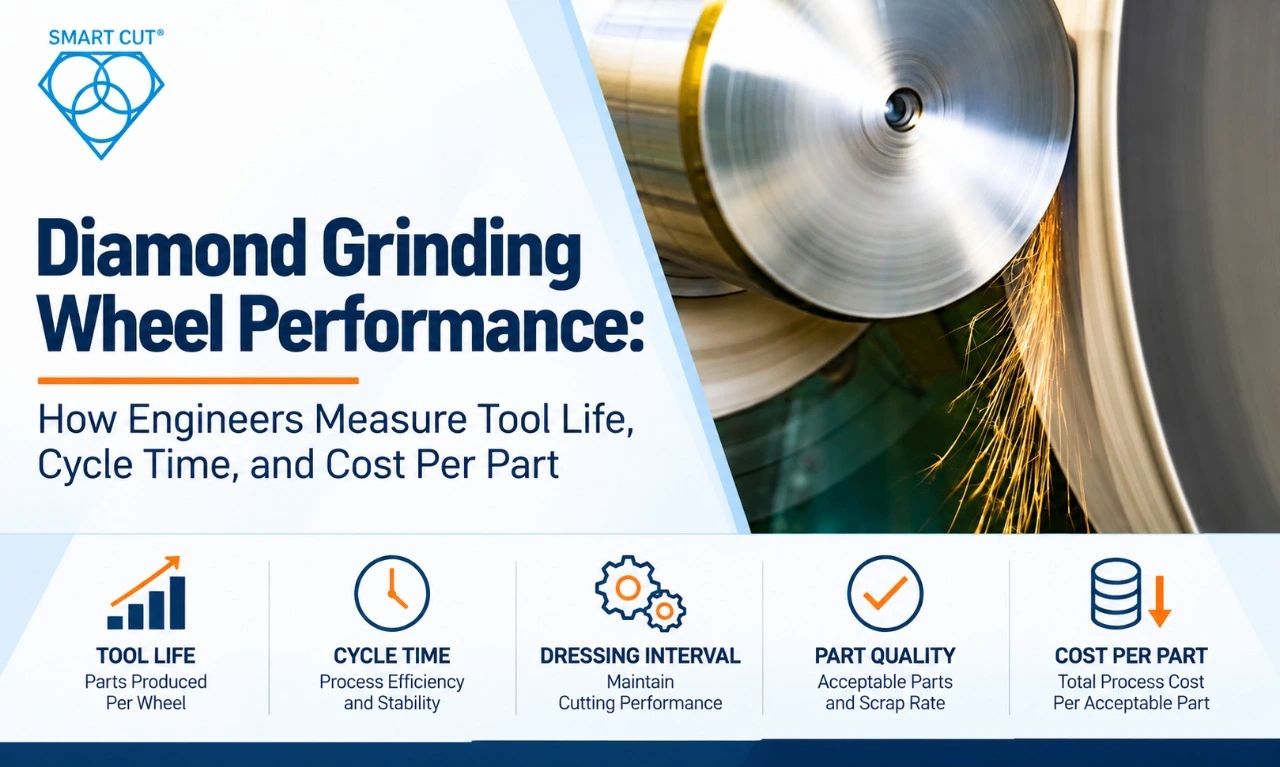
Evaluating Cost per Part
One of the most common mistakes in grinding wheel selection is comparing products based solely on purchase price.
The actual cost of a grinding wheel includes much more than its initial purchase value.
Manufacturers should evaluate:
- Wheel life
- Material removal rate
- Dressing frequency
- Machine downtime
- Surface finish consistency
- Scrap reduction
- Production throughput
- Labor requirements
- Total operating cost
A wheel that costs more initially may significantly reduce production expenses if it delivers better process stability, longer service life, or fewer rejected parts.
For this reason, Experienced manufacturing engineers measure grinding performance using cost per acceptable component rather than wheel price alone. If you’re reevaluating your current supplier relationship, see How to Switch Superabrasive Grinding Wheel Suppliers.
Engineering Insight
Every bond system involves trade-offs.
Resin Bond prioritizes cutting efficiency and surface quality.
Metal Bond prioritizes durability and dimensional stability.
Hybrid Bond balances both characteristics to improve overall process efficiency.
The best-performing wheel is therefore not the one with the longest life or the highest cutting speed. It is the wheel that consistently produces acceptable components with the lowest total manufacturing cost while meeting production and quality objectives.
Resin Bond Diamond Wheels: Best for Precision Finishing and Superior Surface Quality
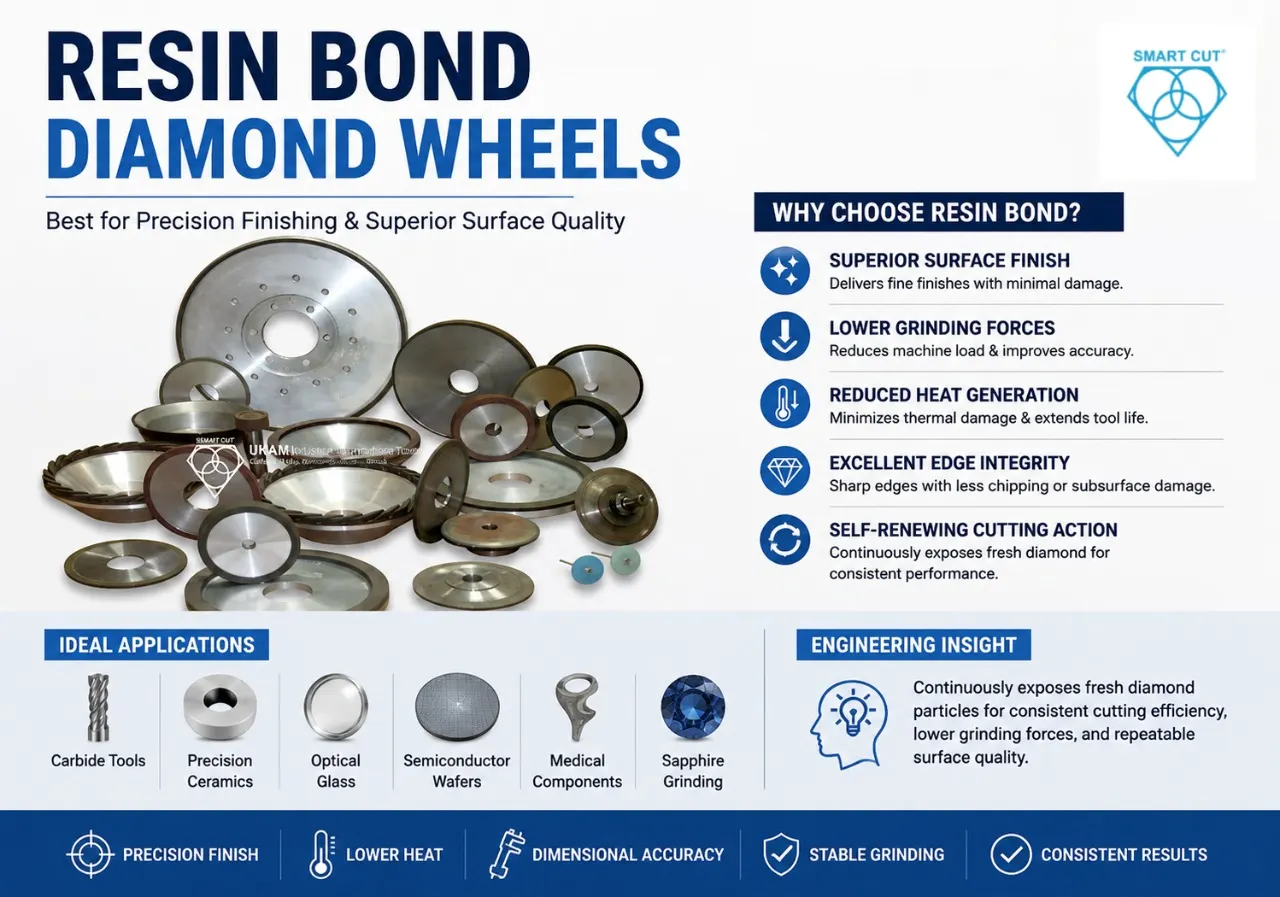
Resin Bond diamond wheels are among the most widely used bond systems in precision grinding because they consistently produce superior surface finishes while maintaining relatively low grinding forces. Their ability to expose fresh cutting edges throughout the grinding process makes them an excellent choice for applications where dimensional accuracy, surface integrity, and minimal thermal damage are critical.
Unlike harder bond systems that retain abrasive particles for extended periods, Resin Bond wheels are engineered to wear in a controlled manner. As diamond particles become dull, the resin matrix gradually releases them and exposes new sharp abrasives. This continuous self-renewing action allows the wheel to maintain efficient cutting performance throughout its operating life.
For manufacturers producing high-value components, this controlled abrasive renewal often results in improved process stability, reduced grinding temperatures, and better finished part quality.
How Resin Bond Wheels Work
The polymer-based bond is designed to strike a balance between securely holding diamond particles and releasing them at the optimal time.
During grinding:
- Sharp diamond particles remove material efficiently.
- Abrasives gradually become dull through normal wear.
- The resin bond slowly erodes under grinding forces.
- Worn diamonds are released.
- Fresh cutting edges become exposed.
Because the wheel continually renews its cutting surface, grinding forces remain relatively consistent, helping reduce friction and heat buildup.
This free-cutting behavior is one of the primary reasons Resin Bond wheels are preferred for precision finishing applications.
Key Advantages
Excellent Surface Finish
Resin Bond wheels are widely recognized for producing fine surface finishes with minimal scratching or subsurface damage.
Applications requiring tight Ra values, excellent edge quality, or optical-grade finishes frequently benefit from Resin Bond technology.
Lower Grinding Forces
The controlled release of worn abrasives allows the wheel to continue cutting efficiently without requiring excessive grinding pressure.
Lower grinding forces help:
- Improve dimensional accuracy
- Reduce machine loading
- Minimize workpiece distortion
- Extend spindle life
Reduced Heat Generation
Heat is often responsible for grinding burns, microcracking, residual stresses, and premature tool failure.
Because Resin Bond wheels continuously expose sharp abrasives, they generate less friction than harder bond systems operating under similar conditions.
This makes them particularly effective when grinding:
- Tungsten carbide
- Precision ceramics
- Glass
- Optical materials
- Medical components
- Semiconductor wafers
Excellent Edge Integrity
Components requiring sharp edges without chipping often benefit from the smoother cutting action of Resin Bond wheels.
Examples include:
- Cutting tools
- End mills
- Surgical instruments
- Optical lenses
- Precision ceramic components
Limitations
Although Resin Bond wheels provide outstanding finishing performance, they are not intended for every grinding application.
Compared with Metal Bond wheels, they generally:
- Wear more quickly during heavy stock removal
- Require more frequent dressing
- Lose profile accuracy faster in aggressive grinding
- Have shorter wheel life during continuous production
For manufacturers focused primarily on long production runs or maximum wheel durability, another bond system may provide better overall value.
Typical Applications
Resin Bond wheels are commonly used in industries where precision outweighs aggressive material removal.
Typical applications include:
- Precision carbide tool grinding
- Tool sharpening and reconditioning
- Surface grinding of advanced ceramics
- Optical glass finishing
- Semiconductor wafer processing
- Sapphire finishing
- Medical component manufacturing
- Composite material grinding
- Precision mold finishing
These applications generally require exceptional surface quality while maintaining tight dimensional tolerances.— see Semiconductor Wafer Manufacturing Process: Cutting, Grinding, Dicing & Polishing Tools Explained for the full production sequence.
When Should Engineers Choose Resin Bond?
Resin Bond technology is typically the preferred choice when the primary objective is producing the highest-quality finished component rather than maximizing wheel life.
It is particularly suitable when:
- Superior surface finish is the highest priority.
- Low grinding forces are required.
- Thermal damage must be minimized.
- Precision finishing is more important than stock removal.
- Tight dimensional tolerances must be maintained.
- Workpiece quality has greater value than wheel longevity.
Engineering Best Practices
To maximize Resin Bond wheel performance:
- Match the bond specification to the workpiece material.
- Maintain proper coolant delivery.
- Dress the wheel before cutting efficiency declines.
- Monitor grinding forces throughout production.
- Evaluate performance using cost per acceptable component, not wheel price.
Consistent monitoring and process optimization will generally deliver greater productivity improvements than changing wheel specifications alone.
Engineering Insight
Resin Bond wheels are often selected because they produce outstanding surface finishes. However, their greatest engineering advantage is maintaining consistent cutting efficiency throughout the grinding cycle. By continuously exposing fresh diamond particles, they help reduce grinding forces, improve thermal stability, and deliver repeatable quality in precision manufacturing applications.
Application Tip
For many carbide tooling, ceramic, and optical grinding operations, Resin Bond wheels provide the best balance of surface finish, dimensional accuracy, and process stability. However, if wheel wear becomes excessive or production volume increases significantly, evaluating Hybrid Bond or Metal Bond alternatives may improve overall manufacturing efficiency.
Need Help Selecting the Right Resin Bond Wheel?
Every grinding application is different. The ideal Resin Bond wheel depends on factors such as the workpiece material, grit size, diamond concentration, wheel geometry, machine capability, and production goals.
UKAM Industrial Superhard Tools has over 50 years of experience helping manufacturers optimize grinding performance through application-specific diamond wheel solutions. Whether you’re grinding carbide, ceramics, glass, sapphire, or advanced composites, our engineering team can recommend the right bond specification to improve surface finish, extend wheel life, and reduce your overall cost per part.
Contact UKAM’s application engineers today to discuss your grinding application or request a recommendation for the best Resin Bond diamond wheel for your process.
Metal Bond Diamond Wheels: Maximum Durability for High-Volume Precision Grinding
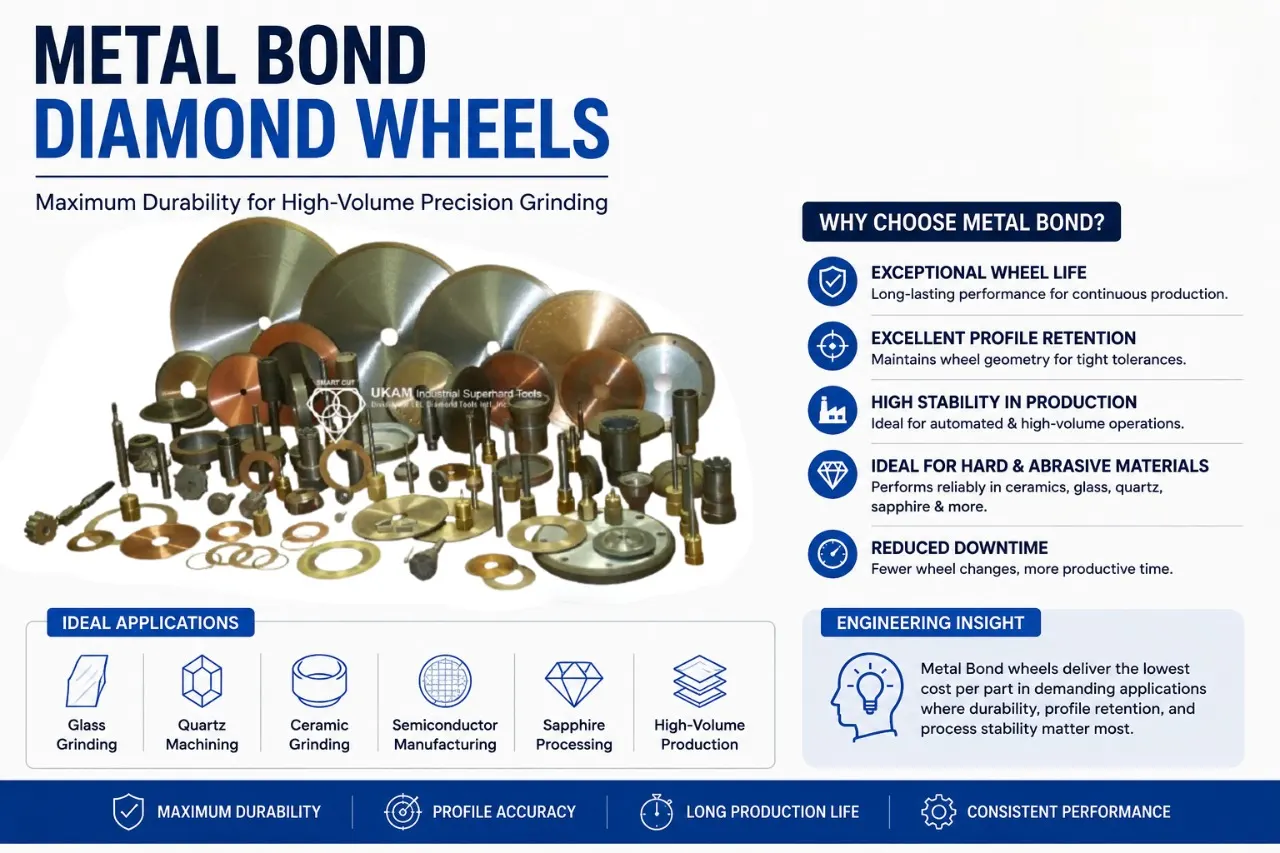
While Resin Bond wheels are known for producing exceptional surface finishes, Metal Bond diamond wheels are engineered for an entirely different objective—maximum durability, profile retention, and extended production life.
In applications involving hard, abrasive, or difficult-to-machine materials, wheel wear can significantly impact productivity. Frequent wheel changes, repeated dressing, and inconsistent profiles increase downtime and manufacturing costs. Metal Bond technology addresses these challenges by securely retaining diamond abrasives within a tough metallic matrix, allowing the wheel to withstand demanding grinding conditions over extended production cycles.
For manufacturers focused on process stability and long-term production efficiency, Metal Bond wheels often provide the most economical solution.
How Metal Bond Wheels Work
Unlike Resin Bond systems that continuously release worn diamond particles, Metal Bond wheels use a metallic alloy matrix to hold each abrasive particle much more securely.
During grinding:
- Diamond particles perform the cutting action.
- The metal bond resists wear, keeping abrasives firmly in place.
- The wheel maintains its profile over long production runs.
- Abrasive particles remain engaged until they eventually lose cutting efficiency or are restored through dressing.
This robust bond structure enables Metal Bond wheels to maintain dimensional stability even under aggressive grinding conditions, making them ideal for applications where wheel geometry must remain consistent over time.
Key Advantages
Exceptional Wheel Life
One of the greatest strengths of Metal Bond wheels is their outstanding wear resistance.
Because the bond wears very slowly, these wheels typically last much longer than Resin Bond alternatives, reducing the frequency of wheel replacements and lowering tooling costs in continuous production environments.
For manufacturers running multi-shift operations or automated grinding cells, extended wheel life can significantly improve overall equipment efficiency.
Excellent Profile Retention
Maintaining wheel geometry is essential when grinding components with tight dimensional tolerances.
Since the metallic bond resists deformation and wear, Metal Bond wheels preserve complex wheel profiles for much longer periods. This results in:
- Improved dimensional consistency
- Better repeatability between production batches
- Reduced profile corrections
- Less variation in finished components
Profile retention is especially important in industries where even minor dimensional deviations can affect product performance.
High Stability in Continuous Production
Metal Bond wheels are designed for applications where consistency over long grinding cycles is more important than aggressive self-sharpening.
Their stable bond structure allows manufacturers to run extended production without frequent wheel replacement, making them ideal for:
- Automated production lines
- CNC grinding systems
- High-volume manufacturing
- Continuous industrial operations
Reduced downtime translates directly into higher productivity and lower manufacturing costs.
Suitable for Hard and Abrasive Materials
Metal Bond technology performs particularly well when machining materials that rapidly wear conventional grinding wheels.
Common examples include:
- Advanced technical ceramics
- Glass
- Quartz
- Sapphire
- Ferrites
- Silicon carbide
- Semiconductor materials
- Stone and mineral-based materials
These materials often require wheels capable of maintaining both dimensional stability and long service life under demanding operating conditions. Our Precision Carbide Tools line complements many of these applications.
Limitations
Despite their durability, Metal Bond wheels are not universally suitable for every grinding application.
Because the bond retains abrasive particles for an extended period, worn diamonds may continue rubbing against the workpiece after their cutting efficiency decreases. This can increase grinding forces and heat generation if the wheel is not dressed or maintained properly.
Compared with Resin Bond wheels, Metal Bond wheels generally:
- Produce higher grinding forces
- Generate more heat under improper operating conditions
- Require specialized dressing methods
- May produce slightly lower surface finishes in ultra-precision applications
- Need careful optimization of grinding parameters
Proper coolant delivery, dressing intervals, and machine rigidity become especially important when using Metal Bond technology.
Typical Applications
Metal Bond diamond wheels are widely used in industries requiring durability, profile accuracy, and consistent production performance.
Typical applications include:
- Glass edge grinding
- Quartz component machining
- Ceramic grinding
- Sapphire wafer processing
- Semiconductor manufacturing
- Ferrite grinding
- Stone and mineral processing
- Precision profile grinding
- High-volume industrial production
These operations prioritize long wheel life and dimensional consistency over aggressive self-sharpening characteristics. See Cutting Glass with Diamond Saw Blades: How to Prevent Chipping, Cracking & Material Loss for related edge-quality guidance.
When Should Engineers Choose Metal Bond?
Metal Bond wheels are generally the preferred choice when manufacturing priorities include:
- Maximum wheel life
- Long production runs
- Excellent profile retention
- High dimensional consistency
- Reduced wheel replacement
- Continuous automated production
- Grinding highly abrasive materials
If minimizing production interruptions is more important than achieving the finest possible surface finish, Metal Bond technology often provides the greatest long-term value.
Engineering Best Practices
To achieve optimal performance from Metal Bond wheels:Depth of cut significantly influences heat generation, wheel wear, and dimensional accuracy.
As a general guideline:
- Select the appropriate bond hardness for the workpiece material.
- Maintain consistent coolant flow to control grinding temperatures.
- Monitor grinding forces and spindle load during production.
- Dress the wheel before glazing affects cutting performance.
- Optimize wheel speed, feed rate, and depth of cut based on the material being machined.
Routine process monitoring helps maintain cutting efficiency and prevents excessive heat buildup that can compromise part quality.
Engineering Insight
Many manufacturers assume the longest-lasting wheel is automatically the best investment. In reality, wheel life is only one component of process efficiency. A Metal Bond wheel delivers maximum value when its durability, profile retention, and production stability outweigh the additional effort required for dressing and process optimization. Evaluating cost per finished component, rather than wheel lifespan alone, provides a more accurate measure of manufacturing performance.
Application Tip
Metal Bond wheels are an excellent choice for high-volume grinding operations involving ceramics, glass, quartz, sapphire, and other hard materials where maintaining wheel geometry and minimizing downtime are essential. However, for applications requiring both long wheel life and lower grinding forces with superior surface finishes, Hybrid Bond technology may offer the best overall balance.
Need Help Choosing the Right Metal Bond Wheel?
Selecting the correct Metal Bond wheel requires more than matching the material being ground. Factors such as bond composition, diamond grit size, concentration, wheel shape, coolant strategy, and machine capability all influence grinding performance.
UKAM Industrial Superhard Tools works closely with manufacturers to recommend application-specific Metal Bond diamond wheels that improve productivity, extend wheel life, and maintain precision throughout long production runs.
Contact UKAM’s application engineers today for expert guidance on selecting the ideal Metal Bond wheel for your grinding process or to discuss a custom-engineered solution tailored to your manufacturing requirements.
Resin Bond vs. Metal Bond vs. Hybrid Bond: Which Diamond Wheel Is Right for Your Application?
After understanding how each bond system performs individually, the next step is determining which one best matches your specific grinding application. There is no universal “best” bond. Each is engineered to solve different manufacturing challenges, and the optimal choice depends on balancing material characteristics, production requirements, surface finish expectations, and overall operating costs.
Rather than comparing bond systems based on a single factor—such as wheel life or purchase price—manufacturing engineers should evaluate how each option contributes to the entire grinding process.
Side-by-Side Comparison
|
Performance Factor |
Resin Bond |
Metal Bond |
Hybrid Bond |
|---|---|---|---|
|
Cutting Efficiency |
Excellent |
Moderate |
Excellent |
|
Surface Finish |
Excellent |
Very Good |
Excellent |
|
Wheel Life |
Moderate |
Excellent |
Very Good to Excellent |
|
Profile Retention |
Good |
Excellent |
Excellent |
|
Grinding Forces |
Low |
Higher |
Low to Moderate |
|
Heat Generation |
Low |
Moderate |
Low |
|
Dressing Frequency |
More Frequent |
Less Frequent |
Moderate |
|
Stock Removal Capability |
Moderate |
High |
High |
|
Production Stability |
Good |
Excellent |
Excellent |
|
Best For |
Precision Finishing |
Continuous Production |
Precision + Productivity |
This comparison highlights that each bond system excels under different manufacturing conditions. The ideal choice depends on which performance characteristics are most important for your operation.
Choose Resin Bond When...
Resin Bond wheels are best suited for applications where surface quality and precision are the highest priorities.
Consider Resin Bond if your application requires:
- Exceptional surface finish
- Low grinding forces
- Minimal thermal damage
- Precision finishing operations
- Tight dimensional tolerances
- Tool sharpening and reconditioning
- Grinding carbide, ceramics, glass, or optical materials
Although Resin Bond wheels generally wear faster than harder bond systems, their free-cutting characteristics make them ideal for applications where finished component quality is more important than maximum wheel life.
Choose Metal Bond When...
Metal Bond wheels are designed for manufacturers focused on durability, profile retention, and production consistency.
Metal Bond is often the preferred choice when:
- Wheel life is the primary concern
- Long production runs are required
- Maintaining wheel geometry is critical
- Grinding highly abrasive materials
- Operating automated CNC production lines
- Reducing wheel replacement frequency
- Maximizing machine uptime
For continuous production environments, Metal Bond wheels often deliver the lowest operating cost over extended manufacturing cycles.
Choose Hybrid Bond When...
Hybrid Bond technology is ideal when manufacturers need to balance quality, productivity, and wheel longevity.
Hybrid Bond is an excellent choice if you want:
- Better wheel life than Resin Bond
- Lower grinding forces than Metal Bond
- Excellent surface finishes
- Reduced dressing frequency
- Improved production efficiency
- Stable grinding performance
- Lower overall cost per part
Many manufacturers transitioning from traditional Resin or Metal Bond systems find that Hybrid Bond technology offers the best overall compromise between precision and productivity.
Factors That Should Influence Your Decision
Selecting the correct bond involves evaluating far more than the material being ground. Several process variables influence grinding performance and should be considered before specifying a wheel.
1. Workpiece Material
Different materials respond differently to grinding forces, heat, and abrasive wear.
Examples include:
- Tungsten carbide
- Silicon carbide
- Aluminum oxide ceramics
- Zirconia
- Glass
- Quartz
- Sapphire
- Ferrites
- Composite materials
Material hardness, brittleness, thermal conductivity, and abrasiveness all affect bond selection. See Why Diamond Blades Fail Prematurely During Silicon Carbide Cutting.
2. Grinding Operation
The grinding process itself plays a major role in determining the most suitable bond.
Common operations include:
- Surface grinding
- Cylindrical grinding
- Tool and cutter grinding
- Profile grinding
- Peripheral grinding
- Wafer back grinding
- Precision finishing
Different operations place different demands on wheel wear, profile retention, and cutting performance.
3. Machine Capability
Machine characteristics influence how efficiently a grinding wheel performs.
Important considerations include:
- Spindle power
- Machine rigidity
- Coolant delivery system
- Wheel speed
- Feed rate control
- Dressing equipment
- Automation level
A wheel optimized for one machine may not deliver the same performance on another with different operating capabilities.
4. Production Volume
Manufacturing objectives should always influence wheel selection.
For example:
- Prototype production may prioritize flexibility and finish quality.
- Medium-volume manufacturing often benefits from balanced performance.
- High-volume production usually emphasizes wheel life, consistency, and reduced downtime.
Selecting a bond that aligns with production demands helps optimize both productivity and operating costs.
5. Total Cost of Ownership
The lowest-priced wheel is rarely the most economical option.
Instead, manufacturers should evaluate:
- Wheel consumption
- Dressing costs
- Machine downtime
- Labor requirements
- High-volume production usually emphasizes wheel life, consistency, and reduced downtime.
- High-volume production usually emphasizes wheel life, consistency, and reduced downtime.
- Scrap reduction
- Productivity
- Finished part quality
- Tool replacement frequency
The goal is to minimize the total cost per acceptable component, not simply reduce the initial tooling expense.
Engineering Insight
Successful grinding is achieved by optimizing the entire manufacturing process—not by maximizing one performance characteristic. A wheel with exceptional durability may reduce productivity if it generates excessive grinding forces, while a wheel producing an outstanding surface finish may become uneconomical if frequent dressing interrupts production. The most effective bond system is the one that delivers the best balance of quality, consistency, productivity, and operating cost for your specific application.
Need Help Choosing the Right Bond?
Choosing between Resin Bond, Metal Bond, and Hybrid Bond requires more than comparing product specifications. Factors such as material properties, machine capability, production goals, coolant strategy, and dressing methods all influence grinding performance.
UKAM Industrial Superhard Tools provides application-specific engineering support to help manufacturers identify the most effective bond system for their grinding process. Whether you’re optimizing an existing operation or developing a new manufacturing process, our team can recommend a diamond wheel solution designed to improve productivity, enhance part quality, and reduce overall manufacturing costs.
Contact UKAM’s application engineers today to discuss your application and receive expert guidance on selecting the ideal Resin Bond, Metal Bond, or Hybrid Bond diamond wheel for your manufacturing needs.
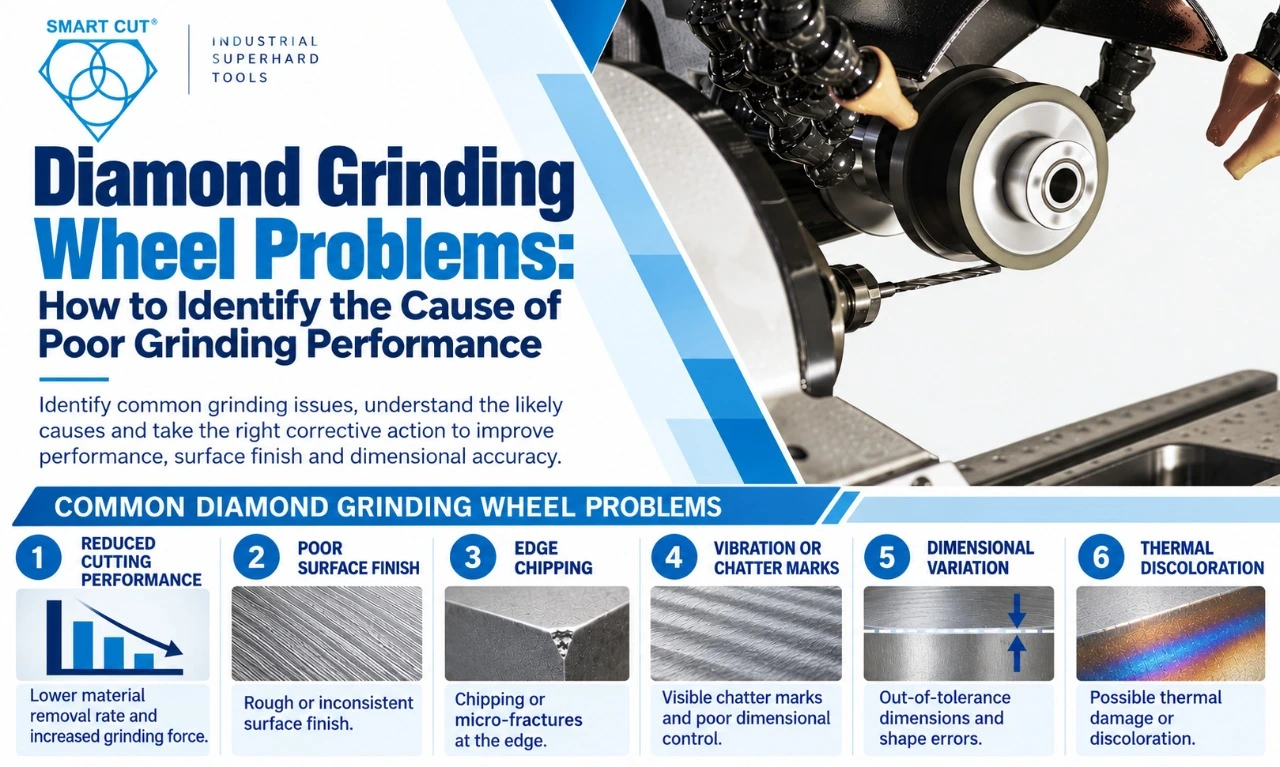
Common Grinding Problems and How the Right Bond Can Solve Them
Even with a high-quality diamond grinding wheel, grinding performance can decline if the bond system is not properly matched to the application. Manufacturers often blame machine settings, coolant systems, or wheel quality when the real issue is an unsuitable bond specification.
Problems such as rapid wheel wear, glazing, poor surface finish, excessive heat generation, or dimensional inconsistencies are frequently symptoms of a mismatch between the grinding wheel and the manufacturing process. Identifying these issues early—and understanding how bond selection influences them—can significantly improve productivity, reduce scrap, and lower operating costs.
Below are some of the most common grinding challenges encountered in precision manufacturing and practical engineering recommendations for resolving them. Common Grinding Mistakes That Reduce Diamond Tool Performance covers this and related root causes in detail.
Problem: Excessive Wheel Wear
Symptoms
- Frequent wheel replacement
- Short dressing intervals
- Increased tooling costs
- Reduced production efficiency
Possible Causes
- Bond is too soft for the application
- Excessive stock removal
- Incorrect wheel specification
- Aggressive grinding parameters
Recommended Solution
If wheel wear becomes excessive during continuous production, consider transitioning from a Resin Bond wheel to a Hybrid Bond or Metal Bond wheel. These bond systems provide improved abrasive retention and longer service life while maintaining stable grinding performance.
Review feed rates, wheel speed, and depth of cut to ensure they are appropriate for the material being machined.
Problem: Wheel Glazing
Symptoms
- Reduced cutting efficiency
- Increased grinding forces
- Higher spindle load
- Poor material removal
- Excessive heat generation
Possible Causes
- Bond retains worn diamonds too long
- Insufficient dressing
- Incorrect wheel hardness
- Improper grinding parameters
How Resin Bond Wheels Work
The polymer-based bond is designed to strike a balance between securely holding diamond particles and releasing them at the optimal time.
During grinding:
- Sharp diamond particles remove material efficiently.
- Abrasives gradually become dull through normal wear.
- The resin bond slowly erodes under grinding forces.
- Worn diamonds are released.
- Fresh cutting edges become exposed.
Because the wheel continually renews its cutting surface, grinding forces remain relatively consistent, helping reduce friction and heat buildup.
This free-cutting behavior is one of the primary reasons Resin Bond wheels are preferred for precision finishing applications.
Key Advantages
Excellent Surface Finish
Resin Bond wheels are widely recognized for producing fine surface finishes with minimal scratching or subsurface damage.
Applications requiring tight Ra values, excellent edge quality, or optical-grade finishes frequently benefit from Resin Bond technology.
Lower Grinding Forces
The controlled release of worn abrasives allows the wheel to continue cutting efficiently without requiring excessive grinding pressure.
Lower grinding forces help:
- Improve dimensional accuracy
- Reduce machine loading
- Minimize workpiece distortion
- Extend spindle life
Reduced Heat Generation
Heat is often responsible for grinding burns, microcracking, residual stresses, and premature tool failure.
Because Resin Bond wheels continuously expose sharp abrasives, they generate less friction than harder bond systems operating under similar conditions.
This makes them particularly effective when grinding:
- Tungsten carbide
- Precision ceramics
- Glass
- Optical materials
- Medical components
- Semiconductor wafers
Excellent Edge Integrity
Components requiring sharp edges without chipping often benefit from the smoother cutting action of Resin Bond wheels.
Examples include:
- Cutting tools
- End mills
- Surgical instruments
- Optical lenses
- Precision ceramic components
Limitations
Although Resin Bond wheels provide outstanding finishing performance, they are not intended for every grinding application.
Compared with Metal Bond wheels, they generally:
- Wear more quickly during heavy stock removal
- Require more frequent dressing
- Lose profile accuracy faster in aggressive grinding
- Have shorter wheel life during continuous production
For manufacturers focused primarily on long production runs or maximum wheel durability, another bond system may provide better overall value.
Typical Applications
Resin Bond wheels are commonly used in industries where precision outweighs aggressive material removal.
Typical applications include:
- Precision carbide tool grinding
- Tool sharpening and reconditioning
- Surface grinding of advanced ceramics
- Optical glass finishing
- Semiconductor wafer processing
- Sapphire finishing
- Medical component manufacturing
- Composite material grinding
- Precision mold finishing
These applications generally require exceptional surface quality while maintaining tight dimensional tolerances.— see Semiconductor Wafer Manufacturing Process: Cutting, Grinding, Dicing & Polishing Tools Explained for the full production sequence.
When Should Engineers Choose Resin Bond?
Resin Bond technology is typically the preferred choice when the primary objective is producing the highest-quality finished component rather than maximizing wheel life.
It is particularly suitable when:
- Superior surface finish is the highest priority.
- Low grinding forces are required.
- Thermal damage must be minimized.
- Precision finishing is more important than stock removal.
- Tight dimensional tolerances must be maintained.
- Workpiece quality has greater value than wheel longevity.
Engineering Best Practices
To maximize Resin Bond wheel performance:
- Match the bond specification to the workpiece material.
- Maintain proper coolant delivery.
- Dress the wheel before cutting efficiency declines.
- Monitor grinding forces throughout production.
- Evaluate performance using cost per acceptable component, not wheel price.
Consistent monitoring and process optimization will generally deliver greater productivity improvements than changing wheel specifications alone.
Engineering Insight
Resin Bond wheels are often selected because they produce outstanding surface finishes. However, their greatest engineering advantage is maintaining consistent cutting efficiency throughout the grinding cycle. By continuously exposing fresh diamond particles, they help reduce grinding forces, improve thermal stability, and deliver repeatable quality in precision manufacturing applications.
Application Tip
For many carbide tooling, ceramic, and optical grinding operations, Resin Bond wheels provide the best balance of surface finish, dimensional accuracy, and process stability. However, if wheel wear becomes excessive or production volume increases significantly, evaluating Hybrid Bond or Metal Bond alternatives may improve overall manufacturing efficiency.
Need Help Selecting the Right Resin Bond Wheel?
Every grinding application is different. The ideal Resin Bond wheel depends on factors such as the workpiece material, grit size, diamond concentration, wheel geometry, machine capability, and production goals.
UKAM Industrial Superhard Tools has over 50 years of experience helping manufacturers optimize grinding performance through application-specific diamond wheel solutions. Whether you’re grinding carbide, ceramics, glass, sapphire, or advanced composites, our engineering team can recommend the right bond specification to improve surface finish, extend wheel life, and reduce your overall cost per part.
Contact UKAM’s application engineers today to discuss your grinding application or request a recommendation for the best Resin Bond diamond wheel for your process.
Metal Bond Diamond Wheels: Maximum Durability for High-Volume Precision Grinding
While Resin Bond wheels are known for producing exceptional surface finishes, Metal Bond diamond wheels are engineered for an entirely different objective—maximum durability, profile retention, and extended production life.
In applications involving hard, abrasive, or difficult-to-machine materials, wheel wear can significantly impact productivity. Frequent wheel changes, repeated dressing, and inconsistent profiles increase downtime and manufacturing costs. Metal Bond technology addresses these challenges by securely retaining diamond abrasives within a tough metallic matrix, allowing the wheel to withstand demanding grinding conditions over extended production cycles.
For manufacturers focused on process stability and long-term production efficiency, Metal Bond wheels often provide the most economical solution.
How Metal Bond Wheels Work
Unlike Resin Bond systems that continuously release worn diamond particles, Metal Bond wheels use a metallic alloy matrix to hold each abrasive particle much more securely.
During grinding:
- Diamond particles perform the cutting action.
- The metal bond resists wear, keeping abrasives firmly in place.
- The wheel maintains its profile over long production runs.
- Abrasive particles remain engaged until they eventually lose cutting efficiency or are restored through dressing.
This robust bond structure enables Metal Bond wheels to maintain dimensional stability even under aggressive grinding conditions, making them ideal for applications where wheel geometry must remain consistent over time.
Key Advantages
Exceptional Wheel Life
One of the greatest strengths of Metal Bond wheels is their outstanding wear resistance.
Because the bond wears very slowly, these wheels typically last much longer than Resin Bond alternatives, reducing the frequency of wheel replacements and lowering tooling costs in continuous production environments.
For manufacturers running multi-shift operations or automated grinding cells, extended wheel life can significantly improve overall equipment efficiency.
Excellent Profile Retention
Maintaining wheel geometry is essential when grinding components with tight dimensional tolerances.
Since the metallic bond resists deformation and wear, Metal Bond wheels preserve complex wheel profiles for much longer periods. This results in:
- Improved dimensional consistency
- Better repeatability between production batches
- Reduced profile corrections
- Less variation in finished components
Profile retention is especially important in industries where even minor dimensional deviations can affect product performance.
High Stability in Continuous Production
Metal Bond wheels are designed for applications where consistency over long grinding cycles is more important than aggressive self-sharpening.
Their stable bond structure allows manufacturers to run extended production without frequent wheel replacement, making them ideal for:
- Automated production lines
- CNC grinding systems
- High-volume manufacturing
- Continuous industrial operations
Reduced downtime translates directly into higher productivity and lower manufacturing costs.
Suitable for Hard and Abrasive Materials
Metal Bond technology performs particularly well when machining materials that rapidly wear conventional grinding wheels.
Common examples include:
- Advanced technical ceramics
- Glass
- Quartz
- Sapphire
- Ferrites
- Silicon carbide
- Semiconductor materials
- Stone and mineral-based materials
These materials often require wheels capable of maintaining both dimensional stability and long service life under demanding operating conditions. Our Precision Carbide Tools line complements many of these applications.
Limitations
Despite their durability, Metal Bond wheels are not universally suitable for every grinding application.
Because the bond retains abrasive particles for an extended period, worn diamonds may continue rubbing against the workpiece after their cutting efficiency decreases. This can increase grinding forces and heat generation if the wheel is not dressed or maintained properly.
Compared with Resin Bond wheels, Metal Bond wheels generally:
- Produce higher grinding forces
- Generate more heat under improper operating conditions
- Require specialized dressing methods
- May produce slightly lower surface finishes in ultra-precision applications
- Need careful optimization of grinding parameters
Proper coolant delivery, dressing intervals, and machine rigidity become especially important when using Metal Bond technology.
Typical Applications
Metal Bond diamond wheels are widely used in industries requiring durability, profile accuracy, and consistent production performance.
Typical applications include:
- Glass edge grinding
- Quartz component machining
- Ceramic grinding
- Sapphire wafer processing
- Semiconductor manufacturing
- Ferrite grinding
- Stone and mineral processing
- Precision profile grinding
- High-volume industrial production
These operations prioritize long wheel life and dimensional consistency over aggressive self-sharpening characteristics. See Cutting Glass with Diamond Saw Blades: How to Prevent Chipping, Cracking & Material Loss for related edge-quality guidance.
When Should Engineers Choose Metal Bond?
Metal Bond wheels are generally the preferred choice when manufacturing priorities include:
- Maximum wheel life
- Long production runs
- Excellent profile retention
- High dimensional consistency
- Reduced wheel replacement
- Continuous automated production
- Grinding highly abrasive materials
If minimizing production interruptions is more important than achieving the finest possible surface finish, Metal Bond technology often provides the greatest long-term value.
Engineering Best Practices
To achieve optimal performance from Metal Bond wheels:Depth of cut significantly influences heat generation, wheel wear, and dimensional accuracy.
As a general guideline:
- Select the appropriate bond hardness for the workpiece material.
- Maintain consistent coolant flow to control grinding temperatures.
- Monitor grinding forces and spindle load during production.
- Dress the wheel before glazing affects cutting performance.
- Optimize wheel speed, feed rate, and depth of cut based on the material being machined.
Routine process monitoring helps maintain cutting efficiency and prevents excessive heat buildup that can compromise part quality.
Engineering Insight
Many manufacturers assume the longest-lasting wheel is automatically the best investment. In reality, wheel life is only one component of process efficiency. A Metal Bond wheel delivers maximum value when its durability, profile retention, and production stability outweigh the additional effort required for dressing and process optimization. Evaluating cost per finished component, rather than wheel lifespan alone, provides a more accurate measure of manufacturing performance.
Application Tip
Metal Bond wheels are an excellent choice for high-volume grinding operations involving ceramics, glass, quartz, sapphire, and other hard materials where maintaining wheel geometry and minimizing downtime are essential. However, for applications requiring both long wheel life and lower grinding forces with superior surface finishes, Hybrid Bond technology may offer the best overall balance.
Need Help Choosing the Right Metal Bond Wheel?
Selecting the correct Metal Bond wheel requires more than matching the material being ground. Factors such as bond composition, diamond grit size, concentration, wheel shape, coolant strategy, and machine capability all influence grinding performance.
UKAM Industrial Superhard Tools works closely with manufacturers to recommend application-specific Metal Bond diamond wheels that improve productivity, extend wheel life, and maintain precision throughout long production runs.
Contact UKAM’s application engineers today for expert guidance on selecting the ideal Metal Bond wheel for your grinding process or to discuss a custom-engineered solution tailored to your manufacturing requirements.
Resin Bond vs. Metal Bond vs. Hybrid Bond: Which Diamond Wheel Is Right for Your Application?
After understanding how each bond system performs individually, the next step is determining which one best matches your specific grinding application. There is no universal “best” bond. Each is engineered to solve different manufacturing challenges, and the optimal choice depends on balancing material characteristics, production requirements, surface finish expectations, and overall operating costs.
Rather than comparing bond systems based on a single factor—such as wheel life or purchase price—manufacturing engineers should evaluate how each option contributes to the entire grinding process.
Side-by-Side Comparison
|
Performance Factor |
Resin Bond |
Metal Bond |
Hybrid Bond |
|---|---|---|---|
|
Cutting Efficiency |
Excellent |
Moderate |
Excellent |
|
Surface Finish |
Excellent |
Very Good |
Excellent |
|
Wheel Life |
Moderate |
Excellent |
Very Good to Excellent |
|
Profile Retention |
Good |
Excellent |
Excellent |
|
Grinding Forces |
Low |
Higher |
Low to Moderate |
|
Heat Generation |
Low |
Moderate |
Low |
|
Dressing Frequency |
More Frequent |
Less Frequent |
Moderate |
|
Stock Removal Capability |
Moderate |
High |
High |
|
Production Stability |
Good |
Excellent |
Excellent |
|
Best For |
Precision Finishing |
Continuous Production |
Precision + Productivity |
This comparison highlights that each bond system excels under different manufacturing conditions. The ideal choice depends on which performance characteristics are most important for your operation.
Choose Resin Bond When...
Resin Bond wheels are best suited for applications where surface quality and precision are the highest priorities.
Consider Resin Bond if your application requires:
- Exceptional surface finish
- Low grinding forces
- Minimal thermal damage
- Precision finishing operations
- Tight dimensional tolerances
- Tool sharpening and reconditioning
- Grinding carbide, ceramics, glass, or optical materials
Although Resin Bond wheels generally wear faster than harder bond systems, their free-cutting characteristics make them ideal for applications where finished component quality is more important than maximum wheel life.
Choose Metal Bond When...
Metal Bond wheels are designed for manufacturers focused on durability, profile retention, and production consistency.
Metal Bond is often the preferred choice when:
- Wheel life is the primary concern
- Long production runs are required
- Maintaining wheel geometry is critical
- Grinding highly abrasive materials
- Operating automated CNC production lines
- Reducing wheel replacement frequency
- Maximizing machine uptime
For continuous production environments, Metal Bond wheels often deliver the lowest operating cost over extended manufacturing cycles.
Choose Hybrid Bond When...
Hybrid Bond technology is ideal when manufacturers need to balance quality, productivity, and wheel longevity.
Hybrid Bond is an excellent choice if you want:
- Better wheel life than Resin Bond
- Lower grinding forces than Metal Bond
- Excellent surface finishes
- Reduced dressing frequency
- Improved production efficiency
- Stable grinding performance
- Lower overall cost per part
Many manufacturers transitioning from traditional Resin or Metal Bond systems find that Hybrid Bond technology offers the best overall compromise between precision and productivity.
Factors That Should Influence Your Decision
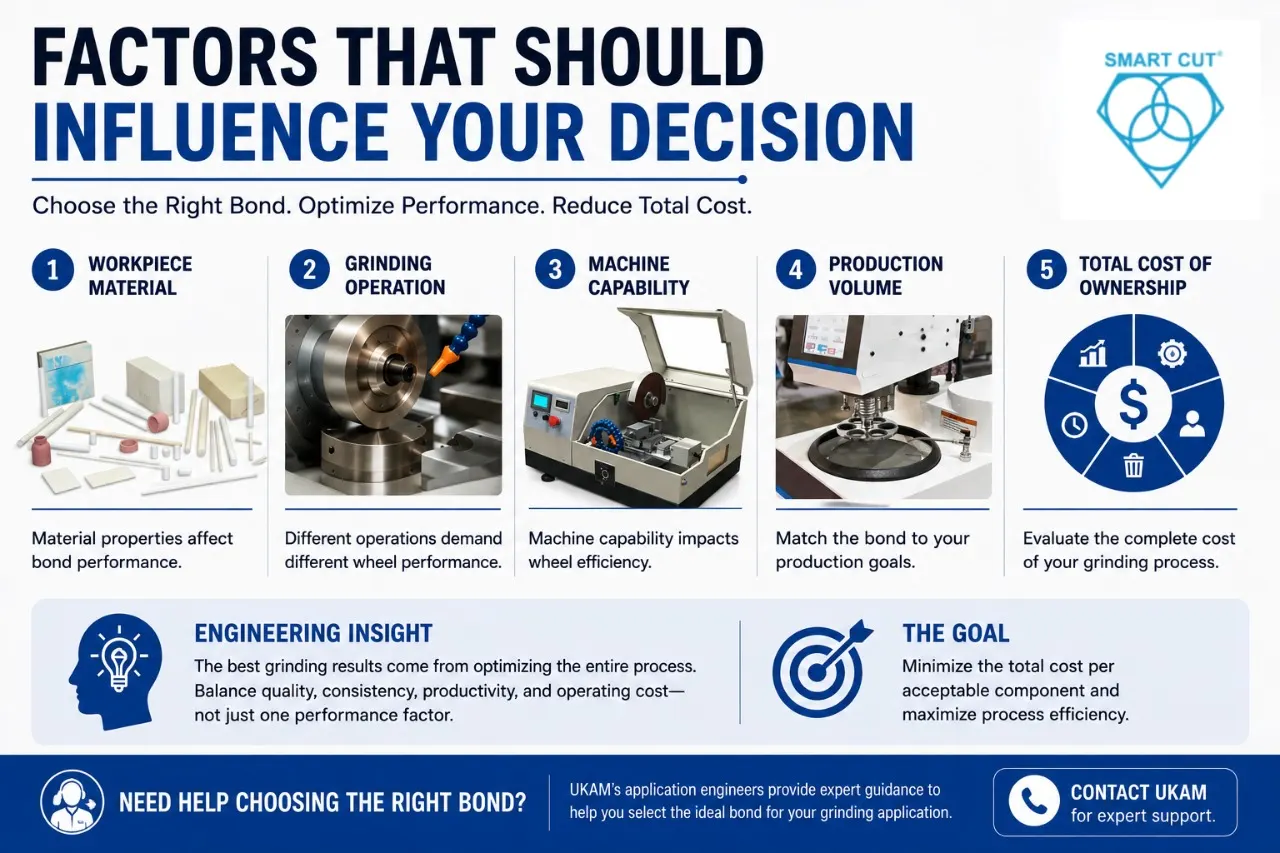
Selecting the correct bond involves evaluating far more than the material being ground. Several process variables influence grinding performance and should be considered before specifying a wheel.
1. Workpiece Material
Different materials respond differently to grinding forces, heat, and abrasive wear.
Examples include:
- Tungsten carbide
- Silicon carbide
- Aluminum oxide ceramics
- Zirconia
- Glass
- Quartz
- Sapphire
- Ferrites
- Composite materials
Material hardness, brittleness, thermal conductivity, and abrasiveness all affect bond selection. See Why Diamond Blades Fail Prematurely During Silicon Carbide Cutting.
2. Grinding Operation
The grinding process itself plays a major role in determining the most suitable bond.
Common operations include:
- Surface grinding
- Cylindrical grinding
- Tool and cutter grinding
- Profile grinding
- Peripheral grinding
- Wafer back grinding
- Precision finishing
Different operations place different demands on wheel wear, profile retention, and cutting performance.
3. Machine Capability
Machine characteristics influence how efficiently a grinding wheel performs.
Important considerations include:
- Spindle power
- Machine rigidity
- Coolant delivery system
- Wheel speed
- Feed rate control
- Dressing equipment
- Automation level
A wheel optimized for one machine may not deliver the same performance on another with different operating capabilities.
4. Production Volume
Manufacturing objectives should always influence wheel selection.
For example:
- Prototype production may prioritize flexibility and finish quality.
- Medium-volume manufacturing often benefits from balanced performance.
- High-volume production usually emphasizes wheel life, consistency, and reduced downtime.
Selecting a bond that aligns with production demands helps optimize both productivity and operating costs.
5. Total Cost of Ownership
The lowest-priced wheel is rarely the most economical option.
Instead, manufacturers should evaluate:
- Wheel consumption
- Dressing costs
- Machine downtime
- Labor requirements
- High-volume production usually emphasizes wheel life, consistency, and reduced downtime.
- High-volume production usually emphasizes wheel life, consistency, and reduced downtime.
- Scrap reduction
- Productivity
- Finished part quality
- Tool replacement frequency
The goal is to minimize the total cost per acceptable component, not simply reduce the initial tooling expense.
Engineering Insight
Successful grinding is achieved by optimizing the entire manufacturing process—not by maximizing one performance characteristic. A wheel with exceptional durability may reduce productivity if it generates excessive grinding forces, while a wheel producing an outstanding surface finish may become uneconomical if frequent dressing interrupts production. The most effective bond system is the one that delivers the best balance of quality, consistency, productivity, and operating cost for your specific application.
Need Help Choosing the Right Bond?
Choosing between Resin Bond, Metal Bond, and Hybrid Bond requires more than comparing product specifications. Factors such as material properties, machine capability, production goals, coolant strategy, and dressing methods all influence grinding performance.
UKAM Industrial Superhard Tools provides application-specific engineering support to help manufacturers identify the most effective bond system for their grinding process. Whether you’re optimizing an existing operation or developing a new manufacturing process, our team can recommend a diamond wheel solution designed to improve productivity, enhance part quality, and reduce overall manufacturing costs.
Contact UKAM’s application engineers today to discuss your application and receive expert guidance on selecting the ideal Resin Bond, Metal Bond, or Hybrid Bond diamond wheel for your manufacturing needs.
Common Grinding Problems and How the Right Bond Can Solve Them
Even with a high-quality diamond grinding wheel, grinding performance can decline if the bond system is not properly matched to the application. Manufacturers often blame machine settings, coolant systems, or wheel quality when the real issue is an unsuitable bond specification.
Problems such as rapid wheel wear, glazing, poor surface finish, excessive heat generation, or dimensional inconsistencies are frequently symptoms of a mismatch between the grinding wheel and the manufacturing process. Identifying these issues early—and understanding how bond selection influences them—can significantly improve productivity, reduce scrap, and lower operating costs.
Below are some of the most common grinding challenges encountered in precision manufacturing and practical engineering recommendations for resolving them. Common Grinding Mistakes That Reduce Diamond Tool Performance covers this and related root causes in detail.
Problem: Excessive Wheel Wear
Symptoms
- Frequent wheel replacement
- Short dressing intervals
- Increased tooling costs
- Reduced production efficiency
Possible Causes
- Bond is too soft for the application
- Excessive stock removal
- Incorrect wheel specification
- Aggressive grinding parameters
Recommended Solution
If wheel wear becomes excessive during continuous production, consider transitioning from a Resin Bond wheel to a Hybrid Bond or Metal Bond wheel. These bond systems provide improved abrasive retention and longer service life while maintaining stable grinding performance.
Review feed rates, wheel speed, and depth of cut to ensure they are appropriate for the material being machined.
Problem: Wheel Glazing
Symptoms
- Reduced cutting efficiency
- Increased grinding forces
- Higher spindle load
- Poor material removal
- Excessive heat generation
Possible Causes
- Bond retains worn diamonds too long
- Insufficient dressing
- Incorrect wheel hardness
- Improper grinding parameters
Recommended Solution
Dress the wheel before glazing becomes severe. If glazing occurs repeatedly, evaluate whether a Resin Bond or Hybrid Bond wheel would provide better self-sharpening characteristics than the current Metal Bond specification.
Monitoring spindle power and grinding forces can help identify glazing before part quality begins to decline.
Problem: Poor Surface Finish
Symptoms
- Visible grinding marks
- High surface roughness (Ra)
- Inconsistent finish quality
- Customer quality concerns
Possible Causes
- Dull abrasive particles
- Incorrect grit size
- Wheel vibration
- Inappropriate bond selection
Recommended Solution
For applications where surface quality is the highest priority, Resin Bond wheels generally provide the best finishing performance due to their free-cutting characteristics and continuous abrasive renewal.
Verify that machine rigidity, wheel balance, coolant delivery, and dressing conditions are optimized before changing wheel specifications.see How Diamond Mesh Size Affects Grinding Performance and Surface Finish.
Problem: Thermal Damage or Grinding Burns
Symptoms
- Burn marks
- Surface discoloration
- Microcracks
- Residual stresses
- Reduced component life
Possible Causes
- Excessive grinding forces
- Poor coolant application
- Dull abrasive particles
- Incorrect bond selection
Recommended Solution
Reduce grinding temperatures by ensuring adequate coolant delivery and selecting a bond that maintains sharp cutting edges.
For heat-sensitive materials such as carbide, ceramics, glass, or sapphire, Resin Bond and Hybrid Bond wheels typically generate lower grinding forces than conventional hard-bond systems.
Problem: Loss of Profile Accuracy
Symptoms
- Dimensional variation
- Rounded wheel edges
- Profile distortion
- Increased part rejection
Possible Causes
- Wheel wears too quickly
- Excessive dressing
- Bond lacks sufficient wear resistance
Recommended Solution
Applications requiring long-term profile stability generally benefit from Metal Bond wheels due to their superior wear resistance and excellent profile retention.see Vitrified Bond Diamond Grinding Wheels for PDC Cutter Grinding, built on our Vitrified Bond technology.
For applications requiring both profile accuracy and improved cutting efficiency, Hybrid Bond technology may provide the optimal balance.
Problem: High Cost per Finished Component
Symptoms
- Rising production costs
- Frequent downtime
- Increased wheel consumption
- Excessive labor requirements
Possible Causes
- Wheel selected based only on purchase price
- Incorrect bond for production objectives
- Frequent dressing or wheel changes
- Process inefficiencies
Recommended Solution
Instead of focusing on wheel price, evaluate the complete grinding process.
Consider:
- Wheel life
- Dressing frequency
- Machine utilization
- Production throughput
- Surface finish consistency
- Scrap rate
- Labor costs
- Overall cost per acceptable component
Many manufacturers achieve substantial savings by selecting a bond system that improves overall process stability rather than simply reducing tooling costs.
Quick Troubleshooting Guide
|
Grinding Problem |
Likely Cause |
Recommended Bond Solution |
|---|---|---|
|
Excessive wheel wear |
Bond too soft |
Hybrid Bond or Metal Bond |
|
Wheel glazing |
Bond too hard or insufficient dressing |
Resin Bond or Hybrid Bond |
|
Poor surface finish |
Dull abrasives or incorrect bond |
Resin Bond |
|
Grinding burns |
High grinding forces or excessive heat |
Resin Bond or Hybrid Bond |
|
Profile loss |
Wheel wears too quickly |
Metal Bond or Hybrid Bond |
|
High production costs |
Incorrect wheel selection |
Optimize bond based on total cost per part |
Engineering Best Practices
Regardless of the bond system you choose, consistent grinding performance depends on maintaining the entire process—not just the wheel. Manufacturers should:
- Monitor grinding forces and spindle load.
- Inspect wheel wear at regular intervals.
- Follow preventive dressing schedules.
- Maintain adequate coolant flow and filtration.
- Verify machine alignment and rigidity.
- Review process data to identify performance trends before quality issues occur.
A proactive approach to process monitoring helps extend wheel life, improve part consistency, and reduce unexpected downtime.
Engineering Insight
Most grinding problems are process-related rather than product-related. A diamond wheel performs as part of a complete manufacturing system that includes the machine, coolant, workpiece material, grinding parameters, and dressing strategy. Optimizing only one variable rarely solves recurring production issues. Manufacturers achieve the best long-term results by evaluating the entire grinding process and selecting a bond system that supports both quality and productivity objectives.
Need Help Solving a Grinding Challenge?
If you’re experiencing rapid wheel wear, poor surface finishes, glazing, excessive heat, or inconsistent grinding performance, the issue may not be the wheel—it may be the bond specification.
UKAM Industrial Superhard Tools has helped manufacturers worldwide troubleshoot complex grinding applications and optimize diamond wheel performance for over 50 years. Our application engineers can evaluate your process and recommend the most effective bond system, wheel specification, and operating parameters to improve efficiency and reduce manufacturing costs.
Contact UKAM’s application engineering team today to discuss your grinding challenges or request expert assistance in optimizing your diamond grinding process.
Conclusion: Selecting the Right Bond Is an Investment in Process Performance
Choosing between Resin Bond, Metal Bond, and Hybrid Bond diamond wheels is not simply a tooling decision—it is a process optimization decision that directly impacts productivity, component quality, manufacturing costs, and long-term operational efficiency.
Each bond system has been engineered to solve different grinding challenges.
- Resin Bond wheels excel in precision finishing applications where superior surface finish, lower grinding forces, and minimal thermal damage are the primary objectives.
- Metal Bond wheels provide exceptional durability, profile retention, and production stability, making them ideal for continuous manufacturing and highly abrasive materials.
- Hybrid Bond wheels combine many of the strengths of both technologies, delivering an effective balance of cutting efficiency, wheel life, dimensional accuracy, and overall productivity.
Rather than asking which bond is “best,” manufacturers should focus on identifying the bond that best aligns with their specific application requirements.
Successful bond selection depends on evaluating the complete grinding process, including:
- Workpiece material properties
- Machine capability and rigidity
- Grinding operation
- Production volume
- Surface finish requirements
- Dimensional tolerances
- Dressing strategy
- Coolant application
- Total manufacturing cost
By considering these factors together, manufacturers can reduce unnecessary wheel consumption, improve process consistency, minimize downtime, and achieve a lower cost per acceptable component.
Key Takeaways
Before selecting your next diamond grinding wheel, remember these engineering principles:
- Choose Resin Bond when superior surface finish, precision, and low grinding forces are your highest priorities.
- Choose Metal Bond when long wheel life, profile retention, and continuous production are critical.
- Choose Hybrid Bond when you need to balance productivity, precision, and overall process efficiency.
- Evaluate wheel performance based on total manufacturing cost, not purchase price alone.
- Optimize the entire grinding process—including wheel specification, machine setup, coolant delivery, and dressing practices—for the best long-term results.
The most successful manufacturers recognize that a diamond wheel is not just a consumable tool; it is a critical component of the manufacturing process. Selecting the correct bond can improve throughput, enhance product quality, reduce scrap, and create measurable cost savings over the life of a production program.
Talk to a Diamond Grinding Expert
If you’re unsure whether a Resin Bond, Metal Bond, or Hybrid Bond diamond wheel is the best fit for your application, our application engineers are ready to help.
Whether you’re developing a new manufacturing process, troubleshooting grinding challenges, or looking to improve productivity, we’ll work with you to recommend the most effective solution based on your specific requirements.
Our engineering team can assist you with:
- Diamond wheel selection
- Custom wheel design
- Bond recommendations
- Process optimization
- Troubleshooting grinding issues
- Improving cost per part and production efficiency
Ready to optimize your grinding process? Contact UKAM Industrial Superhard Tools today to speak with an application engineer and discover the right Resin Bond, Metal Bond, or Hybrid Bond diamond wheel solution for your manufacturing needs.
Frequently Asked Questions
Metal Bond diamond wheels generally provide the longest service life because they retain diamond abrasives more securely and resist wear during extended production runs.
Resin Bond wheels typically deliver the finest surface finishes due to their free-cutting characteristics and lower grinding forces. Hybrid Bond wheels can also achieve excellent finishes while offering improved wheel life.
For many precision manufacturing applications, yes. Hybrid Bond wheels often reduce dressing frequency, improve productivity, and lower the total cost per finished component, making them a cost-effective solution over time.
No. The ideal bond depends on several factors, including the workpiece material, grinding operation, machine capability, production volume, and desired surface finish. Selecting the correct bond ensures optimal performance and efficiency.
The best approach is to evaluate the entire grinding process rather than focusing on a single factor such as wheel life or price. UKAM’s application engineers can help analyze your requirements and recommend the most suitable diamond wheel specification.
Not necessarily. A wheel with a higher initial purchase price may significantly lower overall manufacturing costs by improving productivity, reducing downtime, minimizing scrap, and extending service life. The most meaningful metric is cost per acceptable component, not wheel price alone.
Trusted by Tens of Thousands of Manufacturers, Laboratories,
Research Institutions Worldwide Since 1990
American Based Manufacturer
Established in 1990
Custom manufacturing
RELATED ARTICLES