














Precision Saw Maintenance for Longer Diamond Blade Life
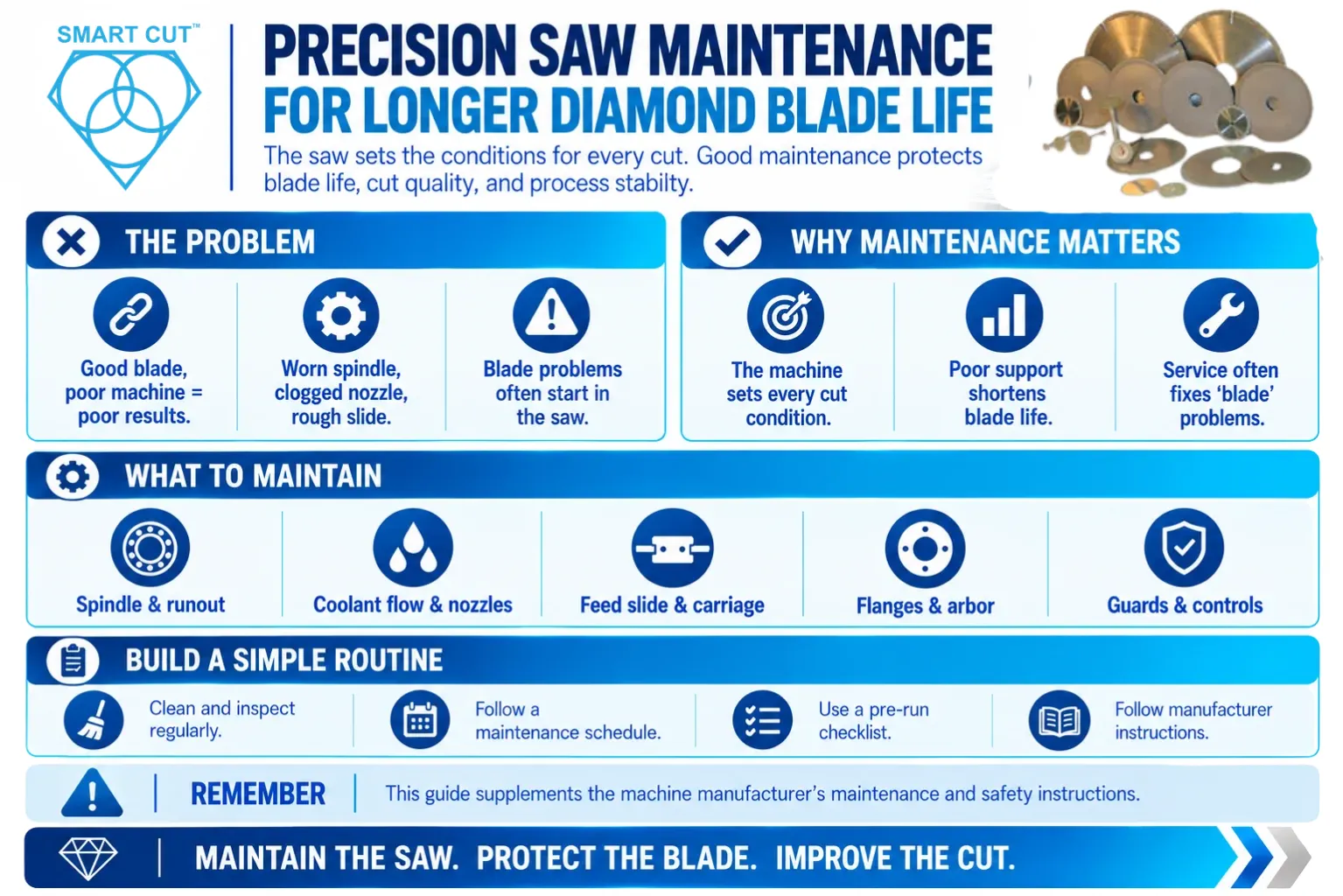
Table of Contents
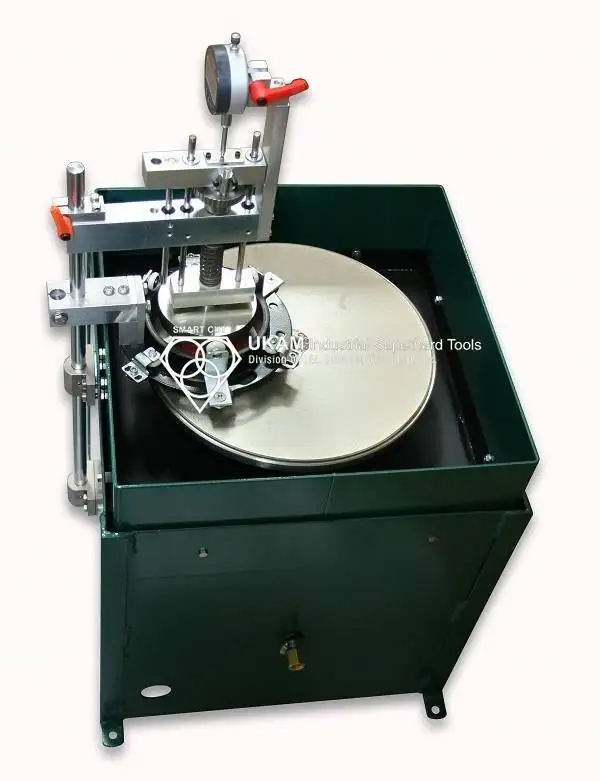
ToggleShops spend a lot of time choosing the right blade. They spend far less time on the machine that spins it. Yet the saw sets the conditions for every cut. A worn spindle, a clogged nozzle, or a rough feed slide can ruin a good blade in a few runs.
That is why blade problems often fix themselves after machine service. The blade did nothing wrong. The machine gave it a poor place to work.
This article explains what to maintain on a precision saw, why each item matters to blade life, and how to build a simple maintenance routine. It covers equipment upkeep. For the mounting steps, see our setup-mistakes article. For measuring blade runout, see our runout article. For a quick pre-run list, see our precision diamond saw pre-operation checklist.
Always follow the machine manufacturer’s maintenance instructions and safety procedures. This article supplements them and does not replace them.
Trusted by Tens of Thousands of Manufacturers, Laboratories Research Institutions Worldwide Since 1990
Established in 1990
Why Machine Condition Controls Blade Life
Problem: Blade life drops or becomes inconsistent, and changing the blade does not help.
Cause: The machine has degraded in a way that loads the blade unevenly, overheats the cut, or lets the workpiece move.
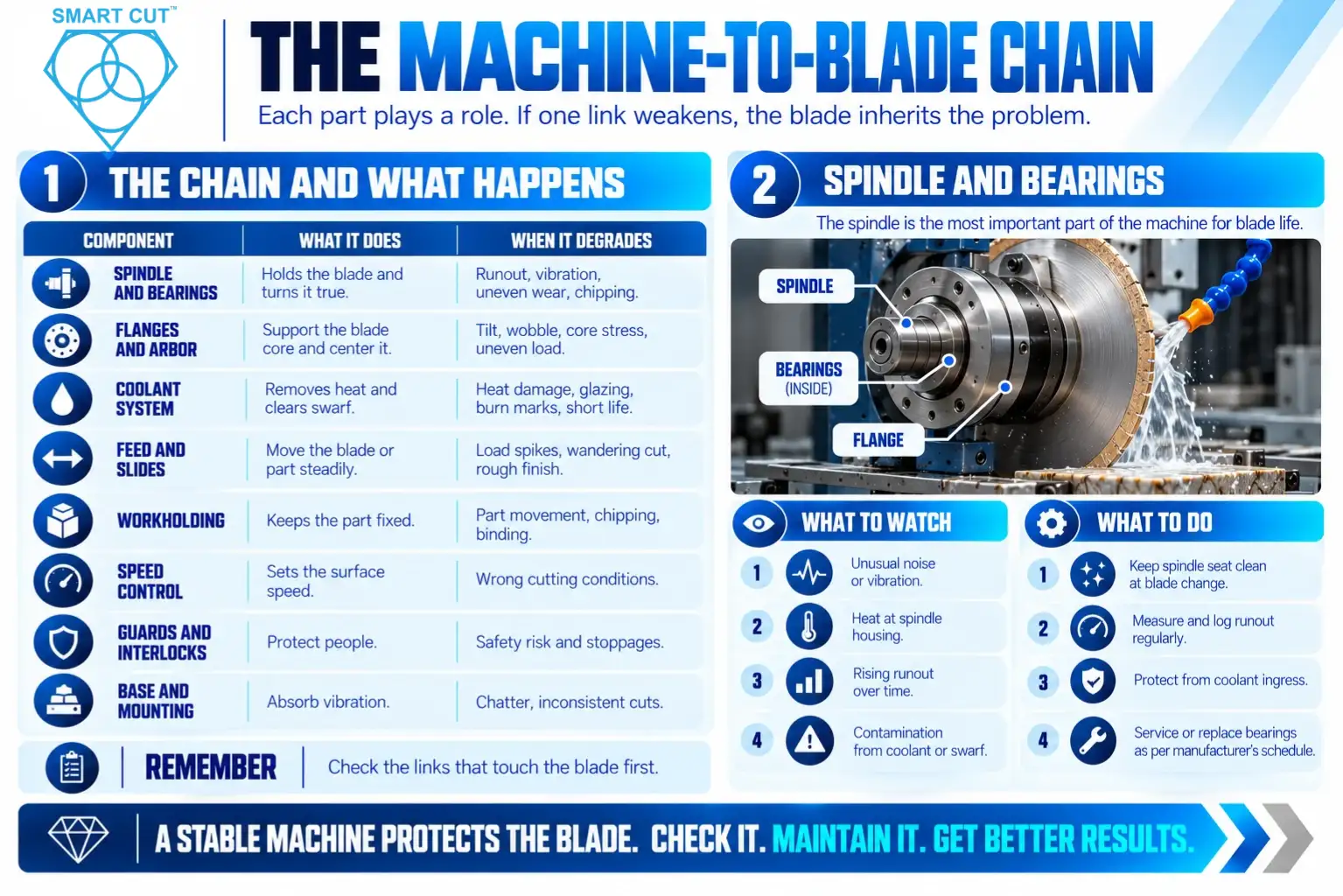
Engineering logic: A diamond blade works inside a chain. The spindle holds and turns it. The flanges support it. The feed system moves it through the material. The coolant system carries heat away. The workholding keeps the part still. If any link weakens, the blade inherits the problem.
For example, a worn spindle adds runout. Runout loads the rim unevenly, so some sections wear faster. A clogged nozzle starves the cut of coolant. Heat then builds at the rim. A rough feed slide makes the load jump up and down, which stresses the bond. In each case, the blade fails early, even though the blade was fine.
Maintenance also keeps your data honest. If the machine drifts, test results drift with it. You may blame a blade for a machine problem, or credit a blade for a lucky machine state.
UKAM’s usage guidance treats the machine as part of the cutting system. You can read more in our article on how to properly use precision diamond and CBN blades. For why good equipment improves precision, see how laboratory cutting machines improve precision sectioning.
Solution: Maintain the machine on a schedule, check the parts that touch the blade first, and keep records.
The Machine-to-Blade Chain
The table below shows each major component, what it does for the blade, and what happens when it degrades.
| Component | What it does | When it degrades |
|---|---|---|
| Spindle and bearings | Holds the blade and turns it true | Runout, vibration, uneven wear, chipping |
| Flanges and arbor | Support the blade core and center it | Tilt, wobble, core stress, uneven load |
| Coolant system | Removes heat and clears swarf | Heat damage, glazing, burn marks, short life |
| Feed and slides | Move the blade or part steadily | Load spikes, wandering cut, rough finish |
| Workholding | Keeps the part fixed | Part movement, chipping, binding |
| Speed control | Sets the surface speed | Wrong cutting conditions |
| Guards and interlocks | Protect people | Safety risk and stoppages |
| Base and mounting | Absorb vibration | Chatter, inconsistent cuts |
Use this chain as the structure for your routine. Check the links that touch the blade first.
Spindle and Bearings
The spindle is the most important part of the machine for blade life. Everything else depends on it running true.
What to watch:
- Unusual noise or vibration during rotation.
- Heat at the spindle housing.
- Rising runout over time.
- Contamination, such as coolant or swarf getting into the spindle area.
What to do:
- Keep the spindle seat clean at every blade change.
- Measure runout regularly and log it. A rising trend points to wear before the machine fails.
- Protect the spindle from coolant ingress, following the manufacturer’s guidance on seals and shielding.
- Service or replace bearings following the manufacturer’s schedule and instructions.
Do not guess at bearing condition. Measure the runout, then compare it with the manufacturer’s specification and your own baseline. A spindle that runs out cannot be fixed by better flanges or a better blade.
Flanges and Arbors
Flanges support the thin blade core. They are small, cheap, and easy to neglect. They also cause a large share of hidden runout.
What to watch:
- Scratches, burrs, dents, or wear on the flange faces.
- Corrosion or build-up from dried coolant.
- Mismatched flange pairs.
- Wear on the arbor or the seat.
What to do:
- Clean both flange faces at every blade change.
- Inspect the faces under good light.
- Replace flanges that no longer sit flat. Keep spares on hand.
- Always use a matched pair, and keep flanges with the machine they belong to.
- Check the arbor for wear and damage.
If your blade needs a different arbor size, ask about it. UKAM can help with arbor modifications through custom manufacturing.
The Coolant System
Coolant keeps the rim cool and carries swarf out of the cut. UKAM guidance is direct: never run a diamond blade dry. Maintenance is what keeps the coolant system able to do that job.
What to watch:
- Weak or uneven flow at the cut.
- Clogged or bent nozzles.
- A low reservoir.
- Dirty, discolored, or contaminated coolant.
- Leaks, loose lines, or a pump that sounds strained.
What to do:
- Check flow and nozzle aim at the start of each shift, and at every new setup.
- Clean nozzles and lines on a routine basis, so clogs never reach the cut.
- Keep the reservoir at the correct level.
- Clean or change filters following the manufacturer’s guidance.
- Replace or refresh coolant when it becomes dirty or contaminated, and keep it at the concentration that your supplier recommends.
- Clean swarf out of the tank and return path, so it does not recirculate.
Our guide on how coolant flow affects blade life, cut quality, and process stability explains why delivery matters so much.
Feed System and Slides
A smooth feed gives a steady load on the blade. A rough one gives spikes.
What to watch:
- Jerky or uneven motion.
- Play or looseness in the slide.
- Noise during travel.
- Build-up of swarf or dried coolant on the guides.
What to do:
- Keep slides and guides clean, and remove swarf regularly.
- Lubricate the moving parts using the manufacturer’s recommended method and materials.
- Check for play and tighten or adjust as the manual directs.
- Test feed smoothness periodically and after any repair.
If the cut quality drops while the blade looks fine, check the feed motion before you blame the blade.
Workholding and Fixtures
Worn clamp faces, loose vises, and bent fixtures let the part move. A moving part gives the blade a changing load. Pinching, binding, and chipping follow.
What to watch:
- Worn or damaged clamp faces.
- Play in the vise or fixture.
- Fixtures that no longer sit square.
- Damaged parts from over-clamping.
What to do:
- Inspect clamps and fixtures at regular intervals, and replace worn faces.
- Check squareness and alignment after any impact or repair.
- Clean fixtures of swarf and coolant residue.
Our article on workholding for precision diamond sectioning and dicing explains how fixturing shapes the cut.
Speed Control and Settings
The machine shows a speed. The blade sees the real speed. If the two differ, the cutting conditions change without anyone knowing.
What to do:
- Verify the indicated speed against the actual speed, using the method the manufacturer recommends.
- Check that speed settings hold during the run and do not drift.
- Remember that surface speed depends on blade diameter as well as RPM. Our RPM and feed rate guide explains the relationship.
If results change and nothing else did, check the speed first.
Guards, Interlocks, and Safety Systems
Safety systems need maintenance too. A guard that sticks or an interlock that fails creates risk and tempts people to bypass it.
What to do:
- Test guards, interlocks, and emergency stops as part of the routine.
- Repair or replace any failed safety device before you use the machine.
- Never bypass a guard or an interlock.
- Follow the manufacturer’s safety instructions at all times.
Base, Mounting, and Cleanliness
A machine that vibrates, shifts, or collects swarf loses accuracy.
What to do:
- Check that the machine sits level and stable, and that its mounting remains secure.
- Clean swarf and slurry from the enclosure, drain, and return path regularly.
- Wipe down exposed surfaces to prevent corrosion.
- Keep the surrounding area clean, so debris does not reach the spindle or slides.
A Practical Maintenance Schedule
The right intervals depend on your machine, duty cycle, and materials. Use the manufacturer’s schedule as the base. The table below shows how to organize tasks by frequency. It gives no fixed time values on purpose, because those belong to your manufacturer’s manual and your own usage.
| When | Typical tasks |
|---|---|
| At every blade change | Clean spindle seat and flange faces; inspect flanges; check mounting and runout |
| At the start of each shift | Check coolant level, flow, and nozzle aim; check guards and stops; look for leaks or unusual noise |
| Regularly during use | Clean swarf from the enclosure and slides; clean nozzles and lines; check feed smoothness |
| Periodically | Clean or change filters; refresh coolant; inspect fixtures; verify speed; lubricate per the manual; log runout trend |
| As the manufacturer directs | Service spindle and bearings; replace worn parts |
| After any incident | Inspect for damage after a crash, blade failure, or impact; re-check runout and alignment |
Review the schedule against your records. If a part fails often, check it more often. If a task never finds a problem, you may be able to extend it, but only if the manufacturer’s guidance allows.
Machine Problem or Blade Problem?
When results change, you need to know where to look. The table below links common symptoms to machine suspects. Treat it as a guide, not a verdict.
| Symptom | Machine suspects |
|---|---|
| Uneven wear on several blades in a row | Spindle runout, flange condition |
| Burn marks or early bond damage | Coolant flow, nozzle aim, contaminated coolant |
| Wandering or tapered cut | Feed smoothness, fixture squareness, spindle runout |
| Chipping at the part edge | Workholding wear, vibration, runout |
| Results change after a machine move | Levelling, mounting, alignment |
| Same blade performs differently on two machines | Machine condition differences |
| Results drift slowly over weeks | Gradual wear in spindle, slides, or filters |
If a known-good blade also performs badly, the machine is the likely cause. For help reading the signs on the blade itself, see troubleshooting common diamond blade wear patterns and why precision diamond blades fail.
Keep a Maintenance Record
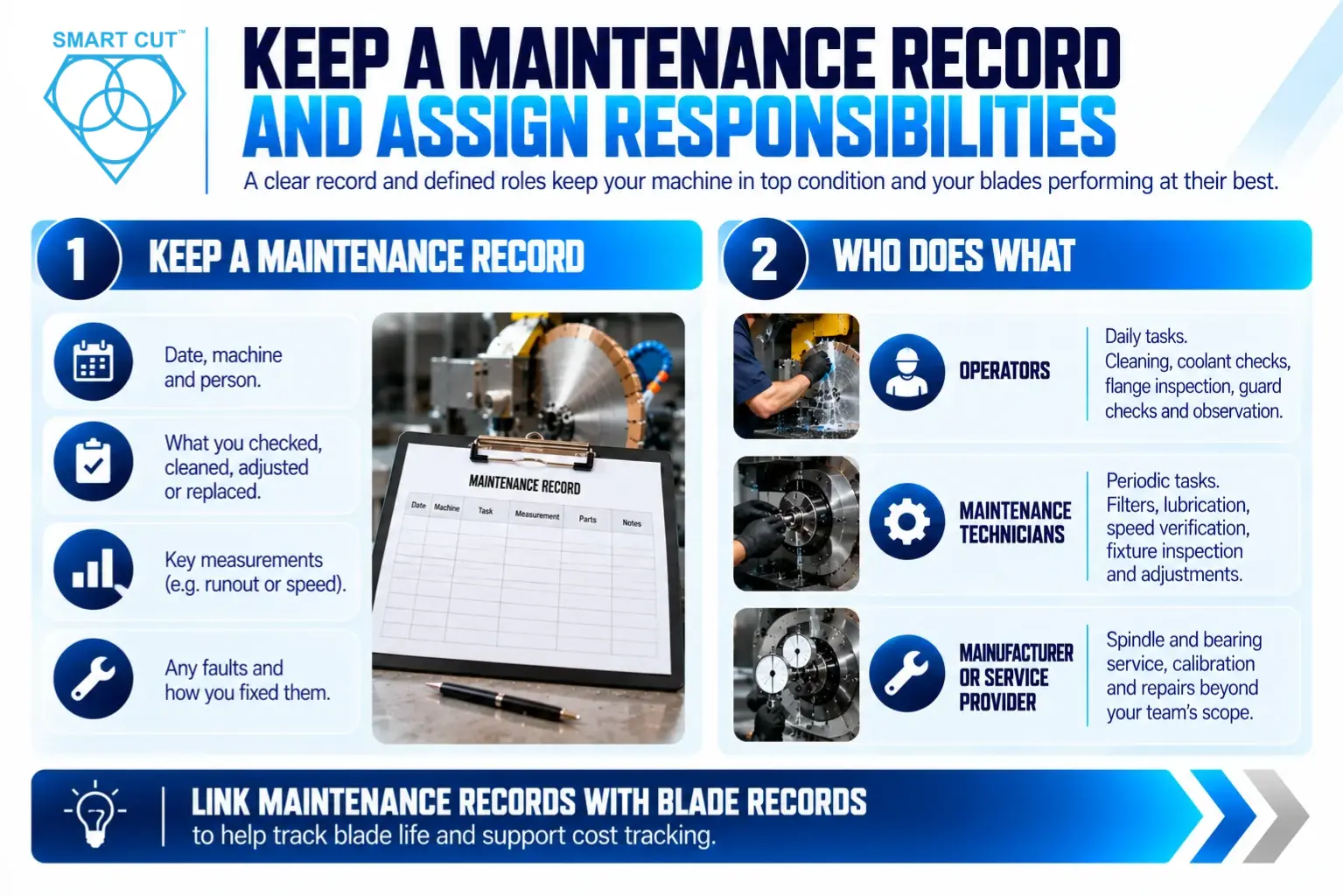
A record turns upkeep into evidence. Log the following.
- The date, the machine, and the person who did the work.
- What you checked, cleaned, adjusted, or replaced.
- Measurements such as runout and indicated versus actual speed.
- Any fault you found and how you fixed it.
- Parts you changed, such as flanges, nozzles, and filters.
Link maintenance records with blade records. When blade life changes, you can look back and see whether maintenance, a part change, or a drift in the machine lines up with it. This also supports blade cost tracking. See diamond blade cost per cut for how to calculate it.
Who Does What
Split the work so that nothing falls through.
Operators handle the daily and per-blade tasks: cleaning, coolant checks, flange inspection, guard checks, and observation. They know the machine best, so ask them to flag changes in sound, feel, or results.
Maintenance technicians handle periodic tasks: filters, lubrication, speed verification, fixture inspection, and mechanical adjustments.
The manufacturer or a qualified service provider handles spindle and bearing service, calibration, and repairs beyond your team’s scope.
Write the split into your SOP. Our precision diamond saw SOP template shows one way to structure it.
Maintenance and Blade Testing
If your shop tests blades, machine condition becomes a test variable. A machine that drifts between tests can make results unreliable.
- Check the machine before every test, including runout, coolant flow, and speed.
- Record machine condition alongside test results.
- Use the same machine for a comparison, or document the differences.
- If a result looks odd, check the machine before you doubt the blade.
For the full approach, see how to design a repeatable diamond blade test and laboratory vs production testing of diamond blades.
Common Maintenance Mistakes
Waiting for failure. Spindle and slide wear builds slowly, so it feels normal until quality drops.
Cleaning the blade but not the flanges. Dirty flange faces cause hidden runout.
Ignoring coolant condition. Clean coolant and clear nozzles protect blade life.
Skipping records. Without records, trends stay invisible.
Using the wrong lubricant or method. Follow the manufacturer’s instructions for every lubrication task.
Bypassing safety devices. A broken guard needs repair, not a workaround.
Blaming the blade first. Check the machine when a good blade performs badly.
Never verifying speed. The display can differ from reality.
Applying This in Your Shop
Start with one machine. Read the manufacturer’s maintenance guidance. Then write a one-page routine covering per-blade, per-shift, and periodic tasks. Record the baseline runout, coolant flow, and speed, so you can spot drift.
Next, add a short maintenance log, and keep spare flanges, nozzles, and filters on hand. Review the log regularly, and adjust the routine to what you find.
Equipment choice matters too. A rigid, well-built precision saw holds its accuracy longer and gives you a better starting point for any routine. Pair it with a well-matched blade. Explore the diamond blade range, including the diamond and CBN wafering and cut-off blades, and our material guide.
Key Takeaways
- The saw sets the conditions for every cut, so machine condition controls blade life.
- Maintain the parts that touch the blade first: spindle, flanges, coolant system, feed, and workholding.
- Clean the spindle seat and flange faces at every blade change.
- Check coolant flow and nozzle aim at every shift and every new setup.
- Verify speed, test feed smoothness, and log runout trends.
- Use the manufacturer’s schedule and instructions as the base for intervals and methods.
- When a known-good blade performs badly, suspect the machine.
- Keep records, and link them with blade and test records.
Frequently Asked Questions
The saw sets the runout, heat, load, and part stability that every blade cut depends on.
The spindle, because everything else depends on it running true.
Clean them at every blade change.
Check flow, level, and nozzle aim at the start of each shift and at every new setup.
Yes, because runout loads the rim unevenly and wears it early.
Try a known-good blade, and suspect the machine if it also performs badly.
Only with the method and materials that the manufacturer recommends.
Yes, because the indicated speed can differ from the actual speed.
Include the date, tasks, measurements, faults, and parts changed.
The manufacturer or a qualified service provider, following the manufacturer’s instructions.
Yes, because heat builds at the rim when flow weakens, or coolant is contaminated.
Yes, because machine drift adds variation that can distort comparisons.
No, repair it before using the machine.
Start with the manufacturer’s guidance, then add per-blade and per-shift checks and a simple log.
Conclusion
A diamond blade can only perform as well as the machine allows. Spindle runout, dirty flanges, clogged nozzles, rough feed, and loose fixtures all shorten blade life, regardless of blade quality. Most of these problems build slowly, so they stay hidden until quality drops.
A simple routine prevents most of them. Clean the spindle seat and flanges at every blade change, check coolant at every shift, and verify speed and feed smoothness on a schedule. Follow the manufacturer’s guidance, log what you find, and suspect the machine when a good blade performs badly.
If you want help matching a blade and setup to your machine and material, request a consultation with the UKAM team, or explore the diamond and CBN wafering and cut-off blades.
Trusted by Tens of Thousands of Manufacturers, Laboratories,
Research Institutions Worldwide Since 1990
Established in 1990
RELATED ARTICLES

Brian is an experienced professional in the field of precision cutting tools, with over 27 years of experience in technical support. Over the years, he has helped engineers, manufacturers, researchers, and contractors find the right solutions for working with advanced and hard-to-cut materials. He’s passionate about bridging technical knowledge with real-world applications to improve efficiency and accuracy.
As an author, Brian Farberov writes extensively on diamond tool design, application engineering, return on investment strategies, and process optimization, combining technical depth with a strong understanding of customer needs and market dynamics.
About Brian Farberov
Brian is an experienced professional in the field of precision cutting tools, with over 27 years of experience in technical support. Over the years, he has helped engineers, manufacturers, researchers, and contractors find the right solutions for working with advanced and hard-to-cut materials. He’s passionate about bridging technical knowledge with real-world applications to improve efficiency and accuracy. As an author, Brian Farberov writes extensively on diamond tool design, application engineering, return on investment strategies, and process optimization, combining technical depth with a strong understanding of customer needs and market dynamics.
View all posts by Brian Farberov