










How Laboratory Cutting Machines Improve Precision Sectioning
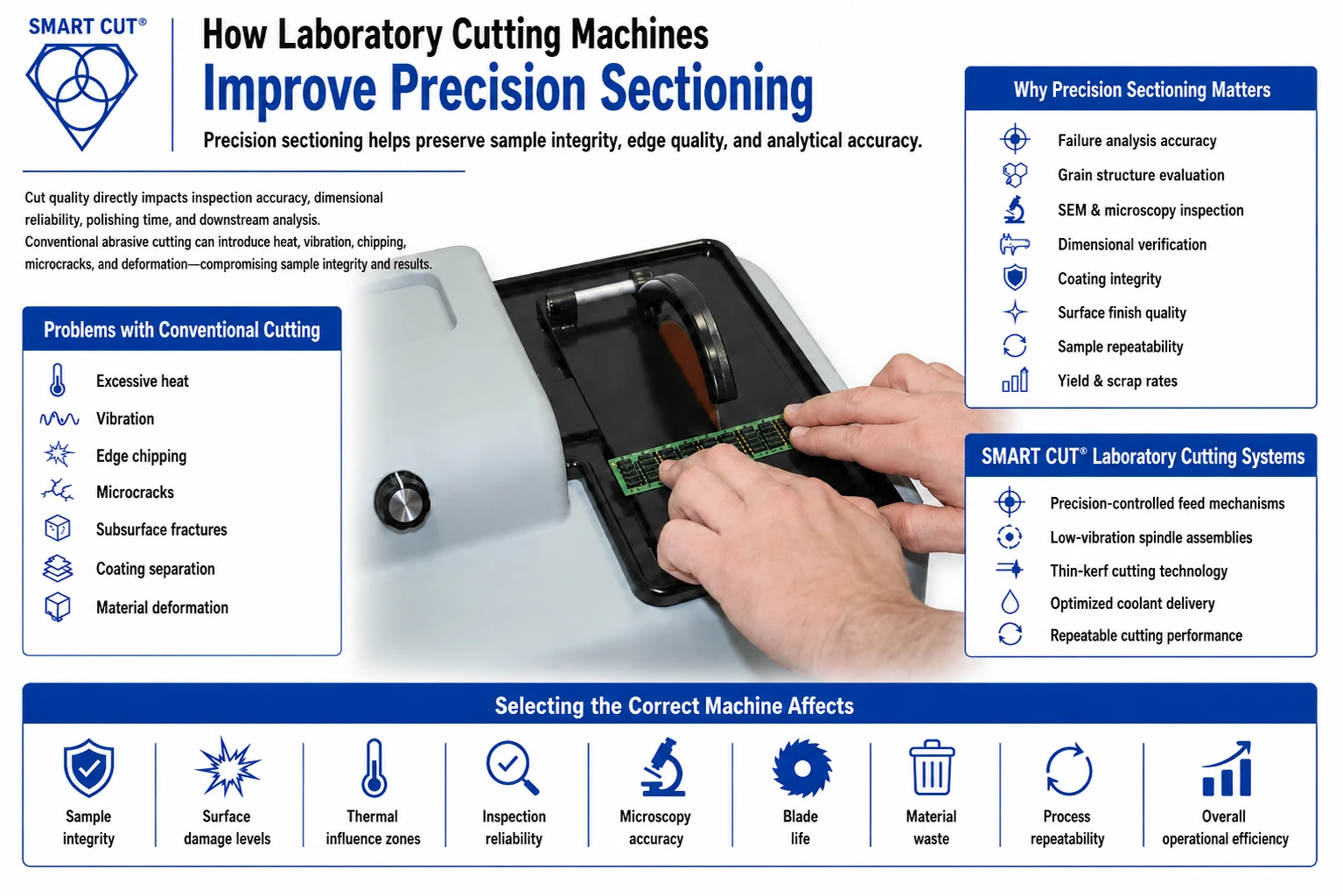
Table of Contents
ToggleIn precision material preparation, the quality of the cut directly affects inspection accuracy, edge integrity, dimensional reliability, polishing time, and downstream analytical results. Standard abrasive cutting equipment often introduces excessive heat, vibration, edge chipping, microcracks, subsurface fractures, coating separation, or material deformation — particularly when sectioning brittle, ultra-hard, composite, or advanced engineering materials.
For industries such as semiconductor manufacturing, metallurgy, aerospace, electronics, ceramics, medical devices, and advanced materials research, improper sectioning can compromise the entire analysis process before inspection even begins.
The challenge is not simply cutting the material.
It is cutting the material without altering its structure.
Even small amounts of thermal distortion, blade deflection, vibration, or edge damage can negatively affect:
- Failure analysis accuracy
- Grain structure evaluation
- SEM and microscopy inspection
- Dimensional verification
- Coating integrity
- Surface finish quality
- Sample repeatability
- Yield and scrap rates
This is why precision laboratory cutting machines play a critical role in modern materials preparation.
Unlike conventional industrial saws designed primarily for aggressive material removal and throughput, precision laboratory sectioning systems are engineered to minimize mechanical stress, thermal loading, and subsurface damage while maintaining repeatable cutting performance.
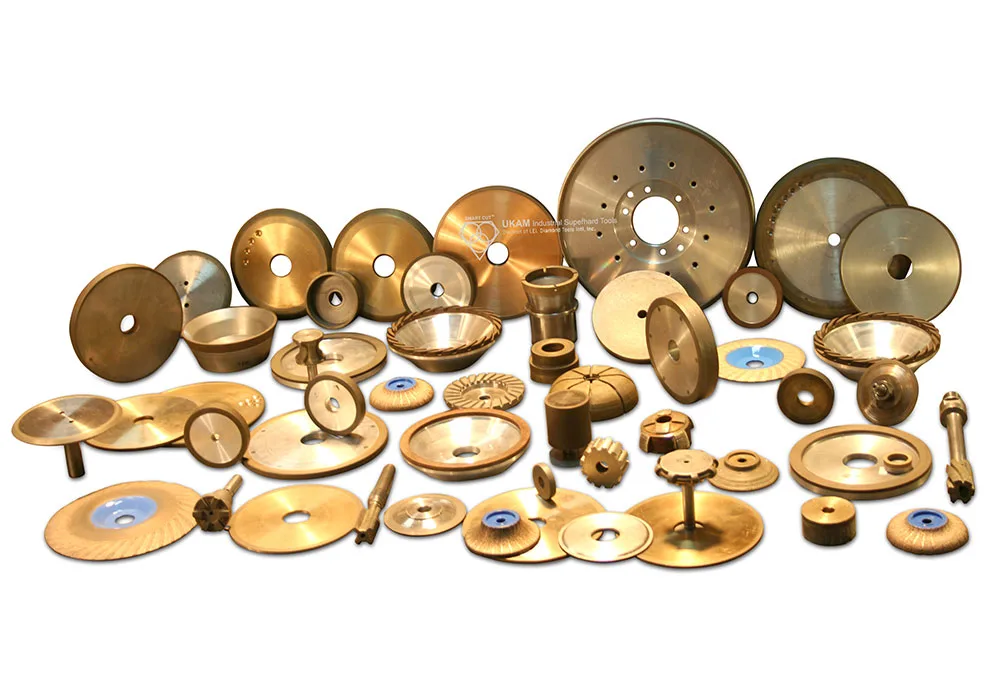
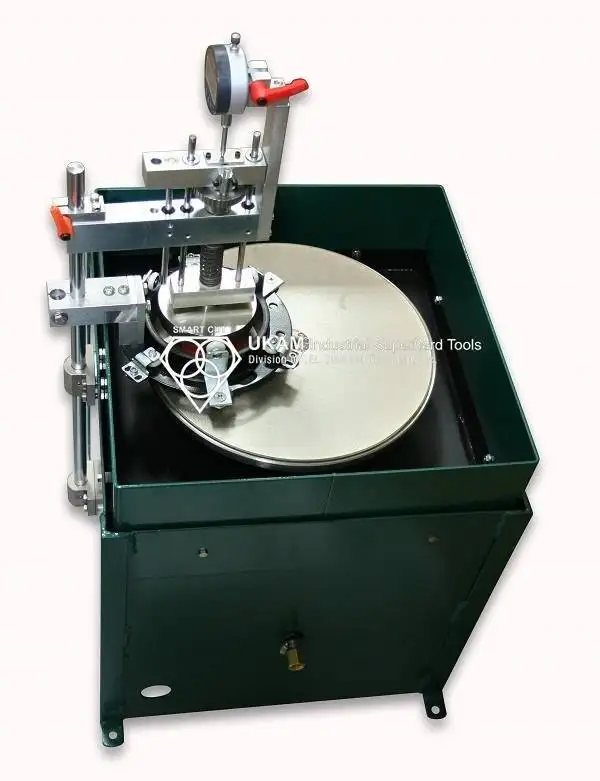
SMART CUT® laboratory cutting machines from UKAM Industrial Superhard Tools are specifically engineered for precision sectioning of brittle and advanced materials where preserving sample integrity is critical. These systems utilize precision-controlled feed mechanisms, low-vibration spindle assemblies, thin-kerf cutting technology, and optimised coolant delivery systems to improve cut quality while reducing material damage and consumable costs.
For engineers, metallurgists, semiconductor manufacturers, R&D laboratories, and quality-control teams, selecting the correct laboratory cutting machine directly affects:
- Sample integrity
- Surface damage levels
- Thermal influence zones
- Inspection reliability
- Microscopy accuracy
- Blade life
- Material waste
- Process repeatability
- Overall operational efficiency
Need help selecting the correct laboratory cutting machine, blade specification, RPM range, or coolant configuration for your material? Contact UKAM’s applications engineering team for technical guidance.
Trusted by Tens of Thousands of Manufacturers, Laboratories Research Institutions Worldwide Since 1990

Established in 1990
Why Precision Sectioning Quality Matters
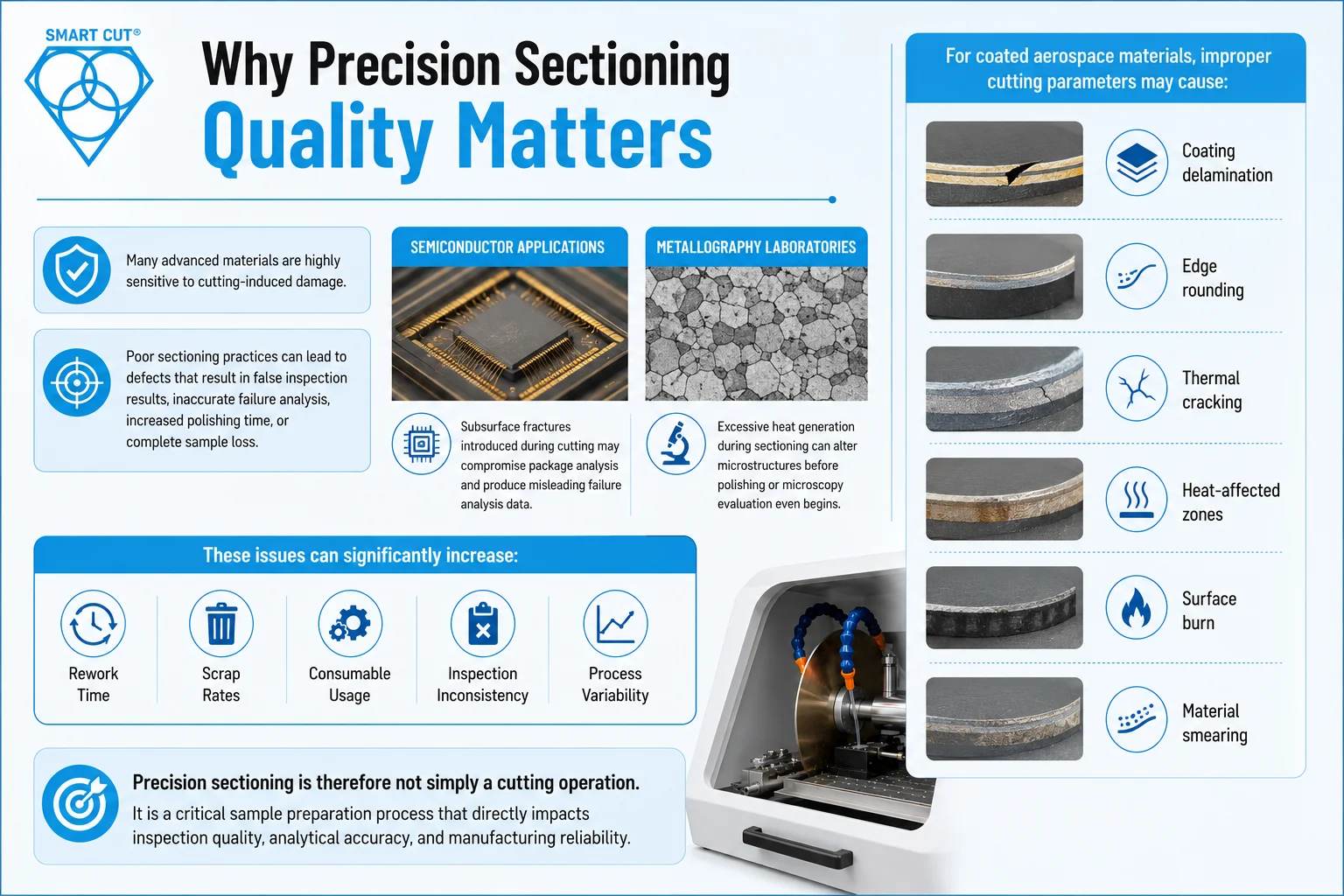
Many advanced materials are highly sensitive to cutting-induced damage.
Poor sectioning practices can lead to defects that result in false inspection results, inaccurate failure analysis, increased polishing time, or complete sample loss.
In semiconductor applications, subsurface fractures introduced during cutting may compromise package analysis and produce misleading failure analysis data.
In metallography laboratories, excessive heat generation during sectioning can alter microstructures before polishing or microscopy evaluation even begins.
For coated aerospace materials, improper cutting parameters may cause:
- Coating delamination
- Edge rounding
- Thermal cracking
- Heat-affected zones
- Surface burn
- Material smearing
These issues can significantly increase:
- Rework time
- Scrap rates
- Consumable usage
- Inspection inconsistency
- Process variability
Precision sectioning is therefore not simply a cutting operation.
It is a critical sample preparation process that directly impacts inspection quality, analytical accuracy, and manufacturing reliability.
What Makes Laboratory Cutting Machines Different from Conventional Industrial Saws?

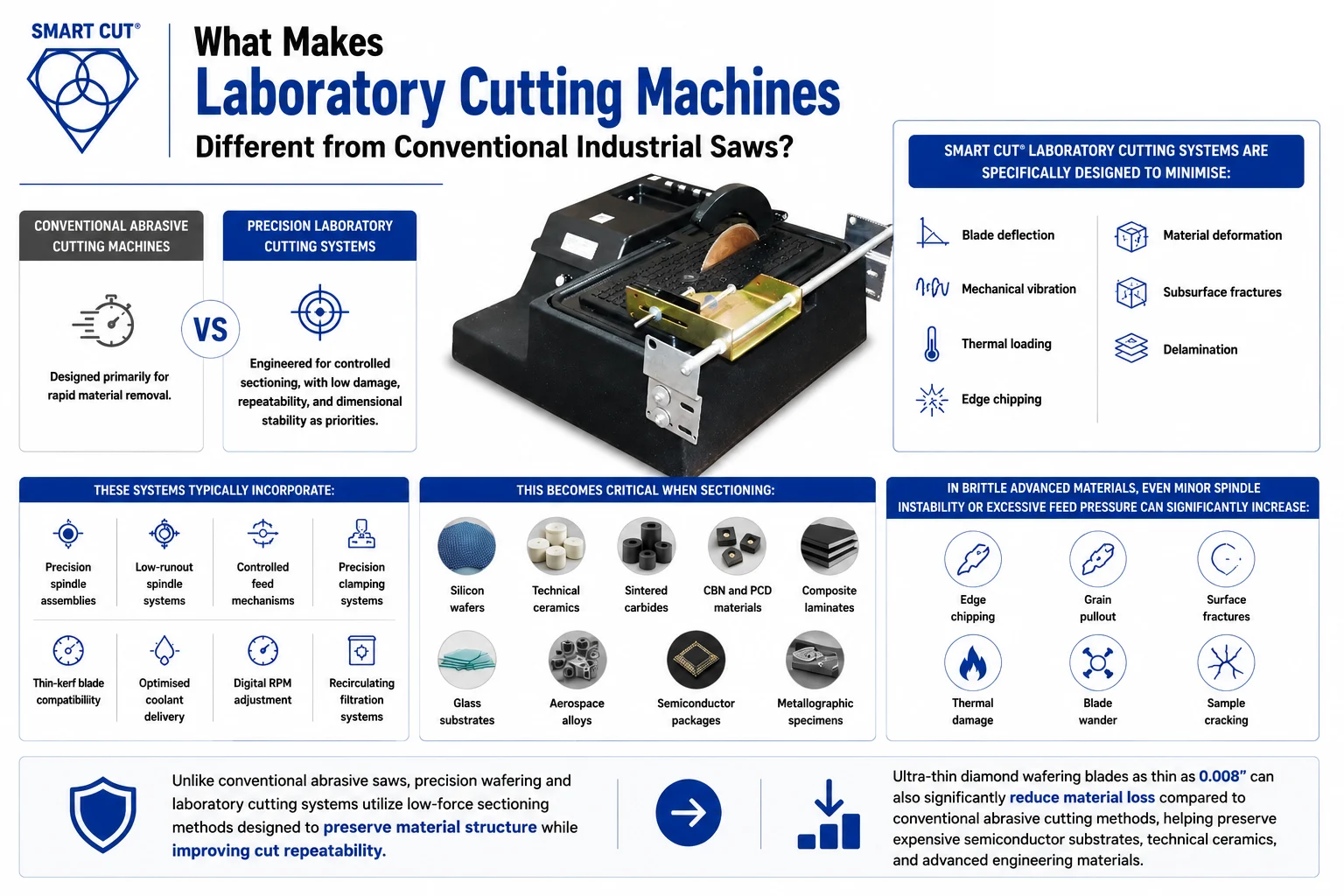
Conventional abrasive cutting machines are designed primarily for rapid material removal.
Precision laboratory cutting systems are engineered for controlled sectioning, with low damage, repeatability, and dimensional stability as priorities.
SMART CUT® laboratory cutting systems are specifically designed to minimise:
- Blade deflection
- Mechanical vibration
- Thermal loading
- Edge chipping
- Material deformation
- Subsurface fractures
- Delamination
These systems typically incorporate:
- Precision spindle assemblies
- Low-runout spindle systems
- Controlled feed mechanisms
- Precision clamping systems
- Thin-kerf blade compatibility
- Optimised coolant delivery
- Digital RPM adjustment
- Recirculating filtration systems
This becomes critical when sectioning:
- Silicon wafers
- Technical ceramics
- Sintered carbides
- CBN and PCD materials
- Composite laminates
- Glass substrates
- Aerospace alloys
- Semiconductor packages
- Metallographic specimens
In brittle advanced materials, even minor spindle instability or excessive feed pressure can significantly increase:
- Edge chipping
- Grain pullout
- Surface fractures
- Thermal damage
- Blade wander
- Sample cracking
Unlike conventional abrasive saws, precision wafering and laboratory cutting systems utilize low-force sectioning methods designed to preserve material structure while improving cut repeatability.
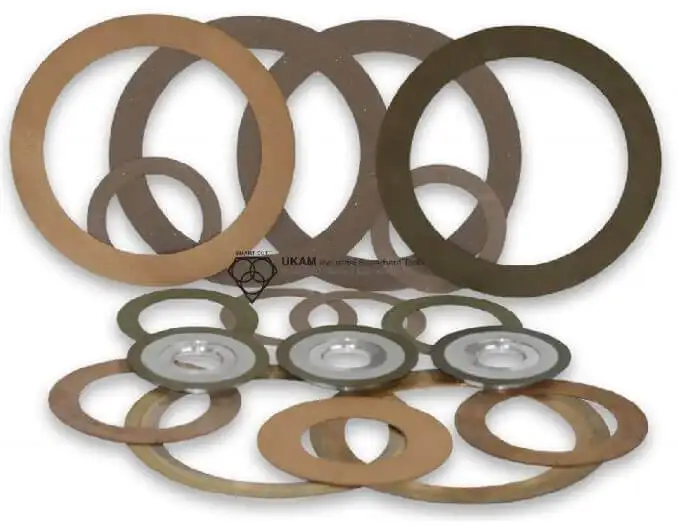
Ultra-thin diamond wafering blades as thin as 0.008″ can also significantly reduce material loss compared to conventional abrasive cutting methods, helping preserve expensive semiconductor substrates, technical ceramics, and advanced engineering materials.
How Laboratory Cutting Machines Improve Sectioning Accuracy

Precision Feed Control
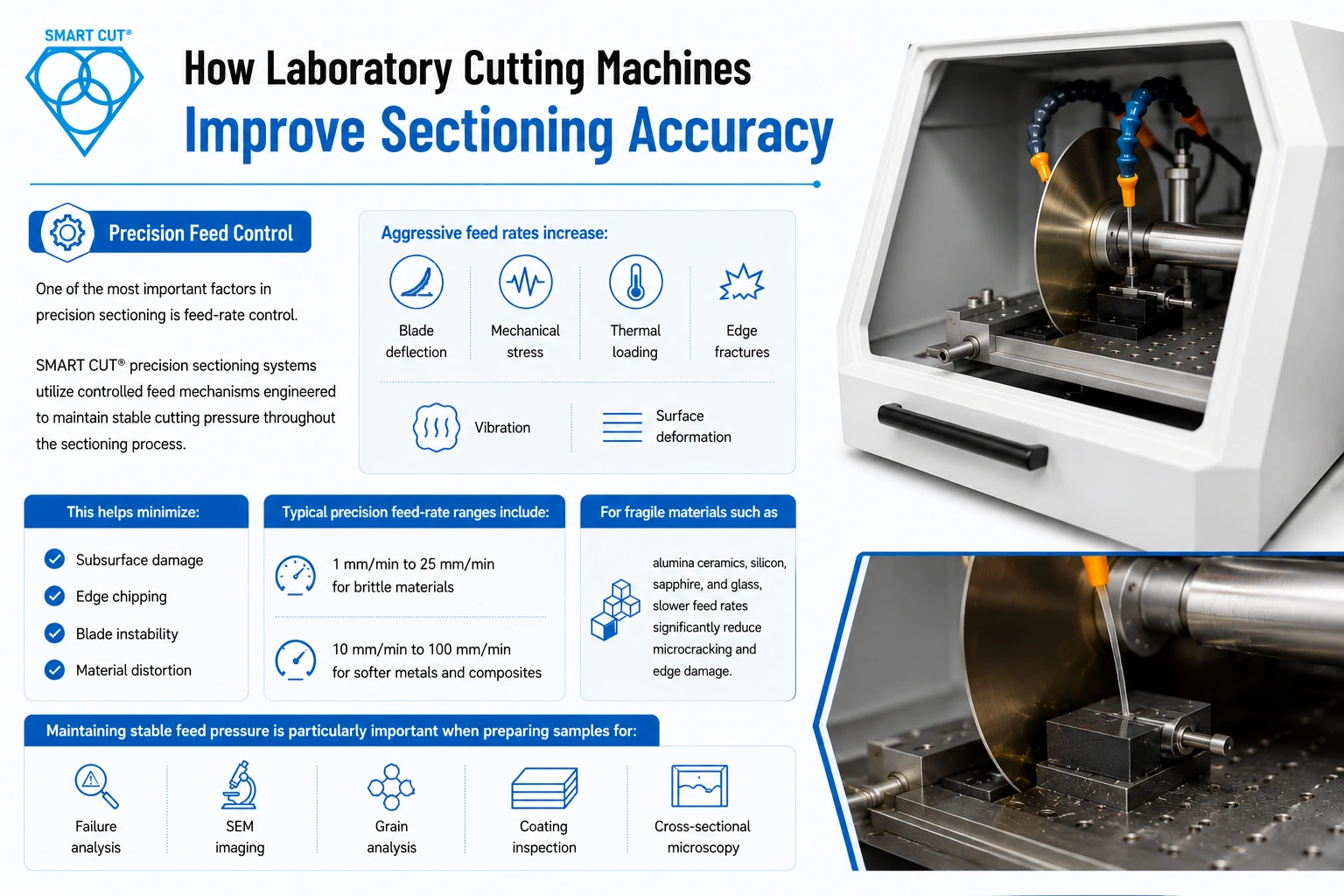
One of the most important factors in precision sectioning is feed-rate control.
Aggressive feed rates increase:
- Blade deflection
- Mechanical stress
- Thermal loading
- Edge fractures
- Vibration
- Surface deformation
SMART CUT® precision sectioning systems utilize controlled feed mechanisms engineered to maintain stable cutting pressure throughout the sectioning process.
This helps minimize:
- Subsurface damage
- Edge chipping
- Blade instability
- Material distortion
Typical precision feed-rate ranges include:
- 1 mm/min to 25 mm/min for brittle materials
- 10 mm/min to 100 mm/min for softer metals and composites
For fragile materials such as alumina ceramics, silicon, sapphire, and glass, slower feed rates significantly reduce microcracking and edge damage.
Maintaining stable feed pressure is particularly important when preparing samples for:
- Failure analysis
- SEM imaging
- Grain analysis
- Coating inspection
- Cross-sectional microscopy
RPM Optimization for Different Materials

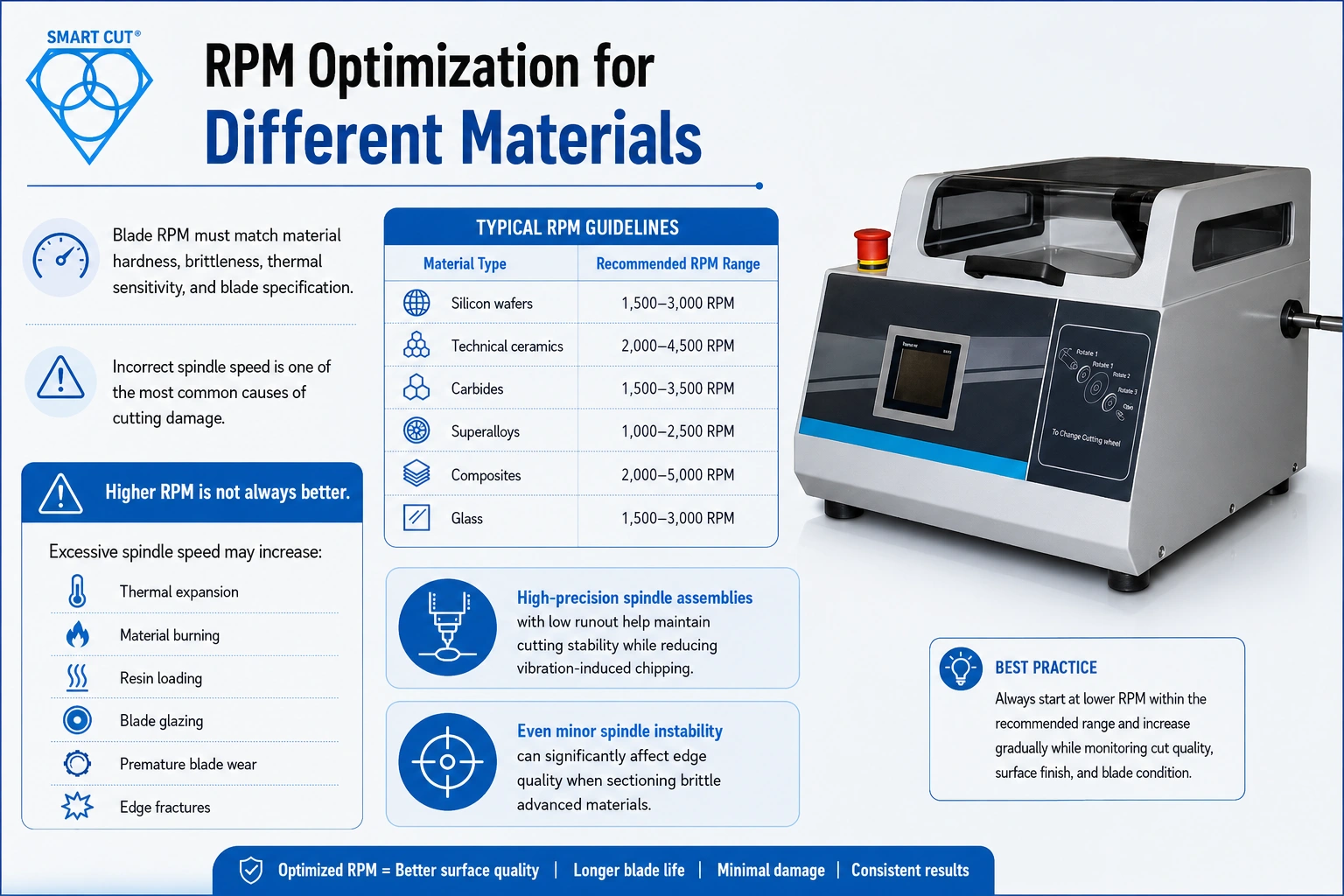
Blade RPM must match material hardness, brittleness, thermal sensitivity, and blade specification.
Incorrect spindle speed is one of the most common causes of cutting damage.
Typical RPM Guidelines
| Material Type | Recommended RPM Range |
|---|---|
| Silicon wafers | 1,500–3,000 RPM |
| Technical ceramics | 2,000–4,500 RPM |
| Carbides | 1,500–3,500 RPM |
| Superalloys | 1,000–2,500 RPM |
| Composites | 2,000–5,000 RPM |
| Glass | 1,500–3,000 RPM |
Higher RPM is not always better.
Excessive spindle speed may increase:
- Thermal expansion
- Material burning
- Resin loading
- Blade glazing
- Premature blade wear
- Edge fractures
High-precision spindle assemblies with low runout help maintain cutting stability while reducing vibration-induced chipping.
Even minor spindle instability can significantly affect edge quality when sectioning brittle advanced materials.
Why Thin-Kerf Precision Sectioning Reduces Material Waste
Material loss during sectioning is a major concern when working with expensive or difficult-to-process materials.
Conventional abrasive cutting methods often produce excessive kerf loss, larger heat-affected zones, and higher polishing requirements.
Thin-kerf precision sectioning minimizes:
- Material waste
- Edge damage
- Cutting forces
- Polishing time
- Scrap rates
This is especially important when sectioning:
- Semiconductor wafers
- Sapphire substrates
- Advanced ceramics
- Carbides
- Composite laminates
- High-value aerospace materials
Ultra-thin diamond wafering blades help preserve expensive materials while improving:
- Sample yield
- Cut precision
- Surface quality
- Process repeatability
Lower cutting forces also reduce the likelihood of:
- Delamination
- Coating separation
- Edge cracking
- Subsurface fractures
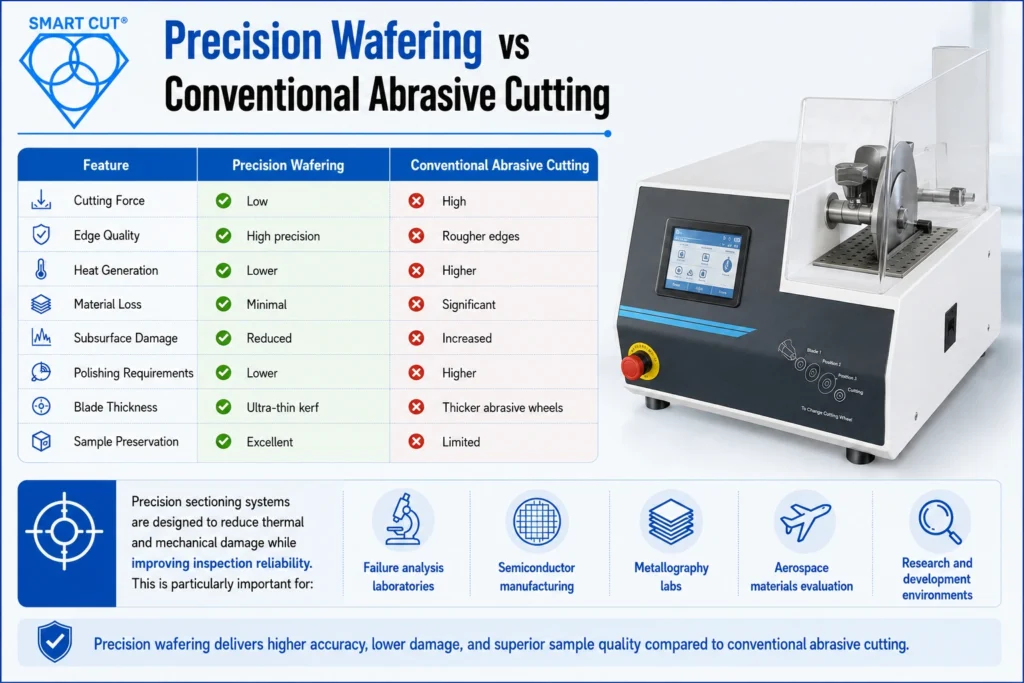
Precision Wafering vs Conventional Abrasive Cutting

| Feature | Precision Wafering | Conventional Abrasive Cutting |
|---|---|---|
| Cutting Force | Low | High |
| Edge Quality | High precision | Rougher edges |
| Heat Generation | Lower | Higher |
| Material Loss | Minimal | Significant |
| Subsurface Damage | Reduced | Increased |
| Polishing Requirements | Lower | Higher |
| Blade Thickness | Ultra-thin kerf | Thicker abrasive wheels |
| Sample Preservation | Excellent | Limited |
- Failure analysis laboratories
- Semiconductor manufacturing
- Metallography labs
- Aerospace materials evaluation
- Research and development environments
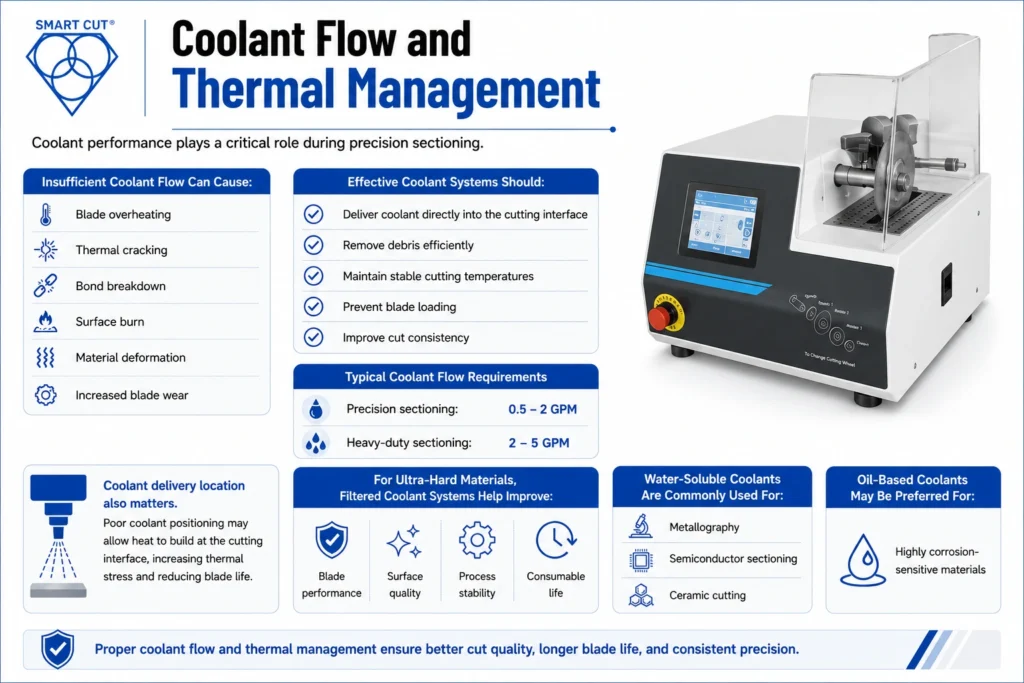
Coolant Flow and Thermal Management

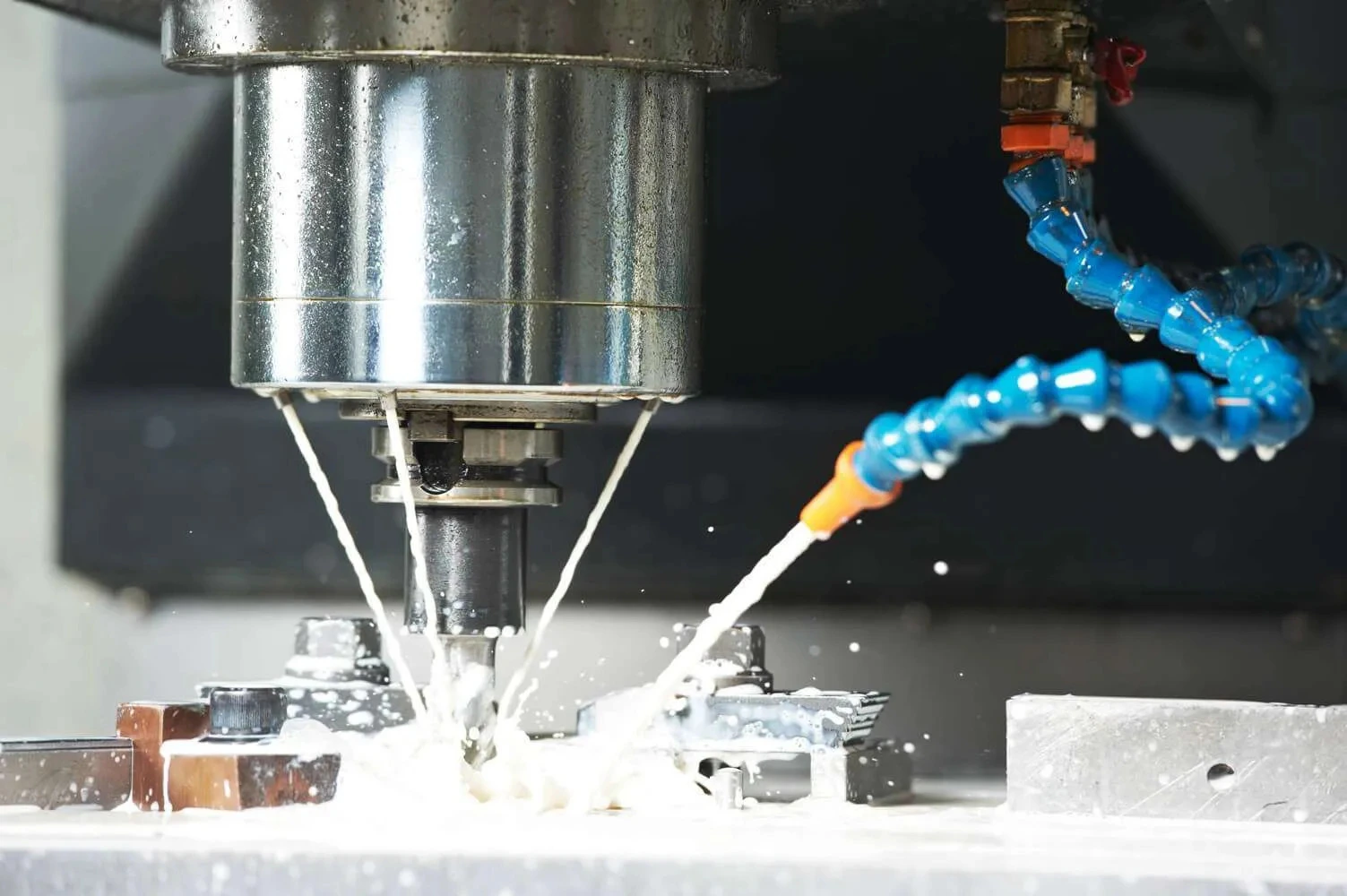
Coolant performance plays a critical role during precision sectioning.
Insufficient coolant flow can cause:
- Blade overheating
- Thermal cracking
- Bond breakdown
- Surface burn
- Material deformation
- Increased blade wear
Effective coolant systems should:
- Deliver coolant directly into the cutting interface
- Remove debris efficiently
- Maintain stable cutting temperatures
- Prevent blade loading
- Improve cut consistency
Typical coolant flow requirements include:
- Precision sectioning: 0.5–2 GPM
- Heavy-duty sectioning: 2–5 GPM
Coolant delivery location also matters.
Poor coolant positioning may allow heat to build at the cutting interface, increasing thermal stress and reducing blade life.
For ultra-hard materials, filtered coolant systems help improve:
- Blade performance
- Surface quality
- Process stability
- Consumable life
Water-soluble coolants are commonly used for:
- Metallography
- Semiconductor sectioning
- Ceramic cutting
Oil-based coolants may be preferred for highly corrosion-sensitive materials.
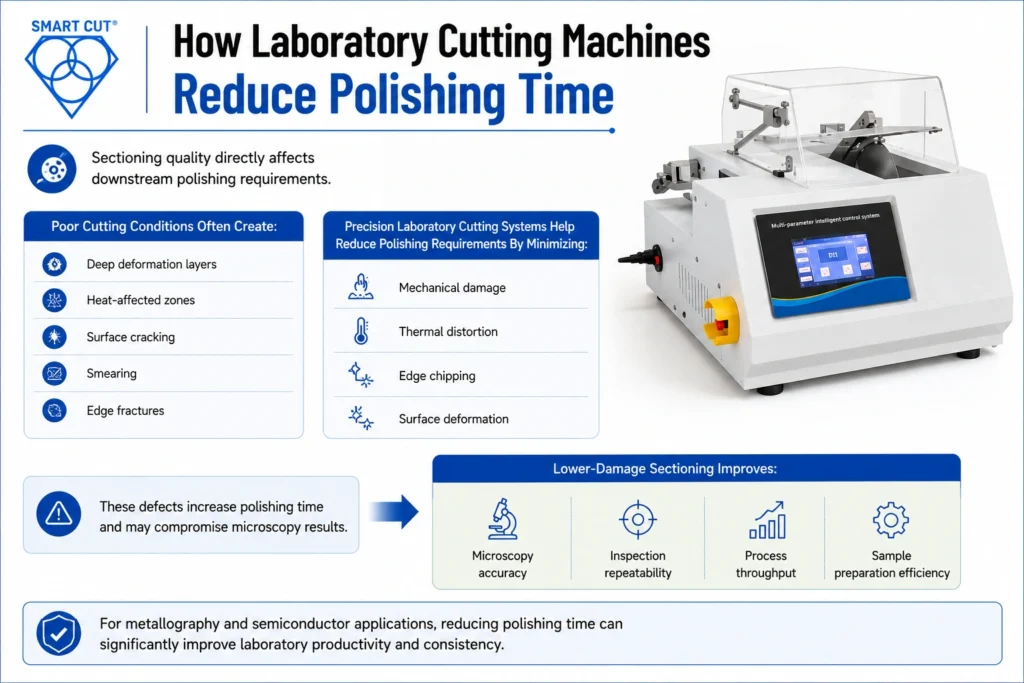
How Laboratory Cutting Machines Reduce Polishing Time

Sectioning quality directly affects downstream polishing requirements.
Poor cutting conditions often create:
- Deep deformation layers
- Heat-affected zones
- Surface cracking
- Smearing
- Edge fractures
These defects increase polishing time and may compromise microscopy results.
Precision laboratory cutting systems help reduce polishing requirements by minimizing:
- Mechanical damage
- Thermal distortion
- Edge chipping
- Surface deformation
Lower-damage sectioning improves:
- Microscopy accuracy
- Inspection repeatability
- Process throughput
- Sample preparation efficiency
For metallography and semiconductor applications, reducing polishing time can significantly improve laboratory productivity and consistency.
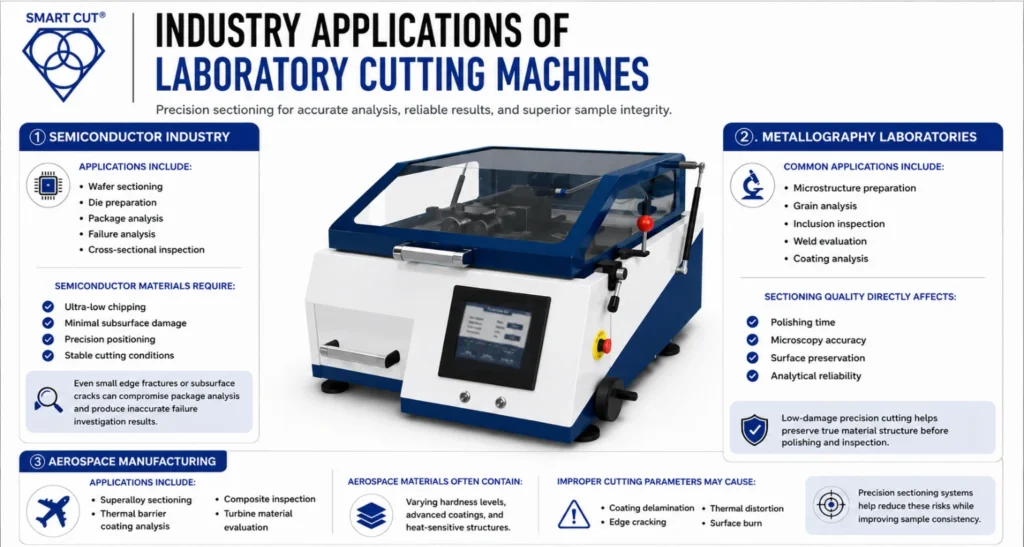
Industry Applications of Laboratory Cutting Machines

Semiconductor Industry
Applications include:
- Wafer sectioning
- Die preparation
- Package analysis
- Failure analysis
- Cross-sectional inspection
Semiconductor materials require:
- Ultra-low chipping
- Minimal subsurface damage
- Precision positioning
- Stable cutting conditions
Even small edge fractures or subsurface cracks can compromise package analysis and produce inaccurate failure investigation results.
Precision wafering systems help minimize these risks while improving repeatability.
Metallography Laboratories
Common applications include:
- Microstructure preparation
- Grain analysis
- Inclusion inspection
- Weld evaluation
- Coating analysis
Sectioning quality directly affects:
- Polishing time
- Microscopy accuracy
- Surface preservation
- Analytical reliability
Low-damage precision cutting helps preserve true material structure before polishing and inspection.
Aerospace Manufacturing
Applications include:
- Superalloy sectioning
- Thermal barrier coating analysis
- Composite inspection
- Turbine material evaluation
Aerospace materials often contain varying hardness levels, advanced coatings, and heat-sensitive structures.
Improper cutting parameters may cause:
- Coating delamination
- Edge cracking
- Thermal distortion
- Surface burn
Precision sectioning systems help reduce these risks while improving sample consistency.
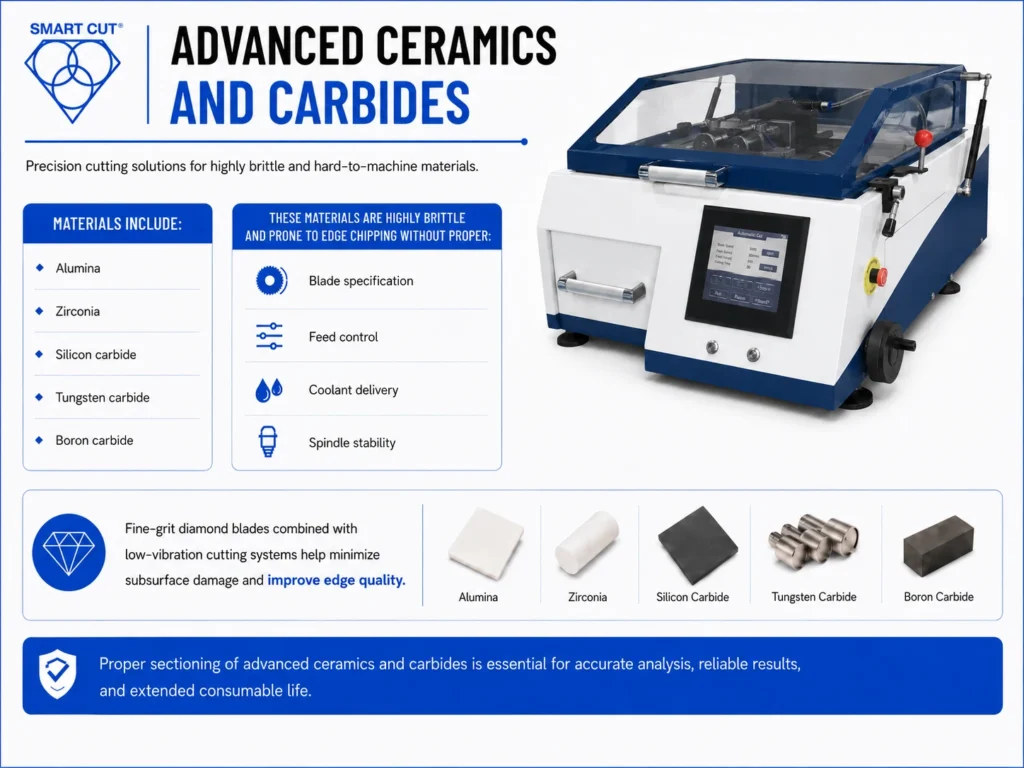
Advanced Ceramics and Carbides

Materials include:
- Alumina
- Zirconia
- Silicon carbide
- Tungsten carbide
- Boron carbide
These materials are highly brittle and prone to edge chipping without proper:
- Blade specification
- Feed control
- Coolant delivery
- Spindle stability
Fine-grit diamond blades combined with low-vibration cutting systems help minimize subsurface damage and improve edge quality.
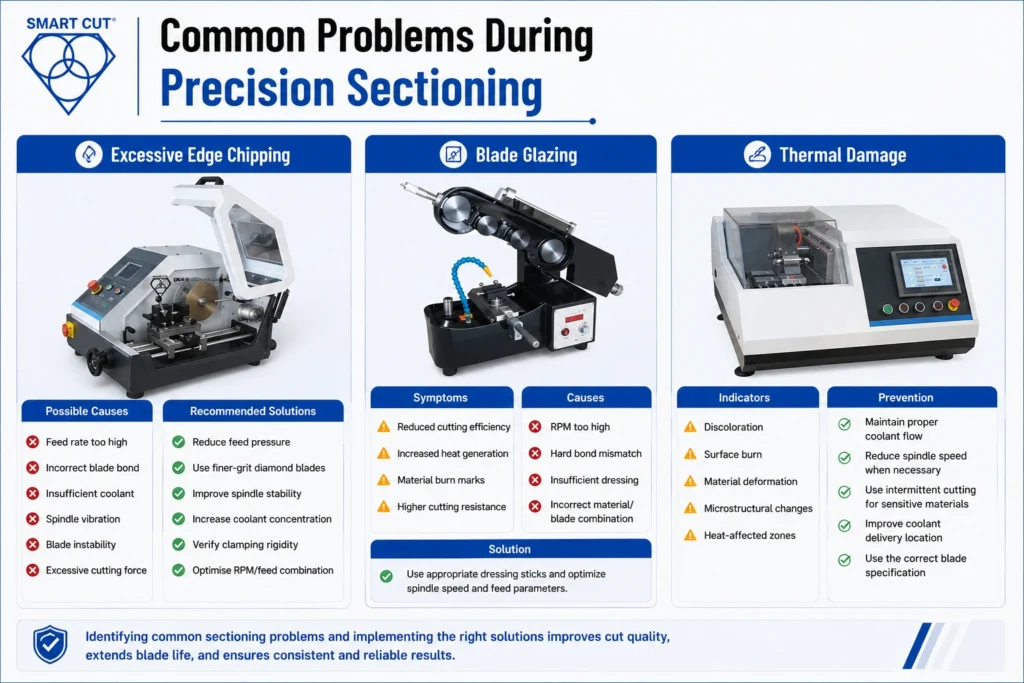
Common Problems During Precision Sectioning

Excessive Edge Chipping
Possible Causes
- Feed rate too high
- Incorrect blade bond
- Insufficient coolant
- Spindle vibration
- Blade instability
- Excessive cutting force
Recommended Solutions
- Reduce feed pressure
- Use finer-grit diamond blades
- Improve spindle stability
- Increase coolant concentration
- Verify clamping rigidity
- Optimise RPM/feed combination
Blade Glazing
Symptoms
- Reduced cutting efficiency
- Increased heat generation
- Material burn marks
- Higher cutting resistance
Causes
- RPM too high
- Hard bond mismatch
- Insufficient dressing
- Incorrect material/blade combination
Solution
Use appropriate dressing sticks and optimize spindle speed and feed parameters.
Thermal Damage
Indicators
- Discoloration
- Surface burn
- Material deformation
- Microstructural changes
- Heat-affected zones
Prevention
- Maintain proper coolant flow
- Reduce spindle speed when necessary
- Use intermittent cutting for sensitive materials
- Improve coolant delivery location
- Use the correct blade specification
Machine Rigidity and Spindle Stability

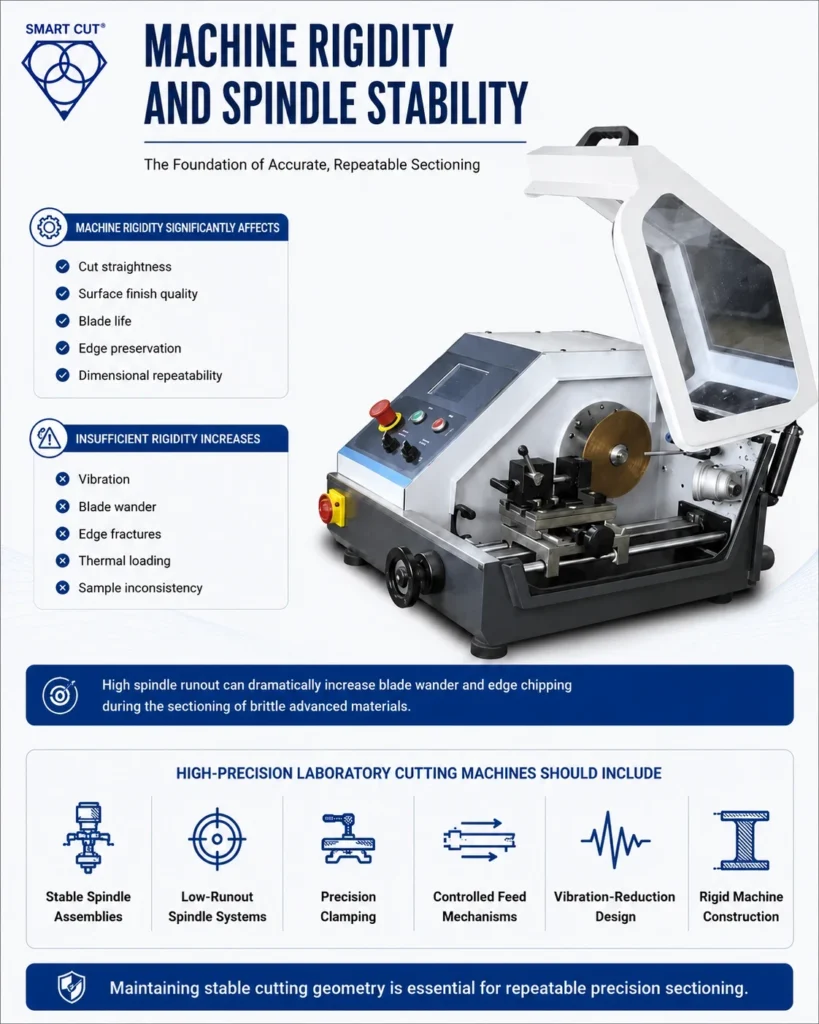
Machine rigidity significantly affects:
- Cut straightness
- Surface finish quality
- Blade life
- Edge preservation
- Dimensional repeatability
Insufficient rigidity increases:
- Vibration
- Blade wander
- Edge fractures
- Thermal loading
- Sample inconsistency
High spindle runout can dramatically increase blade wander and edge chipping during the sectioning of brittle advanced materials.
High-precision laboratory cutting machines should include:
- Stable spindle assemblies
- Low-runout spindle systems
- Precision clamping
- Controlled feed mechanisms
- Vibration-reduction design
- Rigid machine construction
Maintaining stable cutting geometry is essential for repeatable precision sectioning.
How to Select the Right Laboratory Cutting Machine

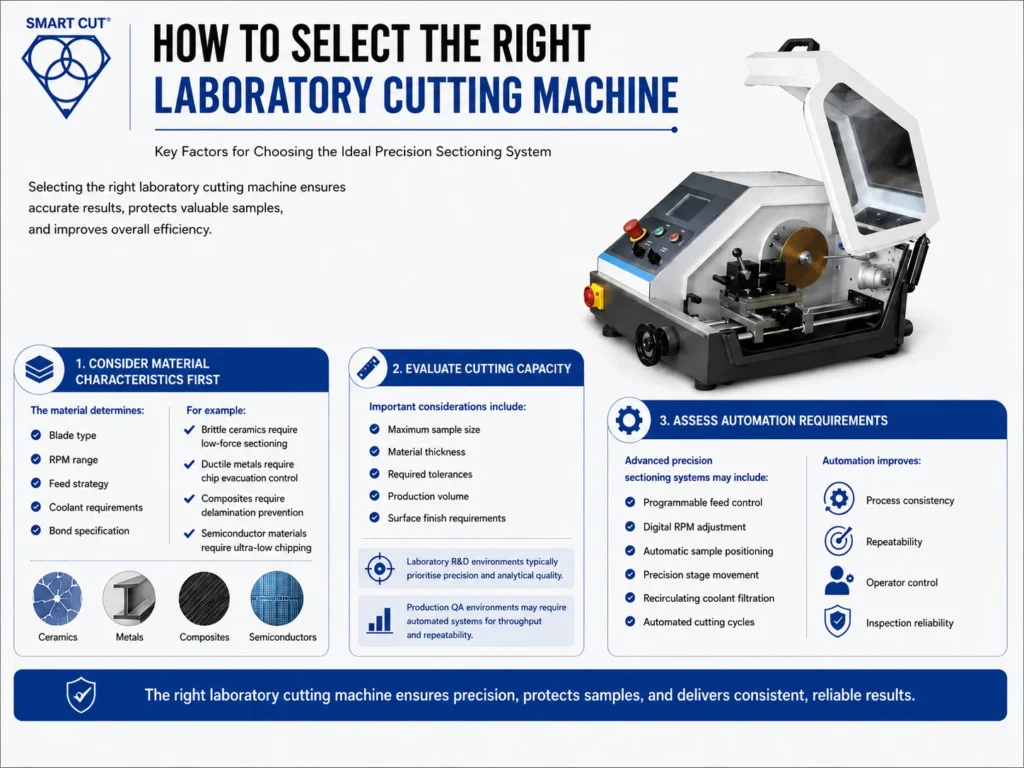
Consider Material Characteristics First
The material determines:
- Blade type
- RPM range
- Feed strategy
- Coolant requirements
- Bond specification
For example:
- Brittle ceramics require low-force sectioning
- Ductile metals require chip evacuation control
- Composites require delamination prevention
- Semiconductor materials require ultra-low chipping
Evaluate Cutting Capacity
Important considerations include:
- Maximum sample size
- Material thickness
- Required tolerances
- Production volume
- Surface finish requirements
Laboratory R&D environments typically prioritise precision and analytical quality.
Production QA environments may require automated systems for throughput and repeatability.
Assess Automation Requirements
Advanced precision sectioning systems may include:
- Programmable feed control
- Digital RPM adjustment
- Automatic sample positioning
- Precision stage movement
- Recirculating coolant filtration
- Automated cutting cycles
Automation improves:
- Process consistency
- Repeatability
- Operator control
- Inspection reliability
Frequently Asked Questions
Laboratory cutting machines are commonly used for ceramics, carbides, silicon, composites, superalloys, glass, semiconductor materials, metallographic specimens, and advanced engineering materials.
Coolant helps reduce heat generation, remove debris, improve blade life, and minimise thermal damage and edge chipping during cutting operations.
Common causes include excessive feed rate, incorrect blade specification, spindle vibration, excessive cutting force, and inadequate coolant delivery.
Wafering saws use thin precision blades with controlled feed systems engineered to minimise material deformation, thermal damage, and subsurface fractures.
Conventional abrasive saws are generally designed for aggressive material removal rather than low-damage precision sectioning.
Blade selection depends on:
- Material hardness
- Brittleness
- Thickness
- Surface finish requirements
- Feed rate
- RPM range
- Cutting speed requirements
Selecting the correct blade specification is critical for minimising damage and improving blade life.
Conclusion
Precision sectioning is not simply a cutting operation.
It is a critical material preparation process that directly affects inspection accuracy, analytical reliability, polishing efficiency, and overall sample integrity.
For advanced materials and high-value components, improper cutting parameters can introduce defects before testing or inspection even begins.
Modern laboratory cutting machines provide the spindle stability, feed precision, coolant control, and thin-kerf cutting capability necessary to achieve repeatable low-damage sectioning across demanding industrial applications.
SMART CUT® precision sectioning systems from UKAM are engineered to help manufacturers, laboratories, and research facilities reduce:
- Scrap rates
- Material loss
- Thermal damage
- Edge chipping
- Polishing time
- Consumable waste
While improving:
- Inspection accuracy
- Surface integrity
- Repeatability
- Process consistency
- Blade performance
- Overall operational efficiency
Need help selecting the right laboratory cutting machine, diamond blade specification, RPM configuration, or coolant system for your application?
Contact UKAM’s applications engineering team for precision sectioning recommendations tailored to your material and process requirements.
Trusted by Tens of Thousands of Manufacturers, Laboratories,
Research Institutions Worldwide Since 1990

Established in 1990
RELATED ARTICLES

Brian is an experienced professional in the field of precision cutting tools, with over 27 years of experience in technical support. Over the years, he has helped engineers, manufacturers, researchers, and contractors find the right solutions for working with advanced and hard-to-cut materials. He’s passionate about bridging technical knowledge with real-world applications to improve efficiency and accuracy.
As an author, Brian Farberov writes extensively on diamond tool design, application engineering, return on investment strategies, and process optimization, combining technical depth with a strong understanding of customer needs and market dynamics.
About Brian Farberov
Brian is an experienced professional in the field of precision cutting tools, with over 27 years of experience in technical support. Over the years, he has helped engineers, manufacturers, researchers, and contractors find the right solutions for working with advanced and hard-to-cut materials. He’s passionate about bridging technical knowledge with real-world applications to improve efficiency and accuracy. As an author, Brian Farberov writes extensively on diamond tool design, application engineering, return on investment strategies, and process optimization, combining technical depth with a strong understanding of customer needs and market dynamics.
View all posts by Brian Farberov