


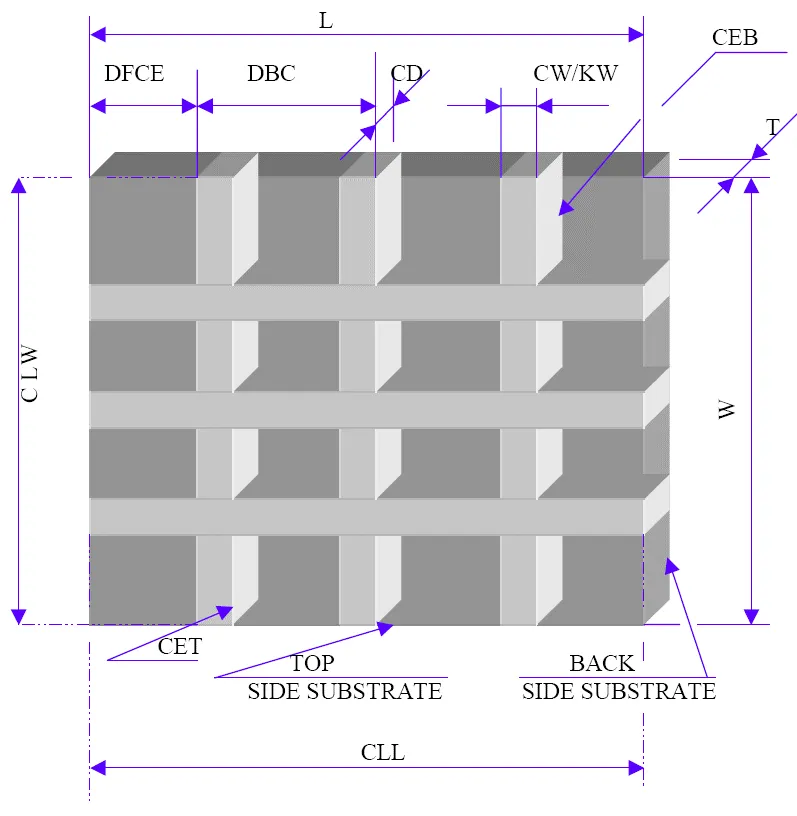







How to Measure Precision Diamond Blade Cut Quality: Chipping, Kerf, Flatness, Subsurface Damage, and Material Loss

Diamond crystal concentration is one of the most important and one of the most misunderstood specifications in diamond blade selection. Many users assume that a blade with a higher diamond concentration will always cut faster, last longer, and produce superior results. In reality, concentration is only one component of an engineered cutting system, and increasing it without considering bond hardness, grit size, material properties, spindle speed, feed rate, coolant performance, and machine rigidity can reduce cutting efficiency rather than improve it.
Continue reading

Why Is My Precision Diamond Blade Failing? Root Causes of Chipping, Wandering, Glazing, Rapid Wear & Poor Cut Quality

Diamond crystal concentration is one of the most important and one of the most misunderstood specifications in diamond blade selection. Many users assume that a blade with a higher diamond concentration will always cut faster, last longer, and produce superior results. In reality, concentration is only one component of an engineered cutting system, and increasing it without considering bond hardness, grit size, material properties, spindle speed, feed rate, coolant performance, and machine rigidity can reduce cutting efficiency rather than improve it.
Continue reading

Diamond / CBN Blade Dressing: When, Why & How to Restore Maximum Cutting Efficiency

Precision diamond and CBN blades are engineered to deliver exceptional cutting accuracy, minimal material damage, and long service life across a wide range of advanced materials. Whether sectioning silicon wafers, sapphire, technical ceramics, carbides, composites, hardened steels, or metallographic specimens, these tools rely on a carefully engineered balance between diamond or CBN abrasive particles and the bond material that supports them.
Continue reading

Understanding Cutting Force Distribution During Metallographic Sectioning Using Diamond & CBN Wafering Blades and Cut-Off Wheels

Precision sectioning is far more than simply separating material into smaller pieces. In metallography, semiconductor manufacturing, failure analysis, materials research, and quality control laboratories, the objective is to produce a specimen that accurately represents the original material without introducing damage that could compromise subsequent inspection or analysis.
Continue reading

How Material Fracture Toughness Influences Diamond & CBN Blade Selection

Selecting the correct diamond or CBN blade involves far more than matching the blade to a material’s hardness. While hardness is often the first property engineers consider, it is rarely sufficient for determining how a material will behave during precision cutting. Two materials may exhibit similar hardness values yet respond very differently under identical cutting conditions. One may produce clean, repeatable cuts with minimal edge damage, while the other may experience extensive edge chipping, subsurface cracking, rapid blade wear, or complete specimen failure.
Continue reading

Understanding Diamond Crystal Concentration: Balancing Cutting Speed, Tool Life & Cost

Diamond crystal concentration is one of the most important and one of the most misunderstood specifications in diamond blade selection. Many users assume that a blade with a higher diamond concentration will always cut faster, last longer, and produce superior results. In reality, concentration is only one component of an engineered cutting system, and increasing it without considering bond hardness, grit size, material properties, spindle speed, feed rate, coolant performance, and machine rigidity can reduce cutting efficiency rather than improve it.
Continue reading