










Home > Blog > Why Is My Precision Diamond Blade Failing? Root Causes of Chipping, Wandering, Glazing, Rapid Wear & Poor Cut Quality
Diamond Blade Articles, blog

Why Is My Precision Diamond Blade Failing? Root Causes of Chipping, Wandering, Glazing, Rapid Wear & Poor Cut Quality

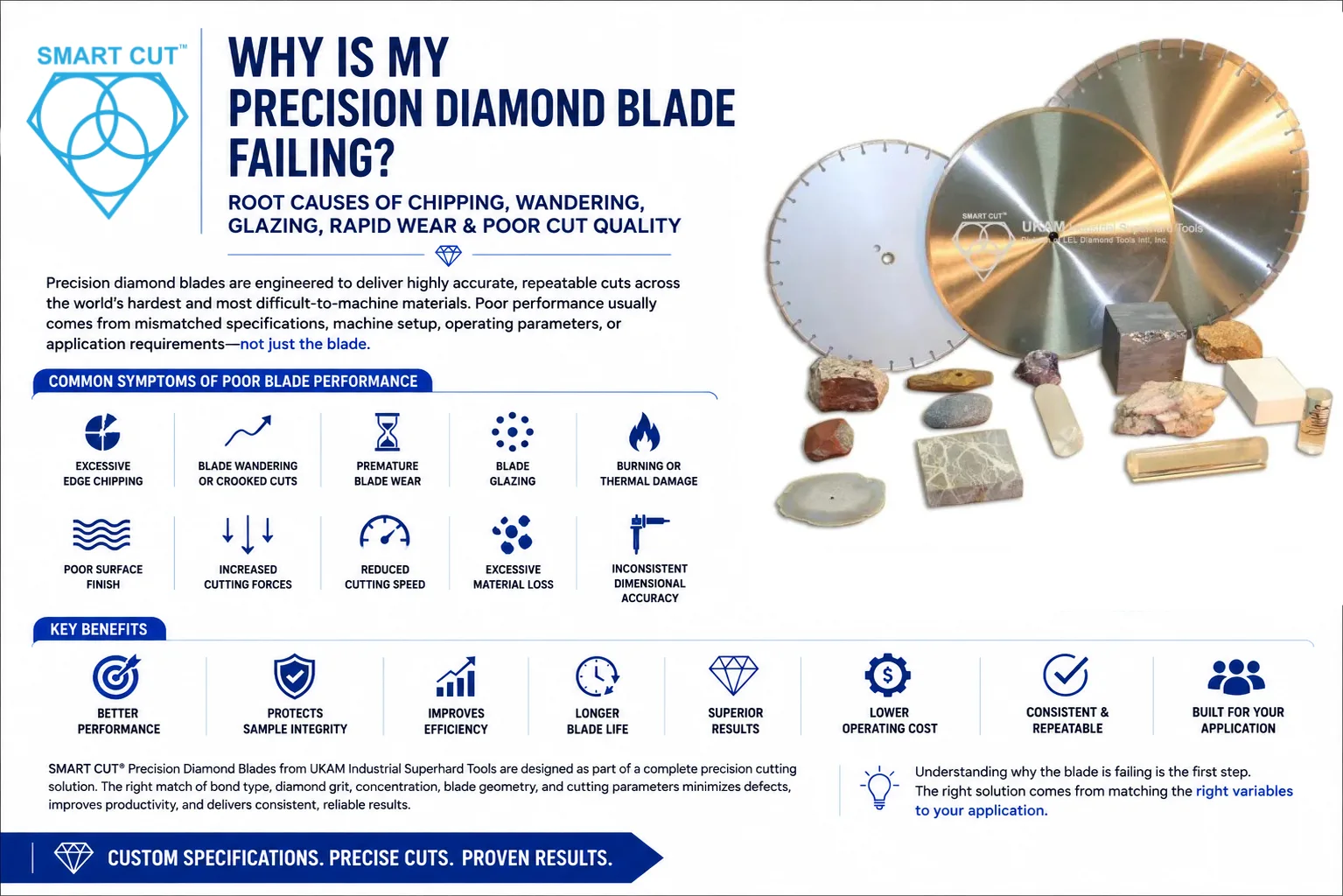
Table of Contents

Precision diamond blades are engineered to deliver highly accurate, repeatable cuts across some of the world’s hardest and most difficult-to-machine materials. However, even a premium diamond blade can experience poor cutting performance if the blade specification, machine setup, operating parameters, or application requirements are not properly matched.

When cutting performance begins to decline, the blade itself is often blamed first.

In reality, the blade is only one component of a complete precision cutting system.

Factors such as machine rigidity, spindle runout, feed rate, coolant delivery, workpiece fixturing, material characteristics, and operator technique all interact to influence cutting performance. A change in any one of these variables can significantly affect cut quality, blade life, and process repeatability.

As a result, replacing the blade without identifying the underlying cause frequently leads to the same problems occurring again.

Common symptoms of poor blade performance include:

● Excessive edge chipping

● Blade wandering or crooked cuts

● Premature blade wear

● Blade glazing

● Burning or thermal damage

● Poor surface finish

● Increased cutting forces

● Reduced cutting speed

● Excessive material loss

● Inconsistent dimensional accuracy

These issues not only reduce blade life but also increase polishing time, consumable costs, scrap rates, and inspection variability. In industries such as semiconductor manufacturing, metallography, aerospace, medical devices, advanced ceramics, and failure analysis, even minor cutting defects can compromise an entire sample before analysis begins.

Successful troubleshooting requires understanding why the blade is failing—not simply replacing it.

SMART CUT® Precision Diamond Blades from UKAM Industrial Superhard Tools are designed as part of a complete precision cutting solution. By carefully matching bond type, diamond grit, concentration, blade geometry, and cutting parameters to the application, these blades help minimize cutting defects while improving productivity, sample integrity, and overall process consistency.

This guide explains the most common causes of precision diamond blade failure, how to diagnose each problem using engineering methods, and the corrective actions that restore cutting performance while preventing recurring issues.

Trusted by Tens of Thousands of Manufacturers, Laboratories Research Institutions Worldwide Since 1990

American Based Manufacturer

Established in 1990

Custom manufacturing

Why Precision Diamond Blades Fail

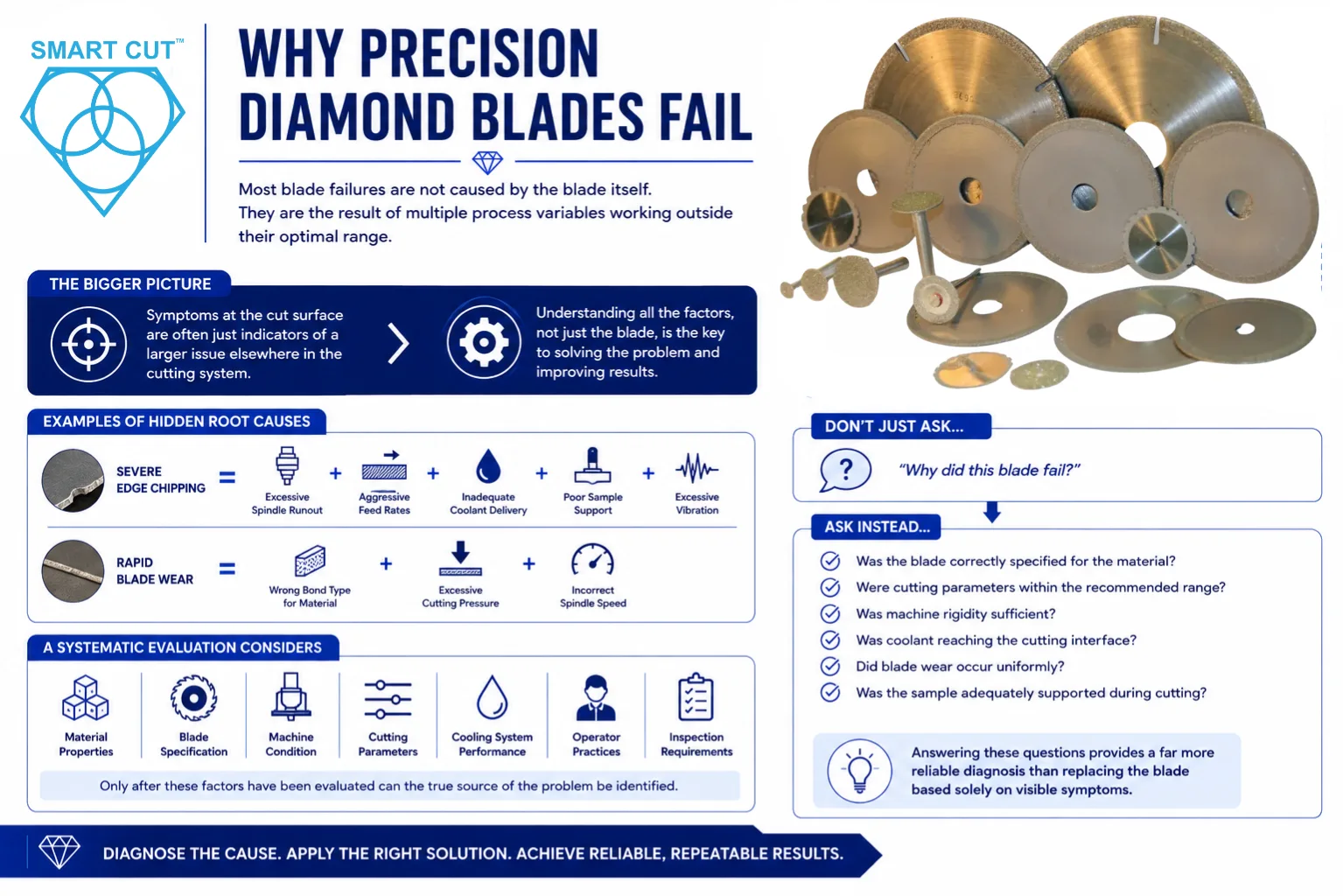
Unlike conventional abrasive wheels, precision diamond blades rarely fail because of a single defect.

Most cutting problems develop gradually as multiple process variables move outside their optimal operating range. In many cases, the symptoms observed at the cut surface are simply indicators of a larger issue elsewhere in the cutting system.

For example, severe edge chipping may initially appear to be caused by an unsuitable blade. However, the actual root cause may be excessive spindle runout, aggressive feed rates, inadequate coolant delivery, poor sample support, or excessive machine vibration.

Similarly, rapid blade wear does not automatically indicate poor blade quality. The wear may instead result from selecting the wrong bond type for the material, operating the blade at excessive cutting pressure, or using incorrect spindle speed.

For this reason, experienced applications engineers investigate the complete cutting process before recommending changes to blade specifications.

A systematic evaluation generally considers:

● Material properties

● Blade specification

● Machine condition

● Cutting parameters

● Cooling system performance

● Operator practices

● Inspection requirements

Only after these factors have been evaluated can the true source of the problem be identified.

Rather than asking:

“Why did this blade fail?”

Applications engineers typically ask:

● Was the blade correctly specified for the material?

● Were cutting parameters within the recommended range?

● Was machine rigidity sufficient?

● Was coolant reaching the cutting interface?

● Did blade wear occur uniformly?

● Was the sample adequately supported during cutting?

Answering these questions provides a far more reliable diagnosis than replacing the blade based solely on visible symptoms.

Understanding Diamond Blade Failure Mechanisms

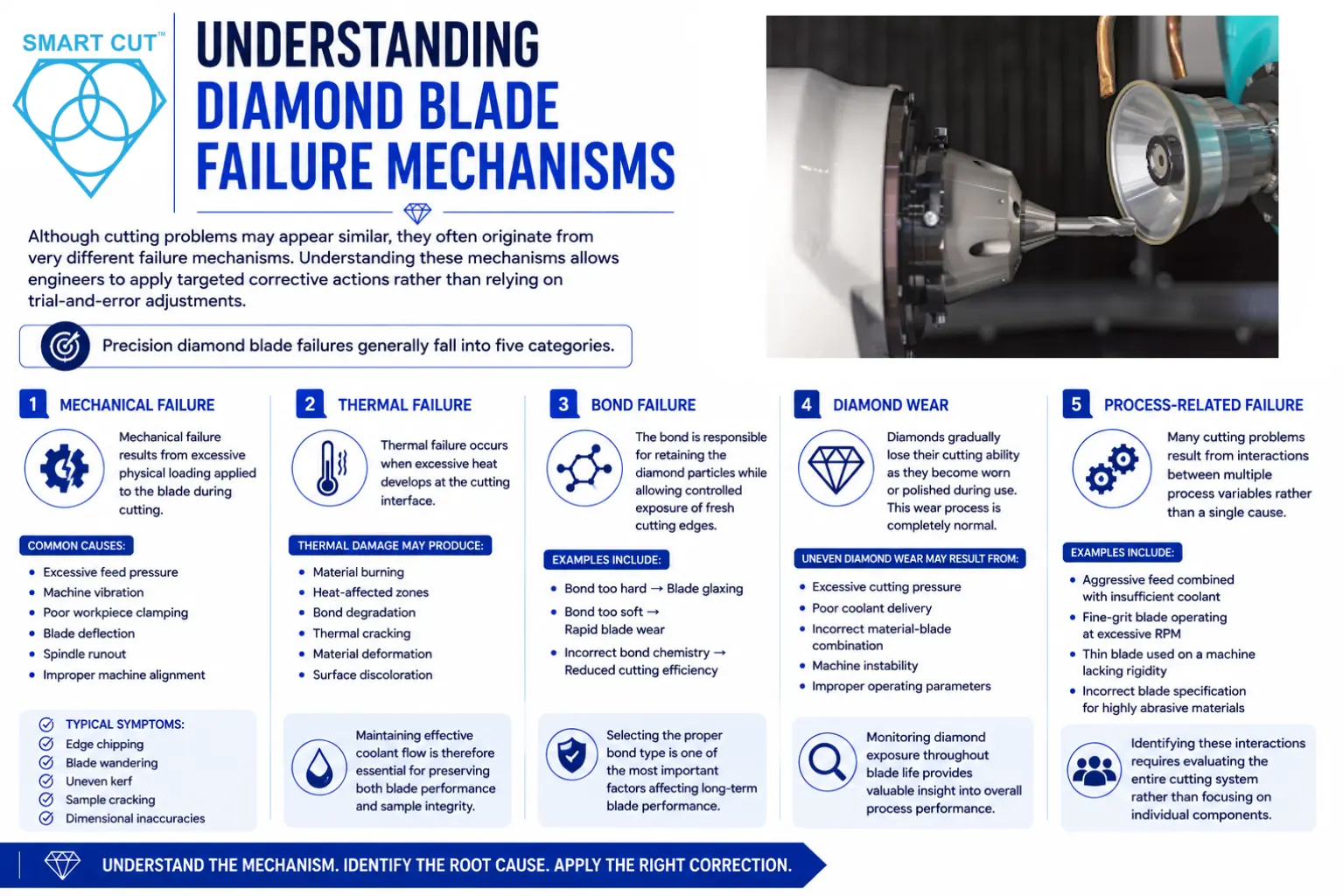
Although cutting problems may appear similar, they often originate from very different failure mechanisms.

Understanding these mechanisms allows engineers to apply targeted corrective actions rather than relying on trial-and-error adjustments.

Precision diamond blade failures generally fall into five categories.

Mechanical Failure

Mechanical failure results from excessive physical loading applied to the blade during cutting.

Common causes include:

● Excessive feed pressure

● Machine vibration

● Poor workpiece clamping

● Blade deflection

● Spindle runout

● Improper machine alignment

Mechanical failures often produce symptoms such as:

● Edge chipping

● Blade wandering

● Uneven kerf

● Sample cracking

● Dimensional inaccuracies

Thermal Failure

Thermal failure occurs when excessive heat develops at the cutting interface.

Heat generation increases rapidly when coolant delivery becomes ineffective or cutting conditions exceed the blade’s design capability.

Thermal damage may produce:

● Material burning

● Heat-affected zones

● Bond degradation

● Thermal cracking

● Material deformation

● Surface discoloration

Maintaining effective coolant flow is therefore essential for preserving both blade performance and sample integrity.

Bond Failure

The bond is responsible for retaining the diamond particles while allowing controlled exposure of fresh cutting edges.

When bond characteristics do not match the material being processed, cutting efficiency declines rapidly.

Examples include:

● Bond too hard → Blade glazing

● Bond too soft → Rapid blade wear

● Incorrect bond chemistry → Reduced cutting efficiency

Selecting the proper bond type is one of the most important factors affecting long-term blade performance.

Diamond Wear

Diamonds gradually lose their cutting ability as they become worn or polished during use.

This wear process is completely normal.

However, abnormal wear patterns often indicate problems elsewhere in the cutting process.

Uneven diamond wear may result from:

● Excessive cutting pressure

● Poor coolant delivery

● Incorrect material-blade combination

● Machine instability

● Improper operating parameters

Monitoring diamond exposure throughout blade life provides valuable insight into overall
process performance.

Process-Related Failure

Many cutting problems are not caused by either the blade or the machine individually.

Instead, they result from interactions between multiple process variables.

Examples include:

● Aggressive feed combined with insufficient coolant

● Fine-grit blade operating at excessive RPM

● Thin blade used on a machine lacking rigidity

● Incorrect blade specification for highly abrasive materials

Process-related failures frequently produce inconsistent symptoms that vary between operators, materials, or production batches.

Identifying these interactions requires evaluating the entire cutting system rather than focusing on individual components.

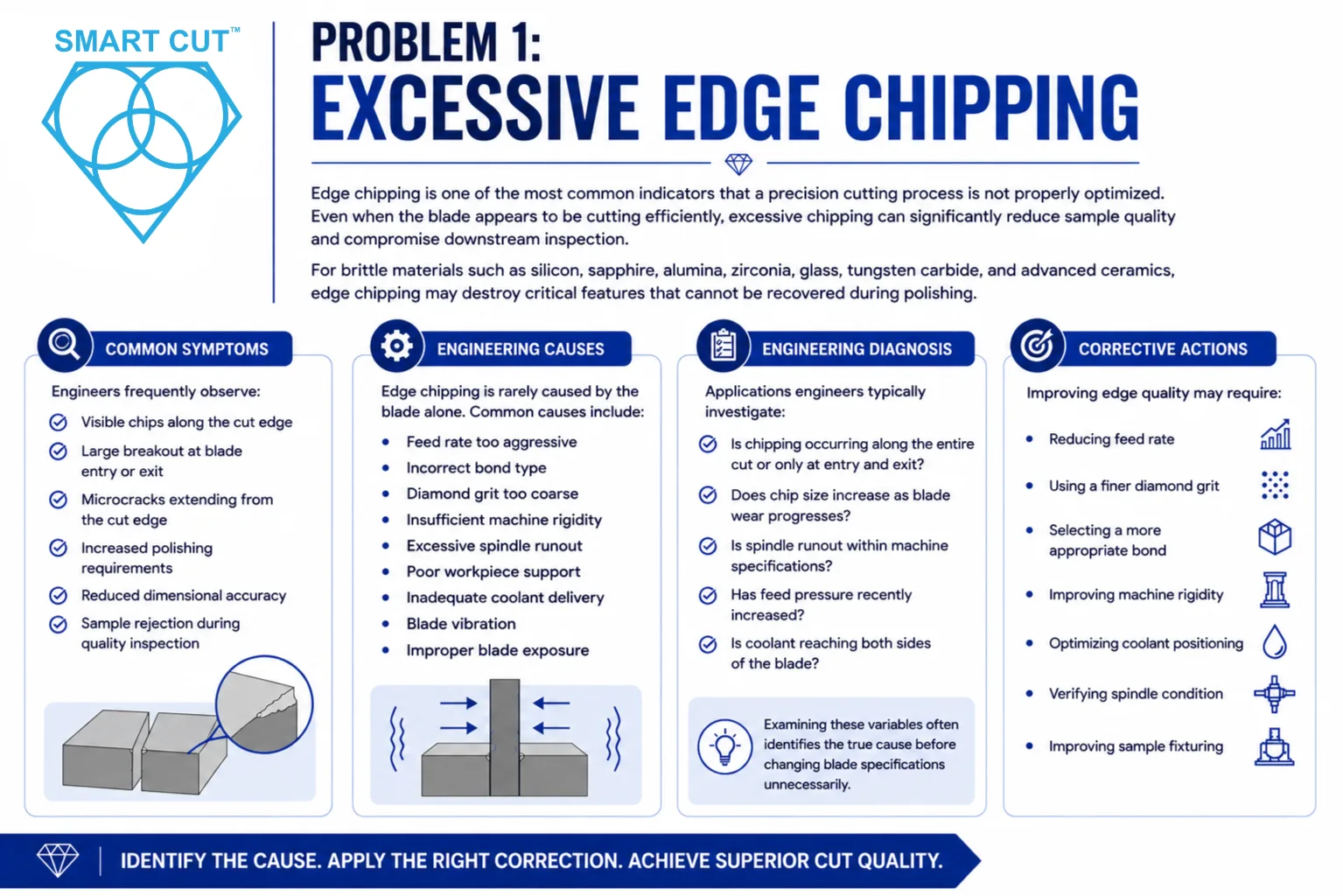
Problem 1: Excessive Edge Chipping

Edge chipping is one of the most common indicators that a precision cutting process is not properly optimized. Even when the blade appears to be cutting efficiently, excessive chipping can significantly reduce sample quality and compromise downstream inspection.

For brittle materials such as silicon, sapphire, alumina, zirconia, glass, tungsten carbide, and advanced ceramics, edge chipping may destroy critical features that cannot be recovered during polishing.

Common Symptoms

Engineers frequently observe:

● Visible chips along the cut edge

● Large breakout at blade entry or exit

● Microcracks extending from the cut edge

● Increased polishing requirements

● Reduced dimensional accuracy

● Sample rejection during quality inspection

Engineering Causes

Edge chipping is rarely caused by the blade alone. It typically results from one or more process variables operating outside their recommended range.

Common causes include:

● Feed rate too aggressive

● Incorrect bond type

● Diamond grit too coarse

● Insufficient machine rigidity

● Excessive spindle runout

● Poor workpiece support

● Inadequate coolant delivery

● Blade vibration

● Improper blade exposure

Engineering Diagnosis

Applications engineers typically investigate:

● Is chipping occurring along the entire cut or only at entry and exit?

● Does chip size increase as blade wear progresses?

● Is spindle runout within machine specifications?

● Has feed pressure recently increased?

● Is coolant reaching both sides of the blade?

Examining these variables often identifies the true cause before changing blade specifications unnecessarily.

Corrective Actions

Improving edge quality may require:

● Reducing feed rate

● Using a finer diamond grit

● Selecting a more appropriate bond

● Improving machine rigidity

● Optimizing coolant positioning

● Verifying spindle condition

● Improving sample fixturing

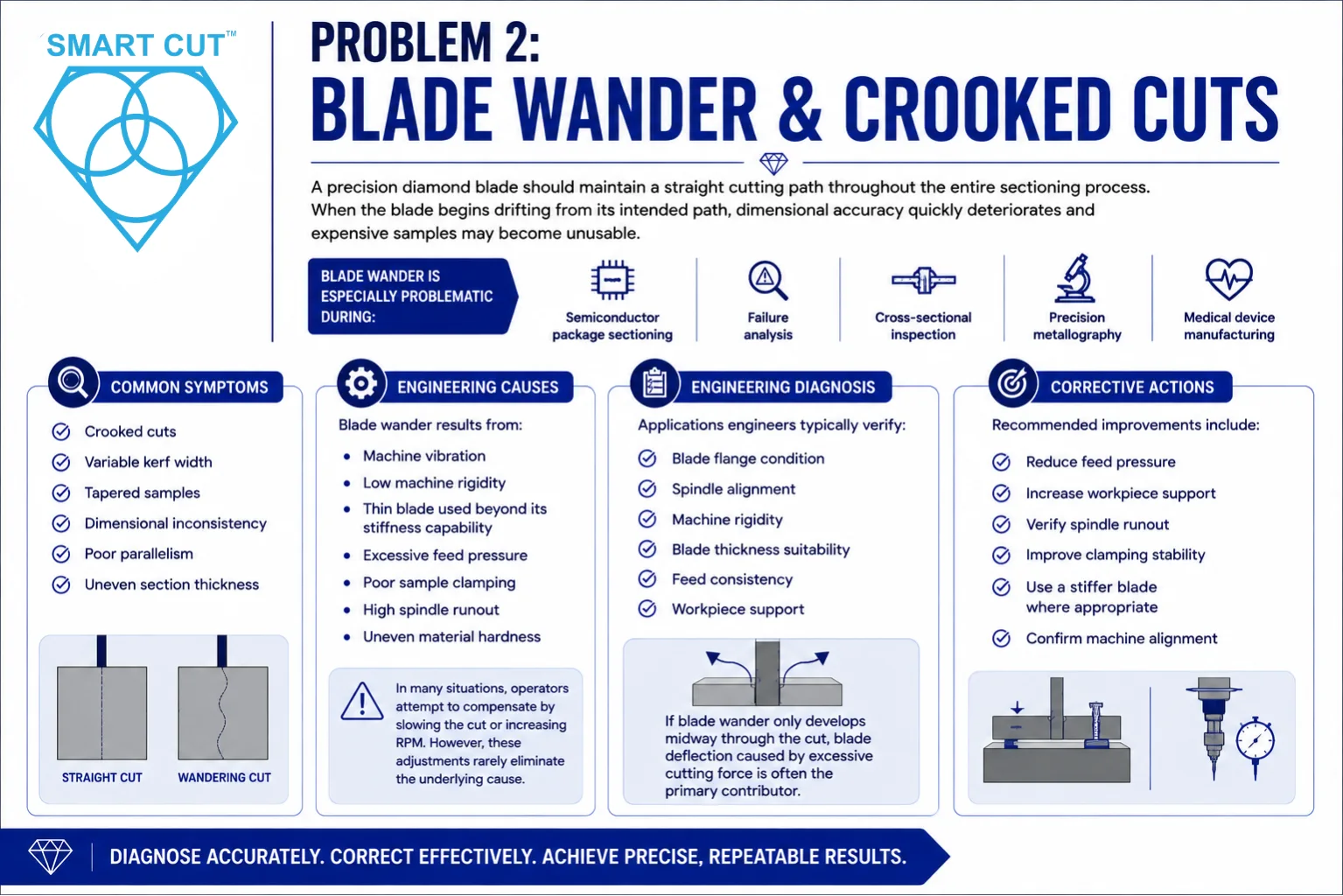
Problem 2: Blade Wander & Crooked Cuts

A precision diamond blade should maintain a straight cutting path throughout the entire sectioning process.

When the blade begins drifting from its intended path, dimensional accuracy quickly deteriorates and expensive samples may become unusable.

Blade wander is especially problematic during:

● Semiconductor package sectioning

● Failure analysis

● Cross-sectional inspection

● Precision metallography

● Medical device manufacturing

Common Symptoms

● Crooked cuts

● Variable kerf width

● Tapered samples

● Dimensional inconsistency

● Poor parallelism

● Uneven section thickness

Engineering Causes

Blade wander results from:

● Machine vibration

● Low machine rigidity

● Thin blade used beyond its stiffness capability

● Excessive feed pressure

● Poor sample clamping

● High spindle runout

● Uneven material hardness

In many situations, operators attempt to compensate by slowing the cut or increasing RPM. However, these adjustments rarely eliminate the underlying cause.

Engineering Diagnosis

Applications engineers typically verify:
● Blade flange condition

● Spindle alignment

● Machine rigidity

● Blade thickness suitability

● Feed consistency

● Workpiece support

If blade wander only develops midway through the cut, blade deflection caused by excessive cutting force is often the primary contributor.

Corrective Actions

Recommended improvements include:

● Reduce feed pressure

● Increase workpiece support

● Verify spindle runout

● Improve clamping stability

● Use a stiffer blade where appropriate

● Confirm machine alignment

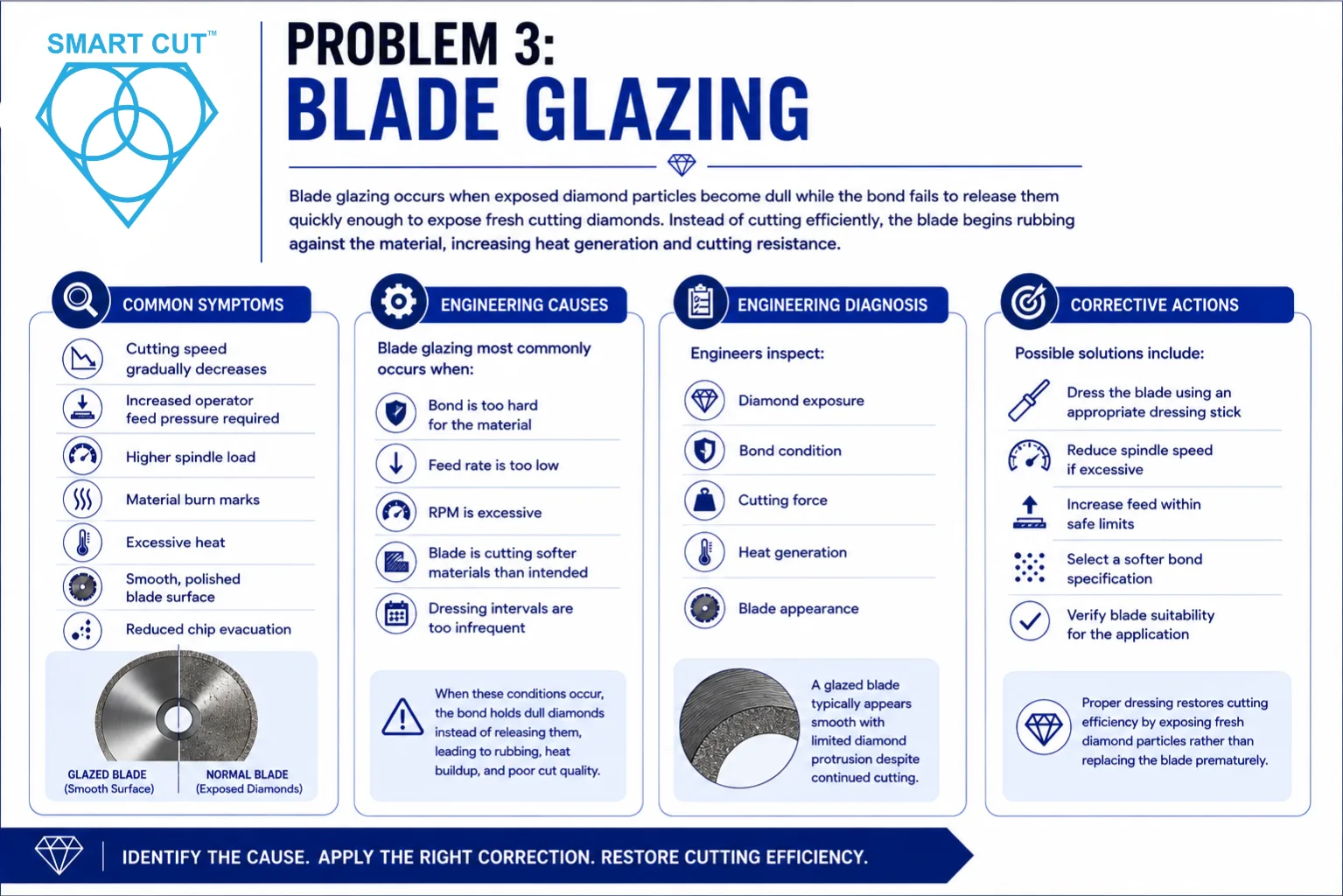
Problem 3: Blade Glazing

Blade glazing occurs when exposed diamond particles become dull while the bond fails to release them quickly enough to expose fresh cutting diamonds.

Instead of cutting efficiently, the blade begins rubbing against the material, increasing heat generation and cutting resistance.

Common Symptoms

Cutting speed gradually decreases

● Increased operator feed pressure required

● Higher spindle load

● Material burn marks

● Excessive heat

● Smooth, polished blade surface

● Reduced chip evacuation

Engineering Causes

Blade glazing most commonly occurs when:

● Bond is too hard for the material

● Feed rate is too low

● RPM is excessive

● Blade is cutting softer materials than intended

● Dressing intervals are too infrequent

Engineering Diagnosis
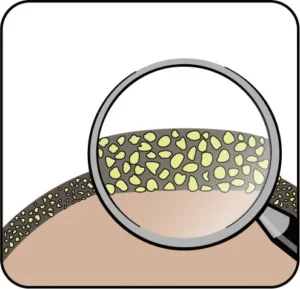


Engineers inspect:

● Diamond exposure

● Bond condition

● Cutting force

● Heat generation

● Blade appearance

A glazed blade typically appears smooth with limited diamond protrusion despite continued cutting.

Corrective Actions
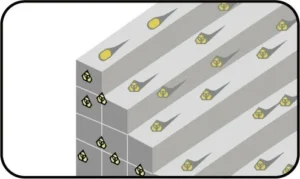
Possible solutions include:

● Dress the blade using an appropriate dressing stick

● Reduce spindle speed if excessive

● Increase feed within safe limits

● Select a softer bond specification

● Verify blade suitability for the application

Proper dressing restores cutting efficiency by exposing fresh diamond particles rather than replacing the blade prematurely.
Problem 4: Rapid Blade Wear

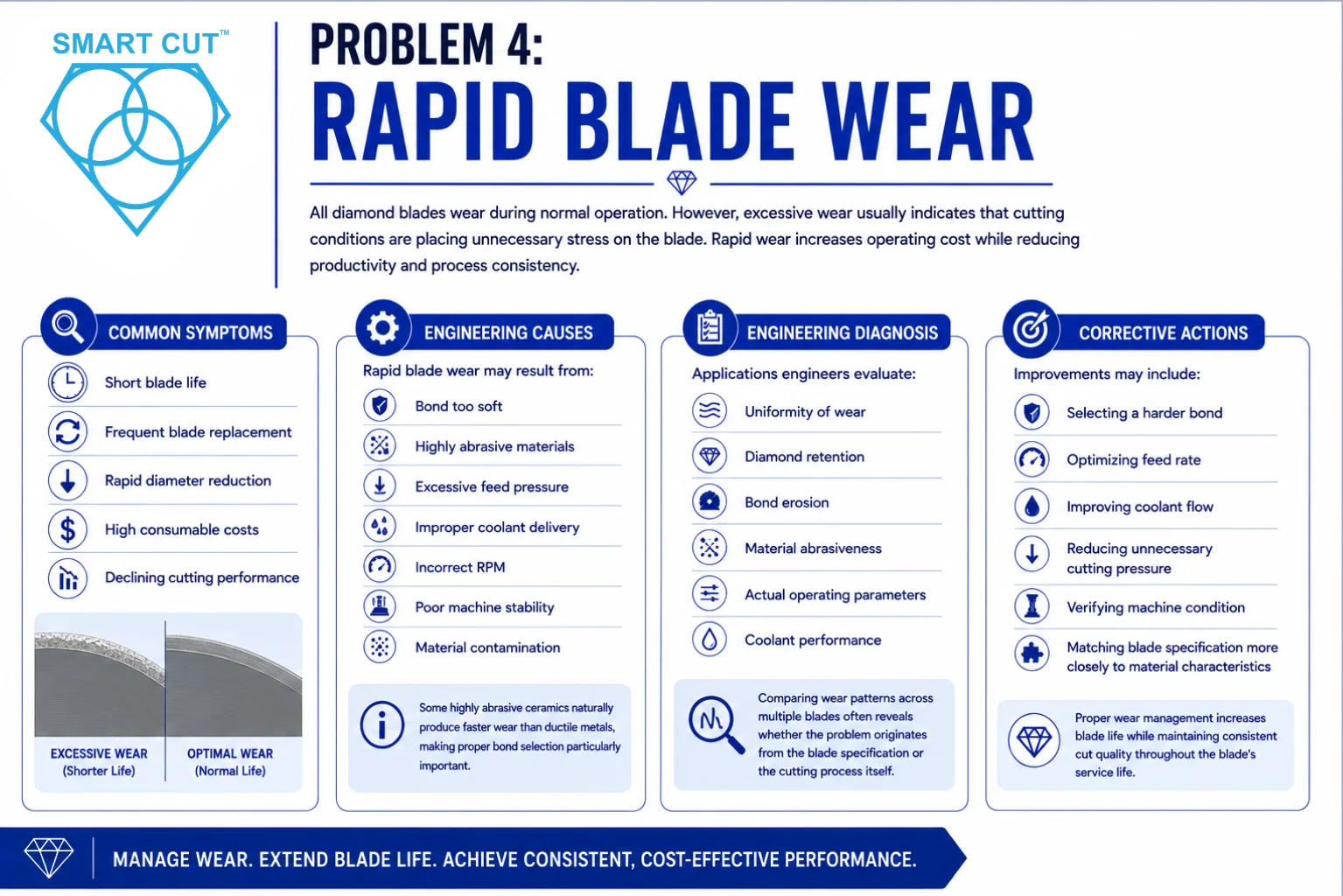
All diamond blades wear during normal operation.

However, excessive wear usually indicates that cutting conditions are placing unnecessary stress on the blade.

Rapid wear increases operating cost while reducing productivity and process consistency.

Common Symptoms

● Short blade life

● Frequent blade replacement

● Rapid diameter reduction

● High consumable costs

● Declining cutting performance

Engineering Causes

Rapid blade wear may result from:

● Bond too soft

● Highly abrasive materials

● Excessive feed pressure

● Improper coolant delivery

● Incorrect RPM

● Poor machine stability

● Material contamination

Some highly abrasive ceramics naturally produce faster wear than ductile metals, making proper bond selection particularly important.

Engineering Diagnosis

Applications engineers evaluate:

● Uniformity of wear

● Diamond retention

● Bond erosion

● Material abrasiveness

● Actual operating parameters

Coolant performance

Comparing wear patterns across multiple blades often reveals whether the problem originates from the blade specification or the cutting process itself.

Corrective Actions

Improvements may include:

Selecting a harder bond

● Optimizing feed rate

● Improving coolant flow

● Reducing unnecessary cutting pressure

● Verifying machine condition

● Matching blade specification more closely to material characteristics

Proper wear management increases blade life while maintaining consistent cut quality throughout the blade’s service life.

Problem 5: Burning & Thermal Damage

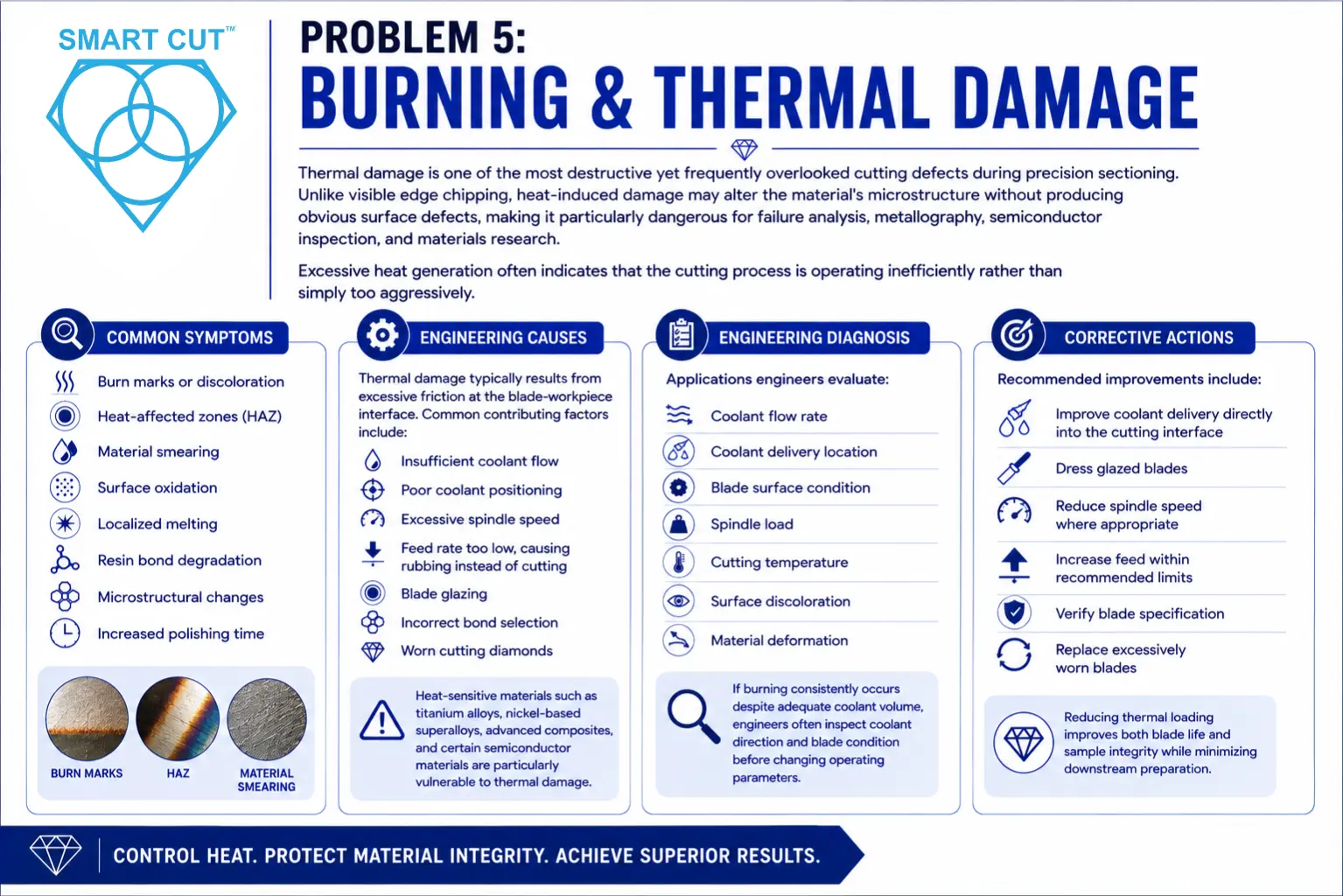
Thermal damage is one of the most destructive yet frequently overlooked cutting defects during precision sectioning. Unlike visible edge chipping, heat-induced damage may alter the material’s microstructure without producing obvious surface defects, making it particularly dangerous for failure analysis, metallography, semiconductor inspection, and materials research.

Excessive heat generation often indicates that the cutting process is operating inefficiently rather than simply too aggressively.

Common Symptoms

● Burn marks or discoloration

● Heat-affected zones (HAZ)

● Material smearing

● Surface oxidation

● Localized melting

● Resin bond degradation

● Microstructural changes

● Increased polishing time

Engineering Causes

Thermal damage typically results from excessive friction at the blade-workpiece interface.

Common contributing factors include:

● Insufficient coolant flow

● Poor coolant positioning

● Excessive spindle speed

Feed rate too low, causing rubbing instead of cutting

● Blade glazing

● Incorrect bond selection

● Worn cutting diamonds

Heat-sensitive materials such as titanium alloys, nickel-based superalloys, advanced composites, and certain semiconductor materials are particularly vulnerable to thermal damage.

Engineering Diagnosis

Applications engineers evaluate:
● Coolant flow rate

● Coolant delivery location

● Blade surface condition

● Spindle load

● Cutting temperature

● Surface discoloration

● Material deformation

If burning consistently occurs despite adequate coolant volume, engineers often inspect coolant direction and blade condition before changing operating parameters.

Corrective Actions

Recommended improvements include:

● Improve coolant delivery directly into the cutting interface

● Dress glazed blades

● Reduce spindle speed where appropriate

● Increase feed within recommended limits

● Verify blade specification

● Replace excessively worn blades

Reducing thermal loading improves both blade life and sample integrity while minimizing downstream preparation.

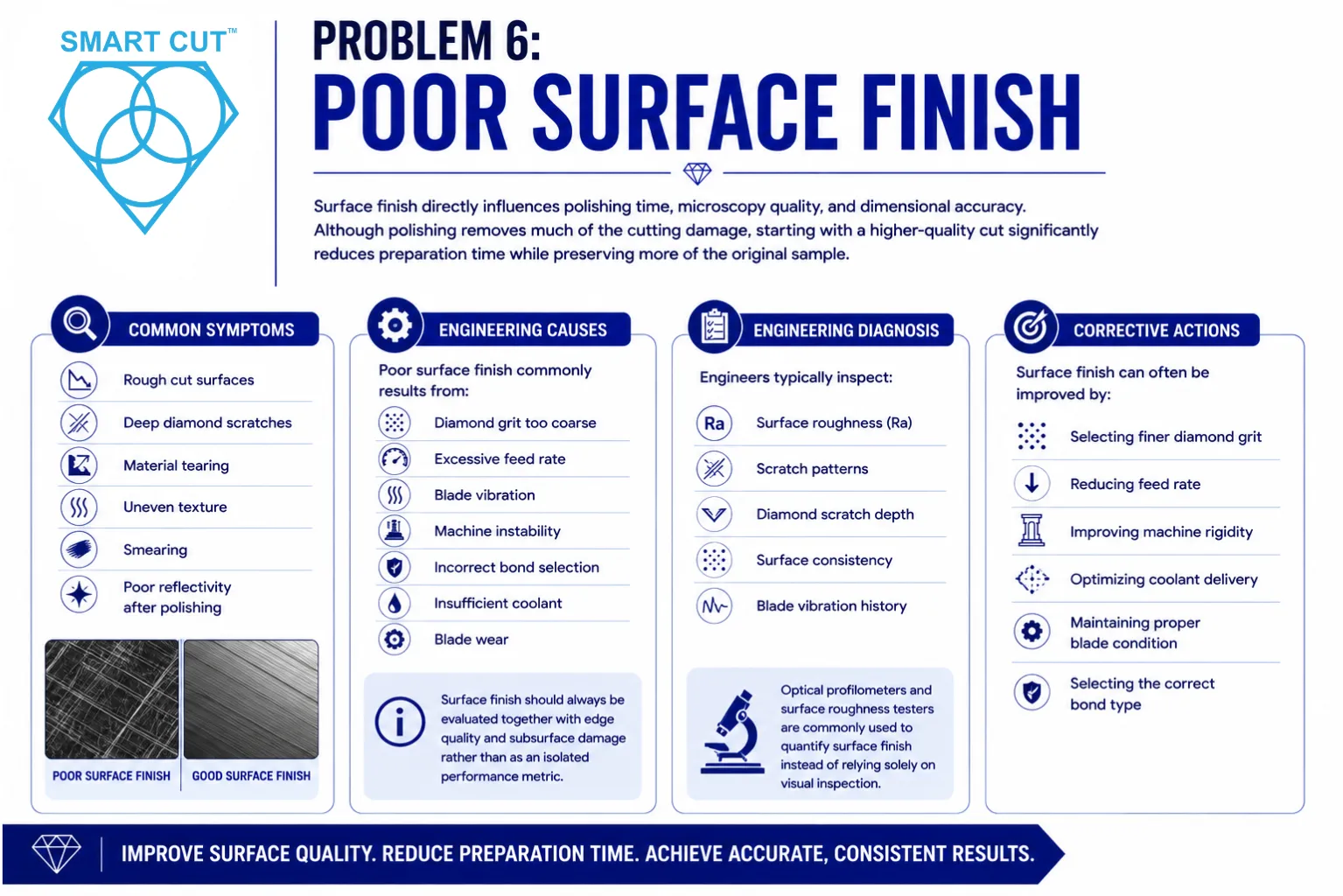
Problem 6: Poor Surface Finish

Surface finish directly influences polishing time, microscopy quality, and dimensional accuracy.

Although polishing removes much of the cutting damage, starting with a higher-quality cut significantly reduces preparation time while preserving more of the original sample.

Common Symptoms

● Rough cut surfaces

● Deep diamond scratches

● Material tearing

● Uneven texture

● Smearing

● Poor reflectivity after polishing

Engineering Causes

Poor surface finish commonly results from:

● Diamond grit too coarse

● Excessive feed rate

● Blade vibration

● Machine instability

● Incorrect bond selection

● Insufficient coolant

● Blade wear

Surface finish should always be evaluated together with edge quality and subsurface damage rather than as an isolated performance metric.

Engineering Diagnosis

Engineers typically inspect:

● Surface roughness (Ra)

● Scratch patterns

● Diamond scratch depth

● Surface consistency

● Blade vibration history

Optical profilometers and surface roughness testers are commonly used to quantify surface finish instead of relying solely on visual inspection.

Corrective Actions

Surface finish can often be improved by:

● Selecting finer diamond grit

● Reducing feed rate

● Improving machine rigidity

● Optimizing coolant delivery

● Maintaining proper blade condition

● Selecting the correct bond type

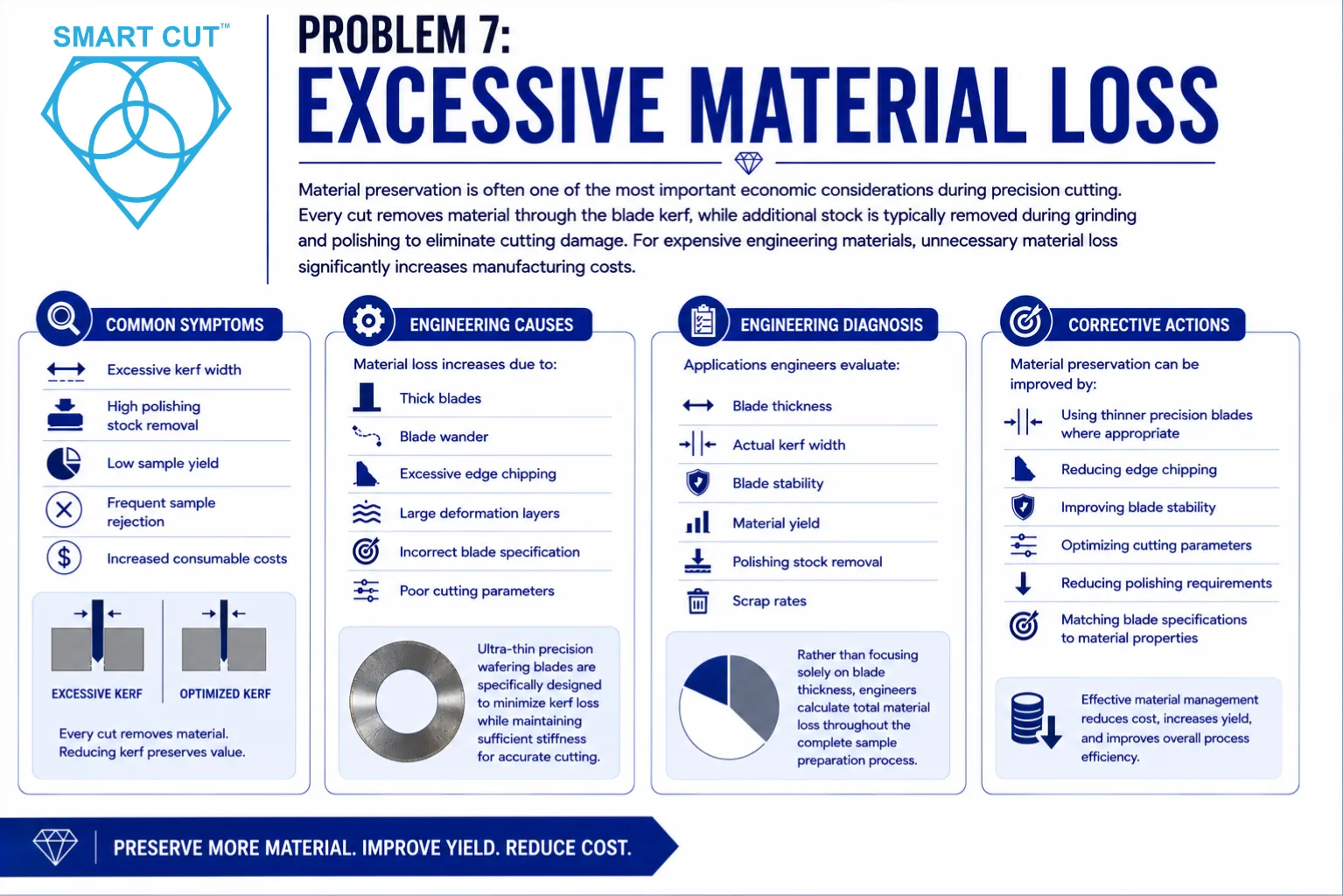
Problem 7: Excessive Material Loss

Material preservation is often one of the most important economic considerations during precision cutting.

Every cut removes material through the blade kerf, while additional stock is typically removed during grinding and polishing to eliminate cutting damage.

For expensive engineering materials, unnecessary material loss significantly increases manufacturing costs.

Common Symptoms

● Excessive kerf width

● High polishing stock removal

● Low sample yield

● Frequent sample rejection

● Increased consumable costs

Engineering Causes

Material loss increases due to:

● Thick blades

● Blade wander

● Excessive edge chipping

● Large deformation layers

● Incorrect blade specification

● Poor cutting parameters

Ultra-thin precision wafering blades are specifically designed to minimize kerf loss while maintaining sufficient stiffness for accurate cutting.

Engineering Diagnosis

Applications engineers evaluate:

● Blade thickness

● Actual kerf width

● Blade stability

● Material yield

● Polishing stock removal

● Scrap rates

Rather than focusing solely on blade thickness, engineers calculate total material loss throughout the complete sample preparation process.

Corrective Actions

Material preservation can be improved by:

● Using thinner precision blades where appropriate

● Reducing edge chipping

● Improving blade stability

● Optimizing cutting parameters

● Reducing polishing requirements

● Matching blade specifications to material properties

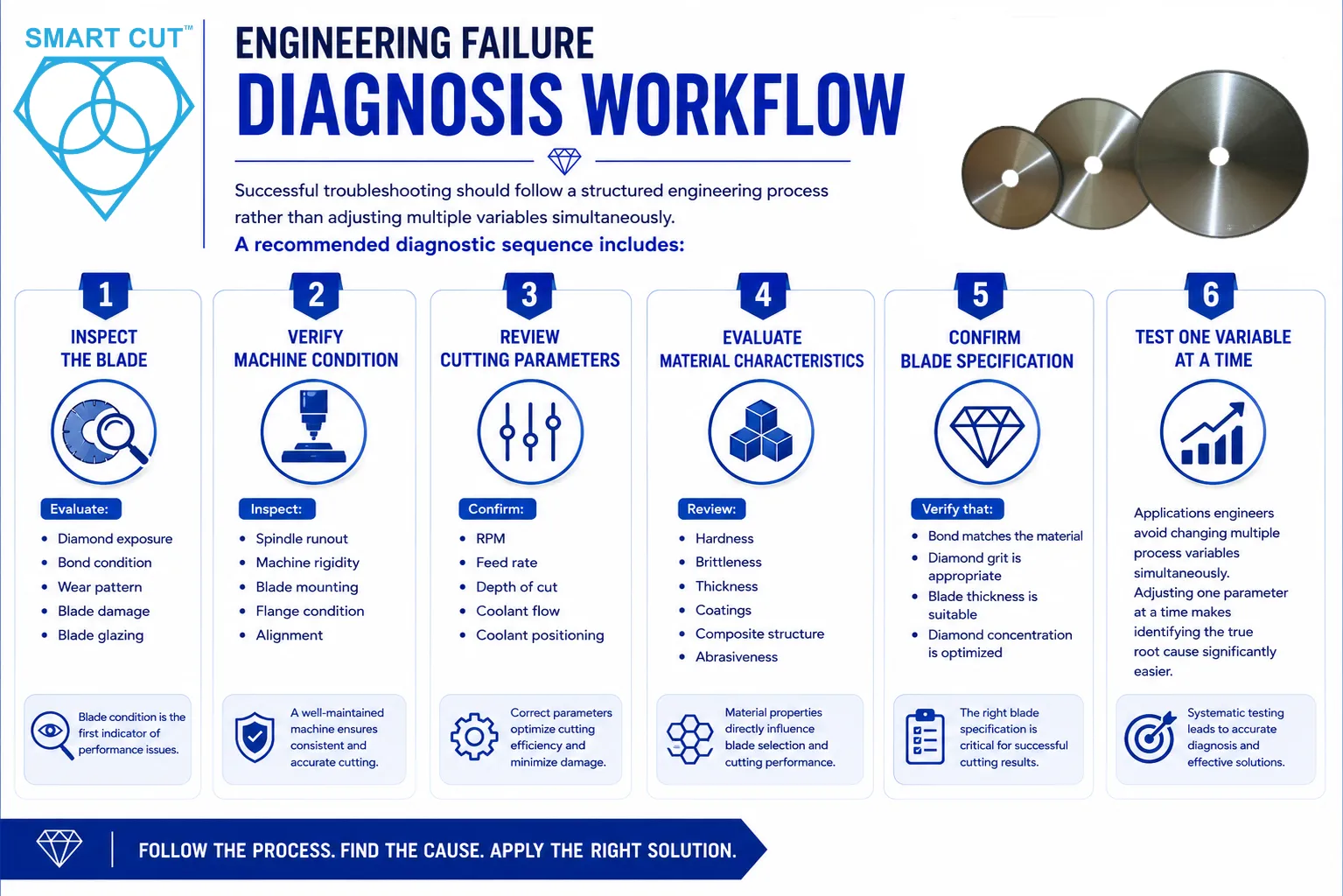
Engineering Failure Diagnosis Workflow

Successful troubleshooting should follow a structured engineering process rather than adjusting multiple variables simultaneously.
A recommended diagnostic sequence includes:

Step 1 – Inspect the Blade
Evaluate:

● Diamond exposure

● Bond condition

● Wear pattern

● Blade damage

● Blade glazing

Step 2 – Verify Machine Condition

Inspect:

● Spindle runout

● Machine rigidity

● Blade mounting

● Flange condition

● Alignment

Step 3 – Review Cutting Parameters

Confirm:

● RPM

Feed rate

● Depth of cut

● Coolant flow

● Coolant positioning

Step 4 – Evaluate Material Characteristics

Review:

● Hardness

● Brittleness

● Thickness

● Coatings

● Composite structure

● Abrasiveness

Step 5 – Confirm Blade Specification

Verify that:

● Bond matches the material

● Diamond grit is appropriate

● Blade thickness is suitable

● Diamond concentration is optimized

Step 6 – Test One Variable at a Time

Applications engineers avoid changing multiple process variables simultaneously.

Adjusting one parameter at a time makes identifying the true root cause significantly easier.

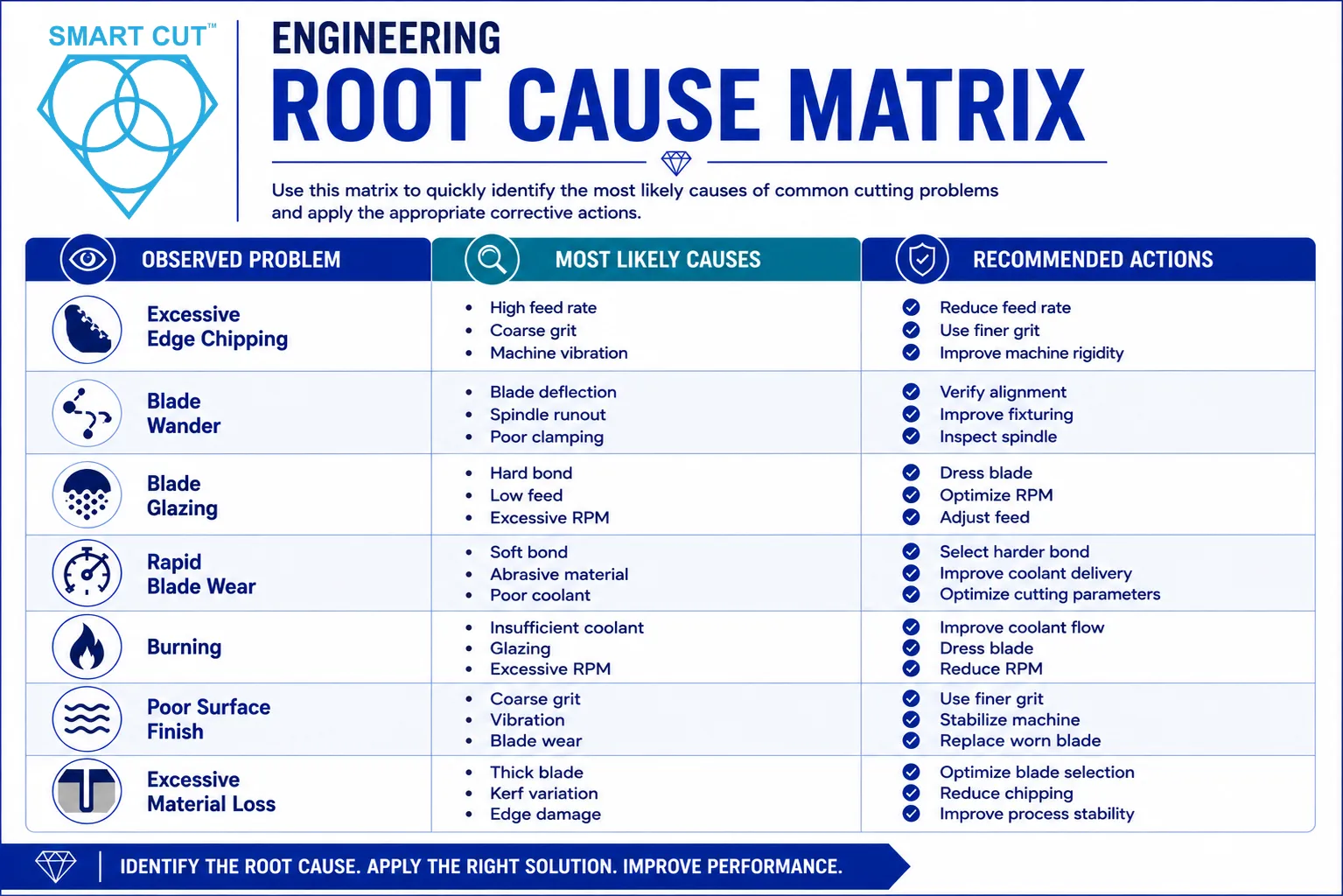
Engineering Root Cause Matrix

Observed ProblemMost Likely CausesRecommended Actions
Excessive Edge ChippingHigh feed rate, coarse grit, machine vibrationReduce feed rate, use finer grit, improve machine rigidity
Blade WanderBlade deflection, spindle runout, poor clampingVerify alignment, improve fixturing, inspect spindle
Blade GlazingHard bond, low feed, excessive RPMDress blade, optimize RPM, adjust feed
Rapid Blade WearSoft bond, abrasive material, poor coolantSelect harder bond, improve coolant delivery
BurningInsufficient coolant, glazing, excessive RPMImprove coolant flow, dress blade, reduce RPM
Poor Surface FinishCoarse grit, vibration, blade wearUse finer grit, stabilize machine, replace worn blade
Excessive Material LossThick blade, kerf variation, edge damageOptimize blade selection, reduce chipping, improve process stability

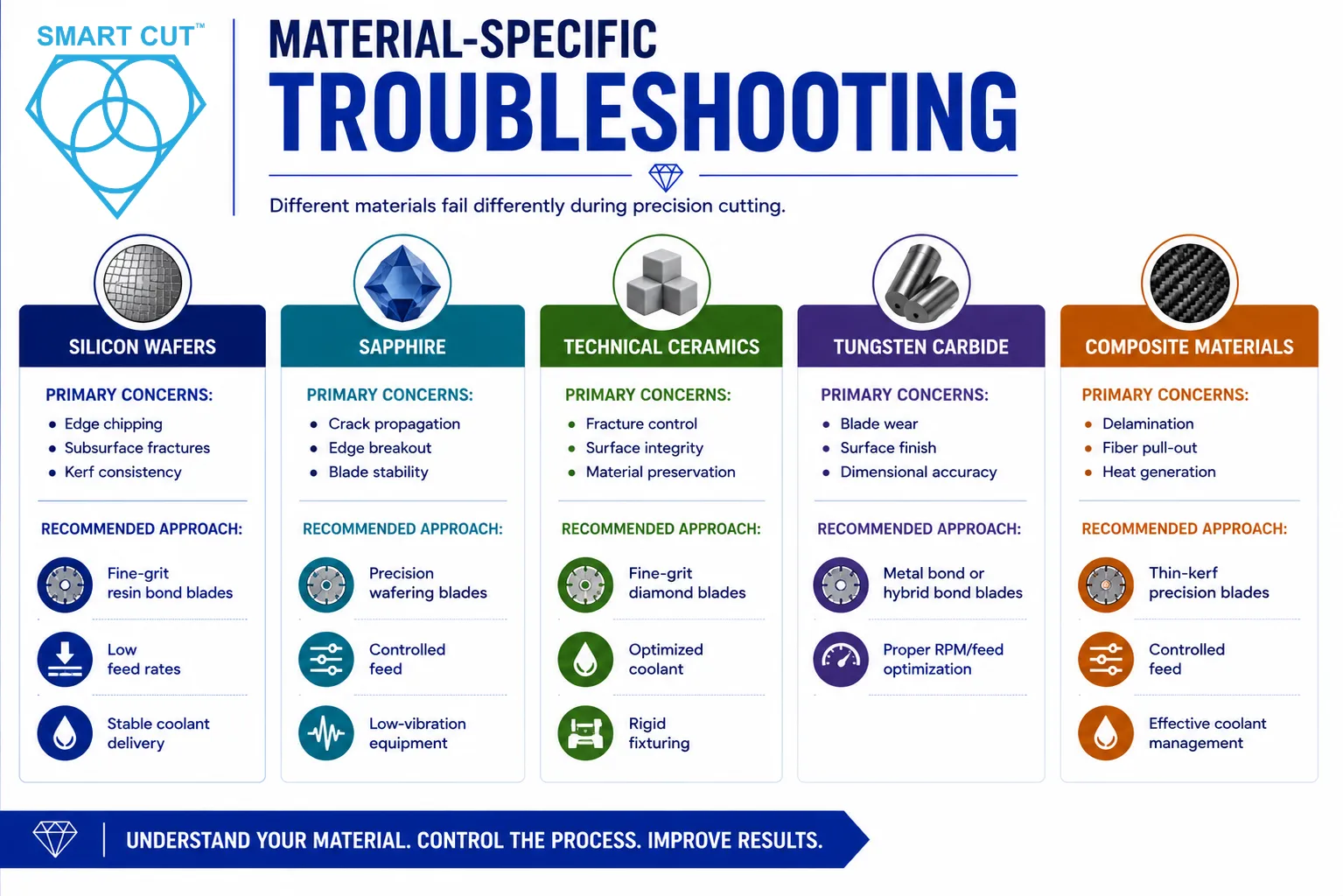
Material-Specific Troubleshooting

Different materials fail differently during precision cutting.

Silicon Wafers

Primary concerns:

● Edge chipping

● Subsurface fractures

● Kerf consistency

Recommended approach:

● Fine-grit resin bond blades

● Low feed rates

● Stable coolant delivery

Sapphire

Primary concerns:

● Crack propagation

● Edge breakout

● Blade stability

Recommended approach:

Precision wafering blades

● Controlled feed

● Low-vibration equipment

Technical Ceramics

Primary concerns:

● Fracture control

● Surface integrity

● Material preservation

Recommended approach:

● Fine-grit diamond blades

● Optimized coolant

● Rigid fixturing

Tungsten Carbide

Primary concerns:

● Blade wear

● Surface finish

● Dimensional accuracy

Recommended approach:

● Metal bond or hybrid bond blades

● Proper RPM/feed optimization

Composite Materials

Primary concerns:

● Delamination

● Fiber pull-out

● Heat generation

Recommended approach:

● Thin-kerf precision blades

● Controlled feed

● Effective coolant management

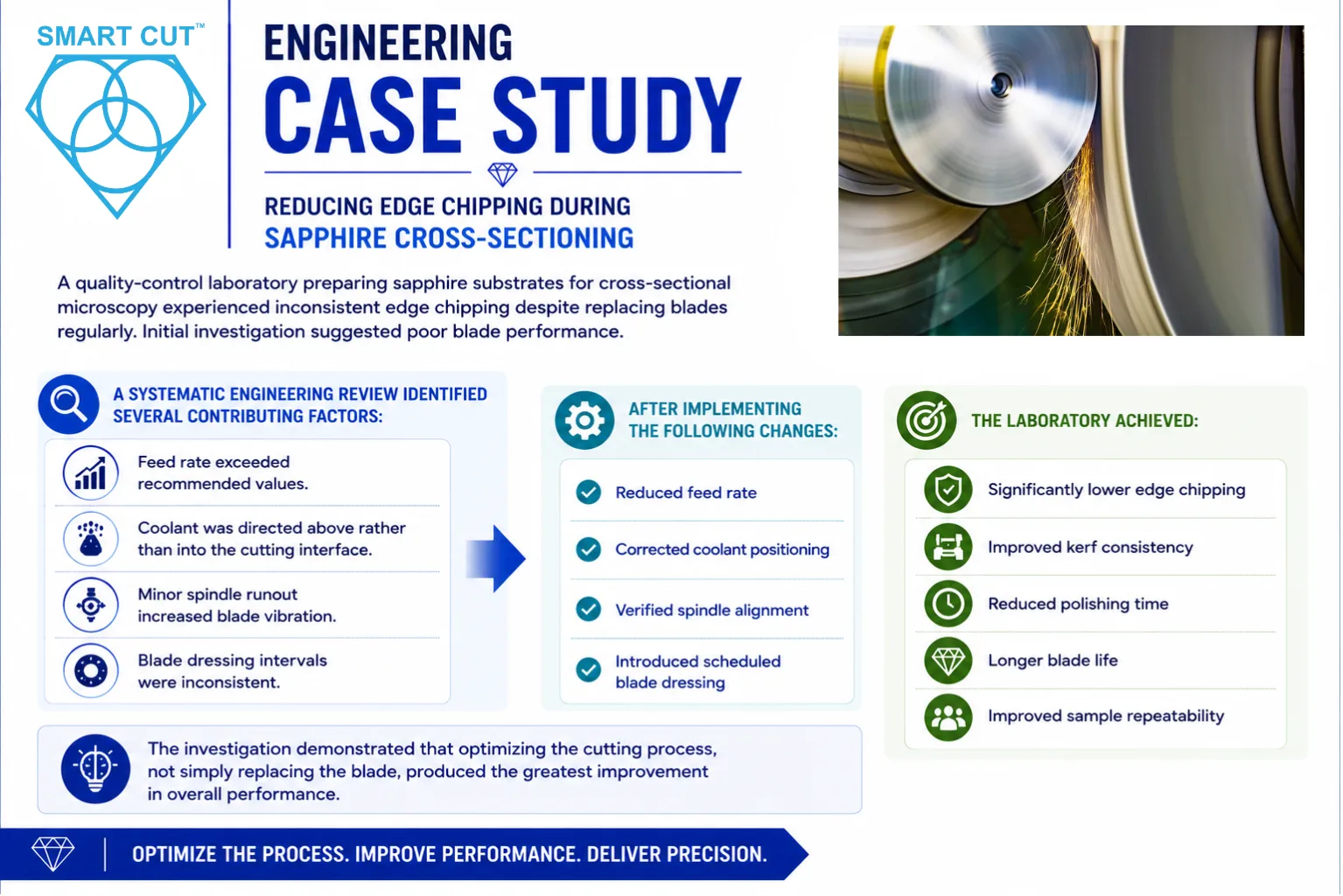
Engineering Case Study

Reducing Edge Chipping During Sapphire Cross-Sectioning

A quality-control laboratory preparing sapphire substrates for cross-sectional microscopy experienced inconsistent edge chipping despite replacing blades regularly.

Initial investigation suggested poor blade performance.

A systematic engineering review identified several contributing factors:

Feed rate exceeded recommended values.

● Coolant was directed above rather than into the cutting interface.

● Minor spindle runout increased blade vibration.

● Blade dressing intervals were inconsistent.

After implementing the following changes:

● Reduced feed rate

● Corrected coolant positioning

● Verified spindle alignment

● Introduced scheduled blade dressing

the laboratory achieved:

● Significantly lower edge chipping

● Improved kerf consistency

● Reduced polishing time

● Longer blade life

● Improved sample repeatability

The investigation demonstrated that optimizing the cutting process, not simply replacing the blade, produced the greatest improvement in overall performance.

Frequently Asked Questions

Excessive edge chipping is commonly caused by aggressive feed rates, improper blade specifications, insufficient machine rigidity, excessive spindle runout, poor coolant delivery, or inadequate workpiece support. Identifying the root cause requires evaluating the complete cutting system rather than focusing on the blade alone.

A blade that appears visually acceptable may have become glazed, where worn diamond particles remain trapped within the bond instead of exposing fresh cutting edges. Incorrect bond selection, excessive spindle speed, or insufficient dressing are among the most common causes of reduced cutting efficiency.

Blade wander typically results from machine-related issues such as spindle runout, inadequate machine rigidity, improper workpiece clamping, excessive cutting pressure, or using a blade that lacks sufficient stiffness for the application. Verifying machine alignment and optimizing cutting parameters usually resolves the problem.

Yes. Coolant not only removes heat but also flushes debris from the cutting interface and reduces friction. Poor coolant positioning or inadequate flow can increase thermal damage, accelerate blade wear, promote glazing, and reduce overall cut quality.

If cutting performance declines due to blade glazing while sufficient diamond remains within the bond, dressing the blade can often restore cutting efficiency. However, if the blade has reached its wear limit, exhibits structural damage, or no longer meets dimensional requirements, replacement is the appropriate solution.

Even identical blades may produce different results due to variations in machine condition, spindle accuracy, operator technique, workpiece material, feed rate, coolant application, and cutting speed. Blade performance should always be evaluated as part of the complete cutting process rather than as an isolated component.

The most effective approach is a systematic engineering evaluation. Begin by inspecting the blade, verifying machine condition, reviewing cutting parameters, evaluating the workpiece material, and confirming that the blade specification matches the application. Adjust one variable at a time to accurately identify the root cause.

Optimizing blade life and cut quality requires selecting the correct blade specification, maintaining machine rigidity, controlling feed rate and spindle speed, ensuring proper coolant delivery, periodically dressing the blade when necessary, and routinely inspecting machine condition. A balanced process generally delivers better long-term performance than maximizing any single operating parameter.

Conclusion

Precision diamond blade failures are rarely the result of poor blade quality alone.
Most cutting problems—including edge chipping, blade wandering, glazing, rapid wear, burning, poor surface finish, and excessive material loss—develop from the interaction between the blade, machine, material, operator, and cutting parameters. Successfully resolving these issues requires a systematic engineering approach that identifies the true root cause rather than simply replacing the blade.
By evaluating blade condition, machine performance, coolant effectiveness, operating parameters, and material characteristics together, manufacturers and laboratories can significantly improve cut quality, increase blade life, reduce polishing requirements, minimize scrap, and achieve greater process repeatability.

Trusted by Tens of Thousands of Manufacturers, Laboratories,
Research Institutions Worldwide Since 1990

American Based Manufacturer

Established in 1990

Custom manufacturing

RELATED ARTICLES