





















How Diamond Mesh Size Affects Grinding Performance and Surface Finish

Table of Contents
Toggle
American Based Manufacturer

Established in 1990


Custom manufacturing


Diamond mesh size is one of the most misunderstood yet influential variables in diamond grinding wheel design. Engineers often focus on bond type, spindle speed, coolant delivery, or wheel concentration when troubleshooting grinding problems, while the abrasive particle size receives far less attention than it deserves. In reality, diamond mesh size directly influences chip formation, grinding forces, stock removal rate, surface finish, wheel wear, dressing frequency, heat generation, dimensional accuracy, and overall process stability.
Selecting an inappropriate mesh size frequently produces production problems that appear unrelated to the abrasive specification. Poor surface finish, excessive wheel glazing, frequent dressing, thermal damage, inconsistent grinding forces, rapid wheel wear, and edge chipping may all originate from selecting a diamond particle size that does not match the application requirements.
For manufacturers processing silicon carbide, alumina, sapphire, optical glass, fused silica, quartz, silicon nitride, gallium arsenide, tungsten carbide, polycrystalline diamond (PCD), chemical vapor deposition (CVD) diamond, and other advanced engineering materials, diamond mesh size becomes one of the primary variables controlling both productivity and finished component quality.
This article explains how engineers evaluate diamond mesh size during process qualification, how abrasive particle size influences grinding performance, and how mesh selection should be integrated with bond type, diamond concentration, dressing practices, machine capability, and coolant delivery. Rather than presenting rigid recommendations, this guide discusses engineering principles and qualification strategies that support informed decision making across a wide range of precision grinding applications.
Why Engineers Evaluate Diamond Mesh Size
Diamond mesh size is rarely reviewed without a reason. Most process evaluations begin after a measurable change in production performance or when a new grinding application is introduced.
Typical production triggers include:
|
Production Observation |
Engineering Review Required |
|---|---|
|
Surface finish deteriorating |
Evaluate abrasive size, wheel condition, and grinding stability |
|
Material removal becoming inconsistent |
Review mesh size together with bond type and concentration |
|
Wheel glazing occurring more frequently |
Evaluate abrasive exposure and dressing practices |
|
Excessive wheel wear |
Review wheel specification and process qualification |
|
Edge chipping increasing |
Inspect abrasive size, grinding forces, and process stability |
|
Thermal damage appearing |
Review abrasive specification, coolant delivery, and wheel condition |
|
New workpiece material introduced |
Perform complete process qualification |
|
Customer tolerance becoming tighter |
Reevaluate wheel specification and grinding methodology |
Changing mesh size should always be supported by engineering documentation rather than trial and error adjustments.
What Is Diamond Mesh Size?
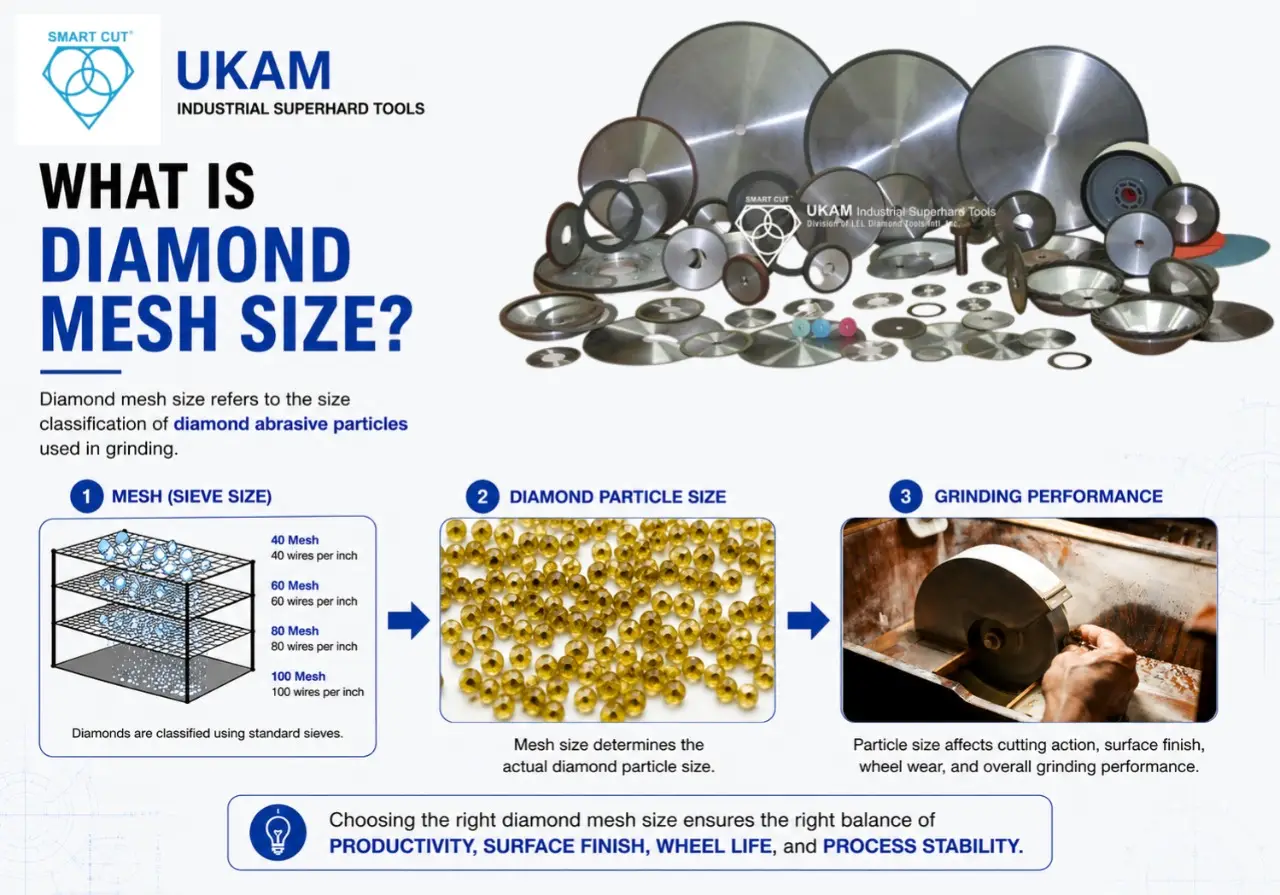
Diamond mesh size describes the approximate size classification of diamond particles used within a grinding wheel. The classification is based on the size of the openings in standardized sieves through which the abrasive particles pass during manufacturing.
Contrary to common misunderstanding, a larger mesh number represents a smaller diamond particle.
For example:
- 40 mesh contains relatively large abrasive particles.
- 80 mesh contains smaller particles.
- 140 mesh contains considerably finer particles.
- 325 mesh contains extremely fine particles suitable for precision finishing applications.
Particle size influences the number of active cutting points present on the grinding wheel surface. Larger particles penetrate more deeply into the workpiece and generally remove larger chips, while finer particles produce more cutting points that distribute grinding forces across a greater contact area.
Diamond Mesh, Diamond Grit and Micron Size
Engineers frequently encounter three different methods for describing abrasive particle size:
- Mesh size
- Grit size
- Micron size
Although these terms are often used interchangeably, they describe different methods of classifying abrasive particles.
|
Classification |
Description |
Typical Use |
|---|---|---|
|
Mesh Size |
Based on standardized sieve openings used during particle classification |
Grinding wheel specifications |
|
Grit Size |
General industry terminology describing abrasive size |
Manufacturing and tooling |
|
Micron Size |
Direct measurement of particle diameter expressed in micrometers |
Precision grinding, lapping and polishing |
Micron measurements provide the most direct description of particle size, while mesh numbers remain the most common terminology used when specifying diamond grinding wheels.
How Diamond Mesh Classification Works
Diamond particles are classified using precision sieves containing a defined number of openings per linear inch.
A 40 mesh sieve contains approximately forty openings per inch, while a 100 mesh sieve contains approximately one hundred openings per inch. Larger particles are retained by coarser sieves, while progressively smaller particles pass through increasingly finer screens until the desired particle distribution is obtained.
This classification system provides a consistent method for manufacturing grinding wheels with controlled abrasive size distributions.
Comprehensive Diamond Mesh Size Reference Chart
The following engineering reference summarizes common diamond mesh sizes used in precision grinding applications. The values represent typical engineering practice and should be verified through process qualification.
|
Mesh Size |
Approx. Micron Range |
Relative Stock Removal |
Relative Stock Removal |
Typical Surface Finish |
Typical Applications |
|---|---|---|---|---|---|
|
30/40 |
600–500 µm |
Very High |
Rough |
Heavy stock removal |
Abrasive ceramics, rough grinding |
|
40/50 |
500–400 µm |
High |
Rough |
Surface grinding |
Stone, ceramics |
|
50/60 |
400–300 µm |
High |
Medium |
Cylindrical grinding |
Tungsten carbide, engineering ceramics |
|
60/80 |
300–177 µm |
Medium High |
Medium |
General grinding |
Glass, ceramic components |
|
80/100 |
177–149 µm |
Medium |
Fine |
Precision grinding |
Advanced ceramics |
|
100/120 |
149–125 µm |
Medium |
Finish grinding |
Finish grinding |
Sapphire, optical components |
|
120/140 |
125–105 µm |
Medium Low |
Very Fine |
Precision finishing |
Semiconductor materials |
|
140/170 |
Low |
Low |
Excellent |
Fine grinding |
Quartz, fused silica |
|
170/200 |
90–75 µm |
Low |
Excellent |
Precision finishing |
Fine ceramics |
|
200/230 |
75–63 µm |
Very Low |
Excellent |
Finish grinding |
PCD preparation |
|
230/270 |
63–53 µm |
Very Low |
Ultra Fine |
Precision finishing |
Optical components |
| 325 |
~45 µm |
Minimal |
Ultra Fine |
Metallographic preparation |
Research and laboratory applications |
These values represent general engineering guidance rather than mandatory specifications. Final mesh selection should always consider the workpiece material, bond system, machine capability, wheel concentration, and production objectives.
Diamond Mesh to Micron Conversion Guide
Many engineering drawings, supplier specifications, and research papers reference diamond size in microns rather than mesh numbers. The following simplified guide illustrates common classification ranges.
|
Mesh Classification |
Approx. Micron Range |
Typical Engineering Use |
|---|---|---|
|
Coarse |
600–250 µm |
Heavy stock removal |
|
Medium |
250–125 µm |
General precision grinding |
|
Fine |
125–63 µm |
Finish grinding |
|
Ultra Fine |
Below 63 µm |
Precision finishing, lapping preparation and polishing |
Micron classification becomes increasingly important during optical manufacturing, semiconductor processing, and metallographic sample preparation where very small changes in abrasive size may significantly influence surface integrity.
Coarse Versus Fine Diamond Mesh
One of the most common engineering questions is whether a coarser or finer diamond mesh should be selected. There is no universal answer because each offers different performance characteristics.
|
Engineering Variable |
Coarser Mesh |
Finer Mesh |
|---|---|---|
|
Relative Stock Removal |
Higher |
Lower |
|
Surface Finish |
Rougher |
Smoother |
|
Chip Size |
Larger |
Smaller |
|
Feed Rate Potential |
Higher |
Lower |
|
Wheel Loading Tendency |
Lower |
Higher |
|
Dressing Frequency |
Generally Lower |
May Increase |
|
Heat Generation |
Typically Lower |
May Increase if Not Optimized |
|
Dimensional Control |
Moderate |
Higher |
|
Edge Chipping Risk |
Higher on Brittle Materials |
Generally Lower |
|
Typical Production Stage |
Rough Grinding |
Finish Grinding |
Selecting between coarse and fine abrasives therefore becomes an engineering optimization problem rather than simply choosing the smallest available particle size.
Engineering Perspective
Diamond mesh size should never be evaluated independently. Engineers obtain the most consistent grinding performance when abrasive size is considered together with bond type, concentration, wheel structure, machine rigidity, coolant delivery, dressing practices, and production objectives.
Successful grinding processes rarely result from optimizing a single variable. They are achieved by balancing the entire grinding system.
Material Specific Diamond Mesh Size Selection
Selecting the appropriate diamond mesh size begins with understanding the material being ground. Hardness alone should never determine abrasive size. Fracture toughness, brittleness, thermal conductivity, required surface finish, dimensional tolerance, stock removal requirements, and downstream manufacturing operations all influence the final specification.
The following recommendations represent common engineering practice and should be verified through controlled process qualification rather than treated as universal specifications.
Silicon carbide is among the hardest engineering ceramics processed with diamond grinding wheels. Its combination of high hardness and brittle fracture behavior requires careful balancing between productivity and surface integrity. This material family falls within UKAM’s broader advanced ceramics application range.
Typical Engineering Practice: Medium to coarse diamond mesh sizes are frequently evaluated during rough grinding where efficient stock removal is required. As dimensional tolerances become tighter and the process transitions toward finishing, finer mesh sizes are commonly investigated to improve surface quality and reduce the likelihood of subsurface damage.
Engineering Considerations: Material removal rate, surface integrity, wheel wear, grinding stability, thermal effects, dimensional accuracy.
Common Production Mistakes: Selecting the coarsest available mesh solely to maximize removal rate; increasing spindle speed before evaluating abrasive size; changing mesh size without reviewing wheel dressing practices.
Qualification Strategy: Begin with the existing qualified wheel specification and introduce only one controlled mesh size change while documenting surface finish, wheel condition, spindle load, and dimensional consistency.
Alumina
Alumina is widely used in electronic substrates, wear components, seals, and structural ceramic applications. Grinding requirements vary considerably depending on density, purity, and finished component specifications.
Typical Engineering Practice: Medium mesh sizes often provide an effective balance between stock removal and dimensional control. Finer mesh sizes are commonly evaluated for applications requiring lower surface roughness before polishing or assembly.
Engineering Considerations: Edge quality, surface finish, grinding force, wheel loading tendency, part geometry.
Common Production Mistakes: Selecting mesh size only according to finish requirements; ignoring bond type during wheel qualification; increasing dressing frequency instead of reviewing abrasive specification.
Qualification Strategy: Document baseline process conditions before introducing finer abrasives. Compare both productivity and finished surface quality during qualification.
Sapphire
Sapphire components are highly valued for their optical transparency, hardness, and wear resistance. These same characteristics make grinding particularly demanding, and are frequently paired with UKAM’s optics industry tooling solutions.
Typical Engineering Practice: Fine diamond mesh sizes are commonly evaluated where optical quality and edge integrity receive higher priority than maximum stock removal.
Engineering Considerations: Edge chipping, subsurface damage, surface integrity, polishing allowance, thermal stability.
Common Production Mistakes: Selecting coarse abrasives during finishing operations; assuming coolant alone prevents edge damage; evaluating spindle speed before reviewing abrasive size.
Qualification Strategy: Qualification should emphasize inspection of both visible surface finish and edge quality while monitoring grinding stability throughout production.
Optical Glass
Optical glass components frequently require subsequent polishing. Grinding therefore becomes a controlled material removal process rather than simply achieving dimensional accuracy — see UKAM’s glass and quartz application guide for related tooling.
Typical Engineering Practice: Engineers commonly evaluate progressively finer mesh sizes as production advances from rough shaping toward finish grinding.
Engineering Considerations: Surface roughness, subsurface damage, polishing efficiency, wheel wear, dimensional stability.
Common Production Mistakes: Maximizing removal rate without considering polishing time; delaying wheel maintenance until finish quality deteriorates.
Qualification Strategy: Qualification should consider the complete manufacturing sequence rather than the grinding operation alone.
Quartz
Quartz exhibits brittle fracture characteristics that require stable grinding conditions.
Typical Engineering Practice: Mesh size should be evaluated together with machine rigidity and coolant delivery to minimize uncontrolled fracture.
Engineering Considerations: Crack initiation, edge quality, surface integrity, dimensional accuracy.
Common Production Mistakes: Introducing multiple specification changes simultaneously; assuming wheel wear alone determines grinding quality.
Fused Silica
Fused silica components are commonly used in semiconductor, optical, and scientific applications where surface quality is critical.
Typical Engineering Practice: Medium to fine diamond mesh sizes are frequently investigated for finishing operations requiring controlled surface integrity.
Engineering Considerations: Surface damage, thermal effects, wheel loading, dimensional repeatability.
Qualification Strategy: Surface inspection should accompany every process adjustment.
Tungsten Carbide
Tungsten carbide combines extreme hardness with high wear resistance. Successful grinding depends on balancing productivity against wheel life; UKAM’s precision carbide tools line addresses related machining needs.
Typical Engineering Practice: Engineers often begin qualification using medium mesh sizes before evaluating either coarser or finer abrasives according to production objectives.
Engineering Considerations: Stock removal efficiency, wheel wear, surface finish, grinding forces.
Common Production Mistakes: Assuming coarse abrasives always improve productivity; replacing wheels before reviewing process stability.
Silicon Nitride
Silicon nitride combines high strength with brittle fracture characteristics.
Typical Engineering Practice: Mesh size selection generally prioritizes dimensional accuracy and stable grinding forces.
Engineering Considerations: Edge integrity, wheel loading, dressing interval, surface consistency.
Qualification Strategy: Machine condition should always be verified before modifying wheel specifications.
Polycrystalline Diamond (PCD)
PCD tools require highly controlled grinding processes because finished edge quality directly influences tool performance. UKAM manufactures dedicated PCD and PCBN tooling for this purpose.
Typical Engineering Practice: Fine diamond mesh sizes are commonly evaluated for finish grinding operations.
Engineering Considerations: Edge sharpness, surface quality, wheel condition, dressing consistency.
Common Production Mistakes: Delaying wheel dressing; modifying multiple variables during qualification.
CVD Diamond
Grinding CVD diamond places significant demands on machine capability and wheel specification, and typically involves UKAM’s chemical vapor deposition diamond tools.
Typical Engineering Practice: Qualification generally emphasizes repeatability rather than maximum production speed.
Engineering Considerations: Grinding stability, surface integrity, wheel wear, machine rigidity.
Gallium Arsenide (GaAs)
Gallium arsenide is widely used within semiconductor manufacturing where brittle fracture and surface damage directly influence device performance.
Typical Engineering Practice: Fine abrasives are frequently evaluated for finishing operations requiring excellent surface quality.
Engineering Considerations: Edge damage, surface integrity, dimensional accuracy, thermal stability.
Advanced Ceramics
Advanced ceramics represent a broad family of materials with significantly different grinding characteristics.
Engineering Practice: Rather than selecting one standard mesh size, engineers typically qualify individual wheel specifications for each ceramic family while documenting stock removal, surface finish, wheel wear, and process stability.
Engineering Tradeoffs Between Coarse and Fine Diamond Mesh
One of the most common engineering decisions involves balancing production efficiency against finished component quality.
|
Engineering Variable |
Smaller Diamond Mesh (Fine) |
Larger Diamond Mesh (Coarse) |
|---|---|---|
|
Material Removal Rate |
Lower |
Higher |
|
Surface Finish |
Better |
Rougher |
|
Chip Size |
Smaller |
Larger |
|
Feed Rate |
Lower |
Higher |
|
Edge Chipping Risk |
Lower |
Higher |
|
Wheel Loading |
May Increase |
Generally Lower |
|
Dressing Frequency |
May Increase |
Often Lower |
|
Grinding Forces |
Distributed Across More Cutting Points |
Concentrated on Fewer Cutting Points |
|
Heat Generation |
May Increase if Parameters Are Incorrect |
Generally Lower During Rough Grinding |
|
Dimensional Control |
Higher |
Moderate |
|
Typical Application |
Finish Grinding |
Rough Grinding |
These trends represent general engineering observations and should be validated through production trials.
Common Mesh Size Selection Mistakes
Many production problems originate from engineering decisions rather than wheel quality. The most frequently observed mistakes include:
- Selecting the finest mesh available without defining the production objective.
- Choosing a coarse mesh solely to maximize stock removal.
- Changing mesh size before evaluating bond type.
- Ignoring machine rigidity during qualification.
- Increasing dressing frequency instead of reviewing abrasive specification.
- Assuming coolant delivery compensates for an incorrect wheel specification.
- Introducing multiple process changes simultaneously.
- Failing to document qualification results.
Successful process optimization begins with systematic engineering evaluation rather than repeated wheel replacement.
Bond Type and Diamond Mesh Selection Matrix
Diamond mesh size should never be selected independently of the bond system. Bond type controls diamond retention, wheel wear characteristics, self sharpening behavior, grinding forces, and dressing requirements. The interaction between bond and abrasive size often has a greater influence on grinding performance than either variable alone.
The following table summarizes common engineering practice. Final specifications should always be confirmed through production qualification.
|
Bond Type |
Typical Coarse Mesh |
Typical Medium Mesh |
Typical Fine Mesh |
Typical Applications |
|---|---|---|---|---|
|
Metal Bond |
30–60 Mesh |
70–120 Mesh |
140–200 Mesh |
Tungsten carbide, engineering ceramics, glass |
|
Resin Bond |
100–180 Mesh |
200–320 Mesh |
320–600 Mesh |
Precision grinding, optical materials, semiconductor applications |
|
Vitrified Bond |
80–150 Mesh |
180–320 Mesh |
400–1200 Mesh |
High precision grinding, advanced ceramic |
|
Nickel Bond |
80–120 Mesh |
150–220 Mesh |
230–270 Mesh |
Electroplated tools, profiling |
|
Brazed Bond |
40–100 Mesh |
120–180 Mesh |
200–300 Mesh |
High exposure cutting and grinding applications |
Engineering Note: Mesh size should always be evaluated together with bond hardness, diamond concentration, coolant method, machine rigidity, and wheel dressing practices. Selecting a finer mesh while retaining an unsuitable bond often produces little improvement. For a deeper comparison of bond systems, see UKAM’s guide to choosing the correct diamond bond type.
UKAM manufactures wheels across every major bond family, including Sintered (Metal Bond), Resin Bond, Vitrified Bond, Electroplated (Nickel Bond), Brazed Bond, and Hybrid Bond tools, each engineered using proprietary SMART CUT technology.
Typical Engineering Process Qualification Workflow
Changing a grinding wheel specification without documenting baseline conditions frequently results in inconsistent conclusions. A structured qualification process isolates the effect of each engineering variable.
Phase 1. Define Production Objective
Document the reason for qualification. Examples include improved surface finish, increased material removal, longer wheel life, reduced edge chipping, and lower production cost.
Phase 2. Record Existing Process
Document material, wheel specification, bond, mesh size, concentration, coolant, machine, dressing method, surface finish, and production rate.
Phase 3. Select Candidate Mesh Size
Evaluate whether a coarser, medium, or finer mesh better supports the production objective.
Phase 4. Controlled Production Trial
Change only one variable. Record spindle load, wheel wear, surface finish, grinding forces, material removal, and dressing interval.
Phase 5. Inspection
Evaluate surface integrity, edge quality, dimensional accuracy, and wheel condition.
Phase 6. Qualification Approval
Approve the new specification only after repeatable production results are achieved.
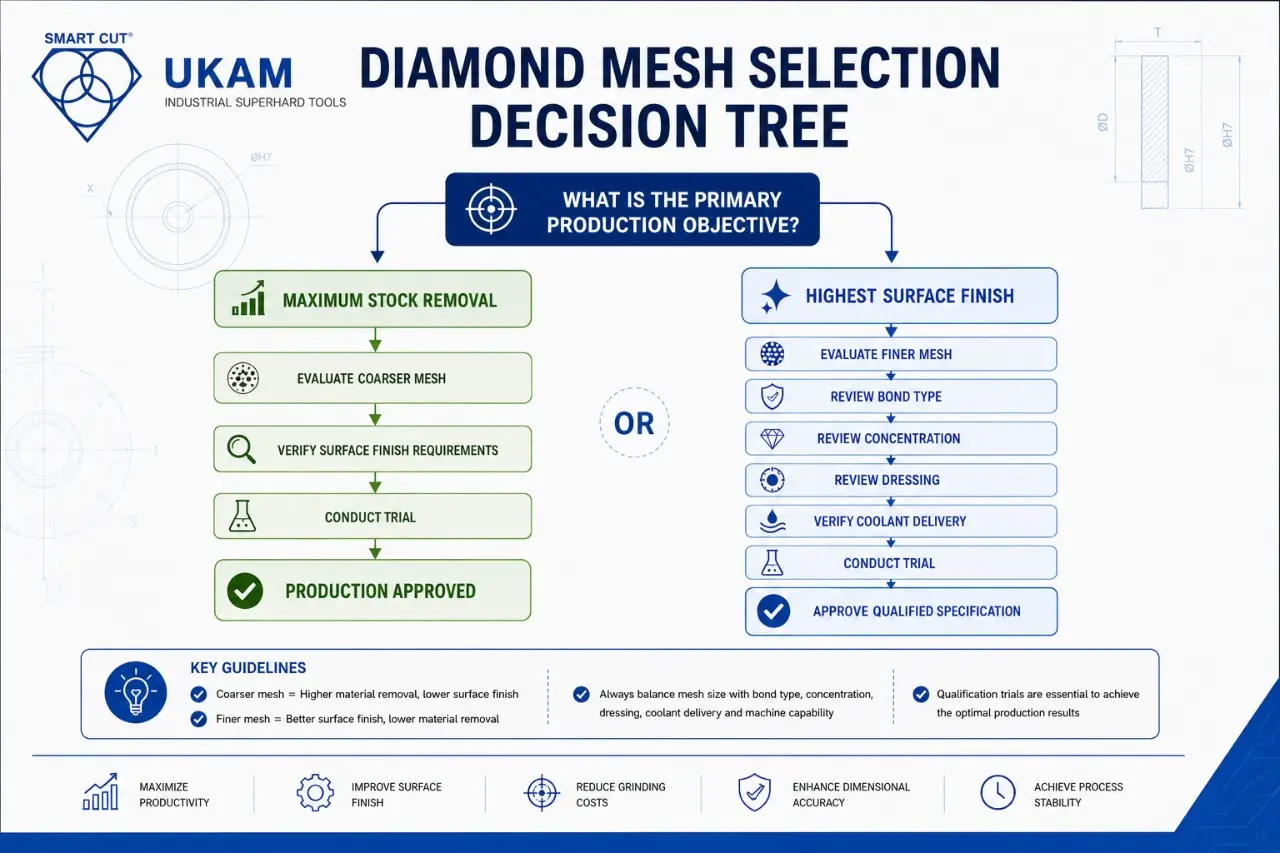
Diamond Mesh Selection Decision Tree
What is the Primary Production Objective?
- Maximum Stock Removal → Evaluate Coarser Mesh → Verify Surface Finish Requirements → Conduct Trial → Production Approved
- Highest Surface Finish → Evaluate Finer Mesh → Review Bond Type → Review Concentration → Review Dressing → Verify Coolant Delivery → Conduct Trial → Approve Qualified Specification
Supplier Evaluation Matrix
Selecting a grinding wheel supplier involves more than comparing product availability. Engineering support often determines whether the grinding process reaches production objectives efficiently.
|
Ask the Supplier |
Engineering Value |
|---|---|
|
Which mesh sizes have been successfully evaluated for this material? |
Demonstrates application experience |
|
Which bond system is generally recommended? |
Indicates knowledge of wheel design |
|
Which concentration options are available? |
Shows specification flexibility |
|
Can dressing recommendations be provided? |
Demonstrates process support |
|
Can grinding parameters be reviewed? |
Indicates engineering capability |
|
Is qualification assistance available? |
Reduces implementation risk |
|
Can application data be reviewed before specification? |
Demonstrates consultative engineering support |
Typical Production Problems and Engineering Review
|
Production Problem |
Variables to Review Before Changing Wheel |
|---|---|
|
Poor Surface Finish |
Mesh size, dressing, bond, machine rigidity |
|
Wheel Glazing |
Bond type, dressing interval, coolant, mesh size |
|
Frequent Dressing |
Bond hardness, abrasive exposure, wheel loading |
|
Excessive Wheel Wear |
Concentration, bond, feed rate, material |
|
Thermal Damage |
Mesh size, coolant delivery, grinding pressure |
|
Edge Chipping |
Abrasive size, machine vibration, process stability |
|
Low Material Removal |
Mesh size, wheel condition, spindle power
|
|
High Grinding Forces |
Wheel specification, coolant, machine condition |
When Should You Contact a UKAM Applications Engineer?
Many production issues originate from the interaction of multiple process variables rather than the grinding wheel alone. Engineering assistance becomes particularly valuable when repeated process adjustments fail to produce consistent improvements.
Consider requesting an application review if you experience recurring wheel glazing, poor surface finish despite multiple wheel changes, excessive wheel wear, frequent dressing requirements, low stock removal, thermal damage, edge chipping, inconsistent dimensional accuracy, qualification of a new engineering material, or difficulties selecting the appropriate bond or mesh size.
Providing complete application information allows engineers to evaluate the entire grinding system rather than recommending changes based solely on wheel specifications. You can request a free consultation directly with a UKAM applications engineer, or explore custom diamond and CBN tool manufacturing and consulting and process development services for complete process support.
Downloadable Engineering Resources
To simplify qualification and standardize engineering documentation, consider maintaining the following resources alongside every grinding project.
|
Resource |
Engineering Purpose |
|---|---|
|
Diamond Mesh Size Chart PDF |
Quick engineering reference |
|
Diamond Mesh to Micron Conversion Chart |
Compare supplier specifications |
|
Grinding Wheel Specification Worksheet |
Record qualification data |
|
Grinding Qualification Checklist |
Standardize production trials |
|
Grinding Process Evaluation Form |
Compare before and after process changes |
|
Supplier Evaluation Worksheet |
Technical supplier comparison |
These documents support engineering consistency and simplify future troubleshooting.
Frequently Asked Questions
Diamond mesh size influences stock removal rate, chip formation, grinding forces, wheel wear, surface finish, dressing behavior, and thermal generation. Coarser particles generally remove material more aggressively, while finer particles produce more cutting points that improve dimensional accuracy and surface quality. Mesh size should always be evaluated together with bond type, concentration, coolant delivery, and machine capability.
Not necessarily. Surface finish depends on the complete grinding system. Bond type, wheel condition, dressing practices, machine rigidity, coolant delivery, and grinding parameters all contribute to the final result. Selecting a finer abrasive without reviewing these variables may produce little improvement.
Qualification should begin with complete documentation of the existing grinding process. Only one process variable should be modified during each production trial. Surface finish, dimensional accuracy, wheel wear, grinding forces, and dressing interval should be recorded before approving a new specification.
Wheel glazing is frequently caused by insufficient abrasive exposure, inappropriate bond characteristics, dressing practices, or inadequate coolant delivery. Mesh size is only one of several engineering variables that influence glazing behavior.
No. Silicon carbide, sapphire, tungsten carbide, optical glass, fused silica, silicon nitride, PCD, and semiconductor materials each respond differently to grinding conditions. Mesh size should always be selected according to material characteristics and production objectives.
Mesh size should be reviewed whenever production requirements change, new materials are introduced, dimensional tolerances become tighter, surface finish deteriorates, or grinding performance becomes inconsistent.
Include the workpiece material, grinding operation, machine type, wheel dimensions, bond type, mesh size, diamond concentration, coolant method, dressing procedure, spindle speed, feed rate, production objective, required surface finish, and dimensional tolerance. Complete application data allows engineers to recommend more appropriate qualification strategies.
Related UKAM Engineering Resources
To develop a complete understanding of diamond grinding technology, engineers should also review:
- What Is Diamond Concentration and Which to Use for Your Application
- Resin Bond Diamond & CBN Tools
- Sintered (Metal Bond) Diamond & CBN Tools
- Vitrified Bond Diamond & CBN Tools
- Choosing the Correct Diamond Bond Type
- Diamond Dressers
- Diamond Tool Accessories & Coolants
- Diamond & CBN Wheels (Precision Grinding)
- Precision Cutting Saws
- Grinding & Polishing Equipment
- Semiconductor Industry Tooling
- Metallography Consumables
- What Is Diamond Mesh Size and How to Select the Best One
- Diamond vs CBN (Cubic Boron Nitride) Tools
- How to Properly Use Diamond Tools: A Complete Guide
These complementary resources provide additional guidance for wheel specification, bond selection, coolant optimization, process troubleshooting, and qualification. The full library is indexed on UKAM’s Knowledge Center.
Key Engineering Principles
- Diamond mesh size directly influences stock removal, surface finish, grinding forces, wheel wear, dressing frequency, and process stability.
- Mesh size should never be selected independently of bond type, diamond concentration, coolant delivery, or machine capability.
- Coarser mesh sizes generally support higher material removal, while finer mesh sizes typically improve surface quality and dimensional control.
- Structured qualification and documentation produce more repeatable results than trial-and-error adjustments.
- Material characteristics should guide mesh selection instead of relying on a universal wheel specification.
- Engineering support should focus on optimizing the complete grinding system rather than changing a single variable.
These complementary resources provide additional guidance for wheel specification, bond selection, coolant optimization, process troubleshooting, and qualification. The full library is indexed on UKAM’s Knowledge Center.
Conclusion
Diamond mesh size is far more than a simple abrasive specification. It is a primary engineering variable that influences the efficiency, stability, and quality of the entire grinding process. Successful mesh selection requires balancing material removal, surface finish, wheel life, dimensional accuracy, and production consistency while considering the interaction between bond type, diamond concentration, machine capability, coolant delivery, and dressing practices.
A structured qualification methodology supported by engineering documentation, process evaluation, and material-specific analysis provides a reliable foundation for optimizing grinding performance. By combining comprehensive mesh size reference data, material-specific guidance, engineering workflows, troubleshooting tools, and qualification strategies, engineers can make informed decisions that improve productivity while maintaining consistent part quality across a wide range of precision grinding applications. Explore UKAM’s full range of diamond and CBN tools or request a consultation to qualify the right specification for your application.
To develop a complete understanding of diamond grinding technology, engineers should also review:
Trusted by Tens of Thousands of Manufacturers, Laboratories,
Research Institutions Worldwide Since 1990
American Based Manufacturer
Established in 1990
Custom manufacturing
RELATED ARTICLES