





















The Hidden Cost of Choosing the Wrong Diamond Blade

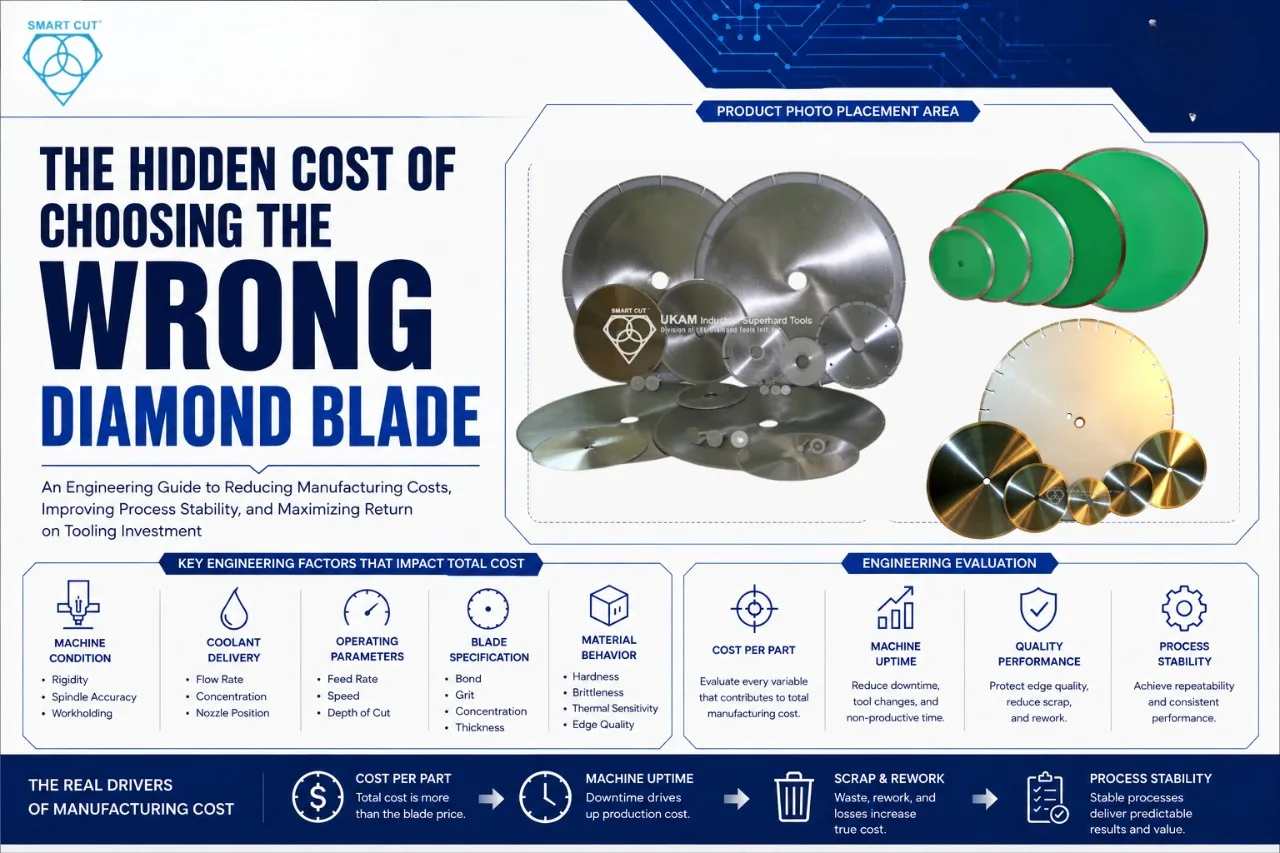
Table of Contents
Toggle
American Based Manufacturer

Established in 1990


Custom manufacturing


An Engineering Guide to Reducing Manufacturing Costs, Improving Process Stability, and Maximizing Return on Tooling Investment
Introduction
For many manufacturers, selecting a diamond blade often begins with comparing purchase prices. While the initial cost is important, it rarely reflects the blade’s true impact on manufacturing performance. A lower-priced blade that wears prematurely, generates edge chipping, or requires frequent replacement can ultimately cost far more than a premium blade that delivers stable, predictable performance throughout production.
In precision cutting, the objective is not simply to buy the least expensive blade — it is to reduce total manufacturing cost while maintaining consistent quality, productivity, and process reliability.
This principle becomes even more critical when machining high-value materials such as silicon carbide, sapphire, alumina, optical glass, quartz, tungsten carbide, advanced ceramics, and semiconductor wafers. In these applications, the cost of damaging a single workpiece may exceed the purchase price of the blade itself.
For this reason, experienced manufacturing engineers evaluate diamond blades as critical process-control components rather than consumable tools.
Looking Beyond Purchase Price
The purchase price of a blade is visible on the invoice, but many of the costs it influences are hidden within the manufacturing process.
A blade directly affects:
- Machine uptime
- Product quality
- Scrap and rework
- Operator productivity
- Downstream grinding and polishing
- Tool change frequency
- Overall Cost Per Part
A blade that performs consistently throughout production often delivers greater value than a lower-cost alternative requiring constant adjustments or replacement. Objective, side-by-side testing and comparing of diamond blades is the only reliable way to confirm which option actually performs better under real production conditions.
Engineering Insight
The lowest-priced blade is not always the lowest-cost solution. Manufacturing efficiency depends on the stability of the entire cutting process — not just the initial tooling investment.
Purchase Price vs. Total Manufacturing Cost
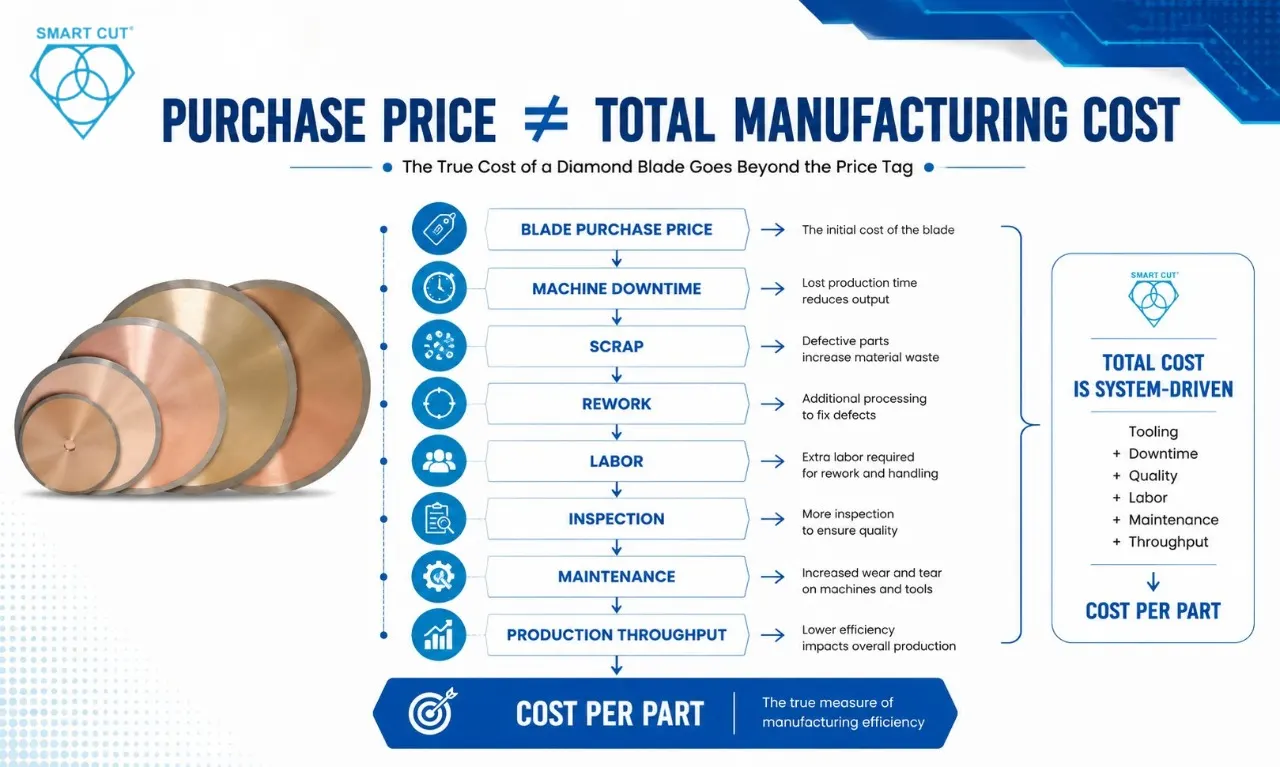
Successful manufacturers evaluate tooling using Total Cost of Ownership (TCO) rather than purchase price alone.
|
Purchasing Perspective |
Engineering Perspective |
|---|---|
|
Lowest Blade Price |
Lowest Cost Per Part |
|
Initial Tool Cost |
Process Stability |
|
Supplier Discount |
Machine Utilization |
|
Inventory Cost |
Product Quality |
|
Immediate Savings |
Long-Term Manufacturing Efficiency |
This engineering approach considers the complete production system, including:
- Machine downtime
- Scrap generation
- Rework
- Labor
- Quality inspections
- Maintenance
- Production throughput
These factors often have a much greater impact on profitability than the blade’s purchase price. Framing the decision around calculating Return on Investment for diamond blades — rather than sticker price — gives engineers a much clearer picture of long-term value.
Why Engineers Focus on Cost Per Part
Manufacturing engineers are measured by production performance — not tooling price.
Their priorities include:
- Process repeatability
- Equipment utilization
- Production throughput
- Scrap reduction
- Quality consistency
- Cost Per Part
Rather than asking, “Which blade costs less?” they ask, “Which blade helps produce the lowest total manufacturing cost?”
This shift changes the entire tooling selection process. Instead of comparing products, engineers evaluate how each blade contributes to a stable, efficient manufacturing system, using key blade performance metrics as the basis for comparison.
What You'll Learn in This Guide
This article explains why blade selection should be based on engineering performance rather than purchase price alone. You’ll learn:
- The hidden manufacturing costs of poor blade selection
- Why Cost Per Part is more meaningful than blade price
- Engineering factors that influence tooling performance
- Common process mistakes that increase production costs
- Practical strategies for improving process stability and manufacturing efficiency
For readers who want the full specification breakdown alongside this discussion, the Precision & Ultra Thin Diamond Blade Guide is a useful companion reference.
By understanding the complete economics of precision cutting, manufacturers can make better tooling decisions, reduce unnecessary production costs, and achieve more consistent long-term performance.
Why Cost Per Part Matters More Than Blade Price
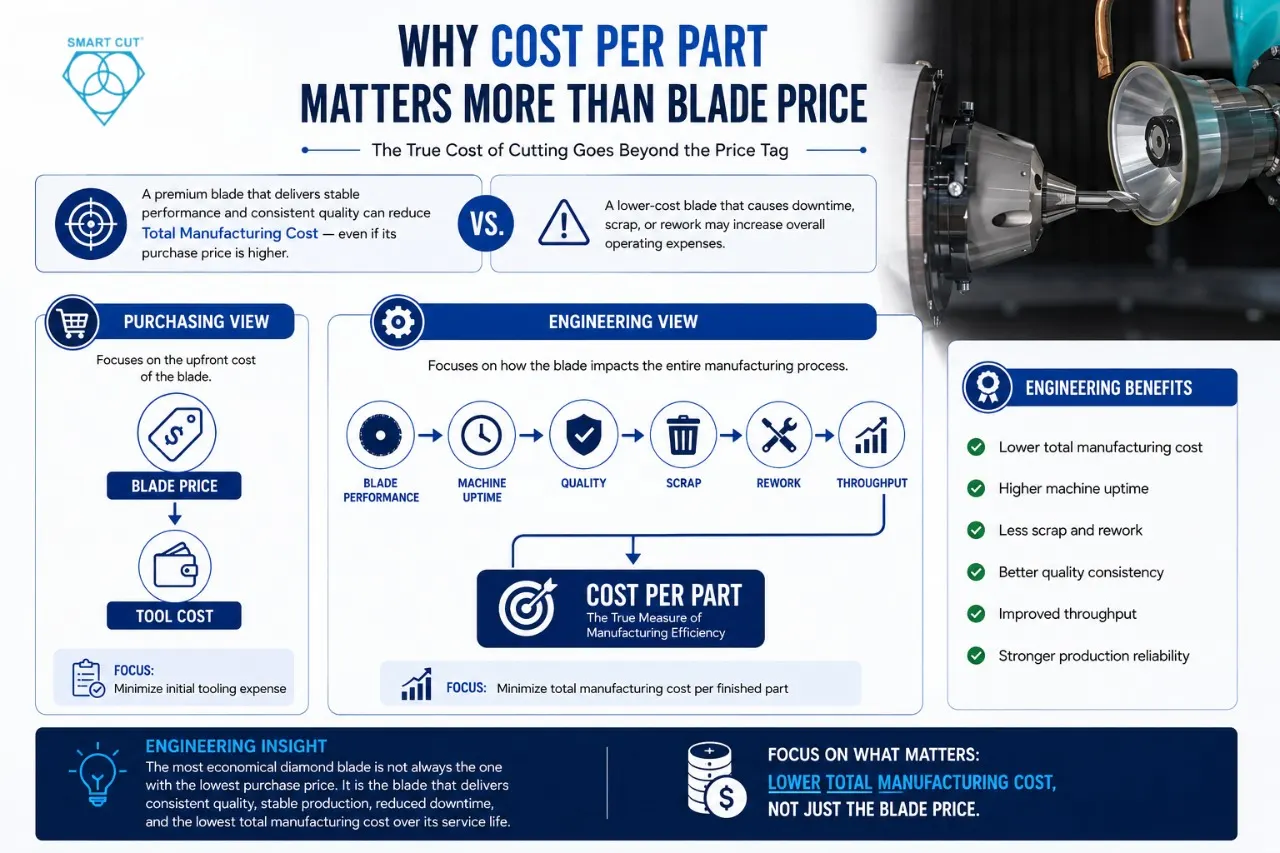
The purchase price of a diamond blade is easy to compare, but it represents only a small portion of the total manufacturing expense. In precision cutting, every tooling decision influences machine utilization, product quality, labor efficiency, production throughput, and downstream processing.
For this reason, experienced manufacturing engineers evaluate Cost Per Part (CPP) rather than Cost Per Blade — a distinction covered in depth in our guide to the performance metrics you should know.
A premium blade that delivers stable cutting performance, predictable wear, and consistent edge quality often reduces total manufacturing costs — even if its purchase price is higher. Conversely, a lower-cost blade that requires frequent replacement or causes production instability may increase overall operating expenses.
Understanding the Hidden Manufacturing Costs
The true cost of a cutting operation extends well beyond the blade itself.
|
Manufacturing Cost Element |
Engineering Impact |
|---|---|
|
Diamond Blade |
Initial tooling investment |
|
Machine Downtime |
Lost production time |
|
Operator Labor |
Setup, adjustments, inspections |
|
Scrap |
Material loss and rejected components |
|
Rework |
Additional grinding and polishing |
|
Quality Inspection |
Increased verification time |
|
Machine Maintenance |
Reduced equipment availability |
|
Production Delays |
Missed schedules and lower throughput |
When combined, these factors often have a greater impact on profitability than the blade’s purchase price.
Hidden Cost #1 — Machine Downtime
Every blade replacement, process adjustment, or unexpected production interruption reduces machine availability.
Downtime commonly occurs during:
- Blade replacement
- Process troubleshooting
- Machine inspection
- Parameter adjustments
- Tool qualification
Although these interruptions may appear minor individually, they accumulate over long production runs and reduce overall equipment utilization. Following documented guidance on properly using precision diamond blades significantly reduces the frequency of these interruptions.
Engineering Insight: A blade that enables longer uninterrupted production often creates greater manufacturing value than one with a lower purchase price but shorter, less predictable service life.
Hidden Cost #2 — Scrap
Poor cutting performance can increase scrap through:
- Edge chipping
- Thermal damage
- Surface defects
- Dimensional inaccuracies
- Microcracking
For high-value materials such as sapphire, silicon carbide, advanced ceramics, and optical glass — and for brittle materials generally, including the challenges covered in cutting glass with diamond blades — the cost of a rejected component may exceed the cost of the blade used to cut it. Manufacturers working in advanced ceramics face this risk especially acutely, since scrap on a single fired ceramic part can be costly to replace.
Reducing scrap improves both manufacturing efficiency and material utilization.
Hidden Cost #3 — Rework
Not every damaged component is discarded.
Many require additional operations such as:
- Grinding
- Polishing
- Edge refinement
- Surface correction
- Secondary inspection
While rework may recover a part, it consumes valuable production time and increases labor costs — a concern that is especially familiar to labs performing metallography and sample preparation, where secondary finishing steps are routine.
Engineering Observation: Improving the initial cutting process often reduces downstream finishing operations, resulting in lower overall manufacturing costs.
Hidden Cost #4 — Operator Labor
Stable cutting processes require less operator intervention.
Inconsistent blade performance increases the need for:
- Process monitoring
- Feed rate adjustments
- Blade changes
- Quality inspections
- Production troubleshooting
Our diamond sawing troubleshooting guide walks through the most common issues that drive up manual intervention time. Reducing manual intervention allows operators to focus on production rather than process correction.
Hidden Cost #5 — Machine Utilization
Precision cutting equipment represents a significant capital investment.
Every minute spent changing blades, adjusting parameters, or investigating quality issues reduces productive machining time. For a structured approach to reclaiming that time, see optimizing your diamond sawing operation.
Higher machine utilization generally contributes to:
- Increased production capacity
- Better equipment efficiency
- Lower Cost Per Part
- Improved production scheduling
Hidden Cost #6 — Quality Inspection
Inconsistent cutting results often require additional inspection to verify:
- Edge quality
- Surface finish
- Dimensional accuracy
- Process consistency
While inspection is an essential part of quality assurance, frequent inspection requirements may indicate opportunities to improve process stability.
Not sure which hidden cost is hitting your line hardest? UKAM’s application engineers can review your material, machine, and current blade specification and show you exactly where Cost Per Part is being lost. Request a Free Engineering Process Review →
Why Cost Per Part Is the Better Metric
Manufacturing engineers rarely measure success by blade price alone.
Instead, they evaluate how efficiently each finished component is produced, using benchmarks such as tolerances, accuracy, and repeatability.
Cost Per Part reflects the combined impact of:
- Blade performance
- Machine uptime
- Production throughput
- Scrap
- Rework
- Labor
- Quality consistency
This provides a more complete measure of manufacturing efficiency than tooling cost alone.
Common Engineering Mistakes
Several common decisions can unintentionally increase production costs:
- Selecting blades based only on purchase price
- Replacing blades before verifying machine condition
- Changing multiple process variables simultaneously
- Ignoring downstream grinding and polishing costs
- Measuring blade life instead of overall production efficiency
Avoiding these mistakes starts with understanding the trade-offs involved in blade selection rather than treating specification sheets as a checklist.
Engineering Best Practices
Successful manufacturers typically:
- Evaluate Cost Per Part instead of blade price
- Monitor machine downtime associated with tooling changes
- Track scrap and rework across production batches
- Review downstream processing requirements
- Optimize the complete cutting process rather than focusing only on the blade
A good starting point is our guide to how to select the right diamond blade for your application.
Engineering Insight:
The most economical diamond blade is not always the one with the lowest purchase price. It is the blade that delivers consistent quality, stable production, reduced downtime, and the lowest total manufacturing cost over its service life.
How Process Variables Determine Blade Performance, Product Quality, and Cost Per Part
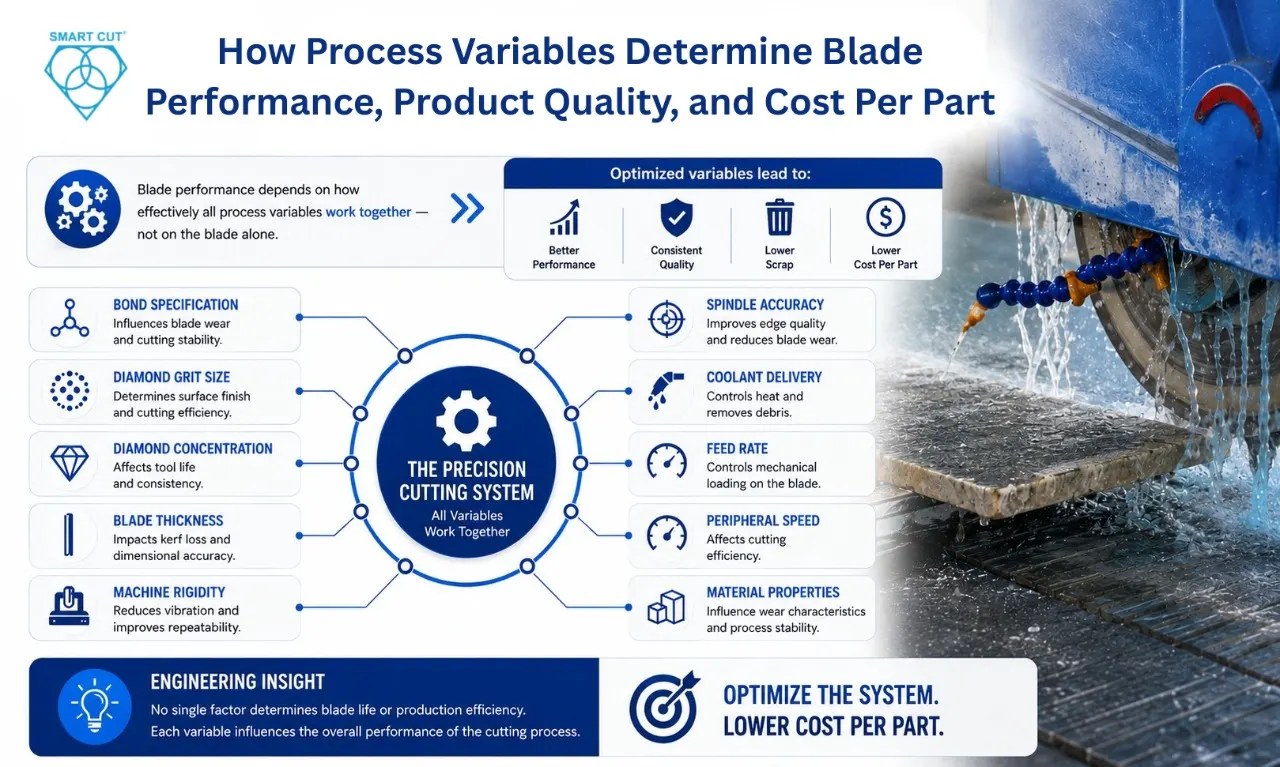
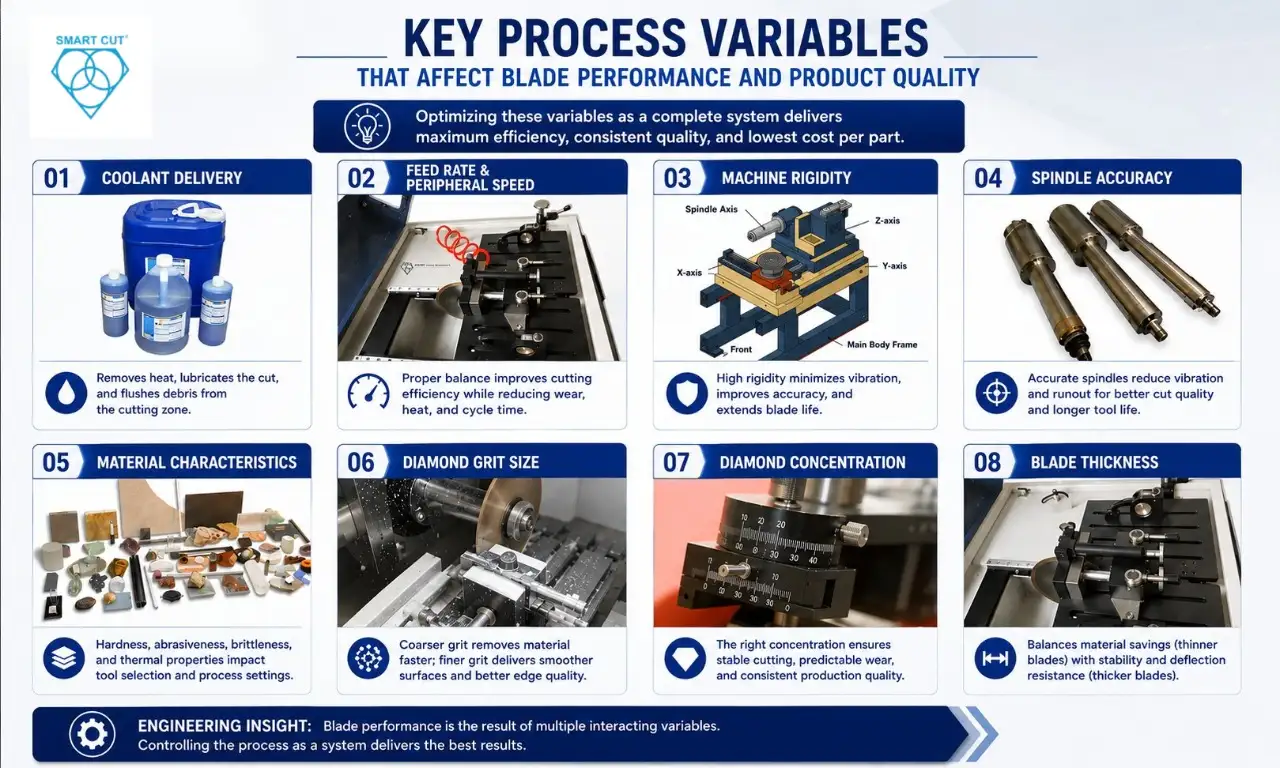
Selecting the right diamond blade is only one part of achieving efficient and cost-effective precision cutting. In reality, blade performance depends on how effectively the entire cutting system works together — a system explained in detail in how diamond tools work.
Many manufacturers assume that replacing a blade will automatically improve cutting performance. However, even a premium diamond blade can wear prematurely or produce inconsistent results if machine conditions, operating parameters, or coolant delivery are not properly controlled.
Successful manufacturing engineers evaluate the complete process rather than focusing on a single component. By optimizing the interaction between tooling, equipment, material, and operating conditions, manufacturers can improve process stability, reduce scrap, and lower the overall Cost Per Part.
The Precision Cutting System
Diamond blade performance is influenced by multiple engineering variables working together.
|
Engineering Factor |
Manufacturing Impact |
|---|---|
|
Bond Specification |
Blade wear and cutting stability |
|
Diamond Grit Size |
Surface finish and cutting efficiency |
|
Diamond Concentration |
Tool life and consistency |
|
Blade Thickness |
Kerf loss and dimensional accuracy |
|
Machine Rigidity |
Vibration and repeatability |
|
Spindle Accuracy |
Edge quality and blade wear |
|
Coolant Delivery |
Heat control and debris removal |
|
Feed Rate |
Mechanical loading |
|
Peripheral Speed |
Cutting efficiency |
|
Material Properties |
Wear characteristics and process stability |
No single factor determines blade life or production efficiency. Instead, each variable influences the overall performance of the cutting process.
Bond Specification
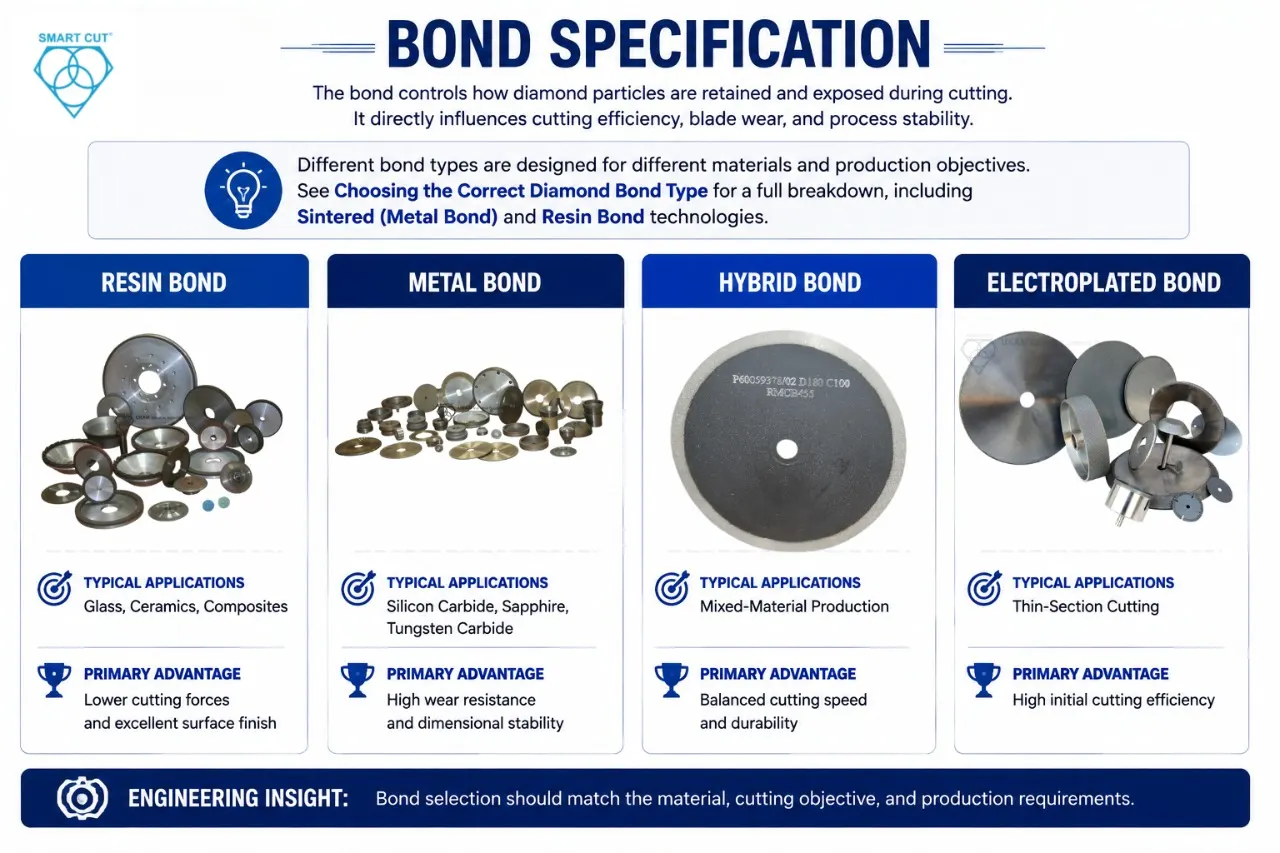
The bond controls how diamond particles are retained and exposed during cutting. It directly influences cutting efficiency, blade wear, and process stability. Different bond types are designed for different materials and production objectives. See choosing the correct diamond bond type for a full breakdown, including Sintered (Metal Bond) and Resin Bond technologies.
|
Bond Type |
Typical Applications |
Primary Advantage |
|---|---|---|
|
Resin Bond |
Glass, ceramics, composites |
Lower cutting forces and excellent surface finish |
|
Metal Bond |
Silicon carbide, sapphire, tungsten carbide |
High wear resistance and dimensional stability |
|
Hybrid Bond |
Mixed-material production |
Balanced cutting speed and durability |
|
Electroplated Bond |
Thin-section cutting |
High initial cutting efficiency |
Engineering Insight:
There is no universal bond suitable for every application. The correct bond depends on material characteristics, production volume, machine capability, and required surface quality.
Diamond Grit Size
Diamond grit determines how aggressively the blade removes material. Generally, coarser grit provides faster material removal, while finer grit produces smoother surfaces and improved edge quality. See how to select the best diamond mesh size for your application.
The appropriate grit size should balance productivity with the required surface finish rather than maximizing one characteristic at the expense of the other.
Diamond Concentration
Diamond concentration affects the number of cutting points available throughout the blade.
Proper concentration contributes to:
- Stable cutting performance
- Predictable blade wear
- Consistent production quality
Learn what diamond concentration is and which to use, and how it interacts with cutting speed, tool life, and cost. Higher concentration does not always result in longer blade life — the optimal concentration depends on the material, bond system, and operating conditions.
Blade Thickness
Blade thickness influences both cutting stability and material utilization.
Thinner blades generally:
- Reduce kerf loss
- Minimize material waste
- Lower cutting forces
Thicker blades typically provide:
- Greater rigidity
- Improved dimensional stability
- Better resistance to deflection
Selecting the proper thickness requires balancing material savings with production stability. Related spacers, flanges, and fixturing components are available in our diamond tool accessories line.
Machine Rigidity
Machine rigidity is one of the most overlooked factors affecting blade performance.
An unstable machine can introduce vibration that leads to:
- Edge chipping
- Uneven blade wear
- Reduced dimensional accuracy
- Lower process repeatability
Common Sources of Instability: worn bearings, loose fixturing, damaged blade flanges, machine wear, poor workholding.
Choosing the right equipment — such as our line of precision cutting saws — is the first step toward eliminating this variable.
Engineering Observation:
Many blade performance problems originate from machine instability rather than tooling. Verifying machine condition before replacing the blade often prevents unnecessary tooling costs.
Spindle Accuracy
Spindle accuracy directly affects blade life and cutting quality.
Poor spindle condition may result in:
- Increased vibration
- Blade deflection
- Accelerated wear
- Poor surface finish
Routine spindle inspection helps maintain consistent production while extending tooling performance.
Coolant Delivery
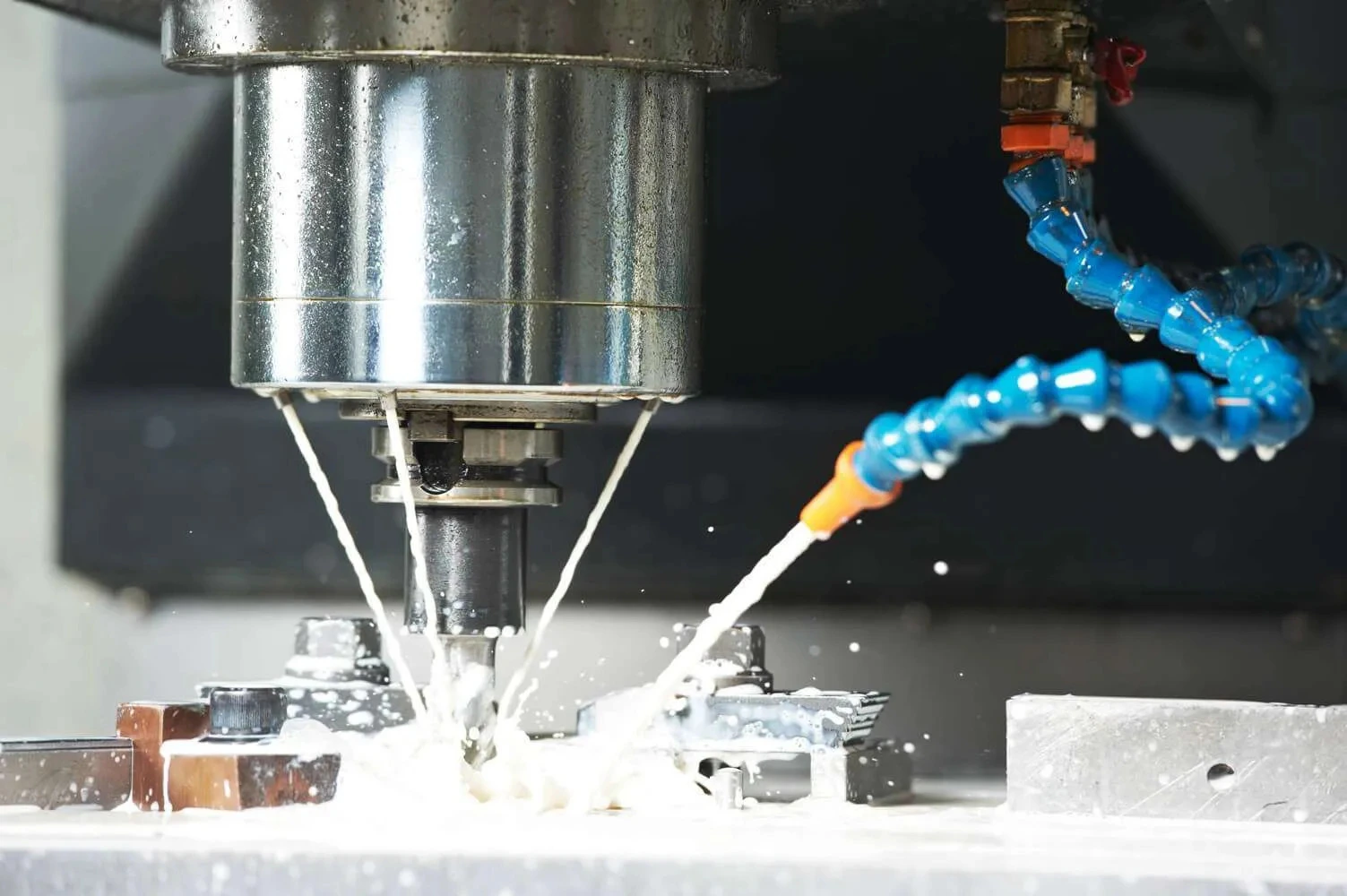
Coolant performs three essential functions during precision cutting:
- Removes heat from the cutting zone
- Lubricates the blade-workpiece interface
- Flushes abrasive debris from the kerf
Poor coolant delivery accelerates bond wear, increases thermal loading, and reduces cutting efficiency. Our guides on diamond tool coolants and selecting the right coolant method cover this in detail.
Engineering Insight:
Coolant effectiveness depends more on proper delivery than on flow rate alone. Correct nozzle positioning often produces greater improvements than simply increasing pump capacity.
Feed Rate and Peripheral Speed
Feed rate and peripheral speed work together to determine cutting efficiency.
Excessive feed rates may increase:
- Mechanical loading
- Blade deflection
- Edge chipping
- Heat generation
Excessively conservative feed rates may unnecessarily extend production cycle times without improving quality. Similarly, increasing spindle speed without evaluating overall process conditions may not improve productivity and can increase thermal stress. Our RPMs & Feed Rates guide provides starting-point recommendations by material and blade type.
Successful optimization balances productivity, blade life, and product quality.
Material Characteristics
Every engineering material responds differently to precision cutting.
Important material properties include:
- Hardness
- Abrasiveness
- Brittleness
- Thermal conductivity
- Microstructure
Understanding these characteristics helps engineers select tooling and operating parameters that produce stable, repeatable results — all covered in our general Material Guide.
Common Engineering Mistakes
Manufacturers often increase production costs by overlooking critical process variables.
Some of the most common mistakes include:
- Selecting a blade without evaluating machine capability
- Increasing feed rate to improve productivity without monitoring edge quality
- Assuming longer blade life automatically reduces manufacturing cost
- Changing multiple process parameters at the same time
- Ignoring preventive machine maintenance
Avoiding these mistakes helps improve production stability while reducing unnecessary tooling expenses.
Engineering Best Practices
To maximize manufacturing efficiency:
- Evaluate the complete cutting system — not just the blade
- Verify machine condition before replacing tooling
- Optimize one process variable at a time
- Monitor blade wear patterns and production consistency
- Document successful operating parameters for future production
It’s also worth understanding how diamond tools compare with conventional abrasive tools so the right technology is chosen from the outset.
Engineering Insight:
The most successful manufacturers recognize that diamond blade performance is the result of a well-optimized process — not a single component. When tooling, equipment, material, coolant, and operating parameters are properly matched, manufacturers achieve longer blade life, improved quality, reduced downtime, and lower Cost Per Part
Why the Same Diamond Blade Performs Differently Across Different Materials
One of the most common misconceptions in precision cutting is that a single diamond blade can deliver optimal performance across every material. While a blade may perform exceptionally well on one application, its performance can change dramatically when introduced to a different workpiece — which is part of why understanding diamond vs. CBN tools matters before specifying a blade.
This is because every engineering material possesses unique mechanical and physical properties that influence cutting behavior, blade wear, heat generation, and surface quality. Material hardness, abrasiveness, brittleness, thermal conductivity, and microstructure all affect how a blade performs throughout its service life.
Understanding these material-specific characteristics allows engineers to select the appropriate tooling and optimize process parameters for lower manufacturing costs and greater production consistency.
Why Material Properties Matter
Every precision cutting application is unique because every material responds differently to mechanical loading.
The interaction between the blade and the workpiece determines:
- Cutting efficiency
- Blade wear rate
- Edge quality
- Surface finish
- Heat generation
- Process stability
- Cost Per Part
Rather than selecting a blade based solely on previous experience, engineers should first understand how the material behaves during cutting.
Key Material Characteristics
Several engineering properties influence cutting performance.
|
Material Property |
Manufacturing Impact |
|---|---|
|
Hardness |
Determines cutting resistanceInitial tooling investment |
|
Abrasiveness |
Influences blade wear |
|
Brittleness |
Affects edge chipping |
|
Thermal Conductivity |
Controls heat dissipation |
|
Microstructure |
Influences fracture behavior |
|
Density |
Impacts cutting forces |
Even materials with similar hardness can require different cutting strategies due to differences in their internal structure.
Silicon Carbide (SiC)
Silicon carbide is widely used in semiconductor manufacturing, power electronics, wear-resistant components, and advanced ceramics.
Engineering Challenges: Silicon carbide combines extreme hardness, high abrasiveness, and brittle fracture characteristics. These properties accelerate blade wear while increasing the risk of edge chipping and surface damage.
When cutting silicon carbide, manufacturers typically focus on stable blade wear, consistent edge quality, reduced thermal damage, and predictable production performance.
Engineering Insight:
Attempting to increase productivity by using aggressive cutting parameters often results in higher scrap rates and additional finishing operations. Maintaining process stability usually delivers better long-term manufacturing efficiency.
Sapphire
Sapphire is commonly used in optics, photonics, semiconductor substrates, medical devices, and electronic components.
Common Manufacturing Challenges: Edge chipping, crack propagation, surface damage, thermal stress. Because sapphire is both hard and brittle, small variations in machine condition or operating parameters can significantly influence product quality.
Best Practice: Successful sapphire cutting depends on stable machine conditions, proper coolant delivery, controlled operating parameters, and consistent blade condition.
Alumina
Alumina remains one of the most widely processed engineering ceramics, used in electronic substrates, electrical insulation, medical components, and industrial wear parts.
Although generally easier to process than silicon carbide, alumina still requires careful process control to maintain surface quality, dimensional accuracy, process repeatability, and predictable blade wear.
Quartz
Quartz is widely used in semiconductor processing, laboratory equipment, analytical instruments, and optical applications within the broader Glass & Quartz category.
Quartz is highly sensitive to mechanical shock, vibration, and improper workholding, which may lead to chipping, surface defects, or fracture.
Engineering Observation:
Machine stability often has a greater influence on cutting quality than blade selection alone.
Optical Glass
Optical glass applications require exceptional surface integrity.
Manufacturing objectives often include minimal edge damage, excellent dimensional accuracy, reduced polishing requirements, and consistent surface quality.
Improving cutting quality at the beginning of the process frequently reduces downstream grinding and polishing time, lowering the overall Cost Per Part — see our guide on reducing subsurface damage during precision wafer sectioning for the underlying engineering principles.
Tungsten Carbide
Tungsten carbide is commonly used for cutting tools, dies, wear components, and industrial tooling, often processed with the help of our Precision Carbide Tools line.
Manufacturers generally focus on stable cutting forces, predictable blade wear, high dimensional accuracy, and long-term process repeatability. Because carbide components often require tight tolerances, machine rigidity and process consistency become especially important.
Advanced Ceramics
Advanced ceramics include materials such as:
- Zirconia
- Silicon Nitride
- Boron Carbide
- Ferrites
- Technical ceramics
Although these materials are often grouped together, each exhibits different machining characteristics — a challenge shared with composite materials, where layered structures behave unpredictably under a standardized cutting approach.
Successful production depends on understanding material composition, brittleness, wear characteristics, surface quality requirements, and production objectives.
Material Selection Matrix
|
Material |
Primary Engineering Focus |
|---|---|
|
Silicon Carbide |
Blade wear and edge quality |
|
Sapphire |
Crack prevention |
|
Alumina |
Process repeatability |
|
Quartz |
Machine stability |
|
Optical Glass |
Surface integrity |
|
Tungsten Carbide |
Dimensional accuracy |
|
Advanced Ceramics |
Process optimization |
Each material requires its own engineering strategy rather than a one-size-fits-all solution — a principle that also applies directly to lapidary and gemstone cutting, where material variability is the norm rather than the exception.
Common Engineering Mistakes
Many production issues arise because material behavior is underestimated.
- Using identical cutting parameters for different materials
- Increasing feed rate without evaluating edge quality
- Ignoring material microstructure during blade selection
- Selecting tooling before defining production objectives
- Measuring success only by blade life instead of overall manufacturing performance
Engineering Best Practices
To achieve consistent results across different materials:
- Evaluate material properties before selecting tooling
- Match blade specification to the application
- Optimize operating parameters gradually
- Verify machine condition before production
- Monitor blade wear and edge quality
- Standardize successful cutting parameters for future production
It’s important to understand how material fracture toughness influences diamond & CBN blade selection rather than relying on hardness alone.
Engineering Insight:
The most successful manufacturers do not search for a universal diamond blade. Instead, they develop material-specific cutting strategies that improve repeatability, reduce scrap, and lower total manufacturing costs over time.
Understanding Why Diamond Blades Fail Prematurely and How to Prevent It
Selecting the correct diamond blade is only one step toward achieving a reliable and cost-effective cutting process. Even a properly specified blade can experience premature wear if machine conditions, operating parameters, or coolant delivery are not properly controlled — a topic explored in depth in why is my precision diamond blade failing.
When blade performance begins to decline, many manufacturers immediately replace the tool. While this may temporarily restore production, it often fails to address the actual cause of the problem.
Experienced manufacturing engineers take a different approach. Instead of simply replacing the blade, they perform failure analysis to understand why performance changed in the first place. Every worn blade provides valuable information about the cutting process, and understanding these wear patterns can significantly improve productivity, reduce downtime, and lower manufacturing costs.
Why Failure Analysis Is Important
Diamond blades rarely fail without reason. Most premature failures result from an imbalance somewhere within the cutting system rather than from the blade itself.
Failure analysis helps engineers:
- Identify root causes instead of symptoms
- Improve process stability
- Reduce unnecessary tooling costs
- Minimize scrap and rework
- Increase machine utilization
- Improve overall Cost Per Part
Rather than asking, “Why did the blade wear out?” engineers ask, “What process condition caused the blade to wear this way?” This shift in thinking leads to long-term process improvements rather than repeated tooling replacements.
Common Blade Failure Mechanisms
|
Failure Mechanism |
Typical Manufacturing Impact |
|---|---|
|
Blade Glazing |
Reduced cutting efficiency |
|
Excessive Bond Wear |
Shortened blade life |
|
Diamond Pull-Out |
Lower cutting performance |
|
Thermal Damage |
Surface defects and cracking |
|
Edge Chipping |
Higher scrap rates |
|
Blade Deflection |
Poor dimensional accuracy |
|
Uneven Wear |
Inconsistent production |
|
Machine Vibration |
Reduced tool life and quality |
Each failure mechanism points toward a different engineering issue and should be investigated before changing tooling.
Blade Glazing
Blade glazing occurs when the bond no longer exposes fresh diamond particles efficiently. Instead of cutting, the blade begins rubbing against the material, increasing friction and reducing cutting performance.
Common Symptoms: Slower cutting speed, increased cutting resistance, higher spindle load, excessive heat generation, poor surface finish.
Possible Causes: Bond too hard for the material, feed rate too low, improper operating speed, inadequate dressing, poor coolant delivery.
Before replacing the blade, evaluate machine settings, coolant delivery, and operating parameters. In many cases, correcting process conditions restores cutting performance without changing tooling. Our guide to blade dressing — when, why & how to restore maximum cutting efficiency covers the fix directly.
Excessive Bond Wear
The bond gradually wears throughout normal production, exposing fresh diamond particles. However, excessive bond wear shortens blade life and increases tooling consumption.
Common Causes: Highly abrasive materials, incorrect bond selection, excessive cutting forces, machine vibration, poor coolant effectiveness.
Premature bond wear results in frequent blade replacement, increased downtime, higher tooling inventory, and reduced production efficiency. See bond hardness in diamond & CBN blades for how bond selection affects wear rate.
Diamond Pull-Out
Diamond particles should remain securely retained until they have completed useful cutting work. Premature pull-out reduces the number of active cutting points and lowers cutting efficiency.
Possible Causes: Improper bond specification, excessive mechanical loading, machine instability, incorrect operating parameters — often linked to the topics covered in diamond tool bond hardness & wear resistance
Engineering Insight:
Diamond pull-out is often the result of unstable production conditions rather than poor blade quality. Evaluating the complete cutting system helps identify the true cause.
Thermal Damage
Heat generation is unavoidable during precision cutting, but excessive thermal loading can damage both the blade and the workpiece.
Common Symptoms: Surface discoloration, material cracking, residual stress, dimensional instability, additional polishing requirements.
Possible Causes: Poor coolant delivery, blade glazing, excessive feed rate, improper spindle speed.
Proper dressing restores exposed diamond and reduces the friction that drives thermal damage.
Engineering Best Practice: Effective coolant delivery depends more on nozzle positioning than flow rate alone. Properly directing coolant into the cutting interface often improves heat removal more effectively than increasing pump capacity.
Edge Chipping
Edge chipping is one of the most common quality issues encountered when cutting brittle materials such as ceramics, sapphire, quartz, and silicon carbide.
Contributing Factors: Machine vibration, aggressive feed rates, blade instability, poor workholding, incorrect blade specification.
Excessive edge chipping increases scrap, rework, polishing time, and inspection requirements. To confirm whether chipping is within acceptable limits, see how to measure precision diamond blade cut quality.
Blade Deflection
Blade deflection occurs when cutting forces exceed the blade’s ability to maintain stable alignment.
Common Symptoms: Curved cuts, uneven kerf, poor dimensional accuracy, reduced repeatability.
Possible Causes: Machine instability, excessive feed rates, improper fixturing, worn blade flanges. Correct material holding methods are one of the most effective ways to eliminate this failure mode. Machine qualification should always be performed before changing tooling.
Machine Vibration
Many blade performance problems originate from machine condition rather than the blade itself.
Even small increases in vibration may lead to accelerated blade wear, edge chipping, poor surface finish, and reduced dimensional accuracy.
Common Sources: Worn bearings, spindle runout, loose fixtures, machine misalignment, damaged flanges. For applications that need a tailored fixturing or tooling solution to eliminate a persistent vibration source, our Custom Diamond & CBN Tools program can help.
Engineering Observation:
Replacing blades without correcting machine vibration often results in repeated production failures and unnecessary tooling costs.
Engineering Failure Analysis Workflow
When production performance declines, follow a structured troubleshooting process rather than replacing the blade immediately:
Observe Production Symptoms → Inspect Blade Wear → Verify Machine Condition → Review Operating Parameters → Inspect Coolant Delivery → Evaluate Material Behavior → Change One Variable → Validate Production Performance
This systematic approach minimizes unnecessary tooling changes while improving process reliability. For a structured, repeatable methodology, see how to verify diamond blade performance.
Common Engineering Mistakes
Many production issues become expensive because troubleshooting begins with assumptions rather than investigation.
- Replacing the blade before inspecting the machine
- Changing multiple process variables at the same time
- Ignoring blade wear patterns
- Assuming all blade failures have the same cause
- Measuring success only by blade life instead of overall production performance
Engineering Best Practices
To improve blade performance and reduce production costs:
- Inspect every worn blade before replacement
- Monitor wear patterns across production batches
- Verify spindle accuracy and machine rigidity regularly
- Maintain consistent coolant delivery
- Document process changes and production results
- Optimize one variable at a time
- Use failure analysis as part of continuous process improvement
Engineering Insight:
Every worn diamond blade provides valuable information about the cutting process. Organizations that analyze blade wear systematically often identify opportunities to improve machine performance, optimize operating parameters, reduce scrap, and extend tooling life without relying solely on new tooling purchases.
A Systematic Approach to Reducing Manufacturing Costs and Improving Precision Cutting Performance
Selecting the right diamond blade is only one part of achieving a reliable and cost-effective cutting process. Many manufacturers invest in premium tooling expecting immediate improvements, only to find that blade life, edge quality, or production consistency remain unchanged — often because forces within the cut, as detailed in cutting force distribution during metallographic sectioning, were never brought under control.
The reason is simple — diamond blade performance depends on the entire cutting system, not the blade alone.
Successful manufacturers improve productivity by optimizing the complete process, including machine condition, operating parameters, coolant delivery, workholding, and process monitoring. This systematic approach helps reduce unnecessary downtime, improve repeatability, and lower the overall Cost Per Part.
Why Process Optimization Matters
Process optimization is the continuous improvement of a manufacturing process through controlled engineering changes and measurable performance evaluation.
Instead of relying on trial and error, engineers use production data to identify opportunities for improvement while maintaining stable operating conditions.
The primary objectives include:
- Improve blade life
- Reduce Cost Per Part
- Increase machine utilization
- Improve edge quality
- Reduce scrap and rework
- Improve process repeatability
- Increase production efficiency
Engineering Insight:
One of the most common reasons optimization projects fail is because multiple variables are changed simultaneously. If feed rate, spindle speed, coolant flow, and blade specification are adjusted at the same time, it becomes almost impossible to determine which change actually improved — or reduced — performance. Successful engineers optimize one variable at a time.
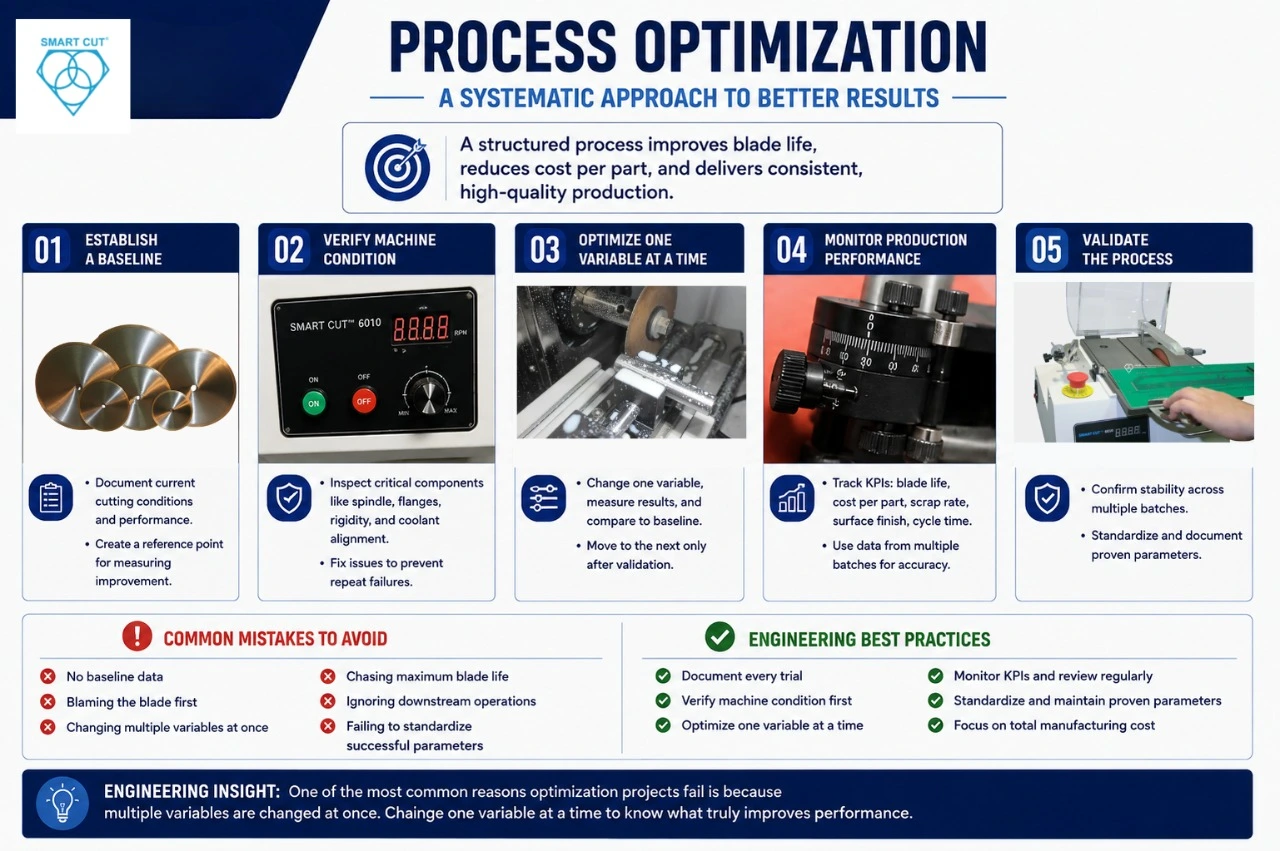
Step 1 — Establish a Production Baseline
Before making any process changes, document the current manufacturing conditions. Without baseline data, it is impossible to determine whether production has improved or deteriorated.
|
Process Variable |
Engineering Purpose |
|---|---|
|
Blade Specification |
Current tooling configuration |
|
Material |
Workpiece characteristics |
|
Feed Rate |
Mechanical loading |
|
Spindle Speed |
Cutting speed |
|
Coolant Method |
Thermal control |
|
Blade Life |
Starting benchmark |
|
Surface Finish |
Quality reference |
|
Scrap Rate |
Process consistency |
This baseline becomes the reference point for every future optimization effort. Our Knowledge Center is a good place to review reference specifications while building this baseline.
Step 2 — Verify Machine Condition
Many blade performance issues originate from machine condition rather than tooling. Before replacing the blade or modifying cutting parameters, inspect the equipment.
Machine Qualification Checklist: Spindle runout, blade flanges, machine rigidity, workholding, coolant alignment, machine leveling.
Even small mechanical issues can increase vibration, accelerate blade wear, and reduce dimensional accuracy. To learn more about the engineering team behind these standards, see About UKAM.
Engineering Observation:
Replacing tooling without verifying machine condition often results in repeated failures because the underlying problem remains unchanged.
Step 3 — Optimize One Variable at a Time
After the machine has been qualified, begin optimizing the cutting process systematically.
Recommended sequence:
- Feed Rate
- Peripheral Speed
- Coolant Delivery
- Blade Specification
- Bond Type
- Diamond Concentration
- Diamond Grit Size
After each adjustment, measure the results, compare them with the baseline, record observations, and proceed to the next variable only if the improvement is validated. Depending on the application, this may mean evaluating alternatives such as our Diamond Band Saw Blades or Diamond Dicing Blades lines.
This structured approach minimizes unnecessary production trials while producing reliable engineering data.
Step 4 — Monitor Production Performance
Optimization should always be measured using objective manufacturing metrics rather than assumptions.
|
KPI |
Why It Matters |
|---|---|
|
Blade Life |
Tooling efficiency |
|
Cost Per Part |
Overall manufacturing cost |
|
Scrap Rate |
Process stability |
|
Surface Finish |
Product quality |
|
Edge Quality |
Process capability |
|
Machine Utilization |
Equipment efficiency |
|
Tool Change Frequency |
Downtime indicator |
|
Cycle Time |
Production throughput |
Tracking these KPIs over multiple production batches provides a much clearer picture of process performance than evaluating only a few test cuts. For drilling-based operations running in parallel with blade optimization, see our Diamond Core Drills line, which follows the same KPI-tracking principles.
Step 5 — Validate the Process
A process that performs well during a short production trial may not remain stable during continuous manufacturing.
Validation should therefore include:
- Multiple production batches
- Different operators (where applicable)
- Consistent machine settings
- Repeatable product quality
- Stable blade wear
Only after these conditions have been confirmed should the process be considered qualified for production.
Continuous Improvement
Process optimization should not end after a successful trial. Manufacturing conditions change over time due to:
- Equipment wear
- Material variation
- Production volume
- Operator changes
- Customer requirements
Periodic process reviews help maintain consistent performance while identifying new opportunities for improvement.
Common Engineering Mistakes
Manufacturers often increase production costs by making avoidable process decisions.
Optimizing Without Baseline Data
Making changes without documenting current performance prevents accurate comparison.
Blaming the Blade First
Many problems originate from machine instability, poor coolant delivery, improper fixturing, or incorrect operating parameters. Replacing the blade alone rarely resolves these issues.
Chasing Maximum Blade Life
The goal is not simply to extend blade life. The objective is to achieve stable production, high product quality, low Cost Per Part, and efficient machine utilization.
Ignoring Downstream Operations
A cutting process should also be evaluated based on its impact on grinding, polishing, inspection, and assembly. Reducing downstream work often produces greater manufacturing savings than increasing blade life alone.
Failing to Standardize Successful Parameters
Once an optimized process has been established, operating parameters should be documented and standardized. This helps maintain consistency across operators, machines, and future production runs. Our engineering guide to selecting diamond blades for cross-sectioning & failure analysis covers how to avoid these pitfalls in lab and production settings alike.
Engineering Best Practices
Manufacturing engineers seeking long-term process stability should:
- Document every production trial
- Verify machine condition before changing tooling
- Optimize one process variable at a time
- Monitor KPIs across multiple production batches
- Record successful operating parameters
- Evaluate total manufacturing cost — not just tooling cost
- Continuously review process performance
It’s also worth reviewing why diamond blade specifications should be customized instead of standardized for your specific application.
Engineering Insight:
The most successful manufacturers treat process optimization as an ongoing engineering discipline rather than a one-time project. Small improvements in machine condition, coolant delivery, operating parameters, and process documentation often produce greater long-term savings than replacing tooling alone.
Optimize Your Entire Precision Cutting Process
Whether you’re working with advanced ceramics, semiconductor materials, optical glass, composites, or tungsten carbide, improving the complete cutting process often delivers greater results than changing tooling alone.
UKAM’s engineering specialists can help evaluate your equipment, tooling, materials, and operating parameters to identify opportunities for improving process stability, increasing productivity, and reducing Cost Per Part.
Collaborate with UKAM’s application engineers to optimize your precision cutting process, improve manufacturing efficiency, and maximize the return on your tooling investment.
Trusted by Tens of Thousands of Manufacturers, Laboratories,
Research Institutions Worldwide Since 1990
American Based Manufacturer
Established in 1990
