





















Engineering Guide to Selecting Diamond Blades for Cross-Sectioning & Failure Analysis
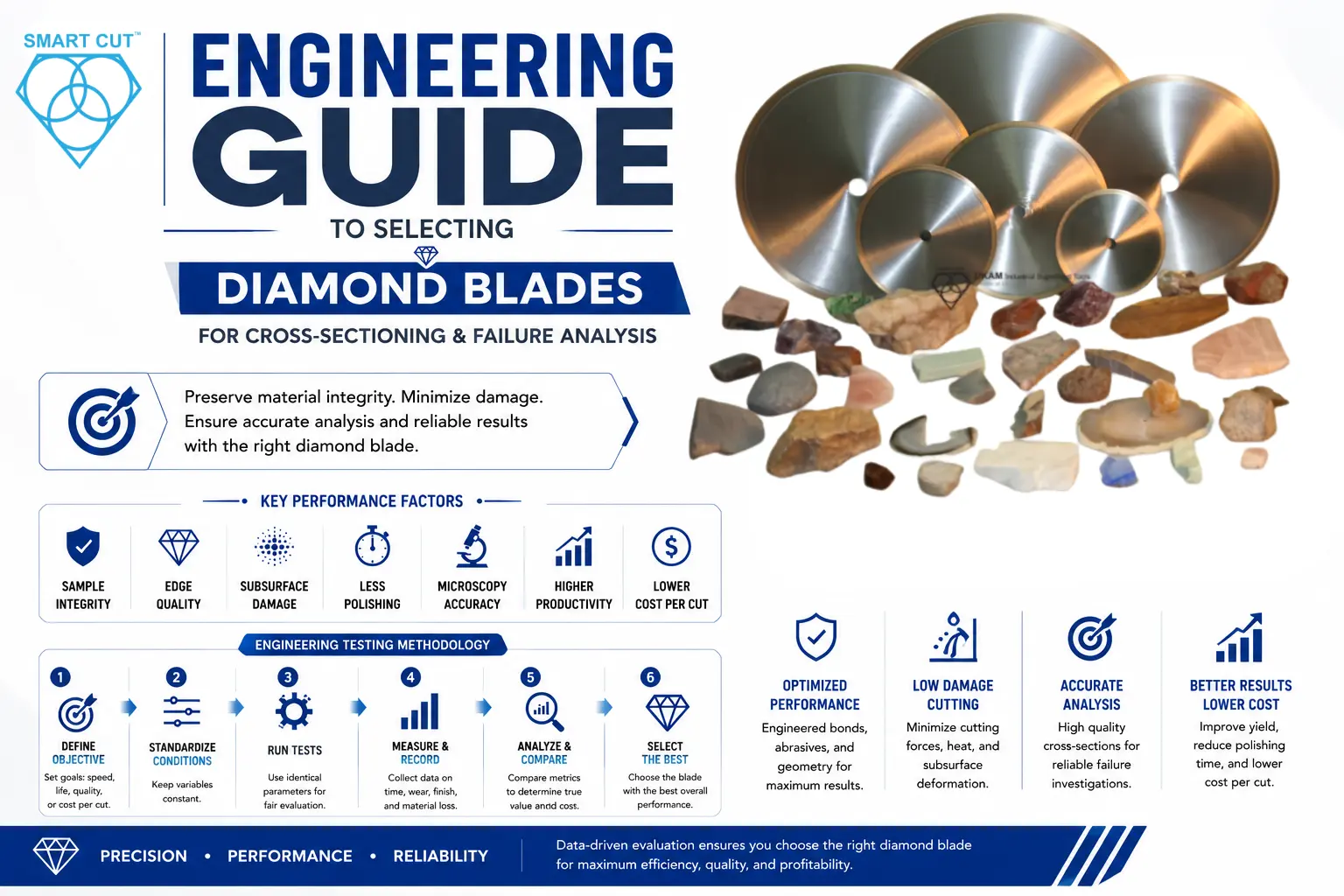
Table of Contents
ToggleCross-sectioning is one of the most critical steps in failure analysis, metallography, semiconductor inspection, quality control, and materials research. Every subsequent process, including mounting, grinding, polishing, optical microscopy, SEM imaging, EDS analysis, and microstructural evaluation, depends on the quality of the initial cut.
If the cutting process introduces heat, mechanical stress, edge chipping, delamination, smearing, or subsurface fractures, the sample no longer accurately represents the original material. Even minor cutting damage can lead to incorrect conclusions during failure investigations, inaccurate dimensional measurements, unnecessary polishing, or complete loss of valuable specimens.
Selecting the correct diamond blade for cross-sectioning is therefore not simply a matter of choosing a blade that can cut the material.
It requires selecting a blade that preserves the material’s original structure while minimizing cutting forces, thermal damage, and material deformation.
For engineers working with semiconductors, technical ceramics, composites, aerospace alloys, carbides, glass, electronic packages, and advanced engineering materials, blade selection directly affects:
- Sample integrity
- Edge quality
- Subsurface damage
- Polishing time
- Microscopy accuracy
- Analytical reliability
- Material yield
- Process repeatability
- Overall laboratory productivity
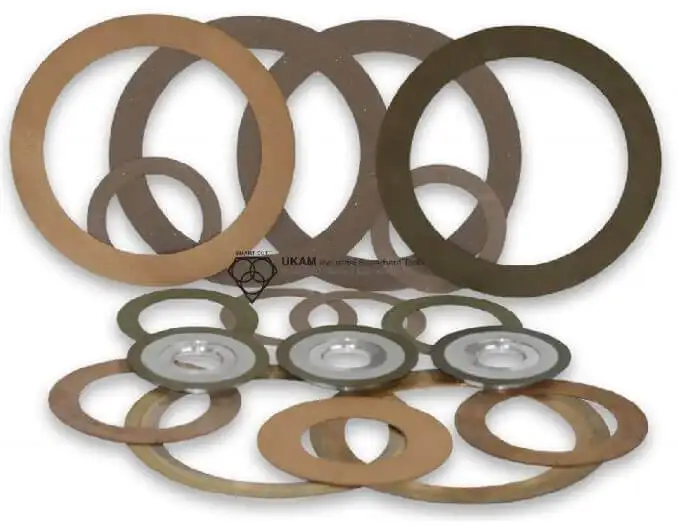
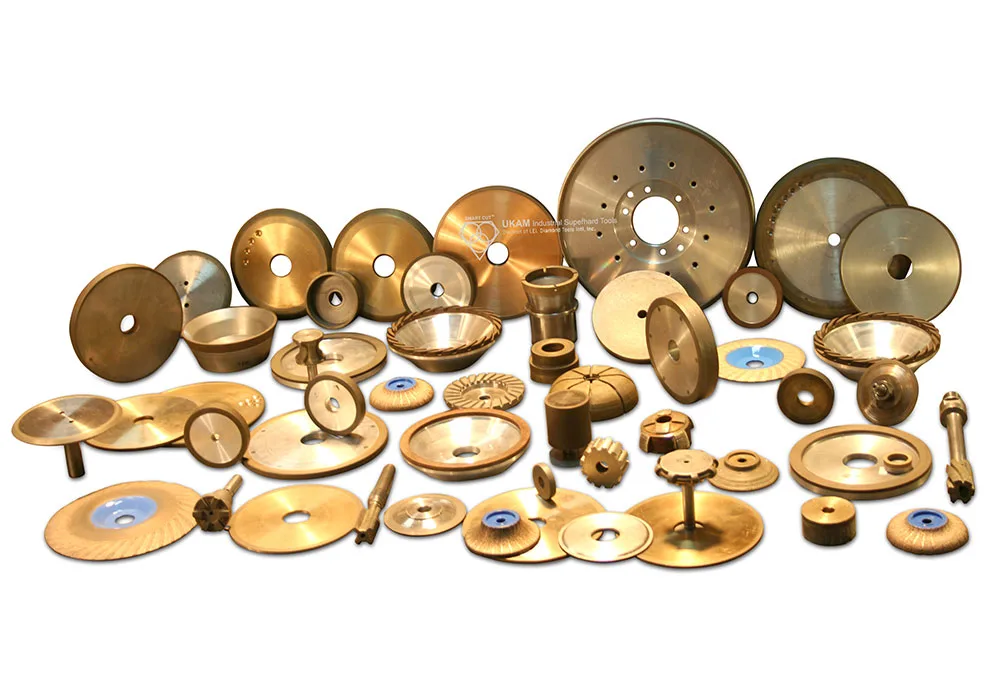
Modern precision diamond blades, precision wafering blades, and precision cutting saws are specifically engineered to achieve these objectives by combining optimized bond systems, abrasive characteristics, blade geometry, and controlled cutting parameters for each application.
Trusted by Tens of Thousands of Manufacturers, Laboratories,
Research Institutions Worldwide Since 1990

American Based Manufacturer

Established in 1990


Custom manufacturing


Why Cross-Sectioning Quality Matters
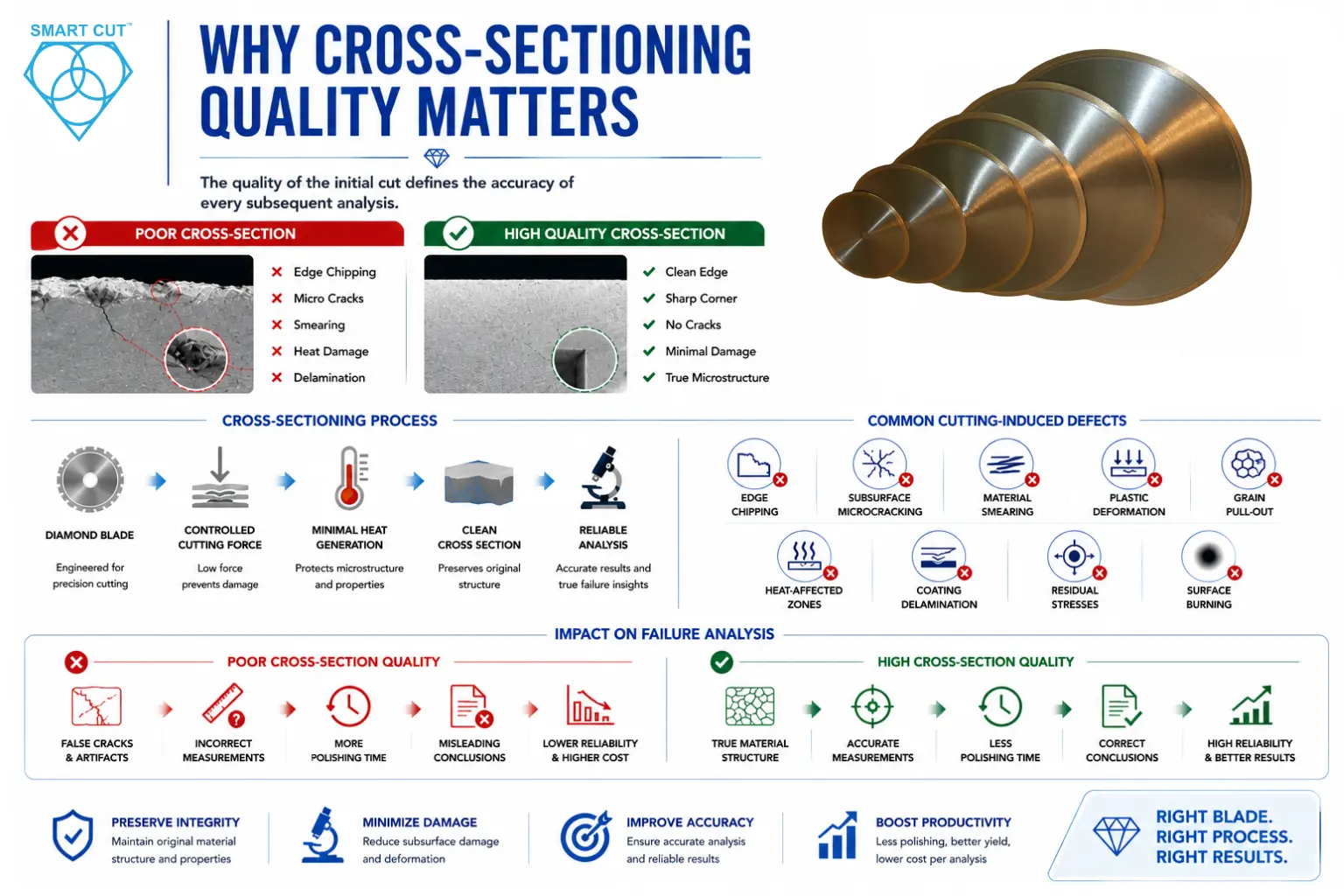
Cross-sectioning is fundamentally different from conventional cutting.
The objective is not simply to separate material.
The objective is to expose the true internal structure of the component without introducing new defects.
Every cutting operation generates mechanical and thermal energy. If these forces are not properly controlled, the cutting process itself can alter the specimen before inspection even begins.
Common cutting-induced defects include:
- Edge chipping
- Subsurface microcracking
- Material smearing
- Plastic deformation
- Grain pull-out
- Heat-affected zones
- Coating delamination
- Residual stresses
- Surface burning
These defects frequently appear similar to actual manufacturing failures, making accurate root-cause analysis far more difficult.
For example, excessive cutting force during ceramic sectioning may create edge fractures that resemble in-service cracking. Likewise, overheating during metallographic sectioning can alter the material’s microstructure, leading to misleading hardness measurements or incorrect metallurgical conclusions.
Selecting the proper diamond blade for sample preparation significantly reduces these risks while improving the overall reliability of laboratory results.
Failure Analysis Begins Before the Microscope
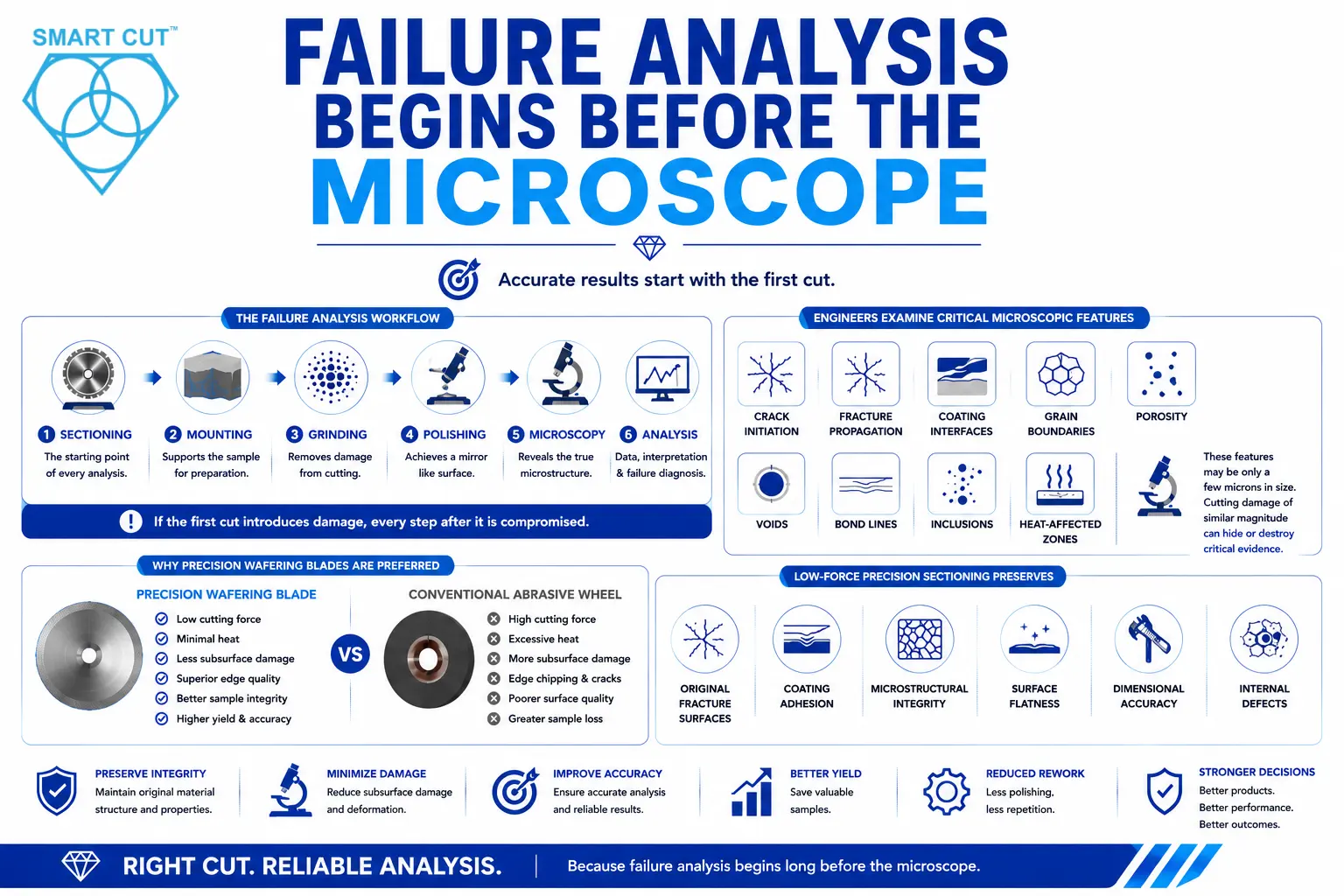
Many engineers focus primarily on microscopy equipment, polishing procedures, or analytical instruments.
However, failure analysis actually begins during the first cut.
A poorly prepared sample cannot be corrected by advanced polishing techniques or higher-resolution imaging.
If the cutting operation damages the specimen, every subsequent analytical step is affected.
During failure investigations, engineers often examine:
- Crack initiation sites
- Fracture propagation
- Coating interfaces
- Grain boundaries
- Porosity
- Voids
- Bond lines
- Inclusions
- Heat-affected zones
These microscopic features may measure only a few microns in size.
Introducing cutting-induced damage of a similar magnitude can easily obscure or destroy the evidence being investigated.
This is why laboratories performing semiconductor failure analysis, aerospace investigations, electronic package analysis, and metallographic evaluations typically rely on precision wafering blades rather than conventional abrasive cut-off wheels.
Low-force precision sectioning helps preserve:
- Original fracture surfaces
- Coating adhesion
- Microstructural integrity
- Surface flatness
- Dimensional accuracy
- Internal defects
The result is greater confidence in analytical findings and more reliable engineering decisions.
Why Diamond Blades Are Preferred for Precision Cross-Sectioning
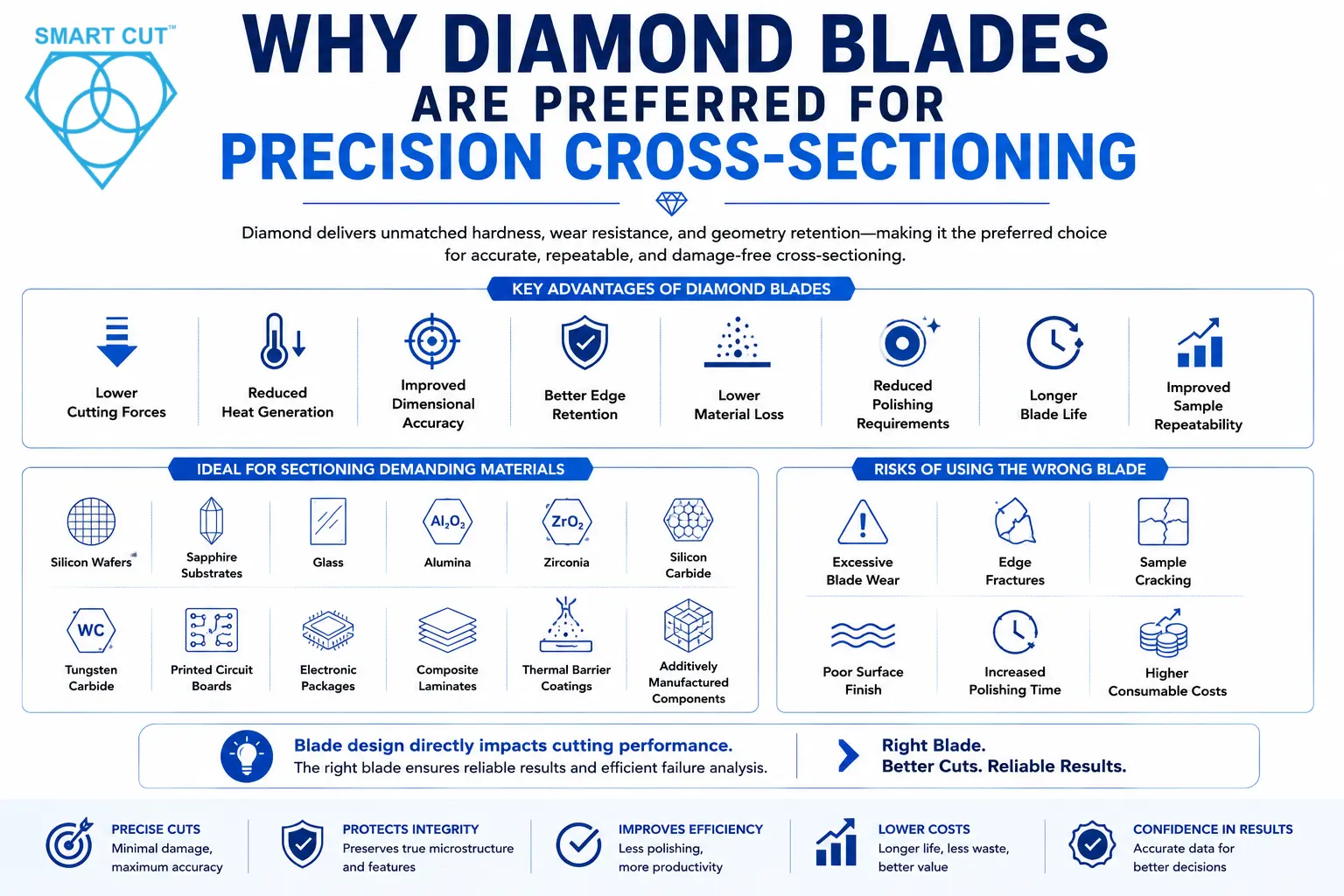
Diamond remains the preferred abrasive for most precision cross-sectioning applications because of its exceptional hardness, wear resistance, and ability to maintain cutting geometry throughout extended use.
Unlike conventional abrasive wheels, precision diamond blades remove material using controlled abrasive action rather than aggressive grinding.
This offers several important advantages:
- Lower cutting forces
- Reduced heat generation
- Improved dimensional accuracy
- Better edge retention
- Lower material loss
- Reduced polishing requirements
- Longer blade life
- Improved sample repeatability
These advantages become increasingly important when sectioning:
- Silicon wafers
- Sapphire substrates
- Glass
- Alumina
- Zirconia
- Silicon carbide
- Tungsten carbide
- Printed circuit boards
- Electronic packages
- Composite laminates
- Thermal barrier coatings
- Additively manufactured components
Different applications require different blade constructions.
Selecting the wrong blade often produces:
- Excessive blade wear
- Edge fractures
- Sample cracking
- Poor surface finish
- Increased polishing time
- Higher consumable costs
Understanding how blade design influences cutting performance is therefore essential for successful failure analysis and precision sample preparation.
Selecting the Correct Diamond Blade
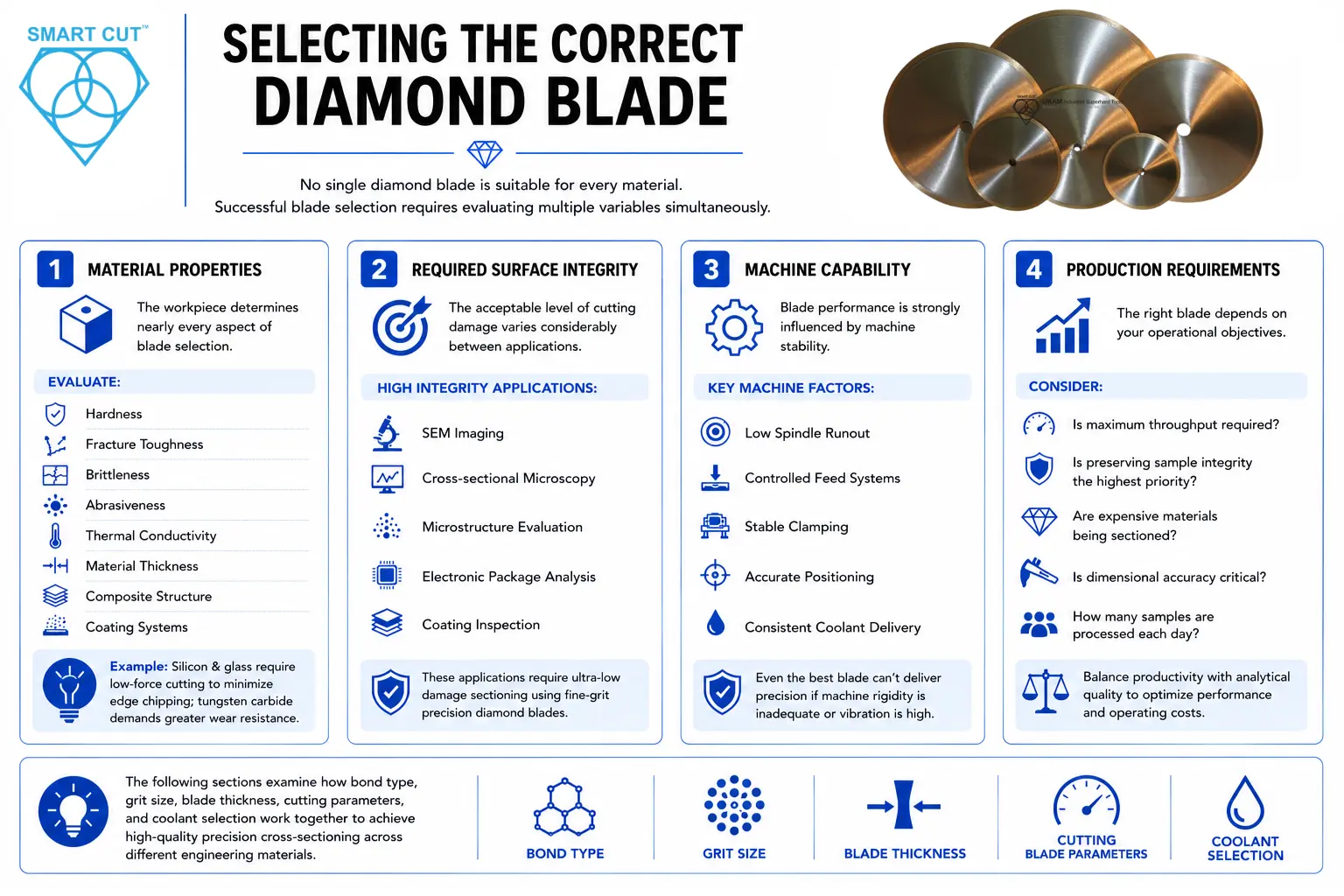
No single diamond blade is suitable for every material.
Successful blade selection requires evaluating multiple variables simultaneously rather than focusing on only one specification.
The most important considerations include:
Material Properties
The workpiece determines nearly every aspect of blade selection.
Engineers should evaluate:
- Hardness
- Fracture toughness
- Brittleness
- Abrasiveness
- Thermal conductivity
- Material thickness
- Composite structure
- Coating systems
For example, silicon and glass require low-force cutting to minimize edge chipping, while tungsten carbide demands greater wear resistance due to its extreme abrasiveness.
Required Surface Integrity
The acceptable level of cutting damage varies considerably between applications.
Routine production sectioning may tolerate minor edge defects.
Failure analysis generally cannot.
Applications involving:
- SEM imaging
- Cross-sectional microscopy
- Microstructure evaluation
- Electronic package analysis
- Coating inspection
typically require ultra-low damage sectioning using fine-grit precision diamond blades specifically designed for laboratory sample preparation.
Machine Capability
Blade performance is strongly influenced by machine stability.
High-quality precision cutting saws provide:
- Low spindle runout
- Controlled feed systems
- Stable clamping
- Accurate positioning
- Consistent coolant delivery
Even the highest-quality blade cannot consistently produce precision cross-sections if machine rigidity is inadequate or spindle vibration is excessive.
Production Requirements
The appropriate blade also depends on operational objectives.
Questions to consider include:
- Is maximum throughput required?
- Is preserving sample integrity the highest priority?
- Are expensive materials being sectioned?
- Is dimensional accuracy critical?
- How many samples are processed each day?
Balancing productivity with analytical quality allows engineers to select blades that optimize both performance and operating costs.
The following sections examine how bond type, grit size, blade thickness, cutting parameters, and coolant selection work together to achieve high-quality precision cross-sectioning across different engineering materials.
Bond Type Selection
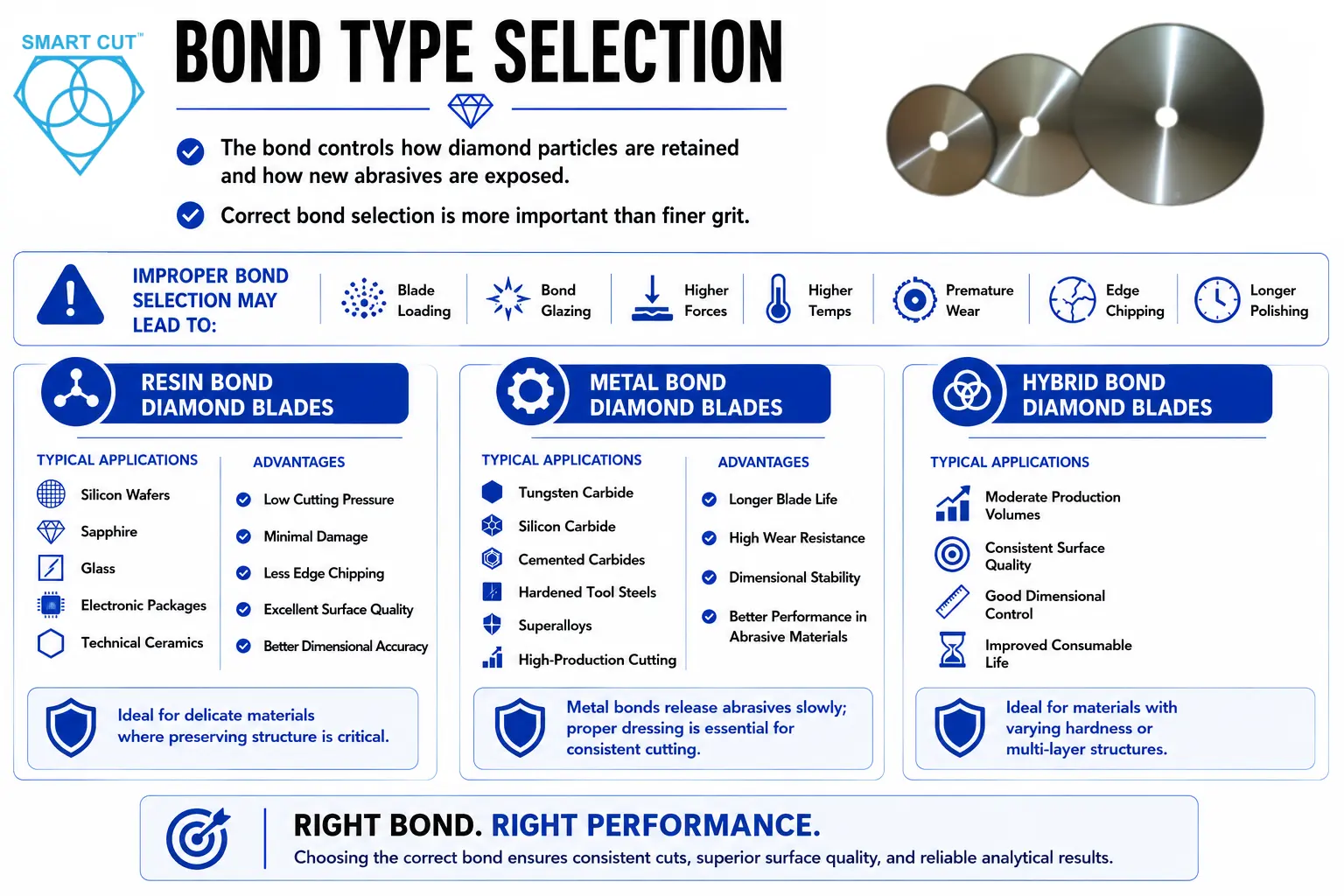
The bond system is one of the most important variables affecting cutting performance, blade life, surface quality, and sample integrity during precision cross-sectioning.
The bond controls how firmly the diamond particles are retained and how quickly new abrasive crystals become exposed during cutting. Selecting the correct bond is often more important than simply choosing a finer grit size.
An improperly selected bond may lead to:
- Excessive blade loading
- Bond glazing
- Increased cutting forces
- Higher cutting temperatures
- Premature blade wear
- Edge chipping
- Longer polishing times
Resin Bond Diamond Blades
Resin bond blades are widely used for precision sectioning because they produce lower cutting forces and excellent surface finishes.
Typical applications include:
- Silicon wafers
- Sapphire
- Glass
- Electronic packages
- Technical ceramics
- Composite materials
- Metallographic specimens
Advantages include:
- Low cutting pressure
- Minimal subsurface damage
- Reduced edge chipping
- Excellent surface quality
- Improved dimensional accuracy
These characteristics make resin bond blades ideal for delicate materials where preserving the original structure is critical.
Metal Bond Diamond Blades
Metal bond blades retain abrasive particles more aggressively, making them suitable for harder, more abrasive materials.
Typical applications include:
- Tungsten carbide
- Silicon carbide
- Cemented carbides
- Hardened tool steels
- Superalloys
- High-production cutting
Advantages include:
- Longer blade life
- Higher wear resistance
- Improved dimensional stability
- Better performance in abrasive materials
However, because metal bonds release abrasive particles more slowly, cutting forces may increase if the blade becomes glazed. Proper dressing becomes increasingly important to maintain consistent cutting performance.
Hybrid Bond Diamond Blades
Hybrid bond systems combine characteristics of both resin and metal bonds to balance cutting performance and blade life.
These blades are often selected for applications requiring:
- Moderate production volumes
- Consistent surface quality
- Good dimensional control
- Improved consumable life
Hybrid bonds are particularly useful when sectioning materials with varying hardness or multi-layer structures.
Bond Selection Comparison
| Characteristic | Resin Bond | Metal Bond | Hybrid Bond |
|---|---|---|---|
| Cutting Force | Low | Moderate | Moderate |
| Surface Finish | Excellent | Good | Very Good |
| Blade Life | Moderate | Long | Long |
| Dressing Frequency | Higher | Lower | Moderate |
| Best Applications | Brittle & Delicate Materials | Abrasive & Hard Materials | Mixed Applications |
Selecting the appropriate bond minimizes unnecessary blade wear while preserving specimen integrity throughout the sectioning process.
Grit Size Selection
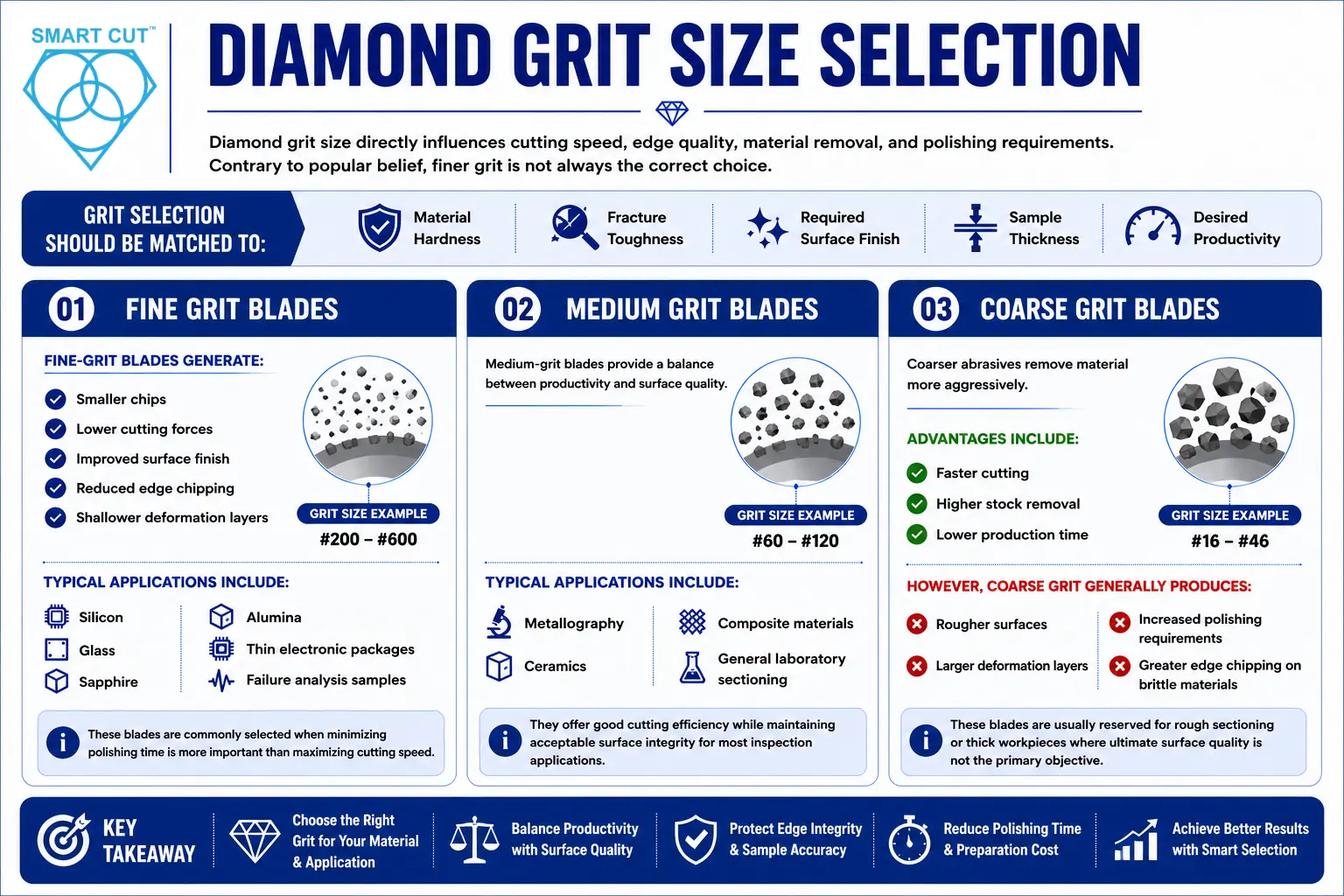
Diamond grit size directly influences cutting speed, edge quality, material removal, and polishing requirements.
Contrary to popular belief, finer grit is not always the correct choice.
Instead, grit selection should be matched to:
- Material hardness
- Fracture toughness
- Required surface finish
- Sample thickness
- Desired productivity
Fine Grit Blades
Fine-grit blades generate:
- Smaller chips
- Lower cutting forces
- Improved surface finish
- Reduced edge chipping
- Shallower deformation layers
Typical applications include:
- Silicon
- Glass
- Sapphire
- Alumina
- Thin electronic packages
- Failure analysis samples
These blades are commonly selected when minimizing polishing time is more important than maximizing cutting speed.
Medium Grit Blades
Medium-grit blades provide a balance between productivity and surface quality.
Typical applications include:
- Metallography
- Ceramics
- Composite materials
- General laboratory sectioning
They offer good cutting efficiency while maintaining acceptable surface integrity for most inspection applications.
Coarse Grit Blades
Coarser abrasives remove material more aggressively.
Advantages include:
- Faster cutting
- Higher stock removal
- Lower production time
However, coarse grit generally produces:
- Rougher surfaces
- Larger deformation layers
- Increased polishing requirements
- Greater edge chipping on brittle materials
These blades are usually reserved for rough sectioning or thick workpieces where ultimate surface quality is not the primary objective.
Blade Thickness & Kerf Considerations
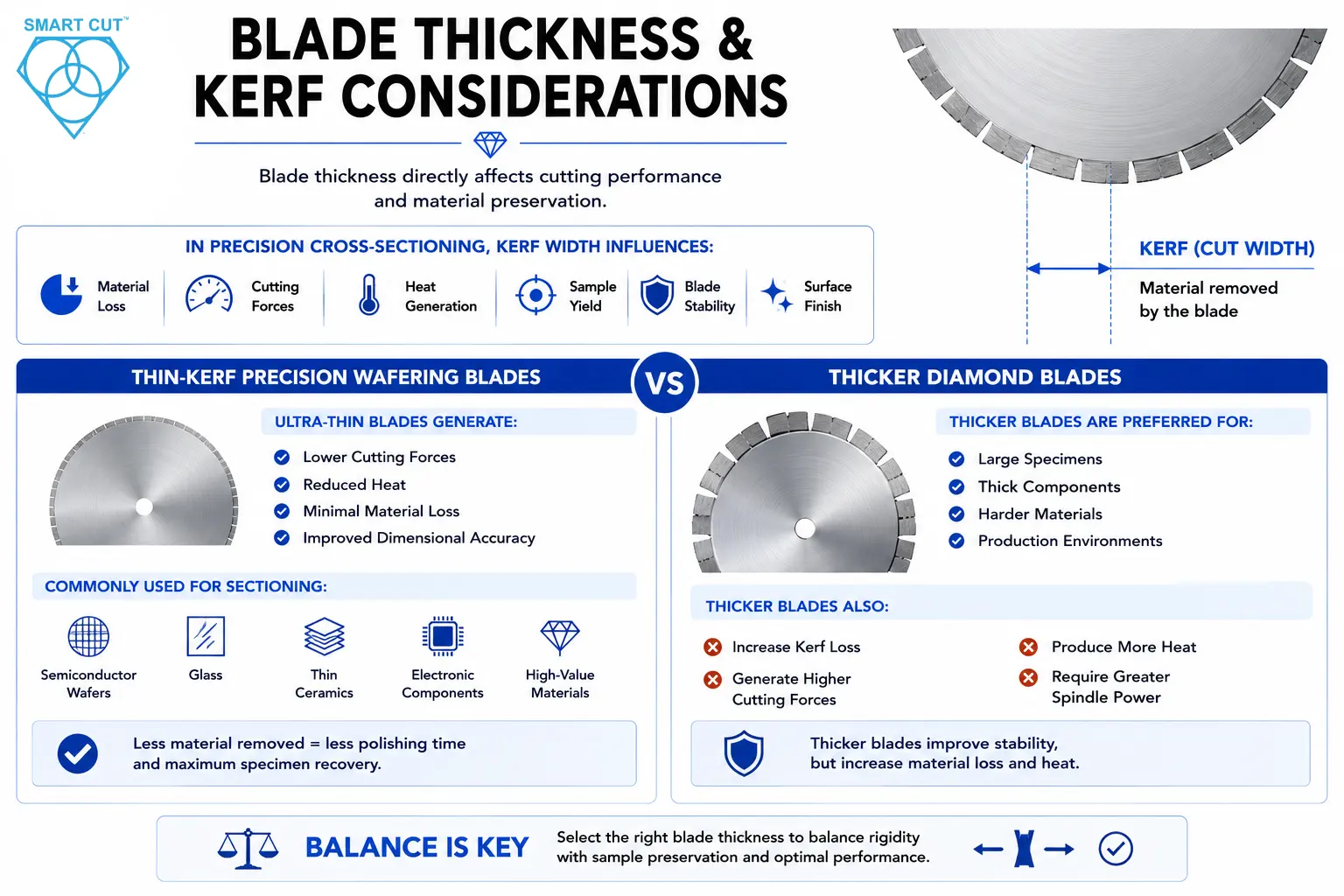
Blade thickness directly affects both cutting performance and material preservation.
Many engineers select blades based solely on diameter while overlooking kerf width.
In precision cross-sectioning, kerf width influences:
- Material loss
- Cutting forces
- Heat generation
- Sample yield
- Blade stability
- Surface finish
Thin-Kerf Precision Wafering Blades
Ultra-thin blades generate:
- Lower cutting forces
- Reduced heat
- Minimal material loss
- Improved dimensional accuracy
These blades are commonly used when sectioning:
- Semiconductor wafers
- Glass
- Thin ceramics
- Electronic components
- High-value materials
Because less material is removed, thin blades also reduce polishing time while maximizing specimen recovery.
Thicker Diamond Blades
Thicker blades offer greater rigidity during demanding cutting operations.
They are generally preferred for:
- Large specimens
- Thick components
- Harder materials
- Production environments
Although thicker blades improve stability, they also:
- Increase kerf loss
- Generate higher cutting forces
- Produce more heat
- Require greater spindle power
Selecting blade thickness therefore requires balancing rigidity with sample preservation.
Cutting Force & Sample Integrity
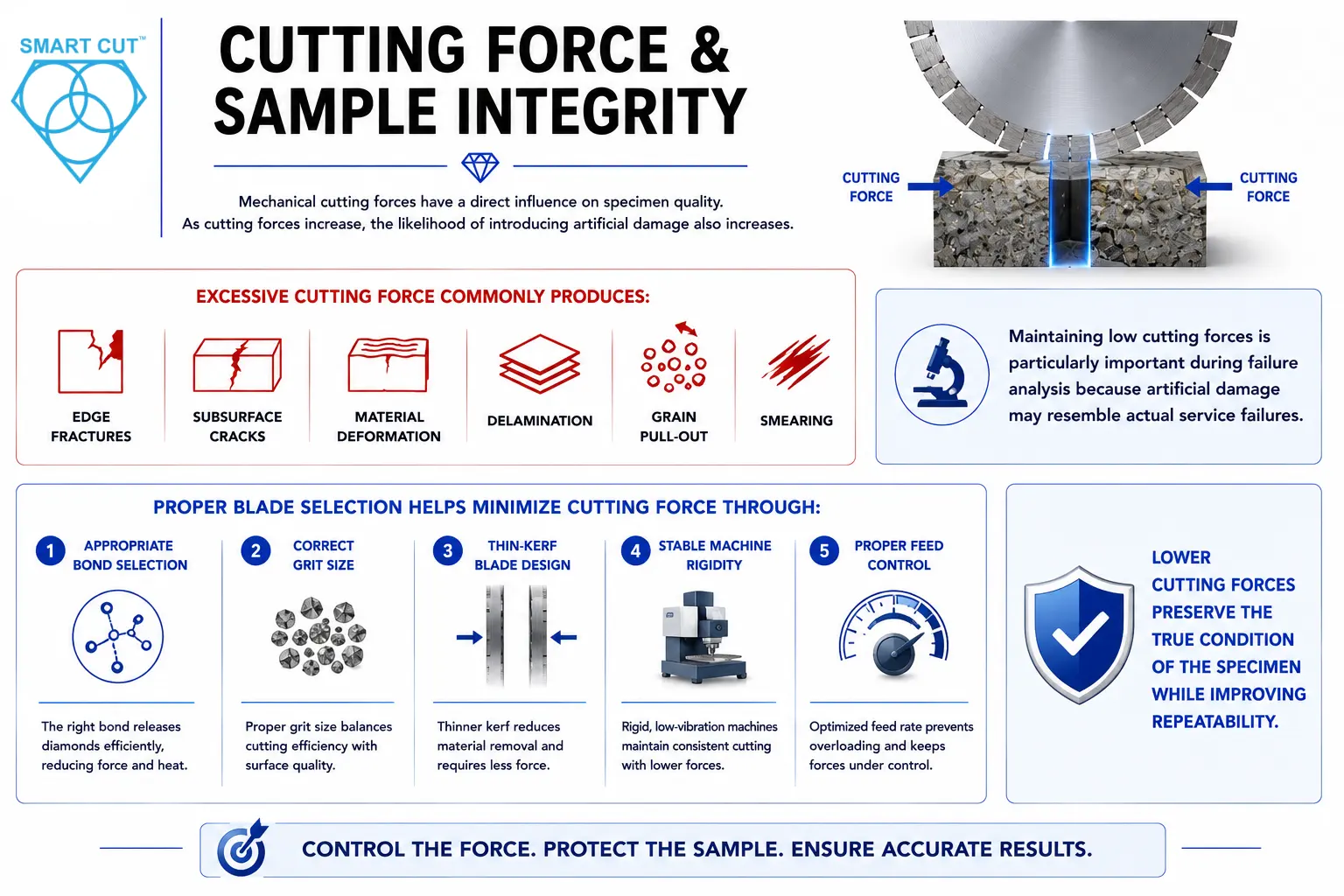
Mechanical cutting forces have a direct influence on specimen quality.
As cutting forces increase, the likelihood of introducing artificial damage also increases.
Excessive cutting force commonly produces:
- Edge fractures
- Subsurface cracks
- Material deformation
- Delamination
- Grain pull-out
- Smearing
Maintaining low cutting forces is particularly important during failure analysis because artificial damage may resemble actual service failures.
Proper blade selection helps minimize cutting force through:
- Appropriate bond selection
- Correct grit size
- Thin-kerf blade design
- Stable machine rigidity
- Proper feed control
Lower cutting forces preserve the true condition of the specimen while improving repeatability.
Surface Finish & Subsurface Damage
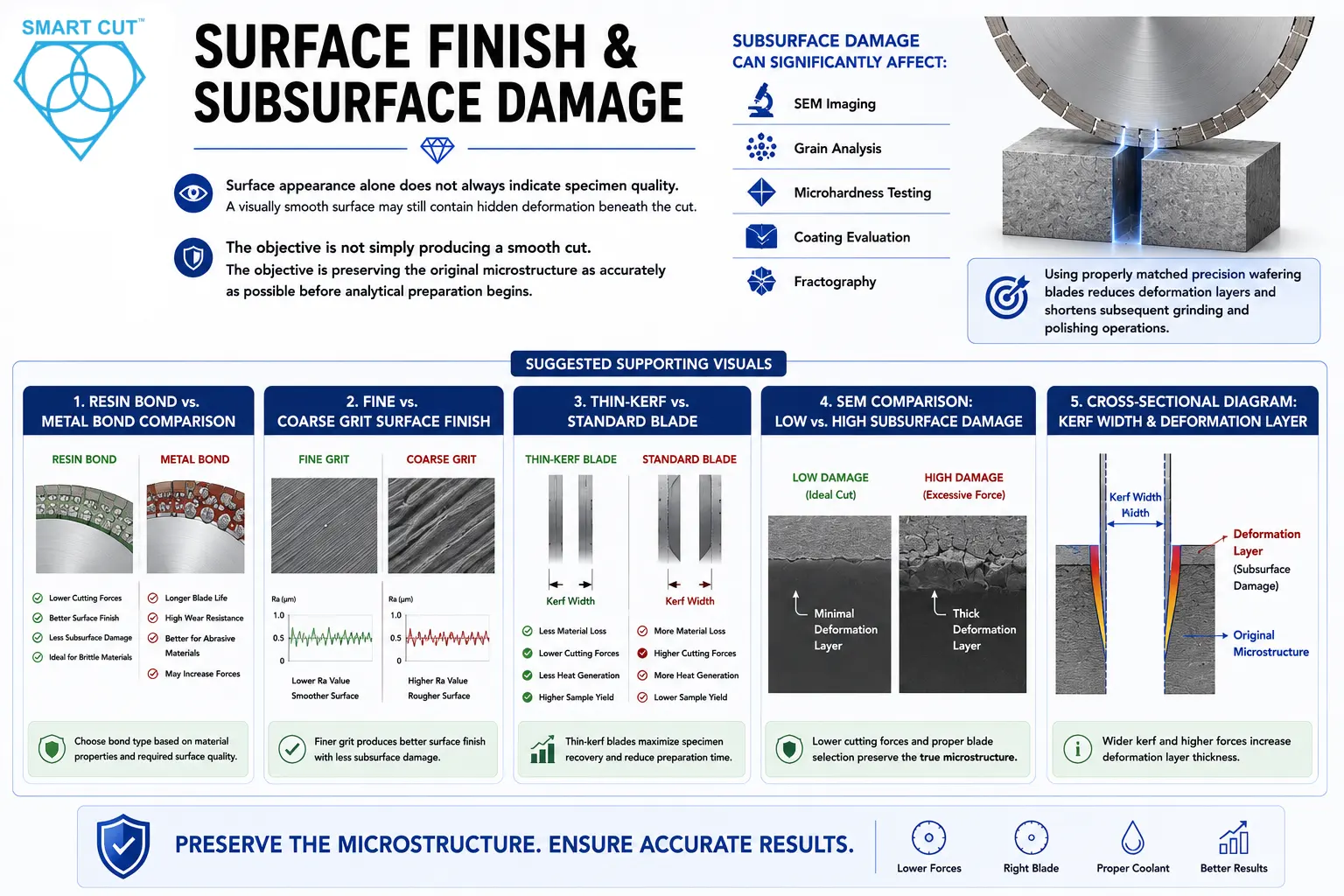
Surface appearance alone does not always indicate specimen quality.
A visually smooth surface may still contain hidden deformation beneath the cut.
Subsurface damage can significantly affect:
- SEM imaging
- Grain analysis
- Microhardness testing
- Coating evaluation
- Fractography
Using properly matched precision wafering blades reduces deformation layers and shortens subsequent grinding and polishing operations.
The objective is not simply producing a smooth cut.
The objective is preserving the original microstructure as accurately as possible before analytical preparation begins.
Suggested Supporting Visuals
- Resin bond vs. metal bond comparison graphic
- Fine vs. coarse grit surface finish comparison
- Thin-kerf vs. standard blade illustration
- SEM comparison showing low and high subsurface damage
- Cross-sectional diagram highlighting kerf width and deformation layer
Coolant & Cutting Parameters
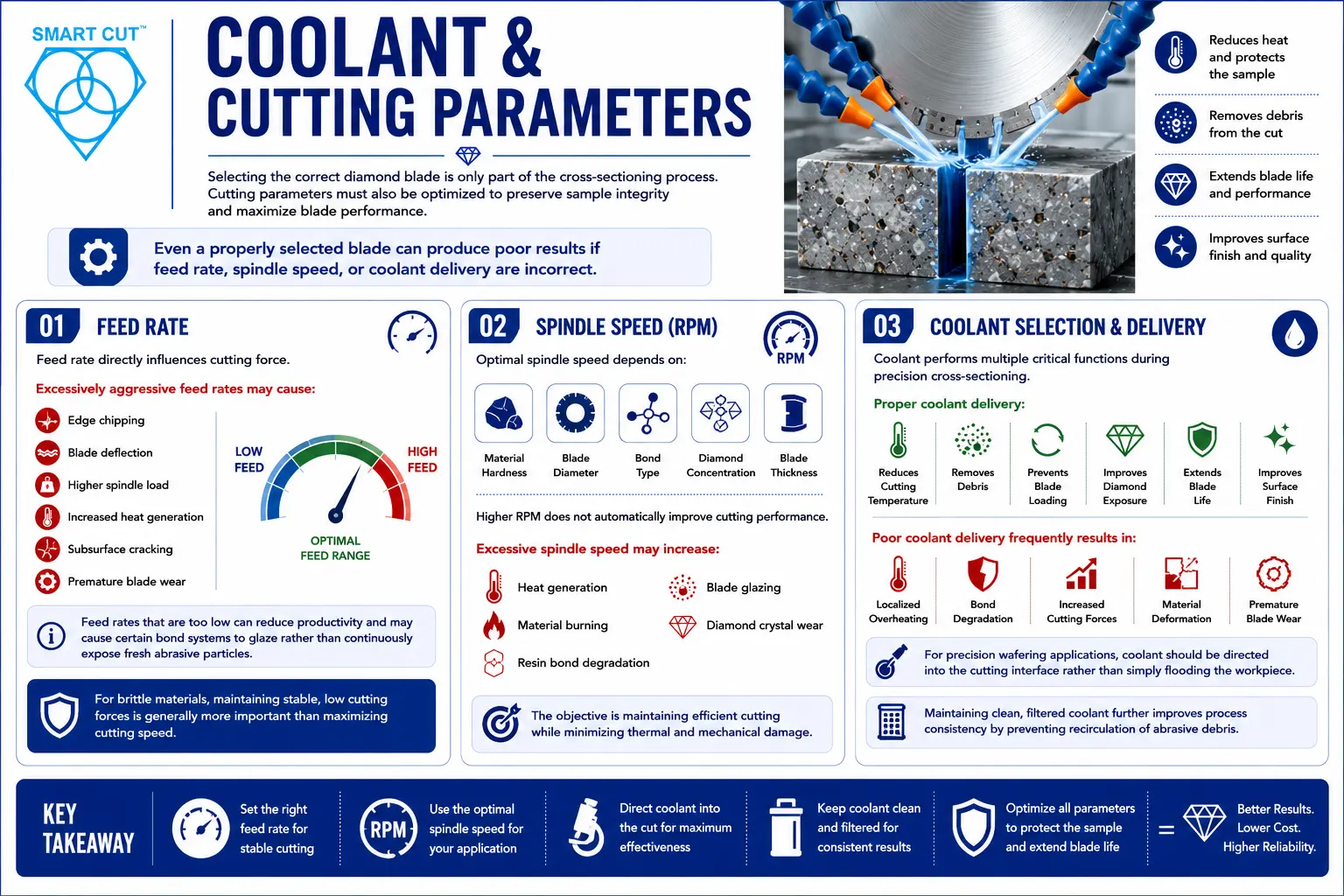
Selecting the correct diamond blade is only part of the cross-sectioning process. Cutting parameters must also be optimized to preserve sample integrity and maximize blade performance.
Even a properly selected blade can produce poor results if feed rate, spindle speed, or coolant delivery are incorrect.
Feed Rate
Feed rate directly influences cutting force.
Excessively aggressive feed rates may cause:
- Edge chipping
- Blade deflection
- Higher spindle load
- Increased heat generation
- Subsurface cracking
- Premature blade wear
Conversely, feed rates that are too low can reduce productivity and may cause certain bond systems to glaze rather than continuously expose fresh abrasive particles.
For brittle materials, maintaining stable, low cutting forces is generally more important than maximizing cutting speed.
Spindle Speed (RPM)
Optimal spindle speed depends on:
- Material hardness
- Blade diameter
- Bond type
- Diamond concentration
- Blade thickness
Higher RPM does not automatically improve cutting performance.
Excessive spindle speed may increase:
- Heat generation
- Material burning
- Resin bond degradation
- Blade glazing
- Diamond crystal wear
The objective is maintaining efficient cutting while minimizing thermal and mechanical damage.
Coolant Selection & Delivery
Coolant performs multiple critical functions during precision cross-sectioning.
Proper coolant delivery:
- Reduces cutting temperature
- Removes debris
- Prevents blade loading
- Improves diamond exposure
- Extends blade life
- Improves surface finish
Poor coolant delivery frequently results in:
- Localized overheating
- Bond degradation
- Increased cutting forces
- Material deformation
- Premature blade wear
For precision wafering applications, coolant should be directed into the cutting interface rather than simply flooding the workpiece.
Maintaining clean, filtered coolant further improves process consistency by preventing recirculation of abrasive debris.
Material-Specific Blade Selection Recommendations
Different engineering materials respond differently to cutting forces.
Matching blade characteristics to material properties significantly improves both sample quality and blade performance.
| Material | Typical Starting Blade Recommendation | Abrasive and Bond | Primary Metallographic Objective | Important Qualification |
|---|---|---|---|---|
| Silicon | Fine-grit precision diamond wafering blade | Metal-bond diamond as the general starting point. Resin-bond diamond for especially damage-sensitive specimens | Minimize edge chipping, kerf loss, and subsurface damage | Use a thin blade, low feed rate, stable fixturing, and continuous coolant delivery |
| Sapphire | Fine-grit precision diamond wafering blade | Metal-bond diamond for general sectioning. Resin-bond diamond when very low cutting damage is required | Control chipping, cracking, and subsurface damage | Sapphire requires a rigid machine, low runout, conservative feed, and adequate dressing |
| Glass and fused silica | Fine to medium-grit diamond wafering blade | Metal-bond diamond for routine precision sectioning. Resin-bond diamond for fragile or highly damage-sensitive glass | Reduce edge chipping and crack propagation | Blade grit, concentration, thickness, and feed rate are often more important than bond designation alone |
| Alumina | Diamond wafering blade selected according to density and toughness | Metal-bond diamond for routine sectioning. Softer metal or resin bond for dense, brittle, or damage-sensitive alumina | Balance cutting rate, chipping control, surface quality, and blade life | Dense technical alumina may require a different blade from porous or lower-density alumina |
| Zirconia | Precision diamond wafering blade | Metal-bond diamond with a bond hardness matched to the zirconia grade | Control heat, microcracking, and surface damage | Stabilized zirconia is relatively tough compared with alumina and may require a freer-cutting blade |
| Silicon carbide | Fine or medium-grit precision diamond wafering blade | Metal-bond diamond, commonly with a relatively open or free-cutting bond | Section an extremely hard and abrasive material without excessive blade glazing | Use low runout, controlled feed, adequate coolant, and periodic dressing |
| Tungsten carbide and cemented carbide | Precision diamond wafering blade | Metal-bond diamond for general service and blade life. Resin-bond diamond when lower cutting damage or improved finish is required | Minimize carbide pullout, binder smearing, edge damage, and polishing time | Select the blade according to carbide grain size, binder percentage, binder type, and hardness |
| Hardened tool steel | CBN precision wafering blade or appropriate metallographic abrasive cut-off wheel | Resin-bonded CBN for precision sectioning. Soft aluminum oxide or CBN wheel for larger abrasive cutters | Prevent thermal damage, burning, deformation, and microstructural alteration | Diamond is generally not the first choice for routine ferrous sectioning because of chemical wear at elevated cutting temperatures |
| Stainless steel | CBN precision blade or soft aluminum oxide abrasive wheel | CBN for precision sectioning. Aluminum oxide for conventional abrasive sectioning | Reduce heat generation, burr formation, and mechanical deformation | Austenitic stainless steel can work-harden and load an improperly selected wheel |
| Nickel-based superalloys | CBN precision blade or soft abrasive cut-off wheel | CBN for precision sectioning. Application-specific aluminum oxide wheel for larger machines | Limit heat, smearing, deformation, and work hardening | These alloys are tough and can cause blade loading. A free-cutting bond is usually required |
| Titanium and titanium alloys | Application-specific diamond wafering blade or abrasive cut-off wheel | Diamond may be used on precision saws. A soft aluminum oxide wheel may be used on abrasive cutters | Reduce heat, smearing, burrs, and surface deformation | Titanium is chemically reactive and prone to loading. Coolant delivery and wheel openness are critical |
| Aluminum and soft nonferrous alloys | Coarse, open-structure diamond blade or silicon carbide abrasive wheel | High-concentration or coarse diamond blade for precision saws, depending on construction. Silicon carbide abrasive wheel for conventional sectioning | Prevent loading, smearing, and excessive burr formation | A fine, hard metal-bond diamond blade may load rapidly on soft aluminum |
| Copper and copper alloys | Free-cutting precision blade or silicon carbide abrasive wheel | Coarser diamond blade with an open bond, or silicon carbide abrasive wheel | Minimize smearing, loading, and mechanical deformation | Soft copper can clog fine diamond blades and may require frequent dressing |
| Carbon-fiber reinforced polymer | Fine diamond wafering blade, usually continuous rim | Diamond with a bond and concentration selected to minimize fiber pullout and matrix damage | Reduce delamination, fiber breakout, and matrix smearing | Composite layup, resin type, fiber direction, and specimen thickness strongly affect selection |
| Glass-fiber reinforced polymer | Fine diamond wafering blade | Diamond blade with a relatively free-cutting bond | Reduce delamination, edge fraying, and glass-fiber breakout | Very fine or hard bonds may load with polymer matrix material |
| Printed circuit boards and electronic assemblies | Thin precision diamond wafering blade | Diamond blade, often fine or medium grit, with a bond selected for mixed materials | Preserve layers, plated features, solder joints, and interfaces | PCBs contain copper, glass fiber, resin, ceramics, and solder. No single blade is ideal for every board |
| Metal-matrix composites | Precision diamond wafering blade | Diamond bond and grit selected according to reinforcement and matrix | Minimize reinforcement pullout and matrix smearing | Selection depends on whether the reinforcement is silicon carbide, alumina, boron carbide, or another phase |
| Ceramic-matrix composites | Fine diamond wafering blade | Metal-bond or resin-bond diamond depending on toughness and damage tolerance | Control cracking, fiber damage, and interface pullout | Fiber architecture and matrix composition must be considered |
These recommendations provide a starting point. Final blade selection should also consider machine rigidity, workpiece geometry, production volume, required tolerances, and surface finish requirements.
Common Cross-Sectioning Mistakes
Many sectioning problems are caused by improper blade selection or cutting parameters rather than defects in the blade itself.
Selecting a Blade Based Only on Material Hardness
Material hardness alone does not determine blade selection.
Engineers should also consider:
- Fracture toughness
- Brittleness
- Abrasiveness
- Thermal sensitivity
- Coating systems
Using Excessive Feed Rates
Higher feed rates often increase productivity only temporarily.
Long-term consequences may include:
- Increased blade wear
- Poor sample quality
- More polishing
- Higher scrap rates
Choosing an Incorrect Bond
A bond that is too hard may glaze.
A bond that is too soft may wear excessively.
Selecting the proper bond ensures consistent diamond exposure throughout the cutting process.
Ignoring Machine Stability
Blade performance depends heavily on machine rigidity.
High spindle runout or poor fixturing may introduce:
- Blade wander
- Vibration
- Chipping
- Dimensional inaccuracies
Even the highest-quality precision diamond blade cannot compensate for an unstable cutting system.
Delaying Blade Maintenance
Reduced cutting efficiency is often caused by blade loading rather than complete blade wear.
Routine inspection and proper dressing frequently restore performance while extending blade life.
Engineering Applications
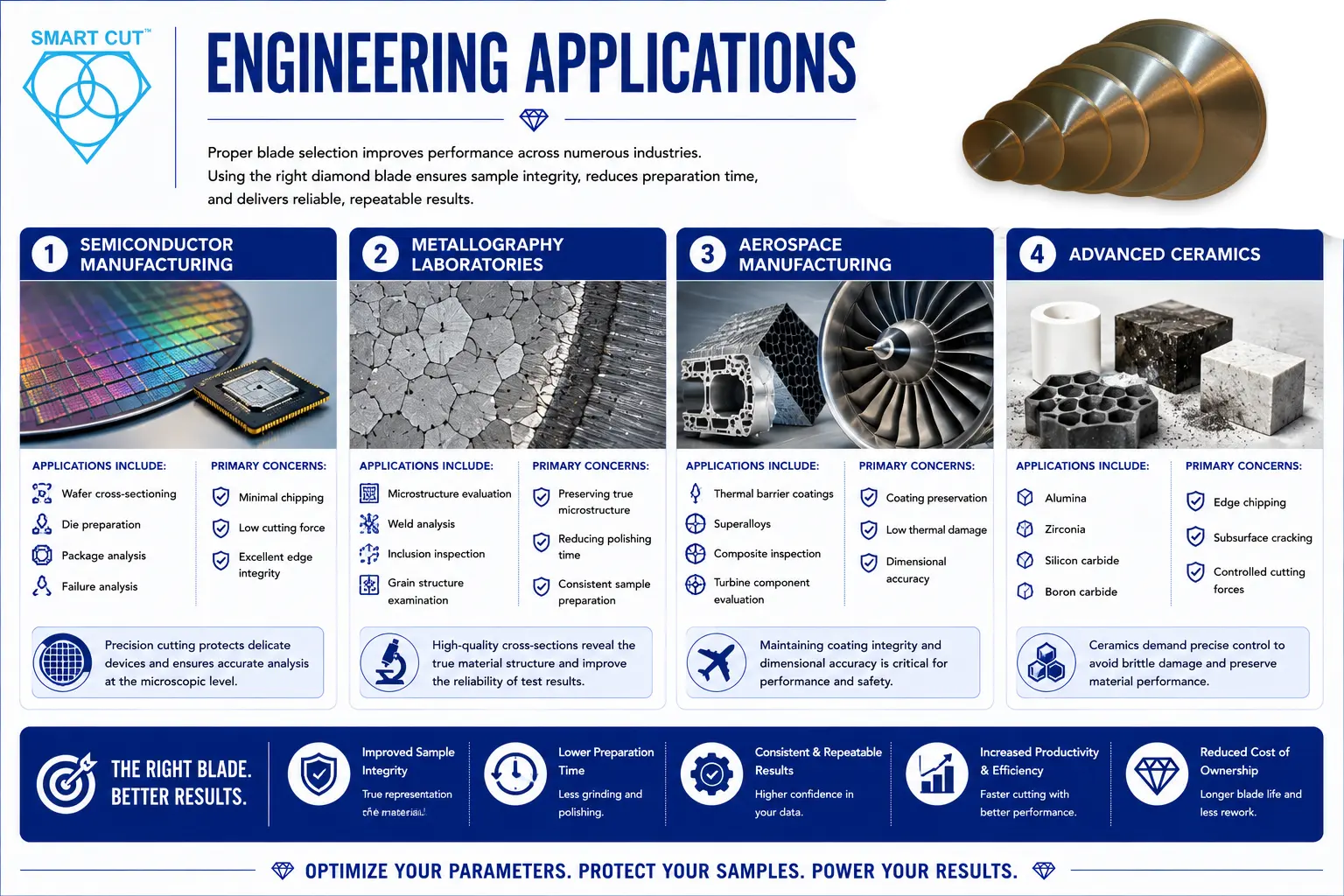
Proper blade selection improves performance across numerous industries.
Semiconductor Manufacturing
Applications include:
- Wafer cross-sectioning
- Die preparation
- Package analysis
- Failure analysis
Primary concerns:
- Minimal chipping
- Low cutting force
- Excellent edge integrity
Metallography Laboratories
Applications include:
- Microstructure evaluation
- Weld analysis
- Inclusion inspection
- Grain structure examination
Primary concerns:
- Preserving true microstructure
- Reducing polishing time
- Consistent sample preparation
Aerospace Manufacturing
Applications include:
- Thermal barrier coatings
- Superalloys
- Composite inspection
- Turbine component evaluation
Primary concerns:
- Coating preservation
- Low thermal damage
- Dimensional accuracy
Advanced Ceramics
Applications include:
- Alumina
- Zirconia
- Silicon carbide
- Boron carbide
Primary concerns:
- Edge chipping
- Subsurface cracking
- Controlled cutting forces
Frequently Asked Questions
Diamond blades produce lower cutting forces, improved dimensional accuracy, reduced material loss, and superior surface quality compared to conventional abrasive wheels.
Common causes include excessive feed rate, incorrect bond selection, coarse grit size, inadequate coolant delivery, and excessive spindle vibration.
Resin bond blades are generally preferred for delicate, brittle materials requiring superior surface finish.
Metal bond blades are better suited for highly abrasive materials requiring longer blade life.
Thinner blades reduce cutting forces and kerf loss while improving material yield. Thicker blades provide greater rigidity for demanding applications but generally increase material removal and cutting forces.
Coolant reduces heat generation, removes debris, prevents blade loading, improves surface finish, and extends blade life.
No.
Successful cross-sectioning depends on matching blade bond, grit size, concentration, thickness, and cutting parameters to the specific material and application.
Conclusion
Successful cross-sectioning requires far more than selecting a blade capable of cutting the material.
The correct diamond blade for cross-sectioning must preserve sample integrity while minimizing thermal damage, cutting forces, subsurface deformation, and polishing requirements.
By carefully selecting the appropriate bond system, grit size, blade thickness, and cutting parameters, engineers can significantly improve:
- Sample quality
- Failure analysis accuracy
- Microscopy results
- Blade life
- Material yield
- Process repeatability
- Overall laboratory productivity
For high-value materials and critical analytical applications, investing in the correct precision diamond blades, precision wafering blades, and precision cutting saws often reduces overall operating costs while improving confidence in engineering results.
If you need assistance selecting the optimal blade specification, bond type, grit size, RPM, or cutting parameters for your application, UKAM’s Applications Engineering Team can recommend a solution tailored to your material, equipment, and performance requirements.
Trusted by Tens of Thousands of Manufacturers, Laboratories,
Research Institutions Worldwide Since 1990
American Based Manufacturer
Established in 1990
Custom manufacturing
RELATED ARTICLES

Brian is an experienced professional in the field of precision cutting tools, with over 27 years of experience in technical support. Over the years, he has helped engineers, manufacturers, researchers, and contractors find the right solutions for working with advanced and hard-to-cut materials. He’s passionate about bridging technical knowledge with real-world applications to improve efficiency and accuracy.
As an author, Brian Farberov writes extensively on diamond tool design, application engineering, return on investment strategies, and process optimization, combining technical depth with a strong understanding of customer needs and market dynamics.