






















How Feed Rate, RPM & Coolant Affect Diamond Blade Performance

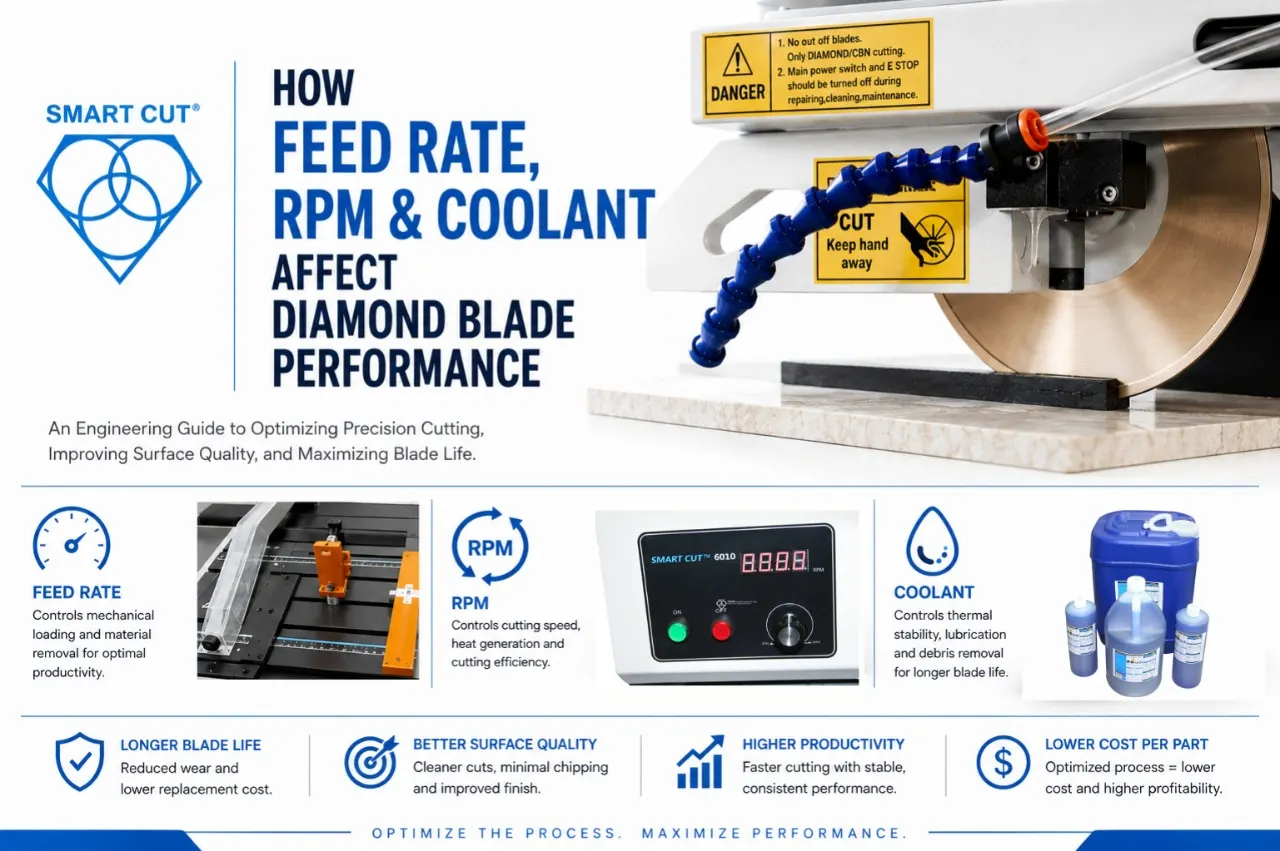
Table of Contents
Toggle
American Based Manufacturer

Established in 1990


Custom manufacturing


An Engineering Guide to Optimizing Precision Cutting, Improving Surface Quality, and Maximizing Blade Life
Introduction
Diamond blade performance is often evaluated based on blade life alone. When cutting quality begins to decline, many manufacturers assume that the blade has reached the end of its service life and simply replace it with a new one.
In reality, blade performance is rarely determined by the blade alone.
Precision cutting is a controlled engineering process where feed rate, spindle speed (RPM), coolant delivery, machine condition, material characteristics, and blade specification all work together. A change in one parameter can influence every other aspect of the cutting operation, affecting blade wear, cutting efficiency, surface quality, dimensional accuracy, and overall manufacturing cost.
A premium diamond blade operated under improper cutting conditions may wear prematurely, generate excessive heat, or produce inconsistent edge quality. Conversely, a properly optimized cutting process often enables the same blade to deliver stable, predictable performance over extended production runs.
For manufacturing engineers, the objective is not simply to maximize blade life. The real goal is to achieve consistent production, repeatable quality, efficient machine utilization, and the lowest possible Cost Per Part. Learn more about UKAM and our engineering approach.
Understanding how feed rate, RPM, and coolant interact is essential for achieving these objectives.
Why Process Parameters Matter More Than Many Engineers Realize
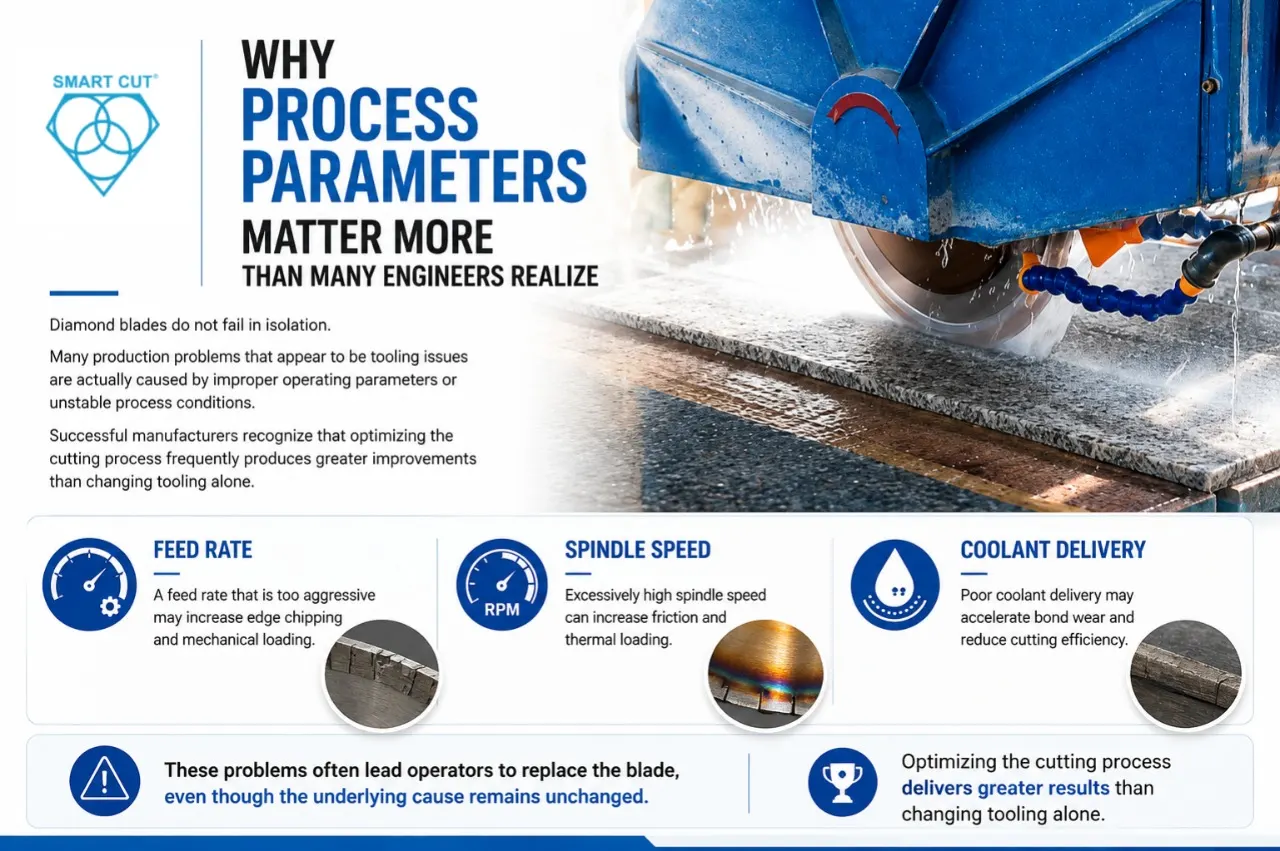
Diamond blades do not fail in isolation.
Many production problems that appear to be tooling issues are actually caused by improper operating parameters or unstable process conditions. If you’re troubleshooting a live production issue, our troubleshooting resources cover related scenarios in depth.
For example:
- A feed rate that is too aggressive may increase edge chipping and mechanical loading.
- Excessively high spindle speed can increase friction and thermal loading.
- Poor coolant delivery may accelerate bond wear and reduce cutting efficiency.
These problems often lead operators to replace the blade, even though the underlying cause remains unchanged.
Successful manufacturers recognize that optimizing the cutting process frequently produces greater improvements than changing tooling alone.
Engineering Insight
One of the most common misconceptions in precision cutting is assuming that a premium blade will automatically compensate for poor process conditions.
In practice, even the highest-quality diamond blade cannot consistently deliver optimal performance if feed rate, RPM, coolant delivery, or machine stability are not properly controlled.
The Three Parameters That Control Blade Performance
Although many variables influence precision cutting, three operating parameters have the greatest day-to-day impact on manufacturing performance:
- Feed Rate
- Spindle Speed (RPM)
- Coolant Delivery
These parameters directly influence:
- Blade life
- Cutting efficiency
- Surface finish
- Edge quality
- Heat generation
- Production consistency
- Cost Per Part
Rather than adjusting these settings independently, engineers should evaluate how they interact throughout the cutting process.
Understanding the Relationship Between Feed Rate, RPM & Coolant
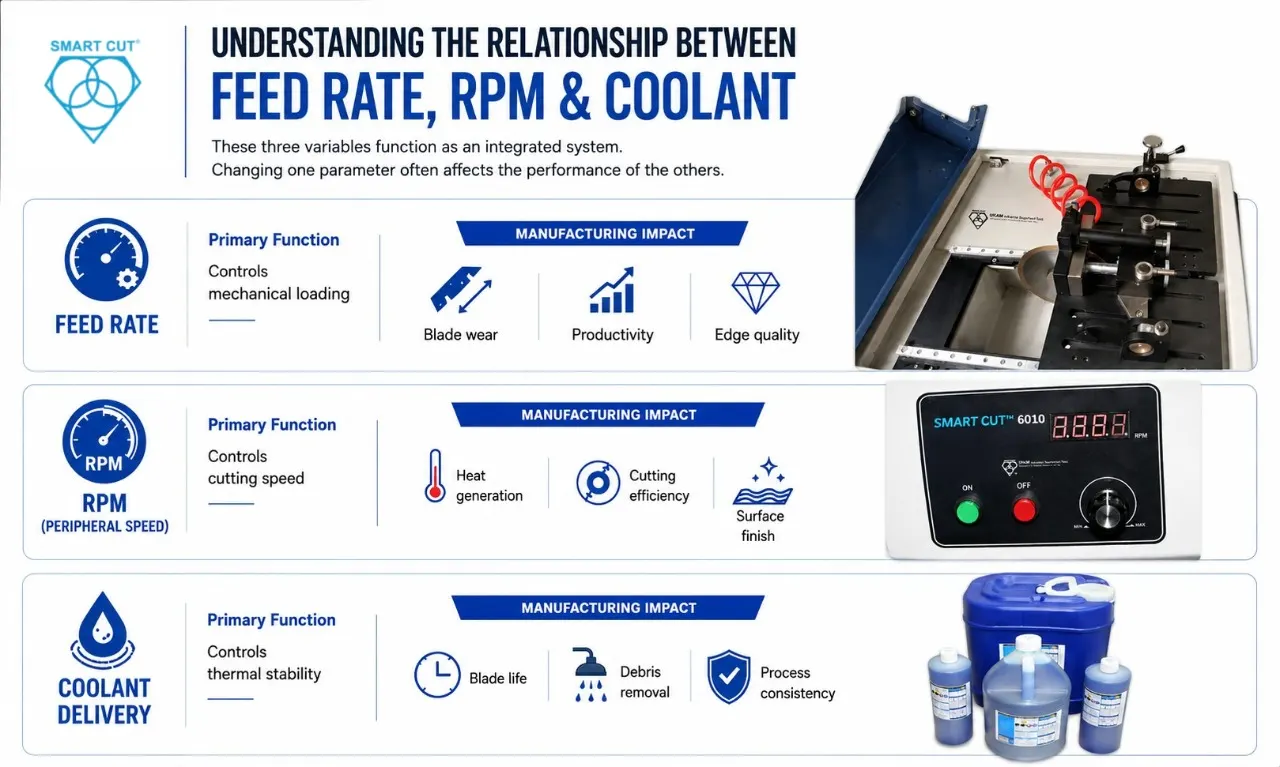
These three variables function as an integrated system. Changing one parameter often affects the performance of the others.
|
Process Parameter |
Primary Function |
Manufacturing Impact |
|---|---|---|
|
Feed Rate |
Controls mechanical loading |
Blade wear, productivity, edge quality |
|
RPM (Peripheral Speed) |
Controls cutting speed |
Heat generation, cutting efficiency, surface finish |
|
Coolant Delivery |
Controls thermal stability |
Blade life, debris removal, process consistency |
For example, increasing feed rate without adjusting coolant delivery may increase cutting temperatures. Likewise, increasing RPM without evaluating feed rate may generate additional friction while reducing process stability.
The objective is not to maximize one parameter, but to balance all three to achieve stable production.
Why Changing One Parameter Changes the Entire Process
Every cutting operation involves a balance between mechanical forces and heat generation. When one process variable changes, the entire cutting system responds.
Increasing Feed Rate may result in:
- Higher cutting forces
- Greater blade loading
- Increased vibration
- Faster material removal
This is especially relevant for diamond band saw blades, which are highly sensitive to mechanical loading changes.
Increasing RPM may result in:
- Higher blade speed
- Increased friction
- Greater heat generation
- Changes in cutting efficiency
Poor Coolant Delivery may result in:
- Higher operating temperatures
- Accelerated bond wear
- Debris accumulation
- Reduced cutting efficiency
These interactions explain why adjusting a single parameter without evaluating the complete process often produces inconsistent results.
Engineering Observation
Manufacturers sometimes attempt to solve production problems by increasing spindle speed or reducing feed rate without understanding the root cause.
While these adjustments may temporarily improve cutting performance, they often shift the problem elsewhere within the manufacturing process.
Successful optimization begins with understanding how all process variables interact.
Engineering Objectives of Process Optimization
Rather than chasing maximum blade life or maximum cutting speed, engineers typically focus on achieving a balanced process that delivers consistent production performance.
Typical manufacturing objectives include:
- Stable blade wear
- Consistent edge quality
- Reduced thermal damage
- Lower scrap rates
- Improved dimensional accuracy
- Reduced downstream grinding and polishing — see our Advanced Ceramics Grinding and Polishing Equipment
- Higher machine utilization
- Lower Cost Per Part
Optimizing feed rate, RPM, and coolant delivery plays a critical role in achieving each of these objectives.
The Engineering Approach to Process Control
Successful production environments rely on data rather than assumptions.
When optimizing cutting parameters, experienced engineers:
- Establish a production baseline.
- Change one variable at a time.
- Measure the effect of each adjustment.
- Document successful operating conditions.
- Validate improvements across multiple production batches.
If you’d like help setting up this process, our customer support and consultation resources can connect you with an application engineer.
This systematic approach minimizes unnecessary experimentation while improving long-term process stability.
Common Engineering Mistakes
Many production issues can be traced back to avoidable process decisions. Some of the most common include:
- Increasing feed rate to improve productivity without monitoring edge quality.
- Increasing RPM without considering heat generation.
- Using excessive coolant flow instead of improving nozzle positioning.
- Changing multiple parameters simultaneously.
- Blaming blade performance before verifying machine condition.
Avoiding these mistakes helps improve both tooling performance and manufacturing efficiency.
What You'll Learn in This Guide
This engineering guide explains how feed rate, RPM, and coolant influence every stage of the precision cutting process.
In the following sections, we’ll examine:
- How feed rate affects blade life, cutting forces, and productivity.
- The relationship between RPM, peripheral speed, and cutting efficiency.
- Why coolant delivery is essential for thermal stability and blade performance.
- How these three variables interact as an integrated manufacturing system.
- Common process optimization mistakes and practical engineering solutions.
- Best practices for achieving stable production and lower Cost Per Part.
By understanding these engineering principles, manufacturers can optimize cutting performance, improve process repeatability, and make better decisions that extend beyond tooling selection alone.
Feed Rate: Finding the Balance Between Productivity, Blade Life, and Edge Quality
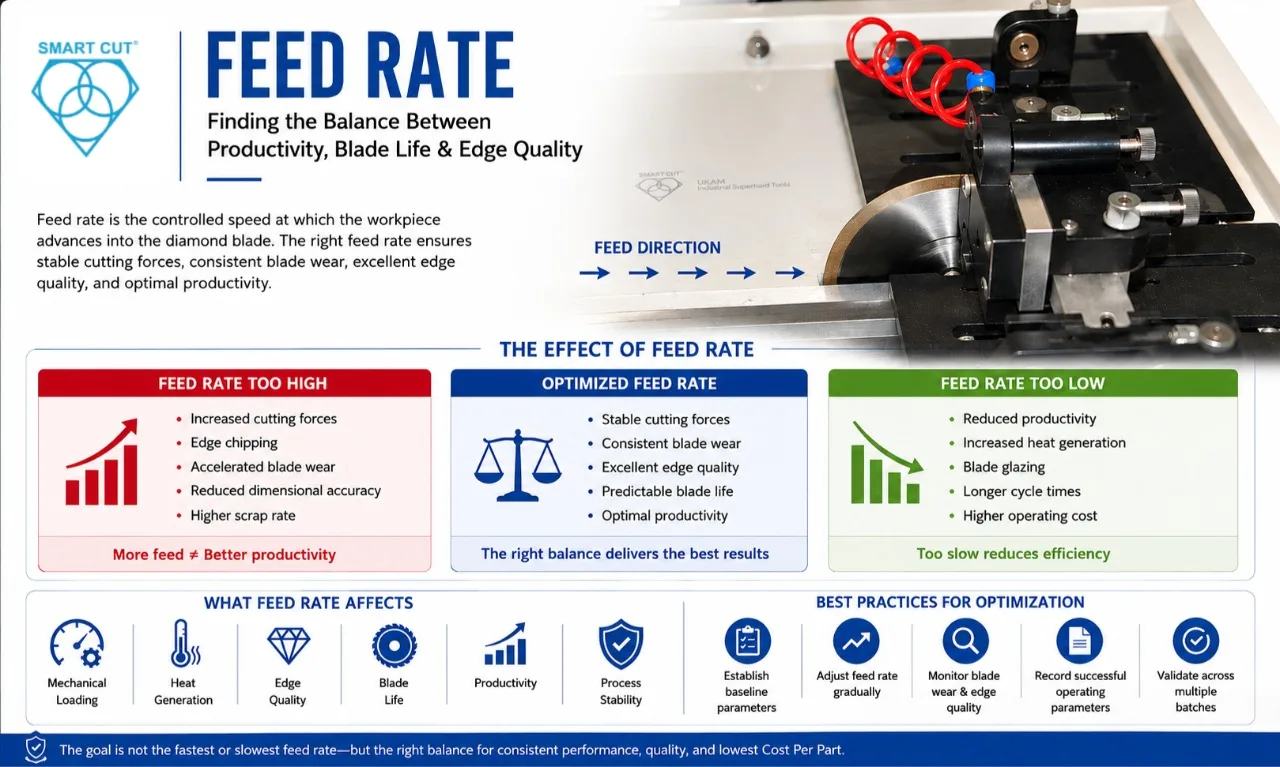
Feed rate is one of the most influential process variables in precision cutting. It determines how quickly the workpiece advances into the rotating diamond blade and directly affects cutting forces, blade wear, surface quality, heat generation, and production efficiency.
Although increasing feed rate may appear to improve productivity by reducing cycle time, an improperly optimized feed rate can introduce a range of manufacturing problems, including excessive edge chipping, accelerated blade wear, poor surface finish, and higher scrap rates.
Conversely, operating with an excessively slow feed rate may reduce productivity, increase heat generation, and prevent the blade from cutting efficiently.
The objective is not to identify the fastest or slowest feed rate—it is to establish a stable operating condition that delivers consistent cutting performance while maintaining product quality and minimizing the overall Cost Per Part.
What Is Feed Rate?
Feed rate refers to the controlled speed at which the workpiece enters the cutting blade during a machining operation.
It determines how much mechanical load is applied to the blade and influences how efficiently diamond particles interact with the material. This is particularly important when cutting composite materials — see our diamond blades for composites for application-specific guidance.
An optimized feed rate helps maintain:
- Stable cutting forces
- Consistent blade wear
- Good edge quality
- Predictable production performance
- Efficient material removal
When feed rate is not properly matched to the application, the entire cutting process becomes less stable.
How Feed Rate Affects Blade Performance
Every increase or decrease in feed rate changes the mechanical relationship between the blade and the material. Our slotted electroplated diamond saw blades are engineered specifically to handle these mechanical loading changes with improved chip clearance.
These changes influence:
|
Feed Rate Effect |
Manufacturing Impact |
|---|---|
|
Mechanical Loading |
Blade stress and wear |
|
Material Removal |
Production efficiency |
|
Heat Generation |
Surface integrity |
|
Cutting Stability |
Process repeatability |
|
Edge Quality |
Scrap and rework |
|
Tool Life |
Overall manufacturing cost |
Rather than evaluating feed rate independently, engineers consider how it affects the complete cutting system.
Feed Rate That Is Too High
Increasing feed rate beyond the process’s stable operating range places additional mechanical stress on both the blade and the workpiece.
Although this may temporarily reduce cutting time, it often introduces production problems that outweigh the gains in productivity.
Possible Effects:
- Increased cutting forces
- Blade deflection
- Higher vibration
- Edge chipping
- Reduced dimensional accuracy
- Accelerated blade wear
- Increased scrap
Aggressive feed rates may also increase the load on the spindle and workholding system, reducing overall process stability.
Engineering Observation
One of the most common production mistakes is increasing feed rate to improve throughput without evaluating its impact on product quality.
While cycle time may decrease, additional polishing, inspection, or rejected parts often increase the total manufacturing cost.
Feed Rate That Is Too Low
Operating at an extremely low feed rate may appear safer, but it can also reduce process efficiency. When insufficient material is presented to the blade, cutting action becomes less effective, and friction may increase.
Possible consequences include:
- Reduced productivity
- Increased heat generation
- Blade glazing — a common issue our SMART CUT Series 301M lapidary blades are engineered to resist through optimized diamond concentration
- Longer cycle times
- Higher machine operating costs
Instead of efficiently removing material, the blade may begin rubbing against the workpiece, reducing cutting performance.
Engineering Insight
A slower feed rate does not automatically produce better results. In many applications, excessively conservative operating conditions reduce production efficiency without improving edge quality or blade life.
Feed Rate and Edge Quality
Edge quality is one of the primary indicators of process stability.
Proper feed rate helps maintain:
- Clean cut edges
- Reduced chipping
- Better dimensional accuracy
- Lower polishing requirements
Excessive feed rates, particularly when cutting brittle materials such as sapphire, quartz, advanced ceramics, or silicon carbide, increase mechanical loading and may contribute to edge damage. For glass and quartz applications, our diamond blades for glass/quartz page details recommended operating ranges.
Manufacturers should evaluate edge quality alongside productivity when optimizing feed rate.
Feed Rate and Blade Life
Blade life depends on maintaining balanced cutting conditions.
An optimized feed rate contributes to:
- Uniform blade wear
- Stable diamond exposure
- Reduced bond degradation
- Predictable production performance
Increasing feed rate beyond the blade’s operating capability often accelerates wear without producing meaningful improvements in manufacturing efficiency.
The objective is consistent blade performance, not simply longer blade life.
Feed Rate and Surface Finish
Surface finish is influenced by the interaction between the blade, the material, and the operating parameters.
Feed rate directly affects:
- Surface roughness
- Material fracture behavior
- Edge integrity
- Downstream polishing requirements
A balanced feed rate helps maintain consistent surface quality while minimizing secondary finishing operations.
Feed Rate and Different Materials
Every material responds differently to changes in feed rate.
- Advanced Ceramics — Engineers generally prioritize edge quality, reduced chipping, and stable cutting conditions. See our Advanced Ceramics Industry page
- Silicon Carbide — Optimization often focuses on controlled cutting forces, consistent blade wear, and reduced thermal loading. See diamond blades for advanced ceramics.
- Sapphire — Manufacturing priorities typically include crack prevention, excellent surface integrity, and stable process conditions. Our SMART CUT Diamond Notch grinding wheel is a relevant tool for sapphire wafer processing.
- Tungsten Carbide — Production objectives commonly include dimensional accuracy, stable cutting performance, and predictable tool wear. See our tungsten carbide dicing blades.
Because each material behaves differently, feed rate should always be optimized for the specific application rather than using identical settings across multiple materials.
Engineering Best Practices for Feed Rate Optimization
Successful manufacturers typically follow a structured approach.
- Establish baseline production parameters.
- Verify machine condition before changing feed rate — if you'd like to see our facility and discuss your application in person, you're welcome to visit UKAM's headquarters.
- Adjust feed rate gradually.
- Monitor blade wear.
- Evaluate edge quality after each adjustment.
- Record successful operating parameters.
- Validate improvements across multiple production batches.
This systematic methodology improves repeatability while reducing unnecessary production trials.
Common Engineering Mistakes (Feed Rate)
Several avoidable mistakes frequently reduce cutting performance.
- Increasing Feed Rate to Improve Productivity — Higher throughput should never come at the expense of product quality or process stability.
- Ignoring Machine Capability — A machine with poor rigidity or spindle wear may not support more aggressive feed rates, even if the blade is properly selected.
- Adjusting Multiple Variables Simultaneously — Changing feed rate, RPM, and coolant together makes it difficult to determine which adjustment influenced production performance.
- Measuring Success Only by Cycle Time — Reducing cutting time may appear beneficial, but increased scrap, polishing, or downtime can significantly increase total manufacturing costs.
- Failing to Document Process Changes — Without documented production data, successful operating conditions are difficult to reproduce consistently.
Engineering Decision Checklist (Feed Rate)
Before changing feed rate, ask:
- Has machine condition been verified?
- Is the blade appropriate for the material?
- Is coolant reaching the cutting interface?
- Are current production parameters documented?
- Will the adjustment improve Cost Per Part rather than simply reduce cycle time?
- Can the results be validated across multiple production runs?
Answering these questions helps ensure that feed rate adjustments contribute to long-term process improvements rather than temporary production gains.
Engineering Insight
Experienced manufacturing engineers rarely optimize feed rate in isolation. Instead, they evaluate how feed rate interacts with spindle speed, coolant delivery, material characteristics, and machine capability to create a balanced, repeatable cutting process.
A stable process not only improves blade life but also reduces scrap, minimizes operator intervention, and lowers the overall Cost Per Part.
RPM: How Spindle Speed Influences Heat Generation, Cutting Efficiency, and Diamond Blade Performance
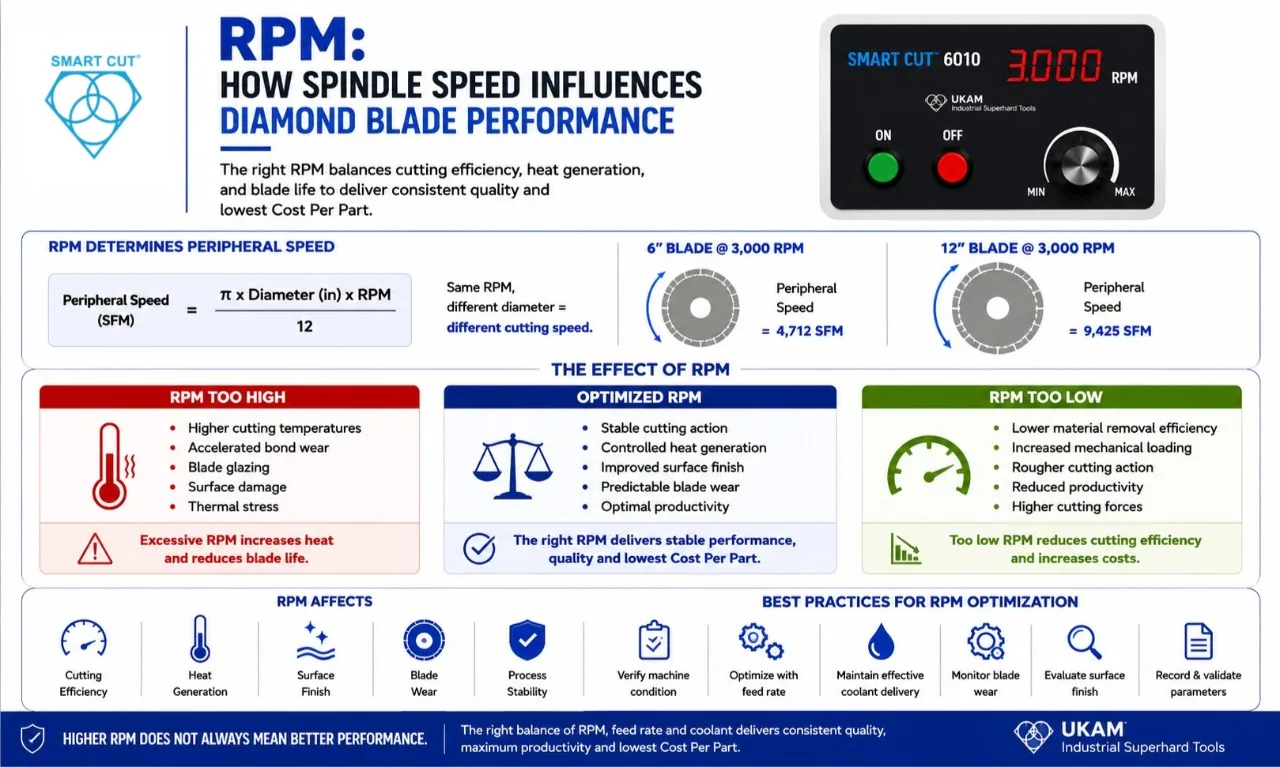
Spindle speed, commonly measured in revolutions per minute (RPM), is one of the most critical operating parameters in precision cutting. Together with blade diameter, RPM determines the peripheral speed—the speed at which the diamond particles travel through the cutting zone.
Many operators assume that increasing RPM will automatically improve productivity because the blade rotates faster. While higher speeds may increase cutting efficiency under certain conditions, they can also generate excessive heat, accelerate blade wear, reduce edge quality, and compromise process stability if not properly balanced with feed rate, coolant delivery, and material characteristics.
Successful manufacturing engineers understand that higher RPM does not necessarily mean better performance. The objective is to establish a spindle speed that maintains stable cutting conditions while achieving the required productivity and surface quality.
Understanding RPM in Precision Cutting
RPM controls how frequently the diamond particles engage the workpiece during each minute of operation.
Changes in spindle speed directly influence:
- Cutting efficiency
- Heat generation
- Surface finish
- Blade wear
- Material removal characteristics
- Process repeatability
Because RPM affects nearly every aspect of the cutting process, it should always be evaluated together with feed rate and coolant delivery rather than adjusted independently. Our resin bond diamond blades category is designed to operate at higher speeds while minimizing heat generation.
RPM vs. Peripheral Speed
Although RPM is commonly used to describe spindle speed, engineers often evaluate peripheral speed, since the actual cutting speed depends on both spindle speed and blade diameter.
For example, two blades rotating at the same RPM but having different diameters will operate at different peripheral speeds.
For this reason, successful process optimization considers the complete cutting system rather than spindle speed alone. Our resin bond dicing blades product page includes guidance on matching blade diameter to spindle speed for dicing applications.
Engineering Insight
Many manufacturers compare spindle speeds between different machines without considering blade diameter. Since cutting performance depends on peripheral speed rather than RPM alone, these comparisons can sometimes lead to incorrect process adjustments.
How RPM Affects Diamond Blade Performance
Proper spindle speed contributes to:
- Stable cutting action
- Consistent diamond exposure
- Controlled heat generation
- Improved surface quality
- Predictable blade wear
Improper spindle speed may reduce production efficiency while increasing manufacturing costs.
RPM That Is Too High
Increasing spindle speed beyond the application’s stable operating range may increase friction between the blade and the workpiece.
This additional friction can produce:
- Higher cutting temperatures
- Accelerated bond wear
- Blade glazing
- Surface damage
- Thermal stress
- Reduced process stability
Higher RPM may also increase vibration if machine condition or blade balance is less than optimal. Using an appropriately formulated coolant — such as our AMF Water Soluble Coolant (Advanced Materials Formula) — can help offset the added thermal load.
Engineering Observation
One of the most common troubleshooting mistakes is increasing spindle speed to compensate for declining cutting performance.
If the underlying problem is poor coolant delivery, improper feed rate, or machine instability, increasing RPM may actually worsen the condition rather than improve it.
RPM That Is Too Low
Operating at excessively low spindle speeds may also reduce cutting efficiency.
Potential consequences include:
- Lower material removal efficiency
- Increased mechanical loading
- Rougher cutting action
- Reduced productivity
- Higher cutting forces
Rather than allowing the diamonds to cut efficiently, lower peripheral speeds may increase resistance at the cutting interface. Pairing correct RPM with a properly formulated coolant, like our General Materials Formula Synthetic Water Soluble Coolant (1 Gallon), helps maintain cutting efficiency across the operating range.
RPM and Heat Generation
Heat generation is a natural part of every precision cutting process.
The amount of heat produced depends on the interaction between:
- RPM
- Feed rate
- Material properties
- Coolant effectiveness
- Blade specification
If heat is not effectively controlled, it may contribute to:
- Thermal damage
- Residual stress
- Surface discoloration
- Increased polishing requirements
- Accelerated blade wear
Maintaining appropriate spindle speed helps keep thermal loading within acceptable limits.
Engineering Insight
Heat-related problems are not always caused by spindle speed alone. In many applications, inadequate coolant delivery or an improperly balanced feed rate contributes more to thermal loading than RPM itself.
RPM and Surface Finish
Surface finish is strongly influenced by the stability of the cutting process.
Proper spindle speed contributes to:
- Consistent diamond engagement
- Uniform cutting action
- Reduced vibration
- Improved edge quality
- Lower downstream finishing requirements
However, increasing RPM beyond the optimum operating range does not necessarily improve surface quality. Excessive speed may increase friction and thermal effects that ultimately degrade the finished surface.
RPM and Blade Wear
Spindle speed also affects how quickly the blade wears during production.
Proper RPM promotes:
- Uniform bond wear
- Stable diamond exposure
- Predictable blade life
- Consistent cutting performance
When spindle speed is not properly matched to the application, wear patterns may become uneven, reducing both blade life and process stability.
Material Considerations (RPM)
Different engineering materials respond differently to spindle speed.
- Silicon Carbide — Manufacturers typically prioritize controlled heat generation, stable cutting performance, and predictable blade wear. See our Semiconductor Industry solutions.
- Sapphire — Production often emphasizes reduced thermal stress, excellent edge quality, and stable operating conditions. Browse our full Industries page for related applications.
- Advanced Ceramics — Engineering priorities generally include reduced edge chipping, process repeatability, and consistent surface integrity.
- Tungsten Carbide — Optimization commonly focuses on dimensional accuracy, stable cutting forces, and predictable production performance. Our SMART CUT 1030 cutting machine is frequently specified for these applications.
Because each material behaves differently, spindle speed should always be optimized for the specific application.
RPM and Machine Capability
Even the most carefully selected spindle speed cannot compensate for poor machine condition.
Before adjusting RPM, engineers should verify:
- Spindle accuracy
- Bearing condition
- Machine rigidity
- Blade balance
- Workholding stability
A mechanically unstable machine may experience vibration regardless of spindle speed, leading to inconsistent cutting quality. Machines such as the SMART CUT 7002 Heavy Duty Automatic Rod & Tubing Cutting Machine are built with these stability requirements in mind. For applications requiring continuous-rim blades, see our continuous rim diamond blades page.
Engineering Best Practices for RPM Optimization
Successful manufacturers generally follow these practices:
- Verify machine condition before changing spindle speed.
- Optimize RPM together with feed rate.
- Maintain effective coolant delivery.
- Monitor blade wear throughout production.
- Evaluate surface finish after process adjustments.
- Record successful operating parameters.
- Validate improvements over multiple production batches.
This structured approach improves repeatability while minimizing unnecessary process changes.
Common Engineering Mistakes (RPM)
Several avoidable decisions frequently reduce cutting performance.
- Increasing RPM Without Evaluating Heat Generation — Higher spindle speed may increase friction and thermal loading without improving productivity.
- Ignoring Blade Diameter — Comparing RPM between different blade sizes without considering peripheral speed may lead to incorrect process conclusions.
- Using the Same RPM for Every Material — Different materials require different operating conditions based on their mechanical and thermal properties.
- Changing RPM and Feed Rate Simultaneously — Adjusting multiple parameters at once makes troubleshooting difficult and complicates process optimization.
- Overlooking Machine Maintenance — Poor spindle condition, worn bearings, or machine vibration often influence cutting performance more than spindle speed itself.
Engineering Decision Checklist (RPM)
Before modifying RPM, consider the following:
- Has machine condition been verified?
- Is the blade correctly matched to the material?
- Is coolant reaching the cutting interface?
- Has feed rate already been optimized?
- Will increasing RPM improve process stability or simply increase heat generation?
- Can the changes be validated using production data?
These questions help ensure that spindle speed adjustments contribute to measurable process improvements.
Engineering Observation
Experienced manufacturing engineers rarely increase spindle speed simply to reduce cycle time. Instead, they evaluate how RPM influences heat generation, blade wear, edge quality, machine stability, and Cost Per Part before making process adjustments.
Optimizing spindle speed is not about running the machine faster—it’s about creating a stable, repeatable cutting process that delivers consistent quality throughout production.
Coolant: Controlling Heat, Protecting the Blade, and Maintaining Process Stability
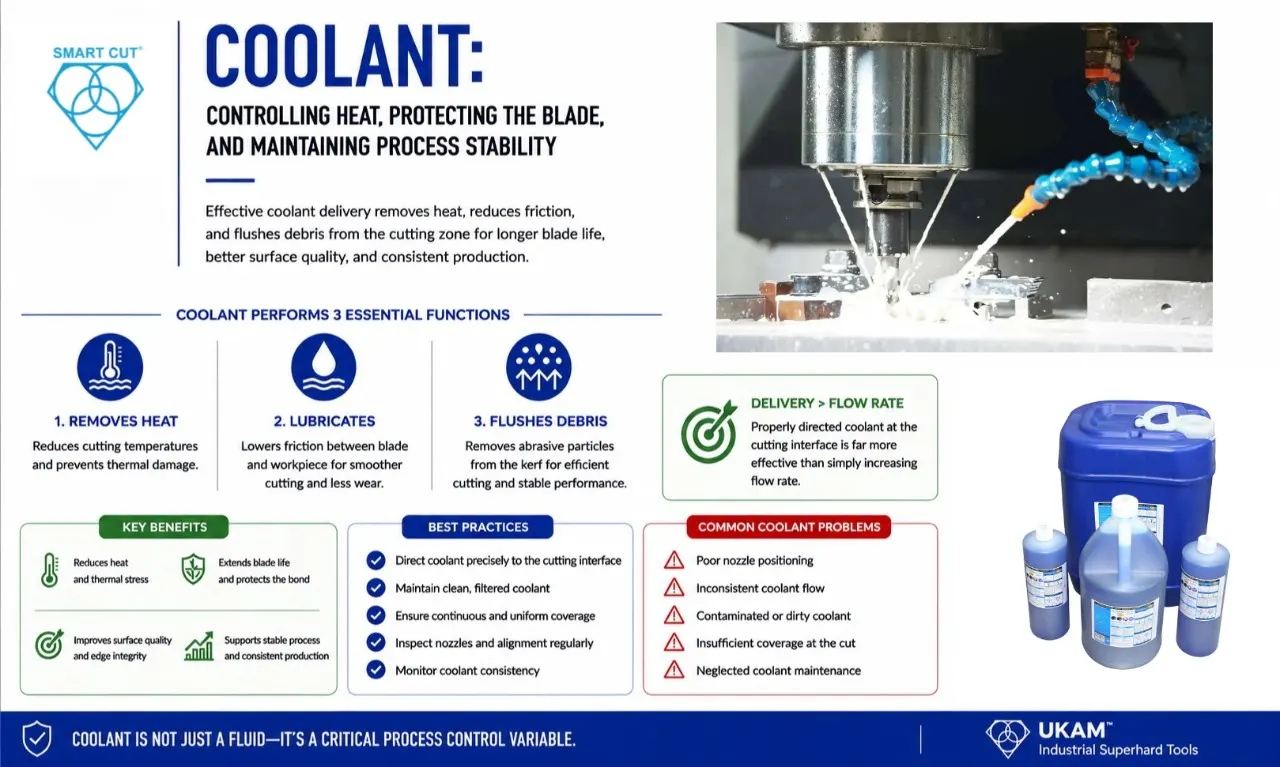
While blade selection, feed rate, and spindle speed receive significant attention during process optimization, coolant delivery is often one of the most overlooked factors affecting diamond blade performance.
Many manufacturers assume that simply increasing coolant flow will improve cutting performance. However, in precision cutting, coolant effectiveness depends far more on how the coolant reaches the cutting interface than on the volume delivered.
Proper coolant application helps maintain thermal stability, reduces blade wear, improves surface quality, and supports consistent production. Poor coolant delivery, on the other hand, can shorten blade life, increase heat generation, accelerate bond wear, and reduce overall manufacturing efficiency.
Successful manufacturing engineers therefore evaluate coolant as an essential part of the cutting system—not merely as a supporting accessory.
Why Coolant Is Critical in Precision Cutting
During every cutting operation, friction is generated as diamond particles interact with the workpiece.
Without effective cooling, this friction can increase cutting temperatures and negatively affect both the blade and the material.
Proper coolant delivery performs three essential functions:
- Removes heat from the cutting zone
- Lubricates the blade-workpiece interface
- Flushes abrasive debris from the kerf
These three functions help maintain stable cutting conditions while extending blade performance throughout production. Our SMART CUT Water Soluble Dicing Coolant/Lubricant/Surfactant is formulated specifically to perform all three functions in precision dicing operations.
How Coolant Affects Diamond Blade Performance
Coolant directly influences several key manufacturing variables.
|
Coolant Function |
Manufacturing Benefit |
|---|---|
|
Heat Removal |
Reduces thermal loading |
|
Lubrication |
Lowers friction during cutting |
|
Debris Removal |
Prevents blade loading and improves cutting efficiency |
|
Process Stability |
Supports consistent blade performance |
|
Surface Protection |
Improves edge quality and reduces thermal damage |
Rather than treating coolant as a maintenance requirement, manufacturers should view it as an important process-control variable.
Heat Removal
Heat generation is unavoidable during precision cutting.
As the blade removes material, friction continuously generates thermal energy at the cutting interface.
If this heat is not effectively removed, manufacturers may experience:
- Surface discoloration
- Thermal damage
- Residual stress
- Reduced blade life
- Poor dimensional stability
- Increased downstream polishing
Proper coolant delivery helps maintain a stable operating temperature throughout the cutting process. Our 1-quart Synthetic Water Soluble Coolant is a popular starting point for labs and smaller production runs needing reliable heat control.
Engineering Insight
Many heat-related production problems are incorrectly attributed to blade quality.
In practice, inadequate coolant delivery often contributes more to thermal loading than the blade itself.
Lubrication
Coolant also acts as a lubricant between the blade and the workpiece.
Reducing friction helps:
- Improve cutting efficiency
- Lower mechanical resistance
- Reduce bond wear
- Promote smoother cutting action
Proper lubrication contributes to more predictable blade wear while supporting consistent production quality.
Debris Removal
During cutting, removed material accumulates within the kerf.
If abrasive debris is not efficiently flushed away, it may:
- Increase friction
- Reduce cutting efficiency
- Accelerate blade loading
- Increase operating temperatures
Effective coolant delivery continuously removes this material, allowing fresh diamond particles to engage the workpiece more efficiently. For higher-volume operations, our 5-gallon Synthetic Water Soluble Coolant offers the same formulation at production scale.
Engineering Observation
Manufacturers often focus on blade wear while overlooking debris accumulation.
In many applications, improving debris removal significantly enhances cutting consistency without changing tooling or operating parameters.
Coolant Delivery vs. Coolant Flow Rate
A common misconception is that increasing coolant flow automatically improves cutting performance.
However, delivery quality is often more important than flow rate.
A properly positioned nozzle directing coolant precisely into the cutting interface frequently provides greater benefits than simply increasing pump capacity.
Proper nozzle positioning helps ensure that coolant reaches the area where heat and friction are actually generated.
Characteristics of Effective Coolant Delivery
Successful coolant systems typically provide:
- Continuous coverage of the cutting interface.
- Stable coolant flow throughout production.
- Effective debris removal.
- Proper nozzle alignment.
- Clean, filtered coolant.
Together, these factors improve process repeatability and reduce unnecessary blade wear.
Common Coolant Delivery Problems
Several coolant-related issues can negatively affect production performance.
- Poor Nozzle Positioning — If coolant does not reach the cutting interface, heat and friction increase even when flow rate appears adequate.
- Inconsistent Coolant Flow — Interrupted coolant delivery may produce fluctuating cutting conditions, reducing process stability.
- Contaminated Coolant — Recirculated abrasive particles may increase blade wear while reducing cutting efficiency. Routine filtration helps maintain coolant effectiveness.
- Insufficient Coverage — Cooling only one portion of the blade may leave the cutting interface exposed to excessive heat.
- Neglected Coolant Maintenance — Dirty reservoirs, clogged filters, or blocked nozzles reduce coolant system performance and may contribute to inconsistent cutting results.
Coolant and Different Materials
Different engineering materials place different demands on the cooling system.
- Silicon Carbide — Manufacturers generally prioritize stable thermal control, reduced blade wear, and consistent cutting performance.
- Sapphire — Cooling focuses on minimizing thermal stress, crack formation, and surface damage.
- Optical Glass — Effective coolant delivery helps preserve surface integrity, edge quality, and dimensional accuracy. See our broader Diamond Industry solutions page for optics-adjacent applications.
- Advanced Ceramics — Cooling contributes to reduced chipping, stable blade wear, and improved process repeatability.
Although the cooling objectives remain similar, each material responds differently to heat and mechanical loading.
Coolant and Process Stability
Coolant should never be evaluated independently.
Its effectiveness depends on how it interacts with:
- Feed rate
- RPM
- Blade specification
- Material characteristics
- Machine capability
For example, an increase in feed rate without improving coolant delivery may increase thermal loading. Likewise, higher spindle speeds often require careful evaluation of coolant effectiveness to maintain stable cutting conditions.
Successful process optimization considers these variables together.
Engineering Best Practices (Coolant)
To maximize coolant effectiveness:
- Verify nozzle alignment before production.
- Ensure coolant reaches the cutting interface.
- Maintain clean filtration systems.
- Inspect nozzles regularly.
- Monitor coolant consistency throughout production.
- Evaluate coolant delivery whenever operating parameters change.
- Include coolant system maintenance in preventive maintenance schedules.
These practices help improve both blade life and manufacturing consistency.
Common Engineering Mistakes (Coolant)
Several avoidable decisions frequently reduce coolant performance.
- Increasing Flow Instead of Improving Delivery — Higher flow rates cannot compensate for poor nozzle positioning.
- Ignoring Coolant Maintenance — Contaminated coolant reduces cooling efficiency while increasing abrasive wear.
- Assuming Every Material Requires the Same Cooling Strategy — Different materials respond differently to heat generation and process conditions.
- Changing Coolant Together with Other Parameters — Changing feed rate, RPM, and coolant simultaneously makes troubleshooting more difficult.
- Treating Coolant as a Secondary Variable — Coolant is an integral part of the cutting process and should be evaluated alongside tooling and machine conditions.
Engineering Decision Checklist (Coolant)
Before modifying coolant delivery, ask:
- Is coolant reaching the cutting interface?
- Has nozzle alignment been verified?
- Is coolant clean and properly filtered?
- Has feed rate already been optimized?
- Has spindle speed changed?
- Are operating temperatures stable?
- Can improvements be measured using production data?
Answering these questions helps ensure that coolant adjustments contribute to meaningful process improvements.
Engineering Insight
One of the most effective ways to improve diamond blade performance is not necessarily increasing coolant volume—it is ensuring that coolant is delivered accurately, consistently, and efficiently to the cutting interface.
Manufacturers who optimize coolant delivery often experience improved process stability, reduced blade wear, lower operating temperatures, and more consistent product quality without changing blade specifications.
How Feed Rate, RPM & Coolant Work Together as a System
Feed rate, spindle speed (RPM), and coolant delivery are often adjusted independently during production. However, in precision cutting, these parameters are closely interconnected. A change in one variable almost always influences the behavior of the others.
For example, increasing feed rate changes the mechanical load placed on the blade. Raising spindle speed affects the frequency of diamond engagement and the amount of heat generated during cutting. Coolant then determines how effectively that heat is removed while also lubricating the cutting interface and flushing abrasive debris from the kerf.
When these parameters are properly balanced, manufacturers achieve:
- Stable blade wear
- Consistent edge quality
- Improved surface finish
- Higher machine utilization
- Lower Cost Per Part
When they are not balanced, production often becomes inconsistent, resulting in excessive blade wear, higher scrap rates, increased downtime, and unnecessary process adjustments.
Successful manufacturing engineers therefore optimize the complete cutting system rather than individual process parameters.
The Relationship Between Feed Rate, RPM & Coolant
These three variables continuously influence one another throughout the cutting process.
|
Process Parameter |
Primary Function |
Influences |
|---|---|---|
|
Feed Rate |
Controls mechanical loading |
Blade wear, cutting forces, productivity |
|
RPM |
Controls cutting speed |
Heat generation, cutting efficiency, surface finish |
|
Coolant Delivery |
Controls thermal stability |
Blade life, lubrication, debris removal |
Rather than maximizing any single variable, engineers seek a balanced combination that delivers stable, repeatable cutting performance.
Why Process Balance Matters
A common production mistake is adjusting one operating parameter without evaluating the rest of the system.
Scenario 1 — Higher Feed Rate
Increasing feed rate without evaluating spindle speed or coolant delivery may result in:
- Higher cutting forces
- Increased vibration
- Greater blade loading
- Additional heat generation
- Reduced edge quality
Although production speed may initially improve, overall manufacturing efficiency may decline if scrap or rework increases.
Scenario 2 — Higher RPM
Increasing spindle speed while maintaining the same feed rate may increase:
- Friction
- Cutting temperature
- Bond wear
- Thermal loading
If coolant delivery is insufficient, the additional heat may negatively affect both blade performance and workpiece quality.
Scenario 3 — Poor Coolant Delivery
Even with optimized feed rate and RPM, poor coolant delivery can lead to:
- Blade glazing
- Accelerated bond wear
- Thermal damage
- Debris accumulation
- Reduced cutting efficiency
This demonstrates why coolant should be considered an active process parameter rather than a supporting accessory.
Engineering Insight
Many manufacturers attempt to solve production problems by adjusting only one parameter. In practice, the best results are achieved by evaluating how feed rate, RPM, and coolant interact as a complete engineering system.
Cause-and-Effect Matrix
The following table illustrates how changes in one parameter influence overall production performance.
|
Process Change |
Possible Manufacturing Effect |
|---|---|
|
Increase Feed Rate |
Higher cutting forces, faster material removal, increased blade loading |
|
Decrease Feed Rate |
Lower productivity, increased friction, possible blade glazing |
|
Increase RPM |
Higher cutting speed, greater heat generation, improved cutting action if properly balanced |
|
Decrease RPM |
Reduced cutting efficiency, higher mechanical loading |
|
Improve Coolant Delivery |
Better heat control, lower blade wear, improved process stability |
|
Poor Coolant Delivery |
Higher temperatures, debris buildup, reduced blade life |
The objective is not to maximize productivity at any cost but to establish a stable operating window that delivers consistent results.
Example Production Scenarios
Scenario A – Edge Chipping Increases
Possible areas to investigate:
- Feed rate too aggressive
- Machine vibration
- Blade specification
- Coolant effectiveness
- Workholding stability
Rather than immediately replacing the blade, engineers evaluate the complete cutting process.
Scenario B – Blade Life Becomes Shorter
Possible contributing factors:
- Excessive cutting forces
- Improper RPM
- Poor coolant delivery
- Machine instability
- Material variation
Blade replacement alone may not resolve the underlying issue. Our sintered (metal bond) diamond & CBN dicing blades page discusses how bond selection interacts with these variables.
Scenario C – Surface Finish Declines
Potential causes include:
- Uneven blade wear
- Thermal loading
- Improper spindle speed
- Machine vibration
- Inconsistent feed rate
Evaluating the complete system helps identify the true source of performance changes.
Scenario D – Production Throughput Falls
Possible reasons include:
- Conservative feed rate
- Excessive process adjustments
- Frequent blade changes
- Cooling inefficiencies
- Equipment condition
Improving process stability often restores productivity more effectively than increasing operating speed.
Engineering Troubleshooting Workflow
When cutting performance begins to decline, follow a structured evaluation process:
Observe Production Symptoms → Inspect Blade Wear → Review Feed Rate → Verify RPM → Inspect Coolant Delivery → Check Machine Condition → Evaluate Material Characteristics → Modify One Variable → Validate Production Results.
Changing one variable at a time allows engineers to identify the true cause of production changes while minimizing unnecessary process trials.
Common Engineering Mistakes (System-Level)
Several process decisions frequently reduce manufacturing efficiency.
- Changing Multiple Variables Simultaneously — Adjusting feed rate, RPM, and coolant together makes it difficult to determine which change affected production.
- Optimizing Only for Cycle Time — Reducing cutting time should never come at the expense of edge quality, blade life, or process stability.
- Ignoring Machine Condition — Machine rigidity, spindle accuracy, and workholding significantly influence how feed rate and RPM affect cutting performance.
- Assuming More Coolant Solves Every Problem — Improper nozzle positioning cannot be corrected simply by increasing coolant flow.
- Replacing the Blade Before Reviewing Process Parameters — Many apparent tooling problems are actually process-related and can often be resolved through systematic optimization.
Engineering Best Practices (System-Level)
Manufacturers seeking long-term process stability should:
- Optimize feed rate, RPM, and coolant together—not independently.
- Verify machine condition before changing operating parameters.
- Monitor blade wear throughout production.
- Record successful process settings.
- Evaluate changes using measurable production data.
- Validate improvements across multiple production batches.
- Focus on reducing Cost Per Part rather than maximizing a single performance metric.
Engineering Observation
Experienced manufacturing engineers recognize that there is no universal combination of feed rate, RPM, and coolant suitable for every material or application.
The optimal operating conditions depend on the interaction between:
- Material properties
- Blade specification
- Machine capability
- Production objectives
- Quality requirements
Developing a stable, repeatable process requires careful evaluation of all these variables rather than relying on trial and error.
Practical Engineering Checklist
- Has machine condition been verified?
- Is the blade appropriate for the material?
- Are feed rate and RPM already documented?
- Is coolant reaching the cutting interface?
- Has only one process variable been changed?
- Are production results being measured?
- Will this adjustment improve Cost Per Part?
Using a structured checklist helps manufacturers make informed engineering decisions while reducing unnecessary production interruptions.
Engineering Insight
The most efficient precision cutting operations are not necessarily those running at the highest feed rate or RPM. They are the operations where feed rate, spindle speed, coolant delivery, machine condition, and blade specification are carefully balanced to achieve predictable, repeatable performance.
This engineering approach leads to longer blade life, improved product quality, lower scrap rates, reduced downtime, and ultimately a lower total manufacturing cost.
Common Mistakes, Best Practices & Continuous Improvement
Selecting the appropriate feed rate, RPM, and coolant settings is only the beginning of process optimization. Achieving consistent diamond blade performance requires a structured engineering approach that combines machine qualification, controlled process adjustments, production monitoring, and continuous improvement.
Many manufacturers attempt to solve cutting problems by making multiple adjustments simultaneously or replacing tooling whenever performance declines. While these actions may temporarily improve production, they rarely address the underlying cause.
Successful manufacturing engineers take a different approach. They optimize the entire cutting process, collect measurable production data, and validate every improvement before implementing it across production.
Why Process Optimization Matters
A well-optimized cutting process delivers benefits that extend beyond blade life.
Manufacturers often experience:
- Improved production consistency
- Better surface finish
- Reduced edge chipping
- Lower scrap rates
- Longer machine uptime
- Reduced operator intervention
- Lower Cost Per Part
Rather than focusing on a single performance metric, process optimization improves the overall efficiency of the manufacturing operation.
Engineering Insight
The most successful manufacturers do not rely on trial and error. They use standardized engineering procedures to evaluate process changes, ensuring that improvements are repeatable across different operators, machines, and production batches.
Step 1 – Establish a Production Baseline
Before modifying any process parameter, document the current cutting operation.
A production baseline should include:
|
Process Parameter |
Engineering Purpose |
|---|---|
|
Blade Specification |
Current tooling configuration |
|
Material |
Workpiece characteristics |
|
Feed Rate |
Mechanical loading |
|
RPM |
Peripheral cutting speed |
|
Coolant Delivery |
Thermal management |
|
Surface Finish |
Quality benchmark |
|
Blade Life |
Performance reference |
|
Scrap Rate |
Process stability |
Without this information, it becomes difficult to determine whether process changes have improved or reduced performance.
Step 2 – Qualify the Machine Before the Blade
Many cutting problems originate from the machine rather than the tooling.
Before changing operating parameters, inspect the mechanical condition of the equipment.
Machine Qualification Checklist:
- Verify spindle runout.
- Inspect blade flanges.
- Confirm machine rigidity.
- Check workholding stability.
- Verify coolant nozzle alignment.
- Inspect bearings and machine alignment.
Engineering Observation
Replacing a blade without first verifying machine condition often results in the same production problem occurring again because the underlying issue has not been corrected.
Step 3 – Optimize One Variable at a Time
One of the most important principles of process optimization is changing only one parameter during each production trial.
Recommended optimization sequence:
- Feed Rate
- RPM (Peripheral Speed)
- Coolant Delivery
- Blade Specification
- Bond Type
- Diamond Grit Size
- Diamond Concentration
After each adjustment:
- Measure production performance.
- Compare results with the baseline.
- Record observations.
- Validate the improvement before proceeding to the next variable.
This systematic approach minimizes unnecessary experimentation while producing reliable engineering data.
Step 4 – Measure Key Performance Indicators (KPIs)
|
KPI |
Why It Matters |
|---|---|
|
Blade Life |
Tooling efficiency |
|
Cost Per Part |
Overall manufacturing cost |
|
Surface Finish |
Product quality |
|
Edge Quality |
Process capability |
|
Scrap Rate |
Production consistency |
|
Machine Utilization |
Equipment productivity |
|
Tool Change Frequency |
Downtime measurement |
|
Cycle Time |
Manufacturing throughput |
Monitoring these indicators over multiple production runs provides a clear understanding of long-term process performance.
Step 5 – Validate Process Stability
A process should not be considered optimized after only a few successful cuts.
Validation should include:
- Multiple production batches
- Consistent cutting quality
- Stable blade wear
- Repeatable operating conditions
- Reliable machine performance
Only after these conditions have been consistently achieved should the process become part of standard production.
Common Engineering Mistakes (Continuous Improvement)
- Changing Multiple Variables at Once — Adjusting feed rate, RPM, coolant, and blade specification simultaneously makes it impossible to determine which change influenced the results.
- Optimizing Only for Productivity — Higher production speed should never compromise product quality, surface finish, process stability, or manufacturing consistency. The objective is balanced performance, not simply faster cutting.
- Ignoring Machine Maintenance — Poor spindle condition, worn bearings, and unstable workholding often reduce blade performance more than operating parameters. Routine preventive maintenance should be part of every optimization program.
- Focusing Only on Blade Life — Longer blade life does not automatically result in lower manufacturing costs. Engineers should also evaluate scrap, downtime, rework, machine utilization, and Cost Per Part. These metrics provide a more complete picture of production efficiency.
- Failing to Document Improvements — Without standardized documentation, successful operating conditions may be lost when production changes or new operators are introduced. Recording optimized parameters helps maintain consistency over time.
Engineering Best Practices (Continuous Improvement)
Manufacturers seeking predictable cutting performance should:
- Establish baseline production data.
- Verify machine condition before modifying process parameters.
- Optimize one variable at a time.
- Monitor production KPIs regularly.
- Record successful operating parameters.
- Standardize qualified production settings.
- Review process performance periodically for continuous improvement.
Following these practices helps reduce variability while improving long-term manufacturing efficiency.
Engineering Decision Checklist (Continuous Improvement)
Before implementing any process change, ask:
- Has the current process been documented?
- Is the machine mechanically qualified?
- Is only one variable being adjusted?
- Will the change improve Cost Per Part?
- Can the improvement be measured?
- Has production been validated across multiple batches?
If the answer is yes, the process change is more likely to produce consistent and repeatable results.
Engineering Observation
Continuous improvement is not achieved through large, unpredictable process changes. Instead, it results from small, measured adjustments supported by engineering data and validated under real production conditions.
Organizations that consistently follow this methodology typically experience more stable production, improved product quality, and lower overall manufacturing costs.
Optimize Your Precision Cutting Process with UKAM
Improving feed rate, RPM, and coolant settings is only one part of achieving reliable diamond blade performance. Every application presents unique challenges based on the material,
machine capability, production objectives, and quality requirements.UKAM’s engineering specialists work directly with manufacturers, research laboratories, and industrial production teams to evaluate cutting processes, optimize operating parameters, and recommend application-specific solutions.
Whether your goal is to reduce blade wear, improve edge quality, increase production consistency, or lower Cost Per Part, our technical team can help identify practical improvements tailored to your manufacturing process.
Collaborate with UKAM’s application engineers to optimize your cutting process, improve productivity, and maximize the performance of your diamond blades.
Optimizing Feed Rate, RPM & Coolant for Long-Term Precision Cutting Performance
Throughout this guide, we’ve explored how feed rate, spindle speed (RPM), and coolant delivery influence every stage of the precision cutting process. While each parameter plays a unique role, none should be optimized in isolation.
Successful manufacturers understand that consistent cutting performance is achieved by balancing these variables with the material being processed, the machine’s capabilities, and the desired production objectives.
Rather than asking “What is the correct feed rate or RPM?” experienced manufacturing engineers ask: “What combination of process parameters will produce the most stable, repeatable, and cost-effective manufacturing process?”
This engineering mindset transforms process optimization from trial and error into a structured, data-driven methodology that improves productivity, product quality, and Cost Per Part.
Engineering Decision Framework
Before changing feed rate, RPM, or coolant settings, evaluate the complete cutting process using the following framework.
Step 1 – Define the Manufacturing Objective
Clearly identify the primary production goal. Examples include: improve blade life, reduce edge chipping, increase production throughput, improve surface finish, reduce thermal damage, or lower Cost Per Part.
A clearly defined objective ensures that every process adjustment supports the desired manufacturing outcome.
Step 2 – Evaluate Material Characteristics
Material properties directly influence cutting performance. Review hardness, brittleness, abrasiveness, thermal conductivity, and material structure.
Understanding how the material behaves helps determine the appropriate balance between feed rate, RPM, and coolant delivery.
Step 3 – Verify Machine Condition
Before adjusting operating parameters, inspect the equipment.
Confirm:
- Spindle accuracy
- Machine rigidity
- Blade flanges
- Workholding stability
- Coolant nozzle alignment
Mechanical instability often affects cutting performance more than process parameters themselves.
Step 4 – Optimize Process Parameters
Adjust only one variable at a time.
Recommended sequence: Feed Rate → RPM → Coolant Delivery.
After each adjustment: measure production results, compare with the baseline, record observations, and validate improvements before making additional changes.
Step 5 – Validate Production Performance
Optimization should be confirmed using multiple production batches rather than a limited number of cuts.
Monitor: blade wear, edge quality, surface finish, scrap rate, machine utilization, and Cost Per Part.
Only after consistent performance has been demonstrated should the process become part of standard production.
Engineering Decision Checklist
Before implementing any process adjustment, ask the following questions:
Production
- What manufacturing problem am I trying to solve?
- Is the objective productivity, quality, or process stability?
- Has baseline production data been recorded?
Material
- Have the material characteristics been evaluated?
- Does the material require special process considerations?
Machine
- Is the spindle in good condition?
- Is the machine rigid and properly aligned?
- Is workholding stable?
Process Parameters
- Is feed rate appropriate?
- Is RPM properly matched?
- Is coolant reaching the cutting interface?
- Has only one parameter been modified?
Validation
- Were production improvements measured?
- Have successful settings been documented?
- Has the process been validated across multiple production batches?
Following this checklist helps reduce unnecessary troubleshooting while improving process repeatability.
Frequently Asked Questions
Not always. Higher feed rates may reduce cycle time but can also increase cutting forces, edge chipping, vibration, and blade wear if the process is not properly balanced. The objective should be improving overall manufacturing efficiency rather than simply increasing production speed.
No. Higher spindle speed may improve cutting efficiency in some applications, but it can also increase friction, heat generation, and bond wear if coolant delivery or feed rate is not optimized. RPM should always be evaluated together with the other process variables.
In many applications, proper nozzle positioning has a greater influence on cutting performance than coolant flow rate alone. Coolant must reach the cutting interface effectively to remove heat and flush abrasive debris.
Blade performance depends on the complete cutting system, including machine rigidity, spindle accuracy, workholding, feed rate, RPM, coolant delivery, and material characteristics. Differences in any of these variables can significantly influence cutting results.
Process parameters should be reviewed whenever materials change, new blades are introduced, machine maintenance is performed, product quality changes, or production volume increases. Regular reviews help maintain consistent manufacturing performance. For more answers, visit our full FAQ page.
Key Engineering Takeaways
Throughout this guide, one principle remains consistent: feed rate, RPM, and coolant should never be optimized independently.
The most successful manufacturing operations:
- Balance cutting speed with product quality
- Verify machine condition before changing process parameters.
- Optimize one variable at a time.
- Monitor blade wear and production KPIs.
- Document successful operating conditions.
- Evaluate Cost Per Part instead of focusing solely on blade life or cycle time.
- Continuously improve processes using measurable engineering data.
Following these principles helps manufacturers achieve predictable cutting performance while reducing downtime, scrap, and unnecessary tooling costs.
Work with UKAM's Engineering Team
Every precision cutting application is unique. Material characteristics, machine capability, production objectives, and quality requirements all influence the optimal combination of feed rate, RPM, coolant delivery, and blade specification.
Rather than relying on trial and error, UKAM works with manufacturers, semiconductor facilities, research laboratories, aerospace companies, medical device manufacturers, and industrial production teams to develop application-specific cutting solutions.
Whether your goal is to improve blade life, reduce edge chipping, optimize feed rate, improve coolant delivery, increase machine utilization, reduce Cost Per Part, or improve process consistency — our engineering specialists can help evaluate your application and recommend practical solutions based on your production requirements.
Ready to Optimize Your Precision Cutting Process?
Optimizing feed rate, RPM, and coolant delivery requires more than adjusting machine settings—it requires understanding how the entire cutting system works together.
Contact UKAM’s engineering team to discuss your application, evaluate your current process, and receive expert guidance on improving cutting performance, product quality, and manufacturing efficiency.
Optimize Your Process. Improve Blade Performance. Reduce Cost Per Part.
Trusted by Tens of Thousands of Manufacturers, Laboratories,
Research Institutions Worldwide Since 1990
American Based Manufacturer
Established in 1990
