




















How Material Fracture Toughness Influences Diamond & CBN Blade Selection
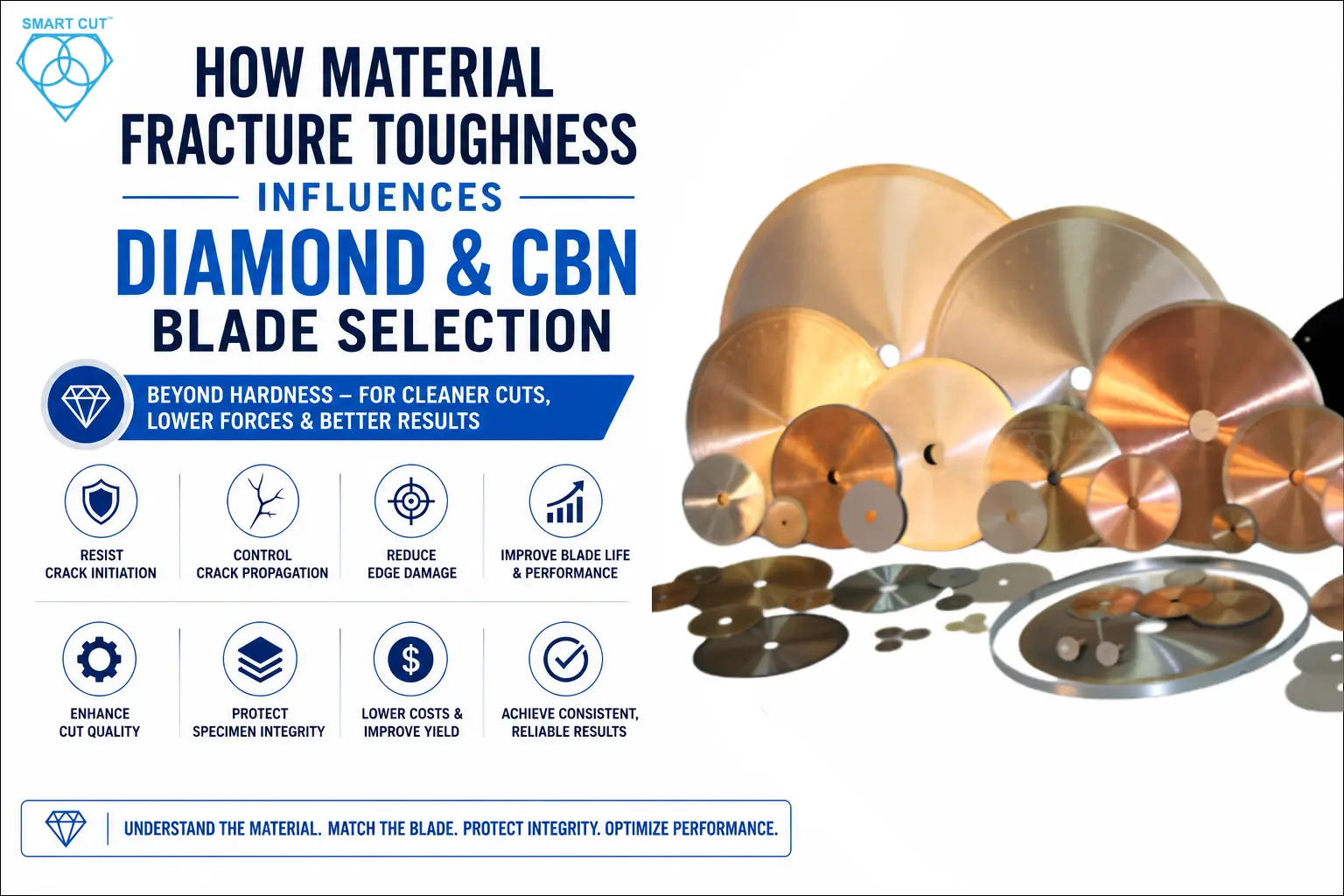
Table of Contents
ToggleSelecting the correct diamond or CBN blade involves far more than matching the blade to a material’s hardness. While hardness is often the first property engineers consider, it is rarely sufficient for determining how a material will behave during precision cutting.
Two materials may exhibit similar hardness values yet respond very differently under identical cutting conditions. One may produce clean, repeatable cuts with minimal edge damage, while the other may experience extensive edge chipping, subsurface cracking, rapid blade wear, or complete specimen failure.
The difference frequently lies in fracture toughness.
Fracture toughness describes a material’s ability to resist crack initiation and crack propagation under mechanical loading. During diamond and CBN cutting, every abrasive particle applies highly concentrated forces to the workpiece. How the material responds to these localized stresses largely determines the cutting mechanism, blade requirements, achievable surface quality, and overall process stability.
This becomes particularly important when sectioning advanced ceramics, semiconductor materials, carbides, glass, composites, hardened steels, and other engineering materials, where preserving specimen integrity is often more important than maximizing cutting speed.
Selecting an inappropriate blade for a material’s fracture toughness may lead to:
- Excessive edge chipping
- Subsurface microcracking
- Material breakout
- Coating delamination
- Increased polishing requirements
- Premature blade wear
- Higher consumable costs
- Reduced inspection accuracy
Conversely, selecting a blade specifically engineered for the material’s fracture behavior allows engineers to achieve cleaner cuts, lower cutting forces, improved blade life, and greater process repeatability.
Understanding the relationship between fracture toughness and blade selection enables manufacturers, metallography laboratories, semiconductor facilities, research organizations, and quality-control departments to optimize both cutting performance and specimen quality while reducing overall operating costs.
Trusted by Tens of Thousands of Manufacturers, Laboratories Research Institutions Worldwide Since 1990

American Based Manufacturer

Established in 1990


Custom manufacturing


What Is Material Fracture Toughness?
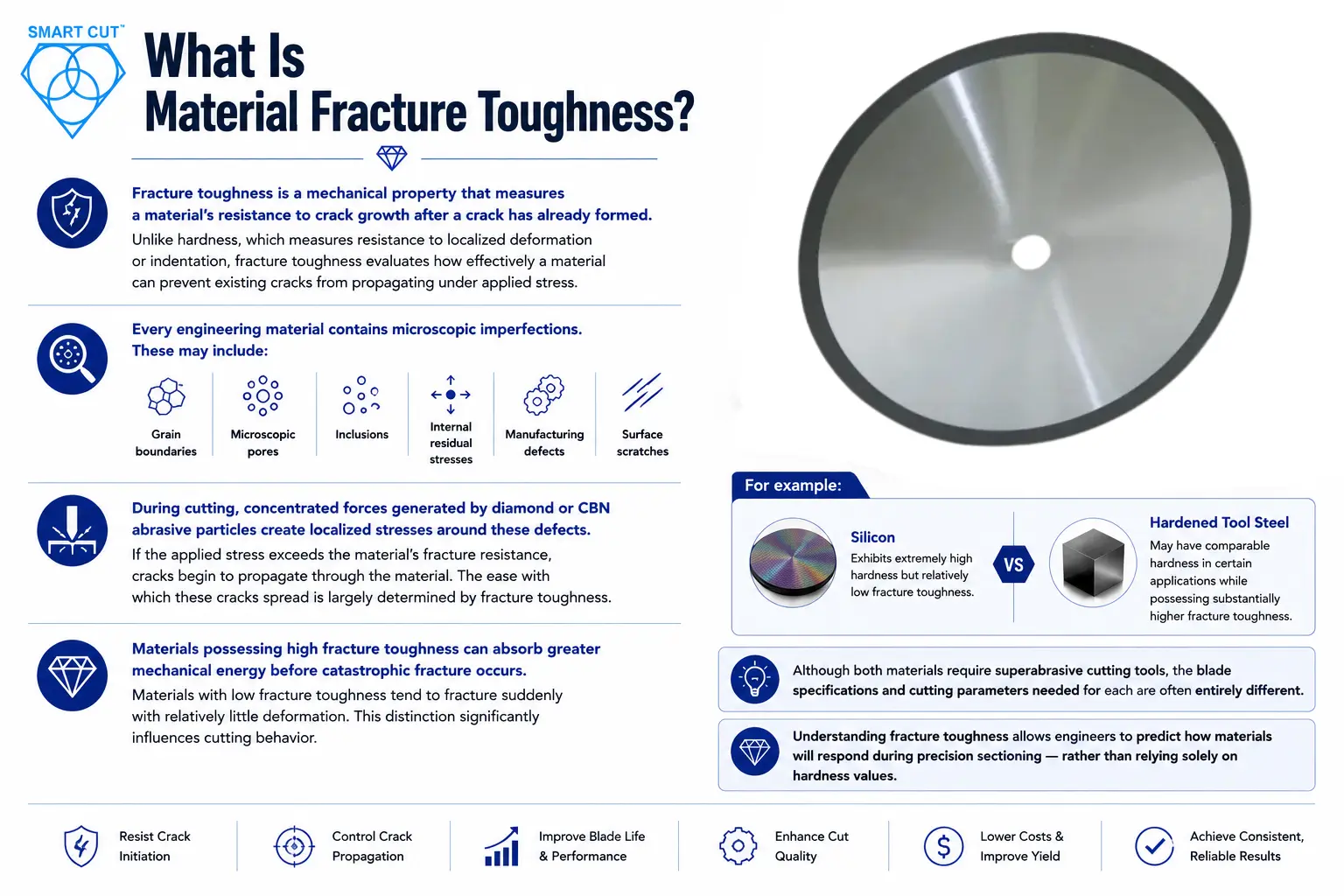
Fracture toughness is a mechanical property that measures a material’s resistance to crack growth after a crack has already formed.
Unlike hardness, which measures resistance to localized deformation or indentation, fracture toughness evaluates how effectively a material can prevent existing cracks from propagating under applied stress.
Every engineering material contains microscopic imperfections.
These may include:
- Grain boundaries
- Microscopic pores
- Inclusions
- Internal residual stresses
- Manufacturing defects
- Surface scratches
Under normal service conditions, these imperfections remain stable.
During cutting, however, concentrated forces generated by diamond & CBN abrasive particles create localized stresses around these defects. If the applied stress exceeds the material’s fracture resistance, cracks begin to propagate through the material.
The ease with which these cracks spread is largely determined by fracture toughness.
Materials possessing high fracture toughness can absorb greater mechanical energy before catastrophic fracture occurs.
Materials with low fracture toughness tend to fracture suddenly with relatively little deformation.
This distinction significantly influences cutting behavior.
For example:
- Silicon exhibits extremely high hardness but relatively low fracture toughness.
- Hardened tool steel may have comparable hardness in certain applications while possessing substantially higher fracture toughness.
Although both materials require superabrasive cutting tools, the blade specifications and cutting parameters needed for each are often entirely different.
Understanding fracture toughness, therefore, allows engineers to predict how materials will respond during precision sectioning rather than relying solely on hardness values.
Hardness vs. Fracture Toughness: Why They Are Different
Hardness and fracture toughness are frequently confused because both describe resistance to mechanical loading.
In reality, they measure entirely different material characteristics.
Hardness
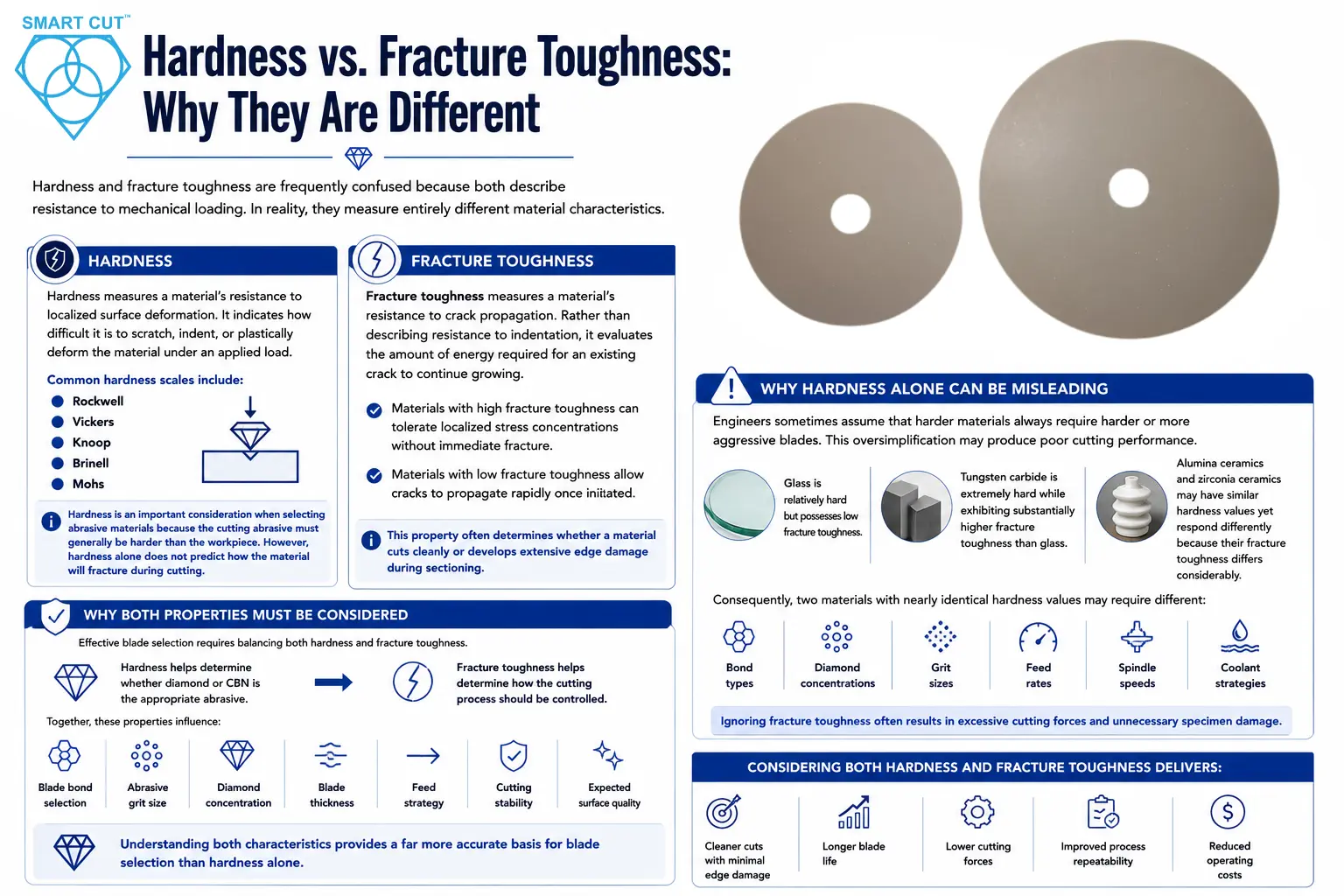
Hardness measures a material’s resistance to localized surface deformation.
It indicates how difficult it is to scratch, indent, or plastically deform the material under an applied load.
Common hardness scales include:
- Rockwell
- Vickers
- Knoop
- Brinell
- Mohs
Hardness is an important consideration when selecting abrasive materials because the cutting abrasive must generally be harder than the workpiece.
However, hardness alone does not predict how the material will fracture during cutting.
Fracture Toughness
Fracture toughness measures a material’s resistance to crack propagation.
Rather than describing resistance to indentation, it evaluates the amount of energy required for an existing crack to continue growing.
Materials with high fracture toughness can tolerate localized stress concentrations without immediate fracture.
Materials with low fracture toughness allow cracks to propagate rapidly once initiated.
This property often determines whether a material cuts cleanly or develops extensive edge damage during sectioning.
Why Hardness Alone Can Be Misleading
Engineers sometimes assume that harder materials always require harder or more aggressive blades.
This oversimplification may produce poor cutting performance.
For example:
- Glass is relatively hard but possesses low fracture toughness.
- Tungsten carbide is extremely hard while exhibiting substantially higher fracture toughness than glass.
- Alumina ceramics and zirconia ceramics may have similar hardness values yet respond differently because their fracture toughness differs considerably.
Consequently, two materials with nearly identical hardness values may require different:
- Bond types
- Diamond concentrations
- Grit sizes
- Feed rates
- Spindle speeds
- Coolant strategies
Ignoring fracture toughness often results in excessive cutting forces and unnecessary specimen damage.
Why Both Properties Must Be Considered
Effective blade selection requires balancing both hardness and fracture toughness.
Hardness helps determine whether diamond or CBN is the appropriate abrasive.
Fracture toughness helps determine how the cutting process should be controlled.
Together, these properties influence:
- Blade bond selection
- Abrasive grit size
- Diamond concentration
- Blade thickness
- Feed strategy
- Cutting stability
- Expected surface quality
Understanding both characteristics provides a far more accurate basis for blade selection than hardness alone.
Why Fracture Toughness Matters When Selecting Diamond & CBN Blades
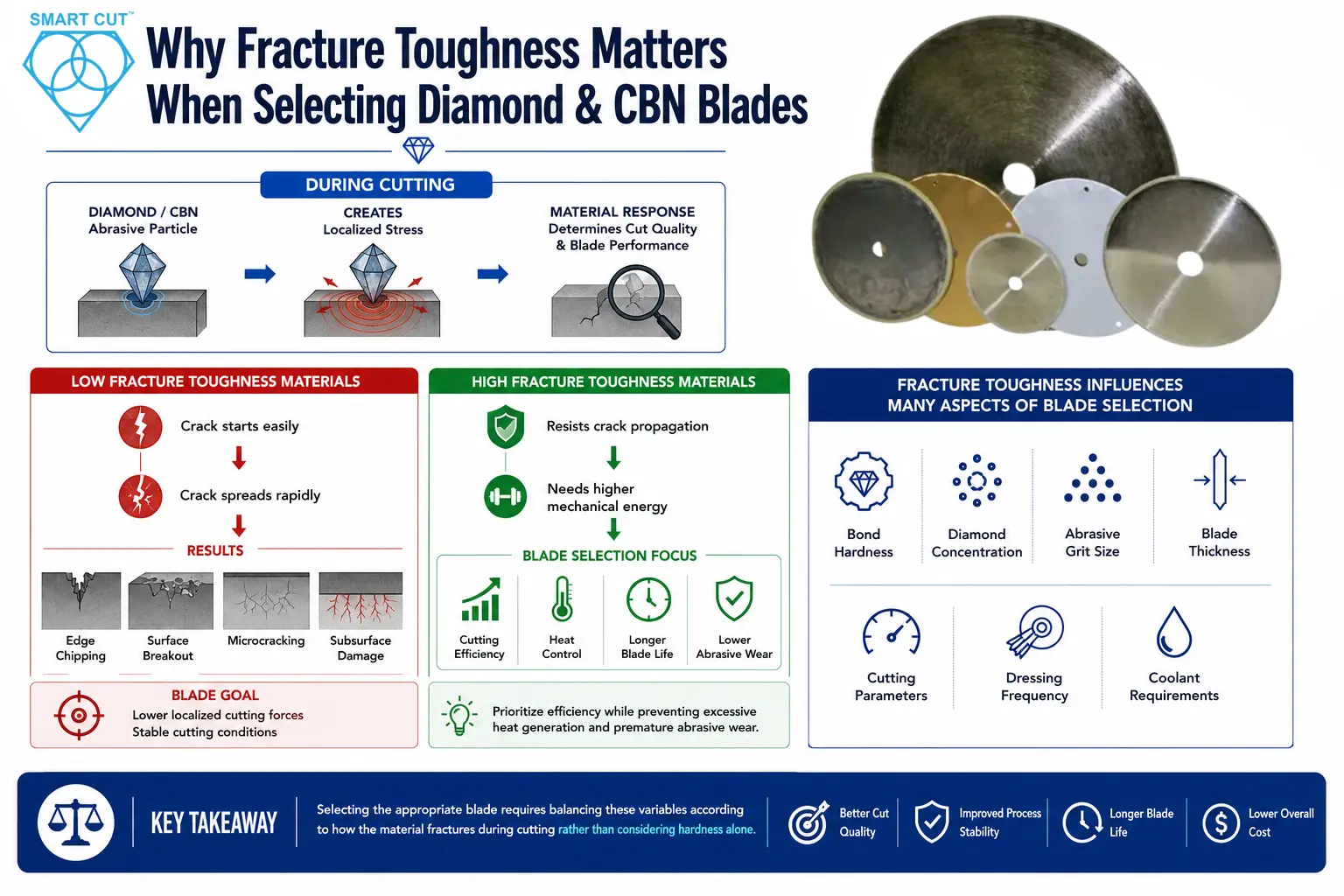
Every diamond or CBN blade removes material by applying concentrated forces through thousands of individual abrasive particles.
Each exposed abrasive crystal generates localized stress at the point of contact with the workpiece.
How the material responds to these stresses determines the effectiveness of the cutting process.
Materials possessing low fracture toughness tend to fracture quickly after crack initiation.
Although this behavior often facilitates efficient material removal, it also increases susceptibility to:
- Edge chipping
- Surface breakout
- Microcracking
- Subsurface damage
To minimize these defects, engineers typically select blade specifications that generate lower localized cutting forces while maintaining stable cutting conditions.
Conversely, tougher materials resist crack propagation.
Material removal, therefore, requires greater mechanical work before fracture occurs.
In these applications, blade selection often prioritizes maintaining cutting efficiency while preventing excessive heat generation and premature abrasive wear.
Fracture toughness therefore influences numerous aspects of blade selection, including:
- Bond hardness
- Diamond concentration
- Abrasive grit size
- Blade thickness
- Cutting parameters
- Dressing frequency
- Coolant requirements
Selecting the appropriate blade requires balancing these variables according to how the material fractures during cutting rather than considering hardness alone.
Crack Initiation, Crack Propagation, and Material Failure
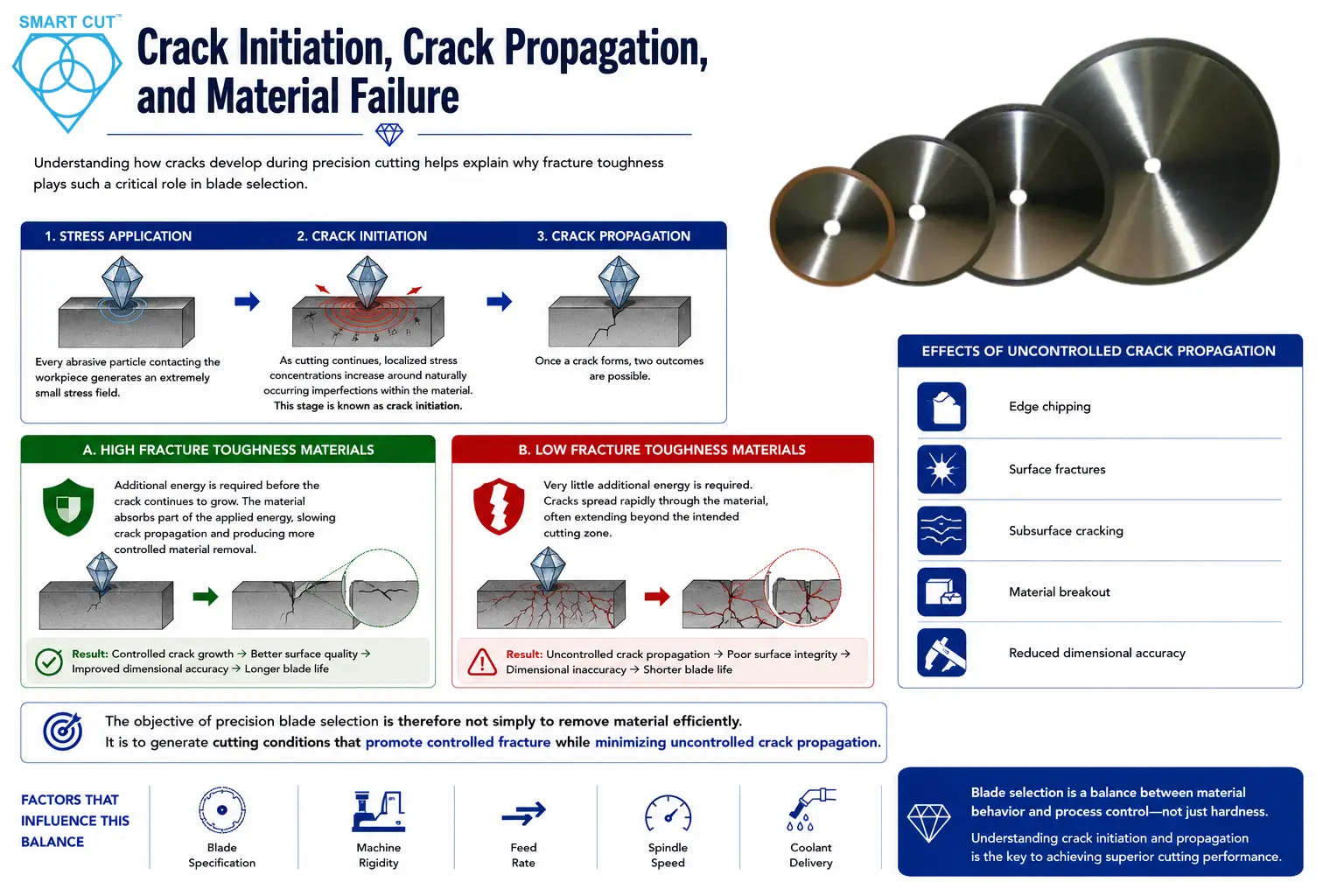
Understanding how cracks develop during precision cutting helps explain why fracture toughness plays such a critical role in blade selection.
Every abrasive particle contacting the workpiece generates an extremely small stress field.
Initially, these stresses deform only a tiny region immediately beneath the abrasive particle.
As cutting continues, localized stress concentrations increase around naturally occurring imperfections within the material.
This stage is known as crack initiation.
Once a crack forms, two outcomes are possible.
In materials with relatively high fracture toughness, additional energy is required before the crack continues to grow. The material absorbs part of the applied energy, slowing crack propagation and producing more controlled material removal.
In materials with low fracture toughness, very little additional energy is required.
Cracks spread rapidly through the material, often extending beyond the intended cutting zone. This uncontrolled propagation contributes to:
- Edge chipping
- Surface fractures
- Subsurface cracking
- Material breakout
- Reduced dimensional accuracy
The objective of precision blade selection is therefore not simply to remove material efficiently.
It is to generate cutting conditions that promote controlled fracture while minimizing uncontrolled crack propagation.
Blade specification, machine rigidity, feed rate, spindle speed, and coolant delivery all influence this balance.
How Different Materials Respond to Diamond Cutting
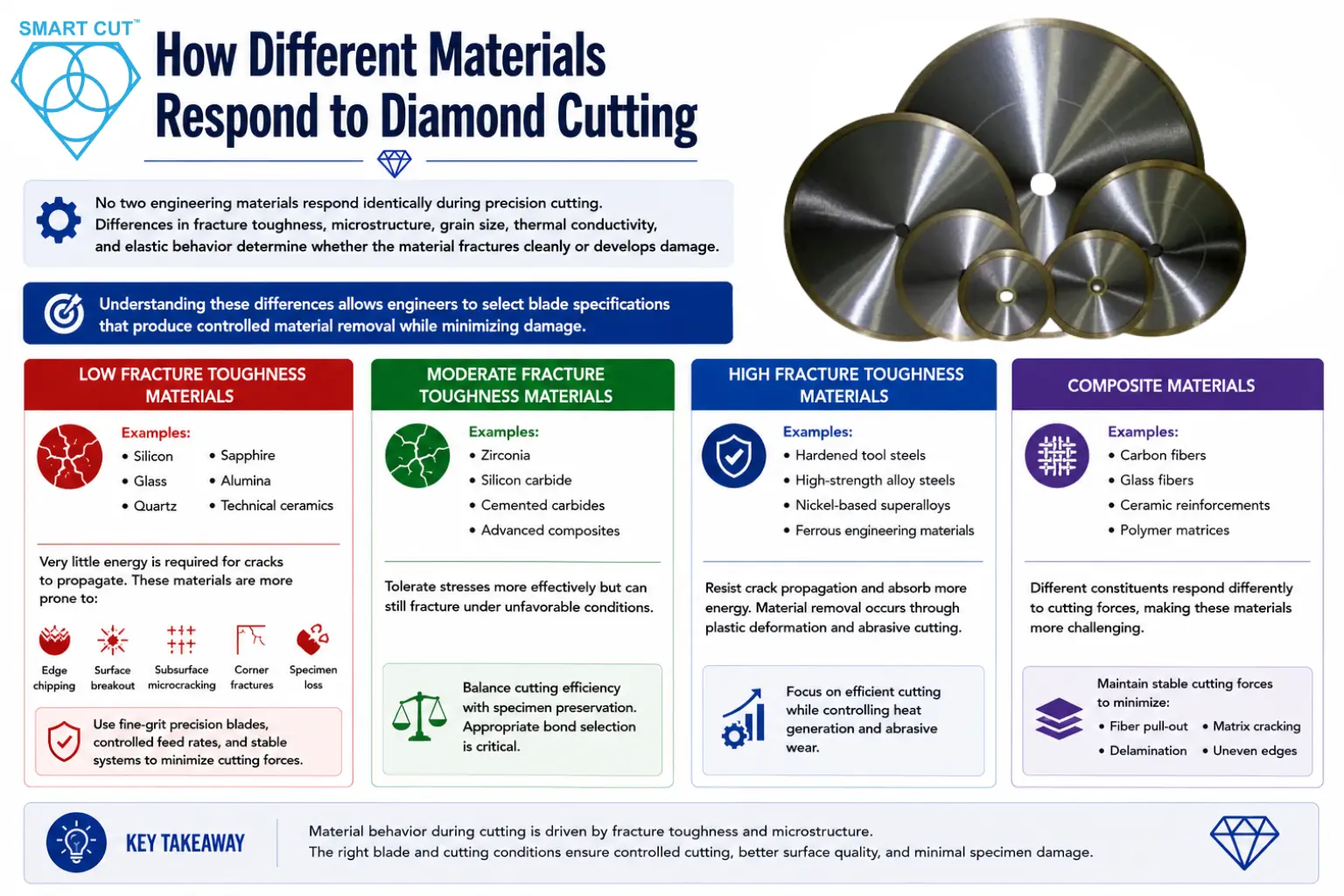
No two engineering materials respond identically during precision cutting, even when identical blades and cutting parameters are used. The primary reason is that materials differ significantly in fracture toughness, microstructure, grain size, thermal conductivity, and elastic behavior.
During sectioning, every exposed diamond particle transfers highly concentrated stresses into the workpiece. Whether these stresses produce clean material removal or uncontrolled fracture depends largely on how the material dissipates or concentrates that energy.
Understanding these differences allows engineers to select blade specifications that produce controlled material removal while minimizing damage to the specimen.
Low Fracture Toughness Materials
Materials with relatively low fracture toughness require very little energy for cracks to propagate once initiated.
Examples include:
- Silicon
- Glass
- Quartz
- Sapphire
- Alumina
- Certain technical ceramics
These materials generally exhibit brittle fracture rather than plastic deformation.
Although they are often easier to separate, they are considerably more susceptible to:
- Edge chipping
- Surface breakout
- Subsurface microcracking
- Corner fractures
- Specimen loss
For these applications, blade selection should prioritize minimizing localized cutting forces rather than maximizing material removal rates.
Fine-grit precision wafering blades combined with controlled feed rates and stable spindle systems typically produce superior results.
Moderate Fracture Toughness Materials
Materials possessing moderate fracture toughness generally tolerate localized stresses more effectively while still remaining susceptible to brittle fracture under unfavorable cutting conditions.
Examples include:
- Zirconia
- Silicon carbide
- Cemented carbides
- Certain advanced composites
These materials often require balancing cutting efficiency with specimen preservation.
Selecting an appropriate bond system becomes particularly important because excessive cutting forces may still initiate crack propagation, while insufficient abrasive exposure may increase friction and heat generation.
High Fracture Toughness Materials
Materials exhibiting relatively high fracture toughness resist crack propagation more effectively.
Examples include:
- Hardened tool steels
- High-strength alloy steels
- Certain nickel-based superalloys
- Many ferrous engineering materials
These materials generally absorb greater mechanical energy before fracturing.
Instead of extensive brittle cracking, material removal often occurs through plastic deformation combined with abrasive cutting.
Although edge chipping is usually less severe than in ceramics or semiconductor materials, cutting resistance tends to increase.
Blade selection therefore focuses on maintaining efficient material removal while minimizing excessive heat generation and abrasive wear.
Composite Materials
Composite materials frequently present the greatest challenge because they combine constituents with significantly different fracture behavior.
For example, fiber-reinforced composites may contain:
- Carbon fibers
- Glass fibers
- Ceramic reinforcements
- Polymer matrices
Each constituent responds differently to localized cutting forces.
As a result, cutting conditions that are appropriate for one component may produce excessive damage in another.
Maintaining stable cutting forces through proper blade selection and controlled feed mechanisms becomes essential for minimizing:
- Fiber pull-out
- Matrix cracking
- Delamination
- Uneven edge quality
Matching Blade Bond, Grit Size & Diamond Concentration to Material Fracture Toughness
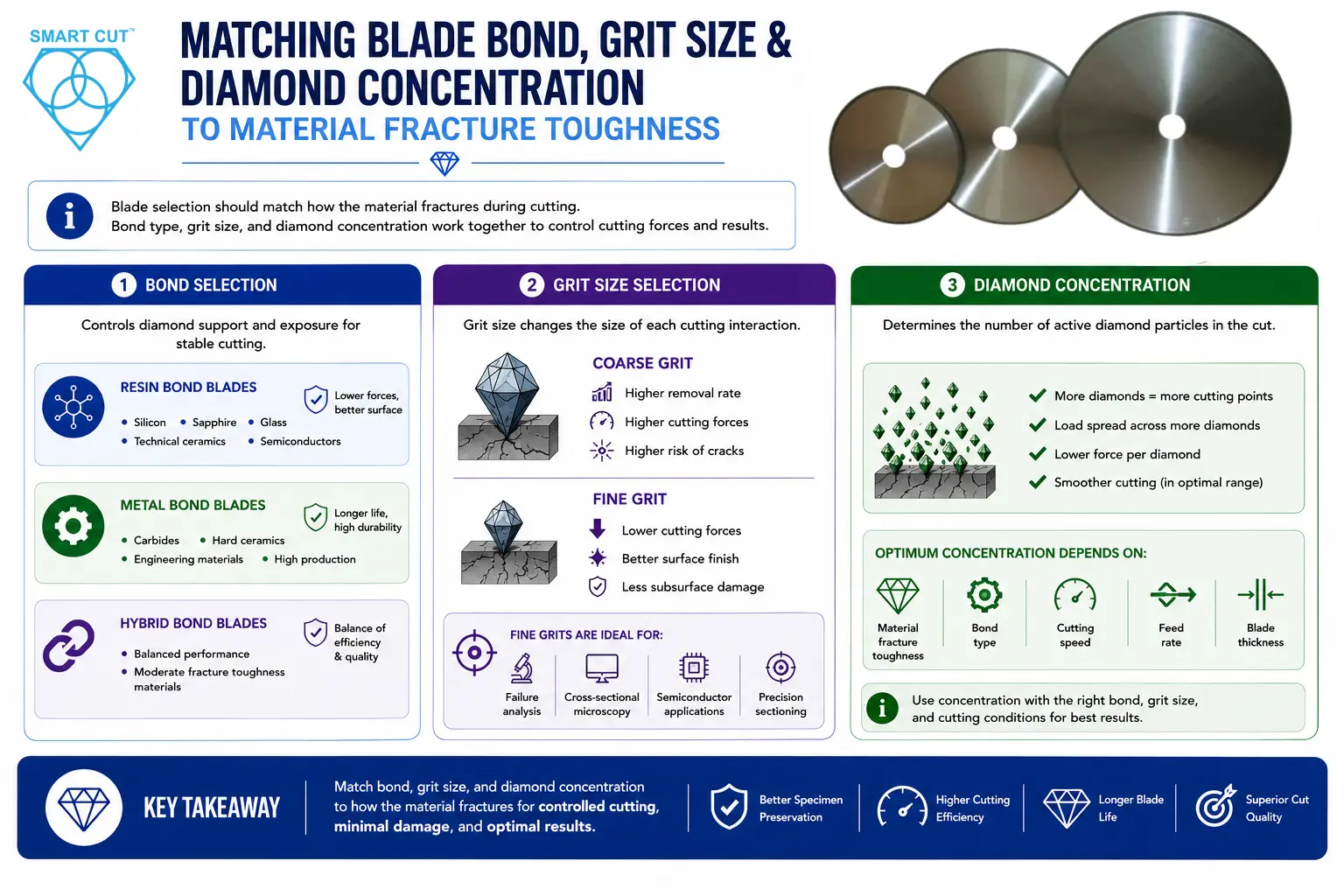
Blade selection should never be based solely on material hardness.
The combination of bond type, abrasive grit size, and diamond concentration should be selected according to how the material fractures during cutting.
Each component influences cutting force distribution differently.
Bond Selection
The bond controls how diamond particles are supported and exposed throughout the cutting process.
Selecting an appropriate bond helps maintain stable cutting forces while promoting consistent abrasive performance.
Resin Bond Blades
Resin bond systems generally produce smoother cutting action with lower mechanical loading.
They are commonly selected for materials where specimen preservation is critical, including:
- Silicon
- Sapphire
- Glass
- Technical ceramics
- Semiconductor packages
Lower cutting forces help reduce edge chipping and subsurface damage.
Metal Bond Blades
Metal bond blades retain abrasive particles more aggressively and generally offer longer service life under demanding conditions.
They are frequently selected for:
- Carbides
- Hard ceramics
- Abrasive engineering materials
- Higher production environments
Proper process optimization remains essential because harder bonds may increase localized cutting forces if abrasive exposure becomes insufficient.
Hybrid Bond Blades
Hybrid bond systems combine characteristics of resin and metal bonds.
Their objective is to balance:
- Cutting efficiency
- Surface quality
- Blade life
- Process stability
Hybrid systems are often advantageous when sectioning materials with moderate fracture toughness, where both productivity and specimen preservation are important.
Grit Size Selection
Diamond grit size directly influences the size of individual cutting interactions.
Coarse grits remove larger volumes of material during each abrasive contact.
While this improves productivity, it also increases localized cutting forces and may accelerate crack propagation in brittle materials.
Fine-grit blades produce:
- Smaller cutting forces
- Reduced edge chipping
- Better surface finish
- Lower subsurface damage
The trade-off is generally lower material removal rates.
Consequently, fine grits are often preferred for:
- Failure analysis
- Cross-sectional microscopy
- Semiconductor applications
- Precision laboratory sectioning
Diamond Concentration
Diamond concentration influences the number of active abrasive particles participating in the cut.
Higher concentrations distribute cutting loads across more abrasive particles.
This often reduces the force acting on each crystal, producing smoother cutting action under appropriate conditions.
However, a higher concentration does not automatically produce better cutting performance.
The optimum concentration depends upon:
- Material fracture toughness
- Bond type
- Feed rate
- Blade thickness
- Cutting speed
Selecting concentration should therefore be considered alongside the entire blade specification rather than as an isolated variable.
Feed Rate, RPM & Coolant Considerations
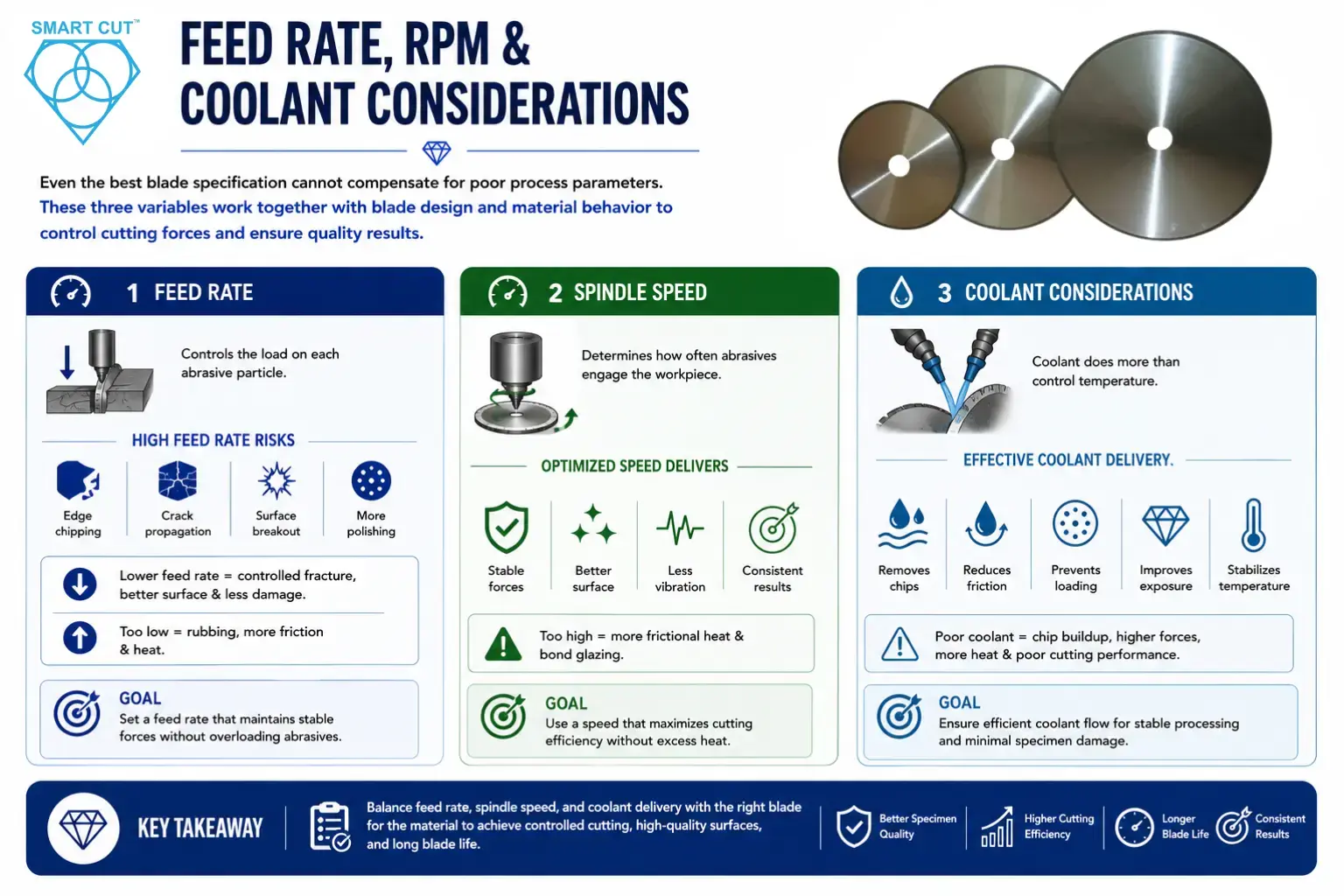
Even the best blade specification cannot compensate for poor process parameters.
Feed rate, spindle speed, and coolant delivery continuously influence cutting force distribution throughout the sectioning process.
Rather than optimizing these variables independently, engineers should consider how they interact with both blade design and material fracture behavior.
Feed Rate
Feed rate largely determines the mechanical load applied to each abrasive particle.
As the feed rate increases, the normal cutting force also increases.
For brittle materials with low fracture toughness, excessive feed rates frequently result in:
- Edge chipping
- Crack propagation
- Surface breakout
- Increased polishing requirements
Reducing feed rate helps maintain controlled fracture while improving specimen quality.
However, feed rates that are excessively low may encourage rubbing rather than efficient cutting, increasing friction and heat generation.
The objective is to establish a feed rate that maintains stable cutting forces without overloading the abrasive structure.
Spindle Speed
Spindle speed influences how frequently abrasive particles engage the workpiece.
Higher rotational speeds generally increase the number of cutting interactions while reducing the amount of material removed during each individual contact.
Properly optimized spindle speeds help maintain:
- Stable cutting forces
- Improved surface quality
- Reduced vibration
- Better process consistency
Excessively high spindle speeds, however, may increase frictional heating and accelerate bond glazing under certain conditions.
Coolant Considerations
Coolant performs several functions beyond temperature control.
Effective coolant delivery:
- Removes chips
- Reduces friction
- Prevents blade loading
- Improves abrasive exposure
- Stabilizes cutting temperatures
Poor coolant delivery often results in increased cutting forces because debris accumulates within the cutting interface, reducing cutting efficiency and increasing mechanical resistance.
For precision sectioning of brittle materials, efficient coolant application is therefore essential for maintaining stable cutting conditions while minimizing specimen damage.
Common Blade Selection Mistakes for Brittle Materials
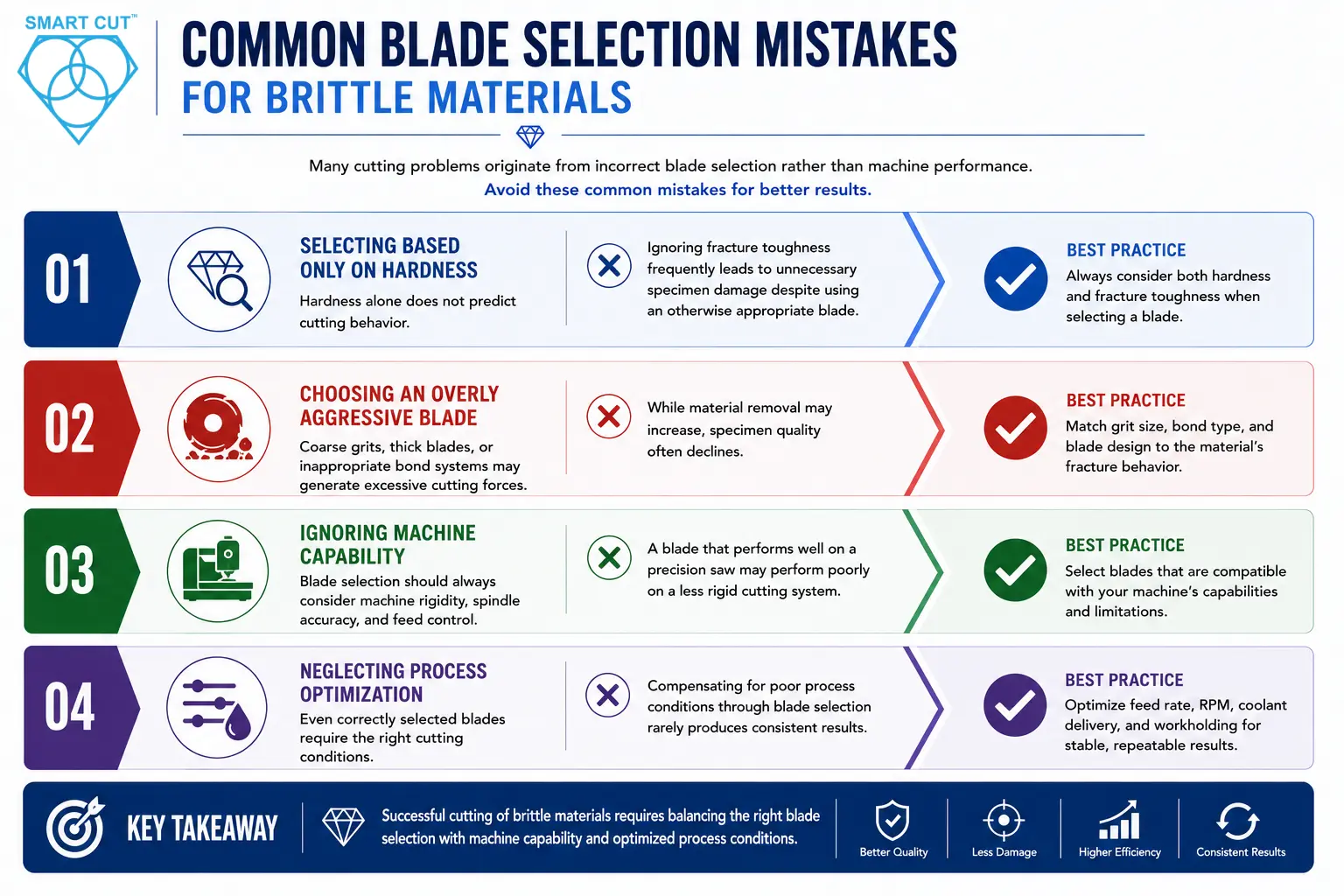
Many cutting problems originate from incorrect blade selection rather than machine performance.
Some of the most common mistakes include:
Selecting Based Only on Hardness
Hardness alone does not predict cutting behavior.
Ignoring fracture toughness frequently leads to unnecessary specimen damage despite using an otherwise appropriate blade.
Choosing an Overly Aggressive Blade
Coarse grits, thick blades, or inappropriate bond systems may generate excessive localized cutting forces.
While material removal may increase, specimen quality often declines.
Ignoring Machine Capability
Blade selection should always consider machine rigidity, spindle accuracy, and feed control.
A blade capable of producing excellent results on a precision laboratory saw may perform poorly on a less rigid cutting system.
Neglecting Process Optimization
Even correctly selected blades require an appropriate feed rate, spindle speed, coolant delivery, and workholding.
Attempting to compensate for poor process conditions through blade selection alone rarely produces consistent results.
Material-Specific Blade Selection Recommendations
Selecting the proper diamond or CBN blade requires evaluating the complete cutting application rather than relying on a single material property. Hardness, fracture toughness, specimen size, desired surface finish, machine capability, and production requirements all influence the final blade specification.
The following recommendations provide a general engineering framework for selecting blades based on material fracture behavior. Final blade selection should always be validated through application-specific testing and adjusted according to actual cutting performance.
| Material | Typical Fracture Behavior | Recommended Blade Characteristics |
|---|---|---|
| Silicon | Very brittle | Thin-kerf resin bond wafering blade, fine grit, controlled feed |
| Sapphire | Brittle | Fine-grit precision wafering blade with excellent coolant delivery |
| Quartz | Brittle | Thin blade, low cutting force, precision feed control |
| Glass | Brittle | Fine-grit blade, stable spindle, low feed rate |
| Alumina | Low fracture toughness | Resin or hybrid bond blade, fine grit, low-force sectioning |
| Zirconia | Higher fracture toughness than alumina | Hybrid or metal bond depending on production requirements |
| Silicon Carbide | Hard and abrasive | Metal bond blade with optimized coolant delivery |
| Tungsten Carbide | Hard with moderate fracture toughness | Metal bond diamond blade, rigid machine setup |
| Hardened Tool Steel | High fracture toughness | CBN saw blade with optimized feed and spindle speed |
| Nickel-Based Superalloys | Tough and heat resistant | CBN blade with effective coolant management |
| Fiber-Reinforced Composites | Mixed fracture behavior | Fine-grit blade with controlled feed to minimize delamination |
Engineering Applications
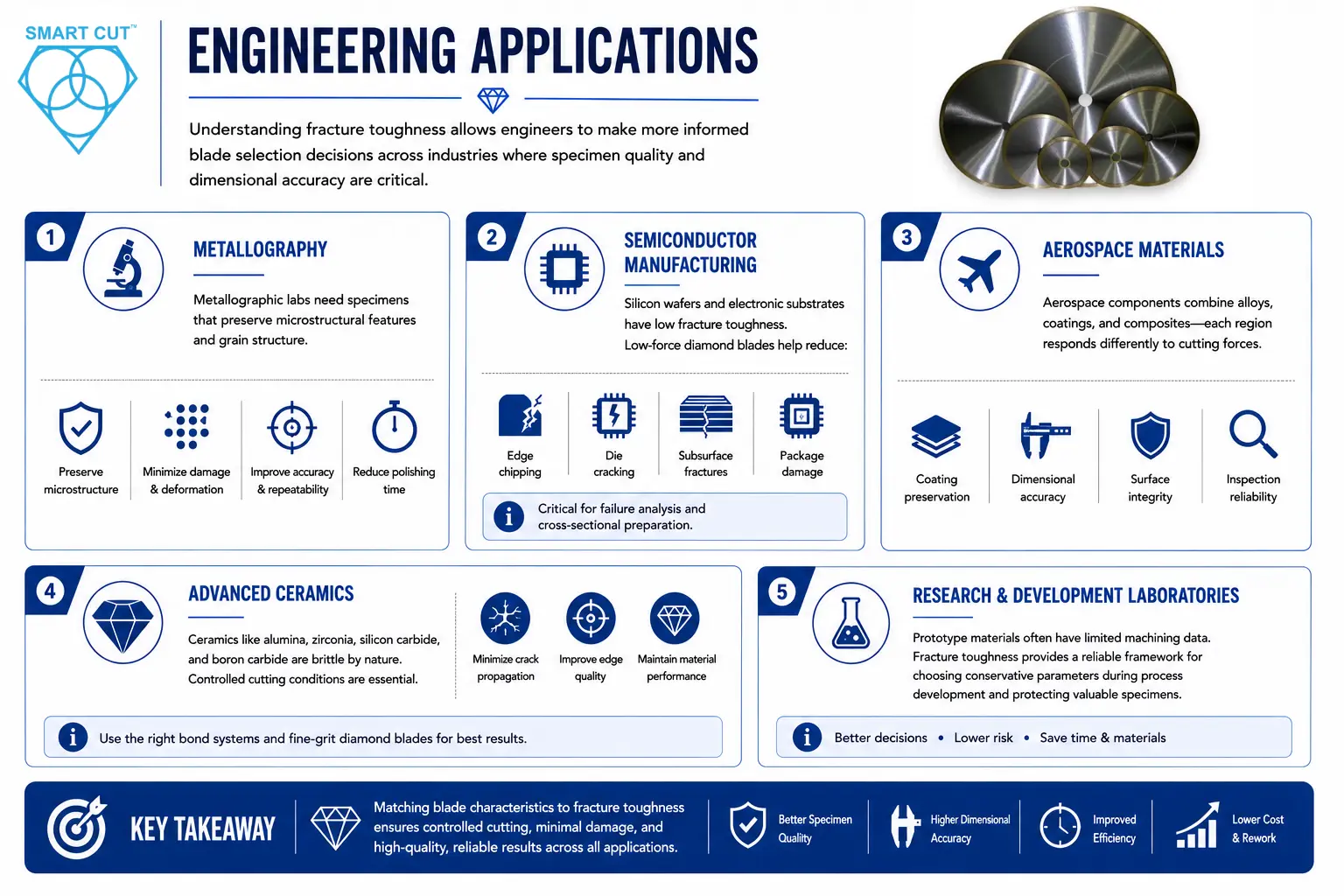
Understanding fracture toughness allows engineers to make more informed blade selection decisions across numerous industries where specimen quality and dimensional accuracy are critical.
Metallography
Metallographic laboratories require sectioned specimens that accurately preserve grain structure and microstructural features.
Selecting a blade based only on hardness may introduce deformation layers or microcracks that increase polishing time and compromise analytical accuracy.
Considering fracture toughness helps minimize mechanical damage while improving specimen repeatability.
Semiconductor Manufacturing
Silicon wafers, packaged devices, and electronic substrates possess relatively low fracture toughness despite their high hardness.
Precision wafering blades designed to generate low cutting forces help reduce:
- Edge chipping
- Die cracking
- Subsurface fractures
- Package damage
This is particularly important during failure analysis and cross-sectional preparation.
Aerospace Materials
Advanced aerospace components frequently combine high-strength alloys, thermal barrier coatings, and engineered composites.
Different regions within a single component may respond differently to localized cutting forces.
Matching blade characteristics to fracture behavior improves:
- Coating preservation
- Dimensional accuracy
- Surface integrity
- Inspection reliability
Advanced Ceramics
Materials such as alumina, zirconia, silicon carbide, and boron carbide are widely used because of their excellent wear resistance and thermal properties.
Their brittle fracture behavior requires carefully controlled cutting conditions.
Selecting appropriate bond systems and fine-grit diamond blades helps minimize crack propagation while improving edge quality.
Research and Development Laboratories
Research laboratories frequently process prototype materials with little available machining data.
Understanding fracture toughness provides a valuable engineering framework for selecting conservative cutting parameters during initial process development, reducing the risk of damaging expensive specimens.
Engineering Case Study
Improving Zirconia Sectioning Quality Through Proper Diamond Blade Selection
Application
An advanced ceramics manufacturer was preparing fully sintered yttria-stabilized zirconia (3Y-TZP) components for metallographic preparation, optical microscopy, and scanning electron microscopy (SEM).
The laboratory was sectioning rectangular zirconia specimens measuring approximately 25 mm × 12 mm × 8 mm using an 8-inch precision laboratory sectioning saw with continuous flood coolant.
The objective was to produce clean, damage-free cross sections while minimizing subsequent grinding and polishing.
The Challenge
The laboratory selected a general-purpose diamond blade based primarily on the hardness of zirconia. While the blade provided efficient cutting and long service life, technicians began experiencing several quality issues during specimen preparation.
Observed problems included:
- Inconsistent edge quality
- Localized edge chipping
- Increased subsurface damage
- Extended grinding and polishing time
- Occasional specimen rejection due to edge damage
Although the blade removed material efficiently, the mechanical damage introduced during sectioning increased the total specimen preparation time and reduced process consistency.
Original Blade Specification
The laboratory was using the following blade:
Outside Diameter: 8″ (203 mm)
Kerf (Thickness): 0.044″ (1.12 mm)
Arbor: 1.25″ (31.75 mm)
Bond Type: Sintered Metal Bond
Diamond Size: 120/140 US Mesh
Diamond Concentration: Medium (Approximately 75 Concentration)
Diamond Depth: 5 mm
Rim Configuration: Continuous Rim
The blade was designed as a durable, general-purpose diamond blade capable of sectioning a wide variety of hard materials. However, it was not specifically optimized for minimizing sectioning damage in advanced ceramics.
Initial Troubleshooting
The laboratory initially attempted to improve specimen quality by modifying cutting parameters while continuing to use the existing blade.
The process adjustments included reducing the feed rate, slightly lowering spindle speed, and increasing coolant flow.
Although these changes produced modest improvements, edge chipping and subsurface damage remained inconsistent.
It became evident that machine settings alone were not addressing the primary cause of specimen damage.
Engineering Evaluation
A detailed engineering review examined the complete cutting process, including material properties, blade bond type, diamond size, kerf thickness, blade rigidity, coolant delivery, cutting speed, feed rate, and specimen support.
The investigation determined that blade selection had been based primarily on material hardness rather than the fracture behavior of zirconia during precision sectioning.
Although zirconia is an extremely hard engineering ceramic, it also possesses relatively high fracture toughness compared with many other technical ceramics. During precision cutting, excessive localized cutting forces can still generate edge chipping and subsurface damage that must later be removed during grinding and polishing.
The engineering review concluded that the blade itself, rather than the machine settings, represented the greatest opportunity for improvement.
Optimized Blade Selection
The laboratory replaced the original blade with a precision resin bond diamond blade specifically engineered for low-damage sectioning of advanced ceramics.
Outside Diameter: 8″ (203 mm)
Kerf (Thickness): 0.035″ (0.89 mm)
Arbor: 1.25″ (31.75 mm)
Bond Type: Resin Bond
Diamond Size: 150 US Mesh
Rim Configuration: Continuous Rim
Unlike the original general-purpose metal bond blade, the resin bond blade provided a smoother, less aggressive cutting action that reduced localized cutting stresses during sectioning.
The slightly thinner kerf further reduced cutting forces by removing less material during each cut.
Only minor adjustments to spindle speed and feed rate were required after installing the new blade.
Results
Following implementation of the optimized blade and process adjustments, the laboratory observed significant improvements throughout the specimen preparation process.
The optimized process produced:
- Improved edge preservation
- Minimal edge chipping
- Reduced subsurface damage
- Improved surface finish after sectioning
- Reduced grinding and polishing time
- Improved specimen-to-specimen repeatability
- Improved overall process efficiency
The cleaner sectioned surfaces required less material removal during subsequent grinding and polishing, reducing total specimen preparation time while improving consistency.
Engineering Analysis
The improvement was not achieved simply by changing diamond grit size.
The primary improvement resulted from selecting a blade specifically engineered for precision sectioning of advanced ceramics.
Resin bond blades generally provide a more compliant cutting action than general-purpose metal bond blades. This helps reduce localized cutting stresses that contribute to edge chipping and subsurface damage in brittle materials.
The reduction in kerf thickness from 0.044 inch to 0.035 inch further decreased cutting forces by reducing the amount of material removed during each cut.
Together, these changes produced cleaner specimen edges, improved surface integrity, and more consistent preparation results.
Engineering Lessons Learned
When sectioning zirconia and other advanced ceramics, blade selection should consider more than material hardness alone.
Important factors include:
- Material fracture behavior
- Blade bond type
- Kerf thickness
- Diamond size
- Required surface quality
- Downstream grinding and polishing requirements
- Coolant application
- Cutting parameters
Selecting the appropriate blade at the beginning of the process often produces greater improvements than adjusting machine settings alone.
Frequently Asked Questions
Fracture toughness measures a material’s resistance to crack propagation after a crack has formed.
No. Hardness measures resistance to indentation, while fracture toughness measures resistance to crack growth.
It determines how a material responds to localized cutting forces generated by diamond or CBN abrasive particles.
Indirectly, yes. Materials that generate unstable cutting forces often accelerate abrasive wear and increase blade loading.
Yes. Fine-grit blades generally produce smaller localized cutting forces, helping reduce edge chipping and subsurface damage.
Fracture toughness itself does not improve efficiency, but understanding it allows engineers to select blades and parameters that optimize both productivity and specimen quality.
CBN blades are generally preferred for hardened ferrous materials where diamond may experience accelerated wear due to chemical interactions with iron at elevated temperatures.
Selecting a blade based solely on hardness while ignoring fracture toughness and overall cutting mechanics.
Conclusion
Material hardness is only one component of successful blade selection. Fracture toughness often has an equally important influence on how a material behaves during precision sectioning and frequently determines whether cutting forces produce clean material removal or uncontrolled crack propagation.
By understanding the relationship between fracture toughness, blade bond, grit size, diamond concentration, and cutting parameters, engineers can significantly improve specimen quality while reducing blade wear, polishing time, and process variability.
Whether sectioning semiconductor materials, advanced ceramics, carbides, hardened steels, or composite materials, selecting a blade that matches the material’s fracture behavior leads to more stable cutting forces, improved surface integrity, and greater process repeatability.
If you need assistance selecting the appropriate precision diamond blade, CBN saw blade, wafering blade, bond system, or cutting parameters for your specific material, UKAM’s applications engineering team can provide recommendations tailored to your application, equipment, and performance requirements.
Trusted by Tens of Thousands of Manufacturers, Laboratories,
Research Institutions Worldwide Since 1990
American Based Manufacturer
Established in 1990
Custom manufacturing
RELATED ARTICLES

Brian is an experienced professional in the field of precision cutting tools, with over 27 years of experience in technical support. Over the years, he has helped engineers, manufacturers, researchers, and contractors find the right solutions for working with advanced and hard-to-cut materials. He’s passionate about bridging technical knowledge with real-world applications to improve efficiency and accuracy.
As an author, Brian Farberov writes extensively on diamond tool design, application engineering, return on investment strategies, and process optimization, combining technical depth with a strong understanding of customer needs and market dynamics.