



















Diamond Blade Cutting Process Qualification: Engineering Guide

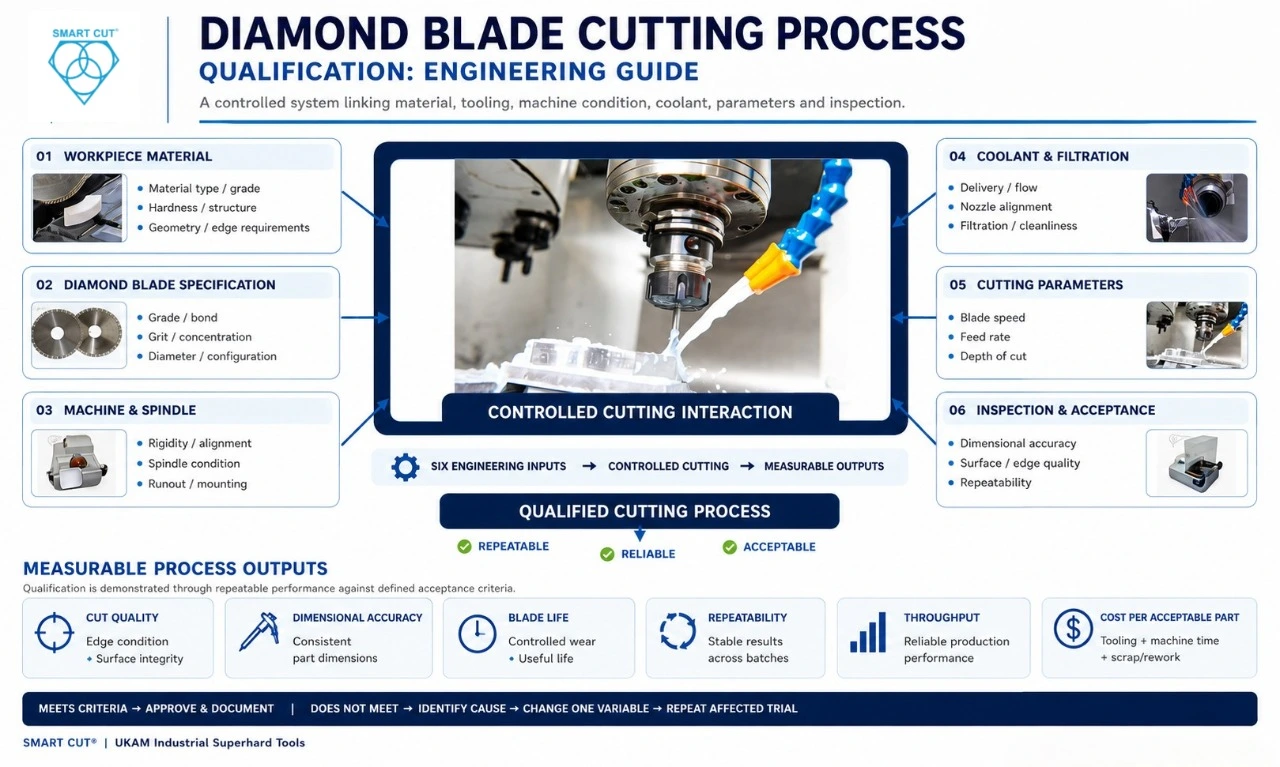
Table of Contents
Toggle
American Based Manufacturer

Established in 1990


Custom manufacturing


Successful diamond blade cutting depends on more than selecting the correct blade. Material properties, blade specification, machine condition, coolant delivery, cutting parameters, and operator practices all influence cutting quality. Without a structured qualification process, manufacturers often experience inconsistent edge quality, excessive blade wear, dimensional variation, thermal damage, and higher production costs.
Many production facilities replace diamond blades or modify cutting parameters whenever cutting performance changes. Although these adjustments may temporarily improve results, they rarely address the underlying process conditions responsible for the problem. A documented qualification procedure provides a systematic method for identifying the root cause before introducing production changes.
Applications involving silicon carbide, alumina, silicon nitride, sapphire, fused silica, tungsten carbide, gallium arsenide (GaAs), polycrystalline diamond (PCD), quartz, optical glass, and other advanced engineering materials require different cutting strategies. A structured qualification process allows engineers to evaluate these materials consistently while maintaining product quality and production efficiency.
Why Engineers Perform Process Qualification
Manufacturing processes are not static. Even a cutting operation that has consistently produced acceptable results can change over time due to normal equipment wear, new workpiece materials, tighter dimensional tolerances, higher production volumes, updated customer specifications, or changes in blade specifications. Small process variations often develop gradually and may go unnoticed until they begin affecting product quality, production efficiency, or manufacturing costs.
Process qualification is a systematic engineering method used to verify that the entire diamond blade cutting process continues to operate within established performance requirements. Rather than focusing on a single variable, qualification evaluates the interaction between the workpiece material, diamond blade, machine, coolant system, operating parameters, and inspection procedures to confirm that the process remains stable, repeatable, and capable of meeting production requirements before routine manufacturing continues.
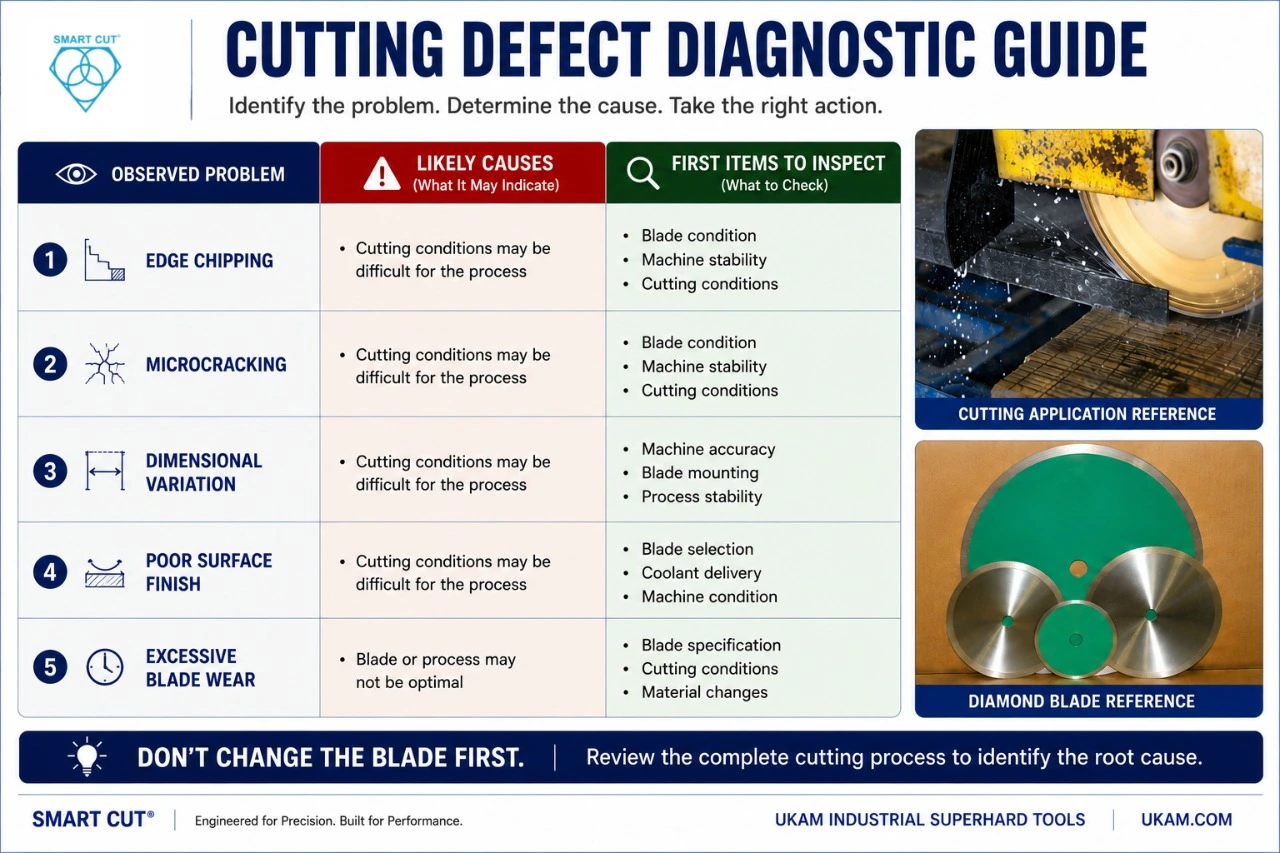
Common Production Triggers That Indicate Process Qualification May Be Required
|
Production Observation |
Possible Engineering Cause |
Recommended Action |
|---|---|---|
|
Increasing edge chipping |
Blade wear, machine vibration, incorrect cutting parameters, or changes in material properties |
Review the complete cutting process and determine the root cause before adjusting operating parameters. |
|
Surface damage or poor surface finish |
Blade specification, inadequate coolant delivery, excessive heat generation, or machine instability |
Verify blade selection, coolant performance, and machine condition. |
|
Excessive blade wear |
Incorrect bond type, unsuitable diamond specification, improper cutting parameters, or material changes |
Evaluate blade specification and overall process efficiency. |
|
Longer cutting cycles |
Blade glazing, reduced cutting efficiency, machine wear, or conservative operating parameters |
Review process performance and identify opportunities for optimization. |
|
Dimensional variation |
Blade deflection, spindle runout, fixture movement, or machine instability |
Inspect machine accuracy, blade mounting, and process repeatability. |
|
Increased blade replacement frequency |
Process instability or improper blade selection |
Perform a documented process qualification to identify contributing factors. |
|
New customer quality requirements |
Tighter tolerances or higher surface quality expectations |
Validate that the existing process consistently meets the new specifications before production. |
|
Introduction of a new workpiece material |
Different hardness, brittleness, abrasiveness, or thermal characteristics |
Complete a full process qualification to determine the optimum blade specification and cutting parameters. |
|
Machine maintenance or equipment upgrades |
Changes in spindle performance, rigidity, alignment, or coolant delivery |
Verify that equipment performance continues to support the qualified process. |
|
New blade specification or supplier |
Differences in bond type, diamond size, concentration, or manufacturing tolerances |
Requalify the process to confirm equivalent or improved cutting performance. |
These production observations should be viewed as indicators that the cutting process may no longer be operating under the conditions established during the original qualification. Rather than replacing the blade or changing cutting parameters based on trial and error, engineers should evaluate the complete cutting system to identify the underlying cause of the change. A documented qualification process helps establish root cause, minimizes unnecessary process adjustments, reduces scrap, improves consistency, and provides confidence that the cutting operation will continue to meet production and quality requirements.
What Is Diamond Blade Cutting Process Qualification?
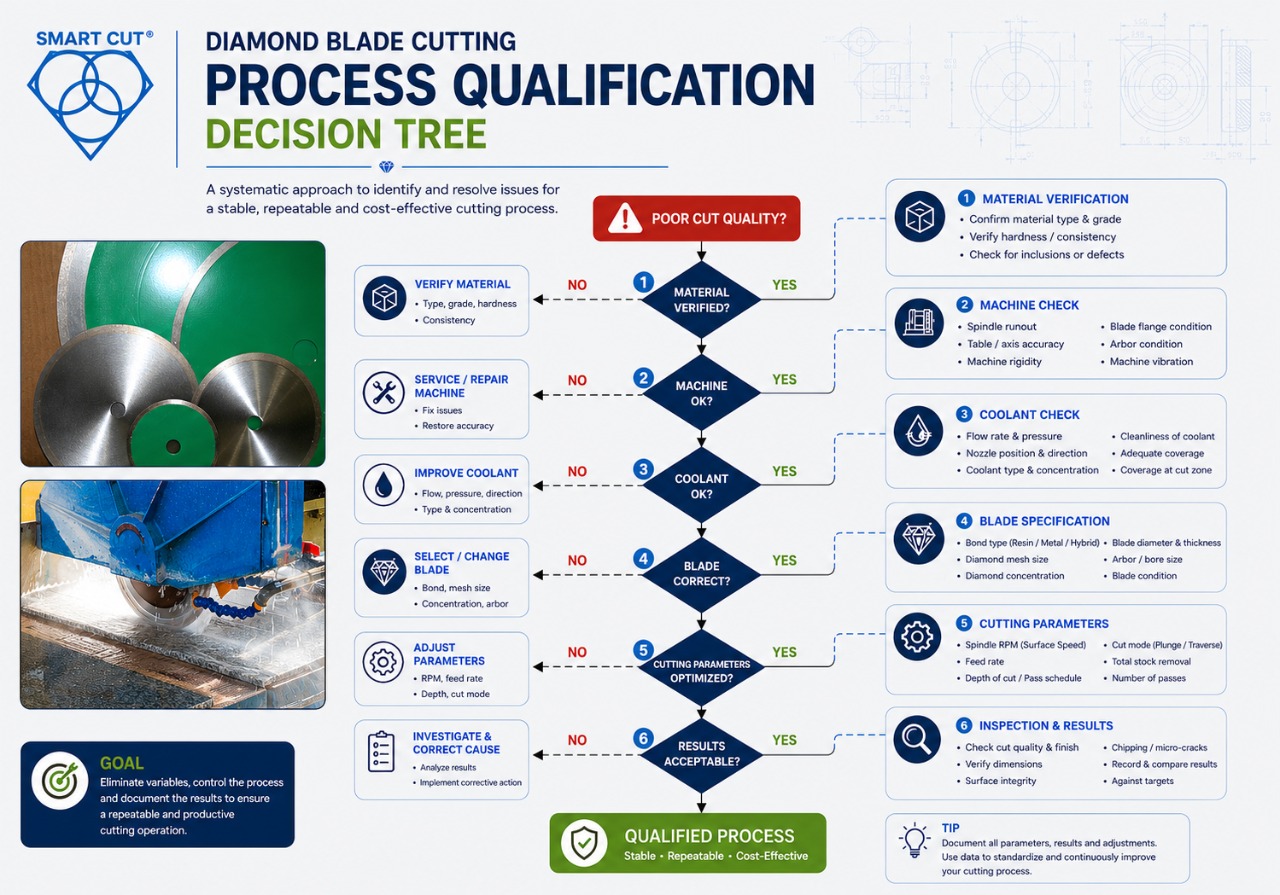
Diamond blade cutting process qualification is a systematic engineering procedure used to verify that a cutting process consistently produces parts that meet defined quality, dimensional, and production requirements. Rather than evaluating the diamond blade alone, process qualification examines the entire cutting system to ensure all process variables work together to achieve stable, repeatable, and predictable manufacturing performance.
A qualified process provides documented evidence that the selected blade specification, machine, coolant system, cutting parameters, and inspection methods are capable of producing consistent results before routine production begins. Process qualification should also be performed whenever significant changes are made to the cutting process, including new workpiece materials, different blade specifications, equipment modifications, or revised customer quality requirements.
Successful process qualification evaluates the interaction between multiple engineering variables, including:
- Workpiece material properties
- Diamond blade specification
- Bond type
- Blade thickness
- Diamond mesh size
- Diamond concentration
- Machine condition and spindle accuracy
- Blade mounting and machine rigidity
- Coolant delivery and filtration
- Cutting parameters
- Workholding method
Because these variables influence one another, changing a single process variable without considering the complete cutting system can produce unexpected changes in cut quality, blade life, dimensional accuracy, surface finish, and production efficiency.
The primary objective of process qualification is to establish a documented manufacturing process that consistently produces acceptable results while minimizing scrap, blade wear, machine downtime, process variation, and overall manufacturing cost.
Why Process Qualification Is Often Overlooked
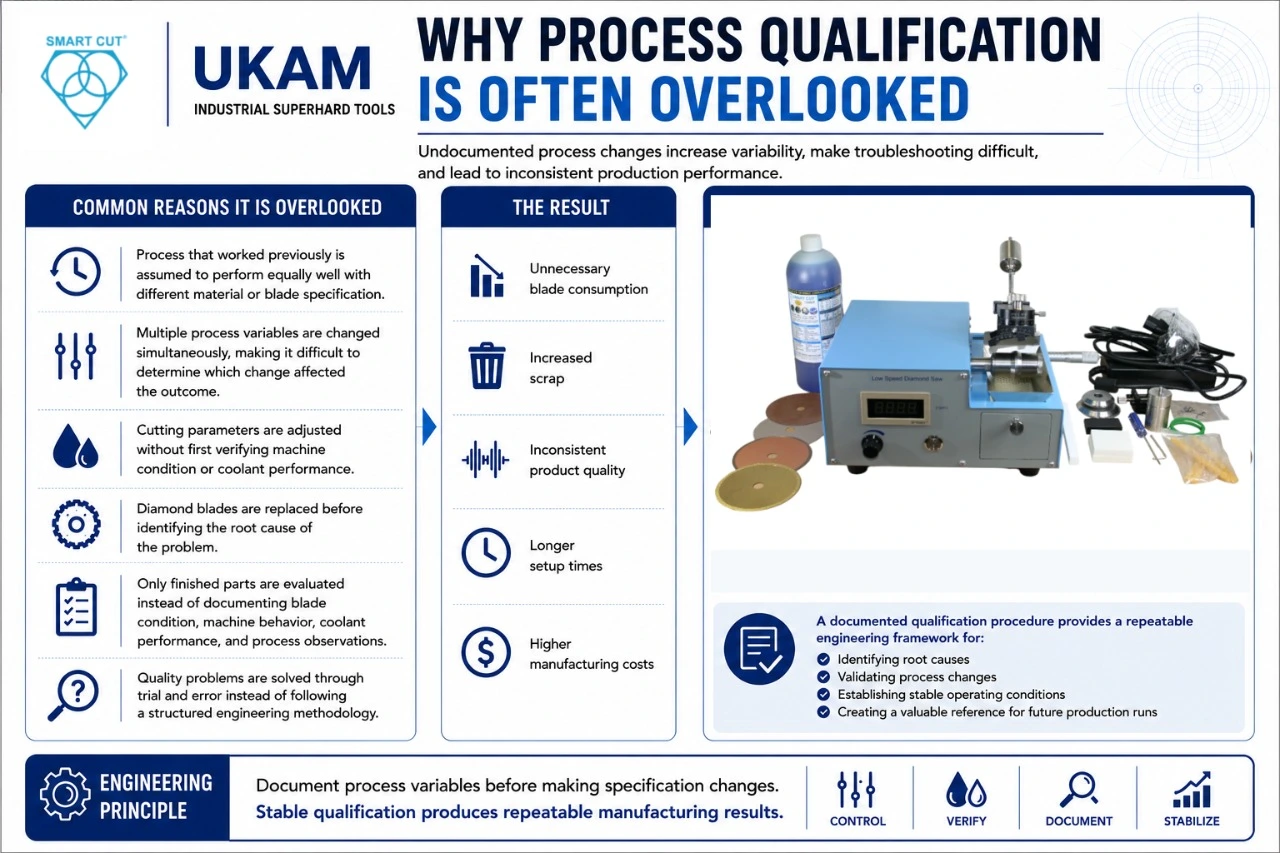
Many manufacturers rely on previous production experience when introducing new materials, blade specifications, or equipment changes. While this approach may reduce setup time initially, undocumented process changes often increase variability, make troubleshooting more difficult, and lead to inconsistent production performance.
Common reasons process qualification is overlooked include:
- Assuming a process that worked previously will perform equally well with a different material or blade specification.
- Changing multiple process variables simultaneously, making it difficult to determine which change affected the outcome.
- Adjusting cutting parameters without first verifying machine condition or coolant performance.
- Replacing diamond blades before identifying the root cause of the problem.
- Evaluating only finished parts instead of documenting blade condition, machine behavior, coolant performance, and process observations throughout qualification.
- Attempting to solve quality problems through trial and error rather than following a structured engineering methodology.
These practices often result in unnecessary blade consumption, increased scrap, inconsistent product quality, longer setup times, and higher manufacturing costs.
A documented qualification procedure provides a repeatable engineering framework for identifying root causes, validating process changes, and establishing stable operating conditions. It also creates a valuable reference for future production runs, making process optimization, troubleshooting, and operator training faster, easier, and more consistent.
Baseline Documentation Before Process Changes
Before modifying any blade specification, cutting parameter, machine setting, or coolant system, engineers should establish a complete baseline of the existing cutting process. A well-documented baseline provides the engineering reference needed to evaluate every subsequent process change. Without accurate baseline documentation, it becomes difficult to determine whether changes improve cutting performance, reduce manufacturing costs, or introduce additional process variation.
Baseline documentation should capture all significant process variables that influence cutting performance. Recording these conditions before qualification begins allows engineers to compare results objectively, identify root causes more efficiently, and reproduce successful operating conditions in future production runs.
Recommended Baseline Documentation
|
Process Parameter |
Why It Matters |
Information to Record |
|---|---|---|
|
Workpiece material |
Material properties determine blade selection, cutting forces, heat generation, and blade wear. |
Material type, grade, hardness, thickness, brittleness, and any special material characteristics (for example, silicon carbide, alumina, sapphire, fused silica, silicon nitride, tungsten carbide, GaAs, PCD, quartz, optical glass, or other engineered materials). |
|
Cutting operation |
Different cutting operations require different blade specifications and operating parameters. |
Precision cutting, sectioning, wafer dicing, slicing, cutoff, laboratory sectioning, or production cutting. |
|
Diamond blade specification |
primary factors affecting cut quality and productivity. |
Blade type, diameter, thickness, bond type, diamond mesh size, diamond concentration, rim design, and manufacturer or part number. |
|
Machine condition |
Machine accuracy directly affects dimensional consistency and cut quality. |
Machine model, spindle condition, spindle runout, rigidity, vibration, flange condition, and blade mounting. |
|
Cutting parameters |
Operating conditions influence cutting efficiency, blade life, and workpiece quality. |
Spindle speed, feed rate, cutting depth, traverse speed, dressing method, and any other operating parameters. |
|
Coolant system |
heat generation, improves blade life, and minimizes thermal damage. |
Coolant type, concentration, flow rate, nozzle position, filtration system, and delivery method (flood, directed nozzle, or recirculating system). |
|
Workholding method |
Inadequate fixturing can cause movement, vibration, dimensional errors, and blade deflection. |
Fixture type, clamping method, workpiece orientation, and support method. |
|
Quality requirements |
Qualification must verify that production requirements are consistently achieved. |
Dimensional tolerances, edge quality, surface finish, kerf width, chipping limits, flatness, and any customer acceptance criteria. |
|
Production objective |
Qualification requirements vary depending on production goals. |
Prototype evaluation, process development, pilot production, qualification testing, or full-scale manufacturing. |
|
Inspection methods |
Consistent inspection is required to verify process capability. |
Measurement equipment, inspection frequency, sampling plan, acceptance criteria, and inspection procedure. |
Engineering Recommendation
Baseline documentation should be completed before any process changes are introduced. During qualification, only one significant process variable should be modified at a time whenever practical. This controlled approach allows engineers to accurately determine the effect of each change while minimizing uncertainty during process optimization.
A comprehensive baseline not only supports successful process qualification, but also becomes a valuable engineering reference for future troubleshooting, continuous process improvement, operator training, process validation, and repeatable production. Manufacturers that maintain detailed baseline records are generally able to identify process changes more quickly, reduce unnecessary experimentation, improve product consistency, and lower overall manufacturing costs.
Evaluating Total Manufacturing Cost
When selecting a diamond blade, the initial purchase price should be considered only one component of the overall manufacturing cost. Although a lower-priced blade may appear to reduce tooling expenses, it can increase the total cost of production if it results in shorter blade life, higher scrap rates, additional machine downtime, or inconsistent cutting performance.
A comprehensive engineering evaluation considers the performance of the entire cutting process, not simply the cost of the blade itself. Factors such as process stability, production consistency, machine utilization, labor efficiency, and product quality often have a much greater impact on manufacturing cost than the initial tooling investment.
The following example illustrates how two blade options with different purchase prices can produce significantly different overall manufacturing costs.
Illustrative Manufacturing Cost Comparison
|
Manufacturing Factor |
Blade Option A |
Blade Option B |
|---|---|---|
|
Initial purchase price |
Lower |
Higher |
|
Average blade life |
Shorter |
Longer |
|
Feed Rate |
Lower |
Higher |
|
Blade replacement frequency |
More frequent |
Less frequent |
|
Process consistency |
Moderate |
High |
|
Edge quality |
Variable |
Consistent |
|
Scrap and rework |
Higher |
Lower |
|
Machine downtime |
More frequent |
Reduced |
|
Operator adjustments |
Frequent |
Minimal |
|
Engineering support |
Limited |
Application-specific guidance |
|
Process qualification support |
Limited |
Available |
|
Overall manufacturing cost per acceptable part |
Higher |
Lower |
Although Blade Option B has a higher initial purchase price, it may reduce overall manufacturing costs by increasing blade life, minimizing scrap, reducing machine downtime, and improving process consistency. In many precision cutting applications, these improvements produce a lower cost per acceptable part, even when the tooling investment is greater.
For this reason, engineers should evaluate diamond blades based on total manufacturing cost, process capability, production consistency, quality performance, and overall operating efficiency, rather than purchase price alone. A blade that delivers repeatable performance, longer service life, and reduced process variation often provides the greatest long-term economic value.
Engineering Recommendation
When evaluating alternative blade specifications, document both tooling costs and process performance metrics, including:
- Blade life
- Cost per acceptable part
- Scrap rate
- Machine downtime
- Production throughput
- Operator intervention
- Process repeatability
- Product quality
- Overall manufacturing cost
Evaluating these performance indicators provides a more accurate assessment of process efficiency and supports better engineering and purchasing decisions than comparing blade prices alone.
Engineering Objectives of Process Qualification
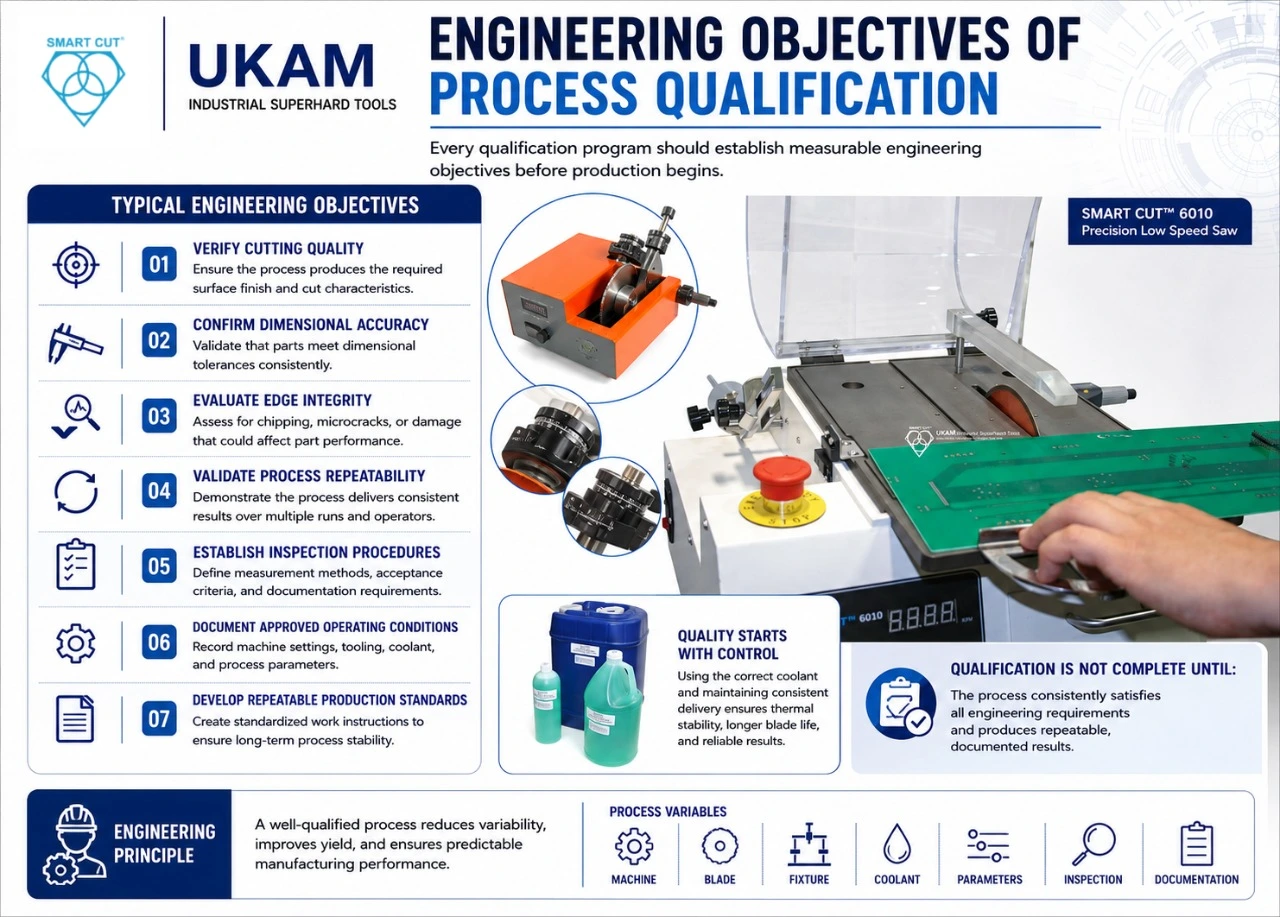
Every qualification program should establish measurable engineering objectives before production begins.
Typical objectives include:
- Verify cutting quality.
- Confirm dimensional accuracy.
- Evaluate edge integrity.
- Validate process repeatability.
- Establish inspection procedures.
- Document approved operating conditions.
- Develop repeatable production standards.
Qualification should continue until the process consistently satisfies all engineering requirements.
Common Process Qualification Mistakes
Even a well-designed qualification program can produce misleading results if engineering decisions are based on assumptions rather than documented evidence. Many qualification failures occur because multiple process variables are changed simultaneously, critical process conditions are overlooked, or insufficient documentation is collected during testing.
Understanding these common mistakes helps engineers identify root causes more efficiently, improve process repeatability, and establish a more reliable manufacturing process.
Mistake 1: Changing Multiple Process Variables Simultaneously
Changing the blade specification, coolant delivery, cutting parameters, and machine settings at the same time makes it impossible to determine which change influenced the final results. While overall cutting performance may improve or decline, engineers cannot identify the specific variable responsible for the outcome, making future optimization and troubleshooting significantly more difficult.
Engineering Recommendation
Whenever practical, modify only one significant process variable at a time while keeping all other conditions constant. Record the results of each change before introducing additional adjustments. This systematic approach provides a clear understanding of how each variable influences cutting performance.
Mistake 2: Evaluating Blade Performance Without Verifying Machine Condition
Poor cut quality is often attributed to the diamond blade when the actual cause is the cutting machine. Spindle runout, machine rigidity, blade mounting, flange condition, and machine vibration all have a direct influence on dimensional accuracy, edge quality, blade life, and process stability.
Engineering Recommendation
Before changing blade specifications, verify that the machine is operating within acceptable mechanical tolerances. Inspect spindle condition, blade mounting, coolant delivery, vibration levels, and overall machine stability to eliminate equipment-related causes.
Mistake 3: Recording Only Final Inspection Results
Final inspection confirms whether a part meets quality requirements, but it does not explain why the process succeeded or failed. Valuable engineering information may be lost if observations made during cutting are not documented.
Examples include changes in blade wear, cutting stability, coolant performance, machine vibration, cutting forces, and operator observations.
Engineering Recommendation
Document process observations throughout the qualification, not just after the final cut. Recording operating conditions together with inspection results makes troubleshooting easier and provides valuable information for future process optimization.
Mistake 4: Skipping Qualification After Material Changes
Materials with similar appearance or hardness often behave very differently during cutting. Changes in hardness, brittleness, abrasiveness, microstructure, or thermal properties may require a different blade specification, coolant strategy, or cutting parameters.
Assuming that an existing process will perform equally well on a different material can result in excessive blade wear, poor surface finish, edge chipping, dimensional variation, and reduced productivity.
Engineering Recommendation
Perform a documented process qualification whenever introducing a new workpiece material, material grade, material thickness, or customer quality requirement. Confirm that the qualified process consistently meets production objectives before routine manufacturing begins.
Mistake 5: Selecting a Blade Based Only on Purchase Price
The purchase price of a diamond blade represents only a small portion of the total manufacturing cost. A lower-priced blade may require more frequent replacement, produce inconsistent cut quality, increase scrap, or require additional operator adjustments, ultimately increasing the overall cost of production.
Engineering decisions should be based on total manufacturing cost, including blade life, production throughput, machine downtime, product quality, process stability, and cost per acceptable part.
Engineering Recommendation
Evaluate blade performance using measurable production data rather than purchase price alone. Consider blade life, scrap rate, machine utilization, operator intervention, process repeatability, overall manufacturing cost, and cost per acceptable part when comparing alternative blade specifications.
Engineering Summary
Most process qualification problems can be traced to insufficient documentation, uncontrolled process changes, or incorrect assumptions about the source of a manufacturing problem. A structured qualification procedure that changes one variable at a time, documents all significant process conditions, and evaluates the complete cutting system provides more reliable results, simplifies troubleshooting, and establishes a stable, repeatable manufacturing process.
Critical Engineering Variables for Process Qualification
Successful process qualification requires evaluating the entire cutting system, not just an individual process variable. The performance of a diamond blade is directly influenced by the interaction between the workpiece material, blade specification, machine condition, coolant system, operating parameters, and inspection methods. Optimizing one variable while overlooking others often results in inconsistent cut quality, reduced blade life, unnecessary troubleshooting, and higher manufacturing costs.
The following engineering decision matrix summarizes the critical variables that should be reviewed and validated before approving a cutting process for production.
|
Engineering Variable |
Why It Matters |
Engineering Review |
|---|---|---|
|
Workpiece Material |
Material properties determine cutting forces, blade wear, heat generation, and blade selection. |
Verify material type, grade, hardness, brittleness, abrasiveness, thickness, and thermal sensitivity before qualification. |
|
Diamond Blade Specificatio |
The blade is the primary cutting tool and must match the application requirements. |
Confirm blade diameter, thickness, bond type, diamond mesh size, concentration, rim design, and manufacturer specifications. |
|
Bond Type |
Bond hardness affects cutting efficiency, blade wear, self-sharpening characteristics, and blade life. |
Select a bond appropriate for the material being cut and the required production rate. |
|
Blade Thickness |
Blade thickness influences kerf width, rigidity, dimensional accuracy, and cutting stability. |
Select the thinnest blade that provides adequate rigidity and process stability. |
|
Diamond Mesh Size |
Diamond particle size affects cutting speed, surface finish, edge quality, and material removal rate. |
Confirm that the selected mesh size matches the material properties and quality requirements. |
|
Diamond Concentration |
Diamond concentration influences blade life, cutting efficiency, and cutting forces. |
Evaluate concentration together with bond type, blade thickness, and production objectives. |
|
Machine Condition |
Machine accuracy directly affects cut quality, dimensional consistency, and process repeatability. |
Inspect spindle runout, machine rigidity, blade mounting, flange condition, vibration, and preventive maintenance records. |
|
Cutting Parameters |
Operating conditions influence productivity, blade wear, thermal damage, and overall process performance. |
Verify spindle speed, feed rate, cutting depth, traverse speed, and dressing procedures. |
|
Coolant Delivery |
Proper coolant application minimizes heat generation, improves blade life, and removes cutting debris. |
Verify coolant type, concentration, flow rate, nozzle position, filtration, and delivery method. |
|
Workholding Method |
Poor fixturing can cause vibration, blade deflection, dimensional variation, and poor edge quality. |
Confirm that the workpiece is securely supported and properly aligned throughout the cutting operation. |
|
Inspection and Measurement |
Inspection verifies that the qualified process consistently meets engineering requirements. |
Define measurement equipment, sampling frequency, inspection procedures, and acceptance criteria before qualification begins. |
Engineering Recommendation
Every engineering variable listed above should be reviewed as part of a single integrated manufacturing system, rather than as independent process elements. Changes made to one variable frequently influence several others. For example, selecting a thinner blade may require different cutting parameters, improved machine rigidity, or modified coolant delivery to maintain acceptable cutting performance.
Successful process qualification depends on systematically documenting, evaluating, and validating each engineering variable before production approval. A structured engineering review minimizes process variation, improves repeatability, reduces troubleshooting time, and establishes a stable manufacturing process capable of consistently meeting quality and production requirements.
Eight-Step Engineering Process Qualification Methodology
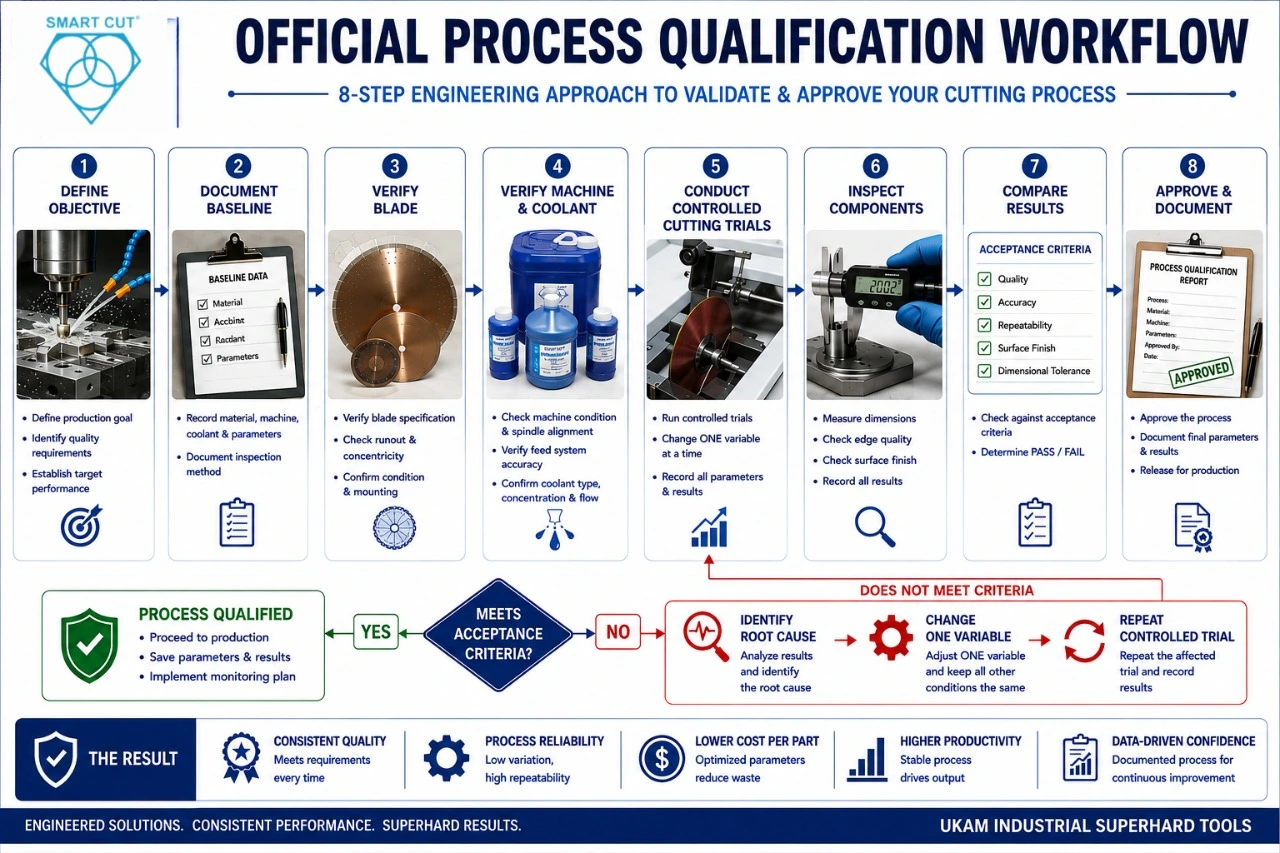
Step 1: Define the Production Objective
Clearly define the intended manufacturing outcome before beginning qualification.
Document:
- Cutting application
- Production volume
- Quality requirements
- Dimensional tolerances
- Surface finish requirements
- Customer specifications
Objective: Establish clear qualification goals and acceptance criteria.
Step 2: Document the Existing Process
Record the current operating conditions before making any changes.
Document:
- Workpiece material
- Blade specification
- Machine configuration
- Cutting parameters
- Coolant system
- Inspection methods
Objective: Establish the engineering baseline used for comparison throughout qualification.
Step 3: Verify the Diamond Blade Specification
Confirm that the blade is appropriate for both the workpiece material and production objective.
Review:
- Bond type
- Blade diameter
- Blade thickness
- Diamond mesh size
- Diamond concentration
- Blade condition
Objective: Verify that the selected blade is suitable for the application.
Step 4: Verify Machine and Coolant System Performance
Before evaluating blade performance, verify that the cutting equipment is capable of supporting the qualification process.
Inspect:
- Spindle condition
- Spindle runout
- Machine rigidity
- Blade mounting
- Flange condition
- Machine vibration
- Coolant flow
- Nozzle alignment
- Coolant filtration
Objective: Eliminate machine-related variables before modifying tooling.
Step 5: Conduct Controlled Cutting Trials
Perform qualification cuts using the documented operating conditions.
During testing, monitor:
- Edge quality
- Surface finish
- Blade wear
- Cutting stability
- Process repeatability
- Operator observations
Whenever practical, modify only one significant process variable at a time.
Objective: Evaluate process performance under controlled conditions.
Step 6: Inspect Finished Components
Verify that finished components satisfy all engineering and customer requirements.
Inspect:
- Dimensional accuracy
- Edge chipping
- Surface damage
- Kerf width
- Surface finish
- Burr formation
- Process consistency
Objective: Confirm that the qualified process consistently produces acceptable parts.
Step 7: Compare Results with Acceptance Criteria
Review all inspection results together with the documented operating conditions.
Determine whether the process consistently satisfies:
- Dimensional accuracy
- Edge chipping
- Surface damage
- Kerf width
- Surface finish
- Burr formation
- Process consistency
Decision Point
Does the process consistently meet all qualification requirements?
Yes
Proceed to production approval.
No
Identify the root cause, modify one process variable, document the change, and repeat the affected qualification steps before continuing.
Step 8: Approve and Document the Qualified Process
Once the process consistently meets all qualification requirements, document the approved operating conditions for future production.
Record:
- Approved blade specification
- Machine settings
- Cutting parameters
- Coolant configuration
- Inspection procedure
- Qualification results
- Engineering observations
- Revision history
Objective: Establish a repeatable, documented manufacturing process that can be consistently reproduced during future production.
These documents support engineering consistency and simplify future troubleshooting.
Engineering Summary
Process qualification is an iterative engineering process, not a single test or inspection. Each qualification cycle should begin with a documented baseline, evaluate one significant process variable at a time, verify results against established acceptance criteria, and fully document the approved operating conditions. Following this structured workflow improves process stability, reduces scrap and downtime, simplifies troubleshooting, and provides confidence that the cutting process will consistently meet quality and production requirements.
Evaluating Engineering Support During Supplier Selection
Selecting a diamond blade supplier should involve more than comparing price, lead time, or product availability. The supplier’s technical knowledge, application experience, and engineering support can have a significant impact on process qualification, production efficiency, product quality, and overall manufacturing cost.
A knowledgeable supplier should be able to recommend appropriate blade specifications, explain the engineering rationale behind those recommendations, assist with process qualification, and provide guidance when troubleshooting production challenges.
The following questions can help evaluate a supplier’s technical capabilities.
Engineering Supplier Evaluation Matrix
|
Evaluation Question |
Why It Matters |
What a Strong Technical Supplier Should Demonstrate |
|---|---|---|
|
Which blade specification do you recommend for this application? |
The blade specification directly influences cut quality, blade life, productivity, and process stability. |
Ability to explain how material properties, quality requirements, and production objectives influence blade selection. |
|
Why is this blade specification recommended? |
Engineering recommendations should be supported by technical reasoning rather than product availability. |
Clear explanation of the relationship between bond type, blade thickness, diamond mesh size, concentration, and cutting performance. |
|
Which bond type should be selected? |
Bond selection significantly affects cutting efficiency, blade wear, self-sharpening characteristics, and tool life. |
Understanding of how different bond systems perform on specific engineering materials and production conditions. |
|
What blade thickness is most appropriate? |
Blade thickness affects rigidity, kerf width, dimensional accuracy, material loss, and cutting stability. |
Ability to balance cutting precision with blade stability and production requirements. |
|
What cutting parameters are recommended? |
Proper spindle speed, feed rate, and cutting depth are essential for consistent results. |
Application-specific recommendations based on material characteristics, machine capability, and production objectives. |
|
What coolant system or coolant type should be used? |
Coolant influences blade life, heat generation, surface quality, and cutting efficiency. |
Recommendations for coolant type, flow rate, filtration, nozzle placement, and delivery method. |
|
Can you provide guidance for process qualification? |
Successful qualification requires more than selecting the correct blade. |
Ability to recommend qualification procedures, process variables to monitor, inspection methods, and acceptance criteria. |
|
Can alternative blade specifications be evaluated? |
Different production objectives may require different tooling strategies. |
Willingness to compare multiple blade specifications and explain the expected performance trade-offs. |
|
Can you support long-term process optimization? |
Manufacturing requirements often change over time. |
Ongoing engineering assistance for improving productivity, extending blade life, reducing scrap, and increasing process stability. |
Engineering Recommendation
The most valuable supplier is not necessarily the one offering the lowest purchase price or the shortest lead time, but the one capable of helping engineers develop, qualify, troubleshoot, and continuously improve the complete cutting process.
A technically competent supplier should function as an engineering partner, providing application knowledge, process qualification support, troubleshooting assistance, and practical recommendations based on documented manufacturing experience. This collaborative approach typically results in faster process qualification, improved product quality, reduced scrap, longer blade life, less machine downtime, and lower total manufacturing cost throughout the life of the process.
The following comparison summarizes engineering flexibility rather than product performance.
|
Feature |
Conventional Diamond Blade |
SMART CUT® Diamond Blade |
|---|---|---|
|
Bond options |
Standard configurations |
Standard configurations |
|
Blade thickness |
Standard offerings |
Broad specification range |
|
Diamond size |
Standard range |
Multiple abrasive options |
|
Material compatibility |
Application dependent |
Configurable for multiple engineering materials |
|
Technical support |
Supplier dependent |
Application guidance available |
This comparison highlights specification flexibility. Final blade selection should always be based on documented process qualification.
Diamond Cutting Process Qualification Checklist
A documented qualification process improves production consistency, simplifies troubleshooting, and provides a repeatable engineering standard for future manufacturing programs.
Application Review
- Workpiece material identified
- Cutting operation documented
- Production objective defined
- Surface quality requirements confirmed
- Dimensional tolerances verified
- Customer specifications reviewed
Blade Specification Review
- Blade type confirmed
- Bond type verified
- Blade diameter inspected
- Blade thickness verified
- Diamond mesh size reviewed
- Diamond concentration confirmed
- Blade condition documented
Machine Evaluation
- Spindle condition inspected
- Machine rigidity verified
- Blade mounting checked
- Flange condition inspected
- Machine vibration evaluated
- Machine maintenance records reviewed
Coolant System Review
- Coolant delivery verified
- Nozzle alignment inspected
- Coolant filtration checked
- Coolant flow confirmed
- Coolant cleanliness documented
Cutting Process Validation
- Edge quality inspected
- Surface condition evaluated
- Blade wear documented
- Dimensional accuracy verified
- Process repeatability confirmed
- Inspection records completed
Documentation
- Qualification report completed
- Approved blade specification recorded
- Machine settings documented
- Inspection procedure approved
- Process changes recorded
A completed qualification checklist becomes the reference standard for future production runs and simplifies future troubleshooting whenever process conditions change.
Frequently Asked Questions
Process qualification verifies that the complete cutting system consistently produces acceptable quality before routine manufacturing begins. Qualification evaluates blade specification, machine condition, coolant delivery, inspection methods, and production requirements together, reducing unnecessary process variation and improving repeatability.
Requalification should be considered whenever significant process changes occur. Examples include introducing a new workpiece material, selecting a different blade specification, modifying machine equipment, changing coolant systems, tightening customer tolerances, or observing unexpected changes in cutting quality.
No. Blade performance depends on the interaction between the blade, machine, coolant system, workpiece material, and production parameters. Qualification should evaluate the complete manufacturing system rather than one component individually.
Engineers should document workpiece material, blade specification, bond type, blade dimensions, diamond mesh size, concentration, machine condition, coolant delivery, inspection methods, production observations, and final qualification results. Complete documentation supports future process optimization and troubleshooting.
Only one significant process variable should be modified at a time. Controlled changes make it easier to identify the effect of each adjustment and reduce uncertainty during engineering evaluation.
Inspection confirms whether engineering objectives have been achieved. Edge quality, dimensional accuracy, surface condition, blade wear, and process repeatability should all be evaluated before approving the process for production.
Supplier selection should include engineering capability, application experience, technical documentation, qualification guidance, and ongoing technical support. Engineering assistance often contributes more to long term manufacturing success than blade availability alone.
UKAM Application Example
Qualifying a Diamond Blade Cutting Process for Technical
A manufacturer producing precision alumina components began experiencing increasing edge chipping during production after several months of stable operation. The immediate assumption was that the existing diamond blade specification was no longer suitable, and a different blade was requested.
Before recommending a new blade, UKAM’s engineering team recommended documenting the existing process and reviewing all significant process variables as part of a structured qualification procedure.
The qualification review included:
- Workpiece material: 99.5% alumina ceramic
- Current blade specification: Resin bond diamond blade
- Machine condition: Spindle accuracy, blade mounting, and machine rigidity
- Coolant system:Flow rate, nozzle position, and coolant condition
- Operating parameters: Spindle speed, feed rate, and cutting depth
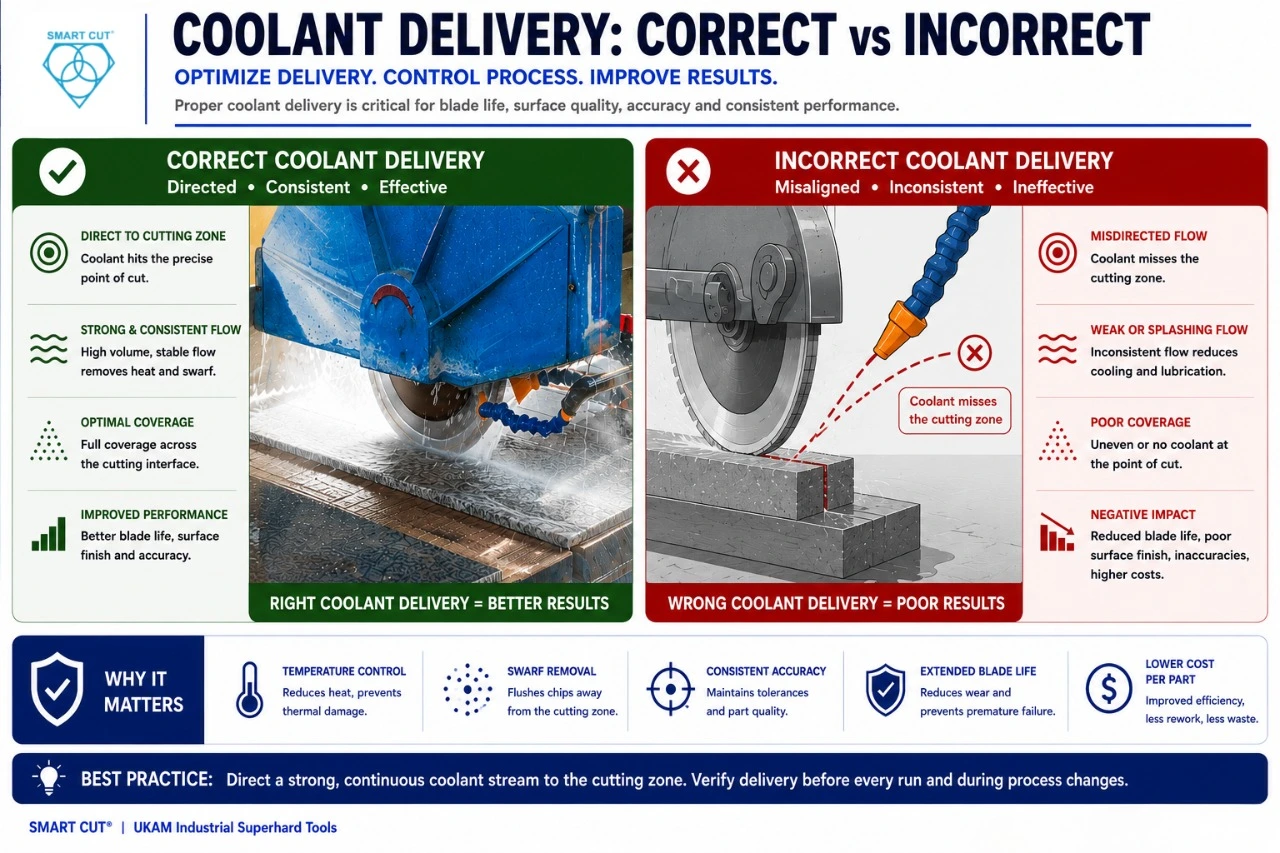
The review confirmed that the blade specification was appropriate for the application. However, inspection of the cutting system revealed that coolant delivery was no longer directed at the cutting interface because the nozzle position had gradually shifted during routine maintenance. Reduced coolant coverage resulted in increased cutting temperatures and less efficient debris removal, both of which contributed to edge chipping and accelerated blade wear.
After restoring proper coolant alignment and repeating the qualification process under controlled operating conditions, the cutting process returned to stable operation using the original blade specification. No blade redesign was required.
Engineering Lessons Learned
This example illustrates several important principles of process qualification.
- The apparent problem is not always the root cause. >A blade that appears to be underperforming may actually be affected by machine condition, coolant delivery, workholding, or operating parameters.
- Documenting the existing process before making changes reduces unnecessary experimentation. Establishing a baseline allows engineers to compare process conditions objectively instead of relying on assumptions.
- Changing one variable at a time makes troubleshooting significantly more effective. When multiple variables are changed simultaneously, it becomes difficult to determine which adjustment influenced the outcome.
- The entire cutting system should be evaluated before changing the blade specification. In many applications, correcting a process-related issue restores cutting performance without requiring new tooling.
This systematic approach helps manufacturers reduce unnecessary blade replacement, minimize production interruptions, improve process consistency, and make engineering decisions based on documented evidence rather than trial and error.
Related UKAM Technical Resources
Readers interested in improving diamond cutting operations should also review these UKAM technical resources:
- Diamond Cut Off Blades
- Precision Diamond Blades
- Resin Bond Diamond Blades
- Metal Bond Diamond Blades
- Diamond Mesh Size Guide
- Diamond Concentration Guide
- Diamond Tool Coolants
- Selecting the Correct Diamond Bond Type
- Precision Cutting of Advanced Materials
- Metallographic Sectioning
- Semiconductor Wafer Dicing
Trusted by Tens of Thousands of Manufacturers, Laboratories,
Research Institutions Worldwide Since 1990
American Based Manufacturer
Established in 1990
Custom manufacturing
RELATED ARTICLES