



















How to Switch Superabrasive Grinding Wheel Suppliers Without Disrupting Your Production

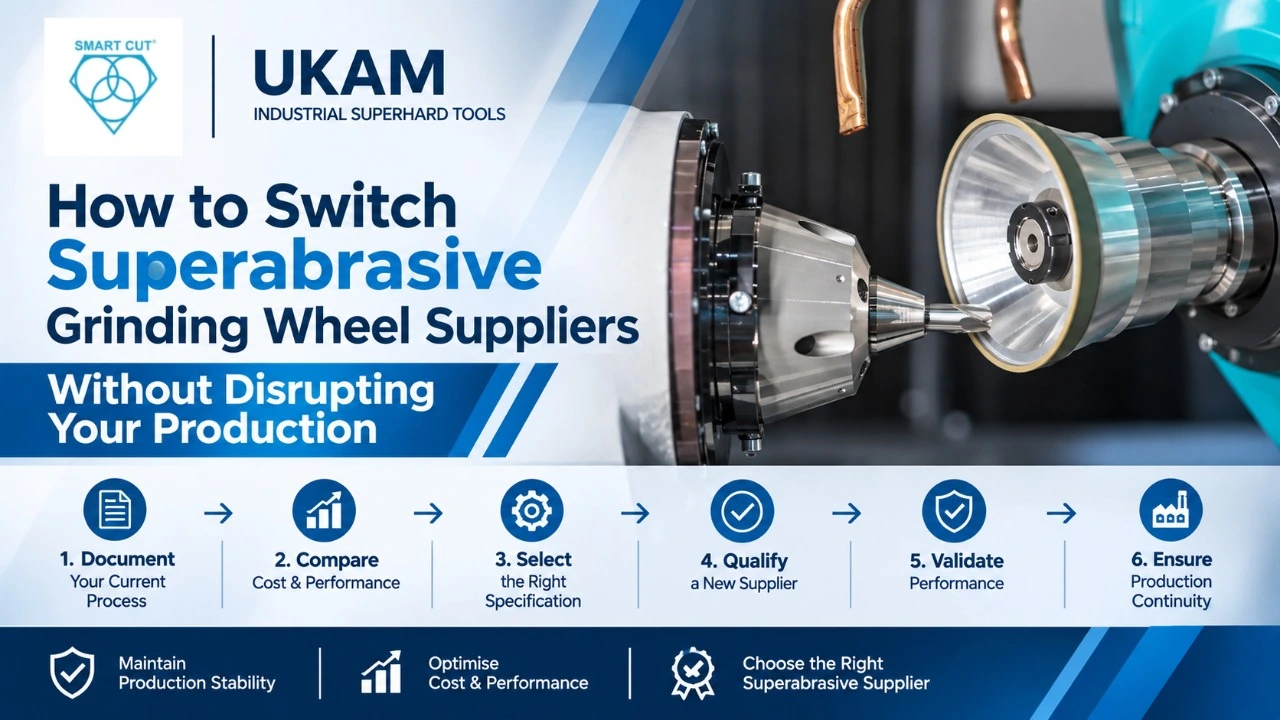
Table of Contents
Toggle
American Based Manufacturer

Established in 1990


Custom manufacturing


Changing superabrasive grinding wheel suppliers can introduce production risks that extend beyond the purchase price of a replacement wheel. Differences in abrasive concentration, grit size, bond composition, wheel geometry, dimensional accuracy, and manufacturing consistency can affect surface finish, dimensional control, cycle time, dressing frequency, and wheel life.
For manufacturing engineers, the objective is not simply to find another supplier offering a similar wheel specification. It is to qualify an alternative wheel against established production requirements without introducing uncontrolled process variation.
A controlled supplier transition requires documented baseline performance, specification verification, application testing, and production approval. The existing supplier should remain available until the alternative wheel has demonstrated acceptable performance under representative operating conditions.
This article presents a practical qualification method for evaluating alternative diamond and CBN grinding wheel suppliers while maintaining production continuity.
1. Why Manufacturers Consider Changing Grinding Wheel Suppliers
A supplier change is usually considered when an existing wheel no longer meets production, quality, delivery, or cost requirements. However, the underlying problem should be identified before selecting a replacement.
A wheel that produces inconsistent results may indicate a specification mismatch, an unsuitable bond, incorrect dressing conditions, machine limitations, or variation between manufacturing batches.
|
Supplier or production issue |
Engineering concern |
What should be investigated |
|---|---|---|
|
Unplanned replacement and production interruptions |
Abrasive retention, bond condition, operating parameters, and batch consistency |
|
|
Additional finishing or rejected components |
Grit size, wheel condition, dressing, and grinding parameters |
|
|
High grinding forces |
Heat generation and dimensional variation |
Heat generation and dimensional variation |
|
Lost production time and increased operating cost |
Bond wear, dressing method, and wheel specification |
|
|
Production scheduling and inventory risk |
Manufacturing lead time, stock availability, and supplier capacity |
|
|
Limited customisation |
Difficulty maintaining application requirements |
Available dimensions, bonds, grit sizes, and custom manufacturing capability |
|
Rising cost per component |
Reduced manufacturing efficiency |
Wheel consumption, cycle time, dressing, scrap, and replacement costs |
Before changing suppliers, engineers should distinguish between a supplier performance problem and a process problem. Replacing a wheel without investigating the original cause can reproduce the same failure with a different manufacturer.
2. Document the Existing Grinding Wheel and Production Process
The existing wheel should be treated as the reference specification during supplier evaluation. A replacement should not be approved solely because its catalogue description appears similar.
Record the physical wheel specification and actual operating conditions before requesting quotations.
Wheel specification baseline
|
Parameter |
Information to record |
|---|---|
|
Abrasive type |
Diamond or CBN |
|
Abrasive grit size |
Current grit designation and applicable standard |
|
Abrasive concentration |
Manufacturer's stated concentration |
|
Bond type |
Resin, metal, electroplated, hybrid, vitrified, or other specified bond |
|
Wheel dimensions |
Outside diameter, thickness, and bore |
|
Wheel profile |
Straight, recessed, cup, dish, or application-specific profile |
|
Maximum operating speed |
Manufacturer's marked maximum RPM |
|
Wheel construction |
Single-layer or multi-layer, where applicable |
|
Mounting arrangement |
Flange, arbor, hub, or other mounting configuration |
|
Manufacturing details |
Supplier, part number, batch, and revision |
Production process baseline
|
Process variable |
Required production record |
|---|---|
|
Workpiece material |
Grade, hardness, and material condition |
|
Machine |
Equipment model and spindle configuration |
|
Spindle speed |
Actual operating RPM |
|
Feed rate |
Machine feed setting and actual feed behaviour |
|
Depth of cut |
Radial or axial engagement, as applicable |
|
Coolant |
Type, concentration, flow, and delivery method |
|
Dressing |
Method, frequency, and dressing parameters |
|
Surface finish |
Required and measured Ra or other relevant parameter |
|
Dimensional accuracy |
Tolerances and actual measurement results |
|
Wheel life |
Parts or operating hours per wheel |
|
Cycle time |
Actual grinding time per acceptable component |
Record the measurement method and inspection equipment used. A surface finish result obtained with a different measurement setup may not be directly comparable.
This baseline allows engineers to evaluate whether a new wheel maintains the existing process capability or requires a controlled adjustment.
3. Compare Suppliers Using Cost Per Acceptable Part
The lowest wheel purchase price does not necessarily produce the lowest manufacturing cost.
A replacement wheel may cost more but deliver longer usable life, lower dressing frequency, shorter cycle time, or fewer rejected components. These differences should be evaluated using the cost per acceptable part.
The following example uses illustrative figures to demonstrate the calculation. These are not actual UKAM or supplier performance results.
Illustrative supplier comparison
Assume a production requirement of 1,000 acceptable components.
|
Cost parameter |
Supplier A |
Supplier B |
|---|---|---|
|
Wheel purchase price |
$160 |
$210 |
|
Attempted components per wheel |
250 |
400 |
|
Rejection rate |
4% |
1% |
|
Attempted components required |
1,042 |
1,011 |
|
Estimated wheels required |
5 |
3 |
|
Total wheel purchase cost |
$800 |
$630 |
|
Dressing interval |
100 components |
200 components |
|
Estimated dressing operations |
10 |
5 |
|
Cost per dressing operation |
$8 |
$8 |
|
Total dressing cost |
$80 |
$40 |
|
Grinding cycle time |
3.0 minutes |
2.6 minutes |
|
Machine hourly rate |
$60 |
$60 |
|
Estimated grinding machine cost |
$3,126 |
$2,628.60 |
|
Rejected components |
42 |
11 |
|
Scrap cost per rejected component |
$5 |
$5 |
|
Total scrap cost |
$210 |
$55 |
|
Total estimated cost |
$4,216 |
$3,353.60 |
|
Cost per acceptable component |
$4.22 |
$3.35 |
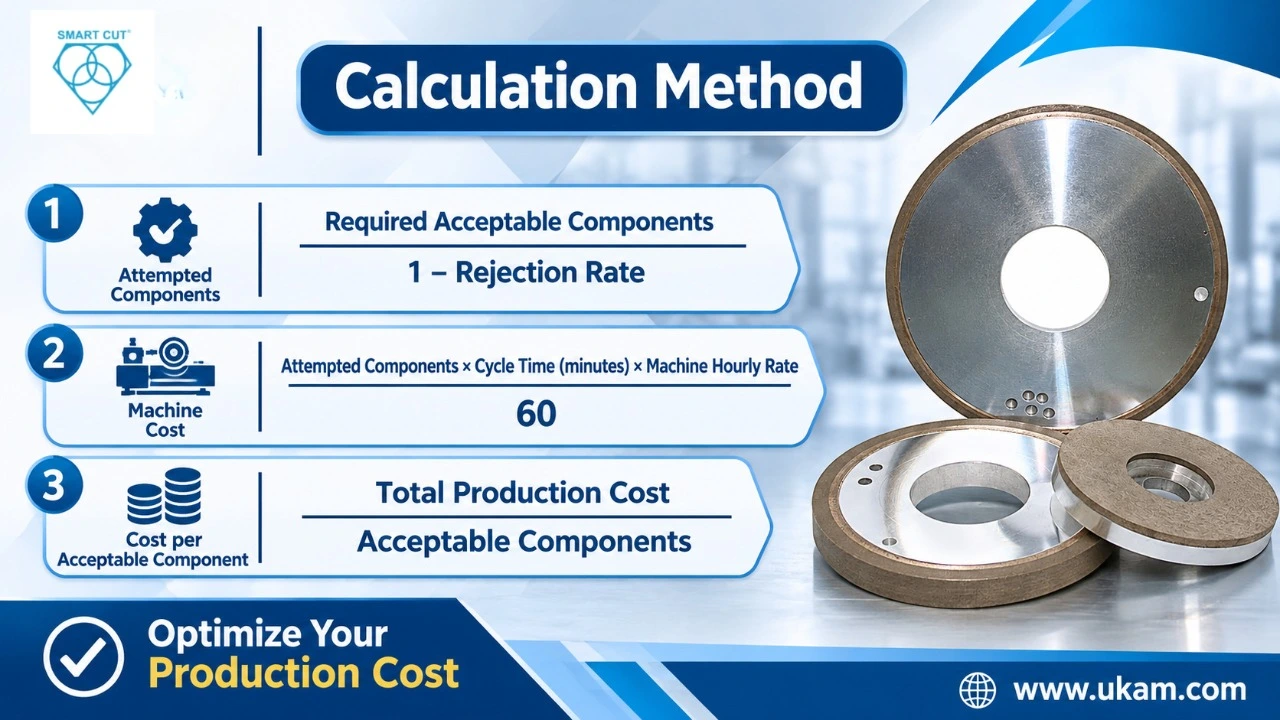
Calculation method
The estimated number of attempted components is calculated as:
Attempted components = Required acceptable components ÷ (1 − rejection rate)
Machine cost is calculated as:
Machine cost = Attempted components × Cycle time in minutes × Machine hourly rate ÷ 60
Cost per acceptable component is calculated as:
Cost per acceptable component = Total production cost ÷ Acceptable components
In this example, Supplier B has a higher purchase price per wheel but a lower estimated total production cost.
The comparison is only valid if the two suppliers’ wheels meet the same dimensional, surface finish, and quality requirements. The model also assumes the stated wheel life and dressing intervals are achieved during production. Actual qualification trials must replace these illustrative assumptions with measured results.
4. Select the Correct Abrasive and Bond Specification
A supplier change should not be treated as a direct substitution unless the replacement wheel has the correct abrasive and bond characteristics for the application.
Diamond and cubic boron nitride (CBN) are both superabrasives, but they are not interchangeable across all workpiece materials.
Diamond versus CBN grinding wheels
|
Selection factor |
Diamond grinding wheel |
CBN grinding wheel |
|---|---|---|
|
Typical applications |
Ceramics, glass, carbide, sapphire, and other hard nonferrous materials |
Hardened steels, tool steels, high-speed steels, and selected ferrous alloys |
|
Abrasive characteristics |
Very high hardness and effective cutting of many hard, brittle, and nonferrous materials |
High hardness and thermal stability suited to many hardened ferrous grinding applications |
|
Material compatibility |
Generally unsuitable for conventional grinding of ferrous materials at elevated temperatures because of chemical interaction between diamond and iron |
Generally preferred for hardened ferrous materials |
|
Key selection considerations |
Workpiece chemistry, brittleness, grit size, bond, coolant, and grinding temperature |
Workpiece hardness, steel composition, heat generation, bond, grit size, and grinding conditions |
The selection should be based on workpiece chemistry and actual grinding conditions, not hardness alone. Diamond is commonly selected for hard nonferrous materials and ceramics, while CBN is generally preferred for hardened ferrous materials.
Bond selection considerations
The bond controls abrasive retention, wheel wear behaviour, profile retention, and dressing requirements.
|
Bond type |
General characteristics |
Engineering considerations |
|---|---|---|
|
Resin bond |
Commonly selected where controlled wheel wear and surface finish are required |
Consider heat generation, bond wear, and dressing requirements |
|
Sintered metal bond |
Metal matrix provides abrasive retention and supports applications requiring wear resistance |
Consider grinding forces, wheel loading, and dressing capability |
|
Electroplated bond |
Abrasive grains are retained in an electrodeposited metal layer, commonly as a single abrasive layer |
Wheel profile and abrasive exposure are important; conventional dressing is generally not applicable |
|
Hybrid bond |
Combines characteristics of different bond systems |
Confirm the specific construction and intended application |
|
Vitrified bond |
Rigid bond structure with a porous construction depending on formulation |
Consider coolant access, wheel structure, dressing, and thermal conditions |
|
Abrasive is metallurgically attached to the supporting body |
Consider abrasive exposure, wheel geometry, and application-specific construction |
The replacement specification should identify the abrasive type, grit size, concentration, bond, dimensions, profile, and operating limits. A supplier should explain any proposed specification change and its expected effect on the grinding process.
5. A Controlled Process for Qualifying a New Supplier
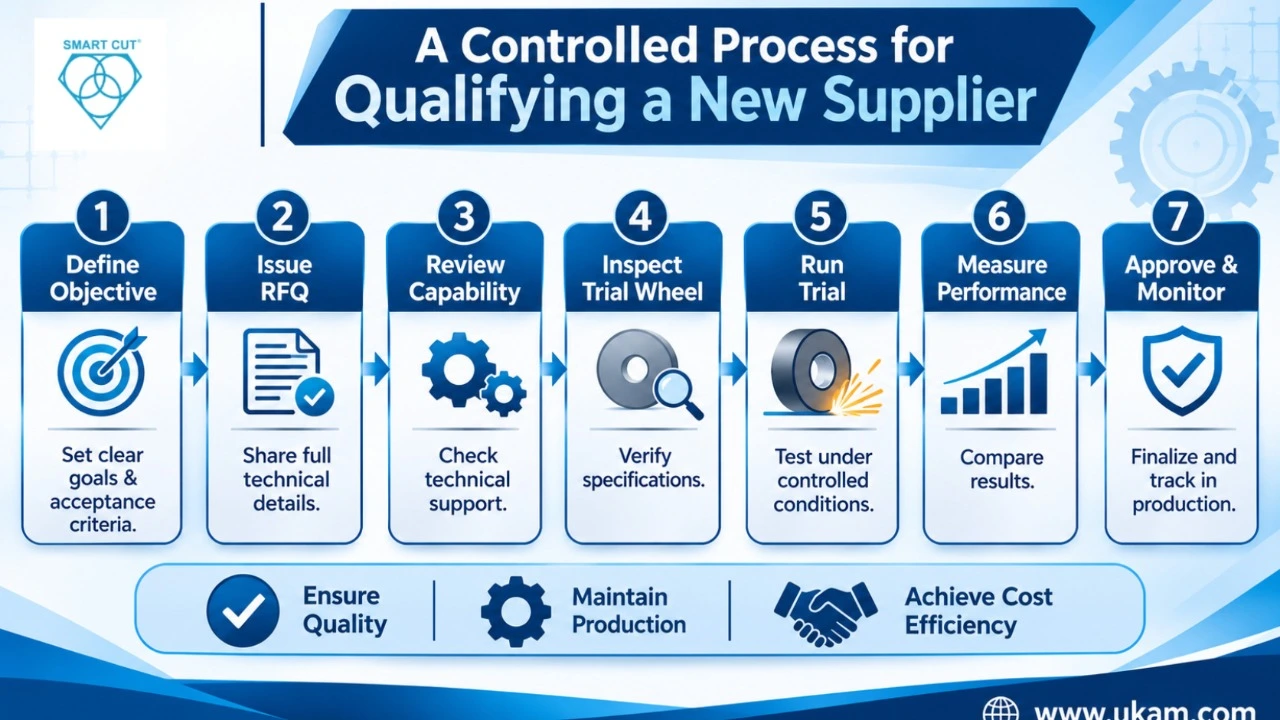
A supplier transition should follow defined qualification stages. The incumbent wheel should remain in production until the alternative has passed the agreed evaluation criteria.
Phase 1: Define the qualification objective
Identify the reason for changing suppliers. The objective may involve reducing wheel cost, improving surface finish, increasing wheel life, reducing dressing frequency, or improving delivery reliability.
Define measurable acceptance criteria before requesting samples.
Phase 2: Issue a complete technical RFQ
Provide the candidate supplier with the current wheel specification, machine information, workpiece material, operating conditions, and required production results.
Ask the supplier to identify any proposed differences rather than silently substituting an alternative specification.
Phase 3: Review technical capability
Evaluate whether the supplier can manufacture the required abrasive, grit, concentration, bond, dimensions, and profile.
Request technical documentation covering maximum operating speed, wheel construction, dimensional tolerances, batch identification, and applicable inspection records.
Phase 4: Inspect the trial wheel
Before installation, inspect the delivered wheel against the approved drawing and purchase specification.
Check outside diameter, thickness, bore, profile, identification, mounting compatibility, and marked operating limits. Verify wheel condition and balance requirements in accordance with the wheel and machine manufacturer’s instructions.
Do not install a wheel with damaged packaging, visible defects, incorrect dimensions, or uncertain identification.
Phase 5: Conduct a controlled grinding trial
Use an allocated machine or planned trial window. Maintain the original production wheel as the reference.
Where possible, keep workpiece material, machine, coolant, inspection method, and operating conditions consistent. If parameters need to change, document each change and its reason.
Do not exceed the wheel manufacturer’s marked maximum operating speed or the machine’s permitted operating limits.
Phase 6: Measure performance
Evaluate the replacement wheel against the agreed criteria.
Record wheel wear, dressing frequency, cycle time, surface finish, dimensional accuracy, grinding forces where measured, rejection rate, and cost per acceptable component.
A short trial may confirm initial cutting behaviour, but it may not establish full wheel life. Longer production validation may be required.
Phase 7: Approve and monitor production
Approve the alternative only after the relevant engineering and quality requirements have been met.
Record the approved specification, supplier, part number, batch, process settings, and inspection results. Monitor the first production batches to identify differences that may not have appeared during the initial trial.
6. Material-Specific Considerations During Supplier Qualification
The same wheel specification should not automatically be transferred between different workpiece materials. Material properties, grinding temperature, brittleness, and required surface integrity affect wheel selection.
|
Workpiece material |
Typical grinding concern |
What to evaluate during qualification |
|---|---|---|
|
Silicon carbide |
High hardness and brittle fracture |
Diamond abrasive suitability, grit size, bond retention, edge damage, and surface finish |
|
Chipping and subsurface damage |
Abrasive size, bond behaviour, feed conditions, and dimensional consistency |
|
|
Silicon nitride |
High hardness and demanding surface integrity requirements |
Wheel wear, grinding forces, thermal effects, and surface damage |
|
High hardness and possible edge chipping |
Diamond wheel specification, bond, concentration, and profile retention |
|
|
Surface damage and edge chipping |
Diamond grit, wheel condition, coolant, and dimensional control |
|
|
Brittle fracture and microcracking |
Diamond abrasive, cutting conditions, coolant delivery, and inspection method |
|
|
Fragile semiconductor material and edge damage |
Wheel specification, low-damage process conditions, and inspection requirements |
|
|
Abrasive wear and material-specific grinding behaviour |
Appropriate abrasive, wheel bond, thermal conditions, and wheel geometry |
|
|
Hardened tool steel and high-speed steel |
Heat generation and grinding burn |
CBN suitability, wheel structure, coolant, dressing, and thermal control |
For ceramic, glass, carbide, sapphire, and many semiconductor materials, diamond is generally the starting abrasive for evaluation. For hardened steel and many ferrous grinding applications, CBN is generally preferred.
PCD and PCBN require separate evaluation because their composition and grinding behaviour differ from conventional carbide and steel. The supplier should confirm abrasive suitability for the specific grade and operation.
7. Questions to Ask a Potential Grinding Wheel Supplier
A supplier’s ability to provide a wheel is only one part of qualification. Engineers should also evaluate specification control, manufacturing consistency, technical support, and traceability.
|
Supplier question |
What a technically useful answer should establish |
|---|---|
|
Can you manufacture the existing wheel dimensions and profile? |
Capability to meet the drawing and dimensional tolerances |
|
Which abrasive and bond do you recommend for this material? |
A reasoned selection based on workpiece material and grinding conditions |
|
Can you provide alternative grit sizes or concentrations? |
Ability to evaluate controlled specification changes |
|
What is the maximum operating speed? |
A clearly documented speed limit for the supplied wheel |
|
What dressing method is required? |
Compatibility with the customer's dressing equipment and process |
|
Can you provide inspection and batch records? |
Traceability and manufacturing quality controls |
|
Can you manufacture custom wheel specifications? |
Capability to meet nonstandard dimensions and application requirements |
|
What information do you need for technical evaluation? |
A structured RFQ and application review process |
|
What is the expected manufacturing lead time? |
Production planning and supply continuity information |
|
How are specification changes controlled? |
Revision management and consistency between repeat orders |
A technically capable supplier should be able to explain why a particular wheel specification is recommended and what information supports that recommendation. General claims about longer wheel life or faster grinding are not sufficient without application-specific test results.
8. Comparing UKAM Superabrasive Wheel Options
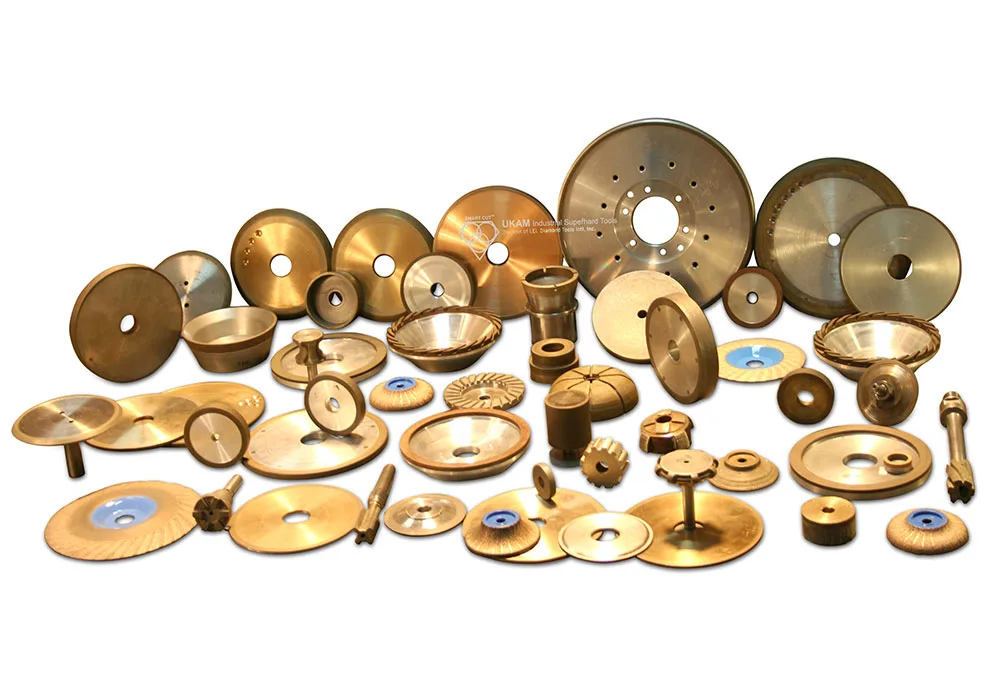
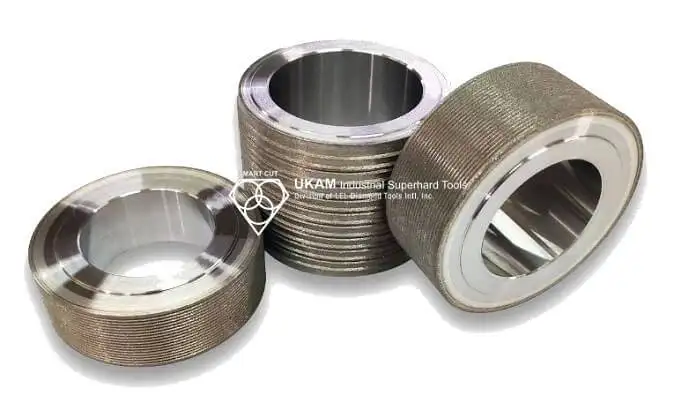
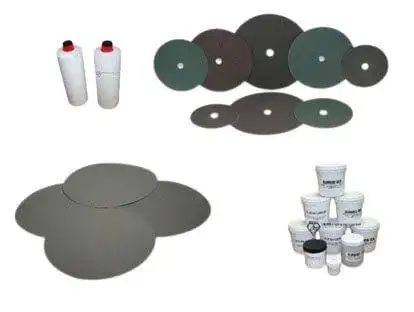
UKAM Industrial Superhard Tools offers diamond and CBN grinding wheel configurations in different bond systems and specifications. Engineers evaluating an alternative supplier can compare the available construction options against their existing application requirements.
The following table describes general bond characteristics. It is not a ranking of performance, and the suitability of each option depends on the workpiece, machine, grinding operation, and required finish.
|
UKAM wheel option |
General construction or characteristic |
Application evaluation |
|---|---|---|
|
Resin bond diamond and CBN |
Resin-based bond system |
Evaluate for applications requiring controlled grinding behaviour and surface finish |
|
Sintered metal bond |
Abrasive retained in a sintered metal matrix |
Evaluate where bond wear, abrasive retention, and profile requirements are important |
|
Electroplated diamond and CBN |
Abrasive retained in an electrodeposited metal layer |
Evaluate for defined profiles and applications where single-layer abrasive construction is suitable |
|
Hybrid bond |
Combines characteristics of different bond systems |
Review the specific formulation and intended operating conditions |
|
Vitrified bond |
Vitrified bond structure with application-dependent porosity |
Evaluate dressing, coolant access, wheel structure, and grinding temperature |
|
Brazed bond |
Abrasive attached to the supporting body through a brazed interface |
Evaluate abrasive exposure, geometry, and the requirements of the grinding operation |
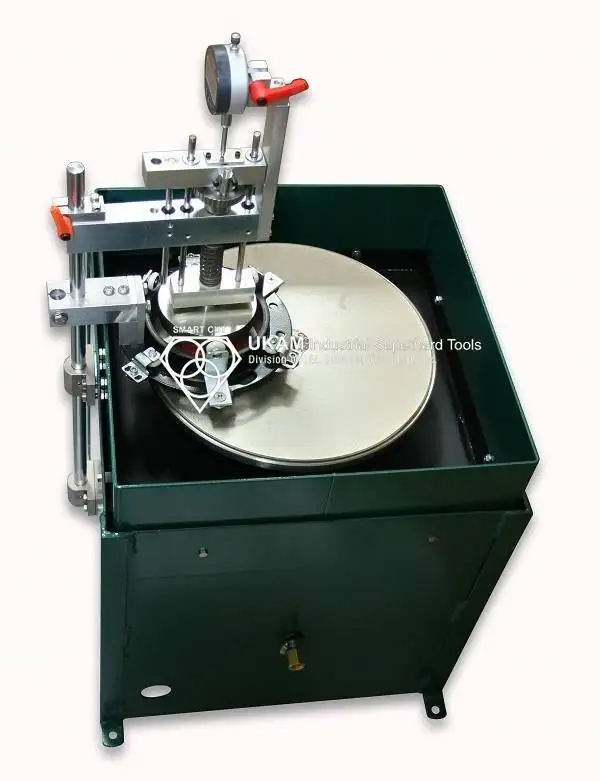
UKAM’s SMART CUT product range includes diamond and CBN grinding wheel configurations. Selection should be based on the required abrasive, bond, grit size, concentration, wheel geometry, and operating conditions.
For an engineering evaluation, provide the current wheel drawing or specification together with the workpiece material, machine details, and production requirements. This gives the manufacturer a technical basis for reviewing a replacement configuration.
9. Supplier Qualification Checklist
Before approving a new supplier, complete the following checks.
Technical specification
- Abrasive type confirmed for the workpiece material.
- Grit size and concentration documented.
- Bond type and wheel construction confirmed.
- Wheel dimensions and profile match the approved drawing.
- Maximum operating speed is documented.
- Mounting and machine compatibility verified.
Process qualification
- Baseline production results recorded.
- Trial conditions documented.
- Coolant and dressing requirements reviewed.
- Surface finish meets the specified requirement.
- Dimensional accuracy meets tolerance.
- Wheel wear and dressing frequency measured.
- Cycle time and rejection rate evaluated.
Commercial and supply qualification
- Cost per acceptable component calculated.
- Manufacturing lead time reviewed.
- Batch identification and traceability confirmed.
- Inspection documentation reviewed.
- Repeat-order specification and revision control established.
- Production approval recorded by the responsible team.
A supplier should be approved only when the technical, quality, and commercial requirements have been satisfied.
Frequently Asked Questions About Diamond and CBN Grinding Wheels
A manufacturer should consider a supplier change when documented production results show recurring problems with wheel consistency, delivery reliability, technical support, or total grinding cost. Before changing suppliers, engineers should investigate whether the problem originates from the wheel specification, machine condition, dressing process, coolant delivery, or operating parameters.
A replacement can use the same nominal specification, but this does not automatically guarantee equivalent performance. Differences in abrasive characteristics, bond formulation, manufacturing tolerances, concentration, and wheel construction can influence grinding behaviour. A controlled trial is required to establish whether the replacement performs acceptably.
Engineers should first establish whether the abrasive is appropriate for the workpiece material. Diamond is generally used for ceramics, glass, carbide, and many hard nonferrous materials. CBN is generally preferred for hardened ferrous materials. Suppliers should then be compared on grit size, concentration, bond, wheel dimensions, manufacturing consistency, technical documentation, and measured production results.
The duration depends on the production application and the performance characteristics being evaluated. A short trial may establish initial cutting behaviour, surface finish, and dimensional accuracy. Wheel life, dressing frequency, batch consistency, and long-term production stability require sufficient operating time and representative production quantities. Approval should be based on agreed acceptance criteria rather than an arbitrary trial duration.
An RFQ should include the abrasive type, grit size, concentration, bond, wheel dimensions, profile, maximum operating speed, workpiece material, machine details, grinding parameters, coolant conditions, dressing method, surface finish, and dimensional requirements. Drawings, photographs of the existing wheel, and production performance records can help the supplier evaluate the application accurately.
Maintain the existing approved wheel as the production reference while qualifying the alternative. Use a controlled trial, document specification differences, inspect the incoming wheel, measure performance against defined criteria, and obtain engineering and quality approval before full implementation. Monitor initial production batches after approval to identify variation that may not appear during the trial.
11. Engineering Principles for a Controlled Supplier Transition
A successful supplier transition depends on measured production performance rather than catalogue comparisons or purchase price alone.
The main principles are:
- Document the existing wheel specification and production process before requesting alternatives.
- Select diamond or CBN based on workpiece chemistry and grinding conditions.
- Evaluate bond, grit size, concentration, and wheel geometry as a complete specification.
- Compare suppliers using cost per acceptable component.
- Keep the existing production wheel available during qualification.
- Conduct controlled trials under representative operating conditions.
- Approve the replacement only after technical and quality requirements are met.
- Monitor repeat-order consistency and initial production batches.
Evaluate a Superabrasive Grinding Wheel Specification with UKAM
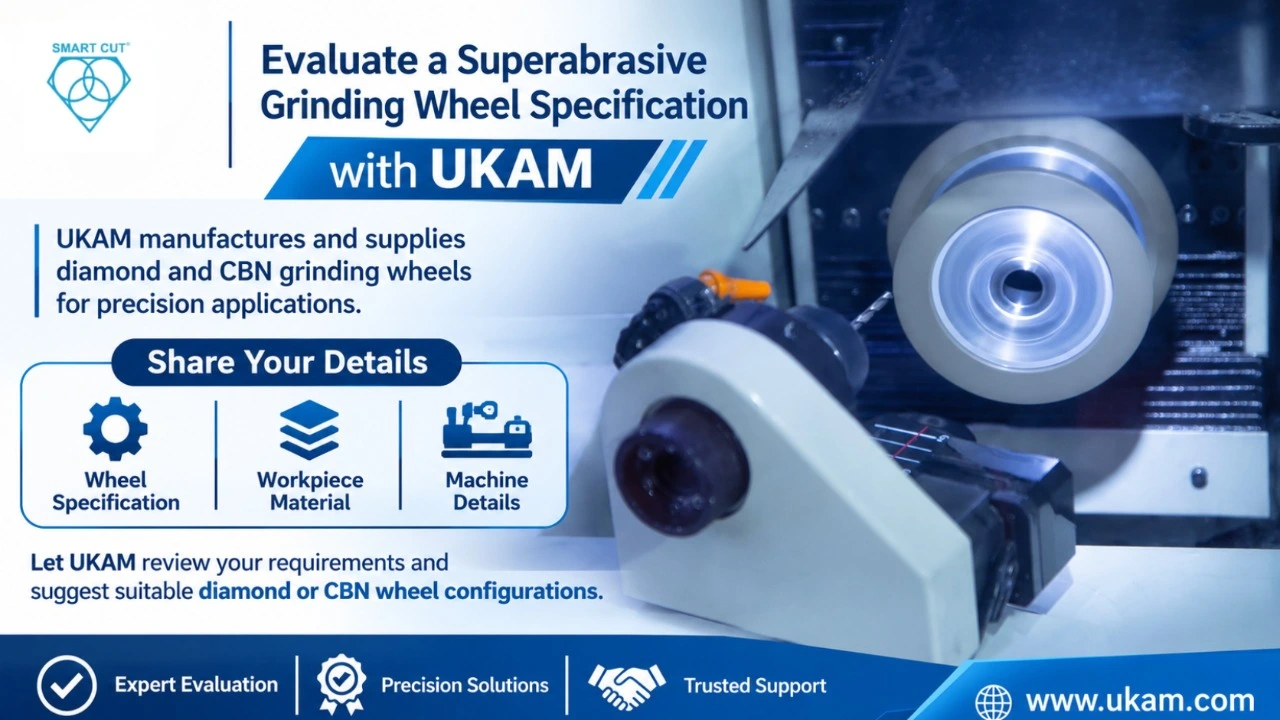
UKAM Industrial Superhard Tools manufactures and supplies diamond and CBN grinding wheel configurations for precision grinding applications. Available options include different bond systems, wheel dimensions, and custom specifications.
If you are evaluating an alternative grinding wheel supplier, provide your current wheel specification, workpiece material, machine details, and production requirements. UKAM can review these details to help identify suitable diamond or CBN wheel configurations for application evaluation.
Contact UKAM Industrial Superhard Tools to discuss your grinding wheel requirements and request a technical review.
Trusted by Tens of Thousands of Manufacturers, Laboratories,
Research Institutions Worldwide Since 1990
American Based Manufacturer
Established in 1990
