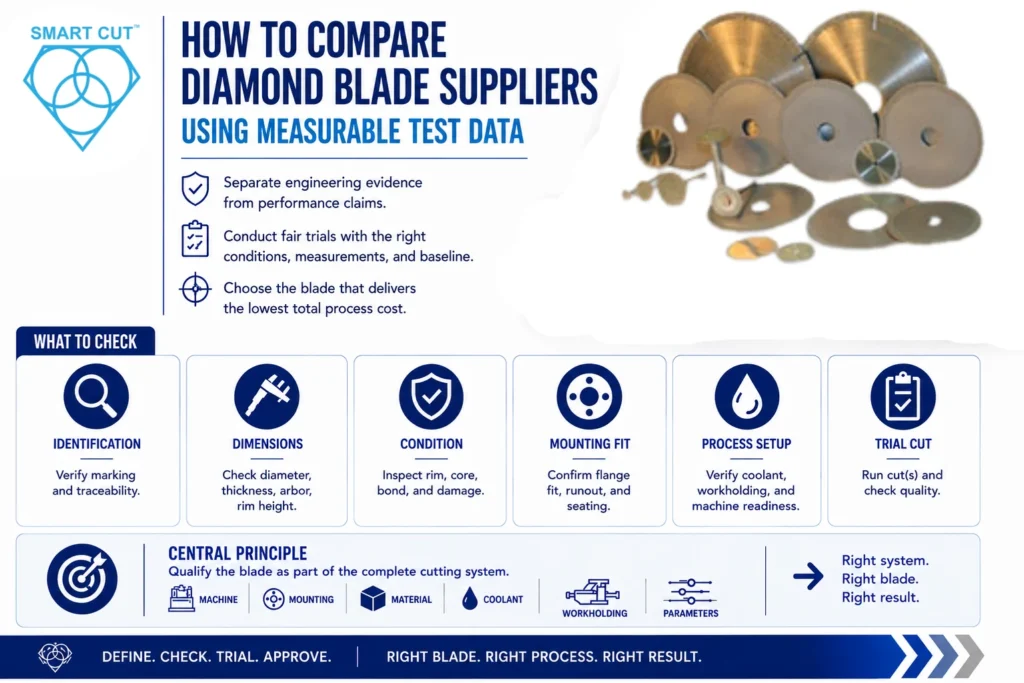










How to Compare Diamond Blade Suppliers Using Measurable Test Data
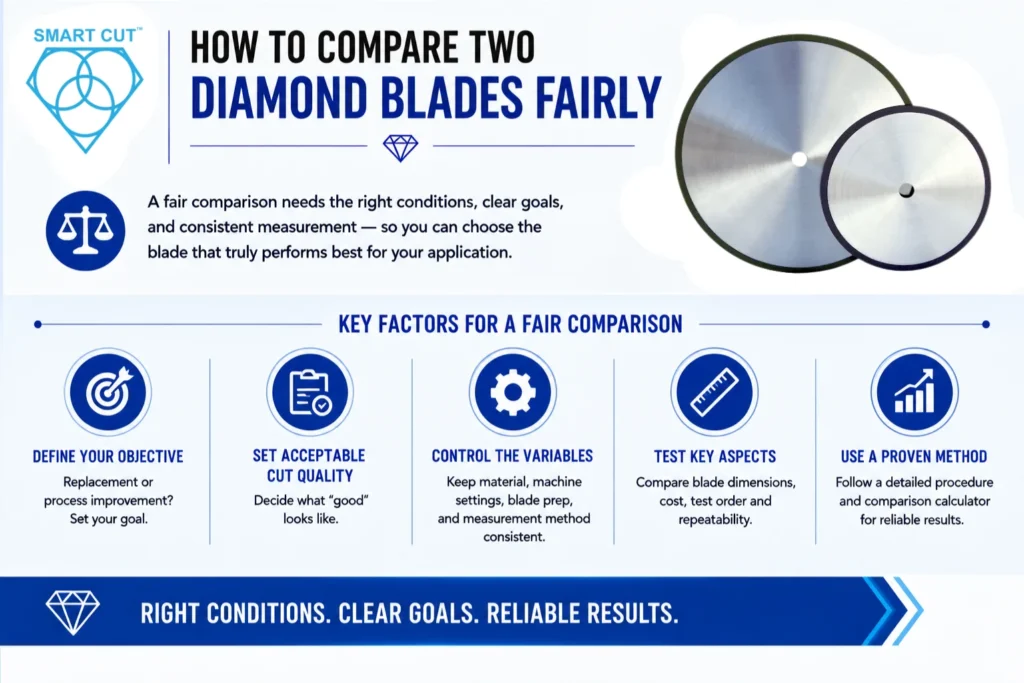
A practical method for separating useful engineering evidence from general performance claims, conducting fair trials, and selecting the blade that delivers the lowest total process cost.
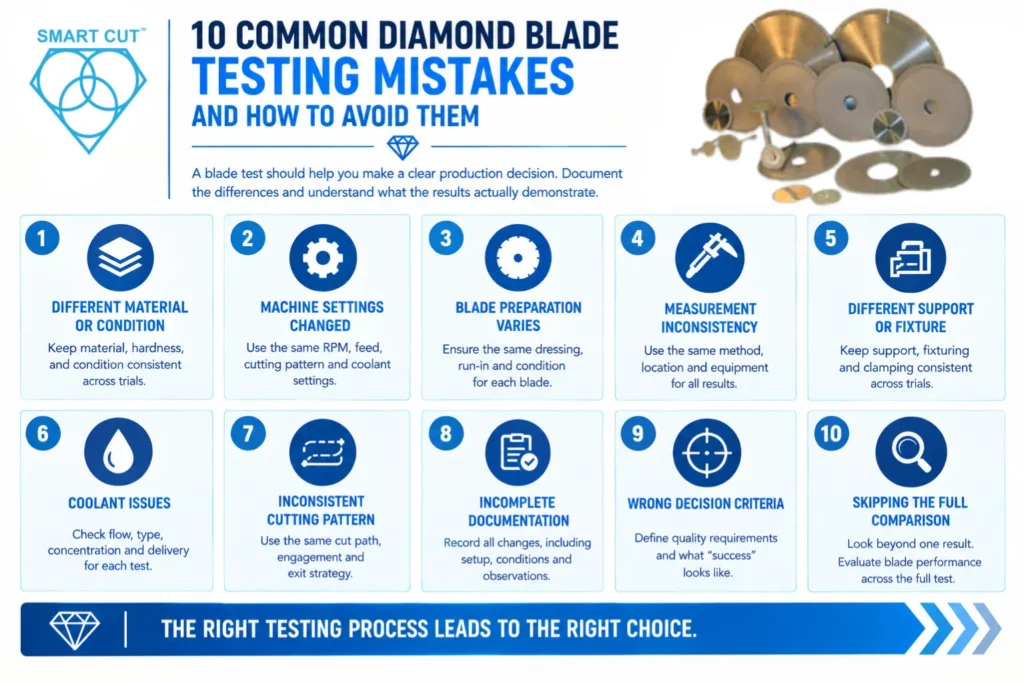
When comparing diamond blade suppliers, statements such as “longer blade life,” “faster cutting,” “less chipping,” or “superior performance” are not enough to support a reliable purchasing decision.
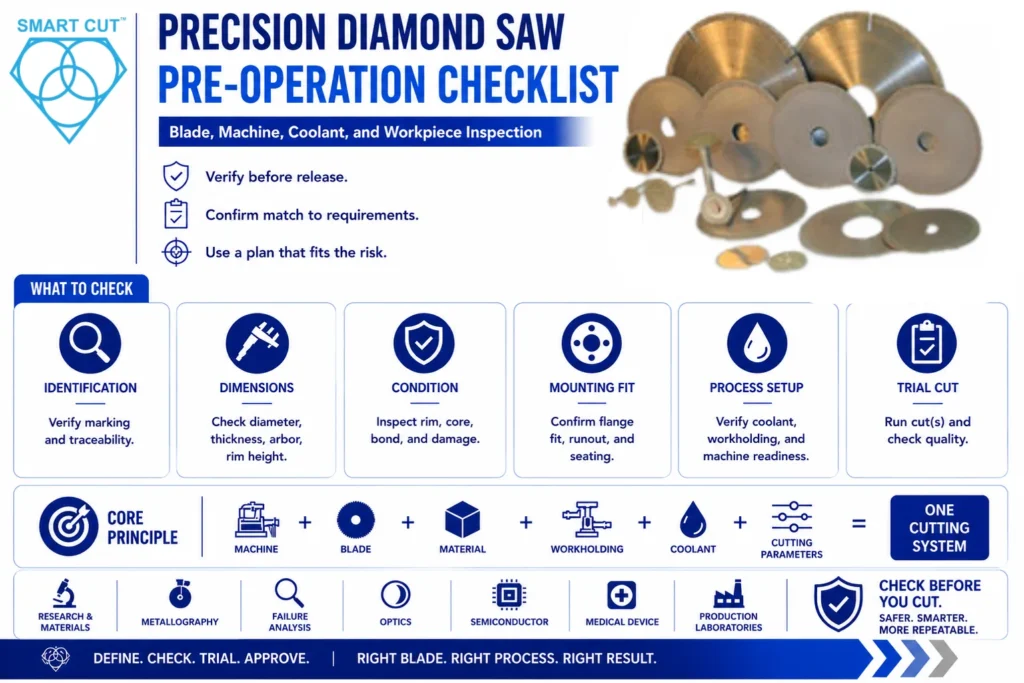
Precision Diamond Saw Pre-Operation Checklist
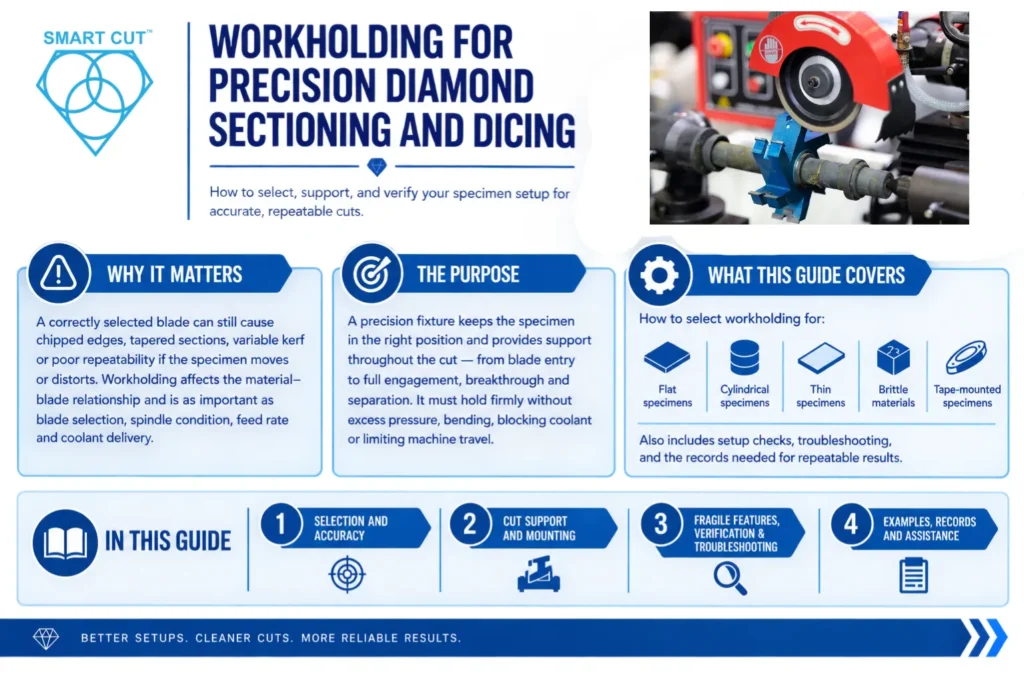
Precision diamond sawing is often treated as a straightforward sample-preparation operation: select a blade, mount the specimen, make the cut, and continue to grinding or polishing.
Diamond Blade Cost per Cut: How to Calculate the True Cost per Good Part
A precision diamond blade does not operate independently of the cutting system around it. The blade is one component in a system that includes the machine, spindle, mounting hardware, workholding, material, cutting parameters, coolant, dressing condition, and the quality requirements of the application.
Incoming Diamond Blade Inspection and Trial-Cut Checklist
For new, changed, high-value, or process-critical applications, incoming verification and a controlled trial cut can reduce risk before a diamond blade is released for regular production. The goal is not to impose one universal test on every blade. The goal is to confirm that the received blade matches the approved requirements and that the complete cutting process can produce the required result under defined conditions.
A useful acceptance plan is proportional to risk. It may be limited to identification and dimensional checks for a stable, previously qualified process, or it may include a documented series of trial cuts for a new or demanding application. In either case, the plan should state what will be checked, how it will be measured, and who can approve the result.
Precision Diamond Saw SOP: A Practical Template for Materials and Research Laboratories
Precision diamond sawing is often treated as a straightforward sample-preparation operation: select a blade, mount the specimen, make the cut, and continue to grinding or polishing.
Why the Same Diamond Blade Performs Differently on Different Machines, Materials, and Applications
A precision diamond blade does not operate independently of the cutting system around it. The blade is one component in a system that includes the machine, spindle, mounting hardware, workholding, material, cutting parameters, coolant, dressing condition, and the quality requirements of the application.
How to Measure Precision Diamond Blade Cut Quality: Chipping, Kerf, Flatness, Subsurface Damage, and Material Loss
Selecting a precision diamond blade based solely on cutting speed, blade life, or purchase price rarely provides an accurate assessment of overall cutting performance.
Why Is My Precision Diamond Blade Failing? Root Causes of Chipping, Wandering, Glazing, Rapid Wear & Poor Cut Quality
Diamond crystal concentration is one of the most important and one of the most misunderstood specifications in diamond blade selection.
Many users assume that a blade with a higher diamond concentration will always cut faster, last longer, and produce superior results. In reality, concentration is only one component of an engineered cutting system, and increasing it without considering bond hardness, grit size, material properties, spindle speed, feed rate, coolant performance, and machine rigidity can reduce cutting efficiency rather than improve it.
How Thin Kerf Diamond Blades Improve Material Yield and Reduce Kerf Loss
In precision cutting operations, every micron of material matters.
Whether sectioning semiconductor wafers, sapphire substrates, technical ceramics, advanced composites, carbides, or high-value aerospace materials, the width of the cut, known as the kerf, directly impacts material yield, production costs, machining efficiency, and overall profitability.