





















Why Pay More for Metallography Consumables? How Laboratories Can Reduce Costs by Buying Manufacturer Direct

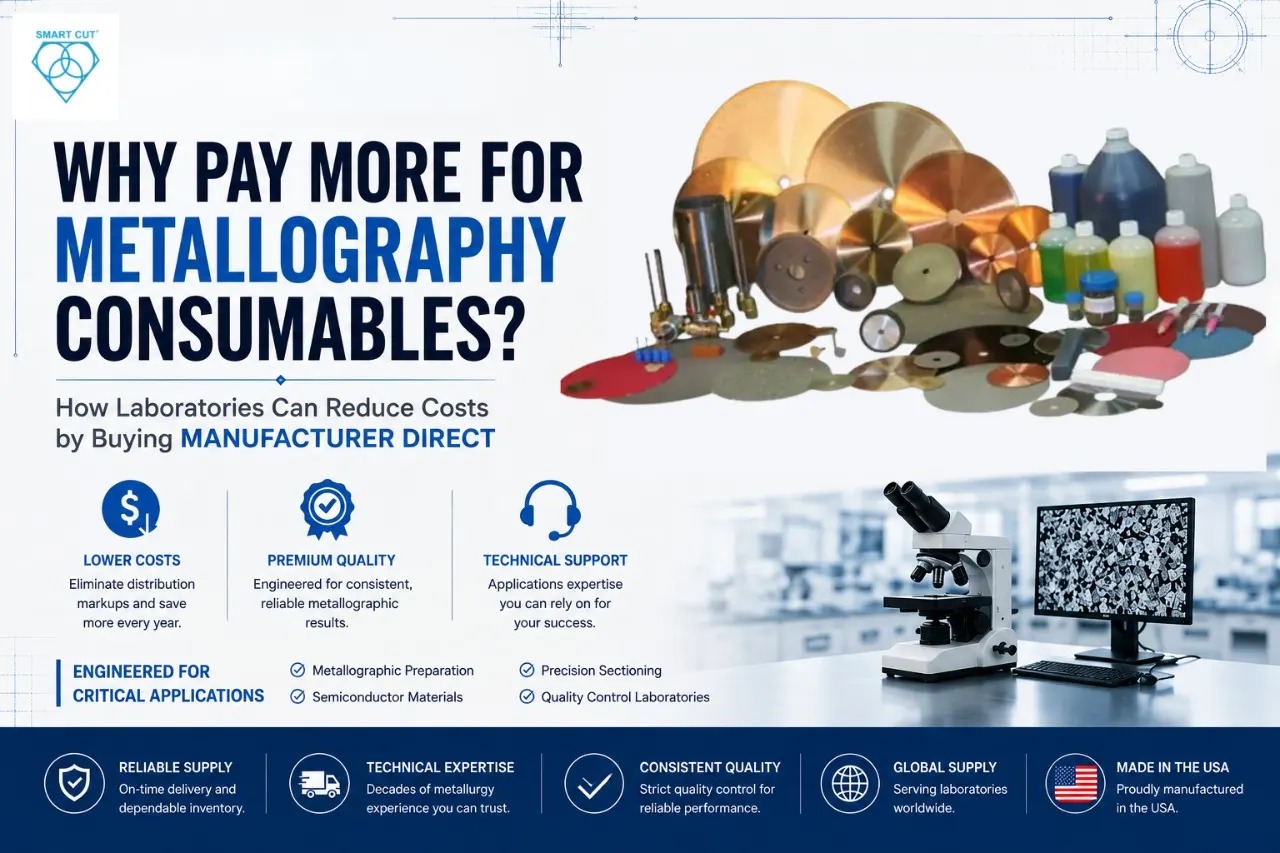
Table of Contents
Toggle
American Based Manufacturer

Established in 1990


Custom manufacturing


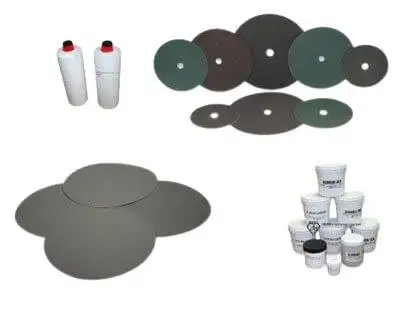
Metallography consumables represent a recurring operating expense for laboratories performing material testing, quality control, failure analysis, research, and production support. Diamond suspensions, polishing cloths, silicon carbide grinding paper, abrasive cut-off wheels, diamond & CBN wafering blades , and other preparation consumables must be replaced regularly, making them an ongoing part of laboratory operating costs.
Many laboratories continue purchasing the same consumables from the same suppliers year after year without comparing alternative sources. Purchasing decisions are often based on familiarity, historical use, existing procurement procedures, or established supplier relationships rather than evaluating current market options.
One factor that is frequently overlooked is the distribution model behind many metallography consumables. Products may pass through multiple intermediaries before reaching the end user, with each level of distribution adding costs that are ultimately reflected in the final purchase price.
Purchasing directly from the manufacturer can help reduce these additional costs while providing products designed for the same applications. Comparing equivalent consumables based on technical specifications rather than brand recognition alone may also help laboratories identify opportunities to reduce annual operating expenses.
For laboratories purchasing metallography consumables on a regular basis, even modest savings on individual products can translate into significant annual cost reductions.
Many laboratories continue purchasing the same consumables from the same suppliers year after year without comparing alternative sources. Purchasing decisions are often based on familiarity, historical use, existing procurement procedures, or established supplier relationships rather than evaluating current market options.
One factor that is frequently overlooked is the distribution model behind many metallography consumables. Products may pass through multiple intermediaries before reaching the end user, with each level of distribution adding costs that are ultimately reflected in the final purchase price.
Purchasing directly from the manufacturer can help reduce these additional costs while providing products designed for the same applications. Comparing equivalent consumables based on technical specifications rather than brand recognition alone may also help laboratories identify opportunities to reduce annual operating expenses.
For laboratories purchasing metallography consumables on a regular basis, even modest savings on individual products can translate into significant annual cost reductions
In this article:
- Why metallography consumables often cost more than expected
- How manufacturer-direct purchasing can reduce costs
- How to compare consumables correctly
- Factors to consider beyond purchase price
- How to evaluate potential replacement products
- Why many laboratories use cross-referencing before changing suppliers
Choosing the right diamond blade requires evaluating your material, machine setup, cutting parameters, and production requirements. If you’re experiencing premature blade wear, edge chipping, glazing, or inconsistent cutting performance, our application specialists can help identify the best blade specification for your process.
How Much Could Your Laboratory Be Overspending?
Many laboratories focus on the purchase price of individual consumables rather than the total amount spent over the course of a year. While the difference between two products may appear small on a single order, recurring purchases can significantly increase annual operating costs.
The amount a laboratory may be overspending depends on several factors, including:
- Product category
- Product specifications
- Package size
- Annual purchase volume
- Supplier pricing
- Shipping costs
- Purchase frequency
- Whether products are purchased through distributors or directly from the manufacturer
For example, if one consumable costs $25 more than a comparable manufacturer-direct alternative, the difference may seem insignificant. However, laboratories purchasing that product regularly throughout the year may spend hundreds or even thousands of dollars more on that single item alone.
When this comparison is extended across multiple consumables — including diamond suspensions, polishing cloths, grinding papers, abrasive cut-off wheels, diamond blades, lubricants, and diamond paste — the total annual difference can become substantial.
|
Annual Cost Model |
|
|---|---|
|
Branded Purchasing |
Higher due to distribution markups |
|
Manufacturer-Direct Purchasing |
Lower — costs reduced across the supply chain |
Why Compare Annual Consumable Costs?
Reviewing annual consumable spending provides a more accurate picture of operating costs than evaluating individual purchase orders.
Potential savings may allow laboratories to:
- Purchase additional equipment
- Increase research funding
- Improve laboratory capabilities
- Support equipment maintenance
- Expand testing capacity
- Invest in staff training
- Fund process improvements
Comparing annual purchasing costs also helps laboratories identify recurring expenses that may be reduced without compromising product performance or preparation quality.
FREE Technical Cross-Reference & Manufacturer-Direct Price Comparison →
Using Buehler®, Struers®, LECO®, Allied High Tech®, PRESI®, QATM®, Extec®, Pace Technologies®, or another manufacturer’s consumables? Submit your current part numbers to receive technically equivalent SMART CUT® recommendations, manufacturer-direct pricing, and potential cost-saving alternatives—all at no obligation.
Why Are Metallography Consumables So Expensive?
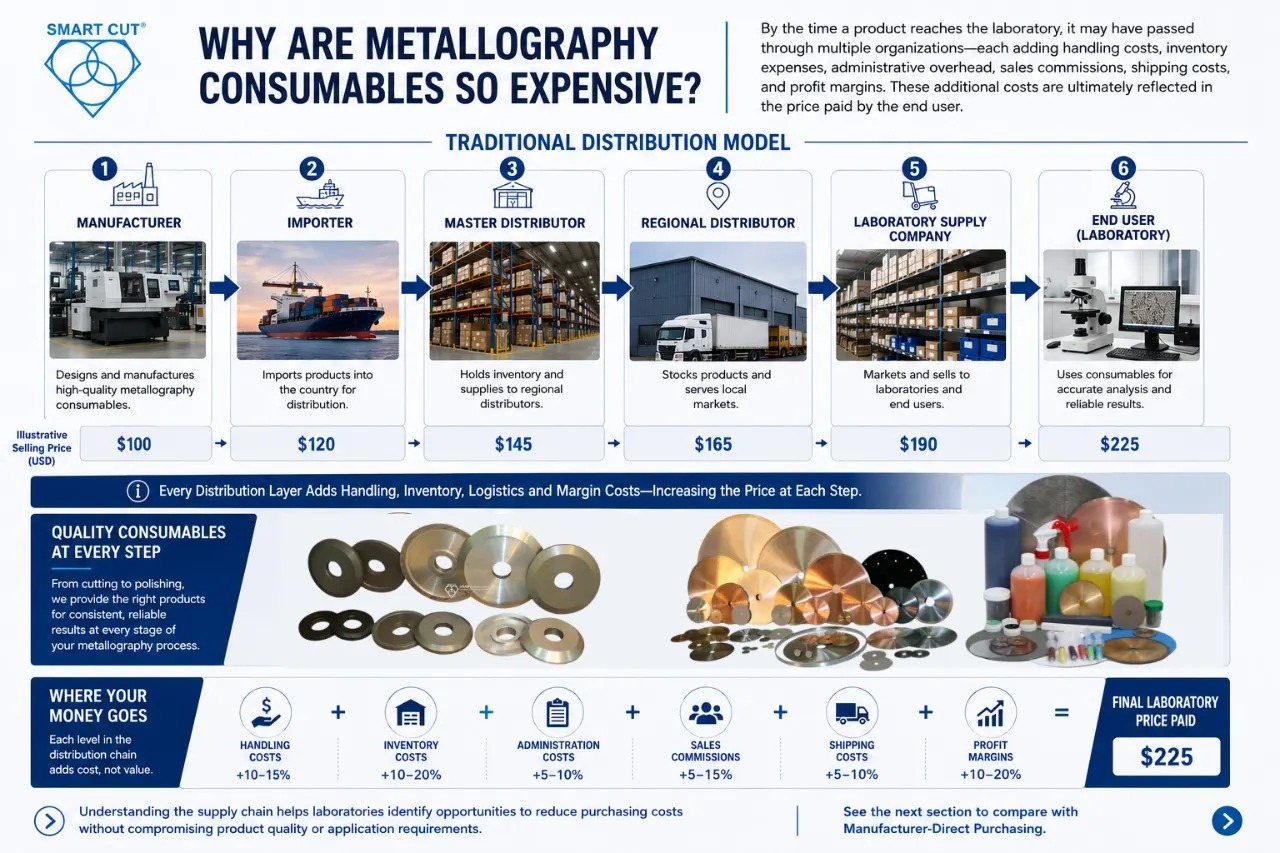
Many laboratories assume that higher-priced metallography consumables are inherently better. In many cases, however, the final purchase price reflects the distribution model rather than the actual manufacturing cost of the consumable.
By the time a product reaches the laboratory, it may have passed through multiple organizations, each adding handling costs, inventory expenses, administrative overhead, sales commissions, shipping costs, and profit margins. These additional costs are ultimately reflected in the price paid by the end user.
Understanding how metallography consumables move through the supply chain can help laboratories identify opportunities to reduce purchasing costs without compromising product quality or application requirements.
Multiple Layers of Distribution
Many metallography consumables are sold through several levels of distribution before reaching the end user.
A typical supply chain may include:
Manufacturer → Importer → Master Distributor → Regional Distributor → Laboratory Supply Company → End User
Each level in the distribution chain may add:
- Handling costs
- Inventory costs
- Sales commissions
- Warehousing costs
- Administrative expenses
- Shipping costs
- Profit margins
As products move through each level of distribution, the selling price increases. By the time the consumable reaches the laboratory, the final purchase price may be significantly higher than the manufacturer’s selling price.
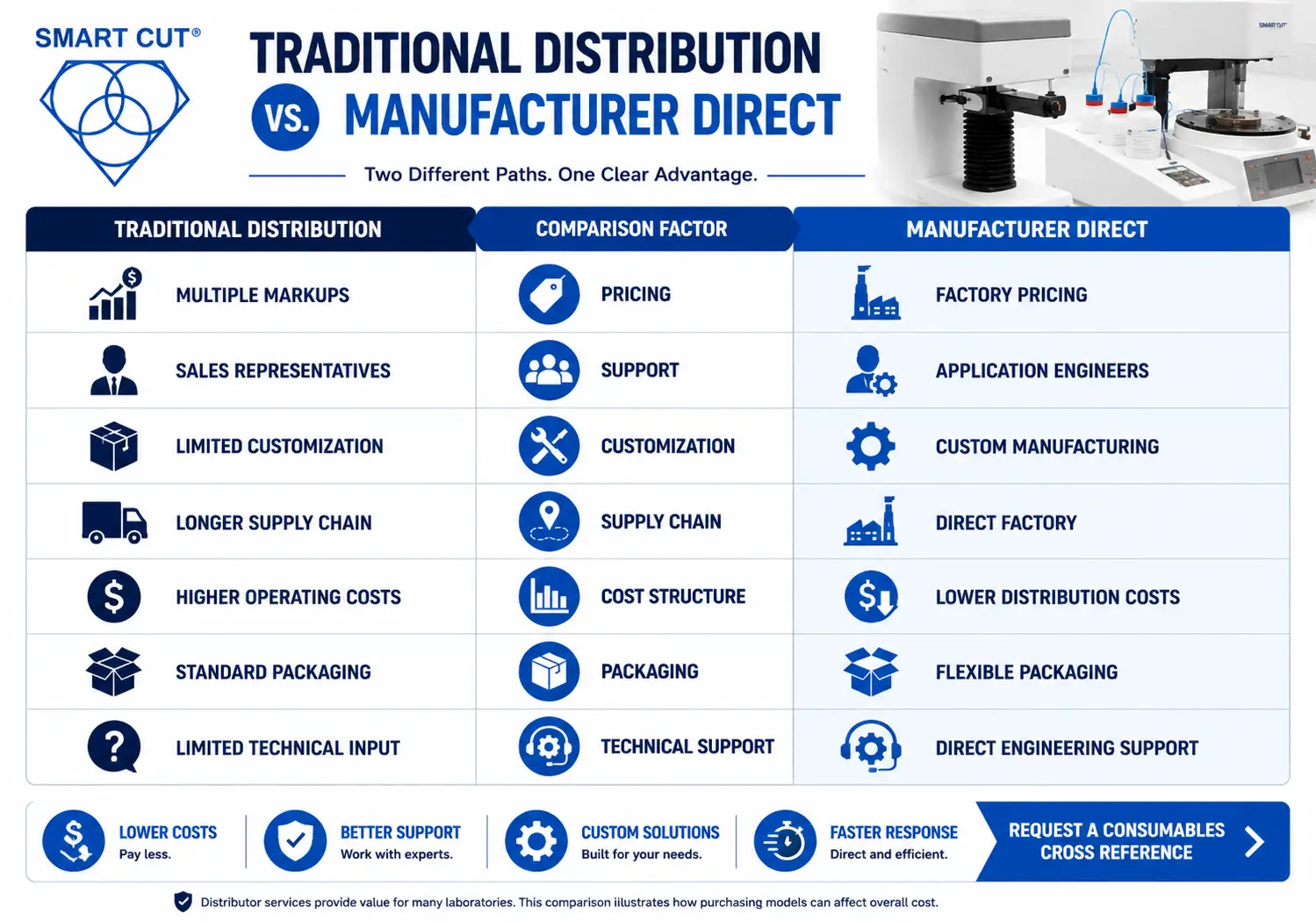
Traditional Distribution Model:
Manufacturer → Importer → Distributor → Laboratory Supply Company → End User
Manufacturer-Direct Model:
Manufacturer → End User
Brand Premium
Well-known manufacturers often invest in advertising, printed catalogs, trade shows, sales representatives, demonstration laboratories, regional offices, distributor support, and corporate administration.
These programs provide value and support for many customers, but they also contribute to the overall cost of the product. As a result, laboratories may be paying not only for the consumable itself, but also for the additional costs associated with branding, marketing, and distribution.
Dealer and Reseller Markups
Many laboratories purchase consumables through industrial distributors, laboratory supply companies, authorized dealers, regional sales representatives, procurement platforms, and contract suppliers.
Each additional sales channel generally applies its own operating costs and profit margin before the product reaches the customer. For laboratories that purchase consumables throughout the year, these markups can significantly increase annual purchasing costs.
Private Labeling and Third-Party Manufacturing
Many laboratories purchase consumables through industrial distributors, laboratory supply companies, authorized dealers, regional sales representatives, procurement platforms, and contract suppliers.
Each additional sales channel generally applies its own operating costs and profit margin before the product reaches the customer. For laboratories that purchase consumables throughout the year, these markups can significantly increase annual purchasing costs.
Many metallography consumables are sold under well-known brand names, but not every company manufactures every product it sells. In many industries, including metallography, manufacturers, distributors, and equipment suppliers may purchase products from specialized manufacturers and market them under their own private labels. As a result, the company name on the package does not always identify the original manufacturer.
Private labeling is a common business practice that allows companies to offer a broader product portfolio without manufacturing every consumable themselves. Depending on the product category, consumables sold under different brand names may originate from the same manufacturer, from manufacturers using similar production methods, or from entirely different production sources. For this reason, laboratories should evaluate each consumable on its own technical merits rather than relying solely on brand recognition.
When comparing alternative consumables, laboratories should evaluate the published technical specifications, including:
- Abrasive type (Diamond, CBN, Silicon Carbide, Alumina, etc.)
- Grit or particle size
- Particle size distribution (where applicable)
- Bond type or abrasive formulation
- Diamond or abrasive concentration
- Carrier or lubricant formulation
- Backing or polishing cloth material
- Removal rate
- Surface finish requirements
- Expected consumable life
- Intended material and application
- Manufacturer's recommended operating parameters
- Published technical specifications and performance data
Comparing products using these criteria provides a far more meaningful basis for evaluating alternatives than comparing brand names alone. In many cases, two products with similar technical specifications may perform similarly under the same operating conditions, while products sold under the same brand may differ significantly depending on their intended application.
At the same time, similar published specifications do not necessarily guarantee identical performance. Differences in raw materials, manufacturing processes, quality control procedures, abrasive distribution, bonding technology, and formulation can influence cutting efficiency, polishing performance, consumable life, and surface finish quality.
For this reason, laboratories should view published specifications as the starting point—not the final decision. Whenever practical, replacement consumables should be evaluated under normal operating conditions using the laboratory’s existing equipment, preparation procedures, and representative sample materials before routine implementation. A structured side-by-side comparison provides the most reliable method for determining whether an alternative product meets the laboratory’s performance, quality, and repeatability requirements.
If your laboratory currently purchases consumables from Buehler, Struers, LECO, Allied High Tech, Pace Technologies, Presi, ATM, Kemet, or another supplier, UKAM can review your current manufacturer and item numbers and recommend comparable manufacturer-direct alternatives based on your application and technical requirements.
Inventory, Packaging, and Administrative Costs
The cost of metallography consumables is influenced by more than the manufacturing process alone. Additional expenses associated with inventory, packaging, distribution, and administration are often included in the final selling price.
These costs may include warehousing, inventory carrying costs, specialized packaging, small package quantities, order processing, catalog production and maintenance, sales commissions, customer service, administrative overhead, and shipping and logistics.
Each of these costs contributes to the price ultimately paid by the laboratory. Understanding these factors helps explain why comparable consumables can vary significantly in price.
Why Can Manufacturer-Direct Pricing Be Lower?
Many laboratories focus on the purchase price of individual consumables rather than understanding how those prices are established. While premium brands such as Buehler, Struers, LECO, and others are well known throughout the metallography industry, the selling price of a consumable often reflects much more than the manufacturing cost alone.
Large global suppliers typically maintain extensive organizations that may include engineering teams, sales representatives, application specialists, customer service personnel, regional offices, warehouses, marketing departments, trade show participation, advertising programs, product management, inventory management, distributor support, administrative staff, and other operating expenses. These costs are necessary to support their worldwide operations and are generally incorporated into the prices of the products they sell.
In addition, many consumables are sold through one or more distribution channels before reaching the end user. Depending on the purchasing model, each level of distribution may add costs associated with inventory, logistics, sales support, administration, and profit margins. As a result, the final selling price paid by the laboratory can be significantly higher than the manufacturer’s production cost.
Manufacturer-direct suppliers often operate with a different business model. By selling directly to laboratories, they may reduce or eliminate some of the costs associated with multiple distribution channels, allowing them to offer competitive pricing on technically equivalent products. In many cases, customers also gain direct access to the engineers and technical specialists responsible for product design, manufacturing, and application support.
This does not mean that distributors or premium brands do not provide value. Many laboratories benefit from local inventory, rapid delivery, established purchasing relationships, equipment service, training, and technical support. These services can be important depending on the laboratory’s needs.
However, for standardized consumables such as diamond suspensions, polishing cloths, silicon carbide grinding papers, diamond paste, lubricants, abrasive cut-off wheels, and diamond & cbn wafering blades, laboratories should periodically compare manufacturer-direct alternatives based on technical specifications, application requirements, performance, and total cost of ownership—not simply brand recognition.
Even modest savings on frequently purchased consumables can translate into hundreds or thousands of dollars in annual cost reductions, particularly when applied across an entire laboratory’s consumable purchasing program.
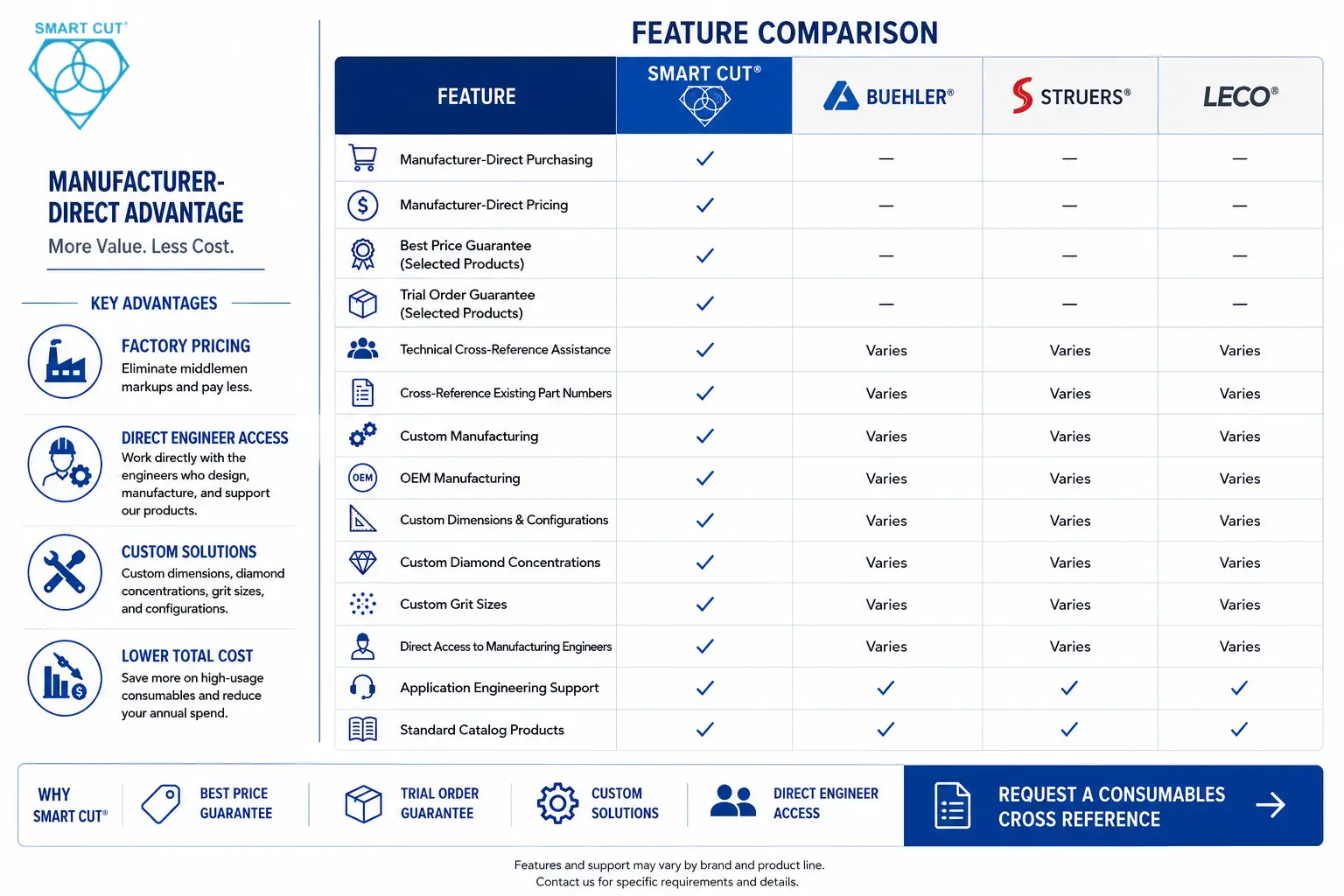
|
Feature |
SMART CUT® |
Buehler® |
Struers® |
LECO® |
|---|---|---|---|---|
|
Manufacturer-Direct Purchasing |
✓ |
— |
— |
— |
|
Manufacturer-Direct Pricing |
✓ |
— |
— |
— |
|
Best Price Guarantee (Selected Products) |
✓ |
— |
— |
— |
|
Trial Order Guarantee (Selected Products) |
✓ |
— |
— |
— |
|
Technical Cross-Reference Assistance |
✓ |
Varies |
Varies |
Varies |
|
Cross-Reference Existing Part Numbers |
✓ |
Varies |
Varies |
Varies |
|
Custom Manufacturing |
✓ |
Varies |
Varies |
Varies |
|
OEM Manufacturing |
✓ |
Varies |
Varies |
Varies |
|
Custom Dimensions & Configurations |
✓ |
Varies |
Varies |
Varies |
|
Custom Diamond Concentrations |
✓ |
Varies |
Varies |
Varies |
|
Custom Grit Sizes |
✓ |
Varies |
Varies |
Varies |
|
Direct Access to Manufacturing Engineers |
✓ |
Varies |
Varies |
Varies |
|
Application Engineering Support |
✓ |
✓ |
✓ |
✓ |
|
Standard Catalog Products |
✓ |
✓ |
✓ |
✓ |
Disclaimer: Feature availability varies by product category and manufacturer. This comparison is intended to provide a general overview of available capabilities and services. Laboratories should evaluate consumables based on technical specifications, application requirements, performance, technical support, and total cost of ownership.
FREE Technical Cross-Reference & Manufacturer-Direct Price Comparison →
Using Buehler®, Struers®, LECO®, Allied High Tech®, PRESI®, QATM®, Extec®, Pace Technologies®, or another manufacturer’s consumables? Submit your current part numbers to receive technically equivalent SMART CUT® recommendations, manufacturer-direct pricing, and potential cost-saving alternatives—all at no obligation.
Price Is Not the Only Consideration
Purchase price should not be the only factor when selecting metallography consumables. Laboratories should also consider material removal rate, surface finish, edge retention, sample flatness, repeatability, consumable life, preparation time, operator labor, rework, equipment compatibility, technical support, product consistency, availability, and lead time.
A lower-priced consumable does not necessarily reduce overall operating costs if it increases preparation time, shortens consumable life, or requires additional rework. The objective is to evaluate the total value of the consumable within the preparation process, not simply the purchase price. For a deeper look at how preparation steps affect results, see this guide to improving sample quality and optimizing polishing.
How to Compare Metallography Consumables Correctly
Cross-referencing metallography consumables should be based on technical specifications and application requirements, not product names alone. A proper comparison helps ensure that replacement products provide comparable performance for the intended application.
Sectioning Consumables
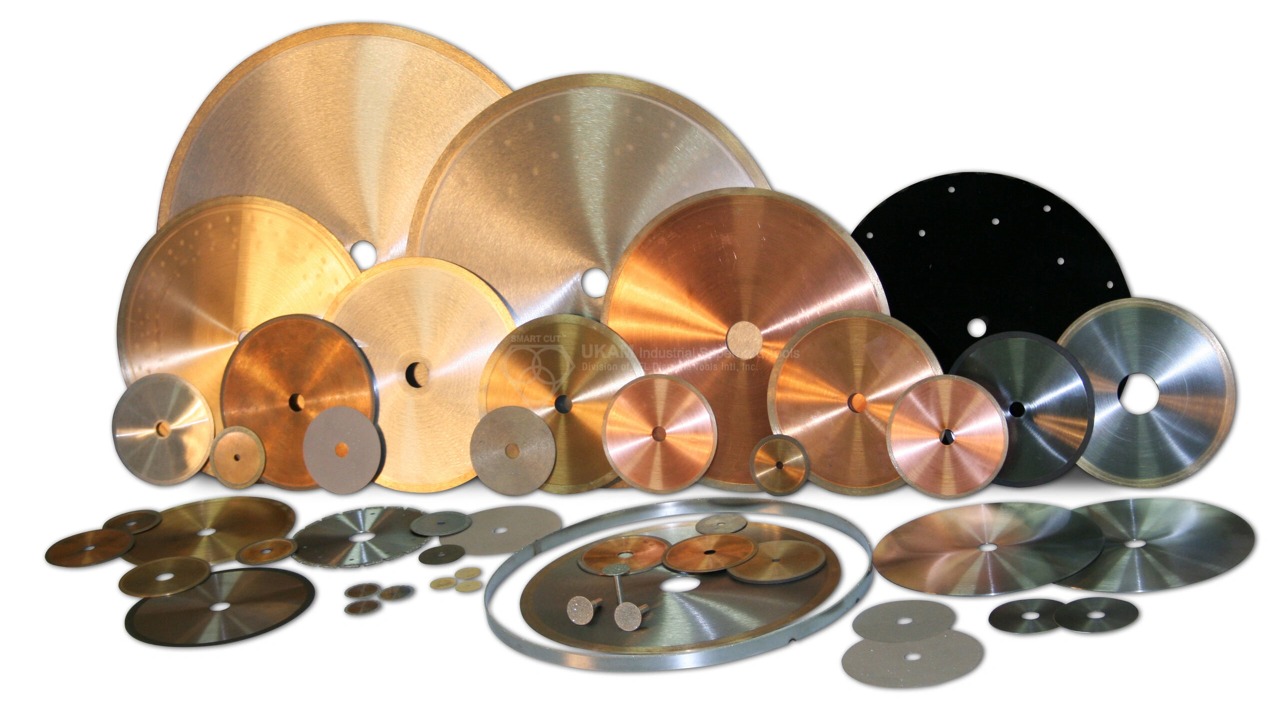
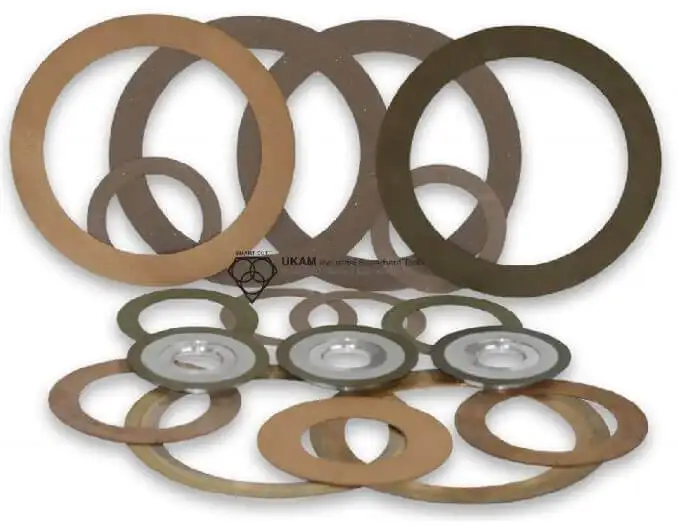
Compare outside diameter, thickness, arbor size, abrasive type, grit size, bond type, abrasive concentration, rim design, material being cut, and recommended operating speed. UKAM’s diamond and CBN wafering / cut-off blades are available across these specifications, along with supporting coolants, dressing sticks, and blade and wheel bushings.
Grinding Consumables
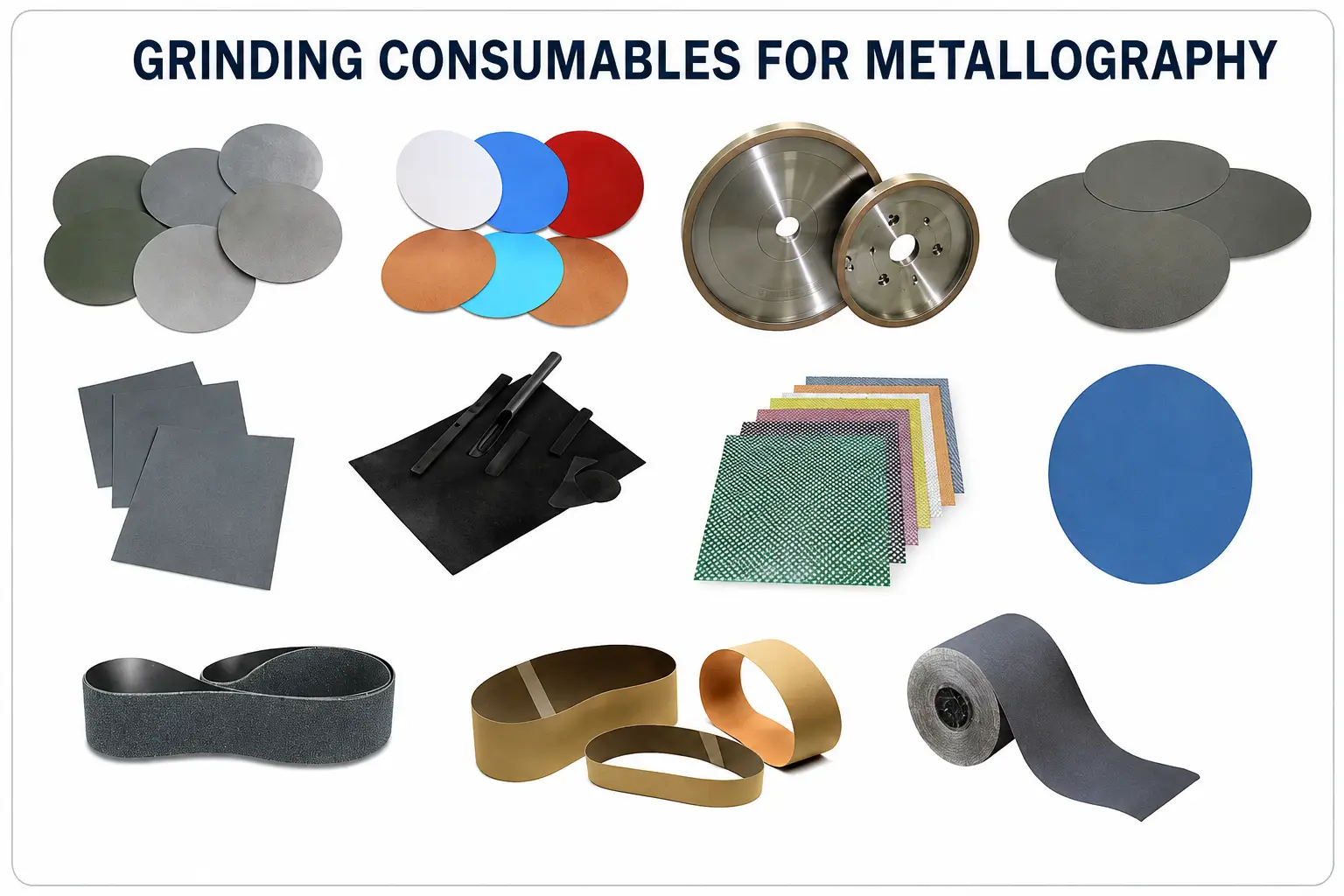
Compare abrasive type, grit size, disc diameter, backing type, adhesive system, bond hardness, grinding rate, and expected consumable life. UKAM offers this range through its silicon carbide grinding discs, available in both plain-back and PSA-back configurations, along with fine-grit options such as its 1200-grit finishing discs. Metal bond and resin bond diamond discs, grinding belts
- Metal Bond Diamond Discs
- Resin Bond Diamond Discs
- Diamond Cup Wheels
- Silicon Carbide Grinding Paper
- Abrasive Sheets (Silicon Carbide)
- Diamond Foil
- Diamond Cloth
- Zirconia Grinding Paper
- Abrasive Belts (Silicon Carbide, Zirconia, Aluminum Oxide)
- Diamond Belts (Resin Bond)
- Silicon Carbide Grinding Rolls
Polishing Consumables
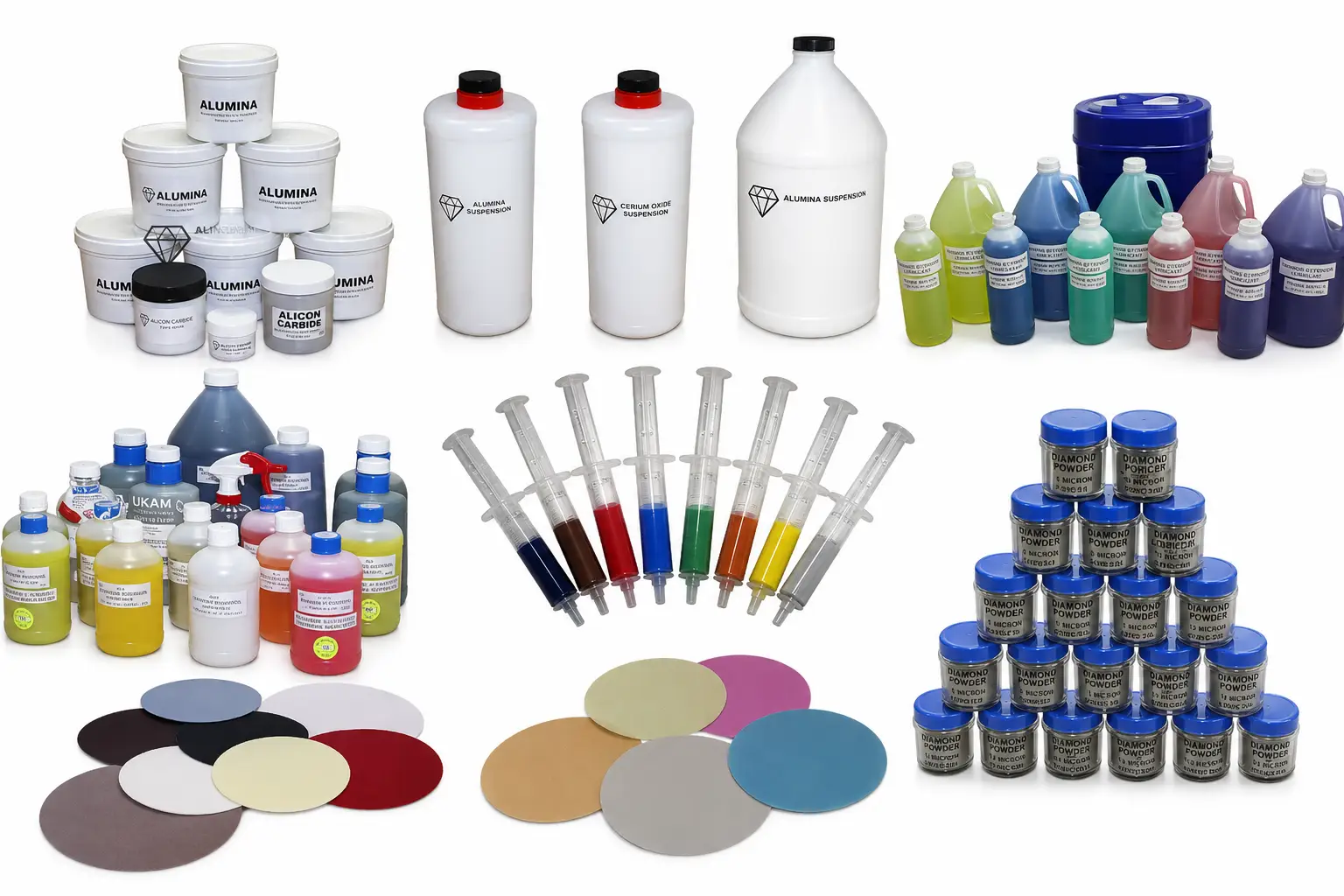
Compare diamond particle size, monocrystalline or polycrystalline diamond, carrier type, water-based or oil-based formulation, diamond concentration, viscosity, polishing cloth material, cloth hardness, nap length, backing type, lubricant compatibility, and required surface finish.
For guidance on selecting between diamond types, see Monocrystalline vs. Polycrystalline Diamond Suspension. For abrasive powder options, UKAM offers silicon carbide polishing powder and aluminum oxide polishing powder, diamond powder, and diamond compounds in multiple grit sizes.
Evaluating consumables using measurable technical specifications provides a more reliable basis for comparison than relying solely on brand names or product descriptions.
Can You Replace Buehler, Struers, or LECO Consumables?
In many cases, metallography consumables can be cross-referenced by matching technical specifications and intended applications. UKAM can review products from manufacturers including Buehler, Struers, LECO, Allied High Tech, Pace Technologies, Presi, ATM, Kemet, and other metallography consumable suppliers.
A cross-reference does not necessarily mean that two products are identical. It indicates that the recommended product has been selected to perform the same application based on comparable specifications and intended use. For a detailed walkthrough of one commonly cross-referenced category,
Daimond & CBN Wafering Blades Cross Reference
Abrasive Cut off Blades / Wheels Cross Refernece
Metal Bond Diamond Discs Cross Rerfernce
Using Buehler®, Struers®, LECO®, Allied High Tech®, PRESI®, QATM®, Extec®, Pace Technologies®, or another manufacturer’s consumables? Submit your current part numbers to receive technically equivalent SMART CUT® recommendations, manufacturer-direct pricing, and potential cost-saving alternatives—all at no obligation.
Laboratory Cost Comparison Examples
The following examples are illustrative and are intended to demonstrate how manufacturer-direct purchasing may reduce annual consumable costs. Actual savings will vary depending on the products used, purchase volume, supplier pricing, package sizes, and laboratory requirements. These examples should be used as representative comparisons until actual UKAM and competitor pricing are available.
University Materials Laboratory
University materials laboratories support undergraduate instruction, graduate research, faculty research, materials characterization, and collaborative industry-sponsored research projects across a wide range of engineering and scientific disciplines. Because these laboratories use a diverse selection of consumables for teaching, research, and routine sample preparation, reviewing recurring purchases and evaluating manufacturer-direct alternatives may help maximize limited research budgets while maintaining preparation quality and laboratory standards.
Representative Annual Consumable Purchases
The following example illustrates a representative annual purchasing profile for a university materials laboratory. Actual quantities will vary depending on laboratory size, student enrollment, research activity, specimen volume, and preparation procedures.
|
Consumable |
Typical Annual Quantity |
|---|---|
|
Silicon Carbide Grinding Papers |
500–1,200 discs |
|
Polishing Cloths |
50–120 pcs |
|
Diamond Suspensions |
40–80 bottles |
|
Diamond Paste |
20–50 syringes |
|
Abrasive Cut-Off Wheels |
40–80 pcs |
|
Polishing Lubricants |
40–80 bottles |
|
Colloidal Silica & Final Polishing Consumables |
25–60 bottles |
Illustrative Annual Cost Comparison
|
Description |
Annual Cost |
|---|---|
|
Annual Purchases Through Traditional Supply Channels |
$18,000 |
|
Estimated Manufacturer-Direct Purchases |
$11,500
|
|
Illustrative Potential Annual Savings |
Up to $6,500 (36%)
|
This example is illustrative. Actual savings will vary depending on product selection, purchase volume, existing supplier agreements, laboratory requirements, and institutional purchasing policies.
In addition to reducing purchasing costs, manufacturer-direct sourcing may provide application engineering support, consistent product quality, technical cross-referencing, and assistance selecting consumables optimized for specific materials, research applications, and sample preparation procedures.
For university laboratories operating under ASTM, ISO, or internally developed laboratory procedures, replacement consumables should be evaluated and validated before routine implementation. Many laboratories begin by qualifying a single frequently used consumable before expanding to additional product categories, allowing them to improve purchasing efficiency while maintaining consistent preparation quality and supporting reproducible research results.
Reducing recurring consumable costs may allow university laboratories to redirect limited research funding toward new instrumentation, equipment maintenance, student research projects, laboratory modernization, expanded testing capabilities, and additional educational or research initiatives without compromising the quality or reliability of metallographic sample preparation.
Production Quality Control Laboratories
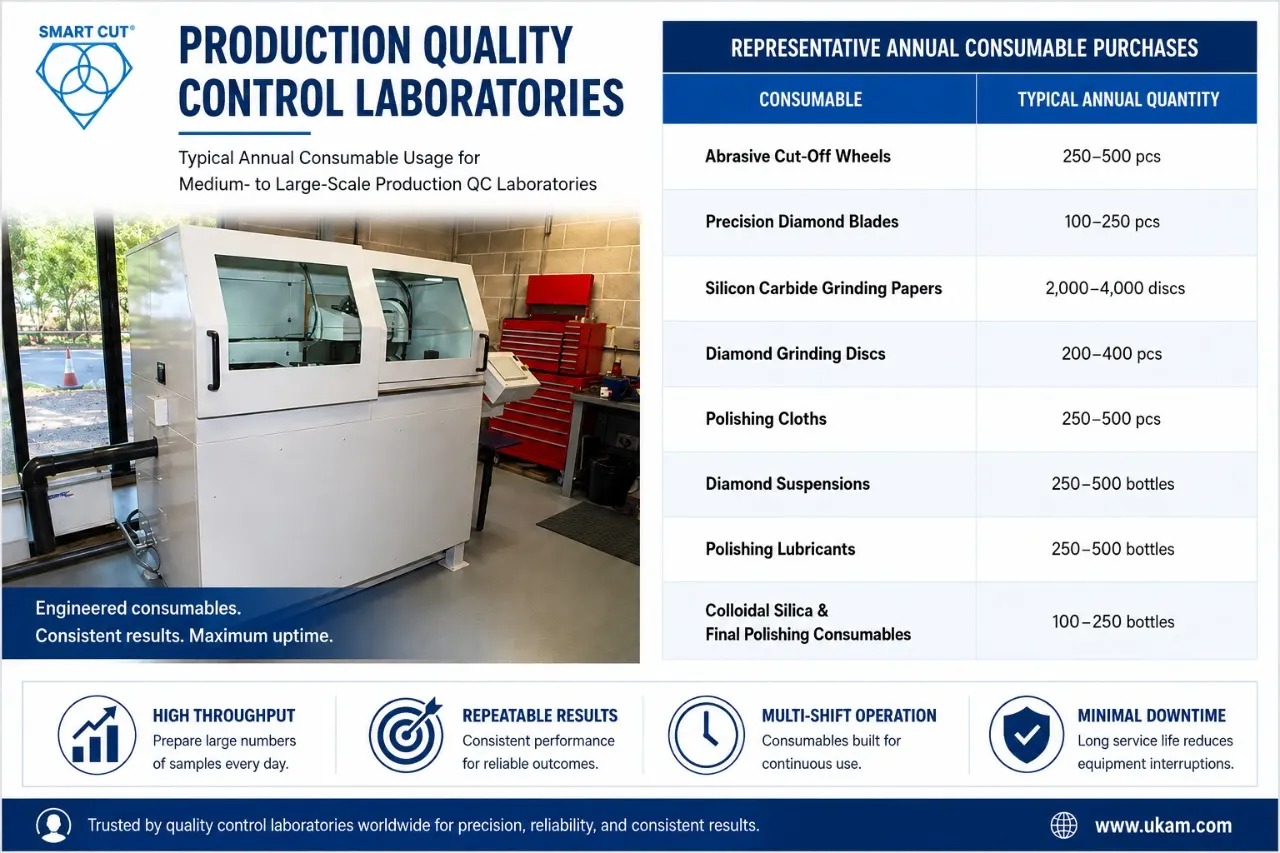
Production quality control laboratories prepare specimens continuously to support incoming inspection, in-process quality control, final product verification, failure investigations, and process validation. Because these laboratories often operate multiple shifts and prepare large numbers of samples each day, they require consumables that deliver consistent performance, long service life, repeatable results, and minimal equipment downtime to maintain production efficiency.
Representative Annual Consumable Purchases
The following example illustrates a representative annual purchasing profile for a medium- to large-sized production quality control laboratory. Actual quantities will vary depending on production volume, specimen throughput, materials being tested, and laboratory procedures.
|
Consumable |
Typical Annual Quantity |
|---|---|
|
Abrasive Cut-Off Wheels |
250–500 pcs |
|
Precision Diamond Blades |
100–250 pcs |
|
Silicon Carbide Grinding Papers |
2,000–4,000 discs |
|
Diamond Grinding Discs |
200–400 pcs |
|
Polishing Cloths |
250–500 pcs |
|
Diamond Suspensions |
250–500 bottles |
|
Polishing Lubricants |
250–500 bottles |
|
Colloidal Silica & Final Polishing Consumables |
100–250 bottles |
Illustrative Annual Cost Comparison
|
Description |
Annual Cost |
|---|---|
|
Annual Purchases Through Traditional Supply Channels |
$52,000 |
|
Estimated Manufacturer-Direct Purchases |
$31,000 |
|
Illustrative Potential Annual Savings |
Up to $21,000 (40%)
|
This example is illustrative. Actual savings will vary depending on product selection, purchasing volume, supplier agreements, production requirements, and laboratory operating procedures.
In addition to reducing purchasing costs, manufacturer-direct sourcing may provide application engineering support, consistent product quality, custom manufacturing capabilities, technical cross-referencing, and assistance optimizing cutting and polishing processes to improve consumable life and overall process efficiency.
For production laboratories operating under ISO 9001, IATF 16949, ASTM, ISO test methods, or internal quality management systems, replacement consumables should be evaluated and validated before routine implementation. Many manufacturers begin by qualifying one frequently used consumable before expanding to additional product categories, allowing them to reduce recurring operating costs while maintaining production throughput, preparation quality, and process consistency.
Because consumables are purchased continuously throughout the year, reducing the cost of frequently used products can significantly lower annual operating expenses while maintaining production efficiency, equipment utilization, repeatable sample preparation, and quality control requirements.
Failure Analysis Laboratories
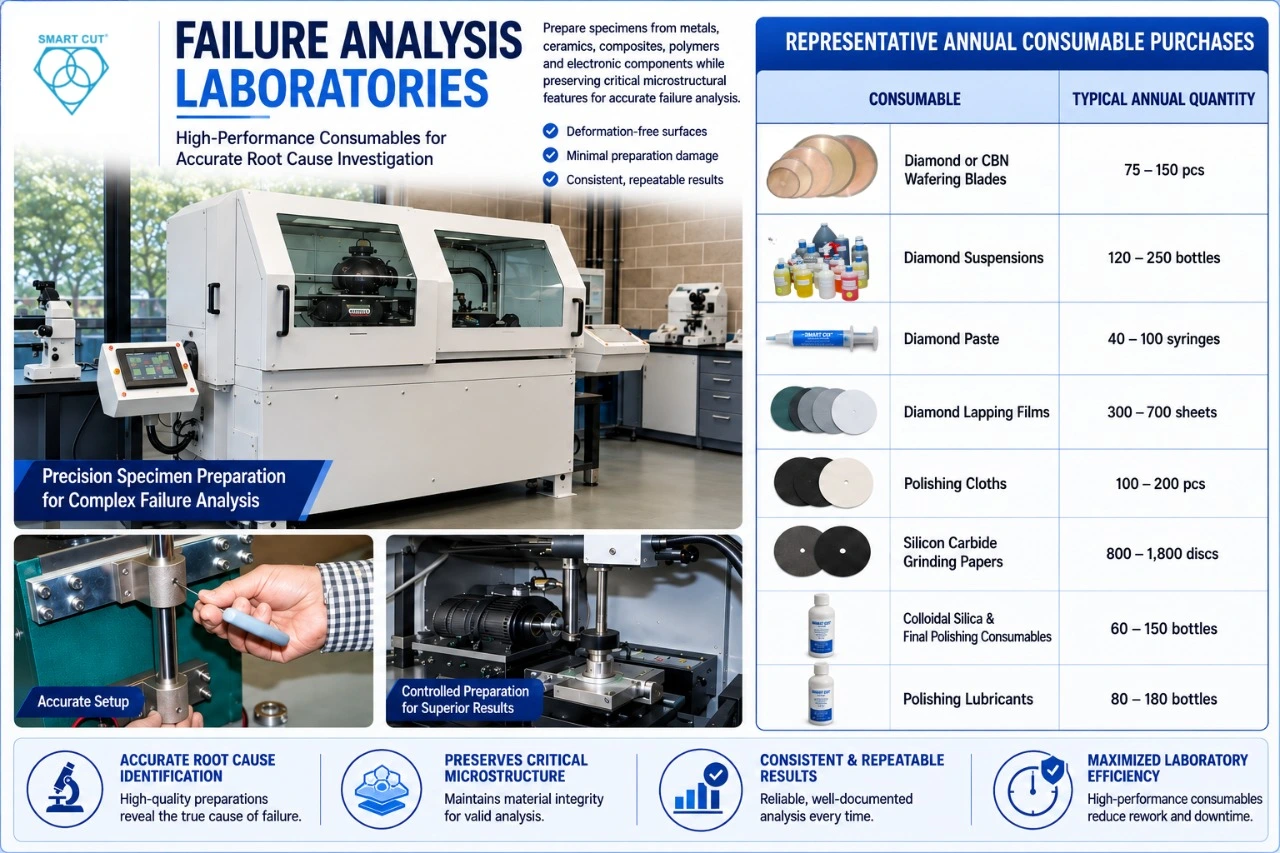
Failure analysis laboratories prepare specimens from a wide variety of metals, ceramics, composites, polymers, electronic components, and other advanced materials to determine the root cause of component failures, manufacturing defects, service-related damage, and material degradation. Because every specimen may be unique, these laboratories require high-performance consumables capable of producing consistent, deformation-free surfaces with minimal preparation-induced damage, preserving critical microstructural features for accurate examination and documentation.
Representative Annual Consumable Purchases
The following example illustrates a representative annual purchasing profile for a medium-sized failure analysis laboratory. Actual quantities will vary depending on specimen volume, material types, analytical techniques, and laboratory procedures.
|
Consumable |
Typical Annual Quantity |
|---|---|
|
Diamond or CBN Wafering Blades |
75–150 pcs |
|
Diamond Suspensions |
120–250 bottles |
|
Diamond Paste |
40–100 syringes |
|
Diamond Lapping Films |
300–700 sheets |
|
Polishing Cloths |
100–200 pcs |
|
Silicon Carbide Grinding Papers |
800–1,800 discs |
|
Colloidal Silica & Final Polishing Consumables |
60–150 bottles |
|
Polishing Lubricants |
80–180 bottles |
Illustrative Annual Cost Comparison
|
Description |
Annual Cost |
|---|---|
|
Annual Purchases Through Traditional Supply Channels |
$30,000 |
|
Estimated Manufacturer-Direct Purchases |
$19,500 |
|
Illustrative Potential Annual Savings |
Up to $10,500 (35%)
|
This example is illustrative. Actual savings will vary depending on product selection, purchasing volume, supplier agreements, laboratory requirements, and analytical applications.
In addition to reducing purchasing costs, manufacturer-direct sourcing may provide
application engineering support, technical cross-referencing, consistent product quality, and custom-manufactured consumables optimized for challenging materials and specialized failure analysis applications.
Failure analysis laboratories frequently support aerospace, automotive, semiconductor, medical device, energy, defense, and industrial manufacturing investigations, where specimen integrity and preparation quality are critical for obtaining reliable analytical results. For laboratories operating under ASTM, ISO, ISO/IEC 17025, NADCAP, or internal quality management systems, replacement consumables should be evaluated and validated before routine implementation.
Many laboratories begin by qualifying one frequently used consumable before expanding to additional product categories. This approach minimizes implementation risk while ensuring preparation quality, repeatability, and compatibility with existing laboratory procedures.
Medical Device Laboratories
Medical device laboratories support product development, quality assurance, manufacturing validation, failure investigations, regulatory compliance, and materials characterization for a wide range of implantable and non-implantable medical devices. Because these laboratories prepare specimens from stainless steels, titanium alloys, cobalt-chromium alloys, ceramics, polymers, coatings, and other advanced biomaterials, they require documented, repeatable preparation procedures and high-performance consumables that consistently produce reliable, defect-free surfaces.
Representative Annual Consumable Purchases
The following example illustrates a representative annual purchasing profile for a medium-sized medical device laboratory. Actual quantities will vary depending on production volume, laboratory size, regulatory requirements, specimen throughput, and preparation procedures.
|
Consumable |
Typical Annual Quantity |
|---|---|
|
Precision Diamond Blades |
100–200 pcs |
|
Abrasive Cut-Off Wheels |
120–250 pcs |
|
Silicon Carbide Grinding Papers |
1,200–2,500 discs |
|
Diamond Suspensions |
150–300 bottles |
|
Polishing Cloths |
120–250 pcs |
|
Colloidal Silica & Final Polishing Consumables |
80–180 bottles |
|
Polishing Lubricants |
120–250 bottles |
|
Diamond Paste |
40–100 syringes |
Illustrative Annual Cost Comparison
|
Description |
Annual Cost |
|---|---|
|
Annual Purchases Through Traditional Supply Channels |
$42,000 |
|
Estimated Manufacturer-Direct Purchases |
$27,000 |
|
Illustrative Potential Annual Savings |
Up to $15,000 (36%) |
This example is illustrative. Actual savings will vary depending on product specifications, purchasing volume, supplier agreements, laboratory requirements, and regulatory considerations.
In addition to reducing purchasing costs, manufacturer-direct sourcing may provide application engineering support, consistent product quality, technical cross-referencing, and custom-manufactured consumables optimized for demanding medical device materials and preparation procedures.
Using Buehler®, Struers®, LECO®, Allied High Tech®, PRESI®, QATM®, Extec®, Pace Technologies®, or another manufacturer’s consumables? Submit your current part numbers to receive technically equivalent SMART CUT® recommendations, manufacturer-direct pricing, and potential cost-saving alternatives—all at no obligation.
Semiconductor and Electronics Laboratory
Semiconductor and electronics laboratories require high-precision sample preparation that minimizes edge chipping, subsurface damage, contamination, and surface defects while maintaining dimensional accuracy, repeatability, and process consistency. Because many semiconductor materials are extremely brittle and sensitive to preparation-induced damage, selecting the appropriate cutting and polishing consumables is essential for obtaining reliable inspection, failure analysis, and quality control results.
Representative Annual Consumable Purchases
The following example illustrates a representative annual purchasing profile for a medium- to large-sized semiconductor or electronics laboratory. Actual quantities will vary depending on production volume, specimen types, laboratory size, and preparation procedures.
|
Consumable |
Typical Annual Quantity |
|---|---|
|
Ultra-Thin Precision Diamond Blades |
80–150 pcs |
|
Precision Dicing Blades |
100–200 pcs |
|
Diamond Lapping Films |
600–1,200 sheets |
|
Diamond Suspensions |
250–400 bottles |
|
Polishing Cloths |
150–250 pcs |
|
Colloidal Silica |
100–200 bottles |
|
Polishing Lubricants |
100–200 bottles |
Illustrative Annual Cost Comparison
|
Description |
Annual Cost |
|---|---|
|
Annual Purchases Through Traditional Supply Channels |
$85,000 |
|
Estimated Manufacturer-Direct Purchases |
$49,000 |
|
Illustrative Potential Annual Savings |
Up to $36,000 (42%) |
This example is illustrative. Actual savings will vary depending on product specifications, purchasing volume, existing supplier agreements, contract pricing, shipping costs, and laboratory requirements.
In addition to reducing purchasing costs, manufacturer-direct sourcing may provide application engineering support, consistent product quality, custom tooling solutions, technical cross-referencing, and assistance optimizing cutting and polishing processes for semiconductor materials.
For laboratories performing failure analysis, quality assurance, materials characterization, MEMS, wafer inspection, packaging analysis, or research and development, replacement consumables should be validated according to established laboratory procedures before implementation. Many laboratories begin by qualifying a single consumable before expanding to additional product categories, allowing them to reduce recurring purchasing costs while maintaining preparation quality, repeatability, and process reliability.
Research & Development Laboratories
Research and development laboratories support new product development, process optimization, prototype evaluation, materials characterization, and advanced materials research. Because R&D projects frequently involve new materials, changing specimen geometries, and evolving preparation methods, these laboratories require flexible, high-performance consumables capable of producing consistent, repeatable results across a wide variety of applications.
Representative Annual Consumable Purchases
The following example illustrates a representative annual purchasing profile for a medium-sized research and development laboratory. Actual quantities will vary depending on research activity, laboratory size, project requirements, material types, and specimen throughput.
|
Consumable |
Typical Annual Quantity |
|---|---|
|
Precision Diamond Blades |
75–175 pcs |
|
Abrasive Cut-Off Wheels |
100–250 pcs |
|
Silicon Carbide Grinding Papers |
1,000–2,500 discs |
|
Diamond Suspensions |
120–300 bottles |
|
Diamond Paste |
40–120 syringes |
|
Polishing Cloths |
100–250 pcs |
|
Colloidal Silica & Final Polishing Consumables |
60–180 bottles |
|
Polishing Lubricants |
100–250 bottles |
Illustrative Annual Cost Comparison
Subsurface microcracking.
|
Description |
Annual Cost |
|---|---|
|
Annual Purchases Through Traditional Supply Channels |
$24,000 |
|
Estimated Manufacturer-Direct Purchases |
$15,500 |
|
Illustrative Potential Annual Savings |
Up to $8,500 (35%) |
This example is illustrative. Actual savings will vary depending on product selection, purchasing volume, supplier agreements, laboratory requirements, and research applications.
In addition to reducing purchasing costs, manufacturer-direct sourcing may provide application engineering support, technical cross-referencing, custom-manufactured consumables, and assistance optimizing preparation methods for new materials and specialized research applications.
Government and National Laboratory
Government and national laboratories often purchase metallography consumables for multiple departments, research programs, and testing facilities under formal procurement procedures. Because these consumables are purchased repeatedly throughout the year, even modest reductions in unit pricing can result in significant annual cost savings.
Representative Annual Consumable Purchases
The following example illustrates a typical annual purchasing mix for a medium to large government materials laboratory. Actual quantities will vary depending on laboratory size, testing volume, and application requirements.
|
Consumable |
Typical Annual Quantity |
|---|---|
|
Diamond Suspensions |
320 bottles |
|
Polishing Cloths |
240 pcs |
|
Silicon Carbide Grinding Papers |
2,400 discs |
|
Diamond Grinding Discs |
180 pcs |
|
Abrasive Cut-Off Wheels |
220 pcs |
|
Precision Diamond Blades |
140 pcs |
|
Diamond Paste & Lubricants |
180 units |
|
Colloidal Silica & Final Polishing Consumables |
120 units |
Based on this representative purchasing profile:
|
Description |
Annual Cost |
|---|---|
|
Annual Purchases Through Traditional Supply Channels |
$120,000 |
|
Estimated Manufacturer-Direct Purchases |
$72,000 |
|
Illustrative Potential Annual Savings |
Up to $48,000 (40%) |
This example is illustrative. Actual savings depend on product selection, purchase volume, existing supplier agreements, contract pricing, shipping costs, and laboratory requirements.
Using Buehler®, Struers®, LECO®, Allied High Tech®, PRESI®, QATM®, Extec®, Pace Technologies®, or another manufacturer’s consumables? Submit your current part numbers to receive technically equivalent SMART CUT® recommendations, manufacturer-direct pricing, and potential cost-saving alternatives—all at no obligation.
Total Cost of Ownership
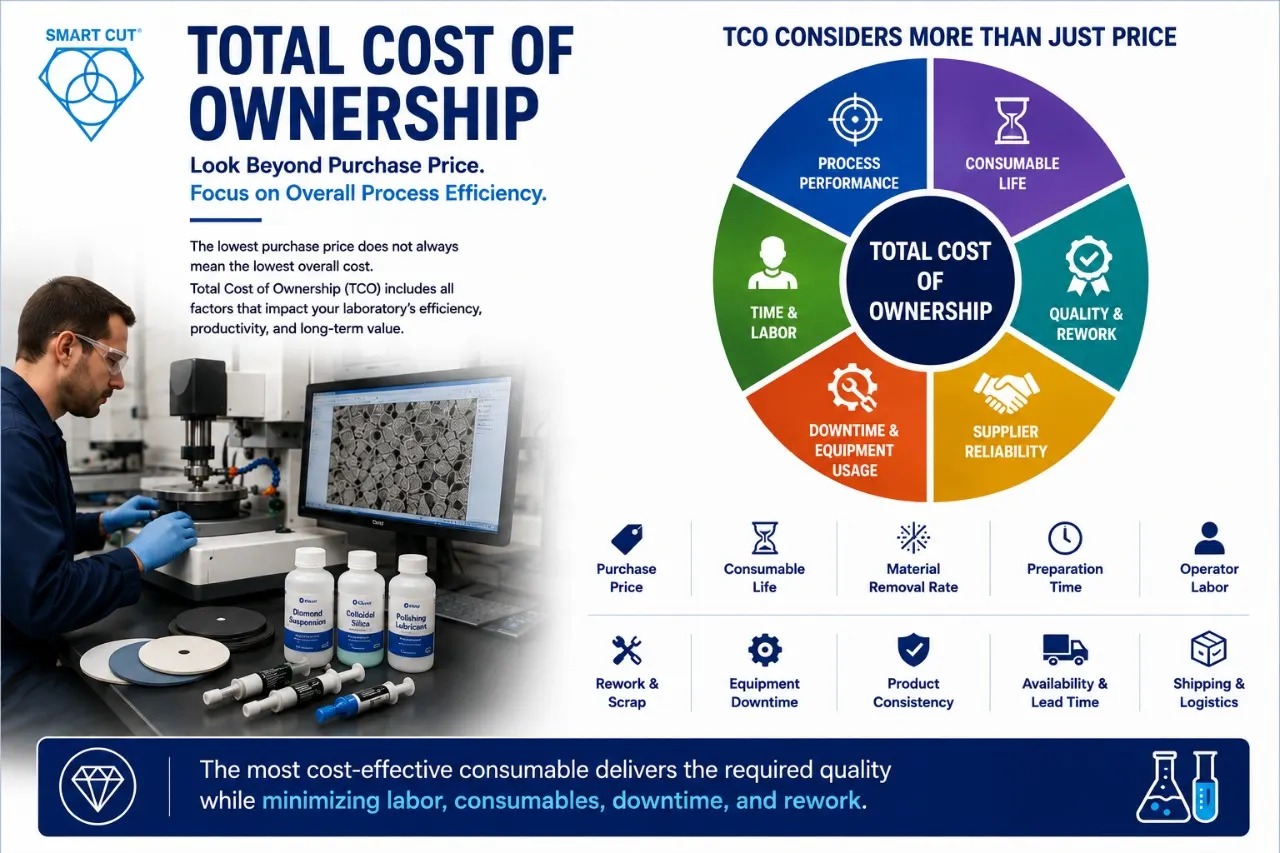
Purchase price is only one factor when evaluating metallography consumables. Laboratories should consider the total cost of using a consumable throughout the entire sample preparation process, including purchase price, consumable life, material removal rate, surface finish quality, preparation time, operator labor, rework, equipment downtime, product consistency, availability, shipping, and lead time.
A consumable with a lower purchase price does not necessarily reduce overall operating costs. If it wears more quickly, requires additional preparation steps, produces inconsistent results, or increases consumable usage, the initial savings may be offset by higher labor costs, more frequent replacement, additional rework, lower productivity, and increased equipment downtime.
For example, a polishing cloth that costs less but lasts only half as long may require more frequent replacement, additional machine setup, and increased operator time. Likewise, a diamond suspension that requires longer polishing times or additional preparation cycles may increase labor costs even if its purchase price is lower.
Similarly, an abrasive cut-off wheel or precision diamond blade that produces excessive chipping, burn damage, edge deformation, or poor surface quality may require additional grinding and polishing to remove damaged material. The added preparation time, increased consumable usage, and additional operator labor can quickly exceed any savings gained from a lower purchase price.
When evaluating the total cost of ownership, laboratories should consider questions such as:
- How many samples can be prepared before the consumable requires replacement?
- Does the consumable reduce overall preparation time?
- Does it consistently produce the required surface finish and dimensional accuracy?
- Does it minimize edge damage, deformation, and rework?
- Does it improve repeatability between operators and sample batches?
- Is knowledgeable technical support available when process optimization is required?
- Can the supplier consistently deliver the same product quality and maintain reliable inventory?
Operator productivity should also be considered. Even small improvements in preparation time can become significant when hundreds or thousands of samples are processed each year. A consumable that reduces preparation time by only a few minutes per sample may generate substantial annual labor savings while increasing laboratory throughput and allowing personnel to focus on higher-value work.
Equipment utilization is another important factor. Consumables that require fewer dressing operations, less frequent replacement, or fewer process interruptions help keep equipment in production longer. Higher equipment availability improves laboratory efficiency and reduces delays in testing schedules.
Product consistency also plays a major role in total cost of ownership. Consistent consumable performance helps reduce process variation, minimizes troubleshooting, improves repeatability, and allows laboratories to maintain standardized preparation procedures across different operators, shifts, and facilities.
Supplier reliability should not be overlooked. A lower-cost consumable provides little value if extended lead times, inconsistent inventory, or unpredictable product quality interrupt laboratory operations. Delayed deliveries can postpone testing, slow production, increase equipment idle time, and ultimately cost far more than the initial purchase price difference.
For laboratories operating under ISO 17025, ASTM, ISO, or internal quality management systems, consistent consumable performance can also reduce the time required for process validation, documentation, quality control, and method verification. Reliable consumables help maintain standardized preparation procedures while reducing the risk of inconsistent results.
Another consideration is technical support. Experienced application engineers can often recommend adjustments to operating parameters, consumable selection, or preparation methods that improve performance and extend consumable life. Access to knowledgeable technical support can reduce trial-and-error, minimize downtime, and improve overall process efficiency.
Ultimately, the lowest-priced consumable is not always the lowest-cost solution. The most cost-effective product is the one that consistently delivers the required preparation quality while minimizing labor costs, consumable consumption, equipment downtime, process variability, and rework.
By evaluating total cost of ownership rather than purchase price alone, laboratories can make purchasing decisions based on overall process efficiency, long-term operating costs, product reliability, and measurable technical performance, resulting in lower operating expenses and more consistent metallographic preparation.
— a principle also covered in Upgrading Metallography Grinding with Silicon Carbide Paper.
A Low-Risk Method for Switching Suppliers
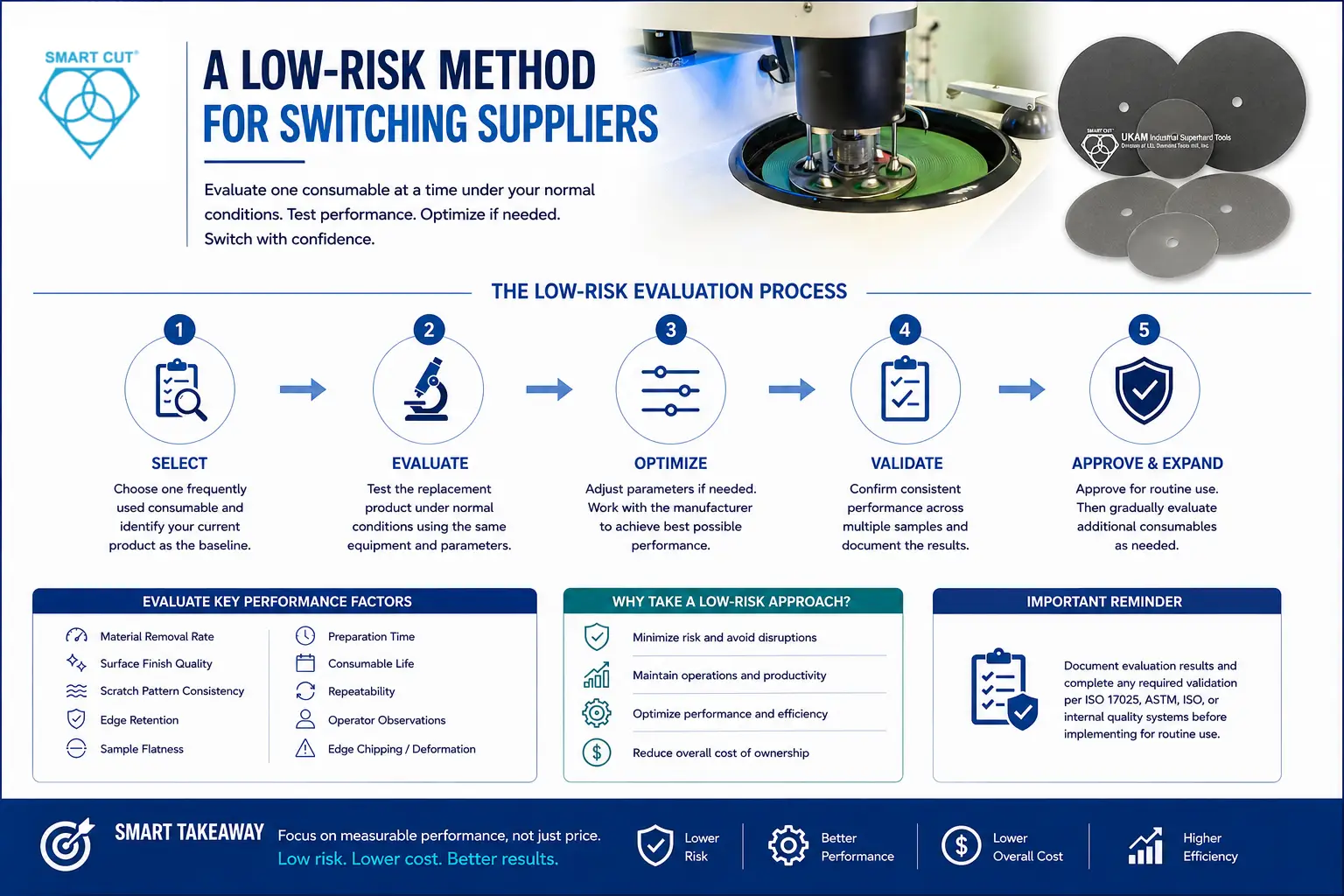
Changing suppliers does not require replacing every consumable at once. Many laboratories successfully transition to a new supplier by evaluating a single, frequently used consumable before expanding to additional products. This approach minimizes risk, reduces disruption to laboratory operations, and allows personnel to compare performance under actual operating conditions before making broader purchasing decisions.
Rather than focusing solely on purchase price, the evaluation should determine whether the replacement consumable can provide equivalent or improved performance, repeatability, preparation quality, and overall operating efficiency. Testing one product at a time also allows laboratories to identify any necessary process adjustments while maintaining confidence in their existing preparation procedures.
A structured evaluation process typically includes:
- Identify the current manufacturer and item number to establish a baseline for comparison.
- Confirm the application, material being prepared, and preparation objectives, including any required surface finish or quality standards.
- Compare the technical specifications such as abrasive type, grit size, bond type, concentration, backing material, or other relevant characteristics.
- Evaluate the product under normal operating conditions using the same equipment, preparation procedures, operating parameters, and sample materials whenever practical.
-
Compare performance, including:
Material removal rate
Surface finish quality
Scratch pattern consistency
Edge retention
Sample flatness
Preparation time
Consumable life
Repeatability between samples
Operator observations - Document the evaluation results, including any adjustments made to operating parameters and the resulting performance.
- Approve the product for routine use if it consistently meets laboratory performance requirements, quality standards, and process objectives.
Whenever possible, evaluate the replacement consumable using multiple representative samples rather than a single test specimen. Testing several samples provides a more reliable assessment of product consistency and helps ensure the results accurately reflect normal laboratory operations.
If the replacement consumable performs differently than the existing product, do not assume it is unsuitable based on the initial trial alone. Equivalent products from different manufacturers often require minor adjustments to operating parameters such as speed, feed rate, applied pressure, lubrication, polishing time, or consumable sequence to achieve optimal performance.
Working closely with the manufacturer during the evaluation can significantly improve the success of the trial. An experienced applications engineer can recommend process adjustments based on the material being prepared, equipment configuration, desired surface finish, and laboratory objectives. In many cases, relatively small process changes can improve preparation quality, extend consumable life, and increase overall process efficiency.
Laboratories operating under ISO 17025, ASTM standards, ISO procedures, or internal quality management systems should document the evaluation results and complete any required validation before implementing replacement consumables for routine production or testing. Proper documentation helps maintain traceability, supports quality assurance programs, and simplifies future purchasing decisions.
Once the evaluation is complete, compare both technical performance and overall operating costs rather than purchase price alone. Consider factors such as consumable life, preparation time, repeatability, rework requirements, equipment utilization, operator productivity, product availability, and technical support. These factors often have a greater impact on long-term operating costs than the initial purchase price.
How to Evaluate a Trial Product
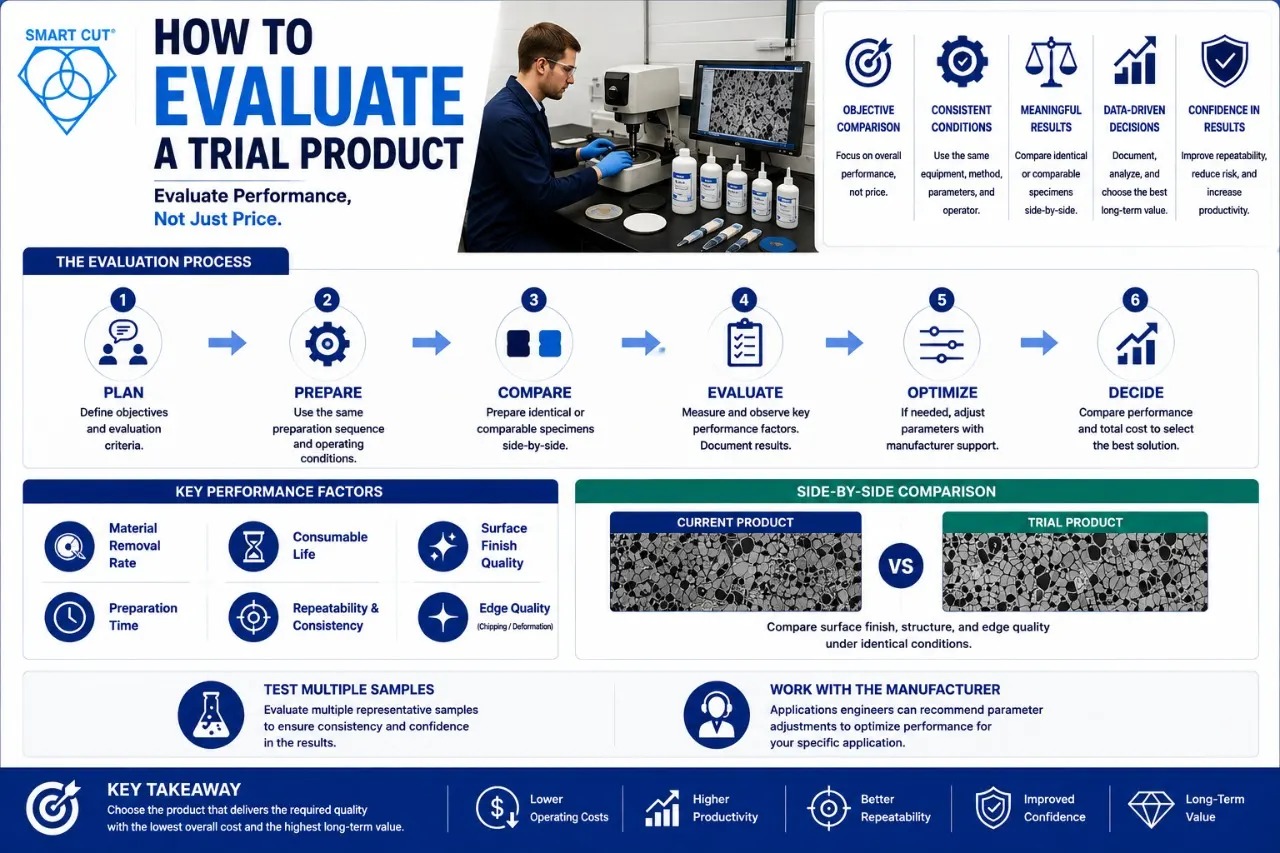
When evaluating a replacement metallography consumable, the objective is to determine whether the product provides equivalent or improved performance under normal laboratory operating conditions. The evaluation should compare overall process performance rather than focusing solely on purchase price.
For the most meaningful comparison, use the same equipment, preparation method, operating parameters, sample material, and operator whenever practical. Maintaining consistent test conditions helps ensure that any differences observed are due to the consumable itself rather than changes in equipment setup or operating technique.
Whenever possible, compare the replacement product directly against your current consumable by preparing identical or comparable specimens using the same preparation sequence. This side-by-side approach makes it easier to identify differences in performance, consistency, and overall preparation quality.
During the evaluation, document both quantitative measurements and qualitative observations, including:
- Cutting or grinding performance
- Material removal rate
- Surface finish quality
- Scratch pattern consistency
- Edge retention
- Sample flatness
- Edge chipping or deformation
- Preparation time
- Consumable life
- Repeatability between multiple samples
- Ease of use
- Operator observations
Depending on the application, laboratories may also evaluate factors such as dimensional accuracy, surface integrity, contamination, deformation, polishing quality, and compatibility with existing preparation procedures.
The trial should include multiple representative samples whenever practical. Testing only one specimen may not accurately reflect normal operating performance. Evaluating several samples helps identify product consistency and improves confidence in the results.
If performance differs from the existing consumable, do not immediately assume that the product is unsuitable. Equivalent consumables from different manufacturers may require minor adjustments to operating parameters to achieve optimal performance. Changes to cutting speed, wheel speed, feed rate, applied pressure, lubrication, polishing time, or consumable sequence can often improve results.
For this reason, laboratories should work closely with the manufacturer during the evaluation process. An experienced applications engineer can recommend parameter adjustments based on the material being prepared, equipment configuration, sample geometry, and desired surface finish. In many cases, small process changes can significantly improve consumable performance.
Once the evaluation is complete, compare the replacement product against the current consumable using both technical performance and overall operating cost. Consider factors such as:
- Purchase price
- Consumable life
- Material removal rate
- Preparation time
- Operator labor
- Surface finish quality
- Repeatability
- Rework requirements
- Equipment downtime
- Product availability
- Technical support
- Overall cost per prepared sample
Laboratories operating under ISO 17025, ASTM procedures, internal quality systems, or other documented preparation methods should record the evaluation results and complete any required validation before implementing the replacement consumable for routine production or testing.
A structured evaluation process allows laboratories to reduce purchasing costs while maintaining confidence in preparation quality, repeatability, process control, and compliance with established laboratory procedures. By comparing products using objective performance criteria rather than brand recognition alone, laboratories can make purchasing decisions based on measurable technical performance and long-term value rather than purchase price alone.
Why Laboratories Choose UKAM
Laboratories purchase from UKAM Industrial Superhard Tools for a variety of reasons, including manufacturer-direct purchasing, cross-reference assistance, technical application support, a broad selection of metallography consumables, custom product capabilities, and technical assistance based on application requirements.
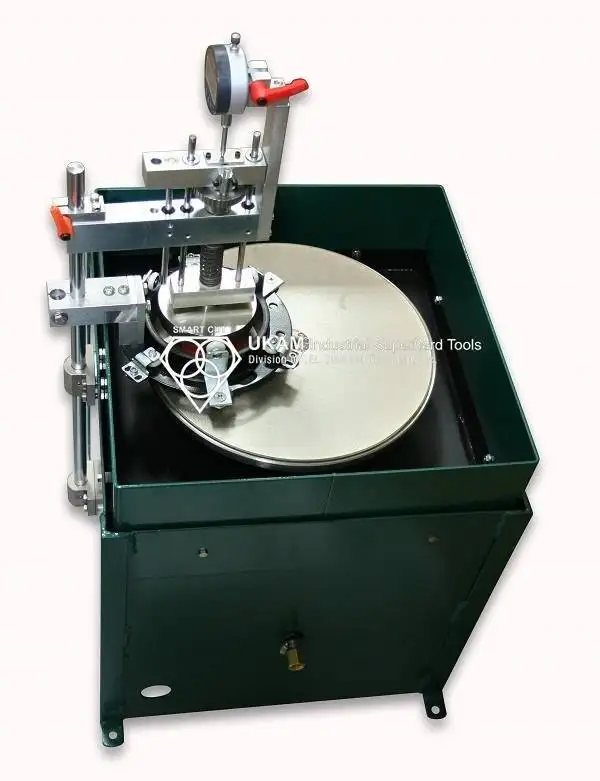
UKAM offers consumables for sectioning, grinding, lapping, and polishing applications used in research laboratories, production facilities, quality control departments, and failure analysis laboratories — supported by equipment such as the SMART CUT LP grinding/polishing machine and a full range of diamond blades for advanced ceramics.
Submit your current manufacturer and item numbers for a technical review.
Frequently Asked Questions
Manufacturing engineers, production managers, and process development teams often encounter similar questions when selecting and optimizing diamond blades for precision cutting. The following answers address common concerns based on the engineering principles discussed throughout this guide.
Yes. UKAM can review many competitor manufacturer and item numbers and recommend comparable products based on technical specifications and application requirements.
Not necessarily. Products are selected based on comparable specifications and intended application, rather than identical manufacturing processes.
In many cases, yes. Minor adjustments to operating parameters may be recommended depending on the product and application.
Many laboratories begin by evaluating one product before deciding whether to replace additional consumables.
Yes. Recommendations can be made based on the material being prepared, equipment used, and preparation requirements.
Blade specifications should be reviewed whenever production conditions change.
Common situations include:
- Introducing a new material
- Tightening dimensional tolerances
- Increasing production volume
- Experiencing changes in blade life
- Noticing inconsistent edge quality
- Modifying machine parameters
Regular reviews help engineers identify opportunities to improve manufacturing efficiency while maintaining process stability.
Custom sizes, specifications, formulations, and packaging may be available depending on the product.
Conclusion
Metallography consumables represent a recurring laboratory expense that can have a significant impact on annual operating costs.
Comparing products based on technical specifications, application requirements, and total cost of ownership provides a more informed basis for purchasing decisions than relying on brand recognition or historical purchasing habits alone.
For laboratories evaluating alternative suppliers, manufacturer-direct purchasing and technical cross-referencing may help identify products that meet application requirements while reducing overall consumable costs.
If your laboratory is interested in comparing its current consumables with manufacturer-direct alternatives, submit your manufacturer and item numbers for technical review.
Get a pricing comparison built around your current products and application requirements
Trusted by Tens of Thousands of Manufacturers, Laboratories,
Research Institutions Worldwide Since 1990
American Based Manufacturer
Established in 1990
Custom manufacturing
RELATED ARTICLES