




















How to Choose Diamond Wafering Blades for Precision Sectioning

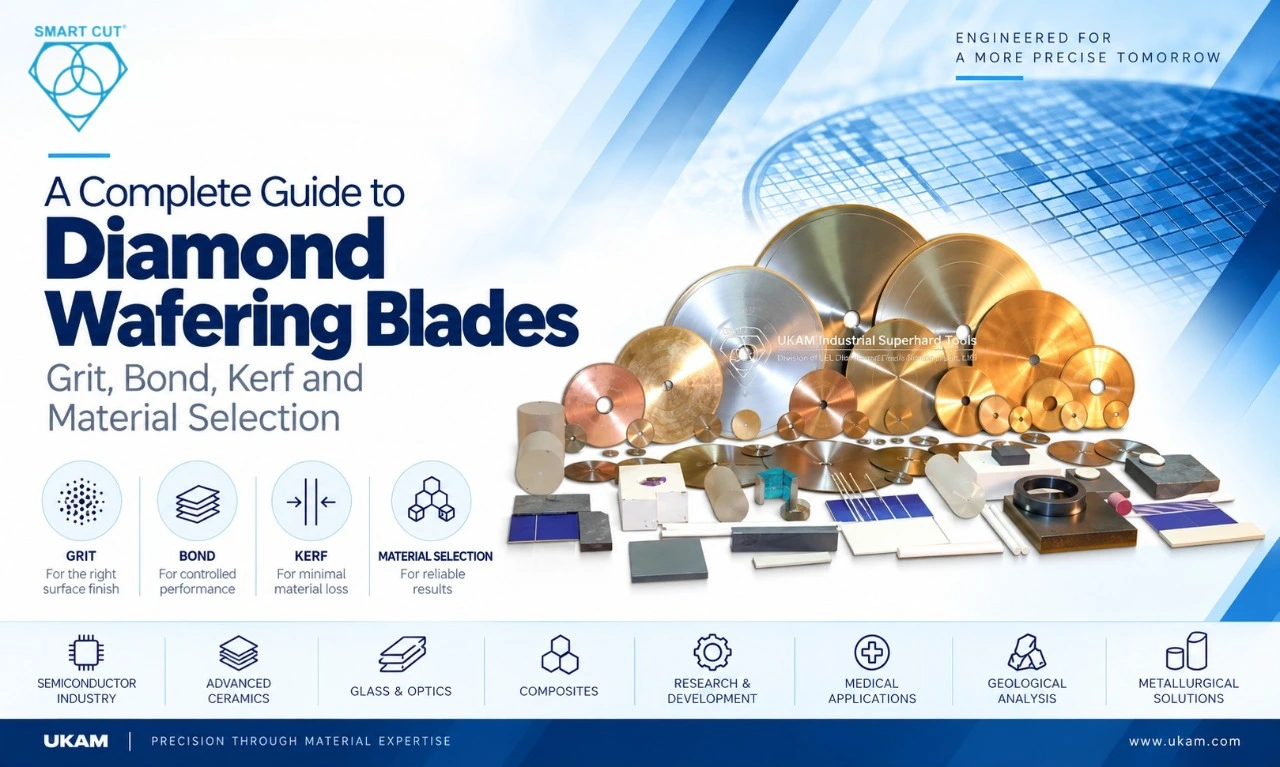
Table of Contents
Toggle
American Based Manufacturer

Established in 1990


Custom manufacturing


Grit, bond, kerf, and material selection — treated as a system problem, not a catalog lookup.
Precision sectioning is often treated as a blade selection problem. In practice, the blade is only one part of the cutting system.
A diamond wafering blade with the correct diameter and arbor can still produce excessive chipping, material deformation, poor surface finish, blade deflection, overheating, or unacceptable material loss. The result depends on the relationship between material, diamond mesh size, concentration, bond, blade thickness, kerf, machine capability, coolant, feed, speed, and workholding.
For engineers sourcing diamond wafering blades, the useful specification is therefore more than blade diameter. A blade should be selected against the actual sectioning requirement and then qualified under controlled production conditions.
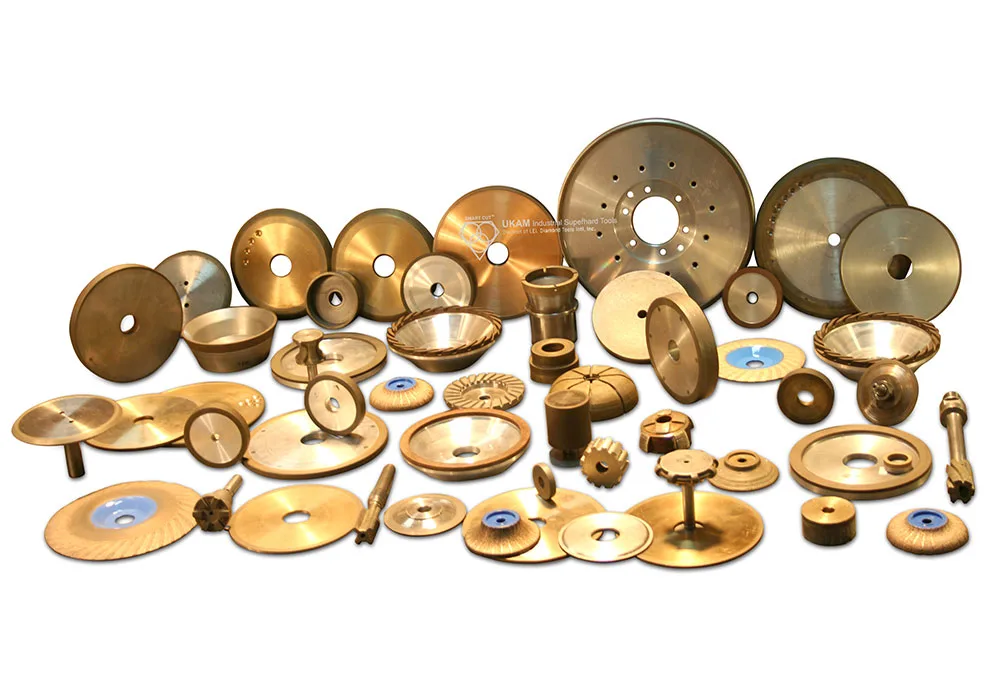
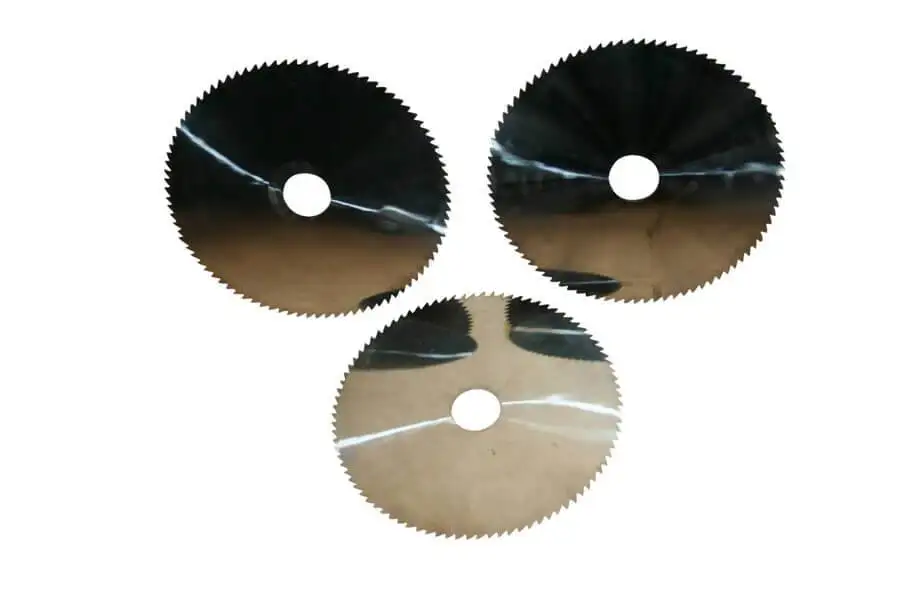
UKAM manufactures precision diamond and CBN wafering and sectioning blades for laboratory, industrial, research, semiconductor, optics, advanced ceramics, composites, glass, geological, medical, and metallurgical applications. Its wafering blade range includes different diameters, kerfs, diamond sizes, concentrations, bond constructions, arbor configurations, and blade geometries.
Why Engineers Reconsider the Wafering Blade Specification
A blade change is usually triggered by a measurable production problem rather than a desire for a different specification.
|
Production symptom |
What to investigate first |
|---|---|
|
Excessive edge chipping |
Diamond mesh size, bond, feed, workholding, blade runout |
|
Poor surface finish |
Grit size, blade condition, feed rate, material response |
|
High material loss |
Kerf and blade thickness |
|
Blade deflection |
Blade thickness, arbor, machine stiffness, unsupported length |
|
Excessive heat |
Speed, feed, coolant delivery, loading |
|
Slow cutting |
Diamond exposure, concentration, bond behavior, process parameters |
|
Short blade life |
Material abrasiveness, concentration, bond wear, operating conditions |
|
Variable section thickness |
Runout, blade stiffness, workholding, alignment |
|
Frequent dressing |
Blade construction, material loading, process conditions |
|
High scrap rate |
Edge damage, deformation, dimensional variation, process stability |
The first question should not be “which blade is fastest?” The better question is: which blade specification produces the required section quality at the lowest total cost per accepted section?
Document the Existing Process Before Changing the Blade
A new blade should not be evaluated against memory or supplier claims. Record the existing process first — this baseline makes the trial measurable and prevents a blade problem from being confused with machine runout, poor support, or inconsistent material.
|
Parameter |
Record before the trial |
|---|---|
|
Material |
Exact grade, hardness, brittleness, reinforcement |
|
Workpiece thickness |
Actual section thickness |
|
Section dimensions |
Length, width, diameter where applicable |
|
Required section thickness |
Target and tolerance |
|
Edge quality |
Maximum permitted chip or breakout |
|
Surface finish |
Required Ra or inspection criterion |
|
Blade diameter / thickness / kerf |
Current values |
|
Diamond size / concentration / bond |
Mesh designation, stated concentration, bond type |
|
Arbor / Saw |
Diameter, mounting arrangement, manufacturer and model |
|
Speed / Feed |
Actual RPM and feed rate |
|
Coolant / Workholding |
Type, delivery method and flow; fixture and support arrangement |
|
Blade runout |
Measured value |
|
Tool life / Scrap / Cycle time |
Accepted sections, rejection %, cutting + changeover time |
Diamond Mesh Sizes: Start With the Required Section Quality
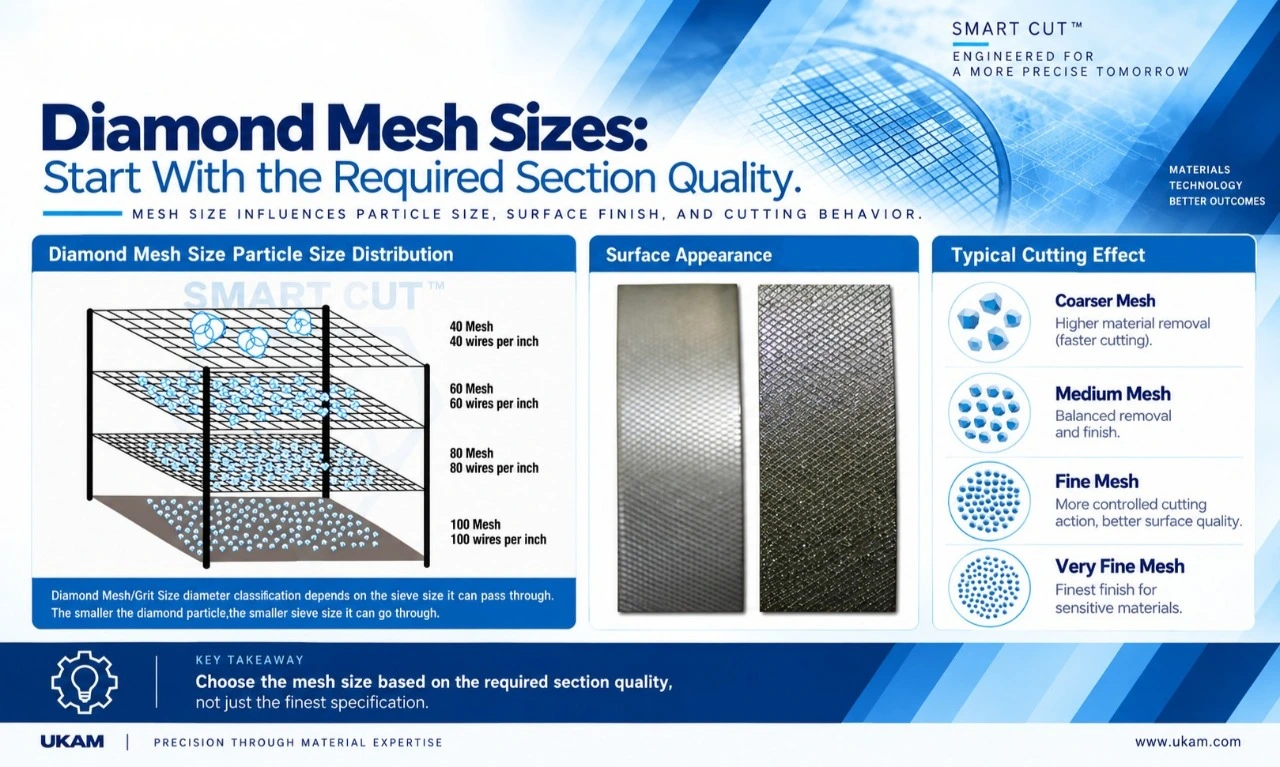
Diamond mesh size describes the approximate particle size classification used for the abrasive. UKAM lists diamond sizes from 60 to 400 mesh across its wafering blade range. Its blade series also use numbered designations, with finer specifications represented by lower series numbers and coarser specifications by higher numbers.
The selection should begin with the required section quality rather than automatically choosing the finest available abrasive.
|
Diamond spec |
General cutting behavior |
Typical consideration |
|---|---|---|
|
Coarser diamond |
Higher material removal potential |
Faster sectioning where edge damage is acceptable |
|
Medium diamond |
Balance between removal and finish |
General precision sectioning |
|
Fine diamond |
More controlled abrasive interaction |
Brittle materials, improved surface quality |
|
Very fine diamond |
Fine cutting action |
Highly sensitive surfaces, finishing applications |
Finer diamond can reduce the size of individual cutting interactions, but that does not automatically make it the best production choice. A fine specification can cut inefficiently if the bond, exposure, feed, or debris removal does not allow the abrasive to work effectively. Coarser diamond can increase productivity, but aggressive abrasive interaction can increase edge breakout in sensitive materials. A 3″ fine mesh sintered wafering blade is one example of a specification built specifically around controlled, low-chip cutting.
Engineering rule: select diamond size from the required edge condition first, then qualify cutting rate and blade life.
When comparing suppliers, ask for the actual diamond designation. A mesh number, micron range, and commercial grit code should not be treated as interchangeable descriptions — see this diamond and CBN wafering blade guide for a deeper breakdown of how mesh size interacts with concentration.
Kerf and Blade Thickness Directly Affect Material Yield
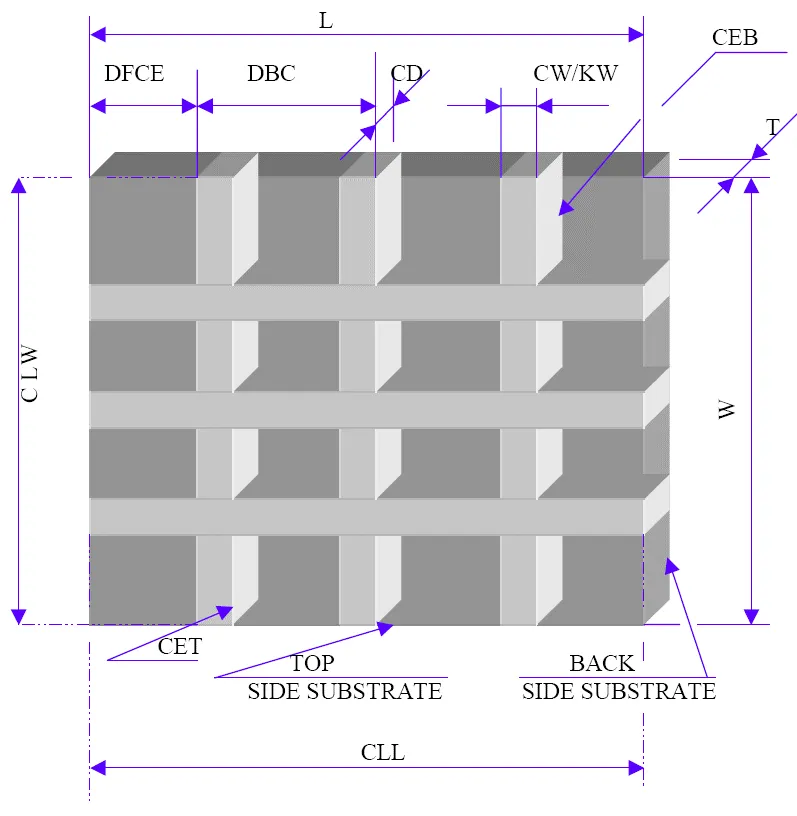
For high value materials, kerf is not a minor dimensional specification. UKAM lists wafering blade kerfs from approximately 0.004″ (0.1 mm) to 0.035″ (0.8 mm), depending on blade construction and application.
Consider a production process requiring 5,000 sections:
|
Kerf |
Approx. material removed |
|---|---|
|
0.10 mm |
500 mm |
|
0.20 mm |
1,000 mm |
|
0.50 mm |
2,500 mm |
|
0.80 mm |
4,000 mm |
These values are illustrative and represent accumulated width of material removed. Actual yield also depends on section spacing, blade geometry, setup, and material condition. A thinner blade can reduce material loss, but reducing thickness also changes blade stiffness and sensitivity to runout — the thinnest available blade is therefore not automatically correct. UKAM’s ultra thin diamond dicing blades illustrate this tradeoff at the extreme end of the thickness range.
Thinner kerf = lower material loss. Greater blade stiffness = potentially greater process stability. The correct specification balances both.
Bond Selection Changes How the Diamond Works
The diamond itself does not determine cutting behavior. The way the abrasive is retained controls exposure, wear, cutting action, and usable blade life.
|
Bond |
Primary characteristic |
Selection consideration |
|---|---|---|
|
Sintered metal bond |
Abrasive incorporated through the working layer |
Controlled wear, longer working life |
|
Resin bond |
Fine cutting action, precision sectioning |
Surface quality and thin kerf priorities |
|
Nickel bond |
Exposed abrasive, nickel deposition |
Open cutting action |
|
Brazed diamond |
Strongly retained exposed diamond |
High removal, specialty applications |
|
CBN |
Cubic boron nitride abrasive |
Suitable ferrous materials |
|
Specialized construction |
Application specific geometry |
Requires qualification against the actual process |
Sintered metal bond blades contain diamond within the working matrix. As the matrix wears, additional abrasive can become exposed. Bond wear must be controlled — excessively slow wear can cause rubbing or glazing, while excessive wear can release useful abrasive too quickly.
Resin bond construction is used where thin kerf and controlled cutting are required. UKAM’s Series 400 resin bond blades are designed for precision sectioning on high-speed wafering or sectioning saws, and its broader resin bond wafering blade line covers a range of geometries and hardness grades for high-speed laboratory saws.
Nickel and brazed constructions behave differently because the abrasive is retained through a deposited or brazed interface — they should not be evaluated using the same wear assumptions as an impregnated metal bond blade. UKAM’s nickel bond wafering blades are built around this different retention mechanism.
REQUEST A WAFERING BLADE RECOMMENDATION
Provide your material, section dimensions, required kerf, saw model, RPM, feed rate, and required finish for an application-specific blade recommendation.
Diamond Concentration Must Be Evaluated With Grit and Bond
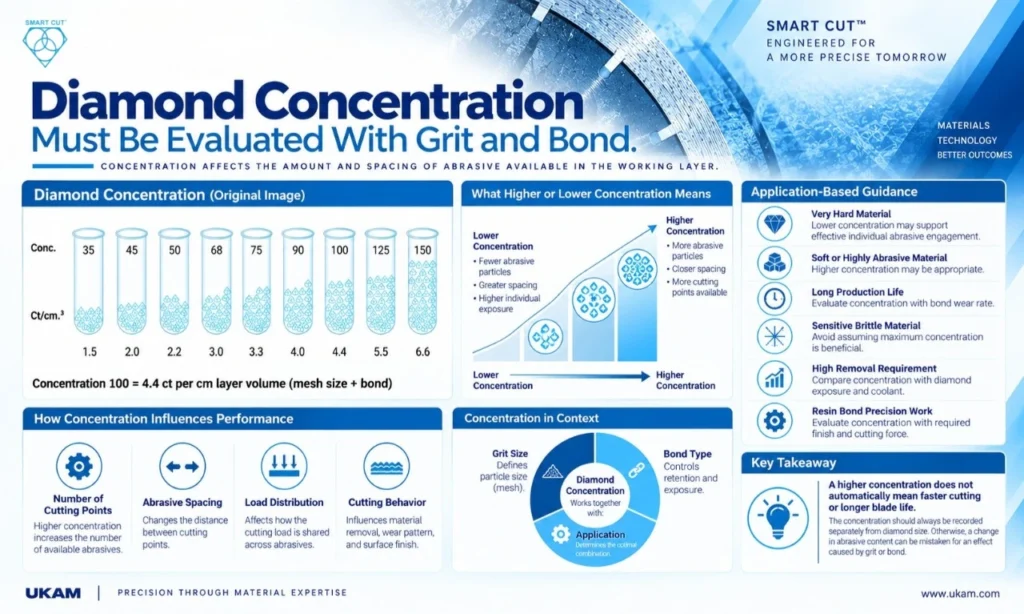
Concentration affects the amount and spacing of abrasive available in the working layer. A higher concentration does not automatically mean faster cutting or longer blade life — it changes the number of available cutting points and the distribution of abrasive load.
|
Requirement |
Concentration consideration |
|---|---|
|
Very hard material |
Lower concentration may support effective individual abrasive engagement |
|
Soft or highly abrasive material |
Higher concentration may be appropriate |
|
Long production life |
Evaluate concentration with bond wear rate |
|
Sensitive brittle material |
Avoid assuming maximum concentration is beneficial |
|
High removal requirement |
Compare concentration with diamond exposure and coolant |
|
Resin bond precision work |
Evaluate concentration with required finish and cutting force |
The concentration should always be recorded separately from diamond size, otherwise a change in abrasive content can be mistaken for an effect caused by grit or bond. The diamond and CBN wafering blade guide covers how concentration is specified relative to bond hardness in practice.
Match the Blade to the Precision Sectioning Saw
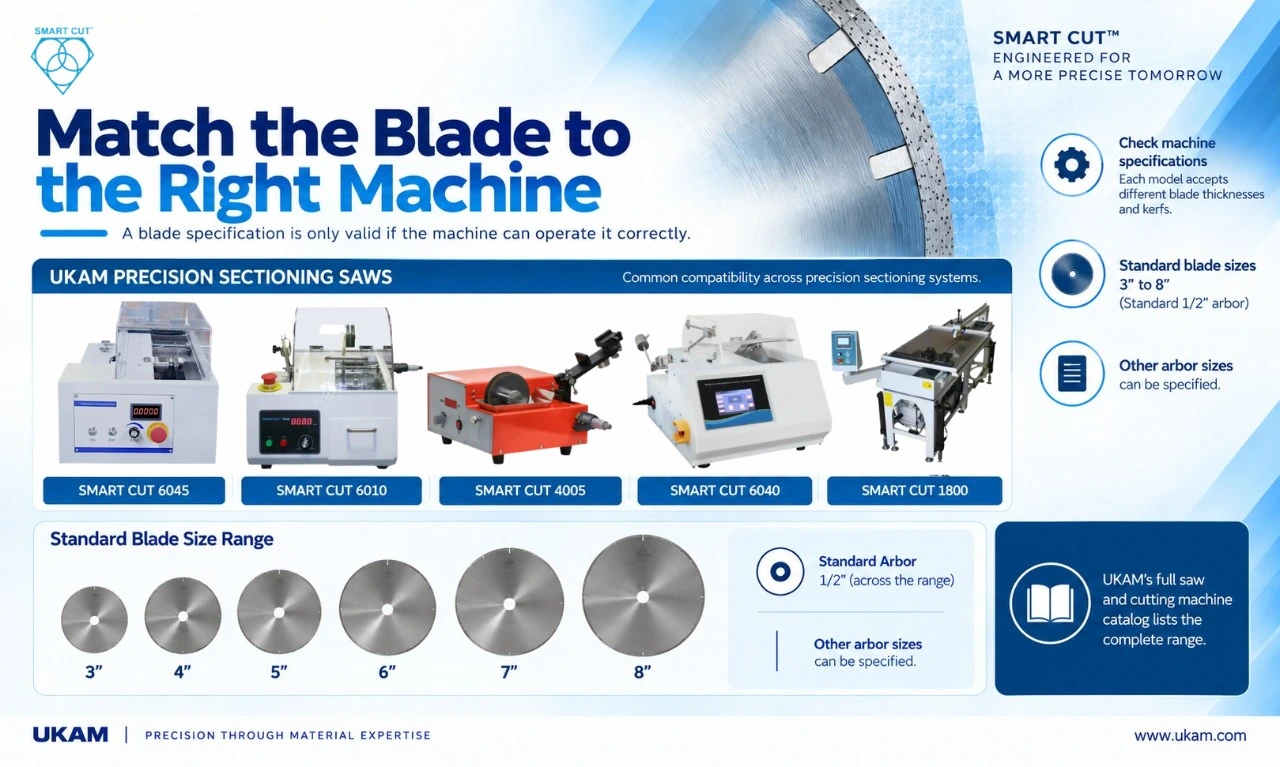
A blade specification is only valid if the machine can operate it correctly. UKAM lists wafering blades for low speed, high speed, and laboratory saws, with common compatibility across precision sectioning systems. Standard blade sizes range from approximately 3″ to 8″, with a standard 1/2″ arbor available across the range; other arbor sizes can be specified.
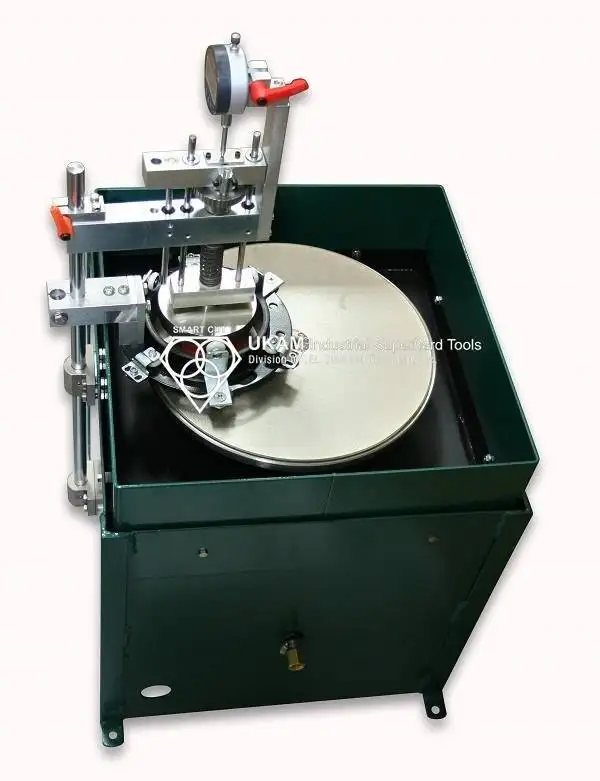
Machines such as the SMART CUT 6045, the SMART CUT 6010, the SMART CUT 4005, the SMART CUT 6040, and the SMART CUT 1800 each accept a different range of blade thicknesses and kerfs, so the machine’s spec sheet should be checked before a blade is finalized. UKAM’s full saw and cutting machine catalog lists the complete range.
|
Machine parameter |
Why it matters |
|---|---|
|
Maximum / minimum RPM |
Determines usable blade speed and low-speed capability |
|
Arbor size |
Mounting compatibility |
|
Flange condition |
Blade alignment |
|
Spindle runout |
Variable kerf and section thickness |
|
Machine rigidity |
Blade deflection |
|
Feed control |
Consistency |
|
Coolant delivery |
Heat and debris control |
|
Workholding / blade clearance |
Material movement, prevents unwanted contact |
The machine should be checked before concluding that the blade is responsible for dimensional variation. UKAM’s flanges and blade accessories — including wheel stiffeners and dressing sticks — are often the first place to look when runout or blade flatness becomes a problem.
Material Specific Selection: Identify the Failure Mode
Different materials produce different sectioning problems. The blade specification should respond to the actual failure mode.
Silicon Carbide
Silicon carbide is extremely hard and brittle. Excessive abrasive engagement can generate edge breakout. Primary checks: diamond mesh size, blade runout, feed rate, workholding, coolant, and bond behavior. UKAM’s semiconductor industry tooling covers blade and notch-grinding specifications built around SiC and related substrates.
Alumina
Alumina can exhibit grain related edge damage when cutting conditions generate excessive local force. Primary checks: finer diamond specification, stable feed, blade stiffness, adequate coolant. This is one of the material classes covered under UKAM’s advanced ceramics tooling.
Silicon Nitride
Silicon nitride combines high hardness with sensitivity to process conditions. Primary checks: heat generation, coolant delivery, blade loading, speed, and feed.
Tungsten Carbide
Tungsten carbide can create substantial abrasive demand and change blade cutting behavior as the working layer wears. Primary checks: bond wear rate, diamond concentration, coolant, blade conditioning requirements.
Sapphire
Sapphire is hard, brittle, and sensitive to local stresses at entry and exit surfaces. Primary checks: fine diamond size, blade stability, controlled feed, workholding, breakthrough conditions. UKAM’s diamond wire is one alternative worth considering for particularly sensitive sapphire sectioning.
Fused Silica
Fused silica can develop fine cracks or edge damage not obvious from visual inspection. Primary checks: fine abrasive specification, thermal control, coolant, controlled feed.
GaAs
Gallium arsenide requires careful control of sectioning conditions because edge damage can affect subsequent processing. Primary checks: blade kerf, fine diamond specification, runout, feed stability, workholding. See the semiconductor wafer dicing guide for parameter recommendations specific to GaAs, Si, and SiC.
PCD
Polycrystalline diamond can create high abrasive demand and significant blade wear. Primary checks: bond construction, diamond concentration, cutting efficiency, cooling, blade life. Tool life should be defined by accepted sections, not the point at which the blade physically stops cutting.
A Six Phase Qualification Process
A controlled trial prevents the common mistake of changing the blade, feed, speed, coolant, and fixture simultaneously.
PHASE 1 — DEFINE THE MATERIAL
Record exact material grade, thickness, hardness, abrasiveness, reinforcement, coating, and production condition.
PHASE 2 — DEFINE THE SECTION
Record target thickness, kerf allowance, surface finish, edge quality, dimensional tolerance, and acceptable scrap limit.
PHASE 3 — CONFIRM THE SAW
Measure blade runout, confirm arbor compatibility, inspect flanges, verify speed range, and check workholding against your precision sectioning saw’s spec sheet.
PHASE 4 — SPECIFY THE BLADE
Define diameter, arbor, thickness, kerf, diamond mesh size, concentration, bond, blade geometry, diamond section depth, operating range.
PHASE 5 — RUN A CONTROLLED TRIAL
Keep the machine, material, fixture, coolant, and inspection method consistent. Change one major blade variable at a time where possible.
PHASE 6 — MEASURE PRODUCTION PERFORMANCE
Record cutting time, edge damage, section thickness, surface finish, blade wear, dressing frequency, accepted sections, scrap, tool changes, total process cost.
The best blade is the one that satisfies the acceptance criteria repeatedly. UKAM’s wafering blade case studies and diamond wafering blade case studies walk through real qualification results across several material types.
Troubleshooting Diamond Wafering Blade Problems
|
Problem |
First checks |
Possible blade related cause |
|---|---|---|
|
Entry chipping |
Alignment, runout, support |
Grit too aggressive or unsuitable bond |
|
Exit chipping |
Backing, breakthrough feed |
Excessive cutting force |
|
Rough surface |
Blade condition, feed |
Coarse diamond specification |
|
Slow cutting |
Coolant, loading, feed |
Bond holding abrasive too strongly |
|
Excessive blade wear |
Material abrasiveness |
Inadequate bond or concentration |
|
Blade deflection |
Machine rigidity, projection |
Blade too thin for the setup |
|
Variable section thickness |
Runout, flange condition |
Blade or mounting instability |
|
Overheating |
Coolant and cutting load |
Loading, inappropriate grit or bond |
|
Short blade life |
Material and process conditions |
Unsuitable construction |
|
Increasing kerf |
Runout and blade wear |
Blade deterioration or mounting error |
A key diagnostic principle is to determine when the defect begins. Damage appearing immediately at entry suggests a different problem from damage appearing only at breakthrough. Progressive deterioration during blade life points toward wear, loading, bond behavior, or process changes. If the root cause is coolant related, this surface finish failure diagnostic guide walks through how to isolate coolant formulation from blade specification issues.
Also see UKAM’s wafering blade usage recommendations for dressing procedures that resolve many of the symptoms above without a blade change at all.
Cost Per Acceptable Section Matters More Than Blade Price
The lowest blade price can produce the highest production cost if it has shorter life, greater scrap, or more frequent dressing. The following example is illustrative and does not represent UKAM test results.
|
Parameter |
Supplier A |
Supplier B |
|---|---|---|
|
Blade price |
$180 |
$125 |
|
Sections per blade |
140 |
85 |
|
Dressing interval |
Every 35 sections |
Every 20 sections |
|
Dressing cost |
$12 |
$10 |
|
Cutting time |
42 sec |
34 sec |
|
Scrap rate |
1.5% |
3.5% |
|
Machine rate |
$120/hr |
$120/hr |
|
Cost per accepted section |
$2.36 |
$3.22 |
Supplier B has the lower purchase price and shorter cutting time. Supplier A produces a lower estimated cost per accepted section because its combination of blade life, dressing frequency, and scrap rate is more favorable.
Total process cost can include: blade cost, machine time, dressing, coolant, labor, tool changes, inspection, rework, scrap, setup and downtime.
COMPARE YOUR CURRENT BLADE SPECIFICATION
Compare your current diameter, thickness, kerf, mesh size, concentration, bond, cutting parameters, and blade life against the requirements of your application.
Questions to Ask a Diamond Wafering Blade Supplier
|
Ask the supplier |
What the answer should reveal |
|---|---|
|
What diamond mesh size do you recommend, and why? |
Relationship between abrasive size and material |
|
What bond is being used? |
Expected wear and cutting behavior |
|
What concentration is specified? |
Abrasive content and cutting point distribution |
|
What is the actual blade kerf? |
Material yield |
|
What blade thickness is recommended? |
Balance of stiffness and material loss |
|
What RPM / feed range applies? |
Machine compatibility, process starting point |
|
What coolant is required? |
Thermal and debris management |
|
How should the blade be dressed? |
Conditioning requirements |
|
What determines useful blade life? |
Acceptance-based life definition |
|
Can the blade be custom manufactured? |
Ability to address nonstandard requirements |
A technically capable supplier should be able to discuss the complete blade and process specification rather than quoting diameter alone. UKAM’s frequently asked questions page and how to order guide outline what to expect from a quote and consultation process, and its customer support hub covers technical support, SDS requests, and consultation forms.
SMART CUT and Other Blade Construction Options
|
Blade / technology |
Construction |
Primary consideration |
|---|---|---|
|
SMART CUT sintered metal |
Sintered metal bond |
Controlled abrasive exposure, repeat production |
|
Resin bond |
Precision sectioning, thin kerf applications |
|
|
Series 100N / 105N |
Nickel bond |
Exposed abrasive, specialized sectioning |
|
Multiple constructions |
Material specific precision sectioning |
|
|
CBN wafering blades |
CBN abrasive |
Suitable ferrous material applications |
|
Thin precision construction |
Low material loss, sensitive sectioning |
UKAM describes its SMART CUT sintered technology as an open diamond bond design intended to expose additional diamond as the matrix wears. Its wafering range also includes resin, nickel, and CBN constructions, and the broader diamond and CBN blade catalog covers dicing, lapidary, and gang-cutting formats built on the same technology.
Common Mistakes in Wafering Blade Selection
Mistake 1: SELECTING BY DIAMETER ALONE
A blade can have the correct diameter but the wrong thickness, kerf, mesh size, bond, or concentration.
Better approach: specify the complete blade construction.
Mistake 2: CHOOSING THE FINEST DIAMOND AUTOMATICALLY
Fine diamond may improve surface quality but can reduce cutting efficiency in some applications.
Better approach: balance edge quality with removal rate.
Mistake 3: CHOOSING THE THINNEST BLADE AVAILABLE
Reducing kerf reduces material loss but can increase sensitivity to machine runout and blade deflection.
Better approach: select thickness according to both material value and machine stiffness.
Mistake 4: IGNORING RUNOUT
A blade can appear defective when the actual problem is mounting or spindle alignment.
Better approach: measure mounted runout before changing blade specifications.
Mistake 5: OPTIMIZING CUTTING SPEED ALONE
Higher cutting speed can increase scrap or reduce blade life.
Better approach: optimize accepted sections per production hour.
Mistake 6: MEASURING TOOL LIFE ONLY
A blade that still cuts may already be producing unacceptable sections.
Better approach: define useful blade life by accepted production.
Mistake 7: CHANGING MULTIPLE VARIABLES TOGETHER
Changing blade, RPM, feed, coolant, and fixture simultaneously makes the result difficult to interpret.
Better approach: establish a baseline and change one major variable at a time. A good starting reference is selecting the right wafering blade for your application.
Example Engineering Blade Specification
A supplier should receive enough information to reproduce the required blade.
|
Specification |
Example |
|---|---|
|
Application |
Precision sectioning |
|
Material |
Advanced ceramic |
|
Workpiece thickness |
6 mm |
|
Required section |
0.8 mm |
|
Blade diameter / thickness / kerf |
4″ / 0.15 mm / 0.20 mm |
|
Diamond size |
Fine mesh specification |
|
Concentration |
Application qualified |
|
Bond |
Resin or selected metal construction |
|
Arbor |
1/2″ |
|
Saw |
|
|
Coolant |
|
|
Acceptance |
Thickness, edge quality, finish, yield |
The exact specification should be established through application testing rather than copied from another material. For custom geometries outside standard catalog dimensions, UKAM’s custom precision cutting machine and tool manufacturing group can build to a client drawing or specification.
Precision Sectioning Qualification Checklist
Blade
- Diameter specified
- Blade thickness specified
- Kerf specified
- Diamond mesh size specified
- Concentration specified
- Bond specified
- Arbor specified
- Blade geometry specified
Machine
- RPM range confirmed
- Feed capability confirmed
- Spindle runout checked
- Flanges inspected
- Machine rigidity evaluated
- Workholding verified
Quality
- Section thickness measured
- Edge damage measured
- Surface finish measured
- Scrap rate recorded
- Blade life defined by accepted sections
- Cost per accepted section calculated
Material
- Exact material grade recorded
- Thickness recorded
- Hardness and abrasiveness considered
- Coatings or reinforcement identified
Process
- Coolant delivery confirmed
- Entry condition evaluated
- Exit condition evaluated
- Cutting parameters recorded
- Dressing procedure defined
Frequently Asked Questions
Diamond wafering blades are used for precision sectioning of hard, brittle, abrasive, and advanced materials where controlled material removal and section quality are required — ceramics, glass, quartz, composites, semiconductor materials, geological specimens, medical materials, optics, and metallographic samples. The appropriate blade construction depends on the material and the required section quality.
There is no universal mesh size correct for every application. Finer diamond generally supports more controlled abrasive interaction and can be appropriate where surface and edge quality are critical. Coarser diamond can support higher material removal in suitable materials. The correct selection depends on material hardness, brittleness, required finish, cutting rate, blade construction, and machine conditions.
No. A thinner blade can reduce kerf and material loss, which is valuable when processing expensive materials. However, reduced thickness can also increase sensitivity to runout, mounting errors, vibration, and machine rigidity. The correct blade thickness balances material yield against process stability.
Diamond is generally selected for hard nonferrous materials, ceramics, glass, composites, stone, and similar materials. CBN is intended for suitable ferrous material applications. The abrasive should be selected according to the workpiece chemistry, hardness, cutting mechanism, and required production result — see diamond vs CBN wafering blades for a fuller comparison.
Blade life depends on material, diamond size, concentration, bond, blade thickness, speed, feed, coolant, workholding, and machine condition. Increasing blade life should not be pursued independently of section quality — a blade that lasts longer but produces unacceptable sections has not delivered useful production life.
Chipping can result from excessive feed, vibration, runout, inadequate support, unsuitable diamond size, inappropriate bond behavior, poor breakthrough control, or inadequate coolant. First identify whether damage occurs at entry, during steady cutting, or at exit — the location and timing narrow the cause considerably.
Not necessarily. Concentration changes abrasive content and cutting point distribution. A higher concentration can change load sharing and wear behavior, but cutting speed also depends on diamond size, bond, material, machine parameters, coolant, and blade condition. Concentration should be qualified as part of the complete blade specification.
Yes. UKAM’s diamond tooling can be manufactured to application requirements — custom dimensions, blade characteristics, abrasive specifications, bond types, concentrations, mounting arrangements, and tolerances — through its custom diamond and CBN tool manufacturing program. Custom tooling becomes valuable when a standard blade forces a compromise in kerf, section quality, tool life, or production efficiency.
Final Engineering Principles
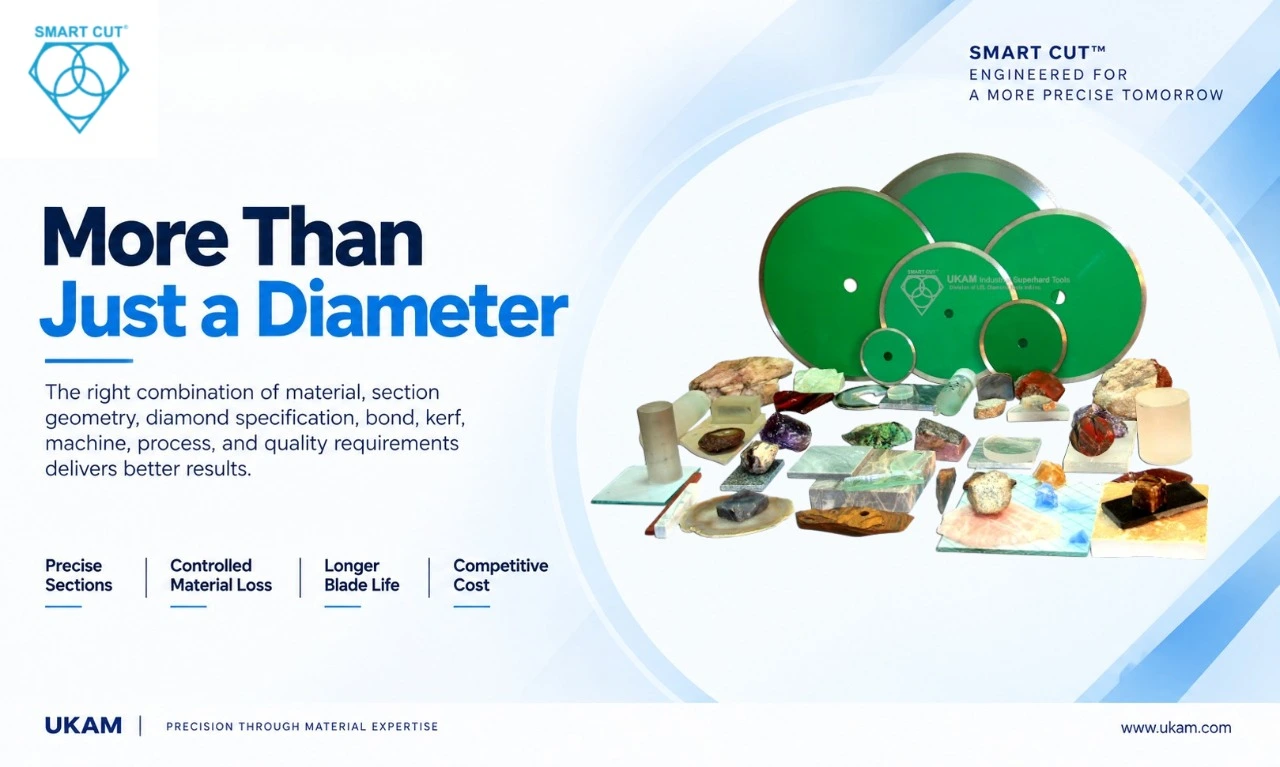
Choosing a diamond wafering blade should never be reduced to finding the correct diameter. The actual selection problem is:
Material + Section Geometry + Diamond Specification + Bond + Kerf + Machine + Process + Quality Requirement
The key variables include material and material condition, section thickness, required kerf, blade thickness, diamond mesh size, diamond concentration, bond construction, blade diameter, arbor configuration, saw RPM, feed rate, coolant delivery, workholding, machine runout, required surface finish, edge quality, acceptable scrap rate, and useful blade life.
The final measure of success should be: accepted sections + stable cutting process + controlled material loss + reasonable blade life + competitive cost. Not simply: lowest blade price + fastest cutting speed.
UKAM provides diamond and CBN wafering and sectioning blade options across different diameters, kerfs, abrasive sizes, concentrations, bond constructions, and mounting configurations. The company also supports application specific tooling for precision sectioning requirements.
NEED HELP SELECTING THE RIGHT DIAMOND WAFERING BLADE?
If your current process is experiencing excessive chipping, high material loss, poor surface finish, blade deflection, short blade life, excessive heat, slow cutting, frequent dressing, variable section thickness, or high scrap rates — the solution may not be another standard blade.
Trusted by Tens of Thousands of Manufacturers, Laboratories,
Research Institutions Worldwide Since 1990
American Based Manufacturer
Established in 1990
