




















How to Create a Diamond Blade Testing SOP

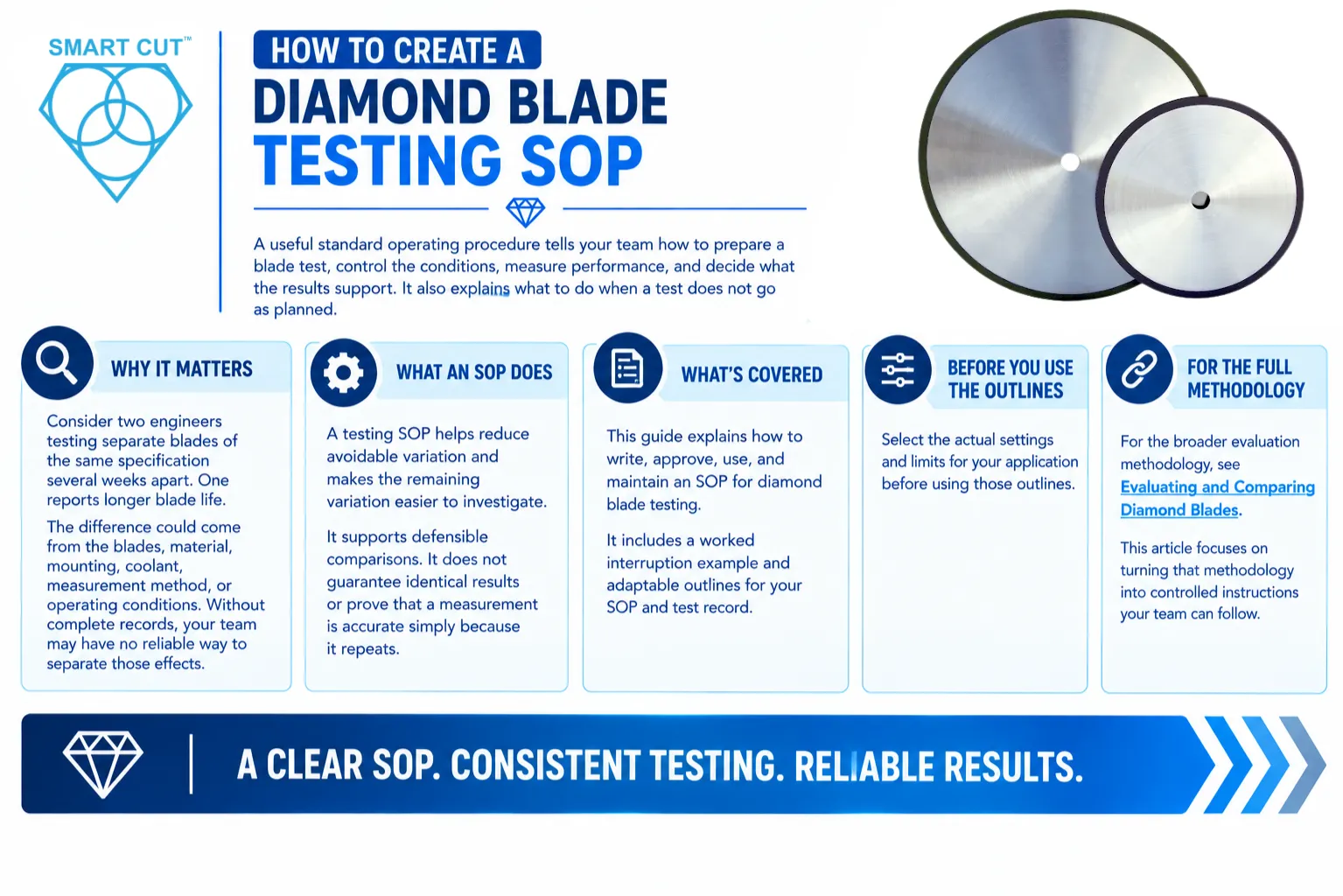
Table of Contents
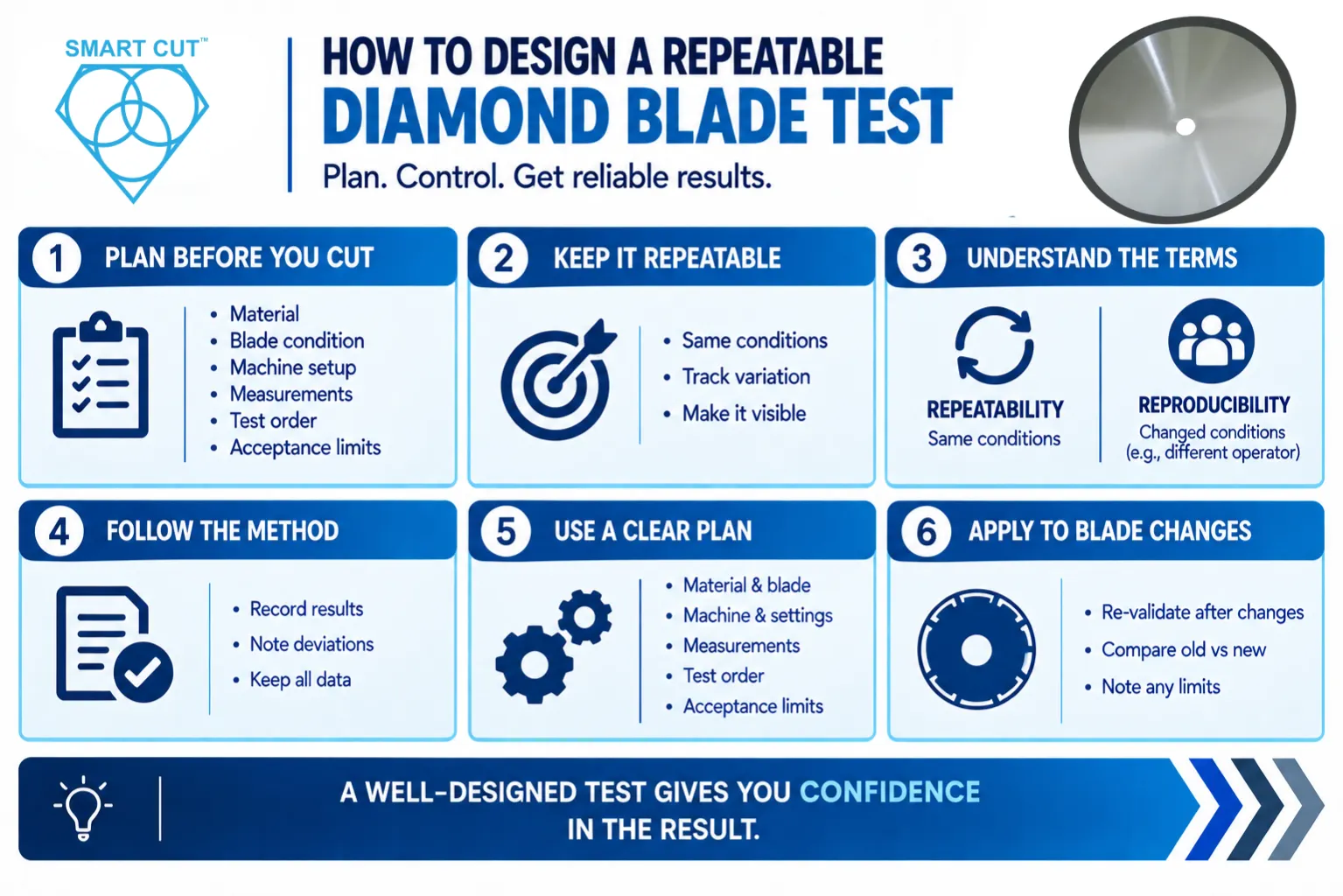
ToggleA useful standard operating procedure tells your team how to prepare a blade test, control the conditions, measure performance, and decide what the results support. It also explains what to do when a test does not go as planned.
Consider two engineers testing separate blades of the same specification several weeks apart. One reports longer blade life. The difference could come from the blades, material, mounting, coolant, measurement method, or operating conditions. Without complete records, your team may have no reliable way to separate those effects.
A testing SOP helps reduce avoidable variation and makes the remaining variation easier to investigate. It supports defensible comparisons. It does not guarantee identical results or prove that a measurement is accurate simply because it repeats.
This guide explains how to write, approve, use, and maintain an SOP for diamond blade testing. It includes a worked interruption example and adaptable outlines for your SOP and test record. Select the actual settings and limits for your application before using those outlines.
For the broader evaluation methodology, see Evaluating and Comparing Diamond Blades. This article focuses on turning that methodology into controlled instructions your team can follow.
Trusted by Tens of Thousands of Manufacturers, Laboratories Research Institutions Worldwide Since 1990

American Based Manufacturer

Established in 1990


Custom manufacturing


Start with the decision your test must support
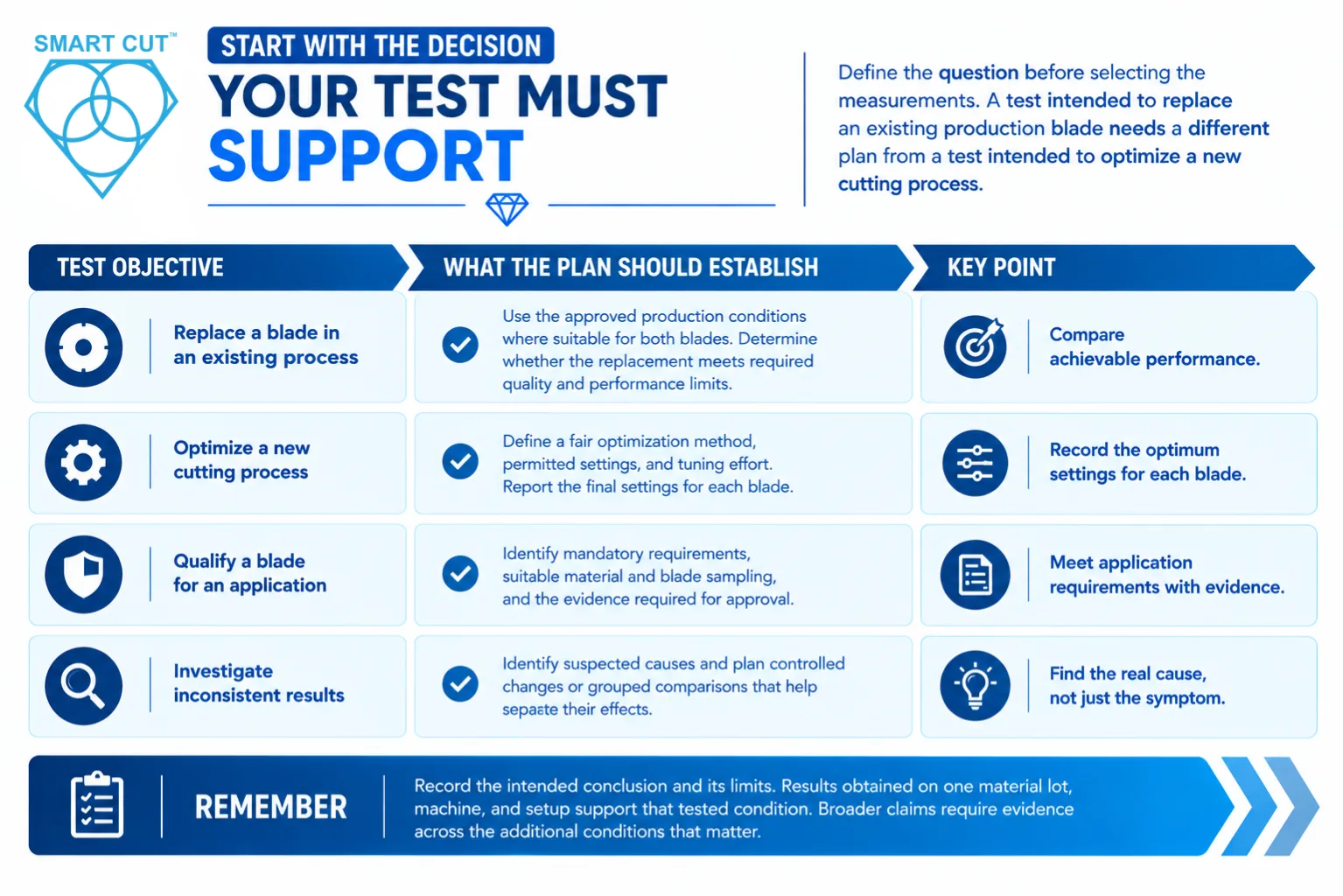
Define the question before selecting the measurements. A test intended to replace an existing production blade needs a different plan from a test intended to optimize a new cutting process.
| Test objective | What the plan should establish |
|---|---|
| Replace a blade in an existing process | Use the approved production conditions where suitable for both blades. Determine whether the replacement meets required quality and performance limits. |
| Compare achievable performance | Define a fair optimization method, permitted settings, and tuning effort. Report the final settings for each blade. |
| Qualify a blade for an application | Identify mandatory requirements, suitable material and blade sampling, and the evidence required for approval. |
| Investigate inconsistent results | Identify suspected causes and plan controlled changes or grouped comparisons that help separate their effects. |
Record the intended conclusion and its limits. Results obtained on one material lot, machine, and setup support that tested condition. Broader claims require evidence across the additional conditions that matter.
Choose a document structure your team can maintain
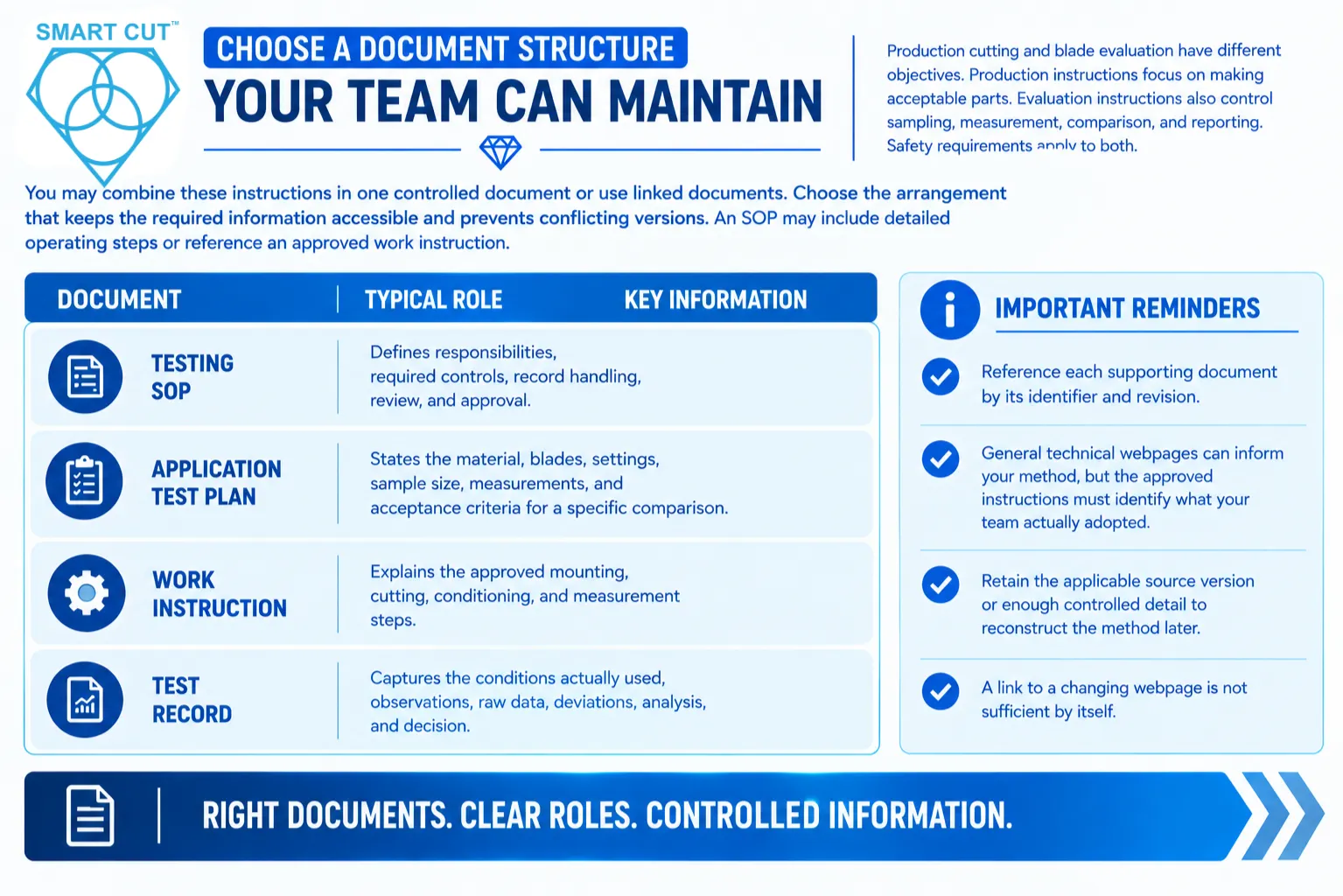
Production cutting and blade evaluation have different objectives. Production instructions focus on making acceptable parts. Evaluation instructions also control sampling, measurement, comparison, and reporting. Safety requirements apply to both.
You may combine these instructions in one controlled document or use linked documents. Choose the arrangement that keeps the required information accessible and prevents conflicting versions. An SOP may include detailed operating steps or reference an approved work instruction.
| Document | Typical role |
|---|---|
| Testing SOP | Defines responsibilities, required controls, record handling, review, and approval. |
| Application test plan | States the material, blades, settings, sample size, measurements, and acceptance criteria for a specific comparison. |
| Work instruction | Explains the approved mounting, cutting, conditioning, and measurement steps. |
| Test record | Captures the conditions actually used, observations, raw data, deviations, analysis, and decision. |
Reference each supporting document by its identifier and revision. General technical webpages can inform your method, but the approved instructions must identify what your team actually adopted. Retain the applicable source version or enough controlled detail to reconstruct the method later. A link to a changing webpage is not sufficient by itself.
Define scope and responsibilities
State the blade types, material families, machine capabilities, and test objectives covered by the SOP. Identify important exclusions. For example, a method developed for one blade construction should not automatically authorize the same conditioning procedure for every bond type.
Assign a test owner to approve the plan and resolve deviations. Identify qualified operators, the person responsible for measurement, and the reviewer who approves the report. In a small team, one person may perform several roles. Record who performed each action and apply any independent review required by your quality system.
Distinguish repeatability from reproducibility. Repeatability concerns agreement under closely matched measurement conditions, usually over a short period. Reproducibility concerns agreement when specified conditions change, such as the operator or equipment. State which conditions you are assessing and report the observed variation. Consistent readings can still contain systematic error.
Control the blade and the complete cutting setup
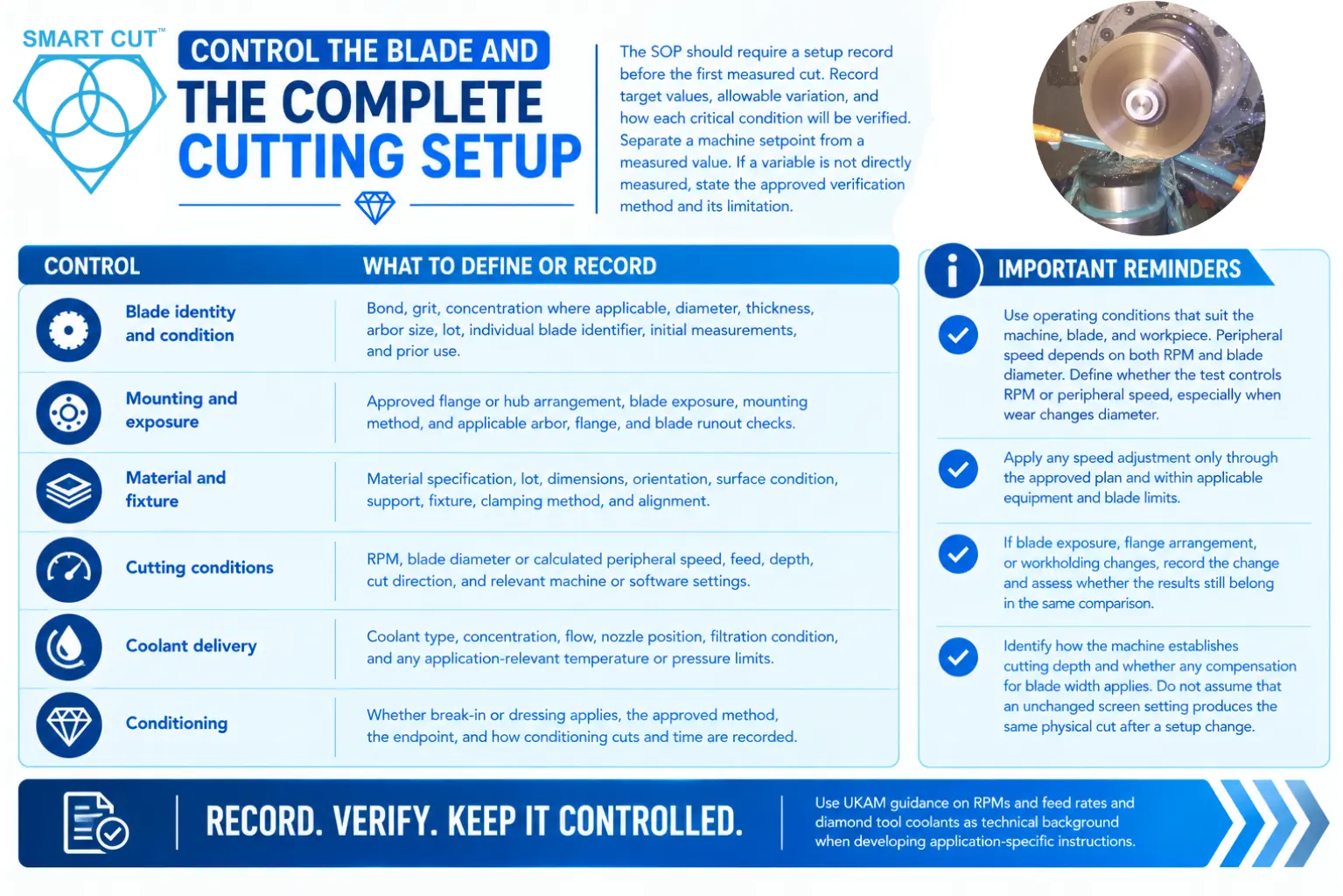
The SOP should require a setup record before the first measured cut. Record target values, allowable variation, and how each critical condition will be verified. Separate a machine setpoint from a measured value. If a variable is not directly measured, state the approved verification method and its limitation.
| Control | What to define or record |
|---|---|
| Blade identity and condition | Bond, grit, concentration where applicable, diameter, thickness, arbor size, lot, individual blade identifier, initial measurements, and prior use. |
| Mounting and exposure | Approved flange or hub arrangement, blade exposure, mounting method, and applicable arbor, flange, and blade runout checks. |
| Material and fixture | Material specification, lot, dimensions, orientation, surface condition, support, fixture, clamping method, and alignment. |
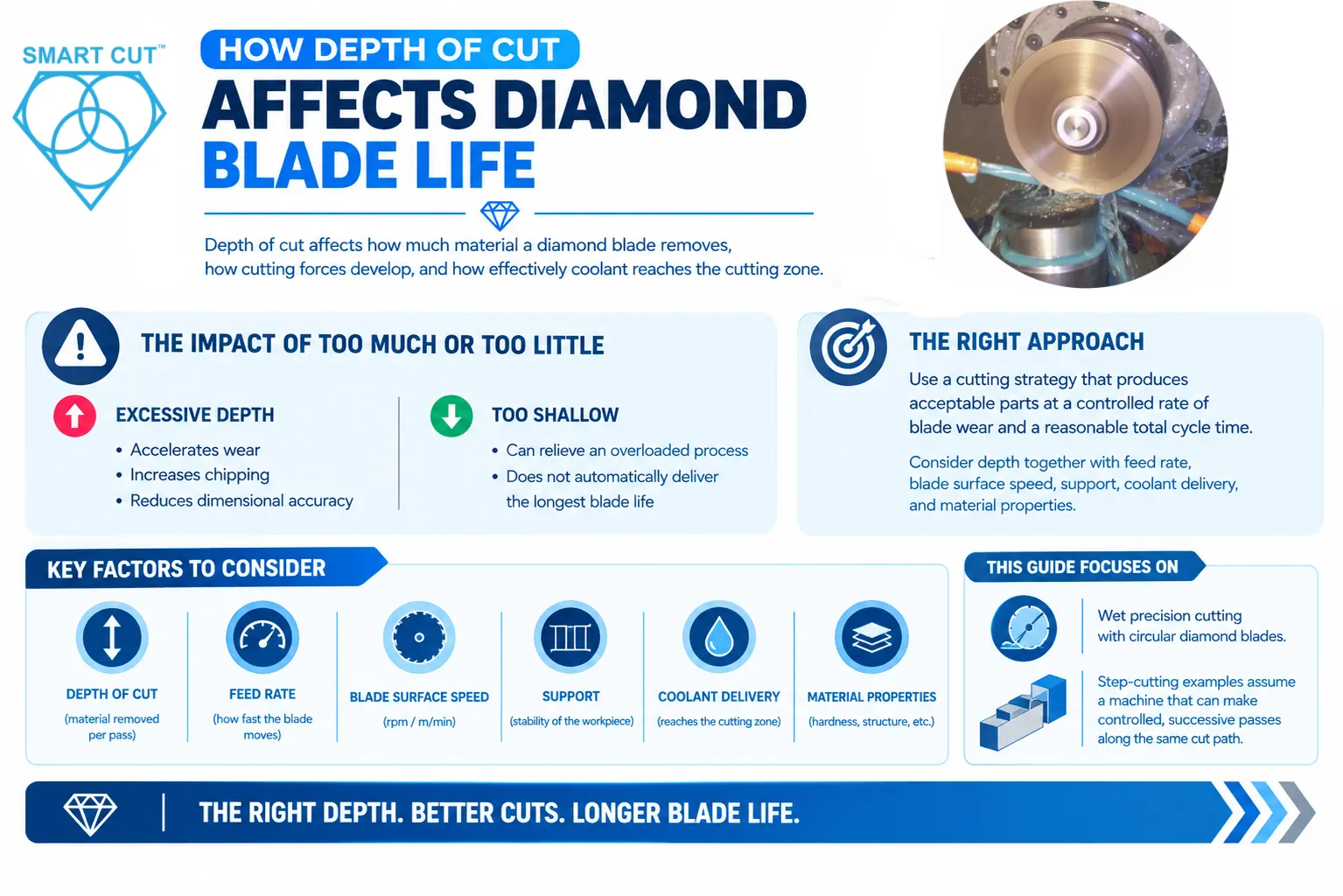
| Cutting conditions | RPM, blade diameter or calculated peripheral speed, feed, depth, cut direction, and relevant machine or software settings. |
| Coolant delivery | Coolant type, concentration, flow, nozzle position, filtration condition, and any application-relevant temperature or pressure limits. |
| Conditioning | Whether break-in or dressing applies, the approved method, the endpoint, and how conditioning cuts and time are recorded. |
Use operating conditions that suit the machine, blade, and workpiece. Peripheral speed depends on both RPM and blade diameter. Define whether the test controls RPM or peripheral speed, especially when wear changes diameter. Apply any speed adjustment only through the approved plan and within applicable equipment and blade limits.
If blade exposure, flange arrangement, or workholding changes, record the change and assess whether the results still belong in the same comparison. Identify how the machine establishes cutting depth and whether any compensation for blade width applies. Do not assume that an unchanged screen setting produces the same physical cut after a setup change.
Use UKAM guidance on RPMs and feed rates and diamond tool coolants as technical background when developing application-specific instructions.
Make safety and stopping rules part of the method
Reference the applicable machine instructions, blade limits, approved guarding, protective equipment, and site safety procedures. Define safe mounting, inspection, and maintenance steps. Where access exposes personnel to hazardous energy, require the applicable isolation procedure.
Specify the conditions that require the operator to stop using the approved stopping procedure. Examples include loss of required coolant, workpiece movement, suspected blade damage, abnormal vibration, or a machine alarm. Data collection never takes priority over safe operation.
Define who may authorize a restart and what must be checked first. Keep safety limits separate from performance targets. A test plan cannot authorize operation outside the approved limits of the equipment or blade.
Specify measurements that answer the test question
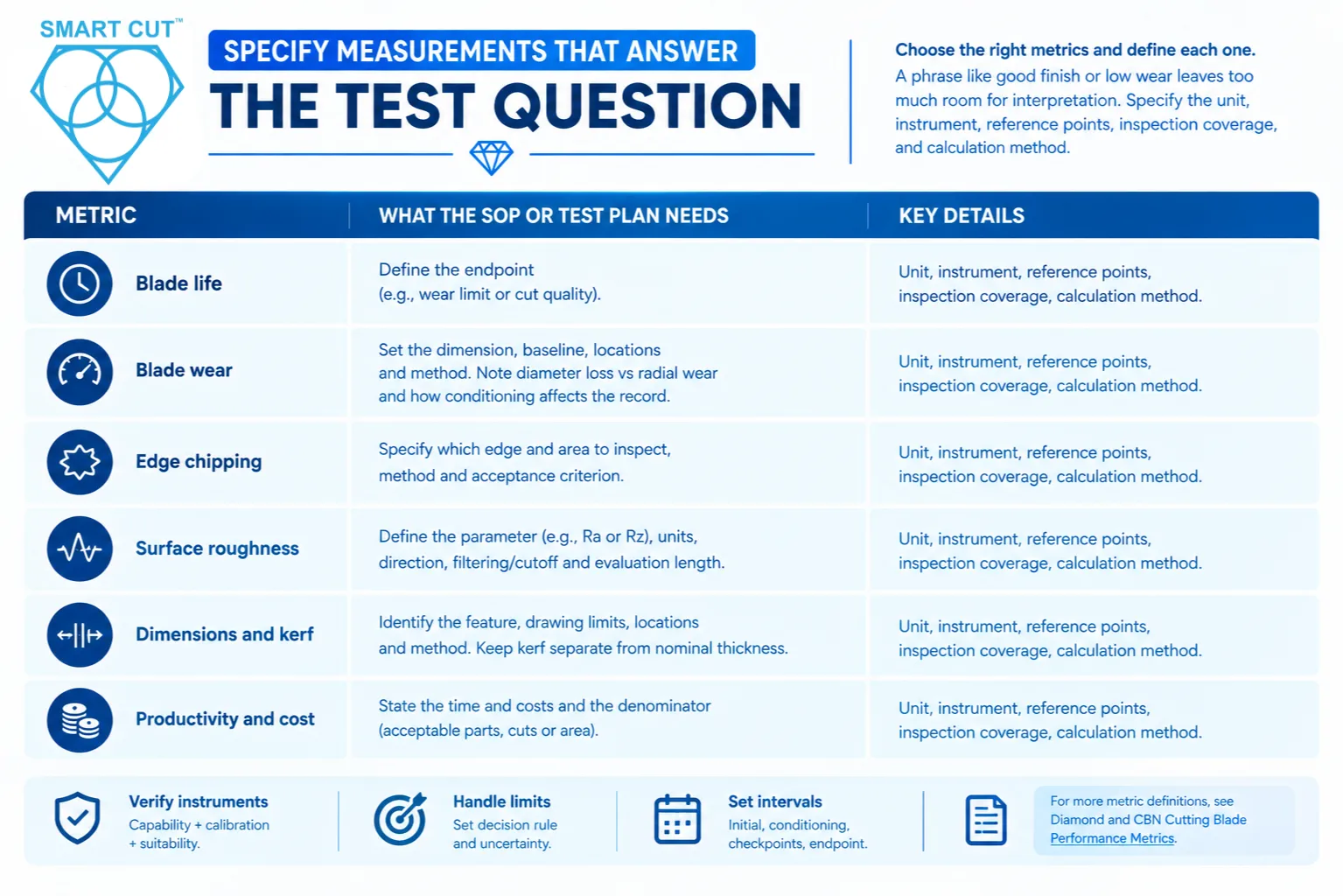
Choose the required metrics and define each one. A phrase such as good finish or low wear leaves too much room for interpretation. Specify the unit, instrument, reference points, inspection coverage, and calculation method.
| Metric | Definition the SOP or test plan needs |
|---|---|
| Blade life | The endpoint, such as an approved wear limit or loss of required cut quality. State whether life means acceptable cuts, cutting area, or another defined quantity. |
| Blade wear | The dimension measured, baseline, locations, and method. Distinguish diameter loss from radial wear and state how conditioning affects the record. |
| Edge chipping | Which edge and area are inspected, the inspection method, and whether the criterion concerns the largest chip or another defined measure. |
| Surface roughness | The specified parameter, such as Ra or Rz, its units, measurement direction, filtering or cutoff, and evaluation length where applicable. |
| Dimensions and kerf | The feature being measured, its drawing limits, locations, and method. Keep measured kerf distinct from nominal blade thickness. |
| Productivity and cost | What time and costs are included, and whether the denominator is acceptable parts, cuts, or cutting area. |
Verify that each instrument has suitable capability, valid calibration status where required, and satisfactory checks for the intended use. Calibration status alone does not establish that a method can resolve the difference you want to measure.
Define how results near a specification limit will be handled. Where measurement uncertainty matters to the decision, include it in the approved decision rule. Do not round a borderline result into acceptance.
Set inspection intervals before testing. Include the initial condition, any conditioning stage, planned checkpoints, and the endpoint. A full-life test must track performance through the approved endpoint. If you stop earlier, report a partial test. Any projected life must remain clearly separate from measured life and state its assumptions.
For additional metric definitions, see Diamond and CBN Cutting Blade Performance Metrics.
Define independent repeats and control test order
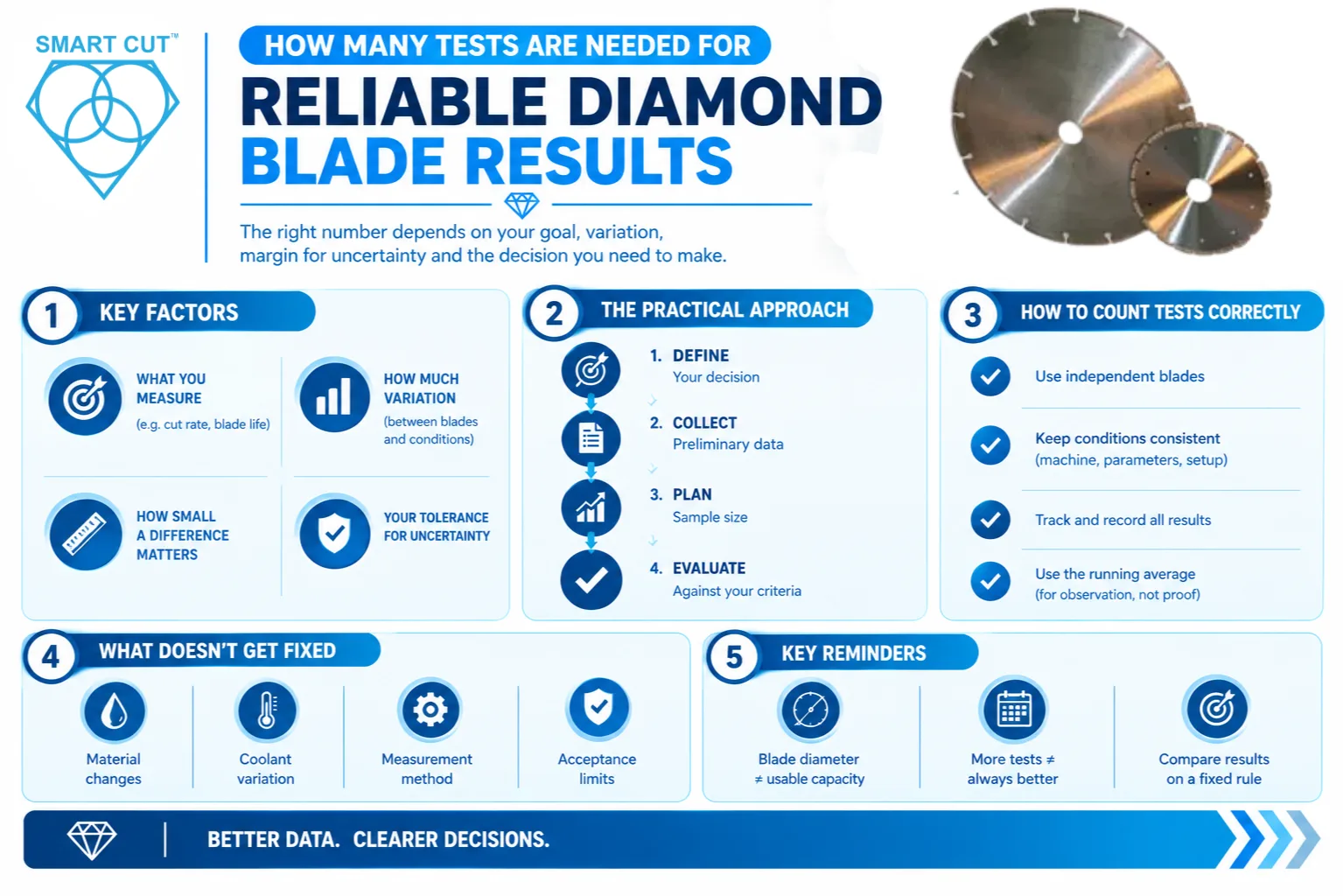
Record how many blades, runs, specimens, cuts, and repeated measurements the plan requires. These counts describe different levels of evidence. One hundred cuts made with one blade provide a history of that blade. They do not provide one hundred independent blade life results.
For example, three separate blades tested to their defined endpoints provide three blade life observations. Measuring each blade repeatedly improves the description of its wear history. It does not increase the number of independent blades. Three blades are an illustration of the distinction, not a universal sample size recommendation. [3]
Select the number of independent repeats using the observed variation, the size of the difference that matters, and the confidence needed for the decision. Use pilot data when variation is unknown. Approve the sample size rationale and any rules for extending the study before reviewing the final comparison.
Control test order so one blade group is not consistently tested under different background conditions. Randomize the order where practical. Where material lot, day, or machine introduces variation, consider planned groups of comparable tests and record those groupings. Match the analysis to the actual design. [3]
For destructive cutting tests, operators cannot always test the same physical specimen twice. Plan equivalent specimens and sufficient independent runs. Do not reuse a worn blade as though it were a new replicate.
Set acceptance criteria and decision rules before testing
Start with mandatory requirements. These may include dimensional tolerance, a maximum roughness value, a maximum chip size, and a minimum number of acceptable cuts. Obtain the limits from the application requirements and record their source.
Apply required quality and safety limits before ranking cost or productivity. A fast blade that fails a mandatory cut requirement is not an acceptable replacement. A weighted score may help compare acceptable alternatives if the metrics, weights, and calculations were approved in advance.
Define what counts as a pass, a fail, or an inconclusive result. Also define what evidence makes a test invalid. An inconclusive comparison may need more evidence. An invalid test needs a documented explanation. Neither outcome should be quietly relabeled as a blade failure or removed because it is inconvenient.
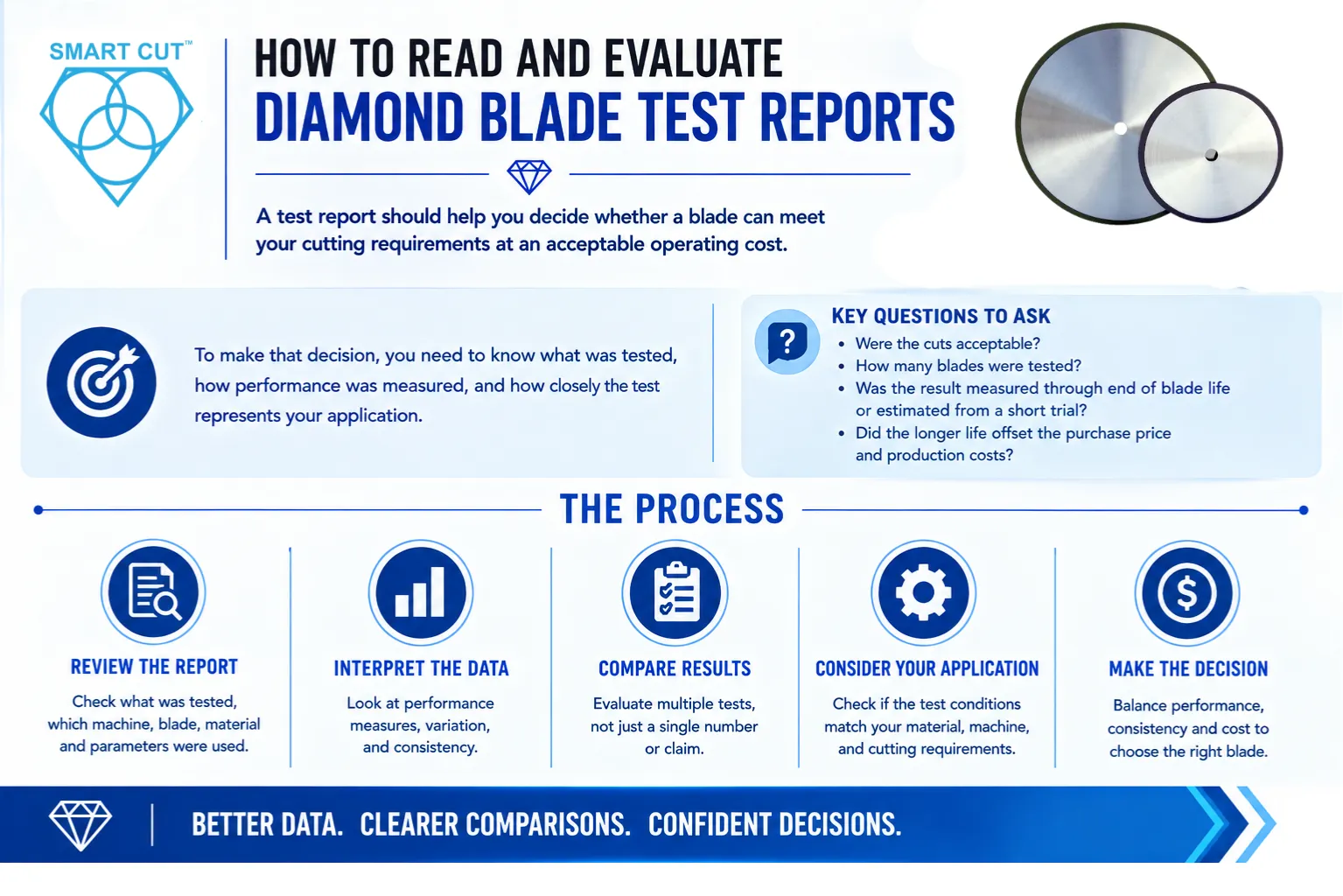
Specify the analysis before results are available. State the independent unit, calculation method, summary statistics, and treatment of incomplete runs. Report individual results as well as averages and a suitable measure of spread. Use confidence intervals or other statistical methods when they suit the design and the decision. A small observed difference does not automatically establish a useful performance advantage.
UKAM’s evaluation and comparison guide includes a calculator and statistical discussion. If your SOP adopts a calculator or spreadsheet, identify the version, verify the relevant formulas, and retain the inputs and outputs used for the decision.
Keep records that explain what actually happened
Capture the approved SOP, test plan, and work instruction revisions with each test. Include the operator, date and time, material and blade identifiers, equipment status, setup verification, and actual operating conditions.
Retain the raw measurements, inspection images where useful, conditioning events, interruptions, rejected parts, and endpoint reason. Label images with the specimen or cut reference and a suitable scale when dimensions are being assessed. Record observations when they occur instead of reconstructing them from memory.
Preserve the original entry when correcting a record. Identify the correction, reason, person, and date. Keep the raw data, calculation file, and approved report connected. Set retention and access rules under your organization’s quality system.
Handle deviations without losing the evidence
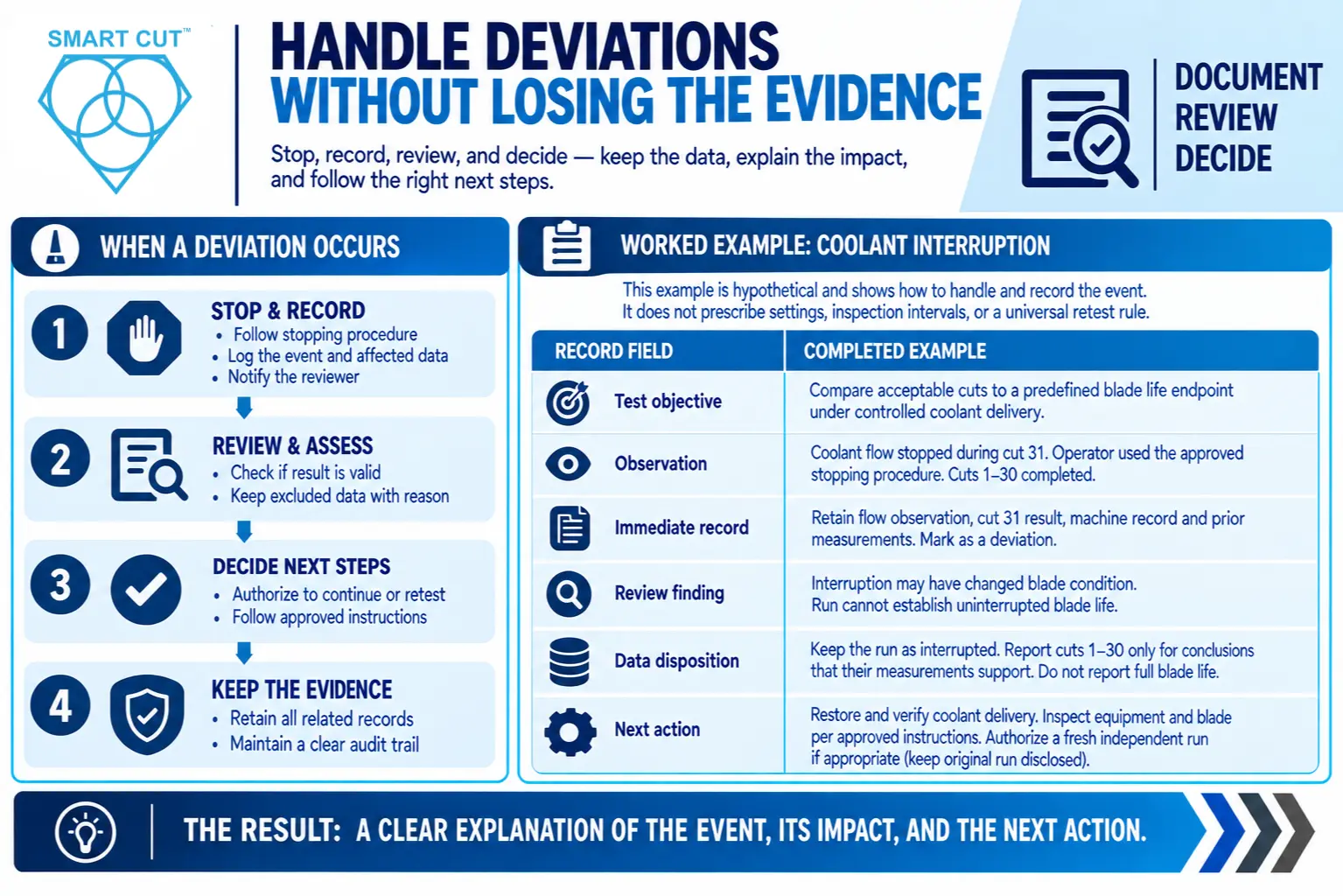
Define the response when a critical condition leaves its approved range or an unplanned event occurs. The operator should follow the required stopping procedure, record the event and affected data, and notify the designated reviewer. Resume only after the required checks and authorization.
Separate a valid poor result from a test that cannot support the intended comparison. If the conditions stayed within the approved method and the blade failed a required quality limit, that result belongs in the evaluation. Exclusion needs a documented technical reason. Keep excluded data and the reason in the record.
Worked example of a coolant interruption
The following example is hypothetical. It illustrates record handling and does not prescribe operating settings, an inspection interval, or a universal retest rule.
| Record field | Completed example |
|---|---|
| Test objective | Compare acceptable cuts to a predefined blade life endpoint under controlled coolant delivery. |
| Observation | Required coolant flow stopped during cut 31. The operator used the approved stopping procedure. Cuts 1 through 30 had been completed. |
| Immediate record | Retain the flow observation, cut 31 result, machine record, and prior measurements. Identify the event as a deviation. |
| Review finding | The interruption may have changed the blade condition. The run cannot establish uninterrupted blade life under the approved conditions. |
| Data disposition | Retain the run as interrupted. Report cuts 1 through 30 only for conclusions their measurements support. Do not report them as a completed blade life result. |
| Next action | Correct and verify coolant delivery. Inspect the equipment and affected blade under the approved instructions. The test owner authorizes a fresh independent run if appropriate, with the original run still disclosed. |
The useful result is a clear explanation of the event, its effect on interpretation, and the basis for the next action. Restarting the cut counter or deleting the interrupted run would conceal relevant history.
Validate the method and control future changes
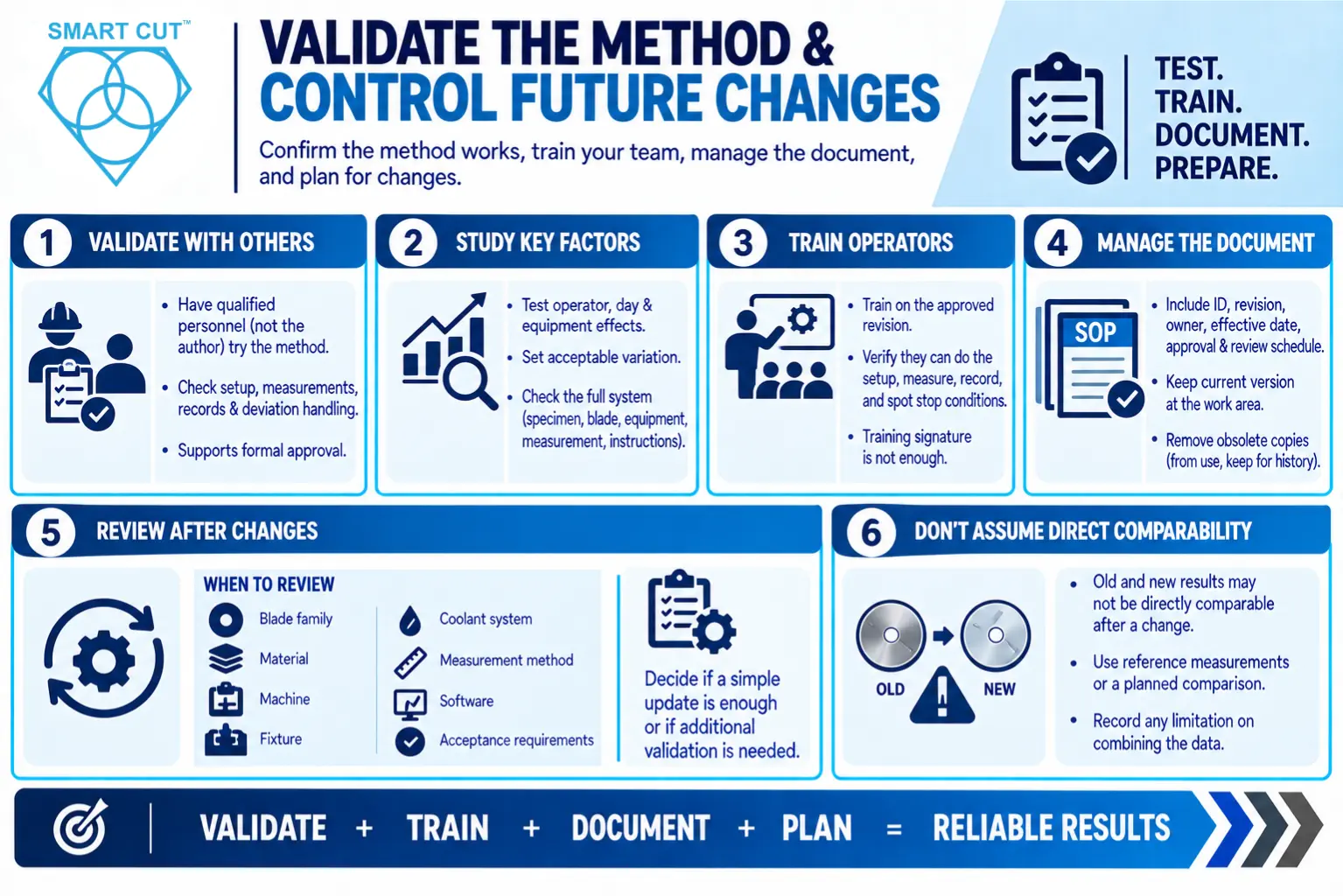
Before routine use, have qualified personnel other than the author try the instructions where practical. Check whether they can complete the setup, measurements, records, and deviation handling without guessing. This practical review supports the formal approval process. [2]
Use a planned study to assess important operator, day, and equipment effects. Establish acceptable variation before deciding whether results agree well enough. Investigate differences across the full system, including specimens, blade condition, equipment, measurement, and instructions.
Train operators on the approved revision and verify their ability to perform the work. A training signature alone does not show that a person can mount the blade, measure the required features, and recognize a stop condition correctly.
Give the SOP an identifier, revision, owner, effective date, approval, and review schedule. Make the current version available at the work area. Withdraw obsolete copies from active use while retaining the versions needed to interpret historical records.
Review the method after relevant changes to the blade family, material, machine, fixture, coolant system, measurement method, software, or acceptance requirements. Decide whether a document update is enough or whether the method needs additional validation.
Do not assume old and new results remain directly comparable after a change. Where historical comparison matters, use suitable reference measurements or a planned comparison of the old and new methods. Record any limitation on combining the data.
Questions that arise during real blade tests
Yes, when the approved plan includes a defined change or optimization step. Record the value and when it changed. If the plan requires fixed settings, treat an unplanned adjustment as a deviation and review its effect before combining the results.
Yes, when the objective concerns that condition and the history is documented. Record prior use, wear, and conditioning. Do not compare it with a new blade as though both began in equivalent condition.
No. Apply the approved conditioning method for the blade construction and application. State whether the objective requires equivalent starting performance or a comparison of the complete conditioning and cutting process. Record dressing time and material use when they affect the cost or productivity comparison.
Compare the difference with the variation allowed by the validation plan. Check the raw data, setup, blade history, material, and measurement method. One disagreement does not by itself prove operator error or an incomplete SOP.
A valid early failure is part of blade performance. Retain it. If an unrelated event invalidated the test, document the reason and keep the original data. Apply the predefined analysis rule consistently to every blade group.
Use a documented review interval that fits your process and quality system. Also review it when relevant equipment, materials, methods, requirements, or recurring problems change. An annual review may be a practical internal choice, but it is not a universal rule for every blade testing program.
Prepare your testing approach with UKAM
If your team is planning a blade comparison or investigating inconsistent cutting results, UKAM can help review the blade specification, application conditions, and information needed to evaluate performance.
Provide your material and dimensions, blade specification, machine details, mounting arrangement, current settings, coolant delivery, observed problems, and acceptance requirements. Include existing test records or cut images when available. Your organization remains responsible for approving its operating procedures and qualification decisions.
To discuss your application, request applications engineering assistance.
Supporting references
Adaptable SOP outline
Use these prompts to draft your controlled instructions. Complete the applicable fields, link the supporting documents, validate the method, and obtain approval before use. The outline itself does not authorize a test.
Document control SOP identifier: __________ Revision: __________ Effective date: __________
Ownership and approval Owner: __________ Approver: __________ Review due: __________
Purpose What decision will this testing process support? ______________________________
Scope Covered blades, materials, machines, and objectives: ___________________________
Exclusions Conditions that require a separate plan or additional approval: __________________
Responsibilities Operator, measurement, deviation review, and report approval roles: ___________
Required references List the identifier and revision of each test plan, work instruction, safety procedure, form, and calculation method: ______________________________________________
Pretest checks Define required equipment checks, instrument capability and calibration status, blade identification, starting condition, mounting, fixture, material, and coolant verification.
Controlled conditions Specify targets, units, allowable ranges, and verification methods in the approved application test plan. Define who may authorize changes.
Conditioning State whether break-in or dressing applies, the approved method and endpoint, and how conditioning cuts, time, and wear enter the record.
Sampling and sequence Define independent repeats, specimens, checkpoints, run order, endpoint, sample size rationale, and any approved extension rule.
Measurement Specify metrics, instruments, locations, inspection coverage, calculations, and the decision rule for results near a limit.
Acceptance and analysis Identify mandatory limits, ranking criteria, statistical methods, and rules for pass, fail, inconclusive, incomplete, and invalid outcomes.
Stop and deviation response List stop conditions, immediate actions, required records, review authority, and checks and authorization needed before restart.
Records and retention Define raw data and image storage, corrections, report approval, access, and retention. Preserve the revisions used for each test.
Validation and training Define the release study, acceptable variation, operator competence checks, training evidence, and revalidation triggers.
Revision history Record the change, reason, date, approver, and effect on historical comparability.
Adaptable diamond blade test record
Complete this record for each independent run. Attach the approved plan, setup details, raw measurements, inspection evidence, and calculation outputs. Expand the fields to suit the application.
Traceability Test reference: __________ Date and time: __________ Operator: __________
Documents SOP and revision: __________ Test plan and revision: _____________________
Objective Decision and conditions covered: _________________________________________
Blade Individual identifier: __________ Lot: __________ Specification attached: __________
Starting condition New or used: __________ Initial measurements and history: _______________
Material Specification: __________ Lot: __________ Dimensions and orientation: __________
Machine and fixture Identifiers: __________ Setup and exposure record: ___________________
Verification Instrument status: __________ Pretest and safety checks completed by: _________
Conditioning Method, endpoint, cuts, time, and wear record: _____________________________
| Parameter and unit | Approved target or range | Actual value and verification |
|---|---|---|
| RPM or peripheral speed | ||
| Feed and depth of cut | ||
| Coolant conditions | ||
| Other critical conditions |
| Cut or checkpoint | Metric and unit | Result | Observation or image reference |
|---|---|---|---|
| Initial | |||
| ________________ | |||
| ________________ | |||
| Endpoint or stop |
Completion Endpoint reached or interruption reason: __________________________________
Deviations Affected cuts, data, action, reviewer, and restart authorization: __________________
Analysis Raw data and calculation references: _____________________________________
Decision Pass / Fail / Inconclusive / Invalid test / Incomplete run: _______________________
Basis and limits Requirements met or missed, comparison limits, and next action: ______________
Review Reviewer: __________ Approval and date: __________ Report reference: __________
Trusted by Tens of Thousands of Manufacturers, Laboratories,
Research Institutions Worldwide Since 1990
American Based Manufacturer
Established in 1990
Custom manufacturing
RELATED ARTICLES