













Skip to navigation Skip to main content
Home > Blog > How Many Diamond Blade Tests Do You Need
Diamond Blade Articles, blog

How Many Diamond Blade Tests Do You Need

How Many Diamond Blade Tests Do You Need

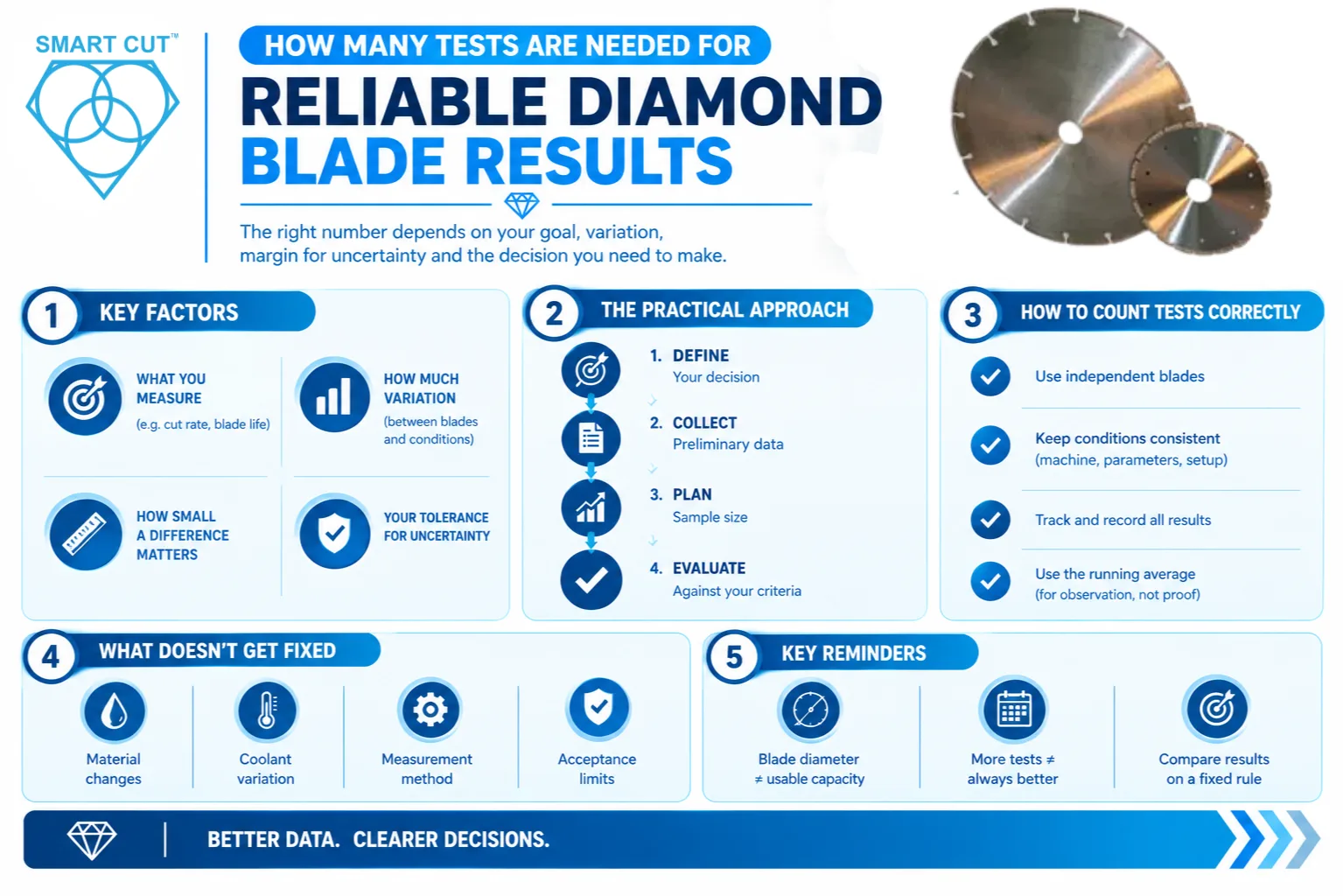
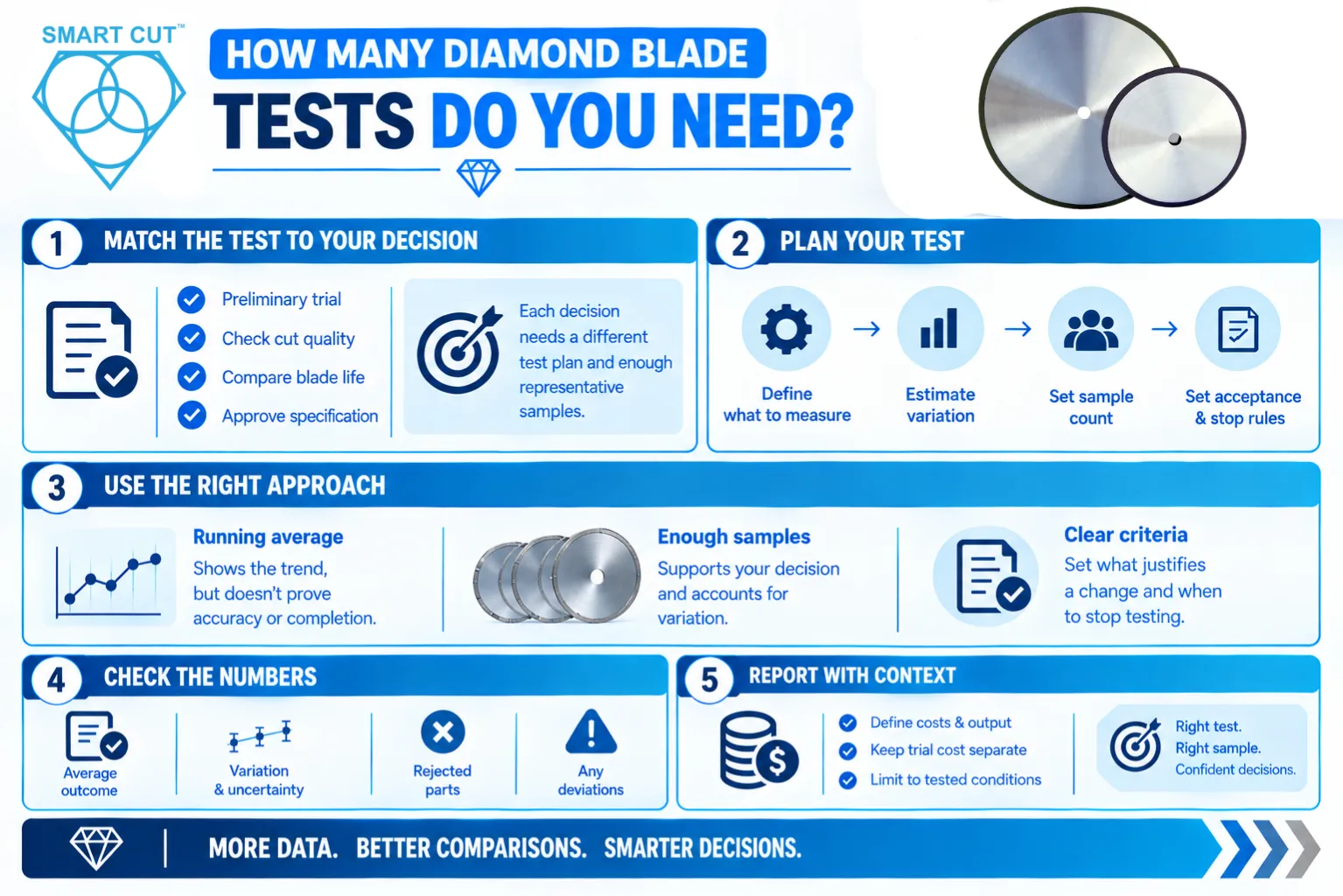
The number of diamond blade tests you need depends on the decision you are making. A preliminary trial can show whether a blade deserves further evaluation. Establishing typical cut quality, comparing blade life, or approving a specification for production requires a defined test plan and enough representative samples to support that decision.

Start by defining what you will measure and what result would justify a change. Use preliminary testing or relevant historical data to estimate variation. Then set the sample count, acceptance criteria, and stopping rules for the main evaluation. A running average that changes very little is useful to observe, but it does not establish that the result is accurate or that testing is complete.

Trusted by Tens of Thousands of Manufacturers, Laboratories Research Institutions Worldwide Since 1990

American Based Manufacturer

Established in 1990

Custom manufacturing

Define what your blade test must establish

Define what your blade test must establish

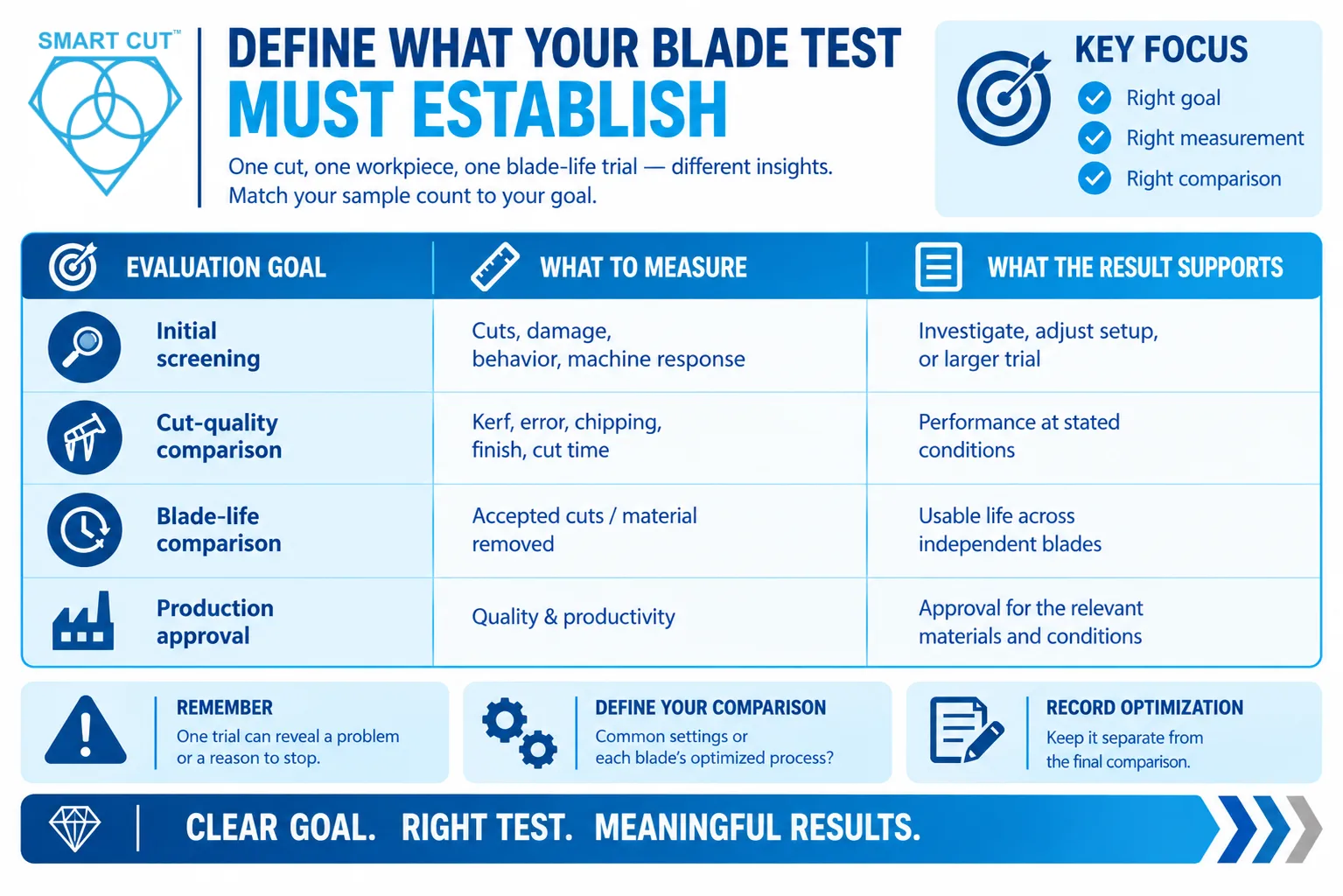
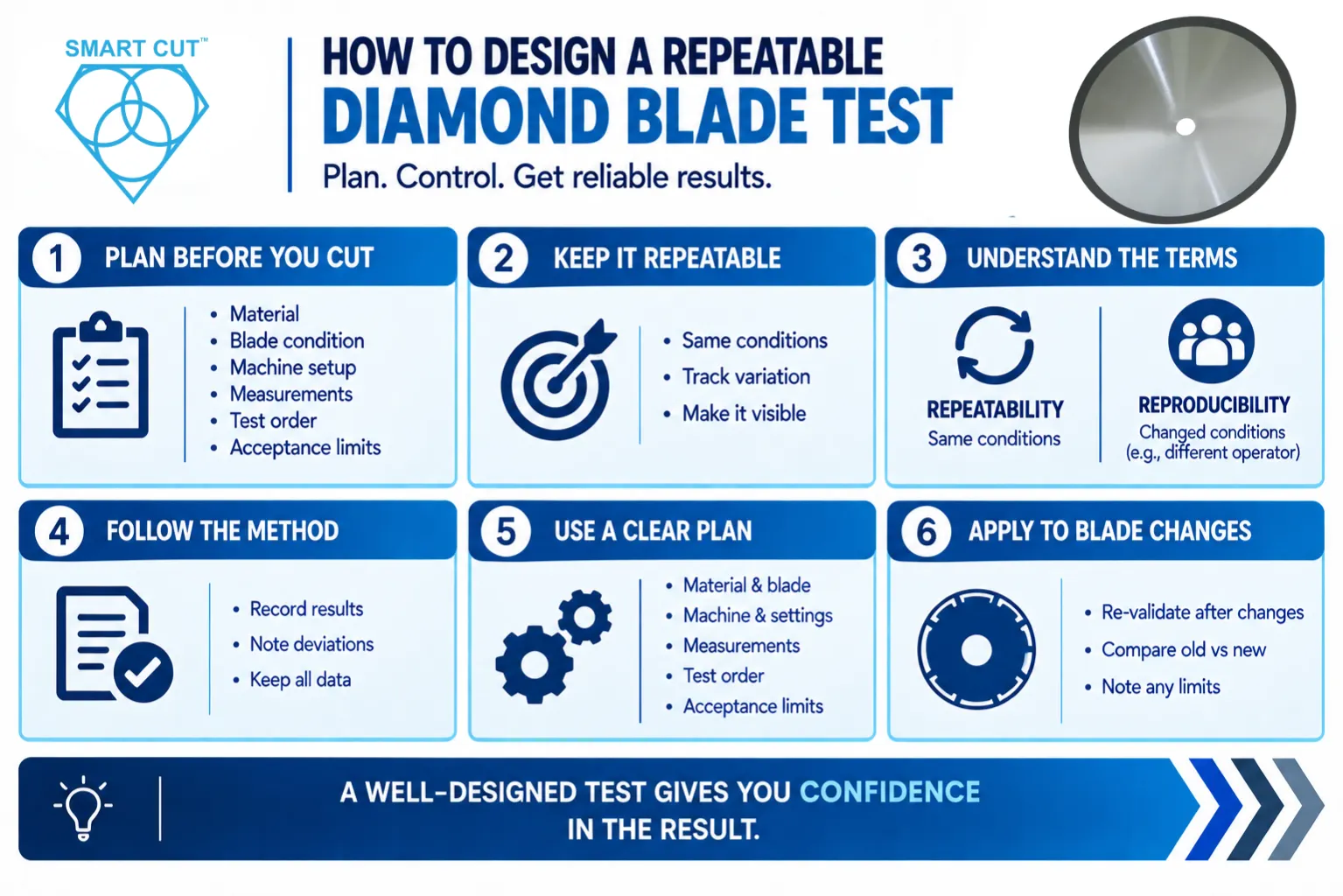
Before asking how many tests to run, define what counts as a test. One cut, one measured workpiece, and one complete blade-life trial provide different information. Your sample count must match your objective.

Evaluation goalWhat to measureWhat the result can support
Initial screeningCut acceptance, obvious damage, cutting behavior, and machine responseWhether to investigate, adjust the setup, or proceed to a larger trial
Cut-quality comparisonKerf width, dimensional error, chipping, surface finish, or cutting timePerformance under the stated conditions and sampled stages of blade life
Blade-life comparisonAccepted cuts or material removed before a defined endpointA comparison of usable life across multiple independent blades
Production approvalRequired quality and productivity across the relevant operating rangeApproval limited to the conditions, materials, and variation represented in the evaluation

A single trial can reveal an unacceptable condition or a reason to stop. It cannot establish typical blade life or consistency across a specification. Also define whether you are comparing blades at common settings or comparing each blade with its own optimized process. Those trials answer different questions. Record any optimization separately from the final comparison.

Count cuts and independent blades separately

Cut-to-cut variation describes differences between cuts made with the same blade. Blade-to-blade variation describes differences between individual blades of the same specification. Both can affect your decision.

For example, ten measured cuts on each of three blades provide 30 cut measurements from three blade samples. They do not provide 30 independent blade samples. Keep each result associated with its blade identity, cut sequence, and operating conditions.

Additional cuts help characterize the behavior of an individual blade. Additional blades help characterize variation between units. If your goal includes consistency between manufacturing lots, include relevant lots in the plan. More cuts from one blade or one lot cannot establish consistency across untested lots.

When the main question concerns blade life, each blade tested to the defined endpoint generally provides one life observation. When the question concerns dimensions or chipping, measurements from cuts are grouped within blades. The analysis should account for that grouping and any time-related pattern. Treating every cut as independent can make the result appear more certain than it is.

Set measurable acceptance requirements

Set measurable acceptance requirements

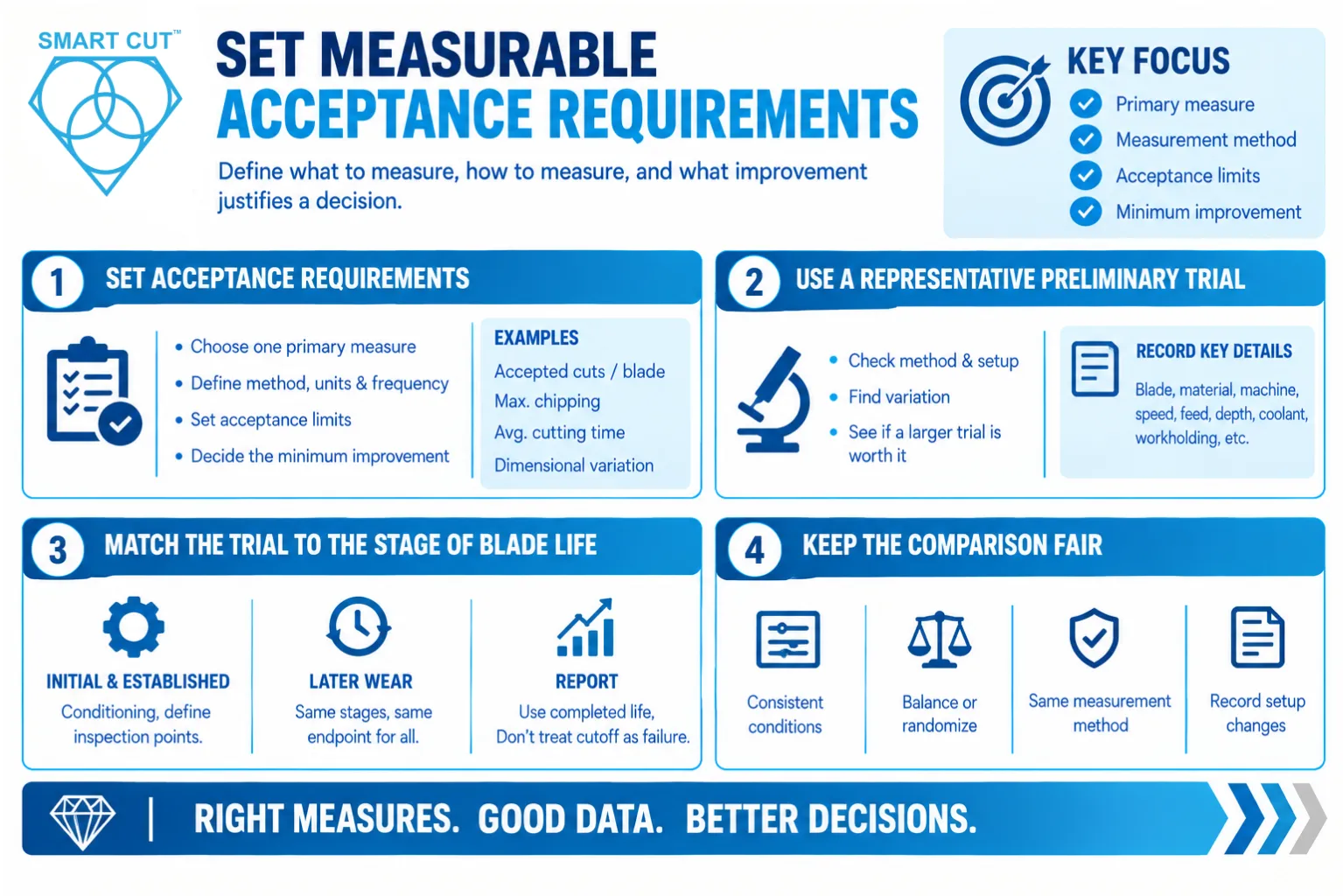
Select one primary measure that directly addresses your objective. Examples include accepted cuts per blade, maximum edge chipping, average cutting time, or dimensional variation. Define the measurement method, units, inspection frequency, and acceptance limits before the final trial.

Then specify the smallest improvement that would justify a decision. For example, a process may require at least 100 additional accepted cuts per blade to offset a higher blade price. Another application may prioritize keeping every inspected part within a tight dimensional limit. These objectives require different evidence.

Check essential secondary requirements as well. A longer blade life has limited value if it increases scrap or requires a feed rate that reduces production output. Define which quality limits must be met regardless of the primary result.

An acceptable average does not establish an acceptable defect rate. If the decision concerns the frequency of chipped or out-of-tolerance parts, use a plan for that defect rate. A small trial with no rejected parts does not establish that the production defect rate is zero.

Use a representative preliminary trial

Preliminary testing helps confirm that the measurement method works, identify setup problems, and estimate the amount of variation. It also helps determine whether a larger comparison is worthwhile.

Include more than one blade when you need information about differences between blades. Inspect several cuts at defined points when you need information about variation within a blade. There is no universal preliminary count. The samples must cover the sources of variation that matter to your application, and a small preliminary estimate of variation should be treated cautiously.

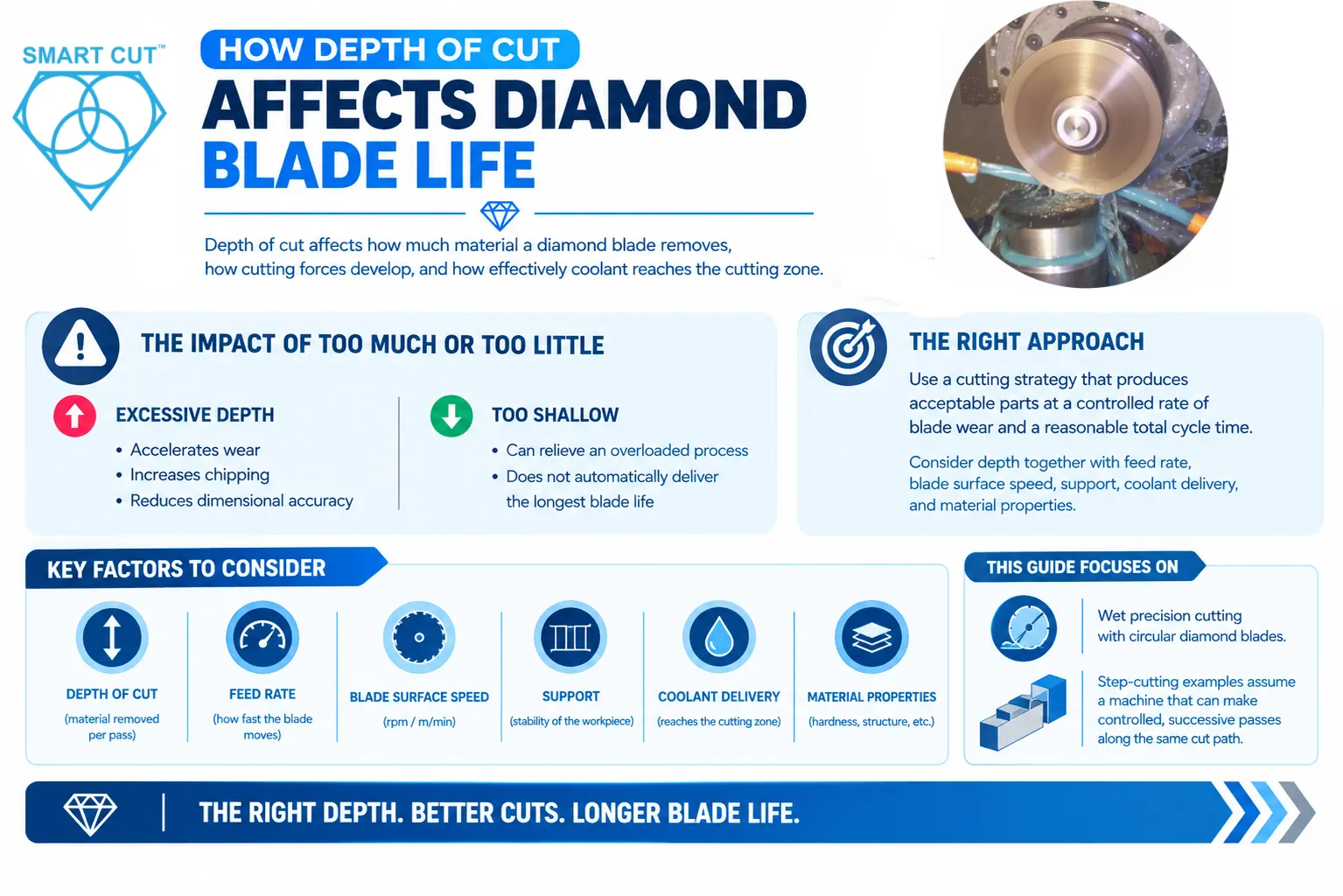
Record the blade specification and identity, material and dimensions, machine, spindle speed, feed rate, depth of cut, mounting arrangement, coolant conditions, and workholding. Record each result with its units, cut sequence, blade condition, and any adjustments or interruptions.

Use the same measurement method for all samples. Verify that the instrument and inspection procedure can resolve the difference you are trying to assess. Additional measurements cannot correct a consistent measurement error.

For a controlled comparison, keep relevant conditions consistent or balance them deliberately between specifications. For example, test both specifications across comparable material batches instead of assigning one specification to one batch and the other to a different batch. Randomize test order where practical and account for the design in the analysis.

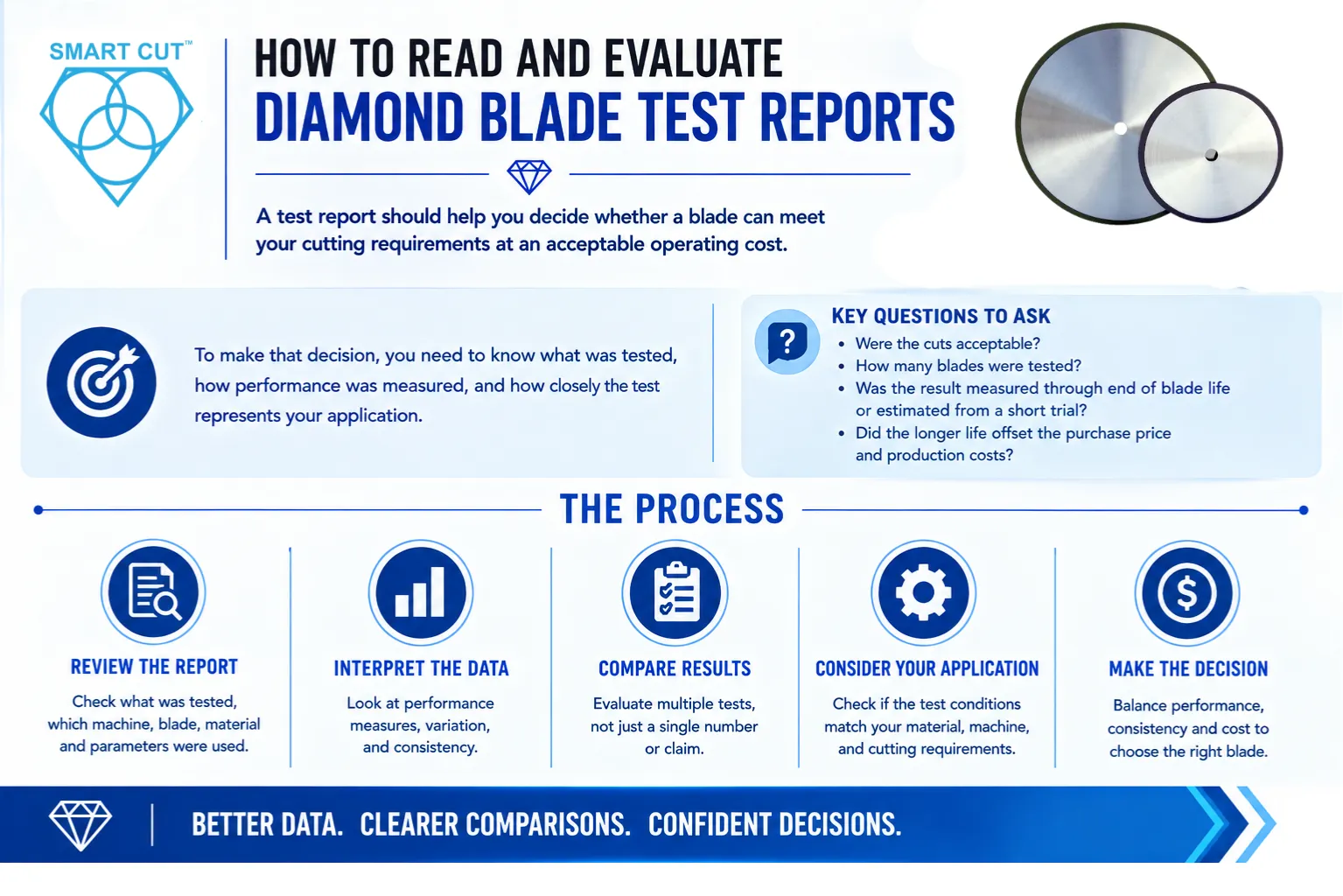
For setup and performance measurements, see UKAM’s evaluation guide. Record setup changes before collecting the data intended for the final decision.

Match the trial to the stage of blade life

Initial cutting behavior, established performance, and later wear may differ. Define any conditioning or dressing procedure appropriate to the blade and application. Identify those cuts in the record, including whether their time and material consumption count toward production cost.

For a cut-quality comparison, measure the same defined stages for each specification. Avoid comparing one blade immediately after preparation with another near its replacement point. Retain results in time order so that progressive changes remain visible.

For a blade-life comparison, agree on the replacement endpoint before testing. It may be a dimensional limit, unacceptable edge damage, a permitted wear limit, or another specified operating criterion. Apply the same endpoint and inspection schedule to both groups.

A blade that remains usable when a trial ends has not reached its measured full life. Report its completed work and continuing status. Do not treat the trial cutoff as failure or present projected life as measured life. If incomplete life observations must be included in the comparison, select an analysis that handles them appropriately.

Understand what additional tests improve

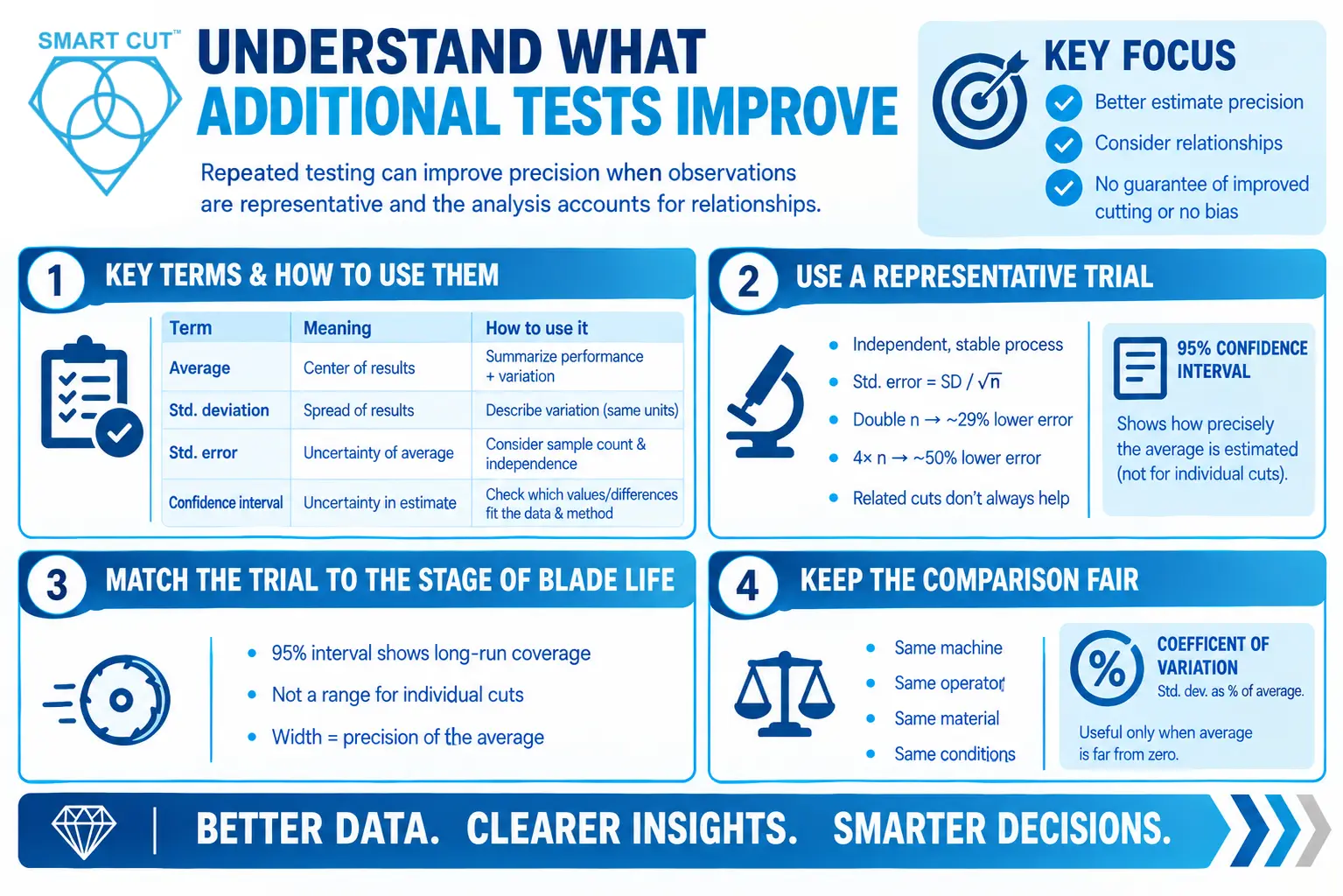
Repeated testing can improve the precision of an estimate when observations are representative and the analysis accounts for their relationships. It does not automatically improve the cutting process or eliminate measurement bias.

TermMeaningHow to use it
AverageThe center of the measured resultsSummarize performance alongside variation and individual acceptance results
Standard deviationThe spread of individual results around their averageDescribe variation in the same units as the measurement
Standard errorThe uncertainty associated with an estimated averageAccount for sample count and the independence or grouping of observations
Confidence intervalAn interval calculated to express uncertainty in an estimateAssess which average values or differences remain compatible with the data and method

For independent observations from a stable process, the standard error of an average is the standard deviation divided by the square root of the sample count. If variability stays the same, doubling the count reduces standard error by about 29%. Four times as many observations roughly halves it. Related cuts from one blade do not necessarily provide that improvement.

A 95% confidence interval describes the long-run coverage of the calculation method. Under its assumptions, about 95% of intervals from repeated studies would contain the true value. It is not a range expected to contain 95% of individual cuts. The interval’s width helps show how precisely the average has been estimated. See guidance on confidence intervals.

For measurements with a meaningful zero, the coefficient of variation expresses standard deviation as a percentage of a positive average. For example, an average life of 1,000 accepted cuts with a standard deviation of 100 cuts has a coefficient of variation of 10%. This describes relative consistency. It does not determine the required sample count by itself. It is unsuitable for some measures, including dimensional errors whose average is near zero.

Use preliminary results to plan the main comparison

The following example is hypothetical. It illustrates planning and interpretation. It does not report UKAM test results or prescribe a standard number of blades.

Assume you are comparing two blade specifications by accepted cuts before replacement. The cutting conditions, workpieces, inspection method, and endpoint are comparable. Each blade supplies one independent life observation. For this illustration, assume the life distributions are approximately normal and have similar variability.

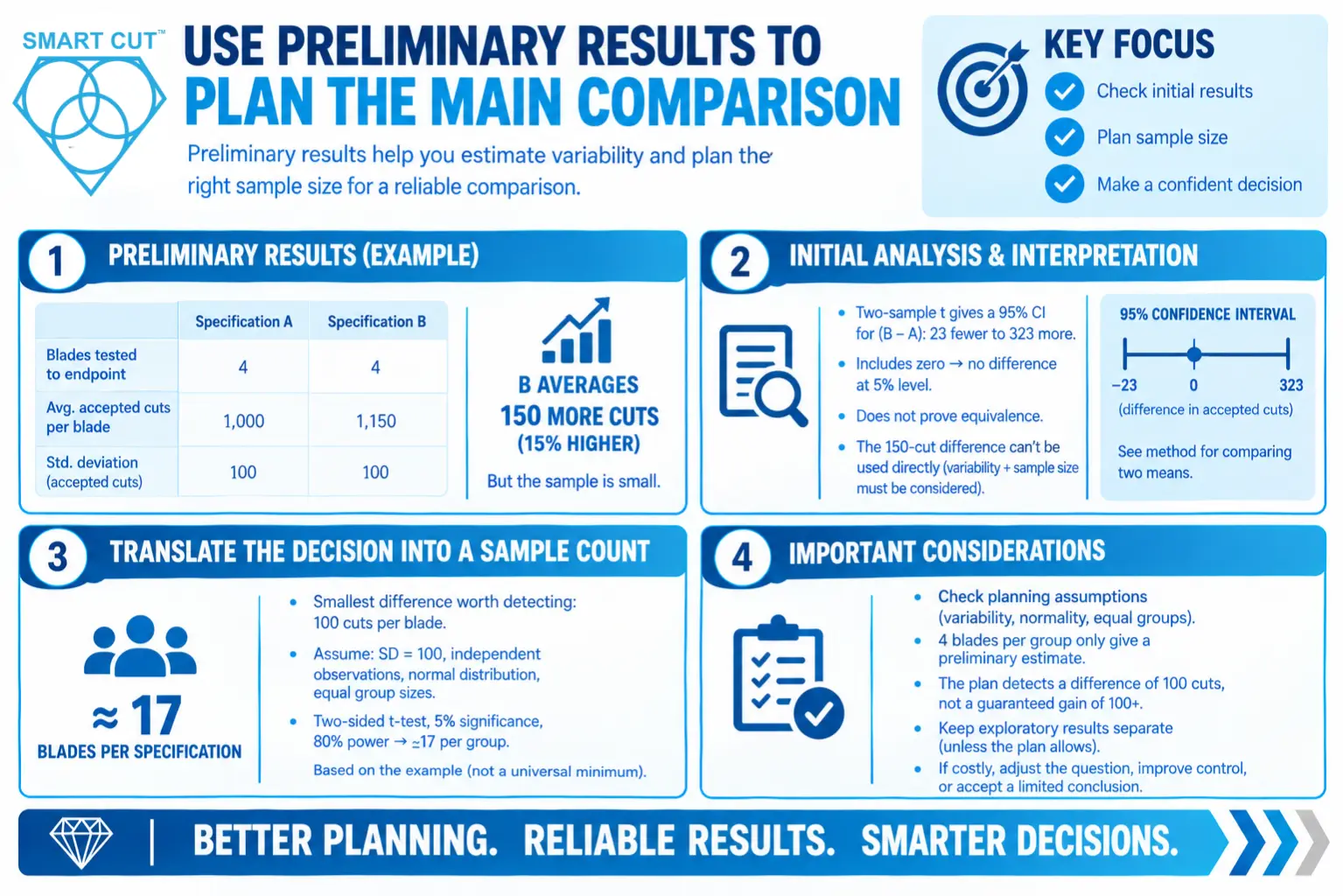
Preliminary resultSpecification ASpecification B
Blades tested to the endpoint44
Average accepted cuts per blade1,0001,150
Sample standard deviation in accepted cuts100100

Specification B averages 150 more accepted cuts, an observed increase of 15% relative to A. However, the sample is small. A two-sample t calculation gives an approximate 95% confidence interval for the difference, B minus A, from 23 fewer cuts to 323 more cuts.

That interval includes zero. The preliminary results do not establish a difference at the two-sided 5% significance level. They also do not establish equivalence. The apparent advantage is a reason to consider further evaluation, subject to its cost and importance.

The uncertainty calculation uses both sample counts and variability. Comparing the 150-cut difference directly with the 100-cut standard deviation would give the wrong basis for a decision. See the method for comparing two means.

Translate the decision into a sample count

Suppose the smallest difference worth detecting is 100 accepted cuts per blade. For a separate confirmation trial, assume a planning standard deviation of 100 cuts in each group, independent blade observations, approximately normal distributions, and equal group sizes.

A conventional two-sided t-test plan with a 5% significance level and 80% power requires approximately 17 blades per specification under those assumptions. Power is the probability of detecting a difference when the specified true difference exists. This count is calculated for the example. It is not a general minimum for diamond blade testing.

The planning assumptions deserve as much attention as the calculated count. Four blades per group provide only a preliminary variability estimate. Review that estimate against relevant historical data or use a justified conservative estimate before committing the full trial. Different variability, pairing, grouping, incomplete life observations, or a different decision target can change the required count.

This plan targets detection of a nonzero difference when the true difference is 100 cuts. It does not establish that an improvement is at least 100 cuts. If approval requires demonstrating that minimum gain, plan a threshold comparison with an appropriate confidence bound and an assumed true gain above the threshold. Sample-size planning guidance explains why the intended decision and error risks must be specified.

Keep exploratory results separate from a new confirmation trial unless the statistical plan explicitly allows their inclusion. If the required trial is too costly, revise the question, improve control without losing production relevance, or accept a limited conclusion. Reducing the sample count alone does not preserve the same confidence.

Decide when testing is complete

For a straightforward confirmation trial, set a fixed sample count and analyze the results at the planned endpoint. Define any early stopping conditions in advance. A hazardous condition or a predefined unacceptable result can justify stopping without completing the performance comparison.

If you need to make statistical decisions at several points during testing, use a planned sequential method. Repeatedly checking ordinary significance tests and stopping when the result becomes favorable can increase false-positive conclusions. Research on sequential testing explains the importance of the stopping method.

DecisionEvidence needed
Approve for the stated applicationThe planned evaluation supports the required performance and essential acceptance limits within the defined scope
Reject or revise the setupA predefined failure condition is met or the results establish unacceptable performance
Report the comparison as inconclusiveThe available evidence leaves a decision-relevant improvement, deterioration, or uncertainty unresolved
Report practical equivalenceAn appropriate equivalence analysis places the difference within limits defined before the evaluation

A confidence interval for a difference helps separate statistical evidence from production value. An interval entirely above zero can support an improvement under the chosen analysis. If it still includes gains below your required minimum, it may not justify approval on that requirement.

Likewise, failure to detect a difference does not demonstrate equivalence. Define the largest acceptable difference in advance and use a method designed for equivalence. See research on equivalence testing. Each conclusion should remain limited to the materials, conditions, blade samples, and life stages represented in the trial.

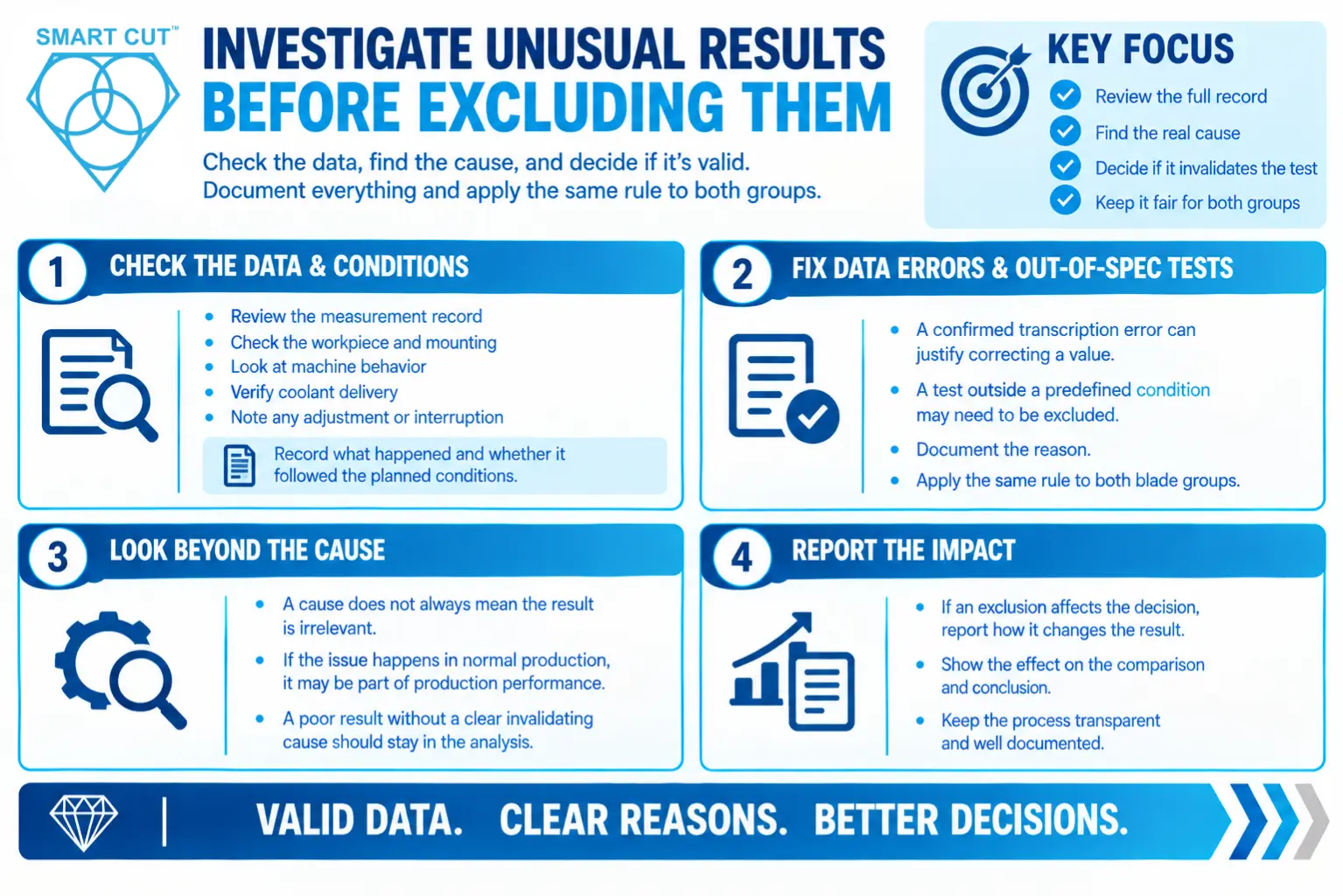
Investigate unusual results before excluding them

Keep the original data and investigate an unusual result. Check the measurement record, workpiece, mounting, machine behavior, coolant delivery, and any adjustment or interruption. Record what happened and whether it invalidated the planned test conditions.

A confirmed transcription error can justify correcting a value. A test performed outside a predefined condition may require exclusion from the controlled comparison. Document the reason and apply the same rule to both blade groups.

Identifying a cause does not automatically make the result irrelevant. If the material defect or operating variation occurs in normal production, it may belong in an evaluation of production performance. A poor result without an established invalidating cause should remain in the analysis. Where an exclusion materially affects the decision, report its effect.

Frequently Asked Questions

There is no universal count. A defined customer requirement or qualification protocol may specify one. Otherwise, choose the count from the test objective, required sensitivity or precision, variability, and experimental design.

They may help assess that blade during a short trial. They cannot establish blade-to-blade consistency or full blade life. State what the trial covered and what remains untested.

Use more measured cuts to understand behavior within blades and more independent blades to understand differences between units. When both matter, collect both and analyze the grouping. Include relevant lots when the decision covers lot consistency.

A stable running average alone is insufficient. Complete the planned evaluation and apply its decision criteria. Review measurement validity and wear trends as well as the statistical uncertainty.

Check its size, uncertainty, quality consequences, and cost. A detectable gain may be too small to justify switching. Approval should follow the practical requirements defined before testing.

A projection depends on assumptions about future wear and performance. Label it as projected life, state those assumptions, and verify them where necessary. A short trial does not provide measured full life.

Use relevant historical data, improve measurement and process control, or narrow the decision. An inconclusive result can be the correct outcome when the available evidence is limited. Retain the distinction between preliminary selection and production approval.

Plan your next diamond blade evaluation

UKAM Industrial Superhard Tools can help you define a blade evaluation around your material, equipment, and production requirements. Start with the decision you need to make and the acceptance limits the blade must meet.

When you request applications engineering assistance, provide the material and dimensions, blade specification, machine settings, mounting and coolant details, and your individual test results. Include the number of blades tested, cuts completed on each blade, inspection method, acceptance requirements, and reasons for any early replacement.

These details help us assess whether the next step should be a setup review, a revised blade specification, additional measurements, or a larger comparison trial.

Trusted by Tens of Thousands of Manufacturers, Laboratories,
Research Institutions Worldwide Since 1990

American Based Manufacturer

Established in 1990

Custom manufacturing

RELATED ARTICLES

Download Checklist

Please fill in your details to download the Precision Diamond Saw Pre-Operation Checklist.