



















How to Increase Diamond Blade Life in Precision Cutting: Engineering Strategies to Maximize Tool Life and Reduce Cost Per Part

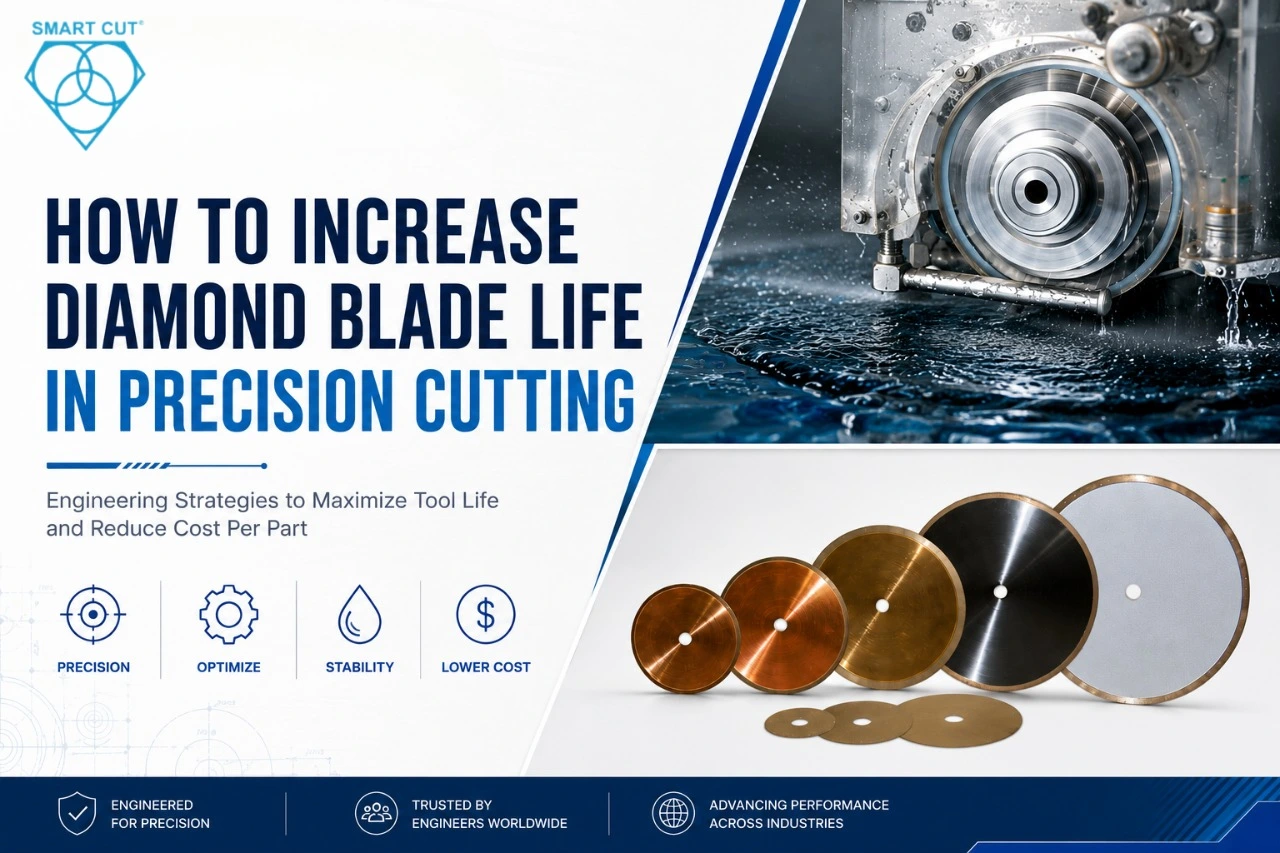
Table of Contents
Toggle
American Based Manufacturer

Established in 1990


Custom manufacturing


Related Engineering Resources
Selecting the right diamond blade is only one part of achieving consistent cutting performance. Explore these related engineering resources to learn more about blade selection, bond types, diamond grit size, and precision cutting best practices.
- Diamond Blade Selection Guide
- Resin Bond vs. Metal Bond Diamond Blades
- Diamond Grit Size Guide
- Precision Cutting Solutions
Engineering Problem
In precision cutting operations, diamond blades are rarely replaced because the diamond abrasive has been completely consumed. More often, blades are removed from production prematurely due to glazing, bond failure, excessive edge wear, thermal damage, unstable machine conditions, or improperly optimized cutting parameters. These issues increase tooling costs, reduce dimensional consistency, create unnecessary scrap, and interrupt production schedules long before the blade reaches its expected service life.
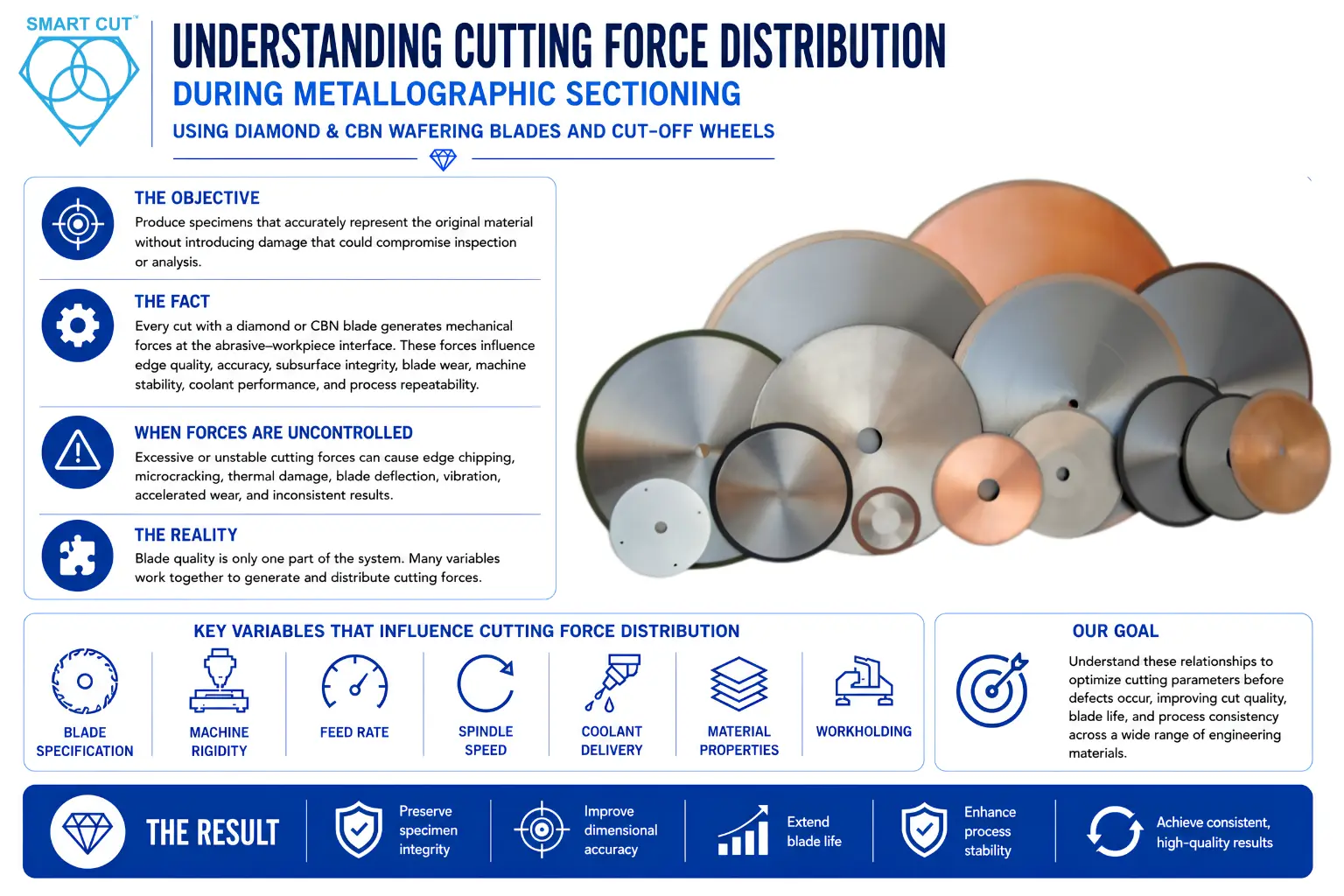
A common misconception is that poor blade life is caused solely by the blade itself. In reality, blade performance is influenced by the entire cutting system — see our guide on how to properly use diamond tools for a full breakdown. Machine rigidity, spindle runout, coolant delivery, feed rate, peripheral speed, workholding stability, material properties, and operator consistency all contribute to tool life. Replacing a blade without evaluating these variables often results in little or no improvement.
For manufacturing engineers, the objective is not simply to make a blade last longer. The real goal is to achieve a stable, repeatable cutting process that delivers consistent edge quality, predictable tool life, reduced downtime, and the lowest possible cost per finished component.
Need Help Selecting the Right Diamond Blade?
Why Engineers Investigate Blade Life
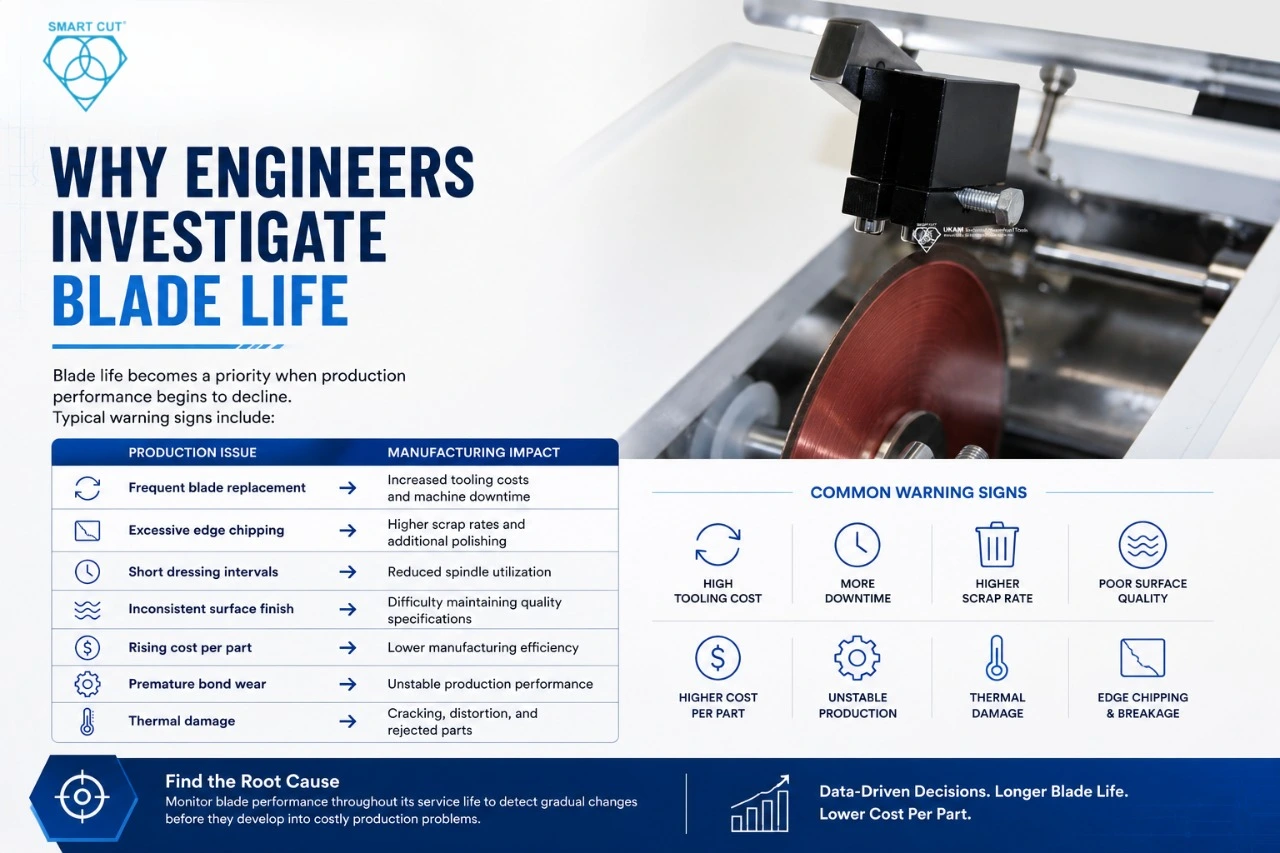
Blade life becomes a priority when production performance begins to decline. Typical warning signs include:
|
Production Issue |
Manufacturing Impact |
|---|---|
|
Frequent blade replacement |
Increased tooling costs and machine downtime |
|
Excessive edge chipping |
Higher scrap rates and additional polishing |
|
Short dressing intervals |
Reduced spindle utilization |
|
Inconsistent surface finish |
Difficulty maintaining quality specifications |
|
Rising cost per part |
Lower manufacturing efficiency |
|
Premature bond wear |
Unstable production performance |
|
Thermal damage |
Cracking, distortion, and rejected parts |
Continue Your Research
Selecting the right diamond blade is only one part of achieving consistent cutting performance. Explore these related engineering resources to learn more about blade selection, bond types, diamond grit size, and precision cutting best practices.
- Choosing the Right Diamond Blade
- Diamond Blade Bond Types Explained
- Optimizing Cutting Parameters
- Reducing Edge Chipping in Precision Cutting
Rather than treating these symptoms independently, experienced engineers evaluate the complete cutting process to identify the root cause. Monitoring blade performance throughout its service life enables gradual changes to be detected before they develop into costly production problems. If you’re seeing these symptoms, our customer support team can help diagnose the root cause.
Why Diamond Blades Fail Prematurely in Precision Cutting
Related Engineering Resources
Selecting the right diamond blade is only one part of achieving consistent cutting performance. Explore these related engineering resources to learn more about blade selection, bond types, diamond grit size, and precision cutting best practices.
A diamond blade is a carefully engineered cutting tool designed to maintain a balance between diamond exposure, bond wear, and cutting forces. When this balance is disrupted, blade performance declines rapidly. Contrary to popular belief, most premature blade failures are not caused by manufacturing defects. They are typically the result of incorrect blade selection, unsuitable operating parameters, inadequate machine maintenance, or unstable process conditions.
Production teams often respond to declining performance by replacing the blade. While this may temporarily restore cutting efficiency, it rarely addresses the underlying cause. Unless the complete cutting process is evaluated, the same problems usually reappear after only a short production run.
The following sections examine the most common failure mechanisms encountered in precision cutting operations and the engineering principles behind each one.
1. Blade Glazing
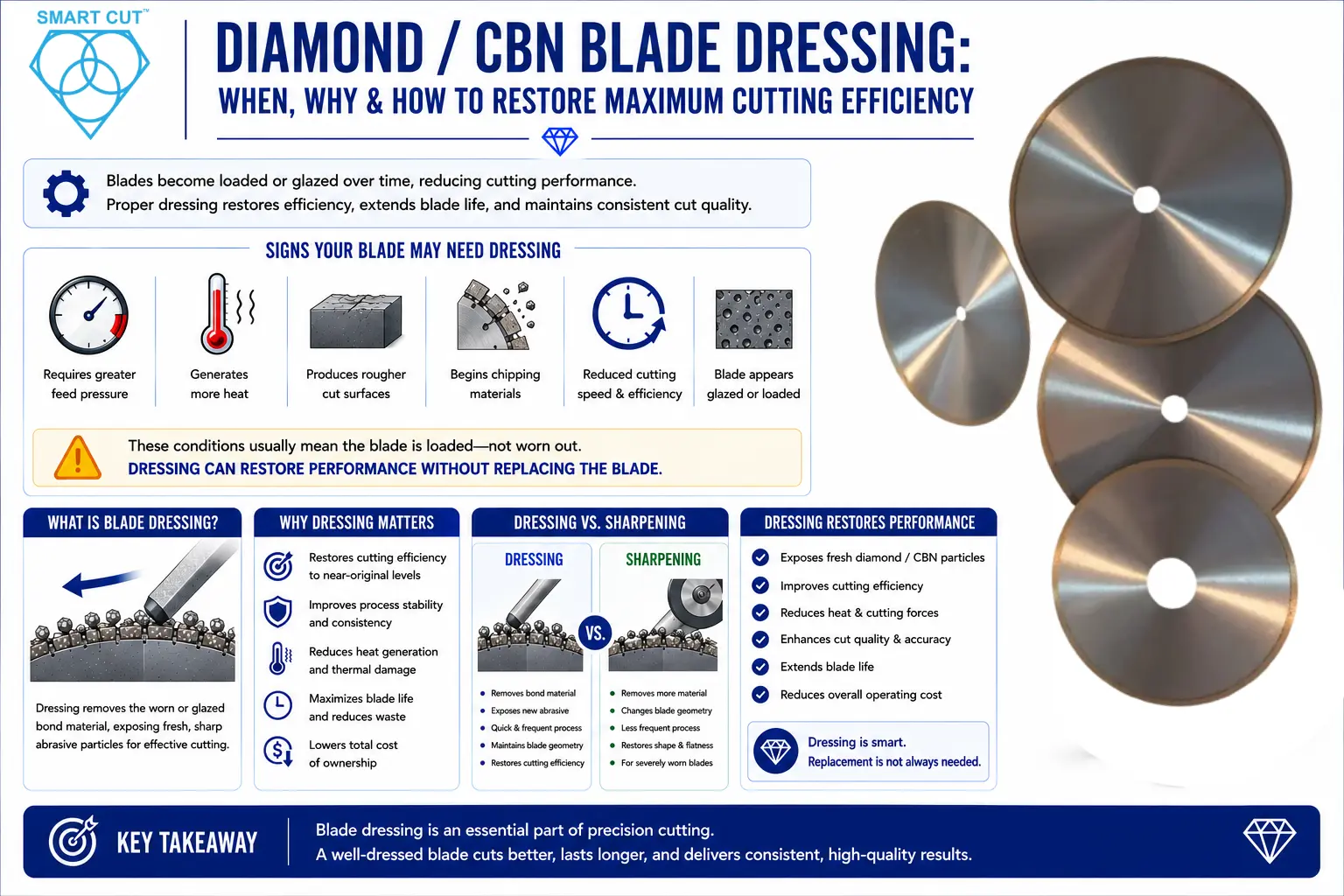
Blade glazing occurs when the bond retains worn diamond particles instead of releasing them to expose fresh, sharp cutting edges. As the diamonds become dull, the blade transitions from cutting to rubbing against the workpiece.
Blade glazing occurs when the bond retains worn diamond particles instead of releasing them to expose fresh, sharp cutting edges. As the diamonds become dull, the blade transitions from cutting to rubbing against the workpiece.
Instead of removing material efficiently, friction increases, cutting forces rise, and excessive heat develops at the cutting interface. Production slows, spindle load increases, and edge quality begins to deteriorate.
Typical Production Symptoms
- Cutting speed gradually decreases
- Higher spindle load during cutting
- Burning or discoloration on the workpiece
- Poor surface finish
- Increased operator effort to maintain productivity
Common Engineering Causes
- Bond specification is too hard for the material
- Feed rate is too low
- Incorrect diamond concentration
- Blade is not dressed when required
Related Reading
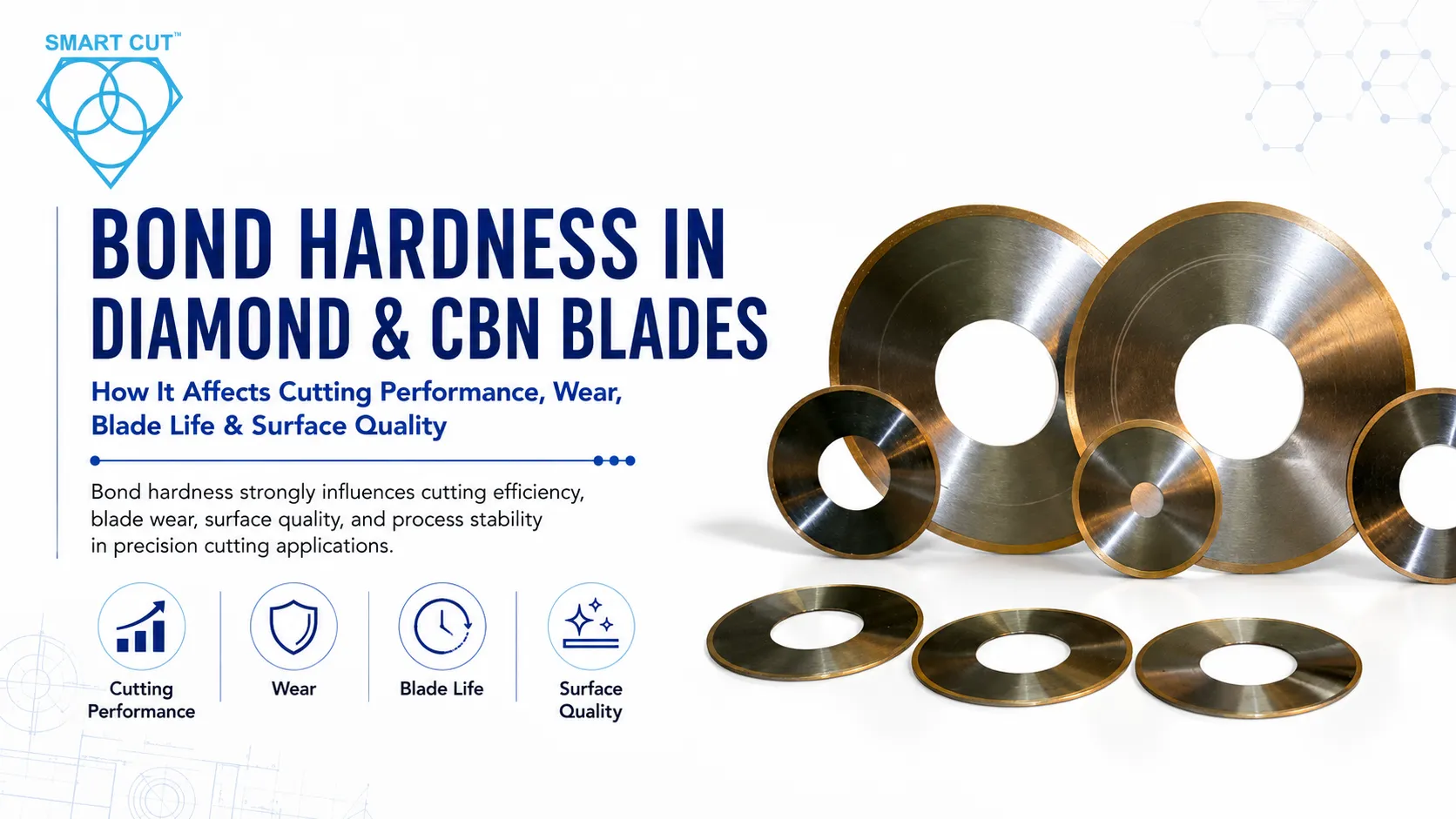
Blade glazing is often related to bond selection and operating parameters. Learn how bond hardness influences cutting efficiency and self-sharpening characteristics.
2. Excessive Diamond Pullout
Unlike glazing, excessive diamond pullout occurs when abrasive particles detach from the bond before completing their useful cutting cycle.
As diamonds are lost prematurely, cutting efficiency decreases while blade wear accelerates. Although the blade may initially appear aggressive, its usable life becomes significantly shorter, increasing tooling costs and reducing production consistency.
Typical Production Symptoms
- Rapid blade wear
- Reduced dimensional accuracy
- Short production runs
- Frequent blade replacement
- Rising tooling cost
Common Engineering Causes
- Bond specification is too soft
- Excessive cutting pressure
- Machine vibration
- Incorrect blade specification
Continue Reading
Blade glazing is often related to bond selection and operating parameters. Learn how bond hardness influences cutting efficiency and self-sharpening characteristics.
3. Thermal Damage
Heat is one of the most significant contributors to reduced blade life and inconsistent cutting performance.
When coolant delivery is inadequate or cutting parameters generate excessive friction, temperatures rise rapidly within the cutting zone. Elevated temperatures accelerate bond degradation, increase thermal stress in the workpiece, and reduce overall blade performance.
For brittle materials such as ceramics, sapphire, and semiconductor wafers, thermal damage can lead to cracking or subsurface defects that may not become visible until later manufacturing stages.
Typical Production Symptoms
- Material discoloration
- Thermal cracking
- Reduced blade life
- Coolant evaporation near the cutting zone
- Increased polishing requirements
Common Engineering Causes
- Poor coolant delivery
- Excessive feed rate
- High spindle speed
- Insufficient coolant flow
Improve Your Cutting Process
Thermal damage is often the result of multiple process variables working together. Review the engineering qualification process to optimize cutting performance and reduce heat generation.
4. Uneven Blade Wear
Consistent blade wear is essential for maintaining dimensional accuracy and predictable cutting performance.
Uneven wear changes blade geometry over time, leading to kerf variation, increased vibration, and inconsistent edge quality. Engineers frequently assume the blade is defective when the root cause is actually mechanical instability within the machine.
Typical Production Symptoms
- Blade wobble
- Kerf width variation
- Irregular edge finish
- Increased vibration
- Poor dimensional accuracy
Common Engineering Causes
- Excessive spindle runout
- Damaged mounting flanges
- Improper blade installation
- Machine instability
Engineering Guide
Machine rigidity, spindle accuracy, blade specification, and operating conditions all influence blade wear. Learn how to qualify your cutting process before changing tooling.
5. Edge Chipping
Edge chipping is especially common when cutting brittle materials such as alumina, quartz, fused silica, sapphire, and advanced ceramics.
Although chipping is often viewed as a product quality issue, it also shortens blade life. Every chip changes the cutting load acting on the blade, creating unstable cutting forces that accelerate wear and reduce process consistency.
Typical Production Symptoms
- Broken or chipped edges
- Surface defects
- Increased polishing time
- Higher scrap rates
- Variable edge quality
Common Engineering Causes
- Diamond grit is too coarse
- Feed rate is too aggressive
- Blade vibration
- Poor workholding stability
Related Engineering Guide
Choosing the correct grit size, bond type, and blade specification can significantly reduce edge chipping while improving surface quality.
Engineering Troubleshooting Matrix
|
Production Observation |
Most Likely Cause |
Recommended Investigation |
|---|---|---|
|
Blade glazes rapidly |
Bond too hard |
Review bond selection |
|
Blade wears rapidly |
Bond too soft |
Verify blade specification |
|
High spindle load |
Dull diamond particles |
Inspect blade condition |
|
Material burns |
Poor coolant delivery |
Check coolant coverage |
|
Short tool life |
Excessive cutting pressure |
Reduce mechanical loading |
|
Kerf variation |
Spindle runout |
Inspect spindle accuracy |
|
Rough surface finish |
Incorrect grit size |
Review abrasive specification |
|
Excessive vibration |
Machine instability |
Verify machine rigidity |
Key Takeaway
Premature diamond blade failure is rarely caused by a single factor. In most precision cutting operations, it results from the interaction between blade specification, machine condition, coolant delivery, operating parameters, and material characteristics. Engineers who identify the underlying failure mechanism before changing tooling specifications consistently achieve longer blade life, improved edge quality, and lower manufacturing costs.
Engineering Factors That Control Diamond Blade Life
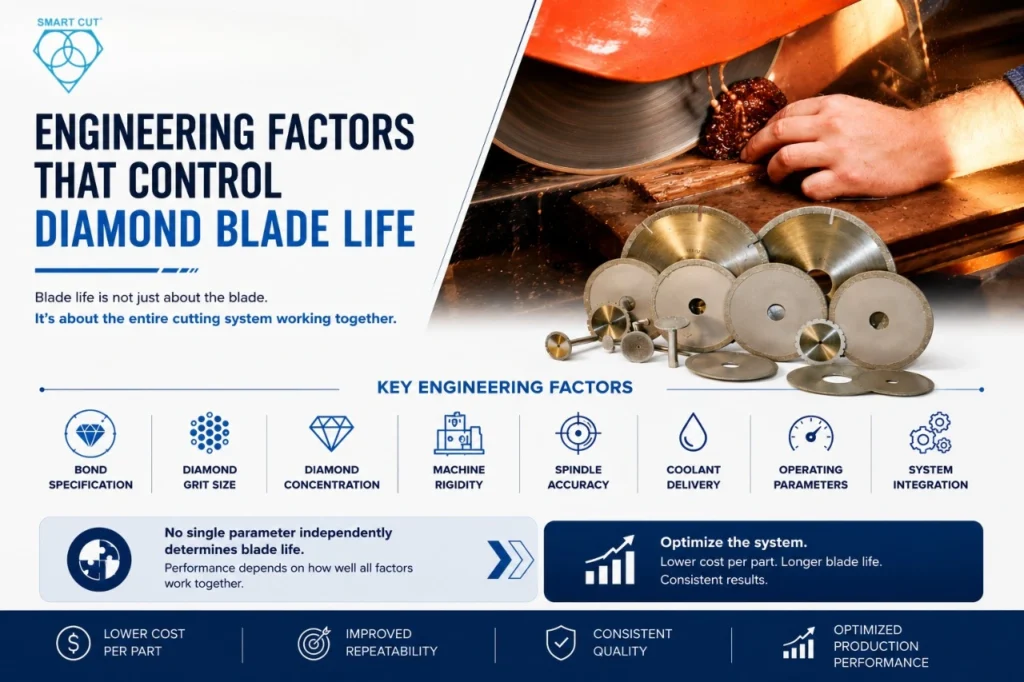
Selecting the correct diamond blade is only one part of achieving long, predictable tool life. In precision cutting, blade performance is determined by how effectively the entire cutting system works together. Bond specification, diamond grit size, concentration, machine rigidity, spindle accuracy, coolant delivery, and operating parameters all influence cutting efficiency, edge quality, and manufacturing cost.
No single parameter independently determines blade life. A premium blade can fail prematurely if machine conditions are unstable, while a properly matched blade operating under optimized conditions can consistently exceed expected service life. Engineers who evaluate these variables as an integrated system achieve lower cost per part, improved repeatability, and more consistent production performance.
The bond acts as the matrix that holds diamond particles in place while controlling how quickly worn diamonds are released and replaced by fresh cutting points.
An ideal bond wears at a controlled rate. If it wears too slowly, dull diamonds remain exposed and the blade begins to glaze. If it wears too quickly, useful diamonds are released before completing their cutting cycle, resulting in excessive blade wear.
Rather than asking, “Which bond lasts the longest?”, engineers should ask:
“Which bond provides the most stable self-sharpening characteristics for this material and process?”
Looking to Optimize Your Cutting Process?
Every cutting application is different. Selecting the correct bond type, diamond grit size, concentration, coolant strategy, and machine setup can significantly improve blade life while reducing cost per part.
Explore these engineering resources to learn more about optimizing your precision cutting process.
Related Resources
1. Bond Specification: The Foundation of Blade Performance
General Bond Selection Guide
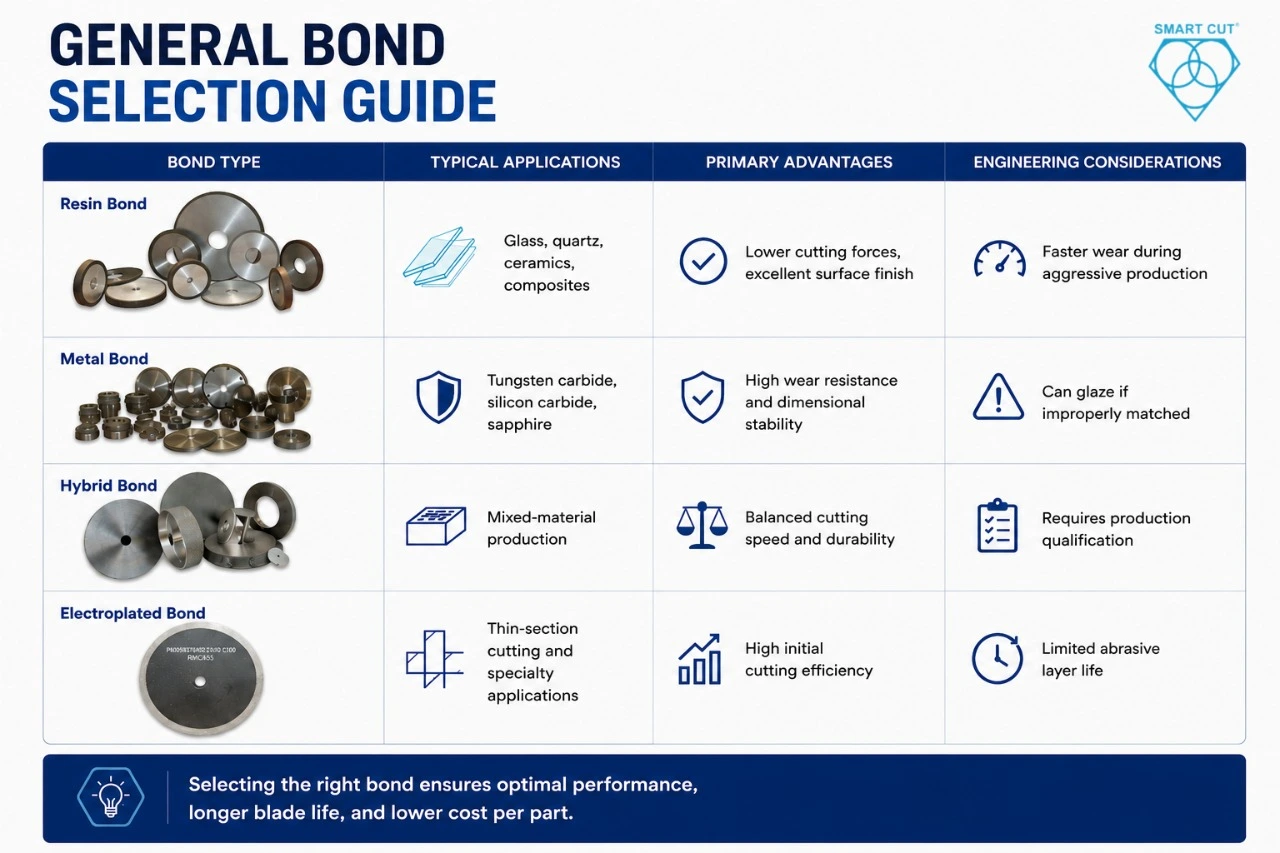
|
Bond Type |
Typical Applications |
Primary Advantages |
Engineering Considerations |
|---|---|---|---|
|
Resin Bond |
Glass, quartz, ceramics, composites |
Lower cutting forces, excellent surface finish |
Faster wear during aggressive production |
|
Metal Bond |
Tungsten carbide, silicon carbide, sapphire |
High wear resistance and dimensional stability |
Can glaze if improperly matched |
| Hybrid Bond |
Mixed-material production |
Balanced cutting speed and durability |
Requires production qualification |
|
Electroplated Bond |
Thin-section cutting and specialty applications |
High initial cutting efficiency |
Limited abrasive layer life |
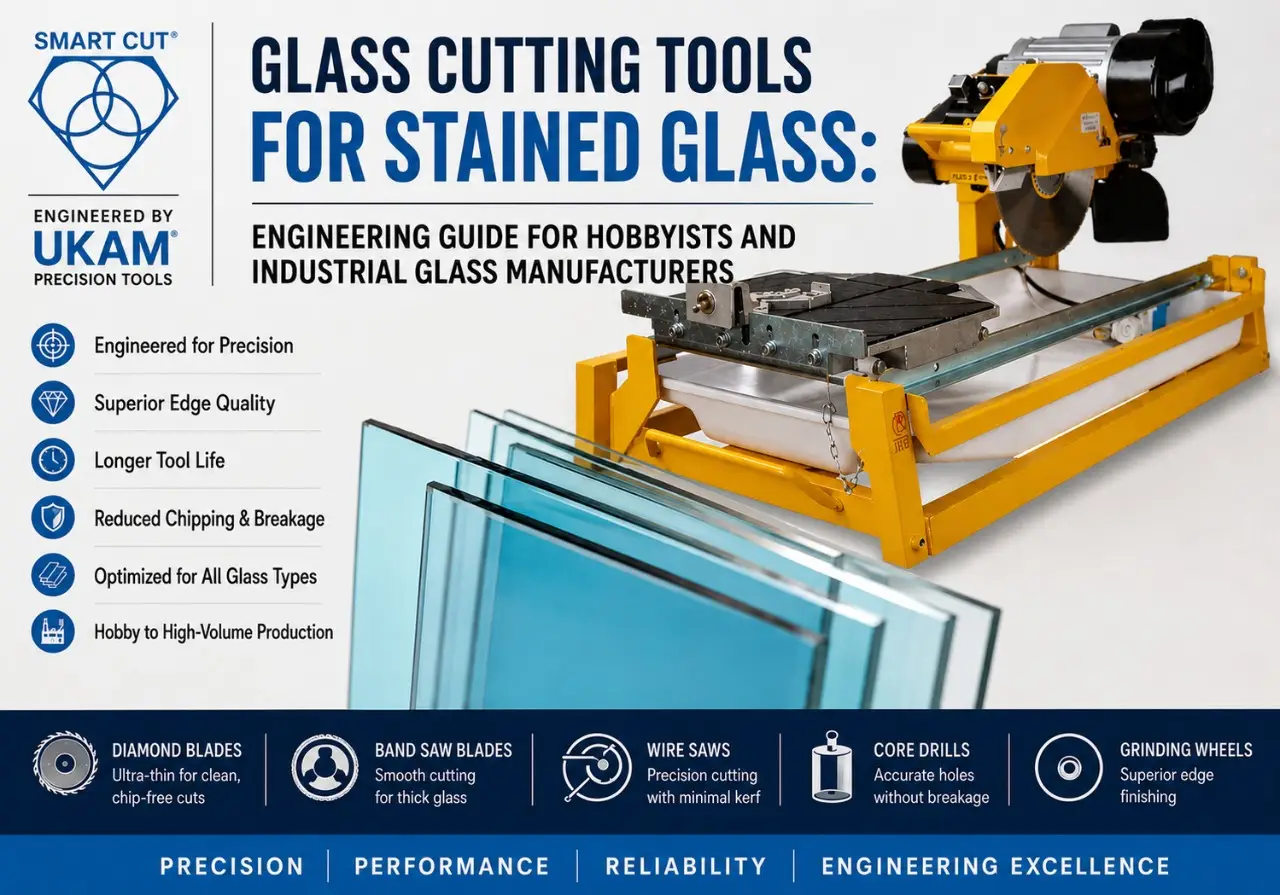
Selecting the right glass cutting tool depends on more than the material alone. Machine capability, production volume, dimensional tolerances, and downstream finishing all influence tooling performance. If you’re unsure which solution best fits your application, submit your material specifications or drawings to a UKAM Applications Engineer for a customized tooling recommendation before beginning production.
Selecting a diamond cutting tool is not the final step in achieving a stable manufacturing process. Long-term production success depends on working with an engineering partner that understands material behavior, machining challenges, and process optimization — not simply a supplier that sells tooling.
For manufacturers processing glass, ceramics, composites, semiconductors, and other advanced materials, technical support, application knowledge, and process qualification are often just as valuable as the cutting tool itself.
The final bond selection should always be validated through production trials rather than laboratory specifications alone. Material hardness, abrasiveness, coolant conditions, machine horsepower, production volume, and required surface finish all influence the optimal bond choice.
Explore each bond type in detail: Resin Bond, Metal Bond (Sintered), Hybrid Bond™, Electroplated Bond, Brazed Bond, Vitrified Bond, and Polycrystalline (PCD/PCBN) tools. UKAM’s SMART CUT® Technology is engineered to improve diamond exposure consistency across bond types.
2. Diamond Grit Size: Balancing Productivity and Surface Quality
Diamond grit size directly affects material removal rate, cutting forces, edge quality, surface finish, and blade wear.
A coarse grit removes material more aggressively but generates higher cutting forces, increasing the likelihood of edge chipping in brittle materials. Fine grit produces smoother surfaces with lower subsurface damage but requires slower feed rates and longer cutting times.
Selecting the proper grit size therefore requires balancing production efficiency with quality requirements. See our full diamond mesh/grit size selection guide for more detail.
General Grit Selection Guide
|
Diamond Grit |
Best Application |
Surface Finish |
Relative Cutting Rate |
|---|---|---|---|
|
Coarse |
Thick sections, rough cutting |
Rough |
High |
|
Medium |
General precision cutting |
Moderate |
Balanced |
|
Fine |
Thin wafers, brittle materials |
Fine |
Moderate |
|
Ultra Fine |
Optical and semiconductor materials |
Excellent |
Lower |
For high-value materials such as sapphire, optical glass, and semiconductor wafers, minimizing subsurface damage is typically more important than maximizing cutting speed. In these applications, finer grit specifications often reduce polishing time and improve overall manufacturing yield.
Engineering Observation
Faster material removal does not necessarily reduce manufacturing cost. Engineers often achieve a lower cost per part by selecting a finer grit that minimizes polishing and rework.
3. Diamond Concentration: More Is Not Always Better
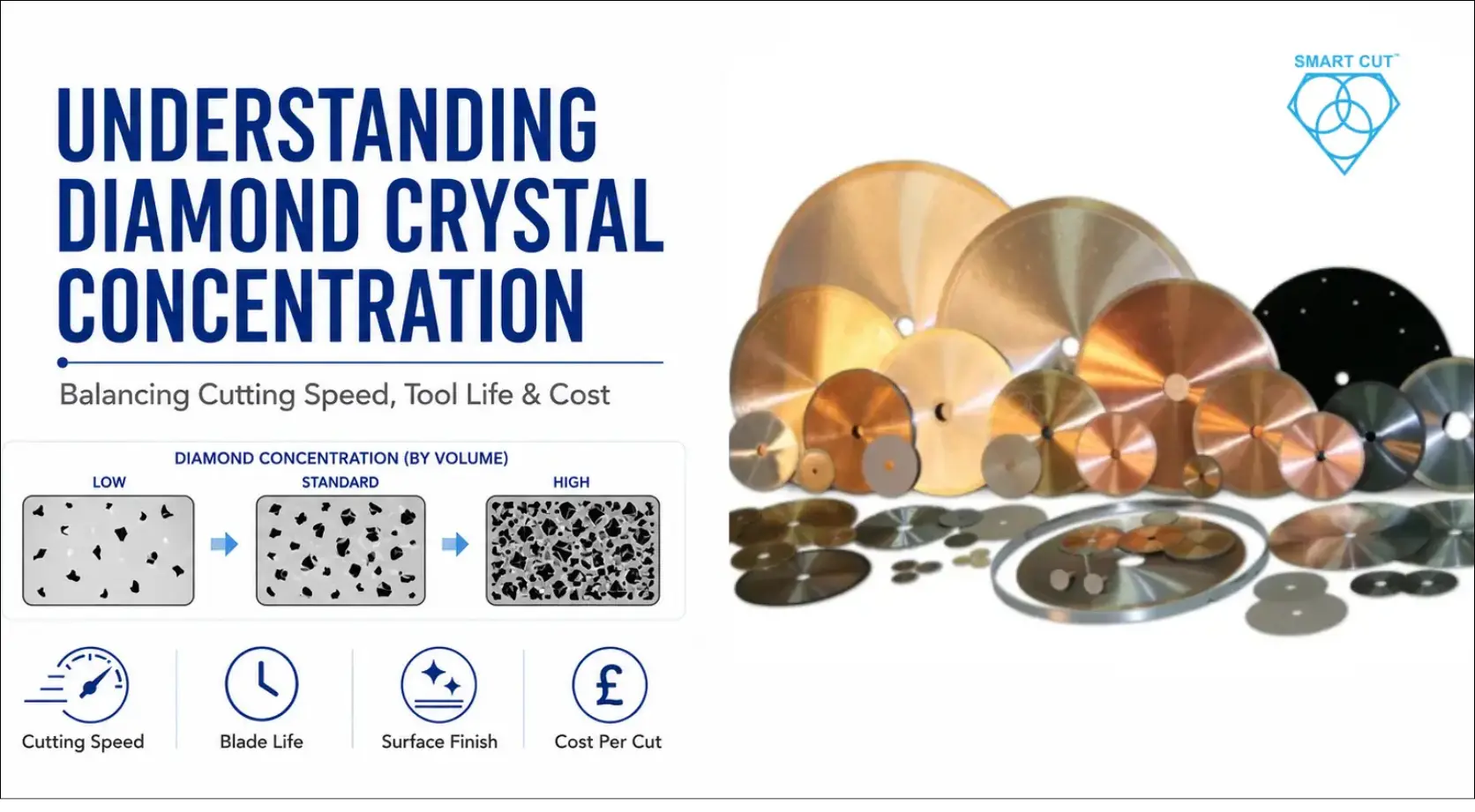
Diamond concentration defines how many abrasive particles are available within the cutting zone.
A common misconception is that increasing diamond concentration automatically increases blade life. In practice, blade performance depends on maintaining the correct relationship between concentration and bond specification.
Higher concentrations distribute cutting forces across more diamond particles, reducing the load carried by each individual abrasive. However, excessively high concentration may reduce the bond’s self-sharpening ability, depending on the application.
|
Production Objective |
Lower Concentration |
Higher Concentration |
|---|---|---|
|
Material Removal Rate |
Higher |
Moderate |
|
Surface Finish |
Moderate |
Improved |
|
Heat Generation |
Higher |
Lower |
|
Cutting Stability |
Moderate |
Higher |
|
Tool Life |
Application Dependent |
Application Dependent |
Rather than selecting the highest available concentration, engineers should qualify the concentration that provides the best balance between cutting efficiency, heat generation, and predictable wear.
4. Machine Rigidity and Spindle Accuracy
Even the highest-quality diamond blade cannot compensate for poor machine condition. Our precision cutting saws are engineered for the rigidity and spindle accuracy this process requires.
Mechanical instability causes vibration, uneven blade wear, inconsistent kerf width, poor surface finish, and accelerated bond degradation. Before changing tooling specifications, engineers should verify that the machine itself is capable of maintaining repeatable cutting conditions.
Machine Qualification Checklist
|
Inspection Item |
Engineering Objective |
|---|---|
|
Spindle Runout |
Maintain consistent cutting geometry |
|
Flange Flatness |
Prevent blade deflection |
|
Blade Mounting |
Ensure correct torque and alignment |
|
Machine Vibration |
Reduce uneven blade wear |
|
Workholding Stability |
Prevent movement during cutting |
|
Feed System Accuracy |
Improve repeatability |
|
Spindle Bearings |
Eliminate excessive vibration |
|
Machine Alignment |
Maintain dimensional accuracy |
Many blade life problems are ultimately traced back to worn spindle bearings, damaged flanges, or poor workholding rather than the blade specification itself. Machine qualification should therefore precede tooling qualification in every optimization project.
5. Coolant Delivery: Controlling Heat and Protecting the Blade
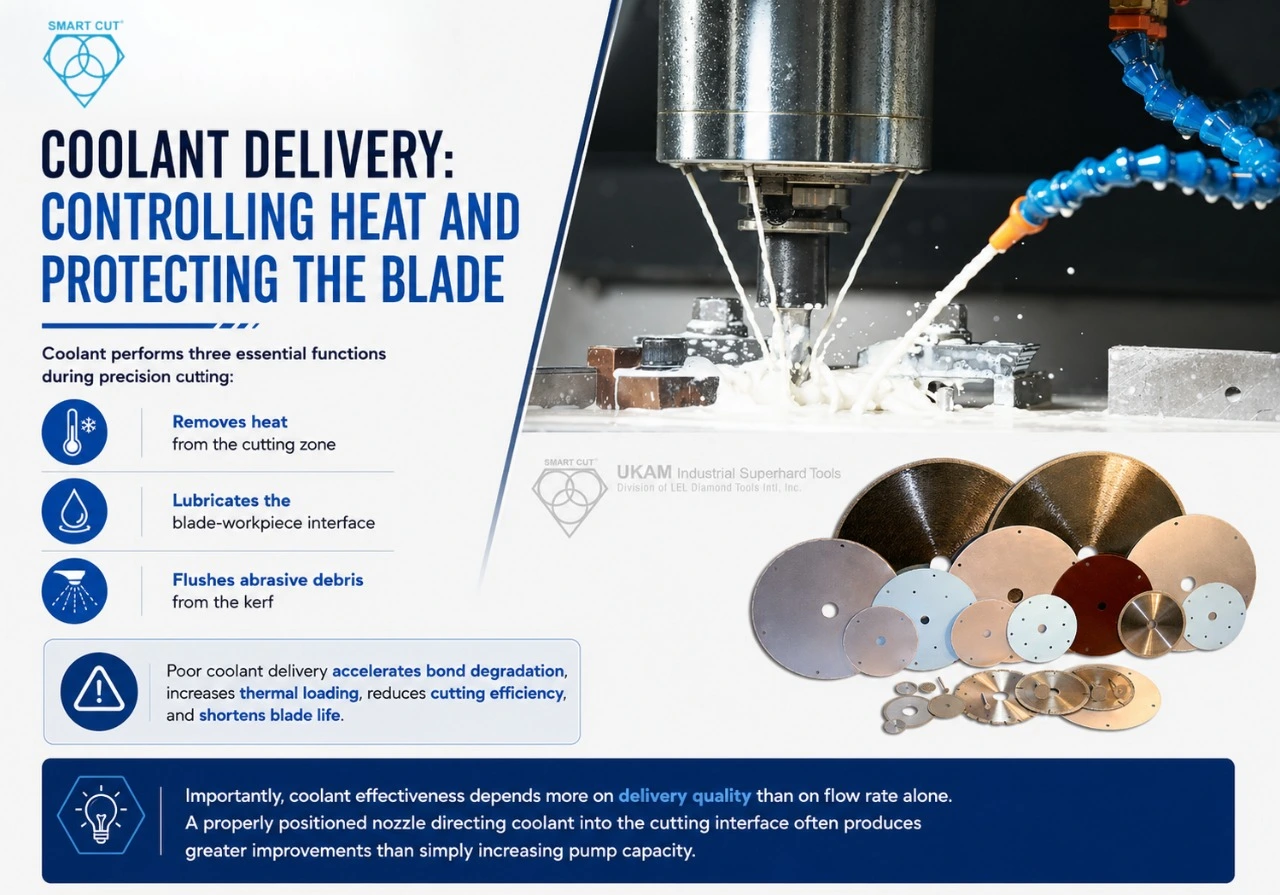
Many blade life problems are ultimately traced back to worn spindle bearings, damaged flanges, or poor workholding rather than the blade specification itself. Machine qualification should therefore precede tooling qualification in every optimization project.
- Removes heat from the cutting zone
- Lubricates the blade-workpiece interface
- Flushes abrasive debris from the kerf
Poor coolant delivery accelerates bond degradation, increases thermal loading, reduces cutting efficiency, and shortens blade life. Explore our diamond tool accessories, including coolants, dressing sticks, and flanges, to improve coolant delivery.
Importantly, coolant effectiveness depends more on delivery quality than on flow rate alone. A properly positioned nozzle directing coolant into the cutting interface often produces greater improvements than simply increasing pump capacity.
Coolant Evaluation Checklist
|
Inspection Area |
Engineering Objective |
|---|---|
|
Coolant Coverage |
Reach the entire cutting zone |
|
Flow Rate |
Maintain continuous cooling |
|
Nozzle Position |
Direct coolant into the kerf |
|
Coolant Cleanliness |
Remove abrasive contamination |
|
Filtration |
Prevent particle recirculation |
|
Coolant Temperature |
Maintain process stability |
Warning Signs of Poor Coolant Performance
- Blade discoloration
- Material burning
- Reduced blade life
- Increased spindle load
- Rough surface finish
These symptoms should prompt engineers to inspect nozzle alignment, coolant filtration, and delivery consistency before adjusting cutting parameters.
Engineering Takeaway: Long diamond blade life is achieved by optimizing the entire manufacturing system, not by changing a single variable. Bond specification, grit size, diamond concentration, machine rigidity, spindle accuracy, and coolant delivery interact continuously throughout the cutting process. Engineers who qualify each variable systematically—and validate changes with production data—consistently achieve longer tool life, improved edge quality, and lower cost per finished component.
Engineering Takeaway
Long diamond blade life is achieved by optimizing the entire manufacturing system, not by changing a single variable. Bond specification, grit size, diamond concentration, machine rigidity, spindle accuracy, and coolant delivery interact continuously throughout the cutting process. Engineers who qualify each variable systematically—and validate changes with production data—consistently achieve longer tool life, improved edge quality, and lower cost per finished component.
Material-Specific Engineering Strategies for Maximizing Diamond Blade Life
No single diamond blade performs optimally across every material. Each workpiece has unique mechanical, thermal, and abrasive characteristics that influence cutting forces, heat generation, bond wear, and diamond exposure. A blade specification that delivers excellent performance on one material may produce rapid wear, glazing, or edge chipping on another.
For this reason, experienced manufacturing engineers qualify blade specifications for each material and application rather than relying on a single “general-purpose” blade. Material hardness, fracture toughness, thermal conductivity, abrasiveness, and required surface finish all influence the optimal combination of bond type, diamond grit size, concentration, feed rate, spindle speed, and coolant delivery.
The following recommendations summarize common engineering challenges and qualification priorities for materials frequently processed using precision diamond blades.
Silicon Carbide (SiC)
Silicon carbide is one of the most abrasive engineering ceramics used in precision manufacturing. Continuous abrasion accelerates bond wear and can cause premature diamond pullout if the blade specification is not properly matched.
Instead of focusing solely on blade hardness, engineers should prioritize wear resistance while maintaining consistent diamond exposure throughout production.
|
Parameter |
Recommendation |
|---|---|
|
Bond Type |
Metal Bond |
|
Diamond Grit |
Medium |
|
Feed Rate |
Moderate |
|
Coolant |
High-flow continuous coolant |
|
Primary Inspection |
Diamond retention |
Typical Engineering Challenge
Premature diamond pullout caused by high abrasive wear.
Recommended Engineering Approach
Because silicon carbide rapidly changes cutting conditions, blade wear should be monitored frequently during qualification trials. Early inspection helps identify changes before they affect dimensional accuracy or production consistency.
Alumina (Al₂O₃)
Alumina is widely used because of its excellent hardness and wear resistance. However, it is also brittle and highly susceptible to edge chipping when cutting forces become excessive — relevant to our advanced ceramics tooling line.
Reducing vibration and controlling mechanical loading are often more effective than simply lowering spindle speed.
Primary Engineering Challenge
Edge chipping.
|
Parameter |
Recommendation |
|---|---|
|
Bond Type |
Resin Bond |
|
Diamond Grit |
Fine |
|
Feed Rate |
Low to Moderate |
|
Coolant |
Continuous |
|
Primary Inspection |
Edge Quality |
Recommended Engineering Approach
For high-precision components, maintaining machine rigidity is equally important. Even minor vibration can significantly increase chipping and polishing requirements.
Silicon Nitride (Si₃N₄)
Silicon nitride combines high fracture toughness with excellent mechanical strength. During extended production runs, heat buildup often becomes a greater concern than abrasive wear.
Stable coolant delivery is therefore critical for maintaining dimensional accuracy and preventing thermal damage.
Primary Engineering Challenge
Thermal cracking.
|
Parameter |
Recommendation |
|---|---|
|
Bond Type |
Hybrid Bond |
|
Diamond Grit |
Medium |
|
Coolant Coverage |
Complete and consistent |
|
Feed Rate |
Stable |
|
Primary Inspection |
Temperature stability |
Recommended Engineering Approach
Rather than increasing coolant pressure, engineers should ensure complete coolant coverage across the cutting zone throughout the entire cut.
Sapphire
Sapphire is among the hardest materials processed with diamond tooling and is widely used in semiconductor, optics, and electronics manufacturing.
Because of its hardness, surface integrity is often more important than cutting speed. Scratches generated during sectioning can significantly increase downstream polishing time.
Primary Engineering Challenge
Surface scratching.
|
Parameter |
Recommendation |
|---|---|
|
Bond Type |
Resin Bond |
|
Diamond Grit |
Fine to Ultra Fine |
|
Feed Rate |
Low |
|
Machine Rigidity |
Very High |
|
Primary Inspection |
Surface Finish |
Recommended Engineering Approach
Before beginning production, spindle runout should be verified to minimize vibration and maintain consistent surface quality.
Fused Silica
Although fused silica offers excellent thermal stability, it remains vulnerable to mechanical shock during cutting. Subsurface microcracks can develop even when the cut surface appears visually acceptable.
Primary Engineering Challenge
Subsurface microcracking.
|
Parameter |
Recommendation |
|---|---|
|
Bond Type |
Resin Bond |
|
Diamond Grit |
Fine |
|
Coolant |
Uniform coverage |
|
Feed Rate |
Conservative |
|
Primary Inspection |
Subsurface damage |
Recommended Engineering Approach
Engineers should minimize machine vibration throughout production, as vibration often contributes more to hidden damage than cutting speed alone.
Quartz
Quartz frequently contains internal stresses that increase the risk of fracture during cutting. Stable process control is therefore more important than maximizing production throughput.
Primary Engineering Challenge
Edge breakout.
|
Parameter |
Recommendation |
|---|---|
|
Bond Type |
Resin Bond |
|
Diamond Grit |
Fine |
|
Feed Rate |
Controlled |
|
Coolant |
Conservative |
|
Primary Inspection |
Edge Integrity |
Recommended Engineering Approach
Maintaining consistent cutting parameters throughout production generally produces better results than frequent adjustments intended to increase cutting speed.
Tungsten Carbide
Tungsten carbide combines high hardness with good toughness. One of the most common production issues is blade glazing caused by selecting a metal bond that retains dull diamond particles too long.
Primary Engineering Challenge
Blade glazing.
|
Parameter |
Recommendation |
|---|---|
|
Bond Type |
Metal Bond |
|
Diamond Grit |
Medium |
|
Feed Rate |
Moderate |
|
Dressing |
Periodic |
|
Primary Inspection |
Cutting Efficiency |
Recommended Engineering Approach
Maintaining proper self-sharpening characteristics significantly extends blade life and helps maintain consistent cutting performance.
Polycrystalline Diamond (PCD)
PCD workpieces are extremely abrasive and place significant demands on the cutting tool. Explore our PCD & PCBN tools. One common wear mechanism is diamond polishing, where the cutting points become smooth rather than fracturing to expose new edges.
Primary Engineering Challenge
Diamond polishing.
|
Parameter |
Recommendation |
|---|---|
|
Bond Type |
Metal Bond |
|
Diamond Grit |
Fine |
|
Feed Rate |
Low |
|
Coolant |
High Flow |
|
Primary Inspection |
Cutting Force |
Recommended Engineering Approach
Monitoring spindle load provides an effective early indicator of polishing before noticeable declines in cutting performance occur.
Gallium Arsenide (GaAs)
Gallium arsenide wafers are brittle semiconductor materials that require careful process control to prevent edge fracture during sectioning.
Primary Engineering Challenge
Edge fracture.
|
Parameter |
Recommendation |
|---|---|
|
Bond Type |
Resin Bond |
|
Diamond Grit |
Ultra Fine |
|
Feed Rate |
Low |
|
Coolant |
Stable |
|
Primary Inspection |
Wafer Edge Quality |
Recommended Engineering Approach
In wafer manufacturing, engineers typically prioritize edge integrity over maximum production speed.
Optical Glass
Optical glass components demand exceptional dimensional accuracy and surface integrity — relevant to photonics applications. Even small chips along the cut edge can increase polishing time and reduce optical quality
Primary Engineering Challenge
Recommended Engineering Approach
Microchips along the cut edge.
|
Parameter |
Recommendation |
|---|---|
|
Bond Type |
Resin Bond |
|
Diamond Grit |
Fine |
|
Feed Rate |
Low |
|
Machine Accuracy |
High |
|
Primary Inspection |
Surface Finish |
Maintaining stable machine conditions throughout production minimizes secondary finishing operations and improves repeatability.
Material Selection Summary
The table below provides a quick reference for selecting an appropriate engineering approach based on the workpiece material.
|
Material |
Preferred Bond |
Primary Challenge |
Engineering Focus |
|---|---|---|---|
|
Silicon Carbide |
Metal |
Diamond Pullout |
Wear Resistance |
|
Alumina |
Resin |
Edge Chipping |
Lower Cutting Force |
|
Silicon Nitride |
Hybrid |
Thermal Cracking |
Coolant Stability |
|
Sapphire |
Resin |
Surface Scratching |
Fine Abrasive Selection |
|
Fused Silica |
Resin |
Microcracking |
Vibration Control |
|
Quartz |
Resin |
Edge Breakout |
Controlled Feed Rate |
|
Tungsten Carbide |
Metal |
Blade Glazing |
Self-Sharpening Bond |
|
PCD |
Metal |
Diamond Polishing |
Cutting Force Monitoring |
|
GaAs |
Resin |
Edge Fracture |
Low Mechanical Loading |
|
Optical Glass |
Resin |
Surface Microchips |
Precision Cutting |
Continue Exploring Material-Specific Cutting Solutions
Different materials require different blade specifications, bond systems, and cutting parameters. Explore our engineering guides to learn how to optimize diamond blade selection for specific materials and precision cutting applications.
Related Engineering Resources
Step-by-Step Engineering Process to Maximize Diamond Blade Life
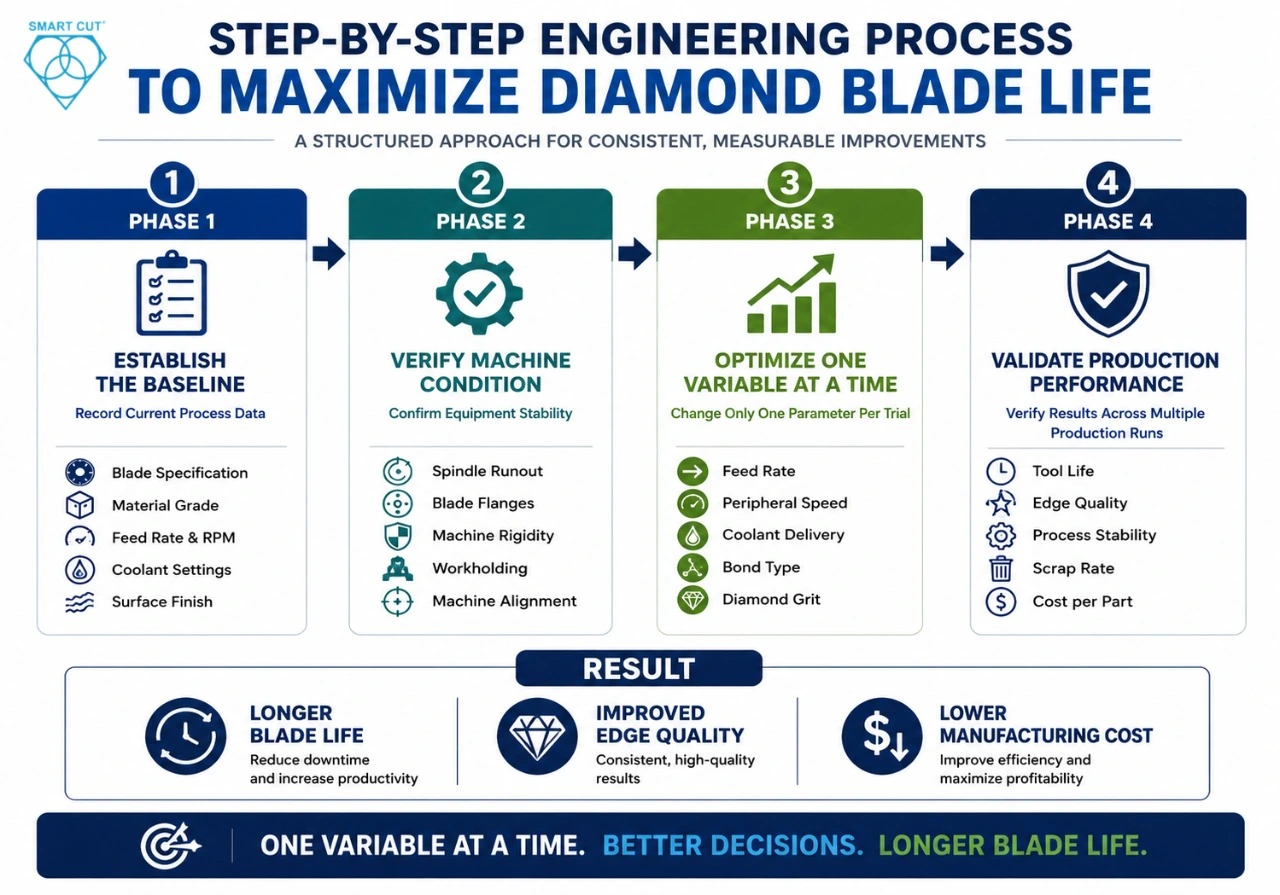
Improving diamond blade life is not achieved by changing multiple variables simultaneously or replacing the blade whenever performance declines. Successful optimization requires a structured engineering methodology that isolates each variable, measures its effect, and validates improvements under real production conditions.
Production engineers who document baseline process data, verify machine condition, optimize one parameter at a time, and monitor performance across multiple production batches consistently achieve longer tool life, improved edge quality, and lower manufacturing costs than those relying on trial-and-error adjustments.
The following qualification process provides a systematic framework for maximizing blade life while maintaining process stability.
Phase 1: Establish the Baseline
Before making any adjustments, document the current cutting process. Without reliable baseline data, it is impossible to determine whether changes improve or reduce performance.
Many optimization projects fail because multiple variables are changed simultaneously, making it difficult to identify the true source of improvement or deterioration.
Record the Following Production Data
|
Process Variable |
Why It Matters |
|---|---|
|
Blade Specification |
Identifies the current tooling configuration |
|
Material Grade |
Influences blade wear and cutting forces |
|
Blade Life |
Establishes the starting benchmark |
|
Feed Rate |
Controls mechanical loading |
|
Spindle Speed (RPM) |
Affects peripheral speed and heat generation |
|
Coolant Settings |
Influences thermal stability |
|
Surface Finish |
Measures cutting quality |
|
Scrap Rate |
Indicates process consistency |
Phase 2: Verify Machine Condition Before Changing the Blade
Many blade life problems originate from worn or improperly maintained equipment rather than the blade itself.
Replacing tooling without inspecting the machine often results in repeated failures and unnecessary tooling costs.
Before evaluating a new blade specification, inspect the mechanical condition of the cutting system.
Machine Qualification Checklist
|
Inspection Item |
Engineering Objective |
|---|---|
|
Spindle Runout |
Maintain cutting accuracy |
|
Blade Flanges |
Prevent blade deflection |
|
Machine Rigidity |
Reduce vibration |
|
Workholding |
Eliminate workpiece movement |
|
Coolant Delivery |
Maintain thermal stability |
|
Machine Alignment |
Improve dimensional consistency |
Even minor spindle runout can increase vibration, accelerate bond wear, and reduce edge quality throughout production.
Engineering Observation
Engineers frequently replace blades to solve problems that are actually caused by spindle wear, damaged flanges, or unstable fixturing. Machine qualification should always precede tooling qualification.
Phase 3: Optimize One Parameter at a Time
Once the machine has been verified, begin optimizing the cutting process.
Changing several variables simultaneously makes it impossible to determine which adjustment produced the observed results.
Instead, modify only one parameter during each production trial while keeping all other conditions constant.
Recommended Evaluation Sequence
- Feed Rate
- Peripheral Speed
- Coolant Delivery
- Blade Specification
- Bond Type
- Diamond Concentration
- Diamond Grit Size
After every adjustment, record measurable production data before proceeding to the next variable. This structured approach minimizes unnecessary trials and shortens process qualification time.
Example
Instead of changing:
- Feed rate
- RPM
- Coolant flow
- Blade specification
all at once,
change only the feed rate, evaluate the results, document the outcome, and then proceed to the next parameter.
This disciplined methodology allows engineers to identify the true cause of performance changes.
Phase 4: Validate Performance Under Production Conditions
A blade that performs well during a short laboratory trial may not deliver consistent results during extended production.
For this reason, qualification should be based on multiple production batches rather than a limited number of cuts.
Engineers should evaluate repeatability alongside productivity and cost.
Key Performance Indicators (KPIs)
|
Performance Metric |
Production Goal |
|---|---|
|
Blade Life |
Stable across multiple batches |
|
Edge Quality |
Meets specification consistently |
|
Cycle Time |
Repeatable |
|
Scrap Rate |
Lower than baseline |
|
Dressing Frequency |
Predictable |
|
Cost Per Part |
Reduced |
Reliable production data provides the confidence required to standardize a blade specification for long-term manufacturing. Our process development and consulting team and precision machining services can help qualify a blade specification for your application.
Engineering Decision Matrix
When production problems occur, engineers should investigate the most influential variables first rather than immediately changing the blade specification.
|
Production Problem |
First Investigation |
Second Investigation |
|---|---|---|
|
Blade glazes rapidly |
Bond Specification |
Feed Rate |
|
Short Tool Life |
Coolant Delivery |
Machine Rigidity |
|
Excessive Chipping |
Diamond Grit Size |
Feed Rate |
|
High Blade Wear |
Bond Type |
Material Hardness |
|
Thermal Damage |
Coolant Coverage |
Peripheral Speed |
|
Poor Surface Finish |
Diamond Size |
Machine Vibration |
|
Variable Tool Life |
Spindle Runout |
Blade Mounting |
|
High Cost Per Part |
Process Stability |
Blade Specification |
This structured troubleshooting sequence reduces unnecessary tooling changes and helps engineers identify root causes more efficiently.
Ready to Optimize Your Cutting Process?
A systematic qualification process helps improve blade life, reduce scrap, and achieve consistent production performance. Explore our engineering resources for practical guidance on blade selection, process optimization, and precision cutting best practices.
Related Engineering Resources
Engineering Best Practices for Process Qualification
Successful production teams treat blade qualification as an ongoing engineering process rather than a one-time setup activity.
The following practices consistently improve blade life and manufacturing stability:
- Document all baseline process conditions before making changes.
- Verify machine condition before evaluating new tooling.
- Modify only one operating parameter at a time.
- Monitor blade wear throughout production.
- Measure cost per part instead of focusing only on blade price.
- Archive successful process parameters for future production runs.
- Review blade performance whenever material grades or production requirements change.
These practices reduce qualification time, improve repeatability, and support continuous process improvement.
Engineering Takeaway
Extending diamond blade life is not the result of a single tooling change—it is the outcome of a disciplined engineering process. By documenting baseline conditions, qualifying machine performance, optimizing one variable at a time, and validating results with production data, manufacturers can achieve longer tool life, more consistent edge quality, lower scrap rates, and reduced cost per finished component. Engineers who follow this systematic approach build robust, repeatable cutting processes that remain stable even as production demands evolve.
Cost Per Part Analysis – Why Longer Blade Life Alone Does Not Reduce Manufacturing Cost
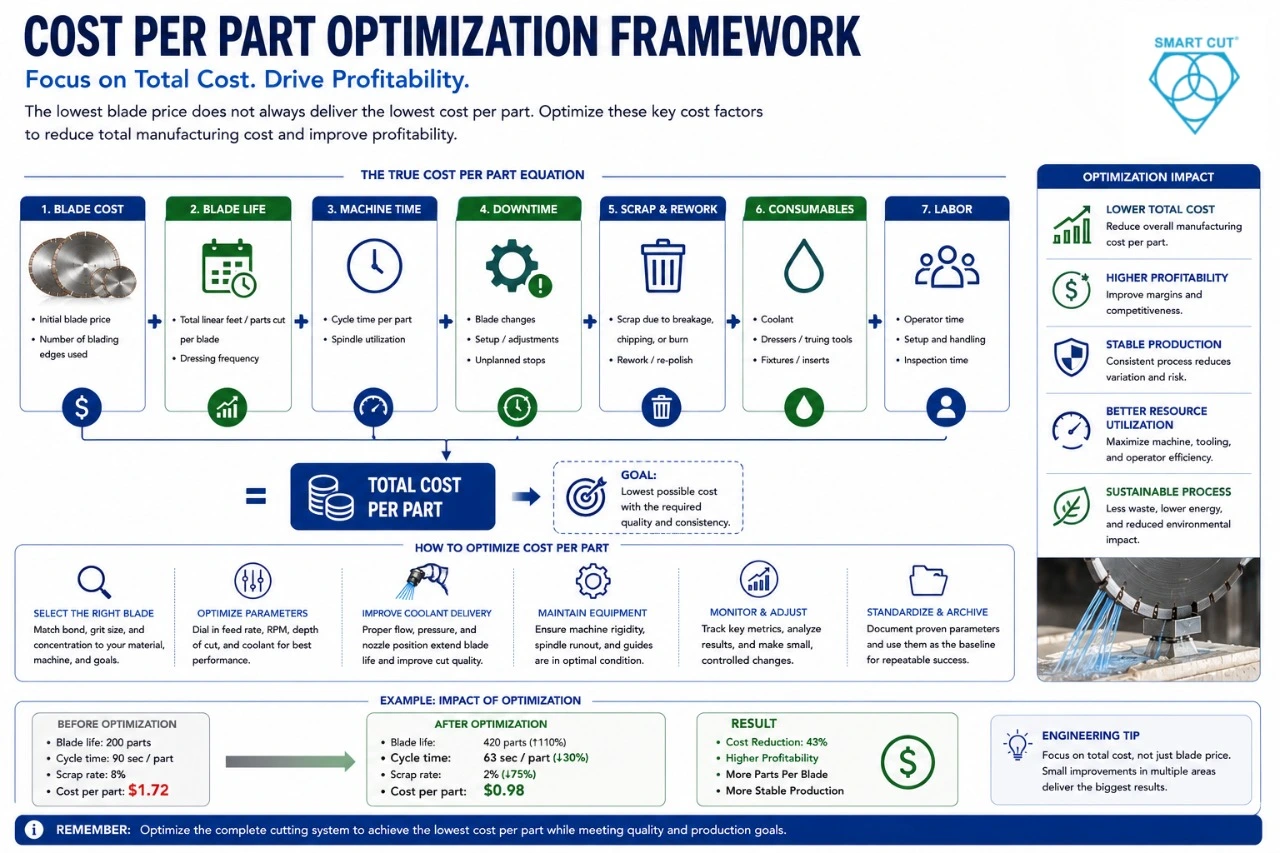
One of the most common mistakes in precision cutting is evaluating diamond blades solely on their purchase price or advertised service life. While these metrics are easy to compare, they provide only a partial view of manufacturing performance.
From an engineering perspective, the real objective is not to maximize blade life—it is to minimize the total cost per finished component while maintaining dimensional accuracy, process stability, and production throughput.
UKAM offers a Guaranteed Trial Order and Best Price Guarantee so you can validate blade performance against your own production data before committing.
A blade that costs more initially may ultimately reduce overall manufacturing costs if it delivers longer service life, fewer dressing interruptions, lower scrap rates, and consistent cutting performance. Conversely, a lower-priced blade that requires frequent replacement or generates inconsistent quality can significantly increase production expenses over time
Why Purchase Price Can Be Misleading
Many procurement decisions focus primarily on tooling cost because it is immediately visible. However, the purchase price of a diamond blade typically represents only a small portion of the total manufacturing cost.
The following hidden factors often have a much greater financial impact:
- Machine downtime during blade changes
- Operator labor
- Dressing frequency
- Scrap and rejected components
- Secondary polishing or rework
- Production delays
- Material waste
- Process inconsistency
For high-value materials such as sapphire, silicon carbide, PCD, and semiconductor wafers, the cost of scrapped components frequently exceeds the cost of the blade itself.
Engineering Cost Per Part Comparison
The following example illustrates why evaluating only blade price can lead to misleading conclusions.
|
Evaluation Factor |
Blade A |
Blade B |
|---|---|---|
|
Purchase Price |
Lower |
Higher |
|
Expected Tool Life |
Moderate |
Longer |
|
Dressing Frequency |
More Frequent |
Less Frequent |
|
Process Stability |
Moderate |
Higher |
|
Scrap Risk |
Higher |
Lower |
|
Overall Cost Per Part |
Evaluate Based on Production Data |
Evaluate Based on Production Data |
*Illustrative engineering values for evaluation purposes only. Actual results depend on material, machine condition, operating parameters, and production environment.
The Hidden Costs of Premature Blade Replacement
Replacing a blade affects far more than tooling inventory.
Every blade change may require:
- Stopping production
- Removing and installing the blade
- Machine verification
- Alignment checks
- Test cuts
- Process requalification
- Operator involvement
Even if the replacement takes only a few minutes, repeated interruptions reduce machine utilization and overall production efficiency.
For automated manufacturing environments, these interruptions can become one of the largest contributors to increased cost per part.
Engineering Variables That Influence Manufacturing Cost
Blade life is only one of several variables affecting production economics.
The following factors should be evaluated together when qualifying a blade specification.
|
Engineering Variable |
Manufacturing Impact |
|---|---|
|
Tool Life |
Reduces blade replacement frequency |
|
Dressing Interval |
Increases spindle utilization |
|
Cycle Time |
Improves production throughput |
|
Edge Quality |
Minimizes secondary finishing |
|
Machine Stability |
Improves repeatability |
|
Coolant Efficiency |
Reduces thermal damage |
|
Process Consistency |
Simplifies production planning |
Engineers who optimize these variables simultaneously typically achieve greater cost savings than those focused exclusively on extending blade life
Measuring Blade Performance Beyond Tool Life
To objectively compare blade performance, production teams should monitor measurable Key Performance Indicators (KPIs) rather than relying on operator observations alone.
|
KPI |
Engineering Objective |
|---|---|
|
Blade Life |
Stable across multiple production batches |
|
Cost Per Part |
Lower than current baseline |
|
Scrap Rate |
Continuous reduction |
|
Edge Quality |
Within specification |
|
Cycle Time |
Consistent and repeatable |
|
Dressing Frequency |
Predictable intervals |
|
Kerf Width |
Maintain dimensional accuracy |
|
Machine Downtime |
Minimize interruptions |
Recommended Production Metrics
Tracking these metrics allows engineers to identify gradual process changes before they become expensive production problems.
Reduce Manufacturing Costs Through Process Optimization
Lower tooling costs don’t always translate into lower production costs. Optimizing blade selection, machine setup, and operating parameters can significantly improve productivity while reducing overall cost per part.
Related Engineering Resources
Engineering Example: Two Different Optimization Strategies
Consider two production teams cutting advanced ceramics.
Team A
- Purchases the least expensive blade.
- Replaces blades frequently.
- Adjusts parameters based on operator experience.
- Experiences variable edge quality.
- Focuses primarily on purchase price.
Team B
- Documents baseline process data.
- Verifies machine condition.
- Selects the blade based on application.
- Optimizes coolant delivery.
- Measures cost per part instead of blade price.
- Tracks production KPIs over multiple batches.
This systematic approach transforms blade selection from a purchasing decision into a process optimization strategy.
- Longer blade life
- Lower scrap rates
- Better dimensional consistency
- Fewer production interruptions
- Lower overall manufacturing costs
This systematic approach transforms blade selection from a purchasing decision into a process optimization strategy.
Engineering Takeaway
The most successful precision cutting operations evaluate diamond blades based on total manufacturing performance, not purchase price alone. Tool life, dressing frequency, cycle time, scrap rate, machine utilization, and edge quality all contribute to the true cost of production. By measuring cost per part and optimizing the complete cutting process, manufacturers can improve productivity, reduce waste, and achieve more predictable long-term manufacturing performance. This engineering-focused approach aligns tooling decisions with operational efficiency rather than short-term purchasing cost.
Engineering Troubleshooting Guide – Diagnosing and Solving Common Diamond Blade Performance Problems
Even when the correct diamond blade has been selected, production issues can still arise if machine conditions, operating parameters, or coolant delivery change during manufacturing. The key to efficient troubleshooting is identifying the root cause before replacing the blade or making multiple process adjustments.
Many cutting problems produce similar symptoms. For example, poor surface finish may result from worn diamond particles, machine vibration, or an incorrect grit specification. Likewise, short blade life may be caused by excessive cutting pressure, poor coolant delivery, or improper bond selection.
A systematic troubleshooting process helps engineers isolate the true cause of the problem, reduce unnecessary tooling changes, and restore stable production more quickly. For a deeper look at common failure modes, see 50 Common Issues When Using Diamond Wheels.
Start with the Symptom, Not the Blade
One of the most common mistakes in production is assuming the blade has failed whenever cutting performance declines.
Instead, engineers should first identify the observable production symptom and investigate the most likely process variables before replacing the tooling.
Engineering Troubleshooting Workflow
This structured approach minimizes downtime and prevents unnecessary trial-and-error adjustments.
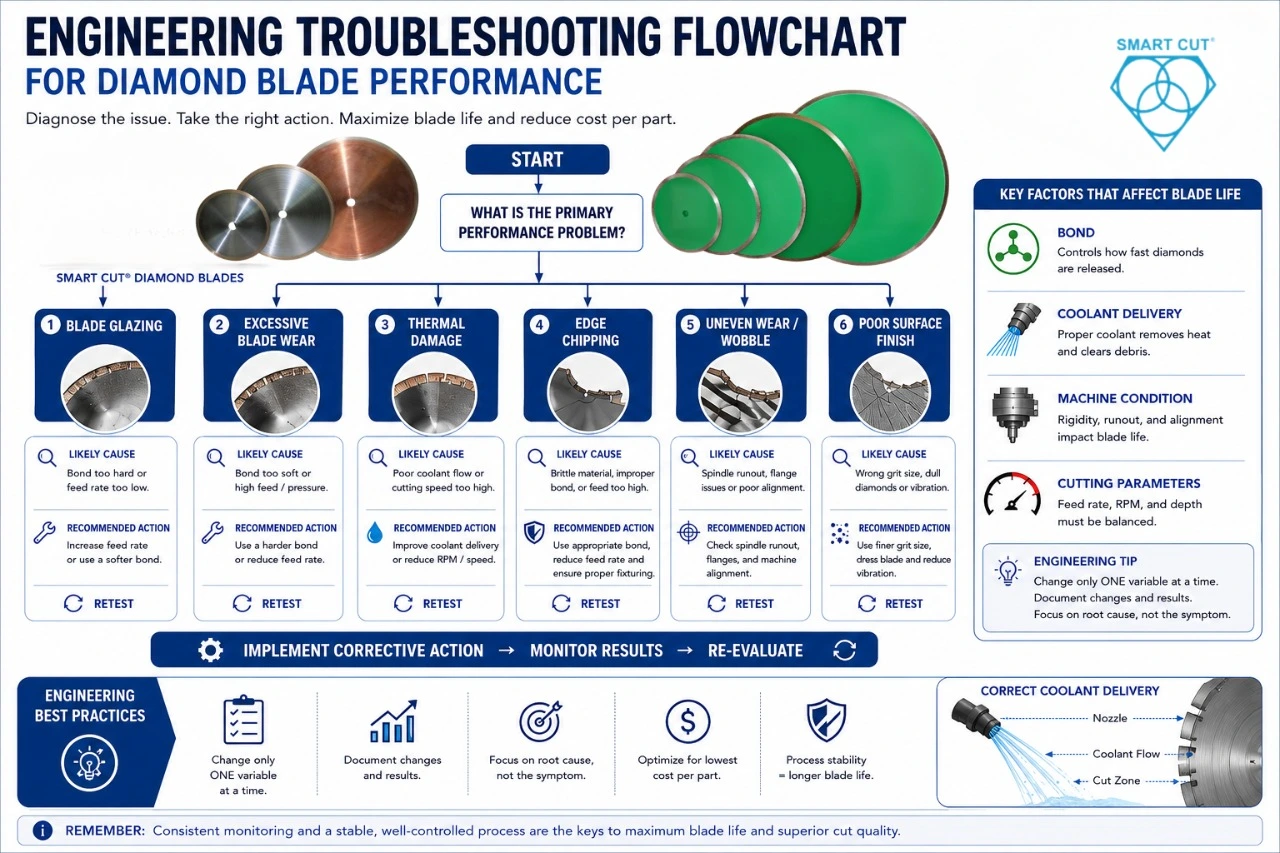
Troubleshooting Matrix
The following reference table summarizes common production problems, their probable causes, and the recommended engineering response.
|
Production Observation |
Probable Cause |
Recommended Engineering Action |
|---|---|---|
|
Blade glazes rapidly |
Bond too hard |
Review bond specification and dressing interval |
|
Blade wears excessively |
Bond too soft |
Select a harder bond specification |
|
Material discoloration |
Excessive heat |
Improve coolant delivery and verify cutting speed |
|
Edge chipping |
Feed rate too high or grit too coarse |
Reduce cutting force and review grit selection |
|
Rough surface finish |
Worn diamonds or incorrect grit |
Inspect blade condition and adjust specification |
|
Kerf width variation |
Spindle runout or blade deflection |
Inspect blade wear and evaluate dressing frequency |
|
Inconsistent tool life |
Process variation |
Verify machine condition and production parameters |
Problem 1: Blade Glazing
Production Symptoms
- Cutting speed decreases
- Higher spindle load
- Increased heat generation
- Poor surface finish
Possible Causes
- Bond specification too hard
- Feed rate too low
- Blade requires dressing
- Incorrect diamond concentration
Recommended Actions
- Verify bond specification.
- Dress the blade if appropriate.
- Increase feed rate within safe operating limits.
- Review material compatibility.
Problem 2: Excessive Blade Wear
Production Symptoms
- Rapid diameter reduction
- Frequent blade replacement
- Higher tooling costs
Possible Causes
- Bond too soft
- Excessive cutting pressure
- Machine vibration
- Improper blade specification
Recommended Actions
- Recommended Actions
- Inspect spindle bearings.
- Check machine rigidity.
- Reduce excessive mechanical loading.
Problem 3: Thermal Damage
Production Symptoms
- Material burns
- Thermal cracks
- Blade discoloration
- Coolant evaporates near cutting zone
Possible Causes
- Poor coolant delivery
- High spindle speed
- Excessive feed rate
- Inadequate coolant flow
Recommended Actions
- Inspect nozzle positioning.
- Verify coolant filtration.
- Reduce cutting speed if necessary.
- Ensure continuous coolant coverage.
Engineering Observation
Improving coolant delivery often provides greater improvements than increasing coolant flow alone.
Problem 4: Edge Chipping
Edge chipping remains one of the most common quality issues when cutting brittle materials such as alumina, sapphire, quartz, fused silica, and semiconductor wafers.
Production Symptoms
- Broken corners
- Edge fractures
- Increased polishing time
- Higher scrap rates
Possible Causes
- Coarse diamond grit
- Excessive feed rate
- Machine vibration
- Poor workholding
Recommended Actions
- Select a finer grit.
- Reduce cutting force.
- Improve fixture stability.
- Verify spindle runout.
Problem 5: Poor Surface Finish
Surface finish often deteriorates gradually before engineers notice measurable changes in blade life.
Production Symptoms
- Rough cut surfaces
- Visible scratches
- Increased polishing requirements
- Variable surface quality
Possible Causes
- Worn diamond particles
- Incorrect grit size
- Machine vibration
- Poor coolant delivery
Recommended Actions
- Inspect blade condition.
- Review grit specification.
- Verify spindle accuracy.
- Improve coolant coverage.
Problem 6: Kerf Width Variation
Maintaining consistent kerf width is essential for dimensional accuracy, especially in semiconductor, optical, and precision ceramic applications.
Production Symptoms
- Variable kerf width
- Blade wandering
- Dimensional inconsistency
Possible Causes
- Spindle runout
- Blade deflection
- Damaged flanges
- Improper mounting
Recommended Actions
- Measure spindle runout.
- Inspect blade mounting.
- Replace damaged flanges.
- Verify machine alignment.
Root Cause Analysis Checklist
Before replacing a blade, engineers should systematically evaluate the complete cutting process.
Machine
- Spindle runout within specification
- Bearings in good condition
- Blade mounted correctly
- Machine vibration acceptable
Coolant
- Proper nozzle positioning
- Adequate flow rate
- Clean filtration system
- Coolant reaches the cutting interface
Blade
- Bond specification matches material
- Diamond grit appropriate
- Concentration verified
- Blade free from shipping or handling damage
Engineering Best Practices for Troubleshooting
The fastest way to solve production problems is not by changing multiple variables—it is by following a structured engineering process.
Successful production teams typically:
- Investigate the observable symptom first.
- Verify machine condition before replacing tooling.
- Change one operating parameter at a time.
- Record production results after every adjustment.
- Validate improvements across multiple production batches.
This disciplined approach reduces downtime, minimizes tooling waste, and improves long-term process stability.
Engineering Takeaway
Effective troubleshooting begins with understanding why blade performance changed—not simply replacing the blade. Most production issues originate from the interaction between tooling, machine condition, coolant delivery, and operating parameters rather than from the blade alone. By identifying the root cause, documenting process changes, and validating improvements systematically, engineers can restore cutting performance while reducing unnecessary tooling costs and improving overall manufacturing efficiency.
Silicon Carbide (SiC)
Silicon carbide is one of the most abrasive engineering ceramics processed with diamond wheels. As grinding continues, dull diamond particles may remain exposed while cutting efficiency gradually decreases.
Primary Failure Mode: Wheel glazing resulting in increased grinding forces and reduced material removal.
- Broken corners
- Edge fractures
- Increased polishing time
- Higher scrap rates
Common Causes
- Bond selection not matched to material abrasiveness.
- Dressing intervals extended beyond qualified limits.
- Reduced coolant coverage.
- Increasing spindle load ignored during production.
Engineering Recommendations
- Inspect wheel condition before replacing the wheel.
- Review dressing practices together with bond selection.
- Maintain consistent coolant delivery.
- Record grinding observations throughout qualification.
To support process planning and qualification, manufacturers may find the following resources valuable:
Gallium Arsenide (GaAs)
Alumina (Al₂O₃)
- Variable kerf width
- Blade wandering
- Dimensional inconsistency
- Improve coolant coverage.
Alumina fractures in a brittle manner. Once glazing develops, grinding stability may decrease before obvious wheel wear becomes visible.
Primary Failure Mode: Surface finish deterioration accompanied by edge chipping.
Common Causes
- Delayed dressing.
- Incorrect grit selection.
- Process changes made without documentation.
Engineering Recommendations
- Monitor finished surface quality.
- Inspect abrasive exposure regularly.
- Review wheel specification before changing grinding parameters.
Silicon Nitride (Si₃N₄)
Silicon nitride generates relatively high grinding forces. Wheel glazing gradually increases spindle load as cutting efficiency declines.
Primary Failure Mode: Higher spindle load with decreasing stock removal.
Common Causes
- Worn abrasive remaining active.
- Poor coolant penetration.
- Dressing intervals not optimized.
Engineering Recommendations
- Monitor spindle behavior.
- Maintain consistent dressing.
- Inspect wheel condition throughout production.
Sapphire
Sapphire grinding requires stable abrasive exposure to maintain optical quality.
Primary Failure Mode: Thermal surface damage.
Common Causes
- Poor coolant delivery.
- Wheel glazing increasing grinding friction.
- Excessive grinding pressure.
Engineering Recommendations
- Verify coolant reaches the grinding interface.
- Review dressing practices.
- Inspect wheel before adjusting grinding parameters.
Fused Silica
Fused silica is susceptible to subsurface damage when grinding temperatures increase.
Primary Failure Mode: Microfracture beneath the finished surface.
Common Causes
- Delayed wheel maintenance.
- Poor coolant coverage.
- Reduced cutting efficiency caused by glazing.
Engineering Recommendations
- Maintain stable coolant delivery.
- Inspect wheel condition routinely.
- Review grit size and bond selection during qualification.
Tungsten Carbide
Tungsten carbide requires stable grinding conditions because high grinding forces accelerate wheel glazing.
Primary Failure Mode: Loss of cutting efficiency.
Common Causes
- Bond retaining worn abrasive too long.
- Machine vibration.
- Infrequent dressing.
Engineering Recommendations
- Monitor grinding forces.
- Inspect machine rigidity.
- Review bond selection if glazing develops repeatedly.
Gallium Arsenide (GaAs)
Gallium arsenide requires careful process control because of its brittle structure.
Primary Failure Mode: Surface fracture resulting from unstable grinding conditions.
Common Causes
- Increased grinding friction.
- Inconsistent coolant delivery.
- Delayed wheel inspection.
Engineering Considerations
- Monitor grinding consistency.
- Maintain wheel condition.
- Review qualification records before changing wheel specification.
Grinding PCD places significant demands on abrasive exposure and process stability.
Primary Failure Mode: Wheel glazing accompanied by increased grinding forces.
Common Causes
- Incorrect bond selection.
- Dressing delayed.
- Coolant delivery becoming inconsistent.
Engineering Considerations
- Review the complete wheel specification.
- Inspect abrasive exposure frequently.
- Maintain documented qualification procedures.
Troubleshooting Matrix
The following reference provides a structured method for identifying the most common causes of wheel glazing. For a step-by-step diagnostic walkthrough, see UKAM’s Diamond & CBN Wheel Troubleshooting Guide.
|
Production Observation |
Possible Engineering Cause |
Recommended Review |
|---|---|---|
|
Reduced material removal |
Wheel glazing |
Inspect wheel condition |
|
Burn marks |
Increased grinding friction |
Review coolant delivery |
|
Higher spindle load |
Reduced cutting efficiency |
Inspect abrasive exposure |
|
Poor surface finish |
Wheel glazing or loading |
Review dressing procedure |
|
Frequent dressing |
Bond characteristics should be evaluated |
Review wheel specification |
|
Dimensional variation |
Process instability |
Inspect machine condition |
|
Increased vibration |
Wheel mounting or spindle condition |
Review machine stability |
|
Grinding noise increasing |
Wheel condition changing |
Inspect grinding system |
Frequently Asked Questions
Manufacturing engineers, production managers, and process development teams often encounter similar questions when selecting and optimizing diamond blades for precision cutting. The following answers address common concerns based on the engineering principles discussed throughout this guide.
There is no single adjustment that guarantees longer blade life. The most effective approach is to optimize the entire cutting process rather than focusing on the blade alone — see our full guide on properly using diamond tools. Machine rigidity, spindle accuracy, bond selection, diamond grit size, coolant delivery, feed rate, and operating parameters all contribute to blade performance.
Successful production teams document baseline process data before making changes and evaluate one variable at a time. This systematic approach helps identify the adjustments that produce measurable improvements in tool life, edge quality, and cost per part.
Each material has unique mechanical and thermal properties that influence blade wear mechanisms.
For example:
- Silicon carbide is highly abrasive and accelerates diamond wear.
- Alumina is brittle and prone to edge chipping.
- Sapphire requires fine diamond grit to maintain surface quality.
- Tungsten carbide may cause blade glazing if the bond is too hard.
Because no single blade performs equally well across all materials, engineers should qualify blade specifications for each application rather than relying on a general-purpose solution.
The bond controls how worn diamond particles are released and replaced by fresh cutting points. See our detailed breakdown: Choosing the Correct Diamond Bond Type.
A bond that is too hard retains dull diamonds, causing glazing and increased cutting forces. Conversely, a bond that is too soft releases abrasive particles prematurely, shortening blade life.
The objective is to achieve a controlled wear pattern that maintains cutting efficiency while exposing fresh diamond particles throughout the cutting process.
No.
Experienced manufacturing engineers evaluate tooling based on cost per finished component, not purchase price alone.
When comparing suppliers, consider:
- Tool life
- Dressing frequency
- Scrap rate
- Cycle time
- Edge quality
- Process consistency
- Engineering support
- Application expertise
A higher-priced blade may produce significantly lower manufacturing costs if it delivers better productivity and reduced downtime. Learn about our financing options and JIT inventory & vending solutions for production-scale procurement.
Reliable production data is essential for process optimization and repeatability.
Engineers should document:
- Material type and grade
- Blade specification
- Bond type
- Diamond grit size
- Diamond concentration
- Spindle speed
- Feed rate
- Coolant settings
- Tool life
- Dressing interval
- Cycle time
- Scrap rate
- Edge quality
- Cost per part
These records provide the foundation for troubleshooting, future process improvements, and standardized production procedures.
Blade specifications should be reviewed whenever production conditions change.
Common situations include:
- Introducing a new material
- Tightening dimensional tolerances
- Increasing production volume
- Experiencing changes in blade life
- Noticing inconsistent edge quality
- Modifying machine parameters
Regular reviews help engineers identify opportunities to improve manufacturing efficiency while maintaining process stability.
Not necessarily.
Coolant effectiveness depends more on how coolant reaches the cutting interface than on flow rate alone. Proper nozzle positioning, continuous coverage, clean filtration, and stable coolant temperature are often more important than simply increasing pump capacity.
Before increasing coolant flow, engineers should verify that coolant is being delivered directly into the cutting zone and effectively removing heat and debris.
A blade should not be replaced solely because it has reached a predetermined number of cuts.
Instead, replacement decisions should be based on measurable performance indicators such as:
- Declining cutting efficiency
- Excessive spindle load
- Inconsistent edge quality
- Increased dressing frequency
- Reduced dimensional accuracy
- Higher scrap rates
- Loss of process repeatability
Monitoring these indicators allows production teams to maximize blade utilization without compromising product quality.
Reducing edge chipping requires controlling both mechanical loading and machine stability.
Engineers should evaluate:
- Diamond grit size
- Feed rate
- Machine vibration
- Workholding rigidity
- Coolant delivery
- Spindle runout
In many cases, improving machine rigidity and selecting a finer grit specification produce greater improvements than simply reducing spindle speed.
Longer blade life does not automatically reduce manufacturing costs.
A blade that lasts longer but increases cycle time or produces inconsistent quality may actually increase the overall cost of production.
Cost per part considers the complete manufacturing process, including:
- Tool life
- Machine downtime
- Scrap rate
- Dressing frequency
- Labor
- Cycle time
- Secondary finishing
- Material utilization
Evaluating these factors together provides a more accurate assessment of production efficiency than blade life alone.
Key Engineering Principles
For background on abrasive selection fundamentals, see Why Use Diamond and Diamond vs CBN Tools. The following principles summarize the engineering practices discussed throughout this guide:
- Evaluate the complete cutting system rather than the blade alone.
- Match bond type, grit size, and concentration to the workpiece material.
- Verify machine condition before changing tooling.
- Deliver coolant directly to the cutting interface.
- Optimize one process variable at a time.
- Measure performance using tool life, cycle time, scrap rate, and cost per part.
- Validate improvements through controlled production trials.
- Standardize successful process parameters to improve repeatability.
Engineering Summary & Next Steps for Optimizing Diamond Blade Performance
Maximizing diamond blade life is not simply a matter of selecting a harder bond, increasing coolant flow, or reducing feed rate. Long-term cutting performance is achieved by treating the blade as one component of an integrated manufacturing system where tooling, machine capability, process parameters, coolant delivery, and material characteristics work together.
Throughout this guide, we have shown that premature blade failure is typically the result of process-related factors rather than tooling defects alone. Blade glazing, excessive diamond pullout, thermal damage, uneven wear, and edge chipping can often be minimized by following a structured engineering qualification process, documenting baseline conditions, optimizing one variable at a time, and validating improvements under production conditions.
Whether cutting advanced ceramics, tungsten carbide, sapphire, optical glass, semiconductor wafers, or composite materials, engineers who focus on process stability rather than individual tooling changes consistently achieve:
- Longer and more predictable blade life
- Reduced scrap and rework
- Improved dimensional accuracy
- Better edge quality
- Lower cost per finished component
- Higher machine utilization
- More repeatable production performance
These outcomes support not only lower manufacturing costs but also more reliable production planning and improved product quality.
Engineering Best Practices at a Glance
The following practices provide a practical framework for extending blade life and improving manufacturing efficiency:
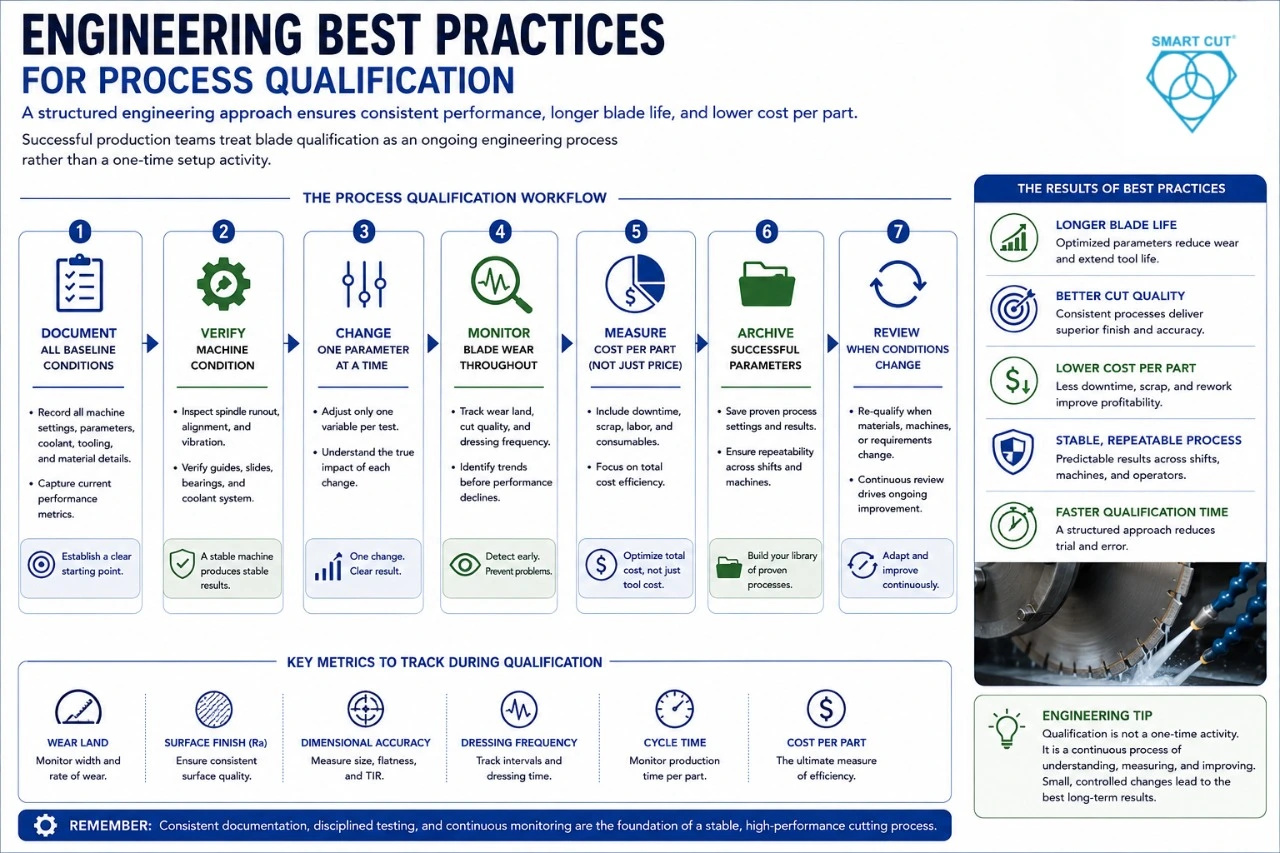
- Document baseline process parameters before making changes.
- Verify spindle runout, machine rigidity, and workholding before replacing tooling.
- Match bond type, diamond grit size, and concentration to the specific workpiece material.
- Deliver coolant directly to the cutting interface to control heat and remove debris effectively.
- Change only one operating parameter at a time during qualification trials.
- Monitor blade wear, dressing intervals, cycle time, scrap rate, and cost per part throughout production.
- Validate process improvements across multiple production batches before standardizing a new blade specification.
Following these practices helps establish a repeatable, data-driven manufacturing process that supports consistent cutting performance over the long term.
Need Help Selecting the Right Diamond Blade?
Selecting the correct blade specification often involves balancing multiple engineering variables, including material properties, machine capability, required edge quality, production volume, and process objectives. While general guidelines provide a useful starting point, many applications benefit from application-specific qualification.
If your production team is experiencing issues such as:
- Premature blade wear
- Blade glazing
- Excessive edge chipping
- Thermal damage
- Poor surface finish
- High scrap rates
- Inconsistent blade life
- Rising cost per part
a structured evaluation of the complete cutting process may help identify opportunities for improvement.
UKAM’s technical resources and application guidance are designed to support engineers in selecting appropriate diamond blade specifications, optimizing cutting parameters, and improving process consistency across a wide range of precision cutting applications. Browse our full product catalog, explore custom diamond & CBN tool manufacturing, or request a consultation with our applications engineering team. You can also sign up for our newsletter for illustrated troubleshooting guides, or visit the UKAM homepage to learn more about our company, established in 1990.
Engineering Summary
Extending diamond blade life requires more than replacing worn tooling—it requires understanding the interaction between blade specification, machine condition, coolant delivery, operating parameters, and material behavior. Manufacturing teams that adopt a systematic engineering approach, validate process changes with measurable data, and optimize the complete cutting system consistently achieve longer tool life, improved edge quality, greater process stability, and lower overall manufacturing costs. By focusing on cost per part rather than blade price, engineers can make more informed tooling decisions that support long-term productivity and manufacturing efficiency.
Trusted by Tens of Thousands of Manufacturers, Laboratories,
Research Institutions Worldwide Since 1990
American Based Manufacturer
Established in 1990
Custom manufacturing
RELATED ARTICLES