









Home > Blog > How Coolant Flow Affects Diamond Blade Life, Cut Quality & Process Stability During Precision Cutting
coolant, blog, Cutting

How Coolant Flow Affects Diamond Blade Life, Cut Quality & Process Stability During Precision Cutting


Table of Contents

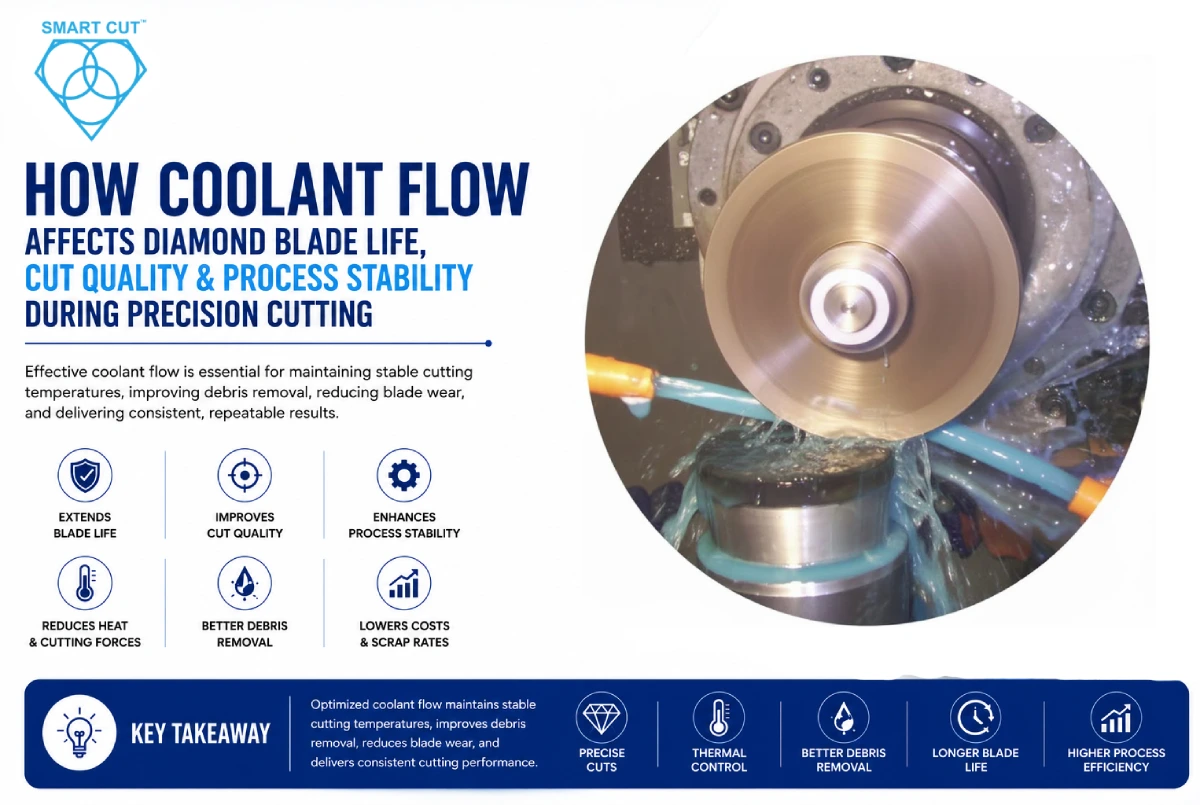
Coolant is one of the most important and often most overlooked variables in precision cutting operations.

Many manufacturers focus heavily on blade selection, spindle speed, feed rate, and machine rigidity while assuming coolant simply serves as a cooling medium.

In reality, coolant directly influences:

Blade life

Cut quality

Surface finish

Edge integrity

Process repeatability

Thermal stability

Material removal efficiency

Operating costs

Whether cutting silicon wafers, technical ceramics, carbides, composites, sapphire, quartz, glass, electronic packages, advanced materials, or metallographic samples, coolant performance frequently determines whether a cutting process remains stable and repeatable.

Poor coolant delivery can lead to:

Blade overheating

Thermal damage

Increased cutting forces

Edge chipping

Blade loading

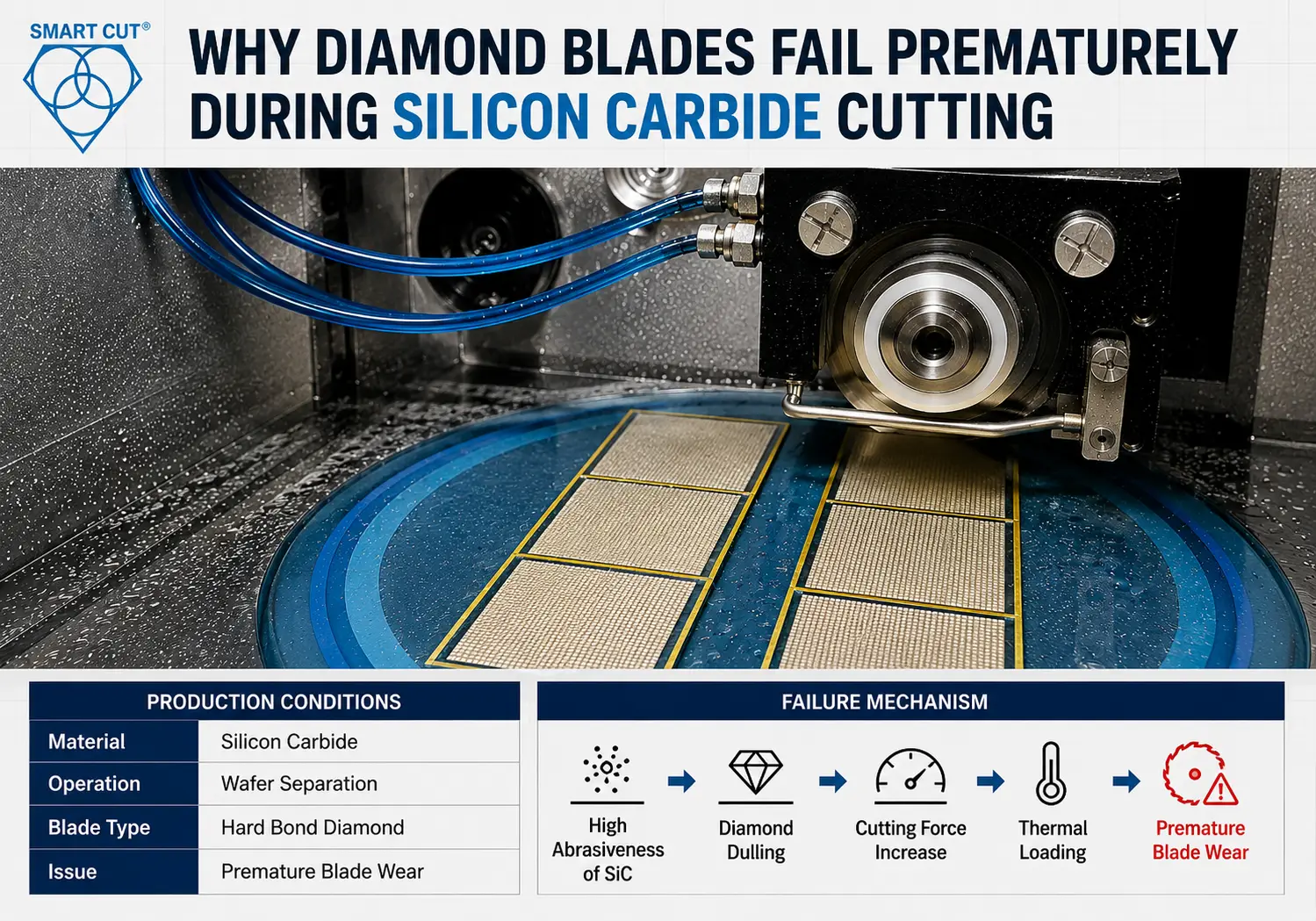
Premature blade wear

Reduced productivity

Higher scrap rates

By contrast, optimised coolant systems help maintain stable cutting temperatures, improve debris removal, reduce blade wear, and support consistent cutting performance.

This article examines the engineering principles behind coolant performance and explains how coolant flow influences blade life, cut quality, and overall process stability.

Trusted by Tens of Thousands of Manufacturers, Laboratories Research Institutions Worldwide Since 1990

American Based Manufacturer

Established in 1990

Custom manufacturing

Why Coolant Is Often Overlooked

Many cutting operations treat coolant as an afterthought.

When cutting quality deteriorates, operators typically investigate:

Blade specifications

Feed rate

RPM

Machine alignment

Workholding

Coolant systems are frequently examined only after other variables have been adjusted.

This approach often overlooks one of the most influential factors affecting cutting performance.

In precision sectioning applications, coolant interacts directly with:

Diamond particles

Blade bond systems

Workpiece material

Cutting debris

Heat generation mechanisms

As a result, coolant performance affects far more than just temperature control.

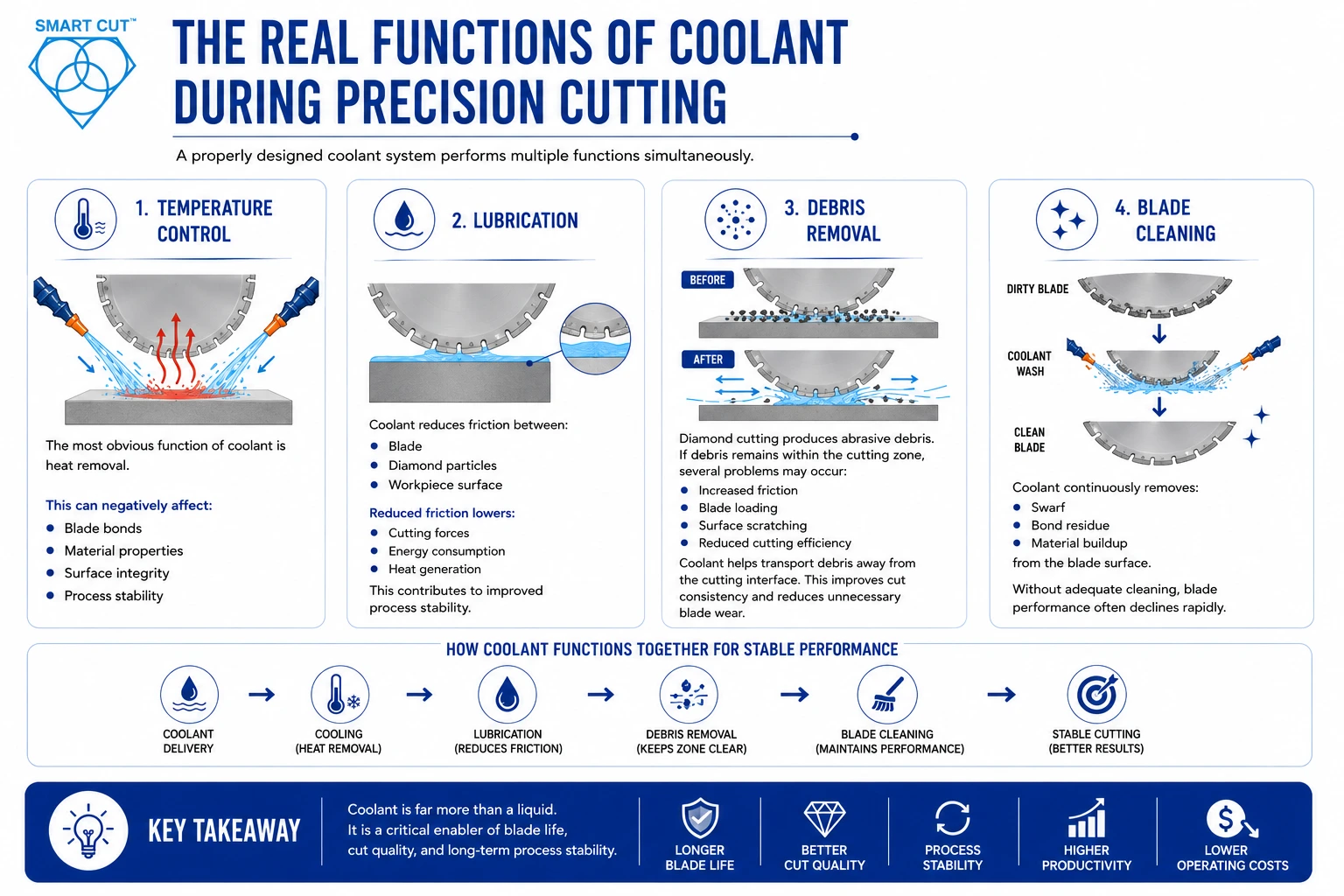
The Real Functions of Coolant During Precision Cutting
A properly designed coolant system performs multiple functions simultaneously.

Temperature Control

The most obvious function of coolant is heat removal.

During cutting, friction at the blade-workpiece interface generates localised heat.

Without adequate cooling, temperatures may rise rapidly.

This can negatively affect:

Blade bonds

Material properties

Surface integrity

Process stability

Lubrication

Coolant reduces friction between:

Blade

Diamond particles

Workpiece surface

Reduced friction lowers:

Cutting forces

Energy consumption

Heat generation

This contributes to improved process stability.

Debris Removal

Diamond cutting produces abrasive debris.

If debris remains within the cutting zone, several problems may occur:

Increased friction

Blade loading

Surface scratching

Reduced cutting efficiency

Coolant helps transport debris away from the cutting interface.

This improves cut consistency and reduces unnecessary blade wear.

Blade Cleaning

Many operators underestimate how important blade cleaning can be.

Coolant continuously removes:

Swarf

Bond residue

Material buildup

from the blade surface.

Without adequate cleaning, blade performance often declines rapidly.

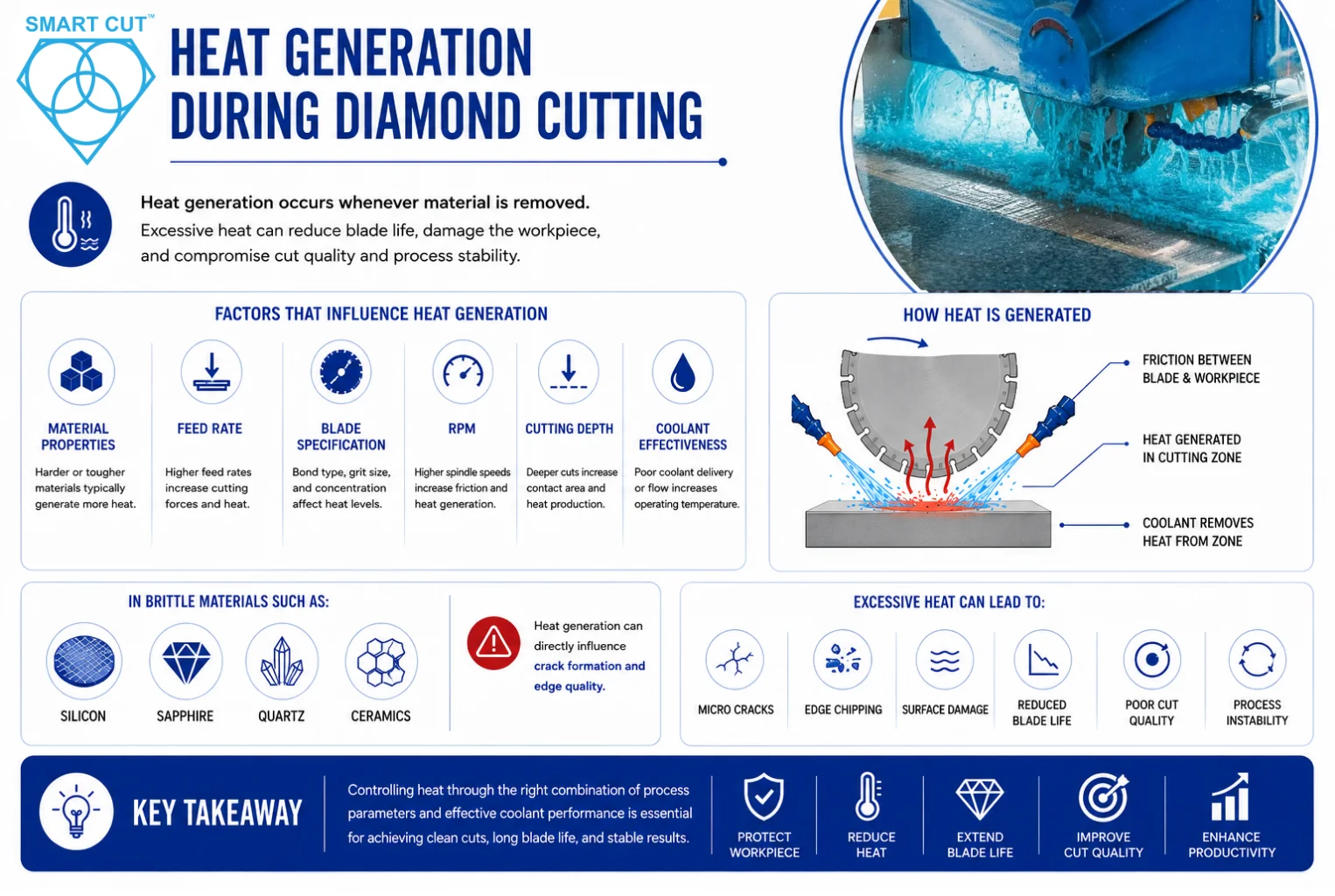
Heat Generation During Diamond Cutting

Heat generation occurs whenever material is removed.

The amount of heat produced depends on:

Material properties

Feed rate

Blade specification

RPM

Cutting depth

Coolant effectiveness

In brittle materials such as:

Silicon

Sapphire

Quartz

Ceramics

Heat generation can directly influence crack formation and edge quality.

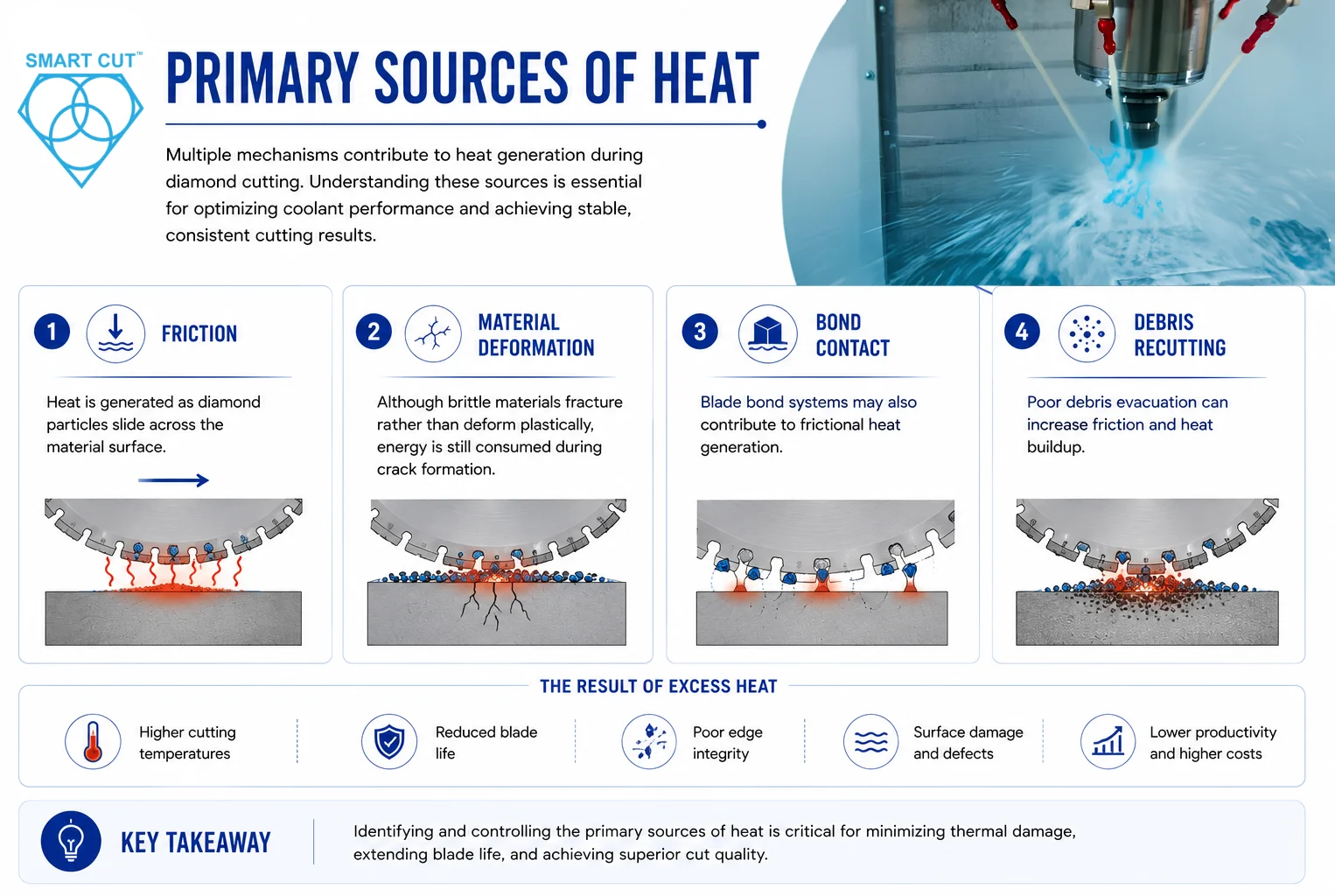
Primary Sources of Heat

Friction

Heat is generated as diamond particles slide across the material surface.

Material Deformation

Although brittle materials fracture rather than deform plastically, energy is still consumed during crack formation.

Bond Contact

Blade bond systems may also contribute to frictional heat generation.

Debris Recutting

Poor debris evacuation can increase friction and heat buildup.

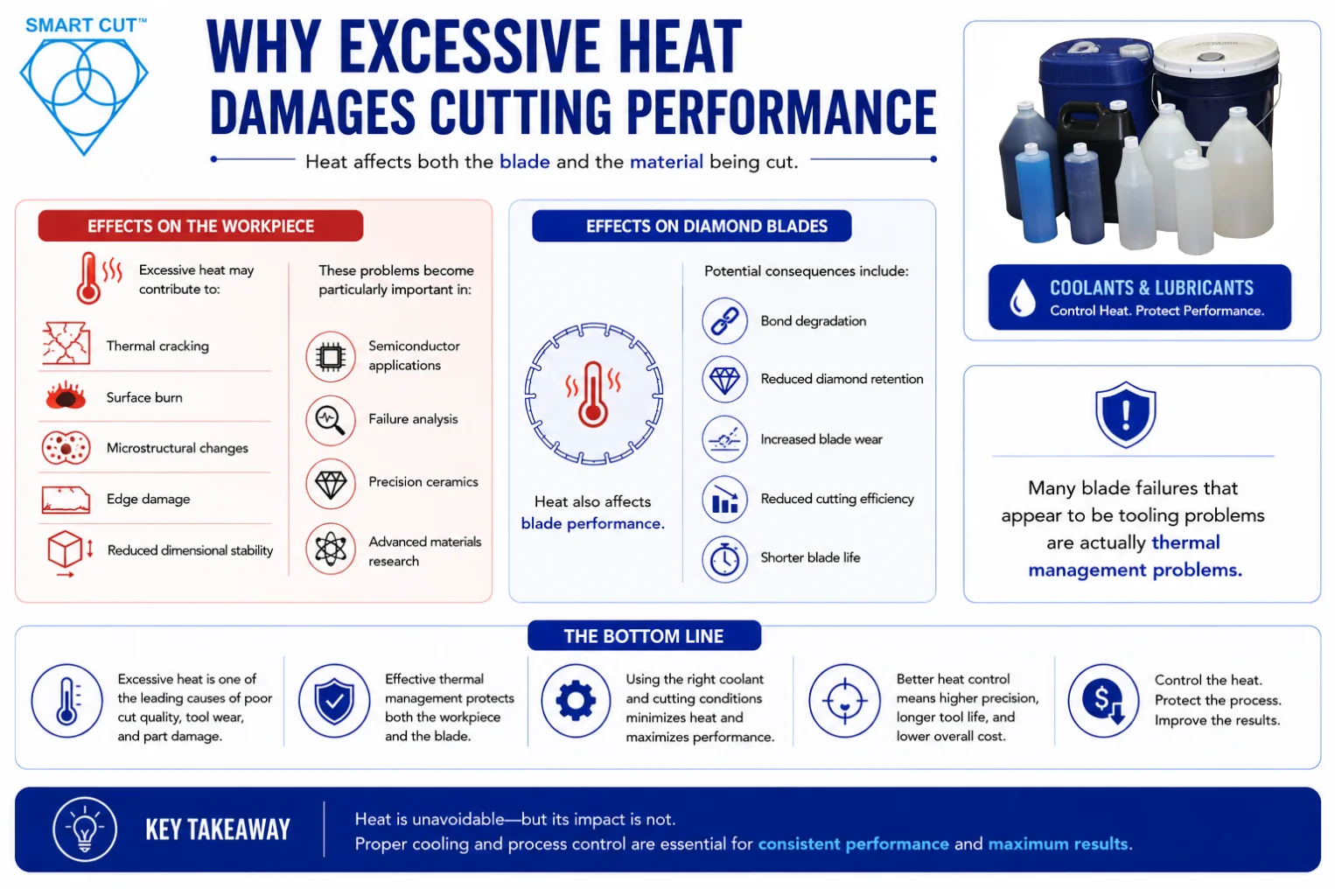
Why Excessive Heat Damages Cutting Performance

Heat affects both the blade and the material being cut.

Effects on the Workpiece

Excessive heat may contribute to:

Thermal cracking

Surface burn

Microstructural changes

Edge damage

Reduced dimensional stability

These problems become particularly important in:

Semiconductor applications

Failure analysis

Precision ceramics

Advanced materials research

Effects on Diamond Blades

Heat also affects blade performance.

Potential consequences include:

Bond degradation

Reduced diamond retention

Increased blade wear

Reduced cutting efficiency

Shorter blade life

Many blade failures that appear to be tooling problems are actually thermal management problems.

Coolant Flow Rate vs Cut Quality

One of the most common misconceptions is that more coolant automatically produces better results.

In reality, coolant effectiveness depends on:

Flow rate

Delivery location

Pressure

Nozzle design

Filtration quality

All of these variables influence overall performance.

Insufficient Flow Rates

Low coolant flow often results in:

Localized overheating

Debris accumulation

Increased blade wear

Higher cutting forces

Symptoms may include:

Poor surface finish

Increased chipping

Thermal damage

Reduced blade life

Excessive Flow Rates

Extremely high coolant flow rates may also create problems.

Potential issues include:

Turbulence

Coolant splash

Reduced nozzle effectiveness

Pump inefficiency

The goal is not maximum flow.

The goal is effective flow.

Coolant Delivery Location Matters

Even a high-flow coolant system may perform poorly if the coolant never reaches the cutting interface.

For maximum effectiveness, coolant should be directed toward:

Blade entry point

Primary cutting zone

Heat generation area

Proper nozzle positioning often produces greater improvements than increasing the flow rate alone.

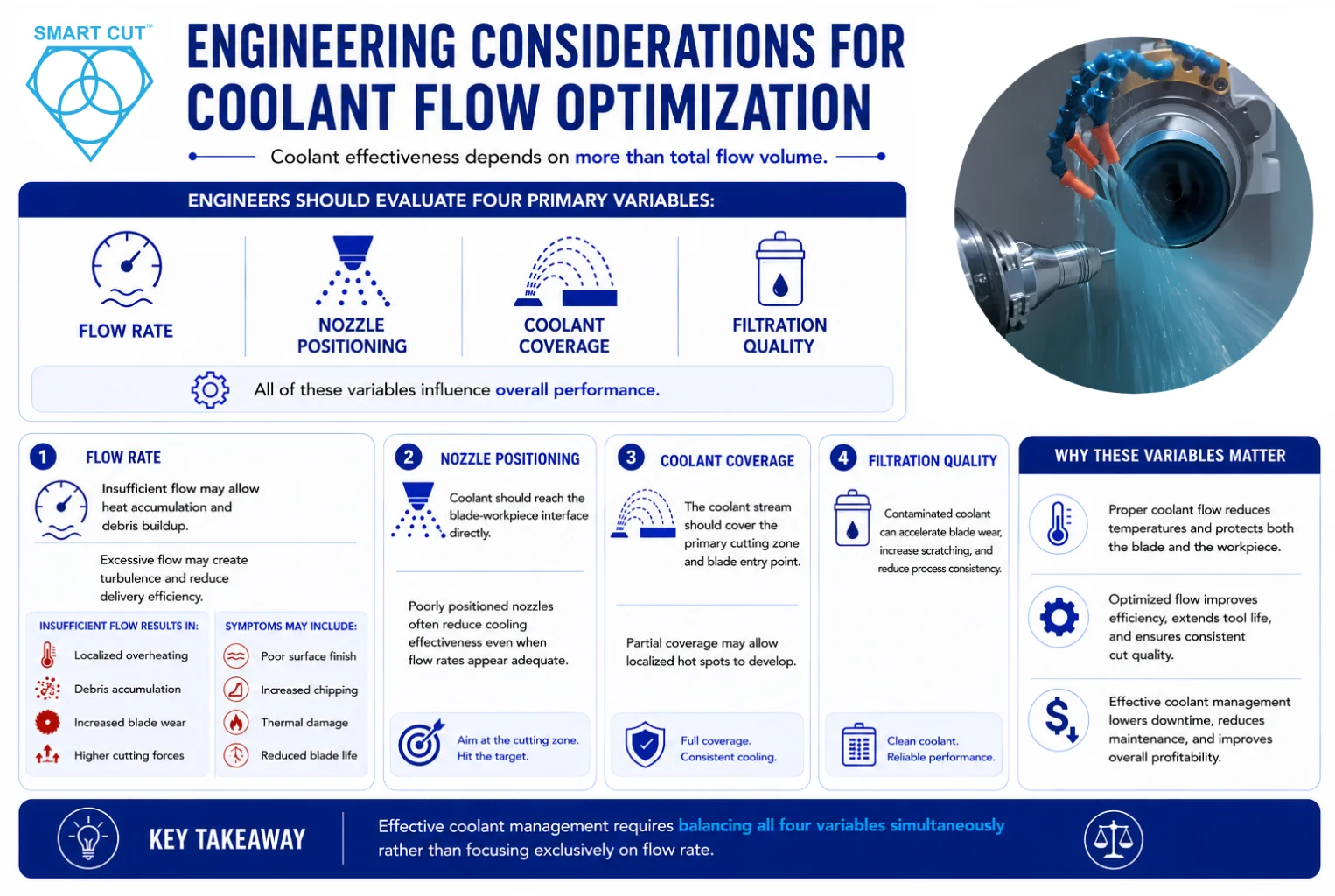
Engineering Considerations for Coolant Flow Optimization

Coolant effectiveness depends on more than total flow volume.

Engineers should evaluate four primary variables:

1. Flow Rate

Insufficient flow may allow heat accumulation and debris buildup.

Excessive flow may create turbulence and reduce delivery efficiency.

2. Nozzle Positioning

Coolant should reach the blade-workpiece interface directly.

Poorly positioned nozzles often reduce cooling effectiveness even when flow rates appear adequate.

3. Coolant Coverage

The coolant stream should cover the primary cutting zone and blade entry point.

Partial coverage may allow localized hot spots to develop.

4. Filtration Quality

Contaminated coolant can accelerate blade wear, increase scratching, and reduce process consistency.

Effective coolant management requires balancing all four variables simultaneously rather than focusing exclusively on flow rate.

How Coolant Influences Edge Quality

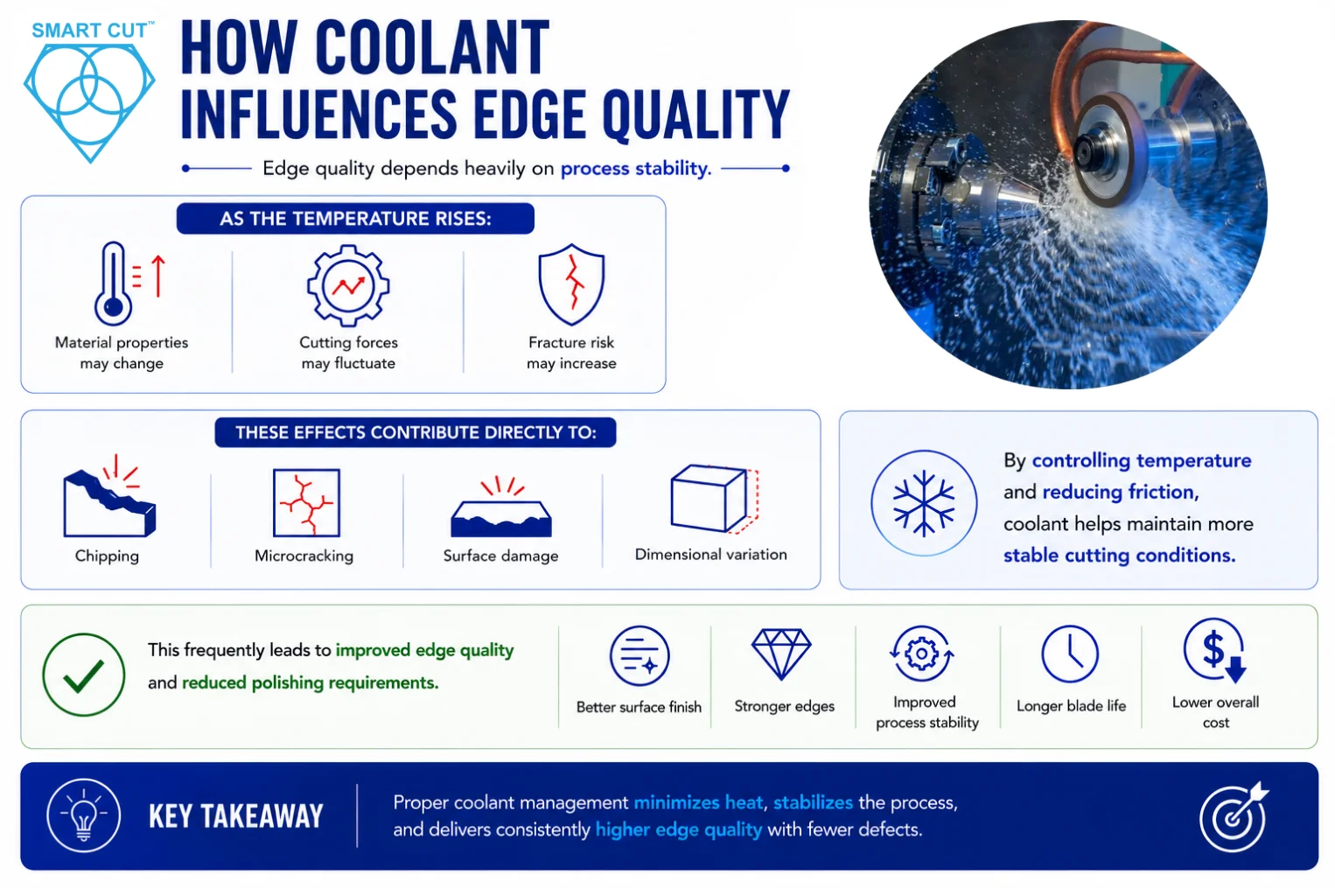
Edge quality depends heavily on process stability.

As the temperature rises:

Material properties may change

Cutting forces may fluctuate

Fracture risk may increase

These effects contribute directly to:

Chipping

Microcracking

Surface damage

Dimensional variation

By controlling temperature and reducing friction, coolant helps maintain more stable cutting conditions.

This frequently leads to improved edge quality and reduced polishing requirements.

Coolant Performance and Process Stability

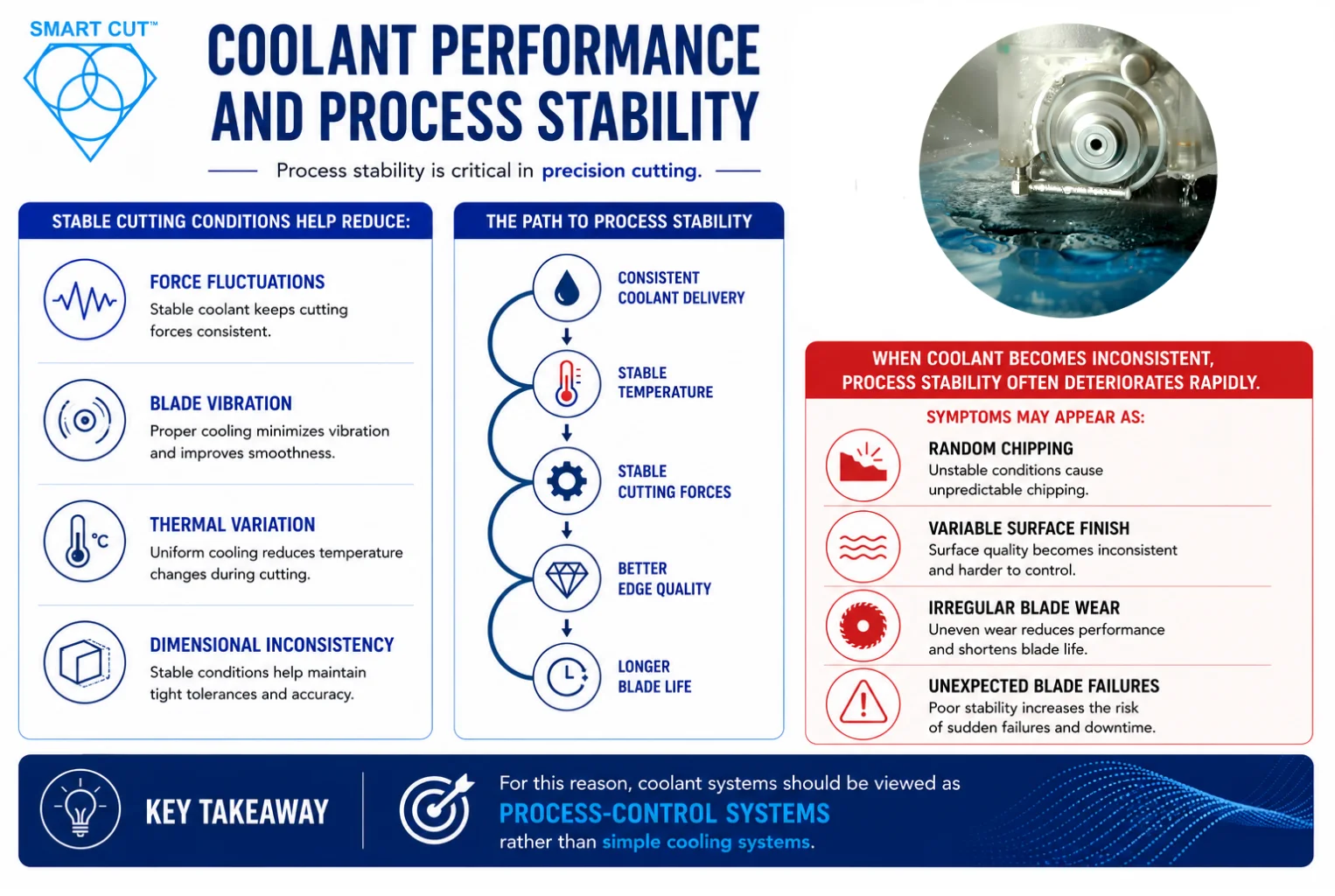
Process stability is critical in precision cutting.

Stable cutting conditions help reduce:

Force fluctuations

Blade vibration

Thermal variation

Dimensional inconsistency

When coolant delivery becomes inconsistent, process stability often deteriorates rapidly.

Symptoms may appear as:

Random chipping

Variable surface finish

Irregular blade wear

Unexpected blade failures

For this reason, coolant systems should be viewed as process-control systems rather than simple cooling systems.

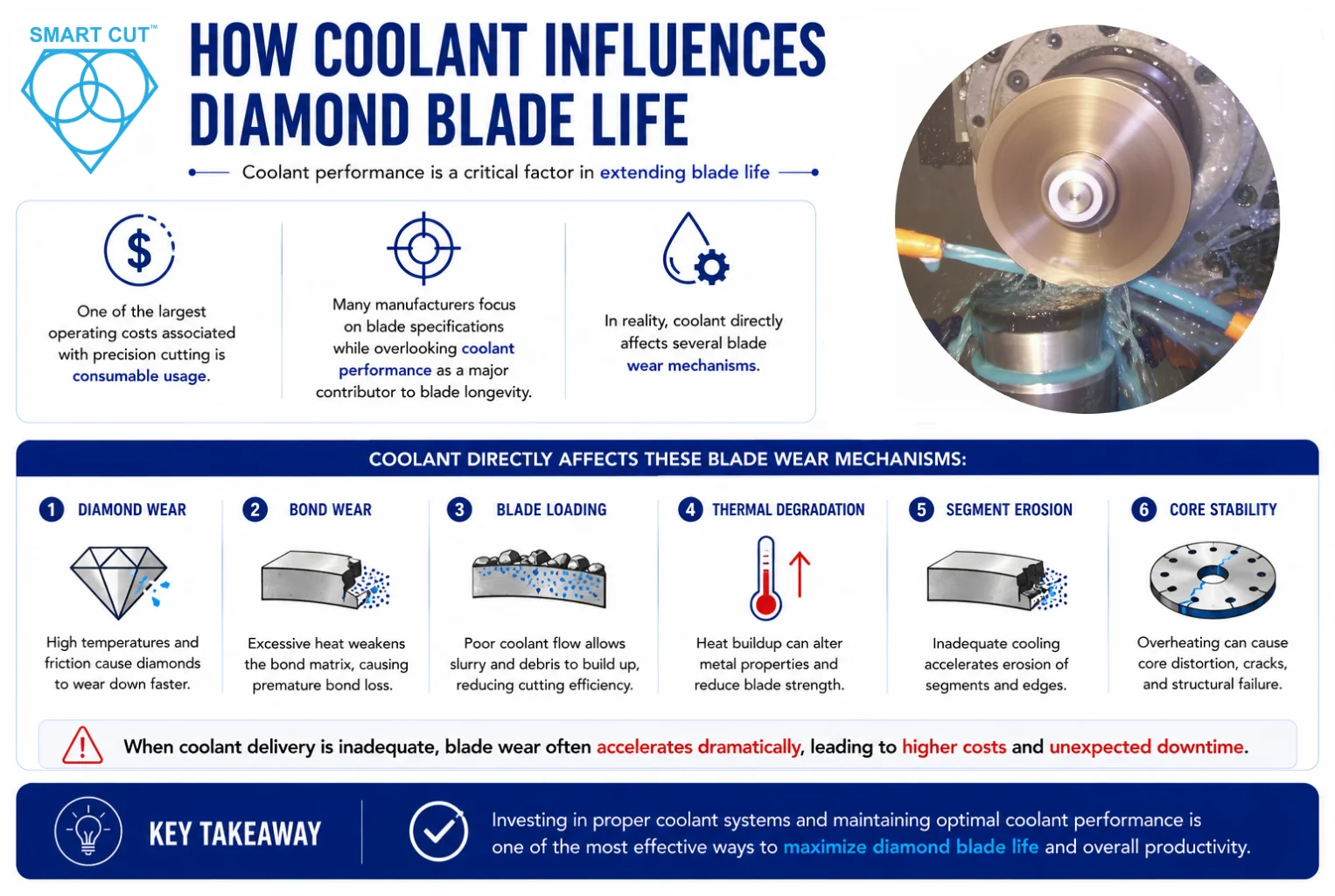
How Coolant Influences Diamond Blade Life

One of the largest operating costs associated with precision cutting is consumable usage.

Many manufacturers focus on blade specifications while overlooking coolant performance as a major contributor to blade longevity.

In reality, coolant directly affects several blade wear mechanisms.

These include:

Diamond wear

Bond wear

Blade loading

Thermal degradation

Segment erosion

Core stability

When coolant delivery is inadequate, blade wear often accelerates dramatically.

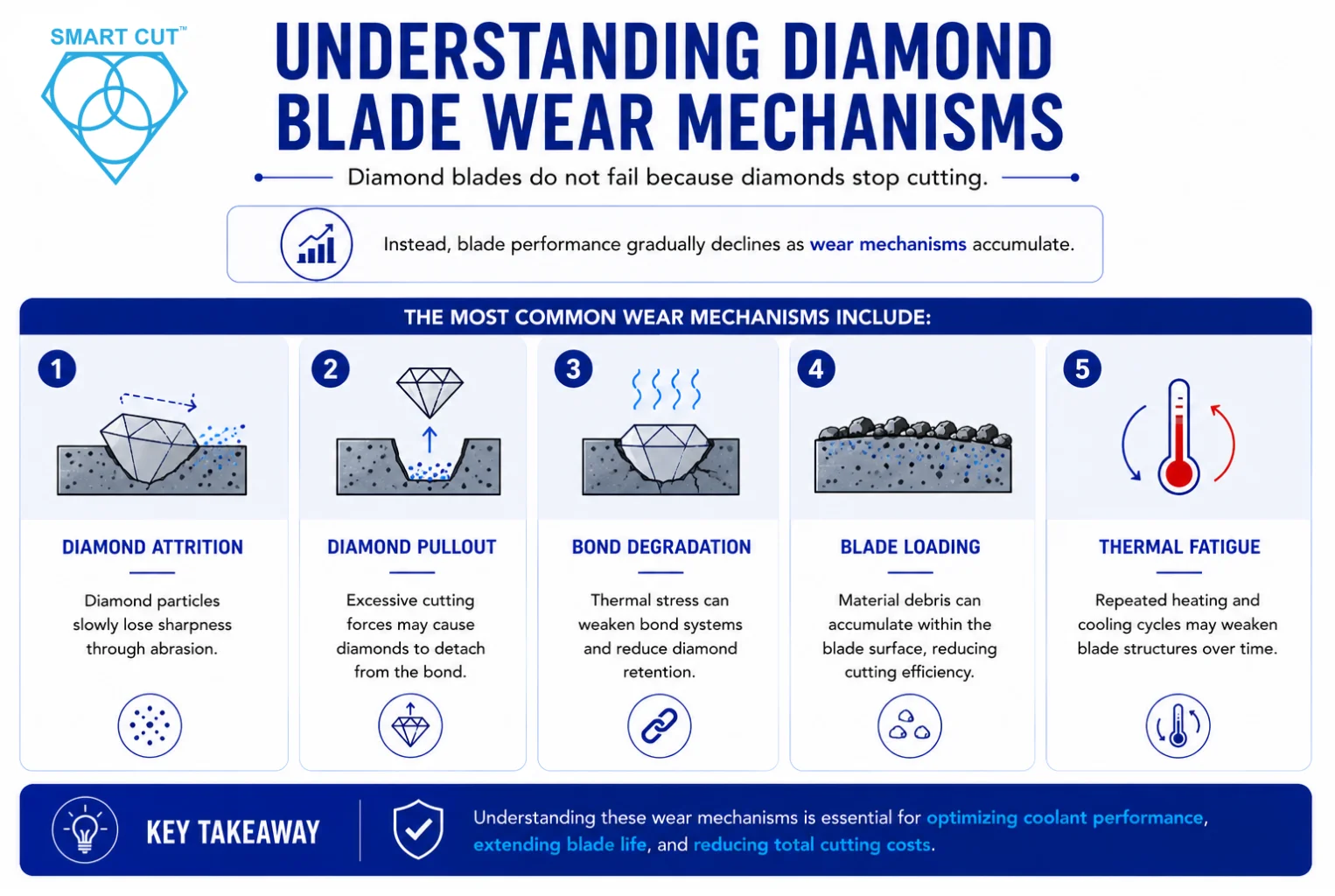
Understanding Diamond Blade Wear Mechanisms

Diamond blades do not fail because diamonds stop cutting.

Instead, blade performance gradually declines as wear mechanisms accumulate.

The most common wear mechanisms include:

Diamond Attrition

Diamond particles slowly lose sharpness through abrasion.

Diamond Pullout

Excessive cutting forces may cause diamonds to detach from the bond.

Bond Degradation

Thermal stress can weaken bond systems and reduce diamond retention.

Blade Loading

Material debris can accumulate within the blade surface, reducing cutting efficiency.

Thermal Fatigue

Repeated heating and cooling cycles may weaken blade structures over time.

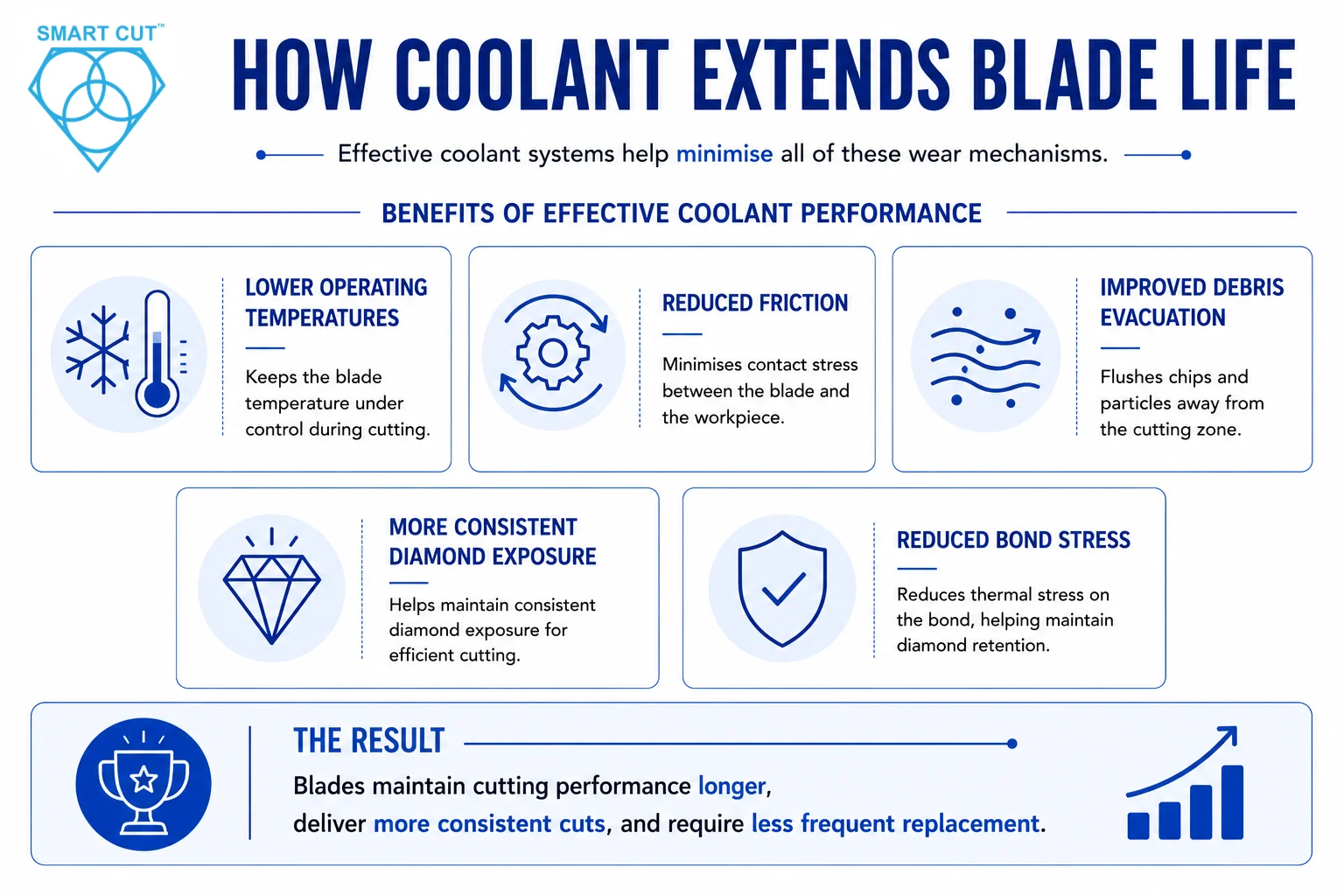
How Coolant Extends Blade Life

Effective coolant systems help minimise all of these wear mechanisms.

Benefits often include:

Lower operating temperatures

Reduced friction

Improved debris evacuation

More consistent diamond exposure

Reduced bond stress

As a result, blades typically maintain cutting performance longer.

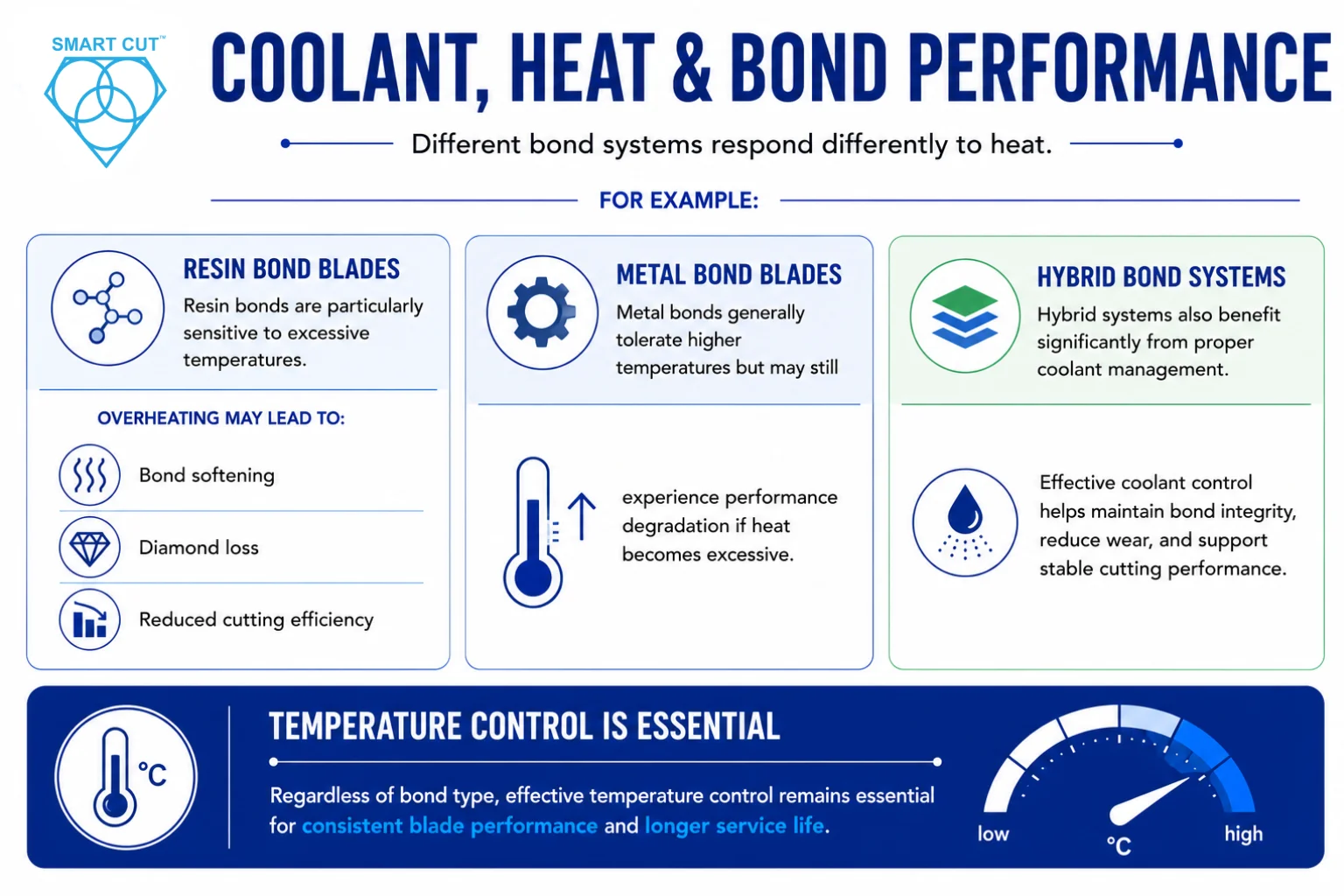
Coolant, Heat & Bond Performance

Different bond systems respond differently to heat.

For example:

Resin Bond Blades

Resin bonds are particularly sensitive to excessive temperatures.

Overheating may lead to:

Bond softening

Diamond loss

Reduced cutting efficiency

Metal Bond Blades

Metal bonds generally tolerate higher temperatures but may still experience performance degradation if heat becomes excessive.

Hybrid Bond Systems

Hybrid systems also benefit significantly from proper coolant management.

Regardless of bond type, temperature control remains essential.

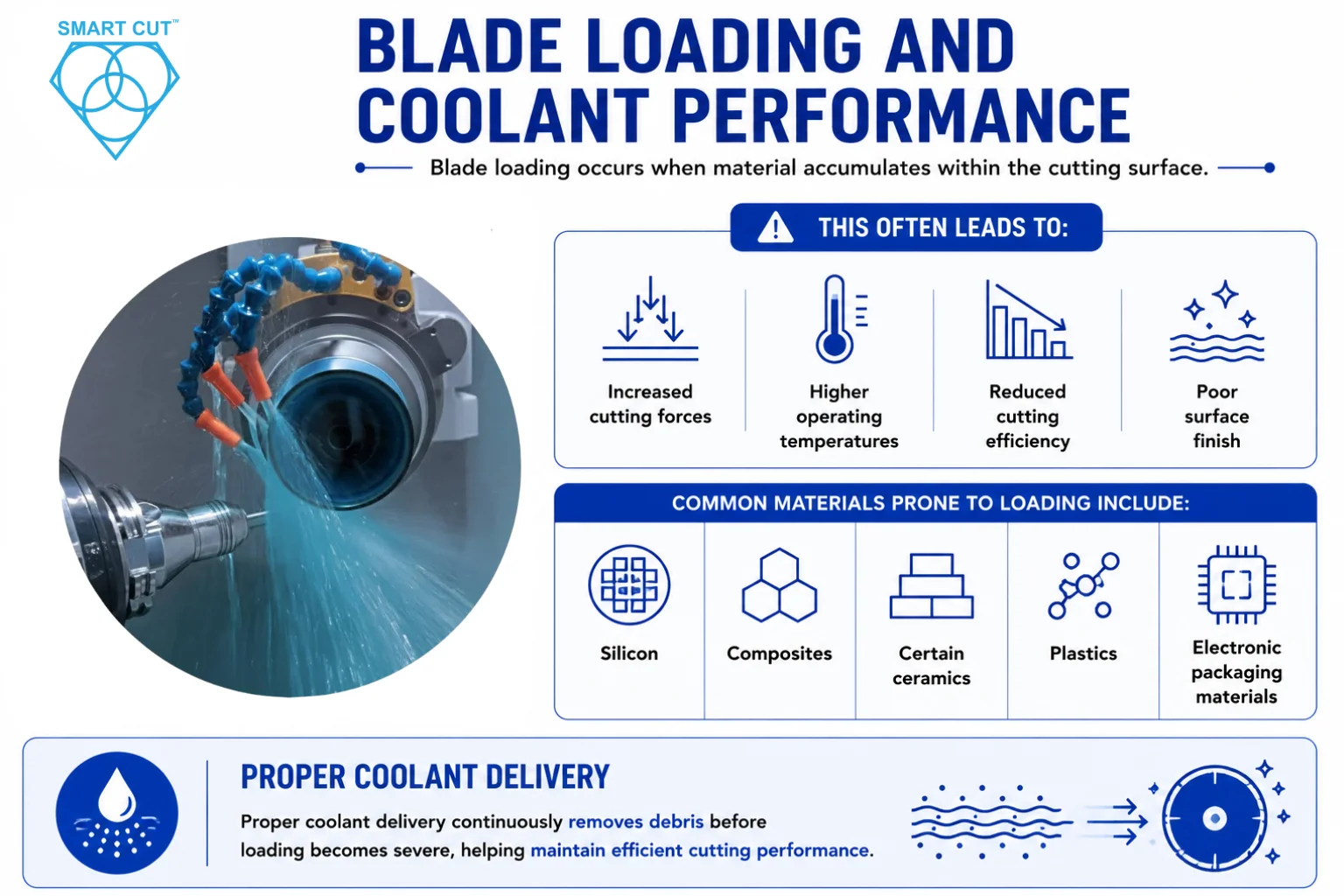
Blade Loading and Coolant Performance

Blade loading occurs when material accumulates within the cutting surface.

This often leads to:

Increased cutting forces

Higher operating temperatures

Reduced cutting efficiency

Poor surface finish

Common materials prone to loading include:

Silicon

Composites

Certain ceramics

Plastics

Electronic packaging materials

Proper coolant delivery helps remove debris before loading becomes severe.

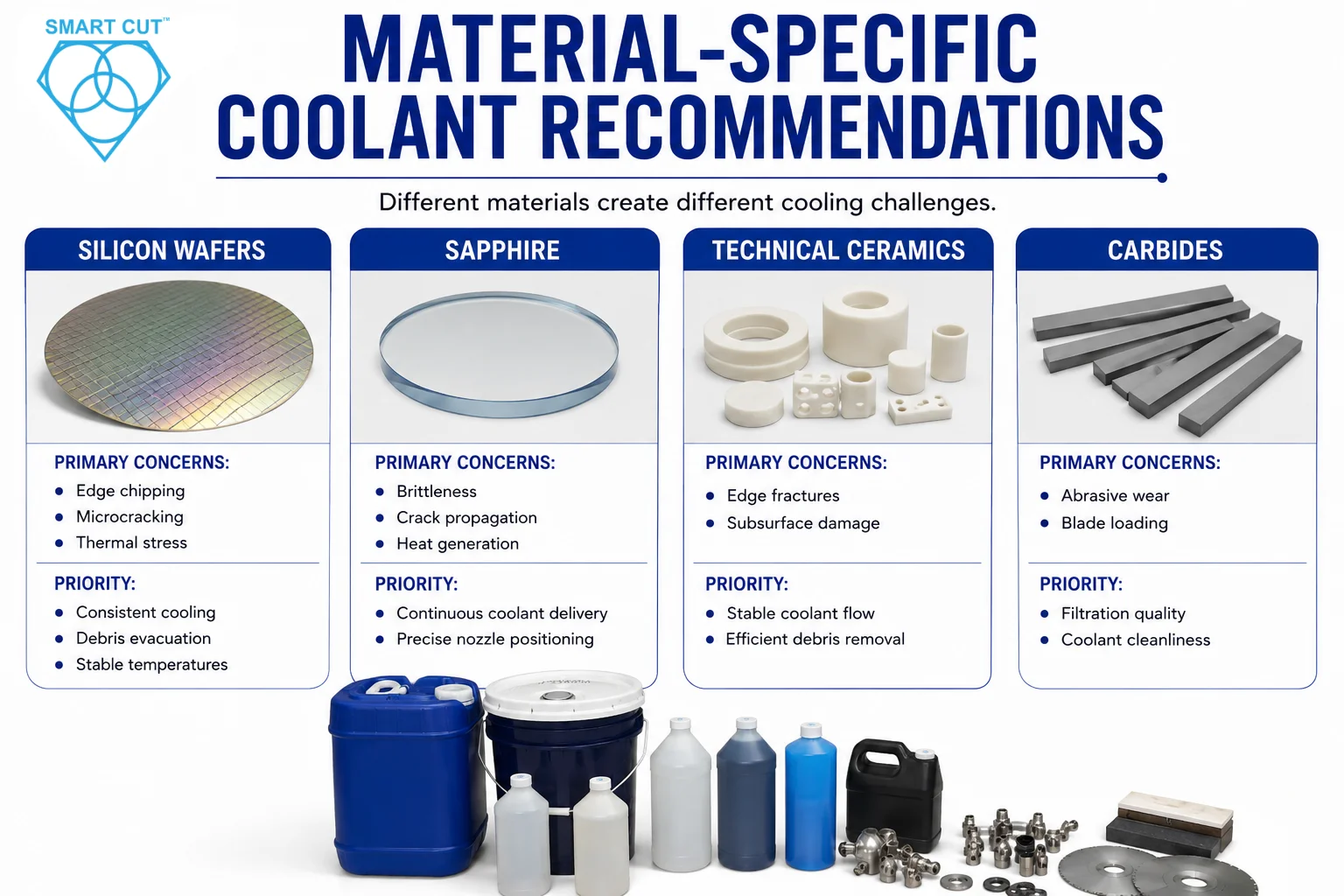
Material-Specific Coolant Recommendations

Different materials create different cooling challenges.

Silicon Wafers

Primary concerns:

Edge chipping

Microcracking

Thermal stress

Priority:

Consistent cooling

Debris evacuation

Stable temperatures

Sapphire

Primary concerns:

Brittleness

Crack propagation

Heat generation

Priority:

Continuous coolant delivery

Precise nozzle positioning

Technical Ceramics

Primary concerns:

Edge fractures

Subsurface damage

Priority:

Stable coolant flow

Efficient debris removal

Carbides

Primary concerns:

Abrasive wear

Blade loading

Priority:

Filtration quality

Coolant cleanliness

Composite Materials

Primary concerns:

Delamination

Fiber damage

Priority:

Temperature control

Reduced cutting forces

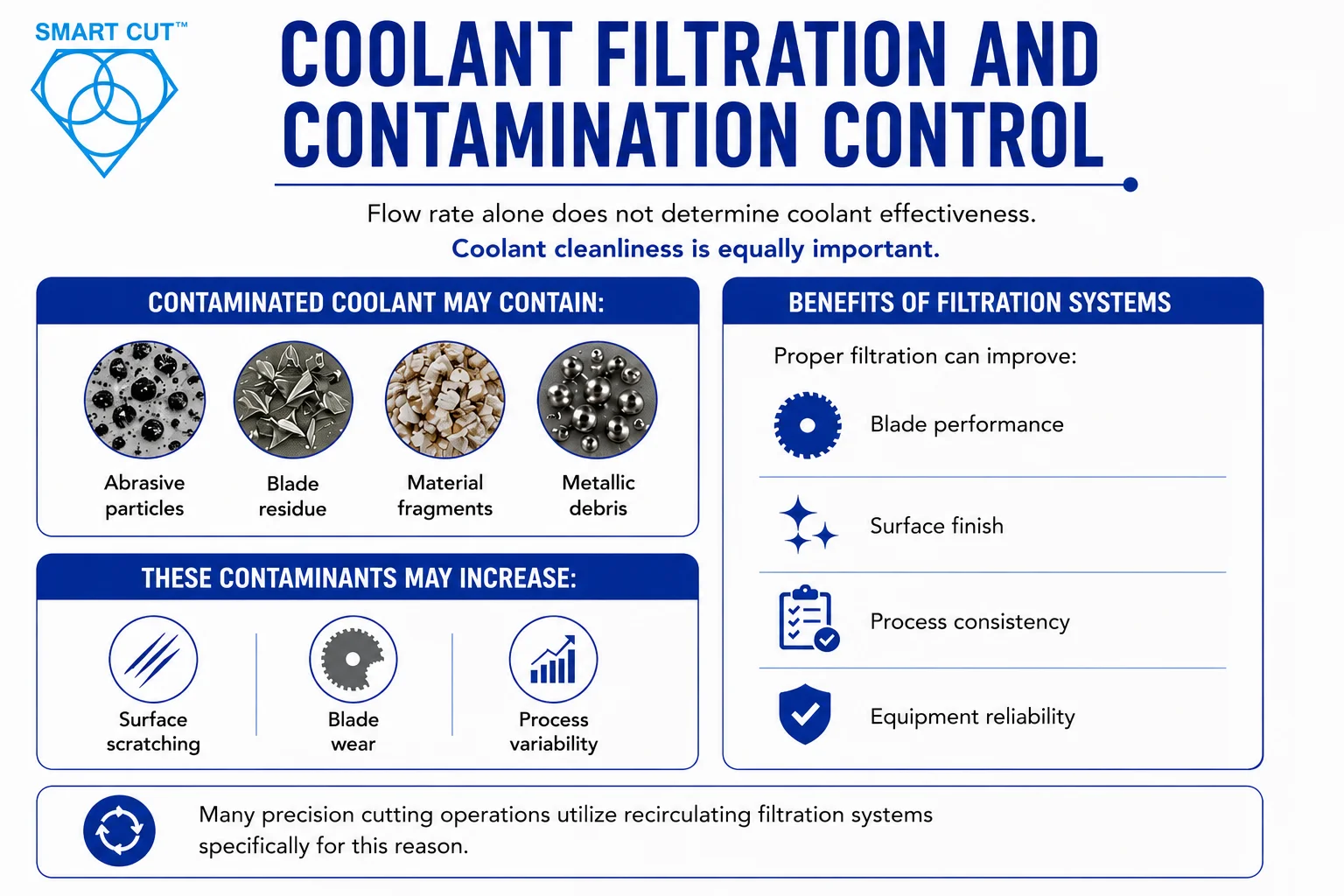
Coolant Filtration and Contamination Control

Flow rate alone does not determine coolant effectiveness.

Coolant cleanliness is equally important.

Contaminated coolant may contain:

Abrasive particles

Blade residue

Material fragments

Metallic debris

These contaminants may increase:

Surface scratching

Blade wear

Process variability

Benefits of Filtration Systems

Proper filtration can improve:

Blade performance

Surface finish

Process consistency

Equipment reliability

Many precision cutting operations utilize recirculating filtration systems specifically for this reason.

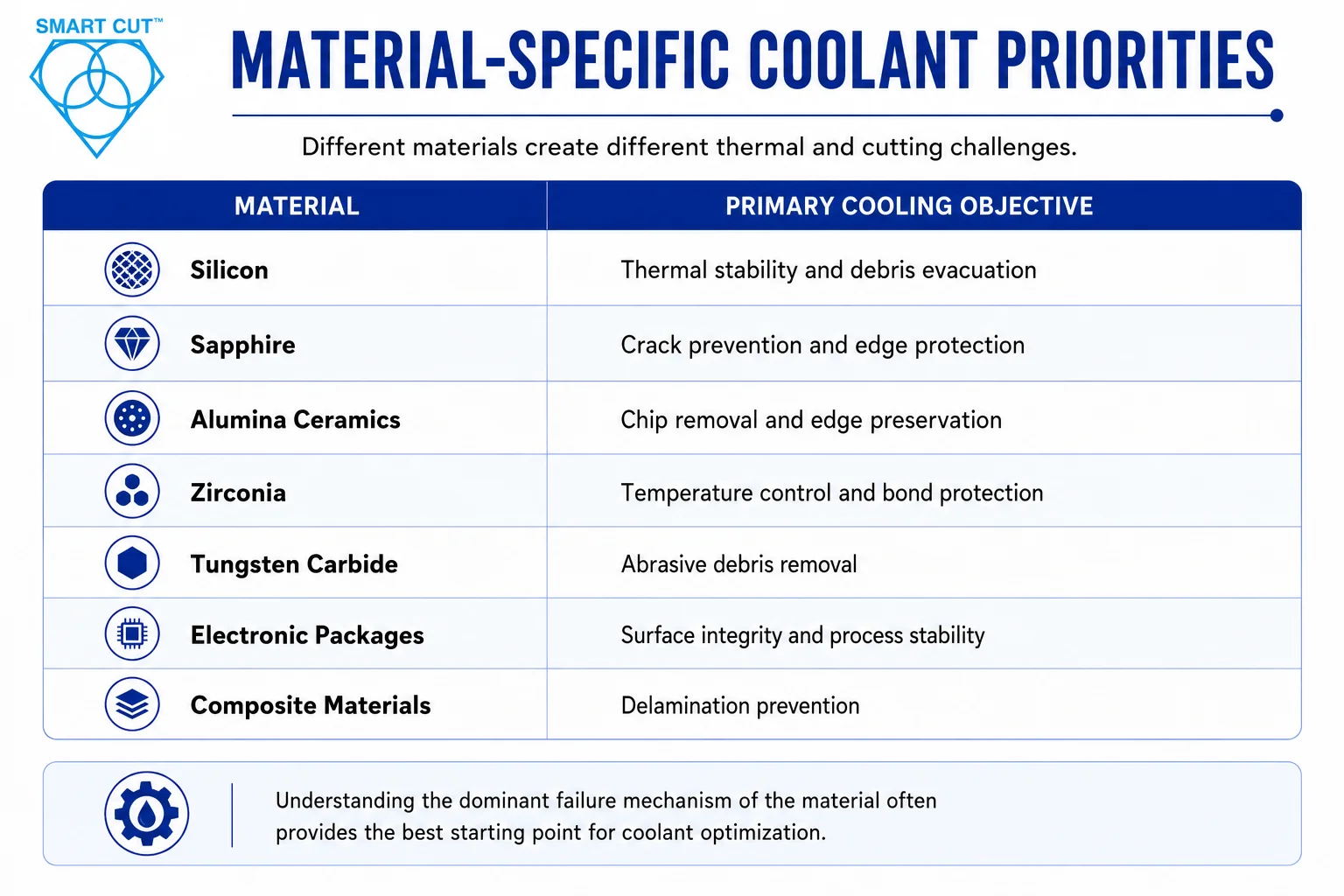
Material-Specific Coolant Priorities

Different materials create different thermal and cutting challenges.

MaterialPrimary Cooling Objective
SiliconThermal stability and debris evacuation
SapphireCrack prevention and edge protection
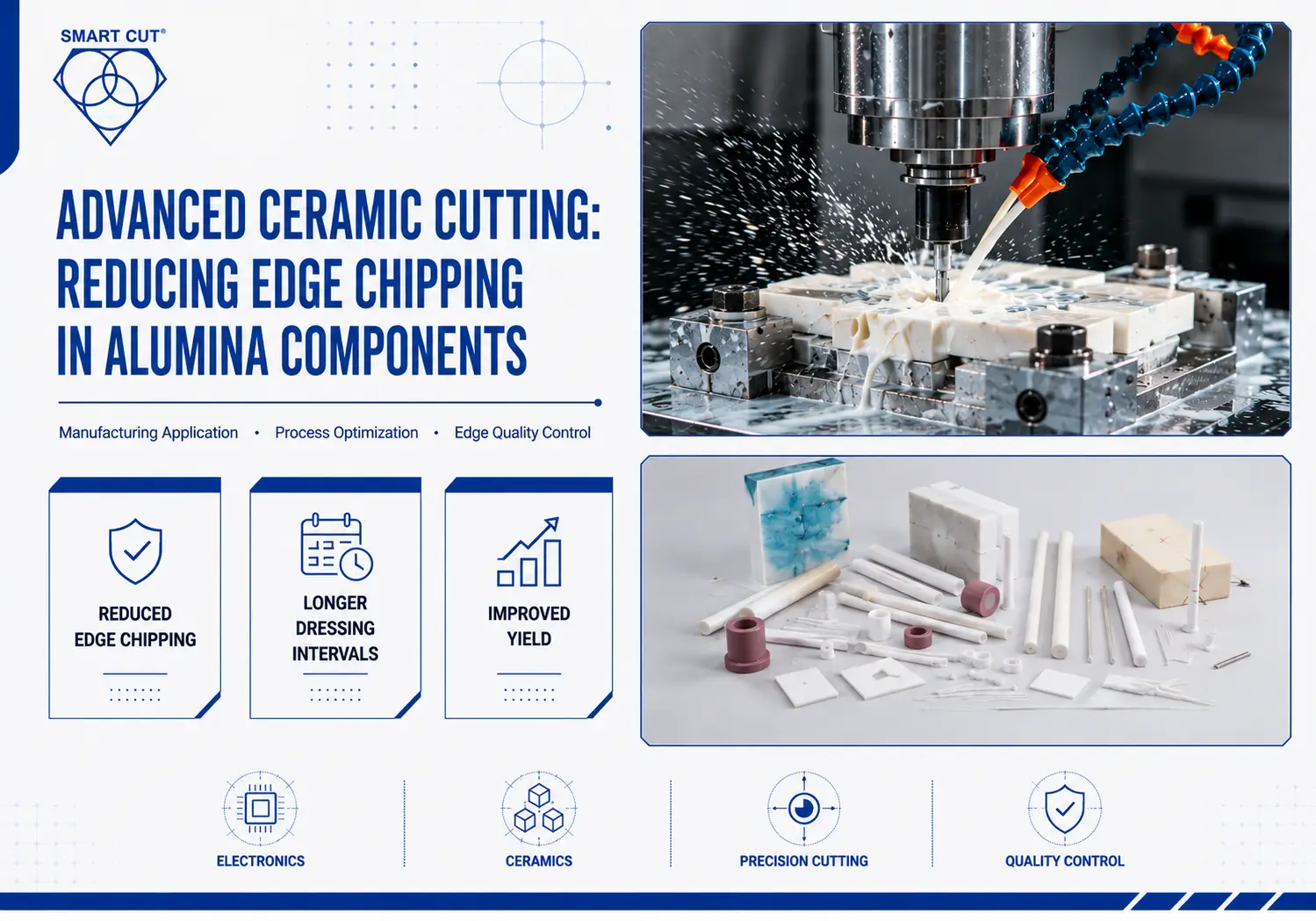
Alumina CeramicsChip removal and edge preservation
ZirconiaTemperature control and bond protection
Tungsten CarbideAbrasive debris removal
Electronic PackagesSurface integrity and process stability
Composite MaterialsDelamination prevention

Understanding the dominant failure mechanism of the material often provides the best starting point for coolant optimization.

Representative Application Example: Coolant Optimization During Precision Cutting of Electronic Packaging Materials
Application

Precision sectioning of silicon-based electronic packaging assemblies used for failure analysis and cross-sectional inspection.

Initial Challenges

The facility experienced:

  • Premature blade wear
  • Increased edge chipping
  • Surface finish variation
  • Reduced process consistency
  • Frequent blade replacement

Engineering Investigation

Process review identified several coolant-related issues:

  • Coolant was not consistently reaching the primary cutting interface
  • Debris accumulated near the cutting zone
  • Filtration effectiveness had deteriorated
  • Temperature fluctuations were observed during extended cutting cycles

Corrective Actions

The process was optimized through:

  • Improved coolant nozzle positioning
  • Enhanced coolant filtration
  • More consistent coolant delivery
  • Scheduled maintenance of the recirculation system

Results

Following optimization, the operation achieved:

  • More stable cutting conditions
  • Reduced blade loading
  • Improved cut consistency
  • Better surface quality
  • Extended usable blade life

Engineering Lesson

The greatest performance improvement resulted from improving coolant delivery efficiency rather than changing blade specifications. In many precision cutting applications, coolant optimization represents one of the most cost-effective process improvements available.

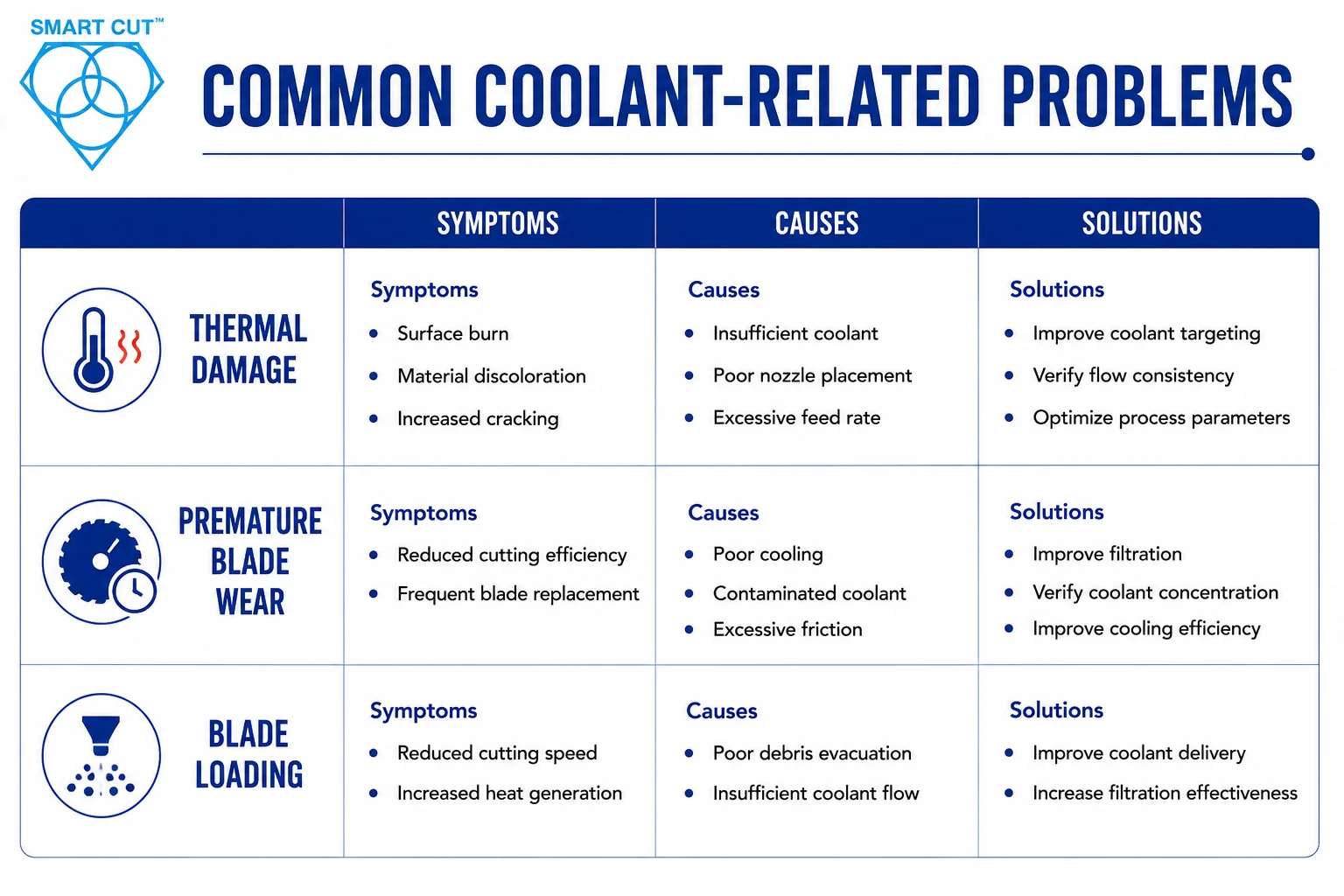
Common Coolant-Related Problems

Thermal Damage

Symptoms

Surface burn

Material discoloration

Increased cracking

Causes

Insufficient coolant

Poor nozzle placement

Excessive feed rate

Solutions

Improve coolant targeting

Verify flow consistency

Optimize process parameters

Premature Blade Wear

Symptoms

Reduced cutting efficiency

Frequent blade replacement

Causes

Poor cooling

Contaminated coolant

Excessive friction

Solutions

Improve filtration

Verify coolant concentration

Improve cooling efficiency

Blade Loading

Symptoms

Reduced cutting speed

Increased heat generation

Causes

Poor debris evacuation

Insufficient coolant flow

Solutions

Improve coolant delivery

Increase filtration effectiveness

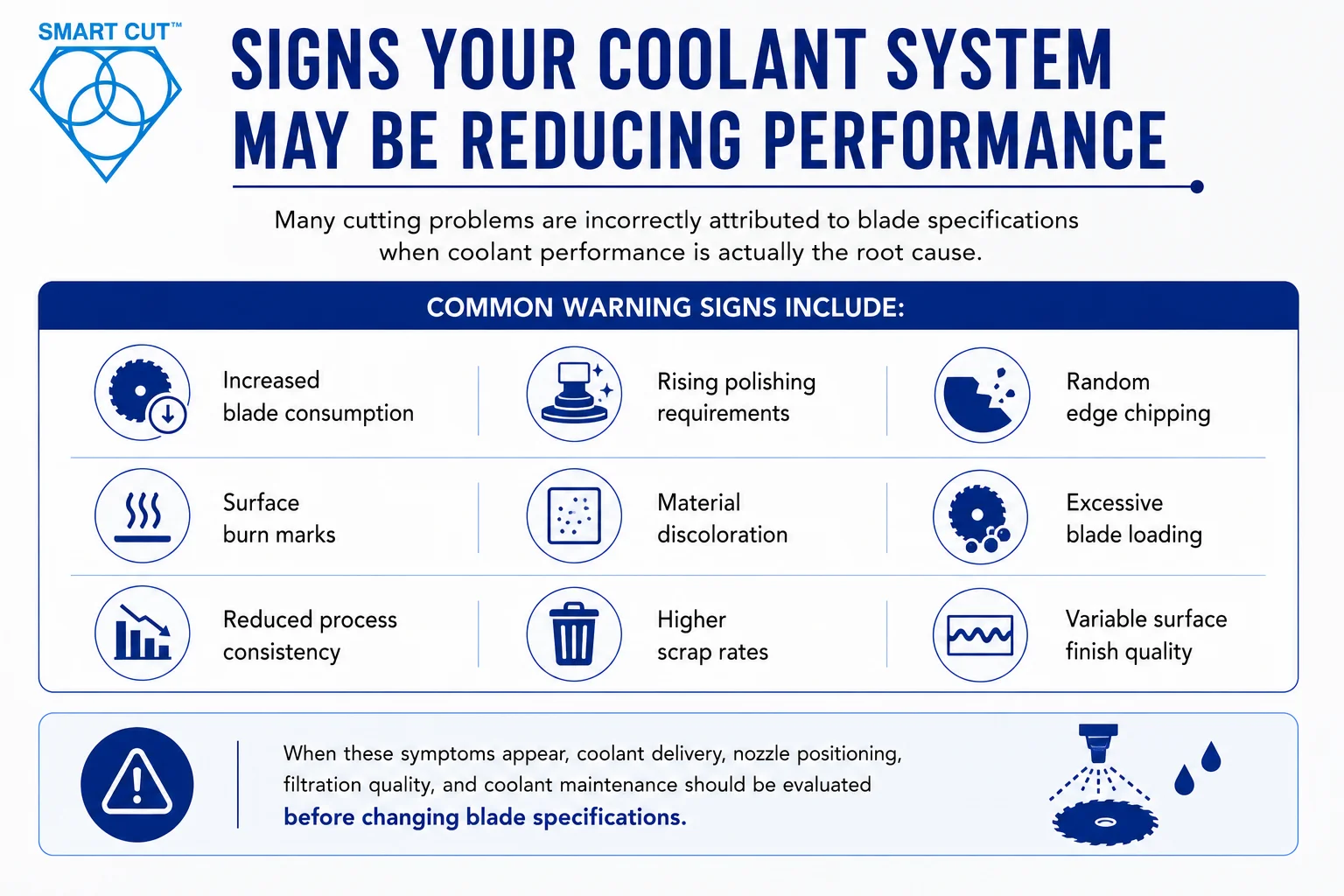
Signs Your Coolant System May Be Reducing Performance

Many cutting problems are incorrectly attributed to blade specifications when coolant performance is actually the root cause.

Common warning signs include:

  • Increased blade consumption
  • Rising polishing requirements
  • Random edge chipping
  • Surface burn marks
  • Material discoloration
  • Excessive blade loading
  • Reduced process consistency
  • Higher scrap rates
  • Variable surface finish quality

When these symptoms appear, coolant delivery, nozzle positioning, filtration quality, and coolant maintenance should be evaluated before changing blade specifications.

Recommended UKAM Solutions

Optimizing coolant performance requires more than simply increasing flow rate.

The most successful precision cutting operations typically combine:

Precision Diamond Blades

Precision Cutting Saws
Proper Coolant Systems

Filtration Equipment

Application-Specific Process Optimisation

The correct solution depends on:

Material type

Blade specification

Production volume

Surface finish requirements

Quality objectives

UKAM’s applications engineering team can assist with selecting appropriate coolant strategies based on specific materials and cutting requirements.

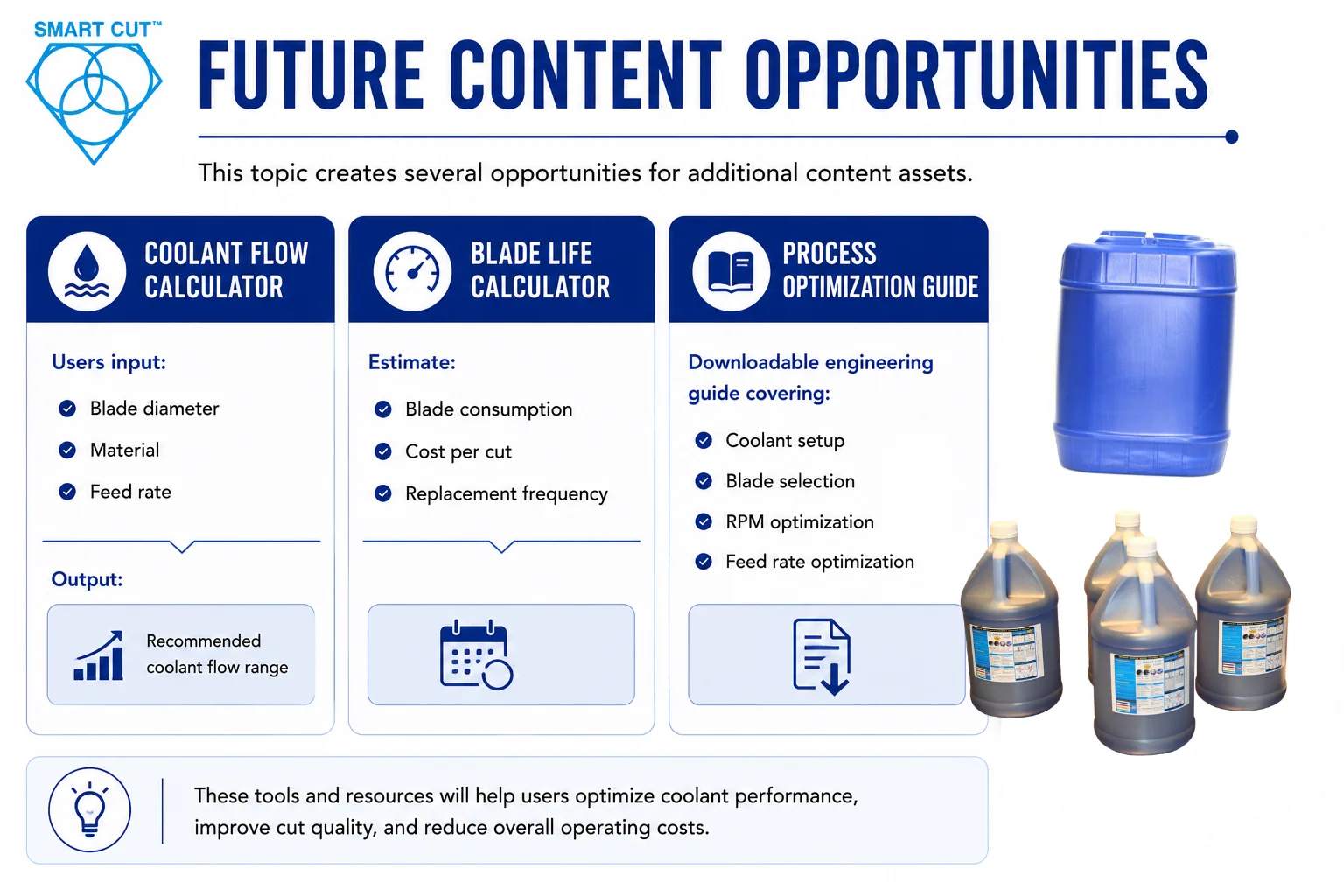
Future Content Opportunities

This topic creates several opportunities for additional content assets.

Coolant Flow Calculator

Users input:

Blade diameter

Material

Feed rate

Output:

Recommended coolant flow range

Blade Life Calculator

Estimate:

Blade consumption

Cost per cut

Replacement frequency

Process Optimization Guide

Downloadable engineering guide covering:

Coolant setup

Blade selection

RPM optimization

Feed rate optimization

Engineering Quick Reference Guide

Variable Recommendation
Primary Objective Maintain Stable Cutting Conditions
Most Common Coolant Issue Poor Delivery Location
Blade Life Risk Thermal Loading
Quality Risk Edge Damage
Process Risk Debris Accumulation
Most Important Factors Flow, Positioning, Filtration
Optimization Goal Consistent Cooling & Debris Remova

Frequently Asked Questions

Coolant helps control heat, remove debris, reduce friction, improve blade life, and maintain process stability.

No. Coolant effectiveness depends on flow rate, delivery location, filtration quality, and process conditions.

Yes.Insufficient cooling may increase cutting forces and thermal stress, contributing to edge damage.

Absolutely. Proper cooling often reduces wear and extends blade life significantly.

Blade loading typically results from inadequate debris evacuation and poor coolant effectiveness.

Yes. Contaminated coolant can increase blade wear, scratching, and process variability.

Common examples include:

Silicon

Sapphire

Ceramics

Quartz

Composites

Electronic packaging materials

Regular inspection intervals should be based on operating hours, contamination levels, and process requirements.

Yes. Effective coolant delivery helps stabilize cutting conditions, reduce friction, improve debris removal, and minimize surface damage.

In many precision cutting applications, correct nozzle positioning can have a greater impact than increasing coolant volume alone.

Yes. Abrasive contaminants can increase blade wear, reduce cutting efficiency, and contribute to inconsistent process performance.

If operations experience persistent blade loading, thermal damage, excessive consumable usage, or inconsistent cut quality despite process optimization, coolant system improvements may be warranted.

Need Help Optimizing Coolant Performance?

Selecting the correct coolant strategy depends on:

Material type

Blade specification

Feed rate

RPM

Machine configuration

Conclusion

Coolant is far more than a cooling medium.

It is a critical process-control variable that directly influences blade life, cut quality, thermal stability, debris evacuation, and overall process performance.

Many cutting problems commonly attributed to blade specifications are actually the result of inadequate coolant delivery, poor filtration, or ineffective thermal management.

By optimizing coolant flow, nozzle placement, filtration quality, and overall coolant system performance, manufacturers can significantly improve:

Blade life

Edge quality

Surface finish

Process consistency

Production efficiency

Operating costs

For precision cutting applications involving silicon, ceramics, sapphire, composites, carbides, and advanced materials, coolant optimization remains one of the most effective ways to improve overall process performance.

Trusted by Tens of Thousands of Manufacturers, Laboratories,
Research Institutions Worldwide Since 1990

American Based Manufacturer

Established in 1990

Custom manufacturing

RELATED ARTICLES

Brian is an experienced professional in the field of precision cutting tools, with over 27 years of experience in technical support. Over the years, he has helped engineers, manufacturers, researchers, and contractors find the right solutions for working with advanced and hard-to-cut materials. He’s passionate about bridging technical knowledge with real-world applications to improve efficiency and accuracy.

As an author, Brian Farberov writes extensively on diamond tool design, application engineering, return on investment strategies, and process optimization, combining technical depth with a strong understanding of customer needs and market dynamics.

author-avatar

About Brian Farberov

Brian is an experienced professional in the field of precision cutting tools, with over 27 years of experience in technical support. Over the years, he has helped engineers, manufacturers, researchers, and contractors find the right solutions for working with advanced and hard-to-cut materials. He’s passionate about bridging technical knowledge with real-world applications to improve efficiency and accuracy. As an author, Brian Farberov writes extensively on diamond tool design, application engineering, return on investment strategies, and process optimization, combining technical depth with a strong understanding of customer needs and market dynamics.