








Home > Blog > Diamond Wire Saw: Maximizing Material Yield and Precision Cutting of Advanced Materials
Diamond Wire & Band Saw Blades, blog, Cutting

Diamond Wire Saw: Maximizing Material Yield and Precision Cutting of Advanced Materials

Table of Contents

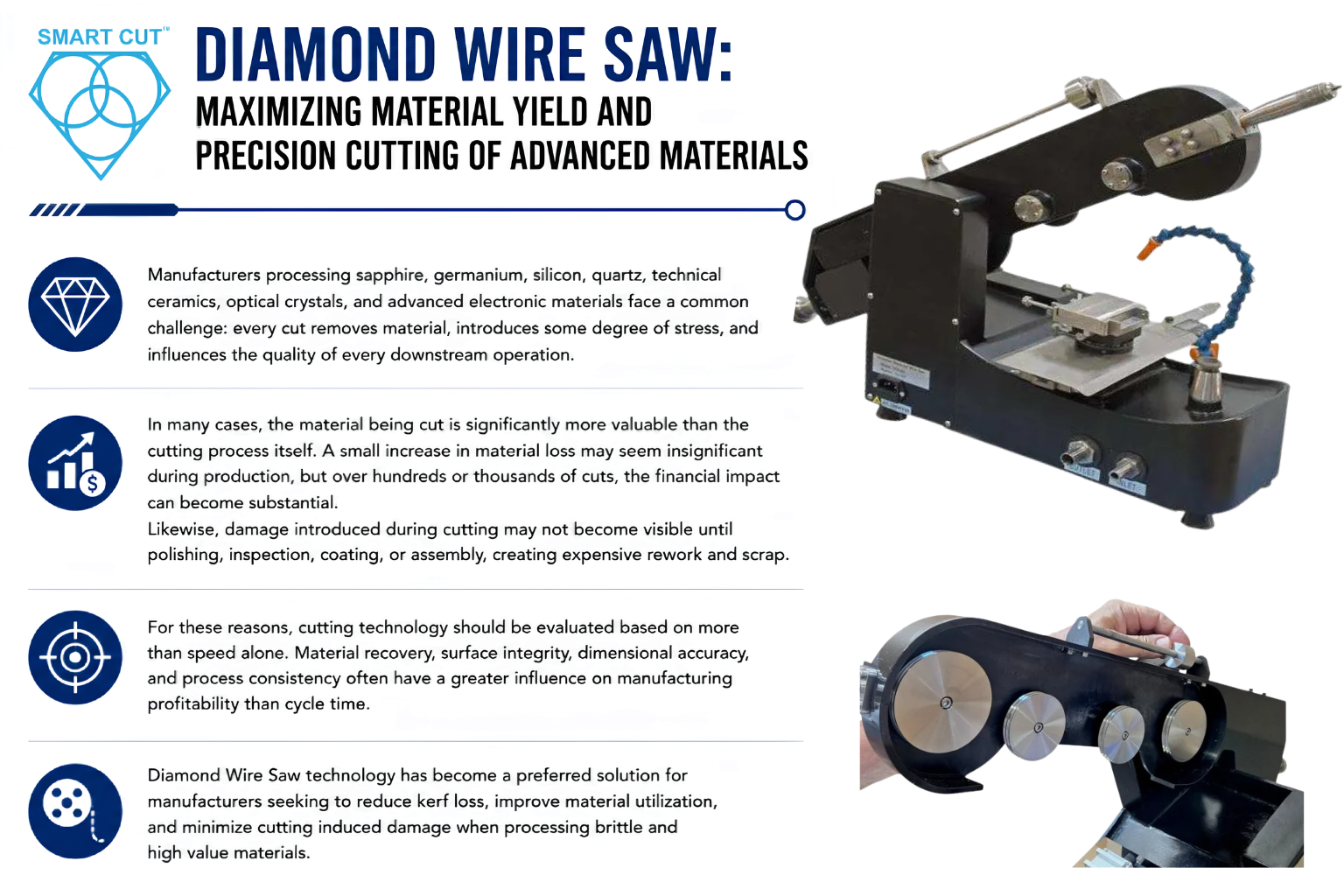
Manufacturers processing sapphire, germanium, silicon, quartz, technical ceramics, optical crystals, and advanced electronic materials face a common challenge: every cut removes material, introduces some degree of stress, and influences the quality of every downstream operation.

In many cases, the material being cut is significantly more valuable than the cutting process itself. A small increase in material loss may seem insignificant during production, but over hundreds or thousands of cuts, the financial impact can become substantial. Likewise, damage introduced during cutting may not become visible until polishing, inspection, coating, or assembly, creating expensive rework and scrap.

For these reasons, cutting technology should be evaluated based on more than speed alone. Material recovery, surface integrity, dimensional accuracy, and process consistency often have a greater influence on manufacturing profitability than cycle time.

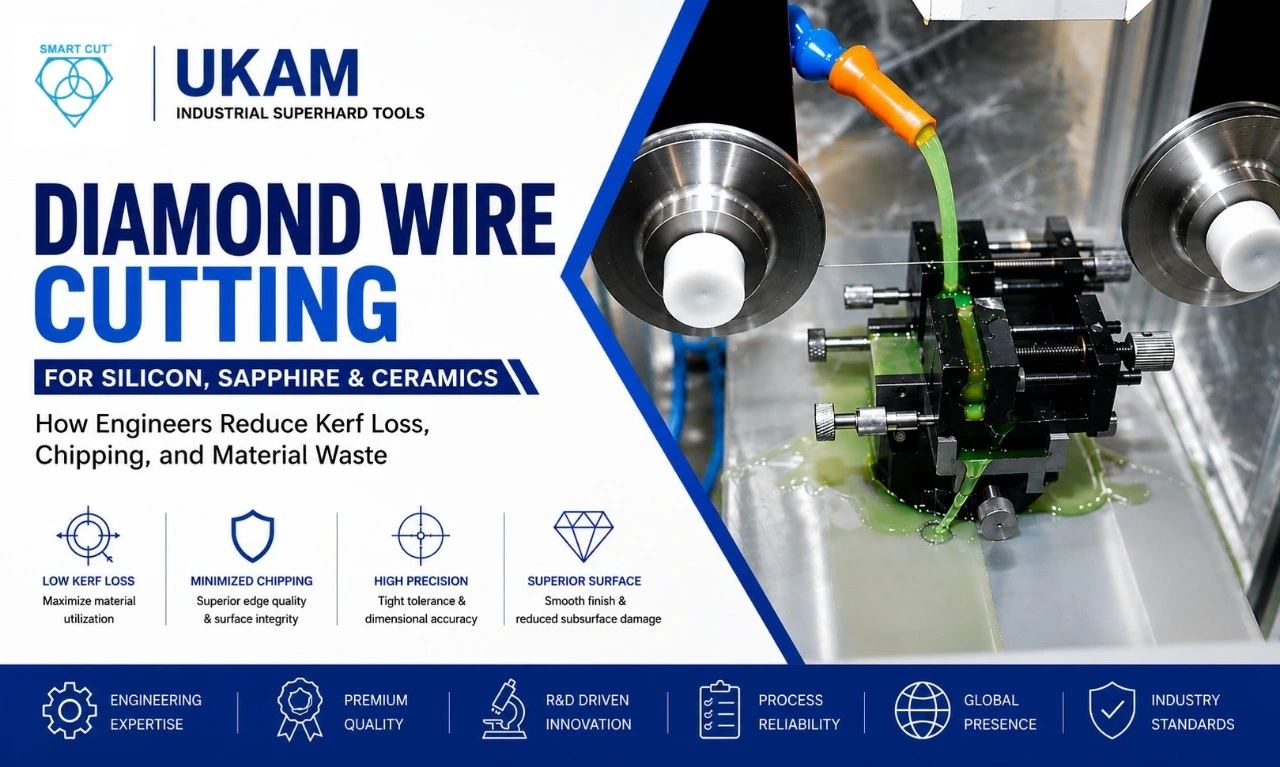
Diamond Wire Saw technology has become a preferred solution for manufacturers seeking to reduce kerf loss, improve material utilization, and minimize cutting induced damage when processing brittle and high value materials.

Trusted by Tens of Thousands of Manufacturers, Laboratories Research Institutions Worldwide Since 1990

American Based Manufacturer

Established in 1990

Custom manufacturing

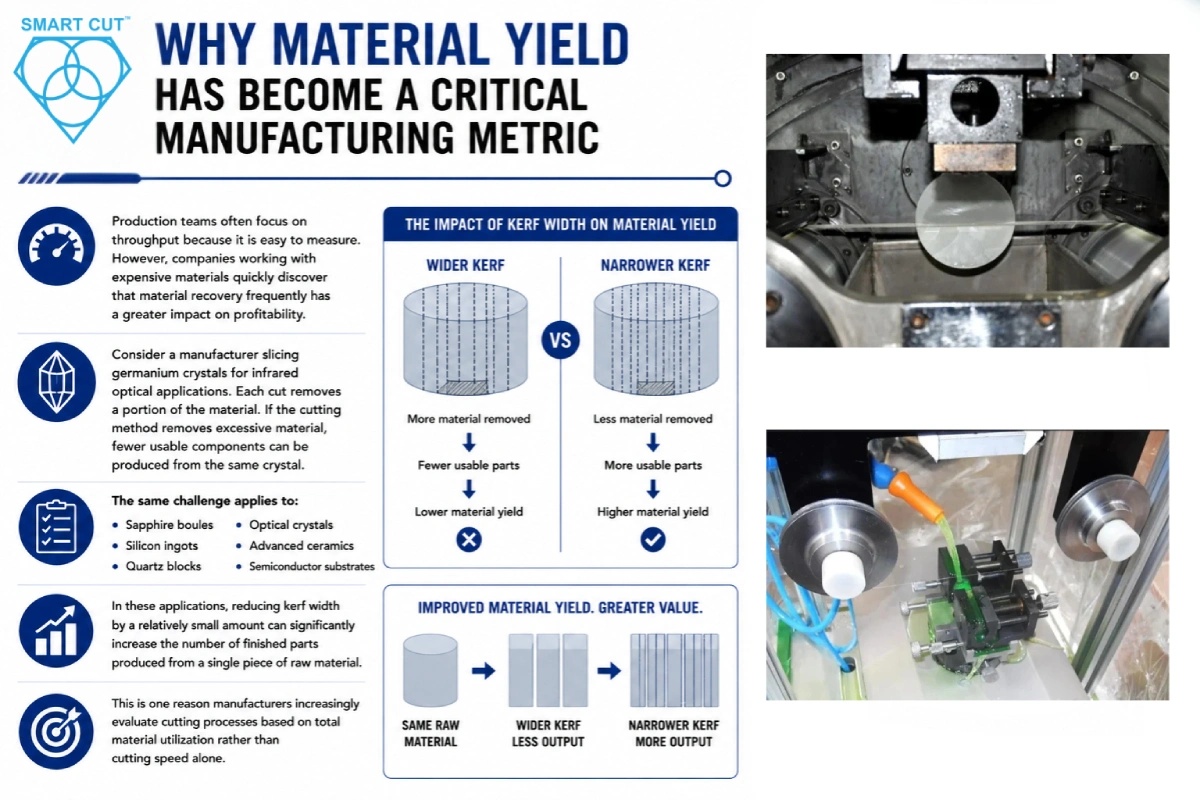
Why Material Yield Has Become a Critical Manufacturing Metric

Production teams often focus on throughput because it is easy to measure. However, companies working with expensive materials quickly discover that material recovery frequently has a greater impact on profitability.

Consider a manufacturer slicing germanium crystals for infrared optical applications. Each cut removes a portion of the material. If the cutting method removes excessive material, fewer usable components can be produced from the same crystal.

The same challenge applies to:

  • Sapphire boules
  • Silicon ingots
  • Quartz blocks
  • Optical crystals
  • Advanced ceramics
  • Semiconductor substrates

In these applications, reducing kerf width by a relatively small amount can significantly increase the number of finished parts produced from a single piece of raw material.

This is one reason manufacturers increasingly evaluate cutting processes based on total material utilization rather than cutting speed alone.

The Hidden Costs of Conventional Cutting Methods

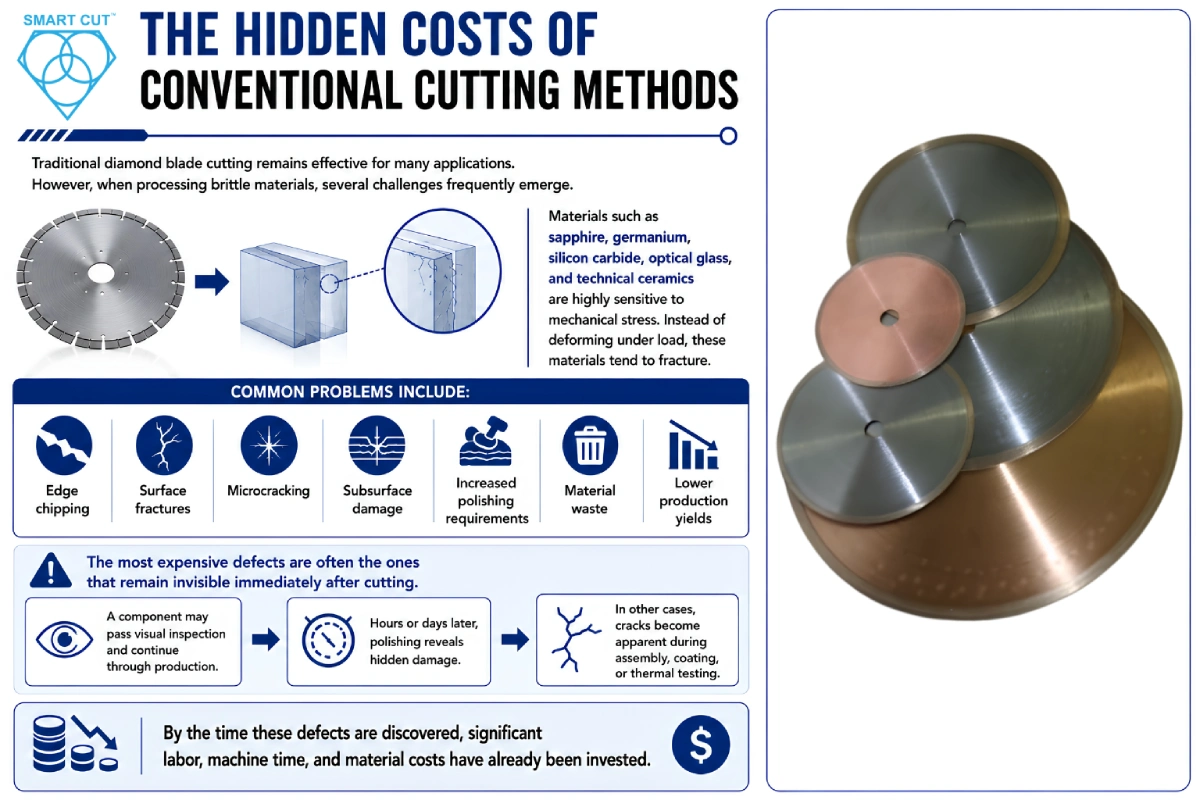
Traditional diamond blade cutting remains effective for many applications. However, when processing brittle materials, several challenges frequently emerge.

Materials such as sapphire, germanium, silicon carbide, optical glass, and technical ceramics are highly sensitive to mechanical stress. Instead of deforming under load, these materials tend to fracture.

Common problems include:

  • Edge chipping
  • Surface fractures
  • Microcracking
  • Subsurface damage
  • Increased polishing requirements
  • Material waste
  • Lower production yields

The most expensive defects are often the ones that remain invisible immediately after cutting.

A component may pass visual inspection and continue through production. Hours or days later, polishing reveals hidden damage. In other cases, cracks become apparent during assembly, coating, or thermal testing.

By the time these defects are discovered, significant labor, machine time, and material costs have already been invested.

Why Diamond Wire Saw Technology Produces Different Results

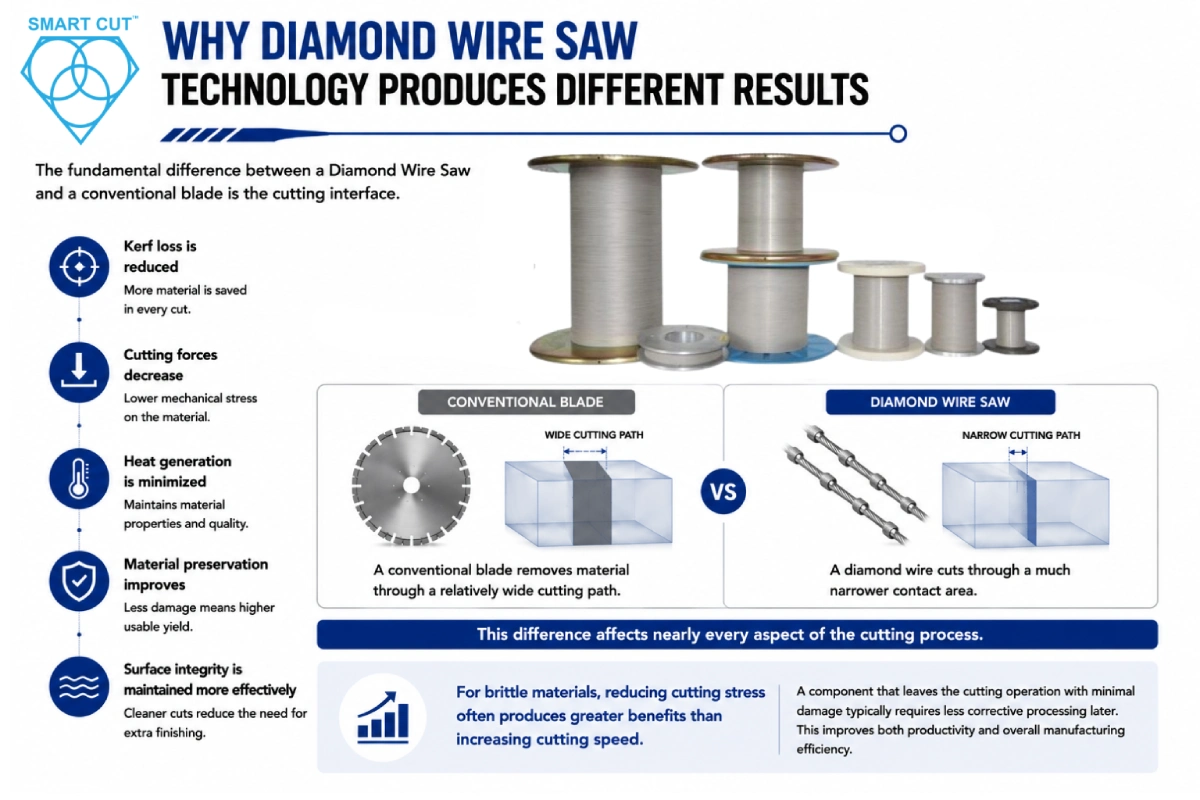
The fundamental difference between a Diamond Wire Saw and a conventional blade is the cutting interface.

A conventional blade removes material through a relatively wide cutting path. A diamond wire cuts through a much narrower contact area.

This difference affects nearly every aspect of the cutting process.

Because less material is removed:

  • Kerf loss is reduced
  • Cutting forces decrease
  • Heat generation is minimized
  • Material preservation improves
  • Surface integrity is maintained more effectively

For brittle materials, reducing cutting stress often produces greater benefits than increasing cutting speed.

A component that leaves the cutting operation with minimal damage typically requires less corrective processing later. This improves both productivity and overall manufacturing efficiency.

Why Precision Cutting Quality Matters

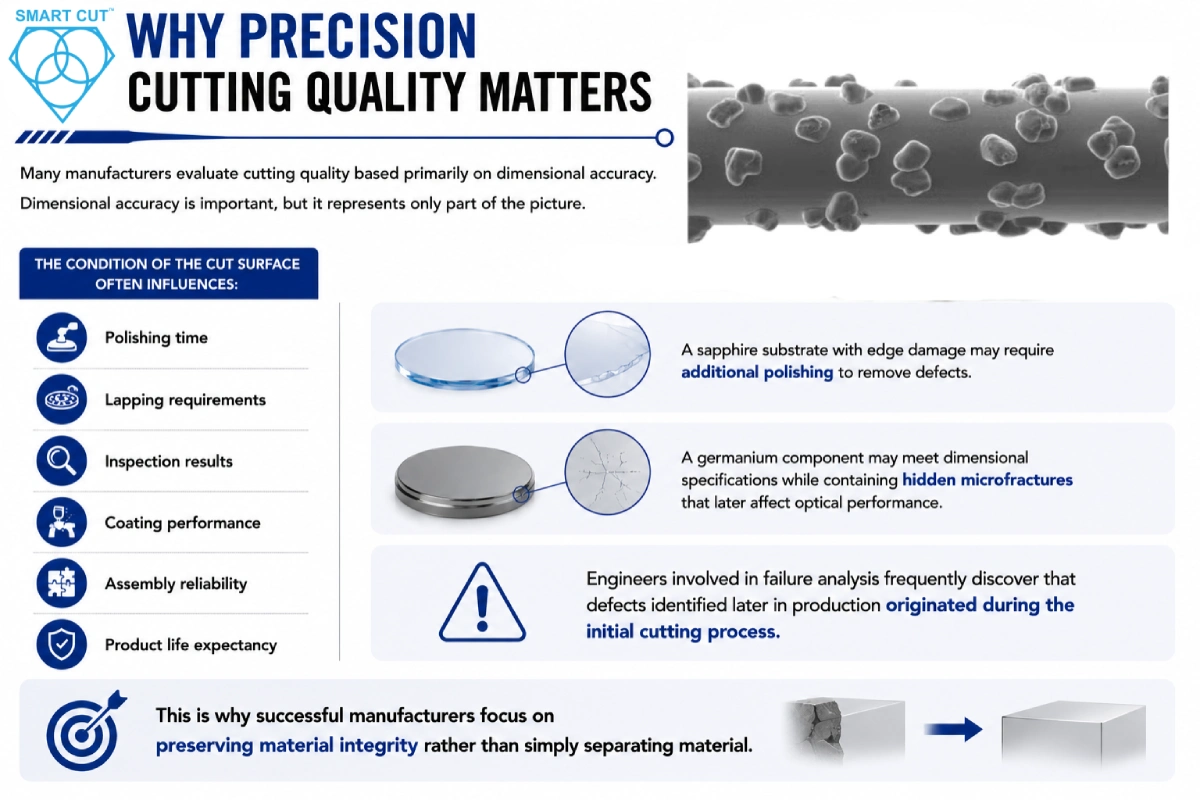
Many manufacturers evaluate cutting quality based primarily on dimensional accuracy.

Dimensional accuracy is important, but it represents only part of the picture.

The condition of the cut surface often influences:

  • Polishing time
  • Lapping requirements
  • Inspection results
  • Coating performance
  • Assembly reliability
  • Product life expectancy

A sapphire substrate with edge damage may require additional polishing to remove defects. A germanium component may meet dimensional specifications while containing hidden microfractures that later affect optical performance.

Engineers involved in failure analysis frequently discover that defects identified later in production originated during the initial cutting process.

This is why successful manufacturers focus on preserving material integrity rather than simply separating material.

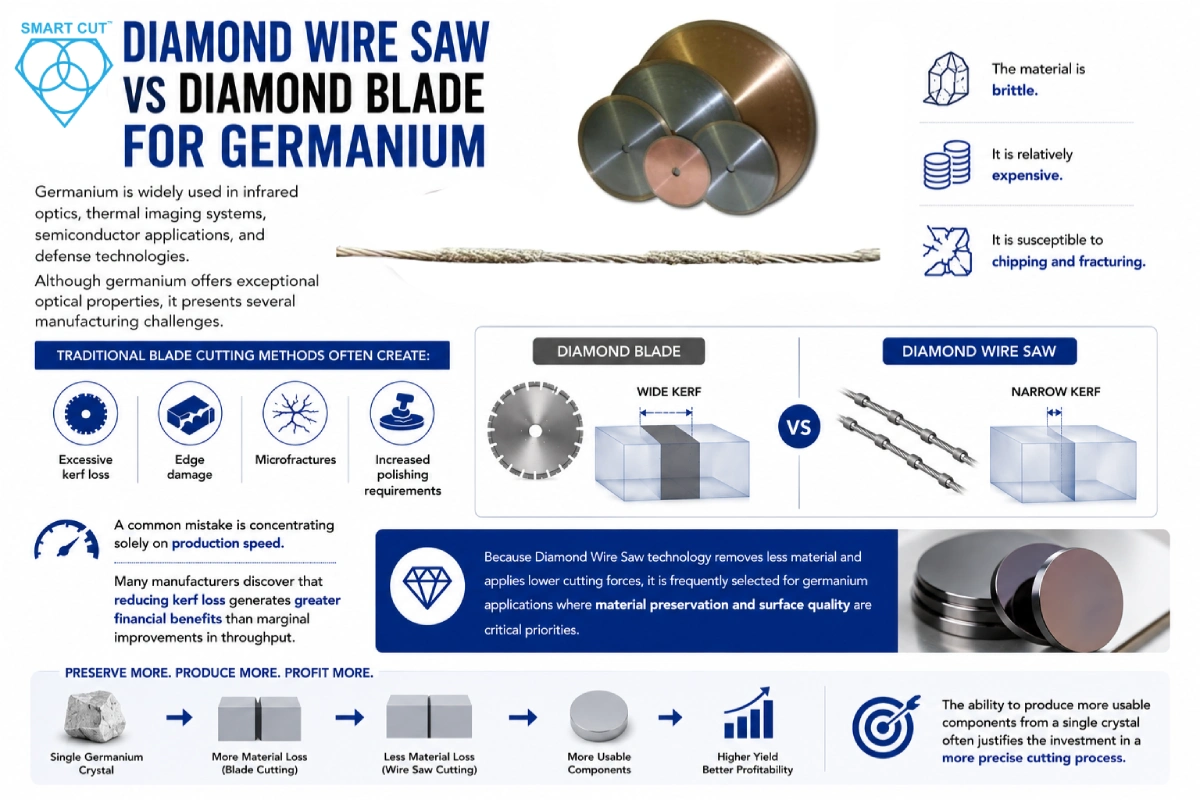
Diamond Wire Saw vs Diamond Blade for Germanium

Germanium is widely used in infrared optics, thermal imaging systems, semiconductor applications, and defense technologies.

Although germanium offers exceptional optical properties, it presents several manufacturing challenges.

The material is brittle.

It is relatively expensive.

It is susceptible to chipping and fracturing.

Traditional blade cutting methods often create:

  • Excessive kerf loss
  • Edge damage
  • Microfractures
  • Increased polishing requirements

A common mistake is concentrating solely on production speed.

Many manufacturers discover that reducing kerf loss generates greater financial benefits than marginal improvements in throughput.

Because Diamond Wire Saw technology removes less material and applies lower cutting forces, it is frequently selected for germanium applications where material preservation and surface quality are critical priorities.

The ability to produce more usable components from a single crystal often justifies the investment in a more precise cutting process.

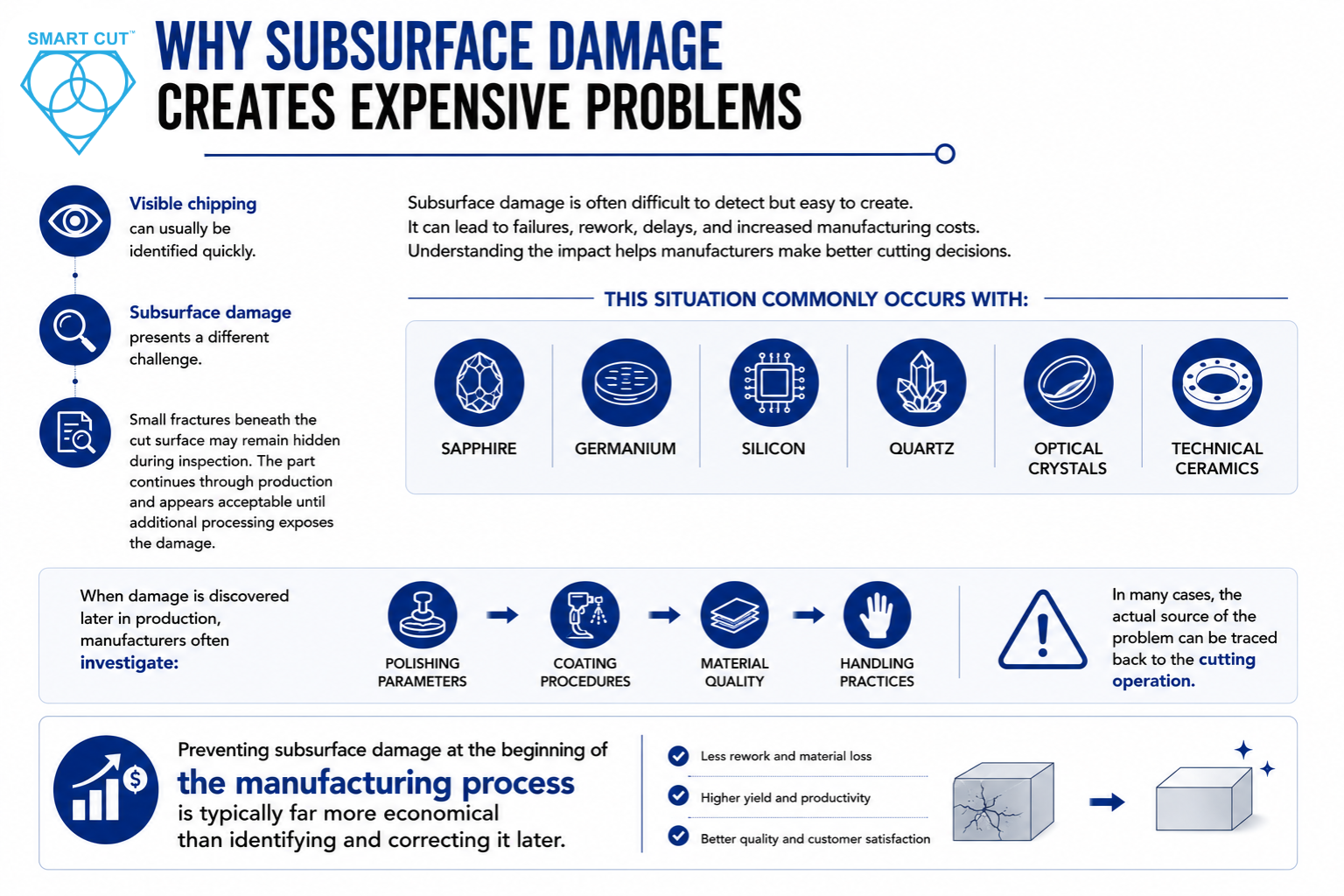
Why Subsurface Damage Creates Expensive Problems

Visible chipping can usually be identified quickly.

Subsurface damage presents a different challenge.

Small fractures beneath the cut surface may remain hidden during inspection. The part continues through production and appears acceptable until additional processing exposes the damage.

This situation commonly occurs with:

  • Sapphire
  • Germanium
  • Silicon
  • Quartz
  • Optical crystals
  • Technical ceramics

When damage is discovered later in production, manufacturers often investigate polishing parameters, coating procedures, material quality, or handling practices.

In many cases, the actual source of the problem can be traced back to the cutting operation.

Preventing subsurface damage at the beginning of the manufacturing process is typically far more economical than identifying and correcting it later.

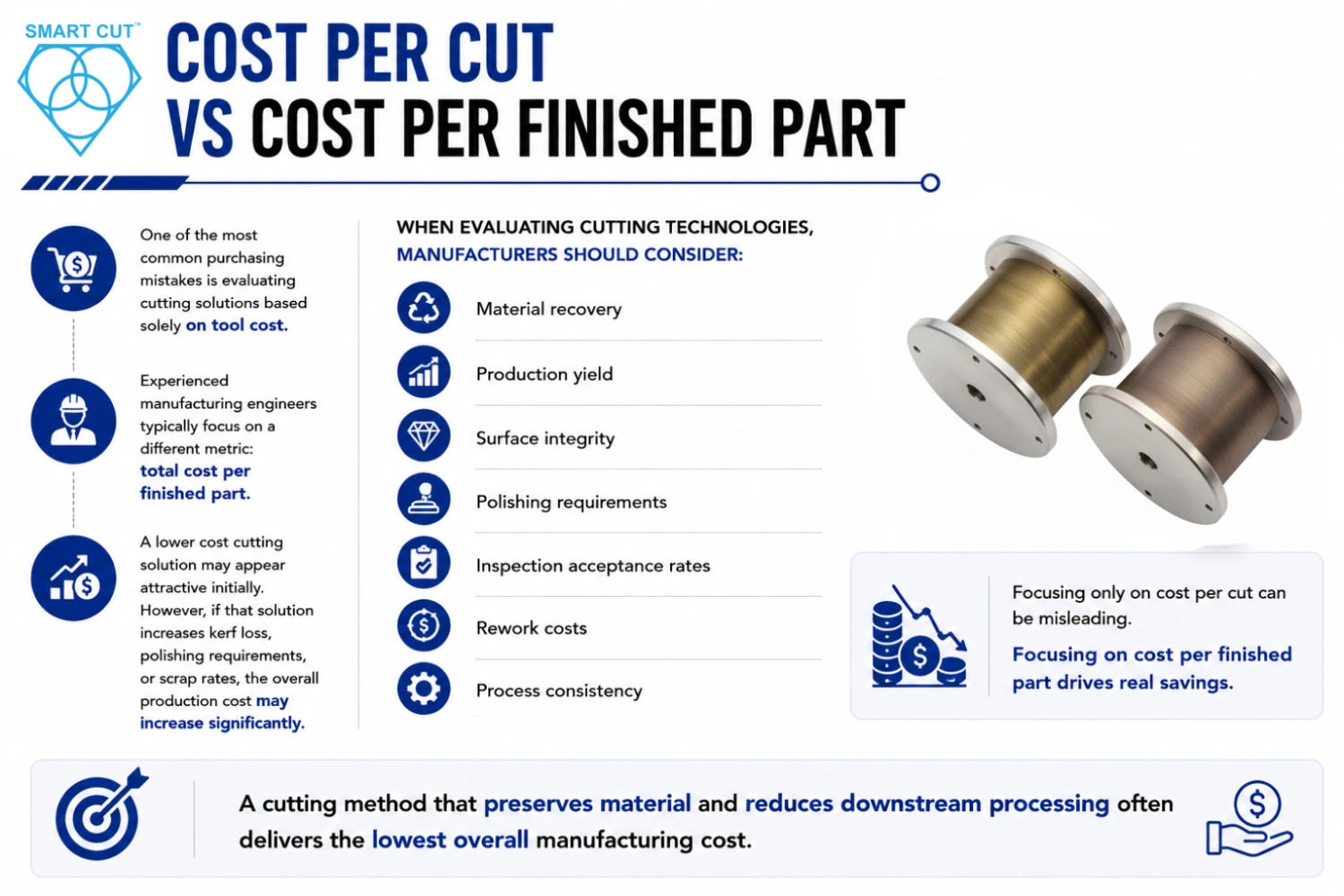
Cost Per Cut vs Cost Per Finished Part

One of the most common purchasing mistakes is evaluating cutting solutions based solely on tool cost.

Experienced manufacturing engineers typically focus on a different metric: total cost per finished part.

A lower cost cutting solution may appear attractive initially. However, if that solution increases kerf loss, polishing requirements, or scrap rates, the overall production cost may increase significantly.

When evaluating cutting technologies, manufacturers should consider:

  • Material recovery
  • Production yield
  • Surface integrity
  • Polishing requirements
  • Inspection acceptance rates
  • Rework costs
  • Process consistency

A cutting method that preserves material and reduces downstream processing often delivers the lowest overall manufacturing cost.

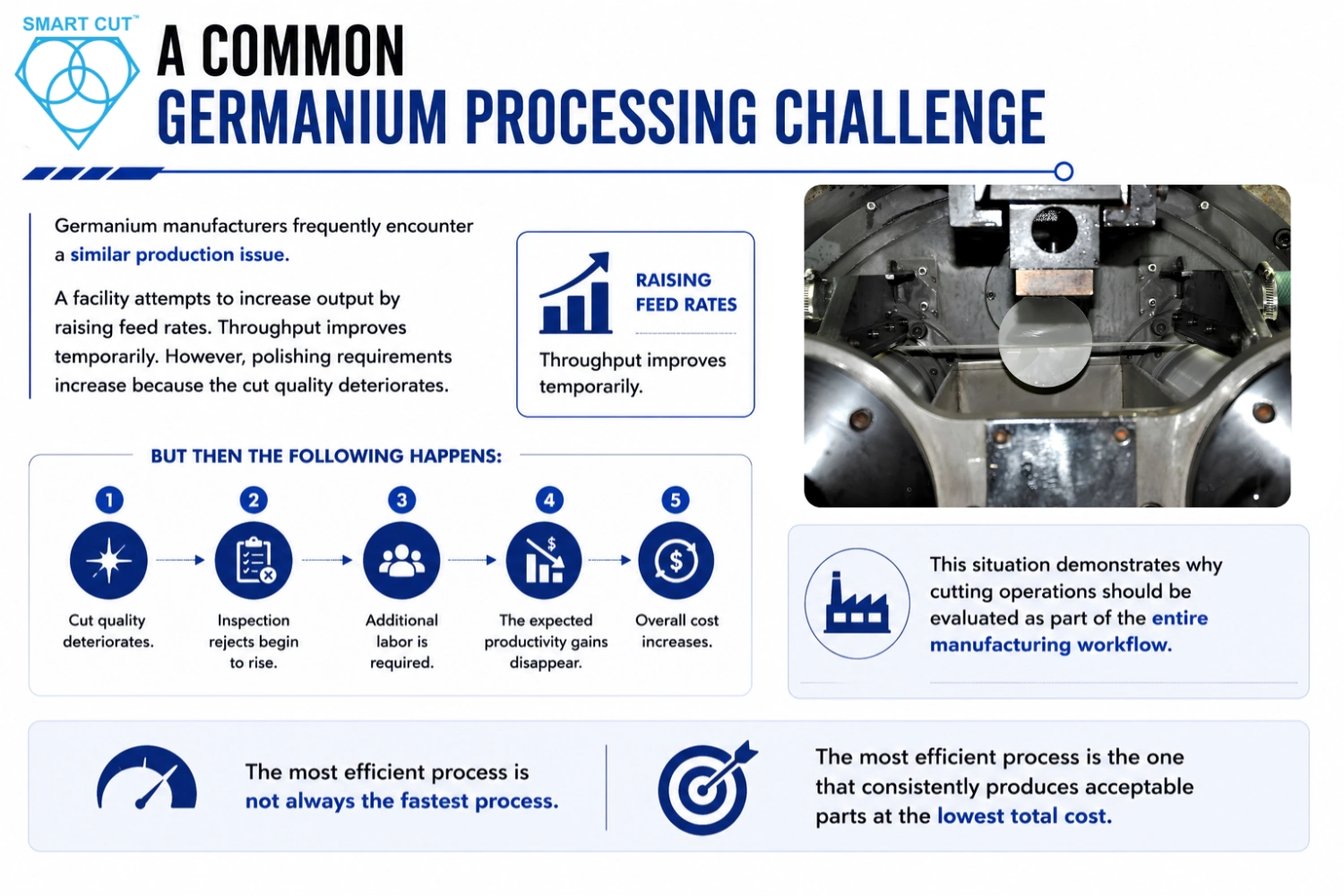
A Common Germanium Processing Challenge

Germanium manufacturers frequently encounter a similar production issue.

A facility attempts to increase output by raising feed rates. Throughput improves temporarily. However, polishing requirements increase because the cut quality deteriorates.

Inspection rejects begin to rise.

Additional labor is required.

The expected productivity gains disappear.

This situation demonstrates why cutting operations should be evaluated as part of the entire manufacturing workflow.

The most efficient process is not always the fastest process.

The most efficient process is the one that consistently produces acceptable parts at the lowest total cost.

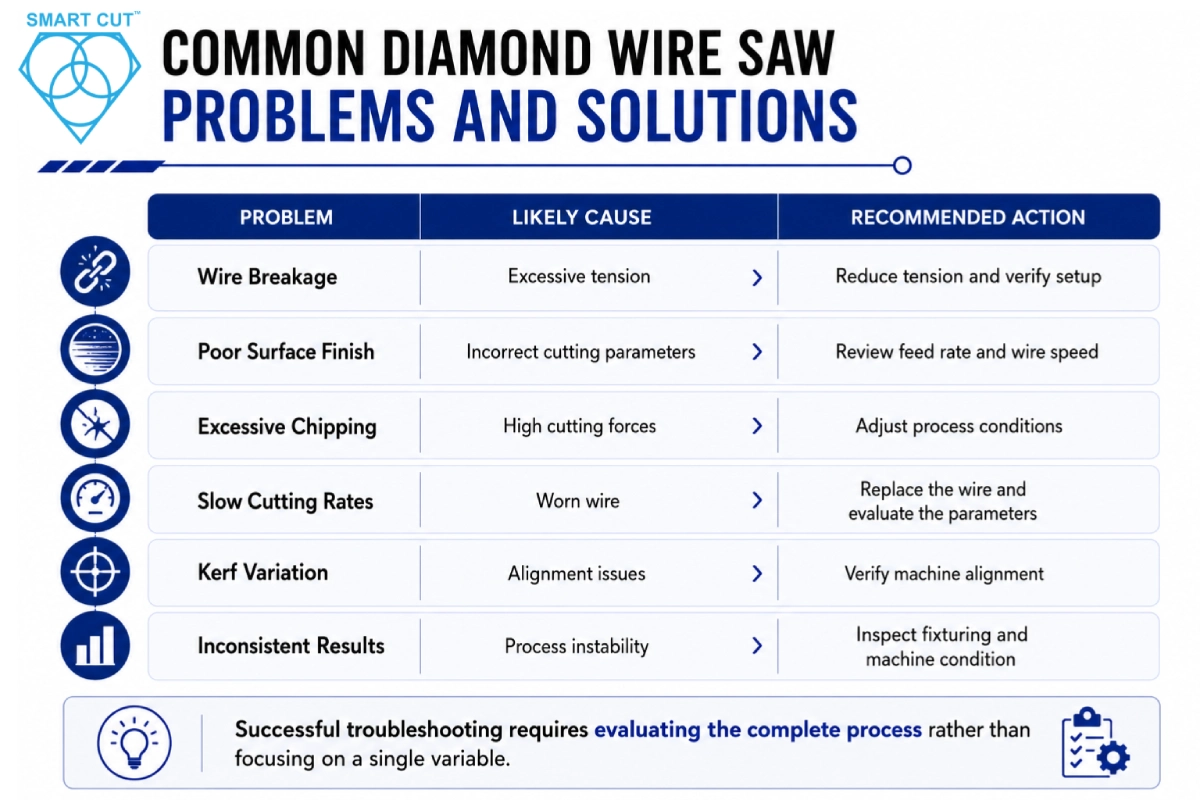
Common Diamond Wire Saw Problems and Solutions

ProblemLikely CauseRecommended Action
Wire BreakageExcessive tensionReduce tension and verify setup
Poor Surface FinishIncorrect cutting parametersReview feed rate and wire speed
Excessive ChippingHigh cutting forcesAdjust process conditions
Slow Cutting RatesWorn wireReplace the wire and evaluate the parameters
Kerf VariationAlignment issuesVerify machine alignment
Inconsistent ResultsProcess instabilityInspect fixturing and machine condition

Successful troubleshooting requires evaluating the complete process rather than focusing on a single variable.

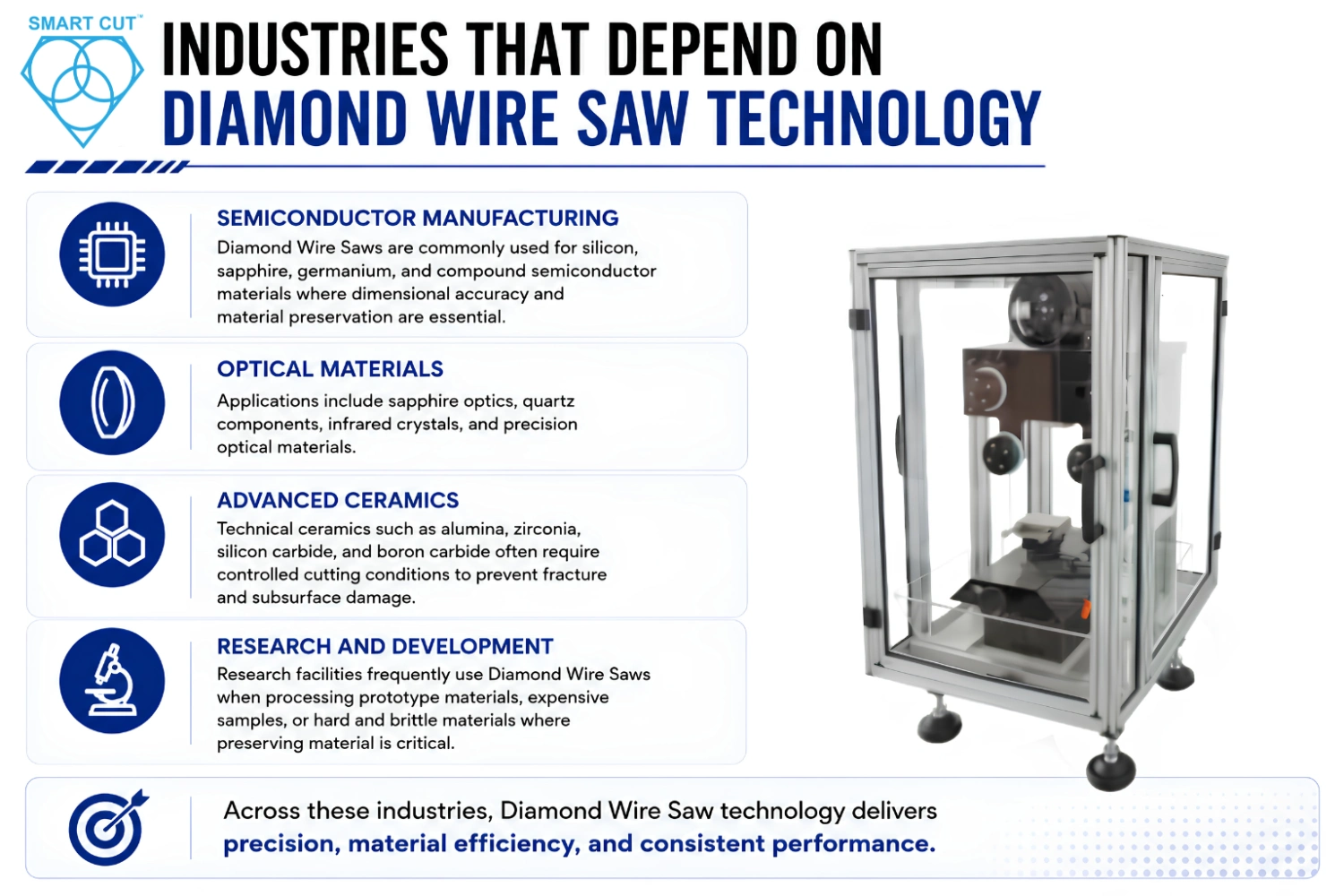
Industries That Depend on Diamond Wire Saw Technology

Semiconductor Manufacturing

Diamond Wire Saws are commonly used for silicon, sapphire, germanium, and compound semiconductor materials where dimensional accuracy and material preservation are essential.

Optical Materials

Applications include sapphire optics, quartz components, infrared crystals, and precision optical materials.

Advanced Ceramics

Technical ceramics such as alumina, zirconia, silicon carbide, and boron carbide often require controlled cutting conditions to prevent fracture and subsurface damage.

Research and Development

Research facilities frequently use Diamond Wire Saws when processing prototype materials, expensive samples, or hard and brittle materials where preserving material is critical.

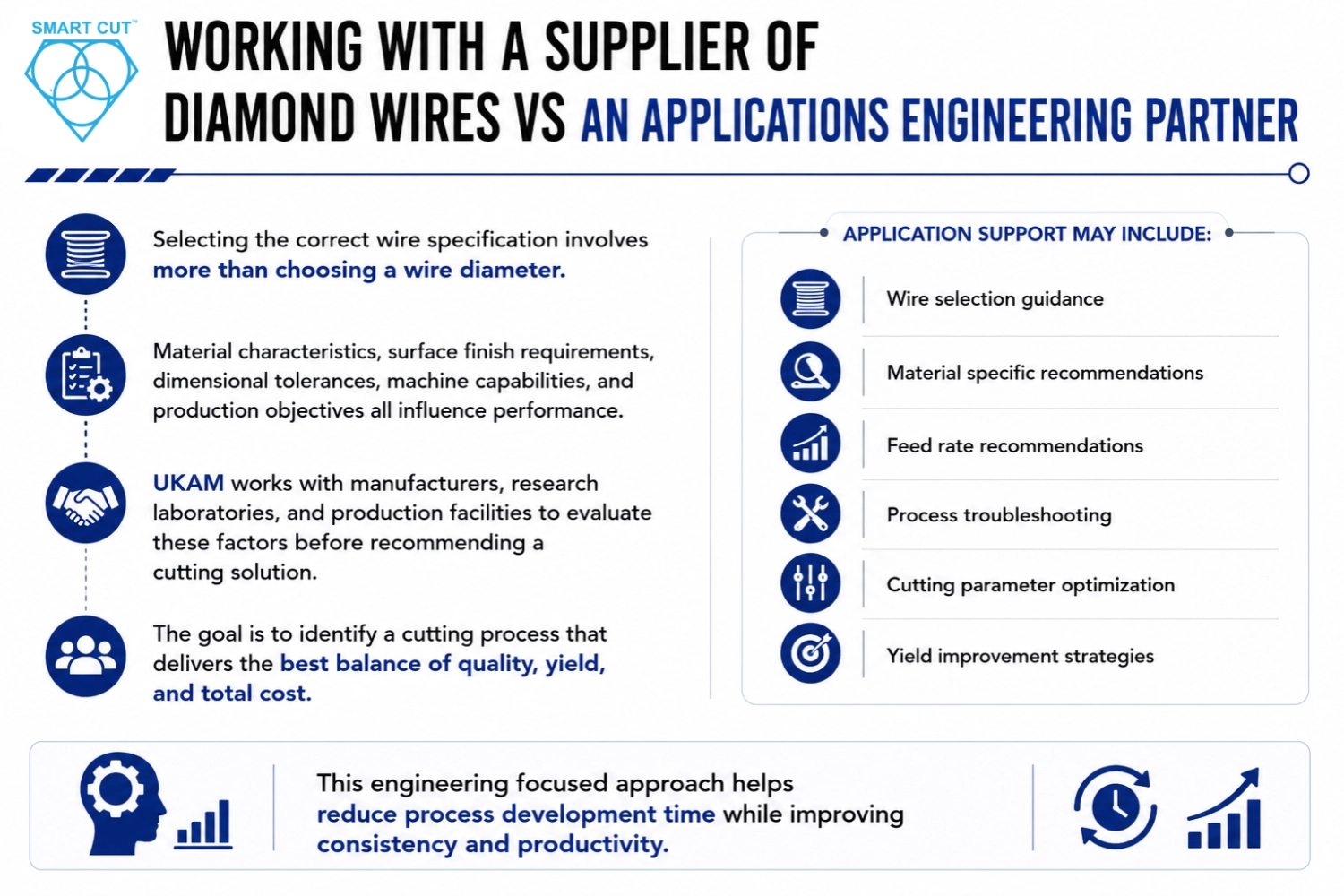
Working With a Supplier of Diamond Wires vs an Applications Engineering Partner

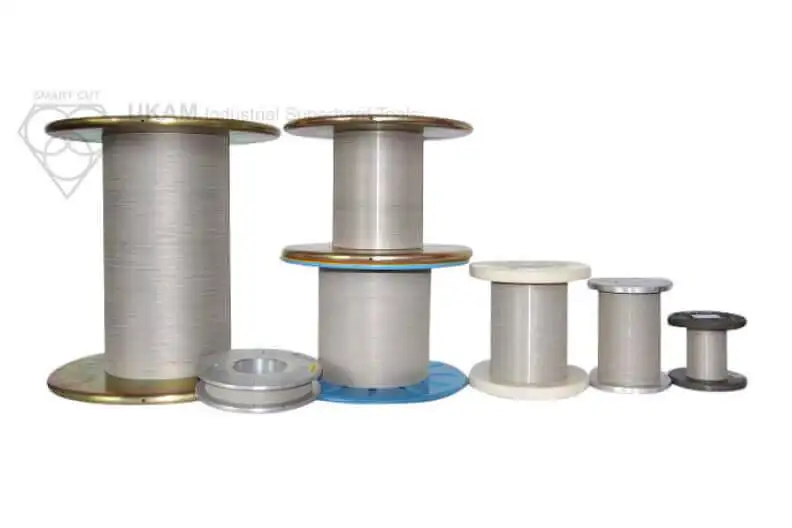
Selecting the correct wire specification involves more than choosing a wire diameter.

Material characteristics, surface finish requirements, dimensional tolerances, machine capabilities, and production objectives all influence performance.

UKAM works with manufacturers, research laboratories, and production facilities to evaluate these factors before recommending a cutting solution.

Application support may include:

  • Wire selection guidance
  • Material specific recommendations
  • Feed rate recommendations
  • Process troubleshooting
  • Cutting parameter optimization
  • Yield improvement strategies

This engineering focused approach helps reduce process development time while improving consistency and productivity.

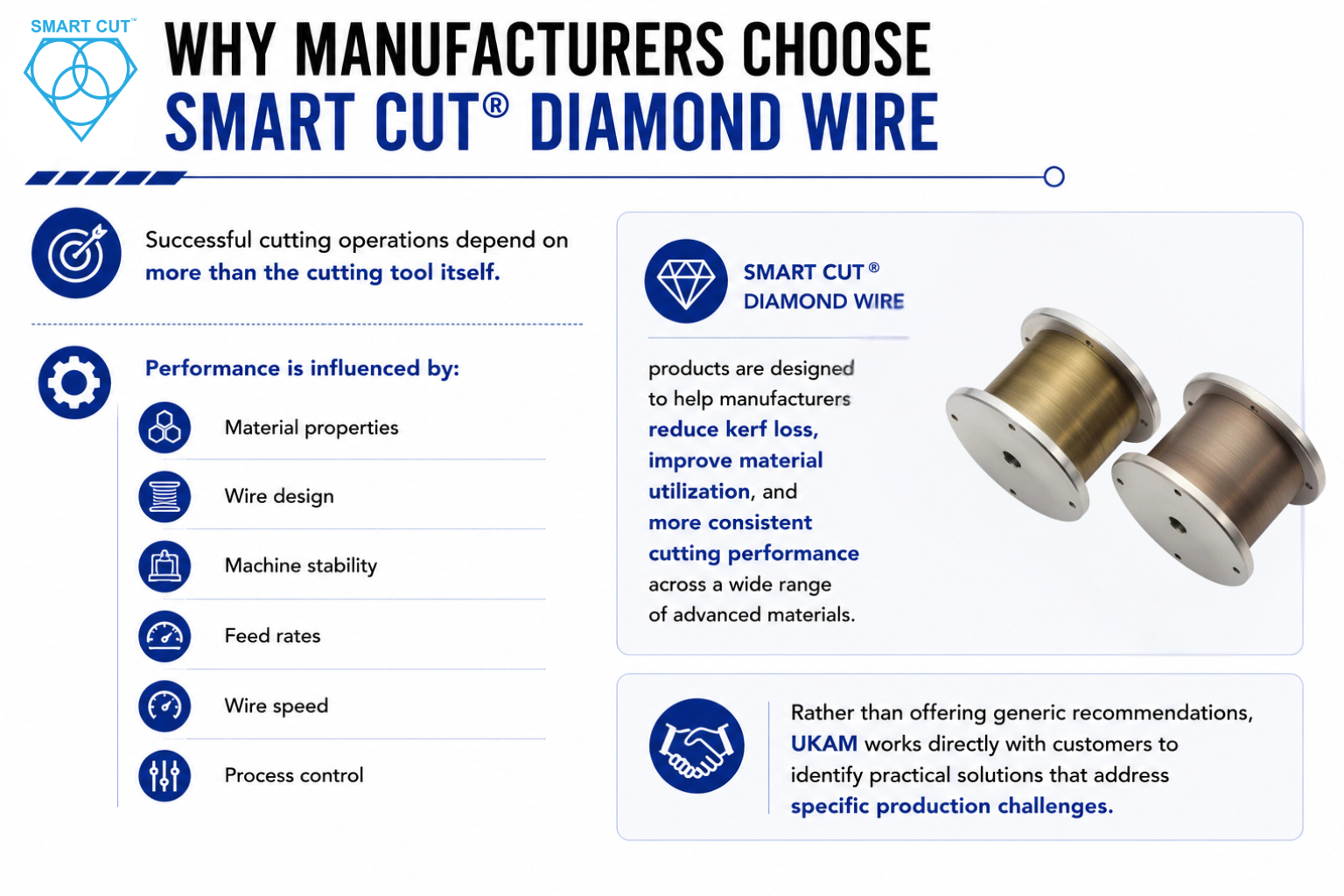
Why Manufacturers Choose SMART CUT® Diamond Wire

Successful cutting operations depend on more than the cutting tool itself.

Performance is influenced by:

  • Material properties
  • Wire design
  • Machine stability
  • Feed rates
  • Wire speed
  • Process control

SMART CUT® Diamond Wire products are designed to help manufacturers reduce kerf loss, improve material utilization, and achieve more consistent cutting performance across a wide range of advanced materials.

Rather than offering generic recommendations, UKAM works directly with customers to identify practical solutions that address specific production challenges.

Frequently Asked Questions

The narrow cutting path reduces material loss and helps maximize the number of usable components produced from valuable materials.

Every cut removes material. Reducing kerf width improves material recovery and can significantly increase production yield.

Yes. Many germanium manufacturers use Diamond Wire Saws because they help reduce cutting damage, preserve material, and improve overall yield.

Hidden fractures may not become visible until polishing, inspection, or assembly. Preventing damage during cutting helps reduce downstream manufacturing costs.

Conclusion

For manufacturers processing sapphire, germanium, silicon, optical materials, technical ceramics, and semiconductor substrates, cutting performance should be measured by more than cycle time.

Material recovery, kerf loss, surface integrity, and production yield often have a greater impact on profitability than cutting speed alone.

Diamond Wire Saw technology helps address these challenges by reducing material waste, minimizing cutting induced damage, and improving process consistency.

When properly matched to the material and application, Diamond Wire Saw systems can improve yield, reduce downstream processing requirements, and lower total manufacturing costs.

UKAM’s applications engineering team works closely with customers to develop cutting solutions tailored to specific materials, tolerances, and production goals, helping manufacturers achieve more consistent and economical results.

Trusted by Tens of Thousands of Manufacturers, Laboratories,
Research Institutions Worldwide Since 1990

American Based Manufacturer

Established in 1990

Custom manufacturing

RELATED ARTICLES

Brian is an experienced professional in the field of precision cutting tools, with over 27 years of experience in technical support. Over the years, he has helped engineers, manufacturers, researchers, and contractors find the right solutions for working with advanced and hard-to-cut materials. He’s passionate about bridging technical knowledge with real-world applications to improve efficiency and accuracy.

As an author, Brian Farberov writes extensively on diamond tool design, application engineering, return on investment strategies, and process optimization, combining technical depth with a strong understanding of customer needs and market dynamics.

author-avatar

About Brian Farberov

Brian is an experienced professional in the field of precision cutting tools, with over 27 years of experience in technical support. Over the years, he has helped engineers, manufacturers, researchers, and contractors find the right solutions for working with advanced and hard-to-cut materials. He’s passionate about bridging technical knowledge with real-world applications to improve efficiency and accuracy. As an author, Brian Farberov writes extensively on diamond tool design, application engineering, return on investment strategies, and process optimization, combining technical depth with a strong understanding of customer needs and market dynamics.