




















Advanced Ceramic Cutting: Reducing Edge Chipping in Alumina Components

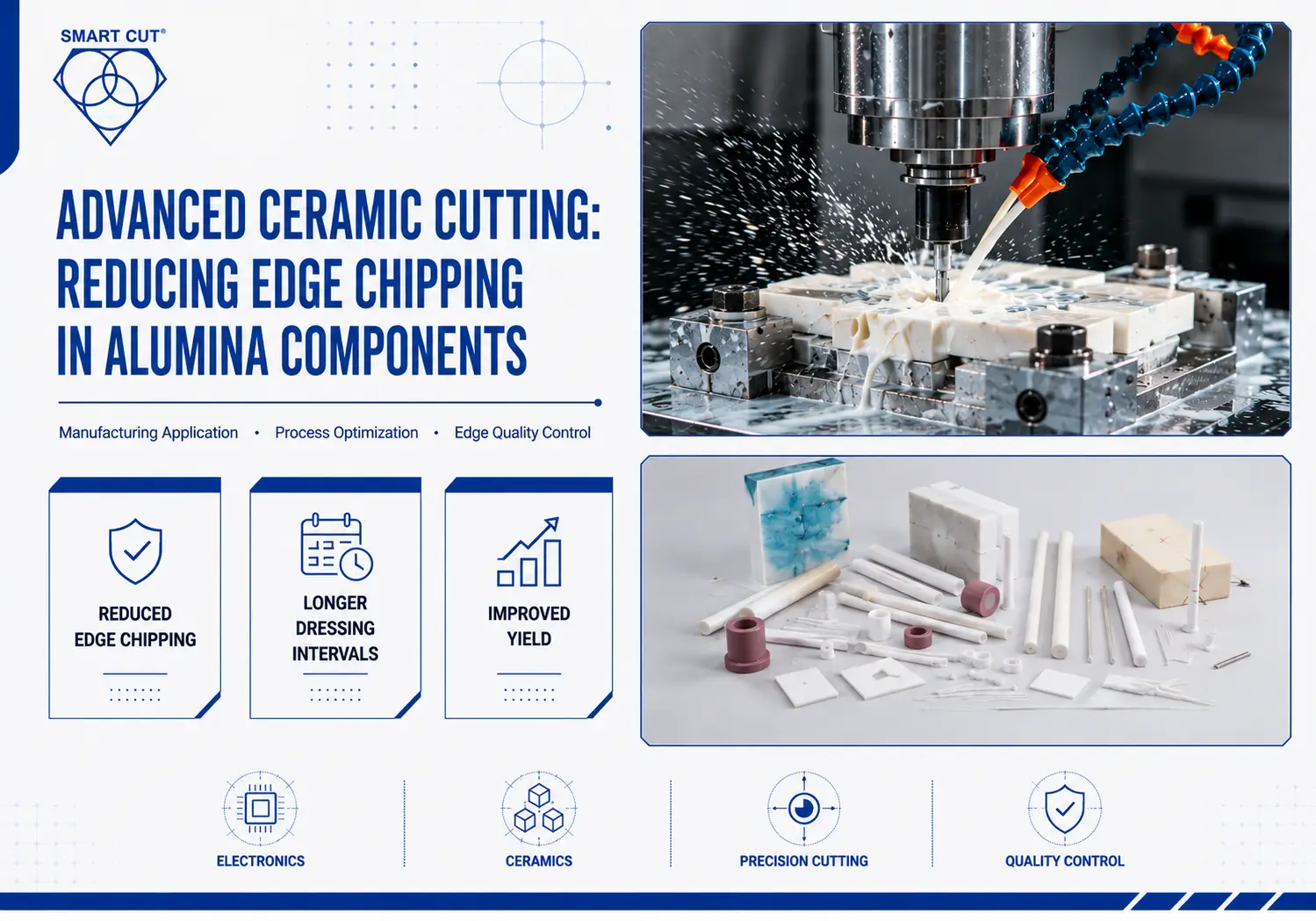
Table of Contents
Toggle
American Based Manufacturer

Established in 1990


Custom manufacturing


How Process Qualification, Blade Selection, and Coolant Optimization Reduced Scrap by Approximately 60%
Executive Summary
Edge chipping remains one of the most common and costly challenges when machining advanced ceramic materials. While dimensional tolerances may remain within specification, microscopic edge damage can propagate during downstream processing, resulting in scrap, rework, assembly failures, and reduced component reliability.
This case study examines a manufacturing operation producing 99.6% alumina ceramic substrates for high-voltage electronic assemblies. The manufacturer experienced significant edge chipping during contour cutting and slotting operations. Components routinely passed dimensional inspection immediately after cutting but later failed during lapping, metallization, and assembly due to micro-fractures propagating from the cut edge.
Through a structured qualification process involving blade selection, coolant optimization, and stabilization of cutting force, production scrap related to edge damage was reduced by approximately 60%. Additional improvements included improved surface finish, extended blade dressing intervals, reduced cycle time, and greater process consistency.
Manufacturing Environment and Production Requirements
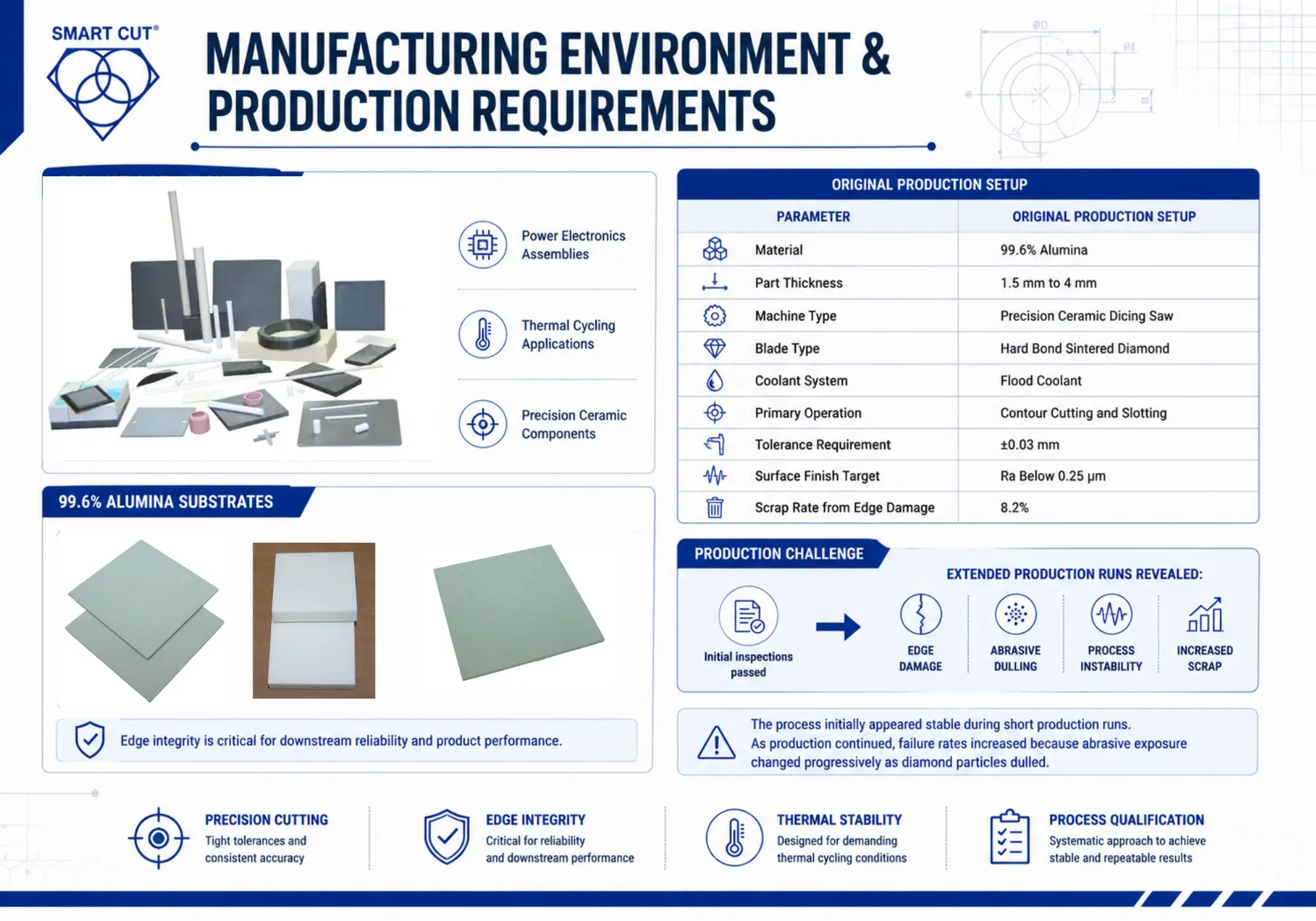
The ceramic substrates were used in power electronics assemblies operating under demanding thermal cycling conditions. In these applications, edge integrity is often more critical than dimensional accuracy because micro-fractures can propagate during assembly, thermal expansion, vibration loading, and field operation.
Even small edge defects created during cutting can significantly reduce product reliability and increase manufacturing costs.
Original Production Conditions
|
Parameter |
Original Production Setup |
|---|---|
|
Material |
99.6% Alumina |
|
Part Thickness |
1.5 mm to 4 mm |
|
Machine Type |
Precision Ceramic Dicing Saw |
|
Blade Type |
Hard Bond Sintered Diamond |
|
Coolant System |
Flood Coolant |
|
Primary Operation |
Contour Cutting and Slotting |
|
Tolerance Requirement |
±0.03 mm |
|
Surface Finish Target |
Ra Below 0.25 µm |
|
Scrap Rate from Edge Damage |
8.2% |
The process initially appeared stable during short production runs. Parts consistently met dimensional requirements and passed initial inspection. However, as production continued, failure rates increased because abrasive exposure changed progressively as diamond particles dulled.
Engineering Challenges Observed During Production
The first indication of a problem was not dimensional variation.
Instead, operators observed increasing rates of edge damage during extended production runs. Components frequently passed initial inspection but later exhibited failures during lapping, metallization, and assembly operations.
These delayed failures significantly increased manufacturing costs because value-added processing had already been completed before defects became visible.
Production Symptoms Observed
|
Production Observation |
Manufacturing Impact |
|---|---|
|
Edge Breakout |
Increased Scrap |
|
Corner Chipping |
Assembly Failures |
|
Thermal Micro-Cracking |
Reliability Concerns |
|
Variable Spindle Load |
Reduced Process Stability |
|
Frequent Blade Dressing |
Lower Productivity |
|
Subsurface Fracture Propagation |
Reduced Yield |
One of the most challenging aspects of ceramic machining is that damage is often not immediately visible. Many fractures initiate below the surface and become apparent only after additional thermal or mechanical stress is introduced.
Why High-Purity Alumina Behaves Differently During Cutting
Many engineers assume higher-purity alumina should be easier to machine because abrasive wear decreases as purity increases.
In reality, the opposite often occurs.
As alumina purity increases, fracture sensitivity also increases. While blade wear may decrease, the material becomes significantly more susceptible to crack initiation and fracture propagation.
Once localized cutting forces exceed the fracture threshold of the material, edge damage can spread rapidly beyond the immediate cutting zone.
Material Behavior Comparison
|
Material |
Relative Abrasiveness |
Fracture Sensitivity |
Common Failure Mode |
|---|---|---|---|
|
96% Alumina |
Moderate |
Moderate |
Blade Loading |
|
99.6% Alumina |
Lower |
High |
Edge Breakout |
|
Silicon Nitride |
Moderate |
High |
Corner Chipping |
|
Silicon Carbide |
Very High |
Moderate |
Thermal Fracture |
|
Sapphire |
Low |
Very High |
Subsurface Cracking |
|
Fused Silica |
Low |
Very High |
Thermal Edge Breakout |
The original blade specification was optimized primarily for abrasive resistance and blade retention rather than fracture control.
As a result, blade life remained acceptable, but cutting forces progressively increased as abrasive particles dulled, contributing to edge damage and fracture propagation.
Application Engineering Assessment
A detailed engineering review determined that fracture sensitivity, rather than material hardness, was the primary challenge.
Many manufacturers initially attempt to solve chipping problems by reducing spindle speed. During this qualification project, testing demonstrated that bond behavior, abrasive exposure, coolant penetration, and cutting-force stability had a greater influence on edge quality than RPM reduction alone.
Engineering Finding
The largest contributor to yield improvement was stabilization of cutting force through improved abrasive exposure and coolant penetration rather than spindle speed reduction by itself.
This finding ultimately guided the qualification strategy and blade selection process.
Cutting Parameters That Influence Edge Chipping
One of the most common mistakes in advanced ceramic machining is attempting to solve edge chipping by adjusting a single process variable.
In practice, edge quality is influenced by the interaction of RPM, feed rate, bond type, abrasive exposure, coolant delivery, machine rigidity, and dressing strategy.
Successful optimization requires evaluation of the complete cutting system rather than isolated adjustments to one variable.
Critical Process Variables Affecting Edge Quality
|
Parameter |
Influence on Edge Quality |
|---|---|
|
RPM |
Influences cutting force and thermal loading |
|
Feed Rate |
Affects fracture propagation and cutting efficiency |
|
Bond Type |
Controls abrasive exposure and force stability |
|
Grit Size |
Influences surface finish and chip formation |
|
Coolant Delivery |
Controls heat accumulation and debris evacuation |
|
Machine Rigidity |
Reduces vibration-induced damage |
|
Dressing Frequency |
Maintains cutting consistency |
The qualification process demonstrated that no single parameter was responsible for edge chipping. Instead, edge quality was influenced by the interaction of cutting force concentration, thermal accumulation, vibration, and fracture propagation occurring simultaneously at the cutting interface.
This explains why RPM reduction alone produced only minor improvements while process optimization delivered substantial reductions in scrap and edge damage.
Blade Qualification Trials
The engineering team evaluated three blade configurations during qualification testing.
Qualification Matrix
|
Blade Configuration |
Bond Type |
Grit Size |
Result |
|---|---|---|---|
|
Blade A |
Hard Metal Bond |
Medium |
Long Blade Life, High Chipping |
|
Blade B |
Standard Resin Bond |
Fine |
Lower Chipping, Moderate Wear |
|
Blade C |
Fine Grit Resin Bond |
Fine |
Best Edge Quality and Stable Cutting Force |
Blade C generated the most stable edge quality because the bond released dull abrasive particles more consistently during cutting.
This reduced localized force concentration near edge transitions and minimized fracture propagation.
The qualification process also revealed that aggressive cutting conditions combined with insufficient coolant penetration amplified edge damage near blade exit zones.
Production Results After Process Optimization
The revised process combined a fine-grit resin bond blade with improved coolant delivery, more stable abrasive exposure, and reduced cutting-force variation.
The objective was not simply to reduce chipping but to create a more stable manufacturing process capable of maintaining consistent edge quality throughout extended production runs.
Before and After Comparison
|
Parameter |
Original Process |
Optimized Process |
|---|---|---|
|
Blade Type |
Hard Bond Sintered |
Fine Grit Resin Bond |
|
Average Edge Chipping |
180–240 µm |
60–90 µm |
|
Scrap Rate |
8.2% |
3.1% |
|
Blade Dressing Interval |
Every 18 Cuts |
Every 42 Cuts |
|
Surface Finish |
0.31 µm Ra |
0.17 µm Ra |
|
Average Spindle Load |
High Variation |
Stable |
|
Cycle Time |
5.6 Minutes |
4.8 Minutes |
The reduction in edge breakout also improved downstream lapping yield because fewer subsurface fractures propagated during secondary processing.
In addition to reducing scrap, the improved process reduced machine interruptions associated with blade dressing and process adjustments.
This created a more repeatable manufacturing environment with fewer quality fluctuations between production runs.
Example Cost Impact of Scrap Reduction
For many manufacturers, scrap reduction produces greater financial savings than extending blade life alone.
Although tooling cost is important, the true cost of ceramic manufacturing includes material, machine time, labor, inspection, downstream processing, and assembly operations.
The following example illustrates the potential financial impact of reducing scrap rates.
Example Calculation Only
|
Parameter |
Example Value |
|---|---|
|
Annual Production Volume |
100,000 Parts |
|
Average Part Value |
$14 |
|
Original Scrap Rate |
8.2% |
|
Optimized Scrap Rate |
3.1% |
Estimated Annual Scrap Cost
|
Metric |
Before Optimization |
After Optimization |
|---|---|---|
|
Scrap Parts |
8,200 |
3,100 |
|
Scrap Cost |
$114,800 |
$43,400 |
Potential Annual Savings
Estimated Savings: $71,400 Per Year
Actual savings will vary depending on production volume, material cost, labor cost, and downstream processing requirements.
This example demonstrates why many manufacturers focus on yield improvement rather than tooling life alone.
Why RPM Reduction Alone Did Not Solve the Problem
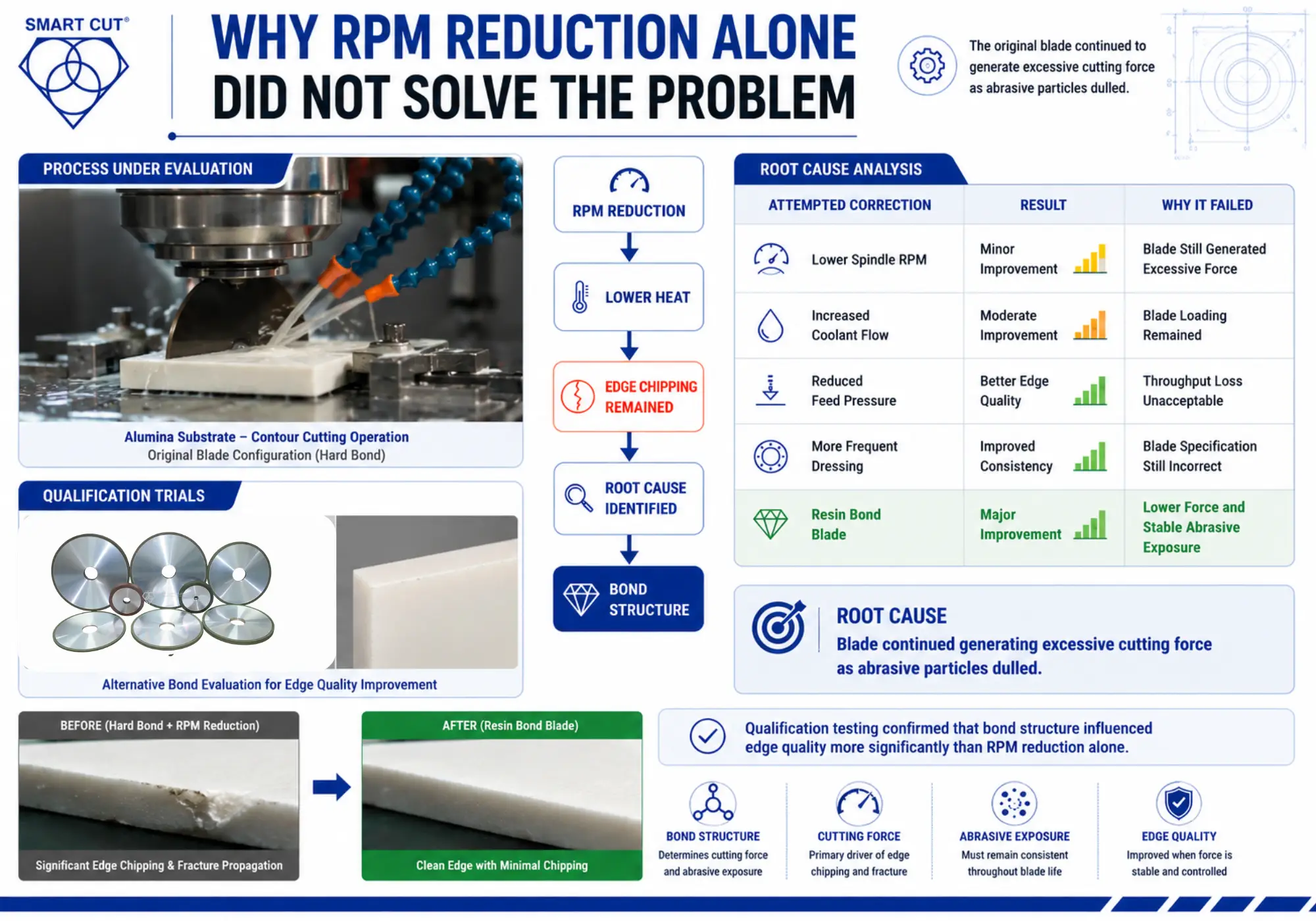
The production team initially attempted to reduce edge chipping by lowering spindle RPM while maintaining the original blade specification.
While this approach reduced thermal loading slightly, it failed to eliminate fracture propagation because the underlying issue remained unchanged.
The original blade continued to generate excessive cutting force as abrasive particles dulled.
Root Cause Analysis
|
Attempted Correction |
Result |
Why It Failed |
|---|---|---|
|
Lower Spindle RPM |
Minor Improvement |
Blade Still Generated Excessive Force |
|
Increased Coolant Flow |
Moderate Improvement |
Blade Loading Remained |
|
Reduced Feed Pressure |
Better Edge Quality |
Throughput Loss Unacceptable |
|
More Frequent Dressing |
Improved Consistency |
Blade Specification Still Incorrect |
|
Resin Bond Blade |
Major Improvement |
Lower Force and Stable Abrasive Exposure |
The qualification process confirmed that bond structure influenced edge quality more significantly than RPM reduction alone.
Thermal Damage Mechanism During Ceramic Cutting
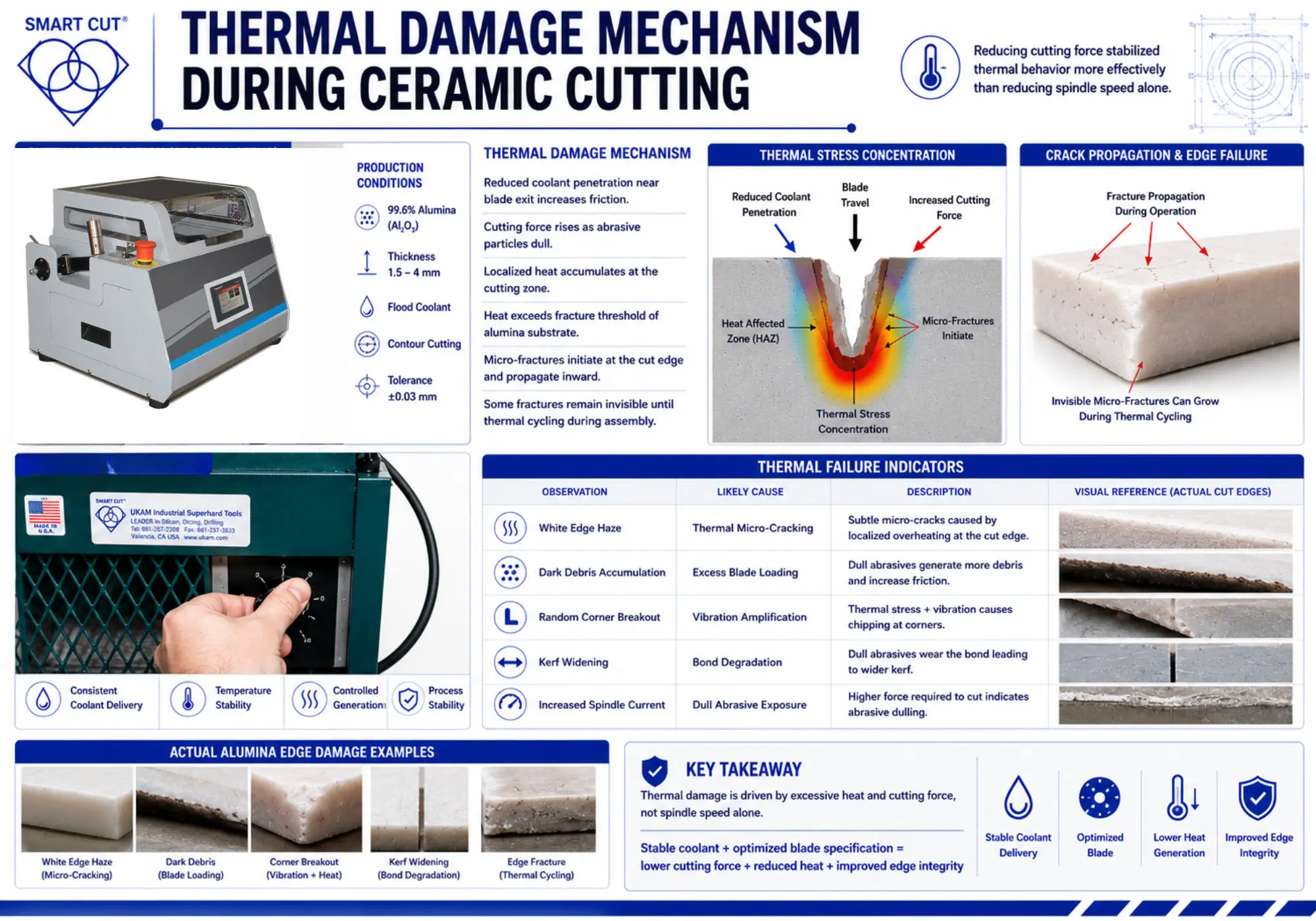
Microscopic analysis indicated that thermal stress concentrated near blade exit transitions where coolant penetration decreased and cutting pressure increased.
Once localized heat accumulation exceeded the fracture threshold of the alumina substrate, micro-fractures propagated inward from the cut edge.
Some fractures remained invisible until later thermal cycling during assembly operations.
Thermal Failure Indicators
|
Observation |
Likely Cause |
|---|---|
|
White Edge Haze |
Thermal Micro-Cracking |
|
Dark Debris Accumulation |
Excess Blade Loading |
|
Random Corner Breakout |
Vibration Amplification |
|
Kerf Widening |
Bond Degradation |
|
Increased Spindle Current |
Dull Abrasive Exposure |
Reducing cutting force stabilized thermal behavior more effectively than reducing spindle speed alone.
Coolant Delivery Optimization
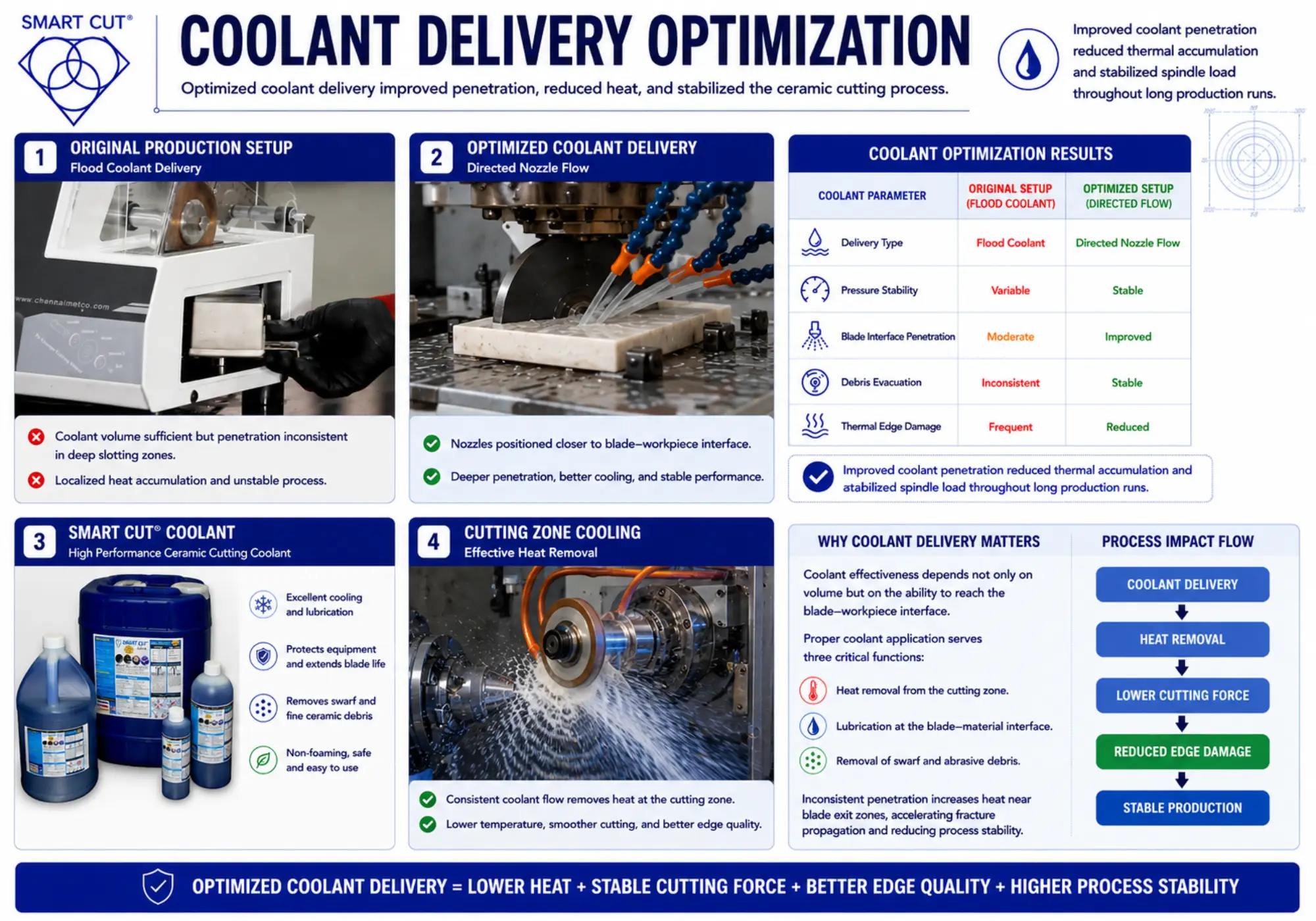
Coolant delivery became one of the largest contributors to process stability during the qualification project.
The original flood coolant system delivered sufficient overall volume but failed to penetrate consistently into deep slotting zones.
The revised setup repositioned coolant nozzles closer to the blade-workpiece interface and improved pressure stability.
Coolant Optimization Results
|
Coolant Parameter |
Original Setup |
Optimized Setup |
|---|---|---|
|
Delivery Type |
Flood Coolant |
Directed Nozzle Flow |
|
Pressure Stability |
Variable |
Stable |
|
Blade Interface Penetration |
Moderate |
Improved |
|
Debris Evacuation |
Inconsistent |
Stable |
|
Thermal Edge Damage |
Frequent |
Reduced |
Improved coolant penetration reduced thermal accumulation and stabilized spindle load throughout long production runs.
Why Coolant Delivery Matters
Many manufacturers focus primarily on coolant volume. During ceramic cutting, coolant effectiveness depends not only on volume but also on the ability to reach the blade-workpiece interface.
Proper coolant application serves three critical functions:
- Heat removal from the cutting zone.
- Lubrication at the blade-material interface.
- Removal of swarf and abrasive debris.
When coolant penetration becomes inconsistent, localized heat accumulation increases near blade exit zones, accelerating fracture propagation and reducing process stability.
SMART CUT vs Conventional Hard Bond Blade
The qualification program highlighted measurable differences between conventional hard-bond tooling and UKAM SMART CUT resin bond technology.
|
Metric |
Conventional Hard Bond Blade |
UKAM SMART CUT Resin Bond |
|---|---|---|
|
Cutting Force Stability |
Moderate |
Improved |
|
Thermal Loading |
Higher |
Reduced |
|
Edge Chipping |
180–240 µm |
60–90 µm |
|
Scrap Rate |
8.2% |
3.1% |
|
Surface Finish |
0.31 µm Ra |
0.17 µm Ra |
|
Dressing Interval |
Every 18 Cuts |
Every 42 Cuts |
|
Exit Edge Quality |
Variable |
More Consistent |
|
Process Stability |
Moderate |
Improved |
The qualification results demonstrated that reducing cutting force and maintaining stable abrasive exposure produced greater yield improvement than maximizing bond hardness alone.
Application-Specific Blade Recommendations
Different ceramic materials require different bond behaviors, grit structures, and cutting strategies. Attempting to standardize one blade specification across multiple ceramic families often reduces process stability and increases scrap rates.
Material composition, fracture toughness, abrasiveness, thermal conductivity, and application requirements all influence blade selection.
UKAM offers application-specific tooling solutions including Diamond Blades for Ceramic Cutting, Resin Bond Diamond Blades, Precision Dicing Blades, Diamond Core Drills for Ceramics, and Ceramic Grinding Wheels designed for advanced ceramic applications.
Material and Blade Selection Matrix
|
Material |
Recommended Blade Type |
Primary Concern |
|---|---|---|
|
99.6% Alumina |
Fine Grit Resin Bond |
Edge Breakout |
|
Silicon Nitride |
Resin Bond |
Corner Fracture |
|
Silicon Carbide |
Soft Metal Bond |
Abrasive Wear |
|
Sapphire |
Fine Resin Bond |
Subsurface Cracking |
|
Quartz |
Thin Rim Resin Bond |
Thermal Shock |
|
Ferrite |
Sintered Bond |
Kerf Stability |
|
Zirconia |
Resin or Hybrid Bond |
Heat Accumulation |
Selecting the proper blade specification based on material characteristics often delivers greater performance improvements than modifying machine settings alone.
Information Required for Blade Recommendation
Accurate blade recommendations require significantly more information than material identification alone.
Many cutting problems originate from incomplete process qualification rather than a single defective parameter.
The more information available, the more accurately tooling can be optimized for performance, edge quality, blade life, and production efficiency.
RFQ Engineering Information Checklist
|
Required Information |
Why It Matters |
|---|---|
|
Material Type and Purity |
Determines Bond Hardness |
|
Part Thickness |
Influences Blade Stiffness |
|
Machine Type |
Affects Vibration Behavior |
|
Spindle RPM Range |
Determines Surface Speed |
|
Coolant System |
Influences Thermal Stability |
|
Kerf Tolerance |
Determines Blade Thickness |
|
Surface Finish Requirement |
Influences Grit Selection |
|
Production Volume |
Affects Bond Optimization |
|
Existing Blade Specification |
Identifies Current Limitations |
Providing this information during the quoting process helps accelerate qualification and improves recommendation accuracy.
Frequently Asked Questions
The resin bond blade reduced localized cutting force because the bond released dull abrasive particles more consistently throughout the cutting process. Stable abrasive exposure lowered thermal accumulation and minimized fracture propagation near blade exit zones. This resulted in more consistent edge quality and reduced scrap rates.
Although high-purity alumina generates less abrasive wear on the blade, it is significantly more fracture-sensitive. Lower impurity content reduces blade wear but increases susceptibility to crack initiation once localized stress exceeds the material’s fracture threshold. This makes edge quality control more challenging.
Flood coolant volume alone does not guarantee thermal stability. Coolant must consistently penetrate the blade-workpiece interface to remove heat and evacuate debris. Poor coolant penetration increases localized thermal accumulation, which accelerates fracture propagation and increases edge breakout.
Lower spindle RPM reduced thermal loading slightly but did not eliminate the underlying cause of the problem. Progressive blade loading continued to increase cutting force as abrasive particles dulled. The largest improvements occurred after optimizing bond behavior, abrasive exposure, and coolant penetration rather than RPM alone.
The largest improvement resulted from stabilizing cutting force throughout the cutting process. Proper bond selection, improved coolant penetration, controlled dressing intervals, and reduced vibration collectively minimized fracture propagation and significantly improved yield.
Key Engineering Principles
Successful ceramic cutting requires balancing multiple process variables simultaneously.
The following principles were confirmed during the qualification process:
- High-purity alumina requires different bond behavior than lower-grade ceramics.
- Edge chipping is primarily a cutting-force and thermal-management problem.
- Bond structure influences fracture propagation more than RPM alone.
- Coolant penetration at the blade interface is critical for thermal stability.
- Dressing consistency directly affects abrasive exposure and edge quality.
- Machine vibration amplifies fracture propagation in brittle ceramics.
- Stable ceramic cutting requires balancing blade specification, coolant delivery, feed pressure, and machine stability together.
- Scrap reduction often produces greater financial benefits than maximizing blade life.
- Different ceramic families require different blade optimization strategies.
- Process qualification should be validated separately for each ceramic material and thickness range.
Trusted by Tens of Thousands of Manufacturers, Laboratories,
Research Institutions Worldwide Since 1990
American Based Manufacturer
Established in 1990
Custom manufacturing
RELATED ARTICLES