
















Diamond Blade Operator Training Guide: How to Build Operator Competence That Protects Blades, Quality, and Safety
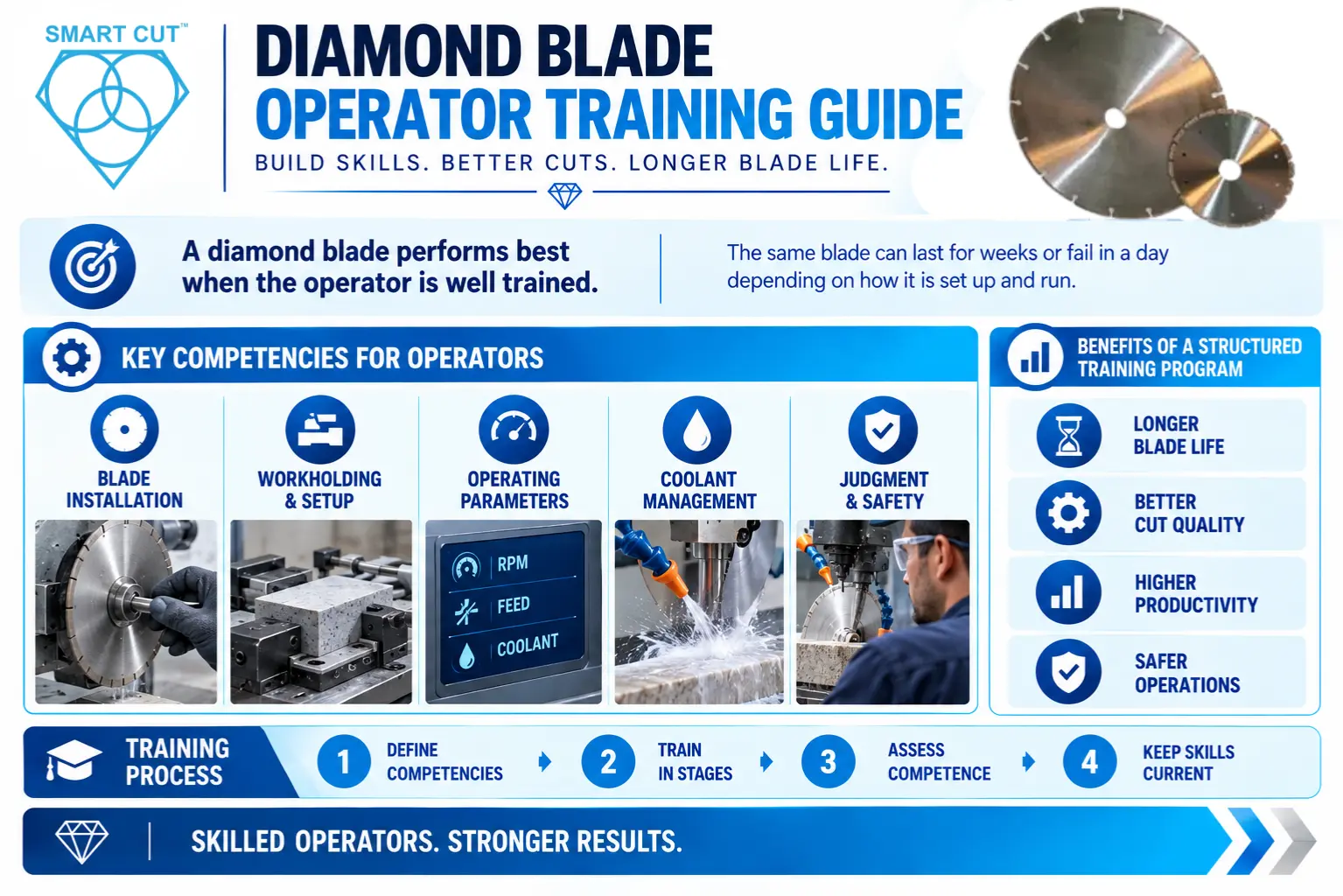
Table of Contents
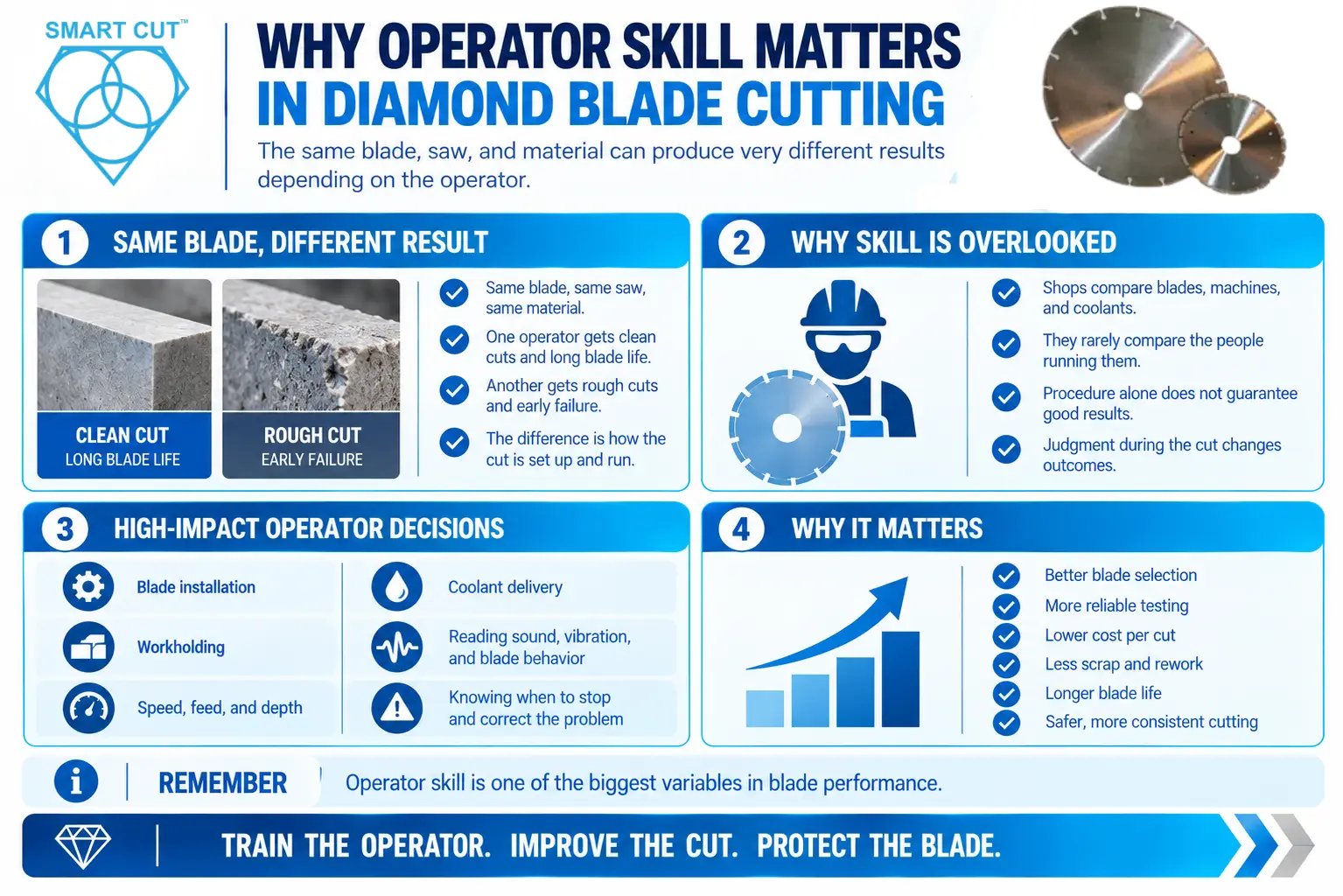
ToggleA precision diamond blade is only as good as the person running it. The same blade, on the same machine, cutting the same material, can last for weeks or fail in a day depending on who sets it up and how they run it. That is not a knock on operators. It reflects how many decisions sit in their hands: blade installation, workholding, parameters, coolant, feed control, and the judgment to stop when something sounds wrong. Train those decisions well, and the blade performs. Leave them to chance, and no blade specification can save the result.
Yet most operator “training” is informal. A new operator shadows an experienced one for a few shifts, picks up a mix of good and bad habits, and then figures out the rest alone. That approach passes on technique inconsistently, and it rarely passes on the reasoning behind it. So the operator can repeat what they were shown, but cannot adapt when the material, blade, or machine changes.
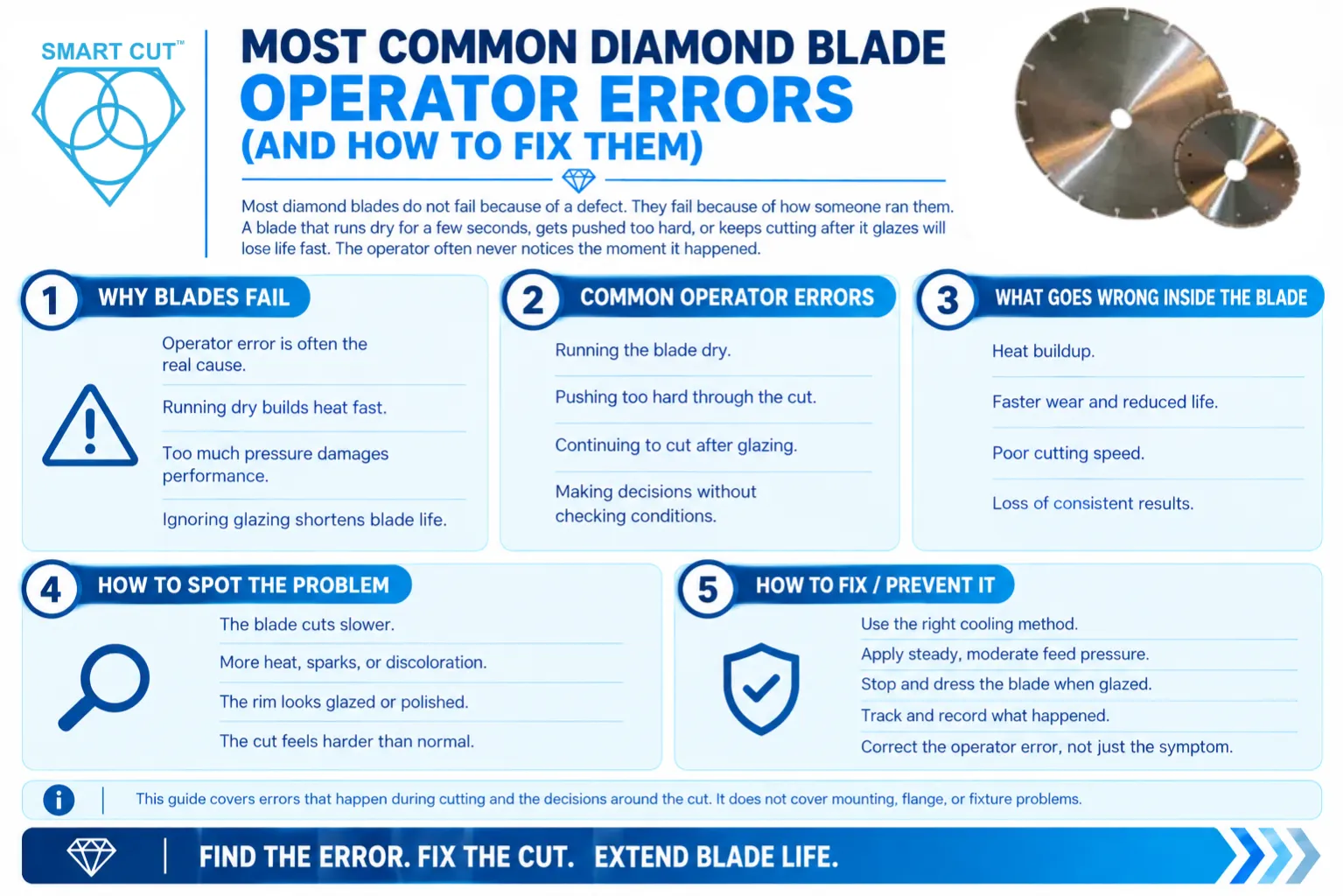
This guide lays out how to build a structured operator training program for precision diamond cutting. It covers the competencies to include, how to stage the training, how to assess competence, and how to keep skills current. It focuses on the training program itself. The specific errors operators make, and the broader case for why operator skill matters so much, are subjects in their own right. For technique fundamentals, it draws on UKAM’s guidance on how to properly use precision diamond blades.
Trusted by Tens of Thousands of Manufacturers, Laboratories Research Institutions Worldwide Since 1990
Established in 1990
Why a Structured Program Beats Shadowing
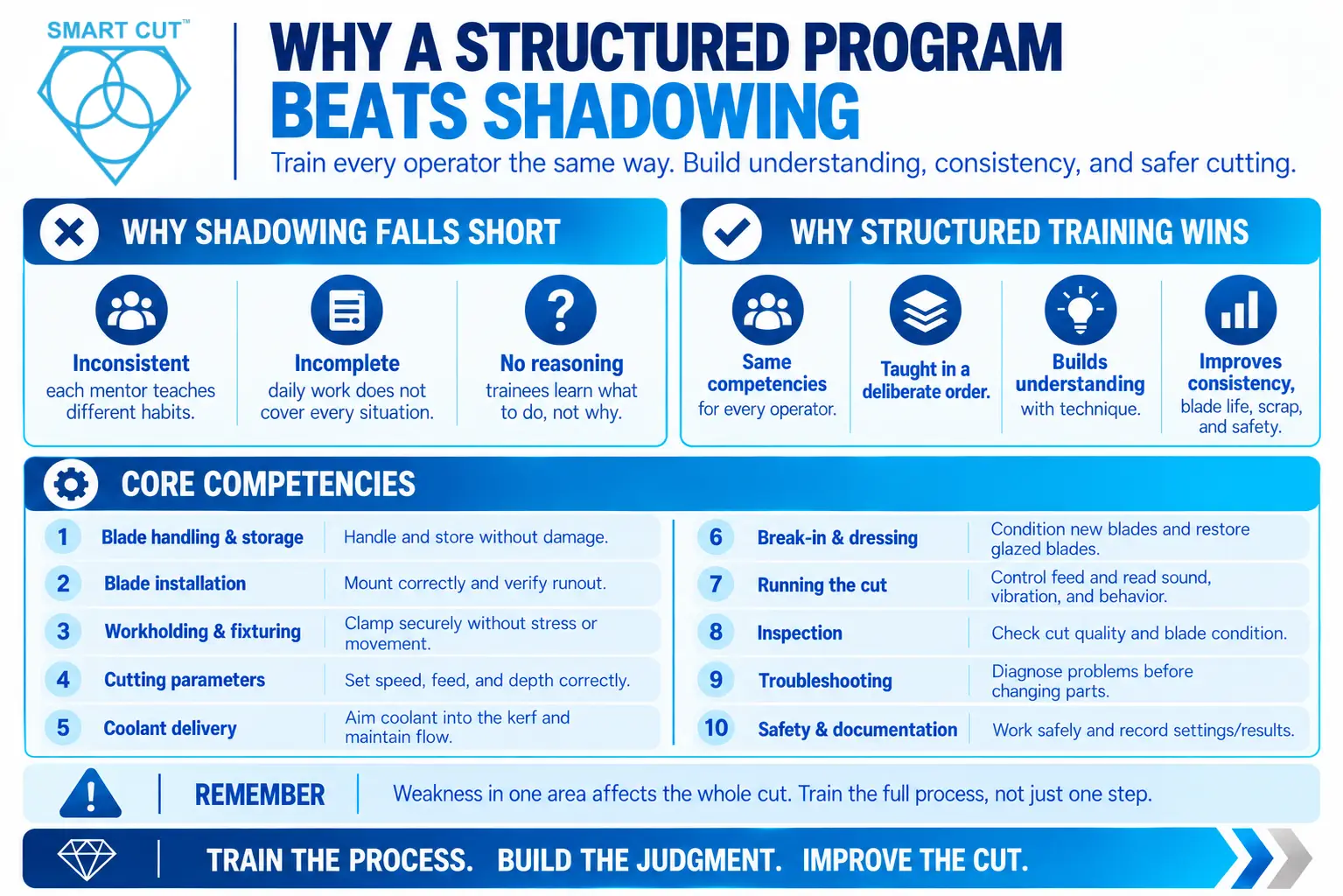
Shadowing feels efficient, but it has three weaknesses. First, it is inconsistent because each mentor teaches differently and passes on personal habits, good and bad. Second, it is incomplete, because day-to-day work rarely covers every situation a trainee needs to handle. Third, and most important, it teaches what to do without teaching why, so the trainee cannot reason through a new problem.
A structured program fixes all three. It covers the same competencies for every operator, in a deliberate order, and it builds understanding alongside technique. As a result, operators trained this way produce more consistent results, waste fewer blades, and recover faster when something goes wrong. The investment is modest, and it pays back in blade life, scrap reduction, and safety.
The Core Competencies an Operator Must Master
A complete program covers the full arc of a cut, from handling the blade to inspecting the result. The table below lists the core competency areas and what a trained operator should be able to do in each.
| Competency area | What the trained operator can do |
|---|---|
| Blade handling and storage | Handle and store blades without damaging them before use |
| Blade installation | Mount with correct flanges, seat the blade true, and verify runout |
| Workholding and fixturing | Support and clamp the specimen without movement or excess stress |
| Cutting parameters | Set and verify speed, feed, and depth for the material and blade |
| Coolant delivery | Direct coolant into the kerf and maintain flow and concentration |
| Break-in and dressing | Condition a new blade and dress it when it glazes or loads |
| Running the cut | Control feed and read vibration, sound, and blade behavior |
| Inspection | Assess cut quality and blade condition against defined criteria |
| Troubleshooting | Diagnose common problems before changing parts |
| Safety and documentation | Operate safely and record parameters and results |
Each area matters, and weakness in any one undermines the rest. An operator who sets perfect parameters but clamps the specimen poorly will still get a bad cut. So the program should cover every area, not just the ones that feel technical.
Teach the Why, Not Just the Steps
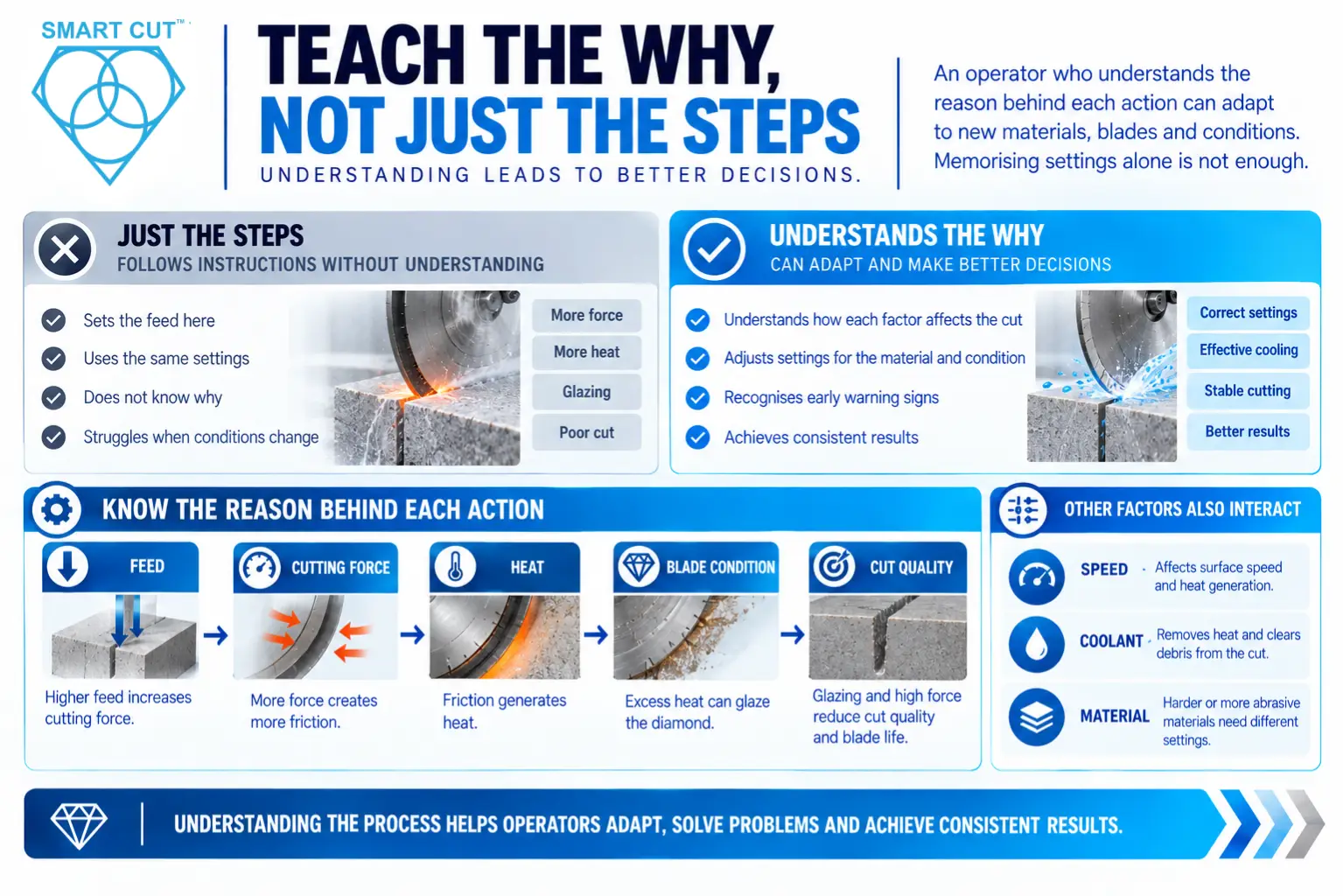
The single most valuable thing a training program can do is explain the reasoning behind each action. An operator who knows that excessive feed raises cutting force, which heats and glazes the diamond, can respond when a cut starts to labor. An operator who was only told to “set the feed here” cannot.
This matters because real cutting constantly presents new situations. A different material, a larger blade, a deeper cut, a harder batch; each one shifts what the right action is. An operator who understands the underlying mechanics, such as how speed, feed, and coolant interact, can adapt. An operator who only memorizes settings cannot, and will keep applying the one recipe they know until it fails. So build the reasoning into every topic, and explain why the same blade can behave differently when conditions change.
Train the Skill of Reading the Cut
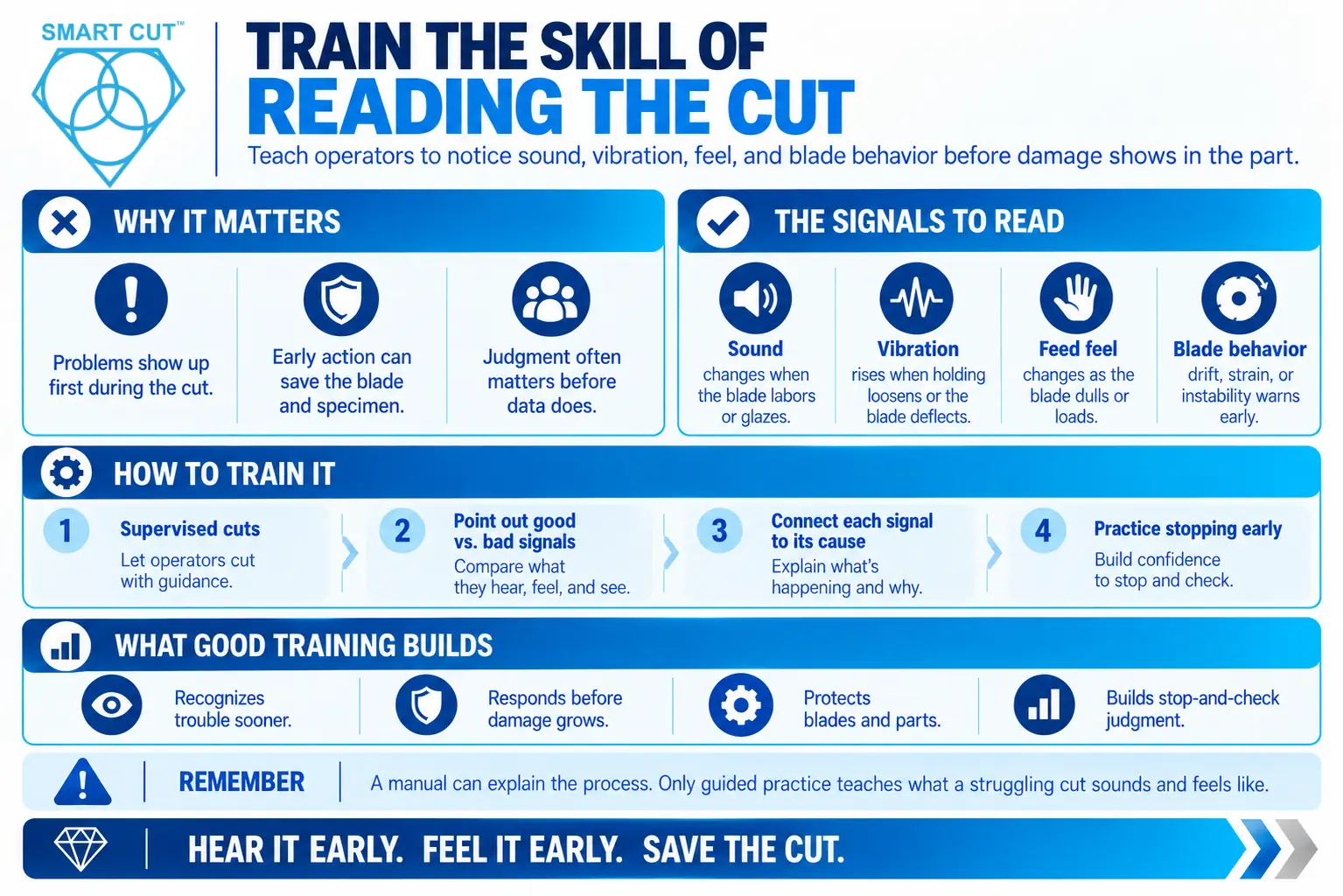
Among all the competencies, one is both the hardest to teach and the most valuable: reading the cut while it happens. A skilled operator senses when a cut is going wrong before the data or the finished part shows it, and acts in time to save the blade and the specimen.
This skill lives in the senses. The sound of the cut changes when the blade labors or glazes. Vibration rises when workholding loosens or the blade deflects. The feel of the feed changes as the blade dulls or loads. A trainee cannot learn these from a manual, so the program has to build them deliberately. Have the trainee cut under supervision while an experienced operator points out what a good cut sounds and feels like, then what a struggling cut sounds and feels like. Let the trainee hear a blade begin to glaze, feel a specimen start to shift, and notice rising vibration, so they connect the signal to its cause. Over time, this turns into the judgment to stop a cut the moment something sounds wrong, which is often the difference between a dressed blade and a destroyed one.
Structure the Training in Stages
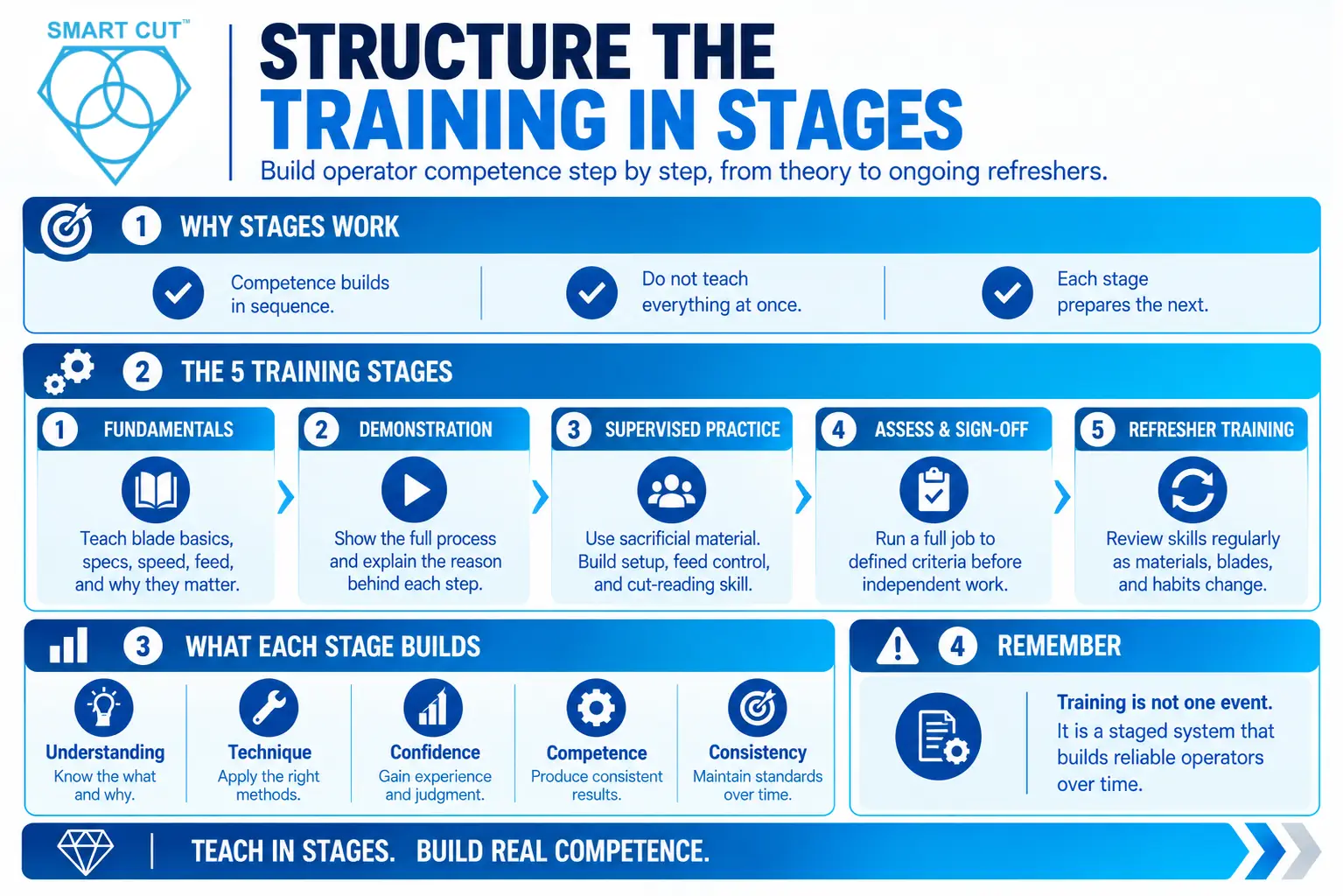
Competence builds in a sequence, so a good program moves through stages rather than dumping everything at once.
Stage 1: Fundamentals
Start with the theory, away from the machine. Cover how diamond cutting works, what the blade specification means, and why each parameter matters. This gives the trainee the mental model that everything else hangs on. UKAM’s guidance on selecting the right blade and RPMs and feed rates supports this stage.
Stage 2: Demonstration
Next, have a skilled operator demonstrate the full process while explaining each step and the reasoning behind it. The trainee watches the complete arc of a cut done correctly, with the why attached to each action. This connects the theory from Stage 1 to the real machine.
Stage 3: Supervised Practice
Then put the trainee on the machine under supervision, using sacrificial material rather than valuable specimens. This is where technique develops, from installing the blade and setting workholding to controlling feed and reading the cut. Keep the oversight close at first, then loosen it as the trainee grows reliable. Mistakes here are cheap and instructive, which is exactly the point.
Stage 4: Assessment and Sign-Off
Before an operator works unsupervised, confirm they can perform the whole process competently. Have them run a complete job to defined criteria, and sign them off only when they meet it. This stage turns “has been trained” into “is competent,” which are not the same thing.
Stage 5: Ongoing and Refresher Training
Finally, treat training as continuing rather than one-time. Skills drift, new materials and blades arrive, and even strong operators pick up shortcuts over time. Scheduled refresher training and reassessment keep competence current, which the final sections cover in more detail.
Build Safety Into the Training, Not Alongside It
Safety is not a separate module bolted onto the end of training. It belongs inside every competency, because the safe way and the correct way are usually the same way.
A blade mounted with the wrong flanges is both a quality risk and a safety risk. A specimen that can shift under cutting forces threatens both the cut and the operator. A blade run outside its rated speed can fail, and a failing blade at speed is dangerous. So teach safety as part of each task rather than as an afterthought. Cover correct handling of blades to avoid damage and injury, proper guarding and personal protective equipment, safe blade mounting and speed limits, secure workholding, and the discipline of stopping a cut when something sounds or feels wrong. When operators understand that the safe method and the correct method coincide, they follow both, because the reasoning is the same.
Assessing Operator Competence
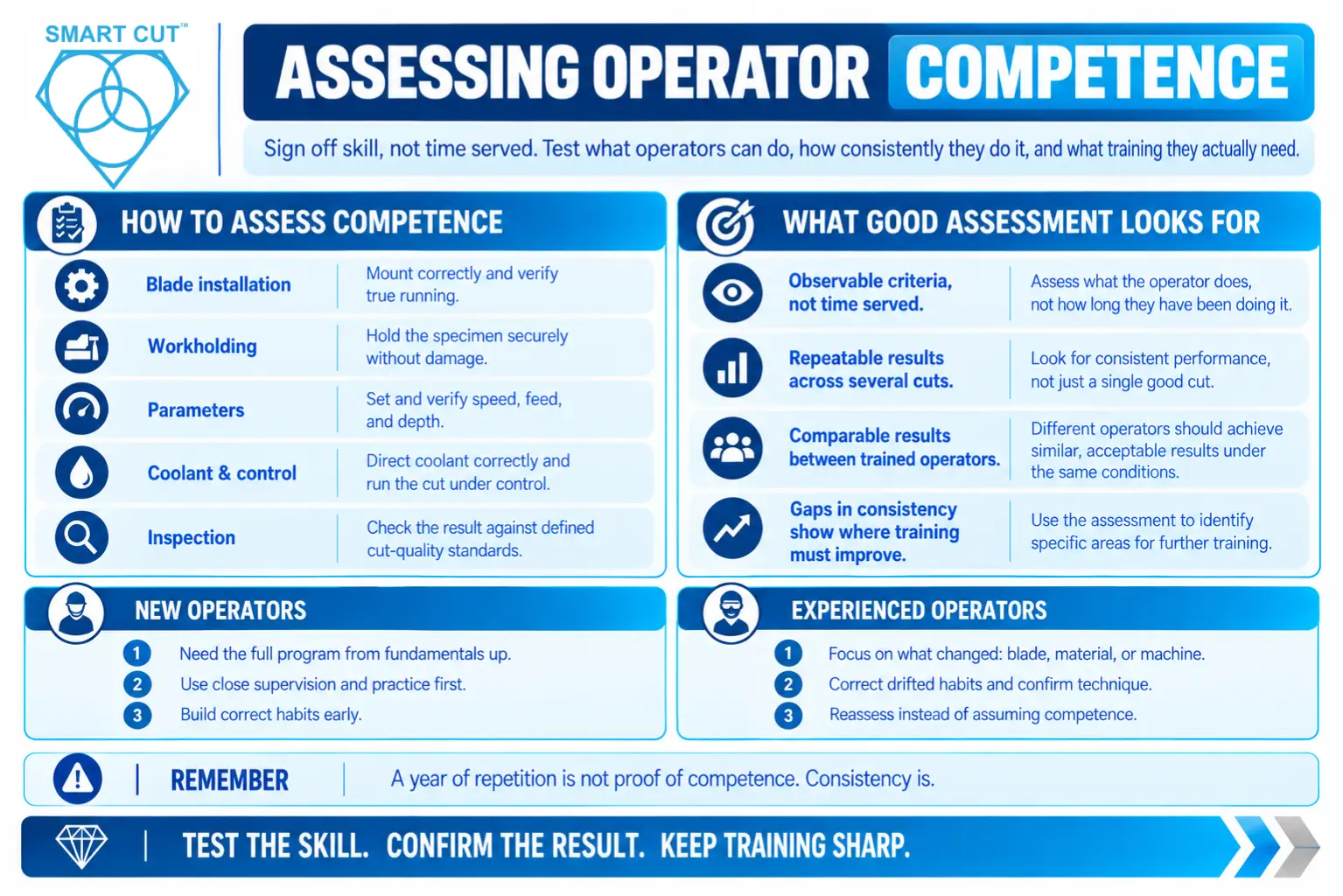
Sign-off should rest on demonstrated competence, not time served. An operator who has “done it for a year” may have practiced the same mistakes for a year.
So assess against defined, observable criteria. Can the operator install the blade and verify it runs true? Can they set up workholding that holds the specimen without damaging it? Can they set and verify the parameters, direct the coolant correctly, run the cut under control, and inspect the result against cut-quality standards? A strong practical test is repeatability: have the operator produce the same result consistently across several cuts, and, where possible, confirm that two trained operators produce comparable results. When they do, the training is working. When they diverge, the program has a gap to close.
Training New Operators vs Experienced Ones
New and experienced operators need different training, and treating them the same wastes effort on one and shortchanges the other.
A new operator needs the full program, built from the fundamentals up, with heavy supervised practice before any valuable work. The priority is building correct habits from the start, because habits formed early are hard to change later. An experienced operator usually needs something narrower: training on a new blade type, a new material, or a new machine, plus periodic correction of habits that have drifted. The risk with experienced operators is complacency, since someone who has cut for years may assume they already know the new situation. So pitch their training at what has actually changed, confirm their habits still match correct technique, and avoid both over-training the basics and skipping the reassessment that catches drift.
Document and Certify Training
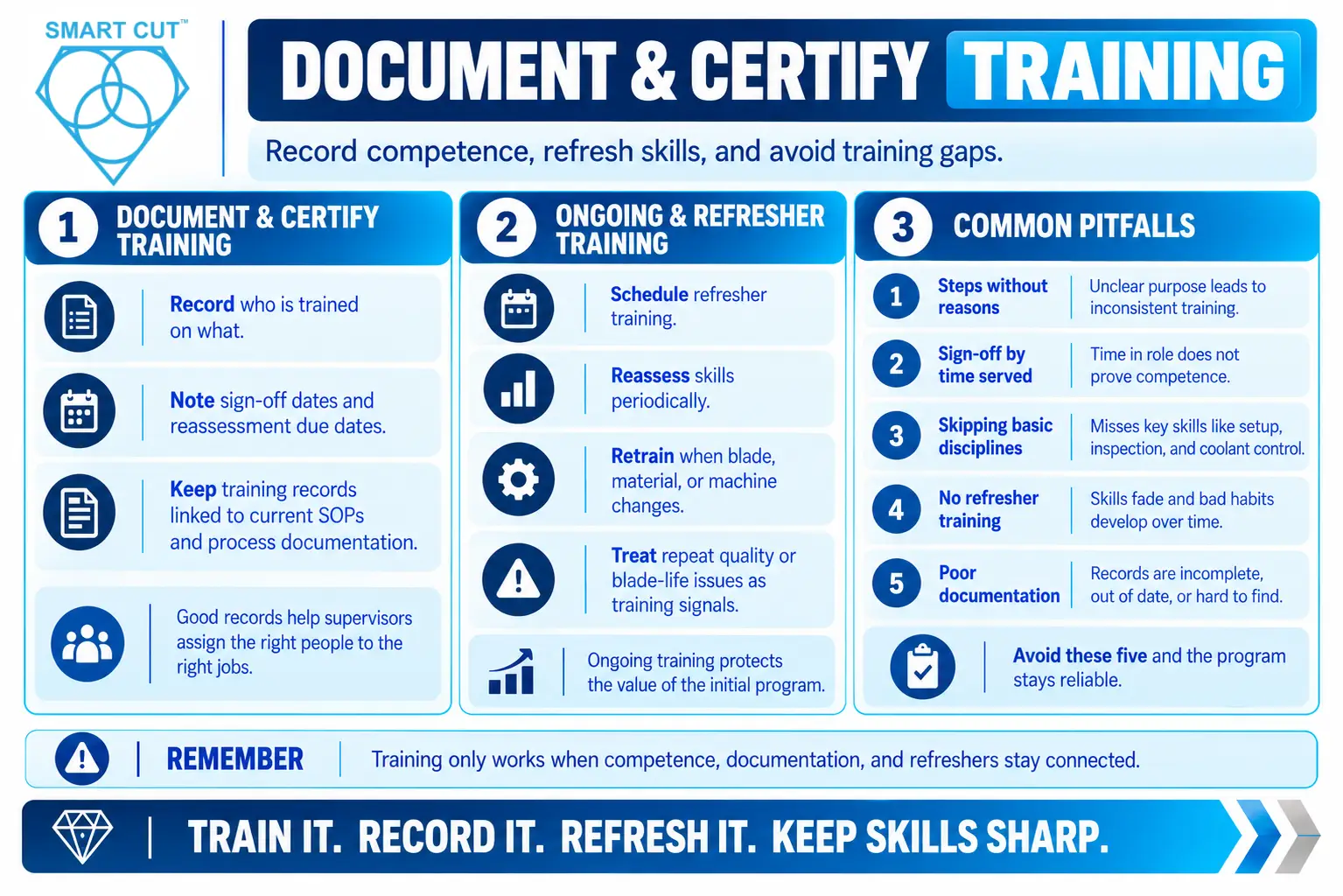
Training that is not recorded is hard to manage and impossible to audit. So document who has been trained on what, when they were signed off, and when they are due for reassessment.
This record does more than satisfy an auditor. It tells supervisors who can run which jobs, it flags who needs refresher training, and it ties directly to your standard operating procedures, since an SOP only works if the people following it are trained on the current version. Keep the training records alongside your process documentation, so competence and procedure stay connected.
Ongoing and Refresher Training
A one-time program is not enough, because several things change after initial training. Operators develop shortcuts that drift from correct technique. New blade types, new materials, and new equipment arrive. And skills that are not used regularly fade.
So schedule refresher training and periodic reassessment, and run additional training whenever you introduce a new material, a new blade, or a new machine. Treat a recurring quality or blade-life problem as a training signal too, since it often points to a technique that has slipped. Regular attention to the sawing operation keeps both the process and the people sharp. In effect, ongoing training is how you protect the investment the initial program made.
Common Pitfalls in Operator Training
A few mistakes recur in training programs often enough to name. The first is teaching steps without reasons, which leaves operators unable to adapt. The second is signing operators off by time served rather than demonstrated competence. The third is skipping the unglamorous competencies, such as blade handling and coolant discipline, that quietly determine blade life. The fourth is treating training as a one-time event and never refreshing it. The fifth is failing to document training, so no one knows who is competent on what. Avoid these five, and the program will hold up.
Frequently Asked Questions
Because operator technique strongly affects blade life, cut quality, and safety, regardless of blade quality.
No; shadowing passes on habits inconsistently and skips the reasoning behind them.
Blade handling, installation, workholding, parameters, coolant, dressing, cutting, inspection, and safety.
As long as it takes to demonstrate competence, not a fixed number of hours.
Yes; understanding the reasons lets operators handle new materials and problems.
Have them demonstrate the full process to defined criteria, with consistent results.
Yes; record who is trained on what, and tie it to your SOPs.
Yes; refresher training catches drift and covers new blades or materials.
Reading the cut and responding to vibration, sound, and blade condition while cutting.
No; start on sacrificial material under supervision before valuable work.
On a set schedule, and whenever processes, materials, or equipment change.
Yes; trained operators waste fewer blades and produce less scrap, which lowers total cost.
Have them cut under supervision while a skilled operator points out the sound, feel, and vibration of good and bad cuts.
No; build it into each task, because the safe method and the correct method are usually the same.
No; new operators need the full program, while experienced ones need targeted training on what changed, plus drift checks.
Continuing to cut after abnormal vibration or sound, which risks both the specimen and the operator.
Conclusion
Operator training is one of the highest-return investments in a precision cutting operation, because the operator controls so much of what determines blade life, cut quality, and safety. A structured program beats informal shadowing on every count. It covers the full set of competencies, builds understanding alongside technique, and moves through deliberate stages from fundamentals to supervised practice to sign-off. Then it keeps skills current with refresher training and reassessment.
So cover every competency, teach the reasoning behind each one, assess against demonstrated competence rather than time, and document it all. Do that, and your operators will get more life from every blade, produce more consistent cuts, and work more safely, no matter what comes across the machine. For the technique fundamentals your program should build on, see UKAM’s guidance on properly using precision diamond blades.
If you would like UKAM’s applications engineering team to help you build operator training around your materials, your machines, and the right diamond or CBN blade, request applications engineering assistance.
Trusted by Tens of Thousands of Manufacturers, Laboratories,
Research Institutions Worldwide Since 1990
Established in 1990
RELATED ARTICLES

Brian is an experienced professional in the field of precision cutting tools, with over 27 years of experience in technical support. Over the years, he has helped engineers, manufacturers, researchers, and contractors find the right solutions for working with advanced and hard-to-cut materials. He’s passionate about bridging technical knowledge with real-world applications to improve efficiency and accuracy.
As an author, Brian Farberov writes extensively on diamond tool design, application engineering, return on investment strategies, and process optimization, combining technical depth with a strong understanding of customer needs and market dynamics.
About Brian Farberov
Brian is an experienced professional in the field of precision cutting tools, with over 27 years of experience in technical support. Over the years, he has helped engineers, manufacturers, researchers, and contractors find the right solutions for working with advanced and hard-to-cut materials. He’s passionate about bridging technical knowledge with real-world applications to improve efficiency and accuracy. As an author, Brian Farberov writes extensively on diamond tool design, application engineering, return on investment strategies, and process optimization, combining technical depth with a strong understanding of customer needs and market dynamics.
View all posts by Brian Farberov