








Home > Blog > CBN Resin Bond Cut-Off Blades: Complete Guide for Cutting Hardened Steels, Tool Life Optimization & Cost-Per-Cut Reduction
blog, Grinding

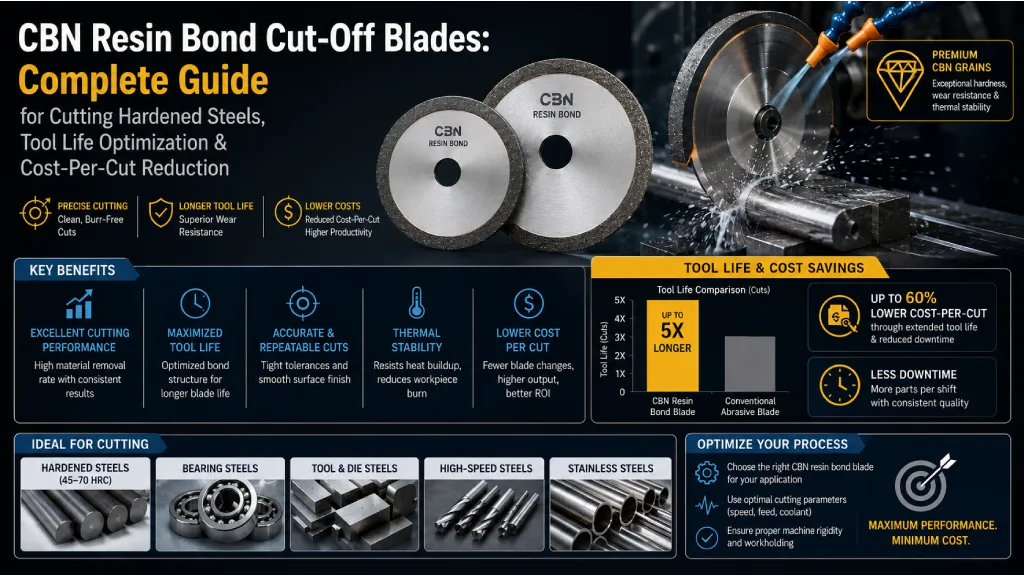
CBN Resin Bond Cut-Off Blades: Complete Guide for Cutting Hardened Steels, Tool Life Optimization & Cost-Per-Cut Reduction

Table of Contents

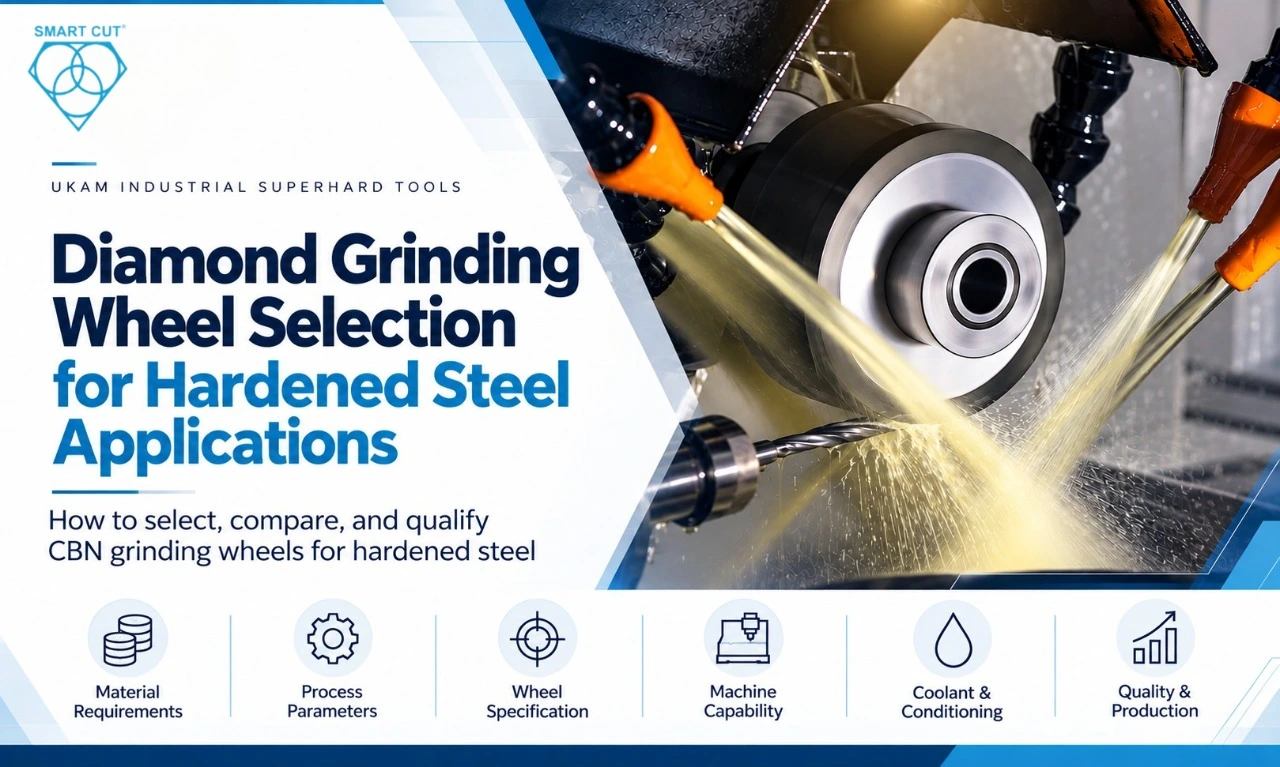
Cutting hardened steels, tool steels, and high-performance alloys is one of the most demanding operations in precision manufacturing. These materials are designed for durability and wear resistance, making them extremely difficult to machine with conventional cutting tools.

In many production environments, manufacturers continue to rely on traditional abrasive cut-off wheels. While these tools may offer a lower upfront cost, they often result in rapid wear, inconsistent cutting quality, excessive heat generation, and higher overall production costs.

This is where CBN (Cubic Boron Nitride) resin bond cut-off blades provide a significant advantage.

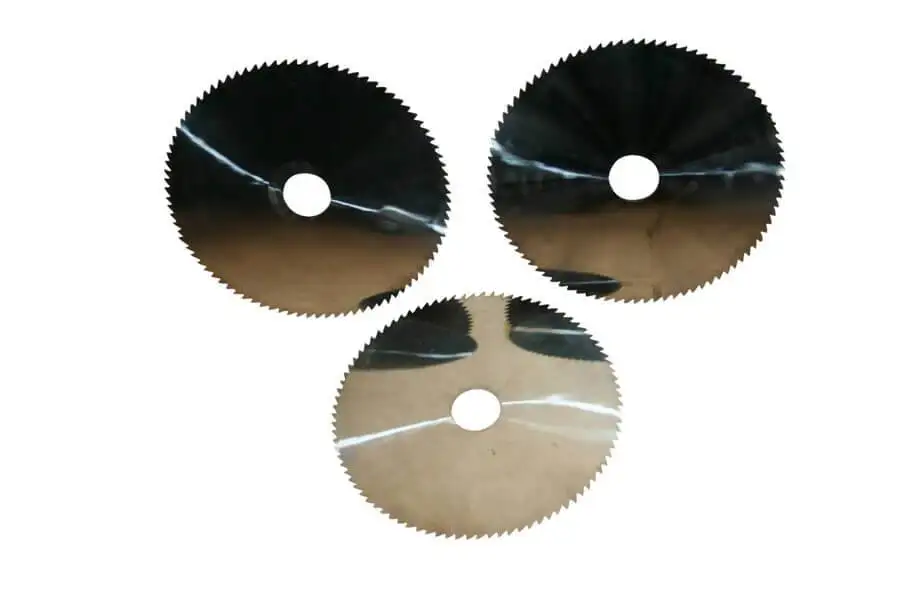
Engineered specifically for ferrous materials, CBN blades deliver longer tool life, improved cutting precision, reduced thermal damage, and lower cost per cut. For industries where consistency and efficiency are critical, switching to CBN tooling is often a measurable performance upgrade.

Manufacturers working with hardened materials frequently rely on advanced tooling solutions from companies such as UKAM Industrial Superhard Tools, known for their expertise in superhard materials and precision cutting applications.

Trusted by Tens of Thousands of Manufacturers, Laboratories Research Institutions Worldwide Since 1990

American Based Manufacturer

Established in 1990

Custom manufacturing

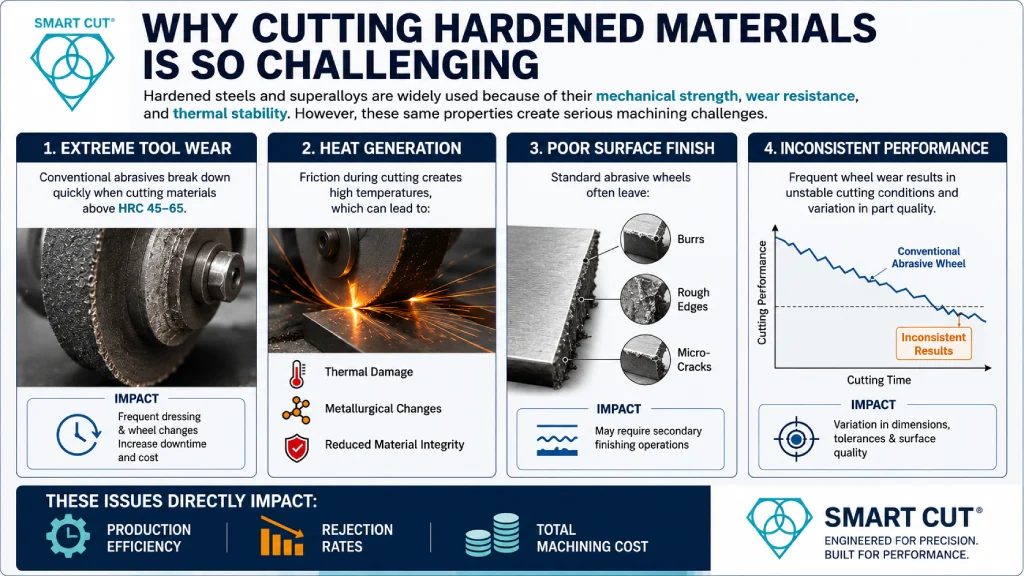
Why Cutting Hardened Materials Is So Challenging

Hardened steels and superalloys are widely used because of their mechanical strength, wear resistance, and thermal stability. However, these same properties create serious machining challenges.

Key Challenges in Cutting Hardened Materials

1. Extreme Tool Wear
Conventional abrasives break down quickly when cutting materials above HRC 45–65.

2. Heat Generation
Friction during cutting creates high temperatures, which can lead to:

● thermal damage
● metallurgical changes
● Reduced material integrity

3. Poor Surface Finish
Standard abrasive wheels often leave:

● burrs
● rough edges
● micro-cracks

4. Inconsistent Performance
Frequent wheel wear results in unstable cutting conditions and variation in part quality.

These issues directly impact:

● production efficiency
● rejection rates
● total machining cost

What Are CBN Resin Bond Cut-Off Blades?

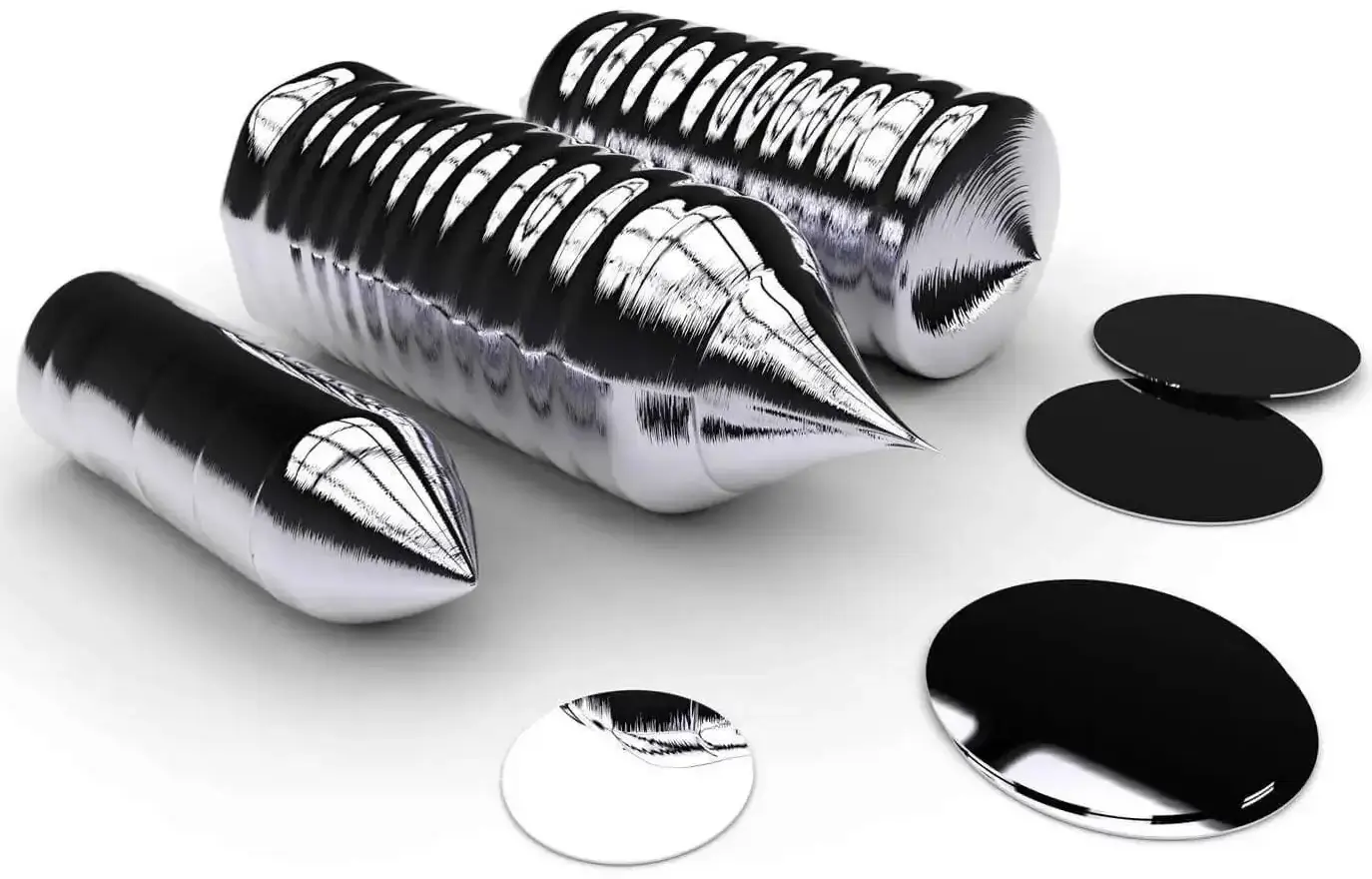
CBN (Cubic Boron Nitride) is the second hardest material after diamond and is uniquely suited for machining ferrous materials.

Unlike diamond, which reacts with iron at high temperatures, CBN maintains its structural integrity, making it ideal for cutting:

● hardened steels
● tool steels
● bearing steels
● high-speed steels

Structure of CBN Resin Bond Blades

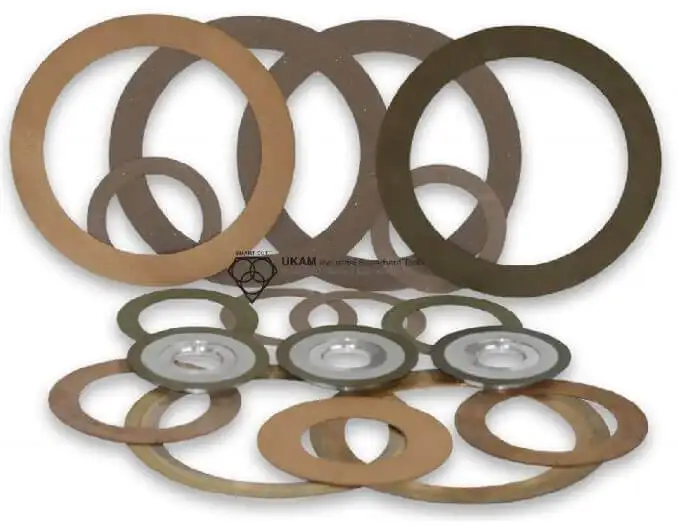
CBN resin bond cut-off blades consist of:

● CBN abrasive grains → provide cutting action
● Resin bond matrix → controls wear and exposure of abrasive
● Precision blade geometry → ensures accurate and stable cutting

This combination allows for controlled cutting action with reduced heat and improved surface finish.

Why CBN Outperforms Conventional Abrasive Wheels

Performance Comparison (Real-World Ranges)

Performance Factor

CBN Resin Bond Blade Abrasive Wheel
Tool Life

5–15× longer

Very short

Cutting Speed

1.5–3× faster

Slower

Heat Generation Low

High

Cut Consistency

Stable

Variable

Surface Finish Smooth

Rough

What This Means in Practice

In production environments:

● CBN blades maintain cutting performance over longer cycles
● Abrasive wheels degrade quickly, leading to variability
● Fewer blade changes mean reduced downtime

Tool Life: The Biggest Cost Driver

Tool life is one of the most critical factors affecting manufacturing cost.

Typical Tool Life Comparison

  • Abrasive wheels: 10–30 cuts
  • CBN blades: 150–400 cuts

This translates to:

  • fewer tool replacements
  • less operator intervention
  • more stable production

Real-World Insight

In many industrial applications, manufacturers report:

“Switching to CBN increased tool life by over 10× while maintaining consistent cut quality.”

Cost-Per-Cut Analysis: Where Real Savings Come From

Many buyers focus only on the initial cost of a tool, but experienced engineers evaluate cost per cut.

Example Comparison

Tool Type

Tool Cost

Cuts per Tool

Cost Per Cut

Abrasive Wheel

$30

20

$1.50

CBN Blade

$200 250

$0.80

Cost per cut reduced by ~45%

Additional Hidden Savings

CBN blades also reduce:

  • machine downtime
  • labor costs
  • scrap rates
  • secondary finishing

When these are included, total savings can exceed 50–60%.

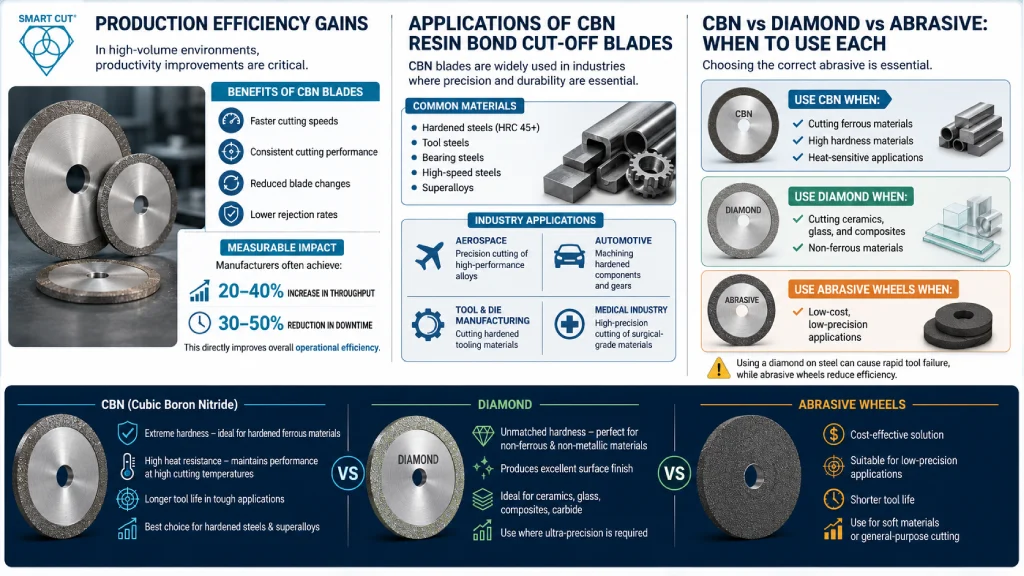
Production Efficiency Gains

In high-volume environments, productivity improvements are critical.

Benefits of CBN Blades

  • Faster cutting speeds
  • Consistent cutting performance
  • Reduced blade changes
  • Lower rejection rates

Measurable Impact

Manufacturers often achieve:

  • 20–40% increase in throughput
  • 30–50% reduction in downtime

This directly improves overall operational efficiency.

Applications of CBN Resin Bond Cut-Off Blades

CBN blades are widely used in industries where precision and durability are essential.

Common Materials

● Hardened steels (HRC 45+)
● Tool steels
● Bearing steels
● High-speed steels
● Superalloys

Industry Applications

Aerospace
 Precision cutting of high-performance alloys

Automotive
 Machining hardened components and gears

Tool & Die Manufacturing
 Cutting hardened tooling materials

Medical Industry
 High-precision cutting of surgical-grade materials

CBN vs Diamond vs Abrasive: When to Use Each

Choosing the correct abrasive is essential.

Use CBN When:

● Cutting ferrous materials
● High hardness materials
● Heat-sensitive applications

Use Diamond When:

● Cutting ceramics, glass, and composites
● Non-ferrous materials
Use Abrasive Wheels When:
● Low-cost, low-precision applications

Using a diamond on steel can cause rapid tool failure, while abrasive wheels reduce efficiency.

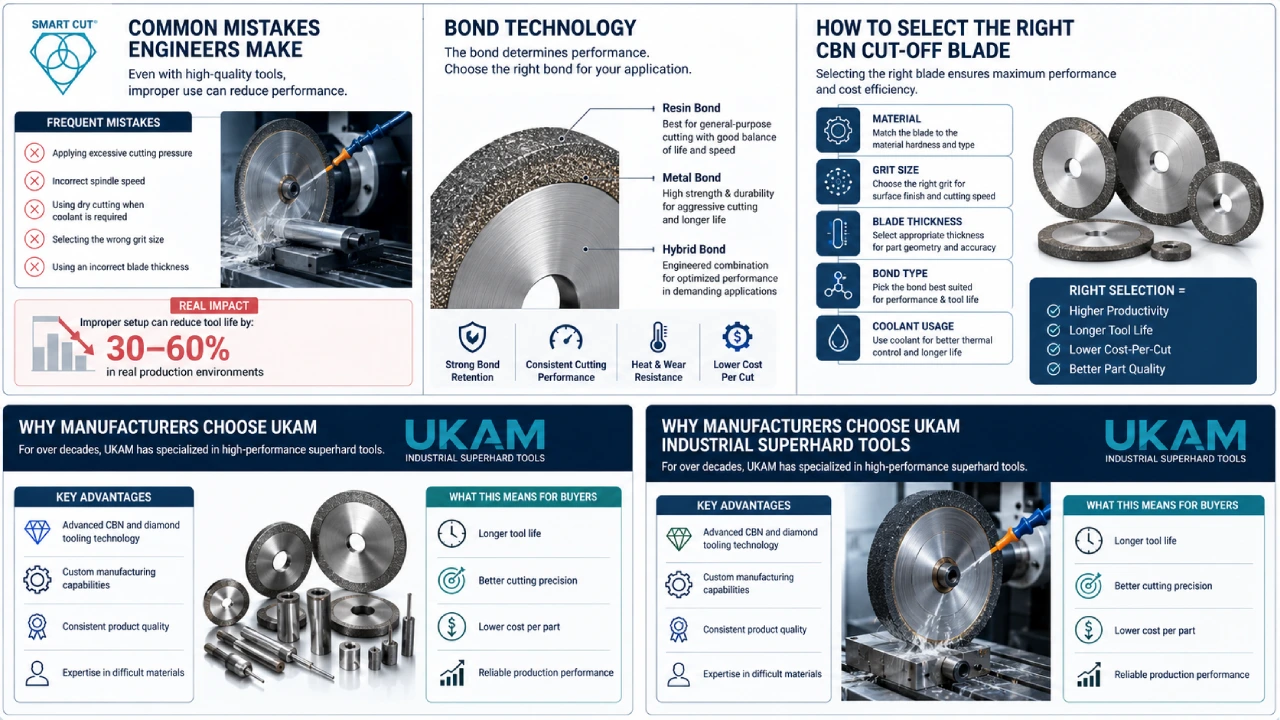
Common Mistakes Engineers Make

Even with high-quality tools, improper use can reduce performance.

Frequent Mistakes

● Applying excessive cutting pressure
● Incorrect spindle speed
● Using dry cutting when coolant is required
● Selecting the wrong grit size
● Using an incorrect blade thickness

Real Impact

Improper setup can reduce tool life by:

30–60% in real production environments

How to Select the Right CBN Cut-Off Blade

For over decades, UKAM has specialized in high-performance superhard tools.

Key Advantages

● Advanced CBN and diamond tooling technology
● Custom manufacturing capabilities
● Consistent product quality
● Expertise in difficult materials

What This Means for Buyers

● Longer tool life
● Better cutting precision
● Lower cost per part
● Reliable production performance

Why Manufacturers Choose UKAM Industrial Superhard Tools

For over decades, UKAM has specialized in high-performance superhard tools.

Key Advantages

● Advanced CBN and diamond tooling technology
● Custom manufacturing capabilities
● Consistent product quality
● Expertise in difficult materials

What This Means for Buyers

● Longer tool life
● Better cutting precision
● Lower cost per part
● Reliable production performance

Recommended Solutions for Your Application

For cutting hardened steels and alloys, manufacturers typically benefit from:

● CBN resin bond cut-off blades for precision cutting
● Optimized cutting parameters for maximum tool life
● Custom tooling solutions for specific applications

For best results, working directly with tooling experts ensures optimal performance.

Frequently Asked Questions

CBN is used for cutting hardened ferrous materials.

Diamond reacts with iron at high temperatures

They typically last 5–15× longer than abrasive wheels.

Higher upfront cost but lower per-cut cost.

Yes, they increase speed and reduce downtime.

Conclusion

CBN resin bond cut-off blades provide a superior solution for cutting hardened steels and high-performance alloys. Compared to conventional abrasive wheels, they offer significantly longer tool life, improved cutting precision, and lower cost per cut. These advantages make them an essential tool for manufacturers seeking to improve productivity and reduce machining costs. By selecting the correct blade specifications and working with experienced suppliers such as UKAM Industrial Superhard Tools, manufacturers can achieve consistent, high-quality results while optimizing overall production efficiency.

Trusted by Tens of Thousands of Manufacturers, Laboratories,
Research Institutions Worldwide Since 1990

American Based Manufacturer

Established in 1990

Custom manufacturing

RELATED ARTICLES