





Abrasive Grinding Belts for Metallography and Precision Sample Preparation
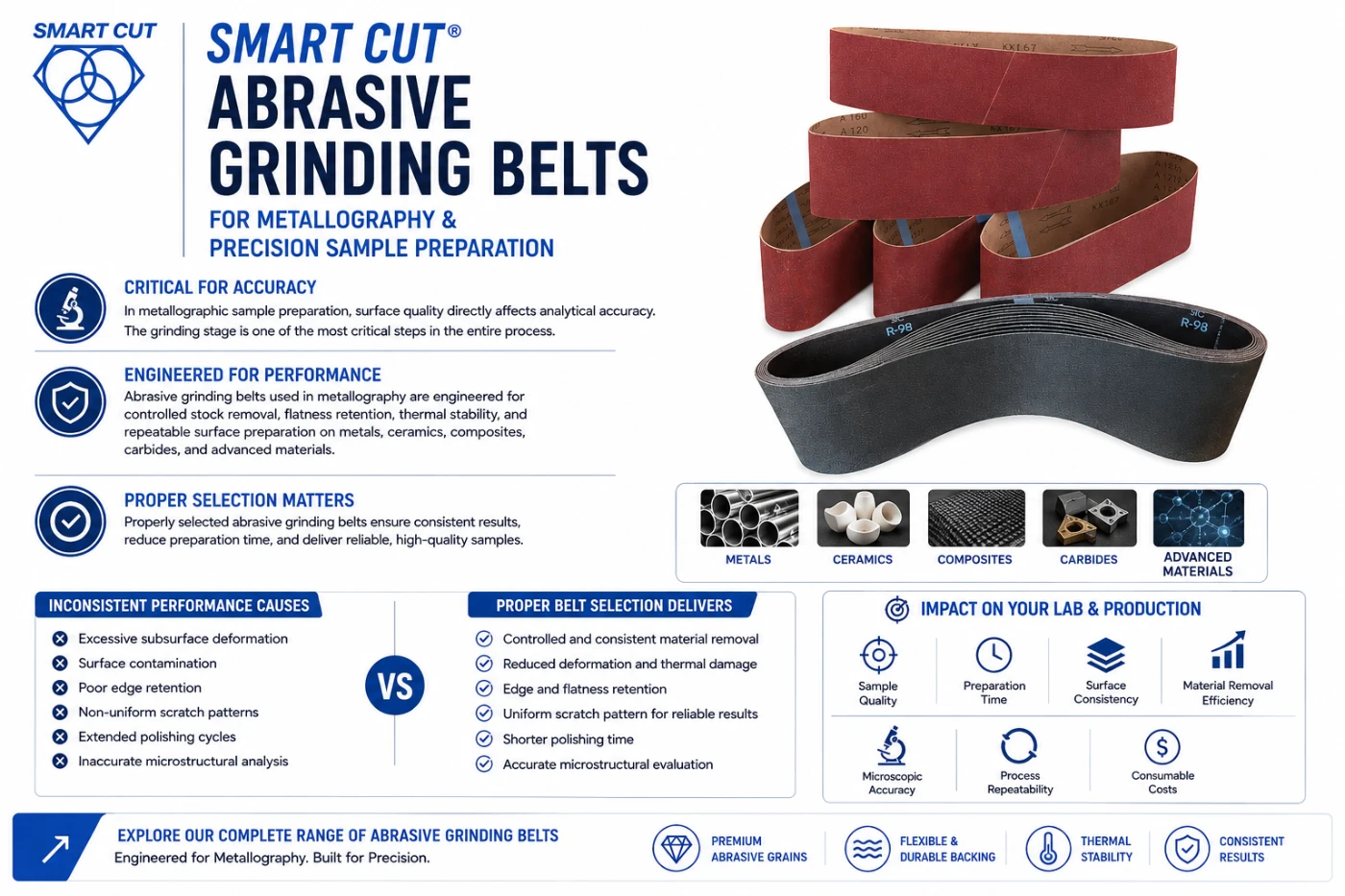
Table of Contents
ToggleIn metallographic sample preparation, surface quality directly affects analytical accuracy. Poor grinding consistency, excessive deformation, deep scratches, overheating, and edge rounding can compromise microscopic analysis and lead to inaccurate material characterization. For laboratories, quality control departments, research facilities, and production environments, the grinding stage is one of the most critical steps in the entire sample preparation process.
This is where properly selected abrasive grinding belts become essential.
Unlike general-purpose sanding belts designed for basic material removal, abrasive grinding belts used in metallography are engineered for controlled stock removal, flatness retention, thermal stability, and repeatable surface preparation on metals, ceramics, composites, carbides, and advanced materials.
Inconsistent abrasive performance during sample preparation frequently causes:
- Excessive subsurface deformation
- Surface contamination
- Poor edge retention
- Non-uniform scratch patterns
- Extended polishing cycles
- Inaccurate microstructural analysis
For metallography laboratories and production environments, selecting the proper abrasive grinding belt directly affects:
- Sample quality
- Preparation time
- Surface consistency
- Material removal efficiency
- Microscopic accuracy
- Process repeatability
- Consumable costs
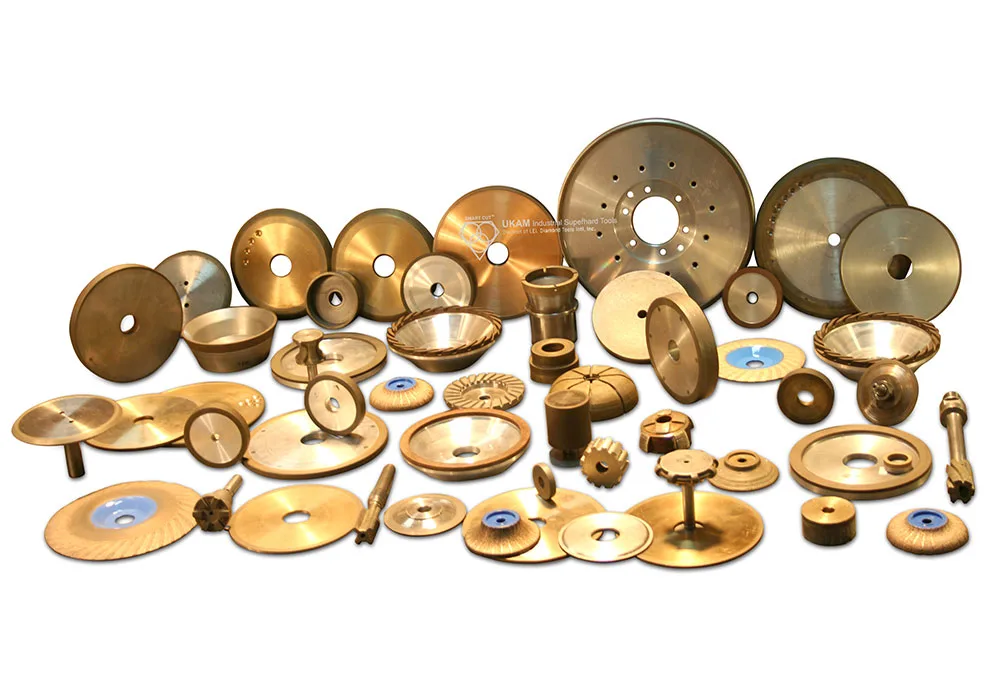
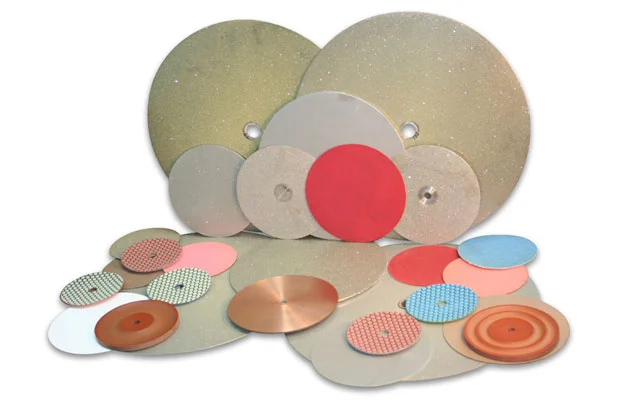
Explore UKAM’s complete range of Abrasive Grinding Belts for Metallography & Sample Preparation
Trusted by Tens of Thousands of Manufacturers, Laboratories Research Institutions Worldwide Since 1990

Established in 1990
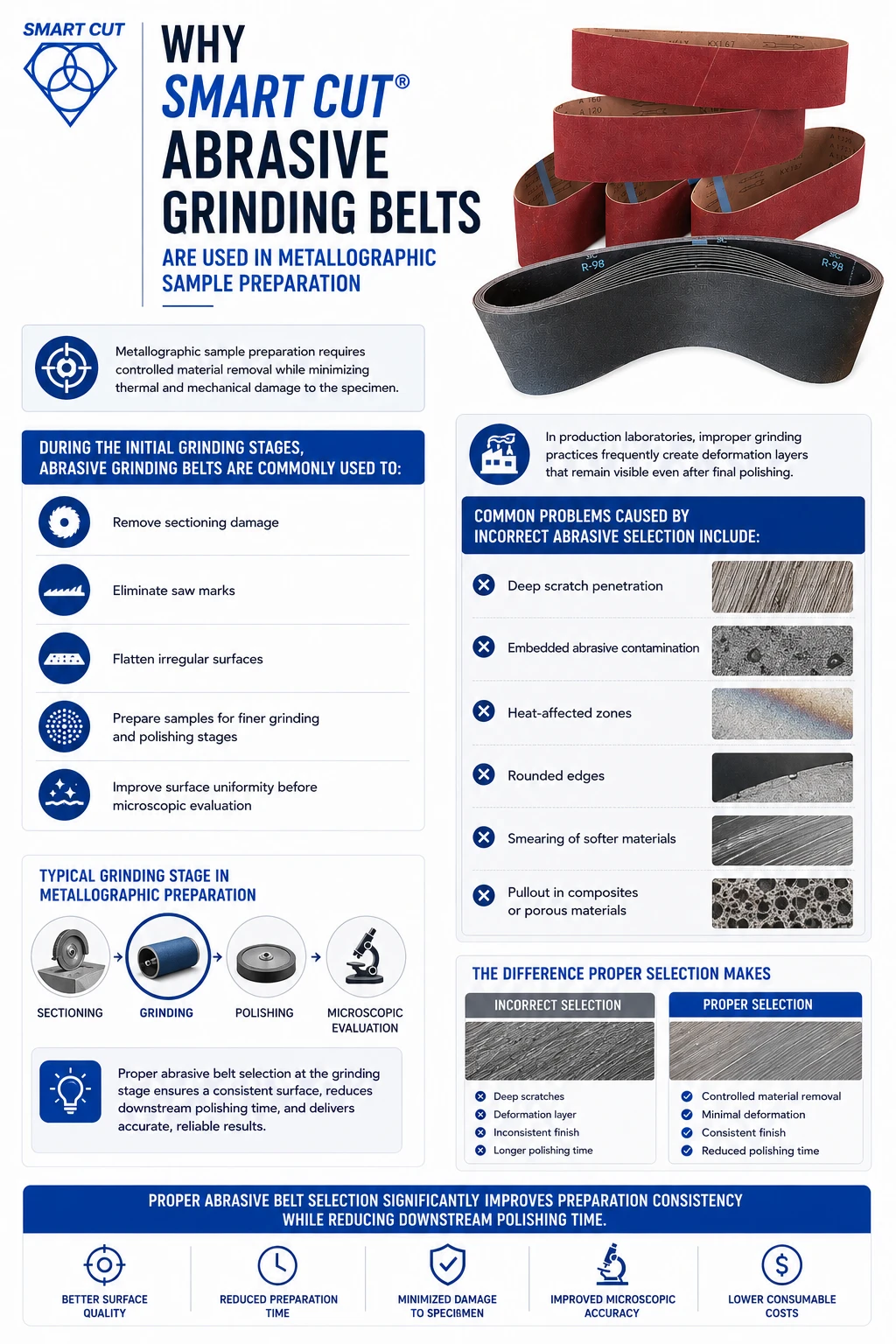
Why Abrasive Grinding Belts Are Used in Metallographic Sample Preparation
Metallographic sample preparation requires controlled material removal while minimizing thermal and mechanical damage to the specimen.
During the initial grinding stages, abrasive grinding belts are commonly used to:
- Remove sectioning damage
- Eliminate saw marks
- Flatten irregular surfaces
- Prepare samples for finer grinding and polishing stages
- Improve surface uniformity before microscopic evaluation
In production laboratories, improper grinding practices frequently create deformation layers that remain visible even after final polishing.
Common problems caused by incorrect abrasive selection include:
- Deep scratch penetration
- Embedded abrasive contamination
- Heat-affected zones
- Rounded edges
- Smearing of softer materials
- Pullout in composites or porous materials
Proper abrasive belt selection significantly improves preparation consistency while reducing downstream polishing time.
How Abrasive Grinding Belts Work

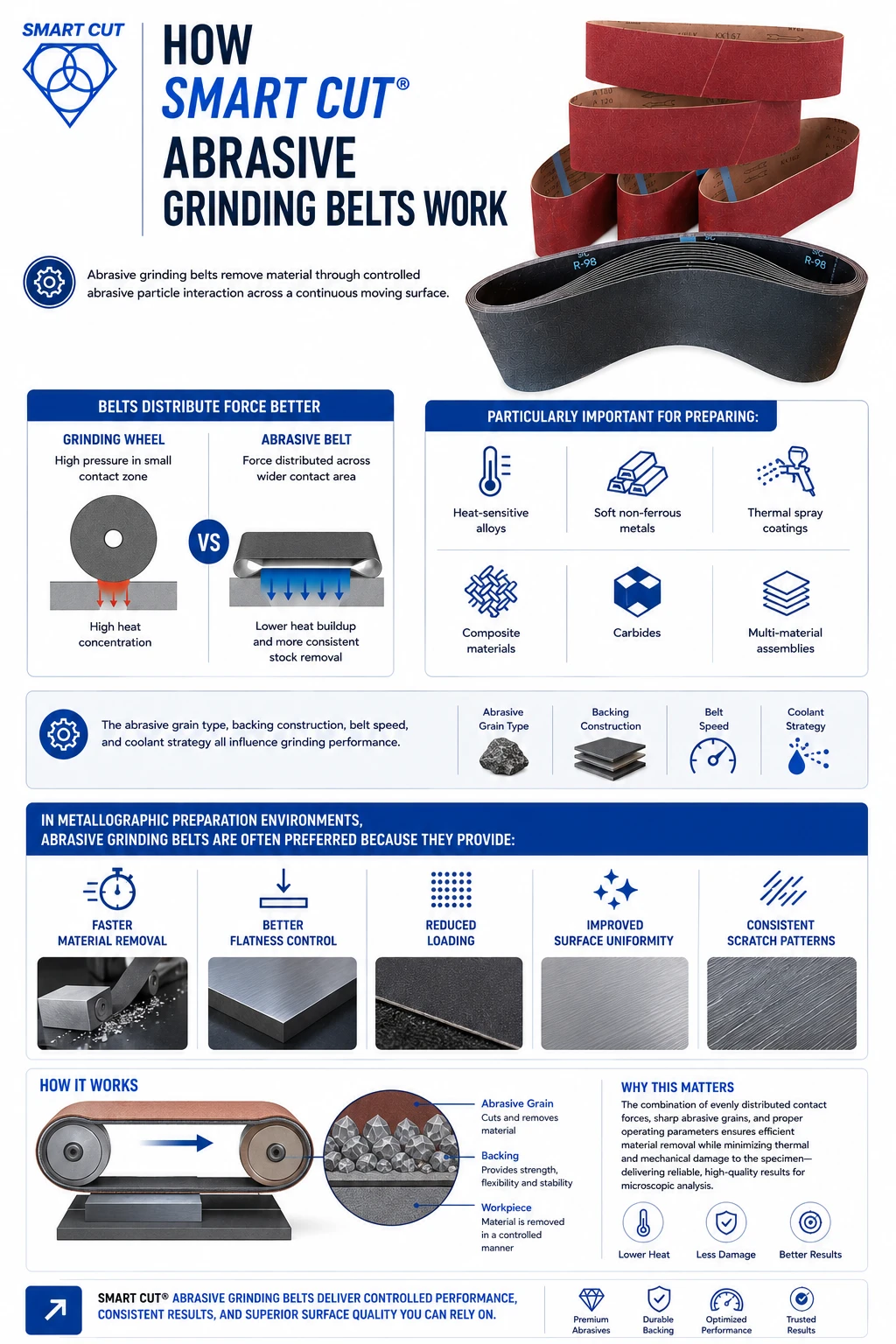
Abrasive grinding belts remove material through controlled abrasive particle interaction across a continuous moving surface.
Unlike grinding wheels that concentrate contact pressure within a smaller contact zone, abrasive belts distribute grinding forces more evenly, helping reduce localized heat buildup and improving stock removal consistency.
This becomes particularly important when preparing:
- Heat-sensitive alloys
- Soft non-ferrous metals
- Thermal spray coatings
- Composite materials
- Carbides
- Multi-material assemblies
The abrasive grain type, backing construction, belt speed, and coolant strategy all influence grinding performance.
In metallographic preparation environments, abrasive grinding belts are often preferred because they provide:
- Faster material removal
- Better flatness control
- Reduced loading
- Improved surface uniformity
- Consistent scratch patterns
Common Abrasive Types Used in Grinding Belts

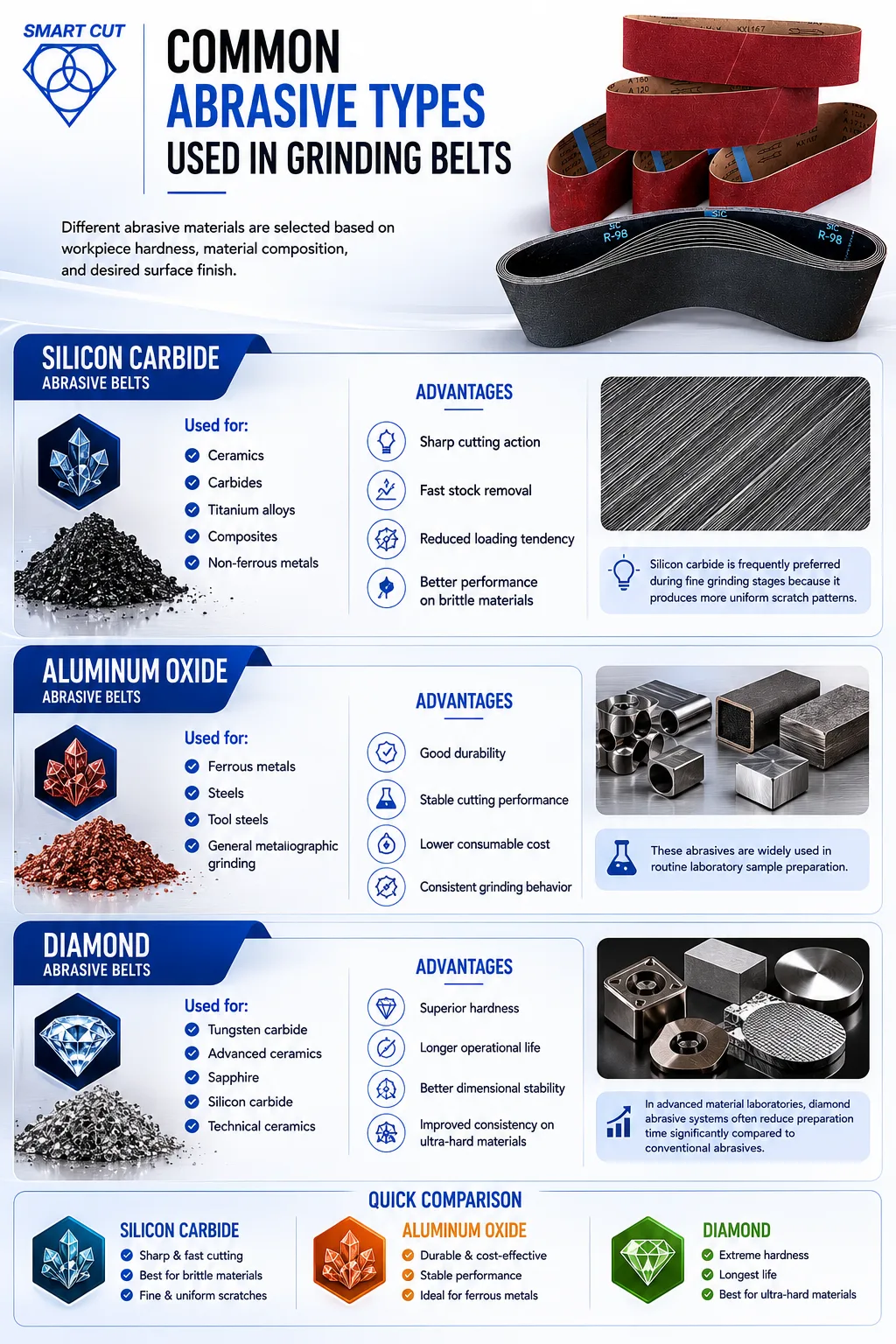
Different abrasive materials are selected based on workpiece hardness, material composition, and desired surface finish.
Silicon Carbide Abrasive Belts
Silicon carbide abrasives are commonly used for:
- Ceramics
- Carbides
- Titanium alloys
- Composites
- Non-ferrous metals
Advantages
- Sharp cutting action
- Fast stock removal
- Reduced loading tendency
- Better performance on brittle materials
Silicon carbide is frequently preferred during fine grinding stages because it produces more uniform scratch patterns.
Aluminum Oxide Abrasive Belts
Aluminum oxide belts are commonly used for:
- Ferrous metals
- Steels
- Tool steels
- General metallographic grinding
Advantages
- Good durability
- Stable cutting performance
- Lower consumable cost
- Consistent grinding behavior
These abrasives are widely used in routine laboratory sample preparation.
Diamond Abrasive Belts
Diamond abrasive belts are used for extremely hard materials, including:
- Tungsten carbide
- Advanced ceramics
- Sapphire
- Silicon carbide
- Technical ceramics
Advantages
- Superior hardness
- Longer operational life
- Better dimensional stability
- Improved consistency on ultra-hard materials
In advanced material laboratories, diamond abrasive systems often reduce preparation time significantly compared to conventional abrasives.
Belt Speed and Grinding Parameters

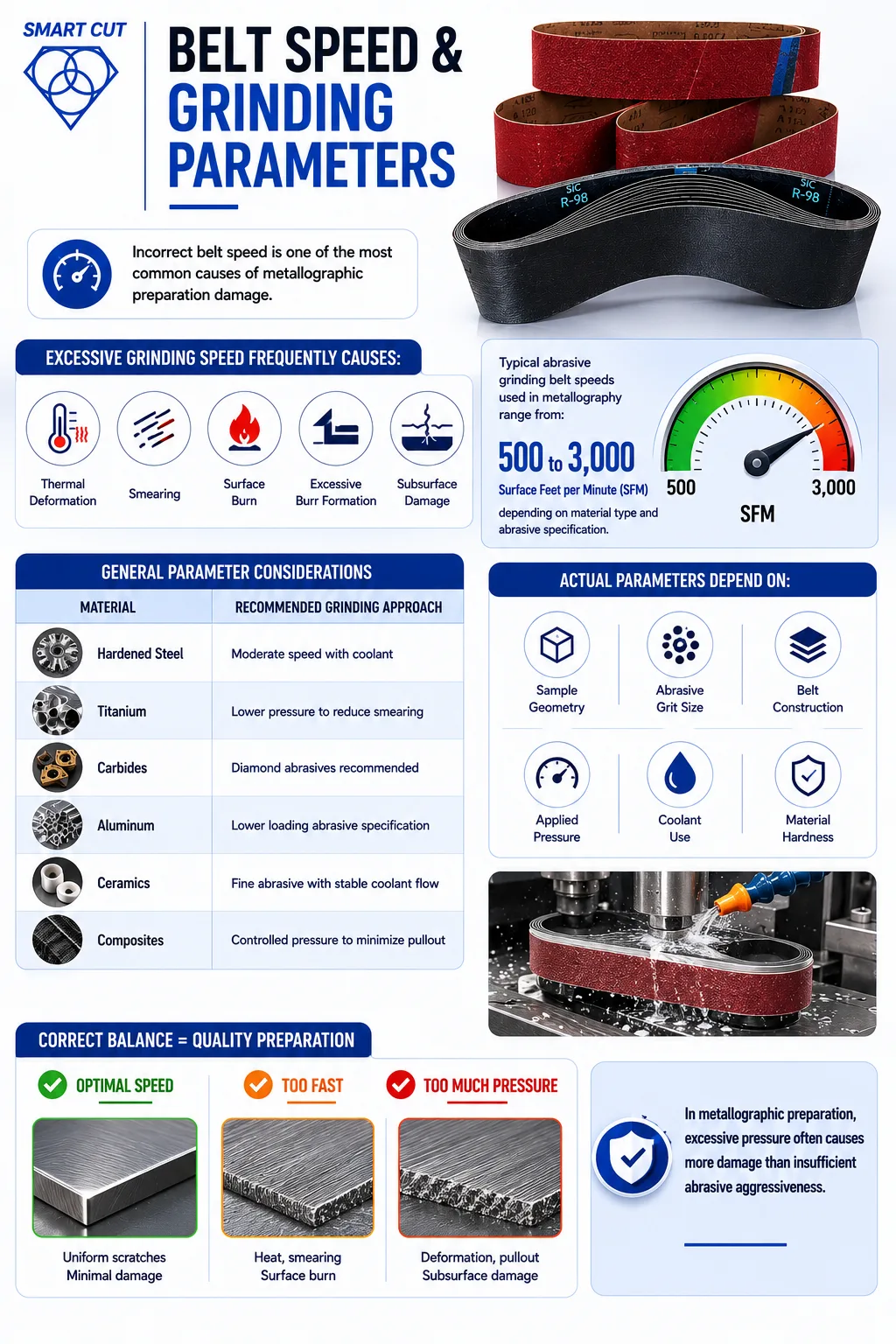
Incorrect belt speed is one of the most common causes of metallographic preparation damage.
Excessive grinding speed frequently causes:
- Thermal deformation
- Smearing
- Surface burn
- Excessive burr formation
- Subsurface damage
Typical abrasive grinding belt speeds used in metallography range from:
- 500 to 3,000 surface feet per minute (SFM), depending on material type and abrasive specification.
General Parameter Considerations
Material | Recommended Grinding Approach |
|---|---|
| Hardened Steel | Moderate speed with coolant |
Titanium | Lower pressure to reduce smearing |
| Carbides | Diamond abrasives recommended |
| Aluminum | Lower loading abrasive specification |
| Ceramics | Fine abrasive with stable coolant flow |
| Composites | Controlled pressure to minimize pullout |
Actual parameters depend on:
- Sample geometry
- Abrasive grit size
- Belt construction
- Applied pressure
- Coolant use
- Material hardness
In metallographic preparation, excessive pressure often causes more damage than insufficient abrasive aggressiveness.
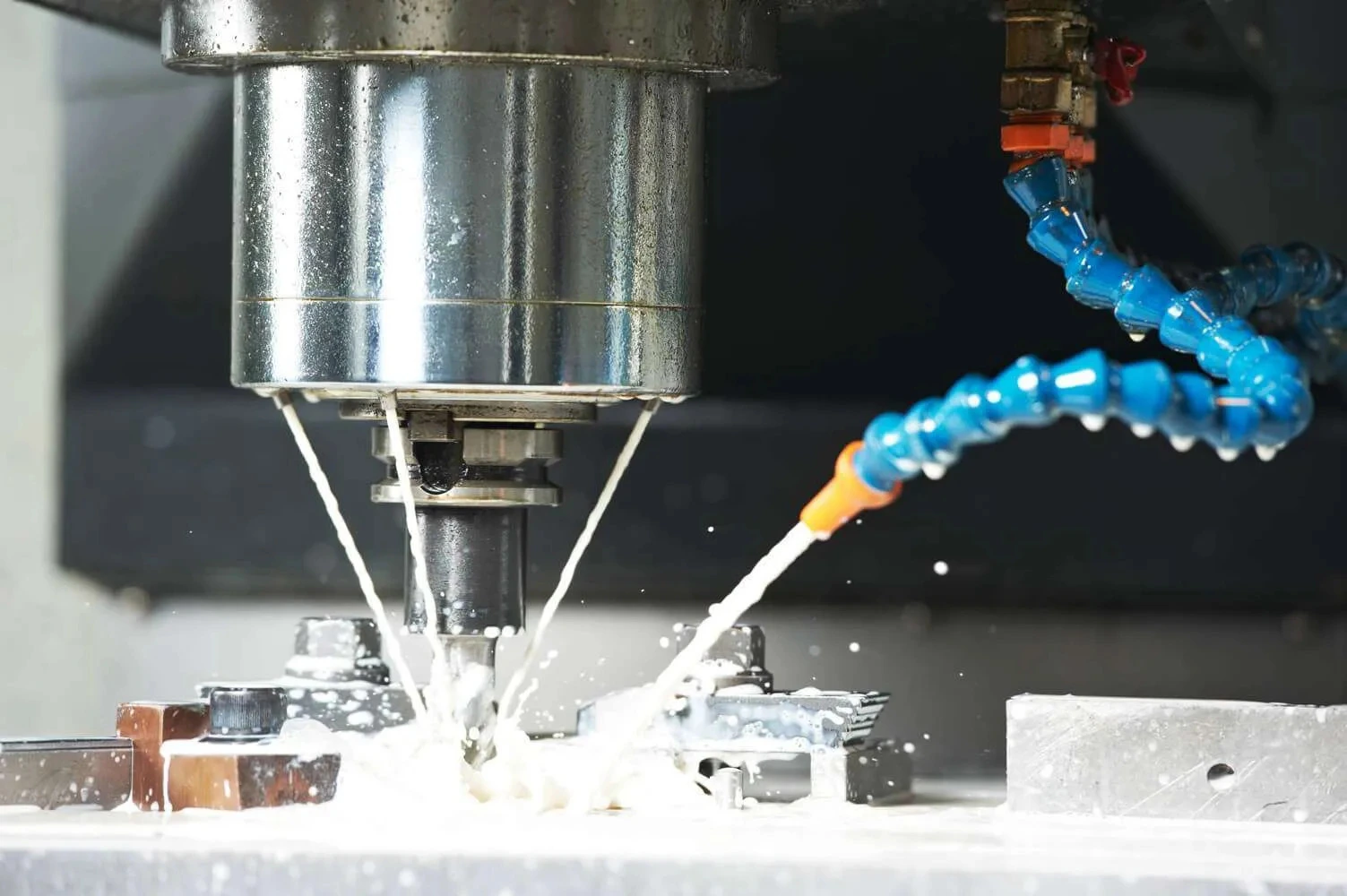
Coolant Requirements During Grinding

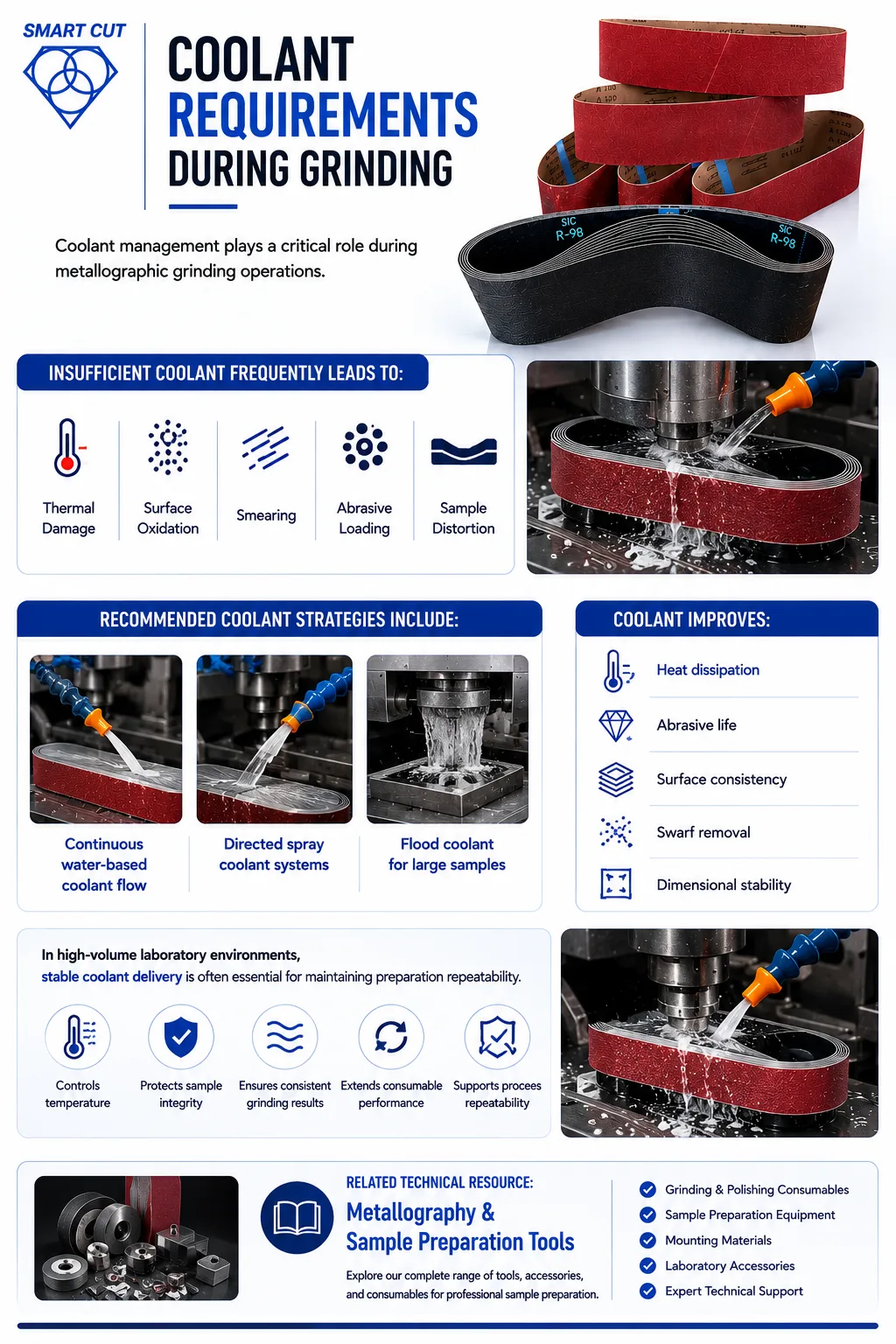
Coolant management plays a critical role during metallographic grinding operations.
Insufficient coolant frequently leads to:
- Thermal damage
- Surface oxidation
- Smearing
- Abrasive loading
- Sample distortion
Recommended coolant strategies include:
- Continuous water-based coolant flow
- Directed spray coolant systems
- Flood coolant for large samples
Coolant improves:
- Heat dissipation
- Abrasive life
- Surface consistency
- Swarf removal
- Dimensional stability
In high-volume laboratory environments, stable coolant delivery is often essential for maintaining preparation repeatability.
Related technical resource: Metallography & Sample Preparation Tools
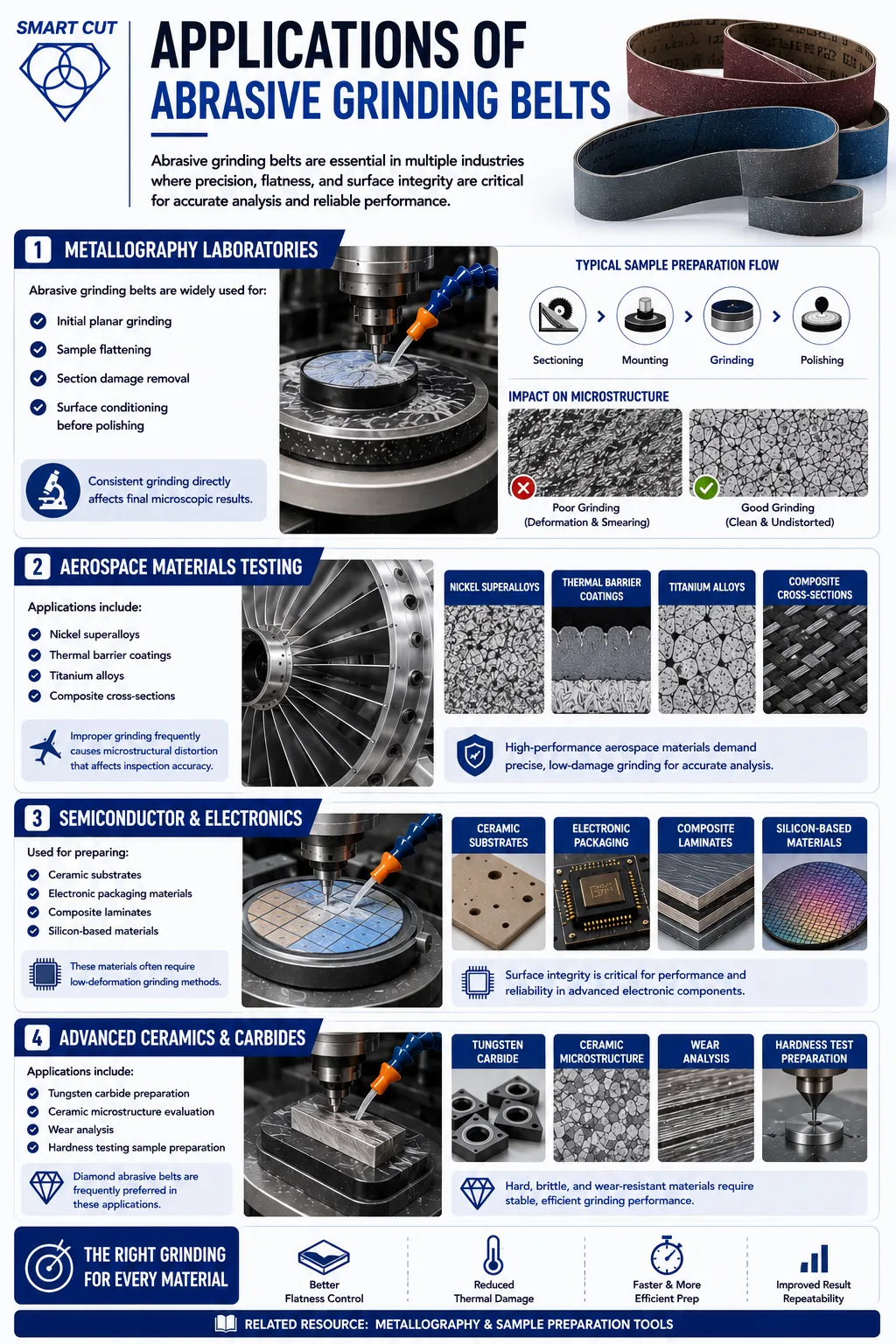
Applications of Abrasive Grinding Belts

Metallography Laboratories
Abrasive grinding belts are widely used for:
- Initial planar grinding
- Sample flattening
- Section damage removal
- Surface conditioning before polishing
Consistent grinding directly affects final microscopic results.
Aerospace Materials Testing
Applications include:
- Nickel superalloys
- Thermal barrier coatings
- Titanium alloys
- Composite cross-sections
Improper grinding frequently causes microstructural distortion that affects inspection accuracy.
Semiconductor & Electronics
Used for preparing:
- Ceramic substrates
- Electronic packaging materials
- Composite laminates
- Silicon-based materials
These materials often require low-deformation grinding methods.
Advanced Ceramics & Carbides
Applications include:
- Tungsten carbide preparation
- Ceramic microstructure evaluation
- Wear analysis
- Hardness testing sample preparation
Diamond abrasive belts are frequently preferred in these applications.
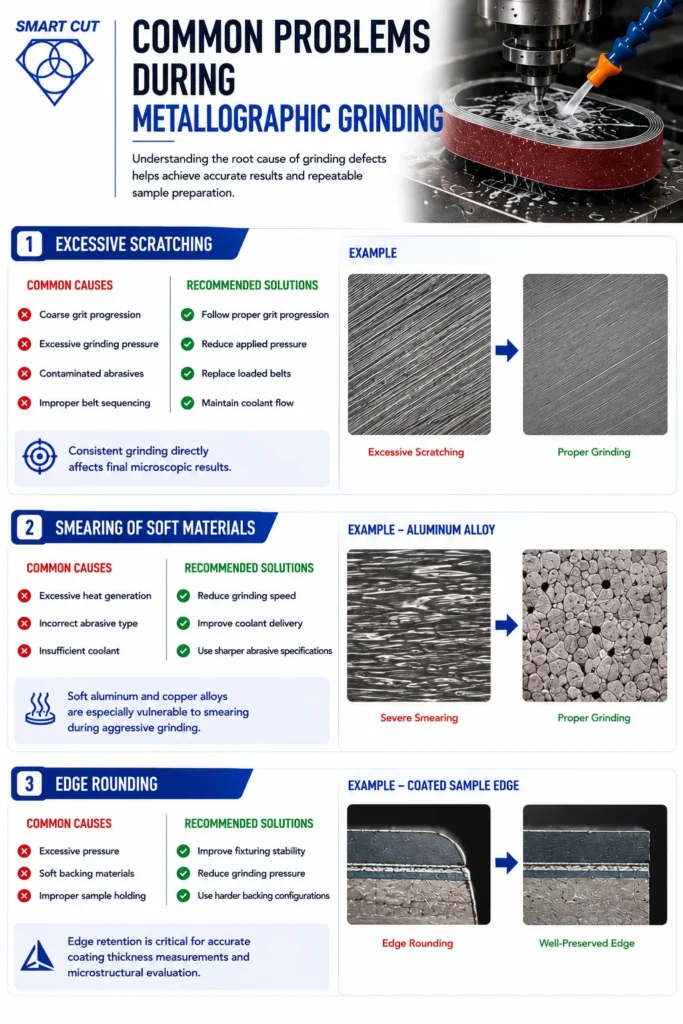
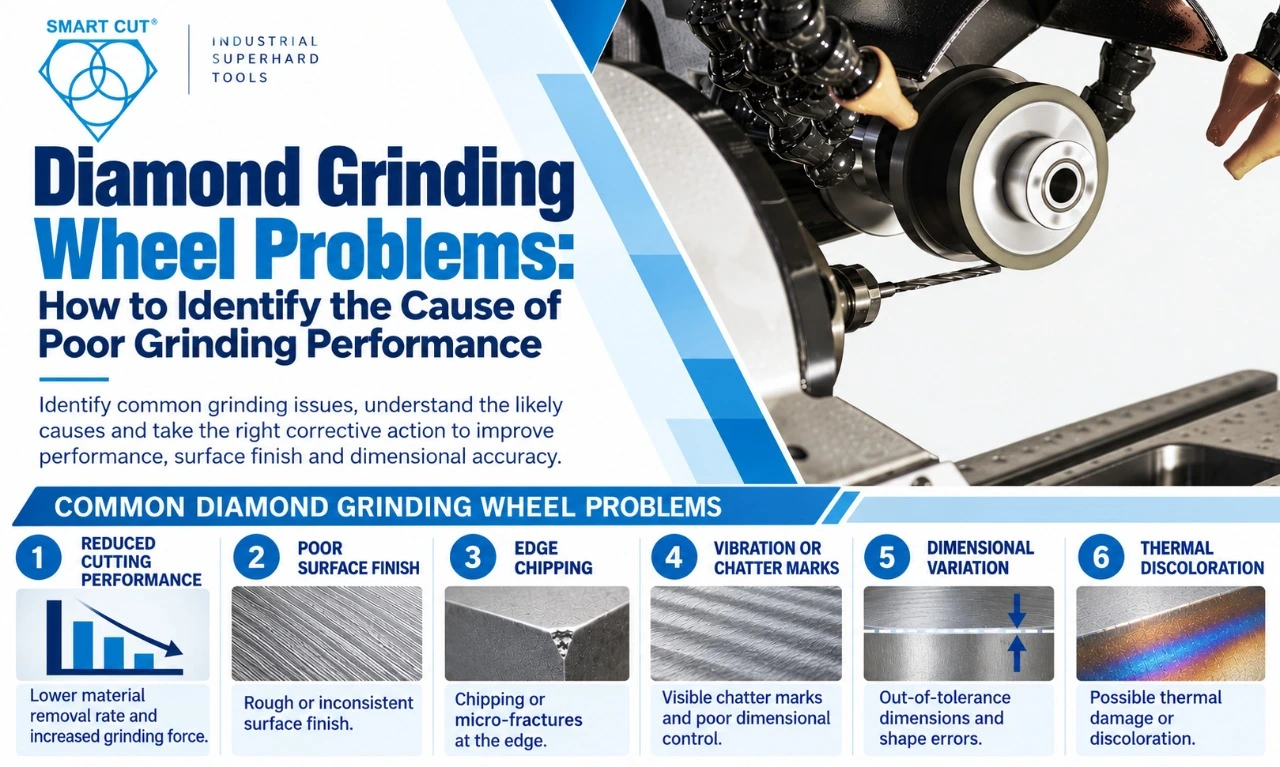
Common Problems During Metallographic Grinding

Excessive Scratching
Common Causes
- Coarse grit progression
- Excessive grinding pressure
- Contaminated abrasives
- Improper belt sequencing
Recommended Solutions
- Follow proper grit progression
- Reduce applied pressure
- Replace loaded belts
- Maintain coolant flow
Smearing of Soft Materials
Common Causes
- Excessive heat generation
- Incorrect abrasive type
- Insufficient coolant
Recommended Solutions
- Reduce grinding speed
- Improve coolant delivery
- Use sharper abrasive specifications
Soft aluminum and copper alloys are especially vulnerable to smearing during aggressive grinding.
Edge Rounding
Common Causes
- Excessive pressure
- Soft backing materials
- Improper sample holding
Recommended Solutions
- Improve fixturing stability
- Reduce grinding pressure
- Use harder backing configurations
Edge retention is critical for accurate coating thickness measurements and microstructural evaluation.
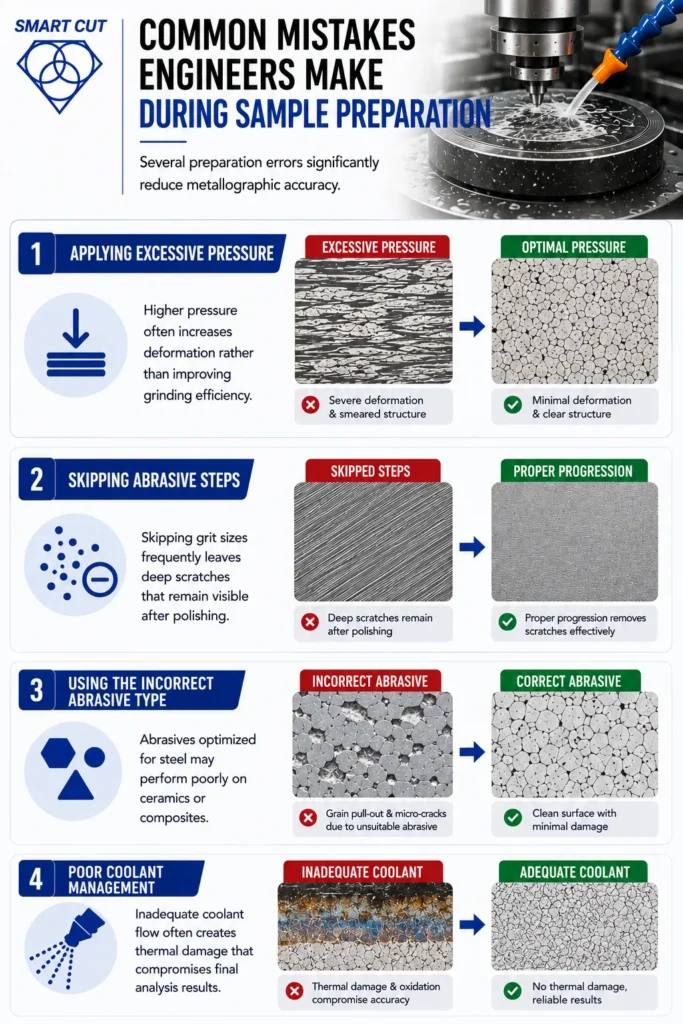
Common Mistakes Engineers Make During Sample Preparation

Several preparation errors significantly reduce metallographic accuracy.
Applying Excessive Pressure
Higher pressure often increases deformation rather than improving grinding efficiency.
Skipping Abrasive Steps
Skipping grit sizes frequently leaves deep scratches that remain visible after polishing.
Using the incorrect abrasive type
Abrasives optimized for steel may perform poorly on ceramics or composites.
Poor Coolant Management
Inadequate coolant flow often creates thermal damage that compromises final analysis results.
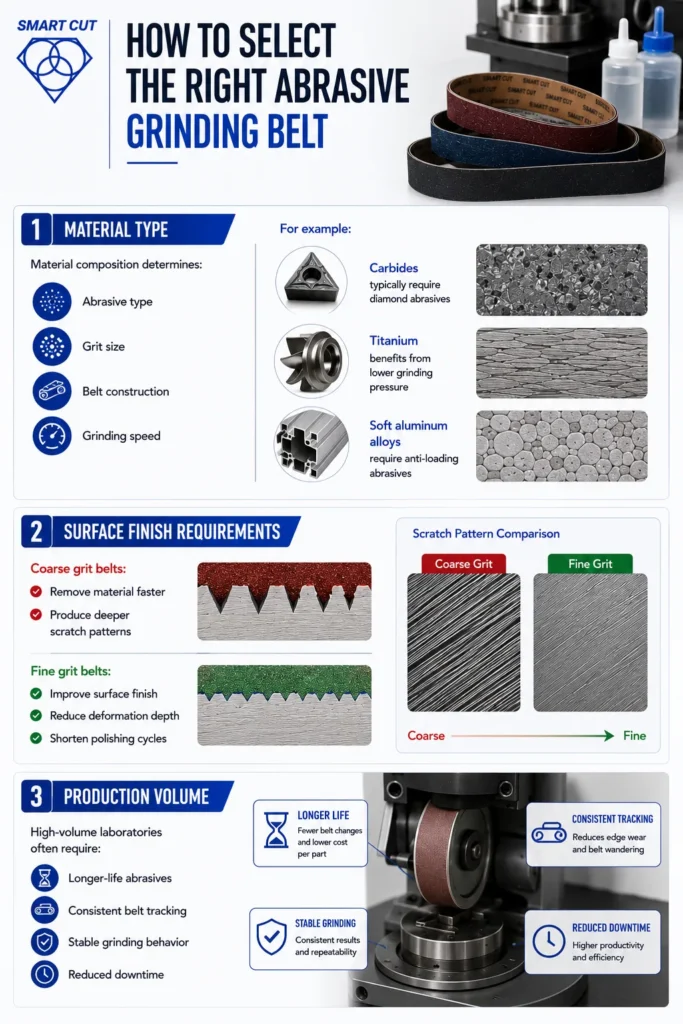
How to Select the Right Abrasive Grinding Belt

Material Type
Material composition determines:
- Abrasive type
- Grit size
- Belt construction
- Grinding speed
For example:
- Carbides typically require diamond abrasives
- Titanium benefits from lower grinding pressure
- Soft aluminum alloys require anti-loading abrasives
Surface Finish Requirements
Coarse grit belts:
- Remove material faster
- Produce deeper scratch patterns
Fine grit belts:
- Improve surface finish
- Reduce deformation depth
- Shorten polishing cycles
Production Volume
High-volume laboratories often require:
- Longer-life abrasives
- Consistent belt tracking
- Stable grinding behavior
- Reduced downtime
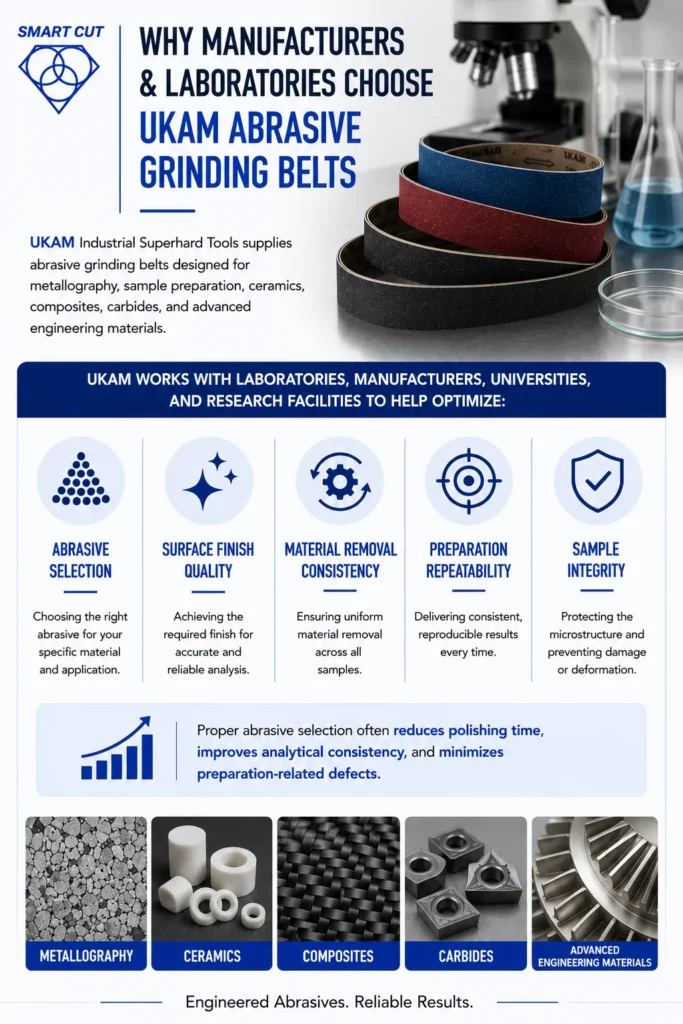
Why Manufacturers & Laboratories Choose UKAM Abrasive Grinding Belts

UKAM Industrial Superhard Tools supplies abrasive grinding belts designed for metallography, sample preparation, ceramics, composites, carbides, and advanced engineering materials.
UKAM works with laboratories, manufacturers, universities, and research facilities to help optimize:
- Abrasive selection
- Surface finish quality
- Material removal consistency
- Preparation repeatability
- Sample integrity
Proper abrasive selection often reduces polishing time, improves analytical consistency, and minimizes preparation-related defects.
Frequently Asked Questions
Conclusion
Abrasive grinding belts play a critical role in metallographic sample preparation, material analysis, and precision surface conditioning. Proper abrasive selection, grinding parameters, coolant management, and process control directly affect surface quality, deformation depth, polishing efficiency, and analytical accuracy. In laboratories and production environments working with metals, ceramics, carbides, composites, and advanced engineering materials, optimized abrasive grinding processes help improve preparation consistency, reduce sample damage, and enhance overall inspection reliability.
Trusted by Tens of Thousands of Manufacturers, Laboratories,
Research Institutions Worldwide Since 1990

Established in 1990
RELATED ARTICLES

Brian is an experienced professional in the field of precision cutting tools, with over 27 years of experience in technical support. Over the years, he has helped engineers, manufacturers, researchers, and contractors find the right solutions for working with advanced and hard-to-cut materials. He’s passionate about bridging technical knowledge with real-world applications to improve efficiency and accuracy.
As an author, Brian Farberov writes extensively on diamond tool design, application engineering, return on investment strategies, and process optimization, combining technical depth with a strong understanding of customer needs and market dynamics.
About Brian Farberov
Brian is an experienced professional in the field of precision cutting tools, with over 27 years of experience in technical support. Over the years, he has helped engineers, manufacturers, researchers, and contractors find the right solutions for working with advanced and hard-to-cut materials. He’s passionate about bridging technical knowledge with real-world applications to improve efficiency and accuracy. As an author, Brian Farberov writes extensively on diamond tool design, application engineering, return on investment strategies, and process optimization, combining technical depth with a strong understanding of customer needs and market dynamics.
View all posts by Brian Farberov