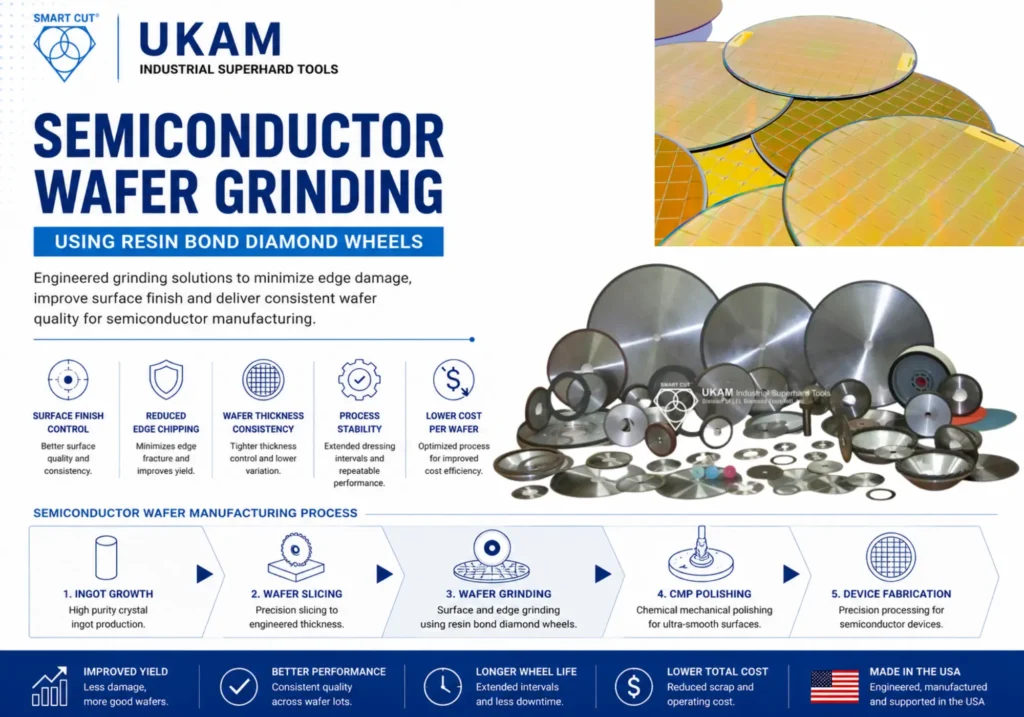











Semiconductor Wafer Grinding: Reduction in Edge Chipping Using Resin Bond Diamond Wheels

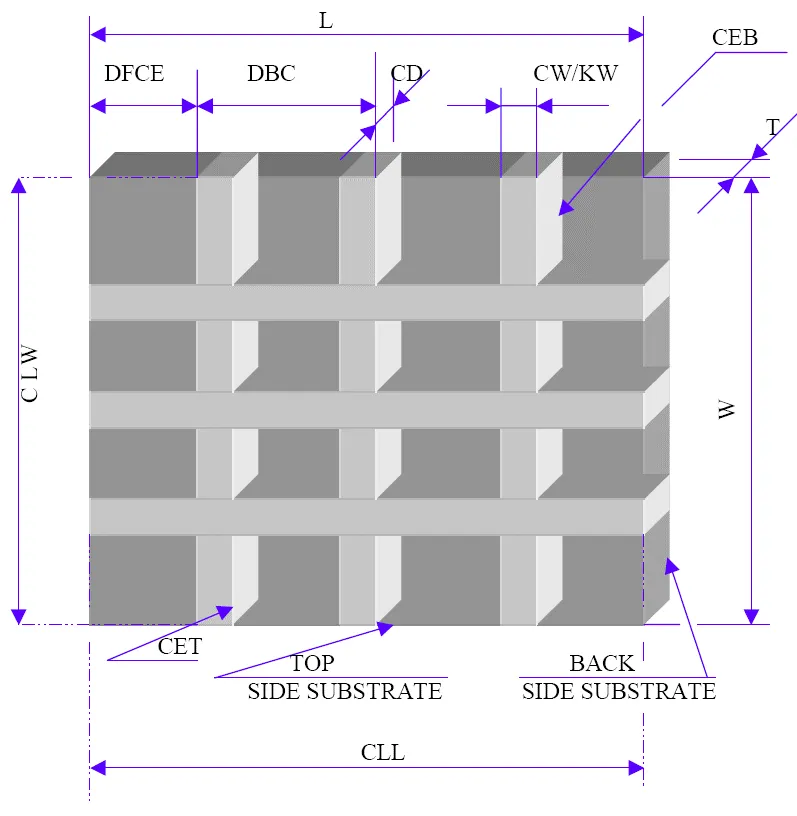
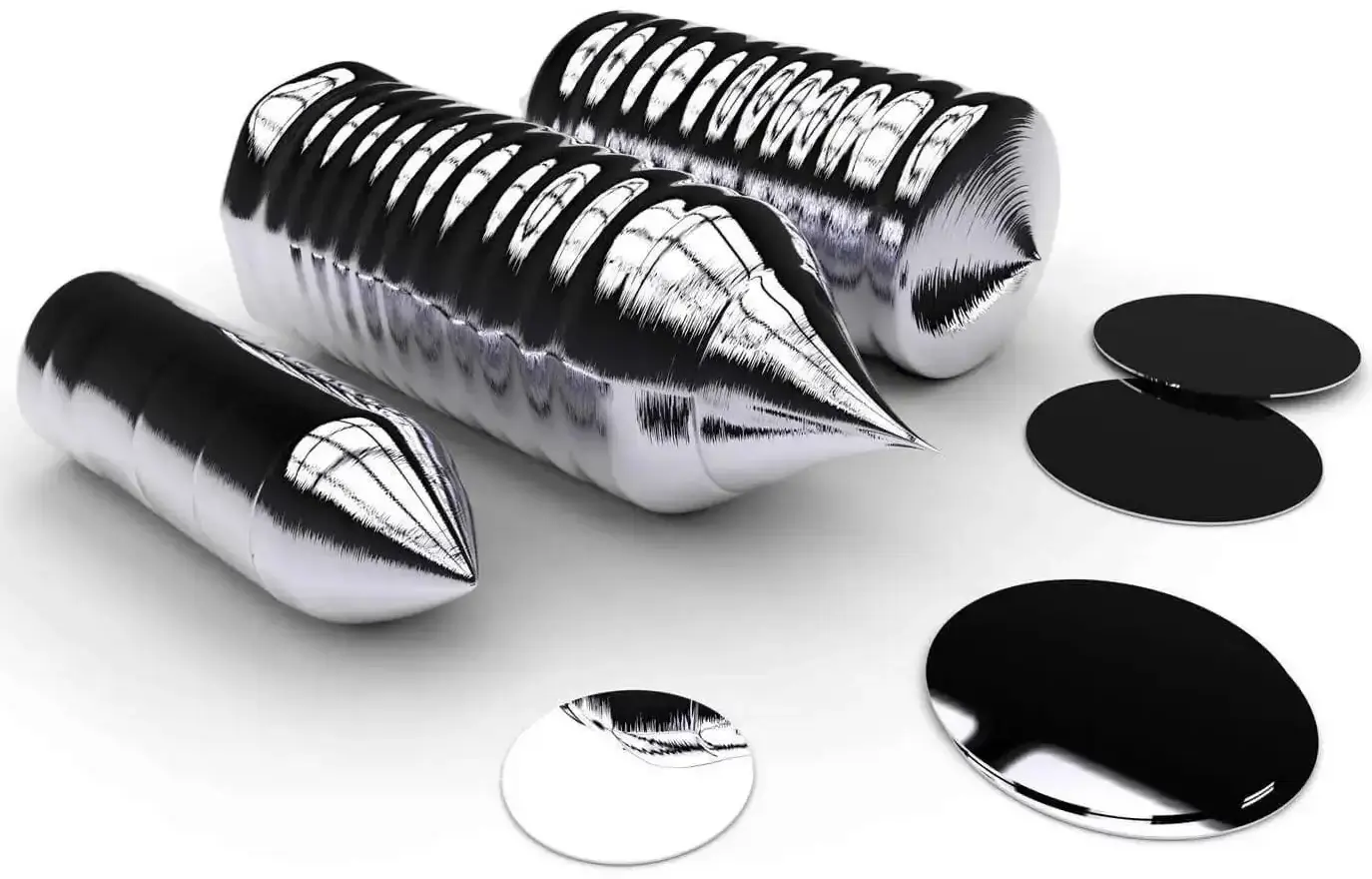
Edge chipping during semiconductor wafer grinding was generating unacceptable scrap rates on GaAs, sapphire, and silicon carbide substrates used in RF devices, power electronics, and optoelectronic manufacturing. During qualification trials a metal bond diamond wheel optimized primarily for wheel life and dimensional retention. Production data showed progressive edge fracture, thermal haze, and subsurface cracking during finish grinding passes.
Continue reading

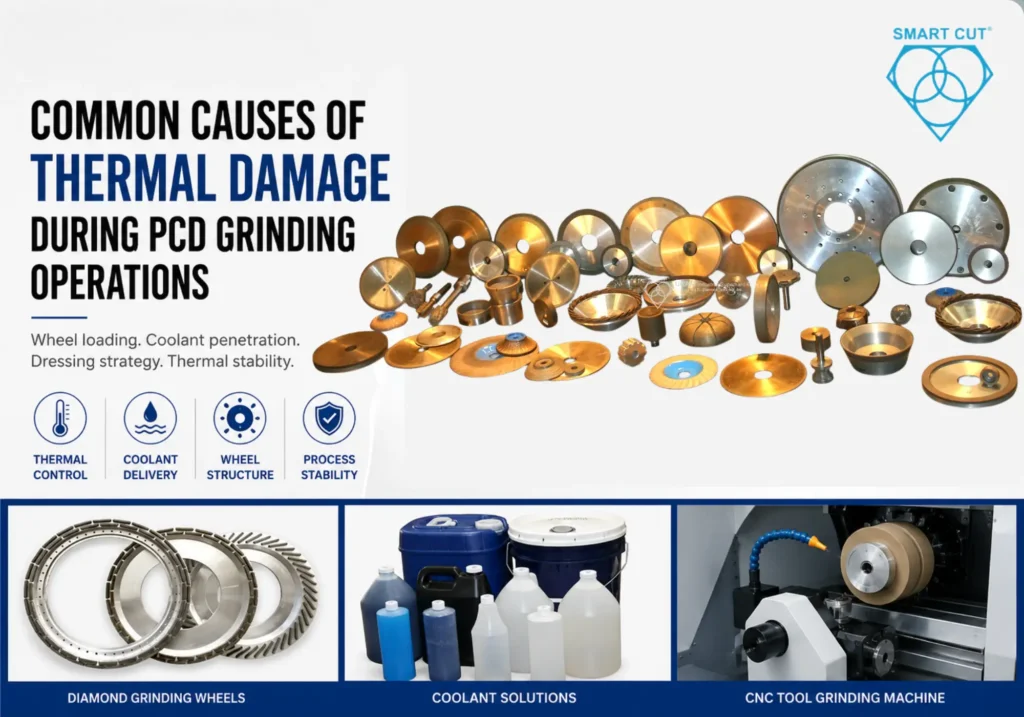
Common Causes of Thermal Damage During PCD Grinding Operations

A manufacturer producing PCD cutting tools for aerospace aluminum machining and composite machining applications experienced recurring thermal damage during finish grinding operations. Operators reported edge discoloration, unstable wheel wear, inconsistent edge radius formation, surface haze, and premature insert failure during production validation.
Continue reading
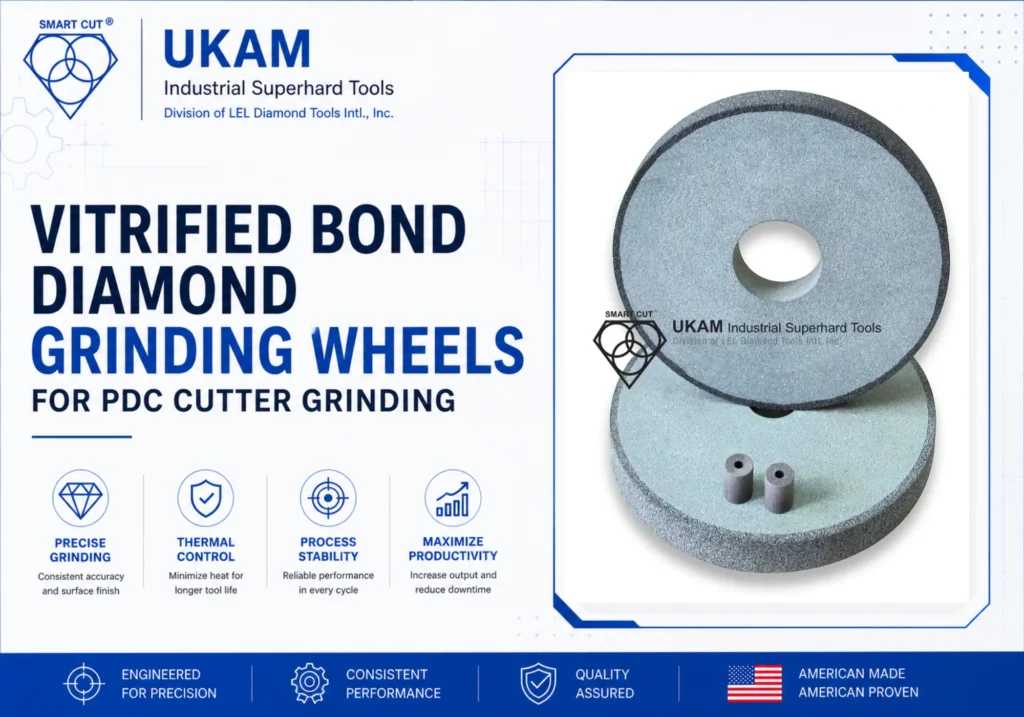
Vitrified Bond Diamond Grinding Wheels for PDC Cutter Grinding

Vitrified Bond Diamond Grinding Wheels for PDC Cutter Grinding

PDC cutter grinding fails in three specific ways: thermal damage to the diamond layer, chipping at the diamond-carbide interface, and wheel glazing that stops material removal entirely. Each failure mode has a distinct cause and a distinct fix. Most process problems trace back to one of three decisions: the wrong bond system, inadequate coolant delivery, or unchanged parameters across the diamond-carbide transition zone. This guide addresses all three. It covers the material science behind PDC grinding difficulty, why vitrified bond outperforms alternative systems, how to set starting parameters, how to manage the transition zone, and what wheel specification variables actually control surface finish and tool life.
Continue reading

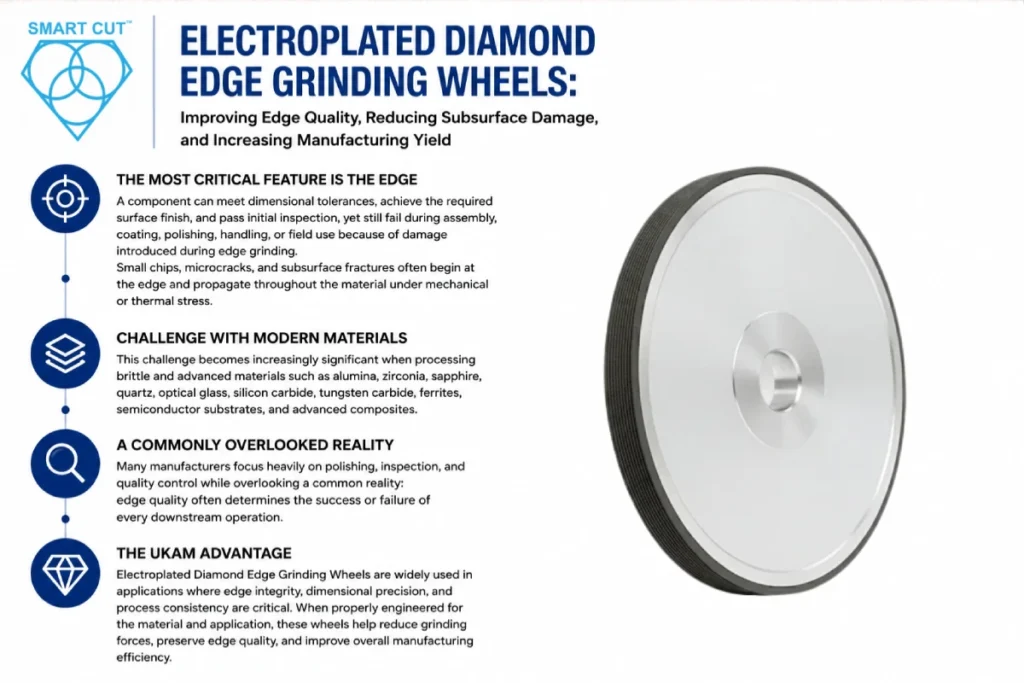
Electroplated Diamond Edge Grinding Wheels: Improving Edge Quality, Reducing Subsurface Damage, and Increasing Manufacturing Yield

In many manufacturing operations, the most critical feature of a component is not the surface. It is the edge. A component can meet dimensional tolerances, achieve the required surface finish, and pass initial inspection, yet still fail during assembly, coating, polishing, handling, or field use because of damage introduced during edge grinding. Small chips, microcracks, and subsurface fractures often begin at the edge and propagate throughout the material under mechanical or thermal stress.
Continue reading

How to Switch Superabrasive Grinding Wheel Suppliers

Switching grinding wheel or diamond tool suppliers is one of the most avoided decisions in precision manufacturing. The hesitation is understandable. A change in abrasive specification can shift surface finish, tighten or loosen dimensional tolerances, and alter cycle times in ways that take weeks to isolate and diagnose.
Continue reading

Abrasive Grinding Belts for Metallography and Precision Sample Preparation

In metallographic sample preparation, surface quality directly affects analytical accuracy. Poor grinding consistency, excessive deformation, deep scratches, overheating, and edge rounding can compromise microscopic analysis and lead to inaccurate material characterization. For laboratories, quality control departments, research facilities, and production environments, the grinding stage is one of the most critical steps in the entire sample preparation process.
Continue reading