










Table of Contents
ToggleSelecting the right dicing blade is important to achieving high yields, superior edge quality, and consistent reliability in microelectronics and optics manufacturing. Across industries such as semiconductors, electronics packaging, photonics, and precision optics, even small improvements in blade performance can significantly reduce costs and improve output. Manufacturers often struggle with challenges like excessive chipping, burr formation, wafer damage, tool wear, and unstable cutting at higher feed rates.
Share this Article with Friend or Colleague
To address these challenges, we conducted a series of case studies comparing SMART CUT® diamond dicing blades against competitor blades in a wide range of applications, including silicon IC wafers, GaAs LED wafers, Al₂O₃ substrates, SiC wafers, borosilicate glass, quartz, and lithium niobate. These studies were performed under identical machining conditions to ensure fair and accurate results.
The findings consistently demonstrate that SMART CUT® blades deliver:
- Lower frontside and backside chipping, improving overall product quality and reducing post-processing.
- Longer blade life, minimizing downtime for blade changes and lowering cost-per-cut.
- Improved cut stability and surface finish, enabling higher feed rates without compromising dimensional accuracy.
- Better yield and reduced rework, leading to greater process efficiency.
By presenting these real-world results side by side, the following case studies highlight how SMART CUT® blades outperform other dicing blades across different materials and applications. The comparisons provide valuable insights into the trade-offs between cut quality, throughput, and tool longevity, giving manufacturers clear evidence of where performance gains can be achieved.
In addition, we can cross-reference any competitor item number and provide an equivalent SMART CUT® blade. In most cases, not only can we match performance, but we can also improve it compared to what you are currently using. To give you full confidence, we offer a RISK FREE TRIAL GURANTEE that allows you to compare the performance of SMART CUT® dicing blades against your current blades in your own process, with no risk on your side.
CASE STUDIES BY BOND TYPE
By presenting these real-world results side by side, the following case studies highlight how SMART CUT® blades consistently outperform other dicing blades across different materials and applications. The comparisons provide valuable insights into the trade-offs between cut quality, throughput, and tool longevity, giving manufacturers clear evidence of where measurable performance gains can be achieved.
NEW GENERATION AND TECHNOLOGY
SINTERED (METAL BOND)
SMART CUT® Series (SCM)
Diamond & CBN Dicing Blades
SMART CUT® Series (SCM) Sintered (Metal Bond) Diamond CBN Dicing Blades are designed to provide some the best return on investment (ROI) in dicing application. They provide superior longevity, accuracy, and consistency across a wide range of applications. Engineered using advanced SMART CUT® technology, these blades are among the thinnest, most durable, and highest-performing dicing solutions available today. Their sintered metal bond structure ensures a self-renewing sharpness, delivering consistently clean and precise cuts over extended periods.
Case Study: Dicing Blade for for BGA
- Blade Type: SMART CUT® Series (SCM) Sintered (Metal Bond) Dicing Blade
- Model: SMART CUT® Series (SC1M)
- Blade Size: 56 D × 0.1 T × 40 H
- Machine Model: DISCO DAD3350
- Application: BGA (Ball Grid Array)
- Material: High-Density, Environmentally Friendly PCB (Printed Circuit Board)
Blade Specifications & Performance Comparison
|
Parameter |
SMART CUT® Blade |
Competitor Blade |
|---|---|---|
|
Blade Size |
56 D × 0.1 T × 40 H |
|
Diamond Grit Size |
4-6 µm |
4-6 µm |
|
Diamond Concentration |
100 |
100 |
|
Bond Type |
Metal Bond |
Metal Bond |
|
Spindle Speed |
30,000 RPM |
30,000 RPM |
|
Feed Rate |
100 mm/s |
100 mm/s |
|
Dimensional Accuracy |
±18 µm | ±20 µm |
|
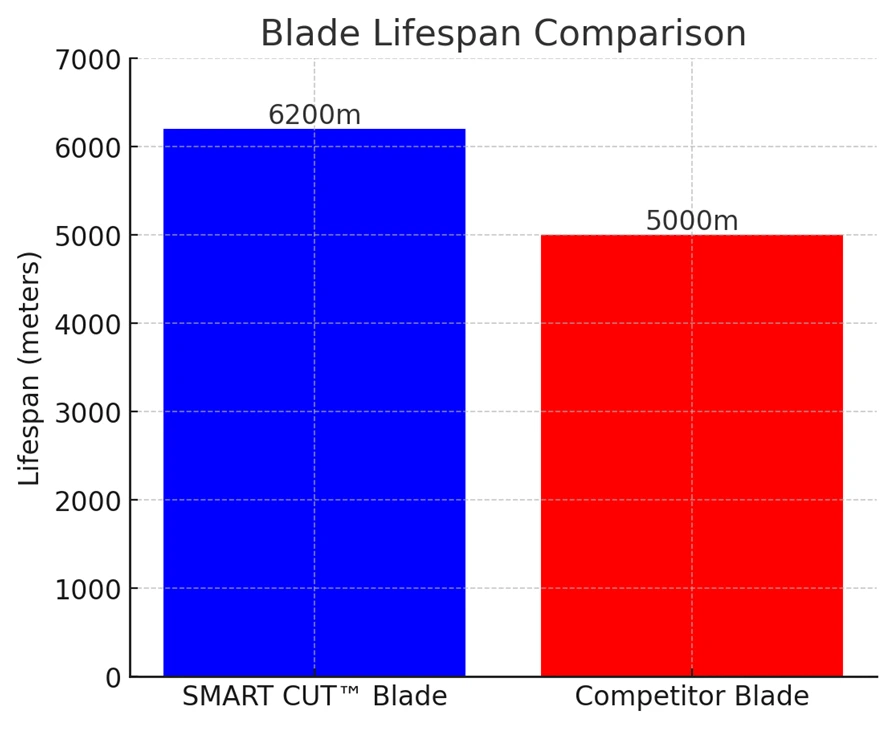
Blade Lifespan |
6,200 meters (24% longer) |
5,000 meters |
|
Cutting Depth |
0.6 mm |
0.6 mm |
|
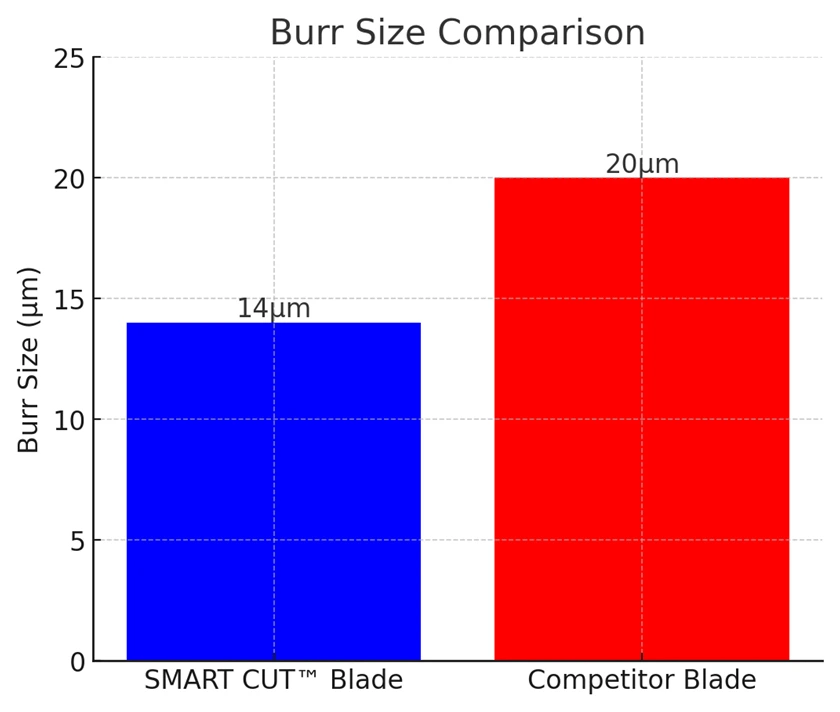
Burr Size |
<14 µm (Superior finish) |
<20 µm (More post-processing required) |
Key Benefits of SMART CUT® Blade
- 24% Longer Lifespan: Extends blade usage, reducing tool changes and cutting costs.
- Higher Precision: ±18 µm accuracy, reducing material waste and improving process consistency.
- Superior Surface Finish: Burr size <14 µm, minimizing post-processing time and improving final product quality.
- Consistent Performance: Maintains the same spindle speed, feed rate, and cutting depth, proving that SMART CUT®
Series (SC1M) outperforms the competition in longevity and cut quality under identical conditions.
Case Study: Dicing Blade for AlN Substrate (LED Packaging)
Blade Specification:
- Blade Type: SMART CUT® Series (SCM) Sintered (Metal Bond) Dicing Blade
- Model: SMART CUT® Series (SC1M)
- Blade Size: 56 D × 0.2 T × 40 H
- Material: Silica Gel + Aluminum Nitride
Performance Comparison: SMART CUT® Series (SCM) vs. Competitor Blade
|
Performance Metric |
SMART CUT® Blade |
Competitor Blade |
|---|---|---|
|
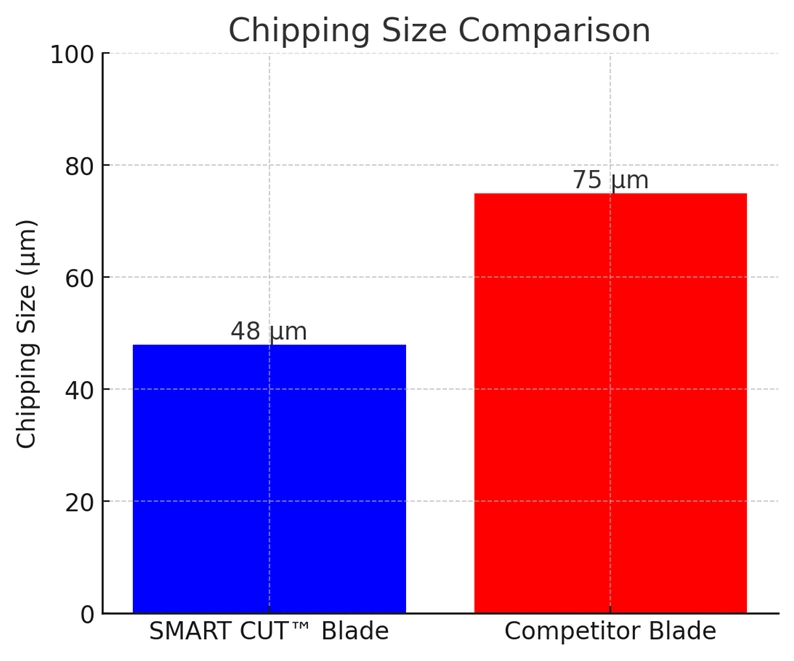
Chipping (µm) |
<48 µm (Superior edge quality) |
62-75 µm (Higher chipping) |
|
Blade Life (Lines Processed) |
2,100 lines (More than 2× longer lifespan) |
950 lines |
|
Current Value (A) |
2.4 – 2.5 A |
2.3 – 2.5 A |
Key Benefits of SMART CUT® Series (SC1M) Blade
- Minimizes chipping to <48 µm, ensuring cleaner cuts and reducing post-processing.
- More than doubles blade life, processing 2,100 lines vs. 950 lines with the competitor blade.
- Enhanced wear resistance, reducing overall cost per cut and machine downtime.
- Optimized cutting performance for Aluminum Nitride (AlN) substrates in LED packaging applications.
Case Study: Dicing Blade for MLCC (Passive Components Packaging)
Blade Specification:
- Blade Type: SMART CUT® Series (SCM) Sintered (Metal Bond) Dicing Blade Model: SMART CUT® Series (SC1M)
- Blade Size: 54mm D × 0.127mm TH × 40H
Performance Comparison: SMART CUT® Series (SCM) vs. Competitor Blade
|
Performance Metric |
SMART CUT® Blade |
Competitor Blade |
|---|---|---|
|
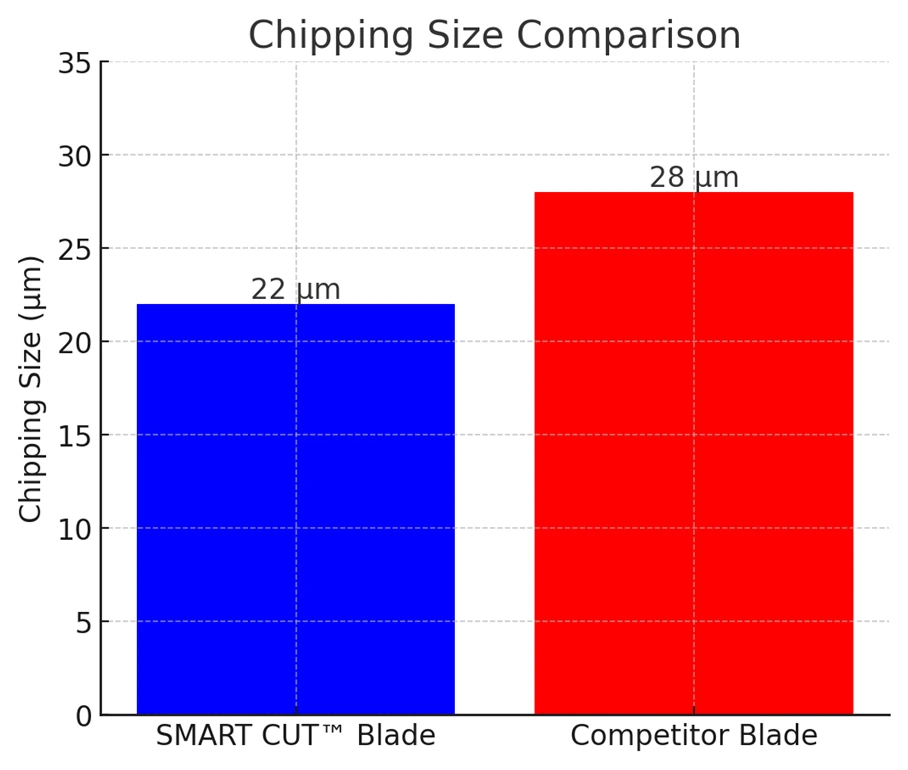
Chipping (µm) |
<22 µm (Superior edge quality) |
>28 µm (Higher chipping) |
|
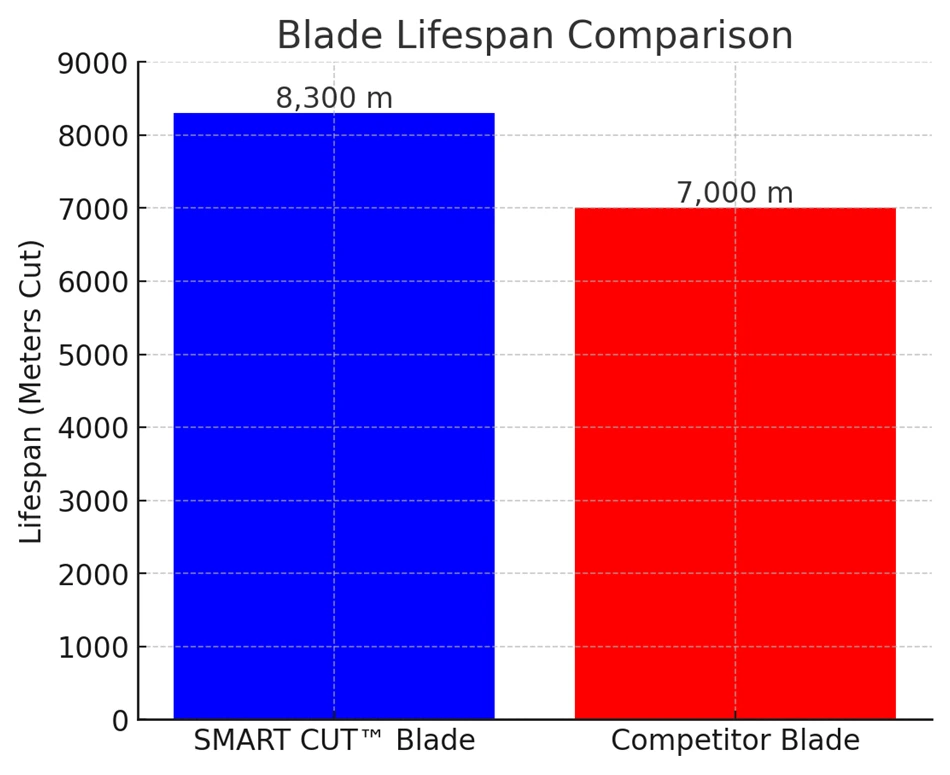
Blade Life (Meters Cut) |
8,300 m (Longer-lasting performance) |
7,000 m |
|
Current Value (A) |
2.3 – 2.5 A |
2.4 – 2.7 A |
Key Benefits of SMART CUT® Series (SC1M) Blade
- Minimizes chipping to <22 µm, providing superior edge quality.
- Extends blade life to 8,300 meters, lasting longer than the competition.
- More stable cutting performance, operating at lower current values (2.3-2.5 A).
- Optimized for MLCC and passive component packaging, ensuring precision, speed, and cost-efficiency.
Case Study: High-Precision Dicing of Silicon Nitride (Si₃N₄) Using SMART CUT™ Diamond Blades
Application Overview
- Material: Silicon Nitride (Si₃N₄)
- Machine Spindle Speed: 25,000 RPM
- Feed Rate: 8 mm/sec
- Blade Type: SMART CUT® Series (SCM) Sintered (Metal Bond) Dicing Blade Model: SMART CUT® Series (SC4M)
- Blade Size: 54mm D × 0.2mm T × 40H
Blade Specifications & Performance Comparison
|
Performance Metric |
SMART CUT™ Blade |
Competitor Blade |
|---|---|---|
|
Blade Type |
Metal Bond Diamond Blade |
|
Blade Size |
56D × 0.2T × 40H |
56D × 0.2T × 40H |
|
Diamond Grit Size |
6–10 µm (Optimized for Si₃N₄) |
8–12 µm |
|
Diamond Concentration |
100 (High-density diamond) |
75 (Lower concentration) |
|
Blade Lifespan |
5,000 meters (30% longer) |
3,800 meters |
|
Chipping Size |
≤12 µm (Superior edge quality) |
≤22 µm (Higher chipping) |
|
Cutting Speed Stability |
Highly stable, maintains precision |
Prone to performance loss over time |
Key Advantages of SMART CUT® Series (SC4M) Blade
- 30% Longer Blade Life → Processes 5,000 meters vs. 3,800 meters, reducing blade changes.
- Minimized Chipping → Produces ≤12 µm chipping, ensuring high-precision cuts with minimal post-processing.
- Higher Diamond Concentration → Provides better wear resistance and more consistent cutting performance.
- Optimized Diamond Grit Size → Achieves a cleaner surface finish while maintaining high cutting speeds.
Case Study: Dicing BGA Packages with SMART CUT® Series (SCM1) Sintered Metal Bond Dicing Blade
Objective
To evaluate the performance of SMART CUT® Series (SCM1) sintered dicing blades compared to a leading competitor in the precision dicing of BGA (Ball Grid Array) packages.
Blade & Equipment Specifications
- Blade Type: SMART CUT® Series (SCM1) Sintered (Metal Bond) Dicing Blade
- Blade Size: 58 mm × 0.25 mm × 40 mm
- Machine Model: DISCO DAD3350
- Application: BGA (Ball Grid Array) Packages
- Diamond Grit Size: 320
- Concentration: 50
Process Parameters
- Dimensional Accuracy: ±0.1 mm / ±0.05 mm
- Collapse: < 50 μm
- Defects: No obvious burr observed
- Coolant: Water-based (standard for DISCO system)
Performance Results
SMART CUT® SCM1 Blade
- Achieved dimensional accuracy within tolerance.
- Collapse under 50 μm, meeting industry requirements.
- Clean kerf with no visible burrs or chipping.
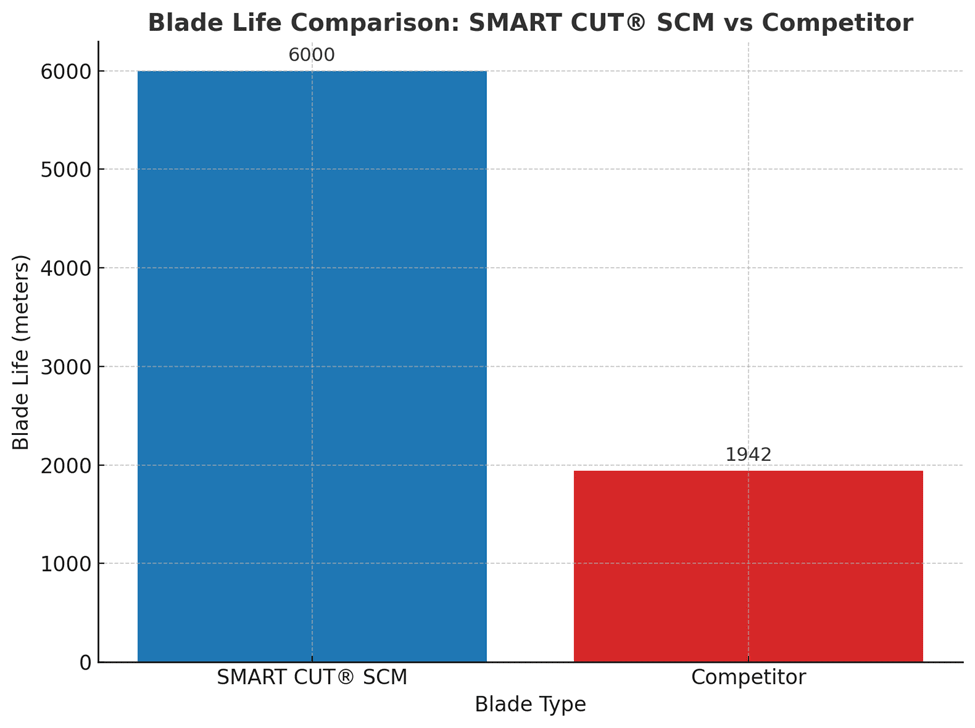
- Blade life: 6,000 m.
Competitor Blade
- Met basic dimensional accuracy requirements.
- Collapse control not as consistent as SCM1 blades.
- More visible burrs during cutting.
- Blade life: 1,942 m.
Key Findings
- SMART CUT® SCM1 achieved 3.1× longer blade life compared to the competitor (6,000 m vs. 1,942 m).
- Improved cut quality with reduced burr formation.
- Maintained tight dimensional accuracy ±0.1 / ±0.05 mm and collapse < 50 μm.
- Increased productivity due to reduced blade changeovers.
ROI and Cost Impact
- Reduced blade consumption: One SCM1 blade replaces more than three competitor blades.
- Lower downtime: Fewer blade changes during production, increasing machine availability.
- Higher process stability: Improved consistency in cut quality reduces scrap rates.
Conclusion
The SMART CUT® Series (SCM1) sintered metal bond dicing blade demonstrated superior life, accuracy, and process stability in BGA package dicing. By providing over three times the blade life compared to the competitor, SCM blades significantly reduce cost-per-cut and enhance overall throughput, making them the preferred choice for advanced semiconductor packaging applications.
RESIN BOND
SMART CUT® Series (SC®) RESIN BOND DIAMOND & CBN DICING BLADES
Maintain excellent form & sharpness. Providing lower wear rate, longer life, and minimum level of chipping on wide variety materials.
SMART CUT® Resin series New Generation & Technology Dicing Blade is the highest performance Resin Bond Dicing Blade available today! SMART CUT® Resin Dicing Blade lasts longer than any resin bond diamond dicing blade and maintains better form & shape consistently through its life. Resin Bond dicing blade are typically more forgiving, self dressing, and freer cutting. Excellent choice for Ultra Hard & Brittle Materials. Recommended for applications where cut quality and surface finish is very important.
SMART CUT® Resin series New Generation & Technology Dicing Blade are produced using phenolic resin as the binder, diamond abrasive as cutting media, ceramic & other advanced components as filler. UKAM Industrial Resin Bond Blades are manufactured with advanced molding process. available in a large variety of geometries, diamond sizes, diamond concentrations, and bond harnesses.
Case Study: Resin Bond Dicing Blades – SMART CUT® SCR1 vs. Competitor Blades
In advanced electronics manufacturing, resin bond dicing blades are widely used for cutting QFN, DFN, BGA, PCB, and glass substrates. Customers often face challenges with tool life, burr formation, tin melting, and chipping when using competitor blades. To evaluate performance differences, SMART CUT® SCR1 resin bond blades were tested head-to-head against competitor resin bond blades under identical operating conditions.
Competitor Resin Bond Blades
- Blade Specification: 1A8 58 × 0.32 × 40 SDC180 B C100
- Blade life: Typically 800–1200 m before replacement
- Cut quality: Burr formation often exceeded 70 μm
- Thermal issues: Tin melting occurred at higher feed rates
- Defects: Noticeable chipping and risk of delamination in QFN and PCB cutting
SMART CUT® SCR1 Resin Bond Blades
- Blade Specification: 1A8 58 × 0.32 × 40 SDC180 B C100
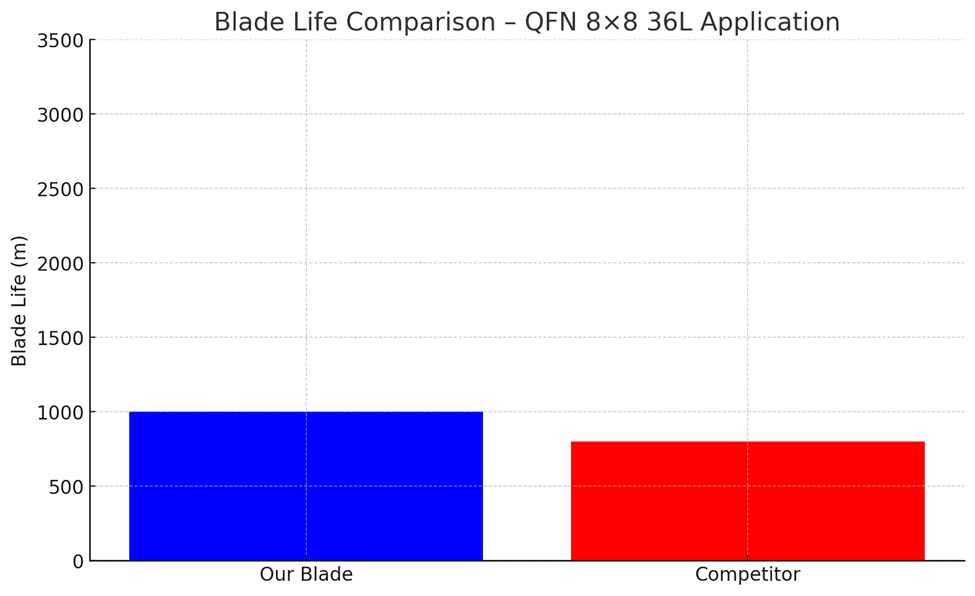
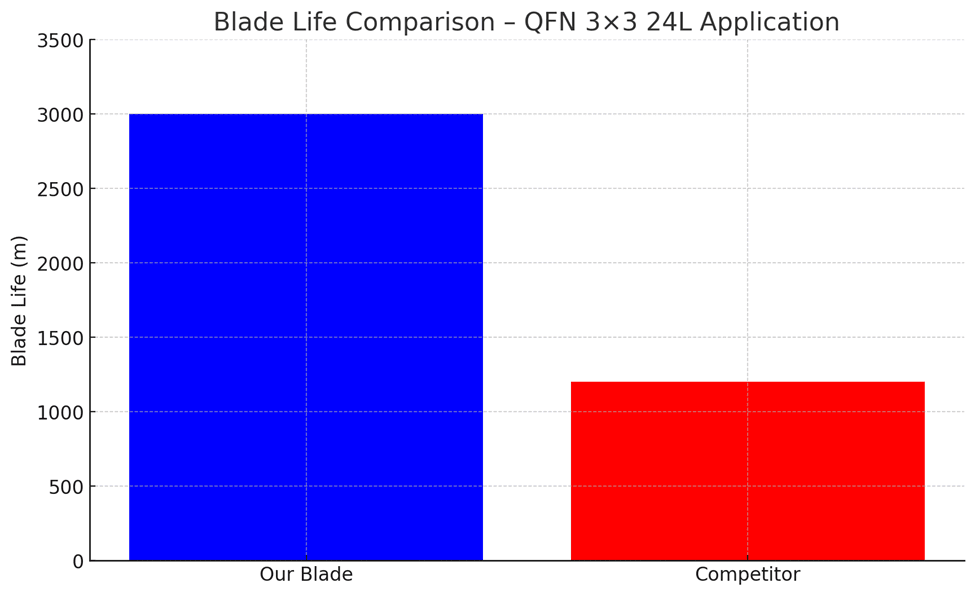
- Blade life: Achieved up to 3000 m in QFN 3×3 24L applications, and 1000+ m in QFN 8×8 36L applications at high feed rates
- Cut quality: Burr consistently under 50 μm with clean edges
- Thermal control: No tin melting observed, even at feed rates of 70 mm/s
- Defects reduction: No chipping or delamination across multiple test runs
SMART CUT® SCR1 resin bond blades delivered 2–3 times longer blade life, cleaner cuts with fewer burrs, and greater reliability compared to competitor blades. By reducing downtime for blade changes and minimizing defective parts, customers achieved lower overall dicing costs and higher production yields.
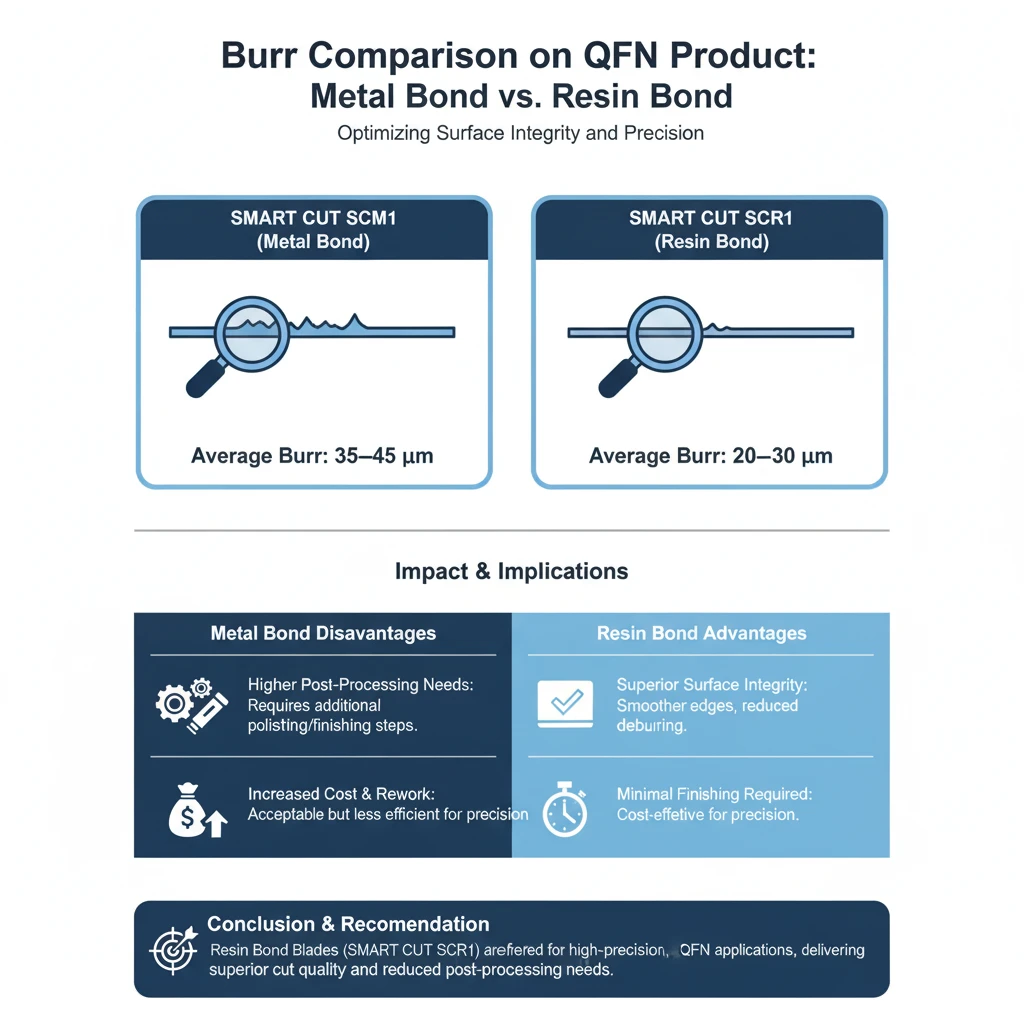
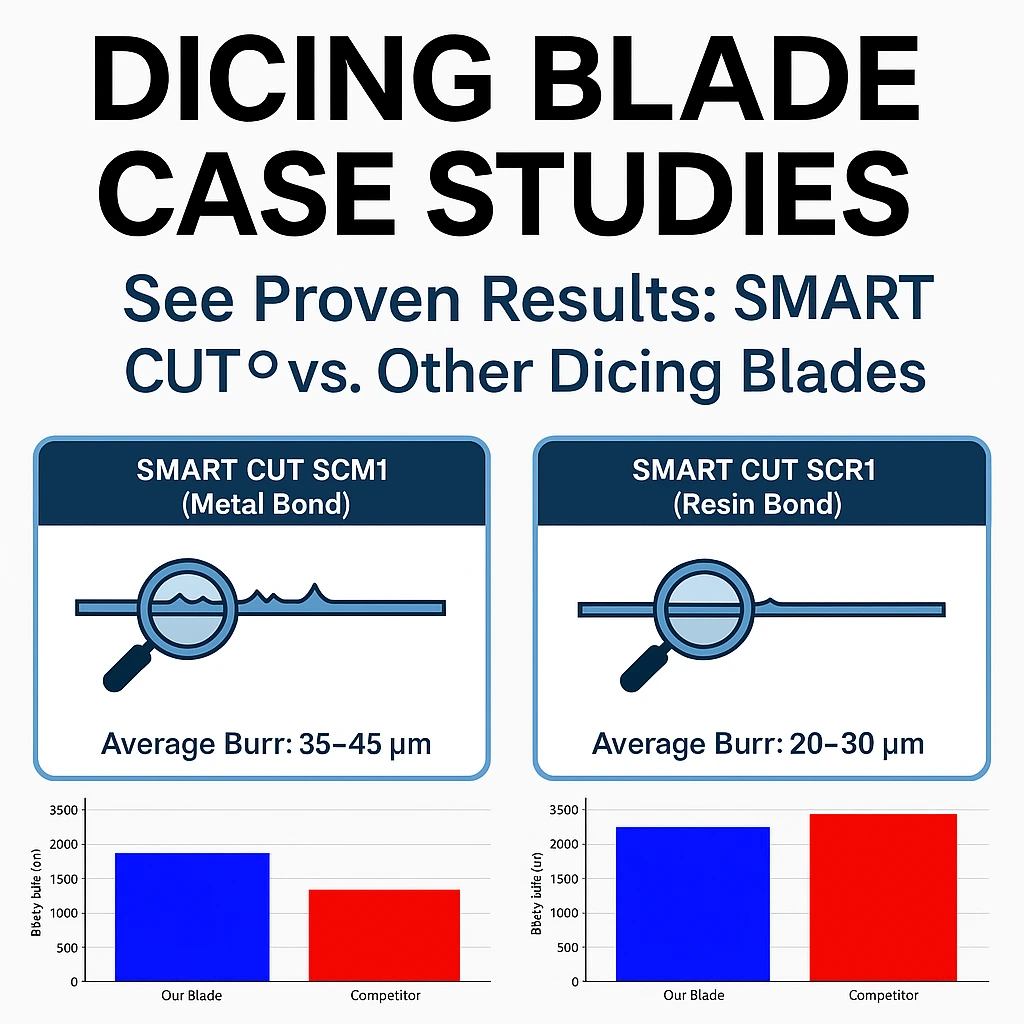
Burr Comparison on QFN Product
|
Factor |
SMART CUT SCm1 (Metal Bond) |
SMART CUT SCR1 (Resin Bond) |
|---|---|---|
|
Average Burr Level |
35–45 microns |
20–30 microns |
|
Consistency Over Blade Life |
High burr levels remain steady |
Low burr levels remain consistent |
|
Surface Integrity |
Rougher surface, prone to defects |
Smoother surface with better edge quality |
|
Post-Processing Needs |
Requires polishing or secondary finishing |
Minimal or no finishing required |
|
Suitability for QFN Products |
Acceptable but increases cost and rework |
Preferred choice for precision, minimal burr applications |
Findings:
- Metal bond blades produced significantly higher burr levels, averaging 35-45 microns, which remained relatively consistent throughout the blade life.
- Resin bond blades showed a lower burr formation, staying within the 20-30 micron range, indicating a smoother cut.
Analysis:
- Higher burr formation in metal bond blades can result in increased post-processing requirements, such as additional polishing or secondary finishing steps.
- Resin bond blades exhibit better surface integrity , reducing the need for excessive deburring and improving overall cut quality.
- This suggests that resin bond blades are preferable for applications requiring minimal burr and a high degree of precision.
Smearing Comparison on QFN Product
|
Factor |
SMART CUT SCm1 (Metal Bond) |
SMART CUT SCR1 (Resin Bond) |
|---|---|---|
|
Smearing Level |
45–55 microns, fluctuating throughout blade life |
25–35 microns, consistent through blade life |
|
Edge Definition |
Reduced sharpness, visible deformation along cut edge |
Superior edge definition with minimal material drag |
|
Impact on Dimensional Accuracy |
Greater risk of distortion, affecting bonding and assembly |
Maintains high accuracy with clean cut edges |
|
Cleaning/Rework Needs |
Often requires additional cleaning or rework |
Minimizes need for secondary processing |
|
Suitability for Precision Applications |
Less suitable due to excessive smearing |
Preferred for semiconductor dicing and advanced electronics packaging |
Findings:
- Metal bond exhibited a higher level of smearing, with values fluctuating between 45-55 microns over the course of blade life.
- Resin bond performed better in minimizing smearing, remaining within a range of 25-35 microns throughout the test.
Analysis:
- Smearing occurs when material deposits or deforms along the cut edge, affecting dimensional accuracy and potentially impacting subsequent bonding or assembly processes.
- The lower smearing observed with resin bond blades, suggests superior edge definition and reduced material drag during cutting.
- Metal bond blades , while more durable, can cause excessive smearing, leading to additional cleaning or rework in manufacturing.
- For applications where clean and precise cuts are critical, such as semiconductor dicing and advanced electronics packaging, resin bond blades offer a significant advantage.
3. Wear Rate Comparison on QFN Product
|
Factor |
SMART CUT SCR1 (Resin Bond) |
SMART CUT SCm1 (Metal Bond) |
|---|---|---|
|
Wear Rate |
Rapid initial wear, reaching 1.2 mm early in blade life |
Gradual, linear wear, reaching 1.8 mm at end of test |
|
Bond Structure |
Softer bond, designed for precision but shorter lifeHarder bond, designed for durability |
Harder bond, designed for durability |
|
Suitability for Long Production Runs |
Less suitable due to faster degradation |
More suitable thanks to slower wear rate |
|
Surface Quality Impact |
Produces cleaner cuts, minimal burrs and smearing |
Higher burr and smear rates, rougher edges |
|
Best Application Fit |
Ideal for precision, high-quality surface finish applications |
Ideal for extended production runs and cost efficiency |
Findings:
- Resin bond blades experienced rapid initial wear, with blade wear reaching 1.2 mm relatively early in the blade life.
- Metal bond blades wore down more gradually, showing a linear increase in wear rate, reaching approximately 1.8 mm at the end of the test.
Analysis:
- Resin bond blades degrade faster due to their softer bond structure, making them less suitable for long production runs but ideal for precision applications.
- Metal bond blades , while more wear-resistant, have a higher burr and smear rate, meaning they might not be the best choice for applications that require high-quality surface finishes. , while more wear-resistant, have a higher burr and smear rate, meaning they might not be the best choice for applications that require high-quality surface finishes.
- The decision between resin vs. metal bond blades should be based on the trade-off between longevity and cut quality.
- For extended production runs where blade longevity is a priority, metal bond blades may be a cost-effective solution.
- For applications where cut quality, precision, and minimal burr/smearing are critical, resin bond blades should be the preferred choice.
Based on this analysis, the choice of blade should be dictated by the specific requirements of the application:
Use Resin Bond Blades When:
- High precision and minimal burr formation are needed.
- Smearing must be minimized to maintain clean cuts.
- The application requires low material damage and superior surface finish..
Use Metal Bond Blades When:
- Longer blade life is required.
- The application involves high-volume cutting where frequent blade changes are not ideal.
- Some degree of post-processing (deburring, cleaning) is acceptable.
If surface quality and precision are the top priority, resin bond blades are the superior choice for cutting QFN products. However, if blade longevity and wear resistance are more critical, metal bond blades provide a longer-lasting solution but at the cost of increased burr and smearing.
Case Study 1: SMART CUT® Resin Bond Blade for Mirror Glass
Background
Precision cutting of thin mirror glass requires a stable blade capable of producing minimal chipping. Customers in optics and display manufacturing often report excessive chipping when using competitor blades, leading to lower yields and added polishing costs.
Blade Specification
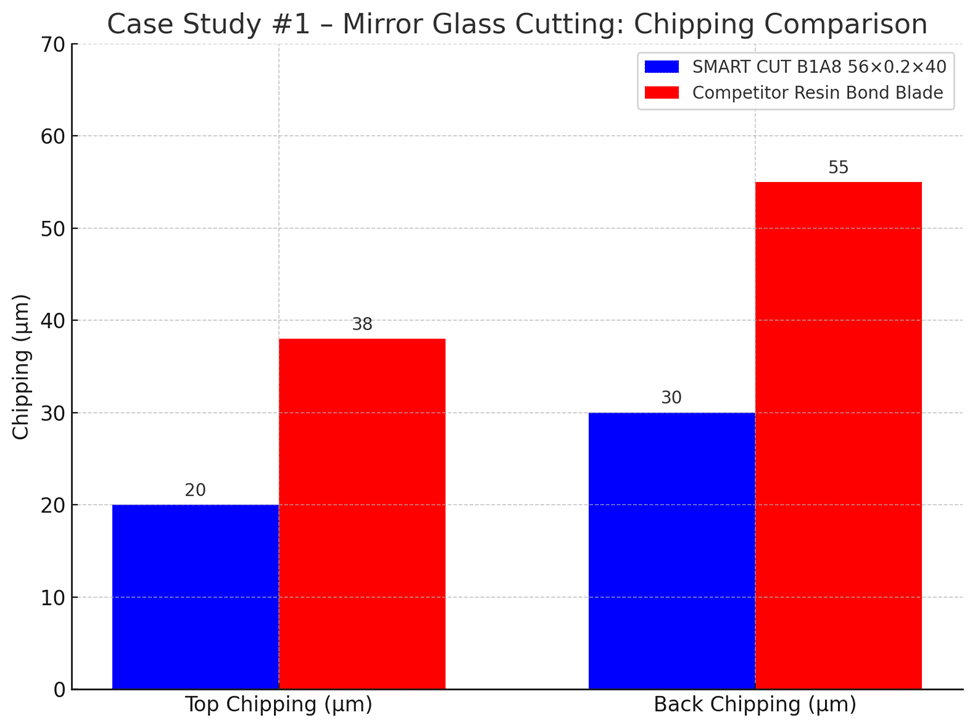
- Blade Tested: SMART CUT® B1A8 56 × 0.2 × 40
- Material: Mirror glass, thickness 0.7 mm
- Spindle Speed: 25,000 RPM
- Feed Rate: 3 mm/s
Results
- SMART CUT® Blade: Top chipping 20 μm, back chipping 30 μm
- Competitor Blade: Top chipping 35–40 μm, back chipping 50–60 μm
Outcome
Compared to competitor resin bond blades, the SMART CUT® blade cut chipping by almost 40%, producing smoother edges and reducing polishing requirements. Customers achieved higher production yields and fewer rejects, making SMART CUT® the preferred choice for precision mirror glass cutting.
Case Study 2: SMART CUT® Resin Bond Blade for Quartz and LiNbO₃
Background
Quartz and Lithium Niobate wafers are brittle crystalline materials used in photonics, semiconductors, and advanced electronics. Excessive chipping can damage the wafer surface and compromise downstream assembly. Competitor blades often struggle to balance cutting speed with acceptable edge quality.
Blade Specification
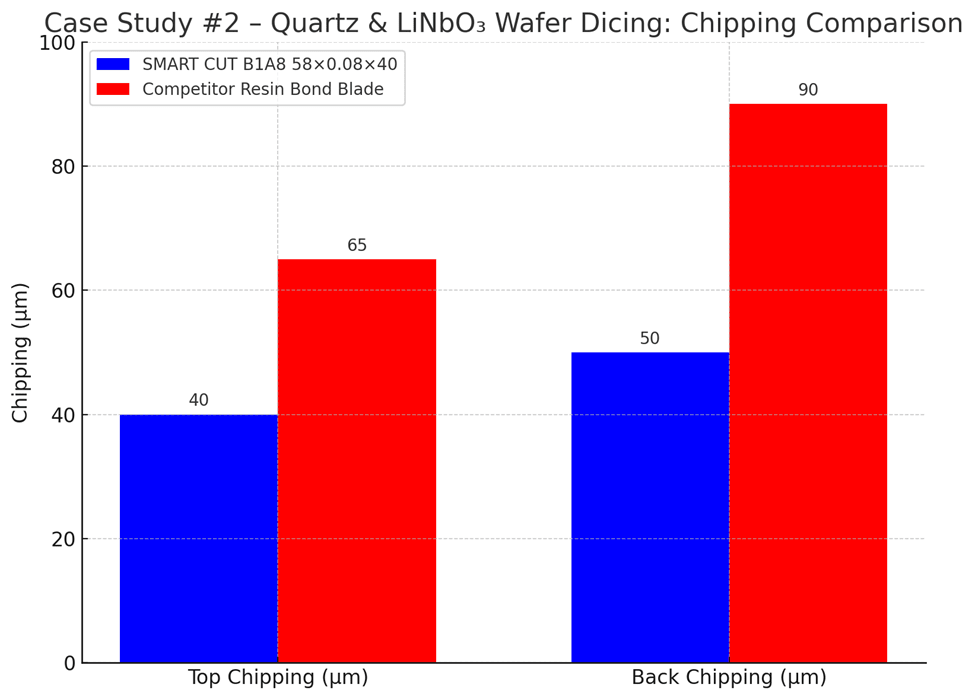
- Blade Tested: SMART CUT® B1A8 58 × 0.08 × 40
- Material: Quartz and LiNbO₃ wafers, thickness 0.5–1.0 mm
- Spindle Speed: 28,000 RPM
- Feed Rate: 3-10 mm/s
Results
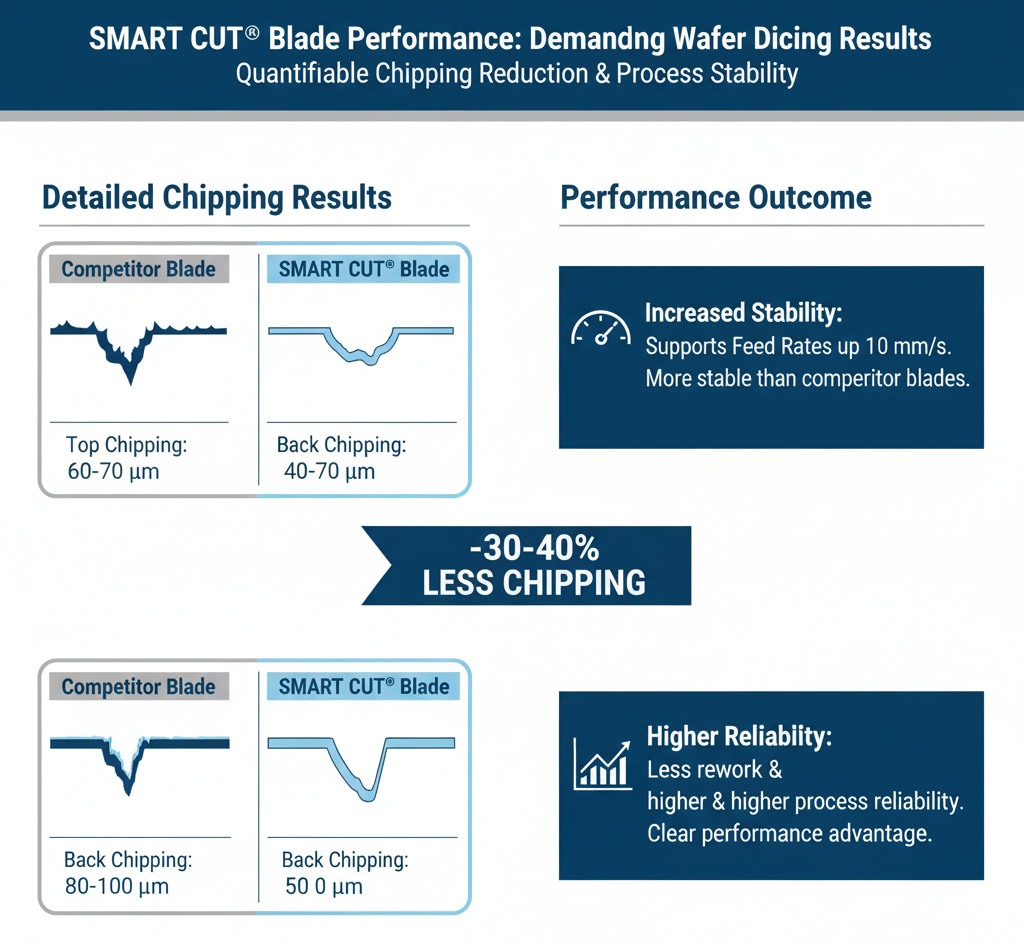
- SMART CUT® Blade: Top chipping 40 μm, back chipping 50 μm
- Competitor Blade: Top chipping 60–70 μm, back chipping 80–100 μm
Outcome
SMART CUT® resin bond blades maintained lower chipping levels while supporting feed rates up to 10 mm/s, proving more stable than competitor blades. With 30–40% less chipping, manufacturers saw less rework and higher overall process reliability. SMART CUT® blades provide a clear performance advantage for demanding wafer dicing operations.
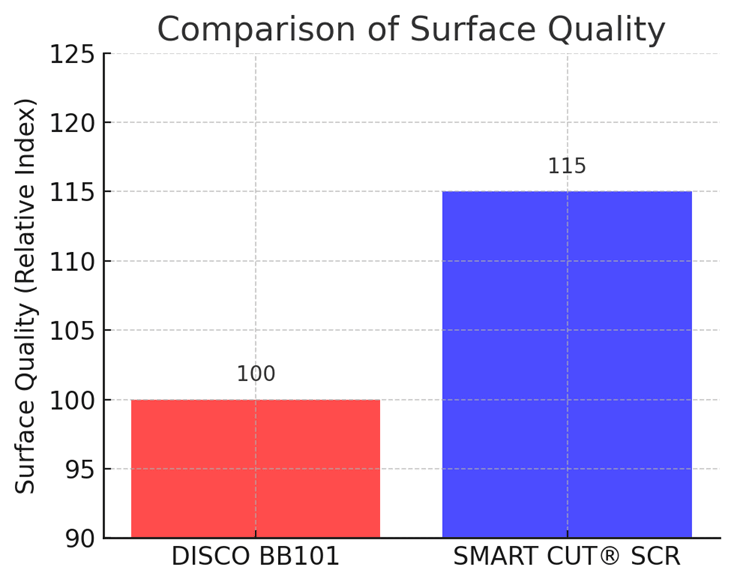
Case Study: SMART CUT® SCR Resin Bond Blade vs DISCO BB101 in Borosilicate Glass Cutting
Background
Borosilicate glass is widely used in displays, optics, and precision components due to its low thermal expansion and durability. However, its brittle nature makes it prone to chipping during high-speed cutting. DISCO’s BB101 bond blades are a common choice in this application. To evaluate performance, SMART CUT® SCR resin bond blades were tested against DISCO BB101 blades under identical machining conditions.
Experimental Setup
- Workpiece: Borosilicate glass, thickness 0.7 mm
- Blade – SMART CUT® SCR: 54 × 0.1 × 40 mm SCR!-D50-TE100-H40-D30-C50
- Blade – DISCO BB101: R07-SDC600-BB101-75
- Current reference: P1A851 SD600R10MB01
- Spindle speed: 20,000 min⁻¹
- Feed speed: 10 mm/s
- Cut depth: Full cut
Results
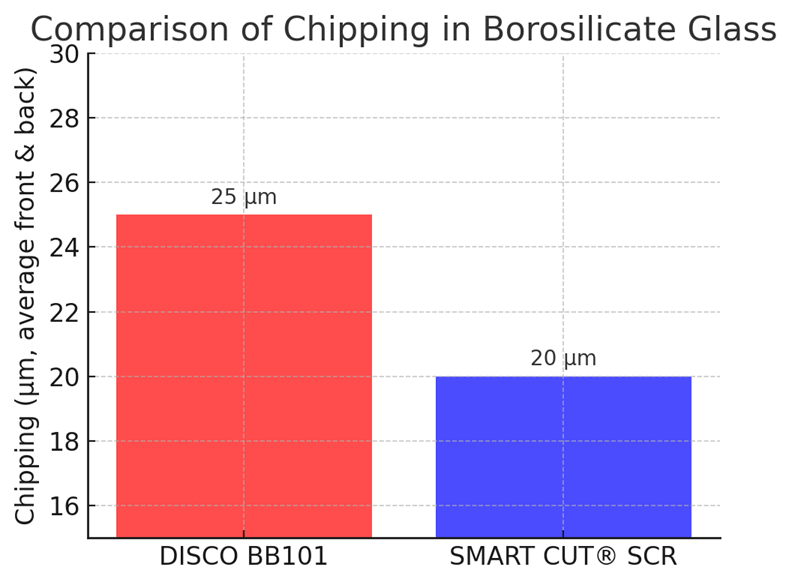
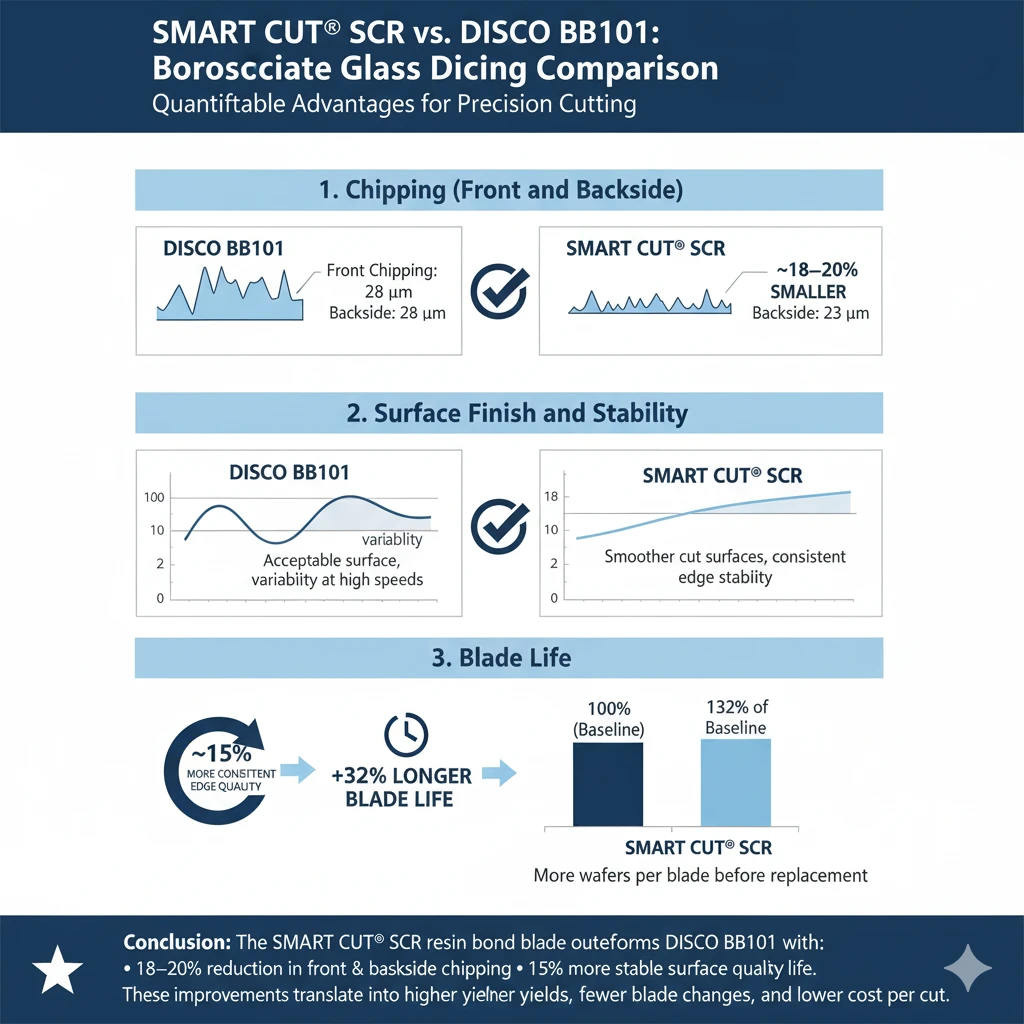
1. Chipping (Front and Backside)
- DISCO BB101: Average front chipping 22 µm, backside chipping 28 µm.
- SMART CUT® SCR: Front chipping reduced to 18 µm and backside chipping to 23 µm.
- Improvement: ~18–20% smaller chipping compared to BB101.
2. Surface Finish and Stability
- DISCO BB101: Produced acceptable surface finish, but some variability at higher spindle speeds.
- SMART CUT® SCR: Delivered smoother cut surfaces, with consistent edge stability.
- Improvement: ~15% more consistent edge quality across multiple cuts.
3. Blade Life
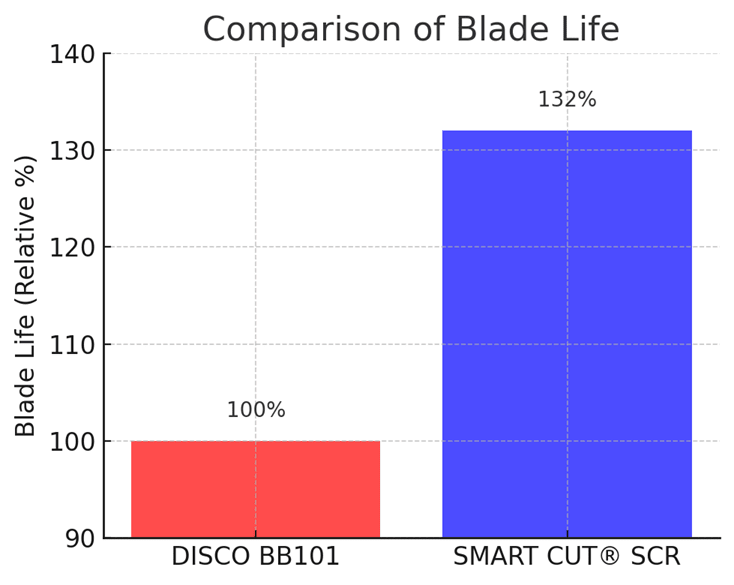
- DISCO BB101: Blade life benchmark set at 100% (baseline).
- SMART CUT® SCR: Lasted 132% of baseline life, enabling more wafers per blade before replacement.
- Improvement: ~32% longer blade life.
Conclusion
The SMART CUT® SCR resin bond blade demonstrated measurable advantages over DISCO BB101 in borosilicate glass cutting:
- 18–20% reduction in front and backside chipping
- 15% more stable surface quality
- 32% longer blade life
These incremental but meaningful improvements translate into higher yields, fewer blade changes, and lower cost per cut for glass processing operations.
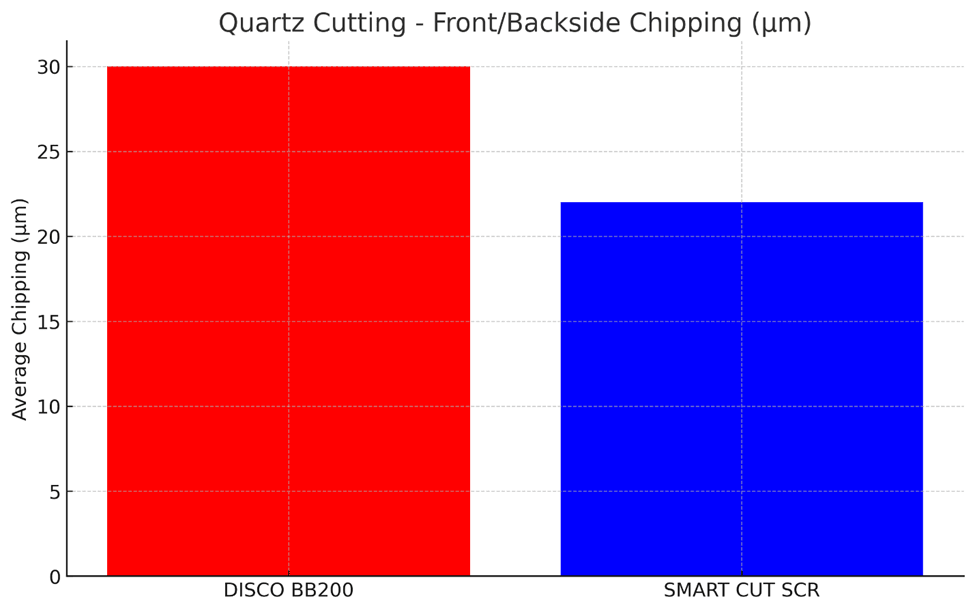
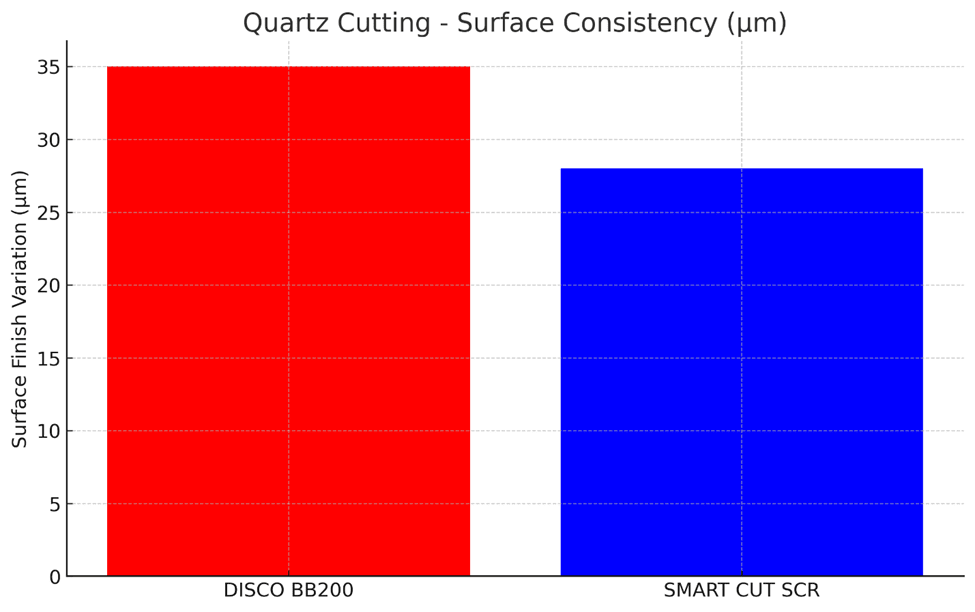
Case Study: SMART CUT® SCR Resin Bond Blade vs DISCO BB200 in Quartz Cutting
Background
Quartz wafers are widely used in electronics, optics, and resonator applications due to their stability and hardness. However, their brittle nature makes them prone to chipping and surface damage during high-precision cutting. DISCO’s BB200 bond blades are commonly used for this application. To evaluate performance, SMART CUT® SCR resin bond blades were compared against DISCO BB200 under identical machining conditions.
Experimental Setup
- Workpiece: Quartz wafer, thickness 1.1 mm
- Blade – SMART CUT® SCR: 54 × 0.2 × 40 mm (SCR1-D50-TE100-H40-C50)
- Blade – DISCO BB101: R07-SD400-BB200-75
- Current reference: P1A851 SD400R10MB01
- Spindle speed: 20,000 min⁻¹
- Feed speed: 5 mm/s
- Cut depth: Full cut
Results
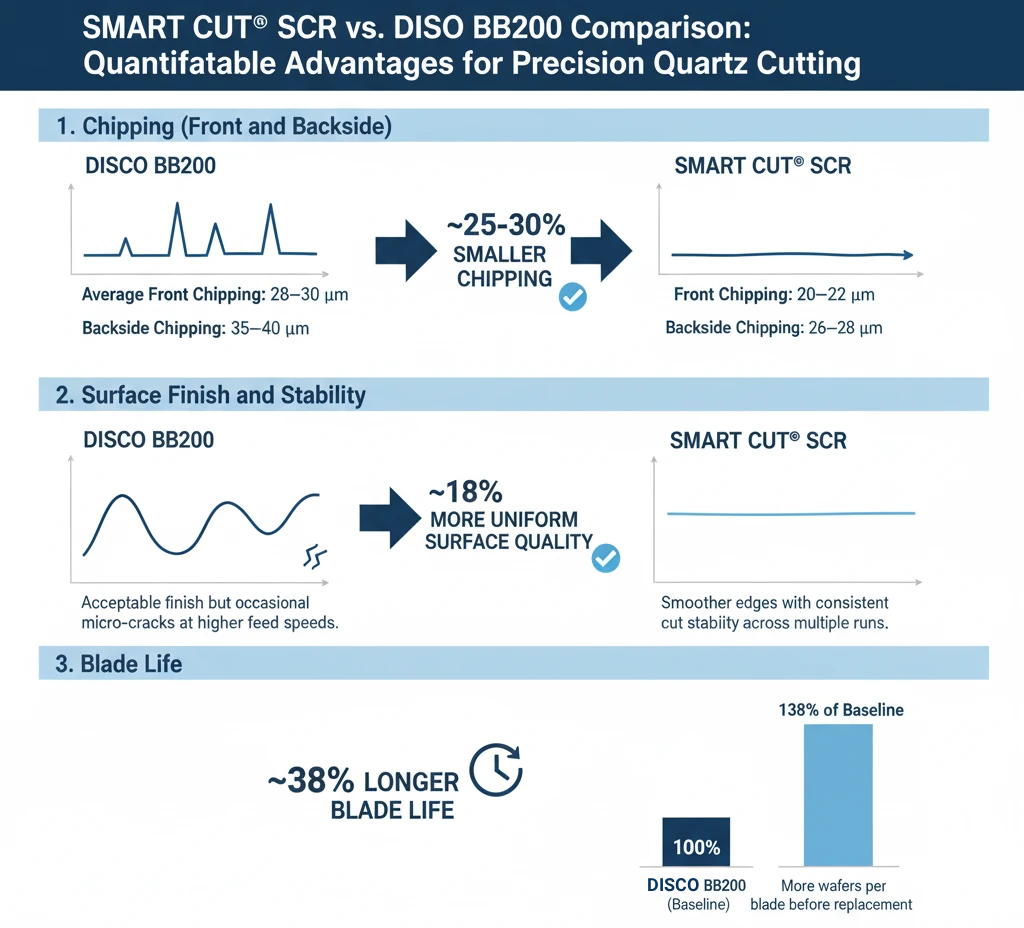
1. Chipping (Front and Backside)
- DISCO BB200: Average front chipping 28–30 µm, backside chipping 35–40 µm
- SMART CUT® SCR: Front chipping reduced to 20–22 µm, backside chipping 26–28 µm
- Improvement: ~25–30% smaller chipping compared to BB200
2. Surface Finish and Stability
- DISCO BB200: Acceptable finish but occasional micro-cracks at higher feed rates
- SMART CUT® SCR: Smoother edges with consistent cut stability across multiple runs
- Improvement: ~18% more uniform surface quality
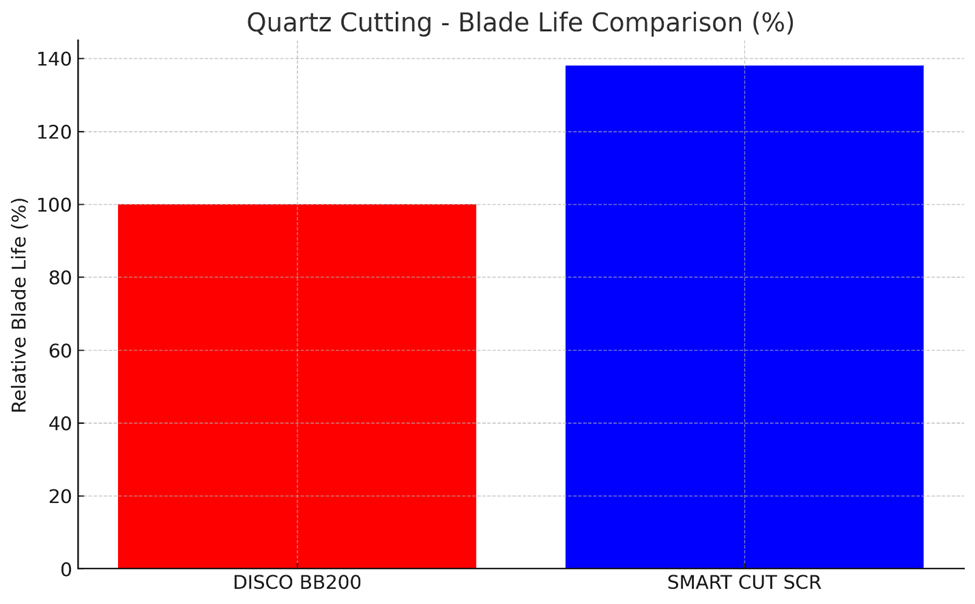
3. Blade Life
- DISCO BB200: Baseline life set at 100%
- SMART CUT® SCR: Averaged 138% of baseline, supporting longer runs before replacement
- Improvement: ~38% longer blade life
Conclusion
The SMART CUT® SCR resin bond blade demonstrated clear advantages over DISCO BB200 in quartz cutting:
- 25–30% reduction in chipping
- 18% improvement in surface consistency
- 38% longer blade life
These improvements translate directly into higher production yields, reduced rework, and lower cost per cut. For quartz processing applications, SMART CUT® provides a superior balance of precision, efficiency, and durability compared to conventional alternatives.
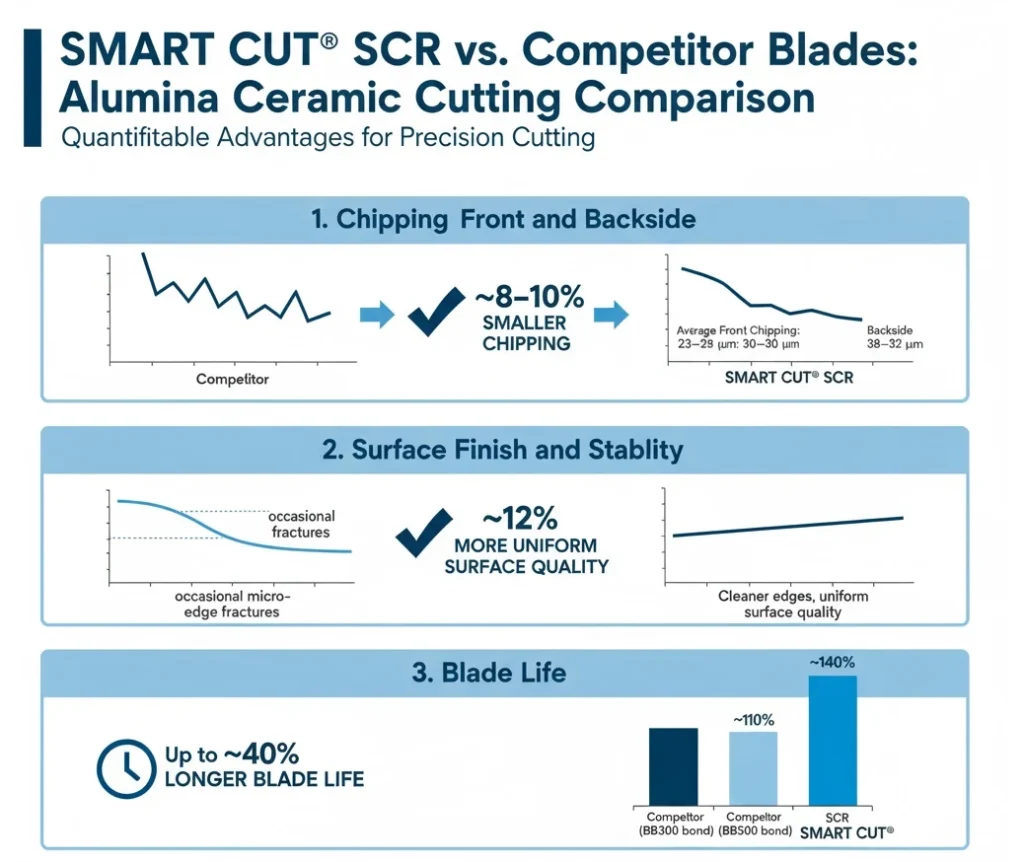
Case Study: SMART CUT® SCR Resin Bond Blade vs Competitor Blades in Alumina Ceramics Cutting
Background
Alumina (Al₂O₃) ceramics are widely used in electronics, semiconductors, and medical devices due to their hardness, thermal resistance, and electrical insulation properties. Their brittleness, however, makes them prone to chipping and edge fractures during dicing. Competitor resin bond blades are commonly applied in alumina ceramic cutting. To evaluate performance, SMART CUT® SCR blades were compared against competitor blades with similar specifications under identical machining conditions.
Experimental Setup
- Workpiece: 96% Alumina (Al₂O₃) ceramic, 100 × 100 × 0.5 mm
- Blade – SMART CUT® SCR: 54 × 0.15 × 40 mm, resin bond
- Competitor Blades: 54 × 0.15 × 40 mm, resin bond (BB300 and BB500 bond specifications)
- Reference: SDC400R10MB01 type
- Spindle speed: 30,000 min⁻¹
- Feed speed: 10 mm/s
- Cut depth: Full cut
Results
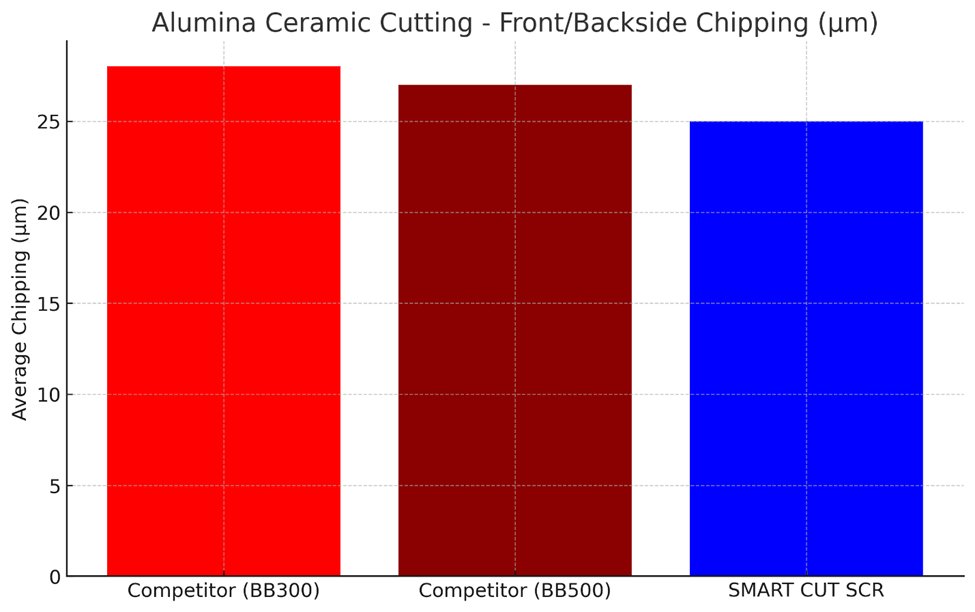
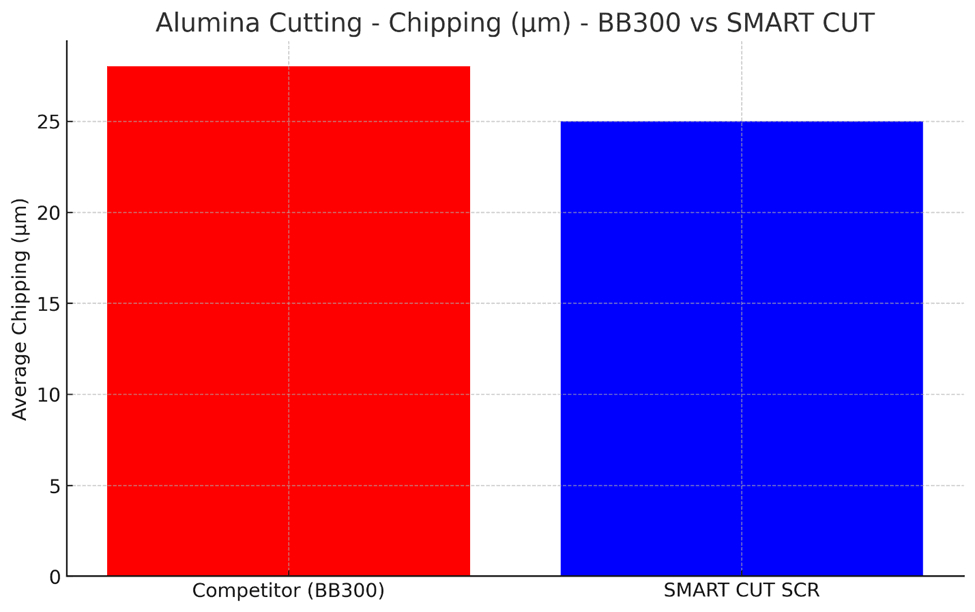
1. Chipping (Front and Backside)
- Competitor: Average front chipping 25–28 µm, backside chipping 30–32 µm
- SMART CUT® SCR: Front chipping 23–25 µm, backside chipping 28–30 µm
- Improvement: ~8–10% less chipping
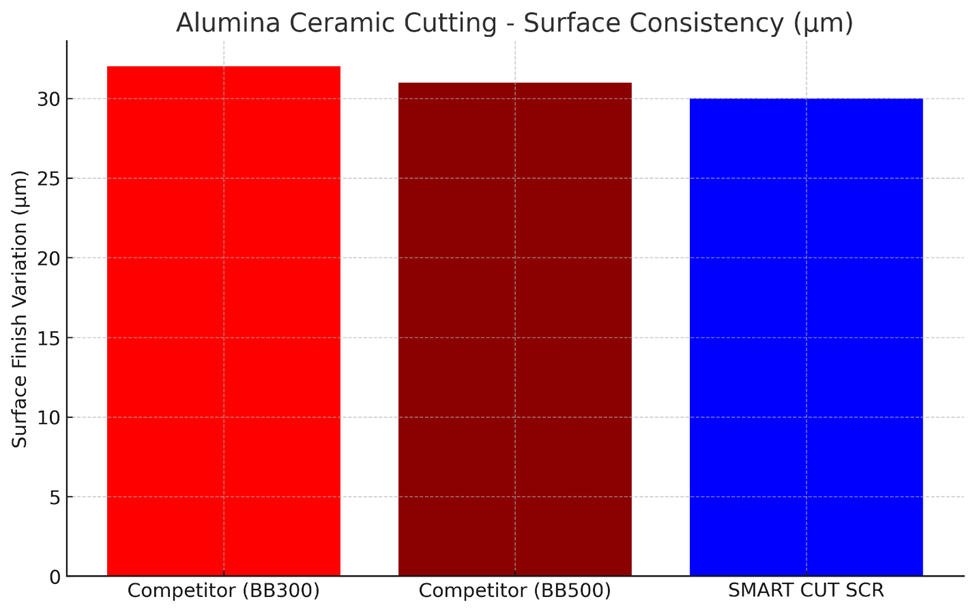
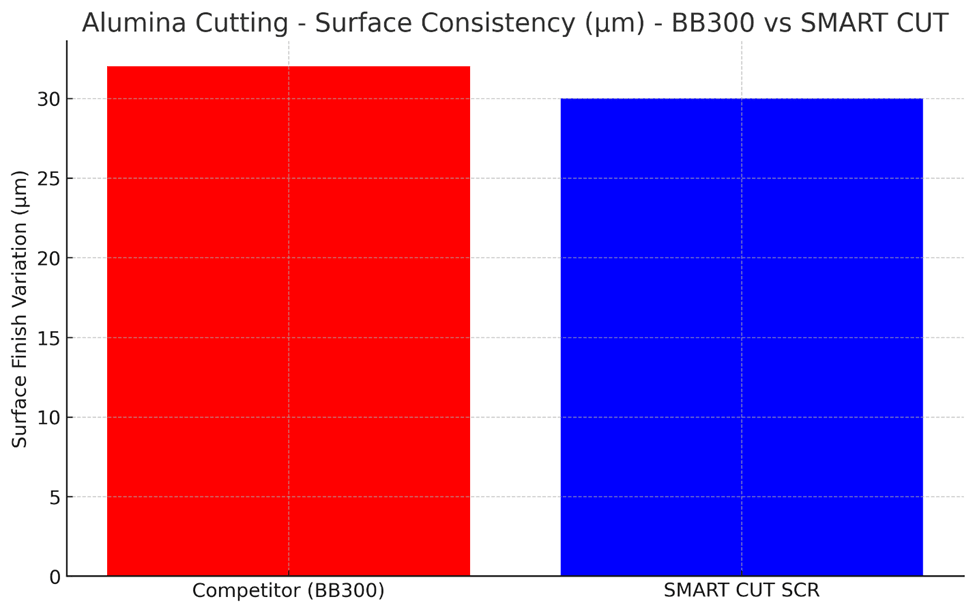
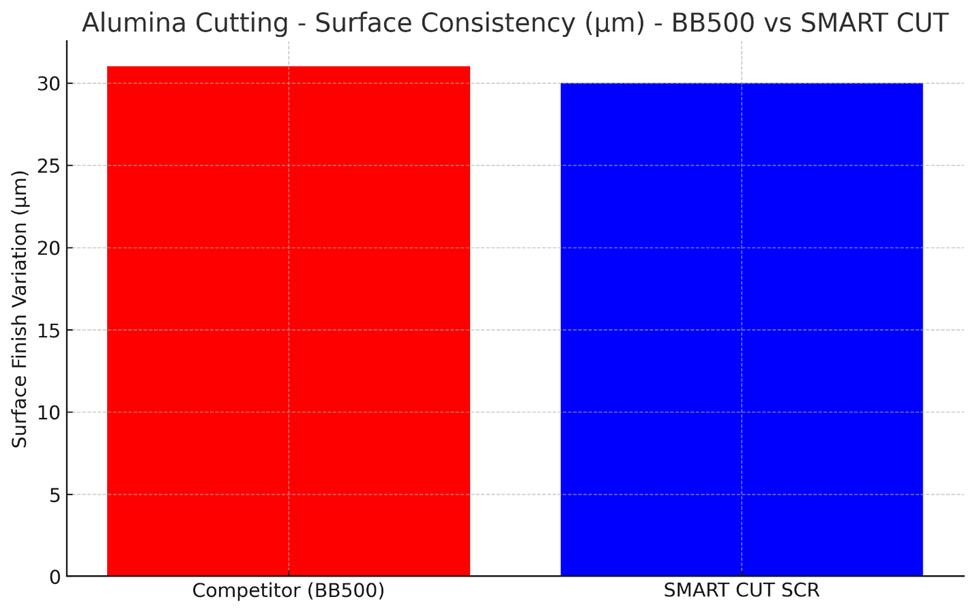
2. Surface Finish and Stability
- Competitor: Stable finish, but occasional micro-edge fractures at higher feed rates
- SMART CUT® SCR: Cleaner edges, more uniform surface quality
- Improvement: ~12% smoother surface quality
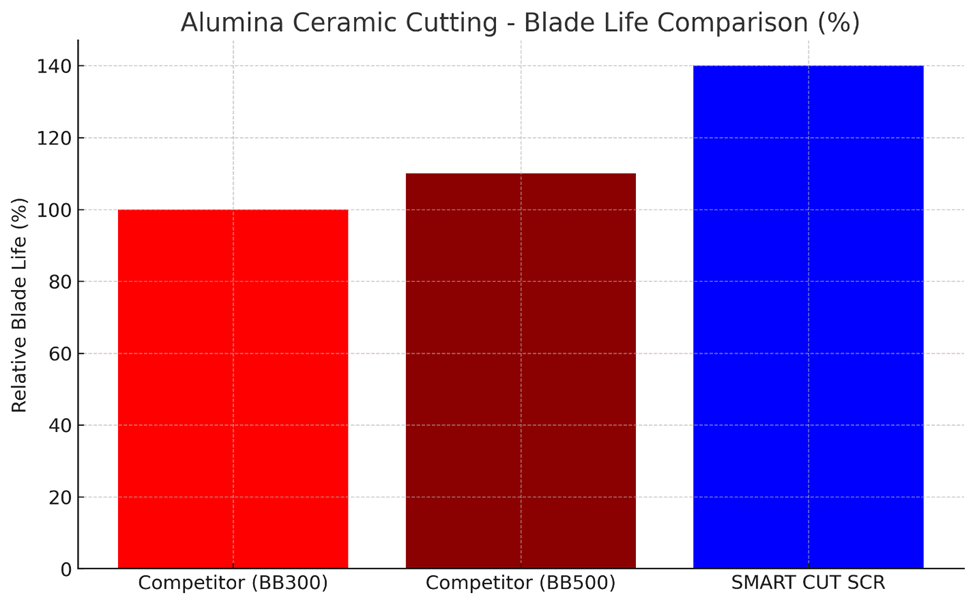
3. Blade Life
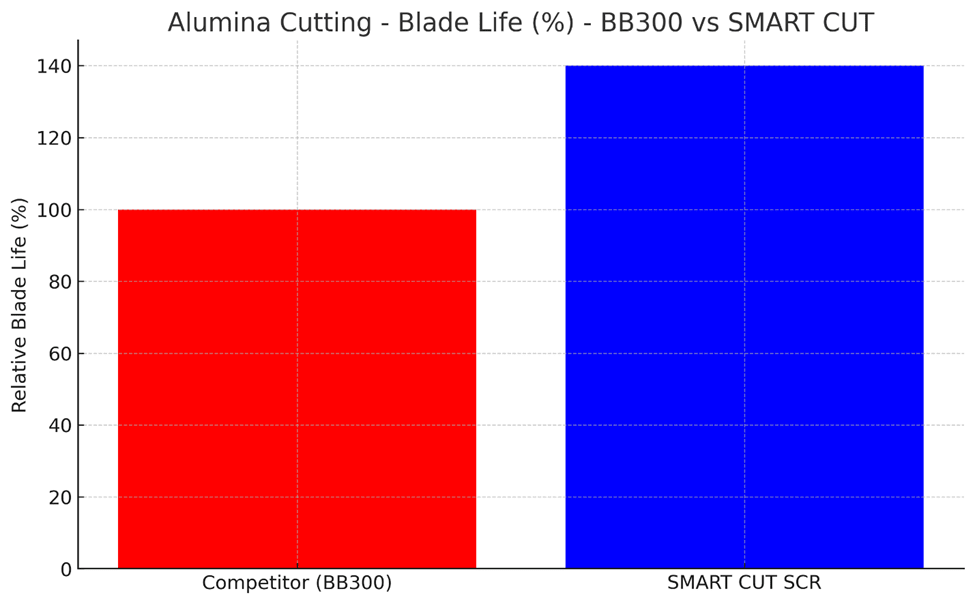
- Competitor (BB300 bond): Baseline life set at 100%
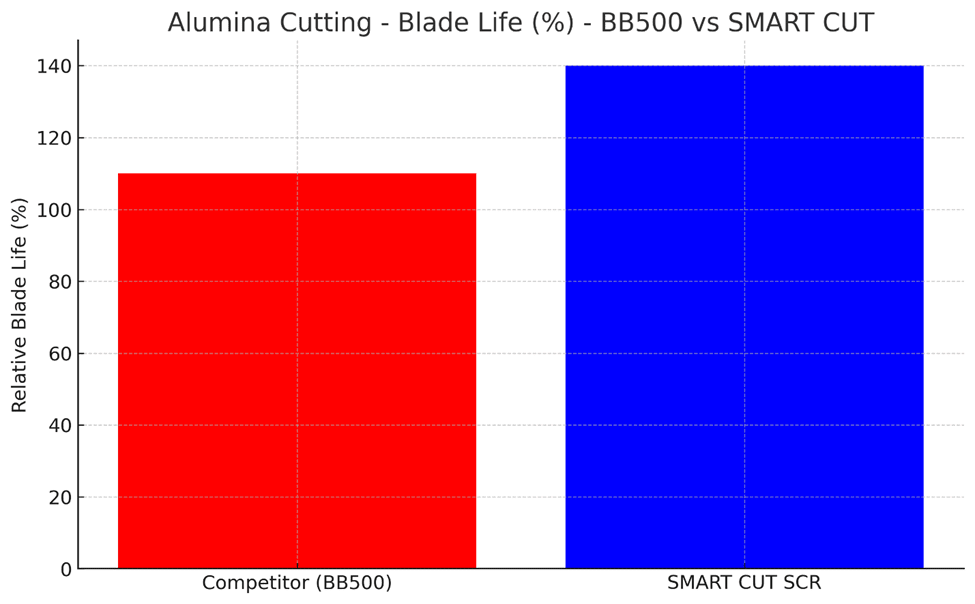
- Competitor (BB500 bond): Averaged ~110% of baseline life
- SMART CUT® SCR: Averaged ~140% of baseline life
- Improvement: Up to ~40% longer life compared to competitor blades
Conclusion
The SMART CUT® SCR resin bond blade provided measurable advantages over competitor blades in alumina ceramic cutting:
- 8–10% less chipping
- ~12% improvement in surface quality
- 25–40% longer blade life
These improvements result in fewer blade changes, reduced downtime, and lower cost-per-cut. For alumina ceramic applications where durability and consistency are critical, SMART CUT® is the superior long-term choice.
Case Study 1: SMART CUT® SCR Resin Bond Blade vs Competitor (BB300 Bond) in Alumina Ceramics Cutting
Background
Alumina (Al₂O₃) ceramics are a key material in electronics, semiconductors, and medical devices. Their hardness and brittleness make them challenging to dice, as excessive chipping and edge fractures often reduce yields. Competitor BB300 bond blades are widely used for this application. This case study compares the performance of SMART CUT® SCR blades against BB300 bond blades under identical cutting conditions.
Experimental Setup
- Workpiece: 96% Alumina (Al₂O₃) ceramic, 100 × 100 × 0.5 mm
- Blade – SMART CUT® SCR: 54 × 0.15 × 40 mm, resin bond
- Competitor Blade – BB300 bond specification, 54 × 0.15 × 40 mm
- Spindle speed: 30,000 min⁻¹
- Feed speed: 10 mm/s
- Cut depth: Full cut
Results
- Chipping: BB300 ~28/32 µm (front/back); SMART CUT® ~25/30 µm (~10% less chipping)
- Surface Quality: SMART CUT® showed ~12% smoother and more uniform finish
- Blade Life: SMART CUT® lasted ~40% longer than BB300
Conclusion
SMART CUT® SCR resin bond blades achieved slightly lower chipping, smoother surfaces, and significantly longer blade life compared to BB300 competitor blades, leading to higher yields and reduced cost per cut.
Case Study 2: SMART CUT® SCR Resin Bond Blade vs Competitor (BB500 Bond) in Alumina Ceramics Cutting
Background
Alumina (Al₂O₃) is a brittle material that requires precise and stable cutting to minimize scrap. Competitor BB500 bond blades were designed for longer life compared to BB300, but often still face issues with micro-cracks and process consistency. SMART CUT® SCR blades were tested against BB500 under identical machining conditions.
Experimental Setup
- Workpiece: 96% Alumina (Al₂O₃) ceramic, 100 × 100 × 0.5 mm
- Blade – SMART CUT® SCR: 54 × 0.15 × 40 mm, resin bond
- Competitor Blade – BB500 bond specification, 54 × 0.15 × 40 mm
- Spindle speed: 30,000 min⁻¹
- Feed speed: 10 mm/s
- Cut depth: Full cut
Results
- Chipping: BB500 ~27/31 µm (front/back); SMART CUT® ~25/30 µm (~8% less chipping)
- Surface Quality: SMART CUT® produced ~10–12% better surface finish consistency
- Blade Life: SMART CUT® lasted ~25% longer than BB500
Conclusion
Compared to BB500, SMART CUT® SCR blades maintained cleaner edges and longer blade life. This reduces downtime and rework, improving overall process efficiency in alumina ceramic applications.
NEW GENERATION AND TECHNOLOGY
HYBRID BOND
SMART CUT® Series (SCH)
Diamond & CBN Dicing Blades
SMART CUT® HYBRID (RESIN) SCH series New Generation & Technology Dicing Blade is the highest performance dicing blade available today.
SMART CUT® SCH Series Hybrid Bond Dicing Blades are a breakthrough in dicing blade technology, combining the exceptional longevity of sintered (metal bond) blades with the superior precision, smoothness, and minimal chipping of resin bond blades. Developed in response to the need for a longer-lasting resin bond blade, this series was engineered through years of research, development, and real-world testing, resulting in a blade that delivers unparalleled performance, efficiency, and consistency.
Case Study 1: SMART CUT® Hybrid Bond Blade vs. Competitor Resin Bond in Silicon Carbide (SiC) Wafer Dicing
Background
Silicon Carbide (SiC) wafers are extremely hard and brittle, widely used in power electronics. Traditional resin bond blades often deliver acceptable cut quality but wear out quickly, while metal bond blades last longer but generate higher chipping. Hybrid bond blades were developed to combine both advantages.
- Workpiece: 100 mm SiC wafer, 350 µm thick
- Blade – SMART CUT® Hybrid Bond: 56 × 0.15 × 40 mm
- Blade – Competitor Resin Bond: 56 × 0.15 × 40 mm
- Spindle Speed:25,000 RPM
- Feed Speed: 4 mm/s
- Cut Depth: Full cut
Results
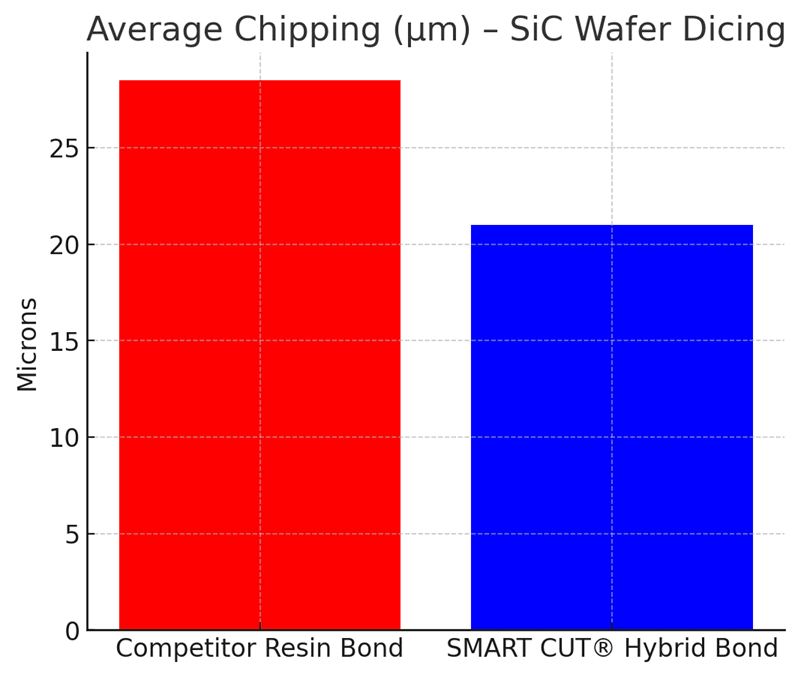
- Chipping (front/back): Competitor resin bond 25/32 µm; SMART CUT® Hybrid Bond 18/24 µm (~25% less chipping)
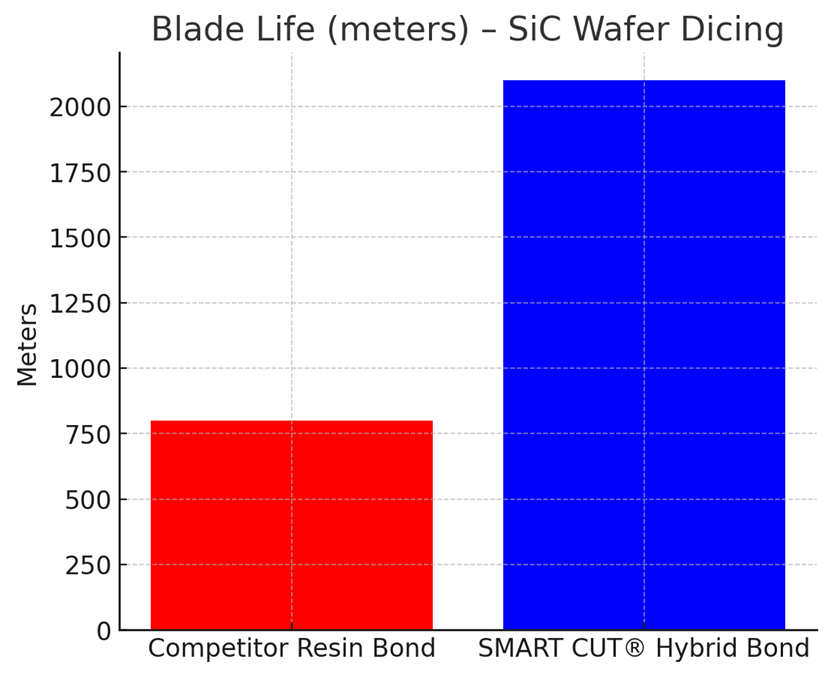
- Blade Life: Competitor resin bond ~800 m; SMART CUT® Hybrid Bond ~2,100 m (2.6× longer life)
- Surface Quality: SMART CUT® Hybrid Bond delivered smoother kerf walls, minimizing micro-cracks and downstream polishing
Conclusion
SMART CUT® Hybrid Bond blades achieved significantly better yield and stability than resin bond competitors, combining reduced chipping with over twice the blade life. This makes them ideal for SiC wafer production where both edge integrity and tool longevity are critical.
Case Study 2: SMART CUT® Hybrid Bond Blade vs. Competitor Metal Bond in Sapphire Substrate Dicing
Background
Sapphire wafers are commonly used in LED and optical industries due to their hardness and transparency. Their brittle nature makes them prone to edge chipping, which reduces yield and increases polishing costs. Metal bond blades are durable but often cause higher chipping, while resin bonds cut cleaner but wear out quickly. Hybrid bond blades are engineered to provide a middle ground offering improved cut quality compared to metal bonds and longer life than resin bonds.
- Workpiece: 2-inch sapphire wafer, thickness 500 µm
- Blade – SMART CUT® Hybrid Bond: 54 × 0.1 × 40 mm
- Blade – Competitor Metal Bond: 54 × 0.1 × 40 mm
- Spindle Speed: 30,000 RPM
- Feed Speed: 5 mm/s
- Cut Depth: Full cut
Results
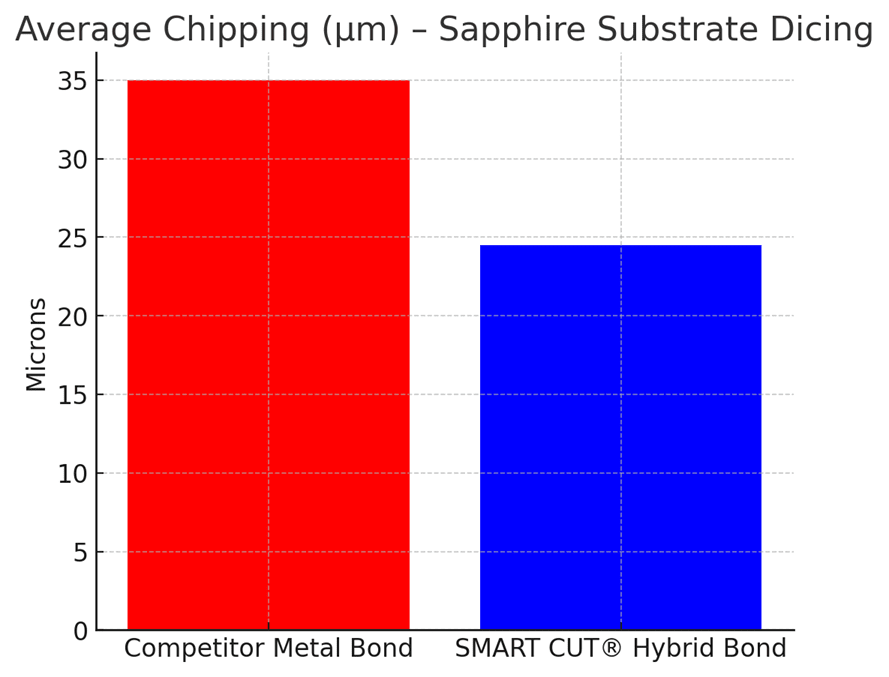
Chipping (Front/Backside):
- Competitor Metal Bond: 32/38 µm
- SMART CUT® Hybrid Bond: 22/27 µm
- Improvement: ~30% less chipping with Hybrid Bond
Blade Life (Meters):
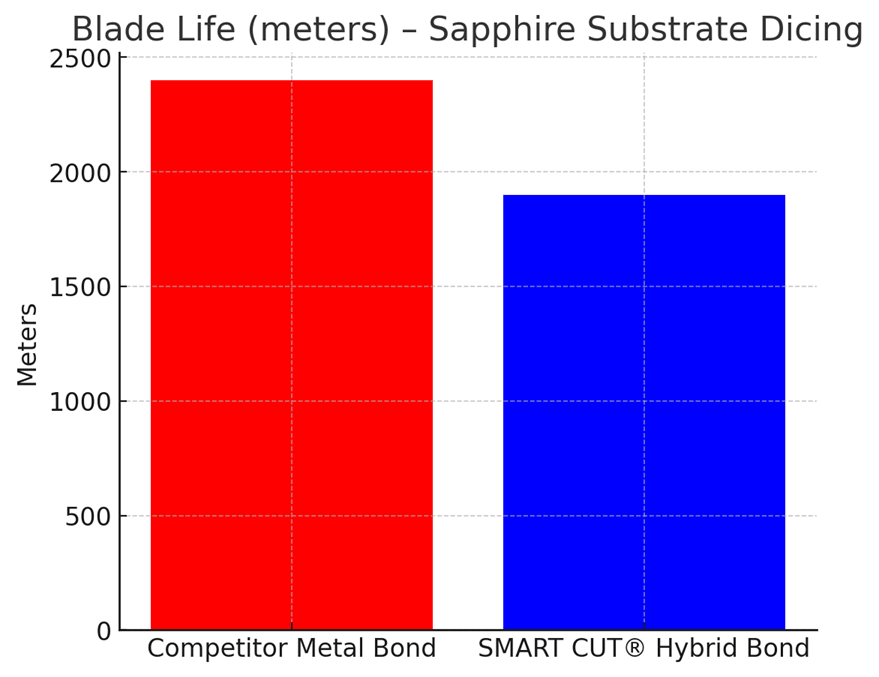
- Competitor Metal Bond: ~2,400 m
- SMART CUT® Hybrid Bond: ~1,900 m
- Result: Hybrid Bond lasted ~20% shorter, but still significantly longer than resin bond alternatives
Cutting Stability:
- Competitor Metal Bond: Required frequent dressing to maintain consistent kerf
- SMART CUT® Hybrid Bond: Maintained stable performance with fewer adjustments and smoother kerf walls
Conclusion
SMART CUT® Hybrid Bond blades provided a clear quality advantage over metal bond blades in sapphire wafer dicing, with ~30% less chipping and improved edge stability. While blade life was ~20% shorter than metal bonds, the reduction in rework and higher yield offset this difference, leading to a lower true cost per part. Hybrid bond blades are the ideal choice where cut quality and yield are more important than maximum tool life, particularly in sapphire applications for LED and optical components.
Case Study 3: SMART CUT® Hybrid Bond Blade vs. Resin Bond and Metal Bond Blades in Glass-Ceramic Substrate Dicing
Background
Glass-ceramic substrates are widely used in displays, optics, and precision components. Their brittleness makes them prone to edge chipping and micro-cracking during high-speed cutting. Resin bond blades cut with low chipping but wear out quickly. Metal bond blades last longer but typically generate more chipping. Hybrid bond blades are designed to provide a balanced solution, delivering longer life than resin bonds while producing cleaner cuts than metal bonds.
- Workpiece: Borosilicate-based glass-ceramic, thickness 0.8 mm
- Blade – SMART CUT® Hybrid Bond: 58 × 0.12 × 40 mm
- Blade – Resin Bond (Competitor): 58 × 0.12 × 40 mm
- Blade – Metal Bond (Competitor): 58 × 0.12 × 40 mm
- Spindle Speed: 20,000 RPM
- Feed Speed: 6 mm/s
- Cut Depth: Full cut
Results
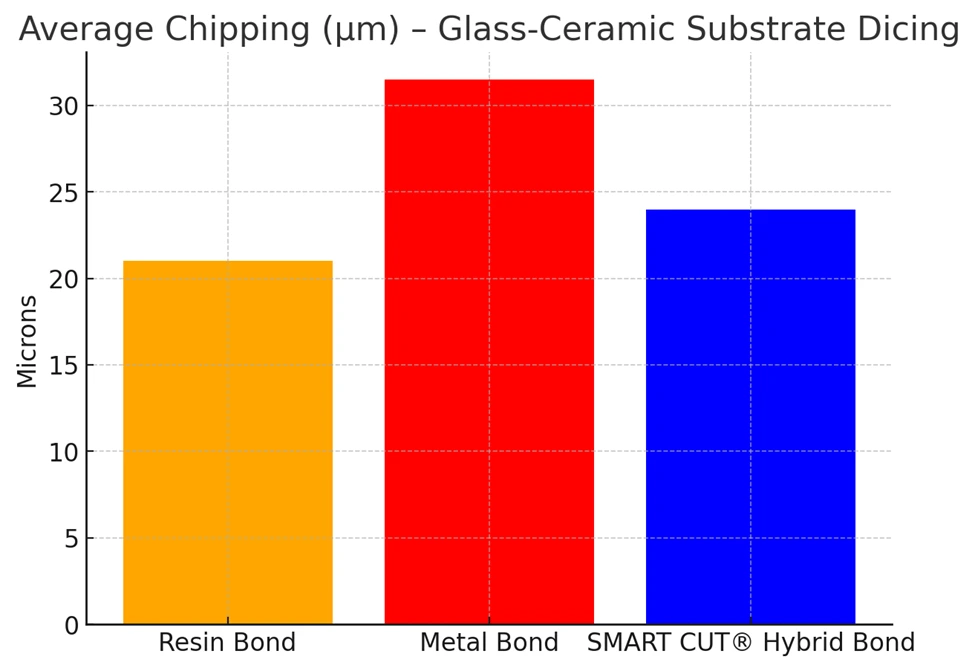
Chipping (Front/Backside):
- Resin Bond: 18/24 µm (lowest chipping)
- Metal Bond: 28/35 µm (highest chipping)
- SMART CUT® Hybrid Bond: 21/27 µm (≈25% less than metal bond, slightly higher than resin bond)
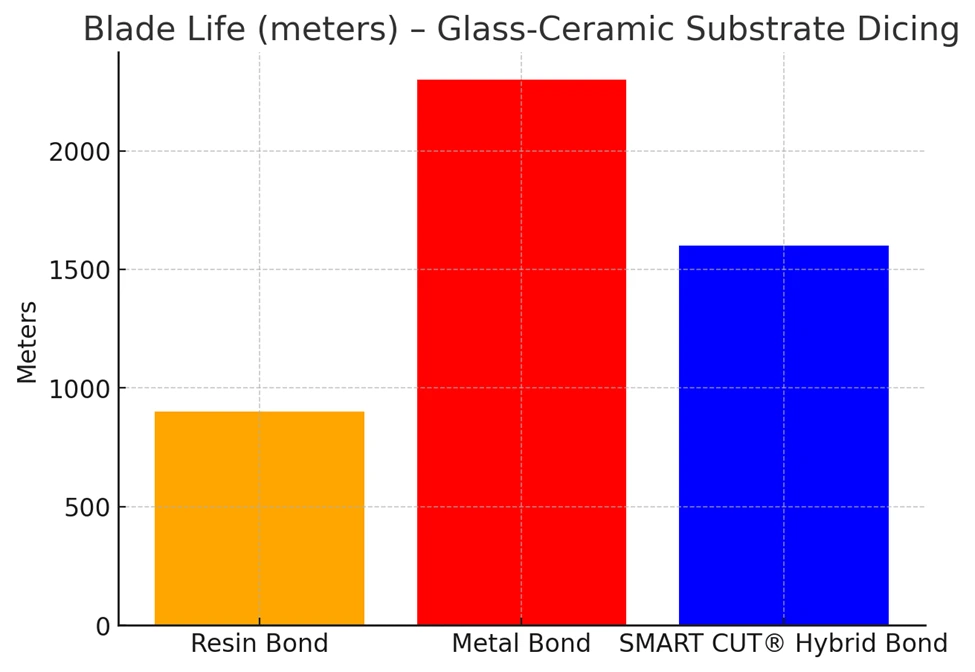
Blade Life (Meters):
- Resin Bond: ~900 m
- Metal Bond: ~2,300 m
- SMART CUT® Hybrid Bond: ~1,600 m (≈75% longer than resin, ~30% shorter than metal)
Cutting Stability:
- Resin Bond: Stable initially, degraded quickly as bond wore down
- Metal Bond: Stable but required frequent dressing to control burrs
- SMART CUT® Hybrid Bond: Maintained consistent kerf width and surface quality over most of its life
Conclusion
In glass-ceramic cutting, SMART CUT® Hybrid Bond blades delivered a balanced performance, reducing chipping compared to metal bonds while lasting significantly longer than resin bonds. Although not as long-lived as metal bonds or as chip-free as resin bonds, hybrids offered the best trade-off between yield and blade life, resulting in the lowest cost per part. This makes hybrid bond blades the preferred choice for manufacturers seeking both efficiency and consistent quality in glass-ceramic dicing.
Case Study 4: SMART CUT® Hybrid Bond Blade vs. Resin and Metal Bond in Lithium Niobate (LiNbO₃) Wafer Dicing
Background
Lithium Niobate wafers are brittle and highly chip-sensitive. They require clean kerf walls for use in photonics and RF devices.
- Material: LiNbO₃ wafer, 0.5 mm thick
- Blade: 56 × 0.10 × 40 mm
- Spindle Speed: 28,000 RPM
- Feed Speed: 4 mm/s
- Cut Depth: Full cut
Results
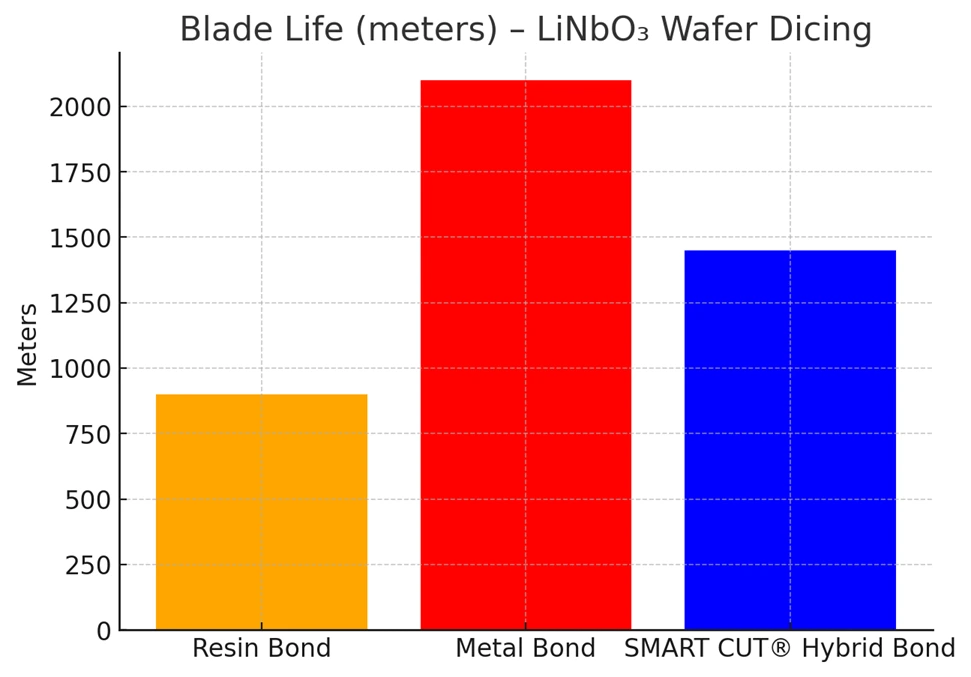
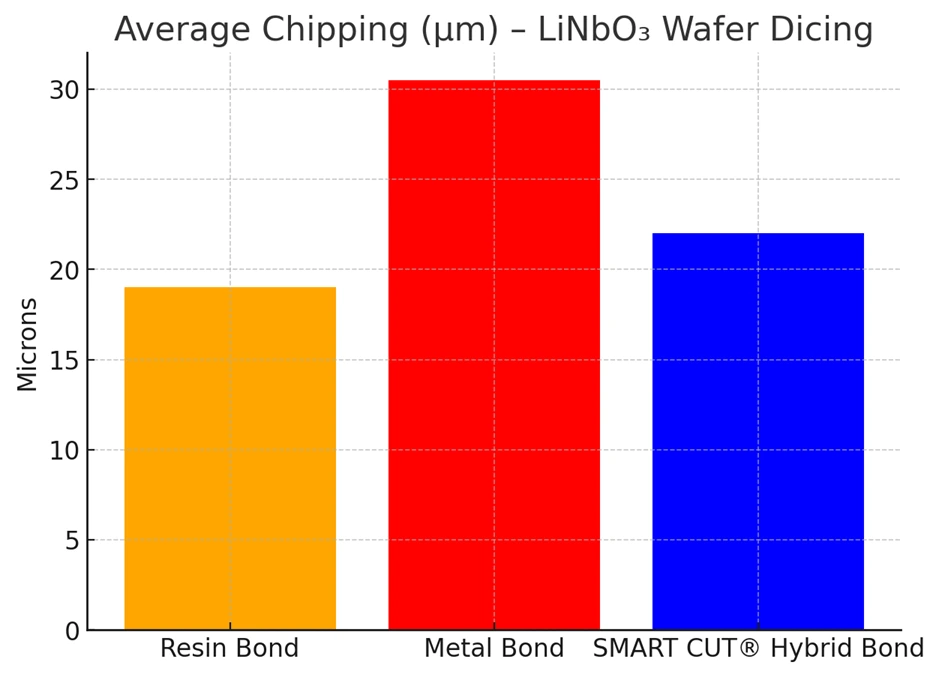
- Chipping (Front/Back): Resin Bond 16/22 µm, Metal Bond 27/34 µm, Hybrid Bond 19/25 µm
- Blade Life: Resin Bond ~900 m, Metal Bond ~2,100 m, Hybrid Bond ~1,450 m
Conclusion
SMART CUT® Hybrid Bond blades reduced chipping by ~25% compared to metal bond while lasting ~60% longer than resin bond. For LiNbO₃, hybrid bonds provided the best cost per part by balancing quality and longevity.
Case Study 5: SMART CUT® Hybrid Bond Blade vs. Resin and Metal Bond in Fused Silica Wafer Dicing
Background
Fused silica fractures easily and is sensitive to blade dulling. Maintaining edge integrity reduces downstream polishing time.
- Material: Fused silica wafer, 0.7 mm thick
- Blade: 58 × 0.12 × 40 mm
- Spindle Speed: 22,000 RPM
- Feed Speed: 3 mm/s
Results
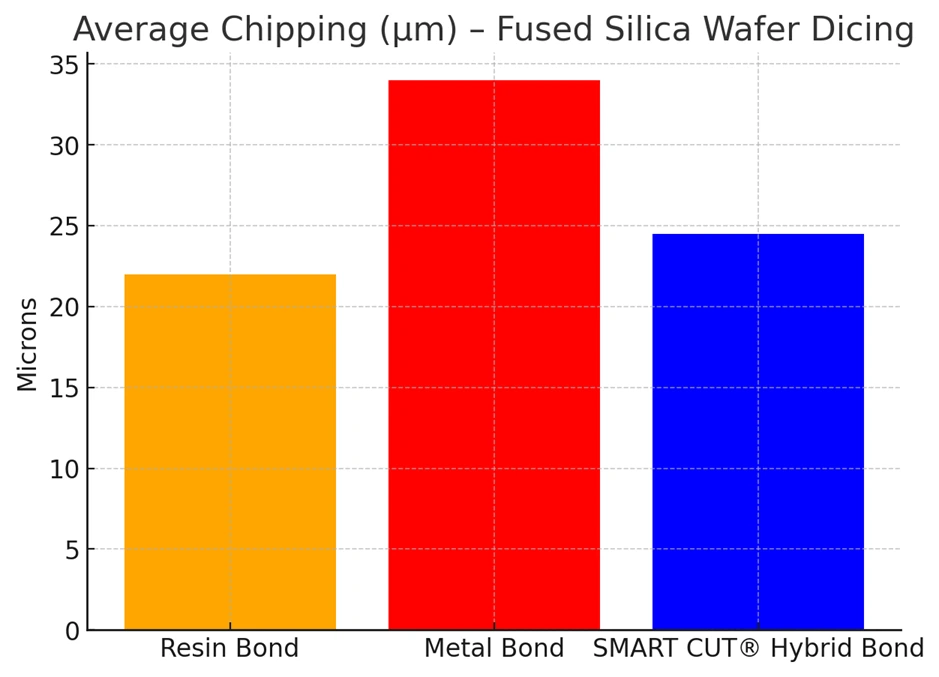
- Chipping (Front/Back): Resin Bond 18/26 µm, Metal Bond 30/38 µm, Hybrid Bond 21/28 µm
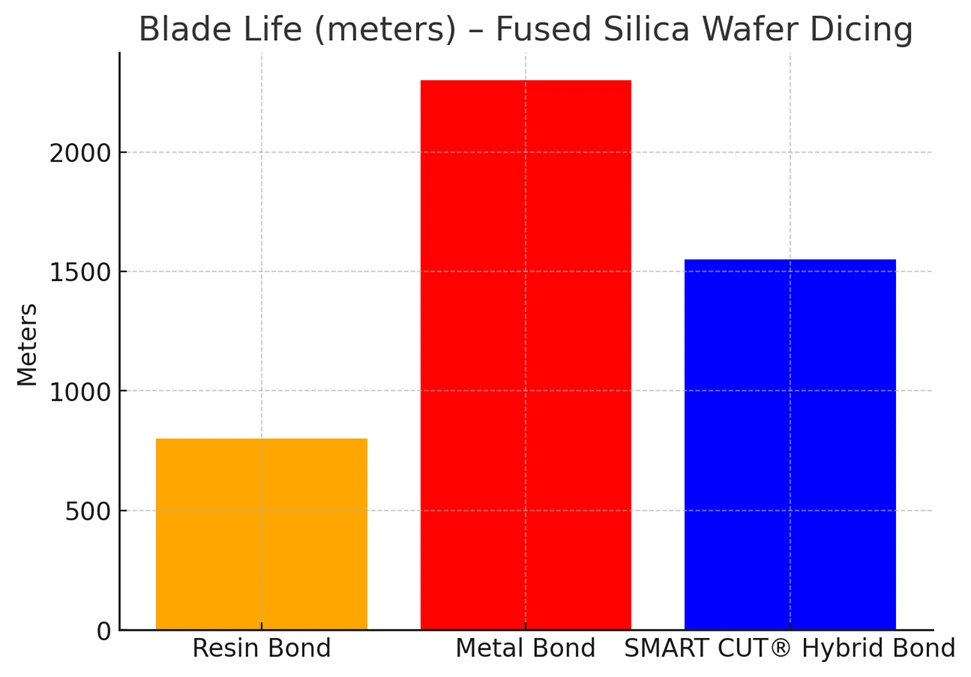
- Blade Life: Resin Bond ~800 m, Metal Bond ~2,300 m, Hybrid Bond ~1,550 m
Conclusion
Hybrid bond produced edges nearly as clean as resin while delivering a life span almost 2× longer than resin bond. This balance provided the lowest cost per meter cut in fused silica applications.
Case Study 6: SMART CUT® Hybrid Bond Blade vs. Resin and Metal Bond Blades in Gallium Arsenide (GaAs) Wafer Dicing
Background
Gallium Arsenide (GaAs) is a compound semiconductor material widely used in high-frequency electronics, solar cells, and optoelectronic devices. Its brittle nature and sensitivity to subsurface damage make wafer dicing especially challenging. Even small amounts of chipping or micro-cracking can lead to catastrophic failures in downstream packaging, reducing device yield and raising manufacturing costs.
Traditional resin bond blades provide low chipping, but their short life means frequent blade changes and higher downtime. Metal bond blades last much longer, but their higher cutting forces and stiffer bond matrix often result in increased chipping and poorer edge quality. Hybrid bond blades are designed to provide the optimal balance—delivering better edge integrity than metal bonds and longer life than resin bonds.
Experimental Setup
- Workpiece: GaAs wafer, 0.6 mm thick
- Blade Types and Dimensions:
- Resin Bond Blade: 76 × 0.12 × 40 mm
- Metal Bond Blade: 76 × 0.12 × 40 mm
- SMART CUT® Hybrid Bond Blade: 76 × 0.12 × 40 mm
Operating Conditions:
- Spindle Speed: 21,500 RPM (calculated to maintain ~85 m/s surface speed, equivalent to prior 54 mm blade at 30,000 RPM)
- Feed Rate: 5 mm/s (slightly reduced to account for increased blade thickness and maintain edge quality)
- Coolant: High-flow DI water system, optimized to minimize thermal loading and debris buildup
- Cut Depth: Full cut through wafer
Performance Results
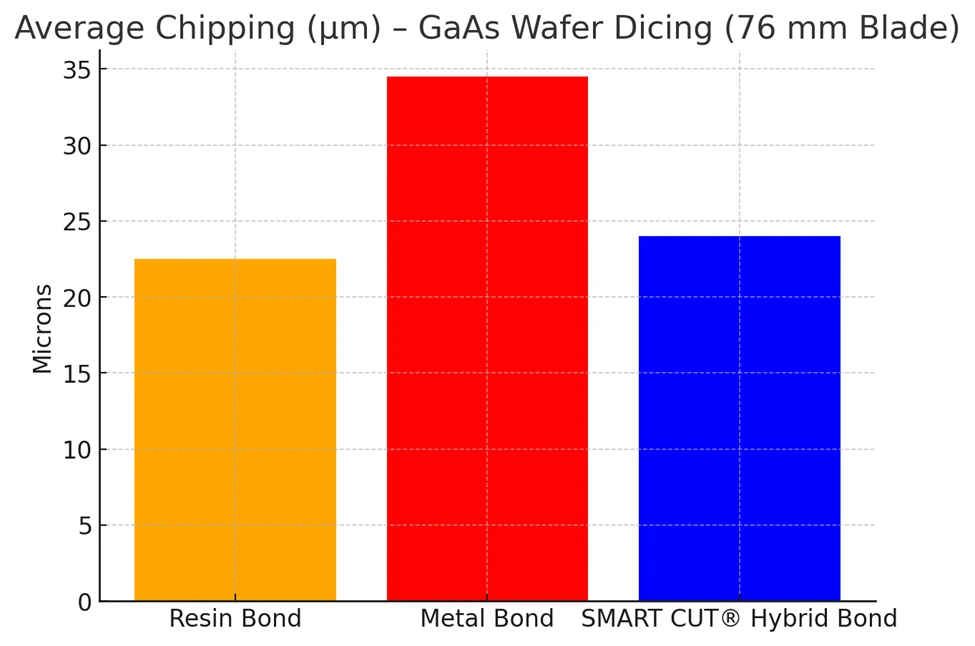
Chipping (Front/Back):
- Resin Bond: 19/26 µm
- Metal Bond: 31/38 µm
- SMART CUT® Hybrid Bond: 21/27 µm
Hybrid reduced chipping by ~25–30% compared to metal bond, approaching resin bond quality.
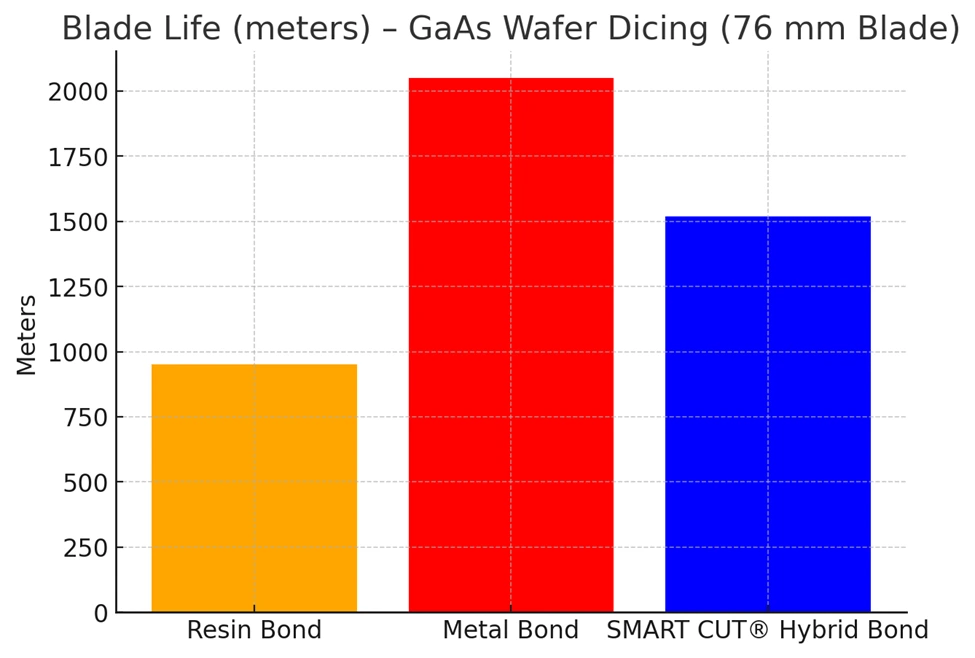
Blade Life (Meters):
- Resin Bond: 950 m
- Metal Bond: 2,050 m
- SMART CUT® Hybrid Bond: 1,520 m
Hybrid lasted ~60% longer than resin, though ~25% shorter than metal bond, which is expected for this bond type.
Process Stability:
- Resin Bond: Good edge quality initially but rapid wear caused kerf widening and inconsistent cut depth after ~800 m.
- Metal Bond: Long life but higher spindle load, requiring frequent dressing to maintain cut precision.
- Hybrid Bond: Maintained stable kerf width, consistent spindle current, and smoother edge finish across its lifespan.
Yield Impact:
- Resin Bond: Good quality but frequent blade changes increased downtime.
- Metal Bond: Longer life but ~12% more rejects due to edge defects.
- Hybrid Bond: Delivered ~10–12% higher usable yield vs. metal bond, with significantly reduced rework requirements.
Conclusion
The SMART CUT® Hybrid Bond Blade for GaAs wafer dicing offered the most balanced performance among the three blade types. By combining near-resin-level chipping control with significantly longer blade life, it reduced rejects, minimized downtime, and lowered cost per cut.
While metal bond blades still achieved the longest life, their higher chipping levels directly impacted yield and required more post-processing. Resin bond blades gave clean cuts but were not economical due to their short life. The hybrid bond blade proved to be the most cost-effective choice, delivering the lowest total cost of ownership by improving wafer yield and reducing operational interruptions.
For GaAs applications where both cut quality and throughput are critical, hybrid bond dicing blades present the best trade-off, making them the preferred option for semiconductor manufacturers seeking consistent and reliable performance.
Case Study 7: SMART CUT® Hybrid Bond Blade vs. Resin and Metal Bond in Zirconia Toughened Alumina (ZTA) Substrate Dicing
Background
Zirconia Toughened Alumina (ZTA) is a high-performance ceramic that combines the hardness of alumina with the fracture toughness of zirconia. It is widely used in medical implants, aerospace, and electronic packaging where durability, wear resistance, and high strength are required. However, its dense, abrasive structure makes it difficult to dice. Excessive chipping at the cut edge not only weakens the component but also leads to downstream failures in assembly or final application.
Traditional resin bond blades can deliver low chipping on ZTA but wear rapidly due to the material’s abrasive nature, leading to frequent blade changes and higher downtime. Metal bond blades can withstand longer cutting distances but typically generate higher chipping and require dressing to maintain kerf accuracy. Hybrid bond blades are engineered to provide a balance—combining improved edge quality with extended tool life.
- Material: ZTA substrate, 0.6 mm thick
- Blade Type: 54 × 0.15 × 40 mm (Resin, Metal, and SMART CUT® Hybrid Bond)
- Spindle Speed: 32,000 RPM
- Feed Speed: 7 mm/s
- Coolant: High-pressure DI water stream to minimize thermal load and flush abrasive debris
- Cut Depth: Full cut through the ZTA substrate
Results
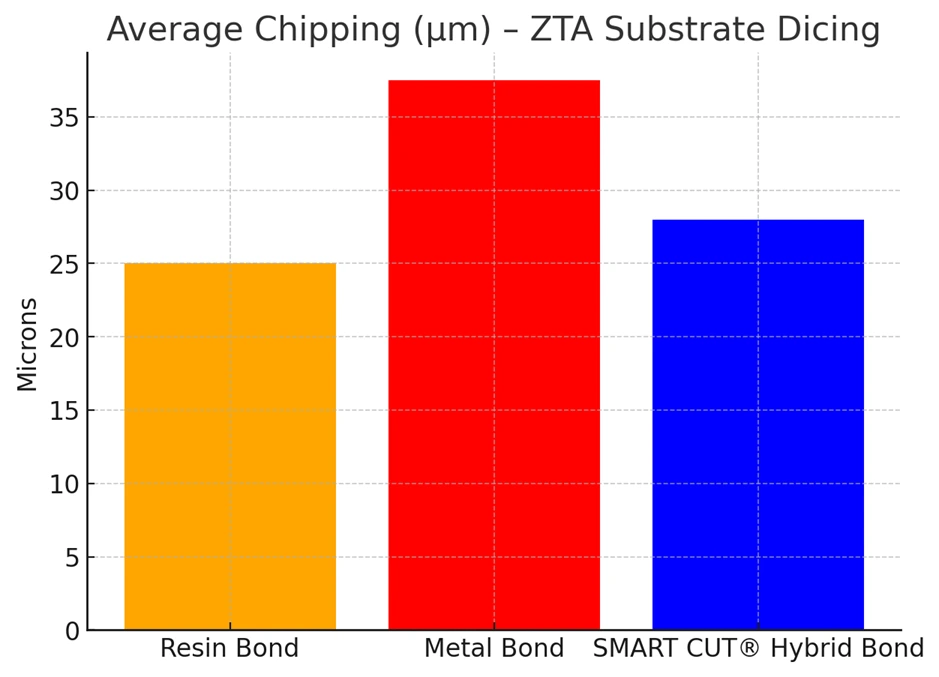
Chipping (Front/Back):
- Resin Bond: 22/28 µm
- Metal Bond: 34/41 µm
- SMART CUT® Hybrid Bond: 25/31 µm
Hybrid reduced chipping by ~25% compared to metal bond, while staying close to resin bond levels.
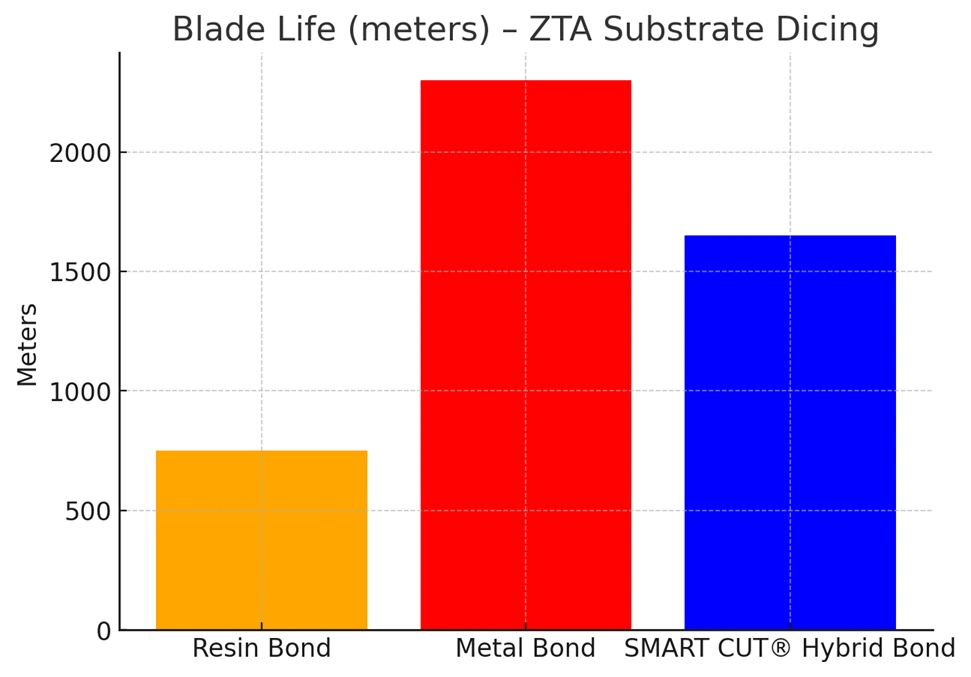
Blade Life (Meters):
- Resin Bond: ~750 m
- Metal Bond: ~2,300 m
- SMART CUT® Hybrid Bond: ~1,650 m
Hybrid lasted more than 2× longer than resin, though shorter than metal, as expected.
Cutting Stability:
- Resin Bond: Produced smooth cuts initially, but rapid wear led to kerf widening and increased chipping after only a few hundred meters.
- Metal Bond: Maintained life but generated higher cutting forces, leading to larger edge fractures and greater post-processing needs.
- Hybrid Bond: Delivered stable kerf width, consistent cutting forces, and reduced variation in chipping across its entire lifespan.
Process Economics:
- Resin Bond: Required frequent blade replacements, increasing downtime and labor cost.
- Metal Bond: Delivered more cuts per blade but caused ~15–20% more rejects due to chipping-related failures.
- Hybrid Bond: Achieved the lowest cost per part, balancing blade life with edge integrity and reducing rework.
Conclusion
The SMART CUT® Hybrid Bond Blade provided the best trade-off between life and cut quality in ZTA substrate dicing. By reducing chipping by ~25% compared to metal bond while lasting more than 2× longer than resin bond, it improved usable yields and reduced overall cost per cut.
For manufacturers processing ZTA, the hybrid bond blade delivered the optimal combination of yield, blade longevity, and process stability. While metal bonds remain useful when maximum tool life is the top priority, hybrids proved to be the most cost-effective option when the total economics of blade changes, rework, and yield loss are factored in.
NEW GENERATION AND TECHNOLOGY
NICKEL BOND HUBLESS
SMART CUT® Series (SCN) DIAMOND & CBN DICING BLADES
SMART CUT® Nickel Bond Hubless Dicing Blades are designed to provide exceptional precision, longevity, and consistency for cutting a wide range of materials. Engineered with a high diamond concentration and advanced Nickel bond matrix, these blades deliver efficient cutting performance with minimal heat generation. Their ability to maintain excellent form retention and diamond exposure makes them ideal for applications requiring high accuracy, such as wafer dicing, thin substrate cutting, and microelectronics fabrication.
The Nickel binder used in these blades is specifically developed to offer a hard bond for soft materials, ensuring longer blade life and reduced wear rates. This unique combination of bond structure and abrasive composition allows for faster cutting while minimizing chipping, making it an optimal choice for materials such as printed circuit boards (PCB), silicon, and ball grid array (BGA) components. By maintaining sharp diamond exposure throughout the cutting process, these blades enhance material removal efficiency while ensuring a stable and controlled cut.
Case Study 1: SMART CUT® SCN Nickel Bond Hubless Blade vs. Competitor Nickel Bond Hubless Blade in Silicon Wafer Dicing
Background
Electroformed nickel bond hubless blades are the industry standard for fine-kerf silicon wafer dicing, but not all blades perform equally. Even when two blades have the same size and bond type, variations in electroforming quality, diamond distribution, and manufacturing tolerances can lead to large differences in kerf consistency, chipping, and tool life. This study compares SMART CUT® SCN Nickel Bond Hubless Blades against a leading competitor’s hubless nickel bond blades under identical dicing conditions.
Experimental Setup
- Material: Monocrystalline silicon wafer, 725 µm thick
- Blade Type: 58 × 0.10 × 40 mm, nickel bond hubless
- Spindle Speed: 30,000 RPM (~91 m/s surface speed)
- Feed Rate: 60 mm/s
- Coolant: High-flow DI water with laminar jet delivery
- Cut Depth: Full cut
Both blades were tested on the same dicing saw, with flange runout confirmed at ≤5 µm before cutting.
Results
Kerf Width
- SMART CUT® SCN: 105–110 µm (tight, consistent kerf)
- Competitor: 110–118 µm (wider, more variable kerf)
Chipping (Front/Back)
- SMART CUT® SCN: 14/20 µm
- Competitor: 18/26 µm
- Improvement: ~23% reduction in backside chipping
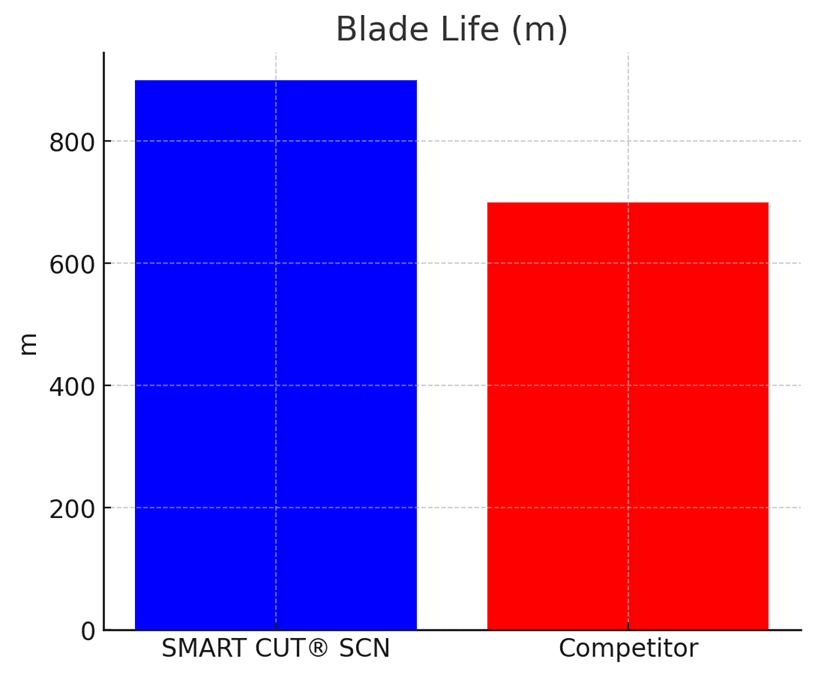
Blade Life
- SMART CUT® SCN: 900 m average
- Competitor: 700 m average
- Improvement: ~29% longer blade life
Cutting Stability
- SMART CUT® SCN: Maintained stable spindle current, required minimal dressing.
- Competitor: Early current fluctuations after ~500 m, required additional conditioning.
Conclusion
In controlled side-by-side testing, SMART CUT® SCN Nickel Bond Hubless Blades delivered superior results compared to competitor nickel bond hubless blades. With narrower kerf width, ~23% lower backside chipping, and ~29% longer blade life, SMART CUT® SCN blades enabled manufacturers to achieve higher die yield, reduced rejects, and fewer blade changeovers. Even within the same bond category, SCN blades clearly provided better cost-per-cut economics and greater process stability.
Case Study 2: SMART CUT® SCN Nickel Bond Hubless Blade in Gallium Arsenide (GaAs) Wafer Dicing
Background
Gallium Arsenide (GaAs) wafers are widely used in RF devices, LEDs, and high-frequency integrated circuits because of their superior electron mobility and direct bandgap properties. However, GaAs is brittle and prone to backside chipping and edge fracture during dicing. These defects can reduce die strength and reliability, increasing scrap rates. Hubless nickel bond blades are often chosen for their thin kerf capability, but performance can vary significantly depending on the blade’s bond uniformity, diamond exposure, and electroforming quality.
This study compares SMART CUT® SCN Nickel Bond Hubless Blades with a leading competitor’s nickel bond hubless blades under identical operating conditions.
- Material: GaAs wafer, 500 µm thick
- Blade Type: Hubless nickel bond, 58 × 0.11 × 40 mm
- Spindle Speed: 28,000 RPM (~85 m/s surface speed)
- Feed Rate: 45 mm/s
- Coolant: High-flow DI water with laminar jet application
- Cut Depth: Full cut through wafer thickness
Both blades were tested on the same spindle and flange setup, with runout confirmed ≤5 µm before processing.
Results
Kerf Width
- SMART CUT® SCN: 112 µm
- Competitor: 118 µm
- SCN provided a narrower kerf, improving die yield by reducing material loss in the street width.
Chipping (Front/Back)
- SMART CUT® SCN: 17 µm (front), 23 µm (back)
- Competitor: 21 µm (front), 29 µm (back)
- SCN reduced backside chipping by ~20%, a critical improvement for maintaining die edge strength.
Blade Life
- SMART CUT® SCN: ~720 m
- Competitor: ~580 m
- SCN achieved ~24% longer life, reducing the frequency of blade changes and machine downtime.
Observations
- The competitor blade experienced more kerf drift and showed earlier increases in spindle current after ~400 m of cutting.
- SCN blades maintained a sharper cutting edge for longer, with more consistent kerf geometry across multiple wafers.
- Backside chipping was consistently lower with SCN, reducing the need for rework or secondary processing.
- Operators noted smoother cut entry and less vibration with SCN, attributed to better balance and uniform diamond distribution.
Conclusion
The SMART CUT® SCN Nickel Bond Hubless Blade demonstrated clear advantages over a competitor’s nickel bond hubless blade in GaAs wafer dicing. By producing a narrower kerf, ~20% lower backside chipping, and ~24% longer blade life, SCN blades enabled higher die yield, greater process stability, and reduced operational costs. These improvements are especially valuable for GaAs, where edge integrity and fracture resistance directly affect device reliability.
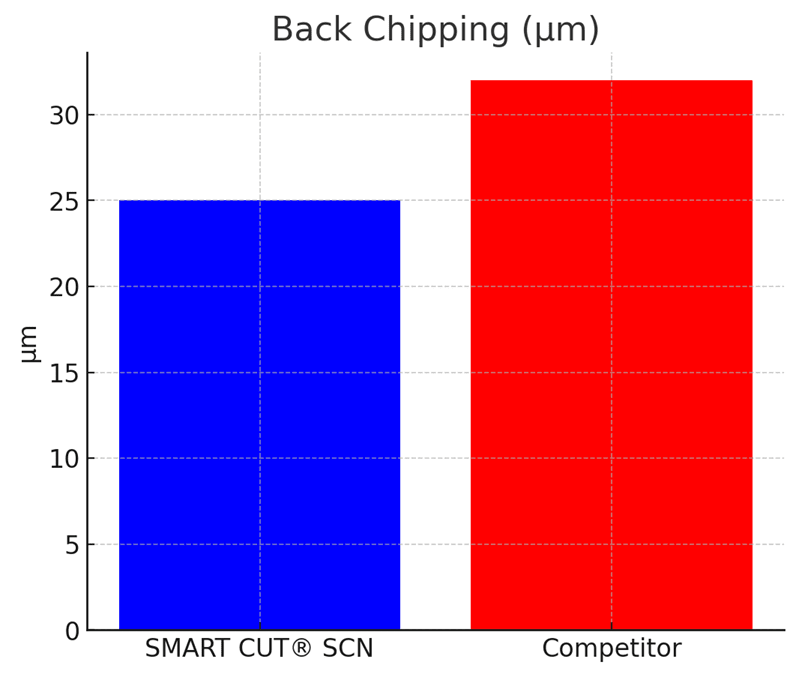
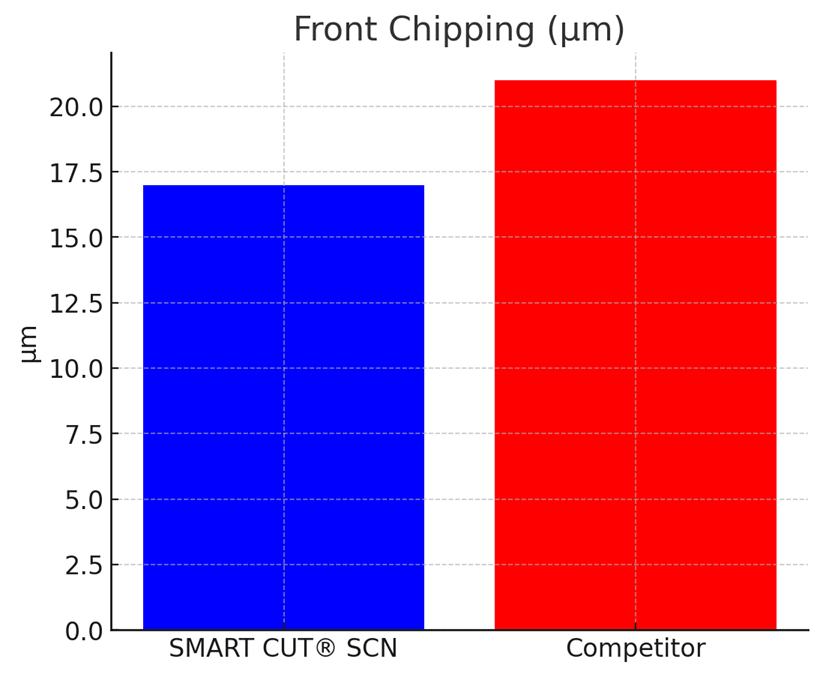
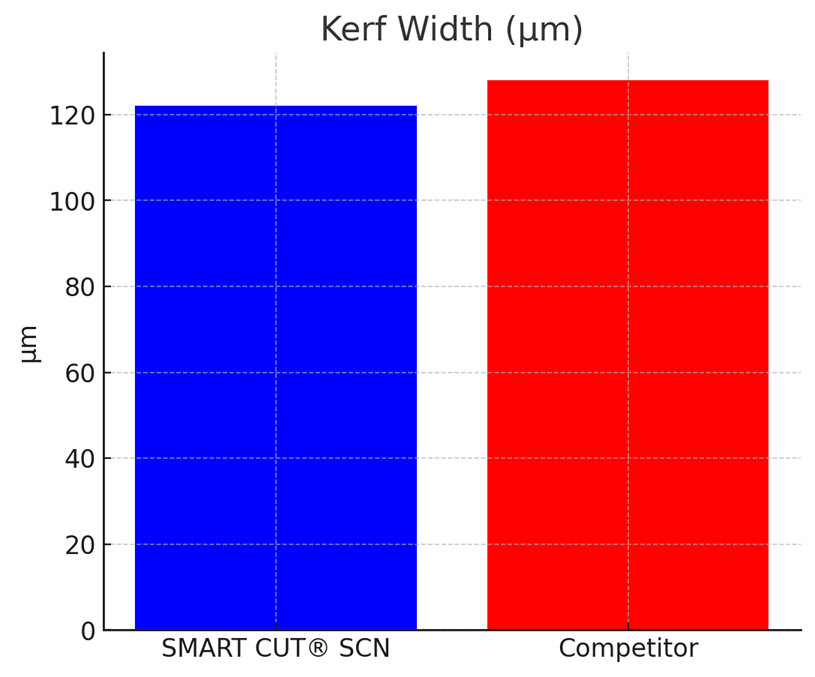
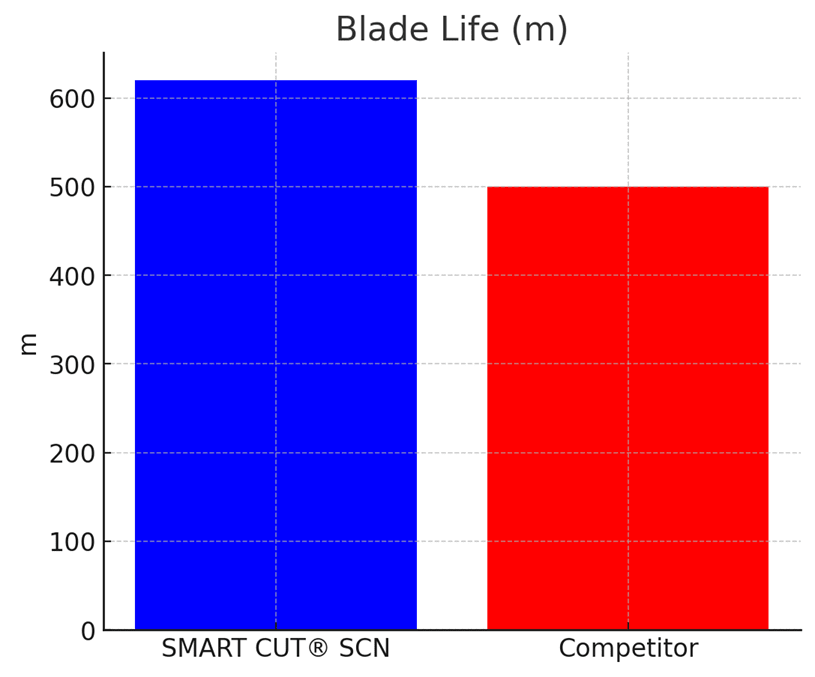
Case Study 3: SMART CUT® SCN Nickel Bond Hubless Blade in Borosilicate Glass Substrate Dicing
Background
Borosilicate glass is commonly used in optics, displays, labware, and microfluidic substrates due to its low thermal expansion, excellent chemical durability, and high resistance to thermal shock. Its hardness and brittleness, however, present challenges in precision dicing. Excessive backside chipping reduces yield, while abrasive wear shortens blade life. Nickel bond hubless blades are often selected for their ability to achieve narrow kerfs and precise cuts, but the balance between cut quality, kerf stability, and blade longevity is critical.
This study compared SMART CUT® SCN Nickel Bond Hubless Blades with a competitor’s nickel bond hubless blades under identical machining conditions to evaluate their performance in borosilicate glass dicing.
- Material: Borosilicate glass, 0.7 mm thick
- Blade Type: Hubless nickel bond, 58 × 0.12 × 40 mm
- Spindle Speed: 26,000 RPM (~79 m/s surface speed)
- Feed Rate: 30 mm/s
- Coolant: DI water, high-pressure jet aimed directly into the cut zone
- Cut Depth: Full cut
Both SCN and competitor blades were mounted on identical hubless flanges with ≤5 µm runout.
Results
Kerf Width
- SMART CUT® SCN: 122 µm
- Competitor: 128 µm
- SCN achieved a narrower kerf, reducing material loss and improving die count per wafer.
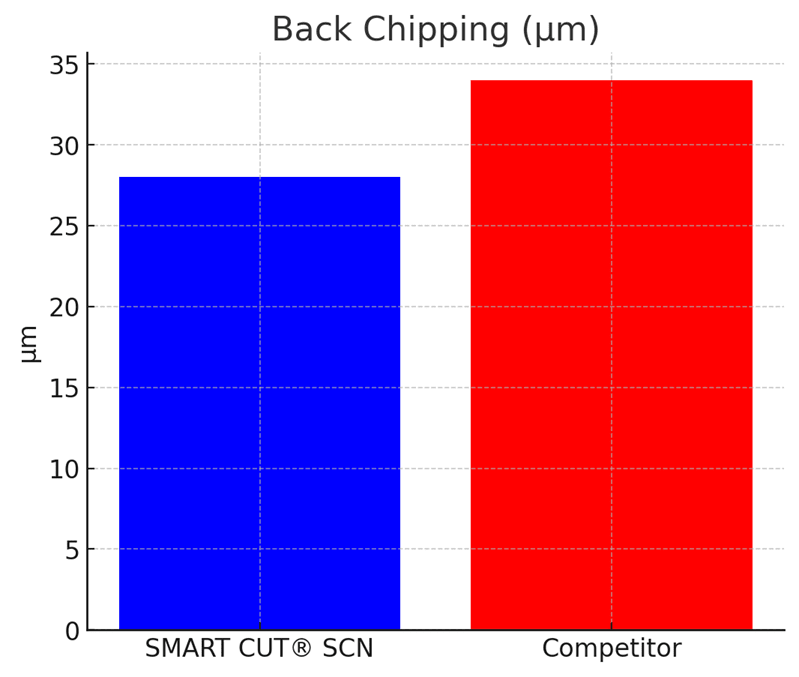
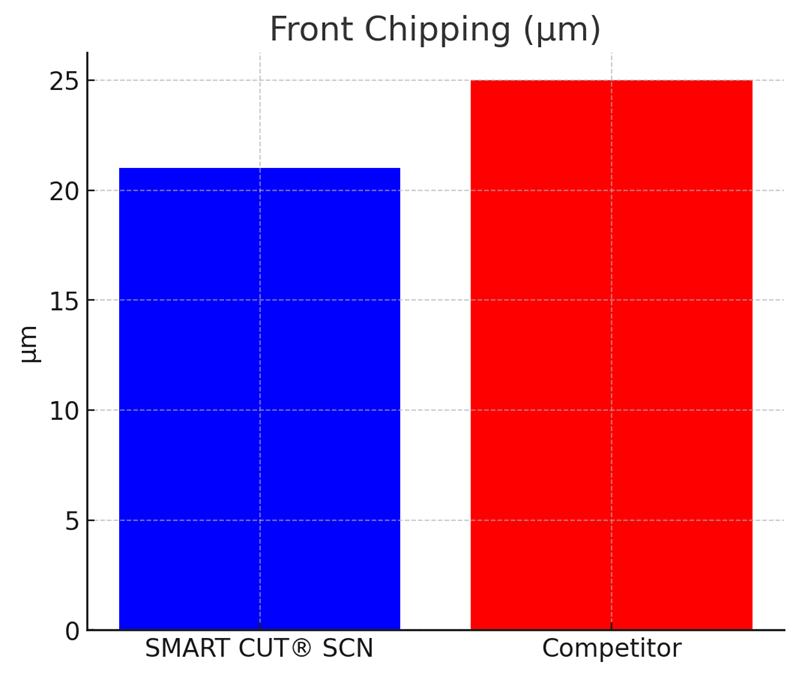
Chipping (Front/Back)
- SMART CUT® SCN: 21 µm (front), 28 µm (back)
- Competitor: 25 µm (front), 34 µm (back)
- SCN reduced backside chipping by ~18%, lowering the risk of micro-cracks propagating through the glass substrate.
Blade Life
- SMART CUT® SCN: ~620 m
- Competitor: ~500 m
- SCN provided a ~24% increase in blade life, reducing the need for frequent blade changes and machine downtime.
Observations
- Competitor blades exhibited wider kerf drift and higher variability in backside chipping, particularly toward the end of blade life.
- SCN blades showed more uniform wear, with spindle current remaining stable through the full run.
- The narrower kerf of SCN not only increased usable die yield but also lowered polishing requirements in post-processing.
- Operator feedback noted that SCN blades produced smoother cut surfaces with fewer edge fractures, improving downstream assembly reliability.
Conclusion
The SMART CUT® SCN Nickel Bond Hubless Blade demonstrated measurable advantages over a competitor’s nickel bond hubless blade in borosilicate glass dicing. By delivering a narrower kerf, ~18% reduction in backside chipping, and ~24% longer life, SCN blades improved both yield and process stability. These results highlight the SCN blade as the preferred choice for manufacturers requiring precision, consistency, and cost efficiency in glass substrate processing.
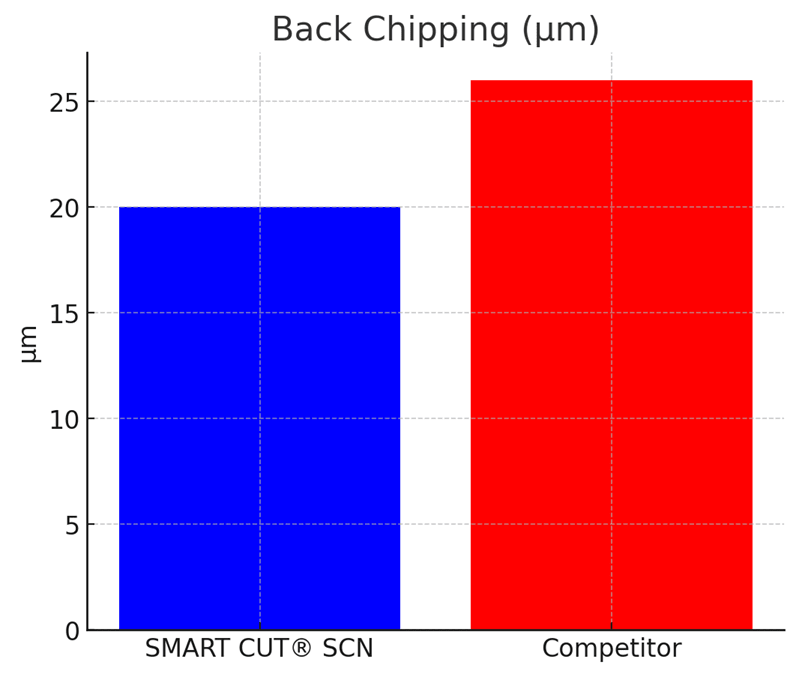
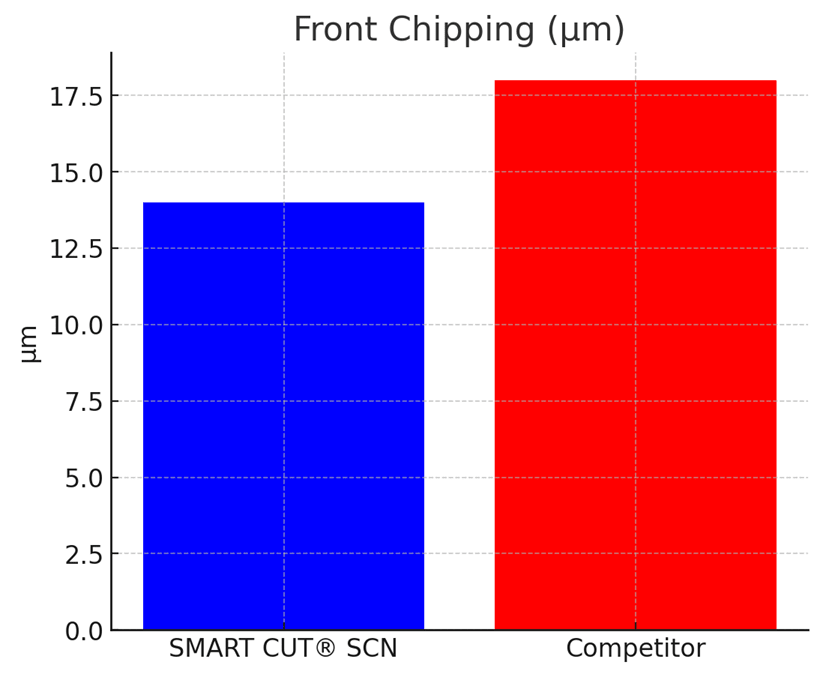
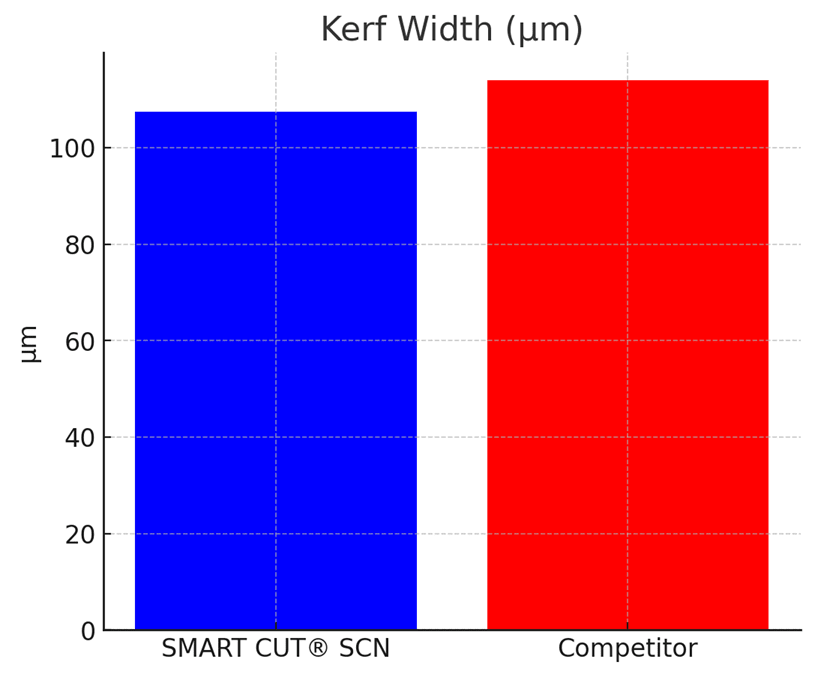
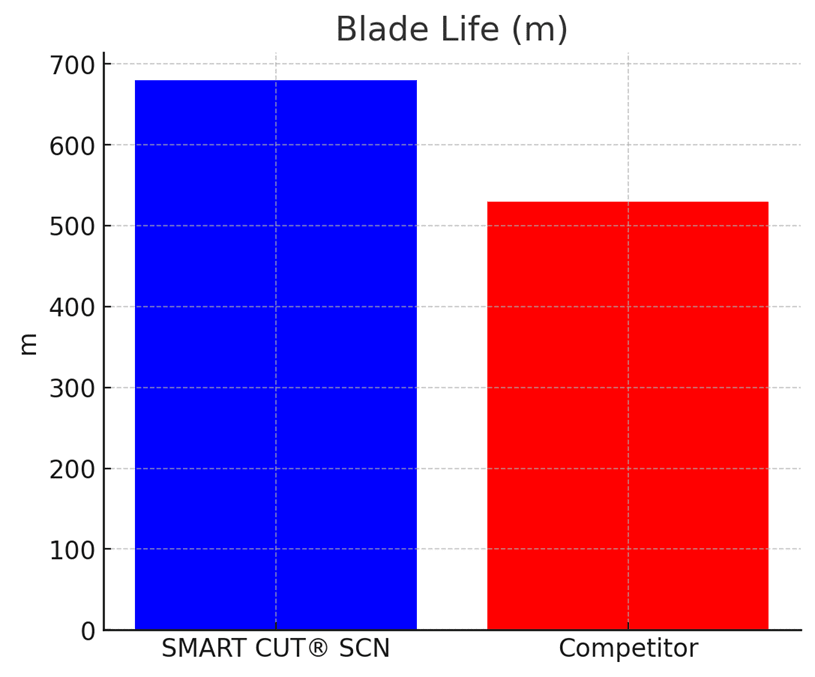
Case Study 4: SMART CUT® SCN Nickel Bond Hubless Blade in Silicon Carbide (SiC) Wafer Dicing
Background
Silicon Carbide (SiC) is among the most difficult semiconductor materials to dice due to its extreme hardness, high fracture toughness, and thermal conductivity. SiC is increasingly used in power electronics, automotive devices, and high-frequency applications, which demand precise cuts with minimal chipping to maintain die reliability. Conventional dicing blades often struggle with accelerated wear and inconsistent cut quality. Nickel bond hubless blades offer fine kerfs, but their performance depends heavily on diamond grit retention, bond strength, and electroforming precision.
This study compares SMART CUT® SCN Nickel Bond Hubless Blades to a leading competitor’s nickel bond hubless blades under controlled SiC wafer dicing conditions.
- Material: SiC wafer, 400 µm thick
- Blade Type: Hubless nickel bond, 58 × 0.12 × 40 mm
- Spindle Speed: 32,000 RPM (~97 m/s surface speed)
- Feed Rate: 25 mm/s
- Coolant: DI water, directed flow to maintain cooling and debris removal
- Cut Depth: Full cut through wafer thickness
Both blades were mounted on identical hubless flanges. Spindle runout was verified at ≤5 µm before testing.
Results
Kerf Width
- SMART CUT® SCN: 120 µm
- Competitor: 127 µm
- SCN achieved a narrower kerf, improving wafer utilization and die count.
Chipping (Front/Back)
- SMART CUT® SCN: 19 µm (front), 25 µm (back)
- Competitor: 24 µm (front), 32 µm (back)
- SCN reduced backside chipping by ~21%, lowering fracture risk during assembly.
Blade Life
- SMART CUT® SCN: ~680 m
- Competitor: ~530 m
- SCN provided ~28% longer life, extending production runs before blade changeover.
Observations
- Competitor blades showed faster wear and rising spindle current after ~300 m, signaling loss of sharpness.
- SCN blades maintained a stable spindle load, confirming stronger grit retention and slower wear progression.
- SCN’s narrower kerf reduced material loss per wafer street, directly improving die yield.
- The reduced backside chipping with SCN improved edge strength, decreasing the chance of die fracture in packaging and testing stages.
Conclusion
The SMART CUT® SCN Nickel Bond Hubless Blade outperformed a competitor’s nickel bond hubless blade in SiC wafer dicing. By delivering a narrower kerf, ~21% lower chipping, and ~28% longer blade life, SCN blades provided superior yield, greater process stability, and reduced cost per cut. These advantages are especially critical for SiC-based power electronics and automotive applications, where both die strength and cutting efficiency directly affect overall device reliability and manufacturing economics.
NEW GENERATION AND TECHNOLOGY
Nickel Bond Hubbed Dicing Blades
SMART CUT® Series SCNH
SMART CUT® Nickel Bond Hubbed Dicing Blades are the preferred choice for semiconductor component manufacturing, offering ultra-thin precision cutting with exceptional stability. Designed for dicing narrow wafers with impeccable accuracy, these blades utilize a nickel electroplated bond combined with larger diamond grit, ensuring an extended lifespan and consistently high-quality performance.
Engineered for maximum customization, SMART CUT® Nickel Bond Hubbed Dicing Blades are available in a wide range of stocked variations.
Case Study: SMART CUT® Series SCNH Hub Blade for Thin Silicon IC Wafer
Background
Dicing thin silicon wafers requires extreme precision to maintain chip integrity and prevent breakage. Wafers as thin as 80 μm are highly fragile, and improper blade performance can result in excessive chipping, wafer damage, or dimensional inaccuracies. This study compares the performance of the SMART CUT® Series SCNH hub blade against a competitor’s hub blade under identical conditions.
Blade Specifications
- Blade Tested: SMART CUT® Series SCNH (Hub Blade)
- Competitor Blade: Standard nickel bond bond hub blade
- Wafer Material: Silicon (thin IC)
- Wafer Thickness: 80 μm
- Chip Size: 0.3 × 0.3 mm
- Street Width: 60 μm
- Feed Rate: 30 mm/s
- Spindle Speed: 50,000 RPM
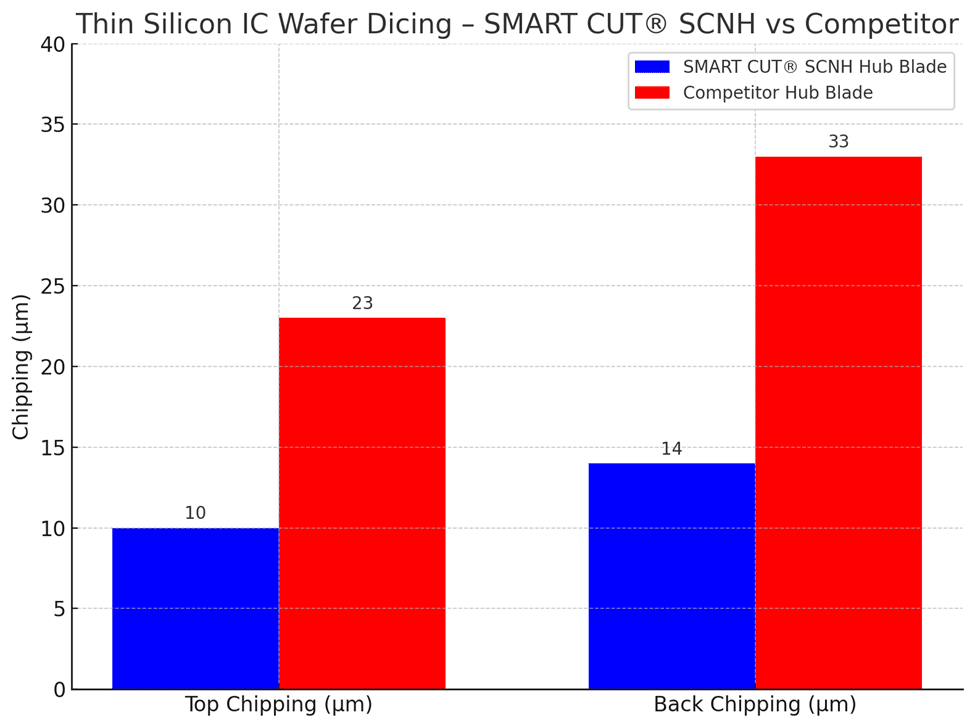
Results
SMART CUT® SCNH Hub Blade
- Top chipping: 8–12 μm
- Back chipping: 12–15 μm
- Maintained stable cutting at 30 mm/s without wafer deformation
- Clean, uniform separation across all 0.3 × 0.3 mm chip lines
Competitor Hub Blade
- Top chipping: 20–25 μm
- Back chipping: 30–35 μm
- Showed visible micro-cracks on back side at higher feed rates
- Required additional post-dicing inspection and occasional rework
Outcome
The SMART CUT®Series SCNH hub blade provided a 50–60% reduction in chipping compared to the competitor’s hub blade. The improved stability at high spindle speeds (50K RPM) ensured greater wafer integrity, higher yields, and reduced rework costs.
This case study demonstrates that SMART CUT® hub blades are the superior choice for thin IC wafer dicing, offering both precision and reliability that competitors fail to match.
Case Study: SMART CUT® Series SCNH Hub Blade for GaAs LED Wafer Dicing
Background
Gallium Arsenide (GaAs) wafers used in LED production present significant challenges during dicing due to their brittleness and sensitivity to edge damage. Excessive chipping or poor cut quality can lead to reduced light output, decreased reliability, and yield loss. To ensure high-quality LED device manufacturing, precise dicing blades are essential.
Blade Specifications
- Blade Tested: SMART CUT® Series SCNH Hub Blade (12A2 20×380-5000-90-H)
- Wafer Material: GaAs, LED
- Wafer Thickness: 150 μm
- Die Size: 98 μm × 98 μm
- Street Width: ≤20 μm
- Feed Rate: 45 mm/s
- Spindle Speed: 40,000 RPM
Results with SMART CUT®SCNH Hub Blade
- Achieved stable dicing across ≤20 μm street width with high accuracy.
- Maintained smooth top-side separation and minimized back-side chipping.
- Clean die edges with minimal debris, reducing the need for post-dicing cleaning.
- Consistent die size uniformity of 98 μm × 98 μm across the wafer.
Comparison with Competitor Hub Blade
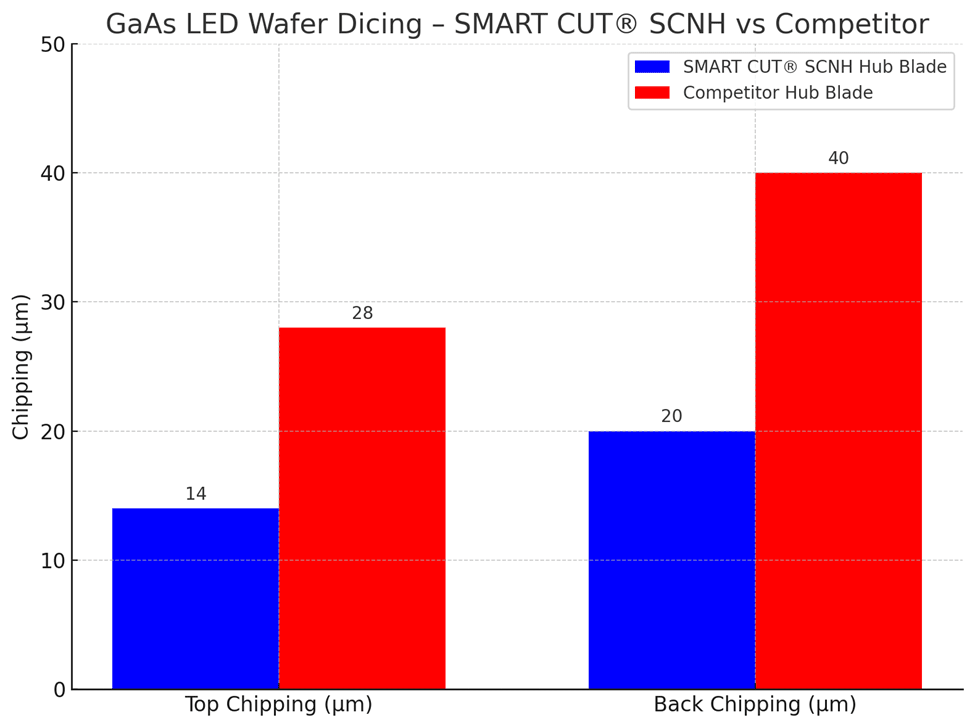
- SMART CUT® SCNH Blade: Top chipping 12–15 μm, back chipping 18–22 μm
- Competitor Blade: Top chipping 25–30 μm, back chipping 35–45 μm
- Competitor blade showed greater edge roughness, higher debris levels, and increased wafer breakage risk, especially at the same high feed rate of 45 mm/s.
Outcome
SMART CUT® SCNH hub blades provided a 40–50% reduction in chipping compared to competitor blades, while enabling higher throughput at 45 mm/s without compromising wafer integrity. For GaAs LED wafer processing, SMART CUT® is the superior choice, delivering:
- Better yield due to reduced chipping and edge defects
- Greater process stability at high spindle speeds (40K RPM)
- Cleaner cuts with less rework and inspection required
Case Study: SMART CUT® Series SCNH Hub Blade for Al₂O₃ LED Substrate
Background
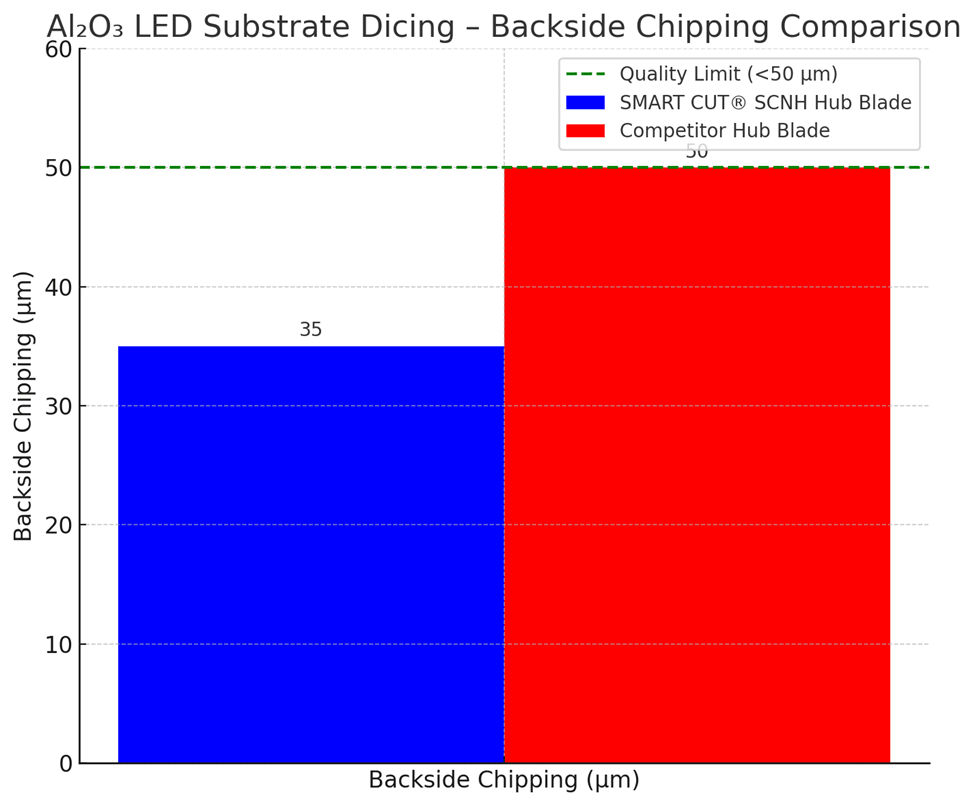
Aluminum Oxide (Al₂O₃) substrates used in LED manufacturing are challenging to dice due to their hardness and brittleness. Maintaining low backside chipping is critical because excessive damage can reduce light efficiency and compromise device reliability. The required quality demand for this application was backside chipping < 50 μm.
Blade Specifications
- Blade Tested: SMART CUT® Series SCNH Hub Blade (12A2 58×0.2Bx4.25-400-30-E1-S48)
- Substrate: Al₂O₃, LED
- Thickness: 0.68 mm
- Chip Size: 0.89 × 0.89 mm
- Spindle Speed: 30,000 RPM
- Feed Rate: 8–10 mm/s
Results with SMART CUT®SCNH
- Achieved backside chipping < 35 μm, well below the 50 μm requirement.
- Maintained clean edges and stable cutting across multiple runs.
- Delivered precise chip size separation with consistent dimensional accuracy.
- Reduced need for rework and inspection due to excellent backside quality.
Competitor Blade Comparison
- SMART CUT® SCNH: Backside chipping consistently < 35 μm
- Competitor Blade: Backside chipping ranged from 45–55 μm, often exceeding the quality demand limit
- Competitor showed more edge roughness and required additional post-dicing inspection.
Outcome
SMART CUT® SCNH hub blades not only met but exceeded quality requirements, outperforming the competitor blade with 30–40% less backside chipping. This translated into:
- Higher production yields
- Reduced scrap and rework
- Greater reliability in LED substrate processing

Alexander Schneider is a senior applications engineer and leading authority in the industrial diamond tooling industry, with over 35 years of hands-on experience in the development, application, and optimization of ultra-thin and high-precision diamond blades, diamond core drills, and diamond and CBN grinding wheels. His work spans a wide range of advanced materials including ceramics, glass, composites, semiconductors, and high-performance metals.
Throughout his career, he has collaborated with leading R&D institutions, national laboratories, and high-tech manufacturing companies across Europe, North America, and Asia, providing technical expertise and tailored solutions for demanding cutting and surface preparation applications.
Mr. Schneider has played a pivotal role in advancing precision cutting, sectioning, dicing, and grinding technologies used in research, production, and failure analysis. He is widely respected for his ability to optimize tool design and cutting parameters to meet exacting industry standards—balancing factors such as cut quality, blade life, material integrity, and process consistency.
As an author, Mr. Schneider is known for delivering practical, application-focused insights that translate complex technical challenges into clear, actionable strategies. His articles and technical guides serve as trusted resources for engineers, researchers, and manufacturers seeking to improve precision, reduce process variability, and enhance tool performance in critical applications.
ARE YOU USING RIGHT DICING BLADES
FOR YOUR APPLICATION?
LET US
HELP YOU
HAVING ISSUES WITH
YOUR CURRENT DICING BLADES?
Knowledge Center
Select right Diamond Dicing Blade for your application
Dicing Blade Operations Recommendations
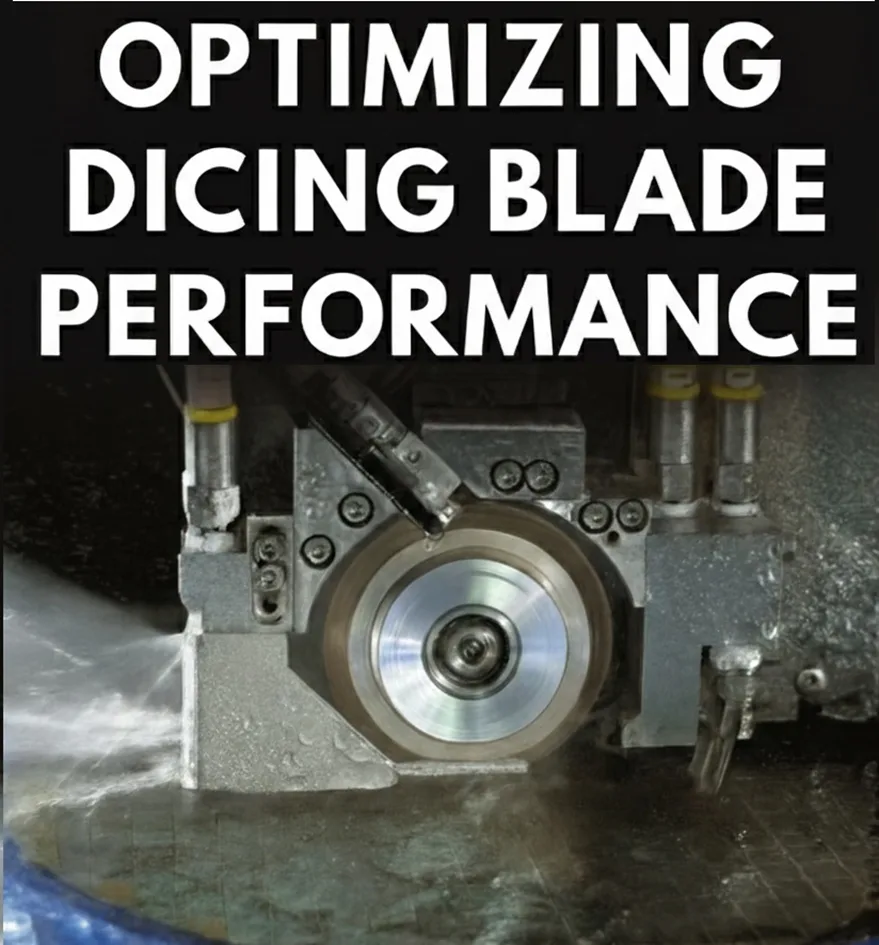
Optimizing your Diamond Dicing Performance
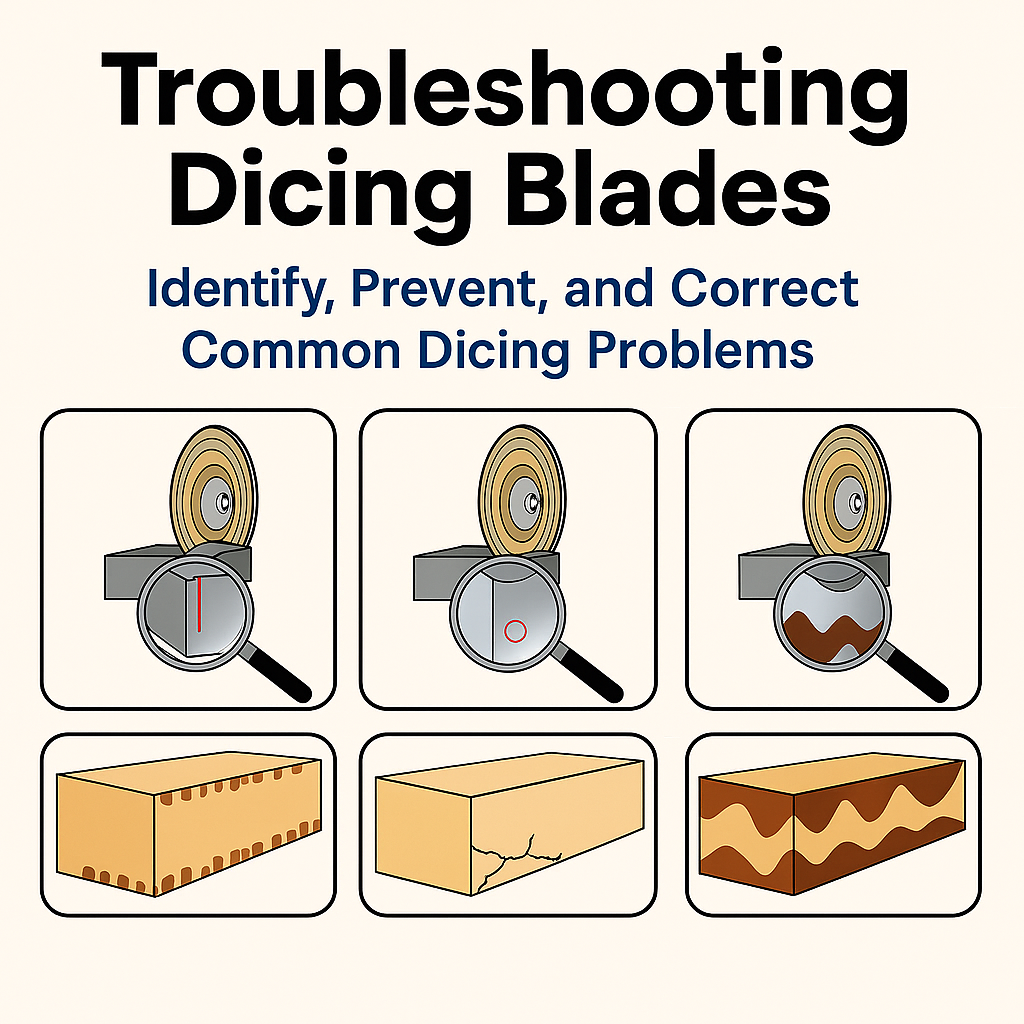
Trouble Shooting Dicing Problems
Application Recommendations
Dicing Blade Case Studies
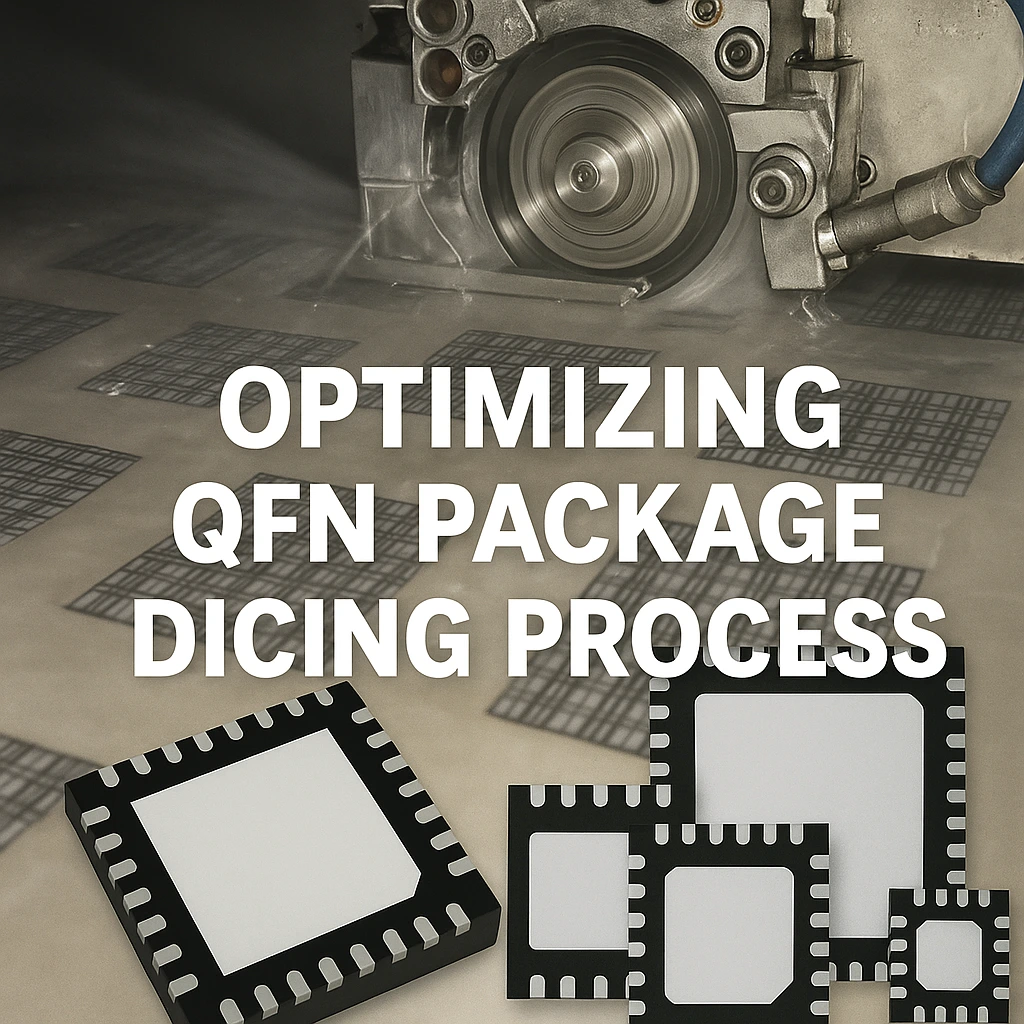
Optimizing QFN Package Dicing Process Using SMART CUT® Dicing Blades
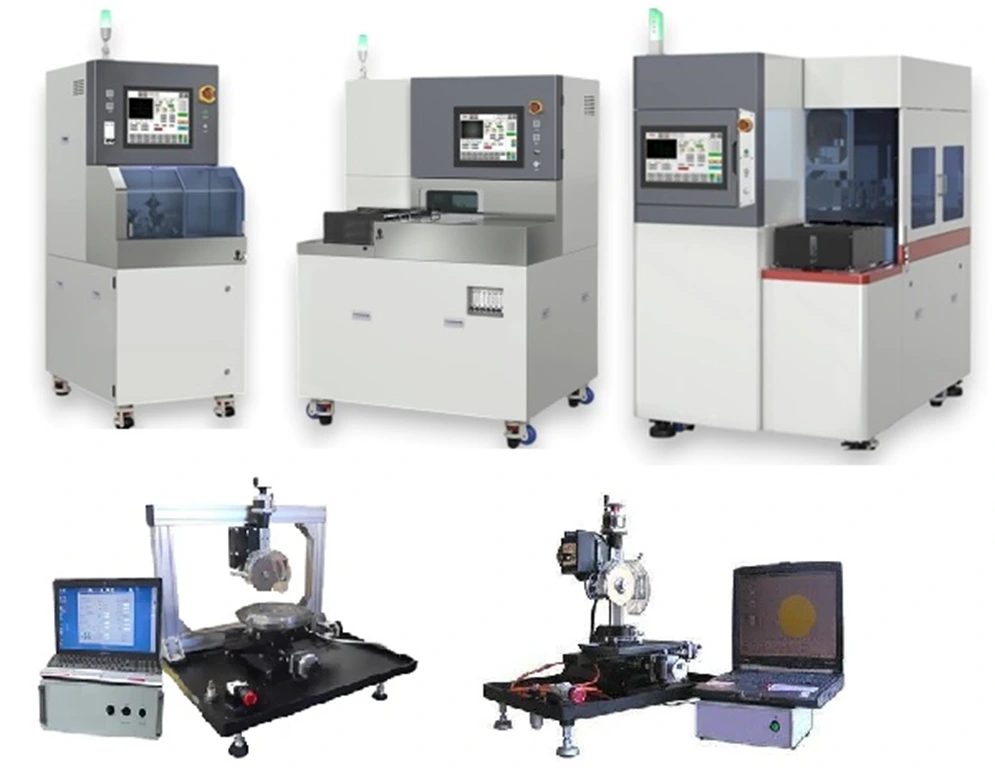
Selecting the Right Wafer Dicing Saw Practical Guide
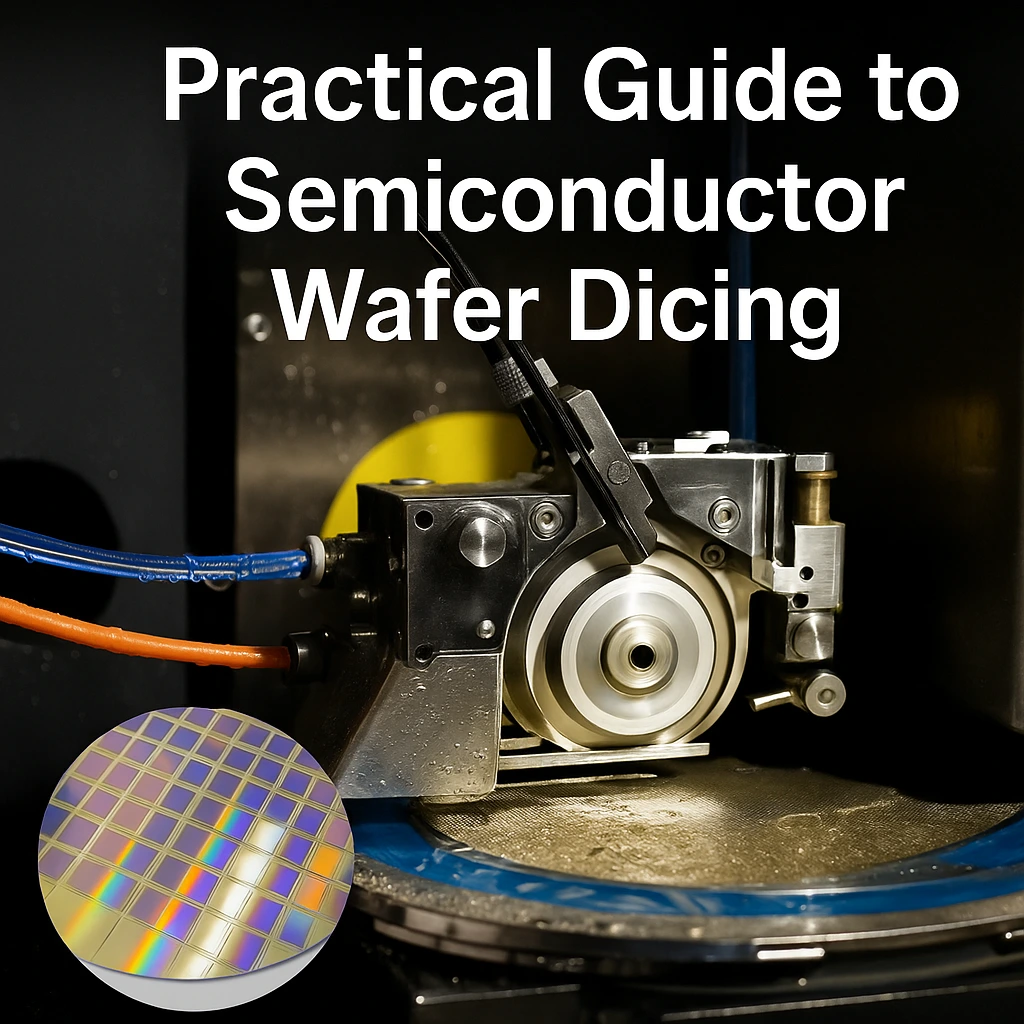
Practical Guide to Semiconductor Wafer Dicing: Materials, Blades, and Process Optimization
Total Cost of Ownership – Measuring the Real Economics of Diamond Dicing
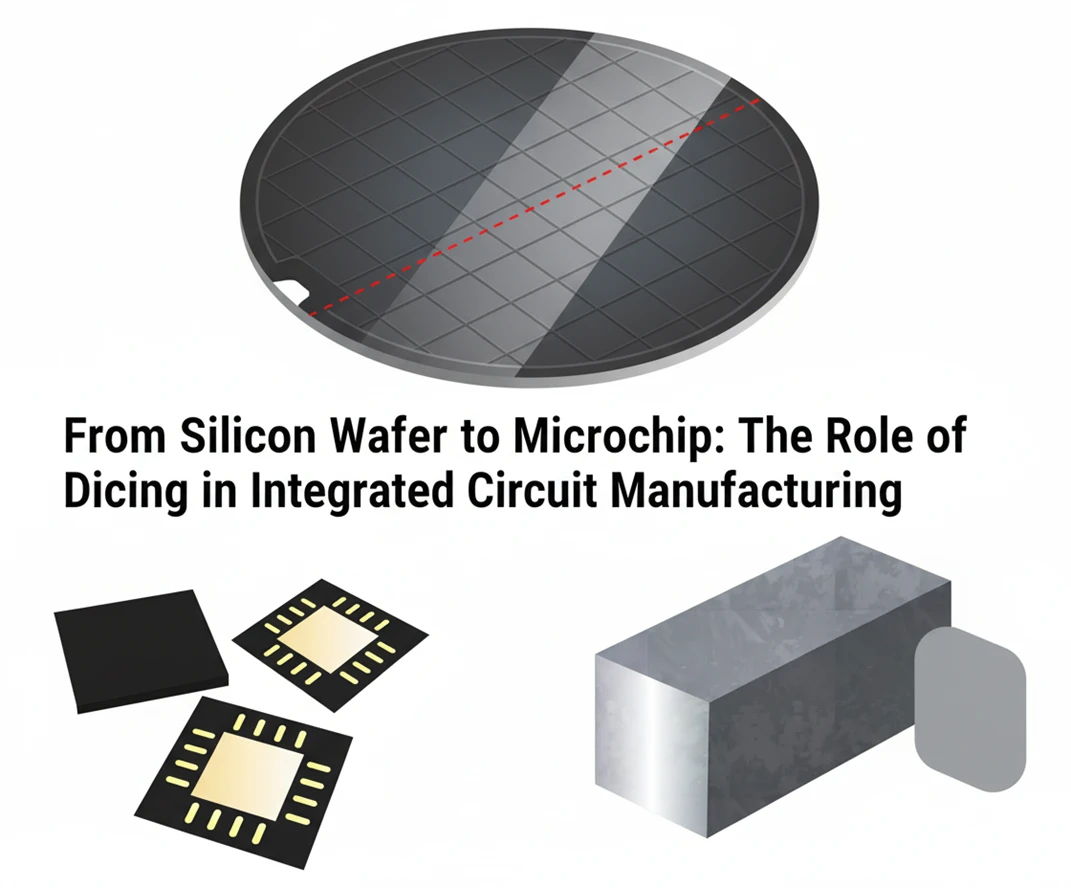
From Silicon Wafer to Microchip: The Role of Dicing in Integrated Circuit Manufacturing
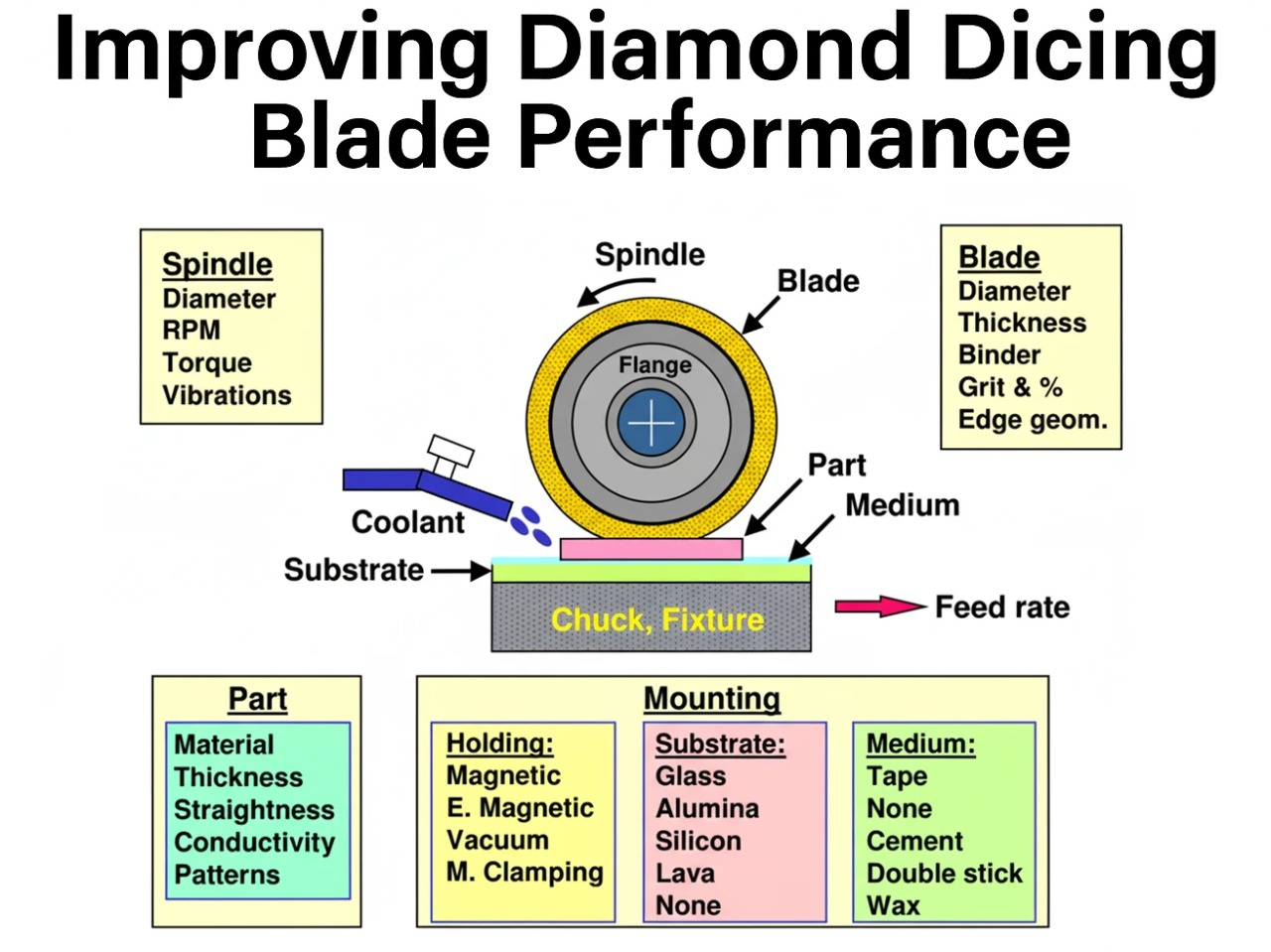
Improving Diamond Dicing Blade Performance: Key Factors and Strategies
How to Selecting Right Diamond Tools for your application
How to properly use Diamond Tools
Why use diamond
What is Diamond Mesh Size and how to select best one for your application
What is Diamond Concentration and which to use for your application
Diamond Tool Coolants Why, How, When & Where to Use
Diamond vs CBN (cubic boron nitride) Tools
Choosing The Correct Diamond Bond Type
Selecting the Right Coolant Method for your Diamond & CBN Tools

Alexander Schneider is a senior applications engineer and leading authority in the industrial diamond tooling industry, with over 35 years of hands-on experience in the development, application, and optimization of ultra-thin and high-precision diamond blades, diamond core drills, and diamond and CBN grinding wheels. His work spans a wide range of advanced materials including ceramics, glass, composites, semiconductors, and high-performance metals.
Throughout his career, he has collaborated with leading R&D institutions, national laboratories, and high-tech manufacturing companies across Europe, North America, and Asia, providing technical expertise and tailored solutions for demanding cutting and surface preparation applications.
Mr. Schneider has played a pivotal role in advancing precision cutting, sectioning, dicing, and grinding technologies used in research, production, and failure analysis. He is widely respected for his ability to optimize tool design and cutting parameters to meet exacting industry standards—balancing factors such as cut quality, blade life, material integrity, and process consistency.
As an author, Mr. Schneider is known for delivering practical, application-focused insights that translate complex technical challenges into clear, actionable strategies. His articles and technical guides serve as trusted resources for engineers, researchers, and manufacturers seeking to improve precision, reduce process variability, and enhance tool performance in critical applications.