


















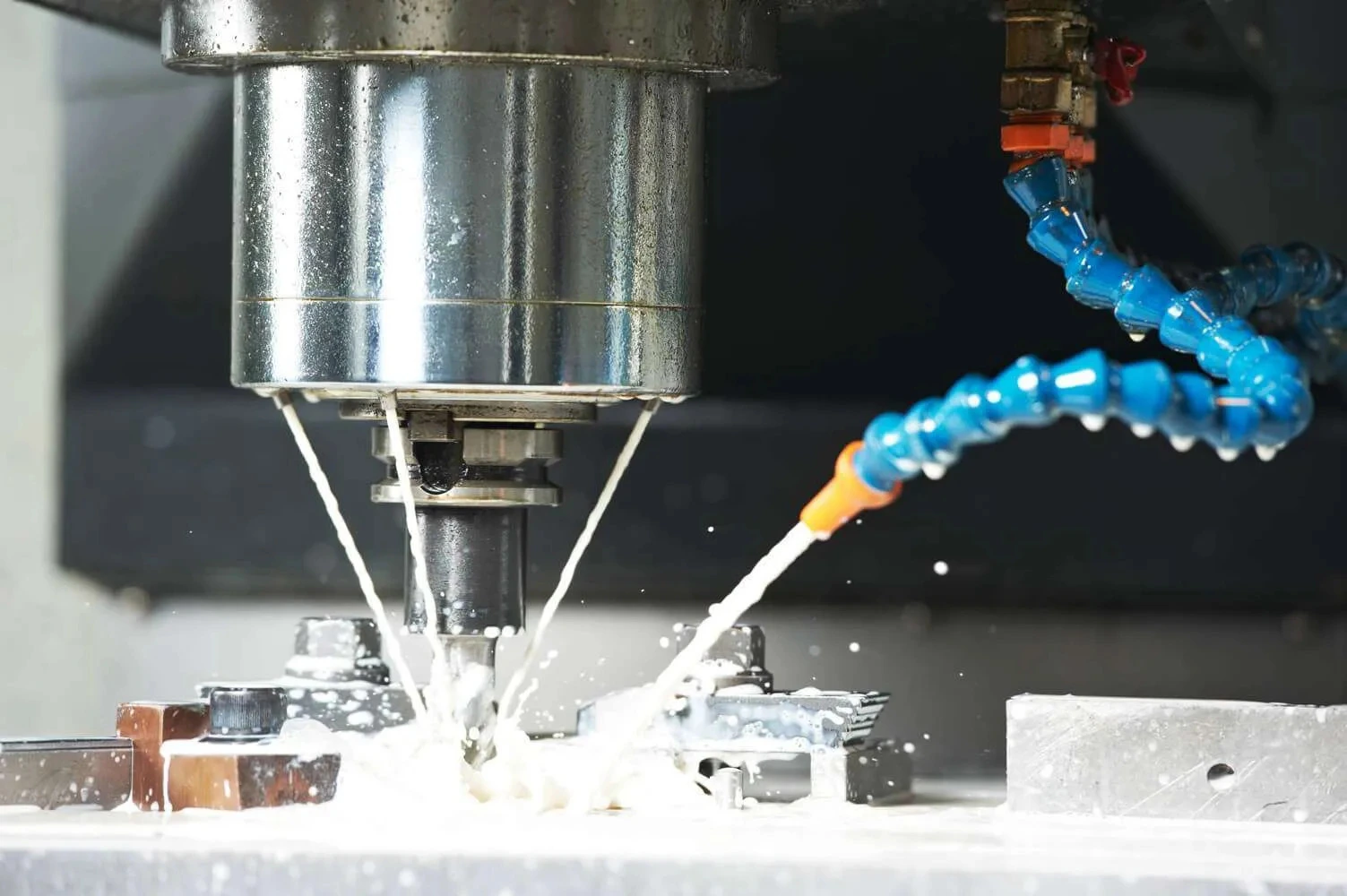

CBN vs. Conventional Grinding Wheels: When Should You Make the Switch?

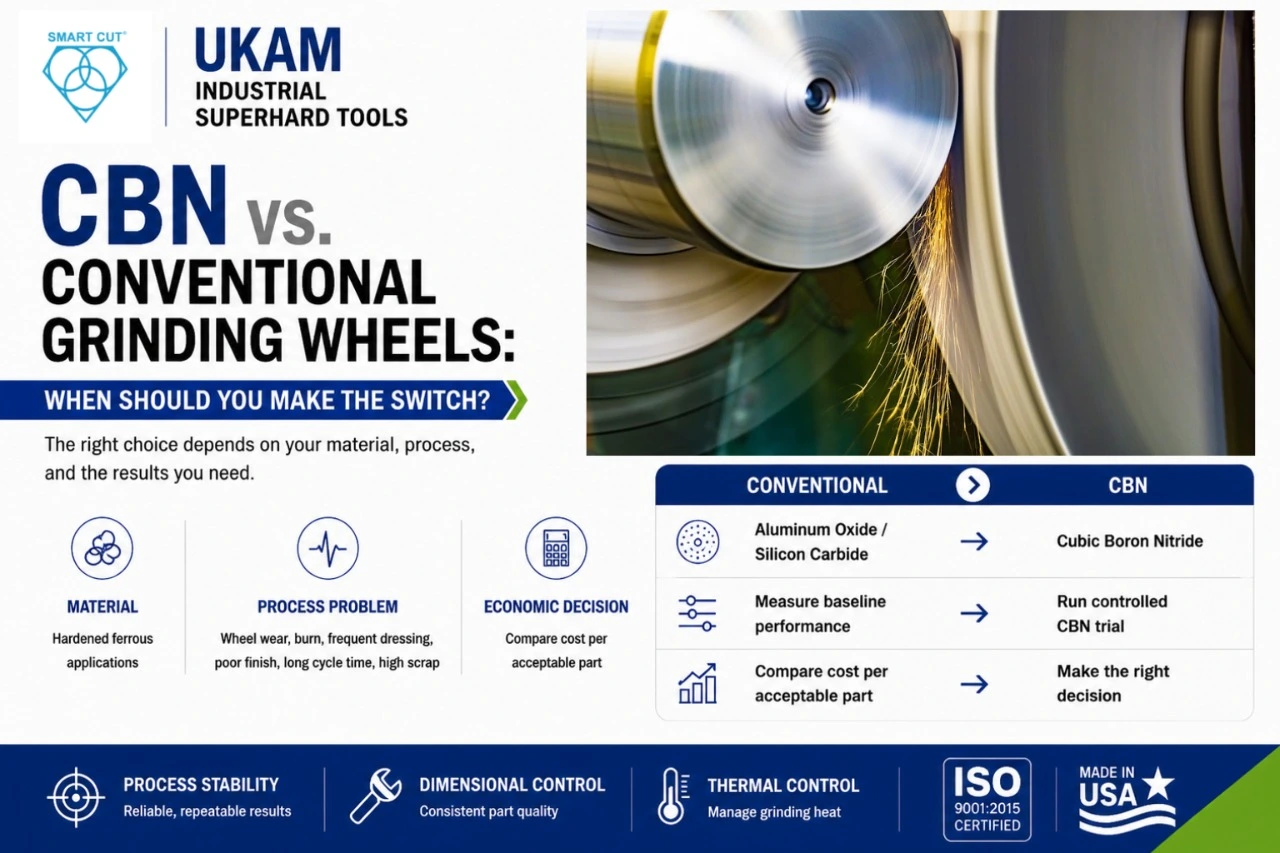
Table of Contents
Toggle
American Based Manufacturer

Established in 1990


Custom manufacturing


A conventional grinding wheel can produce acceptable parts for years and still become the limiting factor when material hardness, stock removal, tolerance, surface finish, or production volume increases. Engineers usually begin considering CBN after seeing higher grinding forces, increasing thermal damage, shorter wheel life, more frequent dressing, declining productivity, or dimensional instability.
The decision should not be based on abrasive hardness alone.
CBN, or cubic boron nitride, is specifically suited to hardened ferrous materials, including tool steels, hardened alloy steels, high speed steels, bearing steels, hardened cast irons, and selected superalloys. Those are the materials we build our CBN wheels for.
The engineering question is not whether CBN is harder. It is:
At what point does replacing a conventional abrasive wheel with a CBN wheel produce a measurable improvement in the grinding process?
The answer depends on the workpiece, hardness, grinding operation, machine, wheel specification, dressing method, coolant, production volume, and total cost per acceptable part.
This article provides a practical framework for making that decision, including the baseline data to collect, how to select grit and bond, how to qualify the wheel, and how to run the cost comparison that actually matters.
Why Engineers Consider Switching to CBN
Conventional abrasives such as aluminum oxide and silicon carbide remain effective for a very wide range of grinding applications. The problem appears when the combination of material hardness and production requirements pushes the existing wheel outside its useful process window.
Typical triggers include:
|
Production Trigger |
What to Investigate |
|---|---|
|
Grinding burn |
Wheel condition, coolant delivery, wheel speed, feed rate |
|
Rapid wheel wear |
Abrasive type, bond, dressing practice |
|
Frequent dressing |
Wheel specification and dressing method |
|
Increasing grinding force |
Wheel dulling or loading |
|
Poor surface finish |
Grit size, wheel condition, dressing |
|
Dimensional drift |
Wheel wear, machine condition |
|
Long cycle time |
Material removal efficiency |
|
High scrap rate |
Thermal or dimensional instability |
|
Short wheel life |
Abrasive and bond selection |
|
Higher production volume |
Total tooling economics |
A production team should document the problem before switching abrasives. A wheel change should solve a defined production problem, not a general impression that the current wheel is underperforming.
Engineering Insight
If a conventional wheel produces acceptable parts at the required cost, switching to CBN simply because CBN is a harder abrasive may add expense without improving the process. The strongest case for CBN occurs when the existing wheel cannot maintain the required combination of quality, productivity, wheel life, and process stability.
What Makes CBN Different From Conventional Abrasives?
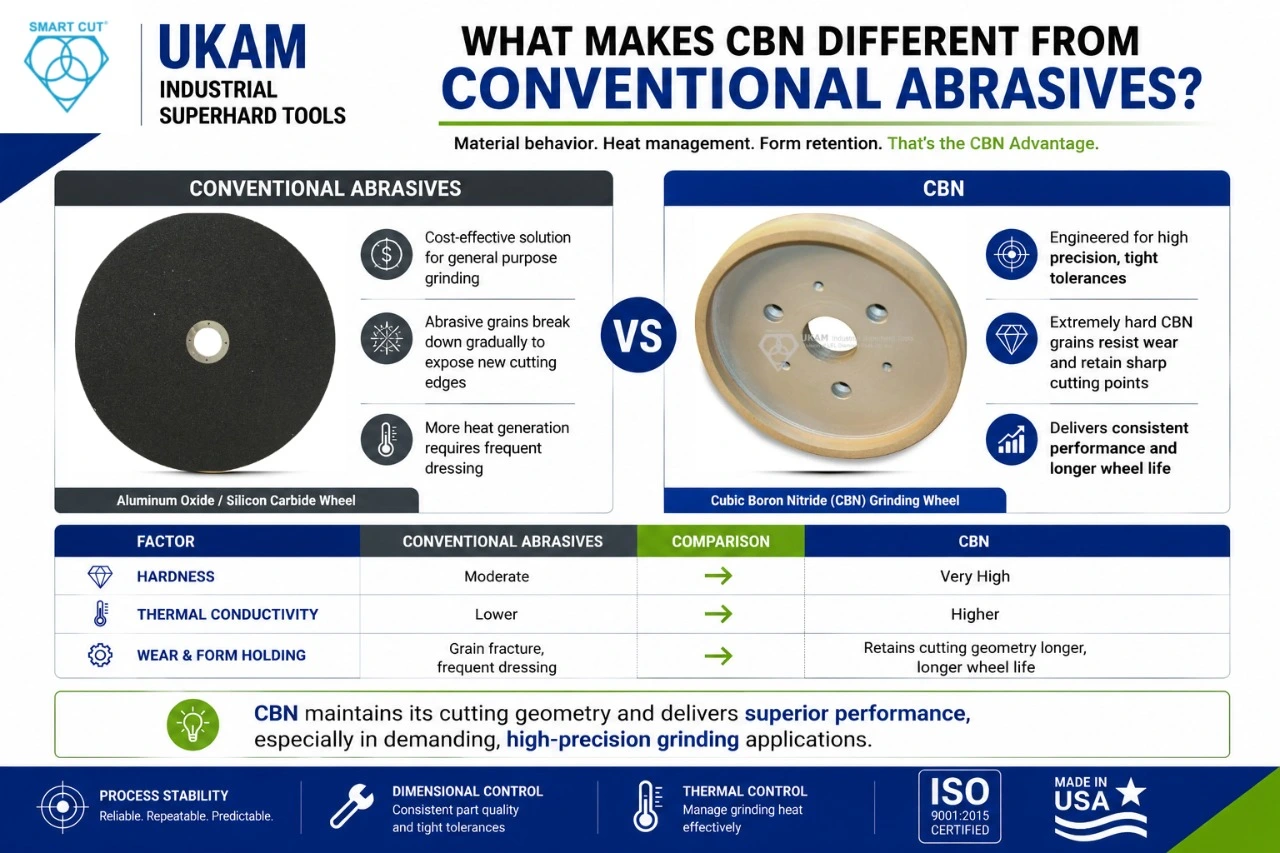
CBN is a superabrasive with substantially greater hardness than conventional abrasives — more than twice the hardness of aluminum oxide or silicon carbide. That hardness allows CBN grains to maintain their cutting geometry under grinding conditions that would round over or fracture a conventional grain.
The difference is not only hardness. Conventional abrasives depend heavily on controlled grain fracture and wheel structure to continually expose new cutting points; the wheel stays sharp by wearing away. CBN grains resist that breakdown, so a correctly specified CBN wheel maintains sharp cutting points far longer, and the wheel holds its form.
CBN also has substantially higher thermal conductivity than aluminum oxide. In hardened steel grinding, where heat entering the workpiece is the primary cause of burn and metallurgical damage, that property is often more important commercially than the hardness itself. More of the grinding heat leaves through the chip and the wheel rather than entering the part.
|
Characteristic |
Conventional Abrasive |
CBN |
|---|---|---|
|
Typical abrasives |
Aluminum oxide, silicon carbide |
Cubic boron nitride |
|
Primary use |
Broad general purpose grinding |
Hardened ferrous and demanding materials |
|
Abrasive hardness |
Moderate |
Very high — roughly twice conventional |
|
Thermal conductivity |
Low |
High — carries heat away from the part |
|
Wear mechanism |
Grain fracture and pull-out |
Slow attritious wear, grains stay sharp |
|
Form holding |
Degrades between dressings |
Holds profile through long runs |
|
Typical G-ratio, hardened steel |
Roughly 10 to 60 |
Frequently several hundred to several thousand |
|
Initial wheel cost |
Lower |
Higher |
|
Best economic case |
Lower volume or general grinding |
High value production and difficult grinding |
A note on G-ratio. G-ratio is the volume of material removed divided by the volume of wheel consumed, and it is the most useful single number for comparing abrasive systems on the same job. The ranges above are typical published values across the industry, not a promise for any particular application. Your own G-ratio should be measured during qualification, because it depends on bond, concentration, coolant, dressing, and how aggressively the machine is run.
CBN vs. Aluminum Oxide
Aluminum oxide is the most widely used conventional grinding abrasive and it remains effective for many steels and general purpose applications. It is inexpensive, forgiving, and easy to dress. The decision to replace it with CBN should therefore be based on process performance, not on abrasive specification.
CBN becomes more attractive as hardness, precision, production volume, and thermal sensitivity increase. Below roughly 45 HRC, aluminum oxide usually grinds efficiently and CBN is difficult to justify. As hardness climbs into the high 50s and 60s HRC — the range typical of tool steels, high speed steels, and bearing steels — the aluminum oxide wheel breaks down faster, dressing frequency rises, and the economic argument shifts.
Engineering Decision
Consider CBN when the aluminum oxide process shows one or more of these conditions:
- Excessive wheel wear or wheel consumption
- High dressing frequency interrupting production
- Rising grinding forces through the wheel life
- Grinding burn or evidence of metallurgical damage
- Cycle time limiting throughput
- Poor dimensional stability or profile loss
- Unacceptable production economics per acceptable part
A conventional wheel may remain technically capable while becoming economically inefficient. That is the most common situation we see, and it is the one worth measuring.
CBN vs. Silicon Carbide
Silicon carbide is harder and more friable than aluminum oxide. That friability makes it useful on materials where a freely fracturing grain is an advantage — cast irons, non-ferrous metals, and some non-metallics. It is not, however, a substitute for CBN in hardened ferrous grinding. Silicon carbide reacts chemically with iron at grinding temperatures and wears rapidly on steel.
That leaves a simple division of responsibility: silicon carbide and aluminum oxide cover general and non-ferrous work, CBN covers hardened ferrous work, and diamond covers hard non-ferrous and non-metallic work.
Choosing Between the Two Superabrasives
Once you have decided a conventional abrasive is not sufficient, the next question is which superabrasive applies. The workpiece material answers it:
|
Workpiece Material |
Superabrasive |
|---|---|
|
Hardened alloy steel |
CBN |
|
Tool steel and die steel |
CBN |
|
High speed steel |
CBN |
|
Bearing steel |
CBN |
|
Hardened cast iron |
CBN |
|
Selected nickel and cobalt superalloys |
CBN, application dependent |
|
Tungsten carbide |
Diamond |
|
Silicon carbide and alumina ceramics |
Diamond |
|
Sapphire, quartz, and optical glass |
Diamond |
|
Composites and graphite |
Diamond |
The reason for the split is chemical, not mechanical. Diamond is carbon, and at grinding temperatures carbon has an affinity for iron; a diamond wheel grinding steel wears through chemical attack regardless of its hardness. CBN does not have that problem with ferrous materials. Choosing the wrong superabrasive creates significant cost without solving the grinding problem.
When CBN Makes the Strongest Case
CBN deserves serious evaluation when the process involves hardened ferrous materials and the production requirements are demanding. Strong candidates include:
- Hardened alloy steels above roughly 45 HRC
- Tool steels and die steels
- High speed steels, particularly in tool and cutter grinding
- Bearing steels requiring repeatable surface integrity
- Hardened cast irons
- Selected nickel and cobalt based superalloys
- Automotive components in high volume production
- Aerospace components with tight tolerance and surface integrity requirements
- Precision tool components requiring form retention
The economic case strengthens as the cost of grinding process instability rises. A $500 conventional wheel may look attractive against a $900 CBN wheel. If the conventional wheel requires dressing every 40 parts and adds a minute to each cycle, the purchase price difference is not the real comparison — and on a machine running two shifts, it is not even close.
Baseline Documentation Before Changing the Wheel
Do not change from conventional abrasive to CBN without recording the existing process. A baseline is the only reference that will tell you whether CBN actually improved the operation, and it is the single most common thing missing when a trial produces an ambiguous result.
|
Parameter |
Record Before Trial |
|---|---|
|
Workpiece material |
Exact grade |
|
Hardness |
Actual measured hardness, not specification range |
|
Heat treatment |
Condition and any surface treatment |
|
Grinding operation |
OD, ID, surface, profile, or tool grinding |
|
Current abrasive |
Aluminum oxide or silicon carbide |
|
Grit size, grade, structure |
Full current wheel specification |
|
Wheel dimensions |
Diameter, width, bore |
|
Wheel speed |
Actual operating surface speed |
|
Feed and depth of cut |
Actual settings, not nominal |
|
Dressing method |
Type and parameters |
|
Dressing frequency |
Parts per dressing |
|
Coolant |
Type, concentration, and delivery method |
|
Cycle time |
Time per acceptable part |
|
Wheel life |
Parts per wheel |
|
Surface finish |
Measured result |
|
Dimensional accuracy |
Measured result |
|
Scrap rate |
Actual percentage |
|
Cost per part |
Current production cost |
This information gives your engineering team and your wheel supplier a factual starting point. It is also the exact data set we ask for when quoting an application specific CBN wheel.
The Most Common Reporting Mistake
A description like this is not enough to act on:
Our aluminum oxide wheel wears too quickly.
Record how quickly it wears, how many parts it produces before dressing, what happens to surface finish across that interval, at what point burn appears, and what the acceptable part rate is. The difference between “wears too quickly” and “surface finish exceeds 32 Ra after 70 parts and the wheel is dressed every 35 parts” is the difference between a guess and a specification.
Grit Size When Switching From Conventional Abrasive to CBN
Grit size should not be copied across from the conventional wheel. Because CBN grains stay sharp and each grain removes material efficiently, a CBN wheel can often achieve the same material removal rate with a significantly finer abrasive than the conventional wheel it replaces — and deliver a better finish while doing it.
As an illustration, a 46 grit aluminum oxide wheel can commonly be replaced by a 100 grit CBN wheel while maintaining metal removal capability under appropriate conditions. That is a two to three step change in nominal grit size for equal productivity.
That does not mean every 46 grit aluminum oxide wheel should become 100 grit CBN. The final selection depends on material hardness, stock removal, required surface finish, machine power, wheel speed, bond, concentration, coolant, and dressing method.
|
Production Requirement |
Grit Direction |
|---|---|
|
Heavy stock removal |
Coarser CBN |
|
General production grinding |
Medium CBN |
|
Fine finishing |
Finer CBN |
|
Tight surface finish requirement |
Fine CBN |
|
Precision profile and form work |
Application specific, bond driven |
|
Tool and cutter grinding |
Medium to fine, application specific |
Engineering Insight
Do not select CBN grit by matching the number printed on the existing wheel. The two abrasive systems behave differently at the same nominal grit. Select the CBN grit from the required material removal rate and surface finish, then confirm it in the trial.
Concentration describes how much abrasive is present in the working layer, and it controls the number of cutting points engaged in the cut. Higher concentration spreads the load across more grains, which reduces the force on each grain and generally extends abrasive life. Maximum concentration is not automatically the correct specification.
The wheel must also provide chip clearance and abrasive exposure. A wheel packed with abrasive but without room for the chip to escape will load, and a loaded wheel generates heat regardless of what the abrasive is made of. Higher concentration also increases the power the machine must supply, because more grains are cutting at once.
We supply standard and custom concentrations, and we treat concentration as a primary selection variable rather than a catalog default.
Engineering Consideration
If the process has a high thermal load, increasing concentration without reviewing coolant delivery and chip clearance may make the problem worse rather than better. These variables interact and should be evaluated together:
- Grit size
- Concentration
- Bond type
- Wheel speed
- Feed and depth of cut
- Dressing method and interval
- Coolant type and delivery
- Contact area between wheel and part
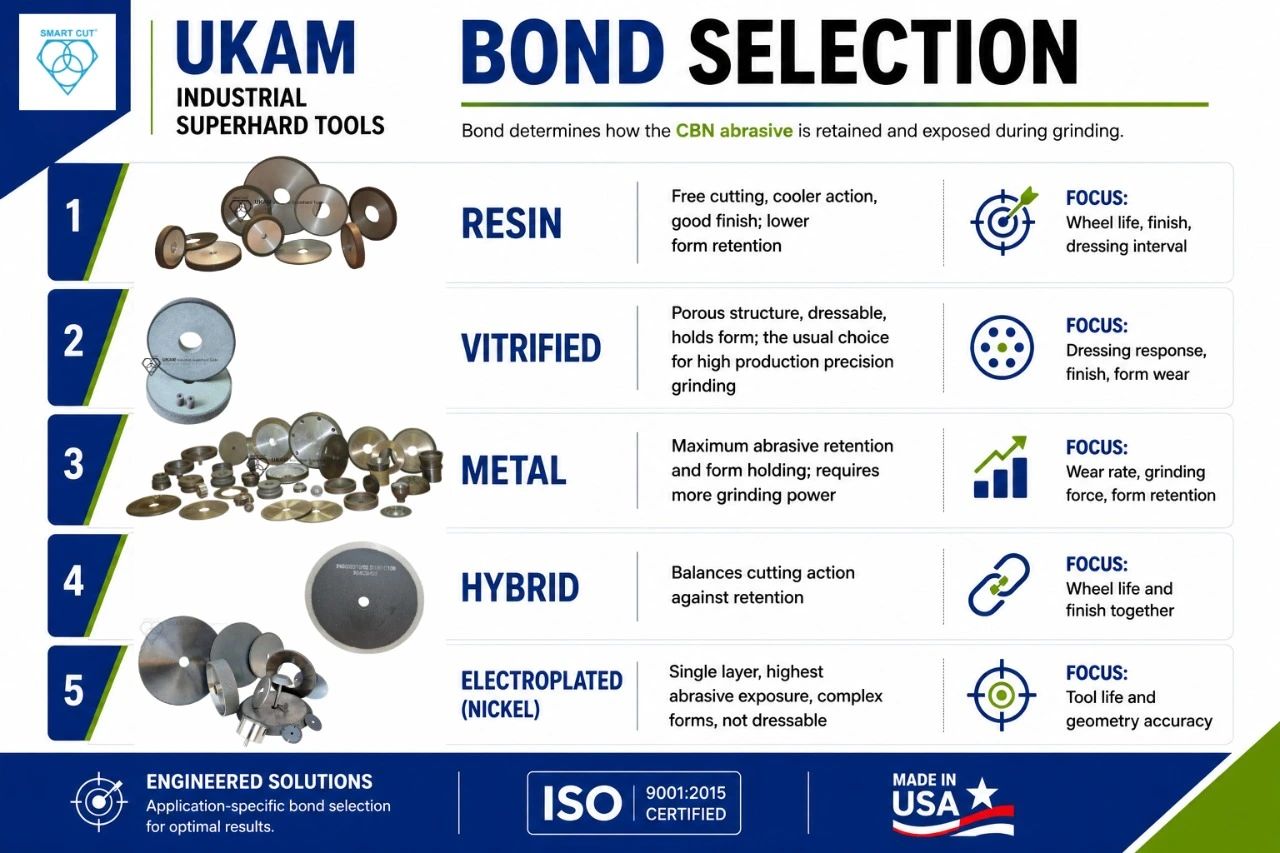
Bond determines how the CBN abrasive is retained and exposed during grinding. It has as much influence on the result as the abrasive itself, and it is where most specification errors occur. We build CBN wheels in resin, metal, hybrid, nickel, and vitrified bonds, selected against the application.
|
Bond |
Typical Engineering Consideration |
Qualification Focus |
|---|---|---|
|
Resin |
Free cutting, cooler action, good finish; lower form retention |
Wheel life, finish, dressing interval |
|
Vitrified |
Porous structure, dressable, holds form; the usual choice for high production precision grinding |
Dressing response, finish, form wear |
|
Metal |
Maximum abrasive retention and form holding; requires more grinding power |
Wear rate, grinding force, form retention |
|
Hybrid |
Balances cutting action against retention |
Wheel life and finish together |
|
Nickel (electroplated) |
Single layer, highest abrasive exposure, complex forms, not dressable |
Tool life and geometry accuracy |
The bond should be selected from the grinding operation, wheel speed, workpiece material, required finish, and available dressing method. An electroplated wheel on a machine with no dressing capability is a sound choice; the same wheel on a job requiring in-process form correction is not.
Engineering Insight
A harder bond is not automatically a better bond. If dull grains remain held in the bond after they stop cutting, grinding forces rise, heat goes into the part instead of the chip, and burn follows. The bond must release or expose fresh abrasive at the right point in the process. A wheel that is glazing is usually telling you the bond is too hard for the job, not that the abrasive has failed.
Wheel Geometry
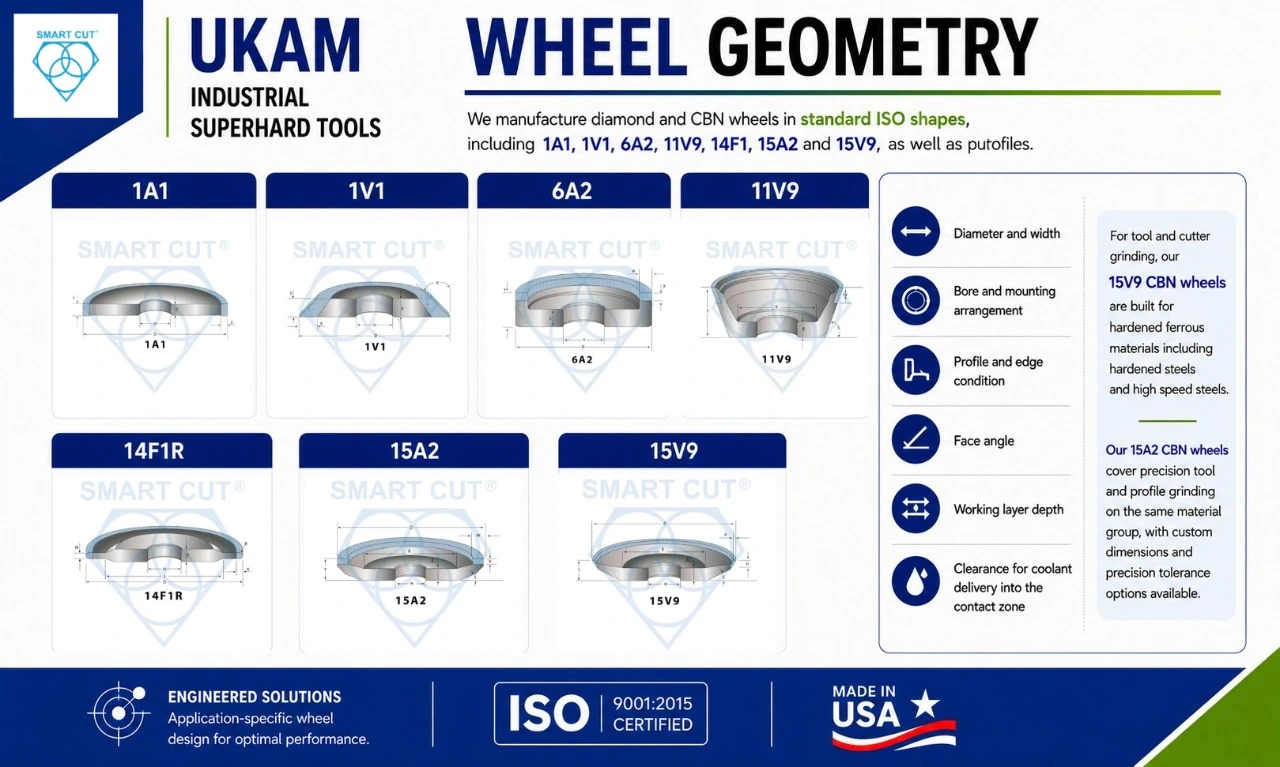
Changing the abrasive does not remove the need to select the correct wheel geometry. We manufacture diamond and CBN wheels in the standard ISO shapes, including 1A1, 1V1, 6A2, 11V9, 14F1, 15A2, and 15V9, as well as custom profiles.
The geometry controls how the wheel contacts the workpiece, and contact area drives thermal load. A wide flat contact generates far more heat than a narrow or angled one at the same removal rate. Consider:
- Diameter and width
- Bore and mounting arrangement
- Profile and edge condition
- Face angle
- Working layer depth
- Clearance for coolant delivery into the contact zone
For tool and cutter grinding, our 15V9 CBN wheels are built for hardened ferrous materials including hardened steels and high speed steels. Our 15A2 CBN wheels cover precision tool and profile grinding on the same material group, with custom dimensions and precision tolerance options available.
CBN cannot compensate for a machine that cannot support the process. This is the most frequent reason a CBN trial underperforms: the wheel is capable, and the machine never lets it demonstrate that. Before switching, verify:
- Available spindle speed range
- Spindle power
- Spindle runout
- Machine and fixture rigidity
- Wheel mounting and flange condition
- Workholding repeatability
- Dressing system capability
- Coolant delivery pressure and volume
- Physical clearance around the wheel
Wheel Speed Is the Variable That Matters Most
CBN generally requires higher surface speed than conventional abrasive to work as intended. Running a CBN wheel at conventional speeds increases the chip thickness per grain, drives up grinding force, and produces exactly the wear and burn the switch was meant to eliminate. Typical published operating ranges are:
|
Wheel Type |
Typical Surface Speed Range |
|---|---|
|
Conventional vitrified aluminum oxide |
Roughly 5,500 to 6,500 sfpm |
|
Resin bond CBN |
Roughly 5,000 to 9,000 sfpm |
|
Vitrified bond CBN |
Roughly 8,000 to 12,000 sfpm |
|
Electroplated CBN |
12,000 sfpm and above, machine permitting |
These are general industry ranges for planning purposes only. The governing limit is always the maximum operating speed marked on the specific wheel and the rating of the machine and mounting. Never exceed either. If your machine tops out near conventional speed, that constraint should be part of the wheel specification discussion before an order is placed, because it changes the bond and concentration we would recommend.
Engineering Insight
If a conventional wheel is replaced with CBN and every machine setting stays the same, the trial does not represent the capability of the CBN wheel. It represents a CBN wheel operated outside its intended process window. Qualify the new wheel as a different abrasive system, not as a physical replacement part.
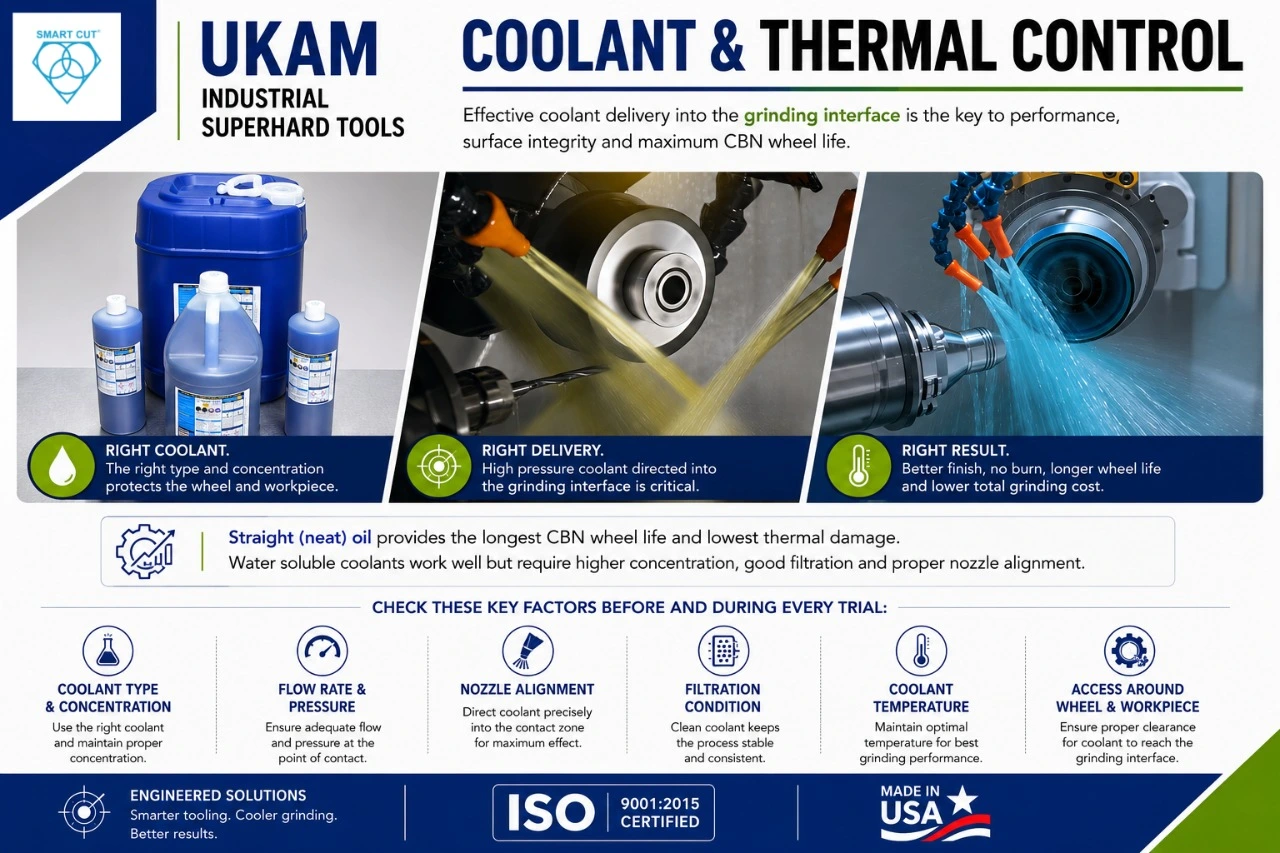
Hardened steel grinding produces substantial heat, and coolant is the primary defense. The requirement is not volume at the machine — it is volume delivered into the actual grinding interface, against the air barrier the wheel carries with it at speed.
Coolant chemistry matters more with CBN than with conventional abrasive. Straight (neat) grinding oil consistently produces the longest CBN wheel life and the lowest thermal damage, because it lubricates the grain-workpiece contact rather than only cooling it. Water soluble coolants work and are widely used, but they generally require higher concentration than the same shop would run for aluminum oxide, along with disciplined filtration and nozzle alignment. If a shop is choosing between straight oil and water soluble for a high value CBN application, the wheel life difference is usually large enough to be part of the economic calculation.
Check all of the following before and during a trial:
- Coolant type and concentration
- Flow rate and delivery pressure
- Nozzle alignment into the contact zone
- Filtration condition
- Coolant temperature
- Access around the wheel and workpiece geometry
Poor coolant delivery contributes directly to grinding burn, surface damage, wheel loading, poor finish, dimensional instability, and reduced wheel life. A CBN wheel reduces certain thermal problems through its own conductivity, but it does not remove the need for effective coolant management.
CBN wheels still require a conditioning strategy. The method depends on wheel construction: vitrified and resin bonds are dressed and trued conventionally, metal bonds require more aggressive conditioning, and electroplated wheels are not dressed at all — they are used until the single abrasive layer is consumed.
A process may use diamond dressing tools, rotary dressers, profile dressing, crush dressing, or an application specific system. Truing establishes the geometry; dressing exposes the abrasive. Both matter, and on a superabrasive wheel they are often separate operations rather than one.
Dressing Baseline
Record the same measurements on the conventional wheel and the CBN trial so the comparison is direct:
|
Measurement |
Conventional Wheel |
CBN Trial |
|---|---|---|
|
Parts between dressing |
Record |
Record |
|
Dressing time per event |
Record |
Record |
|
Dressing depth |
Record |
Record |
|
Wheel material removed per dress |
Record |
Record |
|
Wheel profile change over run |
Record |
Record |
|
Grinding force trend between dresses |
Record |
Record |
The goal is not to eliminate dressing. The goal is to establish a dressing interval that produces acceptable parts at an acceptable cost, and to know how the wheel behaves as it approaches that interval.
Grinding Burn as a Switching Trigger
Grinding burn is one of the strongest reasons to investigate CBN, and also one of the most frequently misdiagnosed. Burn is evidence of heat entering the workpiece; it is not by itself evidence that the abrasive is wrong. Possible causes include:
- Dull or glazed wheel
- Dressing interval extended too far
- Inadequate coolant delivery into the contact zone
- Excessive feed rate
- Excessive depth of cut
- Wheel grade too hard for the application
- Excessive contact area
- Machine or workholding instability
Engineering Insight
Measure when the burn begins. If the first parts after dressing are acceptable and burn develops later in the interval, the mechanism involves wheel dulling, loading, or thermal accumulation — and the fix may be dressing practice or coolant rather than a new abrasive. If burn appears immediately on a freshly dressed wheel, investigate the wheel specification and the operating parameters. This single observation separates a wheel problem from a process problem faster than any other test.
Material Specific Failure Modes
These mistakes can make a CBN qualification misleading or can cause a technically suitable wheel to be rejected for the wrong reason. Use the checklist below during specification and production trials.
Mistake 1 — Hardened Alloy Steel
Failure mode to watch: grinding burn. Monitor surface condition, grinding force trend, coolant delivery, dressing interval, and dimensional stability across the full wheel life. CBN is often a strong candidate here, particularly above 50 HRC.
Mistake 2 — Tool Steel and Die Steel
Failure mode to watch: profile loss and dimensional drift. This work usually requires tight edge and profile control, and the wheel must hold its geometry through the production cycle rather than only at the start of it. Form retention, which is a bond decision, matters more than raw wheel life.
Mistake 3 — High Speed Steel
Failure mode to watch: thermal damage. High speed steel is thermally sensitive and readily shows metallurgical damage that is not visible on inspection. CBN is widely used here for exactly that reason. Monitor temperature indicators, surface condition, wheel wear, and dressing behavior, and consider etch inspection during qualification.
Mistake 4 — Bearing Steel
Failure mode to watch: surface integrity and dimensional variation. Bearing components require repeatable geometry and consistent surface condition. A wheel that gradually changes its cutting behavior will produce dimensional drift well before any obvious wheel failure appears, which is why force trend is a better early indicator than wheel appearance.
Mistake 5 — Hardened Cast Iron
Failure mode to watch: wheel loading. Monitor wheel condition, dressing response, coolant filtration, and grinding force. Loading here is often a chip clearance and concentration question rather than an abrasive question.
Mistake 6 — Superalloys
Failure mode to watch: thermal damage and rapid wheel wear. CBN may be appropriate for selected nickel and cobalt based materials, but these alloys vary widely and the specific grade and grinding conditions must be evaluated individually. Treat superalloy work as an application engineering exercise rather than a catalog selection.
Common Mistakes When Switching to CBN
|
Mistake |
Why It Causes Problems |
|---|---|
|
Assuming CBN is always better |
CBN is not the correct abrasive for every operation, and it is the wrong abrasive for non-ferrous work |
|
Comparing wheel purchase price only |
The correct comparison is total production cost per acceptable part |
|
Matching grit numbers directly |
The two abrasive systems behave differently at the same nominal grit |
|
Keeping every process parameter unchanged |
CBN generally needs higher wheel speed and different dressing to perform |
|
Ignoring machine capability |
Spindle speed, power, runout, and rigidity all limit the result |
|
Ignoring coolant |
A superabrasive does not remove thermal management requirements |
|
Testing only a few parts |
Short trials hide progressive wheel wear and thermal accumulation |
|
Changing several variables at once |
Changing wheel, speed, feed, coolant, and dressing together makes the trial uninterpretable |
|
Measuring only wheel life |
Measure acceptable parts, finish, accuracy, cycle time, scrap, and cost |
|
Assuming longer wheel life means a better process |
A wheel can last longer while producing slower or lower quality parts |
A grinding wheel has a physical life and a production life. Physical life refers to how much usable abrasive remains on the wheel. Production life refers to how long the wheel can produce acceptable parts within the required process window. The production life usually ends first, and the gap between the two is where scrap is generated.
|
Observed Condition |
Physical Wheel Status |
Production Status |
|---|---|---|
|
Low wear, good parts |
Good |
Acceptable |
|
Moderate wear, good parts |
Usable |
Acceptable |
|
Low wear, rising grinding force |
Usable |
Investigate |
|
Good geometry, degraded finish |
Usable |
Process failure |
|
Good wheel size, dimensional drift |
Usable |
Process failure |
|
Burn appearing late in interval |
Usable |
Process failure |
This distinction should be built into any CBN qualification. Reporting that a CBN wheel “lasted three times longer” is only meaningful if the parts produced across that life were all acceptable.
Cost Per Acceptable Part
CBN wheels carry a higher purchase price than conventional grinding wheels. That fact does not determine the economic result, and treating it as the deciding number is the most expensive mistake in this entire process.
The following figures are illustrative only. They are not UKAM production data or guaranteed performance values. They exist to demonstrate the calculation method.
CBN wheels generally have a higher initial purchase price than many conventional wheels. That does not automatically mean CBN has a higher total production cost.
A complete economic evaluation should include wheel price, wheel life, dressing, machine time, cycle time, operator time, coolant, scrap, rework, setup, and downtime.
The key economic measure is not wheel price. It is the total cost required to produce an acceptable part.
Illustrative Comparison
|
Metric |
Conventional Wheel |
CBN Wheel |
|---|---|---|
|
Wheel price |
$350 |
$850 |
|
Wheel life |
500 parts |
1,400 parts |
|
Dressing interval |
40 parts |
100 parts |
|
Cycle time |
6.0 min |
4.8 min |
|
Scrap rate |
4.5% |
2.0% |
|
Tool cost per processed part |
$0.70 |
$0.61 |
|
Acceptable parts per 1,000 processed |
955 |
980 |
|
Tool cost per acceptable part |
$0.73 |
$0.62 |
In this example the CBN wheel costs roughly 2.4 times as much to buy and is still cheaper per acceptable part, because it produces almost three times as many parts and generates less than half the scrap. The purchase price comparison points the wrong way.
Tool cost is also the smaller half of the picture. Machine time usually dominates. Applying an illustrative machine and labor rate of $75 per hour to the same example:
|
Cost Element |
Conventional Wheel |
CBN Wheel |
|---|---|---|
|
Cycle time per part |
6.0 min |
4.8 min |
|
Machine and labor cost per processed part |
$7.50 |
$6.00 |
|
Tool cost per processed part |
$0.70 |
$0.61 |
|
Total cost per processed part |
$8.20 |
$6.61 |
|
Total cost per acceptable part |
$8.59 |
$6.74 |
The difference is approximately $1.85 per acceptable part. At 50,000 parts per year that is roughly $92,000 — against a wheel price difference of $500. And this calculation still excludes the dressing labor and machine downtime saved by dressing every 100 parts instead of every 40, which would widen the gap further.
Complete Economic Calculation
A defensible comparison includes:
- Wheel price and wheel life
- Dressing consumables, dressing time, and associated downtime
- Machine time and cycle time
- Operator and setup time
- Coolant consumption and disposal
- Scrap and rework
- Inspection burden if process stability changes
Engineering Insight
The relevant question is not whether the CBN wheel costs more. It is whether the CBN wheel reduces total cost per acceptable part. That calculation, run on your own baseline data, should drive the purchasing decision.
When You Should Not Switch to CBN
CBN is not automatically justified, and we will say so on an application where it is not. A conventional wheel remains the better option when:
- The material is relatively soft or easy to grind, generally below about 45 HRC
- Wheel life is already acceptable for the production schedule
- Cycle time is not the constraint on throughput
- Surface finish and dimensional results are comfortably within specification
- Scrap is low and stable
- Dressing frequency is not interrupting production
- Production volume is low enough that tooling economics do not dominate
- The machine cannot reach the wheel speed CBN requires and cannot be modified
- The material is non-ferrous, in which case the question is diamond, not CBN
Decision Principle
Switch when CBN solves a measurable problem. Do not switch because CBN has higher abrasive hardness.
Step by Step CBN Qualification Process
Phase One: Establish the Conventional Wheel Baseline
Record the full parameter set listed in the Baseline Documentation table above. Every subsequent phase compares against this data, so gaps here become gaps in the conclusion.
Phase Two: Define the Failure in Measurable Terms
Write a problem statement with numbers in it. For example:
Surface finish exceeds specification after 70 parts, and the wheel requires dressing every 35 parts, limiting the cell to 210 parts per shift.
That is actionable. “The wheel does not last” is not, and it will produce a wheel recommendation based on assumptions rather than on your process.
Phase Three: Select the CBN Specification
Determine grit size, concentration, bond, geometry, diameter, width, bore, and the maximum operating speed required. This is the stage at which the application data should go to your supplier, so that the specification is engineered rather than substituted.
Phase Four: Establish the CBN Process Window
Set wheel speed, feed, depth of cut, dressing parameters, coolant delivery, and workpiece speed for the CBN wheel specifically. Do not assume the conventional process settings are the correct starting point, and change one variable at a time from there.
Phase Five: Run Enough Production to Expose Wear
Run long enough for progressive effects to appear — at minimum across several dressing intervals. Measure surface finish, dimensional accuracy, grinding force, burn, wheel wear, dressing frequency, cycle time, and scrap throughout, not only at the start and end.
Phase Six: Calculate the Economics
Compare cost per acceptable part, including machine time, against the baseline. That number, not wheel price and not wheel life, is the result of the qualification.
A supplier should be able to explain why a particular CBN wheel specification is appropriate for your application. The answers reveal whether you are receiving application engineering or catalog matching.
|
Question to Ask |
What the Answer Reveals |
|---|---|
|
Why CBN rather than diamond or conventional for this material? |
Abrasive selection knowledge |
|
Why this grit size? |
Process understanding |
|
Why this concentration? |
Abrasive system knowledge |
|
Why this bond? |
Wheel behavior knowledge |
|
What geometry do you recommend and why? |
Machine and contact understanding |
|
What dressing method does this wheel require? |
Process support capability |
|
What operating conditions should be tested first? |
Application engineering depth |
|
What should be measured during qualification? |
Trial methodology |
|
What wheel life should we expect, and on what basis? |
Willingness to be held to a benchmark |
|
Can the wheel be customized to our geometry? |
Manufacturing flexibility |
|
Can the specification be reproduced exactly on reorder? |
Production consistency |
A supplier who recommends a CBN wheel from the diameter and the material name alone has not evaluated the application.
Our CBN Wheel Configurations
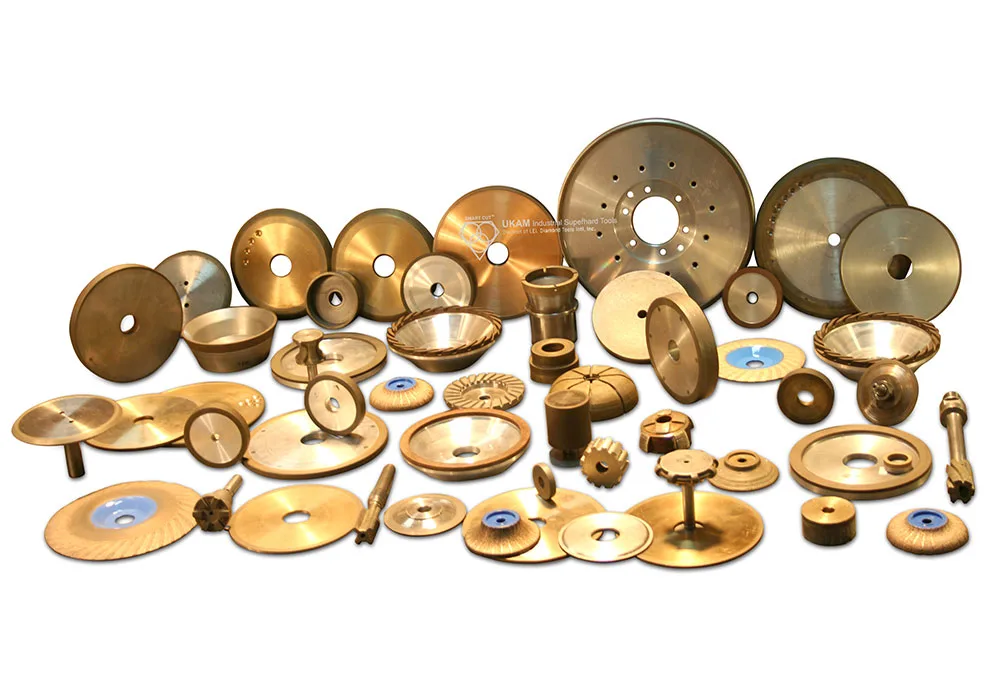
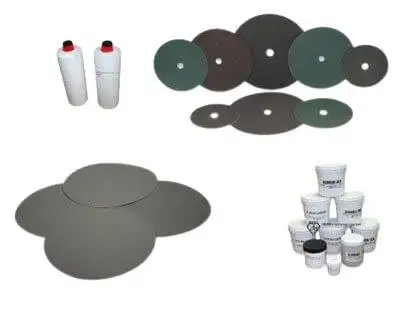
We manufacture diamond and CBN wheels across multiple geometries, abrasive sizes, concentrations, and bond technologies, for applications including hardened steels, tool steels, high speed steels, bearing components, hardened cast irons, and selected superalloys.
|
Configuration |
Engineering Consideration |
|---|---|
|
Resin bond CBN |
Free cutting action and surface finish |
|
Vitrified bond CBN |
Form retention with controlled, dressable cutting action |
|
Metal bond CBN |
Maximum abrasive retention and form holding |
|
Hybrid bond CBN |
Balanced wheel life and finish characteristics |
|
1A1 |
Straight wheel applications |
|
15A2 |
Precision tool and profile grinding |
|
15V9 |
Tool and cutter grinding on hardened and high speed steels |
|
1V1 |
Fluting, gashing, and edge profiling |
|
Custom geometry |
Application specific profiles |
|
Custom concentration |
Application specific abrasive density |
|
Custom grit |
Matched to removal rate and finish requirements |
Custom dimensions and precision tolerance options are available across these configurations. The correct specification should be selected from your actual application data rather than from a standard listing.
Do Not Treat CBN as a Drop-In Replacement
Replacing a conventional wheel with a CBN wheel does not mean keeping the same grit, wheel speed, feed, depth of cut, dressing interval, coolant setting, or wheel width. Every one of those is likely to change.
The new wheel should be qualified as a different abrasive system with its own process window. This matters most in high production grinding, where a small change in cycle time or dressing frequency compounds into a large financial difference across a year — and where a trial run at the old settings can wrongly disqualify a wheel that would have paid for itself in a quarter.
Qualification Checklist
Use this as the sign-off sheet for the trial. It compresses the process above into items that can be checked off in sequence.
1. Workpiece
- Exact material grade documented
- Measured hardness documented
- Heat treatment and surface condition documented
- Stock allowance documented
- Workpiece geometry and contact area documented
2. Conventional Baseline
- Current wheel specification recorded
- Wheel life measured in parts
- Dressing frequency measured
- Cycle time measured
- Surface finish and dimensional accuracy measured
- Scrap rate recorded
- Cost per acceptable part calculated
3. CBN Wheel Specification
- Grit selected from removal and finish requirements
- Concentration documented
- Bond selected against operation and dressing capability
- Geometry, diameter, width, and bore confirmed
- Maximum operating speed verified against machine rating
4. Machine Readiness
- Spindle speed range confirmed adequate
- Spindle power confirmed adequate
- Runout checked
- Mounting and flange condition verified
- Workholding verified
- Dressing system verified
- Coolant type, concentration, and nozzle alignment verified
5. Trial Execution
- Wheel speed, feed, and depth documented for the CBN process window
- Dressing parameters documented
- Trial length defined to cover several dressing intervals
- Only one variable changed at a time
6. Results
- Surface finish and dimensional accuracy measured throughout
- Grinding burn evaluated, including etch inspection where relevant
- Wheel wear and G-ratio measured
- Grinding force trend recorded
- Dressing frequency and cycle time recorded
- Scrap recorded
- Cost per acceptable part calculated and compared to baseline
Frequently Asked Questions
CBN is generally the stronger candidate for demanding hardened steel grinding, because it holds its cutting edge and conducts heat away from the part. Aluminum oxide remains suitable where production requirements are moderate and the existing process is stable. The correct choice depends on hardness, finish requirement, cycle time, wheel life, and total process cost.
No. CBN is suited to ferrous grinding. Diamond is the correct superabrasive for hard non-ferrous materials, carbides, ceramics, and glass, and conventional abrasives remain appropriate for a great deal of general purpose work. Abrasive selection starts with the workpiece material.
There is no universal number, and any supplier offering one without seeing your application is guessing. Wheel life depends on grit, concentration, bond, material, hardness, wheel speed, feed, dressing, coolant, and machine condition. Compare measured parts per wheel from a qualification trial rather than a general percentage improvement.
Usually not. CBN can often use a substantially finer grit while maintaining the same material removal rate — a 46 grit aluminum oxide wheel is commonly replaced by 100 grit CBN under appropriate conditions. Select the final grit from stock removal and surface finish requirements.
No. CBN reduces heat entering the workpiece through its higher thermal conductivity and sharper sustained cutting action, but burn can still occur. Wheel condition, coolant delivery, wheel speed, feed, depth of cut, dressing interval, and contact area all contribute to thermal load. If burn occurs, investigate the complete process.
Not necessarily, but wheel speed is the common constraint. CBN generally performs best at higher surface speeds than conventional abrasive, and a machine limited to conventional speed will not show what the wheel can do. Spindle power, runout, and rigidity also matter. Tell your supplier the machine limitations before the wheel is specified — bond and concentration can be adjusted around them.
The purchase price is higher. That does not determine the total production cost, which frequently favors CBN once wheel life, dressing frequency, cycle time, and scrap are included. Calculate cost per acceptable part before making the decision.
Bond depends on the grinding operation and the wheel behavior you need. Resin cuts freely and finishes well; vitrified holds form while remaining dressable and is the common choice for high production precision work; metal maximizes retention and form holding; electroplated nickel gives maximum exposure and complex forms without dressing. Wheel speed, finish requirement, and your available dressing capability all narrow the choice.
Yes. We manufacture CBN wheels in multiple shapes, grit sizes, concentrations, and bond technologies, including custom dimensions and configurations for specific applications. Send your application data and we will specify against it.
So When Should You Make the Switch?
The decision to move from conventional abrasive to CBN should rest on measurable production evidence. A switch deserves serious consideration when the existing wheel is producing:
- Grinding burn or metallurgical damage
- Short wheel life relative to production requirements
- Dressing frequency that interrupts throughput
- Grinding force that rises through the wheel life
- Cycle time that constrains the schedule
- Dimensional drift or profile loss
- High scrap or rework
- Surface finish outside specification
- High total cost per acceptable part
The case is strongest when the material is hardened ferrous, the tolerances are tight, and production volume is high enough that cycle time and scrap carry real money. A conventional wheel should stay in service when it already meets the required quality, productivity, wheel life, and economic targets.
The objective is not to replace conventional abrasives everywhere. It is to identify the operations where CBN produces a measurable production advantage, and to prove it with your own baseline data.
Request a CBN Grinding Wheel Evaluation
To start, send us three things:
your workpiece material and hardness, your current wheel specification,
and a description of the production problem you are trying to solve.
That is enough for our engineers to tell you whether CBN is worth evaluating for your application.
If we agree it is worth pursuing, we will ask for the full application data set below so we can specify the wheel properly rather than substituting a catalog item:
|
Category |
Information Needed |
|---|---|
|
Material |
Grade, measured hardness, heat treatment, stock allowance |
|
Operation |
OD, ID, surface, profile, or tool grinding; part geometry and contact area |
|
Current wheel |
Abrasive, grit, grade, dimensions, and supplier specification |
|
Machine |
Model, spindle speed range, power, dressing capability |
|
Process |
Wheel speed, feed, depth of cut, dressing method and frequency |
|
Coolant |
Type, concentration, delivery method and pressure |
|
Current results |
Cycle time, wheel life, surface finish, tolerance, scrap rate |
|
Production context |
Annual volume and the current failure mechanism |
This lets a tooling engineer evaluate abrasive, grit, concentration, bond, geometry, and process requirements together rather than in isolation. The objective is not simply to replace an aluminum oxide or silicon carbide wheel. It is to determine whether CBN produces a measurable improvement in wheel life, grinding stability, productivity, part quality, or total cost per acceptable part.
Illustrative data note: All numerical cost figures in this article are illustrative examples used to demonstrate the evaluation method. They are not UKAM production data or guaranteed performance values. Surface speed and G-ratio ranges are typical published industry values for planning purposes; the governing limits are always the wheel’s marked maximum operating speed and your machine rating. Actual wheel life, dressing frequency, cycle time, scrap rate, and cost per acceptable part should be established through application specific production trials.
Trusted by Tens of Thousands of Manufacturers, Laboratories,
Research Institutions Worldwide Since 1990
American Based Manufacturer
Established in 1990
