




















Custom Diamond and CBN Tools: How to Specify the Right Tool for Your Application

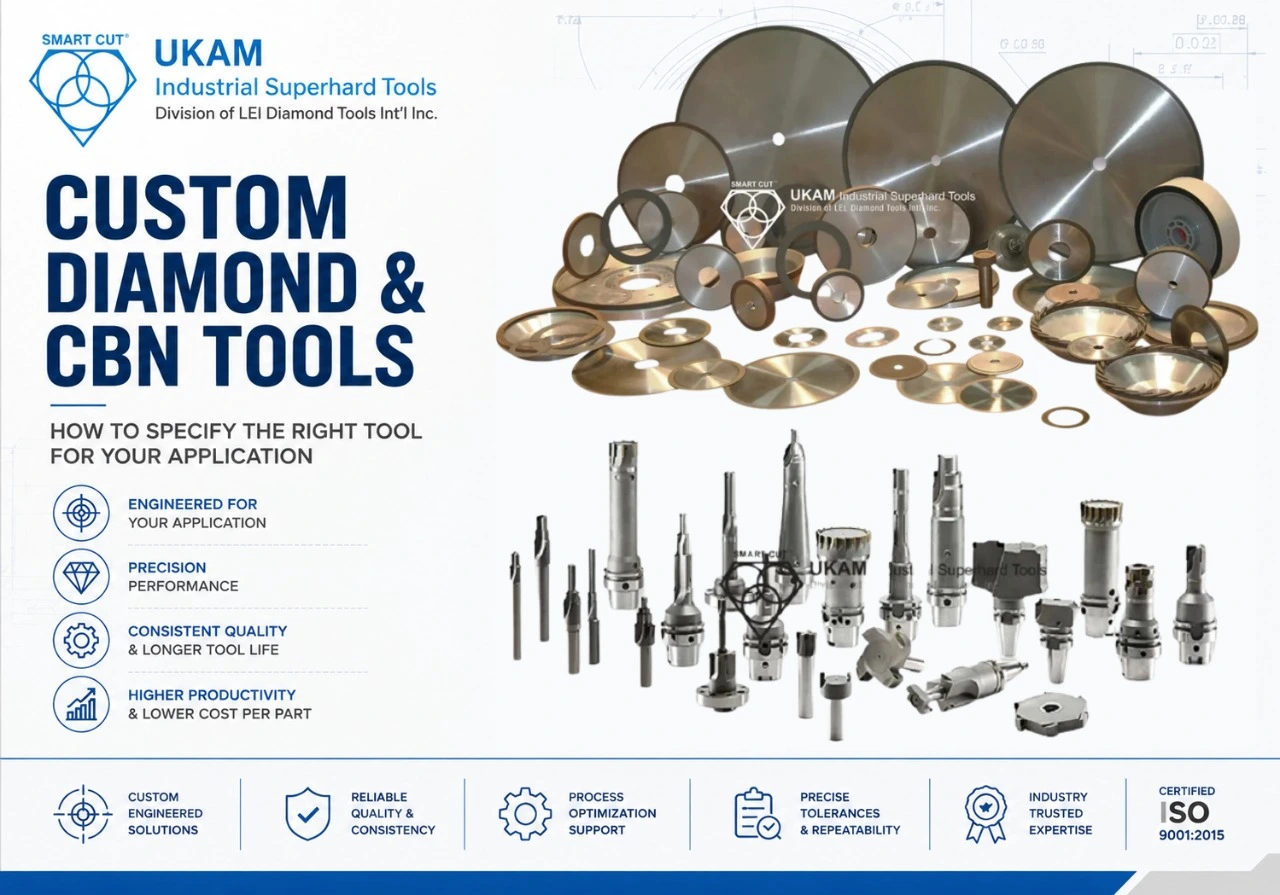
Table of Contents
Toggle
American Based Manufacturer

Established in 1990


Custom manufacturing


A standard diamond or CBN tool can be the right abrasive and still be the wrong tool for the application.
The problem may be the tool geometry, abrasive size, concentration, bond, working-layer thickness, mounting arrangement, tolerance, or the way the tool interacts with the machine and workpiece.
This becomes especially important when an application involves tight tolerances, unusual materials, complex profiles, miniature features, difficult access, high production volumes, or a tool geometry that is not available as a standard product.
So the engineering question is not simply:
Should the application use diamond or CBN?
The more useful question is:
What complete tool specification will produce the required part quality, dimensional accuracy, surface finish, tool life, and production rate on the actual machine?
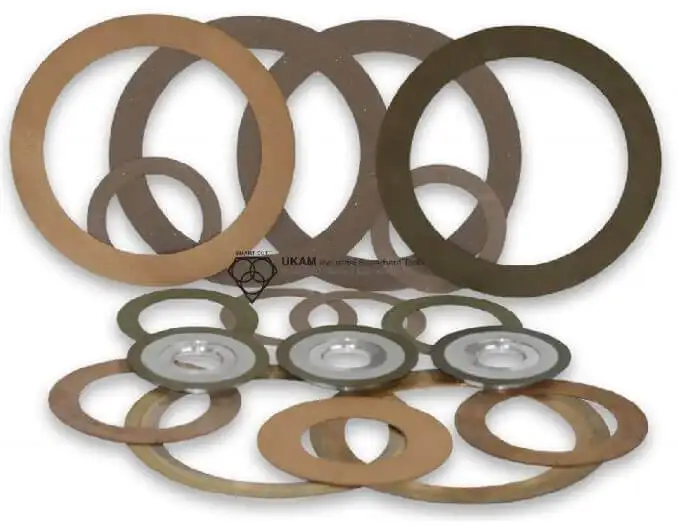
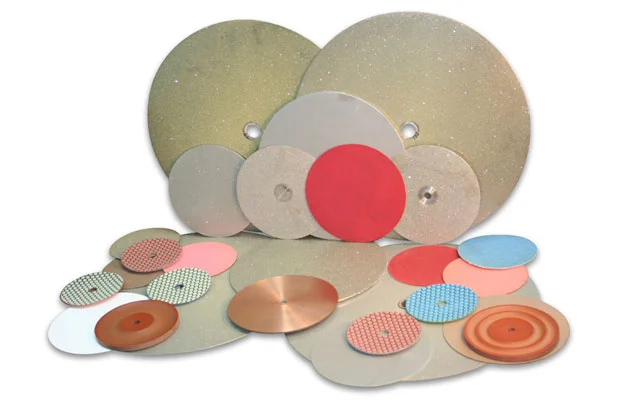
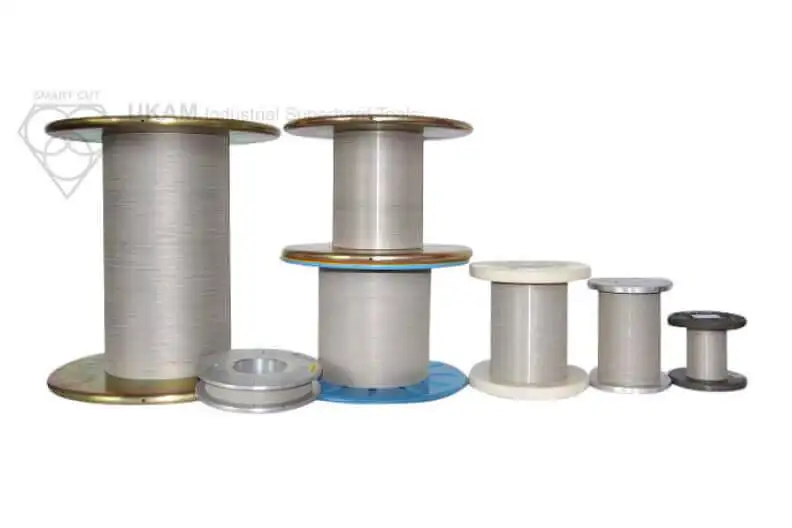
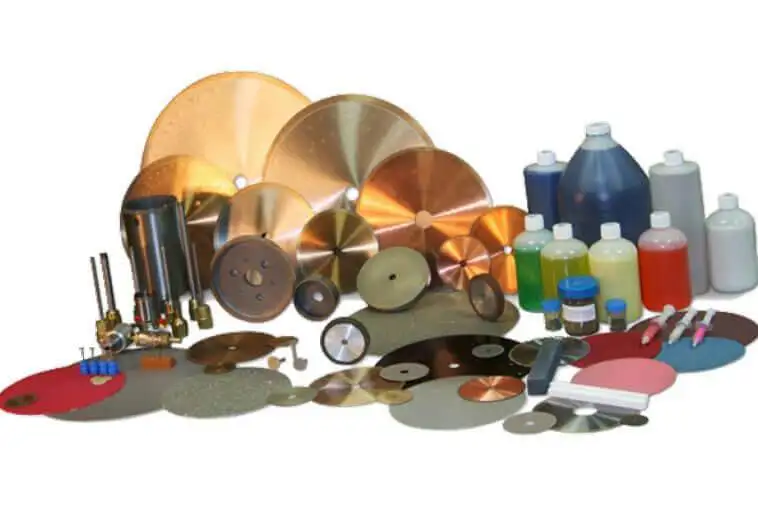
UKAM Industrial Superhard Tools manufactures custom diamond and CBN tools to customer drawings and specifications. Its custom manufacturing program considers application requirements including equipment, tolerances, surface finish, tool life, bond formulation, concentration, and grit size.
A custom tool should therefore not be viewed simply as a more expensive version of a standard tool.
It should be viewed as an engineered solution to a defined manufacturing requirement.
When Should You Consider a Custom Diamond or CBN Tool?
Custom tooling becomes relevant when a standard tool cannot meet the application’s requirements without compromise.
Typical situations include:
- The required diameter is unavailable as a standard product.
- The required arbor or mounting arrangement is unusual.
- The tool must fit within a restricted machine envelope.
- A standard wheel cannot maintain the required profile.
- A standard drill cannot produce the required hole geometry.
- The application requires a special edge configuration.
- A specific grit size or concentration is needed.
- The required tolerance is outside a standard specification.
- Tool life is too short with the existing tool.
- Surface finish is inconsistent.
- A standard tool requires excessive dressing.
- The process generates excessive scrap.
- The tool must combine several geometric features.
- The material is difficult to process.
- The tool needs to be designed around a particular machine or fixture.
|
Production Requirement |
Potential Customization |
|---|---|
|
Standard diameter unavailable |
Custom diameter |
|
Unusual arbor |
Application-specific mounting |
|
Complex profile |
Custom geometry |
|
Tight tolerance |
Controlled tool dimensions |
|
Short tool life |
Grit, concentration, bond, or geometry optimization |
|
Poor surface finish |
Abrasive and bond selection |
|
Excessive heat |
Tool construction and process optimization |
|
Difficult material |
Abrasive and bond selection |
|
Limited machine clearance |
Custom thickness or shank |
|
High production volume |
Tool-life and cycle optimization |
|
Specialized hole |
Custom drill geometry |
|
Complex cutting requirement |
Custom blade configuration |
Engineering Insight
The strongest reason to consider custom tooling is not simply that a standard tool is inconvenient.
It is that the standard specification is limiting the manufacturing process.
If a standard tool produces acceptable parts but creates excessive dressing, long cycle times, poor dimensional stability, or unnecessary scrap at production volume, custom tooling may be worth evaluating.
Standard Tool vs. Custom Tool
Standard tools are often the right choice when the application fits an established geometry and specification.
Custom tooling becomes more attractive when the process has requirements outside that standard configuration.
The decision should be based on measurable production requirements, not simply preference.
|
Selection Factor |
Standard Tool |
Custom Tool |
|---|---|---|
|
Geometry |
Existing configuration |
Designed for application |
|
Dimensions |
Standard range |
Customer specified |
|
Arbor |
Standard options |
Application specific |
|
Abrasive |
Standard options |
Selected for application |
|
Grit |
Standard range |
Application specific |
|
Concentration |
Standard range |
Application specific |
|
Bond |
Existing formulation |
Selected for application |
|
Tolerance |
Standard specification |
Application specific |
|
Production volume |
Established process |
Optimization opportunity |
|
Initial engineering |
Lower |
Higher |
|
Optimization potential |
Limited by standard design |
Greater |
The custom option becomes worthwhile when the expected production benefit justifies the additional engineering effort.
Start With the Application, Not the Tool
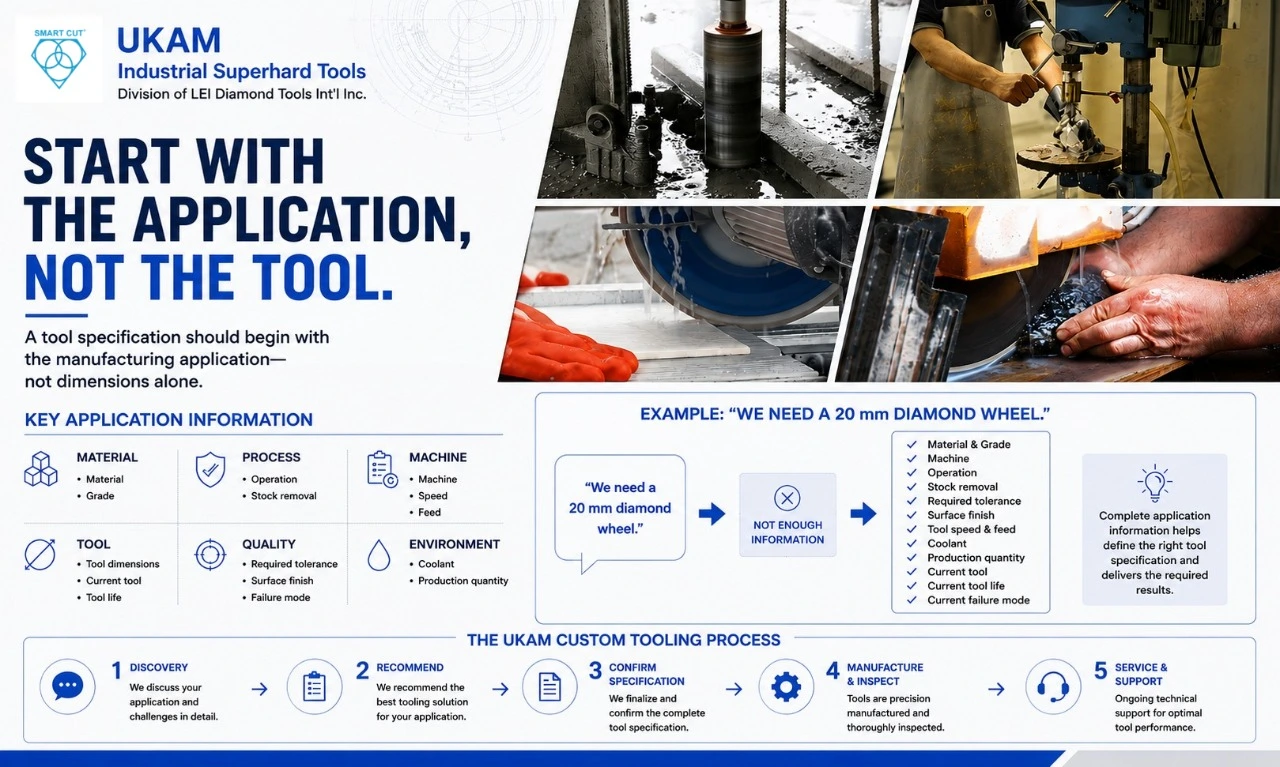
One of the most common tooling mistakes is to provide only the requested dimensions.
For example:
“We need a 20 mm diamond wheel.”
That information alone does not define the application.
A useful tooling specification should also identify:
- Material
- Material grade
- Hardness where applicable
- Machine
- Operation
- Stock removal
- Required tolerance
- Surface finish
- Tool dimensions
- Tool speed
- Feed
- Coolant
- Production quantity
- Current tool
- Current tool life
- Current failure mode
UKAM’s custom-manufacturing process begins by discussing the customer’s specific requirements in detail before recommending a solution.
Application Information Checklist
|
Parameter |
Information to Provide |
|---|---|
|
Workpiece material |
Exact material or grade |
|
Hardness |
Actual value where applicable |
|
Operation |
Cutting, grinding, drilling, profiling, etc. |
|
Machine |
Machine type/model |
|
Tool type |
Wheel, blade, drill, router, point, disc, etc. |
|
Tool diameter |
Required outside diameter |
|
Arbor |
Bore, shank, or mounting |
|
Thickness |
Required tool thickness |
|
Profile |
Drawing or dimensional description |
|
Abrasive |
Diamond or CBN |
|
Grit |
Existing or required range |
|
Concentration |
Existing or target |
|
Bond |
Existing or required |
|
Speed |
Actual operating speed |
|
Feed |
Actual operating feed |
|
Coolant |
Type and delivery method |
|
Tolerance |
Required dimensional tolerance |
|
Finish |
Required surface finish |
|
Production |
Required production volume |
|
Failure mode |
Current measurable problem |
The more complete this information is, the more effectively a tool can be designed around the actual process.
Diamond or CBN: Start With the Workpiece Material
Custom geometry does not eliminate the need for correct abrasive selection.
The abrasive must be compatible with the material and operation.
Diamond is widely used for hard and abrasive nonferrous materials, ceramics, glass, carbide, composites, semiconductor materials, and other difficult-to-machine materials.
CBN is commonly selected for demanding applications involving hardened ferrous materials.
UKAM offers both diamond and CBN tooling across multiple technologies and application areas.
|
Material/Application |
Abrasive Direction |
Key Process Concern |
|---|---|---|
|
Silicon carbide |
Diamond |
Chipping and subsurface damage |
|
Alumina |
Diamond |
Edge breakout |
|
Silicon nitride |
Diamond |
Surface/subsurface cracking |
|
Sapphire |
Diamond |
Edge chipping |
|
Fused silica |
Diamond |
Radial cracking |
|
Tungsten carbide |
Diamond |
Microcracking and thermal damage |
|
PCD |
Diamond |
Layer damage |
|
Hardened alloy steel |
CBN |
Grinding burn |
|
Tool steel |
CBN |
Thermal damage |
|
High-speed steel |
CBN |
Grinding burn |
|
Bearing steel |
CBN |
Surface integrity |
|
Selected cast irons |
CBN |
Loading and dimensional stability |
The final abrasive choice should still be qualified against the actual material and process.
Tool Geometry Can Be the Main Reason for Customization
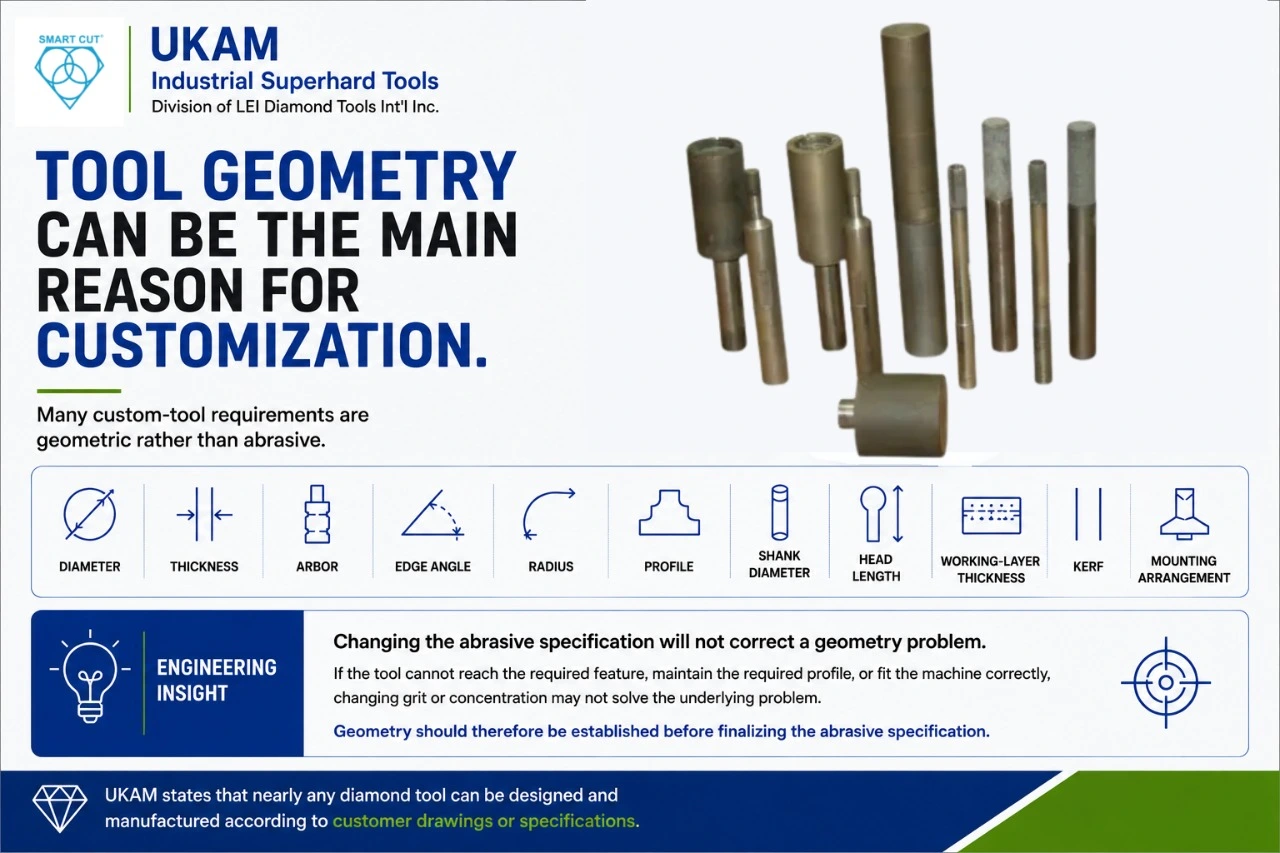
Many custom-tool requirements are geometric rather than abrasive.
A standard tool may have the correct abrasive but the wrong:
- Diameter
- Thickness
- Arbor
- Edge angle
- Radius
- Profile
- Shank diameter
- Head length
- Working-layer thickness
- Kerf
- Mounting arrangement
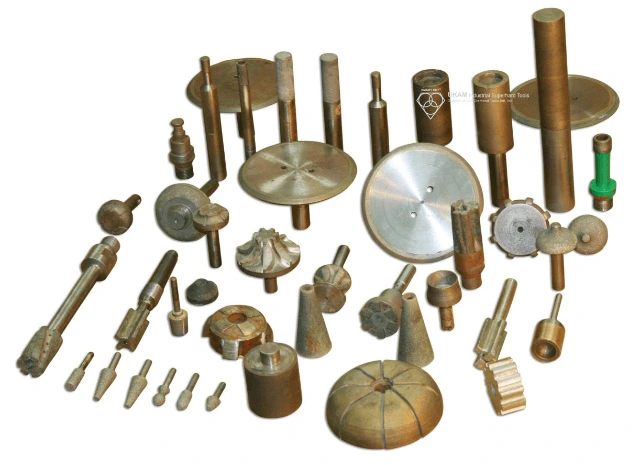
UKAM states that nearly any diamond tool can be designed and manufactured according to customer drawings or specifications. Its custom-manufacturing capabilities cover a broad range of tool configurations.
Engineering Insight
Changing the abrasive specification will not correct a geometry problem.
If the tool cannot reach the required feature, maintain the required profile, or fit the machine correctly, changing grit or concentration may not solve the underlying problem.
Geometry should therefore be established before finalizing the abrasive specification.
Grit size affects cutting action, surface finish, material removal, and contact conditions.
In general:
- DiameterCoarser grit can support more aggressive material removal.
- Finer grit can support finer finishing operations.
But grit should never be selected in isolation.
The selection depends on:
- Material
- Stock removal
- Surface finish
- Tool diameter
- Machine power
- Tool speed
- Coolant
- Required tool life
UKAM states that its engineers work with customers to develop the appropriate grit size for the application.
|
Application Requirement |
Grit Direction |
Main Consideration |
|---|---|---|
|
Heavy stock removal |
Coarser |
Surface finish |
|
General processing |
Medium |
Balance |
|
Fine finishing |
Finer |
Removal rate |
|
Precision profiling |
Application-specific |
Profile stability |
|
Micro tooling |
Fine |
Tool strength and control |
|
Optical applications |
Fine/application-specific |
Surface integrity |
Engineering Question
Is finer grit automatically better because it can produce a finer surface?
Not necessarily.
If the abrasive is too fine for the required stock removal, cutting efficiency can fall and cycle time can increase.
The objective is to balance:
Material removal + surface quality + tool life + production rate.
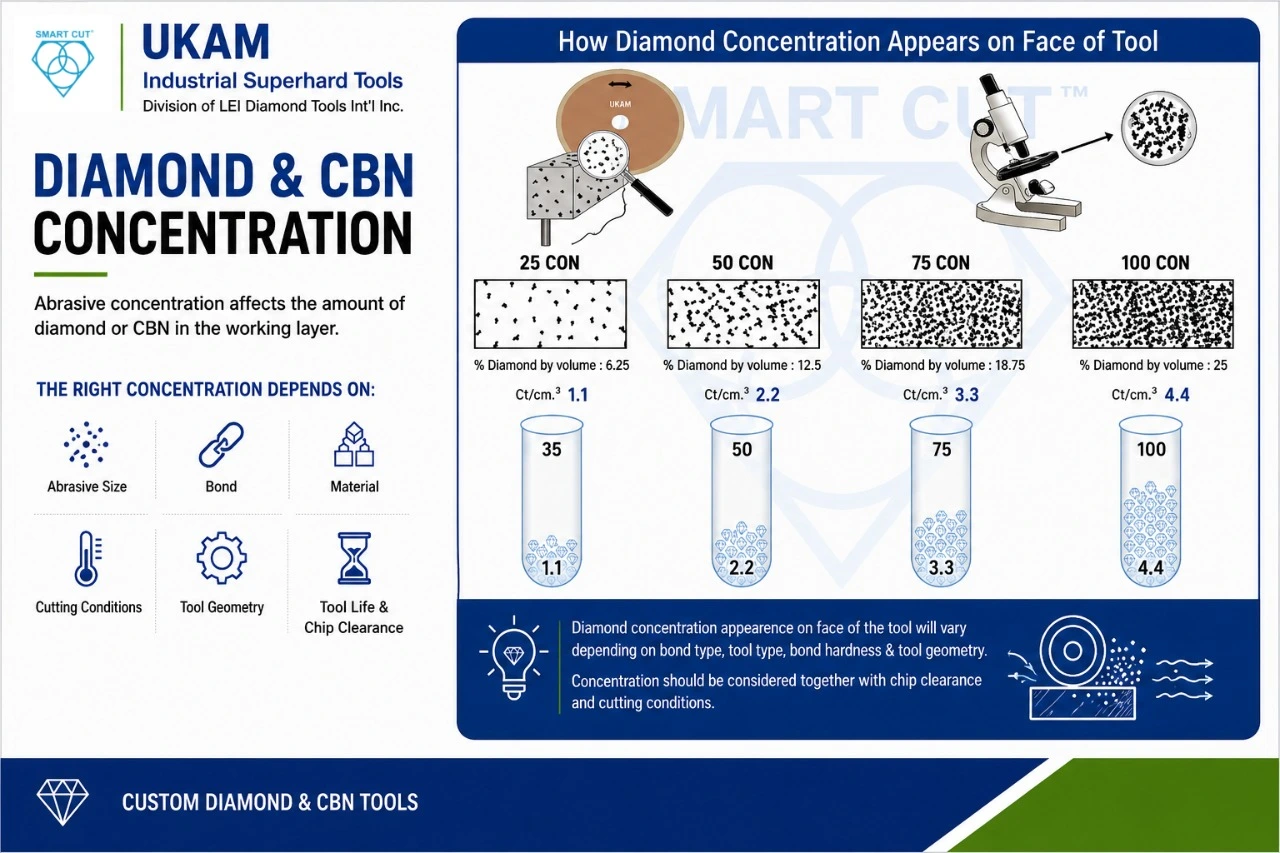
Abrasive concentration affects the amount of diamond or CBN present in the working layer.
Higher concentration does not automatically mean better performance.
The appropriate concentration depends on:
- Abrasive size
- Bond
- Material
- Cutting conditions
- Tool geometry
- Desired tool life
- Chip clearance
UKAM specifically identifies concentration as one of the variables it considers when developing custom tool specifications.
Engineering Insight
Concentration should be considered together with chip clearance and cutting conditions.
Increasing abrasive density without considering the complete process can create an imbalance between abrasive exposure, material removal, cooling, and wear.
The bond controls how the abrasive is held and released during operation.
UKAM currently offers multiple diamond and CBN technologies, including:
|
Bond/Construction |
Engineering Consideration |
|---|---|
|
Resin |
Cutting behavior and finishing |
|
Sintered metal |
Abrasive retention and form |
|
Hybrid |
Balance of tool properties |
|
Nickel/plated |
Abrasive exposure and retention |
|
Brazed |
High abrasive exposure |
|
Vitrified |
Grinding behavior and dressing |
|
CVD |
Specialized cutting applications |
|
PCD |
Specialized cutting applications |
The correct bond is determined by the application—not simply by choosing the hardest or strongest available bond.
Tool Thickness and Working Layer
Thickness affects:
- Tool stiffness
- Clearance
- Kerf
- Material removal
- Machine access
- Durability
For cutting tools, a thinner tool can reduce material loss, but adequate stiffness must be maintained.
For grinding tools, working-layer thickness can influence usable tool life and form retention.
For drilling tools, wall thickness affects rigidity, cutting behavior, and material evacuation.
UKAM’s custom manufacturing program supports application-specific tool dimensions and configurations.
Engineering Insight
The thinnest possible tool is not automatically the best tool.
A thinner blade may reduce kerf, but if the machine or workholding allows excessive deflection, the final production result may be worse.
The correct thickness is the one that provides the required balance of:
Stiffness + life + geometry + process stability.
Mounting and Arbor Requirements
A precise custom tool can still perform poorly if its mounting arrangement is incorrect.
A custom tool specification should identify:
- Arbor diameter
- Bore tolerance
- Shank diameter
- Thread
- Flange requirements
- Mounting direction
- Tool orientation
- Machine interface
- Clearance requirements
UKAM’s custom manufacturing capabilities include application-specific mounting and dimensional configurations.
Failure Mode: Runout-Induced Error
A tool can be manufactured accurately and still produce poor results if the machine interface introduces excessive runout.
Therefore:
Evaluate the tool in its actual machine setup—not only as a standalone component.
Tolerance Should Be Specified by Function
A common mistake is requesting the tightest possible tolerance without defining why it is necessary.
Tighter tolerances can increase manufacturing requirements without necessarily improving the finished component.
Instead, connect each tolerance to its functional purpose.
For example:
- Bore tolerance controls mounting.
- Outside diameter controls tool geometry.
- Rim thickness controls kerf.
- Profile tolerance controls part geometry.
- Shank tolerance influences runout
- Head diameter controls feature access.
Better Engineering Question
Instead of:
“What is the tightest tolerance you can manufacture?”
ask:
“Which dimensions actually control the finished part?”
That creates a more useful and cost-effective tool specification.
Custom Tooling for Difficult Materials
Different materials create different failure modes.
The custom tool should therefore be developed around the specific material and production problem.
Silicon carbide is hard and brittle.
Potential concerns include:
- Edge chipping
- Subsurface fracture
Tool selection should consider abrasive exposure, grit, cutting speed, coolant, and workpiece support.
Alumina
Alumina ceramics can be sensitive to edge damage.
A common concern is:
Edge breakout.
Tool geometry, grit, and process parameters should be evaluated together.
Silicon Nitride
Silicon nitride can require careful control of surface and subsurface damage.
Potential concern:
Subsurface cracking.
Where structural integrity matters, qualification should go beyond simple dimensional measurement.
Tungsten carbide is commonly processed with diamond tooling.
Potential concerns include:
- Microcracking
- Thermal damage
Grit, concentration, bond, coolant, and tool geometry should be evaluated together.
Sapphire
Sapphire is hard and brittle.
Potential concern:
Edge chipping.
Thin tool geometry can reduce material loss but may also increase deflection sensitivity. Tool design should therefore consider the machine and workholding system.
Fused Silica
Fused silica can be sensitive to localized mechanical and thermal damage.
Potential concern:
Radial cracking.
Tool geometry, abrasive specification, cutting speed, feed, and coolant should be controlled during qualification.
Hardened Steel
CBN is commonly considered for demanding hardened-ferrous applications.
Potential concern:
Grinding burn.
The tool should be evaluated with the actual material hardness, machine, coolant, dressing method, and grinding parameters.
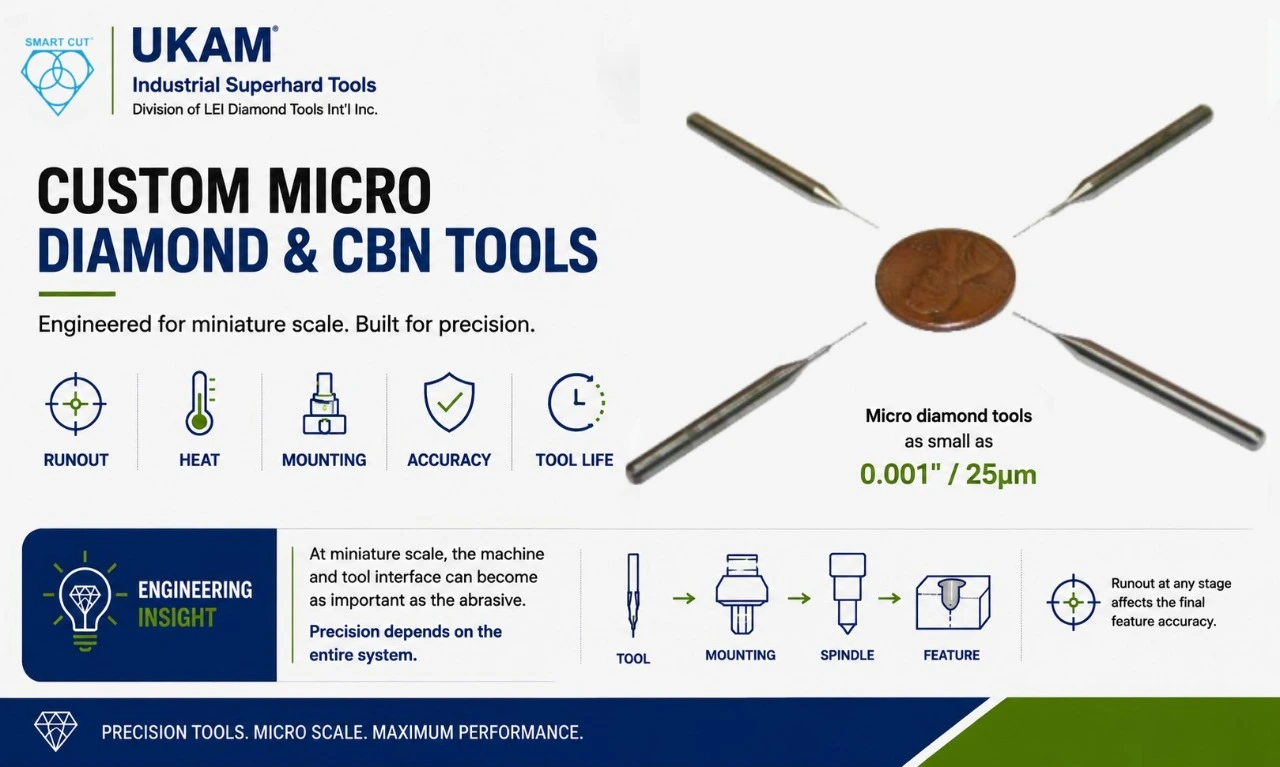
Miniature tooling introduces additional engineering constraints.
As tool diameter decreases:
- Tool stiffness decreases.
- Runout becomes more significant.
- Heat removal becomes more difficult.
- Mounting becomes more sensitive.
- Small dimensional errors become proportionally larger.
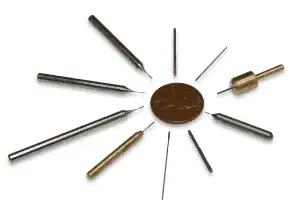
UKAM offers diamond micro drills and micro tools, including custom solutions for specialized applications. Its current product information lists micro diamond drills starting at approximately 0.001 inch / 25 microns for applicable products.
Micro-tool qualification should include:
- Tool runout
- Shank condition
- Machine spindle condition
- Feature diameter
- Feature roundness
- Feature location
- Edge condition
- Tool life
Engineering Insight
At miniature scale, the machine and tool interface can become as important as the abrasive.
A highly precise tool mounted with excessive runout will not produce a precise feature.
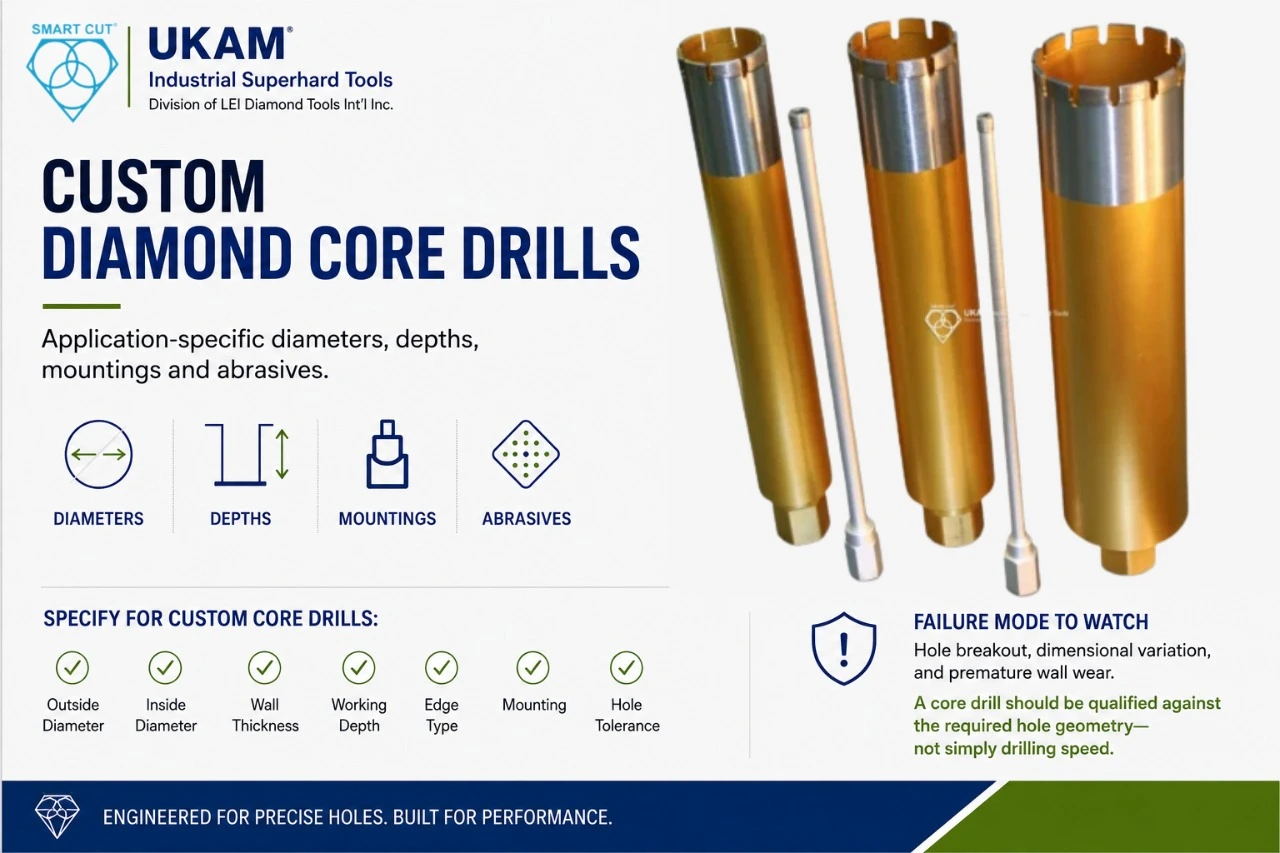
Core drilling applications may require custom:
- Outside diameter
- Inside diameter
- Wall thickness
- Working depth
- Edge type
- Mounting
- Abrasive specification
UKAM offers standard and custom diamond drills and diamond core drills in application-specific diameters, depths, bond types, diamond mesh sizes, mountings, and tolerances.
For a custom core drill, specify:
- Outside diameter
- Inside diameter
- Wall thickness
- Working depth
- Material
- Material thickness
- Machine
- RPM
- Feed
- Coolant
- Edge type
- Mounting
- Required hole tolerance
Failure Mode to Watch
Hole breakout, dimensional variation, and premature wall wear.
A core drill should be qualified against the required hole geometry—not simply drilling speed.
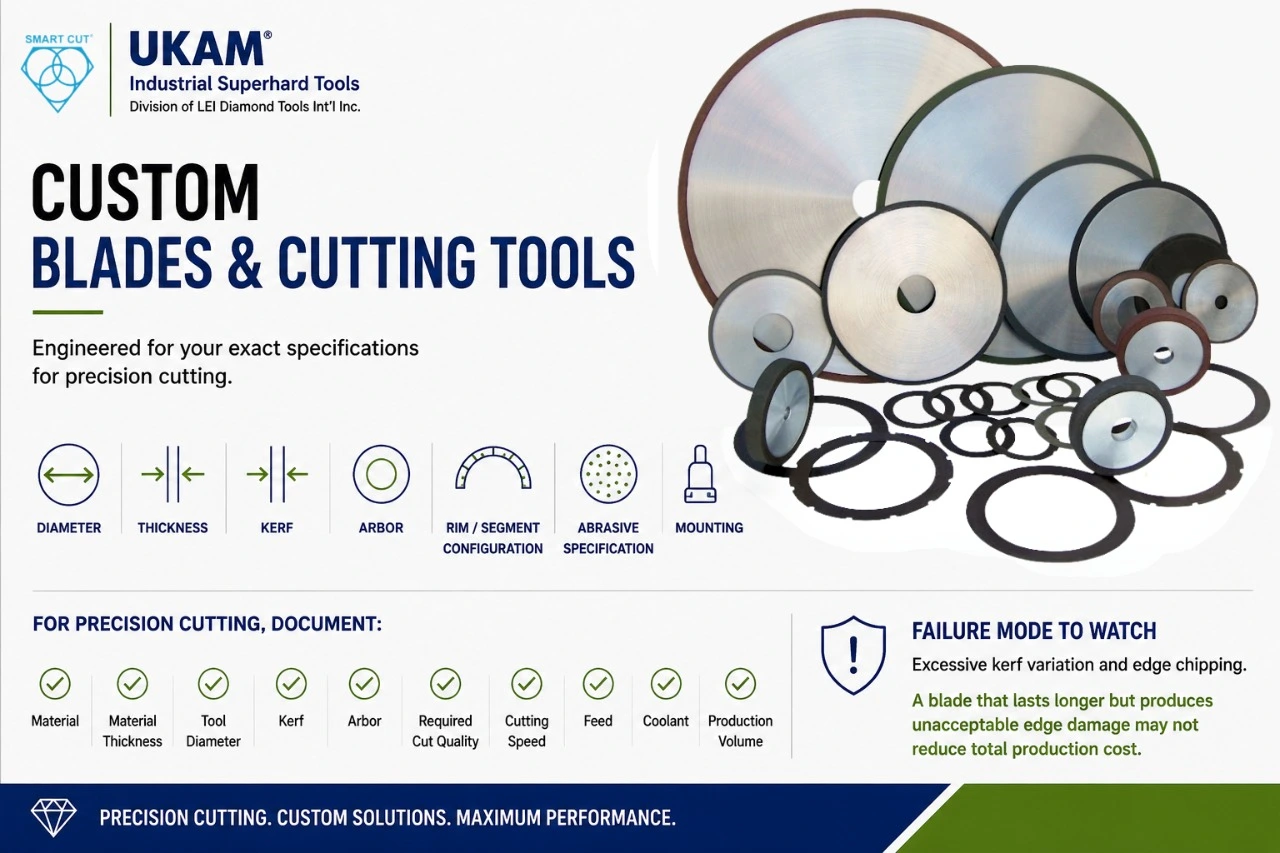
Diamond and CBN blades may require custom:
- Diameter
- Thickness
- Kerf
- Arbor
- Rim or segment configuration
- Abrasive specification
- Mounting
UKAM specializes in ultra-thin and high-precision diamond blades and also offers custom blade configurations. Its current product information includes custom blade diameters, thicknesses, arbor sizes, edge types, bond types, grit sizes, concentrations, and tolerances.
For precision cutting, document:
- Material
- Material thickness
- Tool diameter
- Kerf
- Arbor
- Required cut quality
- Cutting speed
- Feed
- Coolant
- Production volume
Failure Mode to Watch
Excessive kerf variation and edge chipping.
A blade that lasts longer but produces unacceptable edge damage may not reduce total production cost.
Custom grinding wheels can be designed around:
- Machine
- Workpiece geometry
- Abrasive
- Bond
- Profile
- Required finish
- Dressing method
- Production requirements
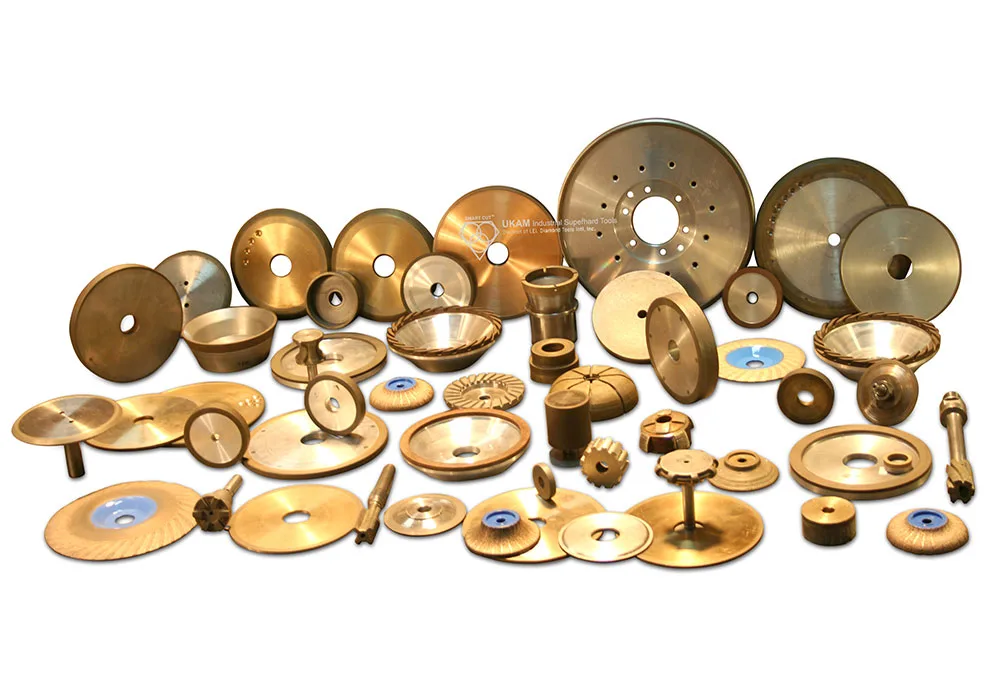
UKAM offers diamond and CBN wheels in multiple specifications and custom configurations for different grinding applications.
A wheel specification should include:
- Wheel form
- Diameter
- Thickness
- Bore
- Abrasive
- Grit
- Concentration
- Bond
- Profile
- Machine
- Dressing method
- Operating speed
Failure Mode to Watch
Profile loss and dimensional drift.
A custom wheel should be evaluated over enough production cycles to determine whether its profile remains stable.
When Custom Tooling Does Not Make Sense
Custom tooling is not automatically the correct choice.
A standard product may be preferable when:
- The application is already stable.
- The standard tool meets tolerance.
- Tool life is acceptable.
- Cycle time meets the production target.
- Surface finish is within specification.
- Production volume does not justify customization.
- A custom tool would not provide a measurable benefit.
Engineering Decision Rule
Customize when the expected production improvement can be measured.
Potential improvements include:
- Longer tool life
- Lower cycle time
- Better surface finish
- Better dimensional stability
- Lower scrap
- Reduced dressing
- Less operator intervention
- Lower material loss
- Better machine access
- Lower cost per acceptable part
If none of these improve, custom tooling may add engineering cost without creating production value.
Common Mistakes When Ordering Custom Tools
Mistake 1 — Sending Only a Drawing
A drawing defines geometry but may not explain the application.
Better approach: Provide the drawing together with material, machine, process, and performance requirements.
Mistake 2 — Specifying Diamond Without Identifying the Material
Diamond is not a universal specification.
Better approach: Let the material and process guide abrasive selection.
Mistake 3 — Requesting Maximum Concentration
Higher concentration does not automatically mean better performance.
Better approach: Consider abrasive exposure, chip clearance, cutting conditions, and tool life together.
Mistake 4 — Requesting the Hardest Bond
A harder bond is not automatically the best bond.
Better approach: Consider abrasive retention, cutting action, wear, dressing, and tool life.
Mistake 5 — Ignoring Machine Speed
Tool speed affects cutting behavior and thermal conditions.
Better approach: Include actual machine operating conditions.
Mistake 6 — Ignoring Mounting
A precise tool with poor mounting can produce poor results.
Better approach: Include the complete machine interface and check runout.
Mistake 7 — Defining Tool Life Only in Hours
Hours alone do not define useful production life.
Better approach: Measure acceptable parts or completed operations.
Mistake 8 — Changing Too Many Variables During Qualification
If geometry, abrasive, bond, speed, feed, and coolant all change simultaneously, the trial becomes difficult to interpret.
Better approach: Establish a baseline and control the qualification process.
Mistake 9 — Comparing Purchase Price Only
A more expensive tool can deliver lower total production cost.
Better approach: Compare cost per acceptable part.
Mistake 10 — Failing to Document the Final Specification
A qualified custom tool should not become an undocumented one-off.
Better approach: Document the final tool specification and qualification conditions.
Engineering Insight: A Custom Tool Is Part of the Process
A custom tool is only one component of the manufacturing system.
A useful way to evaluate the process is:
Material → Machine → Tool Geometry → Abrasive → Bond → Process Parameters → Quality Requirement → Tool Life
If a major element changes, the qualified result can change.
For example:
- Changing workpiece hardness can alter cutting forces.
- Changing machine speed can alter thermal conditions.
- Changing coolant delivery can alter tool behavior.
- Changing mounting can alter runout.
- Changing feed can alter surface damage.
The final custom-tool specification should therefore be documented together with the conditions under which it was qualified.
Cost Per Acceptable Part
Custom tooling should be evaluated using production economics.
The following example is illustrative only and does not represent guaranteed UKAM performance.
Illustrative Standard vs. Custom Tool Comparison
|
Metric |
Standard Tool |
Custom Tool |
|---|---|---|
|
Initial tool cost |
$350 |
$650 |
|
Tool life |
500 parts |
1,100 parts |
|
Cycle time |
5.5 min |
4.6 min |
|
Scrap rate |
5% |
2% |
|
Acceptable parts from 1,000 processed |
950 |
980 |
|
Tool cost per processed part |
$0.70 |
$0.59 |
|
Tool cost per acceptable part |
$0.74 |
$0.66 |
The actual comparison should also include:
- Tool purchase price
- Tool life
- Cycle time
- Dressing
- Machine time
- Operator intervention
- Coolant
- Scrap
- Rework
- Setup
- Downtime
Engineering Insight
A custom tool should not be approved merely because it produces a better first part.
It should be approved because the complete production process performs better.
In many applications, the most useful commercial metric is:
Cost per acceptable part
rather than:
Tool purchase price.
Questions to Ask a Custom Tool Manufacturer
A custom-tool supplier should be evaluated as an engineering partner, not simply as a source of finished tooling.
|
Question |
What It Helps Determine |
|---|---|
|
Can you manufacture from our drawing? |
Manufacturing flexibility |
|
What application information do you need? |
Engineering depth |
|
How will abrasive selection be determined? |
Material/process knowledge |
|
How will grit be selected? |
Process understanding |
|
How will concentration be selected? |
Abrasive-system knowledge |
|
Which bond should be considered? |
Bond expertise |
|
Can mounting be customized? |
Machine compatibility |
|
Can tolerances be controlled? |
Manufacturing capability |
|
Can the tool be modified after a trial? |
Development flexibility |
|
How is the final specification documented? |
Repeatability |
|
Can inspection documentation be supplied? |
Quality control |
|
Is technical support available after delivery? |
Long-term support |
UKAM describes a custom manufacturing process that begins with application discovery, moves through solution recommendation and written specification confirmation, then proceeds through manufacturing, inspection, delivery, and post-delivery technical support.
UKAM Custom Diamond and CBN Tool Capabilities
UKAM states that it manufactures custom diamond and CBN tools according to customer drawings and specifications. Its current custom-manufacturing page lists multiple bond technologies and custom capabilities across tool dimensions, specifications, and configurations.
The current UKAM website identifies capabilities including:
- Sintered metal bond
- Resin bond
- Hybrid bond
- Nickel/electroplated bond
- Brazed bond
- Vitrified bond
- CVD
- PCD
UKAM states that it has the capability to manufacture 30,000+ different types of custom diamond and CBN tools and consumables to better fit a customer’s material, application, specifications, and requirements.
The important point is not the number of configurations available.
It is selecting the specification that addresses the actual application.
The Custom Tool Manufacturing Process
A controlled custom-tooling process helps reduce uncertainty.
UKAM describes five stages.
1. Discovery
The process begins by discussing the specific requirement and determining what solution is needed.
Provide:
- Material
- Machine
- Drawing
- Dimensions
- Tolerances
- Production requirements
- Current tool
- Current failure
- Desired improvement
UKAM states that detailed application information is important because it helps its team understand the customer’s unique requirements and provide a more accurate recommendation.
2. Recommend a Solution
UKAM provides recommended options based on the application requirements, together with quotation and lead-time information.
The recommendation may involve:
- Abrasive type
- Grit
- Concentration
- Bond
- Geometry
- Dimensions
- Mounting
- Production requirements
3. Confirm the Specification
Before production, the tool specification is confirmed in writing.
Review:
- Drawing
- Dimensions
- Tolerances
- Abrasive
- Grit
- Concentration
- Bond
- Geometry
- Mounting
- Quantity
UKAM states that written confirmation of the tool specification is provided before the order proceeds to production.
4. Manufacture and Inspect
The finished product goes through quality control and inspection for conformance to the agreed specification.
UKAM states that certificates of conformance and other documentation can be provided upon request.
5. Service and Support
After delivery, tool performance can be reviewed based on actual application feedback.
Record:
- Tool life
- Cycle time
- Surface finish
- Dimensional accuracy
- Scrap
- Failure mode
- Machine conditions
- Operator observations
UKAM states that it follows up to receive feedback on tool performance and can provide usage recommendations and technical support when needed.
How to Qualify a Custom Tool
A custom tool should be qualified using a controlled trial.
Recommended sequence
- Record the existing process.
- Define the current failure.
- Confirm the workpiece specification.
- Check machine condition.
- Approve the custom-tool drawing.
- Record the complete tool specification.
- Run an initial trial.
- Measure tool and part performance.
- Run sufficient production to establish tool life.
- Compare cost per acceptable part.
- Document the final process window.
- Approve the production specification.
Qualification Metrics
|
Metric |
What It Measures |
|---|---|
|
Tool life |
Production durability |
|
Cycle time |
Productivity |
|
Surface finish |
Part quality |
|
Dimensional accuracy |
Process control |
|
Scrap |
Production risk |
|
Tool wear |
Tool construction |
|
Setup time |
Operational burden |
|
Dressing |
Maintenance requirement |
|
Machine load |
Process demand |
|
Cost per acceptable part |
Commercial result |
Custom Tool Qualification Checklist
1. Application
- Material grade documented
- Hardness documented where applicable
- Machine identified
- Operation defined
- Production volume recorded
- Current failure identified
2. Geometry
- Tool drawing approved
- Outside diameter confirmed
- Inside diameter confirmed
- Thickness confirmed
- Profile confirmed
- Edge geometry confirmed
- Shank/mounting confirmed
3. Abrasive
- Diamond or CBN selected
- Grit documented
- Concentration documented
- Abrasive type documented
4. Bond
- Bond selected
- Bond characteristics documented
- Dressing requirements documented where applicable
5. Machine
- Mounting checked
- Runout checked
- Speed confirmed
- Feed confirmed
- Coolant confirmed
- Machine clearance confirmed
6. Quality
- Tool dimensions inspected
- Tool runout inspected
- Part tolerance measured
- Surface finish measured
- Failure mode monitored
- Scrap recorded
7. Economics
- Tool price recorded
- Tool life measured
- Cycle time measured
- Setup time recorded
- Scrap cost calculated
- Cost per acceptable part calculated
Consider custom tooling when a standard tool cannot meet the required geometry, tolerance, mounting, tool life, surface finish, or production rate.
It can also make sense when a standard tool technically works but creates excessive cycle time, scrap, dressing, or operator intervention.
The decision should be based on measurable production requirements.
Provide:
- Material and grade
- Material hardness where applicable
- Tool drawing with dimensions and tolerances
- Machine and operation
- Speed, feed, coolant, and stock-removal information
- Current tool specification
- Current tool performance
- Specific failure mode
- Production volume
- Required tool life
The more complete the application information, the more useful the initial engineering recommendation can be.
Neither abrasive is universally better.
Diamond is commonly selected for hard nonferrous materials, ceramics, glass, carbide, composites, and other abrasive materials.
CBN is commonly selected for hardened ferrous materials.
The workpiece and process should determine the abrasive selection.
Yes. UKAM states that nearly any diamond tool can be designed and manufactured according to customer drawings or specifications.
However, geometry alone does not determine abrasive, grit, concentration, or bond. Application information should also be supplied.
Grit selection depends on:
- Material
- Stock removal
- Surface finish
- Tool size
- Machine capability
- Coolant
- Cutting conditions
- Tool-life requirements
Grit should therefore be selected as part of the complete tool specification.
Compare the existing and proposed processes using:
- Tool price
- Tool life
- Cycle time
- Dressing and adjustment
- Scrap
- Rework
- Machine time
- Cost per acceptable part
A custom tool can justify a higher initial price if it reduces the total cost of production.
UKAM offers diamond micro drills and micro tools, including custom solutions for specialized applications. The appropriate tool and specification depend on the required geometry, material, machine, and process.
Yes. UKAM currently lists sintered metal, resin, hybrid, nickel/electroplated, brazed, vitrified, CVD, and PCD technologies among its diamond and CBN tooling capabilities.
Bond selection remains application dependent.
The correct superabrasive depends on the complete process, not the material name alone.
If you are evaluating a diamond or CBN tool, send us:
- Material and grade
- Machine and operation
- Tool drawing or dimensional requirement
- Speed, feed, and coolant
- Current tool and its performance
- Required tolerance and finish
- Production volume
- Desired improvement
This information allows an experienced custom manufacturer to recommend a complete specification rather than a single dimension or abrasive type.
Trusted by Tens of Thousands of Manufacturers, Laboratories,
Research Institutions Worldwide Since 1990
American Based Manufacturer
Established in 1990
